Brookston Beer Bulletin

Jay R. Brooks on Beer

  • Home
  • About
  • Editorial
  • Birthdays
  • Art & Beer

Socialize

  • Dribbble
  • Email
  • Facebook
  • Flickr
  • GitHub
  • Instagram
  • LinkedIn
  • Pinterest
  • RSS
  • Twitter
  • YouTube

Powered by Genesis

Beer In Ads #266: Seasons Greetings From Miss Rheingold 1958

December 16, 2010 By Jay Brooks

ad-billboard
Thursday’s holiday ad is for Miss Rheingold of 1958, Madelyn Darrow, who’s getting out of a horse-drawn carriage laden-down with some beautifully Christmas presents. Mine never look that good, though I’m usually too lazy to even include a bow. As far as I’m concerned, it’s the thought that counts, not the wrapping.

Rheingold-1958-3

Filed Under: Art & Beer, Beers Tagged With: Advertising, Christmas, History, Holidays

Birds Fly, Men Drink

December 16, 2010 By Jay Brooks

wright-bros-plane
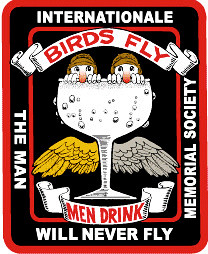
Tomorrow is the anniversary of the Wright Brothers plane flying at Kitty Hawk, North Carolina in 1903. Today, 56 years later, the Man Will Never Fly Memorial Society was founded, also at Kitty Hawk, North Carolina. The society appears to be completely tongue-in-cheek, as evidenced by their “history” and “mission.” Still, you have to long any organization whose motto is “Birds Fly, Men Drink.”

Our History

Our Society was born at Kitty Hawk on one of those dark and windy nights when nothing flew; even the seagulls bounced from place to place like hoppy toads. Our founders, who had been invited to attend a ceremony on December 17, honoring a pair of bicycle mechanics from Dayton Ohio, began drinking and thinking on the evening of December 16. They drank and they thought until the myth of the Wright Brothers’ flight in 1903 became as hard to swallow as the bootleg rye they imbibed.

Thus was born the society’s motto: “Birds Fly, Men Drink”. And thus its purpose: Exposure of the widely held myth of machines moving through the air with men “flying” them. This myth, it was clear, had its origins in folklore, long before the Wright Brothers. First came the nonsense of Cupid flying through the air. Then there was the fairy tale of Pegasus, a winged horse. Next came the fabled Arabian carpet. And the bit of flummery about a flying stork that dropped babies down chimneys. Small wonder that humankind, nourished on such nonsense, would believe that bicycle mechanics could move through the air like winged fowl.

Accepting the challenge these myths have perpetuated, The Man Will Never Fly Memorial Society has fought the hallucination of airplane flight with every weapon at its command save sobriety. We remain dedicated to the principle that two Wrights made a wrong at Kitty Hawk.

birds-fly

Our Mission

Members of the Man Will Never Fly Society are not opposed to flight. Birds do it, Bees do it, even educated fleas do it, as Cole Porter once said. But when you stop to think about it, do you actually believe that a machine made of tons of metal will fly? Small wonder that the editor of a Dayton newspaper said, when informed of the mythical first flight in 1903. “Man will never fly. And if he does, he will never come from Dayton.”

The Society’s members believe that balloons fly, but we do not believe in flying machines. Indeed, members of the Society have proposed a variety of apparati for movement through the ozone. One of our members is even cultivating an enormous jumping bean which, when saddled and heated by a laser, will propel a human for great distances.

But let us hear no more of plane moving through the air, unless they are hurled by carpenters. Airports and airplanes are for the gullible. Little do “plane” passengers realize that they are merely boarding Greyhound buses with wings, and that while aboard these winged buses, given the illusion of flight when cloud like scenery is moved past their windows by stagehands in a very expensive theatrical performance.

We ask you to gather under our banner and combat the myth that man can, did, or will ever fly, except in his or her imagination.

Filed Under: Just For Fun, Related Pleasures Tagged With: History, Humor, Science

Beer In Ads #265: It’s Always Winter In Your Refrigerator

December 15, 2010 By Jay Brooks

ad-billboard
Wednesday’s holiday ad is also for Ballantine, this one from 1953. It shows an invisible refrigerator outdoors during winter, with the idea that the reader will equate Ballantine beer with the “Flavor that chill can’t kill,” whatever that means.

Ballantine-1953

Filed Under: Art & Beer, Beers Tagged With: Advertising, Ballantine, Christmas, History, Holidays

Beer In Ads #264: Ballantine’s Early American Custom

December 14, 2010 By Jay Brooks

ad-billboard
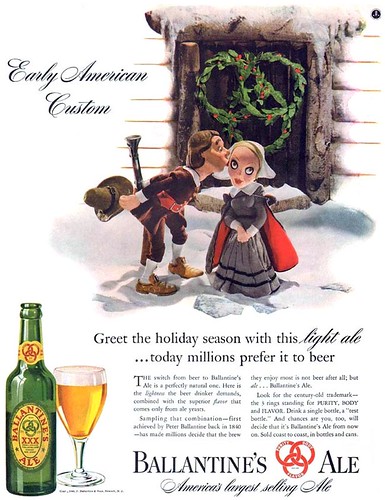
Tuesday’s holiday ad is for Ballantine, from 1940. Part of a series of dioramas Ballantine used in their ads at that time, the holiday one uses a triple wreath on the door with the pilgrim kissing his gal on the cheek.

Ballantine-xmas-1940

Filed Under: Art & Beer, Beers Tagged With: Advertising, Ballantine, Christmas, History, Holidays

Beer In Ads #263: Christmas Bud Break

December 13, 2010 By Jay Brooks

ad-billboard
Monday’s holiday ad is for Budweiser, from 1949. A couple takes a break from putting up the Christmas tree for a sandwich and a Budweiser. Frankly, it doesn’t look they’ve done enough work yet to warrant a break but perhaps it’s not so much a break as their way of drinking the whole time they put up their decorations.

bud-1949-xmas-break

Filed Under: Art & Beer, Beers Tagged With: Advertising, Budweiser, Christmas, History, Holidays

The United States of Abstinence

December 13, 2010 By Jay Brooks

no-yes
There was yet another interesting piece in his month’s Playboy, an essay toward the back by Jessica Warner, the author of a recent book, All or Nothing: A Short History of Abstinence in America. Her essay, The United States of Abstinence: How Saying No Became A Distinctly American Practice, is definitely worth seeking out, but here’s the salient bits.

She begins by outlining the history of the idea of abstinence itself.

In no place other than America has the idea of abstinence — whether from food, drink, drugs or sex — taken root so deeply. Your federal tax dollars are currently being used to tell kids to put off sex until they enter into a “biblical marriage relationship.” The 1980s gave us Nancy Reagan and her antidrug mantra “Just say no.” A century earlier, Anthony Comstock crusaded to outlaw smut, penny dreadfuls and contraceptives, while Frances Willard led America’s women in a fight against demon rum. There have been so many crusades it is easy to forget that at one time, in the 17th and 18th centuries, abstinence meant only one thing to Americans: no sex until marriage. The idea that people should abstain from all other vices first appeared in the 1830s. What began as a campaign against distilled spirits suddenly morphed into a campaign against all forms of alcohol and then against all other “stimulants” — tea and coffee, pickles and spices, meats and apple pie, fancy clothes and double entendres, narcotics and soft mattresses, and, last but not least, sex with oneself.

She then quickly outlines the early influences of religions, and how different Christian denominations reacted differently to temperance sentiments based on their own interpretations of scripture, and specifically a peculiar idea, or doctrine, known by different names, such as “Christian perfection, sanctification, the second blessing or holiness.” That notion was essentially the “touchstone for abstinence in America.”

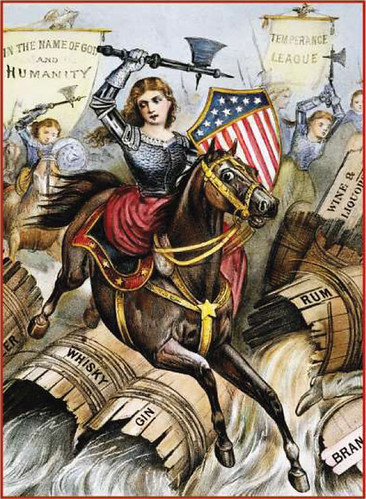
That idea leads adherents “to believe [people] can overcome sin in its entirety” and so “Christian perfection and abstinence are mutually reinforcing concepts of extreme behavior.” These manifest themselves into “a declaration of all-out war on sin.”

temperance-rider

Not every denomination feels as strongly, but the stronger that commitment, “the more likely it encourages abstinence.” And in places like Great Britain, for those same reasons the idea of abstinence never caught on in the same way. There, church leaders like John Wesley — of the Methodists — believed their “religion does not lie in doing what God has not enjoined or abstaining from what he hath not forbidden.”

Among modern evangelicals, the Pentecostals have the strongest commitment to Christian perfection and the highest rate of teetotalism, reaching 70 percent. In contrast, Baptist churches vary in their commitment to perfection, and their overall rate of teetotalism, under 55 percent, is correspondingly lower.

And the Baptists, who over the last few years have had their leaders come out very publicly against alcohol, are not all in agreement at any rate.

When the Southern Baptist Convention recently attempted to reaffirm its “total opposition to the manufacturing, advertising, distributing and consuming of alcoholic beverages,” its younger members objected, complaining that the resolution needlessly “draws a line in the sand.” For the modern evangelical, abstinence effectively means one thing only: saying no to sex outside marriage. There is a certain irony in all this, for in drawing the line at the sins of the sexual revolution, modern evangelicals have, quite despite themselves, returned to the status quo ante, that is, to the looser moral code of America before the great evangelical revivals of the 1800s. The interesting question is whether the list of taboos will continue to shrink and, if so, what will be the next thing to go.

To me, that’s a fascinating question as anti-alcohol groups appear to be gaining influence, especially politically, while younger generations seem generally less interested in their rhetoric. I’ll be very interested to read the entire book, All or Nothing: A Short History of Abstinence in America, which I ordered right after I finished the article.

Filed Under: Beers, Editorial, Politics & Law, Related Pleasures Tagged With: History, Law, Prohibitionists

Guinness Ad #46: Christmas Stocking

December 11, 2010 By Jay Brooks

guinness-toucan
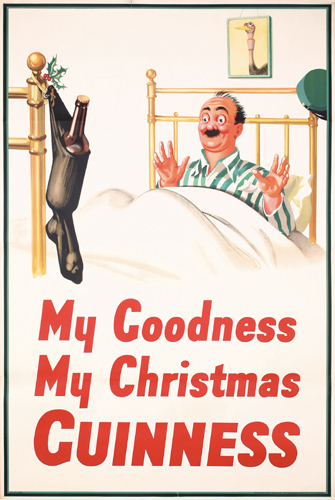
Our 46th Guinness poster by John Gilroy features our intrepid zookeeper waking up Christmas morning to find a bottle of Guinness in his stocking, hung on his bedpost. The slogan is again “My Goodness, My Christmas Guinness.” Hoppy Christmas.

guinness-xmas-stocking

Filed Under: Art & Beer, Beers Tagged With: Advertising, Christmas, Guinness, History, Holidays

Beer In Ads #261: Schlitz, Holidays Call For The Finer Things

December 9, 2010 By Jay Brooks

ad-billboard
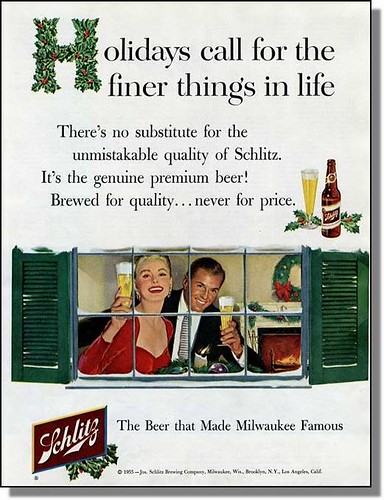
Thursday’s holiday ad is for Schlitz, from 1955. The slogan is “Holidays call for the finer things in life,” and since I’m in my way to a fancy party tonight, this ad made the most sense. Too true.

Schlitz-1955-xmas

Filed Under: Art & Beer, Beers Tagged With: Advertising, Christmas, History, Holidays, Schlitz

Nubian Antibiotic Beer

December 9, 2010 By Jay Brooks

nubians
For reasons passing understanding, apart from anti-alcohol propaganda, beer is forbidden from advertising its many recognized health benefits. For people against alcohol, saying beer is good for you, or at least isn’t bad for you (in moderation), is apparently the same as saying “drink up.” And for goodness sake, we’d never want to tell people to do something that might be good for their health, especially if a small minority can’t handle the truth … er, the beer.

But despite our peculiar inability to be reasonable regarding alcohol, beer and health have been inextricably linked since the beginning of civilization when drinking beer was safer than the water. But there may have been at least one more medicinal use of beer, at least in the variety brewed by ancient Nubians, “an ethnic group originally from northern Sudan, and southern Egypt now inhabiting East Africa and some parts of Northeast Africa.” And for a time, they even ruled over ancient Egypt, beginning in the 25th Dynasty.

Conventional wisdom has it that the use of antibiotics is a modern invention, thought to be no more than eighty years old, but archeologists have found in the bones of ancient Nubian skeletons traces of tetracycline, “a broad-spectrum polyketide antibiotic produced by the Streptomyces genus of Actinobacteria, indicated for use against many bacterial infections.” This suggests that the use of antibiotics may be 2,000 years older than previously thought.

From Discovery News’ coverage:

Some of the first people to use antibiotics, according to the research, may have lived along the shores of the Nile in Sudanese Nubia, which spans the border of modern Egypt and Sudan.

“Given the amount of tetracycline there, they had to know what they were doing,” said co-author George Armelagos, a biological anthropologist at Emory University in Atlanta. “They may not have known what tetracycline was, but they certainly knew something was making them feel better.”

Armelagos was part of a group of anthropologists that excavated the mummies in 1963. His original goal was to study osteoporosis in the Nubians, who lived between about 350 and 550 A.D. But while looking through a microscope at samples of the ancient bone under ultraviolet light, he saw what looked like tetracycline — an antibiotic that was not officially patented in modern times until 1950.

And Physorg.com adds this, from Emory anthropologist George Armelagos and medicinal chemist Mark Nelson of Paratek Pharmaceuticals:

“We tend to associate drugs that cure diseases with modern medicine,” Armelagos says. “But it’s becoming increasingly clear that this prehistoric population was using empirical evidence to develop therapeutic agents. I have no doubt that they knew what they were doing.”

Armelagos is a bioarcheologist and an expert on prehistoric diets. In 1980, he discovered what appeared to be traces of tetracycline in human bones from Nubia dated between A.D. 350 and 550. The ancient Nubian kingdom was located in present-day Sudan, south of ancient Egypt.

Armelagos and his fellow researchers later tied the source of the antibiotic to the Nubian beer. The grain used to make the fermented gruel contained the soil bacteria streptomyces, which produces tetracycline. A key question was whether only occasional batches of the ancient beer contained tetracycline, which would indicate accidental contamination with the bacteria.

Their results were published in the September issue of the American Journal of Physical Anthropology Here’s the abstract:

Histological evidence of tetracycline use has been reported in an ancient X-Group population (350–550 CE) from Sudanese Nubia (Bassett et al., 1980). When bone samples were examined by fluorescent microscopy under UV light at 490 Å yellow–green fluorophore deposition bands, similar to those produced by tetracycline, were observed, suggesting significant exposure of the population to the antibiotic. These reports were met skeptically with claims that the fluorescence was the result of postmortem taphonomic infiltration of bacteria and fungi. Herein, we report the acid extraction and mass spectroscopic characterization of the antibiotic tetracycline from these samples. The bone samples were demineralized in anhydrous hydrogen fluoride which dissolved the bone-complexed tetracycline, followed by isolation by solid phase extraction on reverse-phase media. Chemical characterization by high pressure liquid chromatography mass-spectroscopic procedures showed that the retention times and mass spectra of the bone extract were identical to tetracycline when treated similarly. These results indicate that a natural product tetracycline was detectable within the sampled bone and was converted to the acid-stable form, anhydrotetracycline, with a mass + H of 427.1 amu. Our findings show that the bone sampled is labeled by the antibiotic tetracycline, and that the NAX population ingested and were exposed to tetracycline-containing materials in their dietary regime.

As they discovered, the most likely source of their “dietary regime” that included the antibiotic was Nubian beer. Back in 2000, Armelagos figured out it was most likely the beer, and he published his findings in the magazine Natural History, in an articled entitled Take Two Beers and Call Me in 1,600 Years.

But back to Discovery News:

His team’s first report about the finding, bolstered by even more evidence and published in Science in 1980, was met with lots of skepticism. For the new study, he got help dissolving bone samples and extracting tetracycline from them, clearly showing that the antibiotic was deposited into and embedded within the bone, not a result of contamination from the environment.

The analyses also showed that ancient Nubians were consuming large doses of tetracycline — more than is commonly prescribed today as a daily dose for controlling infections from bad acne. The team, including chemist Mark Nelson of Paratek Pharmaceuticals, reported their results in the American Journal of Physical Anthropology.

They were also able to trace the antibiotic to its source: Grain that was contaminated with a type of mold-like bacteria called Streptomyces. Common in soil, Strep bacteria produce tetracycline antibiotics to kill off other, competing bacteria.

Grains that are stored underground can easily become moldy with Streptomyces contamination, though these bacteria would only produce small amounts of tetracycline on their own when left to sit or baked into bread. Only when people fermented the grain would tetracycline production explode. Nubians both ate the fermented grains as gruel and used it to make beer.

The scientists are working now to figure out exactly how much tetracycline Nubians were getting, but it appears that doses were high that consumption was consistent, and that drinking started early. Analyses of the bones showed that babies got some tetracycline through their mother’s milk.

Then, between ages two and six, there was a big spike in antibiotics deposited in the bone, Armelagos said, suggesting that fermented grains were used as a weaning food.

Today, most beer is pasteurized to kill Strep and other bacteria, so there should be no antibiotics in the ale you order at a bar, said Dennis Vangerven, an anthropologist at the University of Colorado, Boulder.

But Armelagos has challenged his students to home-brew beer like the Nubians did, including the addition of Strep bacteria. The resulting brew contains tetracycline, tastes sour but drinkable, and gives off a greenish hue.

Maybe that could be used for St. Patrick’s Day? As for the antibiotics, they’re not even the only medicinal uses of beer in ancient in times, according to Armelagos:

The first of the modern day tetracyclines was discovered in 1948. It was given the name auereomycin, after the Latin word “aerous,” which means containing gold. “Streptomyces produce a golden colony of bacteria, and if it was floating on a batch of beer, it must have look pretty impressive to ancient people who revered gold,” Nelson theorizes.

The ancient Egyptians and Jordanians used beer to treat gum disease and other ailments, Armelagos says, adding that the complex art of fermenting antibiotics was probably widespread in ancient times, and handed down through generations.

Pretty fascinating stuff. It’s too bad you can’t get antibiotics today by the case … or keg.

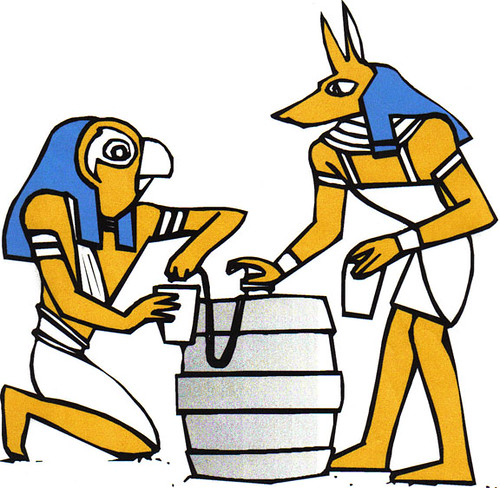
egyptian-beer-party

Filed Under: Beers, News Tagged With: Archeology, Health & Beer, History, Middle East, Science

Beer In Ads #260: Happy Holidays Ahead, From Carling

December 8, 2010 By Jay Brooks

ad-billboard
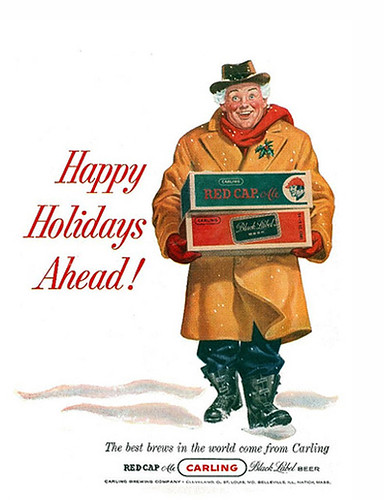
Wednesday’s holiday ads are for Carling, both their Black Label and Red Cap beers. Both of the ads are from the 1950s. They show the same jolly fellow carrying home a case or two of beer in the snow and promising they’ll provide “Happy Holidays Ahead!” Frankly, he already looks so happy I believe him.

Carling-RedCap-holidays

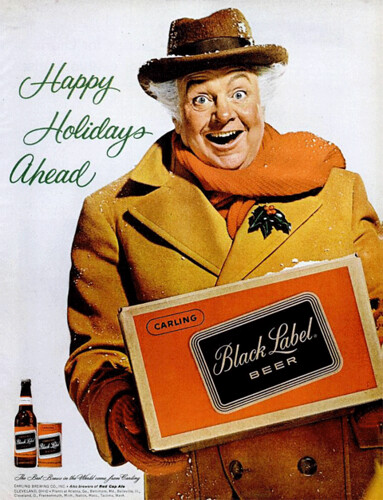
The second ad is for just Carling Black Label.

Carling-1950s-holidays

Filed Under: Art & Beer, Beers Tagged With: Advertising, Christmas, History, Holidays

« Previous Page
Next Page »

Find Something

Northern California Breweries

Please consider purchasing my latest book, California Breweries North, available from Amazon, or ask for it at your local bookstore.

Recent Comments

  • Bob Paolino on Beer Birthday: Grant Johnston
  • Gambrinus on Historic Beer Birthday: A.J. Houghton
  • Ernie Dewing on Historic Beer Birthday: Charles William Bergner 
  • Steve 'Pudgy' De Rose on Historic Beer Birthday: Jacob Schmidt
  • Jay Brooks on Beer Birthday: Bill Owens

Recent Posts

  • Beer In Ads #5393: Anheuser-Busch Bock November 14, 2026
  • Historic Beer Birthday: John H. Stahl November 14, 2026
  • Historic Beer Birthday: Philip Kling November 14, 2026
  • Beer In Ads #5392: Anheuser-Busch Bock Beer November 13, 2026
  • Historic Beer Birthday: William IV, Duke of Bavaria November 13, 2026

BBB Archives

Feedback

Head Quarter
This site is hosted and maintained by H25Q.dev. Any questions or comments for the webmaster can be directed here.