Brookston Beer Bulletin

Jay R. Brooks on Beer

  • Home
  • About
  • Editorial
  • Birthdays
  • Art & Beer

Socialize

  • Dribbble
  • Email
  • Facebook
  • Flickr
  • GitHub
  • Instagram
  • LinkedIn
  • Pinterest
  • RSS
  • Twitter
  • YouTube

Powered by Genesis

Beer In Art #102: More Vincent Van Gogh’s Wheat Fields

November 14, 2010 By Jay Brooks

art-beer
Last week’s artworks were all paintings of wheat fields by Vincent Van Gogh for the most recent Session on wheat beers. Since wheat fields were a favorite subject for Van Gogh — throughout his life he painted at least 40 artworks that included a wheat field — I couldn’t help but feature several more again this week.

Wheat field, painted in 1889.

Van_Gogh-wheat_field-1889

Green Wheat Field, also painted in 1889.

Van_Gogh-green_wheat_field-1889

Wheat Field with Reaper, from 1888.

Van_Gogh-wheat_field_w_reaper-1888

Sheaves of What in a Field, from 1885.

Van_Gogh-Sheaves-of-Wheat-in-a-Field_1885

Sunset Wheat Fields Near Arles, from 1888.
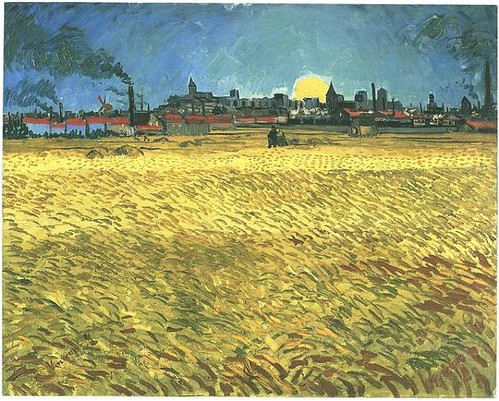
Van-Gogh_Sunset-Wheat-Fields-Near-Arles_1888

Wheat Field Behind Saint Paul Hospital with a Reaper, from 1889.

Van-Gogh_Wheat-Field-Behind-Saint-Paul-Hospital-with-a-Reaper_1889

Wheat Field with Cypresses at the Haute Galline Near Eygalieres, from 1889.
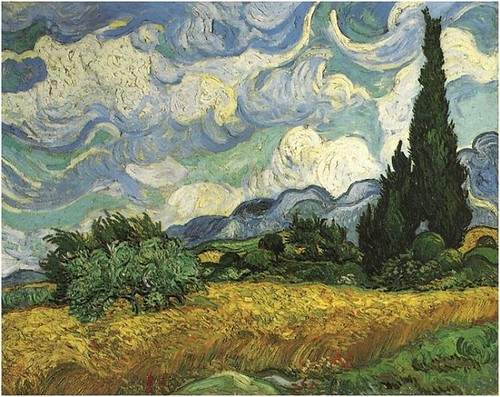
Van-Gogh_Wheat-Field-with-Cypresses-at-the-Haute-Galline-Near-Eygalieres_1889

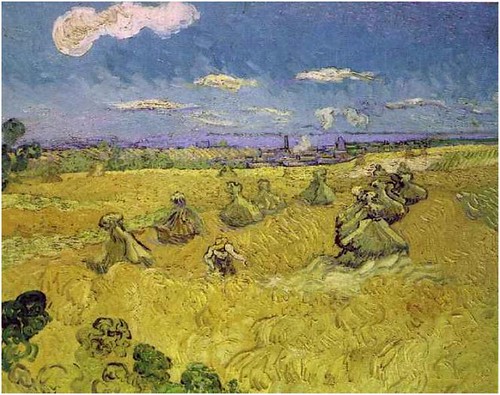
Sunset Wheat Field with Sheafs, from 1888.
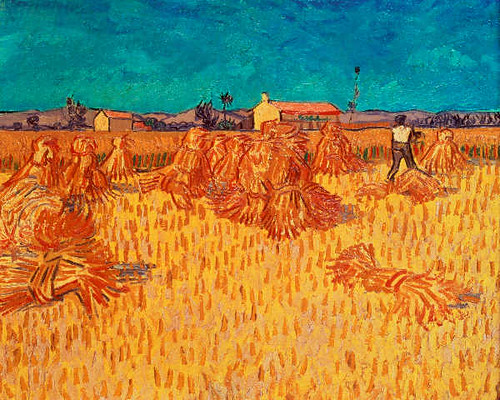
Van-Gogh_Sunset-Wheat-Field-w-Sheafs_1888

For more about Vincent Van Gogh, Wikipedia is a good place to start, though there’s even more at the Vincent Van Gogh Gallery, which has a complete list of his works. There are also tons of links at the ArtCyclopedia and another biography at the Web Museum.

Filed Under: Art & Beer, Beers Tagged With: History, The Netherlands

Guinness Ad #43: Knocking Down Columns

November 13, 2010 By Jay Brooks

guinness-toucan
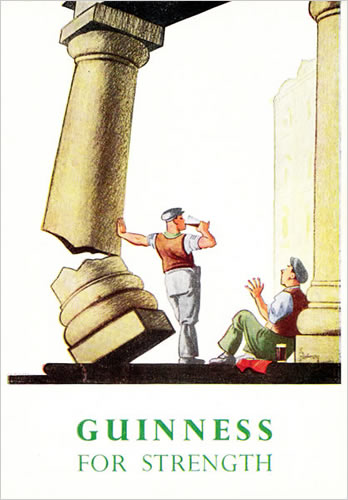
Our 43rd Guinness poster depicts a man leaning against an ancient Greek column and accidentally knocking it down, just because he’s recently enjoyed a pint of Guinness. That’s, as the slogan suggests, “Guinness for Strength.”

Guinness-columns-2

And here’s another version of the ad with a lot more text than usually seen in Guinness advertising at that time.

Guinness-columns

Filed Under: Art & Beer, Beers Tagged With: Advertising, Guinness, History

Beer In Ads #242: Carlsberg Painting

November 12, 2010 By Jay Brooks

ad-billboard
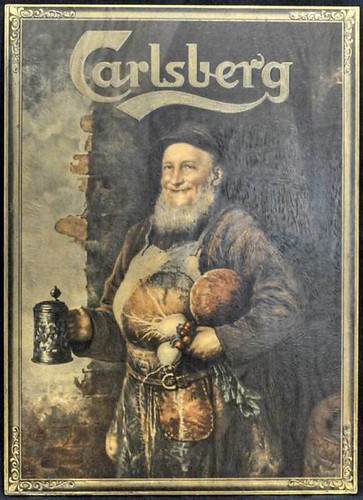
Friday’s ad is for Carlsberg from 1925. It features an odd painting of a man with a beer stein holding some vegetable like turnips. I don’t know if Carlsberg adapted a known work of art for this advertisement or if it was commissioned for it.

Carlsberg-1925

Filed Under: Art & Beer, Beers Tagged With: Advertising, Denmark, History

Beer In Ads #241: Schlitz Famo Soldier

November 11, 2010 By Jay Brooks

ad-billboard
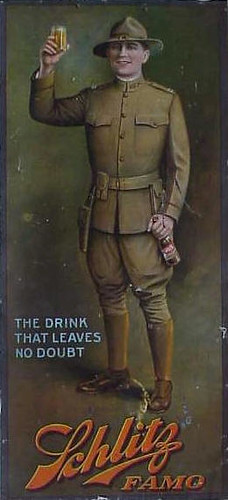
Thursday’s ad is for Schlitz Famo, from around 1918. Famo was their non-alcohol beer during Prohibition, or as they referred to it, “a pure non-intoxicating beverage.” I’m not sure what the tie-in was with the man in uniform, though it was during World War I, and since today is Veteran’s Day — originally Armistice Day for that war’s end.

Most of the beer companies scrambled to come up with a N/A brand in the years just before Prohibition as they finally started to see the writing on the wall. For an interesting overview of the names they came up with, check out Prohibition and Near-Beer Names.

schlitz-famo

During the early part of Prohibition, brewers at the time were emphasizing cleanliness by saying that “Schlitz Famo goes through a pulp filter–then through a sterilized pipe line to glass-lined tanks in a cool cellar for aging. A sterilized line carries it to automatic filling machines containing sterilized bottles, thence to Pasteurization” They further stressed the nutritional values of their products. The company boasted that Schlitz Famo is more than a drink. It is a food. Every time you take a glass of Schlitz Famo you are taking something to eat. Every compound essential to the human body is present in Schlitz Famo–protein, carbohydrates, mineral matter and water–the only factor absent being fats, and they are formed in the body from the carbohydrates. These elements repair and build up broken-down tissues and impart to the body heat and muscular energy. That’s why we say Schlitz Famo is a worth-while cereal beverage. It is non-intoxicating. It is healthful, refreshing and satisfying. It has the wonderful hop aroma.

Filed Under: Art & Beer, Beers Tagged With: Advertising, History, Holidays, Schlitz

Beer In Ads #240: Bud, You Have To See It To Believe It

November 10, 2010 By Jay Brooks

ad-billboard
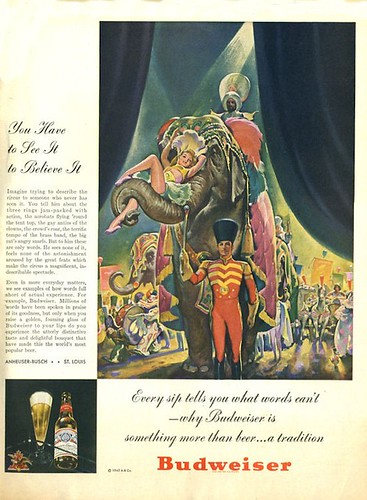
Wednesday’s ad is for Budweiser from 1948. It depicts a very colorful, surreal circus scene with the slogan “You Have To See It To Believe It.”

Bud-circus-1948

Filed Under: Art & Beer, Beers Tagged With: Advertising, Budweiser, History

Beer In Ads #239: Bud Beach Sipping

November 9, 2010 By Jay Brooks

ad-billboard
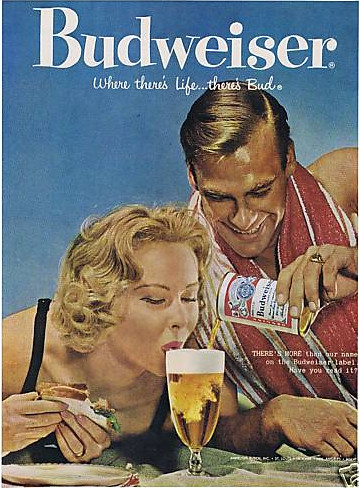
Tuesday’s ad is for Budweiser from 1958. It’s from the “Where There’s Life … There’s Bud” series and features a couple at the beach. The man is pouring beer from a can to overflowing — tilt the glass, dude! — while the woman tries to sip it up before it spills over the side, while holding a partially-eaten sandwich. Is it just me, or is there something vaguely odd about the ad?

Bud-1958-3

Filed Under: Art & Beer, Beers Tagged With: Advertising, Budweiser, History

New Evidence Supports Theory That Beer Sparked Civilization

November 9, 2010 By Jay Brooks

ninkasi-tablet
The theory that it was beer that caused early man to make the transition from hunter/gatherers to farmers instead of bread, thus starting civilization itself, has been gathering steam since it was first proposed by anthropologists in the 1950s. The latest support comes from archaeologist Brian Hayden at Simon Fraser University in Canada, who will be submitting his recent research to the journal Current Archeology. His theories suggest that it wasn’t just the beer that was important, but its use in rituals like feasts that help bring people together.

From the article in Live Science:

The advent of agriculture began in the Neolithic Period of the Stone Age about 11,500 years ago. Once-nomadic groups of people had settled down and were coming into contact with each other more often, spurring the establishment of more complex social customs that set the foundation of more-intricate communities.

The Neolithic peoples living in the large area of Southwest Asia called the Levant developed from the Natufian culture, pioneers in the use of wild cereals, which would evolve into true farming and more settled behavior. The most obvious explanation for such cultivation is that it was done in order to eat.

Archaeological evidence suggests that until the Neolithic, cereals such as barley and rice constituted only a minor element of diets, most likely because they require so much labor to get anything edible from them — one typically has to gather, winnow, husk and grind them, all very time-consuming tasks.

Hayden told LiveScience he has seen that hard work for himself. “In traditional Mayan villages where I’ve worked, maize is used for tortillas and for chicha, the beer made there. Women spend five hours a day just grinding up the kernels.”

However, sites in Syria suggest that people nevertheless went to unusual lengths at times just to procure cereal grains — up to 40 to 60 miles (60 to 100 km). One might speculate, Hayden said, that the labor associated with grains could have made them attractive in feasts in which guests would be offered foods that were difficult or expensive to prepare, and beer could have been a key reason to procure the grains used to make them.

“It’s not that drinking and brewing by itself helped start cultivation, it’s this context of feasts that links beer and the emergence of complex societies,” Hayden said.

Feasts would have been more than simple get-togethers — such ceremonies have held vital social significance for millennia, from the Last Supper to the first Thanksgiving.

“Feasts are essential in traditional societies for creating debts, for creating factions, for creating bonds between people, for creating political power, for creating support networks, and all of this is essential for developing more complex kinds of societies,” Hayden explained. “Feasts are reciprocal — if I invite you to my feast, you have the obligation to invite me to yours. If I give you something like a pig or a pot of beer, you’re obligated to do the same for me or even more.”

“In traditional feasts throughout the world, there are three ingredients that are almost universally present,” he said. “One is meat. The second is some kind of cereal grain, at least in the Northern Hemisphere, in the form of breads or porridge or the like. The third is alcohol, and because you need surplus grain to put into it, as well as time and effort, it’s produced almost only in traditional societies for special occasions to impress guests, make them happy, and alter their attitudes favorably toward hosts.”

Food and beer together at the heart of the birth of civilization. Now that’s pairing idea I can get behind.

Filed Under: Beers, Editorial, News Tagged With: History, Middle East

Beer In Ads #238: When One Is Out Of Schlitz, One Is Out Of Beer

November 8, 2010 By Jay Brooks

ad-billboard
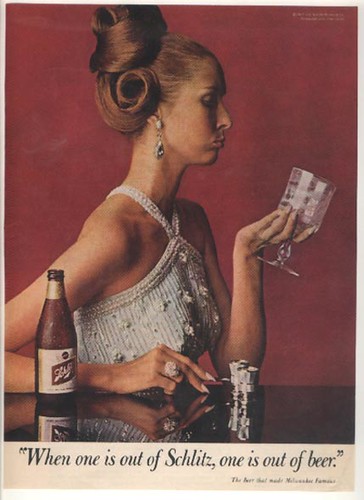
Monday’s ad is for Schlitz, from — I’m guessing — the swinging, sophisticated sixties with a play on their famous slogan “when you’re out of Schlitz you’re out of beer” being rendered more proper, as “When One Is Out Of Schlitz, One Is Out Of Beer.”

schlitz-out-sophisticated

Filed Under: Art & Beer, Beers Tagged With: Advertising, History, Schlitz

Anchor To Receive Ralston Award From SF Museum & Historical Society

November 8, 2010 By Jay Brooks

anchor-steam
Fritz Maytag may have stepped back from his daily duties at Anchor Brewing, the brewery he owned and ran since 1965, but that doesn’t mean he’s slowing down. He’s still running his winery, York Creek Vineyards, and consulting with the new owners of Anchor Brewing & Distilling.

And later this month, on November 18, the San Francisco Museum and Historical Society will present their William C. Ralston Corporate Award to Fritz Maytag and Dave Burkhart on behalf of Anchor Brewing.

From the press release:

Receiving the Ralston Award on behalf of Anchor Brewing will be Fritz Maytag and David Burkhart. Maytag, considered the father of modern microbreweries, had been at the helm of Anchor Brewing for 45 years. Maytag helped spark a revival in the craft of making beer by hand and inspired thousands of entrepreneurs to follow him in creating small, artisan breweries. He won the 2008 James Beard Lifetime Achievement Award. The company was sold this spring but he serves as Chairman Emeritus, Anchor Brewing Company.

Burkhart, a staff member of Anchor Brewing and a California-born historian and honors graduate of Yale, is the author of Earthquake Days: The 1906 San Francisco Earthquake & Fire in 3D and the editor of Cocktail Boothby’s American Bartender. He is also a professional trumpeter who teaches at the San Francisco Conservatory of Music and performs with the San Francisco Opera and the San Francisco Symphony. His latest book project is called Cocktails & Punches in Mark Twain’s San Francisco.

Congratulations to both, and to Anchor. Tickets to the Awards Luncheon may be purchased online.

Filed Under: Breweries, Events, Just For Fun, News Tagged With: Announcements, California, History, San Francisco

Beer In Art #101: Vincent Van Gogh’s Wheat Fields

November 7, 2010 By Jay Brooks

art-beer
Today’s artworks are all by one of the world’s most well-known artists, Vincent Van Gogh. Given last Friday’s Session topic — wheat beers — I thought it would be fun to look at some paintings of what fields. Wheat fields were a favorite subject for Van Gogh and throughout his life he painted at least 40 artworks that included a wheat field.

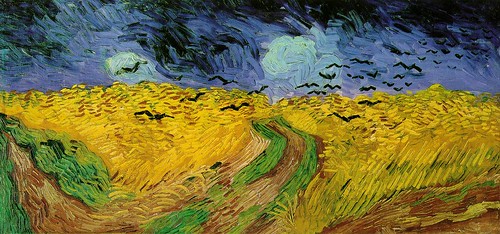
One of his most famous wheat field paintings was Wheatfield with Crows, painted toward the end of Van Gogh’s life, in 1890, the same year he passed away. It was also the subject of an episode of Simon Schama’s Power of Art, a wonderful documentary series on art that I heartily recommend. In addition, it was used in a surreal sequence of a lesser know film by Akira Kurosawa called Dreams. The original is in the Van Gogh Museum in Amsterdam.

Van_Gogh-wheat_field_w_crows-1890

Here’s what the Van Gogh Museum has to say about the painting:

Wheatfield with Crows is one of Van Gogh’s most famous paintings and probably the one most subject to speculation. It was executed in July 1890, in the last weeks of Van Gogh’s life. Many have claimed it was his last work, seeing the dramatic, cloudy sky filled with crows and the cut-off path as obvious portents of his coming end. However, since no letters are known from the period immediately preceding his death, we can only guess what his final work might really have been. Some scholars believe it was the Tree-roots, but we have no proof that this was the case.

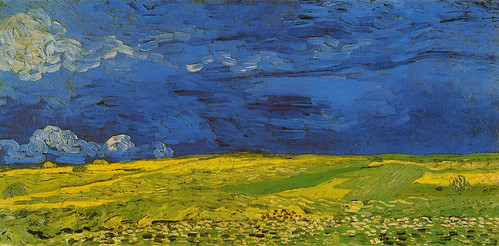
Another one painted around the same time was Wheat Field Under Clouded Sky, also painted in 1890.

Van_Gogh-wheat_field_under_clouded_sky-1890

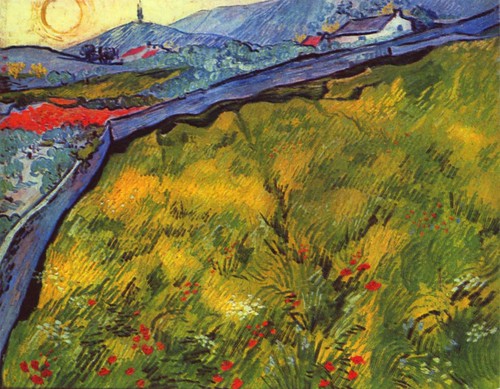
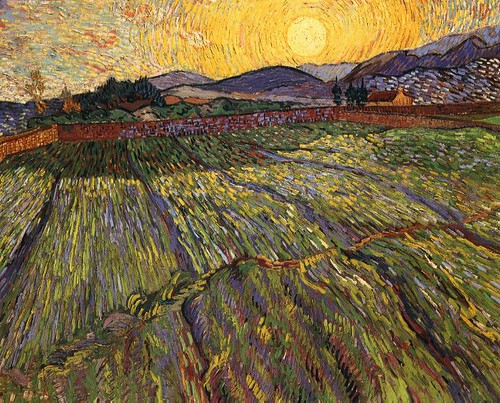
Can Gogh also executed a series of paintings called “The Wheat Field” series. All of the paintings “depict the view Van Gogh had from the window of his bedroom on the top floor of the asylum” at Saint-Rémy-de-Provence from June 1889 to May 1890. Here’s one from that series, Wheat Field, Sunrise, painted in 1890.

Van_Gogh-wheat_field_sunrise-1890

And here’s another one, Wheat Field with Rising Sun, from 1889.

Van_Gogh-wheat_field_w_rising_sun-1889

For more about Vincent Van Gogh, Wikipedia is a good place to start, though there’s even more at the Vincent Van Gogh Gallery, which has a complete list of his works. There are also tons of links at the ArtCyclopedia and another biography at the Web Museum.

Filed Under: Art & Beer, Beers Tagged With: History, The Netherlands

« Previous Page
Next Page »

Find Something

Northern California Breweries

Please consider purchasing my latest book, California Breweries North, available from Amazon, or ask for it at your local bookstore.

Recent Comments

  • Bob Paolino on Beer Birthday: Grant Johnston
  • Gambrinus on Historic Beer Birthday: A.J. Houghton
  • Ernie Dewing on Historic Beer Birthday: Charles William Bergner 
  • Steve 'Pudgy' De Rose on Historic Beer Birthday: Jacob Schmidt
  • Jay Brooks on Beer Birthday: Bill Owens

Recent Posts

  • Beer In Ads #5369: Er Is Weer Bockbier October 9, 2026
  • Historic Beer Birthday: Jacob Schmidt October 9, 2026
  • Historic Beer Birthday: Jackson Koehler October 8, 2026
  • Historic Beer Birthday: Cornelius Antonius Van Ginderachter October 8, 2026
  • Historic Beer Birthday: Nicholas Bastendorff October 8, 2026

BBB Archives

Feedback

Head Quarter
This site is hosted and maintained by H25Q.dev. Any questions or comments for the webmaster can be directed here.