Brookston Beer Bulletin

Jay R. Brooks on Beer

  • Home
  • About
  • Editorial
  • Birthdays
  • Art & Beer

Socialize

  • Dribbble
  • Email
  • Facebook
  • Flickr
  • GitHub
  • Instagram
  • LinkedIn
  • Pinterest
  • RSS
  • Twitter
  • YouTube

Powered by Genesis

Labor Day Hop Picking

September 8, 2009 By Jay Brooks

hop-leaf
On Labor Day this year, Moonlight Brewing held their annual hop-picking event for friends and family to come and help harvest their hops. Since the kids were out of school and the lovely wife off work, we made a family outing of it, reminiscent of 19th century hop-picking when entire communities stopped what they were doing to help the farmers with the hop harvest. My daughter, Alice, was a hop-picking veteran, having come with me the previous year, but both Porter and my wife, Sarah, were newbies.
P1160111
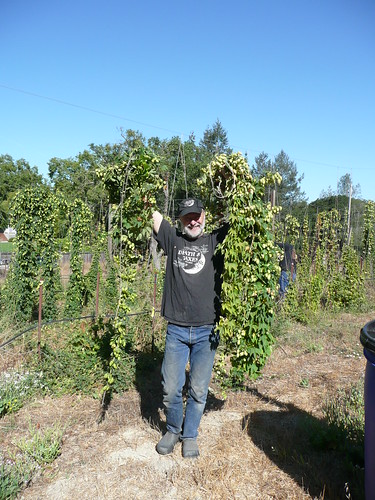
Moonlight Brewery’s owner/brewer Brian Hunt with his hops.

It was a beautiful sunny day in whatever town Moonlighting says it’s in, and nearly three-dozen folks showed up to help. I’d guess we knew a little better than half the people there, so it was great fun sitting around, chatting, enjoying Brian’s beer straight from the tanks and picking the hops. There was also abundant food, and even Sean Paxton, the Homebrew Chef, put together a plate of some delicious cheeses. After we were done, we pulled out the Washoe Boards and played a few games, too.
P1160115
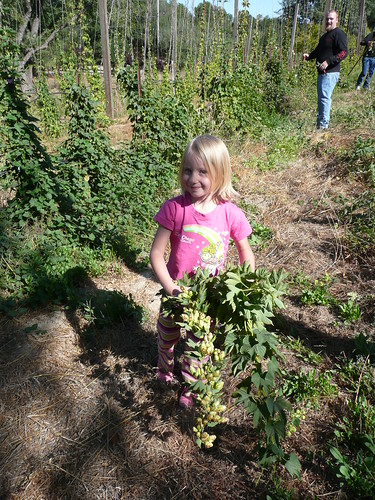
Alice wasn’t content just picking the hops, she wanted to help cut them down and carry them back, too. The kids had a blast and, as always, it felt great to pitch in and help. It was the perfect way to spend our Labor Day.

Below is a short slideshow of our day at Moonlight’s hopyard. If you click on the button on the bottom right with the four arrows pointing outward on it, you can see the photos in glorious full screen.

Filed Under: Breweries, Just For Fun Tagged With: Community, Family, Holidays, Hops, Photo Gallery

Beer In Art #39: Phoebus Levin’s Life In The Hop Garden

August 16, 2009 By Jay Brooks

art-beer
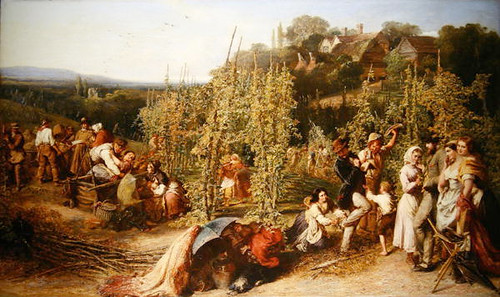
Today’s work of art depicts Life in the Hop Garden, and is by illustrator Phoebus Levin. It was painted in 1859 and today the original resides at the Towneley Hall Art Gallery and Museum located in Burnley, Lancashire.

Phoebus_Levin-hop_garden

Levin lived from 1836-1878 and was born in Berlin, but exhibited in London from 1855-1878. That’s about all the biographical information I could find about him. You can see a few more of his works at My Art Prints and ArtNet.

Filed Under: Art & Beer Tagged With: England, Hops, UK

The Times Goes For Extremes

January 10, 2008 By Jay Brooks

There was another terrific article by Eric Asimov in the New York Times yesterday about extreme beers called A Taste for Brews That Go to Extremes. Although admitting not everybody likes the new extremism, Asimov certainly does and the article also includes several Bay Area beers, including ones from Lagunitas, Mad River and Moylan’s breweries. And there’s a great quote from Brendan Moylan, owner of both Marin Brewing and Moylan’s.

“We’re the same country that put men on the moon, and we’re taking the same approach to beer,” said Brendan Moylan, the founder of Moylan Brewing Company in Novato, Calif. “We passed the rest of the world by ages ago, and they’re just waking up to it.”

The Times also did a tasting of several extreme beers, and happily included two well-known brewers in the process: Garrett Oliver, from Brooklyn Brewing, and Phil Markowski, from Southampton Publick House. Despite their initial derisiveness over the very pursuit of extremeness, even they found beers they enjoyed. 90-Minute IPA from Dogfish Head was the group’s favorite, followed by the Double Simcoe I.P.A. from Weyerbacher and Maximus from Lagunitas. There’s also a Beers of the Times feature where you can listen to the tasters talking about their favorite beers.


Filed Under: Uncategorized Tagged With: Hops, Mainstream Coverage, National

Busch Model Train Accesories

November 18, 2007 By Jay Brooks

After the official part of my recent German beer trip ended, I had a few days to myself before heading back across the pond. So one day, Peter Reid (who publishes Modern Brewery Age) and I took a Deutsche Bahn train to nearby Salzburg, Austria to visit the original Trumer Brauerei (more about that trip soon). On the train, I was idly paging through the train’s on-board magazine Mobil (sort of like an in-flight magazine) when I came across a multi-page ad for a toy store chain, Idee+Spiel. Based on the number of pages and locations listed, I imagine it’s something like the Toys R Us of Germany. On the page with toy trains, there were pictured accessories by a German company called, with no irony, Busch (or more properly Busch Gmbh and Co.). Two of the products shown were a Beer Garden and a Hopyard. I imagine neither of these HO-scale train accessories will ever see the light of day here in neo-prohibitionist America, but I love the idea that these scenes are so common that nobody in civilized Europe has a problem with them.


The Busch model HO-Biergarten.

The Busch model HO-Hopfen.


Visiting their website, I also discovered that Busch has a few more beer-related accessories for train layouts, and the hop field is featured on the cover of their catalog.
 

Busch’s 2007 catalog.
 

The other accessories included this barley field.
 

Notice the hops in the field across the road? If you look back the hopyard picture, you can now see the barley field there, too.
 

I love way the person on the bench is sitting. The catalog refers to him as a “happy ‘carouser.'”


Filed Under: Just For Fun Tagged With: Europe, Germany, Hops, Ingredients, Malt, Strange But True, Websites

Fresh Hops in the Chronicle

November 2, 2007 By Jay Brooks

I am pleased to announce my first beer column for the San Francisco Chronicle is in today’s newspaper. The article is on fresh hop beers, or my preferred name for them — Lupulin Nouveau (which Brian Hunt and I came up with).

Filed Under: Uncategorized Tagged With: California, Hops, Mainstream Coverage, San Francisco

Shuck and Jive

September 26, 2007 By Jay Brooks

There is little doubt that hops are or soon will be in short supply. I heard it at “Hop School” in Ralph Olson’s “state of the hop crop” report and I’ve heard it from almost every other quarter, as well. Belmont Station’s blog has a good summary of what Ralph had to say via Dave Wills at Freshops and Rick Sellers at Pacific Brew News has another summary from Deschutes brewer Larry Sidor, as well as a summary of world hop news. There have even been two recent fires at hop kilns, and while crop damage was minimal (though the kilns were destroyed) it still further reduced an already thin harvest. Lew Bryson also posted David Edgar’s summary from today’s Brewers Forum. Overall, there’s some good but mostly foreboding on the future availability of hops, and most notably prices may skyrocket. There simply isn’t enough hops to meet current demand and acreage has been declining for several years.

Enter corn into the mix. When George Bush started touting ethanol he increased incentives and subsidies for farmers to grow corn to make the alternative fuel. If you’re barely getting by growing a difficult and fragile crop like hops, switching to corn with all that federal moola looks mighty attractive. I’ve heard that now from a variety of sources. According to an Iowa State University study, food prices have risen an average of $47 per person as a result of the ethanol surge since last year. So it’s not just hops, but farmers are replacing a number of other crops with corn, too. This has been widely reported to be effecting food prices across the board. But once on a gravy train, few will voluntarily jump off, no matter that the train may be headed for a collision. And corn has been riding those amber waves for quite some time, especially once high fructose corn syrup made its debut in 1980. HFCS is now in what seems like every processed food you could name. So if government policy makes their situation even better, you would expect the corn industry to be overjoyed.

There’s a little interview today at Retail News online (subscription required) with S. Richard Tolman, CEO of the National Corn Growers Association, trying to allay fears that the corn subsidies are having unintended consequences. And if you want to lay such fears to rest, who better to ask than someone with a totally vested interest in convincing you that black really is the new white. Here’s the forthright honesty he employs to counter numerous claims and studies that suggest “ethanol production is exacerbating environmental impact problems.” Tolan’s answer: “Those claims are simply not true.” Deny, deny, deny.

To the final question, “Critics contend that American farmers will be unable to keep up with demand for corn needed to produce ethanol. What’s the short-term and long-term thinking on this from corn growers?” he answers:

Short-term the question has already been answered. Farmers have planted more acres of corn this year than any time since World War II. If we have merely an average yield, there will not only be enough corn for all current food, fuel and export markets, we will build our carryover (surplus) stocks.

It’s that “planted more acres of corn this year than any time since World War II” line that should concern beer lovers everywhere. More acres of corn means less acres of something else. Believe it or not, when I was in the nation’s “hopbasket” — The Yakima Valley, Washington — last month I saw several large fields of corn.

Ethanol production has doubled over the last three years, and in 2006 accounted for almost 5 billion gallons. But that’s still only around 5% of total gasoline needs, and corn growers are hoping to increase that to 10%. Doubling again the acreage for ethanol would mean a pretty substantial amount of land on which one thing — hops perhaps — would be converted to grow corn. It seems naive to think that’s not going to raise the price of whatever is no longer being grown on the land that’s now growing corn. So while it may seem odd to blame corn for the hop shortage, it is at least one of the factors that’s contributing to it. I’m certainly no energy expert, but I haven’t seen anything to convince me that ethanol is the panacea so many seem to believe it is. Even if planting all that new corn provides us with 10% of our fuel needs, we’ll pay for it somewhere else, either in higher food prices or a potential beer shortage. Frankly, I’d rather walk, bike or take mass transit than give up beer.

But nothing’s going to change if people continue to give a voice to industry stooges like Tolman with so obvious an axe to grind. Why would anyone, and especially people in the retail business, believe such pernicious propaganda? He’s telling retailers the goods they sell will not go up in price if there is less acreage of land to grow the ingredients needed to make or grow the things they sell. On top of that, he represents the very people changing the way that land is used. That’s shuckin’ and jivin’ of the first order.


Filed Under: Editorial, Politics & Law Tagged With: Business, Hops, National

Hunt’s Hop Tea

September 24, 2007 By Jay Brooks

teapot
A few weeks ago while helping Moonlight with their hop harvest, owner/brewer Brian Hunt broke out something I’d never seen before: hop tea. Now I’ve seen regular hop tea before, I’ve even bought some at the health food store and tried it, but this was something totally different. Brian told me the idea grew out of an experiment he was doing to see how hops reacted at different temperatures, which he presented at “Hop School” a few years ago. He discovered in the process that he could make a delicious hop tea and that it varied widely depending on the temperature of the water. Here’s how it works:

  1. Put approximately two-dozen fresh hop cones in a 16 oz. mason jar.
  2. Heat water to __X__ temperature.
  3. Fill jar with heated water and seal cap.
  4. Let the water come down to ambient room temperature.
  5. Refrigerate.
  6. Drink.

There appears to be four main factors that change depending on the temperature of the water. These are:

  1. Color
  2. Float
  3. Bitterness
  4. Tannins

hop-tea-1

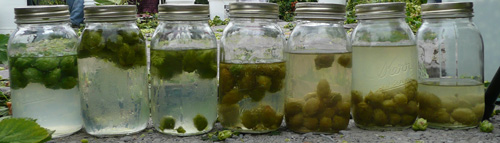
Intrigued by all of this and quite curious, Brian brought out seven examples of his hop tea made with water of different temperatures: 60°, 120°, 130°, 140°, 160°, 180° and 185°. They’re shown above from lower to higher temperature, left to right.

As you can see, the lower the temperature, the more green the hops are and the water remains less cloudy. At the higher temperatures, the hops are stripped of their green, becoming brown, and the water also becomes more brown. Also, as the temperature increases, the hops lose their buoyancy and begin to sink in the water. Although you can’t see it in the photo, the hotter the water, the more hop bitterness and at the upper range, tannins begin to emerge. Here’s what I found:

  • 60°: Fresh, herbal aromas with some hop flavors, but it’s light.
  • 120°: Bigger aromas, less green more vegetal flavors.
  • 130°: Also big aromas emerging, flavors beginning to become stronger, too, but still refreshingly light.
  • 140°: More pickled, vinegary aroma, no longer subtle with biting hop character and strong flavors.
  • 160°: Very big hop aromas with strong hop flavors, too, with a touch of sweetness. Tannins are becoming evident but are still restrained.
  • 180°: Big hop and vinegary aromas, with flavors becoming too astringent and tannins becoming overpowering.
  • 185°: Vinegary aromas, way too bitter and tannins still overpowering.

hop-tea-2
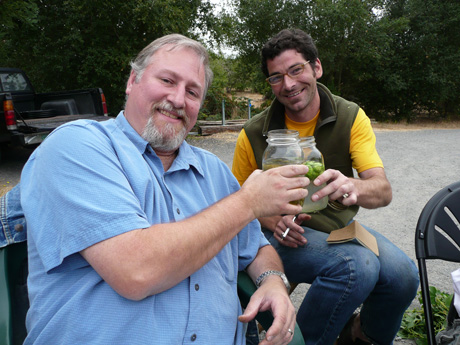
Trying each of the tea samples with Tim Clifford, who writes for Northwest Brewing News.

hop-tea-3

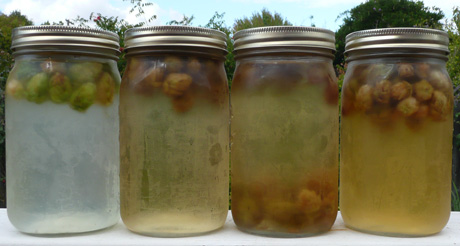
Brian was kind enough to let me take a small bag of fresh hops with me so I could recreate his experiment at home. I had enough for four samples and made tea at 100°, 140° and 160°. Using two dozen hop cones made the jars look light so I used three-dozen in the last jar, also using 160° water. I tasted them with my wife, hoping to get a civilian opinion, too. Here’s what we found:

  • 100°: Hops still green and floating. The nose was very vegetal and reminded my wife of the water leftover in the pot after you’ve steamed vegetables like broccoli or Brussels sprouts. The mouthfeel is somewhat gritty with light, refreshing flavors and only a little bitterness, which dissipates quickly.
  • 140°: Hops turned brown, but still floating. Light hop aromas with some smokey, roasted aromas and even a hint of caramel. Fresh hop flavors with a clean finish. My wife, however, made that puckering bitter face signaling she found it repugnant.
  • 160°: Hops turned brown, but most has sunk to the bottom of the jar. Strong hop aromas and few negatives, at least from my point of view. My wife was still making that face, cursing me for dragging her into this. Hop bitterness had become more pronounced and tannins were now evident, with a lingering finish.
  • 160° Plus: This sample had 50% more hops. The hops had also turned brown but, curiously, they were still floating. The nose was vegetal with string hop aromas. With a gritty mouthfeel, the flavors were even more bitter covering the tannins just slightly, but they were still apparent, and the finish lingered bitterly.

It seems like either 140° or 160° is the right temperature. Lower than that and you don’t get enough hop character (I’m sure that’s why the hops remain green) but above that the tannins become too pronounced. It appears you have to already like big hop flavor or you’ll hate hop tea. I found it pretty enjoyable and even refreshing though it’s still probably best in small amounts. You do seem to catch a little buzz off of it, which doesn’t hurt. I’m sure the amount of hops is important and more research may be needed on that front. Brian tells me that hop pellets can also be used though I doubt the jar of tea looks as attractive using them. They have the advantage of being available year-round, of course. If you use pellets, you need only about a half-ounce for each pint jar.

If you try to make Hunt’s Hop Tea on your own, please let me know your results. And please do raise a toast to Brian Hunt’s ingenuity.

Filed Under: Food & Beer, Just For Fun Tagged With: Bay Area, California, Hops

Picking Hops at the Moonlight

September 12, 2007 By Jay Brooks

Sunday was picking day at Moonlight Brewery in Windsor, California. Having recently returned from Hop School in Yakima, Washington, I was eager to see once more the old-fashioned, slow way of picking hops. Brian Hunt invited me to help him and several friends and neighbors to help with this year’s harvest. I’ve helped out before, but this year was particularly fun because I had just witnessed the industrial hop processing in America’s Hopbasket, Yakima, Washington, and was interested to see the contrast between the two methods. I took over 500 photos of hops while in Yakima and hope to have those up shortly so you can see the entire process from ground to glass.
 

Moonlight Brewery owner Brian Hunt with a vine of hops freshly cut from his hopyard.

For more photos from this year’s hop harvest at Moonlight Brewery, visit the photo gallery.
 

Filed Under: Breweries Tagged With: Bay Area, California, Hops, Northern California, Photo Gallery

Sierra Nevada to Bottle Fresh Hops

September 10, 2007 By Jay Brooks

Almost a dozen years ago, Sierra Nevada head brewer Steve Dresler was having lunch with renowned hop expert Gerard Lemmens. He had just returned from England, where he’d been helping a brewer there figure out how to use whole, unkilned hops. Gerard asked Dresler if he’d ever considered using fresh hops.

He hadn’t, of course, but the idea marinated and a few days later he mentioned it to Ken Grossman who told him to “go for it.” The first year, Dresler made only one 100-barrel batch. In the intervening years, as demand for the beer has risen quickly, many obstacles have been overcome, such as how to ship that many hops or how to convert a recipe from regular hops (which are 8-10% water) to fresh hops (which can be as much as 80% water). Also that first year, an entire UPS truck was filled with small boxes of fresh hops bundled together with holes poked into them. Today, they’re overnighted in mesh onion sacks laid out flat in a single layer of a 18-wheel refrigerator truck. Each year, both Cascade (@2/3) and Centennial (@1/3) hops are used, but because they’re different from year to year — and because the exact quantities of each differ — the beer has to be reformulated on the fly. When it’s brewed is always a moving target because it’s contingent on when the hops are ready to be picked. Often it’s around Labor Day weekend, but you never know. Over the last eleven years, the most Harvest Ale they’ve made in a single year has been around 800-900 barrels available on draft only.

This year, however, Sierra Nevada is taking a giant leap and is planning to brew 3,000 barrels, using 16,000 pounds of fresh hops in two batches. And more exciting still, two-thirds of it will be available nationwide in 24-oz. bottles. I suspect it will sell out fast, not least of which because even though they’re making triple the usual amount, it will be sent all over the country meaning only small amounts which reach most markets. I’ve learned that the final brew was done last Thursday, September 6, and they hope to have it in the bottles as early as September 24. Keep an eye out for it, and buy it right away. But more importantly, drink it right away, too. This is the very antithesis of a beer meant to be aged. Make up your own special event to drink it. Get some fresh, locally made food and cook up a great meal. Invite your favorite people over to share it with you. This is the best way to celebrate harvest time, with the fruits of the harvest, both food and drink.

Filed Under: Beers Tagged With: California, Hops, Northern California, Packaging, Seasonal Release

Oregon To Host Fresh Hop “Tastivals”

August 22, 2007 By Jay Brooks

Fresh Hop or Wet Hop beers have been an exciting development over the last ten years, ever since Sierra Nevada created the first one with their Harvest Ale around 1996. The number of breweries making these beers has grown exponentially since that time and the limited nature of these beers make them something beer lovers eagerly anticipate each fall. This year, the Oregon Brewers Guild has paired up with Oregon Bounty, part of the state’s official tourism organization, “to produce a series of “Tastivals” to celebrate the release of Oregon’s fresh hop beers.”

From the press release:

These much anticipated seasonal beers are brewed only once a year during hop harvest, which typically takes place in late August and early September. Beers created using fresh hops instead of traditional dried hops are given unique flavors that simply aren’t available the rest of the year. Similar to a beer festival, each of the four “Tastivals” will offer visitors the opportunity to sample some of the more than 30 beers from across the state crafted using fresh-off-the-vine hops.

“Fresh hops are extremely fragile and need to be dried or used in a brew within 24 hours of picking — so this type of beer is uniquely suited to Oregon where we have the largest amount of aroma and flavor hops grown locally,” says Brian Butenschoen, Executive Director of the Oregon Brewers Guild. “Nowhere else in the United States are so many breweries located so close to the hop fields. The tastivals will give hop enthusiasts an opportunity to celebrate harvest by tasting the enormous variety of fresh hops grown in Oregon and made into beers by Oregon’s craft brewers.”

Fresh Hop “Tastivals” will be held every Saturday during the month of October with scheduled locations including:


  • October 6: Hood River Hops, Hood River
  • October 13: McMenamins Edgefield, Troutdale
  • October 20: Ninkasi Brewing Company, Eugene
  • October 27: Deschutes Brewery, Bend


Admission to the Tastivals is free of charge. Souvenir tasting glasses are required to sample beers and are available for $5. Beer samples are $1 each. Food will also be available for purchase.

That sounds like it will be a fun time at any one of those events.

More about Oregon Bounty:

Each October and November, Oregon’s winemakers, cheese makers, brewmasters, chefs, growers and producers come together for a celebration of Oregon Bounty. In addition to intimate food and wine events, visitors can purchase special packages that offer them one-on-one time with Oregon’s culinary talent. Visitors can spend the day making wine with an Oregon vintner, making suds with a craft brewmaster, foraging for chanterelles in Mt. Hood’s foothills-even cruising a farmers’ market with a local chef in search of ingredients for a private cooking class. It’s all part of the annual Oregon Bounty Celebration.

Filed Under: Uncategorized Tagged With: Announcements, Hops, Oregon, Press Release

« Previous Page
Next Page »

Find Something

Northern California Breweries

Please consider purchasing my latest book, California Breweries North, available from Amazon, or ask for it at your local bookstore.

Recent Comments

  • Ernie Dewing on Historic Beer Birthday: Charles William Bergner 
  • Steve 'Pudgy' De Rose on Historic Beer Birthday: Jacob Schmidt
  • Jay Brooks on Beer Birthday: Bill Owens
  • Steve 'Pudgy' De Rose on Beer Birthday: Charles Finkel
  • Steve 'Pudgy' De Rose on Beer Birthday: Bill Owens

Recent Posts

  • Beer Birthday: Teri Fahrendorf February 18, 2026
  • Beer In Ads #5207: Good News! Good Cheer! Dawson’s Bock Beer Is Here! February 17, 2026
  • Historic Beer Birthday: George Younger February 17, 2026
  • Historic Beer Birthday: Anton Geiger February 17, 2026
  • Beer Birthday: Marty Jones February 17, 2026

BBB Archives

Feedback

Head Quarter
This site is hosted and maintained by H25Q.dev. Any questions or comments for the webmaster can be directed here.