Brookston Beer Bulletin

Jay R. Brooks on Beer

  • Home
  • About
  • Editorial
  • Birthdays
  • Art & Beer

Socialize

  • Dribbble
  • Email
  • Facebook
  • Flickr
  • GitHub
  • Instagram
  • LinkedIn
  • Pinterest
  • RSS
  • Twitter
  • YouTube

Powered by Genesis

Patent No. 2492327A: Beer Pouring Device

December 27, 2015 By Jay Brooks

patent-logo
Today in 1949, US Patent 2492327 A was issued, an invention of Butler Sheldon Jr., for his “Beer Pouring Device.” There’s no Abstract, although in the description it includes this summary:

This invention relates to improvements in a beer pouring device. Broadly, it is an object of my invention to provide a beer pouring device which may be applied to the neck of the standard bottles when the beer is sold.

More specifically, it is an object of my invention to provide a device which has a series of screens at the pouring end thereof, so that when the device is applied to the neck of the bottle and the beer poured through it, a finer head is obtained on the beer which is more like a head obtained from draft beer.

A further object of my invention is to provide an inexpensive device which can be applied to standard bottle necks, which enhances the taste of the beer after it is poured through said device.

A further object of my invention is to provide a device which reduces the size of the gas bubbles after the beer is poured through it in order to give a more creamy quality to the beer.

US2492327-0

Filed Under: Beers, Just For Fun, Politics & Law, Related Pleasures Tagged With: History, Kegs, Law, Patent

Patent No. 2728344A: Hop Vine Cutter And Picker

December 27, 2015 By Jay Brooks

patent-logo
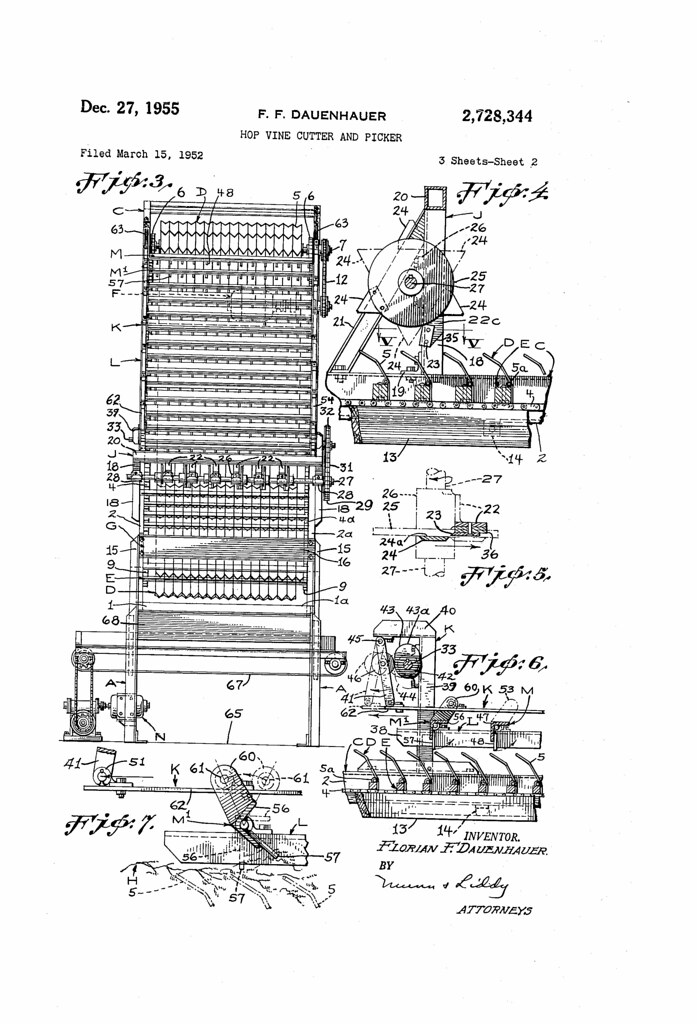
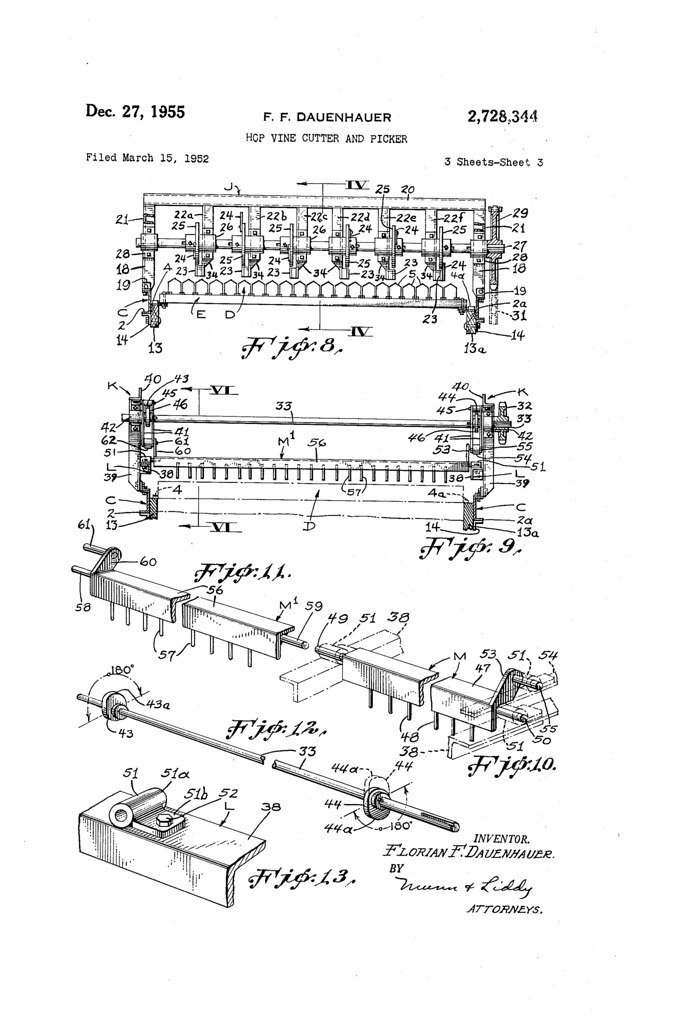
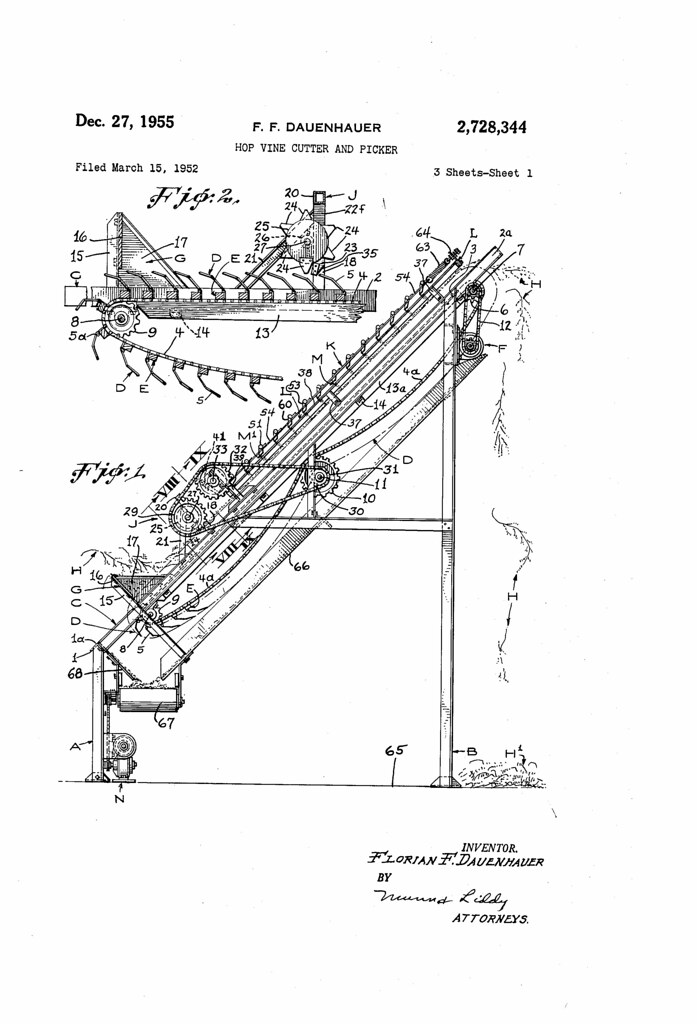
Today in 1955, US Patent 2728344 A was issued, an invention of Florian F. Dauenhauer, for his “Hop Vine Cutter and Picker.” There’s no Abstract, although in the description it includes this summary:

An object of my invention is to provide a hop picking machine which differs from the invention shown in my co-pending application on an apparatus for picking hops from hop branches and clusters and for separating leaves and stems therefrom, filed August 16, 1950, Ser. No. 179,724 (now Patent No. 2,681,066, dated June 15, 1954). In the co–pending case I disclose a branch picker for removing hops from hop branches and hop clusters. The hop branch picker severs the hops from any vine portion or hop clusters. A liXed breaker fork cooperating with a rotary feeder fork acts on the vines to spread them over the combined picker and endless conveyor. A branch or arm picker then acts upon the vines and intermittently stops or retards the movement of the vines along the conveyor. During the temporary holding of the vines, the picking fingers on the conveyor, act to strip the hops from the vines and from the hop clusters.

In the present invention a vine cutter takes the place of the liXed breaker fork and rotary feeder fork shown in the co-pending case and the cutter tends to spread the hop vines more uniformly over a combined conveyor and hop picker as well as reduce the lengths of the vines by cutting them and thus permit the more ready handling of them during the removal of hops therefrom. The branch or arm picker disclosed in the co-pending case is also altered in its structure and operation so that the combined endless conveyor and hop picker can have its upper reach movable in a flat plane through this portion of the machine rather than be caused to move at right angles to the plane at a plurality of spaced points, these points being arranged at a like number of stations where the hop vines are temporarily arrested in their movement through the machine.

The present invention makes use of a plurality of vine holding combs and these are positioned above a portion of the upper reach of the endless conveyor and are arranged in two groups. Every other comb is connected to a common comb swinging means and constitutes one group while the remaining alternate combs are connected to a second common comb swinging means and constitute the other group. The combs when in normal position, extend at right angles to the plane of the conveyor portion over which they are positioned and the tines of the combs will hold the vines from movement and permit the hop picking fingers on the conveyor to remove hops from the vines during this holding period.

US2728344-0
US2728344-1
US2728344-2

Filed Under: Beers, Just For Fun, Politics & Law, Related Pleasures Tagged With: History, Law, Patent

Patent No. 1013057A: Keg-Rinsing Machine

December 26, 2015 By Jay Brooks

patent-logo
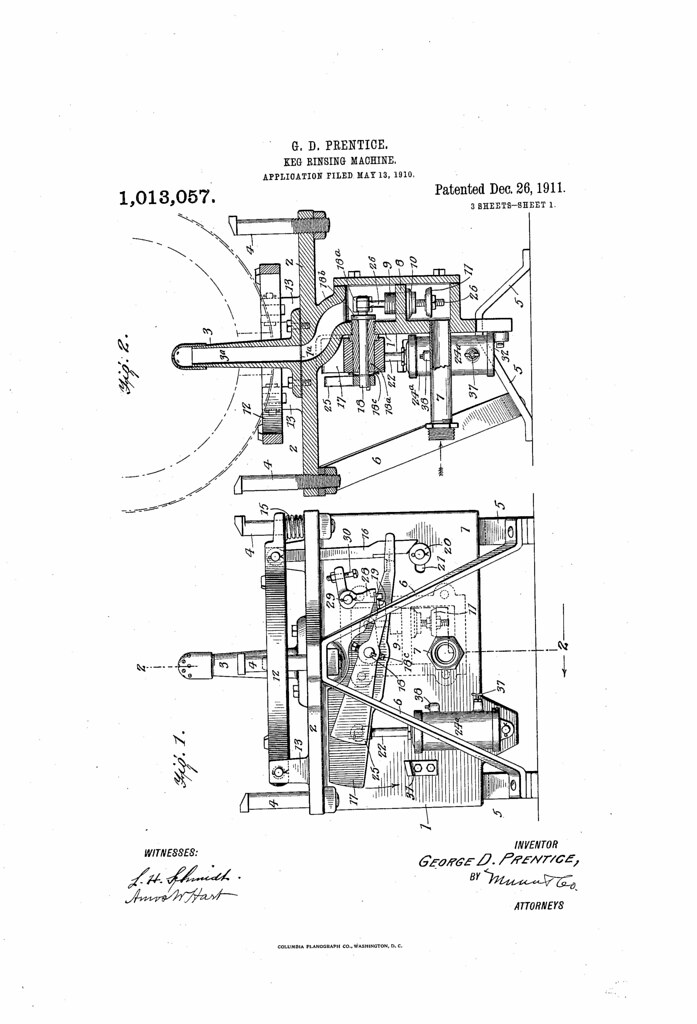
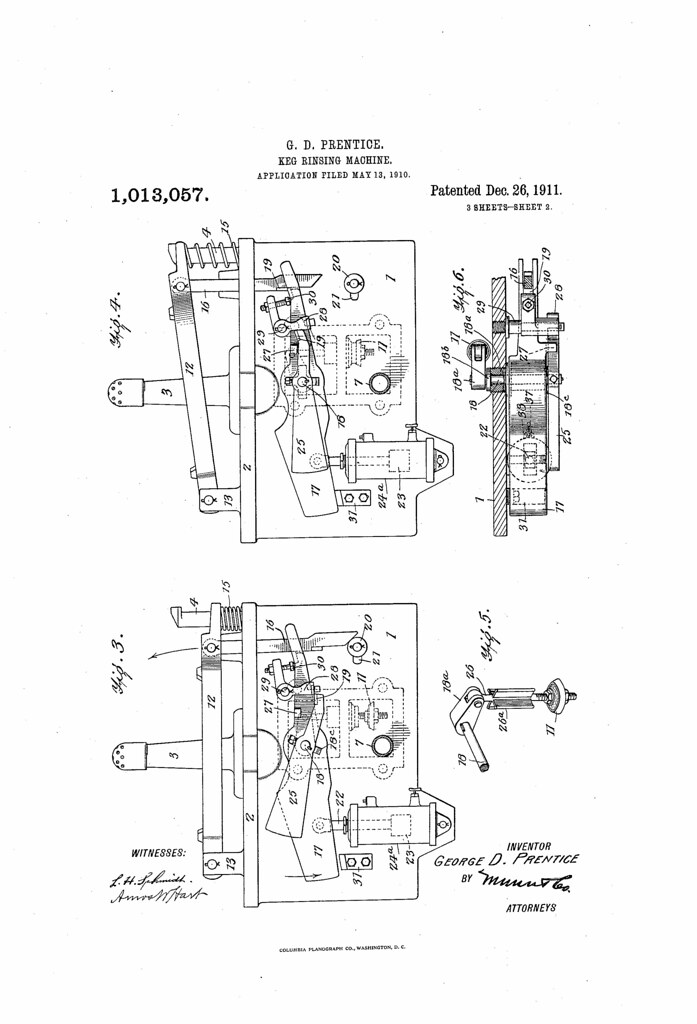
Today in 1911, US Patent 1013057 A was issued, an invention of George Denison Prentice, for his “Keg-Rinsing Machine.” There’s no Abstract, although in the description it includes this summary:

My invention is a machine for rinsing or washing out casks, kegs, or other receptacles, the same being caused to operate automatically by the weight of a cask or keg placed in due position on the ,machine, and requiring no attention or manipulation. Water is discharged into a cask or keg when placed on a depressible support and over a perforated nozzle. When the keg-support is depressed it opens a water-discharge valve and raises a weighted piston in a cylinder or dash-pot, and the time required for descent .of the piston to its original position determines the time of discharge of water into the keg. I thus provide for automatic discharge of water into a keg for rinsing the same and for automatic regulation of the time during which said discharge shall continue.

US1013057-0
US1013057-1
US1013057-2

Filed Under: Beers, Breweries, Just For Fun, Politics & Law, Related Pleasures Tagged With: Brewing Equipment, History, Kegs, Law, Patent

Patent No. 531314A: Process Of And Apparatus For Preparing Beer

December 25, 2015 By Jay Brooks

patent-logo
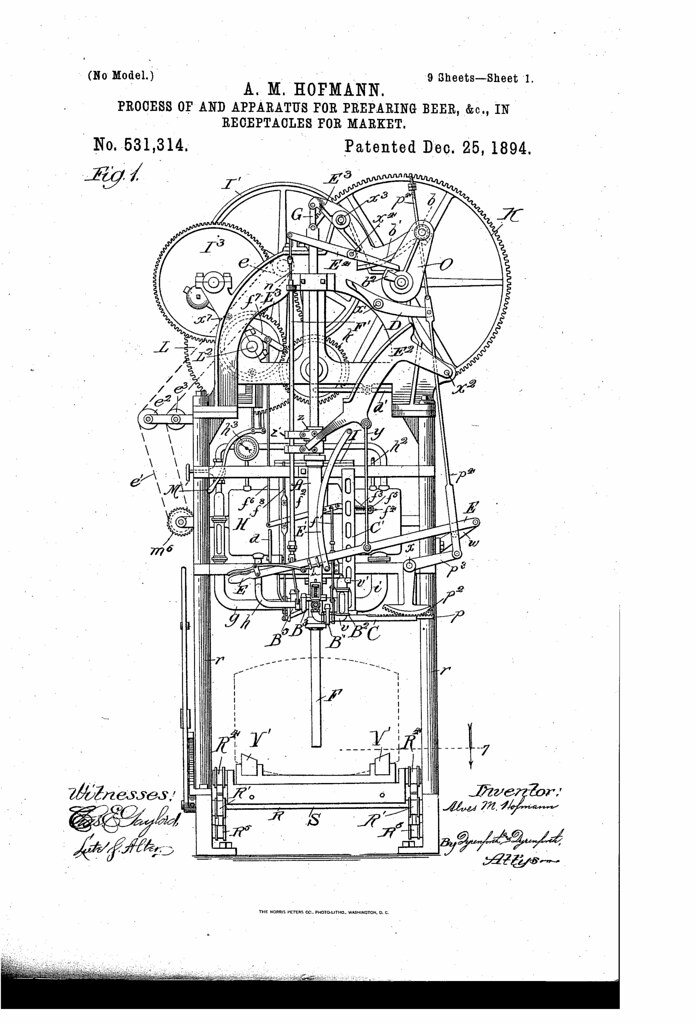
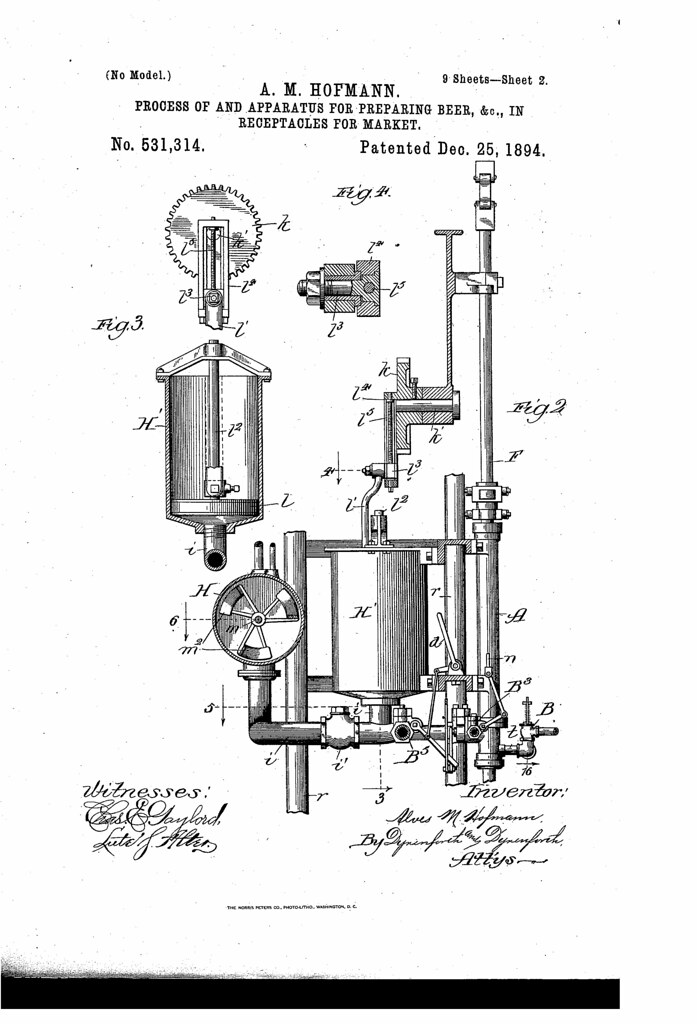
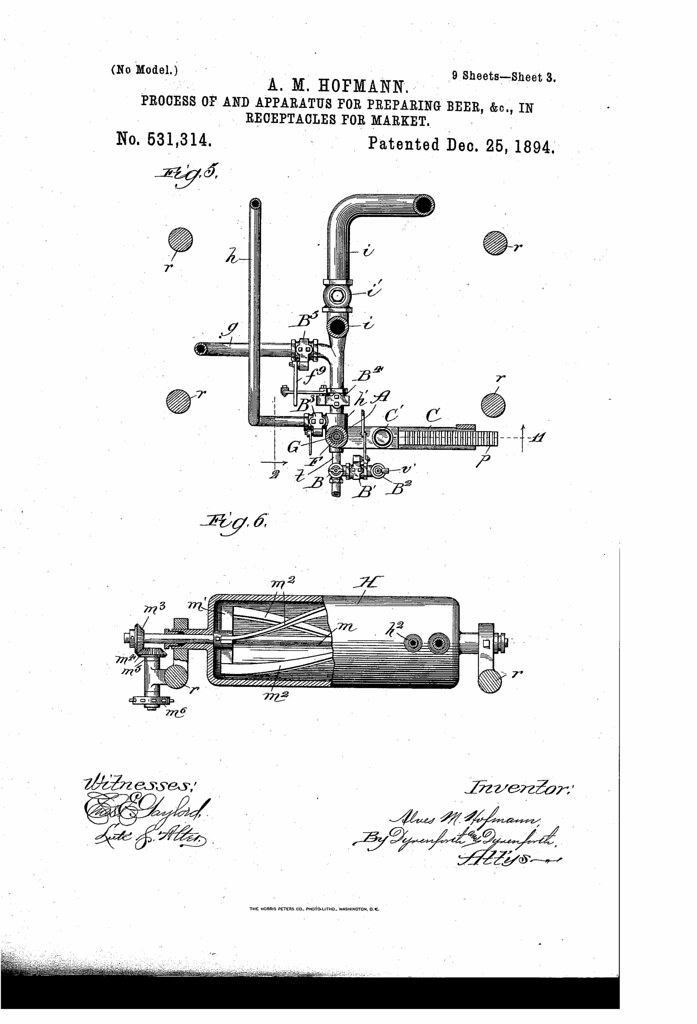
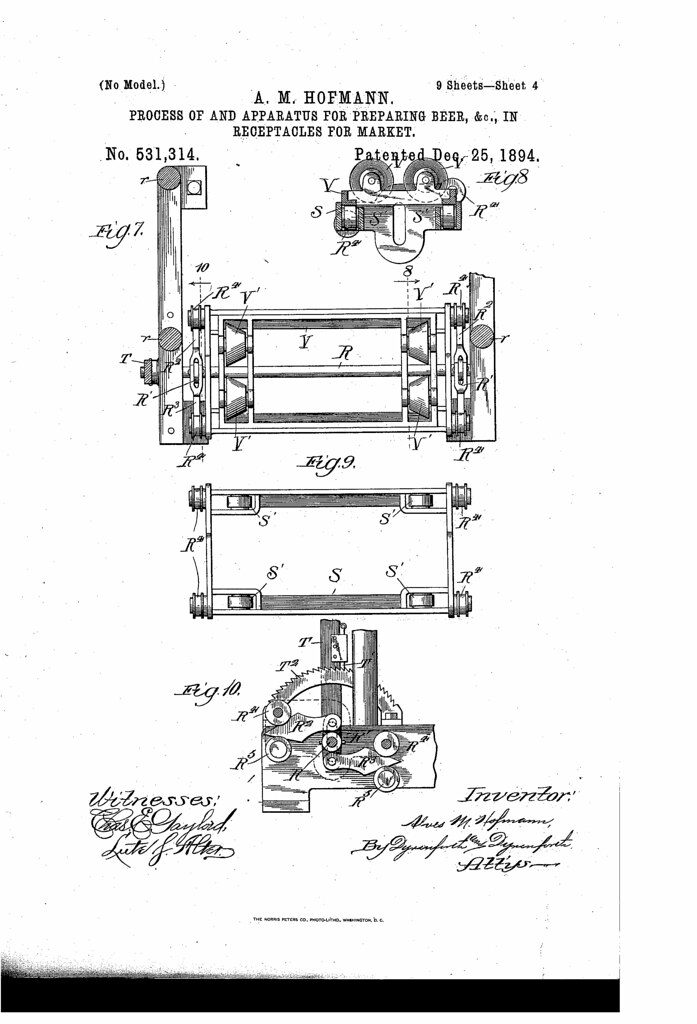
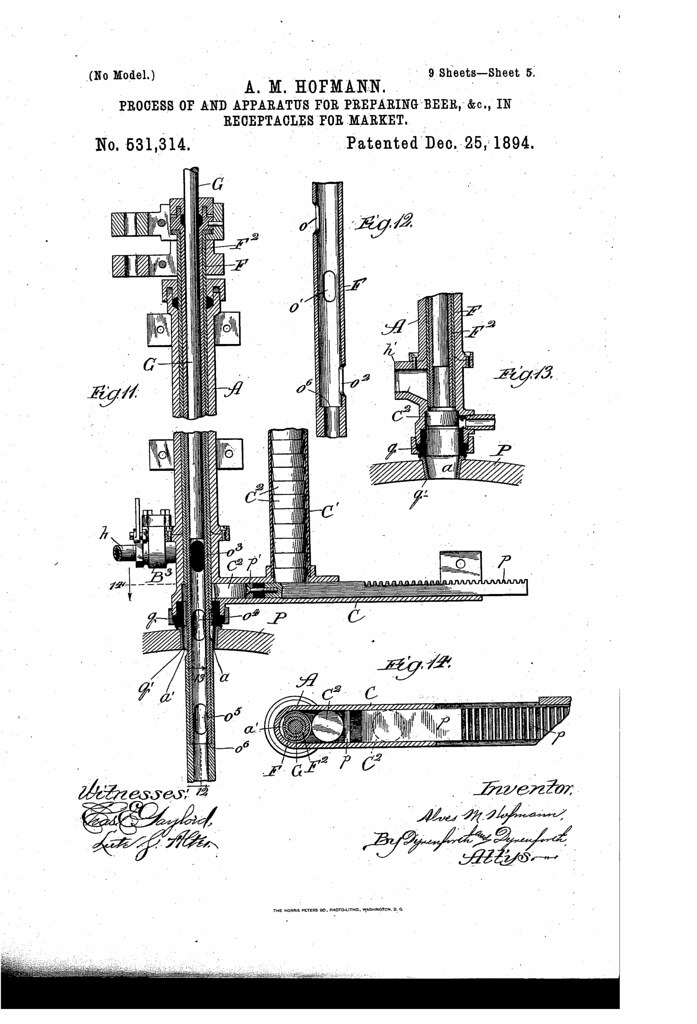
Today in 1894, US Patent 531314 A was issued, an invention of A.M. Hofmann, for his “Process of and Apparatus for Preparing Beer.” There’s no Abstract, although in the description it includes this summary:

It may be stated at the outset that I have primarily designed my improvement for the particular application to beer in barrels or kegs orin bottles, and I therefore, and for the sake of convenience, hereinafter confine the description of my invention in its application to racking, carbonating and bunging beer, though it is also applicable to, and I desire to be understood as intending it for, any and all liquids or beverages requiring similar treatment to prepare them in receptacles for the market.

A known manner of carbonating a beverage to prepare it for the market is to introduce into the holder containing it a liquid (preferably of the same kind) in small quantity proportionately to the quantity contained in the holder, but so highly charged with the gas, for which -,it affords a vehicle and a mixing or incorporating medium, as to supply the contents of the receptacle,and thoroughly impregnate them, with a charge of gas adequate for all requirements in the beverage.

I find that where the carbonating procedure referred to is employed on beer, the diffusion of the gas through the beer in the receptacle, however thoroughly it may be produced, is not lasting where the receptacle is not completely, or at least approximately, filled with the beer to be charged, which it rarely is; since the space left on filled affords, as it were, a pocket, in which the gas tends to accumulate, and whence it quickly escapes on opening or venting the receptacle, leaving the beer, when poured or drawn for consumption, insufficiently carbonated. Incomplete filling of the receptacles is, perhaps, as likely of occurrence where the receptacles are glass bottles as where they are barrels or kegs, notwithstanding that the transparent nature of the former renders the matter of completely filling them readily accomplishable.

My process consists in withdrawing from a .receptacle after filling it with beer (taken by preference directly from the cask) a suitably small proportion of its contents, and replacing the quantity thus withdrawn with an equal, or approximately equal, quantity of liquid highly charged with gas, thereby, practically, withdrawing the desired quantity from the receptacle, then charging it excessively with gas, and returning to the receptacle the same liquid, charged, that was withdrawn from it. Thus, after a receptacle has been completely filled, or substantially so, with the beer to be carbonated, (and complete filling of a barrel or keg is a matter as simple as filling a bottle) by withdrawing ascertain quantity to make room or the charge, and replacing it with an equal or substantially equal quantity of the supercharged carbonating liquid, the desirably full condition of the receptacles is attained.

US531314-0
US531314-1
US531314-2
US531314-3
US531314-4
US531314-7

Filed Under: Beers, Breweries, Just For Fun, Politics & Law, Related Pleasures Tagged With: Brewing Equipment, History, Law, Patent, Science of Brewing

Patent No. 664824A: Cold Air Pressure Apparatus For Beer

December 25, 2015 By Jay Brooks

patent-logo
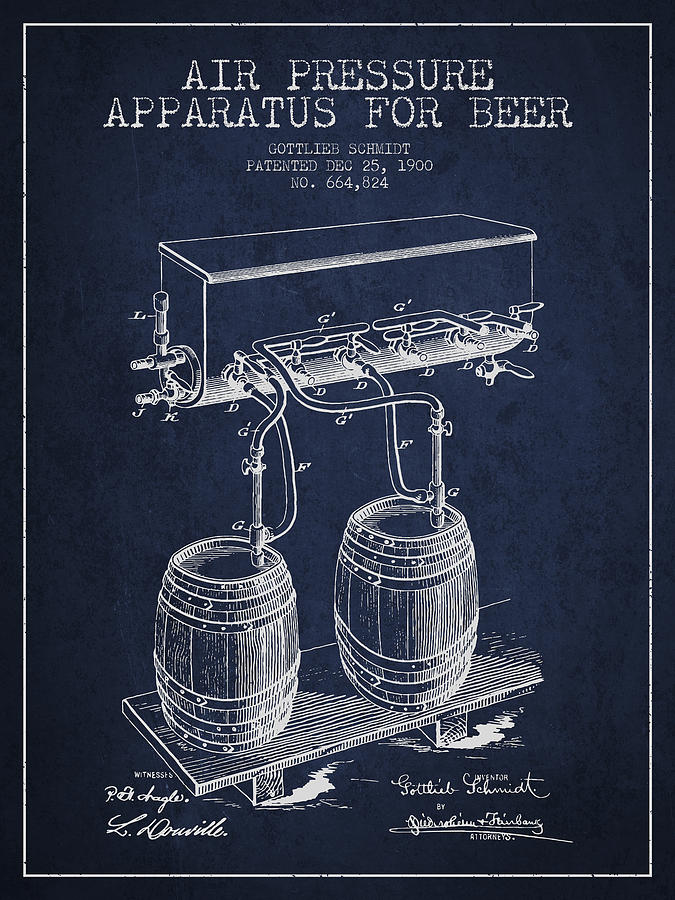
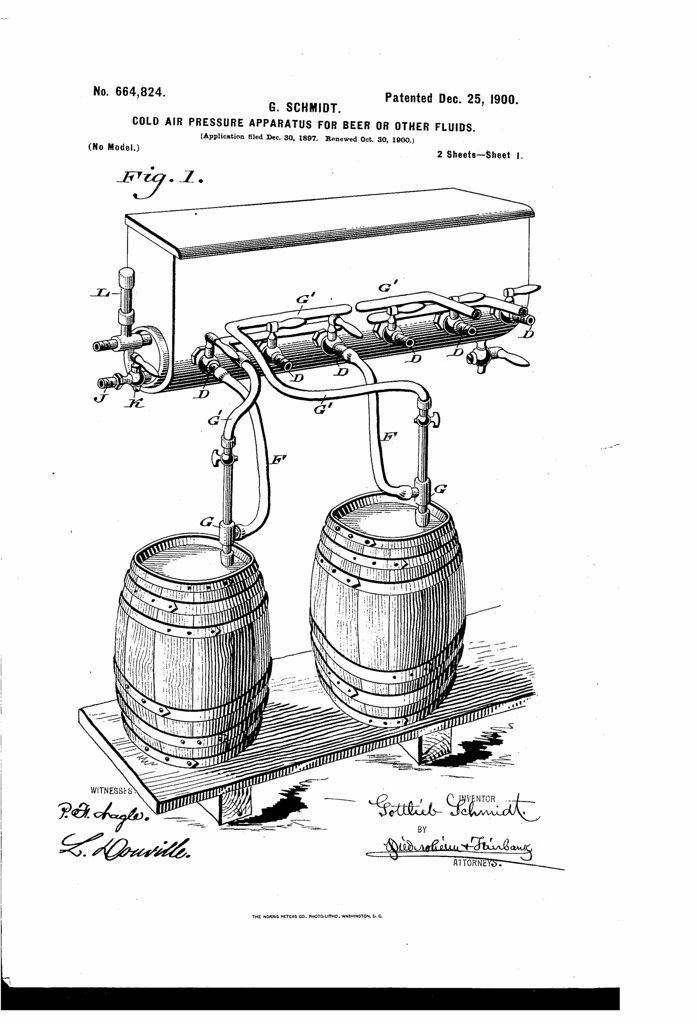
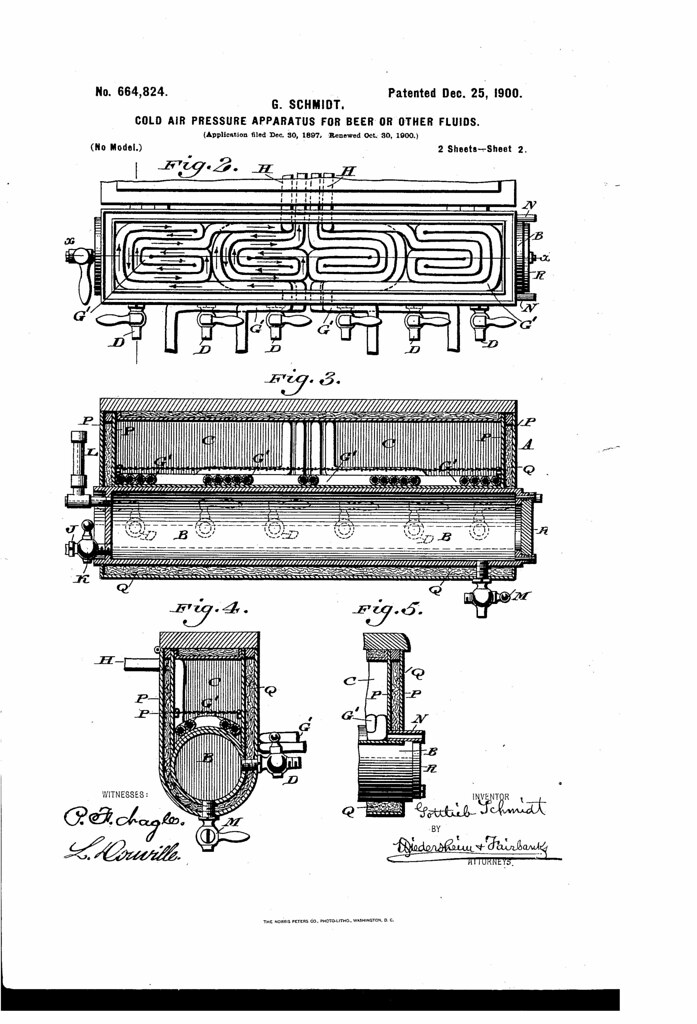
Today in 1900, US Patent 664824 A was issued, an invention of Gottlieb Schmidt, for his “Cold Air Pressure Apparatus For Beer or Other Fluids.” There’s no Abstract, although in the description it includes this summary:

My invention relates to an apparatus involving an air-chamber and a refrigerator adapted more particularly for cooling beer or other fluid, wherein cold air will be directed under pressure to said fluid where it is to be dispensed, the construction and operation of the parts thereof being hereinafter set forth, and the novel features thereof pointed out in the claims.

apparatus-for-beer-patent-from-1900-navy-blue-aged-pixel

And here are the original drawings filed with the application:
US664824-0
US664824-1

Filed Under: Beers, Breweries, Just For Fun, Politics & Law, Related Pleasures Tagged With: Brewing Equipment, History, Law, Patent, Science of Brewing

Patent No. 3418135A: Light-Insensitive Malt Beverage

December 24, 2015 By Jay Brooks

patent-logo
Today in 1968, US Patent 3418135 A was issued, an invention of Peter D. Bayne, assigned to Schlitz Brewing Co., for his “Light-Insensitive Malt Beverage and Process of Producing the Same.” There’s no Abstract, although in the description it includes this summary:

This invention relates to a process of producing a malt beverage such as beer, and more particularly to a process of producing a malt beverage which is insensitive to light.

Malt beverages such as beer and ale are not stable to light. When subjected to light, the beer develops an odor and flavor characterized as skunky. To prevent the development of the sunstruck or skunky odor, beer is generally packaged in colored bottles which minimizes exposure to sunlight. Even though packaged in colored bottles or in cans or kegs, the beer can nevertheless develop the sunstruck odor by virtue of the short exposure to sunlight in drinking glasses.

It has been found that the presence of isohumulones are responsible for the development of the sunstruck odor in beer. The hops, which are boiled with the wort, contain resins and oils which are contained in the lupulin. The resins include the alpha and beta resins, with the alpha resins containing a bitter acid called humulone and the beta resins containing an acid called lupulone. The alpha acids provide the bitter flavor for the beer while the beta acids have low solubility in the Wort and do not appreciably enter into the brewing process.

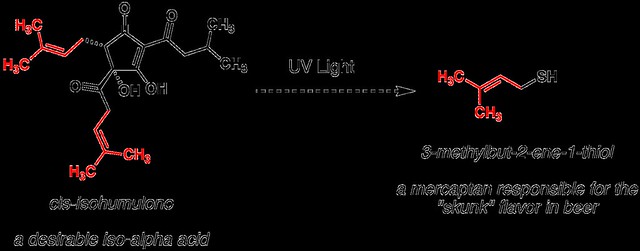
During the brewing-process, the humulone fraction is isomerized to the corresponding isohumulones. The sunstruck odor substance in beer has been identified as a mercaptan,3-Inethyl-2-butene-l-thiol, which is formed by the photolysis of the siX-membered side chain on the isohumulone molecule. The free radical formed by the intervention of sunlight splits Off carbon monoxide, forming the 3-methyl-2-butenyl radical. This product, in turn, reacts with hydrogen sulfide, which is formed from proteins or amino acids by photochemical action, to form 3- methyl-Z-butene-l-thiol. This mercaptan is considered to be the main component of the sunstruck odor in malt beverages.

To prevent the sunstruck odor, it has been proposed to convert a carbonyl group of the isohumulones into a secondary alcohol by reduction. In this reduced form, the molecule becomes insensitive to sunlight and there is no formation of odor on exposure to sunlight. This conversion has been carried out in the past by use of sodium borohydride as disclosed in Patent No. 3,079,262, but the use of sodium borohydride has not been completely successtul in that the reaction is difiicult to control. The contact time between the sodium borohydride and the isohumulone must be accurately controlled in order to effect a complete reduction of the isohumulones In addition, the sodium borohydride is a relatively costly material which adds to the overall cost of the beer.

The present invention is directed to a process for producing a light-insensitive malt beverage by reducing the isohumulones by use of an alkali metal dithionite. More specifically, the process consists of initially extracting ground hops with a solvent, such as hexane. The solvent is then evaporated, leaving a dark resinous oil which is isomerized in a dilute alkaline solution. After the isomerization, the material is neutralized to pH of 6.0 to 7.0 with a mineral acid and the lupulone, wax and chlorophyll are removed by further extractions with a solvent. The aqueous phase is then further acidified to a pH in the range of 1.0 to 2.0 and the isohumulones extracted with a solvent such as diethyl ether. The reduction is then accomplished by contacting the ether-isohumulone extract -with an aqueous solution of sodium dithionite.

After the reduction, the reduced isohumulone extract is separated from the dithionite solution and washed with brine. The ether is then removed by distillation to produce the reduced isohumulone concentrate.

The reduced isohumulone when added to a standard unhopped wort or beer produces a beer which does not develop the characteristic sunstruck odor when subjected to sunlight and at the same time allows precise control of the isohumulone bitterness levels which was hitherto impossible by traditional hopping methods.

isohumulone-degradation1

Filed Under: Beers, Just For Fun, Politics & Law, Related Pleasures Tagged With: History, Hops, Law, Patent, Science of Brewing

Patent No. 2225996A: Beer Foam Control Device

December 24, 2015 By Jay Brooks

patent-logo
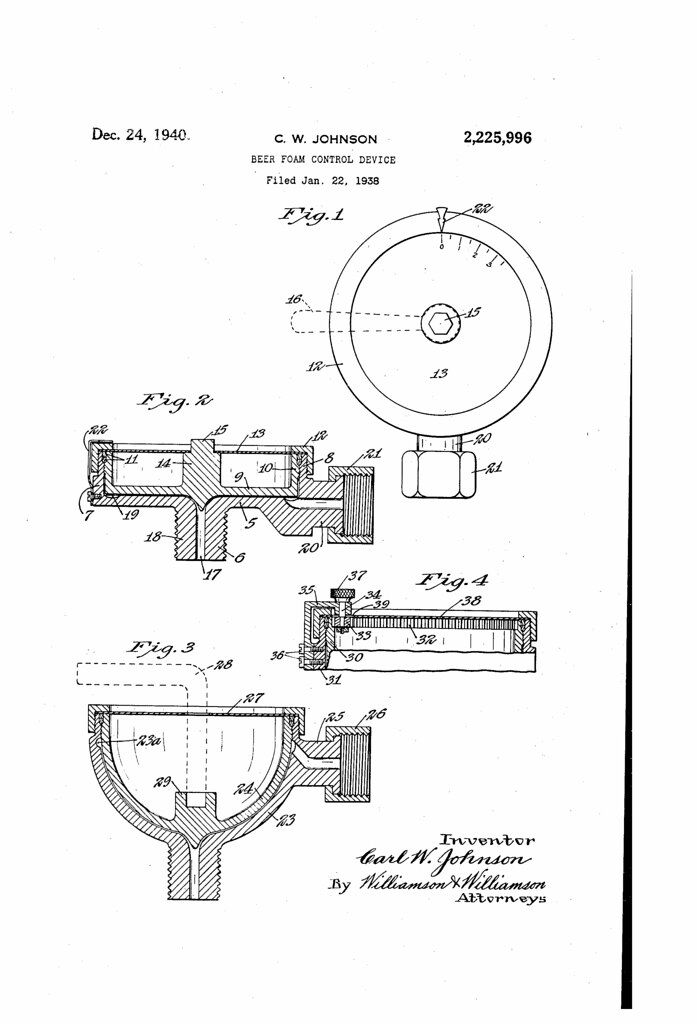
Today in 1940, US Patent 2225996 A was issued, an invention of Carl W. Johnson, for his “Beer Foam Control Device.” There’s no Abstract, although in the description it includes this summary:

This invention relates to devices for controlling the amount of foam on beverages which are maintained in storage containers under gaseous pressure, and is particularly adaptable for use in connection with the dispensing of malt beverages such as beer and ale.

One of the difficulties encountered in the dispensing of malt beverages has been the inability to control the foam or cap which forms on the beer when it is drawn into a glass or other container. It is desirable to maintain beer in a keg under relatively high pressures to prevent the beer from becoming flat, the pressure applied to the liquid serving to retain the natural gases formed in the beer during the fermentation thereof. Heretofore it has been found, however, that beer cannot be placed under very much pressure because it will cause foaming with the result that the person dispensing the beverage must scrape a considerable quantity of foam off the top of the beer in a glass, and that part which is removed is wasted.

It is, therefore, a general object of my invention to provide a device for controlling the amount of foam which is produced in dispensing beverages, such as beer, in. order that the beverage may be maintained under relatively high pressure to prevent it from becoming flat, and at the same time permit it to be dispensed with very little foam or cap thereon.

Another object of the invention is to provide a device which can be easily adjusted to meet different pressure conditions in order that a uniform amount of foam will be produced at all times.

A further object of the invention is to provide a device of this general type which is of extremely simple construction and which can be readily cleaned to maintain the original flavor of the beer.

US2225996-0

Filed Under: Beers, Breweries, Just For Fun, Politics & Law, Related Pleasures Tagged With: Brewing Equipment, History, Law, Patent, Science of Brewing

Patent No. 2225996A: Stationary Beer Container

December 24, 2015 By Jay Brooks

patent-logo
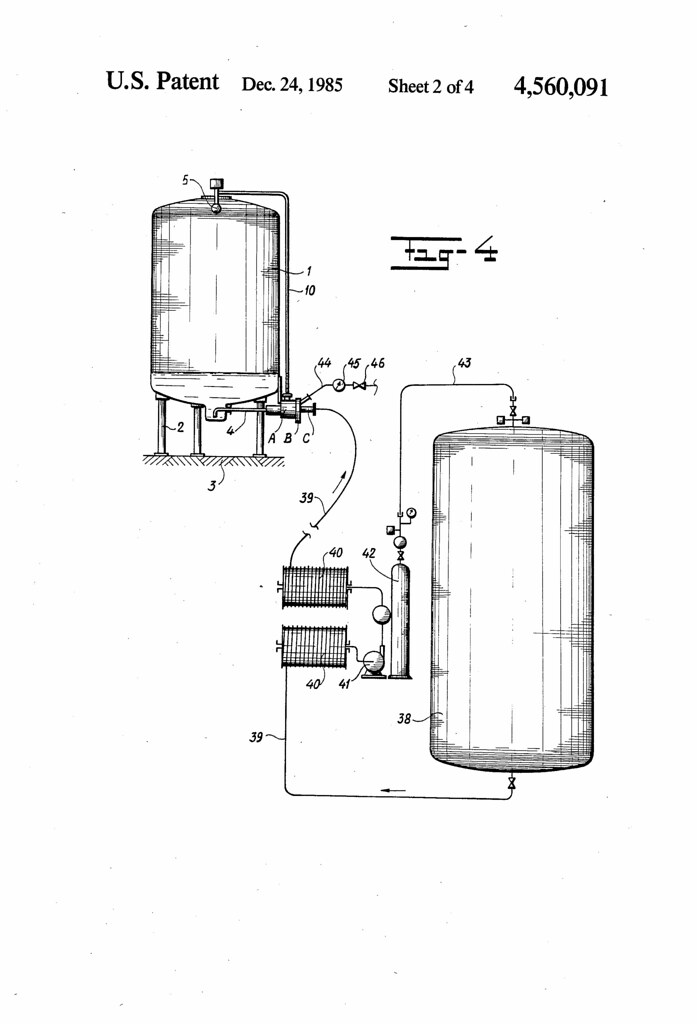
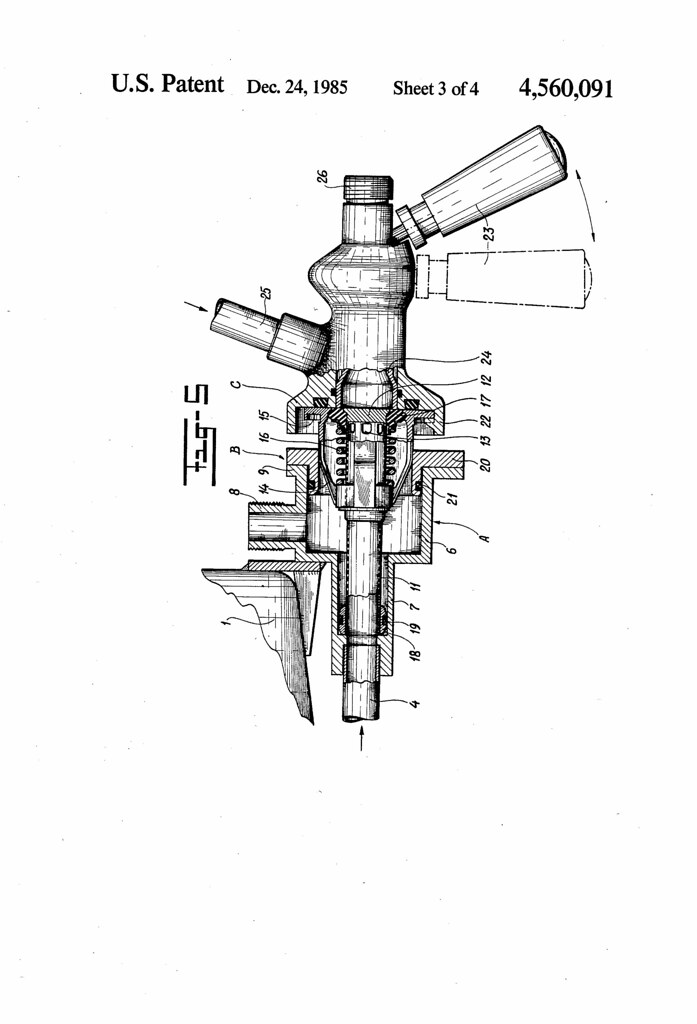
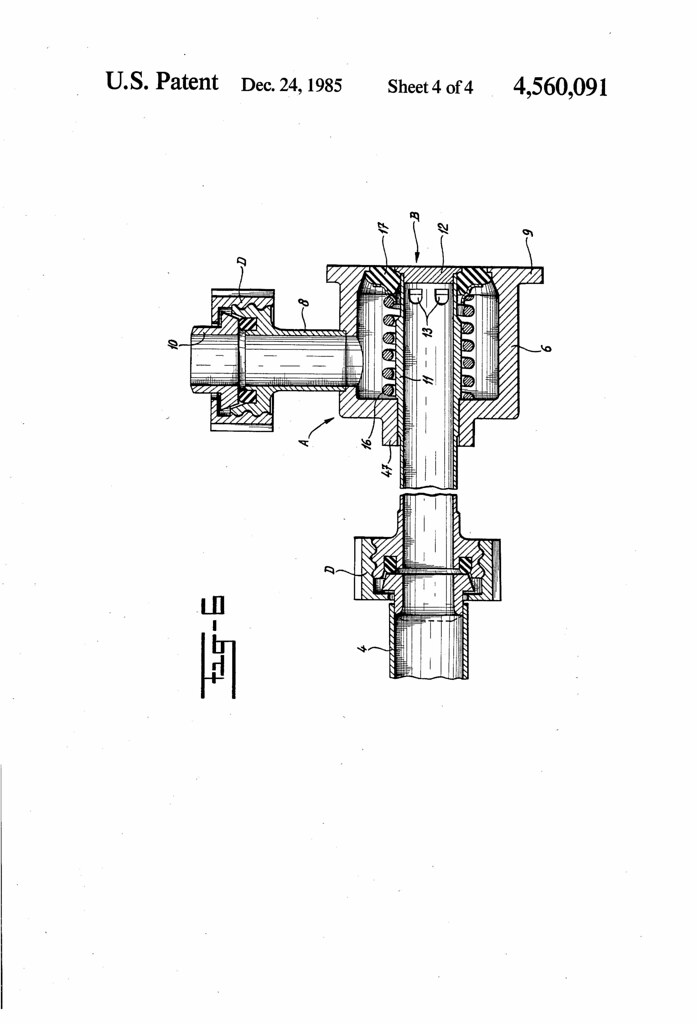
Today in 1985, US Patent 2225996 A was issued, an invention of Hubertus J. Souren, assigned to Grolsche Bierbrouwerij B.V., for his “Stationary Beer Container.” Here’s the Abstract:

A stationary beer container having upper and lower end connections coupled with a flow line coupling and valve assembly adapted to cooperate with a standard beer tap head used with barrels or kegs. The flow line coupling and housing assembly of the invention is connected with a line to the lower end of the beer container and a vertical line to the upper end of the container including a transparent section for determining the beer level in the container. The same type of tap head is used for tapping beer from the container, filing the container, and cleaning the container.

US4560091-1
US4560091-2
US4560091-3
US4560091-4

Filed Under: Beers, Breweries, Just For Fun, Politics & Law, Related Pleasures Tagged With: Brewing Equipment, History, Law, Patent, Science of Brewing

Patent No. 3927680A: Machine For Picking Hops

December 23, 2015 By Jay Brooks

patent-logo
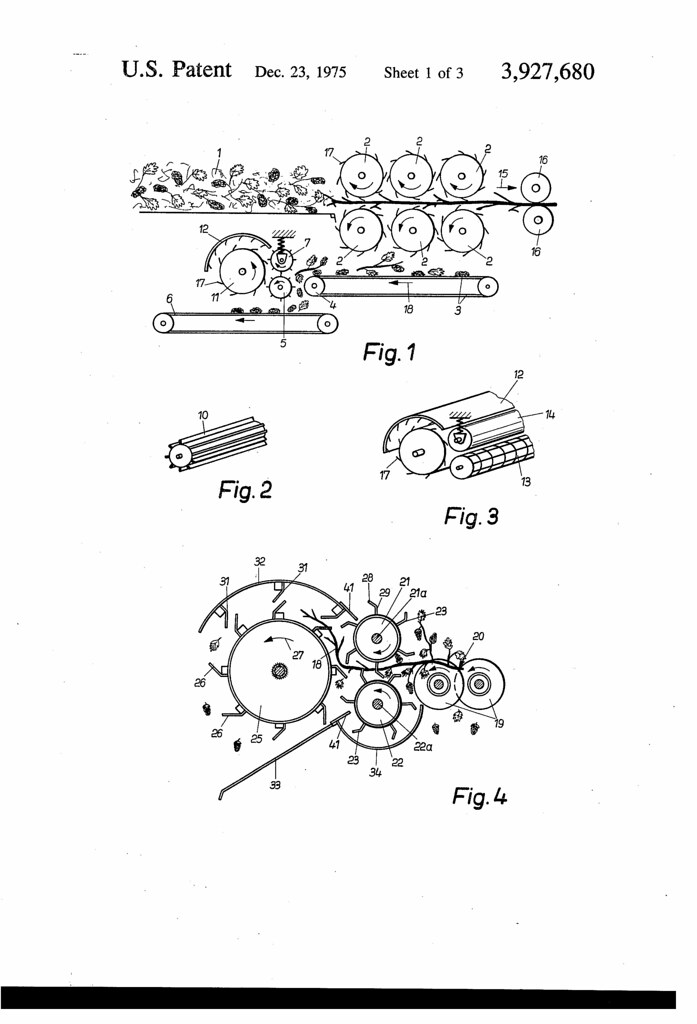
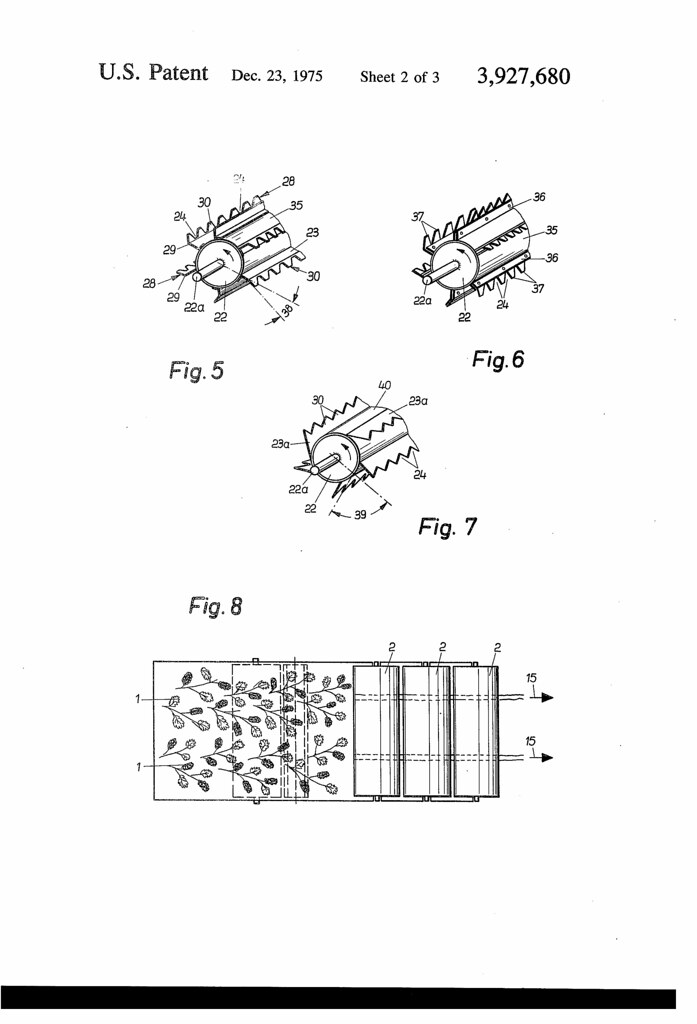
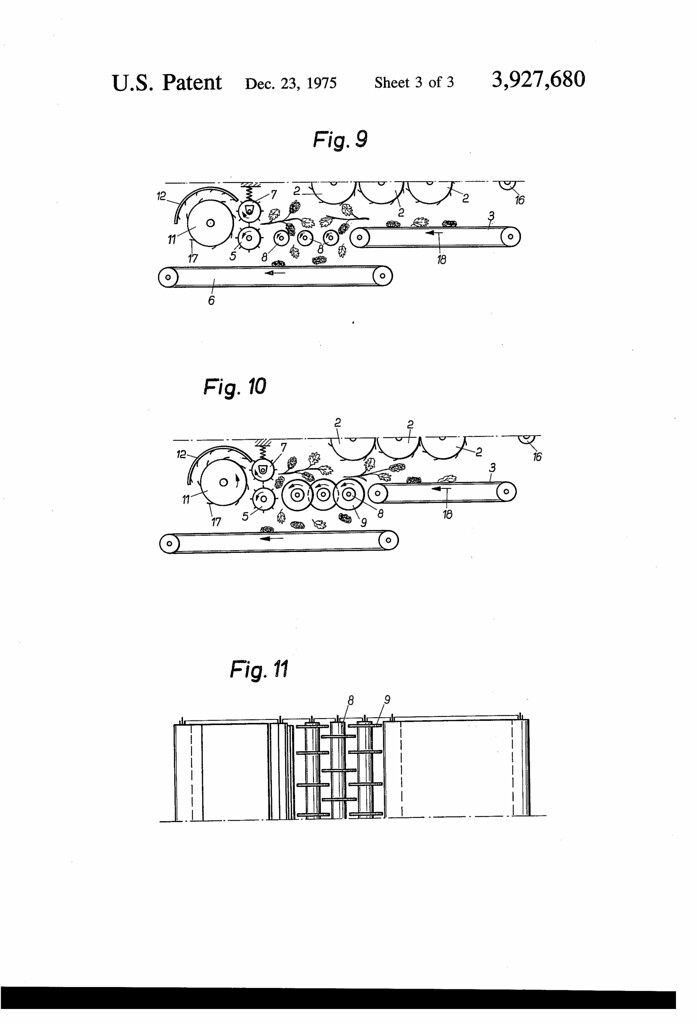
Today in 1975, US Patent 3927680 A was issued, an invention of Hermann Daum and Johann Stefan, for their “Machine For Picking Hops.” Here’s the Abstract:

This invention relates to a hop picking machine and more particularly to a hop picking machine which includes a device for performing a secondary picking operation.

US3927680-1
US3927680-2
US3927680-3

Filed Under: Beers, Just For Fun, Politics & Law, Related Pleasures Tagged With: Brewing Equipment, History, Hops, Law, Patent

Beer In Ads #1767: Open Before Christmas

December 23, 2015 By Jay Brooks


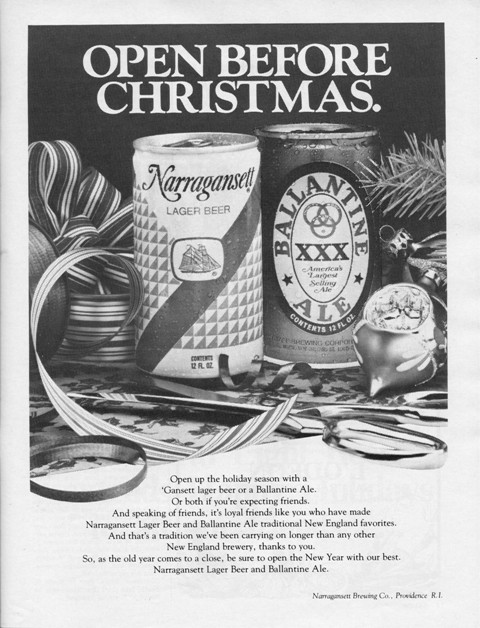
Tuesday’s holiday ad is for both Narragansett Lager Beer and Ballantine, from 1979. Although the ads was created by the Narragansett Brewing Co., they did include a can of Ballantine in the ad, too, and mentioned it in the ad copy that accompanied that it:

Open up the holiday season with a
‘Gansett lager beer or a Ballantine Ale.
Or both if you’re expecting friends.
And speaking of friends, it’s loyal friends like you who have made Narragansett Lager Beer and Ballantine Ale traditional New England favorites.
And that’s a tradition we’ve been carrying on longer than any other New England brewery, thanks to you.
So, as the old year comes to a close, be sure to open the New Year with our best Narragansett Lager Beer and Ballantine Ale.

xmas-gansett_1979

Filed Under: Beers Tagged With: Christmas, History, Holidays, Law, Patent

« Previous Page
Next Page »

Find Something

Northern California Breweries

Please consider purchasing my latest book, California Breweries North, available from Amazon, or ask for it at your local bookstore.

Recent Comments

  • Bob Paolino on Beer Birthday: Grant Johnston
  • Gambrinus on Historic Beer Birthday: A.J. Houghton
  • Ernie Dewing on Historic Beer Birthday: Charles William Bergner 
  • Steve 'Pudgy' De Rose on Historic Beer Birthday: Jacob Schmidt
  • Jay Brooks on Beer Birthday: Bill Owens

Recent Posts

  • Historic Beer Birthday: John J. Schlawig February 27, 2026
  • Beer In Ads #5134: Lord Bushkill On Bushkill Bock February 27, 2026
  • Historic Beer Birthday: William Henry Beadleston February 27, 2026
  • Beer In Ads #5133: Going… Going… SB Bock February 26, 2026
  • Beer Birthday: Art Larrance February 26, 2026

BBB Archives

Feedback

Head Quarter
This site is hosted and maintained by H25Q.dev. Any questions or comments for the webmaster can be directed here.