Brookston Beer Bulletin

Jay R. Brooks on Beer

  • Home
  • About
  • Editorial
  • Birthdays
  • Art & Beer

Socialize

  • Dribbble
  • Email
  • Facebook
  • Flickr
  • GitHub
  • Instagram
  • LinkedIn
  • Pinterest
  • RSS
  • Twitter
  • YouTube

Powered by Genesis

Patent No. 2816032A: Method Of Preparing A Hops Powder

December 10, 2015 By Jay Brooks

patent-logo
Today in 1957, US Patent 2816032 A was issued, an invention of Willy Heyer, for his “Method of Preparing a Hops Powder.” There’s no Abstract, although in the description it includes this summary:

The present invention relates to a method of preparing a hops powder by extracting natural or fresh hops with the aid of an alkaline solvent. A hops powder prepared by the method according to the invention has an application as a base material in the making of beer.

According to the invention, the hops is extracted in a brewing wort of 4 to 6 percent and softened brewing water, the hydrogen ion concentration (pH number) being adjusted from 8.0 to 8.3. With the pH number maintained within this range, an optimum yield of iso-humulone is obtained, which substance is of prime importance in regard to the making of beer, said substance being obtained as a transformation product of humulone which latter is soluble in wort and beer to a very slight extent only.

According to a specific object of the invention the desired pH number of between 8.0 and 8.3 is adjusted by the addition of alkaline salts. Substances particularly suitable for this purpose are soda lye, soda, potash and in the case of boiling under pressure, salt of ammonium. One major object of the invention is to be seen in the fact that the pH number, once it ‘has been adjusted to a value between 8.0 and 8.3, is stabilized by a buffer substance contained in the wort. A suitable buffer substance, is for example a solvent of potassium-sodium phosphate. A buffer substance of this type may be relied upon to maintain substantially constant the pH number which may take any value between 8.0 and 8.3, the use r of the butter substance preventing the pH number from exceeding its upper limiting value, thus preventing any undesirable formation of humulinic acid.

The adjustment of the pH number between 8.0 and 8.3 may be performed, according to the invention, by titrimetric or electrometric methods.

Untitled

Filed Under: Beers, Breweries, Just For Fun, Politics & Law, Related Pleasures Tagged With: History, Hops, Law, Patent, Science of Brewing

Patent No. 4557186A: Brewing Apparatus

December 10, 2015 By Jay Brooks

patent-logo
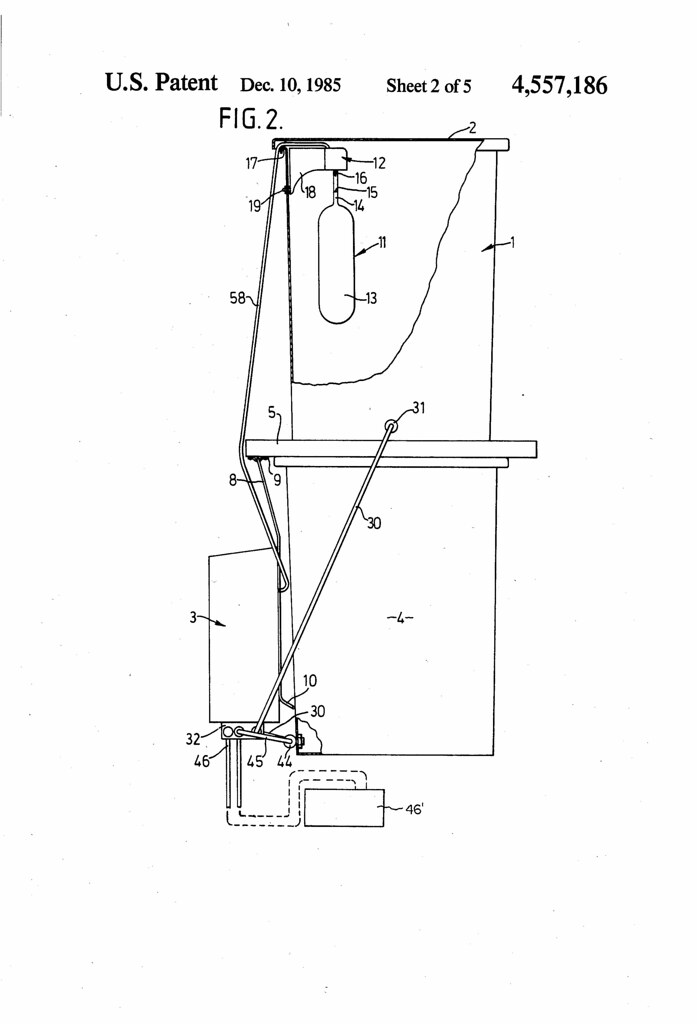
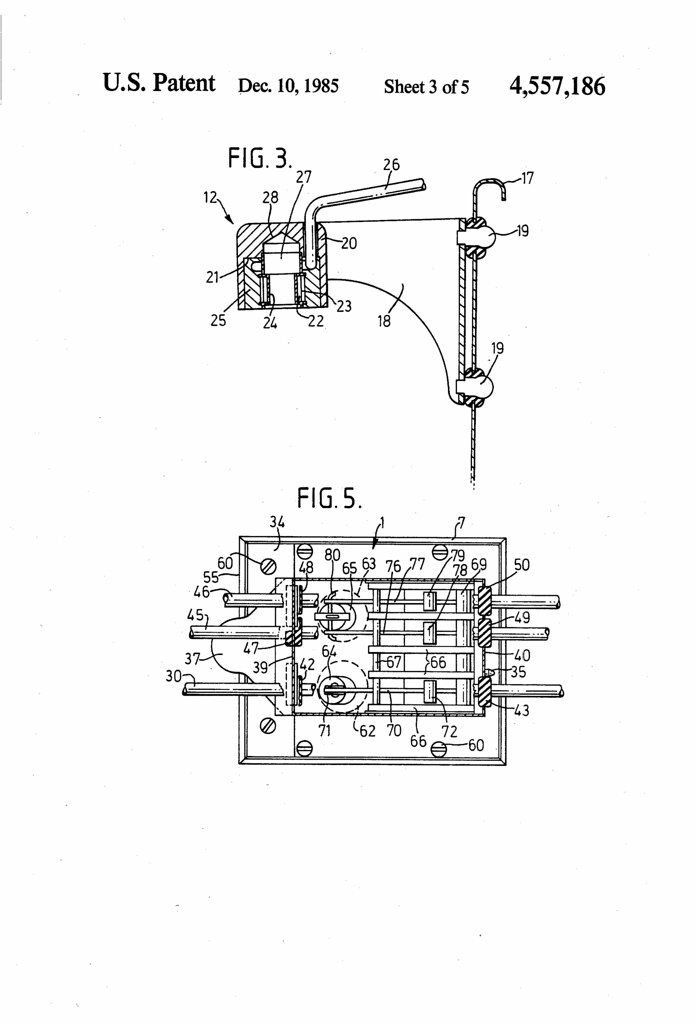
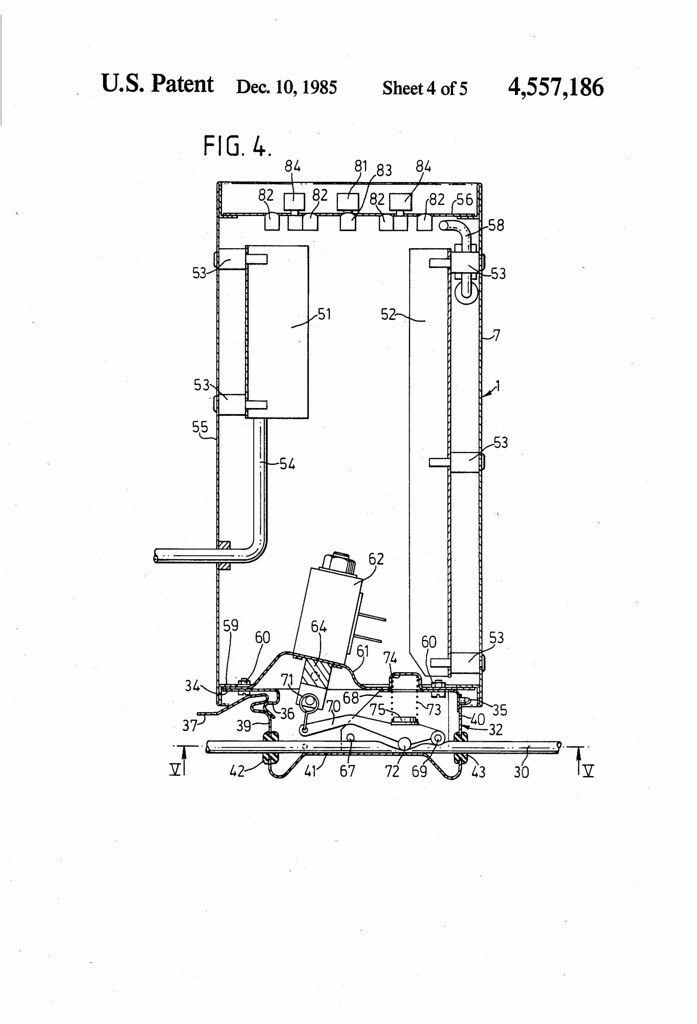
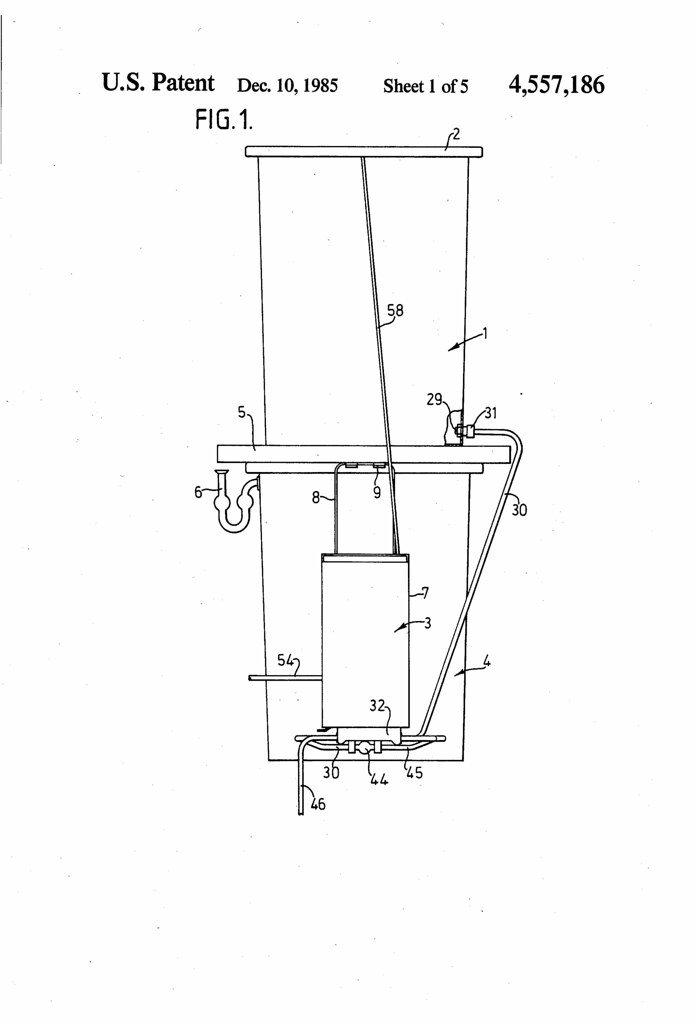
Today in 1985, US Patent 4557186 A was issued, another invention of Christopher J. L. Brown, assigned to Bowmans Brewer, Ltd., for his “Brewing Apparatus.” Here’s the Abstract:

Brewing apparatus for batch brewing beer or ale comprises a fermentation vessel 1 in which a fermentable liquor is contained, a float hydrometer 11 and a sensor 12 for monitoring downward displacement of the hydrometer 11 as the specific gravity of the liquor reduces due to fermentation. The sensor 12 includes means for providing a signal in a controller 3 at a desired specific gravity to indicate completion of the required fermentation and the controller 3 is operable to control automatic transfer of the fermented liquor to a maturing vessel 4 and, after a predetermined time interval to a barrel or the like.

Untitled
Untitled
Untitled
Untitled

Filed Under: Beers, Breweries, Just For Fun, Politics & Law, Related Pleasures Tagged With: Brewing Equipment, History, Law, Patent, Science of Brewing

Patent No. 3415654A: Deep Vat Fermentation Of Beer

December 10, 2015 By Jay Brooks

patent-logo
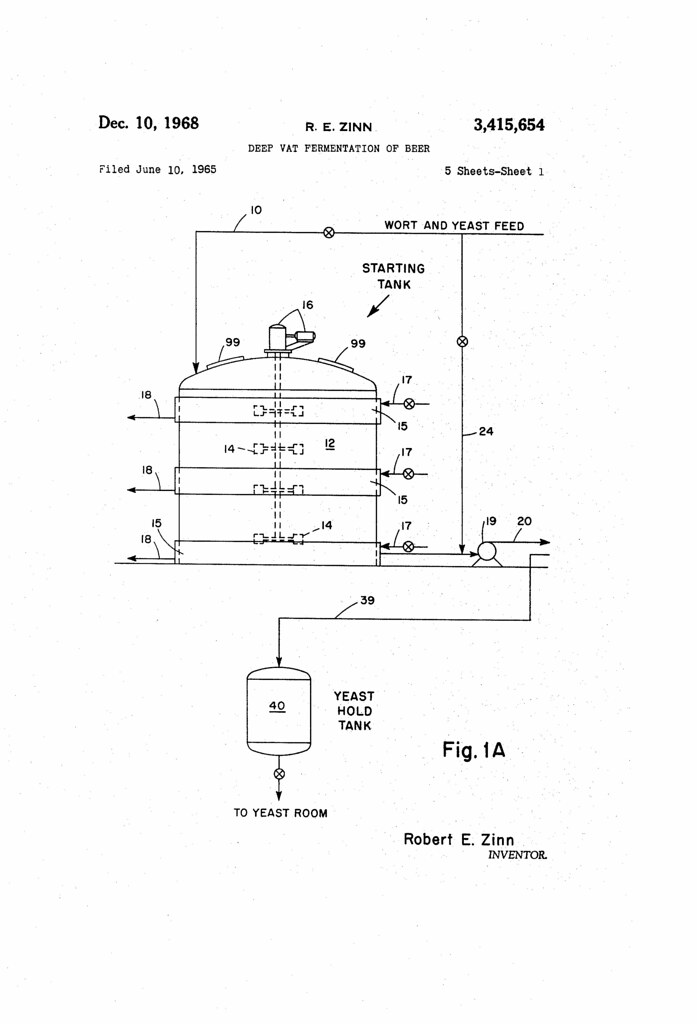
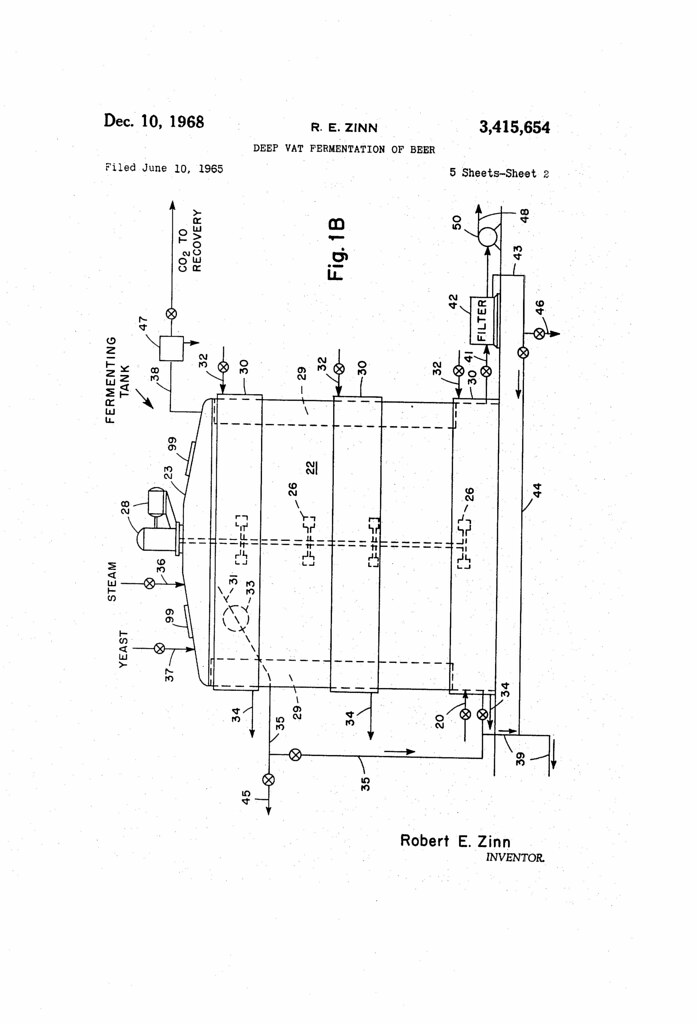
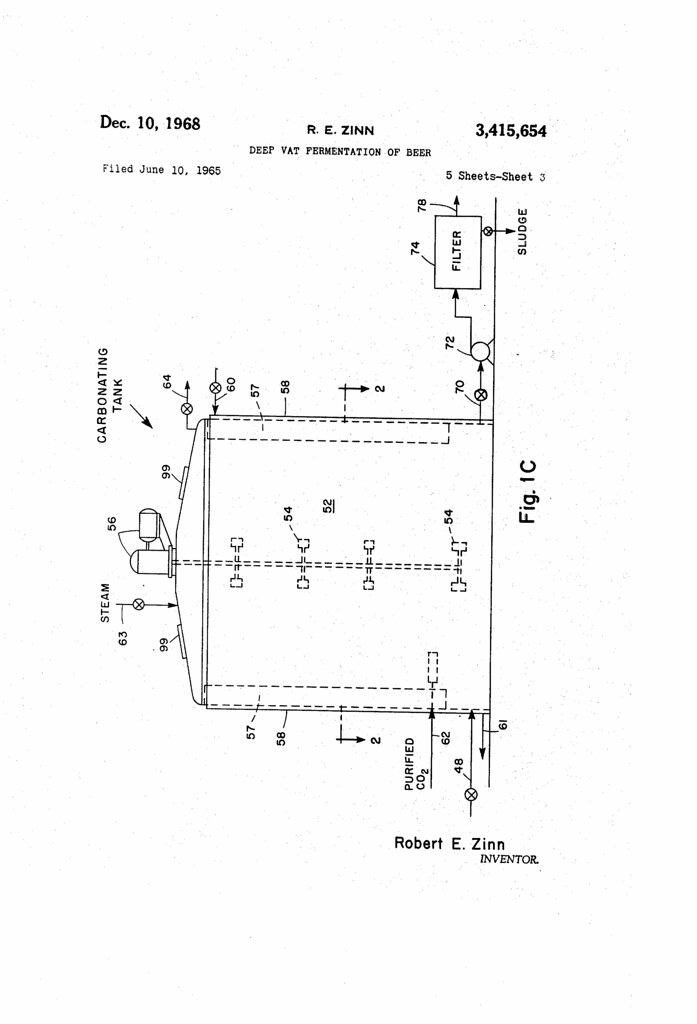
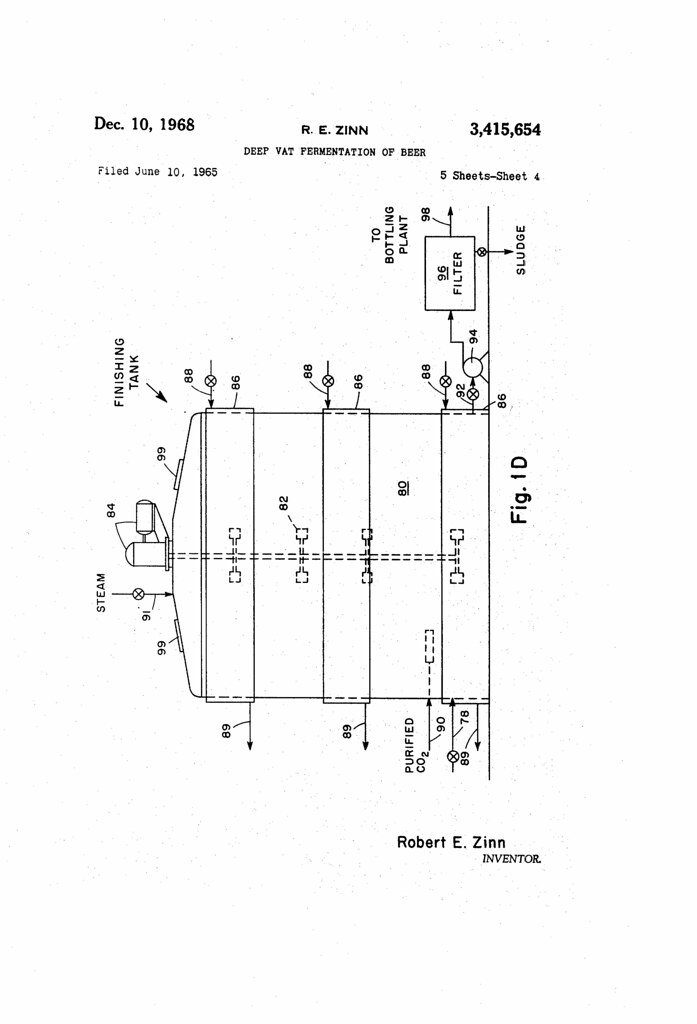
Today in 1968, US Patent 3415654 A was issued, another invention of Robert E. Zinn, assigned to Falstaff Brewing Corp., for his “Deep Vat Fermentation of Beer.” There’s no Abstract, although in the description it includes this summary:

This invention relates to an improved process for making beer, and to apparatus for carrying out the process. By the term beer is meant the various fermented malt beverages commonly included within that term, e.g., lager, ale, bock, porter, and stout. The fermentation of malt beverages is similar in many respects to fermentations in general; however, the consumption of the product by humans to satisfy thirst and for pleasure imposes unique and severe organoleptic criteria on the product.

It has now been found, in accordance with the present invention, that the fermentation of beer, to produce a highly acceptable product, can be carried out advantageously without the use of cellars and in thermally insulated and temperature-controlled individual tanks which provide the requisite greater beer depth and thus the greater foam depth. Despite the greater static pressure in the brew at these greater depths, the normal course of yeast-wort fermentation can unexpectedly be achieved, although hitherto it has generally been considered impossible or undesirable. Additionally, a volume of fermenting beer confined to a deep tank has a smaller surface area exposed to air than the same volume in a shallow tank. Preferably, the reciprocal ratio of surface area to the volume of liquid should be at least 20, and may exceed 60 or more. It will be noted that depth alone controls the surface area to volume ratio of the beer liquid.

A principal object of the present invention is therefore to provide a method of and apparatus for deep fermentation of beer with improved control of foam removal.

It is an object of the invention to provide a process of deep fermentation where the reciprocal ratio of surface area to the volume of liquid is at least 20. It is another object of the invention to provide a deep fermentation process wherein the reciprocal ratio of surface area to volume of liquid exceeds 40.

The object of this invention is attained by providing one or more deep fermentation tanks or fermenters of sufficient size to provide a beer depth of at least 20 feet, each tank being jacketed with suitable temperature control means adequate to assure the desired temperatures within the tanks. These tanks are supplied with wort and yeast and other conventional ingredients prepared in the usual fashion for supplying to beer fermentation tanks. Provisions are also made for thoroughly mixing the ingredients as fed to the fermentation tanks, and preferably also for circulation of the contents of such tanks during fermentation, so that the yeast may be effectively distributed throughout the fermenting mass to provide complete uniformity, thus assisting in assuring desired taste characteristics of the fermented product. Each fermenter is provided with means for selectively removing foam from the brew surface.

Untitled
Untitled
Untitled
Untitled

Filed Under: Beers, Breweries, Just For Fun, Politics & Law, Related Pleasures Tagged With: Brewing Equipment, History, Law, Patent, Science of Brewing

Patent No. 2916421A: Straining Tank

December 8, 2015 By Jay Brooks

patent-logo
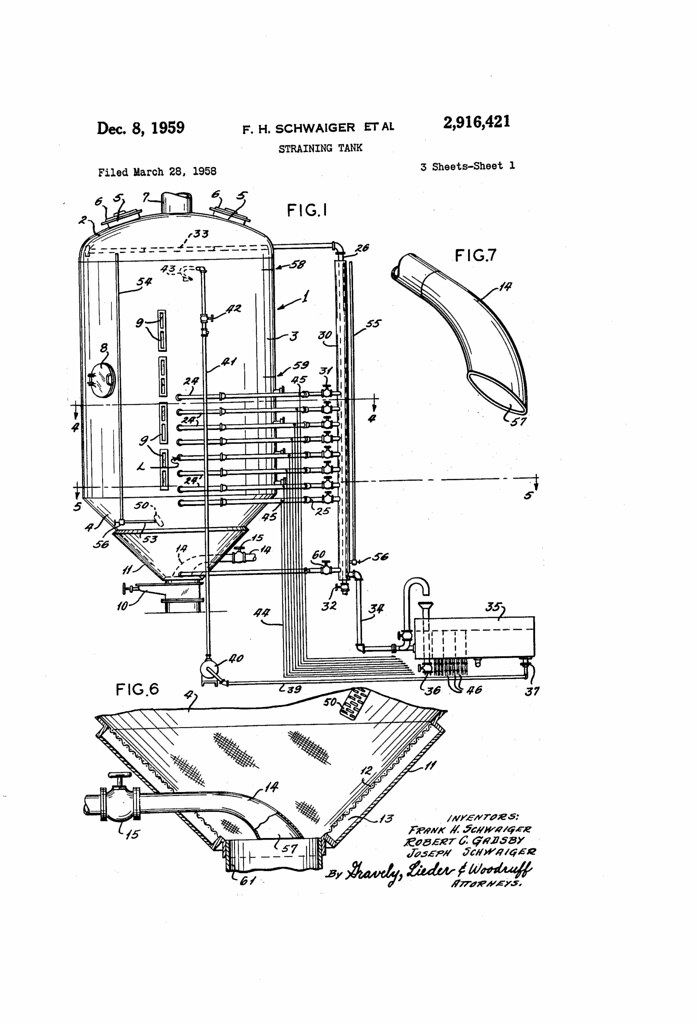
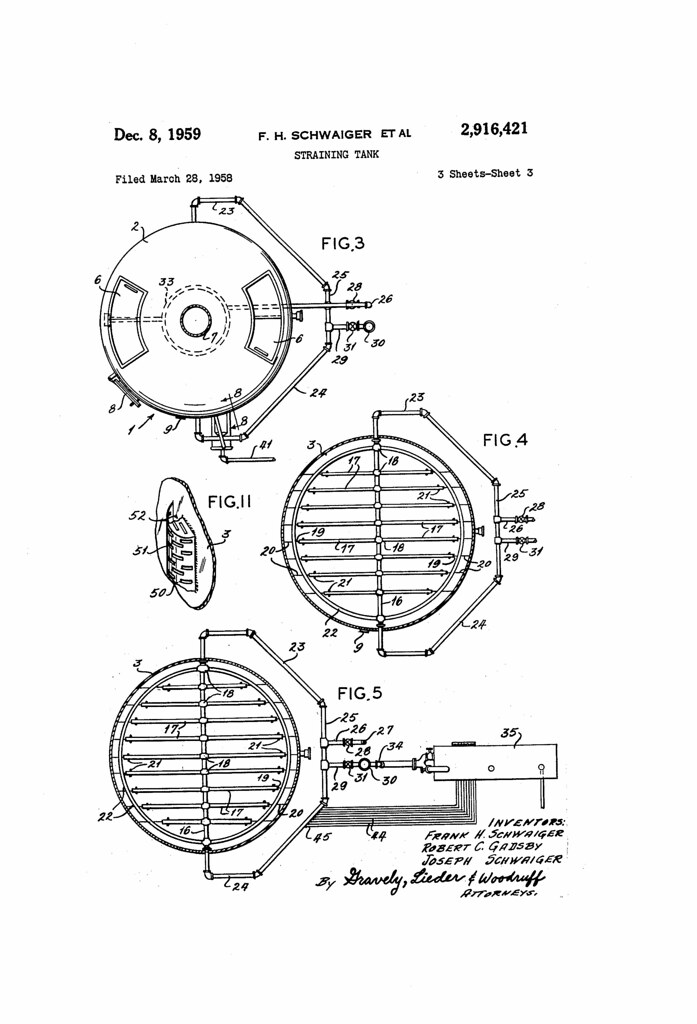
Today in 1959, US Patent 2916421 A was issued, another invention of Robert C. Gadsby, Joseph Schwaiger and Frank H. Schwaiger, assigned to Anheuser Busch, for their “Straining Tank.” There’s no Abstract, although in the description it includes this summary:

This invention relates to a straining tank or grain extractor or lauter tub, and more particularly to a new type of straining tank for use in the brewing industry to remove extract from brewers grains.

One of the principal objects of the present invention is to increase the efficiency of the extraction of soluble substances from material within a straining tank. Another object is to provide a’straining tank with the shortest exposure and contact time between the wort and grains and between the sparge water and the grains which have substances extracted therefrom, thereby extracting less of the undesired substances from the husks of the grains. This results in a cleaner and milder flavor for the resulting wort. Another object is to eliminate the mechanical agitator formerly required and avoid the formation of channels which the numerous knife .blades previously cut into the grain bed.

Another object of the present invention is to provide a straining tank which is relatively small and inexpensive compared to those lauter tubs and mash filters presently used to remove extracts from grains. Another object is to increase .the capacity for removing extracts from grains in a brewing operation, thereby increasing the capacity of the brewery. Another object is to provide a straining device which requires less time per batch and allows more brews per day. Another object is to provide for the fast removal of spent grains from a straining tank which can then be easily and rapidly cleaned.

Still another object is to provide a device which has a smaller initial cost and which requires fewer operators than previously required to efficiently operate a straining tank or mash filter.

Untitled
Untitled
Untitled

Filed Under: Beers, Breweries, Just For Fun, Politics & Law, Related Pleasures Tagged With: Brewing Equipment, History, Law, Patent, Science of Brewing

Patent No. 3625843A: Method For Treating Beer

December 7, 2015 By Jay Brooks

patent-logo
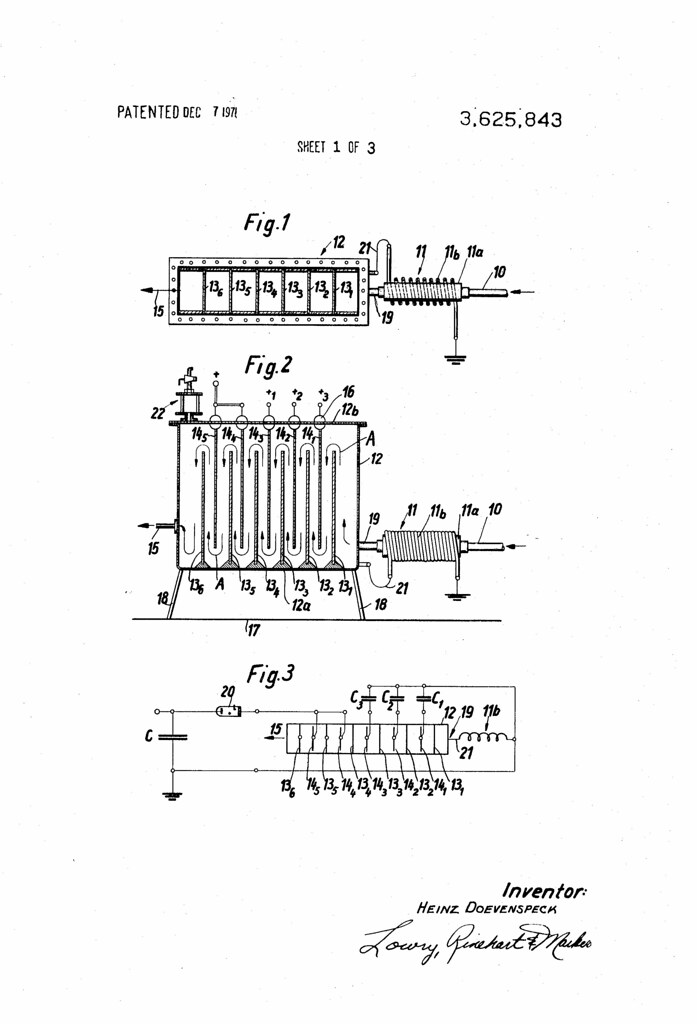
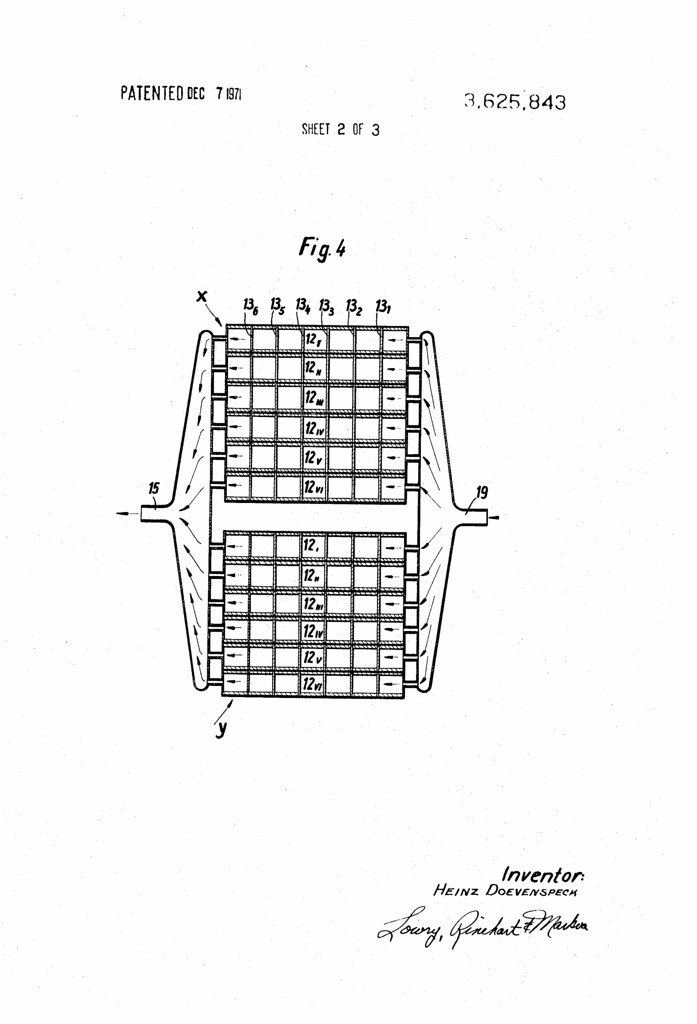
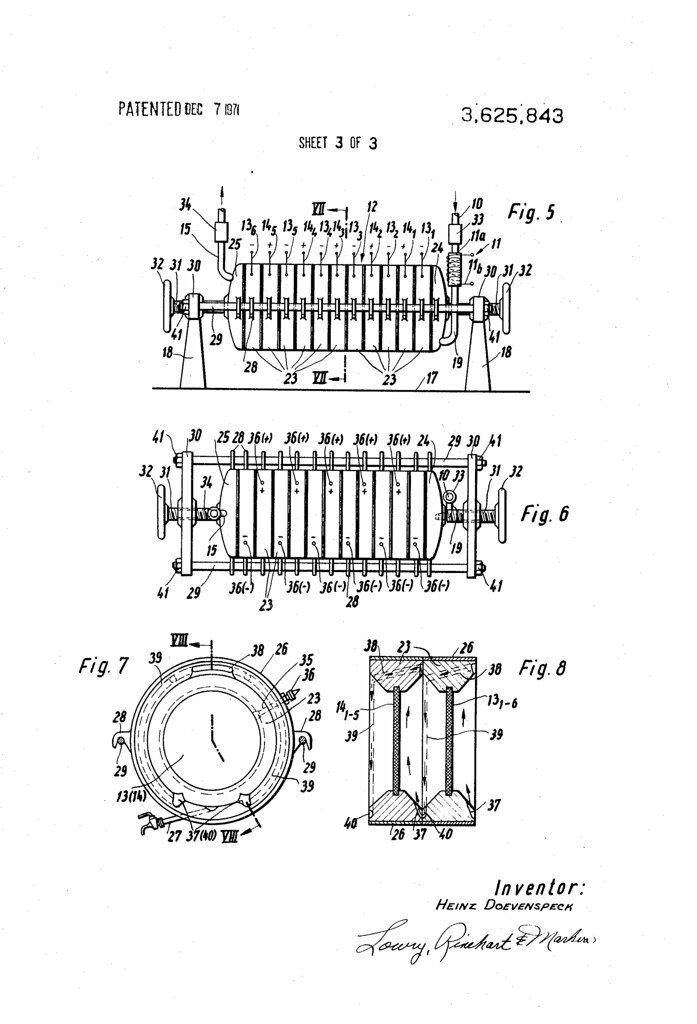
Today in 1971, US Patent 3625843 A was issued, another invention of Heinz Doevenspeck, for his “Method For Treating Beer.” There’s no Abstract, although in the description it includes this summary:

It is an object of the present invention to develop this prior art method and, in particular, to render it applicable with advantage to the treatment of liquids, preferably of beer. The method is intended to be developed in a manner as to enable the same to be carried out at temperatures of only about 25 C, thereby to prevent changes in flavor and color of the liquids to be treated and to obtain, at the same time, pasteurization and/or sterilization as well as stabilization of the liquids for the purpose of increasing the durability thereof.

Untitled
Untitled
Untitled

Filed Under: Beers, Breweries, Just For Fun, Politics & Law, Related Pleasures Tagged With: Brewing Equipment, History, Law, Patent, Science of Brewing

Patent No. 3290153A: Process And Apparatus For Concentrating Wort

December 6, 2015 By Jay Brooks

patent-logo
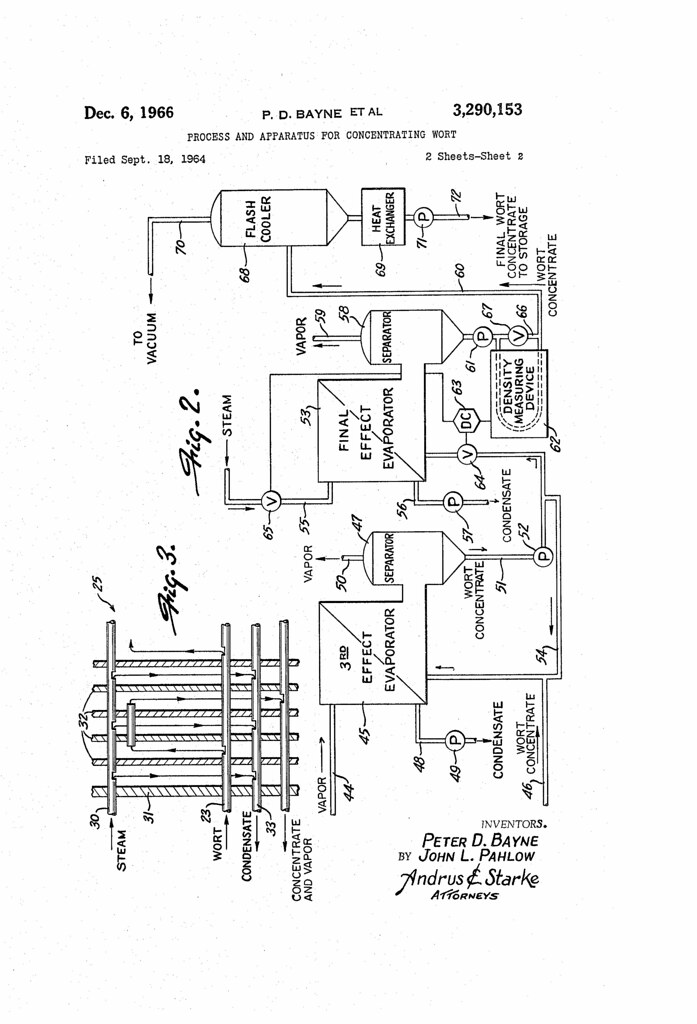
Today in 1966, US Patent 3290153 A was issued, an invention of Peter D. Bayne and John L. Pahlow, assigned to Schlitz Brewing Co., for his “Process and Apparatus for Concentrating Wort.” There’s no Abstract, although in the description it includes this summary:

The process of the invention, which includes the continuous film evaporation under high temperature and short holding time conditions, prevents degradation or color gain of the wort. On reconstitution, identical or organoleptic properties of the original wort are obtained.

The process of the invention utilizes a continuous flow of wort which is obtained by use of the pair of hot wort settling tanks in combination with the centrifuge so that a continuous supply of wort is available. Thus, it is not necessary to cease openation while waiting for a new batch of wort. l

A provision is also made in the process for automatically adding hop constituents to the Wort in the holding tank. A portion of the hop constituents will be lost during the concentrating process, and to compensate for this loss, a predetermined amount of hop constituents may be empirically added during the concentration process.

In addition, the process employs a density control mechanism which accurately regulate-s the final specific -gravity or concentration of the wort. The wort being discharged from the finishing evaporator passes through the density control mechanism which regulates the heating medium used in the` evaporator so that a uniform degree of Wort concentration is obtained.

Untitled
Untitled

Filed Under: Beers, Breweries, Just For Fun, Politics & Law, Related Pleasures Tagged With: Brewing Equipment, History, Law, Patent, Science of Brewing, Wort

Patent No. 2772975A: Injecting Of Hops In The Brewing Of Beer

December 4, 2015 By Jay Brooks

patent-logo
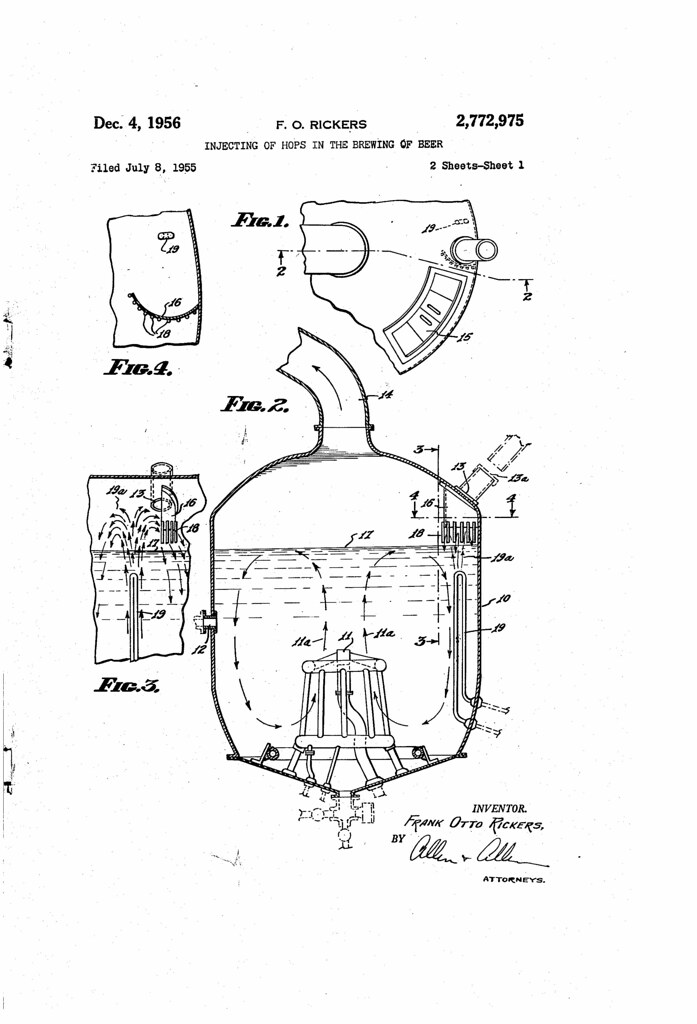
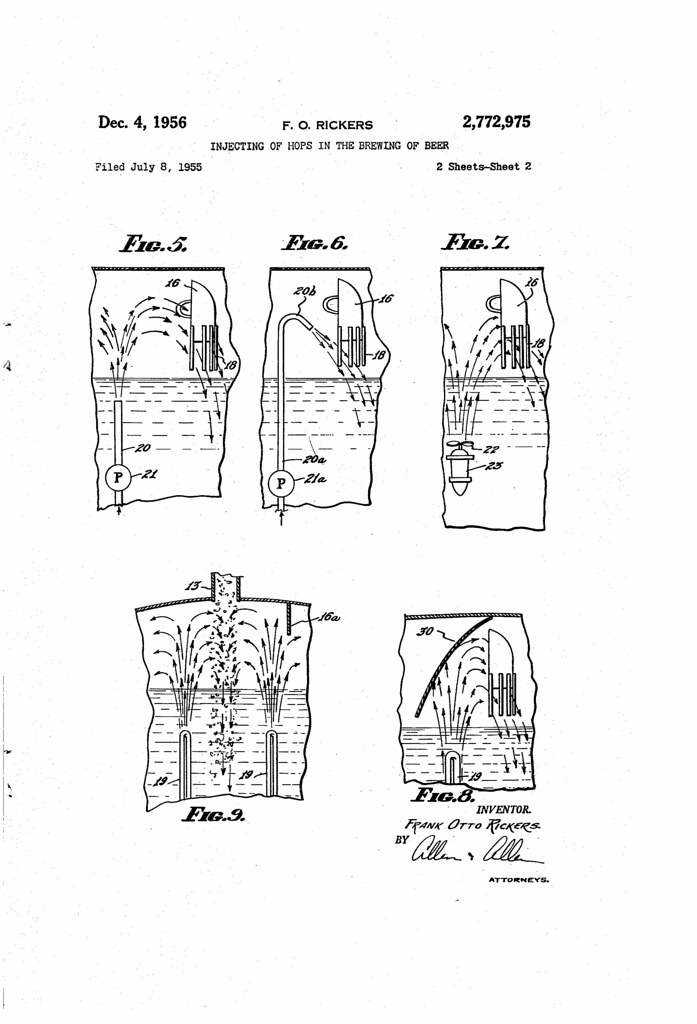
Today in 1956, US Patent 2772975 A was issued, an invention of Frank Otto Rickers, assigned to the Geo Wiedemann Brewing Co. Inc., for his “Injecting Of Hops In The Brewing Of Beer.” There’s no Abstract, although in the description it includes this summary:

It is an object of the present invention to provide for the addition of the hops to a brew kettle in a manner such that the hops will be uniformly distributed through the brew and for greatly increased control over this step of the brewing so any deteriorating effect is prevented by storing in cold temperature so that the loss of hops up the flue will be minimized. Thus, it is an object of the present invention to provide process to the end that each successive brew will have undergone the same length of time in the cooking of the same amount of hops.

Briefly, in the practice of my invention I provide means for insuring that the hops, as they are added to the kettle, are wetted down and caused to enter below the surface of the brew in a rather closely confined area and I provide for a localized ebullition and circulation of the brew such that the lumps or fragments of hops are carried by this localized ebullition and circulation down into the bottom of the kettle whence they are uniformly distributed by the general circulation in the kettle.

Untitled

Filed Under: Beers, Breweries, Just For Fun, Politics & Law, Related Pleasures Tagged With: Brewing Equipment, History, Hops, Law, Patent, Science of Brewing

Patent No. 3544329A: Electrolysis Of Fermented Beverages

December 1, 2015 By Jay Brooks

patent-logo
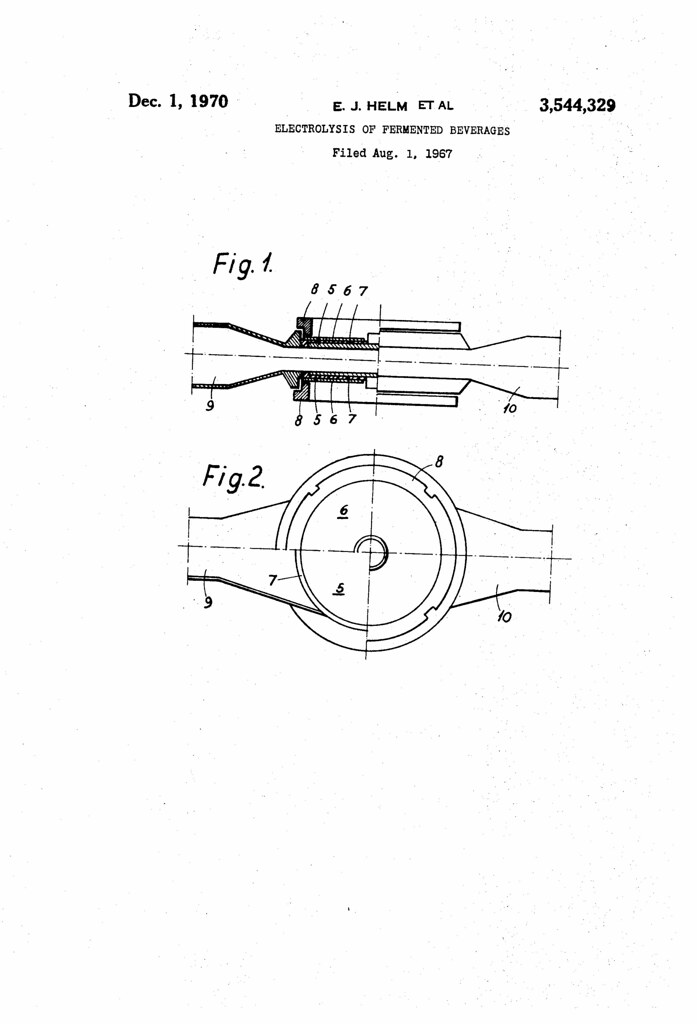
Today in 1970, US Patent 3544329 A was issued, an invention of Erik Johannes Helm and Richard Stanley Wrey Thorne, for their “Electrolysis of Fermented Beverages.” There’s no Abstract, although in the description it includes this summary:

This invention relates to a method and means for the improvement of the flavour of fermented beverages, such as beers, ciders, and wines, by elimination of hydrogen sulphide produced during fermentation.

Hydrogen sulphide is a normal product of yeast metabolism; during fermentation of beverages such as beer it is produced from cysteine by desulphuration and from inorganic sulphate by reduction, and probably from other precursors as well. It is well known to brewers that beer, and particularly newly fermented beer, for this reason often contains so much hydrogen sulphide as seriously to impair its avour, and especially its aroma. Generally speaking, this circumstance applies both to bottom-fermented beers (pilsner and lager types) and to top-fermented beers (ale and stout types).

This hydrogen sulphide may disappear during the maturation of beer, a process which consists essentially of a slow secondary fermentation, the hydrogen sulphide being swept out of the beer by the slowly evolving carbon dioxide. In practice, however, it is often found that for one reason or another the finished beer still retains a sensible concentration of hydrogen sulphide; particularly in the case of pilsner type beers this residual hydrogen sulphide may be sucient to detract from the delicacy of their llavoun The concentration of hydrogen sulphide in iinished beers may vary from inappreciable traces up to about 0.06 p.p.m. Its presence is already perceptible at a concentration of about 0.005 p.p.m.; at this level it is hardly perceived as such, but rather as modifying the general beer aroma. At 0.005 to 0.02 p.p.m. its odour has been described as yeasty or sulphury, i.e. more or less abnormal and undesirable. At about 0.05 p.p.m. it is recognizable as the characteristic hydrogen sulphide stench. Thus, while very low concentrations of hydrogen sulphide, say, less than 0.005 p.p.m. may not be objectionable in beer, and may even contribute a desirable element to its aroma, higher levels than this are definitely undesirable and perceived as a defect.

Accordingly, a process for the elimination of hydrogen sulphide from beer or its reduction to an imperceptible level, a process which might help to abbreviate the economically expensive secondary fermentation, is much to be desired.

The extremely low solubility product of copper sulphide suggests that a very simple means to this end might be to dose small quantities of, for example copper sulphate into beer so as to precipitate all of its hydrogen sulphide in the form of copper sulphide which would be subsequently removed during the regular beer ltration prior to bottling. However, the fact that beers normally contain traces of copper of the order of 0.1 p.p.m. or more which are as a rule more than equivalent to the amount of hydrogen sulphide to be removed, Without any such removal actually taking place, suggests that the problem is not quite so simple as it may at rst sight appear. It is true that the addition of an excess of copper sulphate to beer, of the order of l p.p.m. of copper, does indeed remove all perceptible hydrogen sulphide from it, but the relatively high concentration of residual copper remaining in the beer constitutes such a technical disadvantage that this procedure could not be seriously advocated for practical use. The drawback attaching to soluble copper in beer is that it rather drastically reduces the stability (shelflife) of the beer: copper accelerates the precipitation of proteinaceous material from the beer, rendering it cloudy and unsaleable. Presumably, the small amount of copper normally present in beer is already complexed to proteinaceous material in the beer so that it is unavailable for precipitating the hydrogen sulphide. Similarly, the excessive amount of copper sulphate which is necessary to eliminate hydrogen sulphide from beer must be attributed to most of the copper immediately being complexed, only a minor amount being available to react with the hydrogen sulphide.

The present invention comprises dosing suitably small quantities of copper into beer by means of electrolytic dissolution. Trials have shown that by this procedure the hydrogen sulphide may be removed from beer without causing any appreciable increase in its copper content.

According to this invention, beer, during the course of its passage to the filter, is passed between two electrodes of electrolytic copper, or between two electrodes one of which, the anode, is ot electrolytic copper. By the application of a suitable electromotive force across the electrodes copper passes into solution into the beer; the concentration of copper so dissolved depends only upon (a) the quantity of electricity passing through the beer (measured by the product of current strength and time), and (b) the velocity of the beer flowing past the electrodes. Copper dissolution is therefore precisely controllable by regulating current strength in relation to beer velocity.

Untitled

Filed Under: Beers, Breweries, Just For Fun, Politics & Law, Related Pleasures Tagged With: Brewing Equipment, History, Law, Patent, Science of Brewing

Patent No. 4361080A: Floor For Lautering Vessels

November 30, 2015 By Jay Brooks

patent-logo
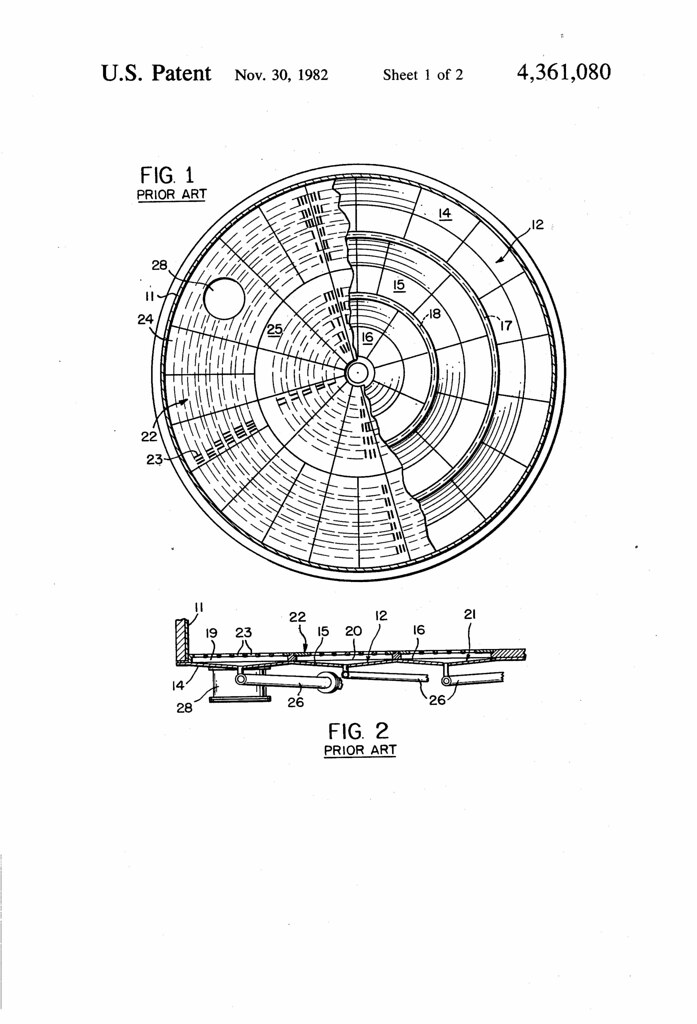
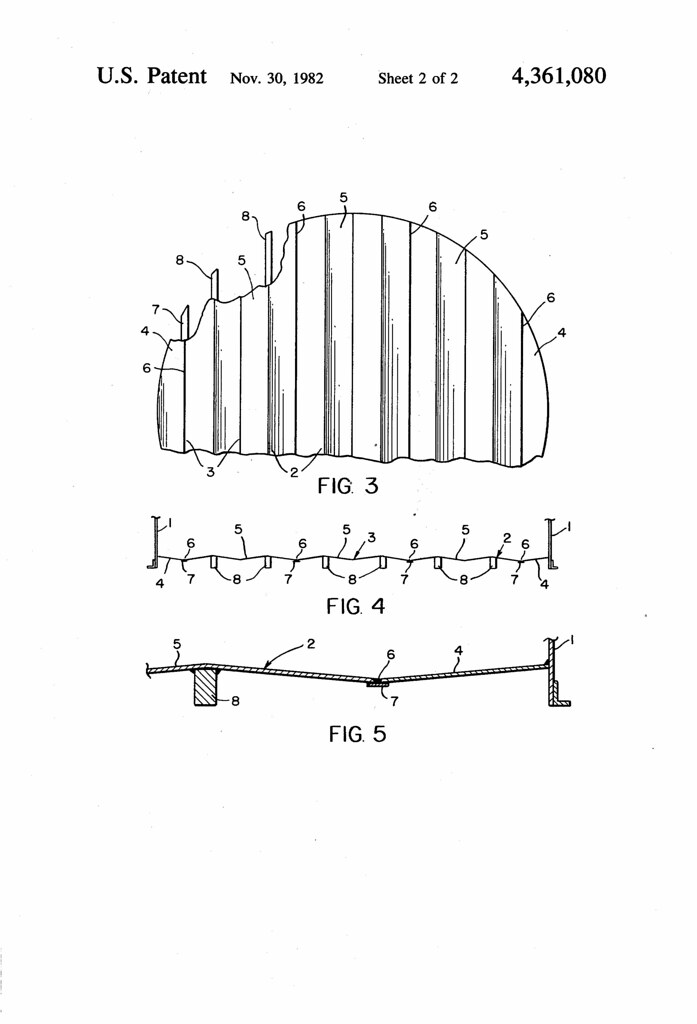
Today in 1982, US Patent 4361080 A was issued, an invention of David K. Smith, Nigel Harlow, and Samuel W. Maxfield, for their “Floor For Lautering Vessels.” Here’s the Abstract:

Disclosed is a real floor for a lauter tun comprising a plurality of elongated linear troughs, each trough extending unobstructed across the bottom of the vessel and each forming a relatively shallow upward opening V-shape. The elements making up the floor are shaped to provide the lauter tun floor with a circular profile.

Untitled
Untitled

Filed Under: Beers, Breweries, Just For Fun, Politics & Law, Related Pleasures Tagged With: Brewing Equipment, History, Law, Patent, Science of Brewing

Patent No. 6968773B1: Vessel And Wort Processing Method For Producing Beer

November 29, 2015 By Jay Brooks

patent-logo
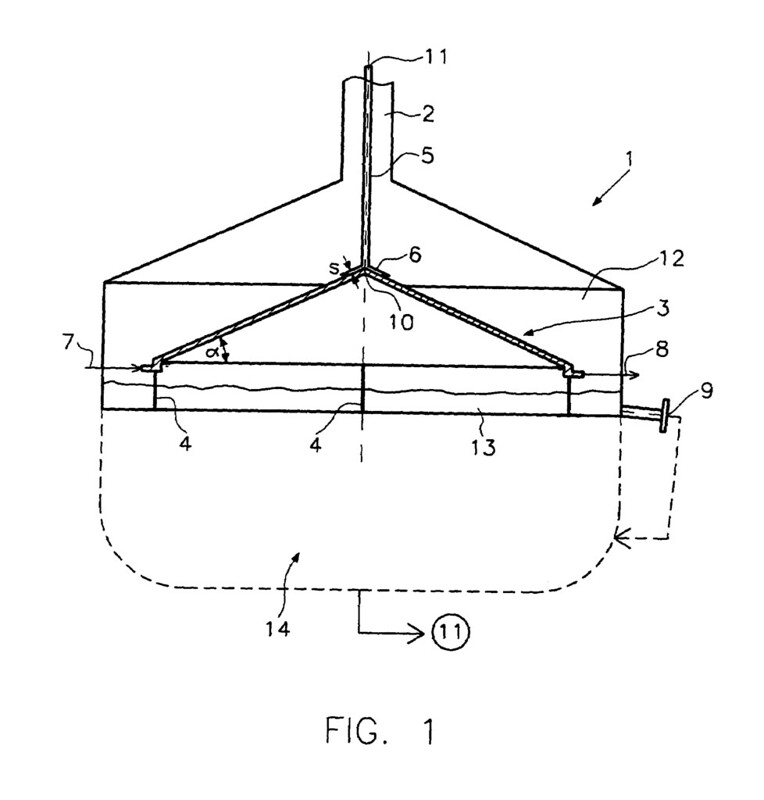
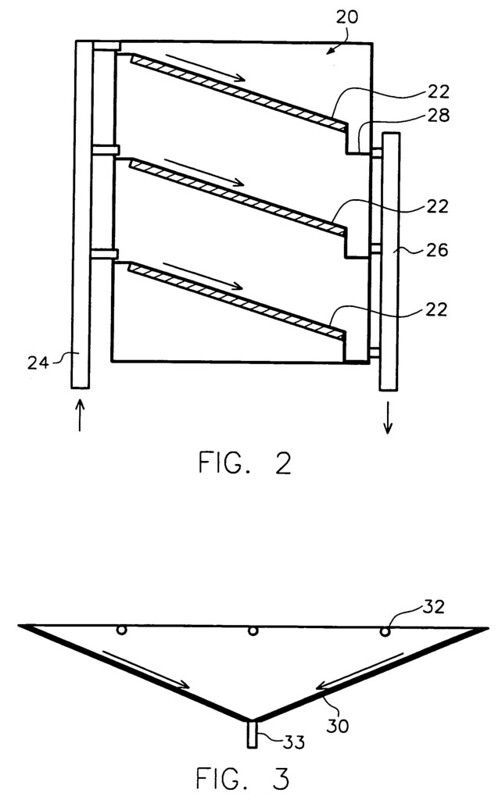
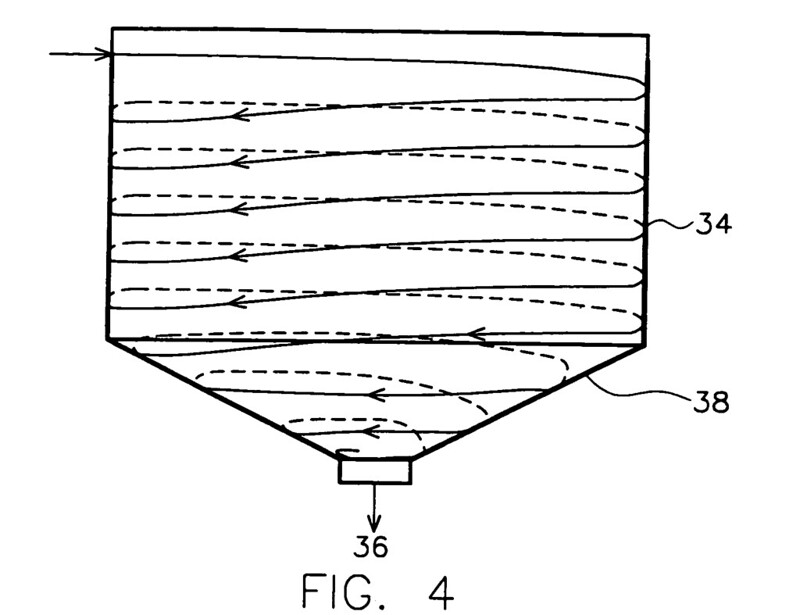
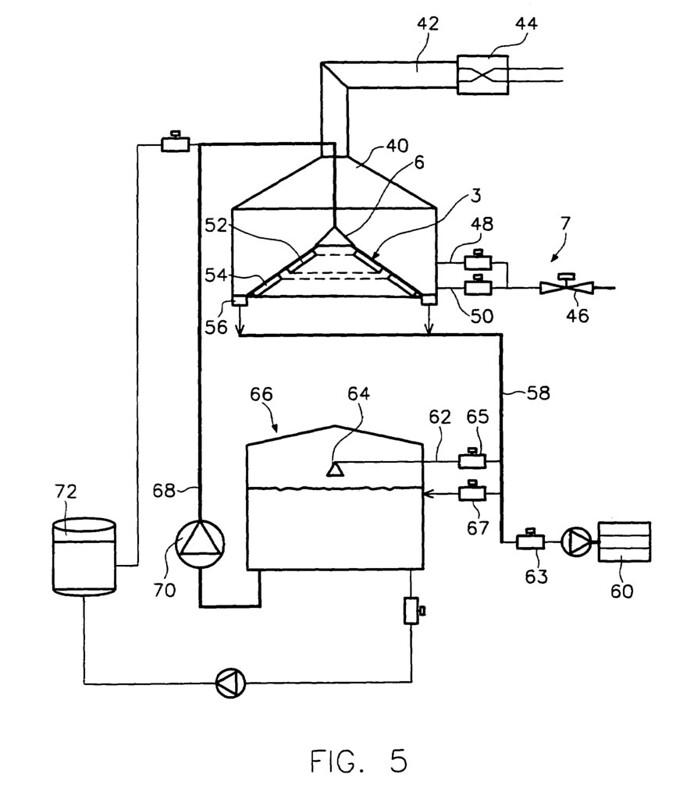
Today in 2005, US Patent 6968773 B1 was issued, an invention of Kurt Stippler and Klaus-Karl Wasmuht, assigned to Anton Steinecker Maschinenfabrik Gmbh, for their “Vessel and Wort Processing Method for Producing Beer.” Here’s the Abstract:

A vessel and a method for thermally treating wort in beer brewing, wherein a wort guiding screen or cone is placed inside the vessel and a feed pipe ending above the wort guiding screen or cone is used to discharge wort from above onto the wort guiding screen or cone. The wort boiling method has the wort discharged onto an inclined, heated guiding surface from which it flows down and spreads into a sheet and is thereby heated.

Untitled

Untitled

Untitled
Untitled

Filed Under: Beers, Breweries, Just For Fun, Politics & Law, Related Pleasures Tagged With: Brewing Equipment, History, Law, Patent, Science of Brewing, Wort

« Previous Page
Next Page »

Find Something

Northern California Breweries

Please consider purchasing my latest book, California Breweries North, available from Amazon, or ask for it at your local bookstore.

Recent Comments

  • Ernie Dewing on Historic Beer Birthday: Charles William Bergner 
  • Steve 'Pudgy' De Rose on Historic Beer Birthday: Jacob Schmidt
  • Jay Brooks on Beer Birthday: Bill Owens
  • Steve 'Pudgy' De Rose on Beer Birthday: Charles Finkel
  • Steve 'Pudgy' De Rose on Beer Birthday: Bill Owens

Recent Posts

  • Historic Beer Birthday: Philip Zorn February 21, 2026
  • Historic Beer Birthday: Rudolph J. Schaefer February 21, 2026
  • Beer Birthday: Kate Bernot February 21, 2026
  • Historic Beer Birthday: William J. Lemp February 21, 2026
  • Beer Birthday: Sayre Piotrkowski February 21, 2026

BBB Archives

Feedback

Head Quarter
This site is hosted and maintained by H25Q.dev. Any questions or comments for the webmaster can be directed here.