Brookston Beer Bulletin

Jay R. Brooks on Beer

  • Home
  • About
  • Editorial
  • Birthdays
  • Art & Beer

Socialize

  • Dribbble
  • Email
  • Facebook
  • Flickr
  • GitHub
  • Instagram
  • LinkedIn
  • Pinterest
  • RSS
  • Twitter
  • YouTube

Powered by Genesis

Patent No. 3212854A: Estimate Of Hop Bitter Substance In Beer

October 19, 2015 By Jay Brooks

patent-logo
Today in 1965, US Patent 3212854 A was issued, an invention of Mohd Akhtar and Max William Betts, for their “Estimate of Hop Bitter Substance in Beer.” There’s no Abstract, although in the description it includes this summary:

This invention relates to the extraction of substances which impart the distinctive bitter taste to beer and to their estimation.

In this specification by hop bitter substances we mean all isohumulones, and humulones as well as humulinic and isohurnulinic acids as well as any other substances which may contribute to the bitter taste of been In this specification by the term beer (except where otherwise stated) we mean hopped wort or beer or any other liquid used in a brewing process whose hop bitter content is required to be known. We also intend the term beer to include any beer in the complete range from light beers such as lagers to heavy beers such as stouts.

The percentage of hop bitter substances in hops varies sufficiently to affect the bitterness of a beer, but until recently no satisfactory chemical method for estimating hop bitter substances was known. Therefore, to keep the bitterness of a beer produced constant, experts had to taste it during the brewing process and advise on what additions were needed. This not only made the product dependent on human judgment but also necessitated brewing beer in batches.

According to the present invention a process for estimating the hop bitter substances in beer comprises passing beer through a water-insoluble solvent for the hop bitter substances, in such a manner that drops of beer are formed, said drops moving at a velocity less than that at which an emulsion is formed but at a velocity sufficient “ice to cause turbulence inside the drops of beer so that more than 60 percent of the hop bitter substances passes from the beer to said water-insoluble solvent, continuously supplying and removing said water-insoluble solvent and estimating the percentage of hop bitter substances in the water-insoluble solvent removed.

The percentage of hop bitter substances in the water insoluble solvent removed may be estimated by any convenient method. We prefer to use an ultra violet spectrophotometer to measure the absorption of the solution of the hop bitter substances. The solution in the water insoluble solvent may be used direct or the hop bitter substances may be extracted into an alkali and then estimated in an ultra violet spectrophotometer.

In order to improve the partition coefficient of the hop bitter substances between the beer and the water-insoluble solvent, the beer is preferably acidified, prior to undergoing the process of the present invention. The preferred acids used are sulphuric acid or hydrochloric acid. We have found that to get the best results the pH of the beer solution should be less than about 3.5.

A large number of water-insoluble organic solvents effectively extract hop bitter substances from beer, but considerable quantities of accompanying materials may also be extracted which interfere with the subsequent spectrophotometric measurement. Hydrocarbon solvents such as light petroleum, hexane or iso-octane extract a relatively low amount of these interfering substances compared with extractions using chloroform or diethyl ether. Preferably the water-insoluble solvent used is optically suitable iso-octane.

The beer (here the term beer is used to exclude hopped wort which is already degassed) must be thoroughly degassed by any convenient method.

The peak optical density of a neutral solution of hop bitter substances and water-insoluble solvent occurs at 275 An alkaline solution of hop bitter substances and water-insoluble solvent has a peak optical density at 255 We prefer to carry out the ultra violet spectrophotometer analysis on an alkaline solution, since the interference of any background effect is reduced at this wavelength, and also because the lamps for generating this wavelength generally have a much longer life than those used for generating a wavelength of 275 ,u.

A method of making the solution of hopped bitter substances alkaline is to add aqueous alkali, for example caustic soda, to the solution followed by mixing. We prefer to pass this mixture to a separator, for example a gravity separator, whereupon pure or nearly pure water insoluble solvent is separated leaving a solution of hop bitter substances and alkali to be passed to the ultra violet spectrophotometer. If necessary further alkali may be added after the separation step.

The temperature at which the extraction takes place will of course have an effect on the partition coefficient of the hop bitter substances between beer and the water insoluble solvent, however, we have found it quite convenient to operate the process at room temperature.

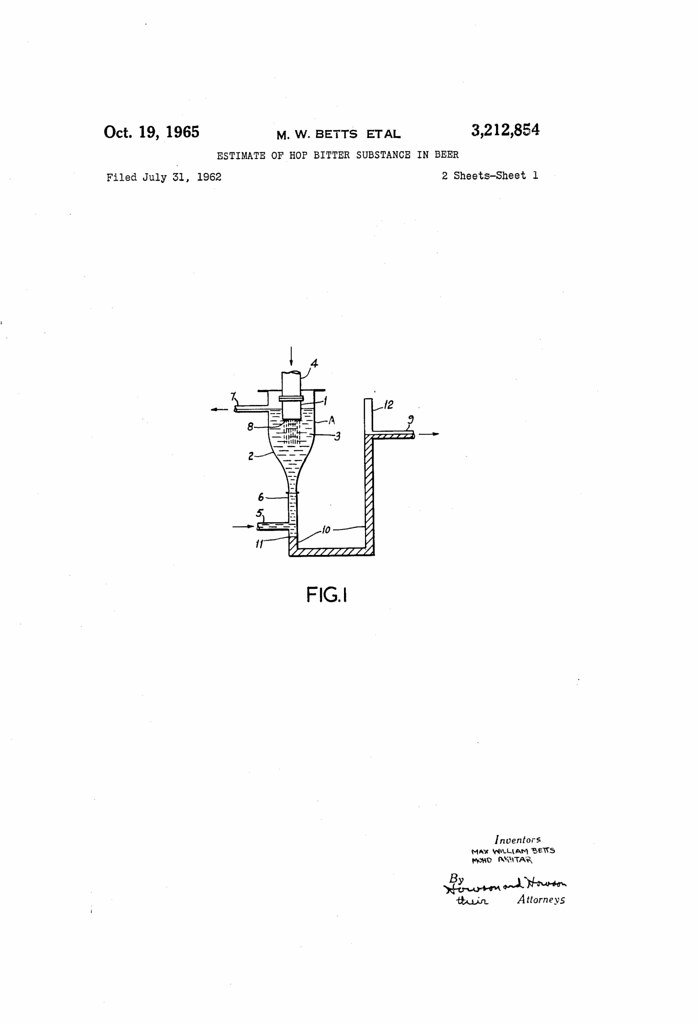
Previous methods of extracting hop bitter substances from beer have involved the use of a counter-current flow column. We have found that substantially the same percentage of hop bitter substances can be extracted by using the process of our invention by using a comparatively short chamber which we call a jet chamber. A jet chamber of as short as 2 inches has been found to have an extraction efficiency of the same order as that obtained by using a counter-current flow column over 8 feet long. However, we prefer to use a jet chamber 3 inches to 4 inches long, especially when extracting from a stout.

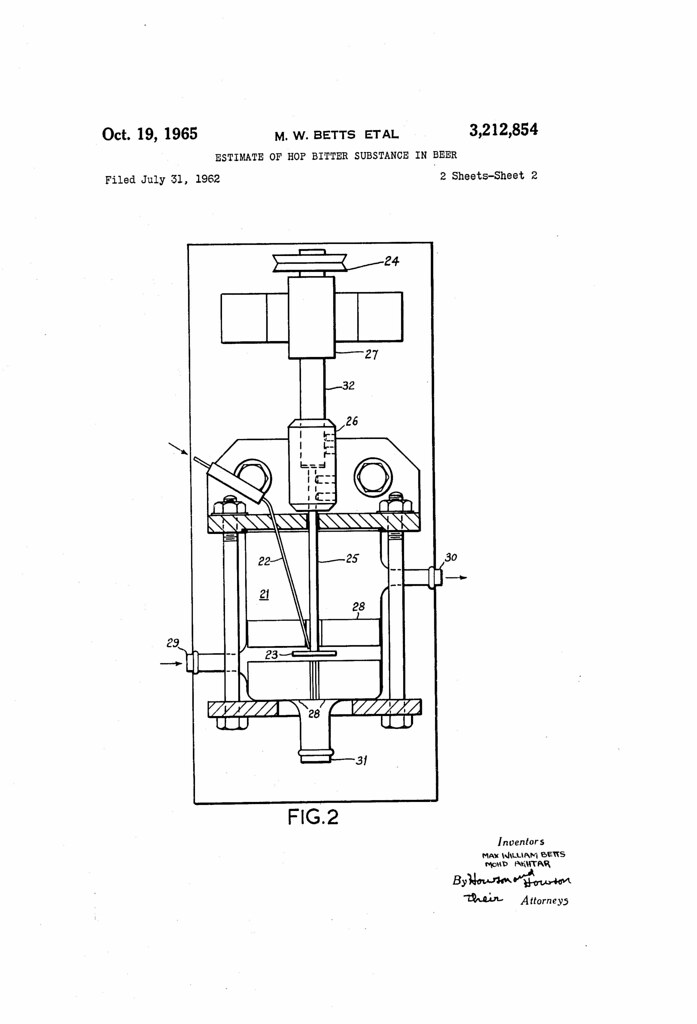
Instead of operating on the counter-current flow principle our extraction process depends on the turbulence created in the beer droplets by the velocity with which they emerge from the orifices into the jet chamber and pass through the water-insoluble solvent. must be very carefully regulated. If, for instance, the beer droplets have a Reynolds number of above about 2,000, cavitation will occur in the water-insoluble solvent and an emulsion will be formed. This emulsion as previously stated is very difficult to break and its formation must be prevented, hence the beer droplets must initially have a Reynolds number below about 2,000. On the other hand, if the velocity of the beer drops is too low, only the beer at the surface of the beer drops will ever be in contact with the water-insoluble solvent and all the hop bitter substances in the centre of the drops will remain in the beer. The velocity of the drops must therefore be high enough to create turbulence inside the said drops. By turbulence in this context we mean that there is a continuous circulation of beer inside the drops to and from the surface of said drops. This will result in equilibrium, as defined by the partition coefficients of the hop bitter substances between beer and the water insoluble solvent, being approached very rapidly. As far as we can gather turbulence occurs inside the beer drops to a useful degree for our purposes provided that the drops have a Reynolds number of over 70.

Any method of creating drops and passing them at a suitable velocity, as defined above, through a water insoluble solvent may be used in the process of this invention. For example the beer may be passed into the water-insoluble solvent through a jet head containing one or more jets. Another method which may be employed is to pass a stream of beer substantially towards the centre of a rapidly rotating plate immersed in the water-insoluble solvent which sends drops of beer outwards from its circumference.

It is not necessary to obtain 100 percent extraction of the hop bitter substances from beer in order to obtain a useful result, provided the process results in a substantially similar percentage of the hop bitter substances being extracted every time a beer containing approximately the same percentage of hop bitter substances, for example a stout, is passed through the apparatus.

If the beer is passed through a small jet it is essential that the beer does not contain any particles of solid matter having a diameter of over about half the diameter of the orifices used, otherwise the orifices are likely to become blocked easily. The particles in the beer may be removed by any convenient filtering process, for example by centrifuging or by using a mesh filter.
Untitled
Untitled

Filed Under: Beers, Breweries, Just For Fun, Politics & Law, Related Pleasures Tagged With: History, Hops, Law, Patent, Science of Brewing

Patent No. 973087A: Equalizing Device For Beer Filtration

October 18, 2015 By Jay Brooks

patent-logo
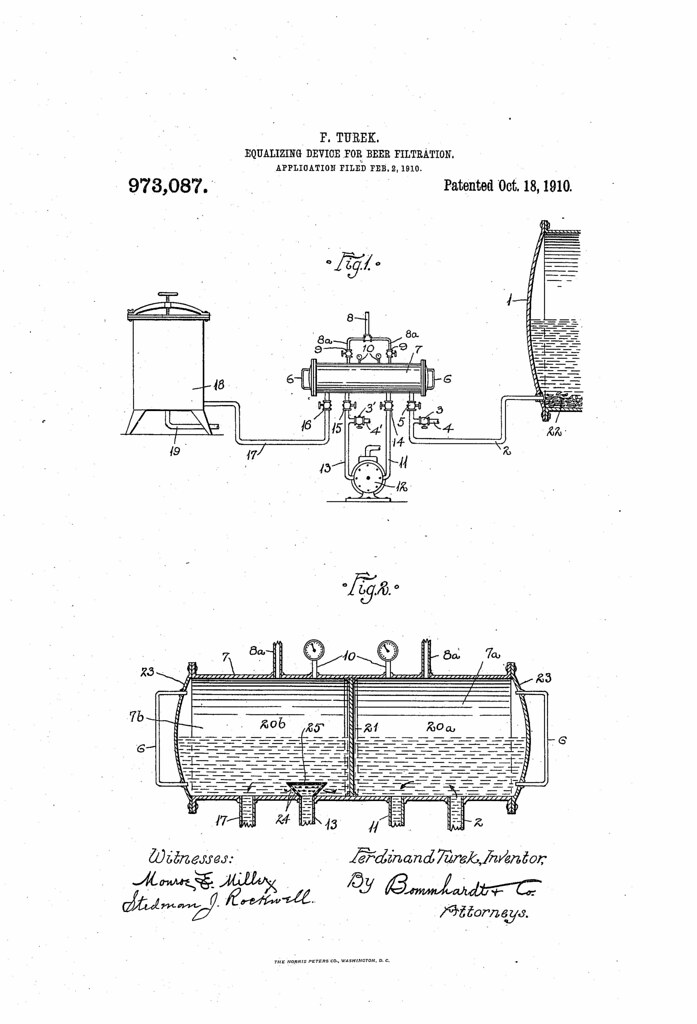
Today in 1910, US Patent 973087 A was issued, an invention of Ferdinand Turek, for his “Equalizing Device For Beer Filtration.” There’s no Abstract, although in the description it includes this summary:

This invention relates to apparatus used in the filtration or purification of beer, and has for its object to provide means for causing a steady fiow of’beer from the chip cask and through the filter.

Untitled

Filed Under: Beers, Breweries, Just For Fun, Politics & Law, Related Pleasures Tagged With: Brewing Equipment, History, Law, Patent, Science of Brewing

Patent No. 3279534A: Percolator For A Brew Kettle

October 18, 2015 By Jay Brooks

patent-logo
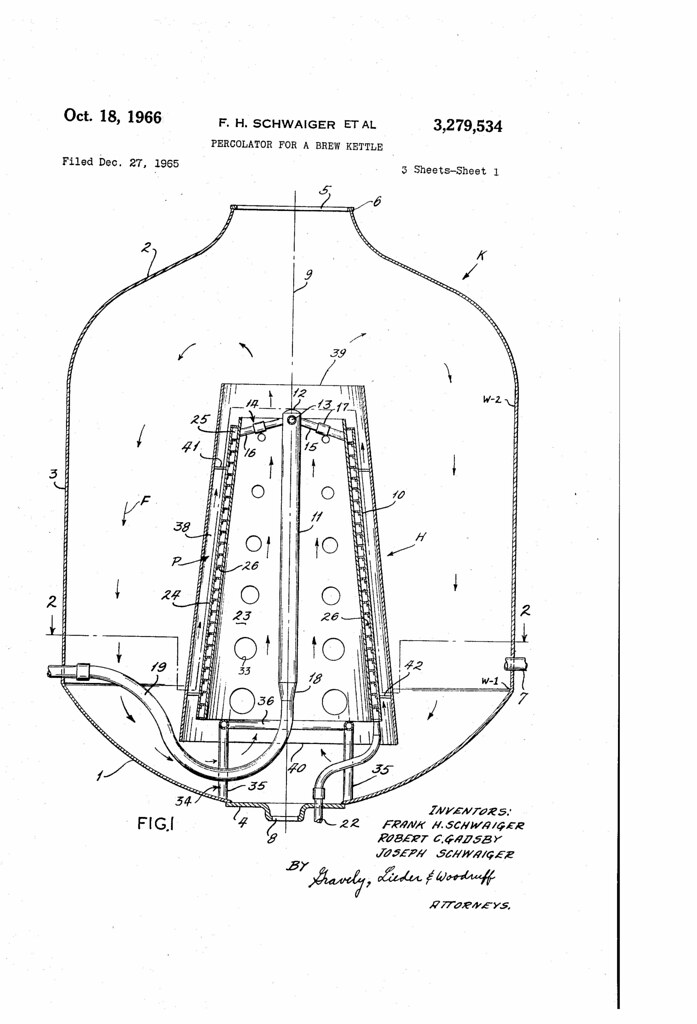
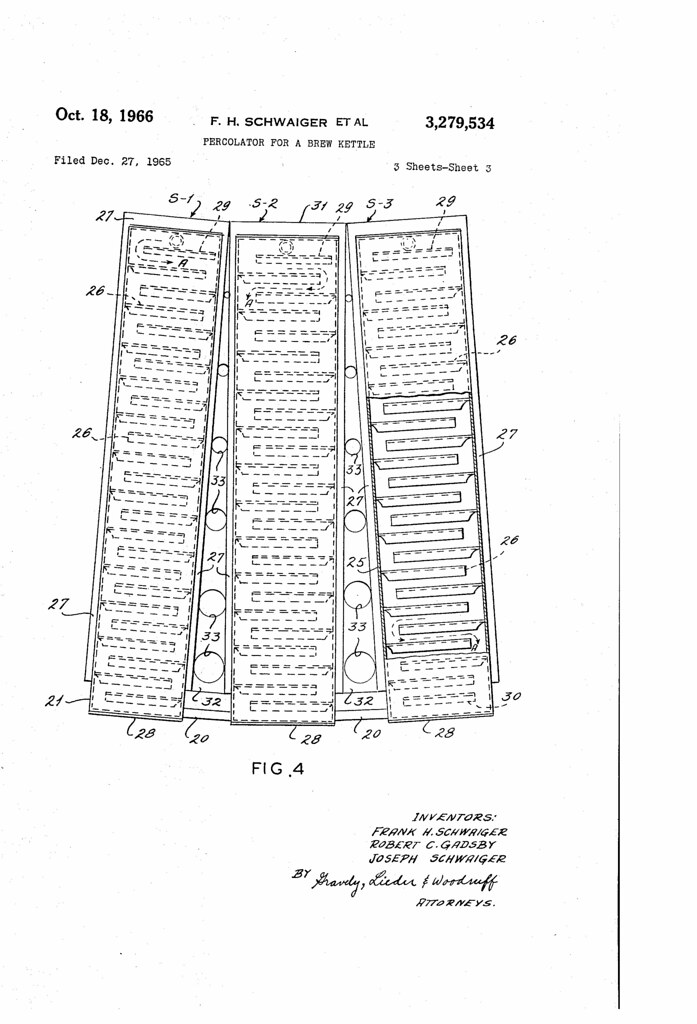
Today in 1966, US Patent 3279534 A was issued, an invention of Robert C. Gadsby, Joseph Schwaiger and Frank H. Schwaiger, assigned to Anheuser-Busch, for their “Percolator for a Brew Kettle.” There’s no Abstract, although in the description it includes this summary:

One of the principal objects of the present invention is to provide an improved percolator for brew kettles, such as are used in the brewing industry. Another object is to provide in such a percolator a plurality of flat heating sections which can be easily cleaned and replaced or repaired if necessary. Another object is to provide an improved percolator design which is shaped to distribute heat in a predetermined manner :and which is shaped so as to create a natural flow of the liquid being heated within the percolator. Another object is to provide a percolator of a design in which there is little likelihood of trapping condensate therein. Another object is to provide connectors between the relatively flat heater sections which prevent entrapment of the liquid so as to prevent the overheating of any liquid which might otherwise become entrapped.

Untitled
Untitled
Untitled

Filed Under: Beers, Breweries, Just For Fun, Politics & Law, Related Pleasures Tagged With: Brewing Equipment, History, Law, Patent, Science of Brewing

Patent No. 3765903A: Isomerised Hop Extract

October 16, 2015 By Jay Brooks

patent-logo
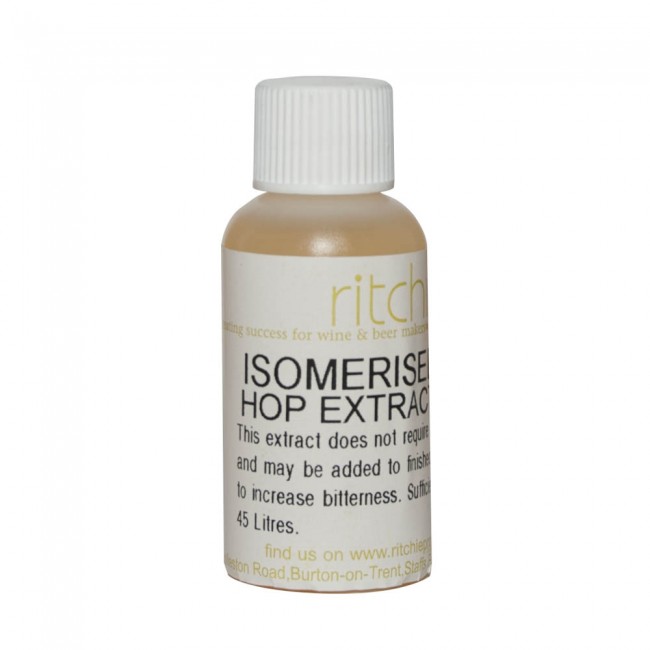
Today in 1973, US Patent 3765903 A was issued, an invention of Brian Clarke, Robert Hildebrand, David Lance, and Alexander White, assigned to Carton and United Breweries Ltd, for their “Isomerised Hop Extract.” Here’s the Abstract:

A process for the preparation of an isomerised hop extract for use in the flavouring of food or beverages which comprises adding to a solution of humulones or their salts a metal ion of calcium, magnesium, nickel, manganese or zinc, which metal ion forms with the humulones a metal ion-humulone complex which then precipitates from the solution. The metal ion-humulone complex is then heated in solid or paste state or in suspension or dissolved in an organic solvent to form a metal ion-isohumulone complex in high yield. The metal ion-isohumulone complex is substantially insoluble and can be used as a bittering additive, without regeneration to a soluble salt of isohumulone, by finely grinding such metal ion-isohumulone complex.

Untitled

Filed Under: Beers, Breweries, Just For Fun, Politics & Law, Related Pleasures Tagged With: History, Hops, Law, Patent, Science of Brewing

Patent No. 438328A: Apparatus For Brewing

October 14, 2015 By Jay Brooks

patent-logo
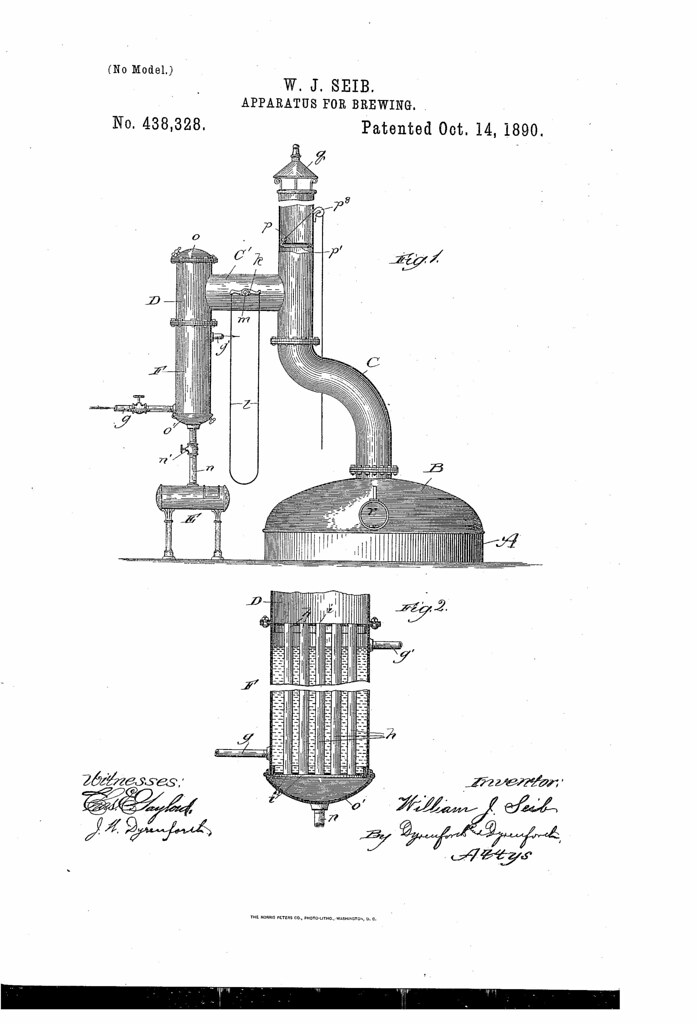
Today in 1890, US Patent 438328 A was issued, an invention of William J. Seib, for his “Apparatus For Brewing.” There’s no Abstract, although in the description it includes this summary:

My invention relates to an improvement in apparatus for use in collecting, condensing, and storing the essential oil and aromatic properties of hops to save them, and which is, therefore, especially serviceable for the particular purpose for which I have invented it namely, that of saving the aforesaid properties of the hops while they are being boiled with the wort in the manufacture of beer.

My present invention is particularly designed to afford an improvement in the construction of an apparatus for the same purpose as that set forth in the application of Carl Hoefner for Letters Patent of the United States No. 301,482, allowed on the 22d day of March, 1890. The construction of the apparatus therein described necessitates that the vapor from the kettle shall pass to the condenser and return by the same course to the storage-reservoir, which impairs the effectiveness of the condensation, since the liquid thereof has to pass under the influence of the rising heated vapor to gain access to the receptacle.

My object is to provide an apparatus for the purpose stated whereby this objection shall be obviated; and to this end my invention consists in the construction hereinafter set forth and claimed.

Untitled

Filed Under: Beers, Breweries, Just For Fun, Politics & Law, Related Pleasures Tagged With: Brewing Equipment, History, Law, Patent, Science of Brewing

Patent No. 2331556A: Process For Purifying Wort

October 12, 2015 By Jay Brooks

patent-logo
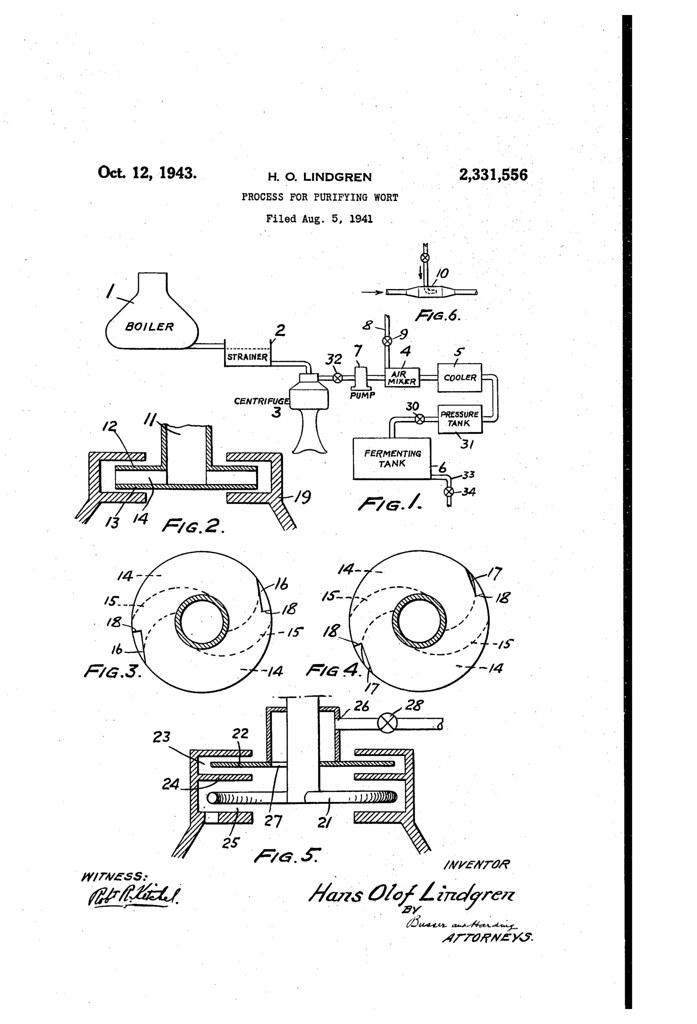
Today in 1943, US Patent 2331556 A was issued, an invention of Hans Olof Lindgren, for his “Process For Purifying Wort.” There’s no Abstract, although in the description it includes this summary:

The object of the invention is to provide a method of purifying, cooling, and aerating the wort, the main part of which is carried out as a continuous process, which is free of the above objections. The warm Wort leaving the hops boiler, at a temperature which is usually above 85 C. (185 FJ, and which should not be below ’70 C. (158 F.), or above 100 C. (212 F), is strained with a view to removing the coarsest impurities. It is then purified in a centrifuge f1 om which the purified Wort is discharged continuously. The wort is then passed through a cooler of such a construction that it cannot therein come into contact with the atmosphere. The cooled wort is conveyed to tanks, e. g., similar to the fermenting vats above described, in which the cool sludge is removed from the wort by finely divided air which has been mixed therewith at some step of the Process at which the wort is hot enough to sterilize the air, and which in the tank 6 lifts the .cool sludge to the surface. The air and the impurities, together with a small amount of wort, there form a layer of froth which may be skimmed off. If a suitable amount of air is used, a satisfactory purification is obtained at the same time, as the amount of wort contained in the froth is so small that it is unnecessary to take any measures for recovering it. The finely divided air need not be sterile unless it is introduced into the stream after the Wort has been partly or wholly cooled.

Untitled

Filed Under: Beers, Breweries, Just For Fun, Politics & Law, Related Pleasures Tagged With: History, Law, Patent, Science of Brewing, Wort

Patent No. 2359876A: Brewing

October 10, 2015 By Jay Brooks

patent-logo
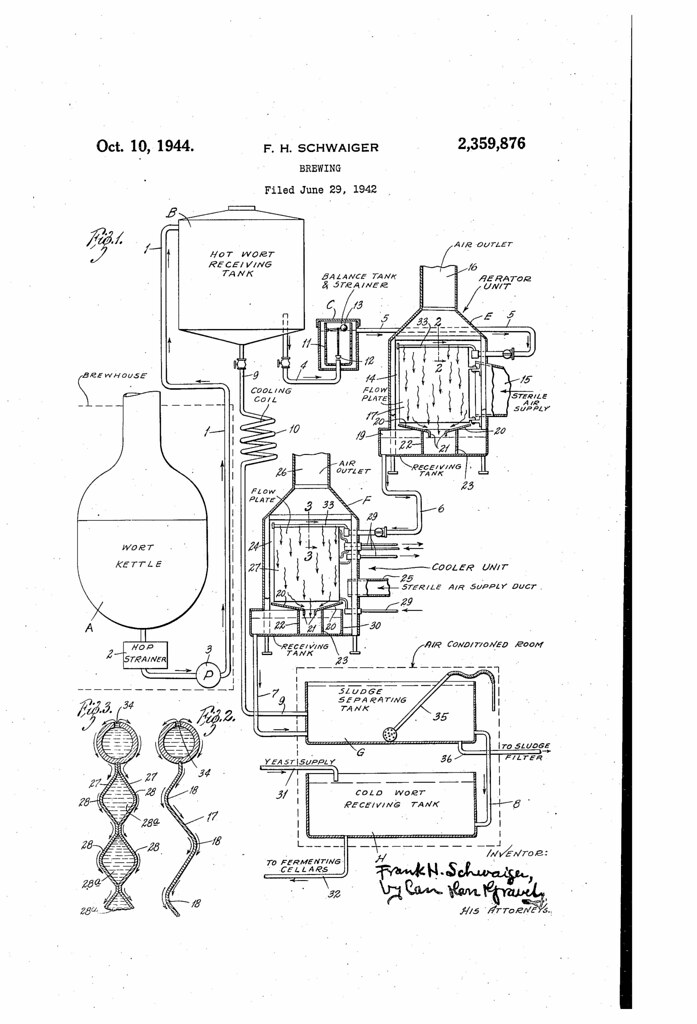
Today in 1944, US Patent 2359876 A was issued, an invention of Frank H. Schwaiger, assigned to Anheuser-Busch, for his “Brewing.” There’s no Abstract, although in the description it includes this summary:

The principal objects of the present invention are to devise a better, simpler, more thorough and more economical way of removing. the suspended solids from the wort. The present invention consists principally in cooling the wort, while it still contains the hot break sludge, under conditions that overcome the difficulties and disadvantages that have heretofore made it impracticable to delay the removal of the sludge until the wort is cooled. It also consists in delaying the removal of the hot break solids until the wort is cooled. It also consists in aerating the wort at or above pasteurizing temperature and quickly cooling and simultaneously aerating it again and then separating the sludge therefrom by sedimentation. It also consists in a novel way of utilizing hot break for removal of cold break from the wort. It also consists in the process hereinafter described.

Untitled

Filed Under: Beers, Breweries, Just For Fun, Politics & Law, Related Pleasures Tagged With: Brewing Equipment, History, Law, Patent, Science of Brewing

Patent No. 195980A: Improvement In Gage Attachments For Beer-Measures

October 9, 2015 By Jay Brooks

patent-logo
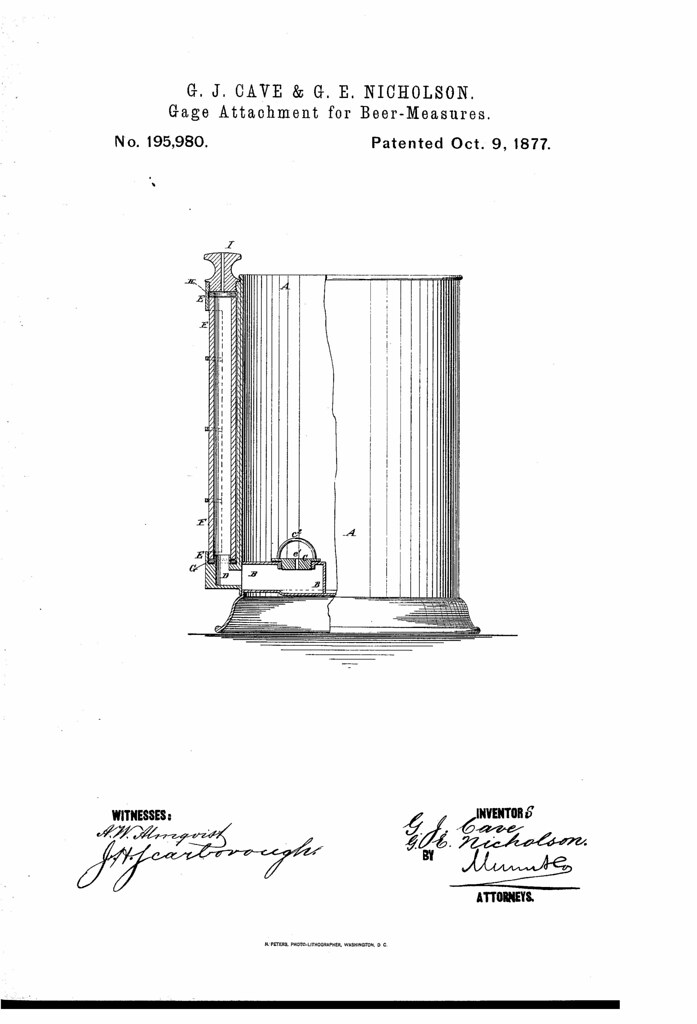
Today in 1877, US Patent 195980 A was issued, an invention of George J. Cave and George E. Nicholson, for their “Improvement in Gage Attachments for Beer-Measures.” There’s no Abstract, although in the description it includes this summary:

The object of this invention is to furnish an improved measure for measuring beer and other liquids that foam when drawn, which shall be so constructed as to show at once how much of the liquid there may be in the measure, however foamy it may be, so that there need be no waiting for the foam to subside, and no refilling.

The invention consists in the combination of the detachable glass tube, the rubber rings, and the screw-plug with the case,the measure, and the elbow-pipe connected with the interior of the measure, or with a box or trap secured within said measure; and in the combination of the screw-cap, provided with the hole and the handle, with the box or trap secured in the interior of the measure, and connected with a glass tube by an elbow-pipe, as hereinafter fully described.

Untitled

Filed Under: Beers, Breweries, Just For Fun, Politics & Law, Related Pleasures Tagged With: History, Law, Patent, Science of Brewing

Patent No. 1087120A1: Method Of Fermenting

October 7, 2015 By Jay Brooks

patent-logo
Today in 1980, US Patent 1087120 A1 was issued, an invention of Walter T. Nagodawithana and Janet M. Cuzner, assigned to the Jos. Schlitz Brewing Company, for their “Method of Fermenting.” Here’s the Abstract:

A method of fermenting a fermentable substrate, such as brewer’s wort. The substrate, having a high concentration of fermentable carbohydrate which would normally ferment very slowly or incompletely, is fermented by utilizing water dilution at a process point in the fermentation. The dilution is effected after the initial foam head produced in the fermentation collapses so that the headspace of the fermenting vessel normally allocated for the foam can be used for the fermentation of the diluted substrate. The water dilution reduces the osmotic pressure and ethanol concentration in the substrate, thus allowing the fermentation to proceed without inhibition by the combined effect of the two factors. The reduced osmotic pressure also increases the ethanol gradient between the inside and the outside of the yeast cells to enable the fermentation to proceed to completion.

Schlitz-old-logo

Filed Under: Beers, Breweries, Just For Fun, Politics & Law, Related Pleasures Tagged With: History, Law, Patent, Science of Brewing

Patent No. 3056436A: Filling Head For Filling Machines

October 2, 2015 By Jay Brooks

patent-logo
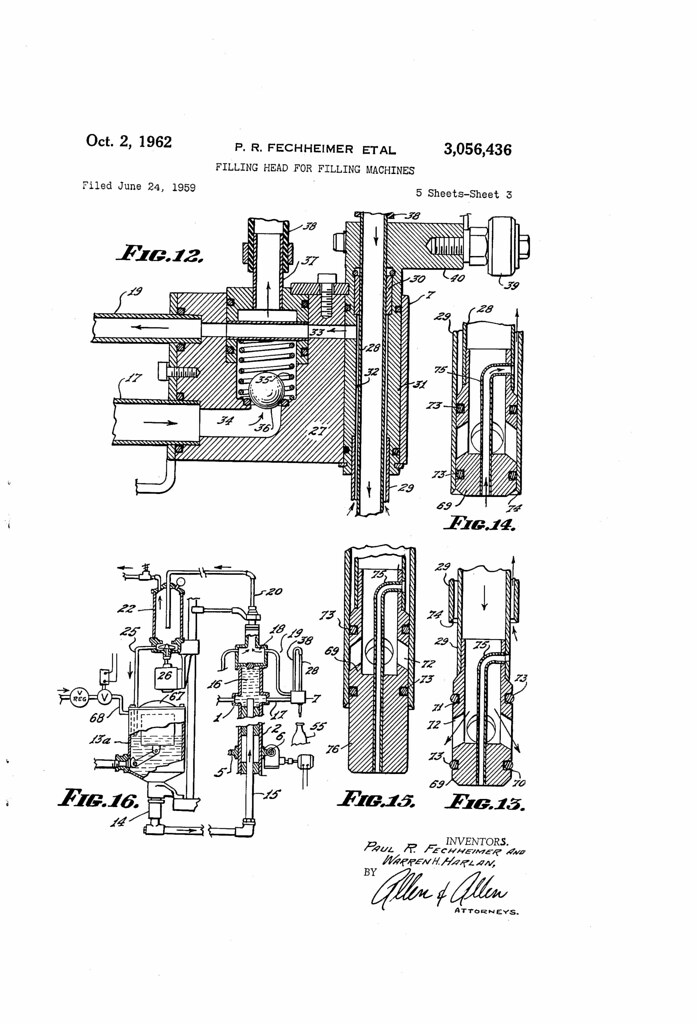
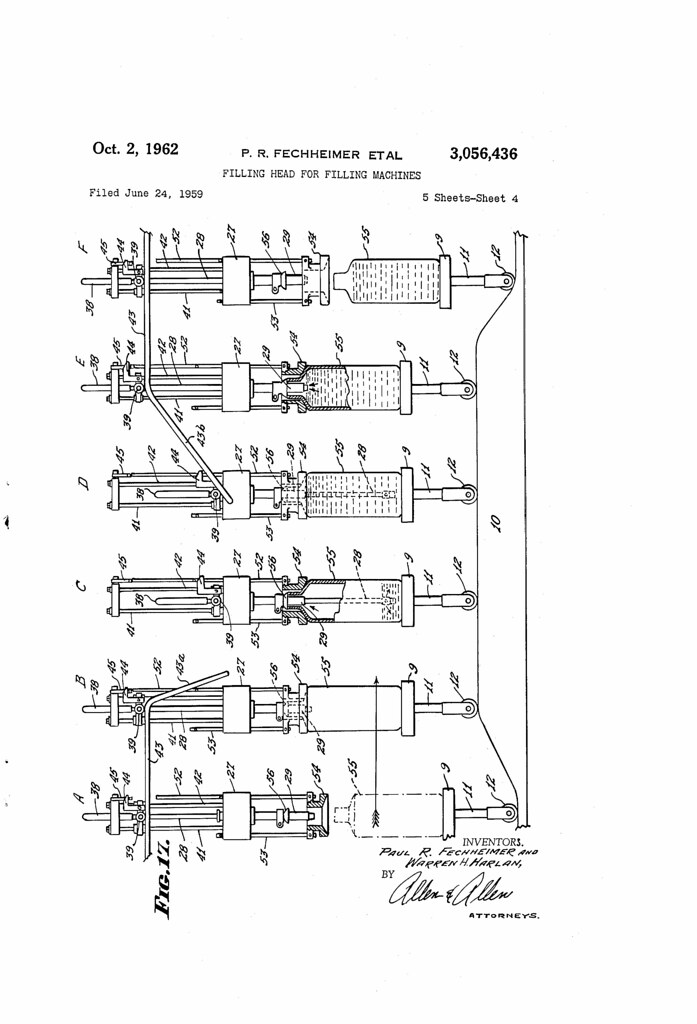
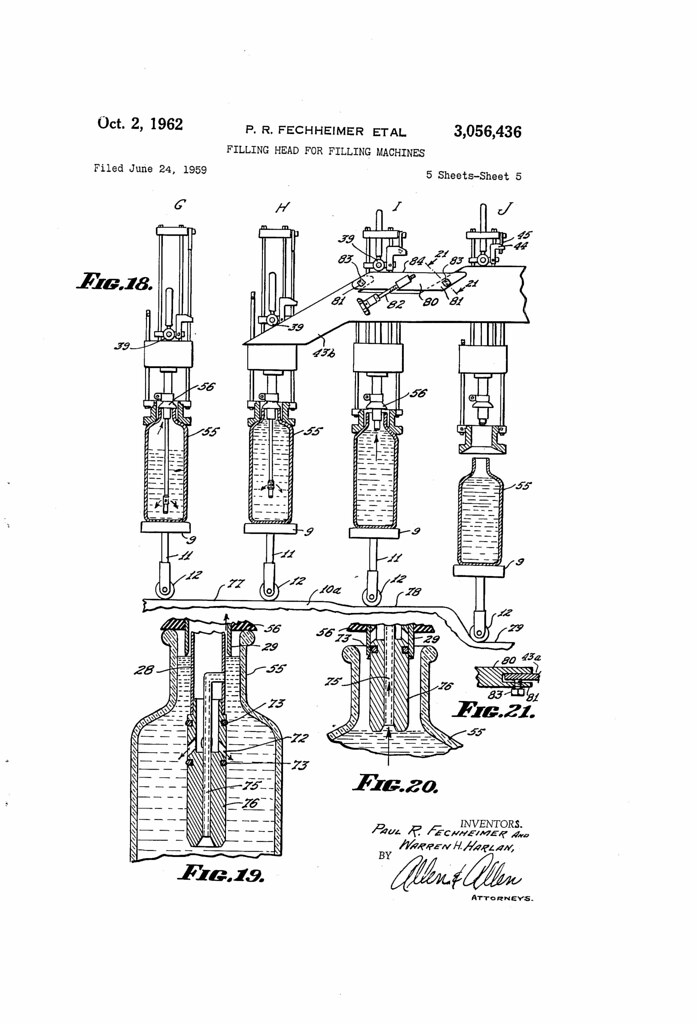
Today in 1962, US Patent 3056436 A was issued, an invention of Paul R. Fechheimer and Warren H. Harlan, assigned to the Cherry Burrell Corp., for their “Filling Head for Filling Machines.” There’s no Abstract, although in the description it includes this summary:

A principal object of the invention is the provision of a filling spout structure having a retractable filling stem adapted, upon the presentation of a container to be filled to the filling spout structure, to enter the container and assume a lowermost position in which the bottom or free end of the stem lies in close proximity to the bottom of the container being filled, whereupon as the liquid product is introduced into the container the filling stem will automatically retract.

A further object of the invention is the provision of a retractable filling stem of the character described which coacts with a vacuum tube forming a part of the filling spout structure, the vacuum tube serving to establish a predetermined height of fill for the container.

A further object of the invention is the provision of a filling spout structure having a retractable filling stem adapted to be locked in retracted position, the filling spout structure incorporating means responsive to the presentation of a container thereto for releasing the locking means so as to permit the filling stem to enter the container there beneath.

Untitled
Untitled
Untitled
Untitled
Untitled

Filed Under: Beers, Breweries, Just For Fun, Politics & Law, Related Pleasures Tagged With: Brewing Equipment, History, Law, Patent, Science of Brewing

« Previous Page
Next Page »

Find Something

Northern California Breweries

Please consider purchasing my latest book, California Breweries North, available from Amazon, or ask for it at your local bookstore.

Recent Comments

  • Ernie Dewing on Historic Beer Birthday: Charles William Bergner 
  • Steve 'Pudgy' De Rose on Historic Beer Birthday: Jacob Schmidt
  • Jay Brooks on Beer Birthday: Bill Owens
  • Steve 'Pudgy' De Rose on Beer Birthday: Charles Finkel
  • Steve 'Pudgy' De Rose on Beer Birthday: Bill Owens

Recent Posts

  • Historic Beer Birthday: Samuel Charles Whitbread February 22, 2026
  • Beer In Ads #5214: Bock Beer? Yes, Point Bock Beer! February 21, 2026
  • Historic Beer Birthday: Philip Zorn February 21, 2026
  • Historic Beer Birthday: Rudolph J. Schaefer February 21, 2026
  • Beer Birthday: Kate Bernot February 21, 2026

BBB Archives

Feedback

Head Quarter
This site is hosted and maintained by H25Q.dev. Any questions or comments for the webmaster can be directed here.