Brookston Beer Bulletin

Jay R. Brooks on Beer

  • Home
  • About
  • Editorial
  • Birthdays
  • Art & Beer

Socialize

  • Dribbble
  • Email
  • Facebook
  • Flickr
  • GitHub
  • Instagram
  • LinkedIn
  • Pinterest
  • RSS
  • Twitter
  • YouTube

Powered by Genesis

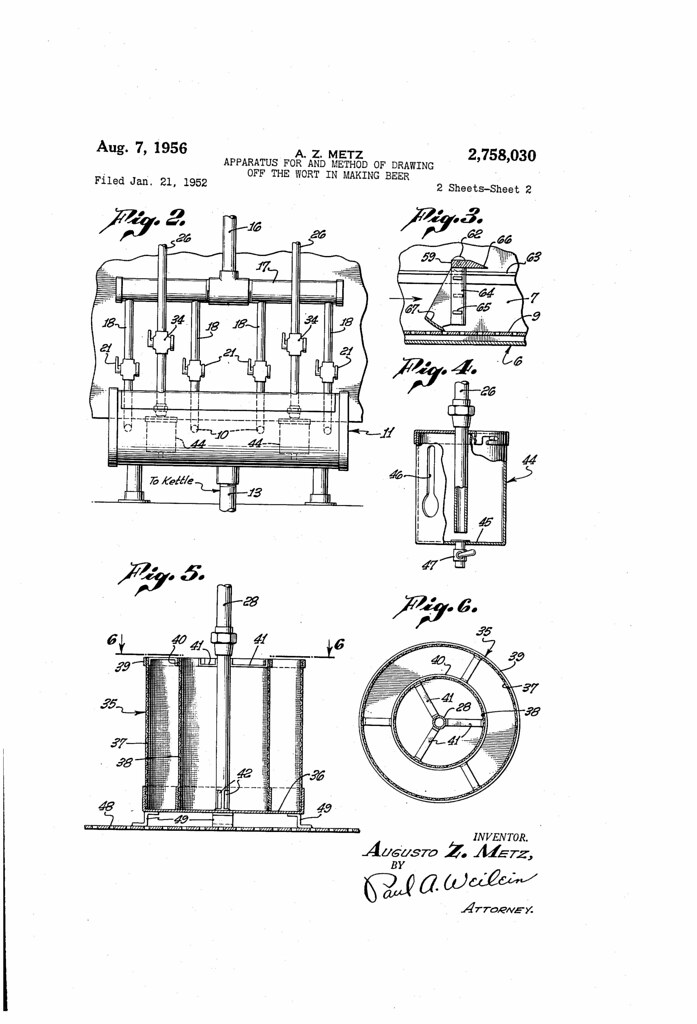
Patent No. 2758030A: Apparatus For And Method Of Drawing Off The Wort In Making Beer

August 7, 2015 By Jay Brooks

patent-logo
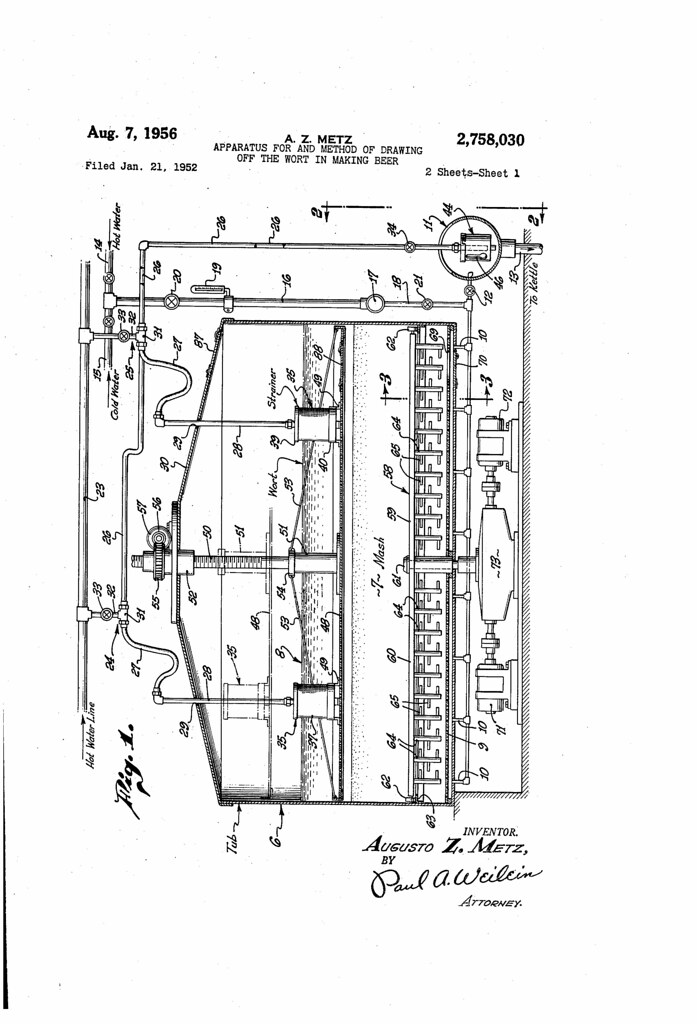
Today in 1956, US Patent 2758030 A was issued, an invention of Augusto Z. Metz, for his “Apparatus For And Method Of Drawing Off The Wort In Making Beer.” There’s no Abstract, although in the description it includes this summary:

This invention relates to the production of beer, and more particularly to an apparatus and a method for drawing off from the tubs or other vessels in which the mashing operation is carried out, the extract or wort which is to be delivered to kettles in which the brewing operation is continued.
Untitled
Untitled

Filed Under: Beers, Just For Fun, Politics & Law, Related Pleasures Tagged With: Brewing Equipment, History, Law, Patent, Science of Brewing, Wort

Patent No. 2605949A: Control Head For Devices For Filling Bottles Under Counterpressure

August 5, 2015 By Jay Brooks

patent-logo
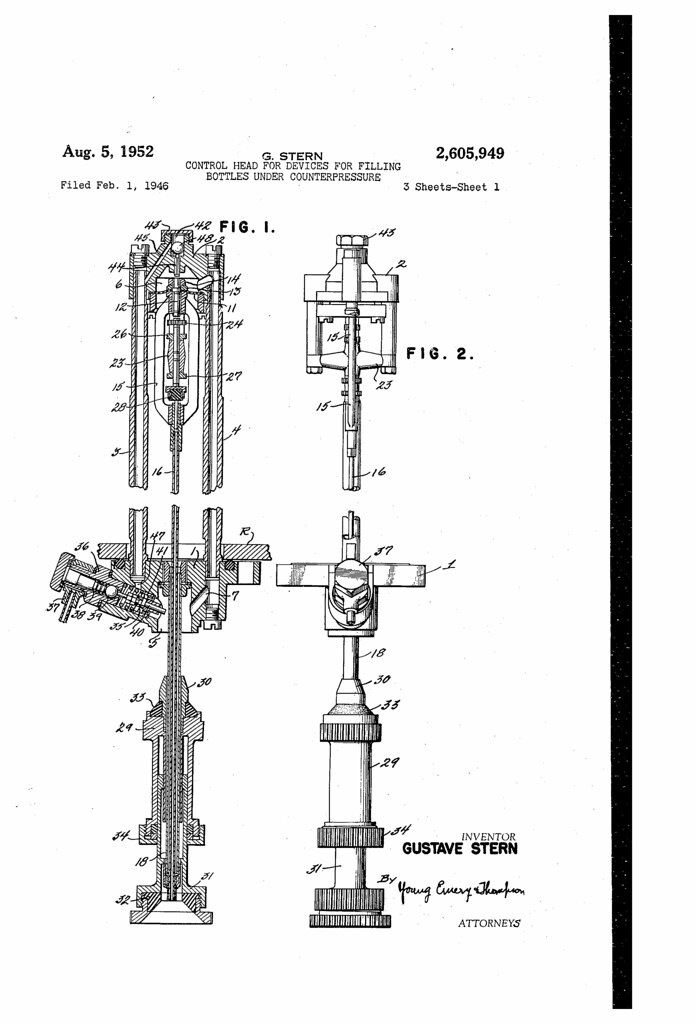
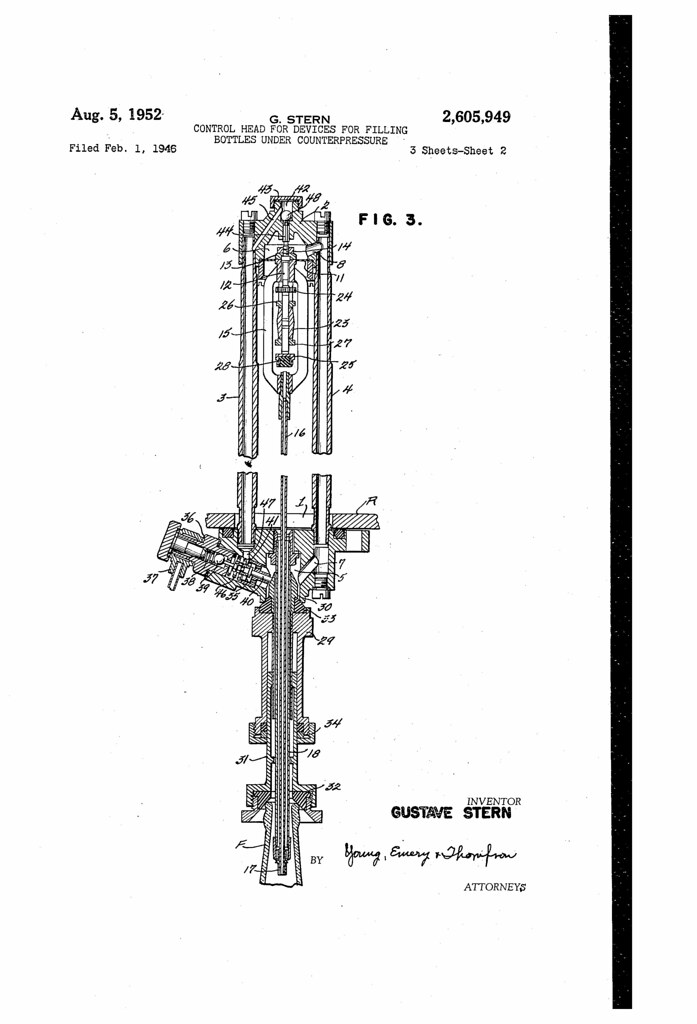
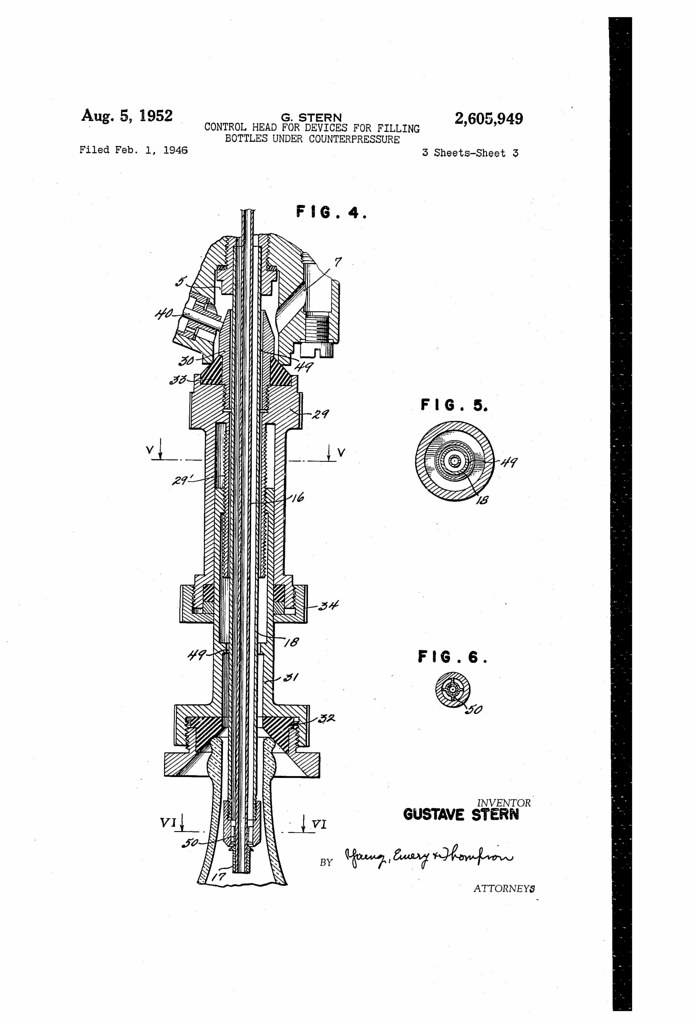
Today in 1952, US Patent 2605949 A was issued, an invention of Gustave Stern, for their “Control Head for Devices for Filling Bottles Under Counterpressure.” There’s no Abstract, although in the description it includes this summary:

The, object of the present invention is a control head for devices for filling bottles or other like (containers, with gaseous or nongaseous liquids, under counter-pressure), said head previously placing the bottles under compressed air.

The purpose of the invention is essentially to increase the automatic operation of the device, thereby enabling the rate of filling to be considerably accelerated, thus increasing the efficiency.

invention ensures the. satisfactory operation of the device when the pressure. of the supply of. compressedV air. is higher than the pressure in the filling tank which contains the liquid to be drawn out. Owing to this fact, it permits the elimination of the complicated and costly apparatus intended to ensure, the regularity of the air pressure.

Finally, tile invention relates to the provision of means of enabling the level of the liquid inside the bottles to be adjusted accurately.

Untitled
Untitled
Untitled

Filed Under: Beers, Breweries, Just For Fun, Related Pleasures Tagged With: Brewing Equipment, History, Law, Patent, Science of Brewing

Patent No. 218231A: Improvement In Processes And Apparatus For Treating Hops And Malt Extracts

August 5, 2015 By Jay Brooks

patent-logo
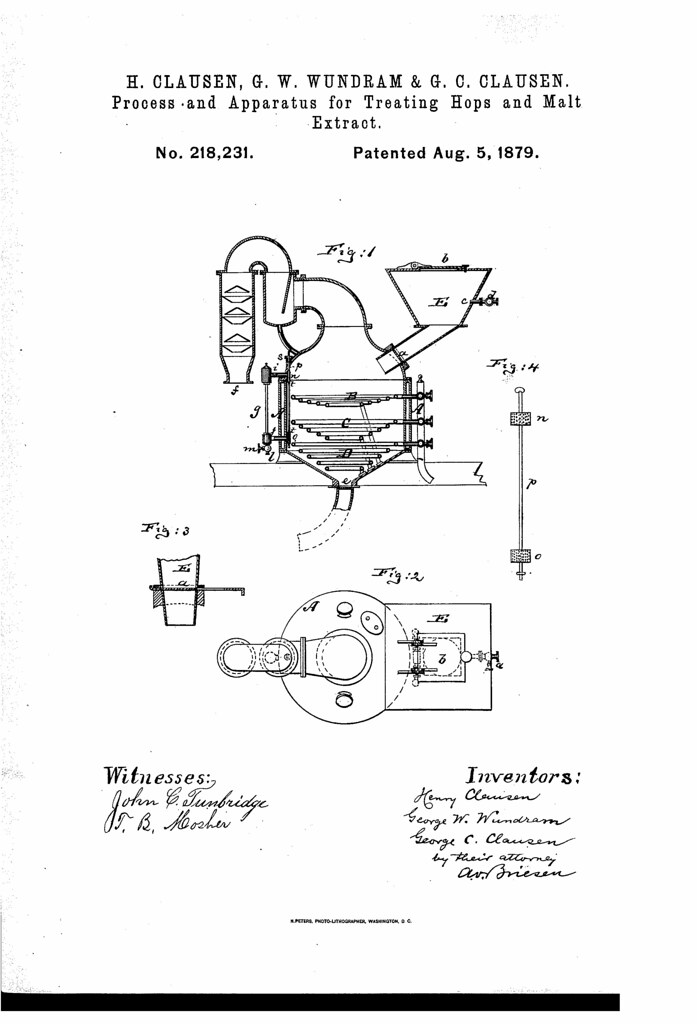
Today in 1879, US Patent 218231 A was issued, an invention of Henry Clausen, for his “Improvement in Processes and Apparatus For Treating Hops and Malt Extracts.” There’s no Abstract, although in the description it includes this summary:

This invention relates to a new method of treating malt extract and hops in the manufacture of beer, and to a new apparatus for carrying the same into effect; and consists, first, in treating the malt extract and the hops in a vacuum-pan which has separate channels for admitting the malt and the hops; also, in the new construction and arrangement of vacuum-pan hereinafter described.

Untitled

Filed Under: Beers, Breweries, Just For Fun, Politics & Law, Related Pleasures Tagged With: Brewing Equipment, History, Hops, Law, Malt, Patent, Science of Brewing

Patent No. 2898209A: Method Of Extracting Hops

August 4, 2015 By Jay Brooks

patent-logo
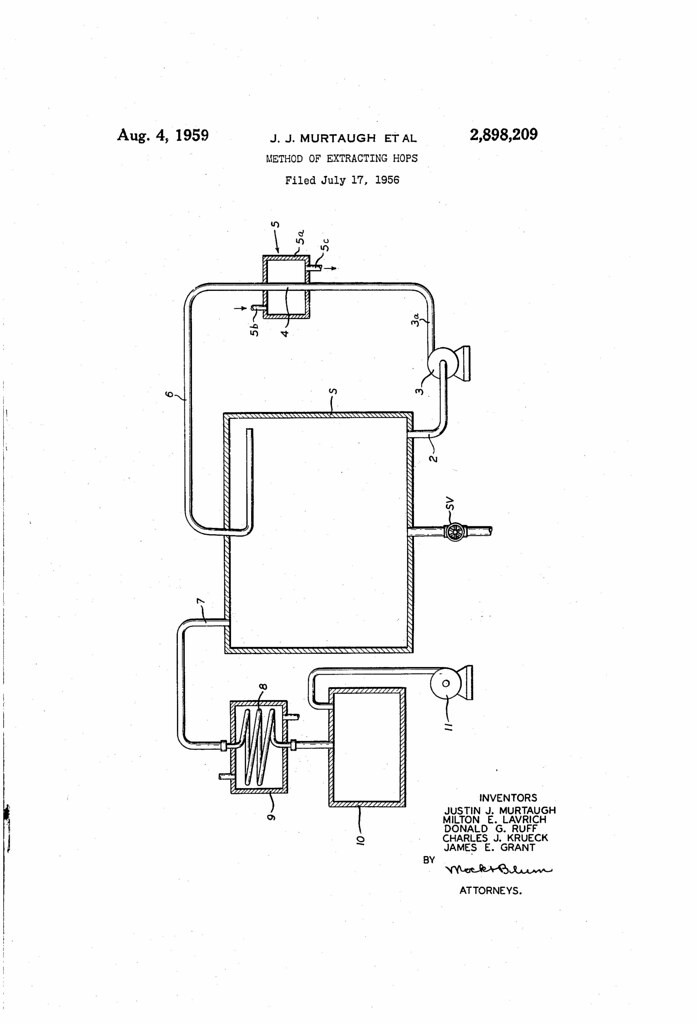
Today in 1959, US Patent 2898209 A was issued, an invention of James E. Grant, Charles J. Krueck, Milton E. Lavrich, Justin J. Murtaugh, and Donald G. Ruff, assigned to the Blatz Brewing Company, for their “Method of Extracting Hops.” There’s no Abstract, although in the description it includes this summary:

Our invention relates to a new and improved hop extract; to a new and improved method of making a hop extract; and to a new and improved hopped beverage, such as alcoholic malt beverages exemplified by beer and ale.

While the invention applies to the treatment of any part of the hop plant, it refers particularly to the treatment of the cones of the hop plant. These cones are preferably extracted in the whole state, but they may be cut, ground, or otherwise comminuted.

After a lengthy discussion, in the last page of the application, they set forth their claims, summarized:

1. A method of extracting solid starting material, said stafting material having substantially the composition of vine-fresh hops, which consists in extracting said material with methanol at a maximum temperature of 65 C. to produce an original liquid extract of said starting ina– terial, said original liquid extract including water which is extracted from said starting material, said water being mixed with said methanol in said original liquid extract, said original liquid extract including water-insoluble and methanol-soluble material which is extracted from said solid starting material and which is dissolved in the methanol of said original liquid extract, said original liquid extract including water-soluble and methanol-insoluble material which is extracted from said solid starting material and which is dissolved in the water of said original liquid extract, said methanol-soluble and waterinsoluble extracted material including alpha-resin and beta-resin, the weight of said alpha resin being at least 40% of the weight of the total soft resin; separating said original liquid extract from the undissolved, residual part of said starting material; flowing the separated, original liquid extract forwardly through an externally heated zone in the form of a thin, rapidly forwardly-flowing stream to heat said forwardly-flowing stream substantially uniformly within’ said heating Zone without substantially evaporating methanol or water from said forwardly-flowing stream within said heating zone, forwardly flowing said forwardlyflowing stream within said heating zone at a sufliciently high velocity to substantially prevent the solutes of said forwardly-flowing stream from coating the inner face of said heating zone; flowing said forwardly-flowing stream out of the outlet of said heating zone into an evaporation chamber; evaporating a part of the methanol and water in said evaporation chamber from the stream which is flowed into said evaporation chamber and thus providing a residue of said stream within said evaporation chamber, flowing the evaporated methanol and water out of said evaporation chamber; flowing the residue of said stream out of said evaporation chamber forwardly through said heating zone and back into said evaporation chamber in cyclic succession while evaporating a part of the methanol and water from the stream which is flowed into said evaporation chamber during each cycle and flowing the part of the methanol and water which is thus evaporated durmg each cycle out of said evaporating chamber, maintaining said evaporation chamber at a maximum temperature of substantially 65 C. and at a maximum pressure of substantially millimeters of mercury, and continuing said cyclic succession to produce a concentrate of said original extract in which the weight of said alpha-resin is at least 40% of the weight of the total soft resin.

2. A method according to claim 1 in which substantially all the methanol is evaporated in said cyclic succe’ssi’on within said evaporation chamber from said original extract.

3. A method according to claim 1, in which the cyclic succession is stopped when said concentrate includes an aqueous phase of residual water and a non aqueous methanol resin phase in which said resins are dissolved, and said aqueous phase is separated from said methanol resin phase. I

4. A method according to claim 3, in which said aqueous phase is separated from said methanol resin phase by dissolving a water-soluble salting-out agent in said aqueous phase.

5. A method according to claim 3, in which the weight of said aqueous phase is at least substantially 70% of the weight of said concentrate.

Untitled

Filed Under: Beers, Breweries, Just For Fun, Politics & Law, Related Pleasures Tagged With: History, Hops, Law, Patent, Science of Brewing

Patent No. WO2010043235A8: Post Fermenting Optimizer (PFO) For The Preparation Of Beer

August 2, 2015 By Jay Brooks

patent-logo
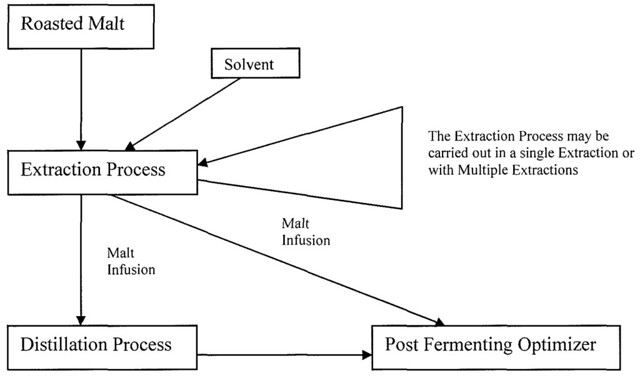
Today in 2010, US Patent WO 2010043235 A8 was issued, an invention of Patrick Accristo, Michel Aubanel, Cyril Denis, Dave Mawby, Matthew Servini, Nilabh Singh, and John Terry, assigned to Cargill Incorporated, for their “Post Fermenting Optimizer (PFO) for the Preparation of Beer.” Here’s the Abstract:

The present application relates to a method of preparing a beer or beer-like beverage by adding a Post Fermenting Optimizer (PFO) in form of an infusion of roasted malt or a distillate thereof after fermentation. This addition of PFO provides the beer or beer-like beverage with additional body, base flavour and/or top notes. The present invention relates also to the PFO infusion itself, its distillate, the methods for preparing them and their use for reducing staling during beer or beer-type product shelf-life.

Untitled

Filed Under: Beers, Breweries, Just For Fun, Politics & Law, Related Pleasures Tagged With: History, Law, Patent, Science of Brewing

Patent No. 2756917A: Valve For Counter Pressure Filling Apparatus

July 31, 2015 By Jay Brooks

patent-logo
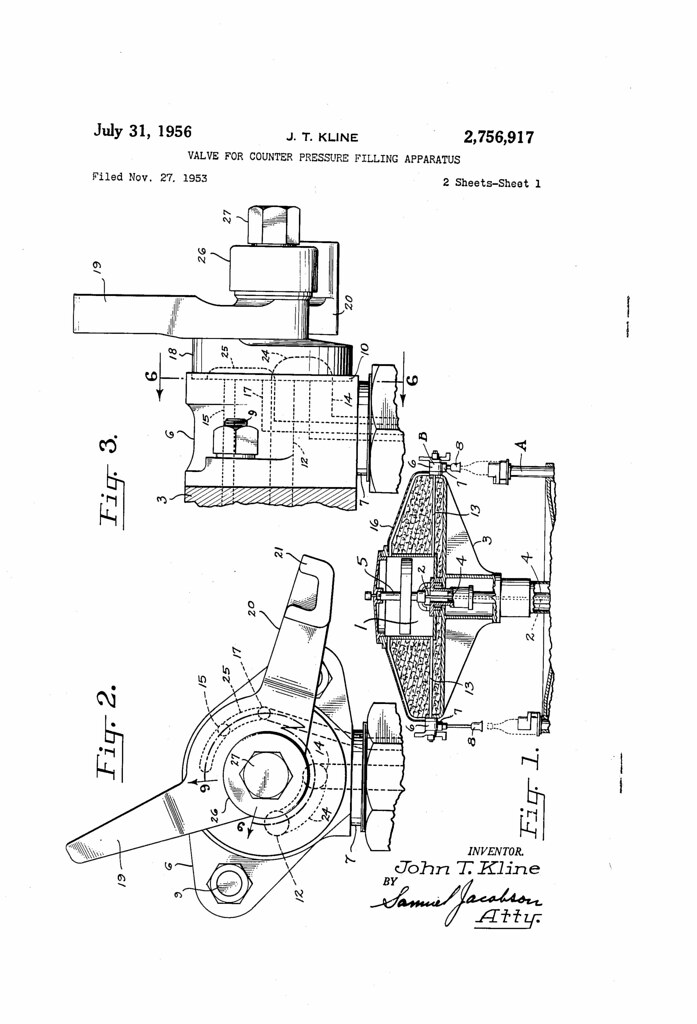
Today in 1956, US Patent 2756917 A was issued, an invention of John T. Kline, for his “Valve For Counter Pressure Filling Apparatus.” There’s no Abstract, although in the description it includes this summary:

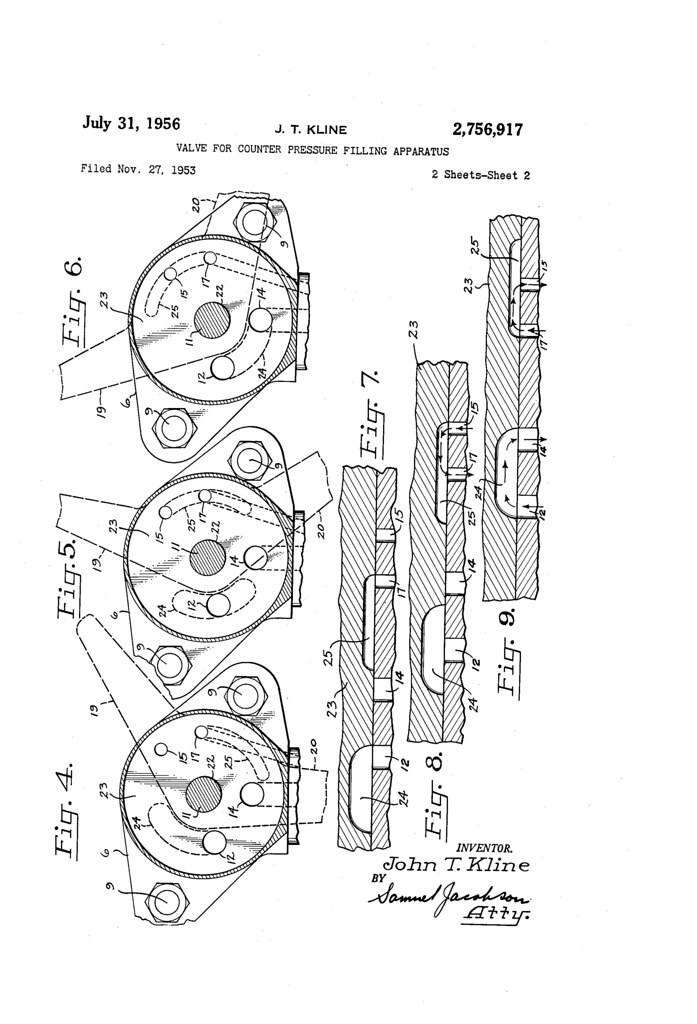
Briefly outlined they are as follows: The charged liquid is supplied to a reservoir by piping connected to a continuous source of supply forming a closed circuit; air or gas under pressure, such as carbon dioxide, is also supplied to the reservoir by suitable piping leading from a continuous source forming a closed circuit, thereby providing a head above the liquid in the reservoir; and a plurality of filling heads, each one of which contains a rotary fiat valve and means to temporarily seal the containers, is joined to the bottom of the reservoir and connected with the interior thereof by suitable piping to permit removal of the liquid and/ or the air or gas confined therein. By positioning the valve in each filling head in a predetermined pattern, a filling sequence is accomplished which permits the filling of the containers without excessively foaming or effervescing the liquid. This sequence consists of temporarily sealing the container to the filling head; then positioning the valve to permit the air or gas under pressure in the reservoir, commonly called counter pressure, to enter into the container to equalize the pressure between them; then positioning the valve to permit the liquid in the reservoir to enter into the container under its normal hydrostatic pressure and to return the air or gas (counter pressure) in the container back to the reservoir as it is being displaced by the liquid; then positioning the valve to out off the flow of the liquid and the air or gas (counter pressure) to and from the container; then exhausting any air or gas remaining in the container and finally permanently sealing the container.

My invention, while relating generally to apparatus for transferring gaseous liquids from a source of supply to containers, specifically relates to the rotary fiat valve employed by such apparatus and is specifically directed to the method employed in conveying the liquid and air or gas from the reservoir to the container.

Untitled
Untitled

Filed Under: Beers, Breweries, Just For Fun, Politics & Law, Related Pleasures Tagged With: Brewing Equipment, History, Law, Patent, Science of Brewing

Patent No. 1235231A: Apparatus For Cooling And Rousing Beer-Wort And For Precipitating Sludge From Same

July 31, 2015 By Jay Brooks

patent-logo
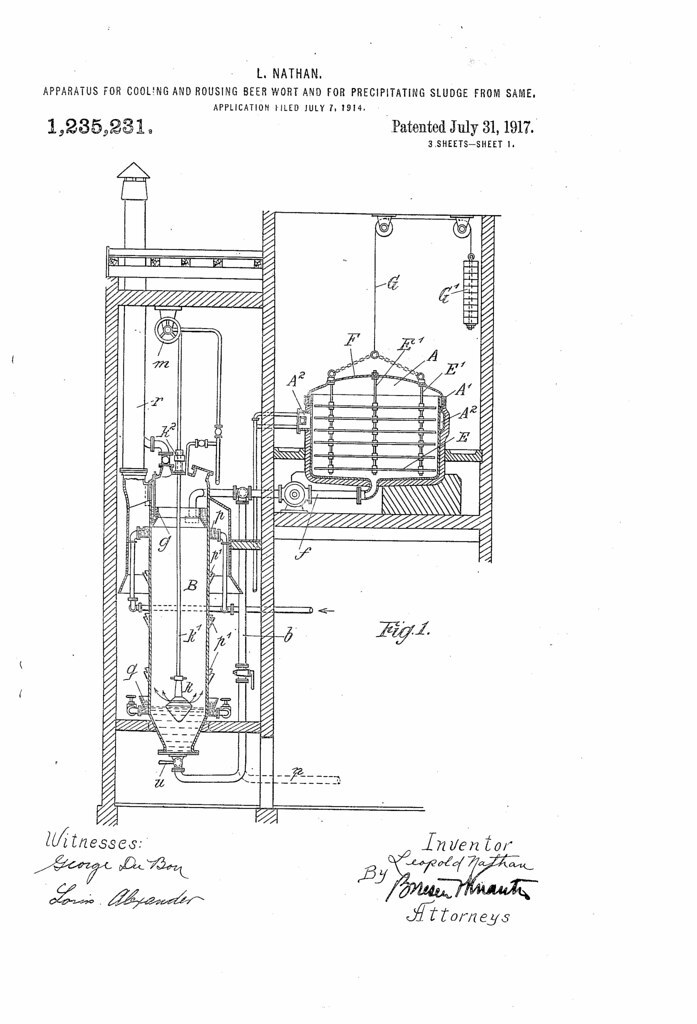
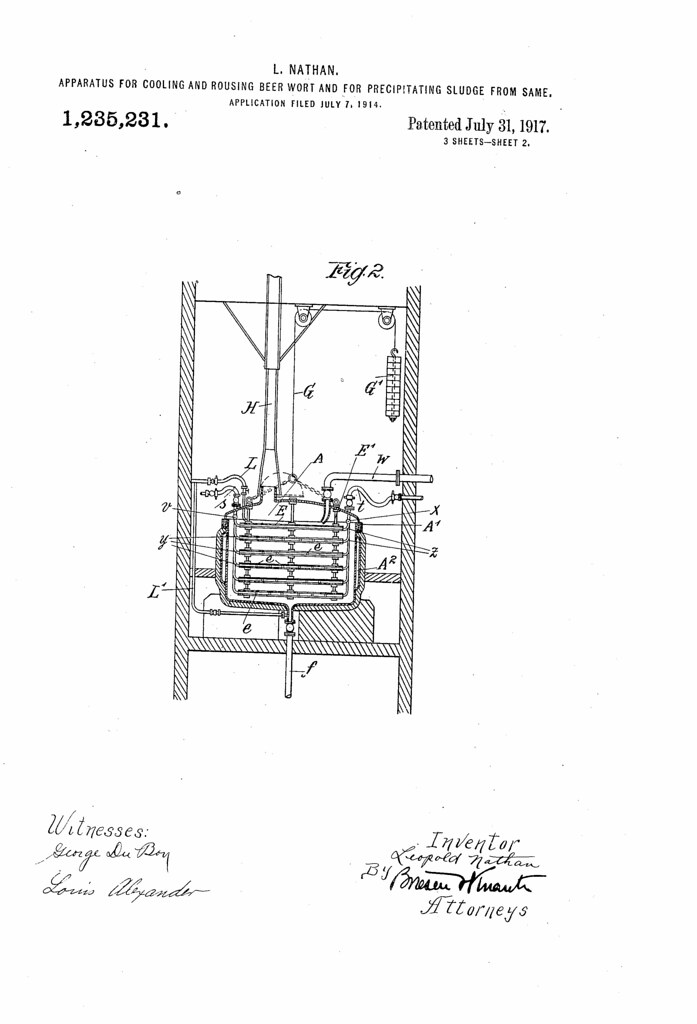
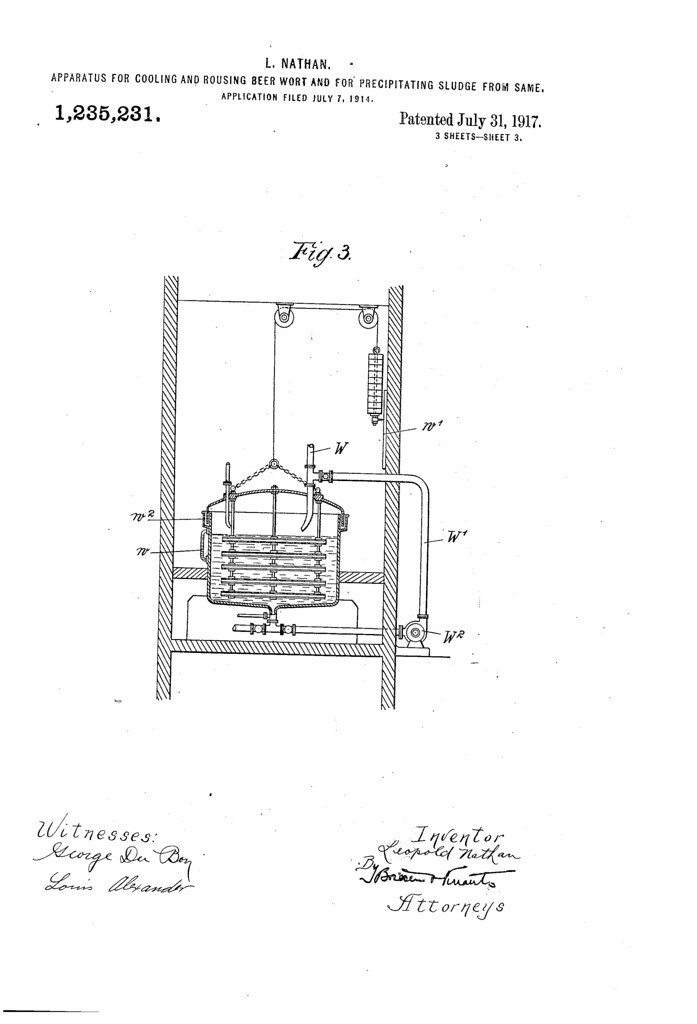
Today in 1917, US Patent 1235231 A was issued, an invention of Leopold Nathan, for his “Apparatus for Cooling and Rousing Beer-Wort and for Precipitating Sludge from Same.” There’s no Abstract, although in the description it includes this summary:

In the brewing of beer, especially in breweries in which special stress is laid on the production of high-class beers, the cooler is still in almost general use for cooling down the worts. The cooler, however, constitutes the primary and worst source of infection in the preparation of beer. Owing to the very rapid cooling of. the wort in the cooler, germs which have settled down on the cooler before it is charged with wort are not all killed. Moreover, fresh germs make their appearance during the cooling process, and these are not killed, especially at temperatures from 60 downward.

In spite of these defects of the cooler, it has been impossible hitherto, owing to its valuable properties for certain special types of beer, to dispense with this appliance. In addition to the cooling effect produced in the cooler, vapors are eliminated which carry off with them unpleasant odors formed in consequence of the inevitable access of air. Through the access of air and simultaneous cooling, considerable quantities of protein substances and hop resins are precipitated, and the only way in which these can be separated from the liquid is by allowing them to settle down, for which purpose the extensive surface of the cooler is highly advantageous.

The method employed by me in connection with the apparatus of the present invention consists in the first place in freeing the wort from the said aromatic and flavoring substances by the passage of a current of air or carbon dioxid, or both. If, as was hitherto the case, in this treatment the gas be forced or drawn into the wort from below, a very strong frothing is produced, which prevents the complete removal of the vapors.

The operation is directed, in the first place, to preventing this frothing or to nullifying its ill effects. With this object, the gas is carried, in a powerful current, along the wort in a finely-divided state so as to carry off the vapors from the surface of the liquid. At the same time a cooling effect is also produced; nevertheless the essential portion of the elimination effect can only be accomplished fully by treating the hot wort with a current of gas. The complete deposition of the cooler sludge, occurring as cooling progresses, is facilitated in a special manner, and the possibility of carrying it out in a closed, sterile vessel is afforded, by setting up in said vessel a frame containing a large number of superimposed stages having a total superficial area corresponding to that of the cooler. In order to remove the sludge this staged frame must be taken out of the vessel. The resulting infection is neutralized by allowing the next charge of wort to run into the vessel in a sufficiently hot condition.

This operation can be carried out in two vessels: one for the elimination treatment and one for the deposition of the sludge; or one and the same vessel may be used for both purposes.

Untitled
Untitled
Untitled

Filed Under: Beers, Breweries, Just For Fun, Politics & Law, Related Pleasures Tagged With: Brewing Equipment, History, Law, Patent, Science of Brewing

Patent No. 533747A: Beer-Cooling Device

July 30, 2015 By Jay Brooks

patent-logo
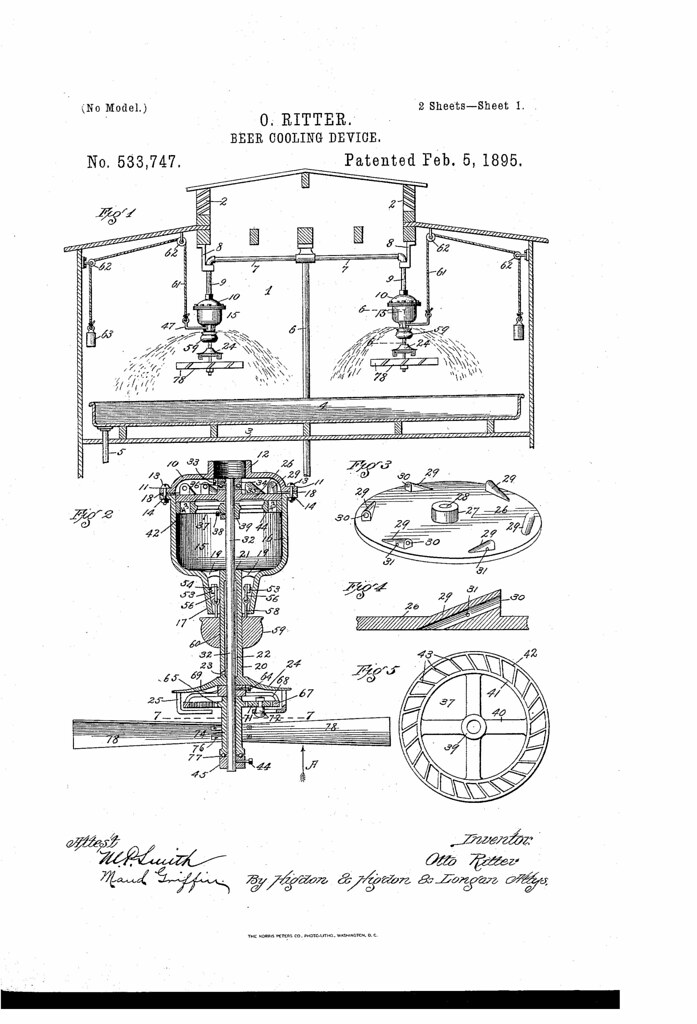
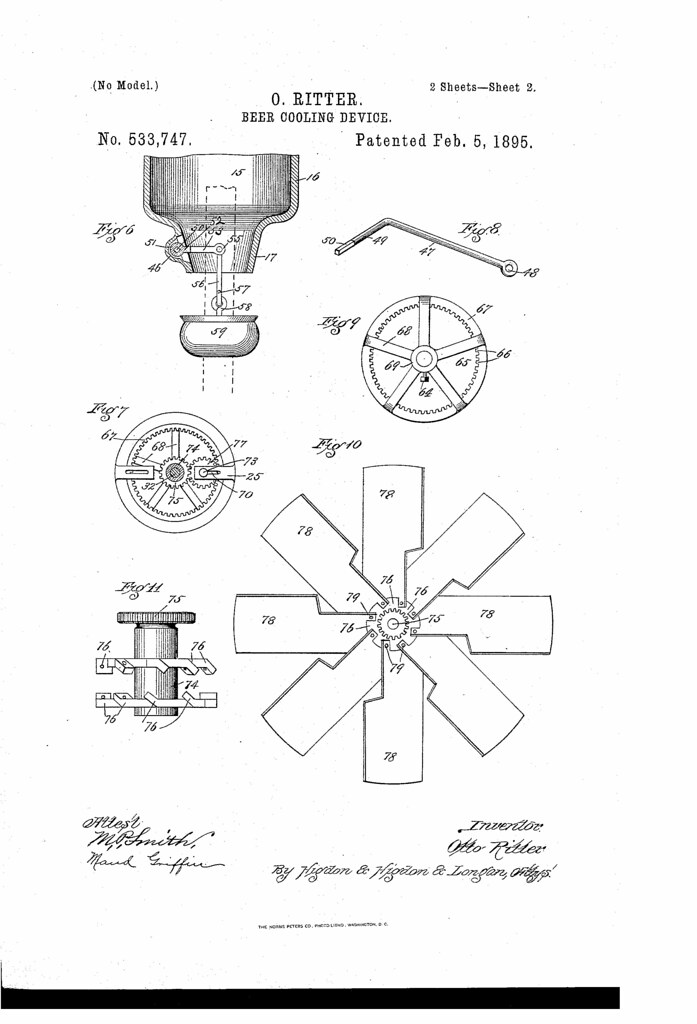
Today in 1895, US Patent 533747 A was issued, an invention of Otto Ritter, for his “Beer-Cooling Device.” There’s no Abstract, although in the description it includes this summary:

My invention relates to a beer cooling apparatus, the object of my invention being to so construct an apparatus as that when the wort or beer is passed through said apparatus it will operate a fan, which fan by its rotation sprays and cools the beer.

A further Object of my invention is to so gear the fan upon the central shaft as that said fan will rotate with greater rapidity than does the shaft.

My improved beer cooling apparatus is adapted to be located in an inclosure which is generally located in the top of brew houses, the beer being forced to said inclosure by a pump, or other suitable means, there to be passed through the apparatus and into the vats or pans adapted to receive it.

My invention consists in a suitable hollow casting adapted to besnpported in a position above the beer cooling receptacle, a shaft mounted vertically in said casting, a series of discharge nozzles or apertures located in said casting, a motor or turbine-wheel mounted to receive the beer that is discharged from said nozzles or apertures and to be revolved by the pressure of the beer, anda fan driven by and located below the said motor or turbine wheel in position to receive the beer sprayed above said fan by the movement ot’ said parts.

Untitled
Untitled

Filed Under: Beers, Breweries, Just For Fun, Politics & Law, Related Pleasures Tagged With: Brewing Equipment, History, Law, Patent, Science of Brewing

Patent No. 3749004A: Apparatus For Crushing And/Or Compacting

July 30, 2015 By Jay Brooks

patent-logo
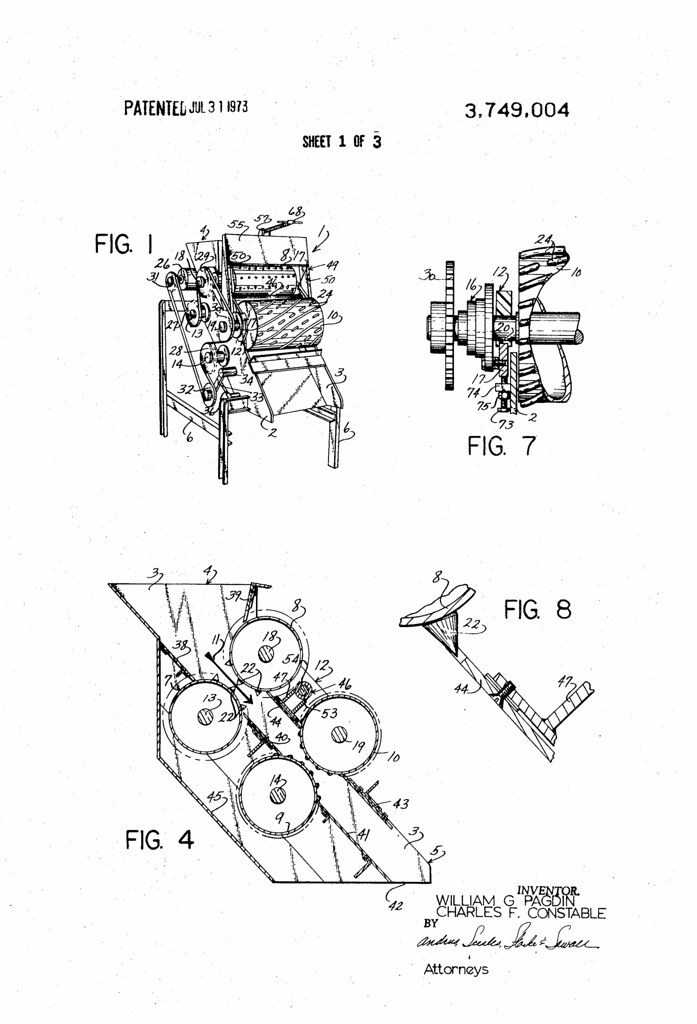
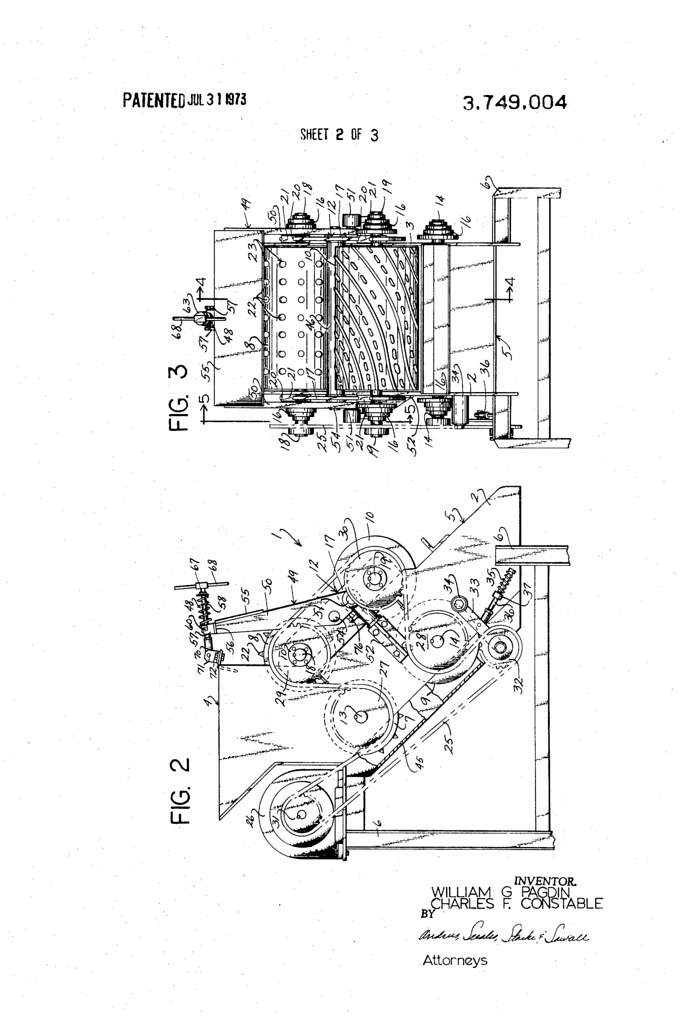
Today in 1973, US Patent 3749004 A was issued, an invention of William G. Pagdin and Charles F. Constable, assigned to the Schlitz Brewing Co., for their “Apparatus for Crushing and/or Compacting.” There’s no Abstract, although in the description it includes this summary:

The invention relates to that type of crushing and/or compacting machine or apparatus wherein a plurality of sets or pairs of opposing crushing rollers are arranged in series. Broadly according to the invention, a frame rotatably supports one roller from each set of rollers. The other roller from each set of rollers is rotatably supported by a member movable relative to the frame and the frame supported rollers. The rollers supported by the movable member move with that member relative to the frame supported rollers to provide for relief from shock loading between the sets of opposing rollers. Relative movement between the opposing rollers to relieve shock loading there between is resisted by resilient means.

Untitled
Untitled
Untitled

Filed Under: Beers, Breweries, Just For Fun, Politics & Law, Related Pleasures Tagged With: Brewing Equipment, History, Law, Patent, Science of Brewing

Patent No. 1138251A: Mash-Filter Plate

July 30, 2015 By Jay Brooks

patent-logo
Today in 1915, US Patent 1138251 A was issued, an invention of Joseph Schaefer, for his “Mash-Filter Plate.” There’s no Abstract, although in the description it includes this summary:

My invention relates to mash filters adapted for use in the arts of brewing, distilling or in the manufacture of compressed yeast, and in part is a continuation of my sugars and soluble matter are more completely removed from the lower part of the grains cakes because of the greater water pressure in the lower part of the frames. This results in the loss of more or less of the valuable sugars unless an excessive amount of water is used. The use of too much water is not desirable since this dilutes the wort to such an extent, that, to remove the excess of water, extended boiling is required which, it should be understood, is expensive and detrimental to the final product. To overcome these objections I have arranged the water chambers so that the grains cakes formed there between will be thicker at the bottom than at the top, or substantially trapezoidal in shape. It has been found that with cakes of this shape the sparging 18 more thorough, and with the use of a given quantity of water-the soluble sugars are more formaly and completely removed from the grains cakes.

Another object of my invention is .to facilitate the removal of the grains cakes from their frames when the sparging process is completed, and the series of frames are separated for this purpose. The frame as ordinarily constructed is provided with a flat floor or bottom from which ‘it is difficult to dislodge that part of the cake resting on the bottom, it usually being necessary’ for the workman to scrape it of with a paddle or other device. With my improved construction I overcome this objection by constructing the bottom or floor of each grains cake frame, wedge-shaped or like a tool edge in cross-section. This construction is adapted to save the time of the workman for, as the grains cakes are friable, it will be seen that a mere tap of a hammer will cause the bottom of the grains cake to separate and slide down on each side of the wedge-shaped bottom of the cake frame, and thus leave the frame clean without any further effort on the part of workman.

Untitled

Filed Under: Beers, Breweries, Just For Fun, Politics & Law, Related Pleasures Tagged With: Brewing Equipment, History, Law, Patent, Science of Brewing

« Previous Page
Next Page »

Find Something

Northern California Breweries

Please consider purchasing my latest book, California Breweries North, available from Amazon, or ask for it at your local bookstore.

Recent Comments

  • Ernie Dewing on Historic Beer Birthday: Charles William Bergner 
  • Steve 'Pudgy' De Rose on Historic Beer Birthday: Jacob Schmidt
  • Jay Brooks on Beer Birthday: Bill Owens
  • Steve 'Pudgy' De Rose on Beer Birthday: Charles Finkel
  • Steve 'Pudgy' De Rose on Beer Birthday: Bill Owens

Recent Posts

  • Historic Beer Birthday: George M. Biner February 22, 2026
  • Historic Beer Birthday: Samuel Charles Whitbread February 22, 2026
  • Beer In Ads #5214: Bock Beer? Yes, Point Bock Beer! February 21, 2026
  • Historic Beer Birthday: Philip Zorn February 21, 2026
  • Historic Beer Birthday: Rudolph J. Schaefer February 21, 2026

BBB Archives

Feedback

Head Quarter
This site is hosted and maintained by H25Q.dev. Any questions or comments for the webmaster can be directed here.