Brookston Beer Bulletin

Jay R. Brooks on Beer

  • Home
  • About
  • Editorial
  • Birthdays
  • Art & Beer

Socialize

  • Dribbble
  • Email
  • Facebook
  • Flickr
  • GitHub
  • Instagram
  • LinkedIn
  • Pinterest
  • RSS
  • Twitter
  • YouTube

Powered by Genesis

Session #44: Frankenstein’s Beers

October 1, 2010 By Jay Brooks

frankenstein-march
Our 44th Session is an appropriately scary one, with Halloween at the end of the month. The Session is hosted by Ashley Routson a.k.a. The Beer Wench. She’s chosen “Frankenstein Beers” as her topic, which Ashley likens to Frankenstein’s monster, a creation that was “constructed of human parts and various other inanimate objects,” defying nature’s laws and ultimately “unlike anything the world had ever seen before.” She continues.

Many craft brewers are like Frankenstein. They have become mad scientists obsessed with defying the laws of brewing and creating beers that transcend style guidelines. These “Frankenstein Beers” challenge the way people perceive beer. They are freaks of nature — big, bold and intense. The ingredients resemble those of a beer and the brewing process might appear to be normal, but some aspects of the entire experience are experimental, unorthodox and insane.

An altercation with these beers produces confusion in the eye of the taster … is it a beer, or a monster?

“I do know that for the sympathy of one living being, I would make peace with all. I have love in me the likes of which you can scarcely imagine and rage the likes of which you would not believe. If I cannot satisfy the one, I will indulge the other.” — The Monster.

Your mission, should you choose to accept it, is to write a blog post on “Frankenstein Beers.” There are no rules about how to write about this topic — feel free to highlight a Frankenstein brewer, brewery, beer tasting notes … or just your opinions on the concept.
session_logo_all_text_200

To me, it’s not the beers that have become like Frankenstein, but the brewers themselves. In the same way that many people often mistake Dr. Frankenstein’s monster for Frankenstein himself, his creation actually had no name and was always referred to euphemistically in the original novel. Although once, in a letter, author Mary Shelley referred to Frankenstein’s monster as “Adam.” Perhaps that means Alan Sprints’ Hair of the Dog Adambier is the original Frankenstein beer?

A Modern Prometheus. Prometheus was the Titan who stole fire from Zeus and gave it to mankind. “Zeus then punished him for his crime by having him bound to a rock while a great eagle ate his liver every day only to have it grow back to be eaten again the next day.” Modern brewers also damage our livers each day, but luckily it’s still intact when we wake up with only a hangover the next day.

But Frankenstein is also considered an allegory for the dangers of messing with nature and the idea that science can be bad, a common theme at the dawn of the industrial revolution. But Frankenstein’s monster only became so monstrous because his creator couldn’t bear the thought of being his father and banished him. The monster reacted badly to being abandoned along with people not being able to see the good inside of him, his ugly exterior was all they could see. That’s what caused him to become violent and seek revenge on Dr. Frankenstein. His creation could have been quite positive had it not been for the way he was treated. And so Frankenstein is considered a cautionary tale, though it really didn’t have to turn out that way. And it’s for that reason that I consider the notion of Frankenstein beers as a very positive development in the world of brewing.

In the last thirty years of craft beer, brewers as confident and skilled as Dr. Frankenstein eschewed traditional styles either by building on them or simply ignoring them to create their own monster beers. But they loved them and nurtured them, and never abandoned them. And I think that’s why we love them, too. No pitchforks necessary. The American craft beer scene, and more recently the world beer scene, has become a landscape filled with Frankenstein-like beers, unique and unusual and beloved. Unlike Mary Shelley’s Frankenstein, today’s monster beers are quite wonderful and prove the science of brewing in a post-industrial age doesn’t pervert nature but raises it to an art form. To me, the best of today’s beers can be described as a balance between art and science. Some breweries are overly scientific and create bland, tasteless beers that are very well-crafted. Others are artistic leaning endeavors that are ambitious and creative but are often inconsistent and/or technically flawed. But the best hit that Goldilocks sweet spot that balances the two.

They also don’t follow traditional styles, preferring their own path. And the best of those new ideas are copied — the sincerest form of flattery — creating new kinds of beer and driving many Brits and others who hate the explosion of new beer categories absolutely bonkers. But at the Great British Beer Festival, the American export booth is one of the most popular spots at Earl’s Court. People may complain about the new monster beers, or at least the American predisposition to categorize them, but they’ll line up to drink them all the same.

It may be Halloween month, but when it comes to beer, Frankenstein is alive and well throughout the entire year. I just think of him as a friendlier monster, more like the 60s cartoon Frankenstein Jr.

frankenstein-jr

Filed Under: Beers, Editorial, The Session Tagged With: brewers, Science of Brewing

Most Complete Beer Proteome Found

September 29, 2010 By Jay Brooks

science
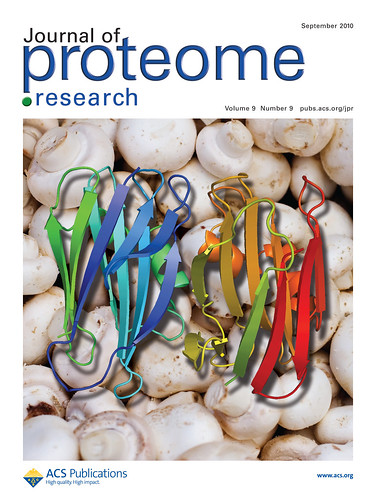
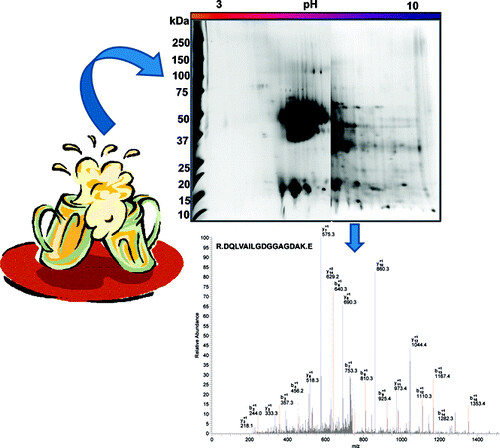
The American Chemical Society has announced that the most complete beer proteome has been found. The journal article in the ACS publication Journal of proteome Research, The Proteome Content of Your Beer Mug was conducted in Milan, Italy by two area university departments from the Politecnico di Milano and the Universit degli Studi di Milano working together.

According to the press release:

In an advance that may give brewers powerful new ability to engineer the flavor and aroma of beer — the world’s favorite alcoholic beverage — scientists are publishing the most comprehensive deciphering of the beer’s “proteome” ever reported. Their report on the proteome (the set of proteins that make beer “beer”) appears in ACS’ monthly Journal of Proteome Research.

Pier Giorgio Righetti and colleagues from say they were inspired to do the research by a popular Belgian story, Les Maîtres de l’Orge (The Brew Masters), which chronicles the fortunes of a family of brewers over 150 years. They realized that beer ranks behind only water and tea as the world’s most popular beverage, and yet little research had been done to identify the full set of proteins that make up beer. Those proteins, they note, play a key role in the formation, texture, and stability of the foamy “head” that drinkers value so highly. Nevertheless, scientists had identified only a dozen beer proteins, including seven from the barley used to make beer and two from yeast.

They identified 20 barley proteins, 40 proteins from yeast, and two proteins from corn, representing the largest-ever portrait of the beer proteome. “These findings might help brewers in devising fermentation processes in which the release of yeast proteins could be minimized, if such components could alter the flavor of beer, or maximized in case of species improving beer’s aroma,” the report notes.

I’m not sure about those findings, the statement about the “ability to engineer the flavor and aroma of beer” sounds a bit too Frankenstein-like for my tastes. Though to be fair, I don’t remember much about Proteomes from my time taking the short course on brewing at U.C. Davis.

j-of-proteome

At any rate, the whole article is online. Below is the abstract, see if it makes sense to you:

The beer proteome has been evaluated via prior capture with combinatorial peptide ligand libraries (ProteoMiner as well as a homemade library of reduced polydispersity) at three different pH (4.0, 7.0, and 9.3) values. Via mass spectrometry analysis of the recovered fractions, after elution of the captured populations in 4% boiling SDS, we could categorize such species in 20 different barley protein families and 2 maize proteins, the only ones that had survived the brewing process (the most abundant ones being Z-serpins and lipid transfer proteins). In addition to those, we could identify 40 unique gene products from Saccharomyces cerevisiae, one from S. bayanus and one from S. pastorianus as routinely used in the malting process for lager beer. These latter species must represent trace components, as in previous proteome investigations barely two such yeast proteins could be detected. Our protocol permits handling of very large beer volumes (liters, if needed) in a very simple and user-friendly manner and in a much reduced sample handling time. The knowledge of the residual proteome in beers might help brewers in selecting proper proteinaceous components that might enrich beer flavor and texture.

Interesting ….

proteome-2010

Filed Under: Beers, News Tagged With: Ingredients, Science of Brewing

A Fermentation Question

January 6, 2010 By Jay Brooks

fermentation
I preordered Michal Pollan’s new book, Food Rules, so it arrived on the day it was published. At 112 sparse pages, it’s really more of a pamphlet but I’ve been enjoying reading it off and on for the last few days. When I reached Rule #33 (of 64) it stopped me in my tracks, and it started me thinking. Here’s the rule:

Rule 33

Eat some foods that have been predigested by bacteria or fungi.

Many traditional cultures swear by the health benefits of fermented foods — foods that have been transformed by live microorganisms, such as yogurt, sauerkraut, soy sauce, kimchi, and sourdough bread.

Pollan goes on to list essential nutrients, vitamins, etc. found in these foods. He ends by mentioning that probiotics are contained in many fermented foods, which studies “suggest improve the function of the digestive and immune systems,” and may combat allergies, too.

So here’s my question. If, as Pollan seems to suggest, that it’s fairly settled that fermented foods have health benefits, doesn’t it then follow that fermented beverages would, too?

In Rule 43 he suggests drinking wine with dinner, while not mentioning beer at all. And the man’s from Berkeley, for chrissakes. He appears to be following the old reservatrol canard in choosing wine over other alcohol, though he admits alcohol of any kind can be beneficial in moderation, something that’s becoming increasingly apparent in study after study.

That slight aside, isn’t fermentation fermentation? It’s an anaerobic process (meaning it takes place without oxygen) in which chemical reactions split complex organic compounds into more simple substances. And if it’s good in food, it should be similarly beneficial in beer, wine and spirits, too.

Beer has been called liquid bread since ancient times. It’s nourished men and women since civilization began, and increasingly is believed to have been the very reason for civilization’s beginnings. Some scientists now believe that our ancestor’s tolerance for alcohol in quantity was an important factor in their survival. So much so, that quite literally you and I owe our very existence to the fact that we have an unbroken chain of ancestors stretching back to the dawn of civilization whose ability to process alcohol insured they lived long enough to reproduce. If that had not been the case, I wouldn’t be here to write these words and you wouldn’t be here, reading them now.

Anyway, just some … ahem … food for thought. Any brewers, chemists or scientists out there know if there would be any substantial difference between fermented food and a fermented beverage? I certainly can’t think of any. If not, I would suggest that Food Rule #33 be amended to “Eat some foods or drink some beverages that have been predigested by bacteria or fungi.”

food-rules

Filed Under: Beers, Editorial, Food & Beer Tagged With: Science, Science of Brewing

Good For Your Bones: Beer

August 15, 2009 By Jay Brooks

health
A study recently conducted in Spain revealed that women who drink beer daily, or nearly so, have stronger bone density and have a lower risk of developing osteoporosis later in life. The study, published in the June edition of Nutrition, speculates that “the high level of silicon in beer slows down the thinning that leads to fractures and boosts the formation of new bone. Beer is also rich in phytoestrogens, plant versions of oestrogen, which keep bones healthy.”

According to the Full Text of the Study:

Of the nearly 1700 women who took part in the study, there “were 793 (46.7%) who drank beer habitually. Two hundred fifty-seven (15.1%) subjects drank wine habitually, 374 (22.0%) subjects smoked, and among these 209 (12.3% of total) were beer drinkers. Postmenopausal women drank less beer than premenopausal and perimenopausal women.”

For postmenopausal women, circulating estrogen concentrations have been shown to be positively associated with alcohol intake. Our findings, of higher Ad-SoS in premenopausal and postmenopausal women who drink, support the idea that the bone-enhancing effects of alcohol might be partially due to a promotion of endogenous estrogens synthesis. Although wine at low doses, and in an acute form, has been observed to have an estrogenic effect, there have been no indications of pathways for its effect on bone other than its stimulation of the syntheses of estrogens and, because of its alcohol content, of calcitonin. This may explain the difference in our results, which were positive for the consumption of beer but not significant for the consumption of wine.

Beer is also a major source of silicon in the form of orthosilicic acid. In fact, it has been suggested that beer is one of the most important sources of silicon in the Western diet. Moreover, it has been demonstrated that dietary silicon intake may have salutary effects on skeletal health, especially cortical bone health in premenopausal women, although not in postmenopausal women. Despite a positive correlation also taking place in the postmenopausal group, we believe that this positive effect on bone might be due to the synergic effect of a combination of silicon and phytoestrogen (daidzein, genistein, and others) compounds in beer. These positive effects of silicon on the bone in postmenopause seem to occur when silicon supplementation is given to prevent bone mass loss. In fact, oral silicon is reported to completely abrogate the loss of bone mass.

In this study, we do not recommend the consumption of beer, wine, or any other alcoholic beverage for bone health; nevertheless, we have been able to verify that beer ingestion, a common component within our area’s diet, seems to provide bone mass with beneficial effects for those women who had moderate alcohol consumption. This was a cross-sectional study with certain limitations, which reflects associations but does not reveal causes and effects. A common problem with studies using dietetic questionnaires is the fact that some subjects could have difficulty recalling type and frequency of ingested food. This is a minor problem with respect to beer consumption because its quantification is easy and precise, since it is available only in 200-mL and 330-mL bottles at supermarkets in our area. Our study design did not include the measurements of plasma levels of phytoestrogens.

In conclusion, the consumption of beer, apart from its alcohol content, favors greater bone mass in women independently of their gonadal status. This might be a result of the phytoestrogen content of this alcoholic drink, which requires further investigation.

Despite their chickening out from actually recommending people drink beer for their health, the conclusions of the study nonetheless support doing just that. Another study by Tufts University earlier this year came to the same conclusion.

So why is it so difficult for scientists to just admit what’s right in front of their faces? That the moderate consumption of beer is really good for you. The only reasons I can think of is that they’re either afraid of having research grant money dry up for not reaching the “correct” conclusions or because they, too, have inadvertently drank the Kool-Aid and internalized the decades of prohibitionist propaganda. In the latter case — and I think this is true of many otherwise typical people — years and years of neo-prohibitionist groups having the only voice without dissenting opinions allowed have left many believing a series of premises that are simply not true or at best grossly exaggerated. That seems to me the only rational explanation of why it’s seemingly so difficult for many similar scientific studies to draw the logical conclusion from the data. Of course, it may simply be a liability issue and they’re afraid of being sued when people begin drinking more based on the studies.
Young woman with glass of beer
Drink up ladies! A beer a day may keep the doctor away.

Filed Under: Editorial, News Tagged With: Health & Beer, Science of Brewing

Das Bierbrauen

March 31, 2009 By Jay Brooks

film
Here’s another very cool old beer video that was sent to me by Steve Altimari, brewmaster at Valley Brewing, who got it from Brian Hunt at Moonlight Brewing. Anyway, it’s a nearly twelve-minute silent film (with appropriately cheesy music) from Germany around the 1920s and shows the brewing process in film and crude animation. The original title was Das Bierbrauen.

The video is a part of Classic Beer Commercials, Vol. 3, available on DVD from TV Days. The YouTube title is Visit A German Beer Factory 1930 but in the DVD description says it’s from the 1920s. Either way, enjoy!

Filed Under: Breweries, Just For Fun Tagged With: Science of Brewing, Video

World’s First All-Rye Beer

January 23, 2008 By Jay Brooks

bear-republic
Most rye beers that I’m aware of use only around 10-20% rye with the rest being the more traditional barley. I’ve always liked that little something that rye adds to the beer and was in heaven over ten years ago during that year or so when it seemed like almost everybody was making a rye beer. These days, rye beers are a bit more on the rare side, though there’s still a few hundred being made in North America.

There is also a German style of beer, Roggenbier, which uses at anywhere from 25-65% rye malt, depending on whose account you accept. The German Institute says “half barley malt and equal portions of wheat and rye malts” are used while the BJCP guidelines say “Malted rye typically constitutes 50% or greater of the grist (some versions have 60-65% rye). Remainder of grist can include pale malt, Munich malt, wheat malt, crystal malt and/or small amounts of debittered dark malts for color adjustment.” Nothing against the BJCP, but I’m more inclined to to accept the version of the German Beer Institute since it’s an association of German breweries and related institutions.

So those are the common rye beers, what about using 100% rye? Well, probably the first and foremost reason you never hear about all-rye beers is that it is so difficult to brew with. Rye has no husks, like barley does, and that means it’s extremely difficult to sparge (which is spraying hot water on the spent grain) as without the husks it turns to a thick porridge or concrete.

There was a Irish brewer, Dwan Tipperary Brewing, who closed a few years back, who made a beer called All Rye Beer or All Rye Paddy at least once. But there’s no information as to whether it really used 100% rye malt, apart from that suggestive name. I’ve also come across an account of a homebrewer making an all-rye beer. MoreBeer’s forum also has a topic dedicated to why this is a difficult task.

ezryder-1

So perhaps I should change the title to the world’s only currently made commercial example of a 100% rye beer, but it doesn’t sound very sexy that way, now does it? At any rate, Bear Republic Brewing in Healdsburg, California on Friday, debuted what they believe to be the world’s first 100% rye beer. I was on hand to try some of the first keg of their new Easy Ryeder and talk with the brewers about it.

But let’s talk about the beer itself first. It had a dull copper color, slightly hazy, with a decent tan head. The nose was a little restrained, with some bready aromas, a touch of hops and, naturally, some rye character. But it was surprisingly smooth, mild and very drinkable, an easy ryeder indeed. I was surprised to learn it was 5% abv because it seemed more like a session beer to me, and I would have guessed a little lower than that. I thought the rye flavors might overpower the beer, but that’s not the case at all. It is light and refreshing throughout with just enough hop character (at 30 IBUs) for balance. It finishes with just a bit of rye flavor lingering, before dissipating quickly and cleanly. Again, I think my expectations were that if beer with just a fraction of rye tends to give it strong rye flavors and character, that with all rye it would be even more so, but that wasn’t really was not what happened. Instead, they managed to create a unique, ultimately very drinkable beer that in temperament seems closer to a wheat beer, but with the more barley-like flavors of rye.

The beer went through several trials before getting things right. To combat the wort turning to concrete, they had to watch the temperature fluctuations much more closely than usual (no more than 3-5 degrees or it turned to stone), and with bags of rice hulls added to make up for the lack of husks in rye malt. It was, of course, difficult to get the malt to break down and early test batches, if they didn’t become concrete-like, were still very thick and viscous and even hard to remove from the lauter tun at all. Even so, the first test batch that yielded drinkable results was the color of bad gravy, having a dull gray tint to it from all pale rye malt. Apparently it tasted fine, but who among us wants a beer the color of dishwater? Twenty-five pounds of chocolate rye malt was then added to give it the much more appealing color it exhibits today. The hops they used are Chinook and Saaz. It took four tries to get it right, as there really aren’t any manuals for tis kind of beer. Was it worth all that effort? I think so, as the results are quite tasty and in some ways different from anything else I’ve tried. It certainly must have been a learning experience and it’s interesting to see that it is possible on a commercial level to use only rye. It’s quite an achievement, and if you love rye — or just brewing innovation and creativity — you owe it to yourself to get up to Healdsburg to try this new beer.

ezryder-2
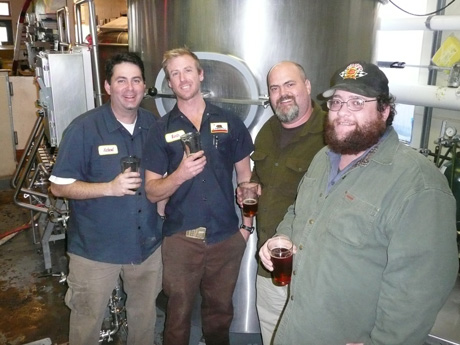
Bear Republic brewers Rich Norgrove, Jode Yaksic, Peter Kruger and Ray Lindecker. Jode, according to Rich, had the most to do with creating the Easy Ryder, from doing the research, test batches and coming up with the name.

Filed Under: Beers, Breweries, News, Reviews Tagged With: Bay Area, California, Ingredients, Malt, Northern California, Science of Brewing

The Yeast of Immortality

January 14, 2008 By Jay Brooks

Though it appears the focus of this new discovery, at least as reported in Live Science, is mostly about the vain hope of immortality, it does involve beer yeast. Research scientists from USC “have extended the lifespan of yeast, microbes responsible for creating bread and beer, by 10-fold. That’s twice the previous record for life extension in an organism.” Or as USC News put it, “[b]iologists have created [brewer’s] yeast capable of living to 800 in yeast years without apparent side effects.” Normal yeast lives not more than a week, usually. The USC study managed to keep the yeast alive for ten weeks.

The full results of the study will be published today in the Journal of Cell Biology. I can’t say this will have any impact on the brewing industry, but it seems like it can’t hurt to have yeast that is effectively ten-times tougher and longer-lasting.


Filed Under: News Tagged With: Ingredients, Science of Brewing, Yeast

Van’s Ned Flanders

December 4, 2007 By Jay Brooks

rock-bottom
John Foyston had a nice piece in the Oregonian yesterday about one of my favorite — and perhaps most underrated — beers to be poured at the Oregon Brewers Festival. It was certainly my favorite the year it appeared, 2006, and as this story attests, people are still talking about it. The beer is Ned Flanders, a sour beer based on the style Flemish Red Ale, of which Rodenbach Red and Duchesse De Bourgogne (another fave of mine) are perhaps the best known examples. I chose it as my buzz beer of the festival that year. Van Havig, then the brewer at Rock Bottom in Portland (and now a regional brewing manager) put quite a bit of effort into the beer, aging it in five different kinds of barrels and then blending it back together. Responding to a question from Foyston, Havig lays out the full story of this beer, and it’s a fascinating account filled with history and chutzpah.

van-havig ned

Will the real Ned Flanders please stand up? Van Havig and his inspiration for Ned Flanders Sour Red Ale.

Filed Under: News Tagged With: History, Ingredients, Oregon, Portland, Science of Brewing

Quick Chilling Beer With Dry Ice

November 15, 2007 By Jay Brooks

The New Zealand Herald reported Tuesday that a Massey University student in Auckland has invented a novel device to quickly chill beer in a fraction of the time, potentially allowing people to leave the cooler at home. It’s one of thirty inventions being exhibited at the three-day Design Exposure 2007, which began Wednesday, at Massey University’s Auckland School of Design.

Twenty-two-year-old New Zealander Kent Hodgson came up with the idea for his device after being frustrated by warm beer at a backyard barbecue earlier this year. He calls it a “Huski,” and it’s described as using a “rapid cooling beverage process” involving dry ice.

“You have plastic cooling cells which are pressed down into the dock which houses the liquid carbon dioxide. The liquid CO2 expands and is pressurized into dry ice in the base of the cooling cells … in a moment.

“You then pop it into your drink and then proceed from there as you normally would.”

With a surface temperature of minus 78.5C, dry ice has a cooling capacity almost four times that of the same amount of regular ice.

“The cooling power is almost instant and is utilized for several minutes and it doesn’t dilute the drink like ice would,” said Mr. Hodgson.

One canister can chill a little more than a case of beer bottles for only about seven cents. But the initial cost of the device will likely be around $50, so you’ll probably have to do a lot of drinking to make it cost effective. Still, if it allows you to not have to lug a cooler around with you that could be a good thing.

The real question is whether or not the rapid cooling using dry ice will damage the beer in the process. Generally speaking, putting beer into the freezer to quick chill it will cause the beer to break down chemically causing chill haze, producing little floating particles in the beer and altering its taste (and not for the better). That’s why it’s never a good idea to put your beer in the freezer. Does dry ice do the same thing? It would logically seem that any method that chills the beer too quickly would similarly damage it, but I’m not a scientist so I can’t really say if using dry ice will cause the same problems. Until then, it’s an intriguing idea, at least.

Inventor Kent Hodgson shows off his “Huski” quick beer chilling device.


Filed Under: Just For Fun, News Tagged With: International, Science of Brewing, Strange But True

Chocolate’s Popularity Began With Beer

November 15, 2007 By Jay Brooks

A new article in the Proceedings of the National Academy of Sciences, a government journal, has determined that ancient Mesoamericans, as long ago as 3,100 years, were using cacao — the stuff chocolate is made from — in a beverage that bears a remarkable similarity to beer. Pottery vessels not unlike the one below recently discovered in Honduras have been found to have residues inside them from cacao plant. It is believed that the beer-like drink was a status symbol used during celebrations in the ancient society.

From a Reuters article:

One of the researchers, anthropologist John Henderson of Cornell University in Ithaca, New York, said cacao beverages were being concocted far earlier than previously believed — and it was a beer-like drink that started the chocolate craze.

“What we’re seeing in this early village is a very early stage in which serving cacao at fancy occasions is one of the strategies that upwardly mobile families are using to establish themselves, to accumulate social prestige,” Henderson said in a telephone interview.

I think this is part of the process by which you eventually get stratified societies,” Henderson said.

The cacao brew consumed at the village of perhaps 200 to 300 people may have evolved into the chocolate beverage known from later in Mesoamerican history not by design but as “an accidental byproduct of some brewing,” Henderson said.

The style of the 10 small, elegant serving vessels suggests the cacao brew was served at important ceremonies perhaps to celebrate weddings and births, the scientists said.


Filed Under: Uncategorized Tagged With: History, Science of Brewing

« Previous Page
Next Page »

Find Something

Northern California Breweries

Please consider purchasing my latest book, California Breweries North, available from Amazon, or ask for it at your local bookstore.

Recent Comments

  • Bob Paolino on Beer Birthday: Grant Johnston
  • Gambrinus on Historic Beer Birthday: A.J. Houghton
  • Ernie Dewing on Historic Beer Birthday: Charles William Bergner 
  • Steve 'Pudgy' De Rose on Historic Beer Birthday: Jacob Schmidt
  • Jay Brooks on Beer Birthday: Bill Owens

Recent Posts

  • Beer In Ads #5127: The Stock-Up “Dozen Sale” On Meister Bräu Bock Beer February 23, 2026
  • Historic Beer Birthday: Gottlieb Brekle February 23, 2026
  • Beer Birthday: J.J. Phair February 23, 2026
  • Beer In Ads #5126: Start Looking For Bock February 23, 2026
  • Historic Beer Birthday: Johann Baier February 23, 2026

BBB Archives

Feedback

Head Quarter
This site is hosted and maintained by H25Q.dev. Any questions or comments for the webmaster can be directed here.