Brookston Beer Bulletin

Jay R. Brooks on Beer

  • Home
  • About
  • Editorial
  • Birthdays
  • Art & Beer

Socialize

  • Dribbble
  • Email
  • Facebook
  • Flickr
  • GitHub
  • Instagram
  • LinkedIn
  • Pinterest
  • RSS
  • Twitter
  • YouTube

Powered by Genesis

USA Beer Consumption

June 24, 2013 By Jay Brooks

maps-usa
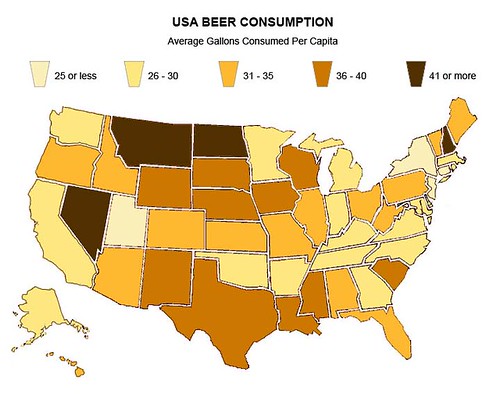
Today’s infographic shows a map of the U.S. that’s been color-coded to show beer consumption by state. It was created by Beer Universe in a post entitled Craft Beer in the US: Creativity Across the Map, and although the data is from 2010, I suspect it’s still reasonably accurate for today, as well.
usa-map-consumption
Click here to see the map full size.
Filed Under: Beers, Just For Fun Tagged With: Infographics, Statistics, United States

Top 10 Drinking Countries

June 23, 2013 By Jay Brooks

world-map-3
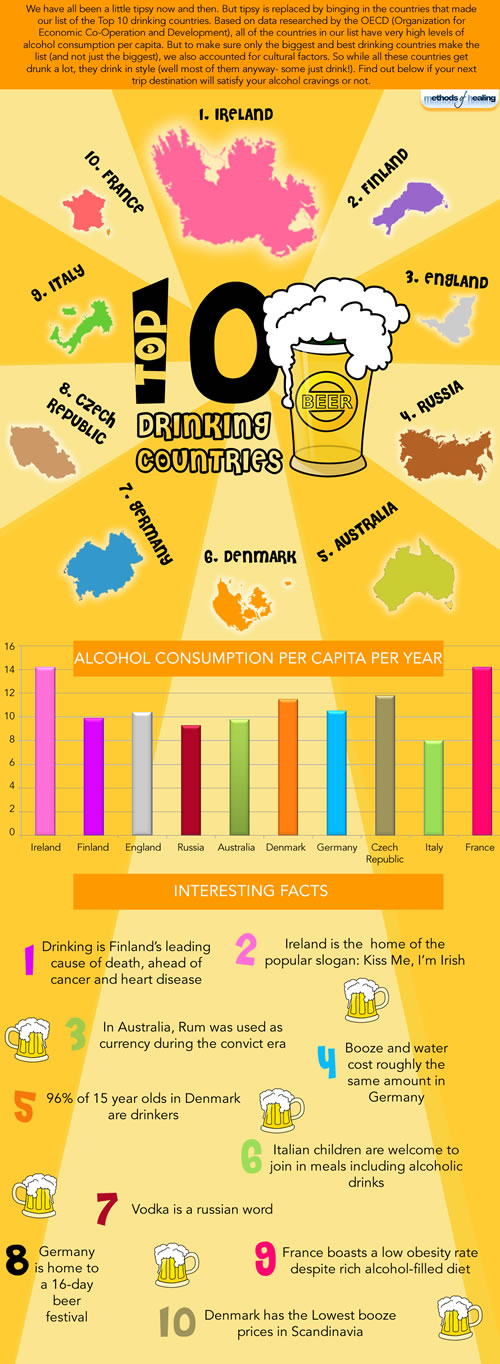
Today’s infographic shows the Top 10 Drinking Countries, meaning alcohol consumption (not just beer) per capita. We don’t even make the top ten.

top-alcoholic-drinking-countries
Click here to see the infographic full size.

Filed Under: Just For Fun, Related Pleasures Tagged With: Infographics, International, Statistics

Intelligent People Drink More Alcohol

June 13, 2013 By Jay Brooks

brain-2
I saw this yesterday in the Discovery Channel’s Curiosity.com. In answer to the question “do intelligent people drink more alcohol,” two separate answers reached the same surprising conclusion. When I say surprising, I mean it will come as a shock to the anti-alcohol wingnuts who continue to deny any positive attributes whatsoever to drinking alcohol. Because while the answer isn’t that new, or that unpredictable, especially if you’ve spent a lot of time around responsible drinkers — wets vs. drys — you probably already knew that the answer is simply yes.

Their first answer was from Ian O’Neill, Discovery News’ Space Producer, who wrote:

Surprisingly, a recent study using data from the National Child Development Study in the United Kingdom and the National Longitudinal Study of Adolescent Health in the United States indicates that intelligent people really do drink more alcohol.

By tracking the intelligence of children under the age of 16 and then revisiting them as adults, it turned out that kids who were considered “more bright” than others in their age group ended up drinking more alcohol later in life. Even after researchers canceled out marital status, parents’ education, earnings and childhood social class, smarter kids were drinking more alcohol as adults.

Why would intelligent people drink more alcohol? Some researchers suggest that as the production of alcohol is only a recent invention (within the last 10,000 years) and our ancestors had gotten their alcohol buzz from rotten fruit, the more intelligent humans would be more likely to drink modern alcoholic beverages. Although this is attractive evolutionary speculation, it’s more likely the real reasons are more complex.

The second answer was presented not by an individual, but as a group answer by Curiosity:

It’s a myth that alcohol kills individual brain cells, but drinking can cause long-term brain damage. That’s why researchers were surprised in 2010, when data from Britain and the United States revealed that more intelligent children, when grown and of legal age, tended to drink more alcohol than their less intelligent peers. The researchers were able to control for other factors that might affect a person’s propensity to drink, such as marital status and income, and the findings related to childhood intelligence held up. Researchers aren’t exactly sure why this link exists; one writer posited that drinking alcohol for pleasure is a relatively new thing, evolutionarily speaking. Intelligent people tend to try new things, so the writer argued that people who enjoy a glass of wine with dinner are actually performing a novel act when you take a long view of history.

One of the longitudinal study each answer is referring to was The National Longitudinal Study of Adolescent Health (Add Health) conducted here in the U.S., while the other was part of the UK’s massive National Child Development Study in the UK. I started writing about some of the conclusions drawn from the UK study several months ago, abandoning it when I got busy with other projects, but it’s still pretty interesting. Satoshi Kanazawa, an evolutionary psychologist who writes a blog for Psychology Today entitled the Scientific Fundamentalist, wrote More Intelligent People Are More Likely to Binge Drink and Get Drunk which covered much of the same ground. Although in it Kanazawa focuses on something I strongly disagree with. “Not only are more intelligent individuals more likely to consume more alcohol more frequently, they are more likely to engage in binge drinking and to get drunk.” That propensity to “binge drink,” I’d argue, has more to do with the narrowing definition of binge drinking than any actual increase in drinking. Binge drinking used to be a defined qualitatively but over the past few decades has become quantitative, meaning it’s become defined as a specific number of drinks in a set period of time, absent any context or mitigating factors (of which there could be many). And even that nonsensical number keeps shrinking and changing.

Kanazawa wonders aloud if that should be worrying. I have to say “no, Doc, it’s not.” Here’s why. Look at this chart below. It shows the correlation between intelligence and incidence of “binge drinking,” as defined using the modern absurdity of five drinks in a row.

binge-drinking-intelligence

But what this chart really says is that the most intelligent among us have just under five drinks one and a half times a year, roughly three times every two years. The horror! Or is it?

Even “controlling for age, sex, race, ethnicity, religion, marital status, parental status, education, earnings, political attitudes, religiosity, general satisfaction with life, taking medication for stress, experience of stress without taking medication, frequency of socialization with friends, number of sex partners in the last 12 months, childhood family income, mother’s education, and father’s education,” the smarter you are as a child, the more you’ll apparently drink as an adult. Isn’t it at least possible that the intelligent people are on to something? Maybe it’s not such a terrible thing after all.

Another psychologist who also writes for Psychology Today, Stanton Peele, wrote sort of a rebuttal to Kanazawa. In Are More Intelligent People More Likely to be Alcoholics?, he ponders.

So, we can ask, is getting drunk ‘once every other month or so good, bad, or neutral? Is it harmless — even beneficial? Is it a social convention? An exploration of the universe? Fun for people who are better off and can spare the time and who can protect themselves while having a night out drinking? Or is this behavior pathological, a precursor to alcoholism? Specifically, are more intelligent people more likely to be alcoholics?

To this, he posits three possibilities.

  • Although smarter people (as measured in childhood) get drunk more, they are less likely than dull people to become alcoholics. Does that mean that they are inured against alcoholism? The dominant theory here would be that being smart is a protective life asset.
  • They are just as likely to become alcoholics. Which would still be somewhat counterintuitive, since despite getting drunk far more often than dull people, they are no more likely to succumb to alcoholism.
  • Smart people are more likely to be alcoholics. This could follow from several theories of behavior: smart people tempt fate by drinking more, and thus they are more likely to become alcoholics. Or, smart people are inherently more likely to be alcoholics — perhaps being smart makes them more acutely aware of the world’s problems, or creates other damaging emotional states.

Which, he notes, is odd, since it would seem to suggest “childhood intelligence is a risk factor for alcoholism.” Are parents putting their children at risk by sending them to good schools, making them do their homework or encouraging them to read? Peele declares this to be something of a “quandary — something most people generally value leads to a behavior of which we disapprove.” And Kanazawa concludes that since “more intelligent children are more likely to grow up to engage in binge drinking and getting drunk,” then “occasional drunkenness is incompatible with regular moderate drinking.”

The fallacy with both these lines of thought, I believe, is that occasional drunkenness may not be the demon the medical community has come to believe. In their zeal to quantify everything, they’ve removed the problems in problem drinking and reduced it to a simple formula that clearly doesn’t work. By their standards, I’m an undisputed binge drinker, and yet I’d warrant I’m drunk less than many people. I can state clearly and unequivocally that I’m not an alcoholic, having grown up with and around countless actual problem drinkers. And without trying to sound too egotistical, I’m not an idiot, at least. I did reasonably well in school. Maybe that’s why I drink more now? Since most of the people I know also drink a fair amount, does that means beer drinkers tend to be smarter than non-drinkers? My anecdotal evidence says yes. But then I’m very biased. Don’t we all want to believe we have smart friends? Maybe, but I’m just happy if they like good beer. Of course, that may possibly be one and the same thing.

Filed Under: Beers, Editorial, Just For Fun, Politics & Law, Related Pleasures Tagged With: Archeology, History, Science, Statistics

Feeling Thirsty??

June 12, 2013 By Jay Brooks

snap
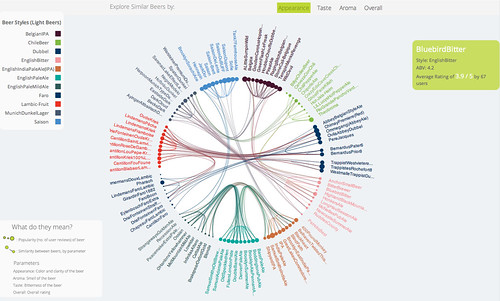
Today’s infographic is an interactive one, meaning if you’re Feeling Thirsty, you should visit the interactive infographic. It was created at Stanford University, using the Stanford Network Analysis Platform (SNAP), which put more than 1.5 million Beer Advocate reviews into a dataset to create the infographic. I’m not sure why they used color (light, medium and dark) as one of the ways to slice the data, but otherwise it’s pretty interesting to see. Below are a couple of examples, but you really need to look at it on the original website.

Here, for example is what Westvleteran 8 look like:
snap-chart-2

And here’s Coniston’s Blue Bitter
snap-chart-1

Also, be sure to check out the About the Data graphs at the bottom.

Filed Under: Beers, Just For Fun Tagged With: Infographics, Statistics, Websites

Mapping The Rise Of Craft Beer

June 7, 2013 By Jay Brooks

maps-usa
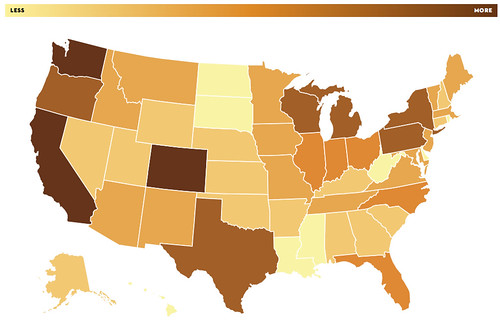
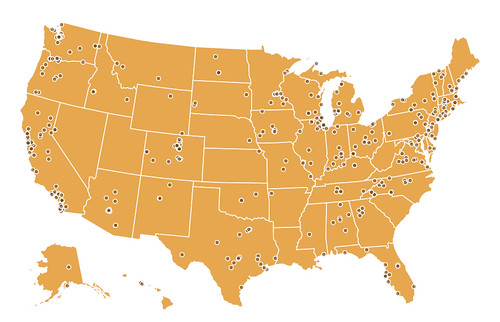
Here’s a very cool interactive map from the New Yorker, part of their Idea of the Week for this week. Their map of the U.S. can show several different pieces of data about craft breweries and beer in the U.S., by state, and moving your mouse over each state reveals additional information. Give it a try.

Here, for example, is Total breweries. The darker the color, the more breweries.
ny-total-breweries

And here are new breweries opened in 2012.
ny-new-breweries-2012

Filed Under: Breweries, Just For Fun, Related Pleasures Tagged With: Statistics, United States

Alpha Acid Ranges By Hop Variety

May 28, 2013 By Jay Brooks

hops
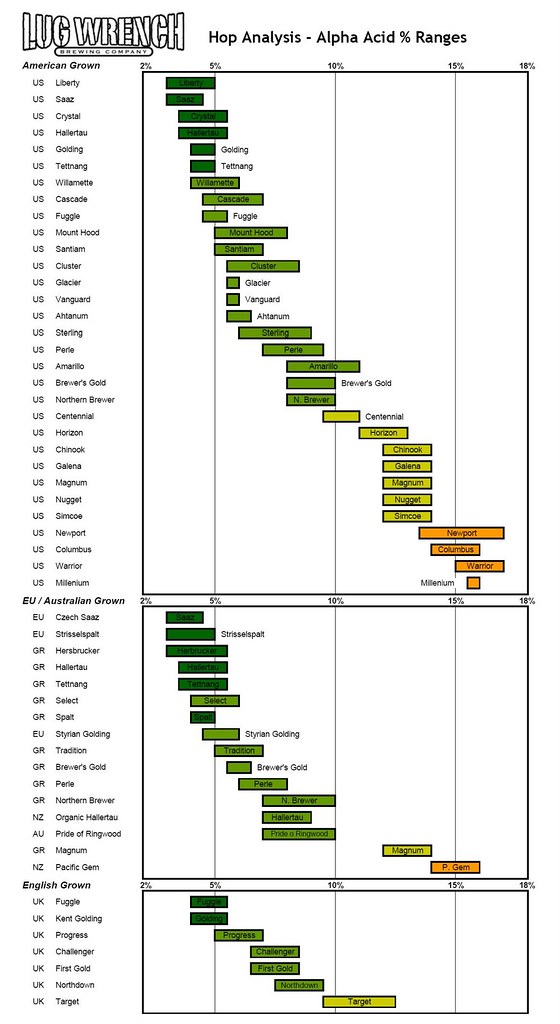
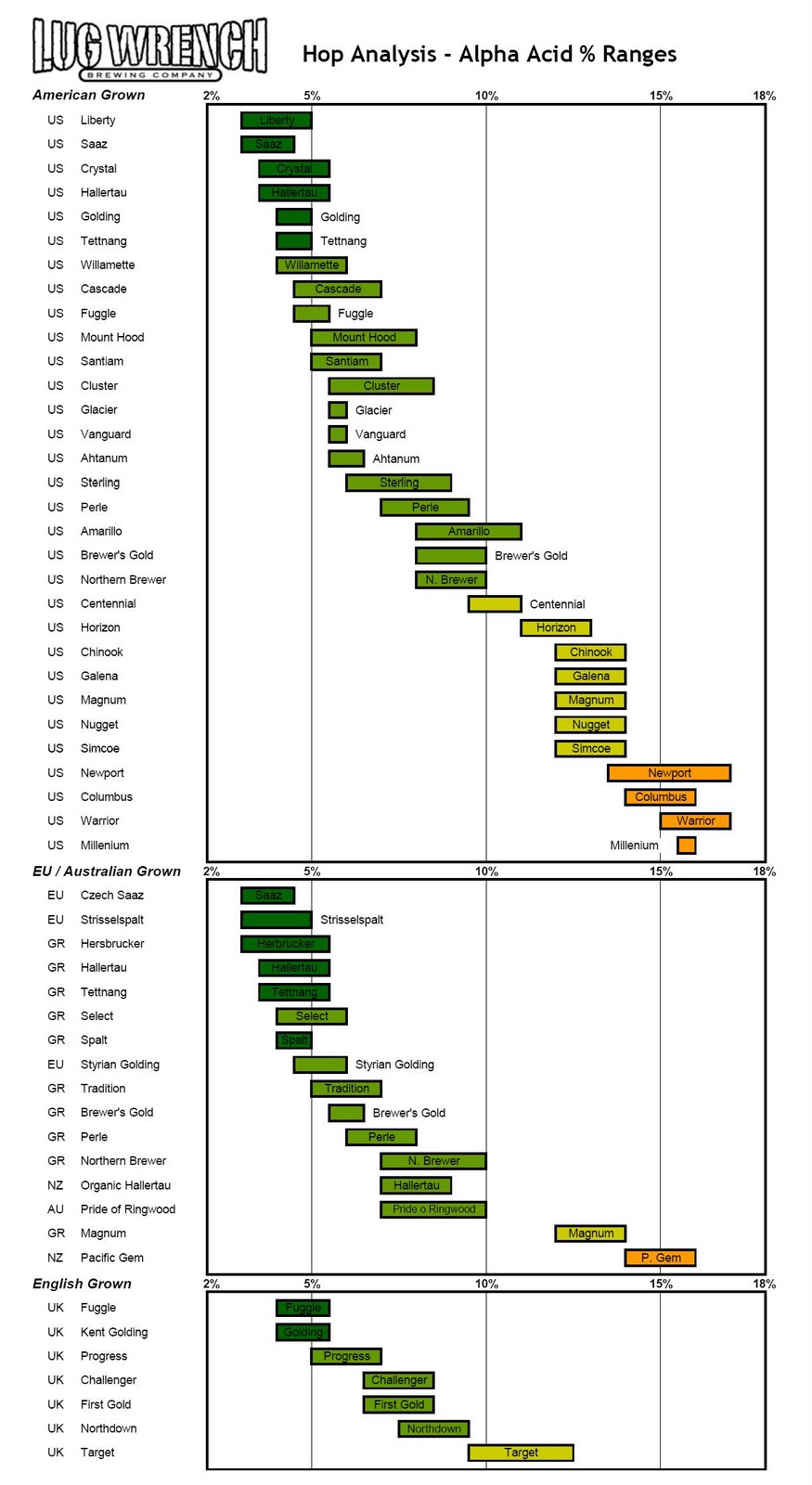
Today’s infographic is another one from Lug Wrench Brewing, this one showing Alpha Acid Ranges By Hop Variety, based on the info provided by HopUnion.

HopUnion-Alpha-Acid
Click here to see the chart full size.

Filed Under: Beers, Just For Fun Tagged With: Hops, Infographics, Statistics

Beer Prices Vs. Baseball Winning Percentages

May 22, 2013 By Jay Brooks

baseball
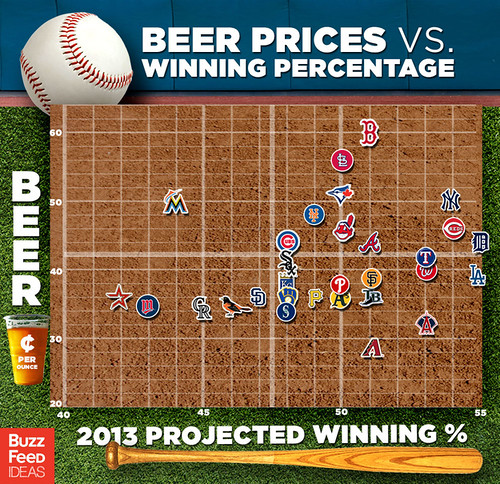
Today’s infographic is about baseball’s Beer Prices vs. Winning Percentage, a chart showing “the projected winning percentage of Major League Baseball teams this season, per Baseball Prospectus, compared to the price of beer at their stadiums,” which they got from an earlier infographic I posted.

Beer-Prices_Winning_Percentage1
Click here to see the poster full size.

Filed Under: Beers, Just For Fun Tagged With: Baseball, Infographics, Sports, Statistics

Which Countries Consume The Most Alcohol?

May 21, 2013 By Jay Brooks

world-map
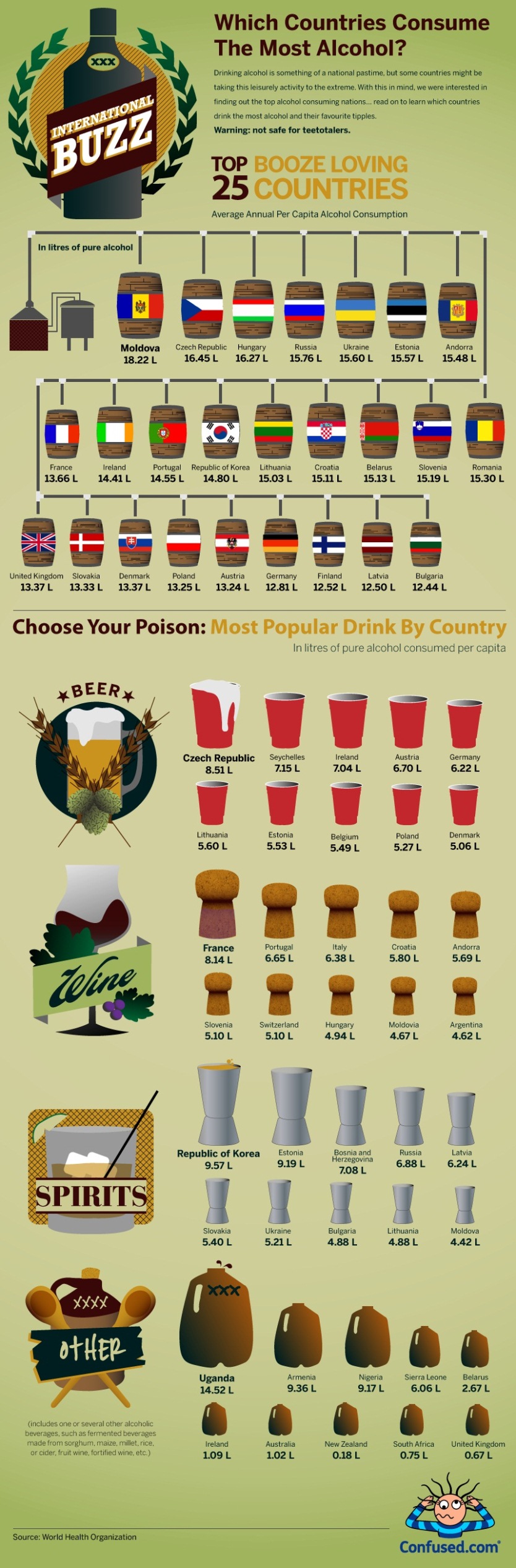
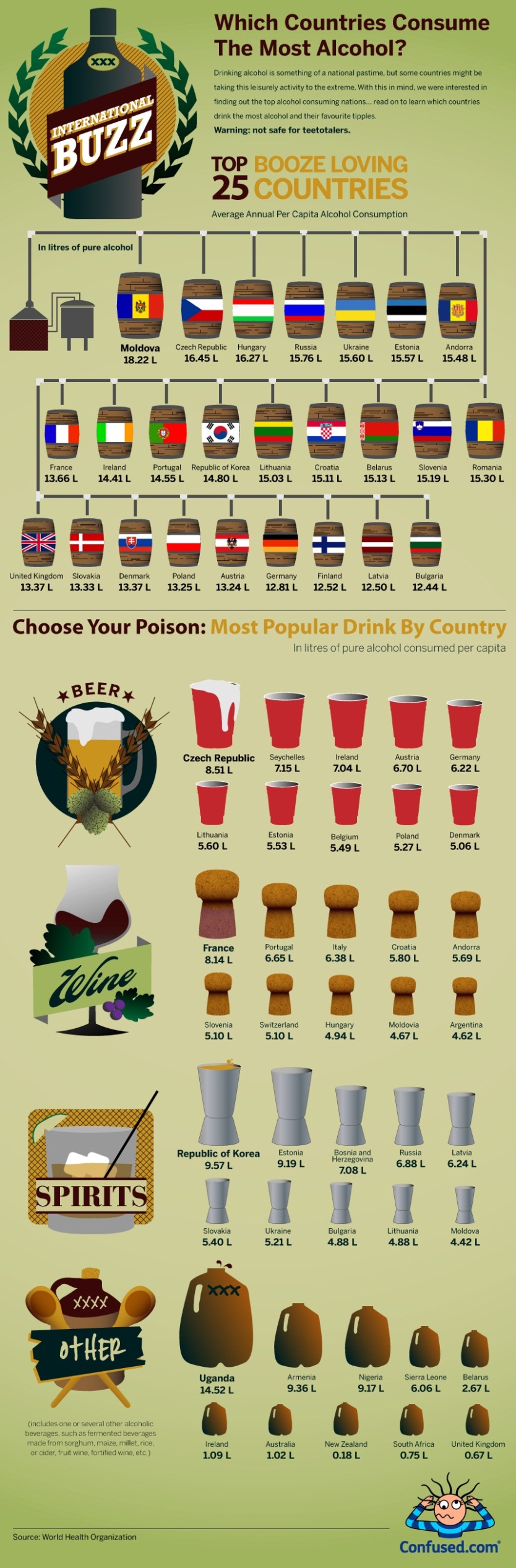
Today’s infographic tackles the question of Which Countries Consume The Most Alcohol? It was created by Confused.com using information from the World Health Organization.

which-country-consumes-the-most-alcohol
Click here to see the chart full size.

Filed Under: Beers, Breweries, Just For Fun Tagged With: Infographics, International, Statistics

The World’s Biggest Beer Loving Countries

May 11, 2013 By Jay Brooks

world-map-3
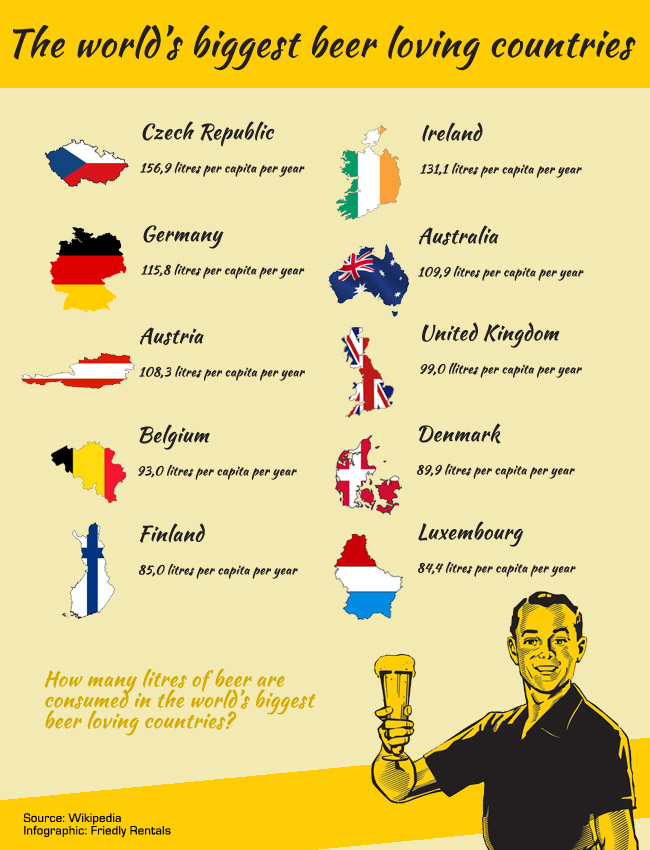
Today’s infographic is a list of The World’s Biggest Beer Loving Countries, created by Friendly Rentals.

Infographic-beer-drinking
Click here to see the chart full size.

Filed Under: Beers, Breweries, Just For Fun Tagged With: Infographics, International, Statistics

UNICEF Study Of Underage Drinking Yields Surprising Results

April 26, 2013 By Jay Brooks

unicef
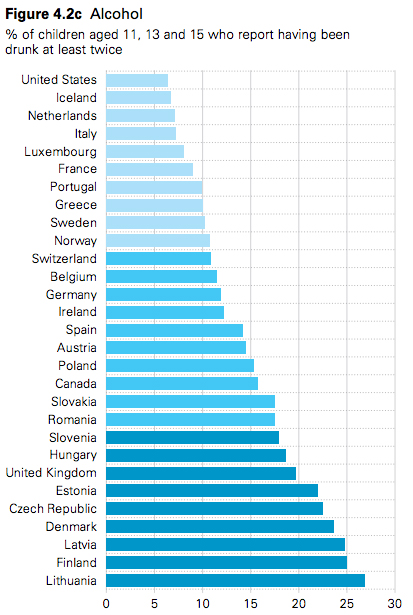
Actually, the results are only surprising if you’re a neo-prohibitionist or you’ve gotten all your information from them about underage drinking in the form of their relentless propaganda, posturing and fund-raising scare tactics. What a new study by UNICEF found was that the U.S. has the least number, or percentage, of kids drinking underage compared with nearly thirty developed countries. They looked at the drinking patterns of people 11, 13 and 15 years of age.

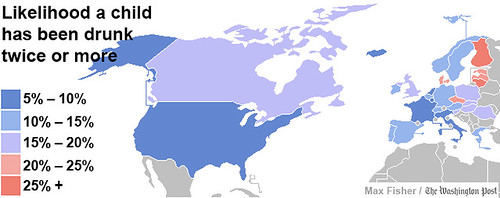
The study, Child Well-Being in Rich Countries, showed that overall the U.S. is in the bottom third, coming in number 26 of 29. Sad, really, but not terribly surprising if you’ve been paying attention. They looked at a variety of factors, and in Dimension 4 they tackled “risk behaviors,” including alcohol. Here’s how the 29 countries stacked up.

alchol-chart

Other findings that contradict the standard anti-alcohol agenda and how they tend to frame the state of underage drinking include the following.

  • More than three-quarters of the 21 countries also saw declines in alcohol use by young people – as measured by the proportion of 11-, 13- and 15-year olds who report having been drunk on at least two occasions.
  • The biggest falls were again recorded in Germany (where the alcohol abuse rate fell from 18% to under 12%) and in the United Kingdom (which saw a decline from 30% to just under 20%).

The Washington Post reported these findings, but curiously spun the story as sort of a win for the neo-prohibitionists. The author, Max Fisher, suggests that because the U.S. is the country least likely to have kids drinking it “lends a bit of credence to the U.S.’s relatively late and well-enforced drinking age, unusual in the Western world.” Of course, there’s no causal link for such a statement whatsoever, but such is the power of decades of propaganda. As the Post’s foreign affairs blogger, he should probably stick to what he knows. He continues, saying that the U.S. is “joined by the tee-totaling kids of Iceland, the Netherlands and, believe it or not, Italy.” Iceland’s minium age is 20 (although “possession or consumption of alcohol by minors is not an offense”), the Netherlands is 16 (for alcohol that’s under 15% a.b.v., 18 if over) and Italy is 16. So there’s no real pattern that can be gleaned from the countries with the lowest reported underage drinking. And in fact the rest of the top ten are either 16, 18 or even have no minimum age, so trying to link a higher minimum drinking age with lower consumption is misleading at best, a little obnoxiously anti-alcohol at worst.

In the next paragraph he then contradicts himself. “Despite the strong wine cultures in Italy, France and Spain – or maybe because of them, given the degree to which it cultivates drinking “to enjoy,” as I’ve heard many French say – children in those countries are among the least likely to get drunk.” So in those “drinking cultures,” the kids aren’t as likely to get drunk for cultural reasons, but in our drinking culture it’s due to more stringent laws? With that attitude, no wonder he was surprised by the results of UNICEF’s study.

But in two of the countries with the most vocal anti-alcohol organizations, Great Britain and the U.S., not only are both countries lower than the propaganda might suggest, both nations have falling rates of this measure, too. In the U.S., we dropped from 12% to 6%, half of what it was just eight years before, And in the UK, it dropped from 30% to below 20%, falling more than a third. But as we’re learning, for many anti-alcohol organizations it’s not about results or the mission, it’s about punishment or profit for themselves. Even as rates of underage drinking continue to fall, their rhetoric increasingly gets turned up, becoming more radicalized and intransigent as they try to squeeze the last dollars out of their followers. It probably won’t surprise you to find out that not one of the usual neo-prohibitionist groups whose websites I checked even mentioned this study, despite it having been published over a week ago. If the results had been different, it would have been on their respective homepages immediately.

child-drinking

Filed Under: Beers, Editorial, News, Politics & Law Tagged With: Anti-Alcohol, International, Statistics, United Nations

« Previous Page
Next Page »

Find Something

Northern California Breweries

Please consider purchasing my latest book, California Breweries North, available from Amazon, or ask for it at your local bookstore.

Recent Comments

  • Ernie Dewing on Historic Beer Birthday: Charles William Bergner 
  • Steve 'Pudgy' De Rose on Historic Beer Birthday: Jacob Schmidt
  • Jay Brooks on Beer Birthday: Bill Owens
  • Steve 'Pudgy' De Rose on Beer Birthday: Charles Finkel
  • Steve 'Pudgy' De Rose on Beer Birthday: Bill Owens

Recent Posts

  • Historic Beer Birthday: Emil Resch February 15, 2026
  • Historic Beer Birthday: Philip Zang February 15, 2026
  • Beer In Ads #5203: Robert Portner’s Bock Beer February 15, 2026
  • Historic Beer Birthday: August Schell February 15, 2026
  • Beer Birthday: Daniel Satterthwaite February 15, 2026

BBB Archives

Feedback

Head Quarter
This site is hosted and maintained by H25Q.dev. Any questions or comments for the webmaster can be directed here.