Brookston Beer Bulletin

Jay R. Brooks on Beer

  • Home
  • About
  • Editorial
  • Birthdays
  • Art & Beer

Socialize

  • Dribbble
  • Email
  • Facebook
  • Flickr
  • GitHub
  • Instagram
  • LinkedIn
  • Pinterest
  • RSS
  • Twitter
  • YouTube

Powered by Genesis

Historic Beer Birthday: Bert Grant

May 17, 2025 By Jay Brooks

bert-grants-real-ales

Today would have been Bert Grant’s 97th birthday, and he is still definitely missed. Bert opened the country’s first brewpub in 1982 in Yakima, Washington and was a fixture in the industry until his death in late July of 2001. Join me tonight in lifting a pint to Bert’s memory.

bert-grant

Here’s his obituary from Real Beer:

Craft brewing pioneer Bert Grant, who founded the first modern day brewpub in the United States, is dead at 73.

Grant had been ill for two years and died Tuesday at the University of British Columbia Hospital in Vancouver. He had moved to that city a year ago to be close to his children.

When Grant founded his brewpub in Yakima, Wash., in 1982 there were fewer than 50 individual brewing operations in the U.S. Today there are more than 1,500. That brewpub expanded to become a bottling microbrewery, selling about 10,000 barrels of Bert Grant’s Ales in 2001. He sold the brewery to Chateau Ste. Michelle wines in 1995, but Grant remained an active spokesman until being slowed by illness.

He’d sometimes wear a kilt at his pub in Yakima and occasionally dance on the bar. He kept a claymore — a double-bladed broadsword — just in case he had to enforce his ban on smoking.

He was born in Dundee, Scotland, in 1928. He moved to Toronto, where he grew up and got his first job in a brewery … at 16, he became a beer taster. He remained in the beer business all his life. He moved to Yakima in 1967, where he helped build and operate two plants that processed hops. His patented processing of hops is still in use today.

Bert Grant Bert was one of a kind,” said Paul Shipman, who founded Red Hook Brewery around the time Grant began Yakima Brewing and Malting Co. “He was a scientist, a brewer, and I don’t think he even graduated high school.”

He remained dedicated to assertive beer and carried a vial of hop oil in his pocket to boost the flavor of a bland domestic beer. His first priority was to brew beer he liked. “It may not be your favorite beer,” Grant’s son Peter said. “But it was his.”

Bert-Grant-GABF
Bert at GABF in the 1990s.

And here is his obituary from the New York Times:

Bert Grant, a veteran brew master who in 1982 opened the granddaddy of all the good, bad and so-so brew pubs slaking thirsts across the country today, died on July 31 at a hospital in Vancouver, British Columbia, where he had recently made his home. He was 73 and a longtime resident of Yakima, Wash.

The cause was a bowel rupture, his family said.

Mr. Grant’s experience in brewing stretched back to his teenage years in Canada. He worked at big brewing companies and later as an international consultant to them before settling in Yakima, the center of American hops country.

Mr. Grant started the Yakima Brewing and Malting Company in the 19th-century former home of the Yakima Opera, using plenty of the flavorful hops he thought other beers lacked. At first he brewed just eight kegs at a time.

Friends who sampled his recipe liked it and spread the word. It caught on with Yakima beer lovers, who welcomed it as an alternative to national brands and expensive imports. Mr. Grant got some chairs to sit on in the lobby and convinced skeptical licensing officials that Washington State law permitted each brewer to operate one pub.

This gave birth in the summer of 1982 to Grant’s Brewery Pub, the first such establishment in the United States since Prohibition. Food and tables were added, and a growing clientele prompted Mr. Grant to move his pub across the street into what used to be Yakima’s downtown railroad station. He liked to greet customers personally and, as a native of Scotland, often did so wearing a plaid kilt with a clan pin.

His brewing company, meanwhile, came to offer an assortment of beers and ales, including seasonal brews that varied with the harvest of the region’s distinctive types of hops. Mr. Grant built the company into one of the Northwest’s leading microbreweries and started bottling his brands, like Grant’s Scottish Ale, Imperial Stout and HefeWeizen. Last year, Yakima Brewing and Malting brewed 10,000 barrels and shipped bottles to distributors in 20 states, from Alaska to Connecticut to Florida.

Herbert Lewis Grant was born in Dundee but immigrated to Canada with his parents as a toddler. With World War II draining his adopted country of manpower, he left school at 16 to work at Canadian Breweries (now Carling).

He moved on to the United States to develop a pilot brewing program for Stroh and, as his reputation grew, became an independent consultant for makers like Anheuser-Busch and the Australian brewer Foster’s.
Also working for hops companies, he became well acquainted with Yakima and moved there when he decided to brew to his own taste. He sold his business in 1995 to Stimson Lane Ltd., a long-established winery, but remained a consultant to it until recently.

Mr. Grant is survived by two sons, David H., of Winnipeg, Manitoba, and Peter A., of Vancouver; three daughters, Shannon D. Grant and Melanie Bond of Vancouver, and Wendy Cundall of Calgary, Alberta; and five grandchildren. Also surviving is his former wife, Daphne Grant of Vancouver.

According to family lore, the Scottish doctor who delivered little Herbert lifted him by the heels and, slapping breath into him, said, ”Bottoms up.” His first cradle, the lore goes, was an oaken barrel sawed in half — possibly apocryphal, Mr. Grant allowed.

bert-grant-hops

And finally, here’s a great retrospective written by Ryan Messer for the Yakima Herald in 2017, entitled “Bert Grant: The Godfather of Craft Brewing.”

He’s been called the “Dean of America’s craft brewers” and the Wall Street Journal called him “The Patriarch of the micro movement.” Personally, I prefer Bert Grant as the “Neil Young of Microbrews.” Neil didn’t invent Rock ’n Roll, but he was the Godfather of Grunge. Likewise, Bert didn’t invent beer but what he did to change it made an indelible mark.

Most people know Bert Grant as the man who gave us Yakima brewing and Malting Co., or Grant’s Ales. While he launched that business in 1982, his passion for beer, and hops in general, started decades before.

Bert was born in 1928 in Dundee, Scotland. Before he reached the age of 10, the Grant family moved to Toronto, and Bert had consumed his first beer. I should say his first of many beers. I don’t even know if it’s possible to quantify what Bert consumed over his lifetime. As a child, Bert’s father let him drink opened beers left behind, and his first job at age 16 was to taste beer; 50-100 per day — you do the math.

The thing about beer drinking for Bert was that he truly enjoyed it. It wasn’t about the feeling, it was about the flavor. And, it was about the science behind the flavor. Bert was a chemist and loved studying why one beer could taste remarkable, and another could ruin your evening.

Part of his career included working for Canadian Breweries (parent company of Carling) and Stroh Brewing Company, doing experimental brewing. He had the freedom to try new things, but sadly neither company utilized his research or expertise. Finally, Bert realized consulting was the best direction for him. He eventually worked with large breweries spanning the globe such as Guinness, Coors, Foster’s, Anheuser-Busch and Yakima hop company, S.S. Steiner.

Steiner was the business that really changed Bert’s world, and ours as a collective of beer drinkers. They convinced him to move to Yakima and redesign a hop extract plant. After great success, Bert and Steiner changed gears — literally. Under Bert’s supervision, Steiner built the first hop pellet plant in the United States. This was a game changer for the beer industry. It took the varying aroma of a whole hop cone (based on time from harvest) and replaced it with exacting smell and bitterness. It was similar in nature to the extract, but far easier and more precise for the brewer to use.

With over 40 years of beer tasting and testing under his belt, Bert wanted to share his knowledge with the world, or at least the people of the Yakima Valley. It would be a daunting task because at the time, no one even knew what a microbrew was. In the early ‘80s, there were two little known breweries in California, Sierra Nevada and Anchor Brewing, that were making something entirely different than the “King of Beers.” In 1982, when Bert was ready to start brewing professionally, his only competition in the state was Redhook. On July 1st that year, Yakima Brewing and Malting Co. poured its first Grant’s Scottish Ale in the old Opera House on Yakima’s Front Street.

Bert was at the helm as one of the chief investors and brewmaster, and the recipes and ideas all stemmed from him. He started with his son-in-law and a few others to round out the investment team and hired Rick Desmarais (who he had worked with at Steiner) as his first head brewer and Dan Boutillier as production manager. Within the first few years the Scottish Ale shared tap space with an Imperial Stout and an India Pale Ale (IPA). A few years beyond that, a low calorie “Celtic Ale”, Weis (white beer), “Spiced Ale” (winter beer) and Yakima Cider (a hard cider made exclusively from apple concentrate) were added to the lineup.

The unique thing about Yakima Brewing and Malting is that it started without a bottling line. It was only available in plastic bottles that the consumer could bring or purchase like a crude precursor to today’s growler. It was also available for consumption on premises. This is what really stood out because it was the first time anyone had an establishment of that nature in the United States since before prohibition. Yakima, Washington was the home of the first “brewpub” in America in over 60 years.

In 1984, Bert hired Darren Waytuck who eventually became head brewer. Waytuck said it was a tremendous learning experience working for someone like Bert. “He wasn’t only into the chemistry of the beer and that process, but in hops as well. That was really his forte. But he also had incredible experience. Someone new might know if a beer was flawed but wouldn’t know why. It was Bert’s job to understand why and how to correct it.”

As brew master, Bert was still in charge of all things happening with his beer. All ideas would come from him on the brewing process and ingredients. When asked about what hops they used to brew with, Waytuck said, “I preferred the whole hop cone and didn’t care for the smell of a hop pellet, but Bert insisted. When I still didn’t use them, Bert ran us out of whole hops so I had to use the pellets.”

Bert was a risk taker though, and had no problem with pushing the envelope for something he was passionate about. “No one was out there getting their beer in front of people like Bert did, it just didn’t happen before his time.” Waytuck said. With that success they had to build a bottling line directly behind the brewery in the Opera House. They also expanded into a space to the north for a larger pub which my mother, Jana Johnson, ran for the better part of two decades. When that wasn’t enough, the brewery expanded to a 20,000 square foot building off Washington Avenue and the pub moved across the street to the old train depot.

Waytuck and the crew enjoyed their craft, but he said, “it was a lot more fun at the Opera House. It became more corporate at the new brewery and was more of a task.”

Shortly after the locations changed, Bert continued to push the envelope, but this time with an organization that no one beats — the Bureau of Alcohol, Tobacco and Firearms, (ATF). Bert had done some testing on his beers and found that a 12 ounce bottle of Scottish Ale contained beneficial vitamins and nutrients, including 170 percent of the U.S. RDA of Vitamin B-12. He had table tents printed, added it to his 6-pack cartons and even made shirts advertising the news (although a bit tattered, I’m happy to say I still have mine).

Of course the ATF wouldn’t allow someone to suggest that beer was actually healthy for you and ordered him to stop. At the same time, the Bureau looked into his cider making process which was not technically a beer, but considered by them as a wine. Not only did they prevent him from continuing to make the cider, they required he pay back taxes for the years he paid too little. Waytuck said, “It was tough for Bert. He didn’t like the confrontation, but he was going to push as far as he could.”

After achieving a greater success than I believe Bert imagined he could, Yakima Brewing and Malting was sold to Stimson Lane, the parent company of Chateau Ste. Michelle, Columbia Crest and other wineries in Washington and California, in 1995. While his role changed, Bert stayed on with the company until he passed away in July of 2001. Stimson Lane sold the company only a few months later. Waytuck stayed committed to the brand and eventually became brewmaster, before the company closed in 2004. “I promised Bert I would see it through and make the best beer as long as we were open,” Waytuck said.

two-bert-grants
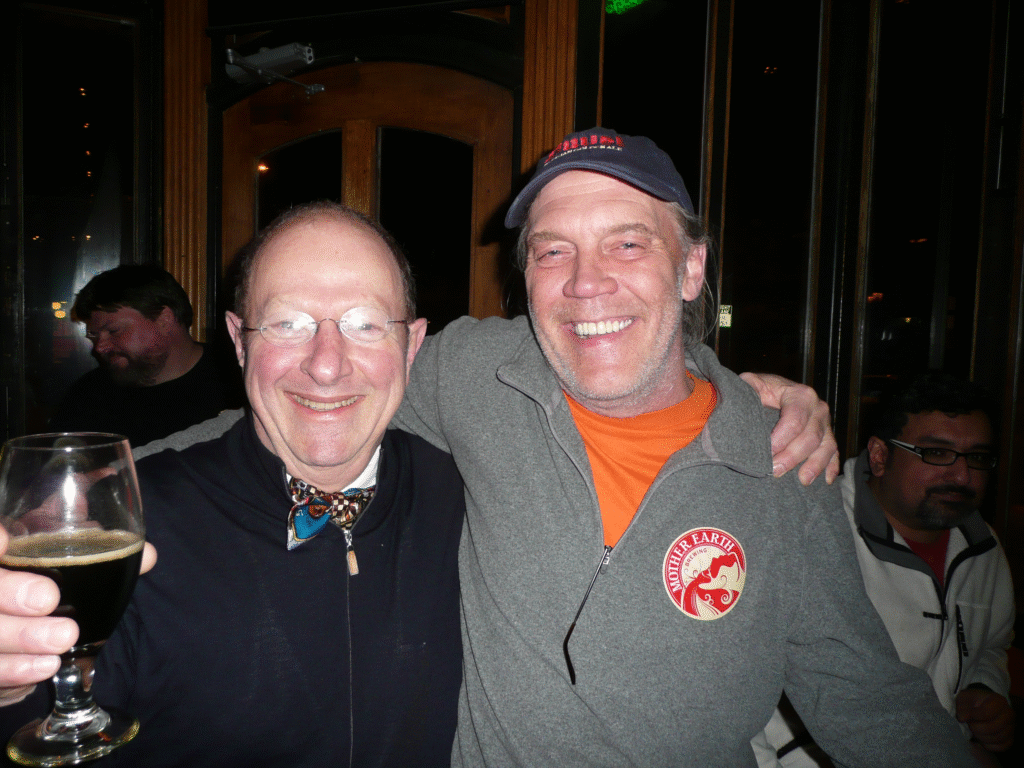
Me and the two Berts at OBF.

Filed Under: Birthdays, Events Tagged With: Canada, Scotland, Washington

Historic Beer Birthday: Louis Hemrich

May 15, 2025 By Jay Brooks

hemrich
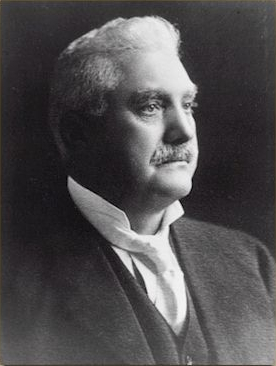
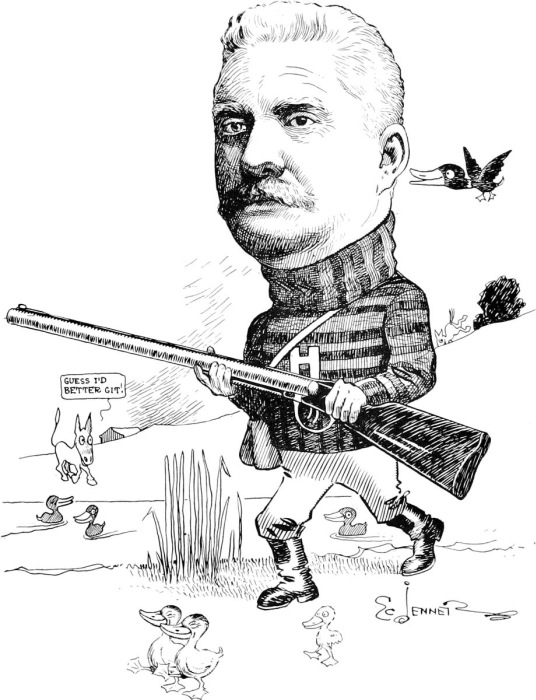
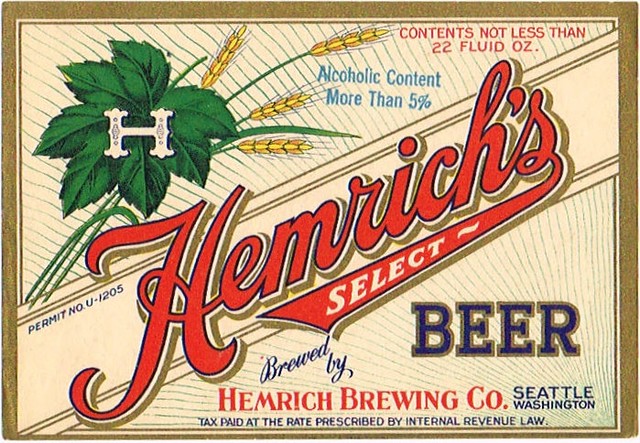
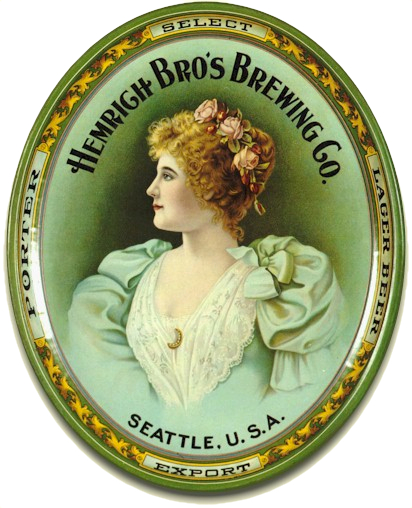
Today is the birthday of Louis Hemrich (May 15, 1873-September 26, 1941). He was born in Wisconsin, and was the brother of Alvin M. Hemrich. Alvin bought the old Slorah Brewery in 1897 and operated it as the Alvin Hemrich Brewing Co. for six months, after which two of his brothers — Julius and Louis — joined him in the business and it became known as the Hemrich Brothers Brewing Co.

Louis-Hemrich

Here’s a short biography from Find-a-Grave:

Louis Hemrich was born to John and Katherine Anna (Koeppel) Hemrich on May 15, 1873, although some records say May 20, 1872.

His father and brothers began operating breweries in Seattle in 1878. Louis began his career as a bookkeeper for Bay View Brewing in Seattle. By 1900 he was partnered with his brothers Senator Andrew Hemrich and Alvin Hemrich in owning and running the Hemrich Brother’s Brewing Co. and the brewing operations it controlled. It was successful enough to send his wife on a trip to Europe in 1902, and join her on trips to Europe and Hong Kong in 1907 and 1908. In 1914 he was President of the Brewers’ Association of the Northwest, and active in lobbying against prohibition of alcohol in Washington. When it passed, the breweries moved to California and British Columbia.

Louis was president of the family brewing company from 1910 until about 3 years before his death.
He married Lizzie Hanna on May 10, 1897 in Seattle, WA, and was widowed in Oct. of 1918. It appears they did not have children. He married Mrs. Maude Etta Engel before Dec. 1923.

Louis-Hemrich-cartoon

And here’s a fuller account of Hemrich from “A Volume of Memoirs and Genealogy of Representative Citizens of the City of Seattle and County of King, Washington,” published in 1903, as posted on Brewery Gems:

A Biographical record of the representative men of Seattle and King county would be incomplete and unsatisfactory without a personal and somewhat detailed mention of those whose lives are interwoven so closely with the industrial activities of this section. In the subject of this review, who is secretary and treasurer of the Hemrich Brothers Brewing Company, we find a young man of that progressive, alert and discriminating type through which has been brought about the magnificent commercial and material development of the Pacific northwest, and it is with satisfaction that we here note the more salient points in his honorable and useful career.

Louis Hemrich was born in the town of Alma, Buffalo county, Wisconsin, on the 20th of May, 1872, a son of John and Catherine (Koeppel) Hemrich, the former of whom was born in Baden, Germany, and the latter in Bavaria. They came to America and resided in Wisconsin for a number of years, removing thence to Seattle when the subject of this sketch was a lad of about fourteen years, his rudimentary educational training having been secured in the public schools of his native state, while he continued his studies thereafter in the public schools of Seattle, where he prepared himself for college. At the age of eighteen years he matriculated in the University of Washington, where he completed a commercial course. After leaving school Mr. Hemrich took a position as bookkeeper for the Seattle Brewing & Malting Company, where he remained for a period of three years and was then elected secretary and treasurer of the company, in which capacity he rendered most effective service for the ensuing two years. He then resigned this office and forthwith became associated with his brothers in the organization of the Hemrich Brothers Brewing Co., which was duly incorporated under the laws of the state. They erected a fine plant, where is produced a lager of the most excellent order, the purity, fine flavor and general attractiveness of the product giving it a high reputation, while the business is conducted upon the highest principles of honor and fidelity, so that its rapid expansion in scope and importance came as a natural sequel.

As a business man Mr. Hemrich has shown marked acumen and mature judgment, and his progressive ideas and his confidence in the future of his home city have been signalized by the investments which he has made in local realty and by the enterprise he has shown in the improving of his various properties. In 1901 he erected in the village of Ballard, a suburb of Seattle, a fine brick business block, located at the corner of First Avenue and Charles Street, and he has also erected a number of substantial business buildings in the city of Seattle, together with a number of dwellings. He is the owner of valuable timber lands in the state and has well selected realty in other towns and cities aside from those already mentioned. He has recently accumulated a tract of land on Beacon Hill, and this will be platted for residence purposed and is destined to become one of the most desirable sections of the city. Mr. Hemrich erected his own beautiful residence, one of the finest in the city, in 1901, the same being located on the southwest corner of Belmont Avenue and Republican Street. It is substantial and commodious, of effective architectural design, having the most modern equipments and accessories and is a home which would do credit to any metropolitan community.

While Mr. Hemrich takes an abiding interest in all that concerns the advancement and material upbuilding of his home city and state, he has never taken an active part in political affairs, maintaining an independent attitude in this regard and giving his support to men and measures. Fraternally he is a popular member of the Ancient Order of United Workmen and the Fraternal Order of Eagles, and he is most highly esteemed in both business and social circles. On the 20th of May, 1897, in the city of Seattle, Mr. Hemrich was united in marriage to Miss Eliza Hanna, daughter of Nicholas and Mary Hanna, who were numbered among the early settlers of this city, where Mrs. Hemrich was born and reared and where she has been prominent in the best social life.”

Hemrich-tray
To that, Gary Flynn on Brewery Gems continued Hemrich’s story:

Less than a year after the article was published, Elizabeth, his wife of 10 years suddenly died. And on 2 May, 1910, his brother, Andrew, president of Seattle Brewing & Malting – succumbed to an illness and passed away. Louis then assumed his brother’s position as president of the company and continued to oversee its phenomenal growth. By 1914 the brewery was the largest west of the Mississippi and 6th largest in the world. Additionally, it was the largest industrial enterprise in the state of Washington. But this too was to pass.

But that’s just the beginning, read the rest at Gary Flynn’s Brewery Gems, who also concludes Hemrich’s story with this:

In July 1938, Louis Hemrich retired from active involvement, but remained on the Rainier Brewing Co. board of directors. A little over three years later, on 26 September 1941, Louis succumbed after battling a three month illness. He was survived by his spouse, Etta Maude, and two daughters.

Seattle_-_Hemrich_Bro's_Brewing_Co_-_1900
Hemrich Brothers Brewing around 1900.

louis-hemrich-beer

Filed Under: Birthdays, Breweries, Just For Fun Tagged With: History, Washington, Wisconsin

Historic Beer Birthday: Edward F. Sweeney

May 10, 2025 By Jay Brooks

seattle-brewing-malting
Today is the birthday of Edward F. Sweeney (May 10, 1860-1923). Although born in San Francisco, Sweeney was involved with founding the Seattle Brewing & Malting Company, the makers of Rainier Beer, along with several other brewery and other businesses in the Seattle area.


edward-f-seeney


Here’s a biography of Sweeney from “An Illustrated History of the State of Washington,” by Rev. H.K. Hines, published in 1893, as it appears on the Brewery Gems page for Sweeney, by Gary Flynn.

Edward F. Sweeney, Secretary of the Seattle Brewing & Malting Company, is a native son of the Golden West, born in San Francisco, California, May 10, 1860.

His father, Morgan Sweeney, was a California pioneer of 1850, who made mining the occupation of his life. He (Morgan) was married in California to Miss Mary Nunan¹, whose father was also a pioneer of the State.

Edward F. Sweeney was educated at St. Mary’s College in San Francisco. His business career began at the age of seventeen, in the French Savings Bank, but shortly after be entered the office of the brewery² of M. Nunan and remained two years. He then went to the Fredericksburg Brewery at San Jose and entered practically into the study of the brewery business. After becoming thoroughly conversant with all details of manufacture and with methods of conducting such an enterprise, he returned to San Francisco as superintendent of Mr. Nunan’s plant, which turned out about 30,000 barrels of beer per year.

In 1882-84 (depending on the account), he came to Seattle, and, forming a co-partnership with W. J. Rule, built a small brewery south of town for the manufacture of steam beer. The firm of Rule & Sweeney continued about eighteen months (sic), when Mr. Rule retired and Mr. Sweeney continued operations alone, gradually increasing the extent of his plant as the conditions of the trade demanded.

In 1888 he organized a stock company known as the Claussen-Sweeney Brewing Company, with a capital of $80,000. The brewery was then rebuilt, and with improved machinery they entered exclusively into the manufacture of lager beer, with an annual output of 36,000 barrels, which was sold throughout the Northwest. In May, 1891, Mr. Claussen³ sold his interest to Mr. George F. Gund⁴, and the business was continued up to the spring of 1893, when the company consolidated with the Bay View Brewing Company and the Albert Braun Brewing Company, incorporating as the Seattle Brewing & Malting Company; capital stock, $1,000,000. Mr. Sweeney was elected secretary of the new organization, whose plant has a capacity for an annual output of 150,000 barrels.

Mr. Sweeney is also a stockholder of the King County Bank; a director of the National Bank of Commerce; owns valuable real-estate interests in Seattle, and mining interests in the Cascade Mountains. Socially, he affiliates with the K. of P., B.P.O.E., the Seattle Athletic Club and the Seattle Yacht Club. He is also a member of the Chamber of Commerce, and is a member of the manufacturing committee of that institution.

Gary Flynn, Brewery Gems, points out that there are several discrepancies with that account and he tries to correct them and adds later details of Sweeney’s life.


And here’s another from “An Illustrated History of the State of Washington.”


Sweeney-bio-1
Sweeney-bio-2


And here’s an account of how the brewery came to be known as the Seattle Brewing & Malting Company from the “History of Seattle from the Earliest Settlement to the Present Time, Volume 2,” by Clarence Bagley

seattle-malting-history


The brewery in 1915.

Filed Under: Birthdays, Just For Fun Tagged With: History, Washington

Beer In Ads #3834: Beer And Pretzels

August 31, 2021 By Jay Brooks

Tuesday’s ad is for “Rainier Beer,” from 1992. This ad was made for the Seattle Brewing & Malting Co., who made Rainier Beer, and was later known as the Rainier Brewing Company of Seattle, Washington. This one features a female contortionist who’s bent herself into a pretzel-shape while holding a mug of beer and a bottle of Rainier Ice-Lagered Draft Light Beer.

Filed Under: Art & Beer, Beers Tagged With: Advertising, History, Washington

Beer In Ads #3833: Through This Portal …

August 30, 2021 By Jay Brooks

Monday’s ad is for “Rainier Beer,” from the 1970s. This ad was made for the Seattle Brewing & Malting Co., who made Rainier Beer, and was later known as the Rainier Brewing Company of Seattle, Washington. This one features another eye-catching image, this one of an overhead close-up of an open can of beer. In the opening it reads: “through this portal…” and continues below with “pours the greatest beer in the west: Rainier.” The ad was created by legendary ad man Len Sirowitz.

Filed Under: Art & Beer, Beers Tagged With: Advertising, History, Washington

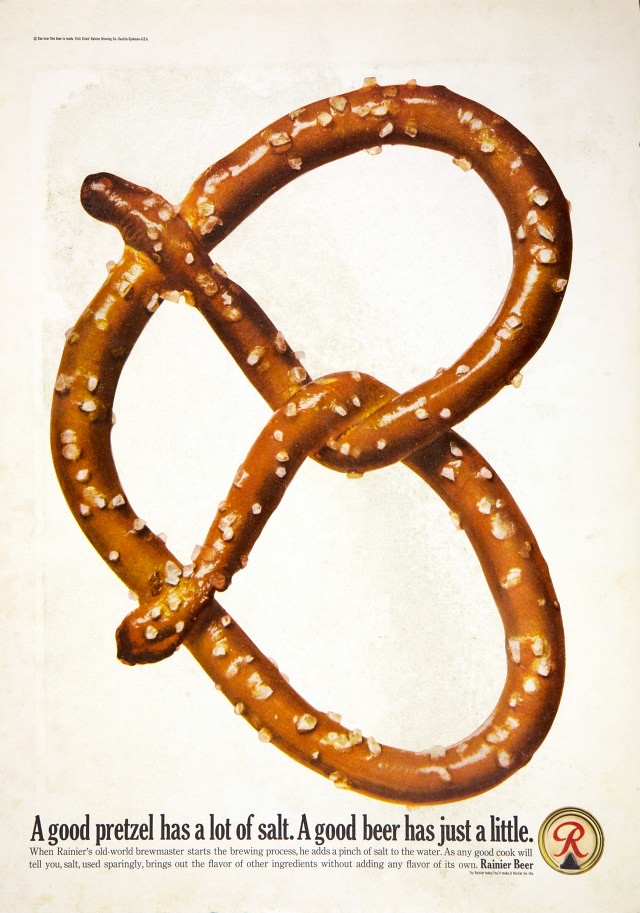
Beer In Ads #3832: A Good Pretzel Has A Lot Of Salt. A Good Beer Has Just A Little.

August 29, 2021 By Jay Brooks

Sunday’s ad is for “Rainier Beer,” from the 1970s. This ad was made for the Seattle Brewing & Malting Co., who made Rainier Beer, and was later known as the Rainier Brewing Company of Seattle, Washington. This one features an eye-catching giant pretzel that fills the page. Below that is the tagline. “A good pretzel has a lot of salt. A good beer has just a little.” And below that, the text explains that Rainier’s brewers add a pinch of salt to the water.

Filed Under: Art & Beer, Beers Tagged With: Advertising, History, Science of Brewing, Washington

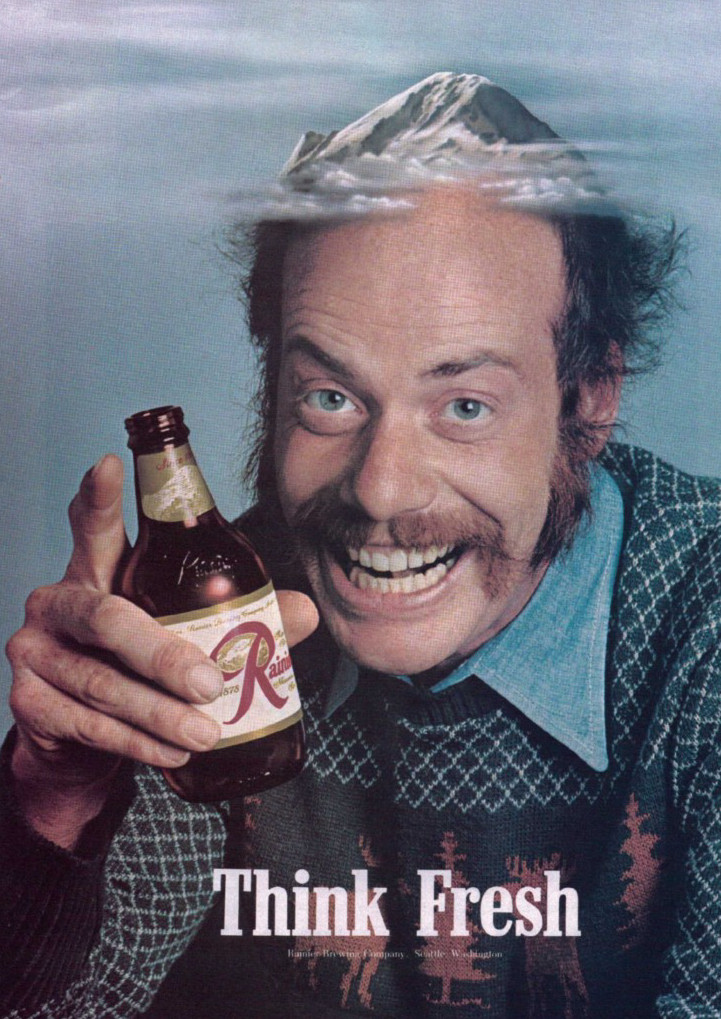
Beer In Ads #3831: Think Fresh

August 28, 2021 By Jay Brooks

Saturday’s ad is for “Rainier Beer,” from 1974. This ad was made for the Seattle Brewing & Malting Co., who made Rainier Beer, and was later known as the Rainier Brewing Company of Seattle, Washington. This one features a man with a mountaintop for a head and the tagline “Think Fresh.” It’s a weird one, to be sure, and it made me think of Frank Zappa’s song “Billy the Mountain.” But no sign of Ethel.

Filed Under: Art & Beer, Beers Tagged With: Advertising, History, Humor, Washington

Beer In Ads #3830: My Favorite Beer

August 27, 2021 By Jay Brooks

Friday’s ad is for “Rainier Beer,” from 1977. This ad was made for the Seattle Brewing & Malting Co., who made Rainier Beer, and was later known as the Rainier Brewing Company of Seattle, Washington. This is another one featuring actor Mickey Rooney in the foreground. He’s wearing a Royal Canadian Mounted Police uniform and the print ad was also in support of a television commercial, as well.

Below is a better image used in the ad, but is also a bit smaller.

Filed Under: Art & Beer, Beers Tagged With: Advertising, Celebrities, History, Video, Washington

Beer In Ads #3829: Bring ‘Em Back Fresh

August 26, 2021 By Jay Brooks

Thursday’s ad is for “Rainier Beer,” from 1975. This ad was made for the Seattle Brewing & Malting Co., who made Rainier Beer, and was later known as the Rainier Brewing Company of Seattle, Washington. This one features a hunting expedition to catch fresh bottles of Rainiers, but things appear to have gone awry. They seem to be having some trouble capturing the bottle, and yes, that is actor Mickey Rooney in the foreground.

Filed Under: Art & Beer, Beers Tagged With: Advertising, History, Washington

Beer In Ads #3828: The Fresh That Got Away

August 25, 2021 By Jay Brooks

Wednesday’s ad is for “Rainier Beer,” from the 1970s. This ad was made for the Seattle Brewing & Malting Co., who made Rainier Beer, and was later known as the Rainier Brewing Company of Seattle, Washington. This one features a fishing expedition to catch fresh bottles of Rainiers, but things appear to have gone awry. It looks the beer broke through their net and is escaping, much to their horror.

Filed Under: Art & Beer, Beers Tagged With: Advertising, History, Washington

« Previous Page
Next Page »

Find Something

Northern California Breweries

Please consider purchasing my latest book, California Breweries North, available from Amazon, or ask for it at your local bookstore.

Recent Comments

  • Bob Paolino on Beer Birthday: Grant Johnston
  • Gambrinus on Historic Beer Birthday: A.J. Houghton
  • Ernie Dewing on Historic Beer Birthday: Charles William Bergner 
  • Steve 'Pudgy' De Rose on Historic Beer Birthday: Jacob Schmidt
  • Jay Brooks on Beer Birthday: Bill Owens

Recent Posts

  • Historic Beer Birthday: Lawrence Steese April 30, 2026
  • Beer In Ads #5235: The Buck Is Loose! April 29, 2026
  • Historic Beer Birthday: Robert Cain April 29, 2026
  • Historic Beer Birthday: Philip Jacob Ebling Jr. April 29, 2026
  • Beer Birthday: Tom Riley April 29, 2026

BBB Archives

Feedback

Head Quarter
This site is hosted and maintained by H25Q.dev. Any questions or comments for the webmaster can be directed here.