Brookston Beer Bulletin

Jay R. Brooks on Beer

  • Home
  • About
  • Editorial
  • Birthdays
  • Art & Beer

Socialize

  • Dribbble
  • Email
  • Facebook
  • Flickr
  • GitHub
  • Instagram
  • LinkedIn
  • Pinterest
  • RSS
  • Twitter
  • YouTube

Powered by Genesis

Beer Saints: St. Nicholas, Patron Saint of Brewers

December 6, 2025 By Jay Brooks 10 Comments

santa-claus
While St. Nicholas is best known — in America, at least — for wearing red and white and giving presents to Children each December 25, he’s actually the patron saint for a number of professions, places and afflictions. His feast day is not actually Christmas Day, but almost three weeks earlier on December 6. That’s the reason why the holiday beer Samichlaus is brewed each year on this day. The person we associate with Christmas, Santa Claus, was based on Saint Nicholas, who was originally known (and still is in some places) as Bishop Nicholas of Myra.

Nicholas is the patron saint of brewers, among many others. He’s also the patron saint against imprisonment, against robberies, against robbers. And Nick’s the patron for apothecaries, bakers, barrel makers, boatmen, boot blacks, boys, brewers, brides, captives, children, coopers, dock workers, druggists, fishermen, Greek Catholic Church in America, Greek Catholic Union, grooms, judges, lawsuits lost unjustly, longshoremen, maidens, mariners, merchants, penitent murderers, newlyweds, old maids, parish clerks, paupers, pawnbrokers, perfumeries, perfumers, pharmacists, pilgrims, poor people, prisoners, sailors, scholars, schoolchildren, shoe shiners, spinsters, students, penitent thieves, travellers, University of Paris, unmarried girls, and watermen. Places he’s the patron for are Apulia, Italy; Avolasca, Italy; Bardolino, Italy; Bari, Italy; Cammarata, Sicily, Italy; Cardinale, Italy; Cas Concos, Spain; Creazzo, Italy; Duronia, Italy; Fossalto, Italy; Gagliato, Italy; Greece; La Thuile, Italy; Lecco, Italy; Limerick, Ireland; Liptovský Mikulás, Slovakia; Lorraine; Mazzano Romano, Italy; Mentana, Italy; Miklavž na Dravskem polju, Slovenia; Naples, Italy; Portsmouth, England; Russia; Sassari, Italy; Sicily; Is-Siggiewi, and Malta.

He also has many names around the world, such as Baba Chaghaloo, Father Christmas, Joulupukki, Kanakaloka, Kris Kringle, Pere Noel, Papa Noël, Santa Claus, and Weihnachtsmann (“Christmas Man” or “Nikolaus”), to name just a few.

merry-xmas-santa-beer

Here’s what Wikipedia has to say:

Saint Nicholas (March 15, 270 – December 6, 346) is the common name for Nicholas of Myra, a saint and Bishop of Myra (in Lycia, part of modern-day Turkey). Because of the many miracles attributed to his intercession, he is also known as Nicholas the Wonderworker. He had a reputation for secret gift-giving, such as putting coins in the shoes of those who left them out for him, and is now commonly identified with Santa Claus. His reputation evolved among the faithful, as was the custom in his time. In 1087, his relics were furtively translated to Bari, in southern Italy; for this reason, he is also known as Nicholas of Bari.

The historical Saint Nicholas is remembered and revered among Catholic and Orthodox Christians. He is also honoured by various Anglican and Lutheran churches. Saint Nicholas is the patron saint of sailors, merchants, archers, and children, and students in Greece, Belgium, Romania, Bulgaria, Georgia, Russia, the Republic of Macedonia, Slovakia, Serbia and Montenegro. He is also the patron saint of Barranquilla, Bari, Amsterdam, Beit Jala, and Liverpool. In 1809, the New-York Historical Society convened and retroactively named Sancte Claus the patron saint of Nieuw Amsterdam, the Dutch name for New York City. He was also a patron of the Varangian Guard of the Byzantine emperors, who protected his relics in Bari. So beloved is Saint Nicholas by Russians, one commonly heard saying is that “if God dies, at least we’ll still have St. Nicholas.”

santa-mug

The American image of Santa Claus in red and white has more to do with marketing than anything else. I wrote about this in The Santa Hypocrisy a couple of years ago when the Shelton Brothers were in hot water from several states who tried to tell them Santa Claus on a beer label threatened the American way of life and especially the impressionable young kiddies who would all be led down the path to underage drinking and alcoholism because Santa was depicted on a beer label. It was an utterly ridiculous position and they ultimately backed down, but it’s indicative of our puritan hang-ups as a culture and our general paternalism where we believe everyone needs to be protected. And in retrospect I can now see how the “institutionalized demonization of alcohol” creates the conditions for such decisions. Remember the message? “Alcohol is evil. No one can be trusted with it.” When that’s the underlying assumption, you create rules for what can and can’t be displayed on a label that are way beyond reason; standards no other products have to follow because they’re not seen as inherently evil.

But before the 20th century and in other parts of the world, Santa Claus was and still is depicted in many different ways and in various colors. Father Christmas, for example, is often seen wearing a green robe, as in the British Isles he’s more associated with nature and the old Celtic religions. The yule log, Christmas tree, wreaths, mistletoe and many other features we take for granted during the holidays do not have direct Christian origins, but were appropriated from pagan religions in order to make the transition to Christianity easier for the masses to make. Personally, I love a green Santa Claus because it reminds me of hops, and a Santa that stands for hops is one I can get behind.

Few American beer labels show Santa precisely because of our peculiar brand of paternalism and the label laws spawned by our institutionalized demonization of alcohol. Santa’s Private Reserve, from Rogue in Oregon, is one of the few I can think of year after year. Most, not surprisingly, come from abroad, where people take a more reasonable approach to both the holidays and alcohol. There’s the famous Santa’s Butt from Ridgeway Brewing in England, but also Pickled Santa from the Hop Back Brewery and Austria’s Samichlaus is translated as “Santa Claus.”

Why does it seem like we’re the only uptight nation on Earth when it comes to this silly issue. In Hong Kong, a giant Santa Claus is shown with a mug of beer, and no one seems to be that concerned. Try putting something like that up here, and all hell would break loose. We’re the only country complaining that there’s a “War on Christmas,” as stupid a notion as ever there was one, especially in a nation where those who celebrate Christmas constitute the vast majority.

The point is if the church can have a patron saint of brewing, why do religious people object to St. Nicholas being on beer labels? Wouldn’t it make perfect sense for brewers to want to place their patron saint on their beer?

Throughout Europe, Monks not only kept alive the method of brewing beer but improved techniques for making it. A Benedictine nun in Germany, Hildegard von Bingen, is most likely responsible for the introduction of hops in beer. Religion and brewing are intertwined throughout history and, in every place except the United States, that continues to be the case. Why? What about our particular religiosity makes us incapable of seeing that and reconciling it? Why is it seemingly acceptable for Santa Claus to be used to sell everything under the sun … except alcohol. Santa sells cigarettes, soda pop, fast food and pretty much everything else with capitalistic glee yet alcohol is the corrupting influence? That’s going too far somehow? Please.

That Santa Claus only appeals to children is usually the rallying cry of the buffoons who complain about this sort of thing, but a survey of pop culture will reveal that St. Nick is used in all manner of adult contexts. Kris Kringle, like the spirit of Christmas itself, belongs to all of us, not just children. There’s no doubt that I love seeing Christmas through the fresh eyes of my children, their innocence and wonder adds a new dimension to my enjoyment of the season. But I loved the holidays as much before I was a father and after I was an adult, too.

That St. Nicholas appeals to wide array of people should be obvious from the huge number of groups and places that consider him their patron. When so many look to him for comfort in such a varied number of ways, how can anyone say what he is or what he isn’t, where he’s appropriate or where he’s not? They can’t of course, despite neo-prohibitionists and our government’s attempts to the contrary. As the patron saint of brewers, Santa Claus is, and ought to be, perfectly at home on a bottle of beer.

There’s also a wealth of information about the real Santa Claus at the Saint Nicholas Center online.

1911-Christmas-Postcard-Santa-Claus-Beer-Mug

Filed Under: Editorial, Just For Fun, Politics & Law Tagged With: Christmas, History, Holidays, Religion & Beer

Historic Beer Terrorist Birthday: Carrie Nation

November 25, 2025 By Jay Brooks

hatchet
Today is the birthday of Carrie Nation (November 25, 1846–June 9, 1911). Many biographies of her today refer to her as a “famous leader and activist,” a “temperance crusader” or “temperance advocate.” But she was also a terrorist who tried to impose her will by smashing up bars. One simple definition of terrorism is “the unlawful use of violence and intimidation, especially against civilians, in the pursuit of political aims.” That’s exactly what she was doing, and why she was celebrated by temperance groups, especially the Woman’s Christian Temperance Union, which she was a member of and went so far as to start a local branch. None of these groups did much to stop her destroying private property and terrorizing people she disagreed with, because even though they wouldn’t come out publicly in favor of such tactics, in private they were just fine with the results. That she’s still revered in some circles today strikes me as quite odd. She was a criminal, and yet has her own page on The State Historical Society of Missouri’s “Historic Missourians,” (which is doubly odd since she was born in Kentucky and only moved to Missouri when she was a young girl). Many biographies refer to her “passionate activism against alcohol” or her “passion for fighting liquor” as positive attributes, which certainly seems like revisionist history and apologists for criminal behavior to me. Certainly, the bar owners and patrons whom she encountered have a considerably different opinion of her “passion.” According to Wikipedia, “She described herself as ‘a bulldog running along at the feet of Jesus, barking at what He doesn’t like,’ and claimed a divine ordination to promote temperance by destroying bars.”

Here’s her entry from Wikipedia:

Nation was born in Garrard County, Kentucky, to George and Mary (née Campbell) Moore. Her father was a successful farmer, stock trader, and slaveholder of Irish descent. During much of her early life, her health was poor and her family experienced financial setbacks. The family moved several times in Kentucky and finally settled in Belton, Missouri in 1854. She had poor education and informal learning.

In addition to their financial difficulties, many of her family members suffered from mental illness, her mother at times having delusions. There is speculation that the family did not stay in one place long because of rumors about Nation’s mother’s mental state. Some writers have speculated that Nation’s mother, Mary, believed she was Queen Victoria because of her love of finery and social airs. Mary lived in an insane asylum in Nevada, Missouri, from August 1890 until her death on September 28, 1893. Mary was put in the asylum through legal action by her son, Charles, although there is suspicion that Charles instigated the lawsuit because he owed Mary money.

The family moved to Texas as Missouri became involved in the Civil War in 1862. George did not fare well in Texas, and he moved his family back to Missouri. The family returned to High Grove Farm in Cass County. When the Union Army ordered them to evacuate their farm, they moved to Kansas City. Carrie nursed wounded soldiers after a raid on Independence, Missouri. The family again returned to their farm when the Civil War ended.

In 1865 Carrie met Charles Gloyd, a young physician who had fought for the Union, who was a severe alcoholic. Gloyd taught school near the Moores’ farm while deciding where to establish his medical practice. He eventually settled on Holden, Missouri, and asked Nation to marry him. Nation’s parents objected to the union because they believed he was addicted to alcohol, but the marriage proceeded. They were married on November 21, 1867, and separated shortly before the birth of their daughter, Charlien, on September 27, 1868. Gloyd died in 1869 of alcoholism.

Influenced by the death of her husband, Nation developed a passionate activism against alcohol. With the proceeds from selling her inherited land (as well as that of her husband’s estate), she built a small house in Holden. She moved there with her mother-in-law and Charlien, and attended the Normal Institute in Warrensburg, Missouri, earning her teaching certificate in July 1872. She taught at a school in Holden for four years. She obtained a history degree and studied the influence of Greek philosophers on American politics.

In 1874, Carrie married David A. Nation, an attorney, minister, newspaper journalist, and father, 19 years her senior.

The family purchased a 1,700 acre (690 ha) cotton plantation on the San Bernard River in Brazoria County, Texas. As neither knew much about farming, the venture was ultimately unsuccessful. David Nation moved to Brazoria to practice law. In about 1880, Carrie moved to Columbia to operate the hotel owned by A. R. and Jesse W. Park. Her name is on the Columbia Methodist Church roll. She lived at the hotel with her daughter, Charlien Gloyd, “Mother Gloyd” (Carrie’s first mother-in-law), and David’s daughter, Lola. Her husband also operated a saddle shop just southwest of this site. The family soon moved to Richmond, Texas to operate a hotel.

David Nation became involved in the Jaybird–Woodpecker War. As a result, he was forced to move back north to Medicine Lodge, Kansas in 1889, where he found work preaching at a Christian church and Carrie ran a successful hotel.

She began her temperance work in Medicine Lodge by starting a local branch of the Woman’s Christian Temperance Union and campaigning for the enforcement of Kansas’ ban on the sale of liquor. Her methods escalated from simple protests to serenading saloon patrons with hymns accompanied by a hand organ, to greeting bartenders with pointed remarks such as, “Good morning, destroyer of men’s souls.” She also helped her mother and her daughter who had mental health problems.

Dissatisfied with the results of her efforts, Nation began to pray to God for direction. On June 5, 1900, she felt she received her answer in the form of a heavenly vision. As she described it:

The next morning I was awakened by a voice which seemed to me speaking in my heart, these words, “GO TO KIOWA,” and my hands were lifted and thrown down and the words, “I’LL STAND BY YOU.” The words, “Go to Kiowa,” were spoken in a murmuring, musical tone, low and soft, but “I’ll stand by you,” was very clear, positive and emphatic. I was impressed with a great inspiration, the interpretation was very plain, it was this: “Take something in your hands, and throw at these places in Kiowa and smash them.”

Responding to the revelation, Nation gathered several rocks – “smashers”, she called them – and proceeded to Dobson’s Saloon on June 7. Announcing “Men, I have come to save you from a drunkard’s fate”, she began to destroy the saloon’s stock with her cache of rocks. After she similarly destroyed two other saloons in Kiowa, a tornado hit eastern Kansas, which she took as divine approval of her actions.

hatchetpin
She even sold hatchet pins.

Nation continued her destructive ways in Kansas, her fame spreading through her growing arrest record. After she led a raid in Wichita, Kansas, her husband joked that she should use a hatchet next time for maximum damage. Nation replied, “That is the most sensible thing you have said since I married you.” The couple divorced in 1901; they had no children. Between 1902-06 she lived in Guthrie, Oklahoma.

Alone or accompanied by hymn-singing women, she would march into a bar and sing and pray while smashing bar fixtures and stock with a hatchet. Her actions often did not include other people, just herself. Between 1900 and 1910, she was arrested some 30 times for “hatchetations”, as she came to call them. Nation paid her jail fines from lecture-tour fees and sales of souvenir hatchets. The souvenirs were provided by a Topeka, Kansas pharmacist. Engraved on the handle of the hatchet, the pin reads, “Death to Rum”.

In April 1901, Nation went to Kansas City, Missouri, a city known for its wide opposition to the temperance movement, and smashed liquor in various bars on 12th Street in downtown Kansas City. She was arrested, hauled into court and fined $500 ($13,400 in 2011 dollars), although the judge suspended the fine so long as Nation never returned to Kansas City. She would be arrested over 32 times—one report is that she was placed in the Washington DC poorhouse for three days for refusing to pay a $35 fine.

Nation also conducted women’s rights marches in Topeka, Kansas. She led hundreds of women that were part of the Home Defender’s Army to march in opposition to saloons.

In Amarillo, Texas, Nation received a strong response, as she was sponsored by the noted surveyor W.D. Twichell, an active Methodist layman.

Carrie_Nation_postcard
A common sight in bars and taverns at the time.

Nation’s anti-alcohol activities became widely known, with the slogan “All Nations Welcome But Carrie” becoming a bar-room staple. She published The Smasher’s Mail, a biweekly newsletter, and The Hatchet, a newspaper. Later in life she exploited her name by appearing in vaudeville in the United States and music halls in Great Britain. In October 1909, various press outlets reported that Nation claimed to have invented an aeroplane.

Nation, a proud woman more given to sermonizing than entertaining, found these venues uninspiring for her proselytizing. One of the number of pre-World War I acts that “failed to click” with foreign audiences, Nation was struck by an egg thrown by an audience member during one 1909 music hall lecture at the Canterbury Theatre of Varieties. Indignantly, “The Anti-Souse Queen” ripped up her contract and returned to the United States. Seeking profits elsewhere, she sold photographs of herself, collected lecture fees, and marketed miniature souvenir hatchets.

Suspicious that President William McKinley was a secret drinker, Nation applauded his 1901 assassination because drinkers “got what they deserved.”

Near the end of her life, Nation moved to Eureka Springs, Arkansas where she founded the home known as “Hatchet Hall”. In poor health, she collapsed during a speech in a Eureka Springs park. She was taken to a hospital in Leavenworth, Kansas, the Evergreen Place Hospital and Sanitarium located on 25 acres at Limit Street and South Maple Avenue just outside the city limits of Leavenworth.

Evergreen Place Hospital was founded and operated by Dr. Charles Goddard, a professor at the University of Kansas School of Medicine and a distinguished authority on nervous and mental troubles, liquor and drug habits.

Nation died there on June 9, 1911. She was buried in an unmarked grave in Belton City Cemetery in Belton, Missouri. The Woman’s Christian Temperance Union later erected a stone inscribed “Faithful to the Cause of Prohibition, She Hath Done What She Could” and the name “Carry A. Nation.”

And this is her biography from the Encyclopedia Britannica:

Carry Nation, in full Carry A. Nation, née Carrie Amelia Moore, (born November 25, 1846, Garrard county, Kentucky, U.S.—died June 9, 1911, Leavenworth, Kansas), American temperance advocate famous for using a hatchet to demolish barrooms.

Carry Moore as a child experienced poverty, her mother’s mental instability, and frequent bouts of ill health. Although she held a teaching certificate from a state normal school, her education was intermittent. In 1867 she married a young physician, Charles Gloyd, whom she left after a few months because of his alcoholism. In 1877 she married David Nation, a lawyer, journalist, and minister, who divorced her in 1901 on the grounds of desertion.

Carry Nation entered the temperance movement in 1890, when a U.S. Supreme Court decision in favour of the importation and sale of liquor in “original packages” from other states weakened the prohibition laws of Kansas, where she was living. In her view, the illegality of the saloons flourishing in that state meant that anyone could destroy them with impunity. Alone or accompanied by hymn-singing women, Nation, who was typically dressed in stark black-and-white clothing, would march into a saloon and proceed to sing, pray, hurl biblical-sounding vituperations, and smash the bar fixtures and stock with a hatchet. At one point, her fervour led her to invade the governor’s chambers at Topeka. Jailed many times, she paid her fines from lecture tour fees and sales of souvenir hatchets, at times earning as much as $300 per week. She herself survived numerous physical assaults.

Nation published a few short-lived newsletters—called variously The Smasher’s Mail, The Hatchet, and the Home Defender—and her autobiography, The Use and Need of the Life of Carry A. Nation, in 1904 (rev. ed., 2006). Her “hatchetation” period was brief but brought her national notoriety. She was for a time much in demand as a temperance lecturer; she also railed against fraternal orders, tobacco, foreign foods, corsets, skirts of improper length, and mildly pornographic art of the sort found in some barrooms of the time. She was an advocate of woman suffrage. Later she appeared in vaudeville, at Coney Island, New York, and briefly in 1903 in Hatchetation, an adaptation of T.S. Arthur’s Ten Nights in a Bar-Room: And What I Saw There (1854). Despite her campaign, the enactment in 1919 of national prohibition was largely the result of the efforts of more conventional reformers, who had been reluctant to support her.

Nation-SF-Call-March-1-1903
This was the front page of the newspaper, the San Francisco Call, on March 1, 1903, when Nation visited the California city.

If you’re curious if her first name is “Carry” or “Carrie,” it’s actually both. “The spelling of her first name varies; both ‘Carrie’ and ‘Carry’ are considered correct. Official records say ‘Carrie,’ which Nation used for most of her life; the name ‘Carry’ was used by her father in the family Bible. Upon beginning her campaign against liquor in the early 20th century, she adopted the name ‘Carry A. Nation,’ saying it meant ‘Carry A Nation for Prohibition.’ After gaining notoriety, Carrie officially registered ‘Carry’ as a trademark.”

Filed Under: Birthdays, Editorial, Just For Fun, Politics & Law, Related Pleasures Tagged With: History, Prohibition, Prohibitionists

Historic Beer Birthday: Charles J. Vopička

November 3, 2025 By Jay Brooks

atlas-chicago
Today is the birthday of Charles Joseph Vopička (November 3, 1857-September 3, 1935). He was born on the Czech Republic, but emigrated to the U.S. and became a U.S. Citizen and was also a Diplomat. He “served as United States Minister to Bulgaria from 1913 to 1919, United States Minister to Romania from 1913 to 1921, and United States Minister to Serbia from 1913 to 1919.” In April 1891, Vopička and other investors founded the Bohemian Brewing Co. in Chicago, though the name was changed to the Atlas Brewing Co. in 1896. Because of prohibition, they stopped making alcoholic beer in 1920, and during those thirteen years was called the Atlas Beverage Co. while they produced non-alcoholic drinks. In 1933, it reopened again and made beer until closing for good in 1962.

charles-vopicka
This biography is from the Foreign Language Press Survey:

Charles J. Vopicka, the only American of Czechoslovak origin to hold a diplomatic post under the United States, was born in the little village of Dolm Hbity (Dolni Hbity), near Prague, Bohemia, November 3, 1857. His father was a farmer and mayor of the community. That the young man had to seek his fortune early is not to be wondered at, because the family consisted of fourteen children.

After attending the local schools, Charles set out for Prague where he hoped to acquire a business education. Possessed of a good voice he sang in the choir of the Benedictine Monastery and the Monastery of Krizovnice, which enabled him to pay his board, room, clothing and have a small amount for pocket money. Upon the completion of his business studies young Vopicka secured a position as bookkeeper in a brewery where he remained for four years, during which time he studied French. English and Russian.

The year 1880 finds young Vopicka in the United States. After spending a 2short time in Racine and Milwaukee, Wisconsin, he decided seek his fortune in Chicago, Illinois, where he arrived in 1881, and has made his home ever since. Immediately he became an American citizen. In the fall of that year he formed a partnership with Otto Kubin under the name of Vopicka and Kubin, which engaged in the real estate and banking business until 1889. Due to a close application to the affairs of the firm by both partners the business prospered and civic honors began to be showered upon Mr. Vopicka. From 1894 until 1897 he was a member of the Chicago West Park Commission; from 1901 until 1907 he was member of the Chicago Board of Education; from 1902 until 1904 he was a member of the Chicago Board of Local Improvements; in 1906 and 1912 respectively, he served on the Chicago Charter Commission, and the Chicago Association of Commerce.

About this time he organized the Atlas Brewing Company of Chicago and became its President and Manager. For four years he served as a director of the Kaspar State Bank, Chicago, and from 1909 until 1913 he was a member of the Illinois Manufacturers’ Association. In 1904 he was candidate for Congress for the fifth district of Illinois on the Democratic 3ticket, but he was defeated.

On September 11, 1913, President Wilson appointed Mr. Vopicka as United States Envoy Extraordinary and Minister Plenipotentiary to Rumania, Serbia and Bulgaria. Here his work, exacting enough in peace times, was made doubly difficult by the outbreak of the Great War. Added to the delicate situation which was created by the daily snapping of diplomatic threads, there was imposed upon him the extra hazardous task of acting as Chairman of the International Commission in Serbia, where he was also representing the German and Austro-Hungarian interests. He was representing British interests in Bulgaria and German and Turkish interests in Rumania. Representing nine nations in Bucharest, during the German occupation of that city, his life for four years was one of extraordinary activity and private and public strain. Acting for Germany and Turkey he handed their ultimatum to Rumania. Likewise to him fell the task of persuading several hundred thousand Russians to remain in the trenches to fight the Central Powers to the bitter end. After the termination of hostilities and the consequent resumption of international 4amenities, Minister Vopicka conducted parleys for the various powers and has notably assisted in the task of building order out of chaos and destruction. In the spring of 1920, he resigned.

On February 3, 1883, Mr. Vopicka married Miss Victoria Kubin, a daughter of Martin Kubin, an organist of Chicago. They had six children….

He is also a member of the Chicago Athletic Association; the South Shore Club; the Iroquois Club and the Bohemian (Ceska Beseda) Club, all of Chicago.

One of the outstanding accomplishments of Mr. Vopicka, while a member of the Chicago West Park Commission, was the erection of the open natatorium connected with a gymnasium, the first to be established in the United States.

Mr. Vopicka has always been prominent in the affairs of the Americans of Czechoslovak origin. He has served on numerous committees and helped in many ways. During the war he could do but little as his diplomatic post required all of his time, energy and strength. However, when the Hoover campaign to aid Czechoslovak children was underway he served as Chairman of the Chicago District Committee.

His experiences in the Balkans during the Great War have thus far been untold. That they will be of considerable historical value, because of their disinterest, is a foregone conclusion. Mr.Vopicka is now engaged in gathering his notes and compiling them in a back, “Secrets of the Balkans”, which will appear very shortly. It promises to be one of the sensations in Great War literature.

Since his retirement from diplomatic work, Mr. Vopicka has again taken up business and is now the head of the American Traders Corporation. He is also interested in solving the financial problems of Czechoslovakia and is the active head of a concern planning to build a modern hotel in Prague.

vopicka-memorial
Despite his diplomatic and other business activities, he was the president and manager so he must have found time to be involved in running the brewery, because, in 1911, he gave an address during the annual convention of the U.S. Brewers Association.

Vopicka-USBA-address

vopicka-and-family
Vopička and his family.

And this is from Heritage Happenings, a newsletter from the Bohemian National Cemetary, where Vopička is buried:

volpicka-stories-of-stones

Atlas-Prager-Bohemian-Beer-Labels-Atlas-Brewing-Company
Forest-Inn-Lager-Beer-Labels-Atlas-Brewing-Company
Atlas-Bock-1888

Filed Under: Birthdays, Just For Fun, Politics & Law Tagged With: Czech Republic, History, Illinois

Historic Beer Birthday: William Penn

October 14, 2025 By Jay Brooks

pennsylvania
Today is the birthday of William Penn (October 14, 1644-July 30, 1718). He “was the son of Sir William Penn, and was an English real estate entrepreneur, philosopher, early Quaker, and founder of the Province of Pennsylvania, the English North American colony and the future Commonwealth of Pennsylvania. He was an early advocate of democracy and religious freedom, notable for his good relations and successful treaties with the Lenape Native Americans. Under his direction, the city of Philadelphia was planned and developed.

In 1681, King Charles II handed over a large piece of his American land holdings to Penn to appease the debts the king owed to Penn’s father. This land included present-day Pennsylvania and Delaware. Penn immediately set sail and took his first step on American soil in New Castle in 1682 after his trans-Atlantic journey. On this occasion, the colonists pledged allegiance to Penn as their new proprietor, and the first general assembly was held in the colony. Afterwards, Penn journeyed up the Delaware River and founded Philadelphia. However, Penn’s Quaker government was not viewed favourably by the Dutch, Swedish, and English settlers in what is now Delaware. They had no “historical” allegiance to Pennsylvania, so they almost immediately began petitioning for their own assembly. In 1704 they achieved their goal when the three southernmost counties of Pennsylvania were permitted to split off and become the new semi-autonomous colony of Lower Delaware. As the most prominent, prosperous and influential “city” in the new colony, New Castle became the capital.

As one of the earlier supporters of colonial unification, Penn wrote and urged for a union of all the English colonies in what was to become the United States of America. The democratic principles that he set forth in the Pennsylvania Frame of Government served as an inspiration for the United States Constitution. As a pacifist Quaker, Penn considered the problems of war and peace deeply. He developed a forward-looking project for a United States of Europe through the creation of a European Assembly made of deputies that could discuss and adjudicate controversies peacefully. He is therefore considered the very first thinker to suggest the creation of a European Parliament.

A man of extreme religious convictions, Penn wrote numerous works in which he exhorted believers to adhere to the spirit of Primitive Christianity. He was imprisoned several times in the Tower of London due to his faith, and his book No Cross, No Crown (1669), which he wrote while in prison, has become a Christian classic.”

william-penn-etching

Of course, that’s his mainstream history, he also made contributions to America’s nascent brewing history. For example, here’s an account, “William Penn And Beermaking in Colonial Pennsylvania,” excerpted from Stanley Baron’s “Brewed in America,” published in 1962:

Pennsylvania and New Jersey were latecomers among the American colonies. True enough, there had been in their development a Swedish period and a Dutch period, but the real establishment of the two colonies had to wait for the time of the English “proprietors.” It was in 1680 that William Penn received his famous grant of land from Charles II, as payment of a debt owed to Penn’s father, the celebrated admiral. By this means Penn became sole proprietor of a colony which he foresaw as a place of refuge for his fellow Quakers — the nonconformist sect whose faith earned them nothing but contempt and persecution in England (as well as in most of the established American colonies). Before he set out in 1682 he sent ahead a government plan of his own devising, and also a number of representatives to map out a city to be called Philadelphia. Penn’s concept of government was extraordinarily liberal, in many respects tantamount to a genuinely democratic scheme; moreover, he guaranteed complete freedom of worship, and delegated much more administrative authority than any other of the colonial governors saw fit to allow.
Penn understood the wisdom of securing friendly relations with the Indians from the start. In 1683, he established a “Great Treaty” with them. In exchange for property rights which they were willing to grant him, he made a practice of giving them a variety of goods — in at least one instance, a barrel of beer.

Shortly after Penn’s arrival, an Assembly was held in Chester, the former Swedish settlement of Upland. At this meeting his Frame of Government was adopted; and there were also laid down certain laws regulating the licensing of taverns, taxing of beer, sale of alcoholic beverages to Indians, etc. Such laws were sooner or later passed in every one of the American colonies and differ only in the merest details.

pennsbury

Penn himself was enough of a beer-drinker to have a brewhouse constructed at the estate he built in Pennsbury, Bucks County, twenty miles upriver from Philadelphia. At a cost of about £7000 and over a period of many years, the manor-house was erected under Penn’s supervision, although he was most of that time back in England. He made a start on the project soon after his arrival in 1682, but he had to return to England in 1684. He commissioned his trusted friend James Harrison as “Steward of the Household at Pennsbury,” and from that date until his return, he wrote frequent letters, filled with details about the house’s specifications, the gardens, the servants, slaves, etc. “I would have a Kitchen,” he wrote from London after he returned there in 1684, “two larders, a wash house & room to iron in, a brew house & in it an oven for bakeing.” During the following two years he felt the need to repeat these instructions, which in time were fulfilled.

Penn was not able to see the results at Pennsbury until 1699. At that time, as things turned out, he remained only a year; thus he spent in all only three years in America. Nonetheless, he made good use of Pennsbury while he was there; “Indians almost every morning were waiting in the hall, seated on their haunches.” Penn also entertained in that house the governors of Maryland and Virginia, as well as what are usually referred to as “visiting dignitaries.” None of Penn’s descendants cared for the house as the proprietor himself had, and it was permitted by sheer neglect to go to ruin. It was finally torn down at the time of the Revolution, but somehow the brewhouse structure managed to survive until 1864. It is described as being 20 by 35 feet, “with solid brick chimney and foundations, 10-inch sills and posts, and weatherboarded with dressed cedar.”

That there was beer in the earliest stages of Philadelphia’s settlement is attested to by the immigrant Thomas Paschall in 1683: “Here is very good Rye . . . also Barly of 2 sorts, as Winter and Summer, . . . also Oats, and 3 sorts of Indian Corne, (two of which sorts they can Malt and make good beer as Barley).”

In a 1685 account of progress in his colony, Penn wrote:

“Our DRINK has been Beer and Punch, made of Rum and Water: Our Beer was mostly made of Molasses, which well boyld, with Sassafras or Pine infused into it, makes very tolerable drink; but now they make Mault, and Mault Drink begins to be common, especially at the Ordinaries and the Houses of the more substantial People. In our great Town there is an able Man, that has set up a large Brew House, in order to furnish the People with good Drink, both there and up and down the River.”

Farther along in the same document, he identified this “able man” as William Frampton, and to demonstrate the first Philadelphia brewer’s prosperity, he added that Frampton had recently built “a good Brick house, by his Brew House and Bake House, and let the other for an Ordinary.” Frampton — Quaker, merchant, provincial councillor and landowner — originally emigrated to New York and did not arrive in Philadelphia until 1683. If he was as prosperous as Penn makes out, he did not enjoy this state for long: he died in 1686.

In those early days of Philadelphia, many inhabitants are said to have owned their own malt-houses in order to make strong beer at home, and Gabriel Thomas stated in his account of the town (as of 1696) that there were three or four “spacious malt-houses, as many large brew-houses.” Thomas, a Welsh pioneer who lived in the colony for fifteen years, also described Philadelphia beer as “equal in strength to that in London,” selling for 15s. the barrel — cheaper than in England. In addition, he speaks of Philadelphia beer as having a “better Name, that is, is in more esteem than English Beer in Barbadoes and is sold for a higher Price there.” This would be an extremely early, if not the first, instance of American beer being exported outside of the mainland, though there is no indication of the regularity or volume of business thus entailed. In the course of the eighteenth century, Philadelphia beer began to make a resounding reputation for itself: the origins of that fame may lie right here, in this remark of Thomas’s comparing the beer favorably with the English product. On the other hand, Thomas’s unbridled enthusiasm must not be discounted — he may very well have been trying to paint the prettiest possible picture of conditions in America, and particularly Pennsylvania.

Another brewer of this earliest Philadelphia period was Joshua Carpenter, whose brother, Samuel, had come over from England several years before Penn’s arrival. Samuel Carpenter, a Quaker, was responsible for building Philadelphia’s first wharf, between Walnut Street and Dock Creek. Joshua, who had followed his brother to Philadelphia some years later and who was himself not a Quaker, did so well out of his brewing enterprise that he was rated as the second richest inhabitant of the town in 1693; his brother was first.

The brewery established by Anthony Morris in 1687, south of Walnut Street, on the riverbank side of Front, was a longer-lasting establishment. Morris (the second of his name) was another Quaker, provincial councillor and second mayor of Philadelphia. He had sailed for America in 1682, and settled first in Burlington, New Jersey. Three years later, however, he went to Philadelphia, and soon set up his brewery there. His son, Anthony, Jr., prepared himself for the business by becoming in 1696 an indentured apprentice to another brewer operating in Philadelphia at that time, Henry Babcock. It was stated in the indenture that he was to spend seven years learning “the art or trade of a Brewer.” He undertook to keep the brewing “secrets” of Babcock and his wife Mary, “& from their service he shall not absent himself, nor the art & mystery of brewing he shall not disclose or discover to any person or persons during ye sd term.” His father paid the Babcocks the sum of twenty pounds, and they undertook not only to teach him for seven years, but also to lodge and board him, and “mending of his linen & woolen cloaths.” They on their side promised not to put him to “slavish work,” such as grinding at the handmill and the like.

It must have been this younger Anthony Morris who signed his name, “Morris junr,” at the bottom of a receipt that read: “Reed of Hannah Ring Eighteen Shillings for barrel Ale delivered for funeral of her husband 7mo 4th 1731.”

The Morris brewery was conducted as a family business, handed down from generation to generation, until 1836, when ownership of the concern was taken over by outsiders. Through marriage with the Perot family of French Huguenot background, however, the Morrises have maintained an unbroken connection with the brewing industry. In 1823 Francis Perot married the daughter of Thomas Morris, in whose brewery he had spent six years as apprentice. With brothers, sons and then grandsons in charge, the Perot family have been malting in Philadelphia ever since.

Pennsylvania had made an encouraging, even a spectacular, beginning. It had grown like a balloon; within twenty years, by the end of the century, its main city had a population equal to that of New York (4000). And yet, after about twenty-five years, it began to bog down. Penn died in 1718, but a good many years before that he had relinquished personal control of the province, while remaining proprietor. Relations with the Indians deteriorated; boundary conflicts, like sores, kept irritating the relations between Pennsylvania and her neighbors; and the fine promise of commercial prosperity had been disappointed. The bold Philadelphia printer, Andrew Bradford, was hauled before the Council in 1721 for publishing a pamphlet called “Some Remedies proposed for the restoring of the Sunk Credit of the Province of Pennsylvania.” He was reprimanded for so-called libelous statements.

Yet at the same time, the Council, under Governor Sir William Keith, passed laws designed to improve just those conditions which it had called untrue in Bradford’s case. Among those was an act “for laying a Duty on Wine, Rum, Brandy and Spirits, Molassoes, Cyder, Hops and Flax, imported, landed or brought into this Province.” The self-evident purpose of an act like this was to give aid to home manufactures and, by placing a duty on imported hops, of course, the Council encouraged Pennsylvania farmers to cultivate them locally. Another reason for this act was undoubtedly the wish to cut down supplies of beverages with high alcoholic content, in favor of beer (which did not appear among the list of dutiable items) — but the barn door may have been closed too late, for by the eighteenth century rum was universally available in America, and increasingly popular. Acts of the same kind were passed at intervals by the Provincial Council — in 1738, 1744, etc. — but they appear to have been less than wholly effectual.
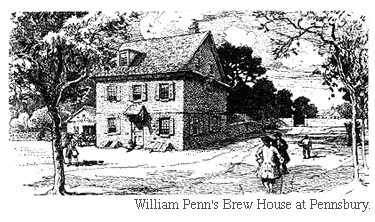
Painting-of-William-Penn

And this short history is from the online Museum of Beer and Brewing:

The William Penn Brewery — the staid Quaker build one of the earliest breweries in America near what is now Philadelphia. Part of his lands were colonized by immigrants from the German Palatinate who found Penn’s Product, prepared under the supervision of a Master Brewer from Europe, highly palatable. The first brewery in America was built in New Amsterdam (now New York) in the 17th century about 30 years before Penn’s.
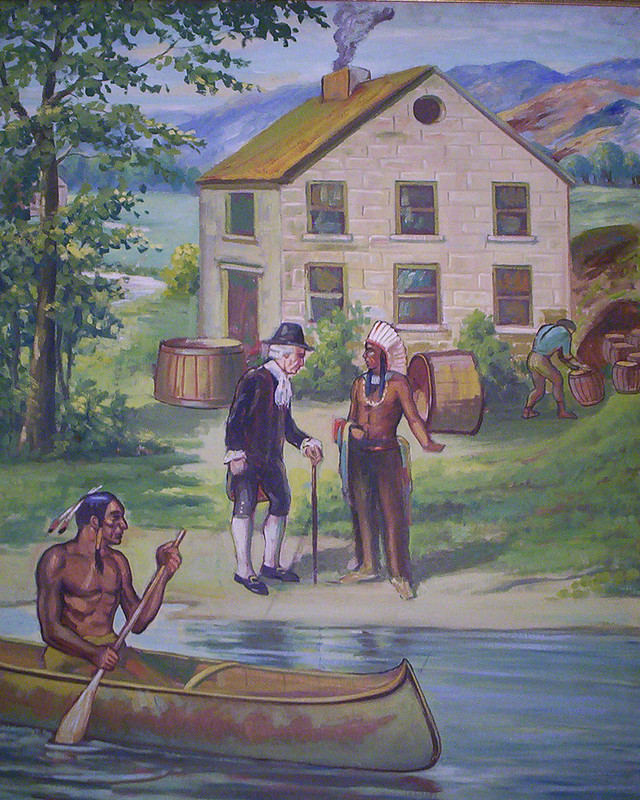
17th-Century-William-Penn-Brewery
The illustration for William Penn’s Brewery from the Museum of Beer and Brewing.

And this is the labels from a beer created to honor William Penn by the now-defunct (I believe) William Penn Brewing Co., which appears to have been a contract beer.
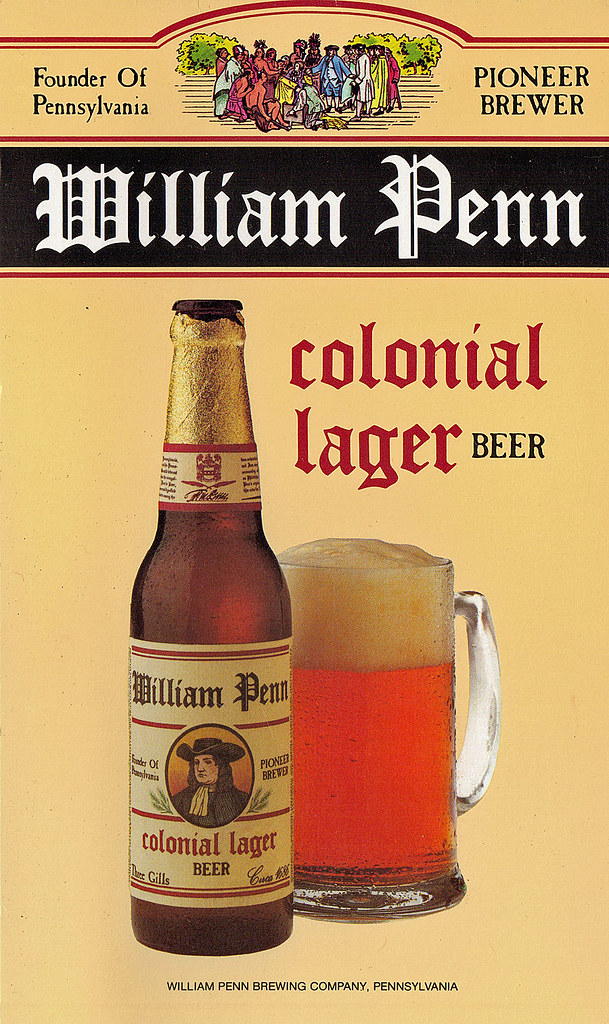
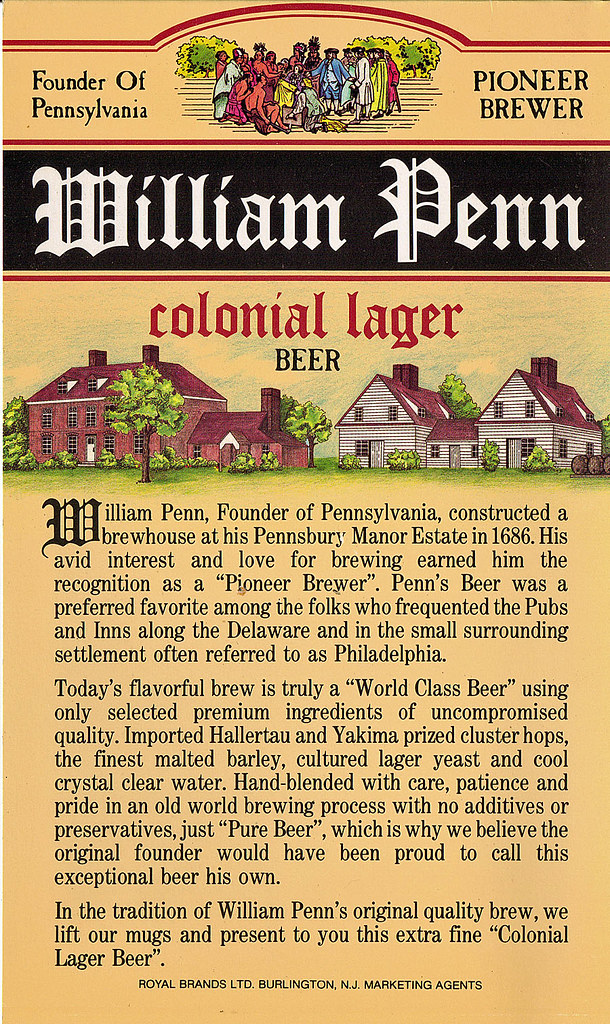
williampenntabletent1
williampenntabletent2

Filed Under: Birthdays, Just For Fun, Politics & Law Tagged With: England, Great Britain, History, Pennsylvania, Philadelphia

Beer Birthday: Jimmy Carter

October 1, 2025 By Jay Brooks

us-president
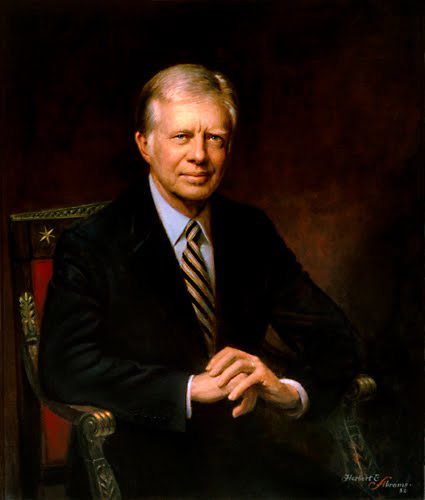
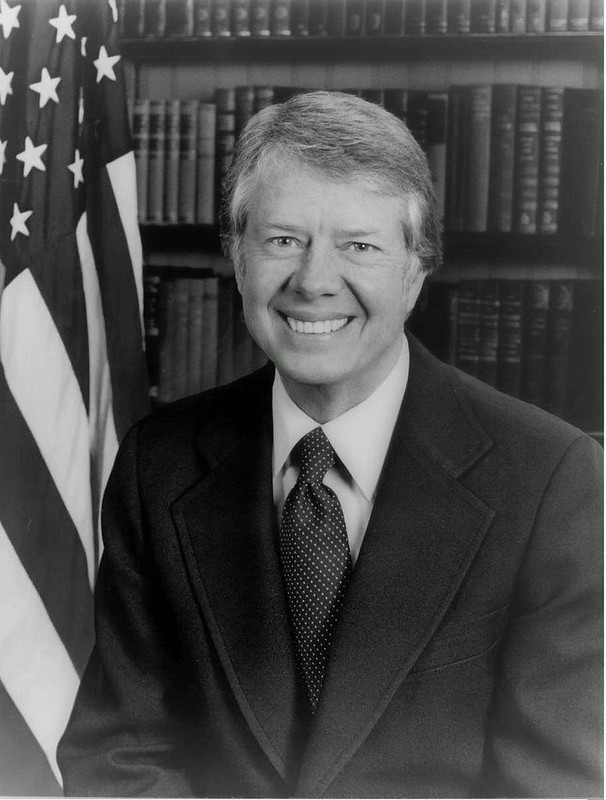
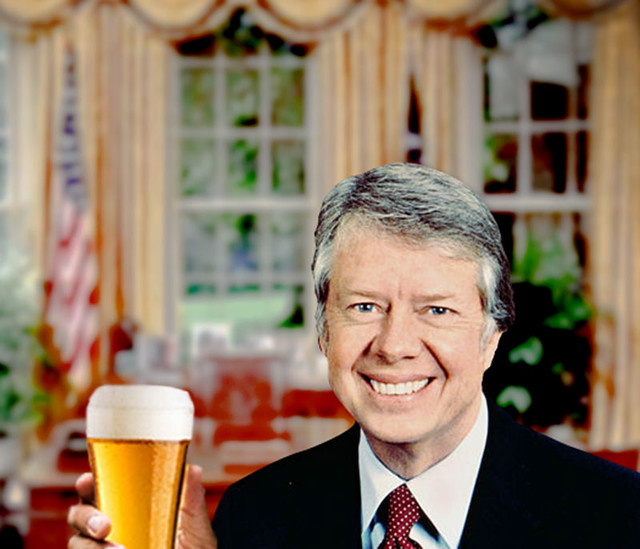
Today would have been the 101st birthday of our 39th U.S. President Jimmy Carter (October 1, 1924-December 29, 2024), but he passed away at the end of the year in 2024. He was “an American politician and author who served as the 39th President of the United States from 1977 to 1981. In 2002, he was awarded the Nobel Peace Prize for his work with the Carter Center.

Carter, a Democrat raised in rural Georgia, was a peanut farmer who served two terms as a Georgia State Senator, from 1963 to 1967, and one as the Governor of Georgia, from 1971 to 1975. He was elected President in 1976, defeating incumbent President Gerald Ford in a relatively close election; the Electoral College margin of 57 votes was the closest at that time since 1916.”

The White House website also has a series of presidential biographies, from “The Presidents of the United States of America,” by Frank Freidel and Hugh Sidey:

Jimmy Carter served as the 39th President of the United States from 1977 to 1981. He was awarded the 2002 Nobel Peace Prize for work to find peaceful solutions to international conflicts, to advance democracy and human rights, and to promote economic and social development.

Jimmy Carter aspired to make Government “competent and compassionate,” responsive to the American people and their expectations. His achievements were notable, but in an era of rising energy costs, mounting inflation, and continuing tensions, it was impossible for his administration to meet these high expectations.

Carter, who has rarely used his full name–James Earl Carter, Jr.–was born October 1, 1924, in Plains, Georgia. Peanut farming, talk of politics, and devotion to the Baptist faith were mainstays of his upbringing. Upon graduation in 1946 from the Naval Academy in Annapolis, Maryland, Carter married Rosalynn Smith. The Carters have three sons, John William (Jack), James Earl III (Chip), Donnel Jeffrey (Jeff), and a daughter, Amy Lynn.

After seven years’ service as a naval officer, Carter returned to Plains. In 1962 he entered state politics, and eight years later he was elected Governor of Georgia. Among the new young southern governors, he attracted attention by emphasizing ecology, efficiency in government, and the removal of racial barriers.

Carter announced his candidacy for President in December 1974 and began a two-year campaign that gradually gained momentum. At the Democratic Convention, he was nominated on the first ballot. He chose Senator Walter F. Mondale of Minnesota as his running mate. Carter campaigned hard against President Gerald R. Ford, debating with him three times. Carter won by 297 electoral votes to 241 for Ford.

Carter worked hard to combat the continuing economic woes of inflation and unemployment. By the end of his administration, he could claim an increase of nearly eight million jobs and a decrease in the budget deficit, measured in percentage of the gross national product. Unfortunately, inflation and interest rates were at near record highs, and efforts to reduce them caused a short recession.

Carter could point to a number of achievements in domestic affairs. He dealt with the energy shortage by establishing a national energy policy and by decontrolling domestic petroleum prices to stimulate production. He prompted Government efficiency through civil service reform and proceeded with deregulation of the trucking and airline industries. He sought to improve the environment. His expansion of the national park system included protection of 103 million acres of Alaskan lands. To increase human and social services, he created the Department of Education, bolstered the Social Security system, and appointed record numbers of women, blacks, and Hispanics to Government jobs.

In foreign affairs, Carter set his own style. His championing of human rights was coldly received by the Soviet Union and some other nations. In the Middle East, through the Camp David agreement of 1978, he helped bring amity between Egypt and Israel. He succeeded in obtaining ratification of the Panama Canal treaties. Building upon the work of predecessors, he established full diplomatic relations with the People’s Republic of China and completed negotiation of the SALT II nuclear limitation treaty with the Soviet Union.

There were serious setbacks, however. The Soviet invasion of Afghanistan caused the suspension of plans for ratification of the SALT II pact. The seizure as hostages of the U. S. embassy staff in Iran dominated the news during the last 14 months of the administration. The consequences of Iran’s holding Americans captive, together with continuing inflation at home, contributed to Carter’s defeat in 1980. Even then, he continued the difficult negotiations over the hostages. Iran finally released the 52 Americans the same day Carter left office.

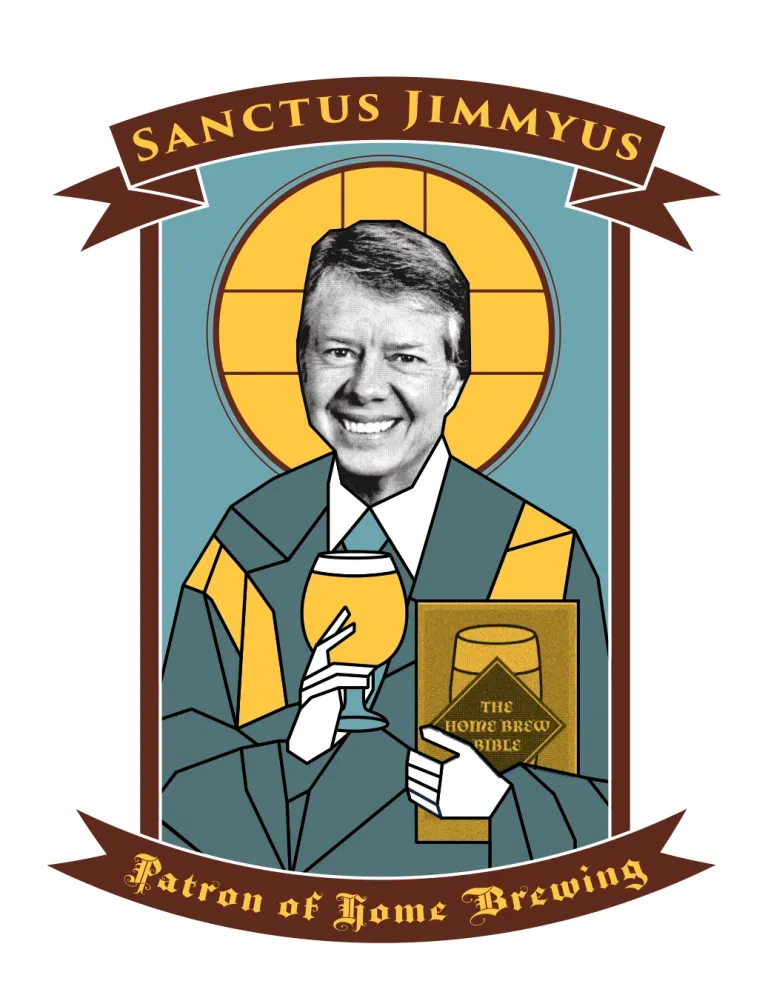
But, of course, none of that is why people who love beer will celebrate Jimmy Carter. Carter, of course signed H.R. 1337 on October 14, 1978. That was the bill that finally legalized homebrewing. And while you can argue that it was really senator Alan Cranston who deserves the lion’s share of the credit, after all he added the specific language to the bill that made homebrewing okay again, it’s generally Carter who’s best remembered for having signed the bill into law. At least outside of California, anyway, where many people know that it was Amendment 3534, drafted by Cranston, that homebrewing was decriminalized.

Still, I think it’s fair to give Carter some of the credit, and thanks him for signing the bill allowing homebrewing again into law. I’m not sure Reagan would have signed it. See also, Tom Cizauskas’ What will President Jimmy Carter be remembered for? and KegWorks’ How Jimmy Carter Sparked the Craft Beer Revolution.

jimmycarter

And finally, here’s Michael Jackson, in an 2004 interview, talking about the importance of Carter signing the homebrewing bill into law.

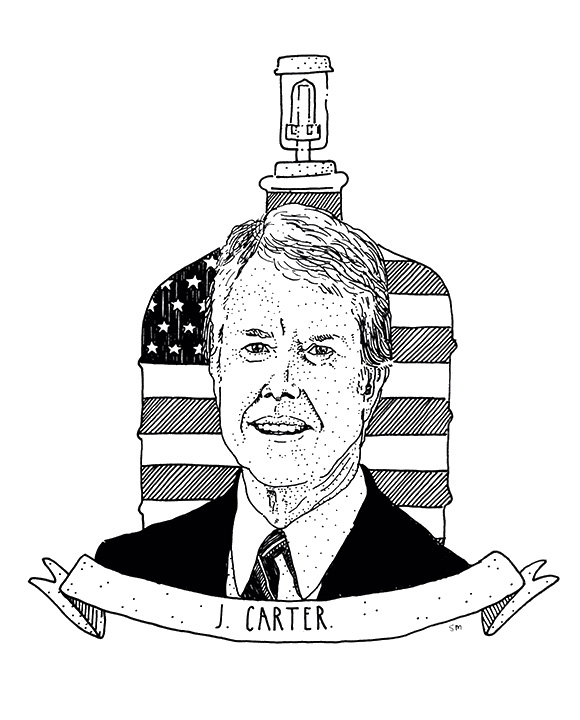
Jimmy Carter, by Sean Marlin McKinney.

Filed Under: Birthdays, Just For Fun, Politics & Law Tagged With: Georgia, History, Homebrewing, Politics

Historic Beer Birthday: Louis X, Duke of Bavaria

September 18, 2025 By Jay Brooks

bavaria
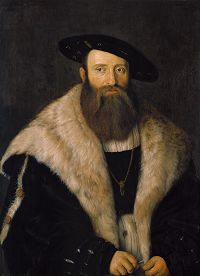
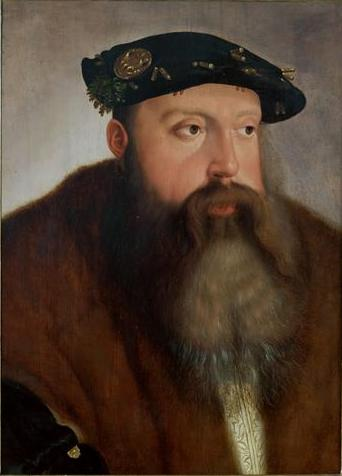
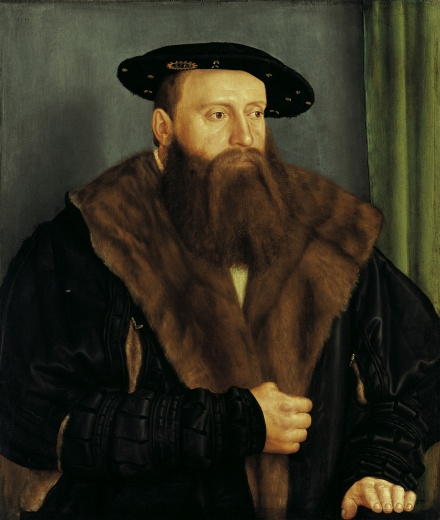
Today is the birthday of Louis X, Duke of Bavaria (September 18, 1495-April 22, 1545). Louis X (or in German, German Ludwig X, Herzog von Bayern), “was Duke of Bavaria (1516–1545), together with his older brother William IV, Duke of Bavaria. His parents were Albert IV and Kunigunde of Austria, a daughter of Emperor Frederick III.”

Here’s another short account of Louis X’s life:

Ludwig (Louis) X, Duke of Bavaria (Herzog von Bayern), was conjoint ruler of Bavaria with his brother Wilhelm IV (1493-1550) from 1516 to 1545. Louis was born 18 September 1495, son of Albert IV, Duke of Bavaria (1447-1508) and Kunigunde of Austria (1465-1520), a daughter of Emperor Frederick III. When his father Albert IV died in 1508, he was succeeded by his eldest son Wilhelm IV. It was Albert’s intention to not have Bavaria divided amongst his sons as had been the practice with previous successions. However, Louis became joint ruler in 1516, arguing that he had been born before his father’s edict of the everlasting succession of the firstborn prince of 1506.

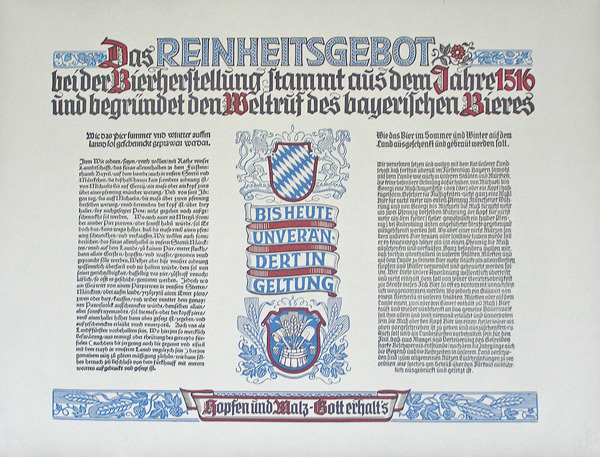
Although his brother, William IV, Duke of Bavaria, wrote and signed the Reinheitsgebot, also known as the Bavarian Beer Purity Law, and later the German Beer Purity Law, Louis X as co-ruler of Bavaria also had a hand in it, and was co-signatory on the historic document.

reinheitsgebot

In the Bavarian town of Ingolstadt on April 23, 1516, William IV, Duke of Bavaria wrote and signed the law, along with his younger brother Louis X, Duke of Bavaria. That 1516 law was itself a variation of earlier laws, at least as early as 1447 and another in independent Munich in 1487. When Bavaria reunited, the new Reinheitsgebot applied to the entirety of the Bavarian duchy. It didn’t apply to all of Germany until 1906, and it wasn’t referred to as the Reinheitsgebot until 1918, when it was coined by a member of the Bavarian parliament.

Filed Under: Birthdays, Just For Fun, Politics & Law Tagged With: Bavaria, Germany, History, Law

Historic Beer Birthday: Frank Jones

September 15, 2025 By Jay Brooks

frank-jones

Today is the birthday of Frank Jones (September 15, 1832–October 2, 1902). He was born in New Hampshire and in the 1870s owned the largest brewery in the U.S. He settled in Portsmouth, New Hampshire and after working for his brother for a time, he began working at a brewery. Accounts differ as to whether he simply worked for Englishman John Swindell or if they were partners in the brewery, but after a short time together, Jones became the sole owner of the brewery. According to one timeline, the John Swindells Brewery was founded in 1856, but two years later, in 1858, it became Swindells & Jones Brewery, and a year after that was renamed the Frank Jones Brewery, which it remained until prohibition. After repeal, it reopened as the Eldridge Brewing Co., at least until 1943. Another source says in 1943, it started trading again as the Frank Jones Brewing Co., but closed for good in 1950.

Frank-Jones

Jones was also active in politics and in 1868 was elected mayor of Portsmouth, N.H. Six years later, in 1874 he was elected to Congress as a Democrat and served two terms, deciding not to run for a third. In 1880, he ran for Governor of New Hampshire, but narrowly lost the race. Later in life, he became disgusted by William Jennings Bryan’s stand on “Free Silver,” and he switched to the Republican party. 

frank-jones-1890s
Jones in the 1890s.

Here is a short biography of Jones from Find-a-Grave:

US Congressman. He was active in numerous businesses, most notably a brewery that by the 1870s was the largest ale brewer in the United States. He invested his profits in other ventures, including hotels, banks, and race horses. He was elected Mayor of Portsmouth, New Hampshire in 1867 and served from 1868 to 1869. He was then elected as a Democrat to represent New Hampshire’s 1st Congressional District in the United States House of Representatives, serving from 1875 to 1879. He unsuccessfully ran for New Hampshire Governor in 1880, losing to Charles Henry Bell. He remained active in the Democratic party, and was an advocate for expansion of the Portsmouth Navy Yard. He was a supporter of Grover Cleveland and in 1885 declined President Cleveland’s offer to nominate him for Secretary of the Navy. In the 1890s he sold his brewery to British investors and became active in railroads and insurance. In 1896 he broke with the Democratic party and was a delegate to the 1900 Republican national convention. The Frank Jones Brewing remained in business until Prohibition in 1917; in the 1990s a local microbrewery briefly revived the name, and in 2000 Nutfield Brewing Company reintroduced Frank Jones Ale. The building that housed his brewery is today home to Tecnomatix Unicam, a computer software company.

frank-jones-1880

And this is his biography from Wikipedia:

Frank Jones was born in Barrington, New Hampshire, on September 15, 1832. He attended the public schools in Barrington. He moved to Portsmouth in 1849 and became a successful merchant and brewer. He owned businesses in Portsmouth and South Boston, Massachusetts.

Jones, the mayor of Portsmouth in 1868 and 1869, elected as a Democrat to the Forty-fourth and Forty-fifth Congresses (March 4, 1875 – March 3, 1879) was not a candidate for renomination in 1878. He was the unsuccessful Democratic candidate for Governor of New Hampshire in 1880, losing to Republican Charles Henry Bell by only a few thousand votes, 44,432 to 40,813.

Later, Jones became involved with the Republican Party. He was disgusted over William Jennings Bryan’s stand on Free Silver. He became interested in railroads and hotels. Jones rebuilt the stately Rockingham Hotel in Portsmouth and enlarged the Hotel Wentworth (now Wentworth-by-the-Sea) in New Castle. Also in Portsmouth, Jones built a mansion in the Second Empire style, with gardens and a horse track, completed in 1876.[1] He was a presidential elector on the Republican ticket in 1900. He died in Portsmouth, New Hampshire, on October 2, 1902, and was buried in Harmony Grove Cemetery.

The Frank Jones Brewery was one of the largest producers of ale in the United States of America. In 1896, Jones’ Portsmouth brewery produced about 250,000 barrels a year. In 1889, Jones put his company’s stock on the market in London. The new company was incorporated on May 17, 1889. In 1950, the Frank Jones Brewery closed after 90 years.

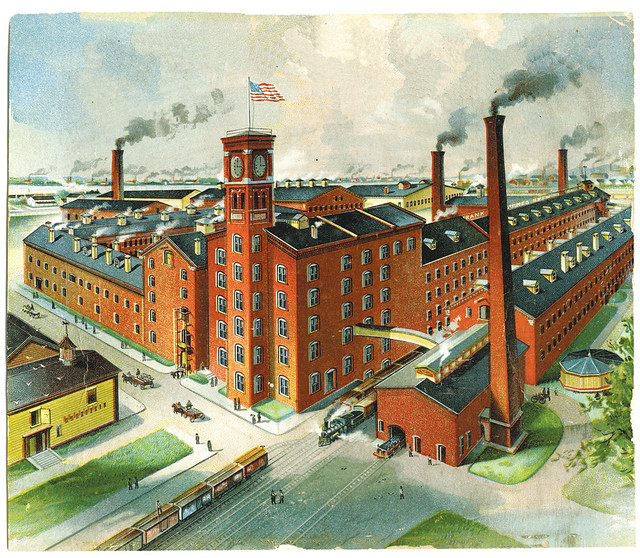
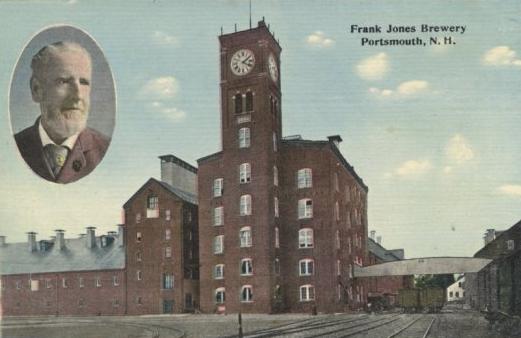
Frank_Jones_brewery_&_malt_houses,_Portsmouth,_N.H.

This account of the brewery is from “Beer New England,” by Will Anderson:

“Keeping up with the Joneses” was not just an idle expression in turn-of-the-century New Hampshire brewing circles: it was a most difficult task indeed. Dominating Manchester was True Jones; dominating Portsmouth (and scores of other markets, too!) was Frank Jones. The two were brothers, part of a family of seven children born unto Mary and Thomas Jones of Barrington, a small town roughly fifteen miles west of Portsmouth. Frank was the older of the two . . . and it was he who would go on to far and away greater prominence. Little, in fact, is known about True Jones. He appears to have followed Frank (and several other siblings) to Portsmouth, from whence he made his way to the state’s largest city, Manchester. There he, in 1891, gained control of the Carney, Lynch & Company brewery. Changing the name to the True W. Jones Brewing Company, he became king of the Manchester brewing scene. But, then again, that was pretty easy: by the 1890s True W. Jones was the only game in town. He was the only brewer in Manchester. True passed away on October 2, 1899, but the brewery that bore his name continued on until New Hampshire went dry in 1917.

But if little is known about True Jones, lots is known about his older brother. Frank Jones was truly a giant among Granite Staters. Raymond A. Brighton, who chronicled the history of Portsmouth in his THEY CAME TO FISH, devoted an entire chapter to Frank, declaring that, while Portsmouth has had many, many notables in its three-hundred fifty plus years of existence, “none of them dominated their times as completely as did Frank Jones.”

Born in 1832, Frank came to Portsmouth — not to be a brewer, but to work as a tin peddler for his brother Hiram’s hardware and stove business — at age sixteen. Frank was much too ambitious, however, to merely peddle tin for very long. By 1858 he’d involved himself in the brewery of an Englishman named John Swindells. Within little more than a year he owned it. And once he owned it, Frank Jones set out to make his brewery the biggest and best around. He added a malt house in 1863, and a second one in 1879. A new brewhouse was constructed in 1870; in 1878 he added a cooperage department; what were generally believed to be the largest ale and porter storage cellars in the world were built in the early 1880s; and extensive bottling works were constructed in 1900.

What really made Frank Jones a Big Man Around Portsmouth, however, was his outside-of-brewing activities and interests. He was twice elected mayor of his adopted city; served New Hampshire as a two-term Congressman; lost in a bid to become governor by a scant 2,000 votes in 1880; was president of the Boston & Maine Railroad, the Granite State Fire Insurance Company, the Portsmouth Fire Association, and the Portsmouth Shoe Company; and was proprietor of two still extant hotels, the Rockingham (in Portsmouth) and the rather colossal Wentworth-by-the-Sea (in nearby Newcastle).

To again quote Portsmouth historian Brighton: “The man was a legend in his own time.”

frank-jones-brewery

This more comprehensive account of the brewery is from Rusty Cans, who also did an exhibition on the Frank Jones Brewery in 2010.

The Frank Jones Brewery was once one of the largest in New England and was founded and headed by a prototypical 19th Century self-made businessman in Portsmouth New Hampshire.  This website is centered on cans, and Frank Jones Ale was never sold in cans. However, it remains one of my favorite breweries perhaps because it was New Hampshire’s most prominent brewery and my wife is a Granite State native.  Actually, until Anheuser-Busch opened their plant in Merrimack in June 1970 it was the only large brewery to operate in New Hampshire. At any rate, here is the story of the Frank Jones Brewery.

Frank-Jones-Portsmouth-Ale--Labels-Frank-Jones-Brewing-Company

Franklin Jones was born in Barrington, New Hampshire in 1832.  He was the fifth of six boys as well as the fifth of seven children in his family.  He left home at 16 and moved to Portsmouth and worked as an apprentice in his older brother Hiram’s stove store.  Within 3 years he owned an interest in the store and in 1854 he took it over completely.  Throughout his life Jones would be active in several businesses at once, a pattern he developed early and in these early years he was also a tin peddler and a rag picker.  In 1858 he became partners with John Swindell, an Englishman who had recently moved to Portsmouth to start a brewery producing ale. 

Jones’ partnership with Swindell only lasted a few months before Jones owned the entire business including the property and, apparently, the recipe for ale that Swindell was using.  A somewhat more ribald story held that Jones, a notorious ladies man, got the recipe for his ale from a housewife he seduced while working as a tin peddler.  However he acquired it, Jones’s ale would be a successful and popular product until 1950.  Swindell did not do as well.  After selling out to Jones he opened another brewery which was not very successful.  He died in 1864 when he was hit by a train while pushing a little girl out of its path.

Frank-Jones-Ale--Labels-Frank-Jones-Brewing-Company

By the time of the Civil War the Frank Jones Brewery was operating profitably and competing with one main rival, the Eldridge Brewing Company founded in Portsmouth in 1864 by Herman Eldridge.  The two companies kept up their rivalry until Prohibition.  Local Prohibitionist sympathies were strong, but the two breweries had steady business.  They even held their own against the many ale-producing breweries in Albany, New York and  Boston.

Jones continually expanded his brewery as the centerpiece of his many businesses.  The Portsmouth Chronicle published  lengthy description of Jones brewery.  Ironically, the paper’s publisher, Frank Miller, although a friend of Jones, was also a prohibitionist.  

Frank_Jones_Company

“In connection with this brewery, Mr. Jones has, within a year or two, erected a large building for a malt house, and here the process of brewing (malting) commences. In the bins, lay immense piles of pure Canada barley, 25,000 to 33,000 bushels, certainly, ‘good looking enough to eat as ale does to drink after the batch is made. About 500 bushels of grain is thrown into the great circular wooden water tank, the sides of which are higher than your head, located in the lower room, and soaked for a couple of days. Then, having been winnowed of all bad kernels, peas, other grains, weed seeds, etc., by dipping off these extraneous matters, which all float on the top of the water, and which are sold at a price for light food for horses, and for pigs, hens and etc. … – the soaked and perfect barley are spread on the smooth, clean floor to the depth of six inches or so, and there lies for a few days to swell and sprout, heat and ferment. There are three of these piles or beds of barley, of 500 bushels each, spread over the floor, in different stages of preparation.

“From here the grain goes into the drying room, the floor of which is iron, punctured with innumerable little holes, like a strainer or sieve, and the coal fires in the furnaces which are never allowed to go out, day or night, the year round. When entirely dry, the grain, which is now malt, or malted barley, is conveyed to the brewery proper, and cracked in a mill, then soaked again, this time in hot water, pure from the Portsmouth Aqueduct, and placed on another sieve or strainer, and the liquid caught below, which, as extract of barley, is all of the grain which is wanted. The residue is the “Brewers Grain” which is sold for food for animals, and is a valuable manure.

“Hops are now added to this liquid extract in such quantities as to produce ale of desired strength and quality, whether stock, amber or cream; and, after fermenting to the proper point, is barreled for use. In pure ale there is no other ingredient besides these, water and hops. But adulteration by means of “quassis” (the wooden bark of tropical trees) instead of hops, may be made at greatly reduced prices. .. . We understand that Mr. Jones” accommodations, spacious and complete as they are, are by no means sufficient for his increasing business; and he has extensive stables and sheds already in the course of erection, and contemplates considerable additions to his brewery and malt house.”

(there is no date listed for this quote in Brighton, King of the Ale makers, 39-40, but it was probably written about 1865.)
Frank-Jones-Ale--Labels-Frank-Jones-Brewing-Co

Jones continued to expand and modernize his brewery over the years.  In 1878 Jones added a cooperage (barrel house) and the next year added a second malt house to his brewery.  At about the same time Jones bought part partnership of a second brewery in Boston to make ale.  In 1883 “The Western Brewer” (a brewer’s trade journal) listed Frank Jones as the largest ale brewer in the country: they had  brewed almost 150,000 barrels of ale in 1882.  As a result of his increasing demand, Jones begins to develop local springs as a water supply.  In 1884 the brew-house was expanded and in 1888 the “Clock Tower” is finished at the brewery.  It was 140 feet high, 40 feet taller than the rest of the brewery.  The clock face measured 11 feet across and the tower bell weighed over 3,000 lbs.  By that time Jones employed over 500 men at his brewery, which probably made him the largest employer in Portsmouth.  In 1890 the brewery added a large bottling shop. 

Frank Jones ales were so popular that in 1889 he opened a branch office in Boston.  In 1875 Jones and his son-in-law and business partner Sinclair together with two other investors bought the Henry Souther & Company brewery in South Boston for $150,000.  The Boston brewery then had the capacity to produce 650 barrels a day, a rate which greatly increased over the years.   Jones put his brother True W. Jones to run the Boston branch.  When one of Jones’ business partners sold out the brewery was renamed the Bay State Brewery.  The Boston brewery continued operation until 1905.

FJB_brewerytower

In the 1890s British financial interests began buying American breweries.  The 1880s had been a time of expansion for many brewers in the US.  When a major depression started in 1893 many brewers found themselves in severe debt.  Moreover, the growth in the number of breweries meant that there was more production capacity than demand.  As a result, breweries had started to consolidate even before the depression began.    In the meantime, stock offerings in European breweries had all been purchased already and British investors were looking for a new outlet.  As the Western Brewer noted…

[The British] are tired of investments in oriental bonds, African mining stock, colonical (sic) promotional organizations, etc.  There is no money in those affairs, and they are quite risky.  Hence American securities attract large attention.  But British speculators will not invest in American railroad stocks…nor will they invest in mining stock….American brewery stock is a more stable commodity. (quoted in Baron, Brewed in America 269)

British investors began buying American breweries in the 1880s and when a depression started in the United States in 1893 and brewers began to fall into financial trouble, British investors stepped in even more.  A number of the investors would buy all or most of the breweries in a single area, often paying well over market value to corner the market.  The buyers would then combine the breweries into one company.  Such trusts operated in Baltimore, Chicago, Detroit, Boston, Philadelphia as well as in other cites.  Efforts to buy some of the biggest concerns such as Anheuser-Busch, Schlitz and Pabst were rebuffed, however.  However, many investors had overpaid for their property.   Consumption of beer dropped in 1894 and 1895 due to the depression and the resulting beer price wars in many areas dropped the price of beer drastically.  In Chicago, for example, the price per barrel went from $6.00 to $3.50.    When the beer tax increased to $2.00 in 1898 to pay for the Spanish-American war over-extended investors began to sell.  Finally, the attempted concentration of breweries had meet with resistance from some local brewers and new, independently owned breweries began to be formed to compete with the conglomerates.

frank-jones-tray

Jones’ sale came at the start of this wave of purchases and was a sign of what would be coming.  He sold his two breweries for $6,300,00 of which between two and three million was “foreign capital.”  He got about 6% in cash and the rest in stock and bonds which were then sold on the British stock market.  Jones kept about $500,000 in stock and he remained on the brewer’s board of directors so in effect he remained in charge.  The British directors were William Heygate, a director of the Middleton Railway, and English brewers E. Ind and R. Pryor.  Jones and his business partner son in law Sinclair made about four million dollars in profit.  Jones guaranteed a 15% net annual profit for three years to the buyers.

There was some local discussion of what British control over such a prominent business would mean to Portsmouth but Jones assured the city that he would remain in control.  A local newspaper under the control of one of Smith’s Republican rivals charged that he was selling his brewery to the British in order to buy out the Boston & Maine railroad.  Jones in fact did become President of the B&M Railroad in 1889, but he had already been on the board of directors.  Sale of the brewery, however, undoubtedly did give him more resources for expanding his other businesses including his railroad stock.  

The brewery of course continued after Jones died in 1902.  In 1903 the Boston plant was closed.  The main brewery in Portsmouth, however, continued brewing ale until Prohibition began in New Hampshire in 1917.  

frank-jones-postcard-1900

The Frank Jones Brewery never reopened after Prohibition.  Its equipment was sold off: the Heuther Brewing Company in Ontario bought the bottling equipment.  But the brand was reborn when Prohibition ended.  Ironically, it was produced by the Eldridge Brewing Company of Portsmouth, Jones’ old rival.  From 1933 to 1937 the Eldridge Brewing Company brewed ale in the old Frank Jones plant under the Eldridge name.  In 1937 it renamed itself the Frank Jones Brewing Company.  Originally their ale was called Eldridge Portsmouth Ale.  However, just to continue the confusion, it was brewed with the old Frank Jones formula!  In 1937 the ale was also renamed Frank Jones Ale. 

FJones_sign1
An ad from the 1940s.

In 1947 the brewery was sold to Caldwell, Inc. another New Hampshire company, one which distilled rum. (This is a different company from the present Caldwell, Inc. which manufactures things such as pallet lifters.)  Consumers’ tastes were changing, however.  Prior to World War II New England and upper New York state were the last holdouts to prefer ale to lager beer.  After the war, however, lager beer gained favor in the Northeast and Frank Jones continued losing sales.  In 1950 the brewery closed.  Some of the buildings still stand in Portsmouth, however, used as offices and shops. 
frank-jones-employees-1910
Employees of the Frank Jones Brewery around 1910.

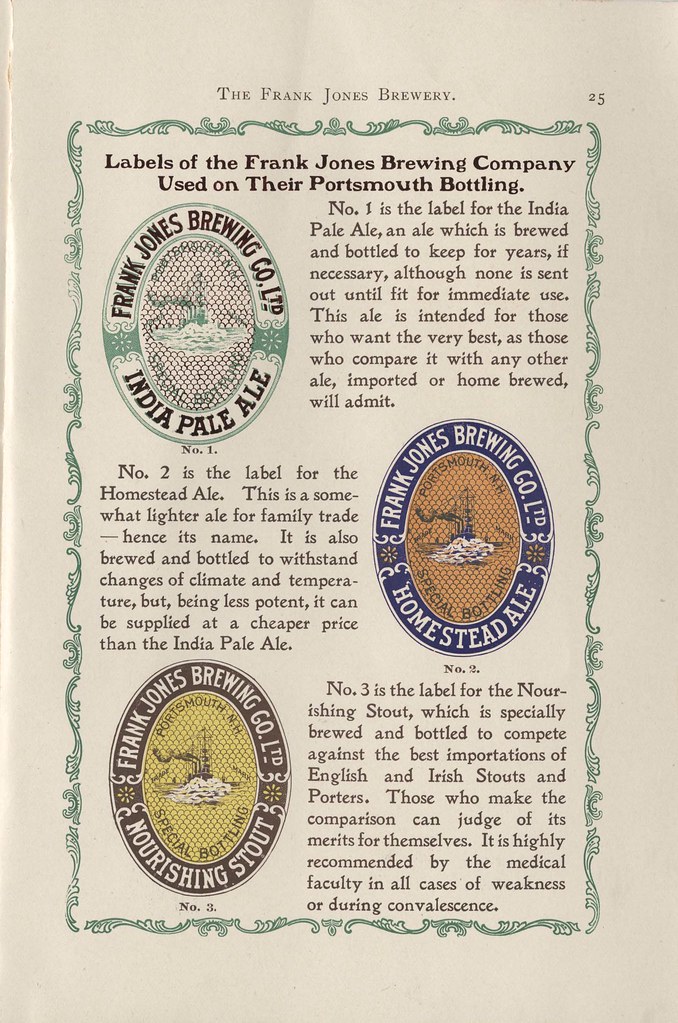
And this fascinating look at their labels is from a 1902 pamphlet entitled “How Good Ale is Brewed.”

frank-jones-brewery-labels
Frank-Jones-IPA

Filed Under: Birthdays, Breweries, Just For Fun, Politics & Law Tagged With: History, New Hampshire

Beer In Ads #5008: “Bock,” Himself, Wants A Beer

June 24, 2025 By Jay Brooks

Last year I decided to concentrate on Bock ads. Bock, of course, may have originated in Germany, in the town of Einbeck. Because many 19th century American breweries were founded by German immigrants, they offered a bock at certain times of the year, be it Spring, Easter, Lent, Christmas, or what have you. In a sense they were some of the first seasonal beers. “The style was later adopted in Bavaria by Munich brewers in the 17th century. Due to their Bavarian accent, citizens of Munich pronounced ‘Einbeck’ as ‘ein Bock’ (a billy goat), and thus the beer became known as ‘Bock.’ A goat often appears on bottle labels.” And presumably because they were special releases, many breweries went all out promoting them with beautiful artwork on posters and other advertising.

Tuesday’s ad is for not technically for a specific Bock Beer. Instead it’s an captioned photo that was published on and around June 24, 1924 as part of the coverage of the Democratic National Convention, which was held that year in Washington, D.C. When I searched today for Bock ads, this photo repeated endlessly in too many newspaper across the country to count. In all my searching this year, this one hands down was published in the most newspapers. This specific one ran in The Washington Daily News, of D.C. Who knew the Democrats once used a goat as their mascot? Not me, that’s for sure.

Filed Under: Art & Beer, Beers, Just For Fun, Politics & Law Tagged With: Advertising, Bock, D, D.C., History, Politics

Historic Beer Birthday: Alan Cranston

June 19, 2025 By Jay Brooks

alan-cranston
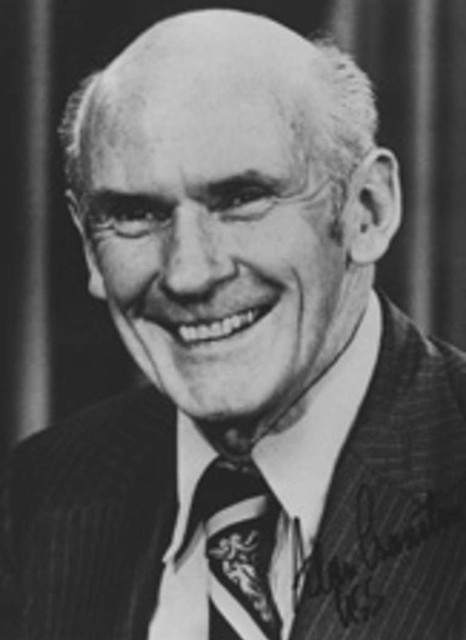
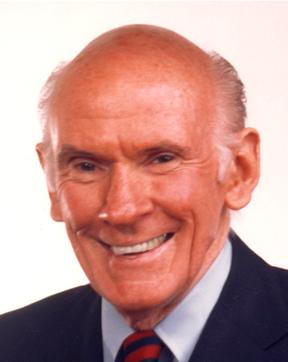
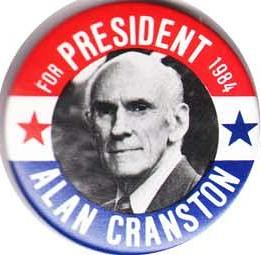
Today is the birthday of Alan MacGregor Cranston (June 19, 1914–December 31, 2000). Cranston was a Democratic senator from California, born in Palo Alto, and served four terms.

cranston

Here’s a biography from Find a Grave:

US Senator. A member of the Democratic party, he represented the state of California for four terms in the US Senate from January 1969 until January 1993, serving as the Democratic Whip from 1977 until 1991. Born Alan MacGregor Cranston in Palo Alto, California into a wealthy real estate family, he attended local public schools before attending Pomona College in Claremont, California and the Universidad Nacional Autonoma de Mexico in Mexico City, Mexico, and graduated in 1936 from Stanford University in Palo Alto with a degree in journalism. In 1937 he became a correspondent for the International News Service for two years preceding World War II, covering Europe and North Africa. When an abridged English-language translation of Adolf Hitler’s “Mein Kampf” was released, sanitized to exclude some of Hitler’s anti-semitism and militancy, he published a different translation (with annotations) which he believed more accurately reflected the contents of the book. In 1939 Hitler’s publisher sued him for copyright violation in Connecticut and a judge ruled in Hitler’s favor and publication of the book was halted. From 1940 until 1944 he served as chief, foreign language division in the Office of War Information and in 1944 he enlisted in the US Army. In 1945 he wrote the book, “The Killing of the Peace,” a synopsis of the failed bid to get the US to join the League of Nations immediately following World War I. A world government supporter, he attended the 1945 conference that led to the Dublin Declaration, and became president of the World Federalist Association in 1948. In 1949 he successfully pushed for the California legislature to pass the World Federalist California Resolution, calling on Congress to amend the Constitution to allow US participation in a federal world government. From 1949 until 1952 he was the national president of the United World Federalists. In 1952 he co-founded the California Democratic Council and served as its chairman. In 1958 he was elected California’s State Controller as a Democrat and was re-elected in 1962. In 1968 he ran as the Democratic candidate for US Senate and was elected to the first of four six-year terms, defeating Republican challenger Max Rafferty, followed by Republican challenger H.L. “Bill” Richardson in 1974, Republican Paul Gann in 1980, and Republican Congressman Ed Zschau in 1986. During his time in the US Senate, he served on the Banking, Housing, Urban Affairs, Veterans (which he chaired), and Foreign Relations Committees and was strongly opposed to the US involvement in the Vietnam War. He was an unsuccessful candidate for the 1984 Democratic presidential nomination, dropping out of the race after finishing poorly in the Iowa and New Hampshire primaries. In November 1991 he was reprimanded by the US Senate Select Committee on Ethics for “improper conduct” after Lincoln Savings head Charles Keating’s companies contributed $850,000 to voter registration groups closely affiliated with him. Because the Keating affair had damaged his political career, coupled with his diagnosis and treatment of prostate cancer, he decided against running for a 5th US Senate term. His final act as a Senator was to preside over the inauguration of Bill Clinton as President of the US on January 20, 1993. A fitness enthusiast, he was notable for practicing and participating in the sport of track and field as a sprinter in special senior races. An avid lifetime supporter of the global abolishment of nuclear weapons, in his retirement he became a part of the Nuclear Weapon Elimination Initiative of the State of the World Forum and founded the Global Security Institute in 1999, serving as its president. He died of natural causes in Los Altos, California at the age of 86.

alan-cranston

Of course, the one thing left out of Cranston’s biography in most accounts is the reason that he’s featured here. On January 4, 1977, Representative William A. Steiger (Republican from Wisconsin’s 6th District) introduced H.R.1337 a transportation bill with the title “A bill to amend the Internal Revenue Code of 1954 with respect to excise tax on certain trucks, buses, tractors, etcetera.”

To that bill, senator Cranston added a crucial amendment which had a profound effect on the landscape of beer today, and its final title was “An Act to amend the Internal Revenue Code of 1954 with respect to excise tax on certain trucks, buses, tractors, et cetera, home production of beer and wine, refunds of the taxes on gasoline and special fuels to aerial applicators, and partial rollovers of lump sum distributions.”

Here’s the text of the beer portion of Amendment 3534, added by Senator Alan Cranston:

(e) BEER FOR PERSONAL OR FAMILY USE. — Subject to regulation prescribed by the Secretary, any adult may, without payment of tax, produce beer for personal or family use and not for sale. The aggregate amount of beer exempt from tax under this subsection with respect to any household shall not exceed —

(1) 200 gallons per calendar year if there are 2 or more adults in such household, or
(2) 100 gallons per calendar year if there is only 1 adult in such household.

For purposes of this subsection, the term ‘adult’ means an individual who has attained 18 years of age, or the minimum age (if any) established by law applicable in the locality in which the household is situated at which beer may be sold to individuals, whichever is greater.

As we all know, President Jimmy Carter signed H.R. 1337 into law on October 14, 1978, paving the way for the our modern brewing industry that includes over 700 breweries in California alone, and over 4,000 nationwide. Thanks Alan.

cranston-for-prez-84

In 1984, Cranston made a failed bid to run for president. I bet he would have gotten the homebrewing vote.

Filed Under: Birthdays, Just For Fun, Politics & Law, Related Pleasures Tagged With: California, History, Homebrewing

Historical Beer Birthday: John Lofting

June 15, 2025 By Jay Brooks

beer-engine
Today is as good a day as any to celebrate the birthday of John Lofting (1659–June 15, 1742). Like many people born centuries ago who weren’t royal or otherwise well-born, we don’t know the exact day he was born, but we do know that he died today. Lofting was a Dutchman who lived in London as an adult, and patented several devices, the most famous of which was the fire engine, but he may also have been responsible for the beer engine.

Here’s his Wikipedia entry:

Originally Jan Loftingh, John Lofting was an engineer and entrepreneur from the Netherlands. His parents were Herman and Johanna. He moved to London, England, before 1686. He patented two inventions being the “sucking worm engine” (a fire engine) and a horse-powered thimble knurling machine. His mill was set up in Islington, where Lofting Road is named after him. However, in or about 1700, he moved his main operation to Great Marlow in Buckinghamshire to take advantage of the River Thames’ ability to turn a water wheel which improved productivity, enabling the production of over 2 million thimbles per year.

sucking-worm-engine


The Sucking Worm Engine, from the British Museum.

And while Joseph Bramah patented the first practical beer engine, Lofting’s design made it possible for Bramah to build on and create his. Although there’s little I could find specific about Lofting’s invention, it is mentioned in the Wikipedia entry for the beer engine:

A beer engine is a device for pumping beer from a cask in a pub’s cellar.

The beer engine was invented by John Lofting, a Dutch inventor, merchant and manufacturer who moved from Amsterdam to London in about 1688 and patented a number of inventions including a fire hose and engine for extinguishing fires and a thimble knurling machine as well as a device for pumping beer. The London Gazette of 17 March 1691 stated “the patentee hath also projected a very useful engine for starting of beers and other liquors which will deliver from 20 to 30 barrels an hour which are completely fixed with brass joints and screws at reasonable rates.”

The locksmith and hydraulic engineer Joseph Bramah developed beer pumping further in 1797.

The beer engine is normally manually operated, although electrically powered and gas powered pumps are occasionally used; when manually powered, the term handpump is often used to refer to both the pump and the associated handle.

The beer engine is normally located below the bar with the visible handle being used to draw the beer through a flexible tube to the spout, below which the glass is placed. Modern hand pumps may clamp onto the edge of the bar or be mounted on the top of the bar.
A pump clip is usually attached to the handle by a spring clip giving the name and sometimes the brewery, beer type and alcoholic strength of the beer being served through that handpump.
The handle of a handpump is often used as a symbol of cask ale. Keg beer dispensers usually feature illuminated countertop fittings behind which a handle opens a valve that allows the gas pressure in the keg to force beer to the attached spout.

modern-beer-engine


A modern beer engine.

Filed Under: Birthdays, Just For Fun, Politics & Law, Related Pleasures Tagged With: Brewing Equipment, Cask, England, Great Britain, History, Kegs, Patent

Next Page »

Find Something

Northern California Breweries

Please consider purchasing my latest book, California Breweries North, available from Amazon, or ask for it at your local bookstore.

Recent Comments

  • Steve 'Pudgy' De Rose on Historic Beer Birthday: Jacob Schmidt
  • Jay Brooks on Beer Birthday: Bill Owens
  • Steve 'Pudgy' De Rose on Beer Birthday: Charles Finkel
  • Steve 'Pudgy' De Rose on Beer Birthday: Bill Owens
  • Steve "Pudgy" De Rose on Beer Birthday: Pete Slosberg

Recent Posts

  • Historic Beer Birthday: Jim Parker December 13, 2025
  • Beer Birthday: Colby Chandler December 13, 2025
  • Beer In Ads #5140: Buckeye Bock Beer Has Been Put To Sleep… December 12, 2025
  • Historic Beer Birthday: Anton Zahm December 12, 2025
  • Beer Birthday: Greg Koch December 12, 2025

BBB Archives

Feedback

Head Quarter
This site is hosted and maintained by H25Q.dev. Any questions or comments for the webmaster can be directed here.