Health & Beer

10 Healthy Reasons To Drink Beer

by Jay Brooks on January 16, 2012 · 2 comments

in Beers,Just For Fun,News,Top 10

catholic-vatican
I may not always see eye-to-eye with the roman catholic church, but I’m with them all the way on this one. While many religious denominations forbid their followers from drinking alcohol and others preach against it, it’s nice to see at least one take a more rational approach. Not only does Catholic Online tell everyone: “Have a beer. Really, go ahead and have one.” They even go so far as to encourage you to spread the word to your fellow man (and woman): “Tell everyone we said it’s okay to pop a cold one.” Talk about a great beginning.

The article published today on the catholic website is entitled 10 healthy reasons to have a beer! and also carries this subtitle: “Beer outperforms wine as a healthy beverage in several categories.” After detailing beer’s long history and its changing perception today, they get to the meat of their thinking:

Several years ago, it became understood that wine had a surprising number of health benefits. Since then, beer drinkers have had to endure a litany of praises about how great wine was for health as opposed to beer. But now, it turns out that the wine drinkers needn’t be so smug when comparing their beverage to beer.

Researchers from around the world have spent years studying one of our favorite beverages in detail, and there’s some good news. The latest collection of studies from around the world reveals that if the beer is enjoyed in moderation, meaning one for women, and no more than two for men, per day, then it can yield a surprising number of health benefits.

Below is the list of their ten reasons to drink a beer, but check out the original story to read the background for each of these ten.

  1. Strong Bones
  2. Strong Heart
  3. Kidney Stone Prevention
  4. Dementia Prevention
  5. Reduced Cancer Risk
  6. Taking Your Vitamins
  7. Stroke Prevention
  8. Diabetes Prevention
  9. Blood Pressure
  10. Long Life

I’ve seen, read and even written about most, if not all, of these health benefits from drinking beer in moderation, but it’s nice to see them all in one place. The article ends with this appropriate suggestion. “So the next time you decide to have a beer, you can enjoy it without the guilt.” Amen to that.

{ 2 comments }

Hangover Cure News

by Jay Brooks on December 6, 2011 · 2 comments

in Just For Fun,News,Related Pleasures

hangover
If you’ve ever looked at the science behind hangovers or endured enough of them, you probably already know that time is really the only cure for one. But when you’re feeling that bad, hope tends to spring eternal; and so hangover cures represent a pretty healthy business, bringing in untold millions of dollars. A hungover fool and his money are soon parted.

We all have our own preferred remedy. Mine is entirely preventative. Before going to bed, I take three Advils and a B-vitamin. More often than not, I wake up feeling fine. I also drink a lot of water, both during a drinking session and before retiring. I don’t think of it as a cure — indeed, I don’t believe there can actually be a cure — but for me it tends to head off the symtoms before they manifest themselves as discomfort or downright pain.

But companies keep taking P.T. Barnum’s prophetic words and proving them true, playing on our desire to do just about anything to speed up the recovery from a bad hangover. And in fact, two new ones are in the news today.
blowfish-tablets

Blowfish

Several news outlets, such as the NY Daily News, have the story that Blowfish tablets, recently approved by the FDA, is on the market, available for sale over-the-counter. The effervescent tablets “combine 1,000 milligrams of aspirin, 120 milligrams of caffeine and a stomach-soothing agent” which you dissolve in water the morning after. “Once dissolved in water, the remedy claims to knock out multiple hangover symptoms in just 15 to 30 minutes.” So far, it’s only for sale in New York City or at ForHangovers.com, and sells for $2.99 for a single dose, or $11.99 for a six-pack. Hmm.
hangover-patch

The Vitamin Patch

The Daily has a story today regarding a patch that you wear on your arm — like a nicotine patch — that time releases B vitamins. “Bytox Inc., has created a hangover patch that slowly releases a complex of B vitamins over eight hours — from the hour before you start drinking to the morning after. The idea, said Dr. Leonard Grossman, is that nutrients are immediately delivered into the bloodstream and stay there instead of being depleted.”

Maybe, but that still seems like a lot of work when taking one pill before bedtime is so simple. Plus, you’d still need to keep drinking a lot of water, too. I continue to think that moderation is the best method, and when that fails, as it inevitably will on occasion, time is your only friend.

{ 2 comments }


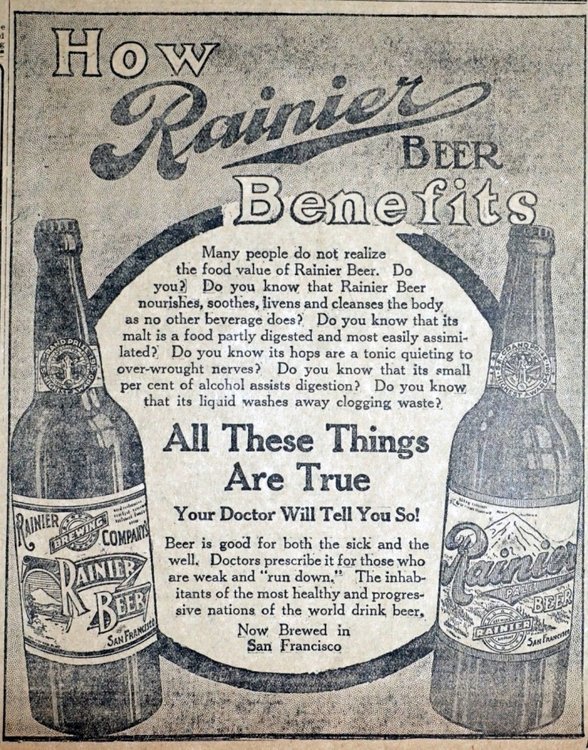
Thursday’s ad is another ad for healthy beer, somewhat similar to yesterday’s Budweiser ad. This one is just a few years later, from 1907, and was sent to me by fellow blogger Lisa Grimm from WeirdBeerGirl (thanks Lisa). The ad is for Rainier Pale Beer, from Seattle Brewing & Malting Co., and shows a group of children using a giant beer bottle as a Maypole. Mother can be seen in the background, arriving on the scene with a tray full of beer bottles and glasses. Again, can you just imagine that ad today? The copy is equally interesting.

Pure Air, Pure Food, Pure Drink are essential to healthy growth … for Pure Drink get Rainier Pale Beer

Another beautiful sentiment.

Rainier-1907

{ 2 comments }


Wednesday’s ad is a Ladies Home Journal (LHJ) ad from 1904 for Budweiser. It’s an interesting ad. First of all, check out the cage and cork on a Bud bottle. That’s not something you see every day. And the endorsement by LHJ is priceless. Can you imagine this today?

Mr. Edward Bok, editor of the Ladies’ Home Journal, in a page article in the May issue gives a list of 36 medicines, with official analysis, asserting them to contain 12 to 47 per cent. of Alcohol!

The ad goes to suggest the reader think of beer, with a mere 2 to 5 percent, is nothing compared to many of the medicines that mothers might give their child, some of which are “stronger than whisky.” At this point, Budweiser suggests that their beer is much healthier even than water with its low alcohol content.

Budweiser contains only 3-89/100 per cent. of alcohol. It is better than pure water because of the nourishing qualities of malt and the tonic properties of hops.

Budweiser is pre-eminently a family beverage; its use promotes the cause of true temperance—it guards the safety of health and home.

Now that’s a beautiful sentiment.

1904Budweiser

{ 3 comments }

abib
This is a bit of a head scratcher. Though it’s been rumored for a while now, apparently it is coming, as AdAge is reporting that the TTB has given label approval for Bud Light Platinum. Though thought to be somewhere between 6% and 8% a.b.v., AdAge indicated the new low-calorie beer will weigh in at 6% and have 137 calories. Regular Bud Light is 4.2% a.b.v. and has 110 calories. And as regular Budweiser is 5% and 145 calories, it’s hard to see the point. Apparently, the idea is “to tap into the rising popularity of craft beers, which tend to be fuller bodied with more alcohol.” Sure, just throw in some alcohol, that should fool people. Apparently they’re missing the point that craft beer drinkers want flavor, not just higher octane. But given how successful the big brewers have been at convincing people to drink low-calorie light beers, I have little doubt this couldn’t work, too, however illogical I find the very notion of light beer.

ABI has also apparently registered the domain name budlightplatinum.com, but it’s not yet an active website. There’s not even a placeholder there so it may be some time before we see the actual beer. ABI has also not yet made an official announcement or sent out a press release.

Bud-Light-Platinum

{ 4 comments }

cdc
At first glance I thought my pals at Alcohol Justice (AJ) got their hooks in the Center for Disease Control and Prevention (CDC), because I don’t know anyone better at making up behaviors that cry out for personal responsibility that are ascribed to society (for the cost) and business (for the fault). Their absurd “charge for harm” campaign, which seeks to make alcohol companies, the businesses that sell their products, and the communities that they live in wholly responsible for the personal decisions and behavior of a minority of people who abuse alcohol, seems to have been swallowed whole in a new study, apparently by the CDC, that was recently published in the American Journal for Preventative Medicine. That study, not surprisingly, was the subject of a recent AJ press release, CDC Releases New Cost Study: Excessive Alcohol Use Cost the U.S. $223.5 Billion in 2006, which they summarize:

Of the total costs, 72.2% ($161 billion dollars) is attributed to lost productivity in the workforce. The remaining costs are attributed to healthcare (11%), criminal justice (9.4%), and effects such as property damage (7.5%). While the CDC has had strong data on premature deaths caused by alcohol consumption (79,000 annually, with an estimated 2.3 million years of potential life lost each year), it last performed an economic cost analysis in 1998, when the annual cost was estimated to be $184.6 billion.

While $223.5 billion dollars is a massive number — almost 3 times what the federal government spent on pre-primary through secondary education in 2010 — the authors of the study believe that it is a substantial understatement of the true costs of alcohol use in the United States. They recommend “effective interventions to reduce excessive alcohol consumption—including increasing alcohol excise taxes, limiting alcohol outlet density, maintaining and enforcing the minimum legal drinking age of 21 years, screening and counseling for alcohol misuse, and specific countermeasures for alcohol- impaired driving such as sobriety checkpoints.” With the national cost of alcohol consumption ringing in at nearly $2 per drink, we could not agree more.

Of course they couldn’t agree more, it’s catnip to their agenda and I wouldn’t be surprised to find a closer link to the study that has not been disclosed since it seems so much like a self-fulfilling prophecy of their own propaganda with conclusions that so closely mirror their own proposals to “fix” alcohol abuse at the expense of the majority of responsible drinkers and local craft brewers who positively affect their local economies and communities. And my instinct turns out to be true, though not with AJ, but because this study “was supported by generous grants from the Robert Wood Johnson Foundation to the CDC Foundation.” For me, that’s the smoking gun. If you don’t know who the Robert Wood Johnson Foundation is, they’re the mother of all neo-prohibitionist groups, and they fund most of the other ones, setting the agenda for a majority of other anti-alcohol organizations nationwide. Supposedly, AJ no longer accepts donations from the Robert Wood Johnson Foundation, though when I asked when they stopped receiving support from them, I never got an answer.

But a closer look at the study reveals that the charges it ascribes to “society” are not actually borne by society at large, at least to my way of thinking, but instead are paid privately by the individuals who supposedly abused alcohol or the private companies that employ them. To me, that makes them false statistics because they say one thing that turns out to not actually be true. So let’s look as those numbers of societal “costs.” Here’s the breakdowns, according to AJ’s press release:

  1. 72.2%: Lost productivity in the workforce
  2. 11%: Healthcare
  3. 9.4%: Criminal justice
  4. 7.5%: Property damage

Okay, the biggest expense blamed on alcohol abuse is “lost productivity in the workforce,” accounting for nearly three-quarters of the total, or about $161 billion. But unless they work for the government (and there’s no data on what percentage might) the costs, it seems to me, would be paid by the private companies they work for. And if they continually show up late, hungover or so they can’t do their job, how many would remain employed for an extended period of time? However you slice it, that’s not me or society paying for the poor performance of that binge-drinking employee. I suppose you could argue that a company filled with such people might result in higher prices passed along to consumers, but any such company that doesn’t weed out employees who don’t perform their jobs well is most likely going to go out of business for other reasons, as well.

The other lost productivity category is early mortality by alcohol-abusers. These people apparently selfishly die before they can do enough work to be considered to have paid their debt to be a member of society. But if you drink yourself into an early grave, your unfinished work or debt to society has got to be the least of your troubles. It’s more likely that the reasons for your early demise have multiple causes, many of which were probably not addressed by the society who was as responsible for you as they claim you were to country, state, community and family. I honestly can’t see how you can total dollar amounts for work undone by one individual, when undoubtedly another person stepped in and did it instead. I don’t mean to sound cold, but with unemployment so high, when a position becomes available under such circumstances, I feel confident that there will be someone to take that job and get the work done. So how does that cost society anything?

But let’s also look at the number itself, $161 billion. GDP at the end of 2006 (the same timeframe as this study) was $13.58 trillion. That makes this “cost to society” 1.19% of GDP. Not only is that a pretty small percentage though, even if true, nothing in their reasoning suggests it’s anything close to the truth.

The next highest cost is from healthcare. But again, unless the binge drinker has no health insurance and doesn’t pay his own medical bills, how is society paying? For those with insurance, their policy pays their medical bills, and whatever isn’t covered under their policy they become personally responsible for. I admit that it’s more likely that a person who abuses alcohol, and may not be able to keep down a job, might not have health insurance, but in the only civilized nation without universal healthcare I would argue that’s more a failure of our society than a cost to it. Whoever ends up paying for the medical care of binge drinkers, it seems more likely it will be insurance companies first, responsible individuals second, and, if at all, society last.

Third, criminal justice apparently accounts for 9.5%. What is meant by “criminal justice” includes $73 billion, of which “43.8% came from crash-related costs from driving under the influence, 17.2% came from corrections costs, and 15.1% came from lost productivity associated with homicide. Other categories include fire loss, crime victim property damage and “special education” about “fetal alcohol syndrome.” In the full text of the study, Table 2 lists who they think is responsible for all these costs, whether the government, the drinker and his family or society (though I should point out how that was arrived upon is completely absent from the study). Given that the entire study supposedly claims the “cost of excessive alcohol consumption in the United States in 2006 reached $223.5 billion,” you’d think that the personal costs even they admit to would not be a part of the total at all. Even by the CDC study’s own admission, 41% of the costs they claim are to society, are actually “paid” by the individual drinker (and his family). That’s almost half that don’t appear to be a cost to society as a whole. How does that not call into question their methodology and/or their conclusions?

But many of these other categories seem plain silly. Fire loss and property damage? Those are crimes, whether or not the person perpetrating them was drinking or not. To say it’s alcohol-related if they had a drink before they robbed someone seems as ludicrous as including a car accident in which the passenger was drinking in drunk driving statistics (which actually has been routinely done). And corrections? If you’re in jail for a crime you committed, yes that’s a cost to society, but that’s a cost we’ve all agreed is supposed to be borne by society, like the police and fire departments. It’s not like there’s some special jails that don’t count or count double if the criminal had a drinking problem. It’s really just a way to inflate the numbers and, as usual, make the problem with alcohol abuse seem far worse than it is.

And while I’m on that subject, let’s briefly mention how absurd the very definition of a “binge drinker” is in compiling these statistics, too. I’ve written about this many times, such as in Inflating Binge Drinking Statistics, Son of Binge Drinking Statistics Inconsistencies and Inventing Binge Drinking.

Lastly, “property damage,” which is really “other effects,” is listed as 7.5% of the harm blamed on alcohol. This is very confusing, because in the study’s Table 1, “criminal justice” is actually listed under “other effects” so I’m not sure what AJ is up to with their list. So I’ve actually addressed property damage above here, though Table 1 also includes a separate column for “crime-related” so the row for “criminal justice” is 100% “crime-related” so I’m not sure what’s being doubled-up on, but surely something is odd, if not intentionally.

The other factors not accounted for, as usual, are any positive effects of alcohol. Although both the study and AJ makes a big deal about what negative effects they couldn’t quantify, they’re completely unconcerned about any omitted positive ones. Certainly there are economic benefits for local communities as well as society at large. But even ignoring those, this “study” undoubtedly does not take into account how total mortality is improved by moderate, responsible drinking as set forth in the most recent FDA dietary guidelines, as well as a number of scientific studies and meta-studies that have shown the same thing. How many people who do drink moderately as part of a healthy lifestyle actually save society money because of their responsible behavior, which includes a drink or two daily?

It also doesn’t take into account how many crimes are prevented or stress relieved which might otherwise have led to “costs to society” because a person had a drink or two and calmed down, relaxed and decided not to do something rash, stupid or illegal. Given that the majority of people who drink alcohol do so responsibly and do not cost society anything, even by these absurd standards, it seems likely a lot more “costs” are actually prevented by moderate alcohol consumption. So where’s the balance? As even this “study” admits, “[m]ost of the costs were due to binge drinking — it’s the subtitle of the CDC’s press release — although the CDC claims “[e]xcessive alcohol consumption, or heavy drinking, is defined as consuming an average of more than one alcoholic beverage per day for women, and an average of more than two alcoholic beverages per day for men, and any drinking by pregnant women or underage youth.”

Of course, that’s at odds with the most recent dietary guidelines that the FDA released, which “defines ‘low-risk’ drinking as no more than 14 drinks a week for men and 7 drinks a week for women with no more than 4 drinks on any given day for men and 3 drinks a day for women.” But the anti-alcohol groups didn’t like that definition, and they gave the money for this study to be done, so they can safely ignore anything that doesn’t fit the conclusion they paid for. Why the government is so hot to be in bed with anti-alcohol factions is a bit trickier, but I feel confident money and control are at the root. The CDC’s handling of autism research has made me more than a little suspect of their motives and their ties to the medical industry and academic institutions.

But the larger picture is the question of Societal Costs vs. Personal Costs for alcohol. Few other products sold in America are as demonized as alcohol and it remains one of the few that continues to be blamed en masse for the actions of a minority of people who abuse it. Whatever harm they do personally is writ large across the entire spectrum of consumption, as if everybody who drinks is a bad person costing society its moral compass and leading us down the mother of all bad roads. We are becoming the scapegoats for all of society’s ills. Make no mistake about it, there are people who want a return to prohibition and the groundwork is being laid as we speak to try it again. And we know how well it turned out the last time. But we should be honest about it. Everything we do costs society something, but only alcohol is singled out to pay for the small number of people who abuse it. It’s a question of weighing the good with the bad and what’s best for a majority of people. Given that the vast majority of people are responsible drinkers who enjoy both drinking alcohol and the rituals that go along with it, I’d say that society has always been better off when its populace could have a beer. And that’s good both for the individual and society as a whole.

{ 5 comments }

Beer Birthday: Rick Lyke

November 3, 2011

Today is the 51st birthday of Rick Lyke, a fellow drinks writer in North Carolina. Rick writes for a variety of publications and online at Lyke 2 Drink. It’s especially terrific that we can all celebrate Rick’s 51st today, because he recently fought and won a battle with prostate cancer, which prompted him to found [...]

Keep Reading →

The Goodness of Beer

April 25, 2011

Charlie Bamforth, brewing professor at UC Davis has a nice overview of The Goodness of Beer on CraftBeer.com. The short piece includes that Beer Is Healthier Than Wine and a long list of What We Do Know About Beer and Health.

Keep Reading →

American Dietetic Ass’n Toasts Beer For Good Health During American Heart Month

February 10, 2011

The Anti-Alcohol wingnuts of the world tend to go apoplectic anytime it’s suggested that alcohol might have any health benefits. It just doesn’t fit their world view. I’ve seen it happen. Oh, some of the comments I’ve gotten. But, of course, myriad studies have shown just that and even our government acknowledged that fact in [...]

Keep Reading →

Nubian Antibiotic Beer

December 9, 2010

For reasons passing understanding, apart from anti-alcohol propaganda, beer is forbidden from advertising its many recognized health benefits. For people against alcohol, saying beer is good for you, or at least isn’t bad for you (in moderation), is apparently the same as saying “drink up.” And for goodness sake, we’d never want to tell people [...]

Keep Reading →

Calories In Beer: Can We Please Stop, Part 2

October 21, 2010

Here’s part two of some nonsense that began last week, with Calories In Beer: Can We Please Stop?, in which I analyzed a very weird list where the Daily Beast created what they called the unhealthiest beers, under the title the 50 Most Fattening Beers. Using an impenetrable combination of calories, carbohydrates and alcohol that [...]

Keep Reading →

Beer In Ads #215: Meister Brau Lite

October 13, 2010

Wednesday’s ad is for one of the first low-calorie light beers from 1969. Notice the spelling of “Lite” for Meister Brau Lite. That’s significant because Miller bought the brand in part to create Miller Lite, which they later introduced in 1973 I love that Mesiter Brau is trying to link their low-calorie beer to sex [...]

Keep Reading →

Calories In Beer: Can We Please Stop?

October 13, 2010

This is one of those things that just drives me crazy: diet beer, low-calorie beer, low carbohydrate beer. That these things are so popular defies logic and common sense and is one of the best examples of just how effective advertising and marketing can be. In today’s Daily Beast there’s yet another list of the [...]

Keep Reading →

Son of Binge Drinking Statistics Inconsistencies

October 6, 2010

If you read my previous post about Inflating Binge Drinking Statistics, you’ve seen how data can be manipulated and essentially bent to any purpose. Today a second news item in U.S. News & World Report, 1 in 4 U.S. Teens and Young Adults Binge Drink, presents yet another portrait of reality using binge drinking data [...]

Keep Reading →

Inflating Binge Drinking Statistics

October 6, 2010

The biggest problem with binge drinking statistics is that the definition keeps changing. Over the last few decades it’s gone from somewhat vague to an increasingly narrow definition. Each change in the definition increases the number of binge drinkers. It’s not that more people are binge drinking necessarily, but that more people fall under the [...]

Keep Reading →

Original AA Bible More Religious

October 2, 2010

I’ve been somewhat suspicious of Alcoholics Anonymous for many years. I grew up with an alcoholic stepfather, and had some experience with AA when I was younger, which you can read about in an earlier post. One of my big issues has been the idea of powerlessness and giving yourself over to a “higher power.” [...]

Keep Reading →