Brookston Beer Bulletin

Jay R. Brooks on Beer

  • Home
  • About
  • Editorial
  • Birthdays
  • Art & Beer

Socialize

  • Dribbble
  • Email
  • Facebook
  • Flickr
  • GitHub
  • Instagram
  • LinkedIn
  • Pinterest
  • RSS
  • Twitter
  • YouTube

Powered by Genesis

Archives for August 2007

Northern England’s 1st Female Brewer

August 17, 2007 By Jay Brooks

The term “brewster,” which means female brewer has fallen largely out of fashion, though I know a number of brewsters who do actually like the word. I’ve always liked the sound of it, myself, and it evokes a time when it was not only common for brewers to be female, but it was it was the norm as recently as the 1700s and into the early 1800s. Women brewed beer for the household, which is where the term “alewife” comes from. At one point, something like 80% of brewers were female.

The beautiful wooden fermenters at Wentworth Brewery.

But then “monasteries began larger scale brewing for passing travelers, so women became less involved in brewing.” Later, in the mid-1800s, the industrial revolution took brewing from the home to the factory brewery and men became the dominant force in the industry. With rise of small craft breweries in the U.S. and abroad, women have been returning to brewing in greater numbers, especially in America.

From some reason, this is less so in England, where the promotion of Michelle Bright to head brewer at the Wentworth Brewery in South Yorkshire makes her only the second brewster in all of England, and the first in northern England. At just 26-years old, she’s also the youngest.

The only other brewster in the UK is Sara Barton, who owns and brews at Brewster’s Brewery in Grantham, Lincolnshire.


Both breweries are effectively with microbreweries, with small output over a local geographic area. A website for the village of Wentworth has a nice photo tour of the Wentworth Brewery online. And Brewster’s website features a short history of brewsters.

From the press release:

Michelle is also thought to be the only award winning brewster in the land, after winning the Gold Medal accolade at the Oakwood Beer Festival in Rotherham, South Yorkshire. She is an ex-army chef who has served in Kosovo and has since turned her skilful hand to brewing.

Steve Beech, Wentworth Brewery’s managing director, said: “Michelle has been with Wentworth for a few years now and has well and truly served her apprenticeship. She is a model employee and we are delighted that she has risen through the ranks to the dizzy heights of head brewer. She really deserves it and we are looking forward to tasting further exciting, new and interesting brews from Michelle in the future.”

Wentworth’s popular Oatmeal Stout – brewed by Michelle – scooped the best in show prize last year; at 4.8% it is dark, smooth, deeply delicious and definitely ‘moreish’! The outstanding Oatmeal Stout has already won many awards across the country and must be tasted to be fully understood. The satisfyingly malty flavour is achieved partly from the roasted barley and Golding hops.

Plus they’ve got some of the most beautiful labels I’ve seen. Here are just a few of them, but check out their website to see many, many more cool labels.


Filed Under: News Tagged With: Europe, Great Britain, Press Release

Steve Harrison’s Body Found

August 16, 2007 By Jay Brooks

The body of Sierra Nevada Brewing Vice-President Steve Harrison was found earlier today, around 4:15 p.m., in the Sacramento River, by a local resident who has helping been with the search on his Wave Runner since last week. Roughly two hours later, the local sheriff’s deputies recovered Harrison’s body, which had been caught on a snag in spot in the river known as the washout near Scotty’s Boat Landing, about half a mile from where his blue Toyota Prius had been discovered next to the river. Harrison had been missing since last Tuesday, August 7. The body has been turned over to the Butte County Coroner’s Office for an autopsy.

My heart goes out to his wife, Linda, and the rest of Steve’s family, not to mention all the close friends and colleagues at the brewery that he’d been working with since it began in 1979. The brewing community has lost one of its most influential and important members. This is very sad day for all of us.
 

Filed Under: News Tagged With: California, Northern California

MADD Hopping Mad Over Movement to Lower Drinking Age

August 16, 2007 By Jay Brooks

On the heels of a growing debate and movement to lower the drinking age from 21 to 18, MADD has issued an “Action Alert” to its members and affiliate neo-prohibitionist groups asking them to let their friends, family and legislators know the “facts.” Though in reality what they’re hoping to do is reinvigorate the moral zealots and remind legislators that common sense and following the will of the people are anathema to staying in office. Politicians don’t like to be portrayed as being for underage drinking, but that’s exactly what would happen to anyone with the temerity to express an opinion other than their own.

They must be feeling the heat from people speaking out against the current drinking age, because their rhetoric seems more vicious than usual. And their press releases use the word “fact” an awful lot despite not really offering anything new or anything that is actually a fact. To my way of thinking, if you can reasonably debate something claimed to be a fact, then it’s not really a fact in the first place. Here are the three points on which they hang their latest argument:

  1. Almost 50 high-quality studies have found conclusively that the 21 minimum drinking age decreases alcohol-related fatalities by 16 percent
  2. The brain continues to grow into the early/mid-20s and that drinking before this can damage the brain irreversibly
  3. In most countries with lower drinking ages, intoxication is much more common among young people than in the United States

So let’s look at these so-called “facts.”

1. There’s nothing conclusive about these studies and many experts believe that alcohol-related fatalities were already in decline before the drinking-age was effectively raised in 1984. Then there’s how you define “alcohol-related fatalities,” which in many cases includes passengers who’d been drinking or even victims. So that means that if a sober person accidentally ran over someone who’d been drinking, it was counted as an alcohol-related fatality. That hardly sounds like a high-quality study to me. Most, if not all, of these studies suffer from the same sorts of problems. They’re hardly ironclad facts that everyone agrees upon.

2. This is a beautiful one. Fear is always a great tool of propagandists. Apparently all of the people of the rest of the world have damaged brains, as does everyone of my generation who drank before reaching the age of 21. Except that virtually every other country’s kids beat the pants off of us at math, science and other academic measurements. Imagine how smart the rest of the world would be if only they didn’t allow their kids to drink. I guess they’d all be super-geniuses. If this was really the danger they make it out to be, no country on Earth would allow drinking before the brain fully formed. I’m going to assume this is only a problem if someone drinks to great excess and that would more properly be curbed by making it legal earlier and teaching responsibility and moderation both through parental modeling and learning in the home.

3. This claim is mostly based on a European study that appeared to show higher “intoxication rates” but the study itself, in it’s conclusion, said only that “the pattern of alcohol consumption reveals that frequent drinking is most prevalent among students in the western parts of Europe, such as the British Isles, the Netherlands, Belgium but also in Austria, the Czech Republic and Malta. Very few students in the northern parts of Europe drink that often (my emphasis).” “Frequent drinking” and “intoxication” are two very different things. The definitions are not necessarily comparable and, as such, these are hardly facts.

One interesting side note is that the only example given by MADD (on their new propaganda website Why 21) — which they also call the best example — is to “look at what happened in New Zealand.” They continue:

“In 1999, New Zealand lowered its purchase age from 20 to 18. Not only did drunk driving crashes increase, but youth started to drink earlier, binge drinking escalated, and in the 12 months following the decrease in legal drinking age, there was a 50 percent increase in intoxicated 18- and 19-year-old patients at the Auckland Hospital emergency room. Clearly, Europe has serious issues with youth alcohol use.”

Hmm, how to put this delicately? Apparently being a teetotaler makes you unable to know anything about geography. Last time I checked, New Zealand wasn’t anywhere near Europe, not even in the same hemisphere. Talk about keeping your facts straight, they don’t even know what countries are in Europe. Is it possible many neo-prohibitionists are also flat-earthers and don’t believe in maps? That would certainly fit my perspective of many of them.

Another howler in the Myths & Facts at Why 21 is in their explanation about why being able to vote or die in the military are not sufficient reasons to also be allowed to drink. They note that different “rights have different ages of initiation,” such as the minimum age to get a hunting license, drivers license or even get married. They then state that “these minimum ages are set for a reason” and list the reason for the drinking age as the following:

In the case of alcohol, 21 is the minimum age because a person’s brain does not stop developing until his or her early to mid-20s. Drinking alcohol while the brain is still developing can lead to long-lasting deficits in cognitive abilities, including learning and memory.

Anybody ever heard that as the reason why the drinking age is 21? Me neither. That certainly wasn’t how they sold it in 1984. Back then it was supposedly to reduce drinking and driving. But the WMD story didn’t fly I guess so now it’s regime change in the guise of developing brain scares. Again, if this was anything other than smoke and mirrors, the rest of the world would have sat up and done something about it, too. Can you really believe that only Americans love their children enough to protect them? Who is naive enough to believe Europeans or the rest of the world wouldn’t rush to protect their own kids’ developing brains if a true threat actually existed?

Another thing that doesn’t fly is the ages for hunting licenses, driving, buying tobacco and legal consent for sex and marriage. All of those occur before one becomes a legal adult, which happens at age eighteen. So those rights are regulated to people who are not yet considered adults. It’s done by adults to protect people who it is believed need such protection. The over 18 examples they give are the ages one can be elected to Congress and minimum age requirements imposed to rent a car or hotel room. The minimums for Congress (25), the Senate (30) and President (35) were set down at a time when living to 35 made you an elder statesman. I can see no reasonable sense in which this is comparable to the drinking age. Trying to insure more experienced men and women would represent us in government bears no relationship to at what age you can drink a beer. And the minimums to rent a car or stay in a hotel are industry standards and are about liability and risk management. They have nothing whatsoever to do with rights or the law. It’s not illegal to rent a car if you’re under 25, it’s just that no major car company will take your business. It’s a decision fueled by commercial interests, not a mandatory law imposed by our government.

So as far as I can tell, all of the under-18 regulated behaviors and the over-18 ones MADD uses in their rationalization, be they constitutional or business-oriented, are in no way related to the idea of what it means to be an adult. And that, I think, is the crux of the argument. I don’t think anyone would dispute that to vote or to fight and possibly die defending our nation makes you an adult. If participating in our democracy or fighting for it doesn’t make you an adult, then I don’t know what else possibly would or, indeed, could. At 18 you can also enter into contracts, gamble, hunt, buy cigarettes, drop out of school, have sex and/or get married without your parents consent. Really, the only legal good I can think of that’s denied eighteen-year olds is alcohol. And as the rest of the world does not deny its adults in this way, one can only conclude that fanaticism and moral zealots have gotten their way. That a few souls have decided it’s time to show the MADD Emperor’s nakedness, I can only say “what took you so long.”


Filed Under: Editorial Tagged With: Law, National, Press Release, Prohibitionists

Kirin Discovers Anti-Oxidizing Yeast

August 16, 2007 By Jay Brooks

Kirin Brewery, along with the Keio University Institute of Advanced Biosciences have announced the discovery of new yeast strain found by analyzing the metabolic byproducts that brewer’s yeast synthesizes. What they found was that brewer’s yeast creates large quantities of “hydrogen sulfide when processing a tiny number of metabolites of the amino acid asparagine.” The team then selected yeasts that unusually prolific asparagine metabolites. The new strain “processes large amounts of sulfurous acid — an antioxidant that helps keep beer fresh — without synthesizing hydrogen sulfide, which has an unpleasant sulfur smell.” In fact, the new Kirin yeast makes 50% more sulfurous acid but no hydrogen sulfide whatsoever. Kirin plans to start using the new yeast in the beer shortly, presumably after more testing is completed. But if true, it could revolutionize the brewing industry.
 

Filed Under: News Tagged With: Asia, Ingredients, Science of Brewing, Yeast

World’s Rarest Bottle of Beer Sold on eBay

August 16, 2007 By Jay Brooks

A full bottle of Allsopp’s Arctic Ale, brewed and bottled in 1852, sold recently on eBay for a record $503,300. The eBay listing gives a great deal of historical information about the Arctic expedition, as well as the bottle itself:

Until the 1850s Allsopp’s Brewery was most notable for brewing some of the first India Pale Ales for export to the colonies. However, Samuel Allsopp was approached about a different recipe; Sir Edward Belcher was about to led an arctic expedition (1852) to search for the lost explorer Sir John Franklin. The Expedition needed a brew that withstand arctic and sub arctic temperatures, and provide a degree of sustenance and nutritious value. “Captain Belcher reported that Allsopp’s Arctic Ale proved to be “a valuable antiscorbutic”, helping fight off scurvy, the bane of all sea voyages in those days.” He added that the beer was “a great blessing to us, particularly for our sick” and that it refused to freeze until the temperature dropped well below zero.”

What you are looking at is an actual museum quality sealed and intact bottle of Samuel Allsopp’s Arctic Ale brewed for the 1852 Expedition to the Arctic lead by Sir Edward Belcher. This bottle of beer is likely the rarest, oldest, and most documented bottle of beer in existence! Not to mention the unbelievably unique history surrounding it. Accompanying the bottle is an actual limited handwritten history about the bottle itself.

That laminated card you see hanging off the bottle is the handwritten note, which reads:

“This ale was specially brewed and bottled in England, in 1852, for Kane’s Expedition in search of Sir John Franklin. A portion of the lot was cached in the Arctic; and was afterwards taken back to England, where it was bought by Allsopp, from whom Mr. Jus. Fennell obtained a part.

This bottle was given to me by Mr. Fennell May 13, 1919. Should I depart from this (by that time probably) dry world before consuming the contents, let my son and brethren perform my duties and enjoy my rights in that respect, on the eve of my funeral (if they find it in time) – unless such act be then illegal, in which case those of the aforesaid trustees who sufficiently learned in law shall advise ac-????? To the rule of ey fares.

Two bottles of this ale were guests of honor at the banquet given to Shackleton and Peary, in Boston, some years ago. (1907/1908) The skeletons of said guests were preserved as mementos of Sir John Franklin! (Useful suggestion regarding the “cast off shell” of the spirit.)

Signed: Percy G Bolster

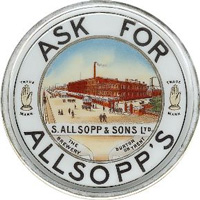
A short history of the Allsopp’s Brewery from MidlandsPubs.co.uk page on Staffordshire breweries:

allsopps-ask4

Based in the High Street of Burton-on-Trent, the history of this company can be traced back to the 1740’s. Samuel Allsop acquired the brewery in 1807. A new brewery and offices were constructed in 1859-60 close to the railway station. Throughout the 19th century Allsopp’s brewing business was second only to Bass in size. The new brewery site alone stretched between Station Street and Horninglow Street. They retained the original brewery in High Street, built a large maltings at Shobnall and numerous premises elsewhere. Samuel Allsopp was the first to export Burton Pale Ale to India in 1822. By 1890 their output had reached 460,000 barrels and they had a workforce of 1,750. However, the 20th century was not so favourable for the company and they went into receivership in 1913. Allsopp’s was eventually merged with the neighbouring Ind Coope & Co.Ltd. to form Ind Coope & Allsopp Ltd. The offices of the new brewery were later used as the headquarters of Punch Taverns and the Spirit Group.

There’s another interesting lecture transcribed that goes into great detail about what led to the Allsopp’s Brewery’s demise, entitled “The Fall of the House of Allsopp” by an R.G. Anderson.

What a fascinating little tale. I just hope they don’t open the bottle.

UPDATE: An alert Bulletin reader (thanks Scott) found a similar looking bottle that sold on eBay in June for a mere $305 and wondered if there was something “hokey going on.” A closer look at the two listings reveals that the person who bought the bottle for $305 is the same one who turned around and sold it for a half million. Now that’s a good return on investment.

Filed Under: Beers, Just For Fun Tagged With: Europe, Great Britain, History, Strange But True

Craft Beer Growth Continues Double-Digit Growth in First Half of 2007

August 15, 2007 By Jay Brooks

The Brewers Association just released the sales numbers for craft beer covering the first half of 2007. It’s all good news and craft beer is again showing double-digit growth at approximately 11%, which is the same percentage growth rate it sustained in 2006.

From the press release:

The Brewers Association, the trade association that tabulates industry data for craft brewers, reports craft beer sales and growth continue to break records. The volume of craft beer sold in the first half of 2007 rose 11% compared to this same period in 2006 and dollar growth increased 14%. For the first time ever craft beer has exceeded more than a 5% dollar share of total beer sales.

Overall, the U.S. beer industry sold one million more barrels in the first half of 2007 compared to 2006, with 400,000 of these new barrels produced by craft breweries. This equates to 3.768 million barrels of craft beer sold in the first two quarters of 2007 compared to 3.368 million barrels sold in the first half of 2006.

Scan data from Information Resources, Inc. provide additional data points that confirm strength for the segment. Craft beer sales in the supermarket channel through July 15th, 2007 showed a 17.4% increase in dollar sales compared to the same period in 2006. This growth in sales was higher than any other alcohol beverage category.

“The 1,400 small, independent and traditional craft brewers in the U.S. have hit their stride,” said Paul Gatza, Director of the Brewers Association.“United States craft brewers are making many of the world’s best beers, and the marketplace is responding.”

Coupled with the growth statistics has been a tidal wave of media coverage in the first half of 2007 including NBC’s Today Show on July 3 stating, “Beer is the new wine and can go with just about any food.” Additionally, Gallup, in its latest poll on alcohol beverages, announced for the second straight year that “Beer Again Edges Out Wine as Americans’ Drink of Choice.”

Julia Herz, Director of Craft Beer Marketing for the Brewers Association concluded, “Craft beer market share is steadily and consistently growing. A grassroots movement is responsible for this success as appreciators continue to trade up.”

The definition of craft beer as stated by the Brewers Association: An American craft brewer is small, independent and traditional. Small = annual production of beer less than 2 million barrels. Beer production is attributed to a brewer according to the rules of alternating proprietorships. Flavored malt beverages are not considered beer for purposes of this definition. Independent = Less than 25% of the craft brewery is owned or controlled (or equivalent economic interest) by an alcoholic beverage industry member who is not themselves a craft brewer. Traditional = A brewer who has either an all malt flagship (the beer which represents the greatest volume among that brewers brands) or has at least 50% of its volume in either all malt beers or in beers which use adjuncts to enhance rather than lighten flavor.

In addition, the Brewers Association released the following charts:


Filed Under: News Tagged With: Business, National, Press Release

Collaborating With the Collaborators

August 15, 2007 By Jay Brooks

Without diminishing all of the great beer dinners I’ve attended this year, I think I’m anticipating this one more keenly than any dinner all year. I’ll have returned home the following day from “Hop School” and will be fairly itching for hoppy beers. How could I do better than this? Beer Chef Bruce Paton’s next beer dinner will feature both Adam Avery, from Avery Brewing in Boulder, Colorado, and Vinnie Cilurzo, from Russian River Brewing in Santa Rosa, California.

It will be a four-course dinner and well worth the $85 price of admission. It will be held at the Cathedral Hill Hotel on Friday, August 31, 2007, beginning with a reception at 6:30 p.m. Call 415.674.3406 for reservations by August 23, though sooner will increase your odds of getting a seat at the table.


The Menu:


Reception: 6:30 PM

Beer Chef’s Hors D’Oeuvre

Beer: Avery IPA and Blind Pig IPA

Dinner: 7:30 PM

First Course

Torchon of Foie Gras with Egg Nog Brioche Toast and Vanilla Poached Stone Fruit

Beer: Avery Salvation and Russian River Salvation

Second Course:

Pan Roasted Skate Filet with Ginger Butter and Spicy Cilantro Pesto

Beer: Avery The Majarajah and Russian River Pliny the Elder

Third Course:

Olive Oil Poached Breast of Duck with Confit “Shepherds Pie”, Corn Fig Relish and Orange Gastrique

Beer: Avery The Reverend and Russian River Damnation Batch 23

Fourth Course:

Chocolate Collaboration

Beer: Avery Fourteen and Russian River Toronado Anniversary Ale / Collaboration Toast


8.31

Dinner with the Brewmasters: Avery & Russian River

Cathedral Hill Hotel, 1101 Van Ness Avenue, San Francisco, California
415.674.3406 [ website ]


Filed Under: Food & Beer Tagged With: Announcements, California, San Francisco

MSNBC On the Drinking Age

August 14, 2007 By Jay Brooks

MSNBC had a very interesting article about the recent surge in support for lowering the drinking age to from twenty-one to eighteen again. Apart from nations that don’t permit alcohol at all — usually for religious reasons — we have the highest age for allowing drinking of any country in the world. For the vast majority of nations, it’s eighteen. To me it’s as simple as if you can vote and die as a soldier defending our country, you should at least be able to drink a beer. I’ve never heard a convincing rebuttal to that. In my opinion, it should be a part of how we define adulthood.
 

Filed Under: Uncategorized Tagged With: Law, Mainstream Coverage, National, Prohibitionists, Statistics

California Redefines Distilled Spirits

August 14, 2007 By Jay Brooks

California’s Board of Equalization took the surprising move today (by a one vote margin) of redefining distilled spirits using some very odd language. The new definition, which takes effect in July 2008, was re-written in an effort by neo-prohibitionist groups to tax FMB’s (flavored malt beverages, a.k.a. alcopops or malternatives) at a higher rate under the pretense of keeping them out of the hands of children. The idea that by making them more expensive they’ll be less attractive to younger and underage drinkers is, of course, prima facie ridiculous. I can understand the state’s angle because it will produce more revenue for them, but that it will help cure underage drinking is pure fantasy. California State Controller John Chiang went so far as to say “taxing flavored malt beverages as liquor will also help reduce their popularity with young people by simply pricing the product out of their reach.” Tell that to the sixteen-year old punks driving around Marin County in new BMW’s that they won’t be able to afford Smirnoff Ice anymore. What utter hogwash.

Even if I accept such tortured logic, why should everybody — older adults included — be punished with higher prices and why should those companies arbitrarily now have to pay significantly higher taxes? I think McDonald’s happy meals are destructive to the health of our nation’s youth. Should we charge McDonald’s a health tax on every happy meal so they’re so expensive no one will buy them anymore, for the good of our children? I think Coke is rotting the teeth and insides of millions of kids. Should a bottle of Coca-cola cost $5.00 to compensate for the health risks and keep children from buying them? Would it then be fair that the rest of us have to spend $5, too, to buy a coke and a smile? Why should every product we don’t want kids to have be more expensive for the rest of us just so they may not be able to afford it? It just doesn’t make sense. But that’s effectively the logic at work here. Is that really how we want to orient our society?

Here is the new language:

Regulation 2558. Distilled Spirits. Define distilled spirits to include any alcoholic beverage, except wine, which contains 0.5 percent or more alcohol by volume from flavors or ingredients containing alcohol obtained from the distillation of fermented agricultural products. (emphasis added.)

What’s troubling about this decision is that this new definition could — which means probably will — be interpreted to include some beer aged in oak barrels as well as certain other craft beers as distilled spirits. If subject to the much higher spirits tax, it will make them either prohibitively expensive or, more likely, effectively force brewers to stop making them altogether. And that would effectively quash some of the most innovative beers being produced today.

According to people who attended the hearing, it appears likely that this issue may be challenged in the courts and/or be dealt with through the legislature. Neo-prohibitionist groups, of course, are already claiming victory and sending out celebratory press releases, such as the one I received from the Marin Institute, who referred to the votes as “historic” and applauded the “strong leadership” of California’s state controller John Chiang. Apparently they regard a strong leader as someone who does their bidding.

Here’s some more back-patting from the press release:

“This is an enlightened step forward in controlling underage consumption of alcohol,” said Bruce Lee Livingston, MPP, Executive Director of Marin Institute. “For generations, Big Alcohol has evaded proper taxation on these products. Now, the state will benefit and the health and well-being of our youth will be improved.”

I find it curious that they even use the word “enlightened,” since that brings to mind the Enlightenment, a time that couldn’t be more removed from the sort of tactics neo-prohibitionists are using now. To enlighten, means to “to give intellectual or spiritual light to” something, or in older parlance to simply “shed light upon.” Trying to remove alcohol from society in order to impose ones own morals on everyone else is the very opposite of enlightened.

Then there’s his “[f]or generations, Big Alcohol has evaded proper taxation on these products.” (my emphasis.) A generation is generally considered to be about thirty years. FMBs first appeared a little over ten years ago, fifteen at most. And they really didn’t become all that popular until the introduction of Smirnoff Ice, which was in 2001. That was only six years ago, not quite the at least sixty years that Chiang’s “generations” implies.

“Public policy trumped corporate-influenced politics today,” said Michele Simon, Director of Research and Policy at Marin Institute. That’s one way of looking at it, I suppose. Another is ‘fear mongering moral crusaders hijacked democracy in an effort to advance their own narrow agenda by pretending to care about the welfare of children and trumped common sense and reason today.’ It’s all how you choose to spin it.

Now personally I’m no fan of FMBs, either, and I also think they subvert young people from discovering the joys of craft beer, but I don’t believe making them more expensive is in any way useful. If the true goal of the neo-prohibitionists really is to keep them out of the hands of children (as they claim), a more effective strategy might be to keep kids from drinking sweet soda and developing a fondness for sweeter drinks in the first place. Then alcopops would not have the same appeal for them as they get older. Plus it would have the added benefit of keeping kids healthier by reducing their intake of sugar, high fructose syrup and other harmful chemicals in today’s soda-pop. But I don’t think this brouhaha really is about the children, but rather is anti-alcohol merely using children as a justification that’s easier to sell than another prohibition.

And that’s why I’m particularly troubled by the vague language of the new definition. Because I believe this is just another first step in a larger and more sinister effort not just to control children’s access to FMBs, but to restrict access to all alcohol. Today it’s FMBs, tomorrow … who knows what. So the enemy of my enemy is my friend in this case. If it was just about the taxes I wouldn’t like it, but at least I’d understand it. The way the neo-prohibitionist groups have been pushing against FMBs makes it obvious that it’s about more than just money. That they’ve persuaded the state of California to take this step and play into their hands is quite disturbing, to say the least.


Filed Under: Editorial, News Tagged With: Business, California, Ingredients, Law, Prohibitionists

Toronado 20th Anniversary Celebration Concludes

August 13, 2007 By Jay Brooks

After the 21st Amendment beer dinner, I hightailed it back to the Toronado where the party had kicked into high gear.

It was this kind of night, with all manner of wonderful beers, many of them — at least 22 — had been made especially for the Toronado and that evening.

Many special bottles were opened and flowing that night. What a wonderful four days filled with friends, food and the fermented.


For many more photos from the second half of the Toronado 20th Anniversary Celebration, visit the photo gallery.
 

Filed Under: Events Tagged With: California, Other Events, Photo Gallery, San Francisco

« Previous Page
Next Page »

Find Something

Northern California Breweries

Please consider purchasing my latest book, California Breweries North, available from Amazon, or ask for it at your local bookstore.

Recent Comments

  • Bob Paolino on Beer Birthday: Grant Johnston
  • Gambrinus on Historic Beer Birthday: A.J. Houghton
  • Ernie Dewing on Historic Beer Birthday: Charles William Bergner 
  • Steve 'Pudgy' De Rose on Historic Beer Birthday: Jacob Schmidt
  • Jay Brooks on Beer Birthday: Bill Owens

Recent Posts

  • Beer Birthday: Van Havig June 8, 2026
  • Beer In Ads #5262: Absolutely Pure Daufer’s Celebrated Bock Beer June 7, 2026
  • Beer & Whiskey Birthday: John Hansell June 7, 2026
  • Historic Beer Birthday: Charles Voegtle June 7, 2026
  • Beer In Ads #5261: Bockbier Aus Der Actienbrauerei Basel June 6, 2026

BBB Archives

Feedback

Head Quarter
This site is hosted and maintained by H25Q.dev. Any questions or comments for the webmaster can be directed here.