Brookston Beer Bulletin

Jay R. Brooks on Beer

  • Home
  • About
  • Editorial
  • Birthdays
  • Art & Beer

Socialize

  • Dribbble
  • Email
  • Facebook
  • Flickr
  • GitHub
  • Instagram
  • LinkedIn
  • Pinterest
  • RSS
  • Twitter
  • YouTube

Powered by Genesis

Beer Birthday: Jim Crooks

March 24, 2026 By Jay Brooks

Today is the 53nd birthday of Jim Crooks, who was the Master Blender at Firestone Walker Barrelworks in Buellton for a number of years. But before that, Jim was the QC manager, and was one of the original brewers there when it was still SLO Brewing when Adam Firestone and David Walker bought the brewery. When I wrote an Innovator’s Series piece for Beer Connoisseur magazine on Matt Brynildson, naturally, Jim came up when re-telling the story of the transition:

But Matt and another SLO brewer, Jim Crooks, weren’t ready to give up quite so easily. What happened next is local legend. The bank didn’t lock the doors or turn off the power. Maybe it was an oversight, maybe not. So Brynildson and Crooks came in and kept making beer while the brewery was still in receivership, and continued filling orders. The idea, they thought, was to just hang on. They both loved the area and the brewery that they’d poured so much of themselves into. The pair hoped that if they kept it alive, that someone would come to the rescue, buy the brewery and give them both jobs. The gamble paid off and their harebrained idea actually worked. Both Matt and Jim Crooks continue to work there to this day, with Jim leading the Barrelworks production in Buellton.

I’ve run to Jim several times over the years, and since heading up Barrelworks in 2013, he’s been knocking it out of the park. Jim left Firestone Walker in 2022, and launched his own venture, Jungle Beverage Company. Join me in wishing Jim a very happy birthday.

Jim, Chuck Silva and me at the Firestone Walker Invitational in 2016.

At the 2008 GABF, Eric and Lauren Salazar, both from New Belgium Brewing, sandwiched by Jim, and Chris Swersey, Competition Manager for GABF judging.
Matt-and-Jim
Matt and Jim at the Firestone Walker Invitational [photo by Sean Paxton].
crooks-2016-fwibf
A happy Jim, at the Firestone Walker Invitational a few years ago [photo purloined from Facebook].

Filed Under: Birthdays, Breweries Tagged With: California

Historic Beer Birthday: John Christoph Wunder

March 24, 2026 By Jay Brooks

Today is the birthday of John Christoph Wunder (March 24, 1855-February 11, 1929). He was born in Streitberg, Germany, and emigrated to the U.S. in 1872, when he was 17, settling in Minneapolis Minnesota. Ten years later he became naturalized as a citizen. He worked as a liquor agent, and eventually opened his own saloon in 1887.

Here, Tavern Trove picks up the story:

In 1884 he was an agent for a liquor dealer in that city. By 1887 Wunder had his own saloon. In 1895 Wunder, along with Charles H. Sievers of Minneapolis, John G. Hinkle of St. Paul, William Bryler of St. Louis, and C. F. Kessler of San Diego together capitalized the San Diego Brewery of California. He left that partnership in 1898 to purchase the Bavarian Brewery in San Francisco, whereupon he renamed it the Wunder Brewery. He phased out its flagship Bavaria Lager Beer in favor of his own Wunder Beer. He continued to run the brewery until it was merged into the Union Brewery syndicate. The brewery closed in 1909 and Wunder retired in Germany.
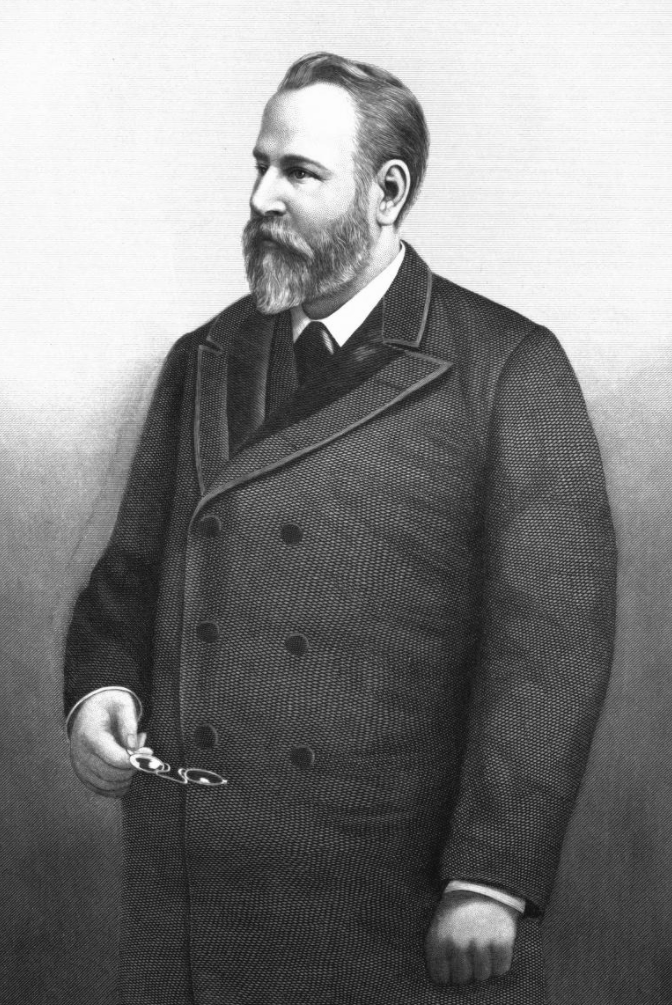
Wunder brewery employees in 1894.

The Bavarian Brewery had been founded by Philip Frauenholz in 1852 at Vallejo & Green Streets in San Francisco, but later moved to Greenwich & Scott Streets. After buying the brewery in 1898, Wunder renamed it the Wunder Brewing Co. and it remained that until he closed in 1909. Somebody reopened it, sort of, under the name Wunder Beverages in 1930 at 830 Isabella Street and ran that until 1955.

Two years after retiring to Germany, Wunder passed away in December of 1928 when he was 73 years old. This short obituary is from the Oakland Tribune on December 20, 1928:

San Francisco, c. 1898.

Filed Under: Birthdays, Breweries, Just For Fun Tagged With: California, Germany, History, San Francisco

Historic Beer Birthday: John Mannheim

March 24, 2026 By Jay Brooks

Today is the birthday of John Mannheim (March 24, 1822-1880). He was born in Kärlich, Germany, and emigrated to the U.S. atv least as early as 1849, since he married German-born Veronica Berg that year in Iowa. He first settled in Dubuque, Iowa, where he ran a hotel, then moved to Chatfield, Minnesota, where he had a variety store. At some point he began brewing because in the 1869 Minnesota census he was listed as a brewer, but ten years later, having moved to Glendale, Montana, the census listed him as a baker. In 1874, he founded the John Mannheim Brewery, which was also known as the Glendale Brewery.

The brewery c. 1885.

In 1877, he brought on a partner, Frank Gilig, who took over the brewery when Mannheim died in 1880, but it burned down in 1887.

One of the few ads I could find, from after Gilg took over the brewery.
Another 1885 view of the brewery, this time in the background, on the left.

Filed Under: Birthdays, Breweries, Just For Fun Tagged With: Germany, History, Montana

Historic Beer Birthday: Michael Brand

March 23, 2026 By Jay Brooks

michael-brand
Today is the birthday of Michael Brand (March 23, 1826-October 26, 1897). Born in Gau-Odernheim, Rhineland-Palatinate, Germany, he was trained as a brewer and came to America and became a partner with Valentine Busch in 1852 and Busch and Brand Brewery continued until Busch passed away in 1872, when in became the Michael Brand Brewery in Chicago, Illinois, though many sources say that it was 1878 when the name change took place. In 1889, in became the United States Brewing Co., which it remained until in closed in 1955.

michael-brand-chicago

Here’s a short biography from the “History of Chicago.”

michael-brand-history-of-chicago

busch-and-brand

Here’s another short history of his brewery for “One Hundred Years of Brewing.”

brand-breweries-100yrs

Gold-Crown-Pilsener-Beer-Labels-United-States-Brewing-Co

michael-brand-portrait

Filed Under: Birthdays, Just For Fun Tagged With: Chicago, Germany, History, Illinois

Historic Beer Birthday: Maximilian Schaefer

March 23, 2026 By Jay Brooks

Today is the anniversary of the death of Maximilian Schaefer, whose exact birth date is not known (1819-March 23, 1904). He was born in Wetzlar, which is part of Hesse, in what today is Germany. He arrived in New York in 1839, a year after his brother Frederick came to America, and the two co-founded F&M Schaefer Brewing Co. in 1842. It was Max who brought with him a recipe for what would become their lager beer.

This is his obituary from Find a Grave:

Beer Magnate. In 1839 he emigrated to the United States, carrying with him the recipe for lager, a popular brew in Germany that was then unknown in America. He joined his brother Frederick in the employ of a local brewer, and in 1842 the Schaefer brothers bought out the owner, establishing F & M Schaefer Brewing. Lager proved popular and the Schaefer company became one of the country’s largest beer producers, with Maximilian Schaefer remaining active in the company until failing health caused him to retire in the late 1890s. By the early 1900s, its customer base in the Northeastern United States made Schaefer the most popular beer in the country, a position it maintained until ceding it to Budweiser in the 1970s. The Schaefer brand continued to decline, and as of 1999 is owned by Pabst Brewing, a holding company that contracts for the brewing of formerly popular regional brands.
This is what the brewery looked like in 1842, when Maximilian and his brother opened the brewery.

schaefer-brewery-1842

Below is part of a chapter on the history of F&M Schaefer Brewing Co., from Will Anderson’s hard-to-find Breweries in Brooklyn.

Longest operating brewery in New York City, last operating brewery in New York City [as of 1976], and America’s oldest lager beer brewing company — these honors, plus many others, all belong to The F. & M. Schaefer Brewing Co.

“F. & M.”, as most breweriana buffs know, stands for Frederick and Maximilian, the brothers who founded Schaefer. Frederick Schaefer, a native of Wetzlar, Prussia, Germany, emigrated to the U.S. in 1838. When he arrived in New York City on October 23rd he was 21 years old and had exactly $1.00 to his name. There is some doubt as to whether or not he had been a practicing brewer in Germany, but there is no doubt that he was soon a practicing brewer in his adopted city. Within two weeks of his landing, Frederick took a job with Sebastian Sommers, who operated a small brewhouse on Broadway, between 18th and 19th Streets. Frederick obviously enjoyed both his job and life in America, and the next year his younger brother, Maximilian, decided to make the arduous trip across the Atlantic also. He arrived in June of 1839 and brought with him a formula for lager, a type of beer popular in Germany but unheard of in the United States. The brothers dreamed, and planned, and saved – and in the late summer of 1842 they were able to buy the small brewery from Sommers. The official, and historic, starting date was September, 1842.
schaefer-brewery-1849
The new brewery they built in 1849.

Sommers’ former facility was a start, but that’s all it was, as it was much too small. New York beer drinkers immediately took a liking to “the different beer” the brothers brewed, and in 1845 Frederick and Maximilian developed a new plant several blocks away, on 7th Avenue, between 16th and 17th Streets (7th Avenue and 17th Street is today, of course, well known as the home of Barney’s, the giant men’s clothing store). This, too, proved to be just a temporary move; the plant was almost immediately inadequate to meet demands and the brothers wisely decided to build yet another new plant, and to locate it in an area where they could expand as needed. Their search took them to what were then the “wilds” of uptown Manhattan. In 1849 the brewery, lock, stock and many barrels, was moved to Fourth Ave. (now Park Avenue) and 51st Street. Here, just north of Grand Central Station, the Schaefers brewed for the next 67 years, ever-expanding their plant. The only problem was that the brothers were not the only ones to locate “uptown.” The area in the 40’s, 50’s and 60’s grew rapidly all during the last half of the 19th century, and especially after the opening of the original Grand Central Terminal in 1871. Frederick and Maximilian had wisely purchased numerous lots between 50th and 52nd Streets, and by the time they passed away (Frederick in 1897 and Maximilian in 1904) the brewery was, literally, sitting atop a small fortune. Maximilian’s son, Rudolph J. Schaefer, fully realized this when he assumed the Presidency of the brewery in 1912. In that same year Rudolph purchased the 50% of the company owned by his uncle Frederick’s heirs. He thus had complete control of the brewery, and one of the first matters he turned to was the suitable location for a new, and presumably everlasting, plant. In 1914, in anticipation of its move, Schaefer sold part of the Park Ave. site to St. Bartholomew’s Church. This sale, for a reputed $1,500,000, forced Rudolph to intensify his search for a new location. Finally, in June of 1915, it was announced that the brewery had decided on a large tract in Brooklyn, directly on the East River and bounded by Kent Avenue and South 9th and 10th Streets. Here, starting in 1915, Rudolph constructed the very best in pre-Prohibition breweries. The move across the river to their ultra-new and modern plant was made in 1916, just four years before the Volstead Act crimped the sails (and sales!) of all United States breweries, new or old alike.

schaefer-brewery-1842-1892

The Schaefers around 1895, with Maximilian Schaefer sitting down, his son Rudolph Schaefer standing behind him, Maximilian holding F.M. Emile Schaefer, his grandson and Rudolph’s son on his lap.

Schaefer-family
Three generations of Schaefers.

Filed Under: Birthdays, Just For Fun Tagged With: History, New York, Schaefer

Historic Beer Birthday: Joseph A. Straub

March 22, 2026 By Jay Brooks

Today is the birthday of Joseph A. Straub (March 22, 1880-1948). He was the son of Peter Straub, who founded the Straub Brewery in St. Mary’s, Pennsylvania in 1872. After his father passed away, Joseph became brewmaster and general manager. The brewery is still owned and operated today by the Straub family.

Joseph Straub.

Following Peter’s death on December 17, 1913, his sons assumed control of the brewery, renaming it the Peter Straub Sons Brewery. During this time, the brewery produced Straub Beer as well as other beer, such as the pilsner-style Straub Fine Beer and Straub Bock Beer. In 1920, the Straub Brothers Brewery purchased one half of the St. Marys Beverage Company, also called the St. Marys Brewery, where St. Marys Beer was produced. During Prohibition, which lasted from January 29, 1920, until December 5, 1933, the brewery produced nonalcoholic near-beer. On July 19, 1940 they purchased the remaining common stock and outstanding bonds of the St. Marys Beverage Company.

straub-family-1904
The Straub Family in 1904. Joseph is the second from the left in the back row.
straub-brewery-1895-closeup
The Benzinger Spring Brewery in 1895. Joseph is standing to the right of the large cask.

Filed Under: Birthdays, Breweries, Just For Fun Tagged With: Pennsylvania

Beer Birthday: Steve Wellington

March 22, 2026 By Jay Brooks

Today is the 82nd birthday of Steve Wellington. He “started working for Bass in 1965, a year after the Worthington’s brewery was demolished, and brewed both Bass and Worthington’s beers. He left Bass to run his own business, teaching people how to brew at home, then returned in 1994 to run the White Shield microbrewery as part of the Brewing Museum in Burton. He brewed some of the beers Burton had lost: Worthington’s E, Imperial Stout, Barley Wine, and the legendary Worthington’s White Shield.” In 2007, he was named “Brewer of the Year’ by the All-Party Parliamentary Beer Group in 2007 and Guild of British Beer Writers’ Brewer of the Year in 2004. I met him shortly after that, when I visited Marston’s in Burton-on-Trent, accompanying Matt Brynildson on a trip to do a collaboration beer. He was very generous with his time and showed us around his brewery. He then retired several times, as many as five (according to Roger Protz), the last time in 2018. When he retired previously, in 2011, Pete Brown referred to him as the “Jedi Master Brewer of Worthington White Shield,” and that sums him up nicely. I’ve run into Steve at least one another time, and he’s a great person. Join me in wishing Steve a very happy birthday.

Steve in the Worthington brewery when I met him.
Steve when he retired in 2011.
Wellington with a stash of ancient beer that was found in a vault under the streets of Burton upon Trent in 2007.

Filed Under: Birthdays, Just For Fun Tagged With: England, Great Britain, UK

Historic Beer Birthday: Sampson Salter

March 21, 2026 By Jay Brooks

Today is the birthday of Sampson Salter (March 21, 1692-April 6, 1778) who in the early 18th century operated one of the most popular breweries in Boston. Considering it was apparently so popular, there’s very little specific information about either Salter or his brewery. Most histories seem to only mention him in passing. For example, “Historic Taverns of Boston” by Gavin Nathan, says only this:

sampson-salter-tavern-book

Boston-1722
Boston in 1722.

Filed Under: Birthdays, Just For Fun Tagged With: History, Massachusetts, Pubs

Historic Beer Birthday: Anton Dreher Jr.

March 21, 2026 By Jay Brooks

schwechater
Today is the birthday of Anton Dreher Jr. (March 21, 1849-August 7, 1888). He was the son of Anton Dreher, “an Austrian brewer of the Dreher family.” He exported their pale lager, invented by his father all over the world.

anton-dreher-ii

This is his biography, translated from his German Wikipedia page:

After the death of his father in 1863, the Viennese lawyer and later mayor of Vienna, Cajetan, was the guardian of the district of the young Anton Dreher, and also directed the building enterprises to his majority.

Dreher took over the brewery in 1870 and extended it considerably. He also began exporting the lager to overseas. This also bore him the title “Viennese Braukaiser”.

In the mild winter of 1872/1873, Anton Dreher had a cooling problem: he had to bring the ice necessary for cooling from the Styria and from Galicia to the railroad, which caused high costs. That is why he encouraged Carl von Linde to build his refrigeration machine. In 1877, the first prototype of a refrigeration machine was put into operation at the Dreher Brewery in Trieste . Anton Dreher was thus the first beer brewer to introduce the artificial cellar cooling system.

In 1897 Anton Dreher had increased beer production to 740,000 hectoliters, doubling the sales volume of his father. The further increase in production in the subsequent years led to Dreher’sche Brewery becoming one of the largest breweries in the world. In 1905, the brewery was converted into Anton Roter’s brewery.

Anton Dreher was from 1884 Member of the Lower Austrian provincial parliament and from 1902, by Emperor Franz Joseph I appointed, a member of the mansion of the Imperial Council and President of the Central Union of Industrialists of Austria ( CVIÖ ).

After 1900, the brewery Mautner ( St. Marx ) and the brewery of his father-in-law, Meichl ( Simmering ), were able to win the competition for the Schwechat brewery . In 1913, the brewery Schwechat merged with the St. Marx brewery and also with the brewery Simmering to the United breweries Schwechat, St. Marx, Simmering – Dreher, Mautner, Meichl AG . During the First World War the brewery was drastically restricted, but not shut down.

Anton_Dreher_junior_1888_Eigner

And this is another translation, this one from the Austrian Biographical Dictionary:

Son of Anton Dreher the Elder.

After the early death of his father, a directorate under the superintendent of the later mayor of Vienna, Cajetan Felder, took over the management of the company and enlarged it by acquiring three other breweries.
After attending the Akademisches Gymnasium in Vienna, Dreher visited the Technical College and, from the day of his grandiaturity (March 21, 1870), to his father’s company. On 12 August 1870 he married in Simmering Katharina Meichl (14. 11. 1850 – 17. 2. 1937), the daughter of the owner of the brewery Simmering, Theodor Meichl.

Dreher extended the paternal enterprise and in 1892 he already employed 1000 workers. He owned 60 of his own railway wagons and also exported overseas. In the year 1891/92 the productions in Schwechat amounted to 550,000, in Steinbruch (Hungary) 400,000, in Micholoup (Bohemia) 40,000, and in Trieste 56,000 hectoliters of beer. His brewery had become the world’s largest.

After his three sons entered the company, he was converted into “Anton Drehers Brauerei AG”, a family-owned company. In 1913 the merger with the brewery Mautner Markhof was carried out to the “United breweries Schwechat, St. Marx, Simmering – Dreher Mautner, Meichl AG”.

Since 1884 Landtagsabgeordneter was Dreher 1902-18 also member of the Herrenhauses.

Dreher’s grandfather, Franz Anton Greher, bought the Brau-Klein-Schwechat brewery in 1796, and today it’s known as Brauerei Schwechat. According to the brewery website, “the brewery Schwechat became the largest of the European mainland and the “Klein Schwechaterlager” consignments went far beyond Austria’s borders. Among other things, Dreher purchased the Michelob brewery near Saaz in 1859, the Steinbruch brewery in Budapest in 1862, and the Trieste brewery in 1869.”

schwechat-brewery

Here the official story of the brewery picks up when Anton Dreher Jr. take over:

After 1863 Anton Dreher sen. Dies, takes over 1870 Anton Dreher jun. (Born 1849), after the completion of the academic high school in Vienna, the management of the Brauereikon Group.

In the “ice-free winter” of 1872, ice needed for cooling, about 100 million kilograms, had to be taken from Poland by rail. These experiences prompted Anton Dreher to deal with artificial cooling and ice-making. Professor Carl von Linde was commissioned to design a cooling machine, which Dreher set up in Brauhaus Trieste in 1877 and then in Schwechat. Dreher was thus the first brewer to introduce the artificial cellar cooling system. This breakthrough invention is still essential today.

On June 4, 1883, Emperor Franz Josef visited the brewery for the second time and gave Anton Dreher jun. The Knights Cross of the Order of Franz Joseph. In 1897 Dreher received the Commander’s Cross, later the Grand Cross of this Order, and in 1902 the Order of the Iron Crown II Class.

1897 produced the brewery Schwechat under Anton Dreher jun. The huge volume of 739,639 hectoliters of beer, which was more than double since the takeover of the brewery by his father. In the following years, the “rotary” breweries with a total production of approximately 1.25 million hectoliters developed into the world’s largest brewery, managed by an owner. In 1905 the brewery was renamed “Anton Drehers Breweries Aktiengesellschaft”.

Antondreherderjüngere

And this is the portion of the brewery’s Wikipedia page that discusses Anton Drehrer Jr.:

In 1837, his son, Anton Dreher, took over the company from his mother and inaugurated a new era in the brewery’s history. In 1839 he turned to Untergärung , which marked the beginning of the lager beer. The breakthrough was made by Dreher in 1841, when he realized that for his under-fermented beer, the “lager” or “Viennese type”, one thing was decisive: cooling. Dreher laid huge cellars and stored ice.

As a result, the brewery’s brewery expanded through the acquisition of existing breweries to the entire Austro-Hungarian monarchy . These included the brewery Michelob near Saaz, acquired in 1859, the brewery quarry (founded 1854) in Budapest, acquired in 1862, as well as the brewery of Trieste, acquired in 1869.

In 1848, Dreher introduced a steam machine to the Bierbrauen, he was supposed to be the first brewer in Austria. The steam engine is now exhibited at the Technical Museum in Vienna. The first cooling machine, which was also the second machine from Linde AG , was installed in the brewery in Trieste in 1877. After the death of Anton Dreher in 1863, his son Anton Dreher junior took over the company of the brewery Schwechat in 1870 and converted it in 1905 into the Anton Drehers brewery stock company . In the face of the beginning of the 20th century mutually growing competition with the brewery St. Marx of Adolf Ignaz Mautner of Markhof and the brewery Simmering of his father – in – law Meichl, the fusion of the three breweries to the United Breweries Schwechat, St. Marx, Simmering – Dreher, Mautner, Meichl AG took place in 1913 . Due to the high quality of the products, the company was awarded the title of a kuk chamber supplier.

Anton_Dreher_junior_(1900)
Dreher around 1900.

Klein-Schwechat

Klein-Schwechat-back

schwe-zwickel

Schwechater_Lager

Filed Under: Birthdays, Just For Fun Tagged With: Austria, History

Historic Beer Birthday: William Worthington

March 21, 2026 By Jay Brooks

Today is the birthday of William H. Worthington (March 21, 1723-1800). Actually, it’s the date of his baptism, but that’s as close as we know, and, strangely, no one seems to have recorded the day he passed away and all we know is it was sometime in 1800. In 1761, he founded the Worthington Brewery in Burton-on-Trent, with the help of his wife Ann Tarratt, when “he purchased a brewery in the High Street for 320 pounds from Richard Cummings of Repton.”

The Worthington brand was purchased from Bass by the American brewing company Coors in 2002, which following a merger became Molson Coors in 2005. Worthington’s White Shield IPA has continued to be brewed since 1829. In 2010, Molson Coors opened the William Worthington microbrewery, which brews historical and seasonal beers.

The Worthington Brewery c. 1899.

Here’s the early history of the brewery, from Wikipedia:

William Worthington (1723–1800) was born at Orton on the Hill in Leicestershire, the fourth child of William Worthington (1687–1742), yeoman farmer, and his wife, Elizabeth. In 1744, he moved to Burton upon Trent in Staffordshire where he worked as a cooper at Joseph Smith’s brewery. In 1760, Worthington purchased the brewery from Smith’s successor, Richard Commings, for £320 (equivalent to £50,000 as of 2019).

By the 1780s, the brewery probably had an annual output of around 1,500 barrels, similar to the rival breweries of Benjamin Wilson and Michael Bass. Throughout the eighteenth century, Worthington sales were mostly of porter, directed towards the Baltic market, which was transported via narrowboat through the River Trent to the Port of Hull. Largely as a result of this trade, by the time of Worthington’s death in 1800, Worthington & Co. ranked among the largest of the provincial breweries.

And this account of the brewery is from the Oxford Companion to Beer, written by my friend Tim Hampson.

Worthington Brewery was established by William Worthington in the English town of Burton-on-Trent in 1744. It became one of a handful of companies to trade lucratively with the Baltic states along with the better-known Burton entrepreneurial brewers run by the Wilson, Sketchley, Bass, and Evans families. By the 1820s a worsening relationship with Napoleon Bonaparte soured much of this trade, and an alternative market had to be found.

Since at least the 1780s the East India Company had exported beers to the Indian sub-continent, following in the wake of the administrators and troops who left the United Kingdom to work in settlements there. Records show that some of the first shipments took place in 1697.

The trade was dominated by London brewer Abbot & Hodgsons, but the Burton brewers recognized a business opportunity when they saw one. When the London brewer faltered, the trade quickly became dominated by Burton brewers Bass and Allsop, and, to a lesser extent, Worthington. They first began to imitate the London brewers’ beer but discovered that a Burton IPA had the attribute of arriving in Calcutta pale, clear, and sparkling. See burton-on-trent and india pale ale. Sometime around the start of the 20th century the term “India pale ale” disappeared from White Shield’s label and became known by its heart shield and dagger label design, which was first registered as a trademark in 1863.

Worthington was never one of the big Burton brewers and was subsumed within the growing Bass empire in 1927. Somehow, nonetheless, the beer survived as a bottled beer. It was a curiosity as it still contained yeast in the bottle, long after the practice of bottle-conditioning had largely disappeared from British brewing. Drinkers’ conversations often focused on whether the beer should be poured clear or have the yeast tipped into the glass too. Many beer enthusiasts have commented upon the beer’s ability to age well, gaining character in the bottle over a year or two.

Blue plaque at the Unicorn Inn, Orton-on-the-Hill, August 2017. (Photo: Steve Peck)

Filed Under: Birthdays, Breweries, Just For Fun Tagged With: England, Great Britain, History, UK

« Previous Page
Next Page »

Find Something

Northern California Breweries

Please consider purchasing my latest book, California Breweries North, available from Amazon, or ask for it at your local bookstore.

Recent Comments

  • Bob Paolino on Beer Birthday: Grant Johnston
  • Gambrinus on Historic Beer Birthday: A.J. Houghton
  • Ernie Dewing on Historic Beer Birthday: Charles William Bergner 
  • Steve 'Pudgy' De Rose on Historic Beer Birthday: Jacob Schmidt
  • Jay Brooks on Beer Birthday: Bill Owens

Recent Posts

  • Beer In Ads #5331: Bock Beer, Hopfen Und Malz Gott Erhalts! August 27, 2026
  • Beer Birthday: Fred Bowman August 27, 2026
  • Beer In Ads #5330: Bock Beer Trade Card August 26, 2026
  • Beer Birthday: Pete Reid August 26, 2026
  • Historic Beer Birthday: Peter Littig August 26, 2026

BBB Archives

Feedback

Head Quarter
This site is hosted and maintained by H25Q.dev. Any questions or comments for the webmaster can be directed here.