Brookston Beer Bulletin

Jay R. Brooks on Beer

  • Home
  • About
  • Editorial
  • Birthdays
  • Art & Beer

Socialize

  • Dribbble
  • Email
  • Facebook
  • Flickr
  • GitHub
  • Instagram
  • LinkedIn
  • Pinterest
  • RSS
  • Twitter
  • YouTube

Powered by Genesis

Patent No. 4055202A: In-Case Bottle Filling Apparatus

October 25, 2015 By Jay Brooks

patent-logo
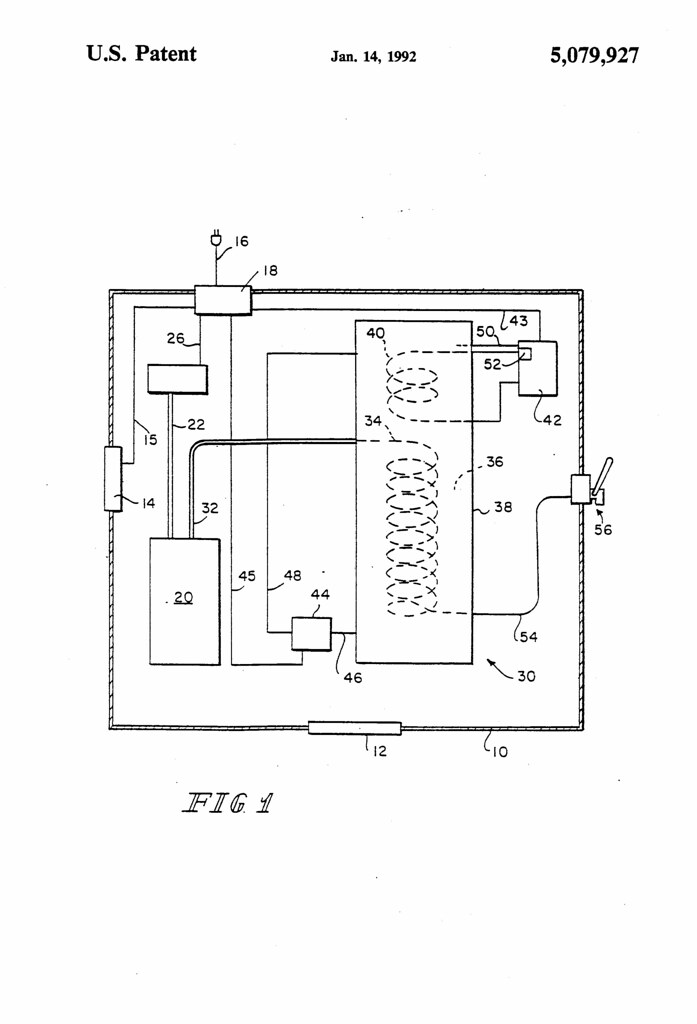
Today in 1977, US Patent 4055202 A was issued, an invention of James Albert Greene, for his “In-Case Bottle Filling Apparatus.” Here’s the Abstract:

A bottle filling device which raises in-case bottles to be filled to engagement with a fill valve assembly which controls fluid communication between a fill tube inserted into each bottle and a pressurized fill tank. Cup members, which engage the bottle openings in fill position, communicate with a vacuum line, such that the combination of pressurized fill source and air-evacuated bottles realizes extremely fast filling. The fill tubes are the shafts of respective double acting fluid pressure operated cylinders of simple construction which position a port in the fill tube upper wall extremes within the fill tank confines or within pressure sealing cylinder end bushings to define respective open and closed fill-valve conditions.

Untitled
Untitled
Untitled

Filed Under: Beers, Breweries, Just For Fun, Politics & Law, Related Pleasures Tagged With: Bottles, Brewing Equipment, History, Law, Patent, Science of Brewing

I Know What I Love

October 25, 2015 By Jay Brooks

camra-blk
Although I was blissfully ignorant of CAMRA in its earliest days — drinking American beer in Pennsylvania while in junior high and high school — my understanding is that it was not always as popular as it later became. And it certainly wasn’t universally beloved by many breweries, since they were moving toward keg beer which was much cheaper to produce and away from cask-conditioned beer, or real ale. It took a small dedicated group to convince brewers, and many ambivalent consumers, that real ale was worth preserving so British beer didn’t end up tasting like America of the 1970s. But there were critics of CAMRA almost from the get go, as recently detailed in a post by Boak & Bailey entitled A Brief History of CAMRA Bashing.

I didn’t follow all of Boak & Bailey’s thread on Twitter this morning, apart from finding part of a script from what they believed was a “c.1978 anti-‘real ale’ propaganda film starring Bernard Cribbins.” They were fishing to see if anybody might have more information about the movie.

real-ale-script

It turned out the film was from 1973, and a follower (thanks Cliff) found the actual film online, courtesy of the East Anglican Film Archive . The film is titled “I Know What I Love,” which is curiously very close to the title of a song from the Genesis album Selling England By the Pound, also released in 1973. That was “I Know What I Like,” but still, it was my first thought since I was a big fan of the band back then.

It’s a fairly goofy film, but also very interesting the way beer and brewing is presented. Bernard Cribbins, a reasonably well-known British character actor plays all of the major parts, explaining how beer is made. If you watch a lot of British TV or films, you’ve probably seen him. He’s made appearances in “The Avengers,” “Fawlty Towers,” “Doctor Who” and “Coronation Street,” and was in the films “The Railway Children,” “Don’t Raise the Bridge, Lower the River,” the 1967 Bond film “Casino Royale” and Alfred Hitchcock’s “Frenzy.”

cribbins-1973-6

Here’s the description from the film’s webpage at the EAFA:

Presented by The Brewers’ Society and featuring Bernard Cribbins in multiple roles, the documentary explains the process of brewing beer, from the pasture to the pint.

After ordering a pint at his local and taking a sip, the actor Bernard Cribbins sets out to explain the brewing process, with a little help from some of his ‘relatives’ in the industry, all played by Cribbins himself. One ‘cousin’ explains the malting process, where barley is germinated and malted, whilst another talks about hops, which contribute to the flavour of beer. His ‘uncle’, who works in a traditional brewery, explains the process, from the spurging of barley in mush tuns to the addition of hops, followed by yeast to aid fermentation, before the beer is conditioned and siphoned into casks.

Brewing on an industrial scale is also explained by Cribbins, with the help of one ‘relative’ who grows large amounts of barley, and a ‘distant relative’ who works as a technician at a large brewer. The film concludes with a glimpse at pub life, with a variety of environments catering for a range of tastes, but linked together by one thing: beer. With the process explained, Cribbins heads back to the bar for another pint, which is pulled by the governor, his ‘father’.

cribbins-1973-3

It was created by the Rank Short Films Group and sponsored by the Brewers’ Society. The director was James Allen from a script by Michael Barnes and the only actor credited is Bernard Cribbins. It doesn’t strike me as particularly anti-real ale, but maybe there’s some nuance I’m missing. They certainly try to allay fears that stainless steel, and modern brewing methods didn’t change the beer they produced. The humor seems a little forced, and not particularly witty, more mildly amusing than funny.

Unfortunately, the archive doesn’t allow their films to be embedded but you can go to their website and watch it online, which I highly recommend. It runs around seventeen minutes, and is certainly an interesting look at brewing at a particular time in recent history.

cribbins-1973-2

Filed Under: Beers, Breweries, Just For Fun, Politics & Law, Related Pleasures Tagged With: CAMRA, England, Great Britain, History, UK, Video

Patent No. 0873396B1: Brewing Products And Their Methods For Production (Clear Beer)

October 22, 2015 By Jay Brooks

patent-logo
Today in 2003, US Patent 0873396 B1 was issued, an invention of Vinod K. Chaudhary, Robert J. Mizerak, Sydney R. Rader, David S. Ryder, William G. Schulze, and Matthew L. Tripp, assigned to Miller Brewing Company, for their “Brewing Products And Their Methods For Production.” Here’s the Abstract:

A method is disclosed of preparing a colorless, clear beer by a method including ultrafiltration and the addition of dextrins, bittering agents and a foam enhancer. Methods of preparing improved nonalcoholic malt beverages and making natural beer foaming components also are disclosed.

Untitled
Untitled

Filed Under: Beers, Breweries, Just For Fun, Politics & Law, Related Pleasures Tagged With: History, Law, Patent, Science of Brewing

Back To The Future: When The Past Becomes The Present

October 21, 2015 By Jay Brooks

back-to-the-future
Visions of the future are rarely what was predicted or promised. I’ve been waiting decades for my Jetsons space car that fold up into a briefcase, my Rocketeer jet-pack (I’d even settle for the one James Bond used in Thunderball) not to mention that sweet holodeck from Star Trek: Next Generation..

bttf-timetravel

You’ve probably noticed that there’s been a considerable amount of hype over the fact that today — October 21, 2015 — is the date that Marty McFly heads to in the sequel Back to the Future 2, released in 1989. We’re all still waiting for those hoverboards and it’s looking increasingly like the Cubs won’t “sweep series in 5” (wouldn’t 4 wins be all you need for a series sweep?) if they can’t beat the Mets four games in a row to even make to the World Series, much less win it.

bttf-usa-today

Anyway, it seems like lots of people are celebrating the day as “Back to the Future Day,” which I think is great since I’m an unabashed lover of holidays and believe there can’t be too many reasons to celebrate life. A couple of worthwhile stories about Back to the Future Day include one from Popular Science and another from Chicago History Cop speculating why the film’s producers and writers chose October 21.

You may also recall that the film’s time machine, a modified DeLorean, had a California license plate reading “OUTATIME,” which is at least somewhat close to Lagunitas’ session IPA, DayTime, especially if you scribble “Day” on the license plate so it reads OUTA DAY TIME.”
back-in-DayTime_LicensePlate

And that’s just what Lagunitas did when they were recently paid a visit by the Northern California DeLorean Motor Club, which they documented with a photo galley, 10/21/15: GOIN’ BACK IN (DAY)TIME. By far, my favorite photo from the day was their arrival at 88 MPH into the brewery.

LaguniGIF_outadaytime_delorean

But check out the rest of the photos, they’re pretty sweet, too.

Filed Under: Breweries, Events, Just For Fun, Related Pleasures Tagged With: Film, History

Patent No. 5823222A: Sanitary Sampling Device

October 20, 2015 By Jay Brooks

patent-logo
Today in 1998, US Patent 5823222 A was issued, an invention of James Edward Minshull and Robert G. Lawrence, assigned to Labatt Brewing Company Limited, for their “Sanitary Sampling Device and Method for Using Same.” Here’s the Abstract:

A sanitary coupling device and a method for its use are described. The sanitary coupling device taps a vessel, such as a brewery tank, without exposing the fluid to the atmosphere. The device can include a coupler that prevents the collected fluid from exposure to the atmosphere. The method for tapping a vessel can include engaging a nipple with a coupler. Then, collecting a sample and disengaging the coupler from the nipple is performed. The invention is desirable for a brewery tank sampling with a clean-in-place connection system.

Untitled
Untitled
Untitled

Filed Under: Beers, Breweries, Just For Fun, Politics & Law, Related Pleasures Tagged With: History, Law, Patent

Patent No. 4355047A: Method Of Preparing A Low Calorie Beer

October 19, 2015 By Jay Brooks

patent-logo
Today in 1982, US Patent 4355047 A was issued, an invention of William F. Line, Vinod K. Chaudhary, Etzer Chicoye, and Robert J. Mizerak, assigned to Miller Brewing Company, for his “Method of Preparing a Low Calorie Beer.” Here’s the Abstract:

Low calorie beer is prepared by introducing into the brewing process a debranching enzyme (pullulanase) obtained from rice, a traditional brewing material. The debranching enzyme reduces the real extract of the beer by cleaving alpha 1,6 linkages of unfermentable limit dextrins to form alpha 1,4 dextrins which can be converted by alpha 1,4 carbohydrates to sugars that can be fermented by brewer’s yeast. The enzyme may be introduced into the brewing process by adding rice or the enzyme extracted from rice to the mash or to the wort before or during fermentation. The debranching enzyme may be obtained from polished dry milled rice by extraction with an aqueous buffer solution. When malted rice is used as the enzyme source a particularly useful mixture of the debranching enzyme and alpha 1,4 carbohydrates is obtained.

Untitled
Untitled

Filed Under: Beers, Breweries, Just For Fun, Politics & Law, Related Pleasures Tagged With: History, Law, Light Beer, Patent, Science of Brewing

Patent No. 2692199A: Method Of Making Beer (With Soybeans)

October 19, 2015 By Jay Brooks

patent-logo
Today in 1954, US Patent 2692199 A was issued, an invention of Ralph O. Weber, assigned to Archer Daniels Midland Co., for his “Method Of Making Beer.” There’s no Abstract, although in the description it includes this summary:

This invention relates to processes of making beer, and more particularly to improvements wherein there is utilized the solid materials of soybeans from which the oil has been removed.

This one’s interesting and worth the long read. It’s essentially adjunct brewing, but incorporating soybeans in the process, too. The fact that Archer Daniels Midland owns the rights to the patent is also a bit curious.
Untitled
Untitled

Filed Under: Beers, Breweries, Just For Fun, Politics & Law, Related Pleasures Tagged With: History, Law, Patent, Science of Brewing

Patent No. 3212854A: Estimate Of Hop Bitter Substance In Beer

October 19, 2015 By Jay Brooks

patent-logo
Today in 1965, US Patent 3212854 A was issued, an invention of Mohd Akhtar and Max William Betts, for their “Estimate of Hop Bitter Substance in Beer.” There’s no Abstract, although in the description it includes this summary:

This invention relates to the extraction of substances which impart the distinctive bitter taste to beer and to their estimation.

In this specification by hop bitter substances we mean all isohumulones, and humulones as well as humulinic and isohurnulinic acids as well as any other substances which may contribute to the bitter taste of been In this specification by the term beer (except where otherwise stated) we mean hopped wort or beer or any other liquid used in a brewing process whose hop bitter content is required to be known. We also intend the term beer to include any beer in the complete range from light beers such as lagers to heavy beers such as stouts.

The percentage of hop bitter substances in hops varies sufficiently to affect the bitterness of a beer, but until recently no satisfactory chemical method for estimating hop bitter substances was known. Therefore, to keep the bitterness of a beer produced constant, experts had to taste it during the brewing process and advise on what additions were needed. This not only made the product dependent on human judgment but also necessitated brewing beer in batches.

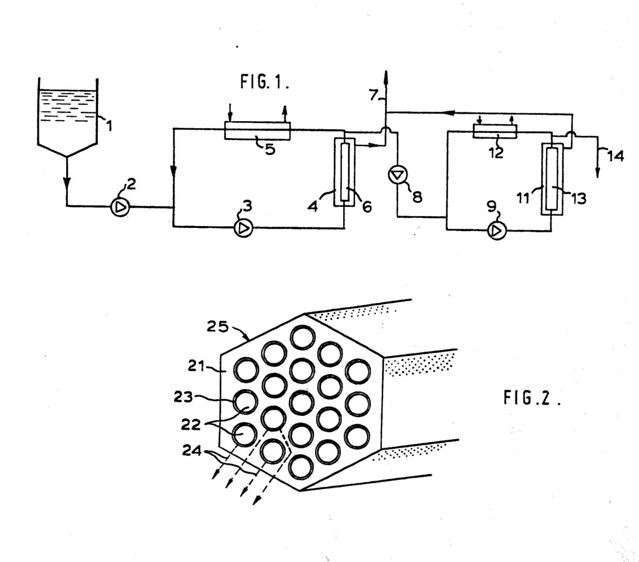
According to the present invention a process for estimating the hop bitter substances in beer comprises passing beer through a water-insoluble solvent for the hop bitter substances, in such a manner that drops of beer are formed, said drops moving at a velocity less than that at which an emulsion is formed but at a velocity sufficient “ice to cause turbulence inside the drops of beer so that more than 60 percent of the hop bitter substances passes from the beer to said water-insoluble solvent, continuously supplying and removing said water-insoluble solvent and estimating the percentage of hop bitter substances in the water-insoluble solvent removed.

The percentage of hop bitter substances in the water insoluble solvent removed may be estimated by any convenient method. We prefer to use an ultra violet spectrophotometer to measure the absorption of the solution of the hop bitter substances. The solution in the water insoluble solvent may be used direct or the hop bitter substances may be extracted into an alkali and then estimated in an ultra violet spectrophotometer.

In order to improve the partition coefficient of the hop bitter substances between the beer and the water-insoluble solvent, the beer is preferably acidified, prior to undergoing the process of the present invention. The preferred acids used are sulphuric acid or hydrochloric acid. We have found that to get the best results the pH of the beer solution should be less than about 3.5.

A large number of water-insoluble organic solvents effectively extract hop bitter substances from beer, but considerable quantities of accompanying materials may also be extracted which interfere with the subsequent spectrophotometric measurement. Hydrocarbon solvents such as light petroleum, hexane or iso-octane extract a relatively low amount of these interfering substances compared with extractions using chloroform or diethyl ether. Preferably the water-insoluble solvent used is optically suitable iso-octane.

The beer (here the term beer is used to exclude hopped wort which is already degassed) must be thoroughly degassed by any convenient method.

The peak optical density of a neutral solution of hop bitter substances and water-insoluble solvent occurs at 275 An alkaline solution of hop bitter substances and water-insoluble solvent has a peak optical density at 255 We prefer to carry out the ultra violet spectrophotometer analysis on an alkaline solution, since the interference of any background effect is reduced at this wavelength, and also because the lamps for generating this wavelength generally have a much longer life than those used for generating a wavelength of 275 ,u.

A method of making the solution of hopped bitter substances alkaline is to add aqueous alkali, for example caustic soda, to the solution followed by mixing. We prefer to pass this mixture to a separator, for example a gravity separator, whereupon pure or nearly pure water insoluble solvent is separated leaving a solution of hop bitter substances and alkali to be passed to the ultra violet spectrophotometer. If necessary further alkali may be added after the separation step.

The temperature at which the extraction takes place will of course have an effect on the partition coefficient of the hop bitter substances between beer and the water insoluble solvent, however, we have found it quite convenient to operate the process at room temperature.

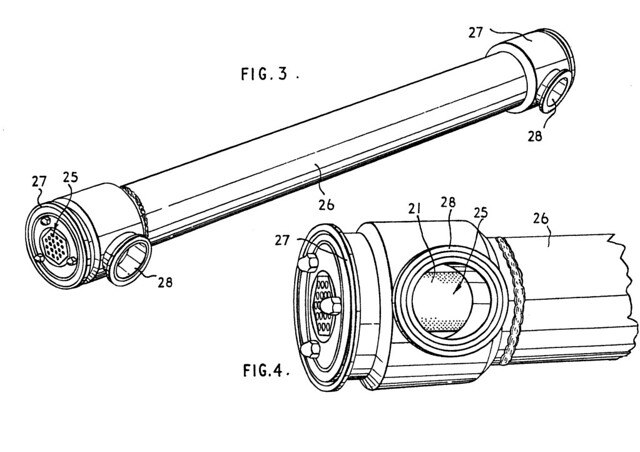
Previous methods of extracting hop bitter substances from beer have involved the use of a counter-current flow column. We have found that substantially the same percentage of hop bitter substances can be extracted by using the process of our invention by using a comparatively short chamber which we call a jet chamber. A jet chamber of as short as 2 inches has been found to have an extraction efficiency of the same order as that obtained by using a counter-current flow column over 8 feet long. However, we prefer to use a jet chamber 3 inches to 4 inches long, especially when extracting from a stout.

Instead of operating on the counter-current flow principle our extraction process depends on the turbulence created in the beer droplets by the velocity with which they emerge from the orifices into the jet chamber and pass through the water-insoluble solvent. must be very carefully regulated. If, for instance, the beer droplets have a Reynolds number of above about 2,000, cavitation will occur in the water-insoluble solvent and an emulsion will be formed. This emulsion as previously stated is very difficult to break and its formation must be prevented, hence the beer droplets must initially have a Reynolds number below about 2,000. On the other hand, if the velocity of the beer drops is too low, only the beer at the surface of the beer drops will ever be in contact with the water-insoluble solvent and all the hop bitter substances in the centre of the drops will remain in the beer. The velocity of the drops must therefore be high enough to create turbulence inside the said drops. By turbulence in this context we mean that there is a continuous circulation of beer inside the drops to and from the surface of said drops. This will result in equilibrium, as defined by the partition coefficients of the hop bitter substances between beer and the water insoluble solvent, being approached very rapidly. As far as we can gather turbulence occurs inside the beer drops to a useful degree for our purposes provided that the drops have a Reynolds number of over 70.

Any method of creating drops and passing them at a suitable velocity, as defined above, through a water insoluble solvent may be used in the process of this invention. For example the beer may be passed into the water-insoluble solvent through a jet head containing one or more jets. Another method which may be employed is to pass a stream of beer substantially towards the centre of a rapidly rotating plate immersed in the water-insoluble solvent which sends drops of beer outwards from its circumference.

It is not necessary to obtain 100 percent extraction of the hop bitter substances from beer in order to obtain a useful result, provided the process results in a substantially similar percentage of the hop bitter substances being extracted every time a beer containing approximately the same percentage of hop bitter substances, for example a stout, is passed through the apparatus.

If the beer is passed through a small jet it is essential that the beer does not contain any particles of solid matter having a diameter of over about half the diameter of the orifices used, otherwise the orifices are likely to become blocked easily. The particles in the beer may be removed by any convenient filtering process, for example by centrifuging or by using a mesh filter.

Untitled
Untitled

Filed Under: Beers, Breweries, Just For Fun, Politics & Law, Related Pleasures Tagged With: History, Hops, Law, Patent, Science of Brewing

Anderson Valley Featured In PG&E Commercial

October 18, 2015 By Jay Brooks

PG&E avbc-new-2
So I’m watching the Mets beating the Cubs in game 2 of the NLCS and happened to look up as the commercials came on between innings, as I heard something in the voiceover that I wasn’t expecting: Anderson Valley Brewing Company. People in the Bay Area know that PG&E has a P.R. problem after a pipe blew up in a San Bruno neighborhood (on the peninsula north of Silicon Valley and south of San Francisco). The blast registered 1.1 on the Richter scale when a segment of pipe 28 feet long blew out onto the street, thrown about 100 feet and creating a crater 167 feet long and 26 feet wide, killing eight people in the process. They stonewalled after the incident, but eventually the “Public Utilities Commission fined PG&E $1.6 billion,” and there was civil litigation by many of the people directly effected by the explosion.

So for the last few years there’s been a lot of TV commercials portraying PG&E as a company that cares. A lot. A lot of ads, I mean. I don’t know if it’s been a successful campaign or not, certainly I’m not buying it and the fact that they’re still creating new ones and running them frequently suggests that not everyone has been convinced, either. Anyway, the ad I just saw during the baseball game featured Rod DeWitt, who’s the Director of Plant Engineering & Process Control for Anderson Valley Brewing, the drummer for Rolling Boil Blues Band, and an old friend. Here’s the commercial:

This is Rod giving me a tour of the brewery back in 2006

P1000409
This is the scene shown on every Anderson Valley beer label.

Filed Under: Breweries, Just For Fun, Related Pleasures Tagged With: Advertising, California, Northern California, Video

Patent No. 973087A: Equalizing Device For Beer Filtration

October 18, 2015 By Jay Brooks

patent-logo
Today in 1910, US Patent 973087 A was issued, an invention of Ferdinand Turek, for his “Equalizing Device For Beer Filtration.” There’s no Abstract, although in the description it includes this summary:

This invention relates to apparatus used in the filtration or purification of beer, and has for its object to provide means for causing a steady fiow of’beer from the chip cask and through the filter.

Untitled

Filed Under: Beers, Breweries, Just For Fun, Politics & Law, Related Pleasures Tagged With: Brewing Equipment, History, Law, Patent, Science of Brewing

« Previous Page
Next Page »

Find Something

Northern California Breweries

Please consider purchasing my latest book, California Breweries North, available from Amazon, or ask for it at your local bookstore.

Recent Comments

  • Bob Paolino on Beer Birthday: Grant Johnston
  • Gambrinus on Historic Beer Birthday: A.J. Houghton
  • Ernie Dewing on Historic Beer Birthday: Charles William Bergner 
  • Steve 'Pudgy' De Rose on Historic Beer Birthday: Jacob Schmidt
  • Jay Brooks on Beer Birthday: Bill Owens

Recent Posts

  • Historic Beer Birthday: Oliver Hughes May 20, 2026
  • Historic Beer Birthday: Benjamin, Lord Iveagh May 20, 2026
  • Historic Beer Birthday: Eduard Buchner May 20, 2026
  • Historic Beer Birthday: Louis de Luze Simonds May 20, 2026
  • Historic Beer Birthday: Johann Adam Lemp May 20, 2026

BBB Archives

Feedback

Head Quarter
This site is hosted and maintained by H25Q.dev. Any questions or comments for the webmaster can be directed here.