Brookston Beer Bulletin

Jay R. Brooks on Beer

  • Home
  • About
  • Editorial
  • Birthdays
  • Art & Beer

Socialize

  • Dribbble
  • Email
  • Facebook
  • Flickr
  • GitHub
  • Instagram
  • LinkedIn
  • Pinterest
  • RSS
  • Twitter
  • YouTube

Powered by Genesis

Historic Beer Birthday: John A. Huck

May 15, 2026 By Jay Brooks

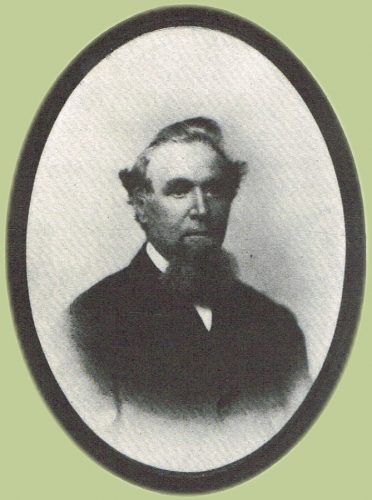
Today is the birthday of John A. Huck (May 15, 1818-January 26, 1878). He was born in Baden-Württemberg, Germany, and in 1847 he came to the U.S. and settled in the Chicago, Illinois area. In 1847, long with a partner, John Schneider, he founded the John Huck & John Schneider Brewery, but for five years beginning in 1855 it was known as the Eagle Brewery, but apparently he bought out Schneider in 1860, when its name was changed again, this time to Huck’s Chicago Brewing Co. and then 1869 became the John A. Huck Brewing Co. But in 1871, the brewery was destroyed by the Great Fire and never reopened after that. A few years before, his son, Louis C. Huck, opened his own malting business, the L.C. Huck Malting Co., so maybe he went to work with him or simply retired.

Here’s account of Huck by Gregg Smith from RealBeer.com:

The story begins in 1847, shortly after lagers arrived in America, when John Huck entered a partnership with John Schneider to construct a brewery. Located just two blocks east of Chicago’s first ale brewery (Lill’s Cream Ale) it had an interesting connection to that facility. Chicago’s first mayor, William Ogden, who had a financial interest in Lill’s, owned the land at Chicago Avenue and Division Street which Huck and Schneider purchased for their facility.

This location provided another innovation in Chicago beer drinking. The property included a tree filled square, and in the center Huck put his house. This he surrounded with a beer garden, another first in the city. More than just a retail outlet for their product, brewers in Europe had long built beer gardens for a more practical reason. An essential part of lager brewing is cool temperatures. These are needed for lager yeast to work its magic. For this reason brewers aged the beer in subterranean “lagering cellars”. The trees of the beer garden, usually elm, provided a shady canopy on the ground above and helped ensure cellars would remain lager friendly cool.
Huck’s beer was a success and rather than sacrifice his home and beer garden to expansion he moved brewing operations in 1855 to a new facility on Wolcott (now N.State Street) near Division. With the move came a new name – Eagle Brewing. The new brewery was, in its day, one of the city’s largest. It boasted both brew and malt houses along with more than 2 miles of underground vaults. The name changed again in 1860, to Huck’s Chicago Brewing Co. and from 1869 to 1871 was known as John A. Huck Brewing Company.

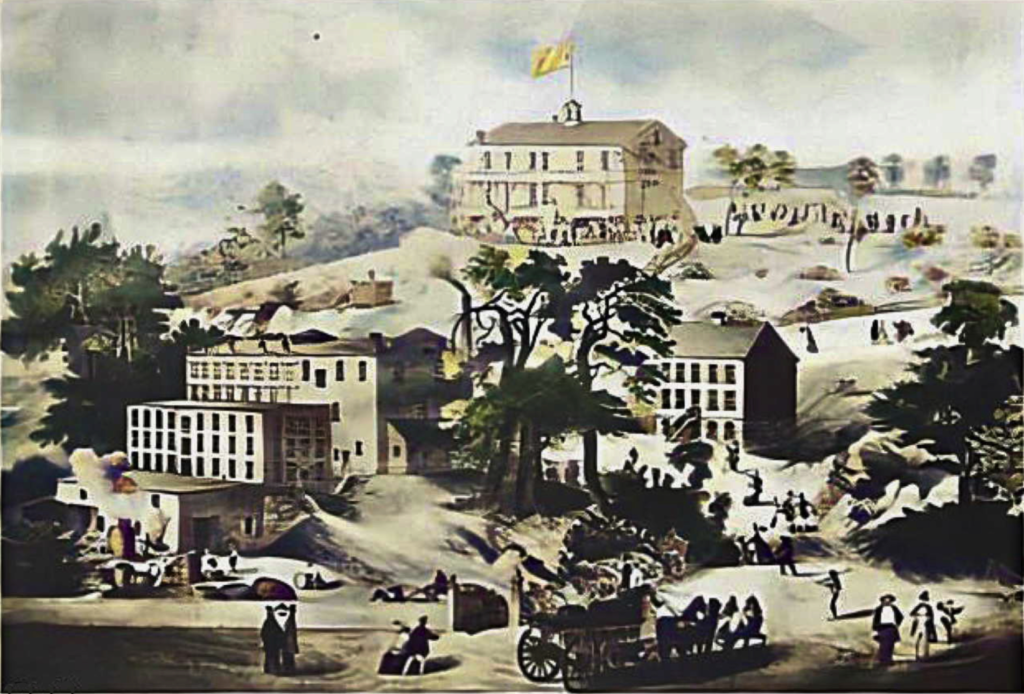
Huck’s Brewery when it opened in 1847.

This is from a blog post about The Huck Tunnels:

In the 1840s, Huck opened the first lager brewery in Chicago at Chicago and Rush, back when the area was still practically the wilderness. In the 1850s he moved to a new location at Banks and Astor, just south of the Catholic portion of City Cemetery (now Lincoln Park), which started at Schiller. The area seems to have been bounded by State and Astor at the West and East, and from Banks to Goethe from the North to South – a full square block, across the corner from the future Playboy mansion, though one source says that it went clear north to Schiller. In what was then quite an innovation, the brewery featured a whole network of subterranean tunnels and vaults for brewing the beer at low temperatures year round, and apparently there were two full miles of them in total. The brewery was destroyed in the Great Chicago Fire in 1871, but the tunnels remained.

In 1977, the Joseph Huber Brewing Co. of Monroe, Wisconsin created a set of 18 commemorative cans featuring Huck’s brewery.

And this is from One Hundred Years of Brewing:

The first lager beer brewery in Chicago and one of the first to manufacture any kind of malt liquor was that founded on the corner of Chicago avenue and Rush street, by the late John A. Huck, in 1847. Two blocks cast was Lill’s cream ale brewery, which had been in successful operation for about eight years. It is worthy of note that Wm. B. Ogden, the first mayor of Chicago, and in many respects its foremost citizen, was identified with ] both of these pioneer breweries; for, as has been stated, he was at first the financial support of the Lill brewery, and it was upon the Ogden block that the Huck lager beer plant was installed—upon the square bounded by Chicago avenue and Superior, Rush and Cass streets. In the center of the square, which was well covered by trees, was Mr. Huck’s residence, which, in turn, was the center of a beer garden—the first in Chicago.

In 1855 Mr. Huck removed his plant to the corner of Banks and North State street, where the residence of Franklin Head now stands, and by the time of the Great Fire it had expanded into one of the most extensive establishments of the kind in the country. With two miles of subterranean vaults and brew and malt houses, in proportion, it was one of the marked sights of the city. In 1871, however, all was swept away and the labors of many years lay in ruins. The property remained idle for several years, but in the latter portion of 1877, Mr. Huck began to lay his plans for a rebuilding of the brewery on the old site. While in the midst of these preparations, however, in January, 1878, he was taken away, leaving, among other children, the Louis C. Huck, who first associated himself with his father in 1861, established an independent malting business in 1869 and is now a well-known capitalist of Chicago.

Huck gravestone in Chicago’s Graceland Cemetary.

Filed Under: Birthdays, Breweries, Just For Fun Tagged With: Chicago, Germany, Illinois

Beer In Ads #5251: Gesundheit Beer

May 14, 2026 By Jay Brooks

Two years ago I decided to concentrate on Bock ads for awhile. Bock, of course, may have originated in Germany, in the town of Einbeck. Because many 19th century American breweries were founded by German immigrants, they offered a bock at certain times of the year, be it Spring, Easter, Lent, Christmas, or what have you. In a sense they were some of the first seasonal beers. “The style was later adopted in Bavaria by Munich brewers in the 17th century. Due to their Bavarian accent, citizens of Munich pronounced ‘Einbeck’ as ‘ein Bock’ (a billy goat), and thus the beer became known as ‘Bock.’ A goat often appears on bottle labels.” And presumably because they were special releases, many breweries went all out promoting them with beautiful artwork on posters and other advertising. With Spring approaching, there are so many great examples that I’m going to post two a day for a few months.

Thursday’s ad is for Leidiger Bock Beer, which was published on May 14, 1915. This ad was for  the Leidiger Brewing Co., which was founded in 1884. This ad ran in The Merrill Star Advocate, also of Merrill, Wisconsin. I’m going to guess that “Gesundheit Beer” or “Some Beer” is meant to be joke, and neither actually existed, but who knows. There was a beer called “Gesundheit” that was brewed by the Neustadtl Brewing Co. of Stroudsburg, Pennsylvania from 1933 to 1935

Filed Under: Art & Beer, Beers, Breweries, Just For Fun Tagged With: Advertising, Bock, History, Wisconsin

Beer In Ads #5250: Pacific Bock Beer

May 13, 2026 By Jay Brooks

Two years ago I decided to concentrate on Bock ads for awhile. Bock, of course, may have originated in Germany, in the town of Einbeck. Because many 19th century American breweries were founded by German immigrants, they offered a bock at certain times of the year, be it Spring, Easter, Lent, Christmas, or what have you. In a sense they were some of the first seasonal beers. “The style was later adopted in Bavaria by Munich brewers in the 17th century. Due to their Bavarian accent, citizens of Munich pronounced ‘Einbeck’ as ‘ein Bock’ (a billy goat), and thus the beer became known as ‘Bock.’ A goat often appears on bottle labels.” And presumably because they were special releases, many breweries went all out promoting them with beautiful artwork on posters and other advertising. With Spring approaching, there are so many great examples that I’m going to post two a day for a few months.

Wednesday’s ad is for Pacific Bock Beer, which was published on May 13, 1900. This ad was for  the Pacific Brewing & Malting Co., which was founded in 1897 in Tacoma, Washington. This ad ran in The Tacoma Daily Ledger, also of Tacoma, Washington.

Filed Under: Art & Beer, Beers, Breweries, Just For Fun Tagged With: Advertising, Bock, History, Washington

Historic Beer Birthday: Jacob Adams

May 13, 2026 By Jay Brooks

Today is the birthday of Jacob Adams (May 13, 1837-July 21, 1909). Born Jacob Adami, in Germany, he moved with his family to San Francisco in 1860. He bought the San Francisco Brewery in 1874, renaming it the Broadway Brewery.

Here’s a short biography from Find a Grave:

Johanas Adami [Adams] and family emigrated from Germany in 1860 to San Francisco and formed a brewery partnership. Johanas’ son, Jacob Adams, formally established the Broadway Brewery at 637 Broadway and Stockton St. in 1874. The brewery burned down in 1885, but was rebuilt at a new location on the corner of Treat Ave. & 19th St. Jacob died in 1909 and his son George C. Adams became president of the brewery. In 1916 another son, William F. Adams, became one of the directors of the newly formed California Brewing Association. During Prohibition William was working at Acme’s Fulton plant, (dba) the Cereal Products Refining Corporation, with JP Rettenmayer and Karl Schuster. In the 30’s & 40’s William held the position of Secretary for Acme Breweries in both SF and LA. He and his brother Edward J. Adams were Acme shareholders and also ran Acme’s Oakland distribution depot.

This account is from Bill Yenne’s “San Francisco Beer: A History of Brewing by the Bay:”

From Page 23.
From Page 41.

This story about a potential crime by one of the brewery employees, a family member no less, is from the San Francisco Call on February 5, 1898.

Brewery Gems also has a more thorough history of both Jacob Adams and the Broadway Brewery in San Francisco from 1862 to 1917, when it closed.

Filed Under: Birthdays, Breweries, Just For Fun Tagged With: California, History, San Francisco

Historic Beer Birthday: Henry Uihlein

May 13, 2026 By Jay Brooks

schlitz-globe
Today is the birthday of Henry Heinrich Johann Uihlein (May 13, 1844-April 22, 1922). He was born in Bavaria, but moved to the U.S. when he was eighteen, in 1862, having learned the brewing trade in Germany. He joined his uncle, August Krug, and his brothers, working for the Joseph Schlitz Brewing Company. He was president of Schlitz from 1875 until he retired in 1916.

This is one of the few photos I could find of Henry, in this Uihlein family photo from the early 1880’s.

Bottom row, from left; Charles, superintendent of the bottling works; Edward, vice president in charge of developing the Chicago markets; Henry, president. Top row, from left; William J., assistant superintendent of the brewery; Alfred, superintendent and brewmaster; August, secretary and chief operating officer.

Schlitz-Beer-Paper-Ads-Jos-Schlitz-Brewing-1900


This Schlitz ad is from around 1900, when Henry was president of the brewery.

This is the Google translation of his German Wikipedia page:

Henry Uihlein was the second eldest of six sons of Joseph Benedict Ühlein and his wife Katharina Krug born in Wertheim, the restaurant, the Gasthaus zur Krone operated.

In Bavaria, Henry Uihlein learned the brewing trade before emigrating to the United States in 1862. There he worked for several years for various breweries in St. Louis and for the Kunz Brewing Company in Leavenworth. In 1871 he moved to Milwaukee and began working with his brothers August, Alfred and Edward for the Joseph Schlitz Brewing Company. Henry’s brewing expertise contributed significantly to the company’s success. He led the company between 1875 and 1916 as president. He also worked in finance, real estate and other industries.

This is Uihlein’s obituary from the Beverage Journal (f.k.a. The Western Brewer) from 1922:

Filed Under: Birthdays, Breweries, Just For Fun Tagged With: Bavaria, Germany, History, Wisconsin

Beer In Ads #5249: Dresdner Hofbräu Bock-Bier

May 12, 2026 By Jay Brooks

Two years ago I decided to concentrate on Bock ads for awhile. Bock, of course, may have originated in Germany, in the town of Einbeck. Because many 19th century American breweries were founded by German immigrants, they offered a bock at certain times of the year, be it Spring, Easter, Lent, Christmas, or what have you. In a sense they were some of the first seasonal beers. “The style was later adopted in Bavaria by Munich brewers in the 17th century. Due to their Bavarian accent, citizens of Munich pronounced ‘Einbeck’ as ‘ein Bock’ (a billy goat), and thus the beer became known as ‘Bock.’ A goat often appears on bottle labels.” And presumably because they were special releases, many breweries went all out promoting them with beautiful artwork on posters and other advertising. With Spring approaching, there are so many great examples that I’m going to post two a day for a few months.

Tuesday’s ad is for “Dresdner Hofbräu Bock-Bier,” created in 1899. This poster was for the Dresdner Hofbräuhaus (or Dresden Court Brewery) of Dresden, Germany, which was originally founded in 1872 but closed in 1921. The poster was created by German artist Fritz Wolff. It was produced by Hollerbaum & Schmidt of Berlin.

Filed Under: Art & Beer, Beers, Breweries, Just For Fun Tagged With: Advertising, Bock, Germany, History

Beer In Ads #5248: Bock Beer, A Hummer B’Gosh

May 12, 2026 By Jay Brooks

Two years ago I decided to concentrate on Bock ads for awhile. Bock, of course, may have originated in Germany, in the town of Einbeck. Because many 19th century American breweries were founded by German immigrants, they offered a bock at certain times of the year, be it Spring, Easter, Lent, Christmas, or what have you. In a sense they were some of the first seasonal beers. “The style was later adopted in Bavaria by Munich brewers in the 17th century. Due to their Bavarian accent, citizens of Munich pronounced ‘Einbeck’ as ‘ein Bock’ (a billy goat), and thus the beer became known as ‘Bock.’ A goat often appears on bottle labels.” And presumably because they were special releases, many breweries went all out promoting them with beautiful artwork on posters and other advertising. With Spring approaching, there are so many great examples that I’m going to post two a day for a few months.

Monday’s ad is “A Hummer B’Gosh,” and is for P. Ganser Bock Beer, which was published on May 11, 1906. This ad was for the Peter Ganser City Brewery of Owatonna, Minnesota., which was originally founded in 1863 as the Monheim & Knobloch Brewery. This ad ran in The People’s Press, also of Owatonna, Minnesota.

Filed Under: Art & Beer, Beers, Breweries, Just For Fun

Historic Beer Birthday: Stephen Weber

May 11, 2026 By Jay Brooks

weber
Today is the birthday of Stephen Weber (May 11, 1822-September 2, 1901). He was born in Bavaria, but settled in Waukesha, Wisconsin, where he founded the Weber Brewing Co. in 1862. There’s not much I could find about Weber, unfortunately.

Here’s a short biography of Stephen Weber from “The History of Waukesha County, Wisconsin.”

stephen-weber-bio

weber-brewery-marker

weber-beer-train

Here’s Weber’s obituary from the Waukesha Freeman, Thursday, September 12, 1901.

weber-obit
Weber-Waukesha-Beer--Labels-Weber-Waukesha-Brewing
WI-WEBER

Filed Under: Birthdays, Breweries, Just For Fun Tagged With: History, Wisconsin

Historic Beer Birthday: Christian Weyand

May 11, 2026 By Jay Brooks

Today is the birthday of Crétien “Christian” Weyand (May 11, 1826-August 7, 1898). He was born in France as Cretien Weyand, but came to the U.S. when he was 21, settling in the Buffalo area of New York. He was originally a shoemaker, but when he was forty years old, he co-founded the Main Street Brewery, along with a partner, John Schetter, who he eventually bought out in 1873. In 1890, the brewery was incorporated as the Christian Weyand Brewing Co. and remained in business until closed by prohibition in 1920.

Here’s a short biography from Find-a-Grave:

Weyand, Christian, was born in Lorraine, France, May 11, 1826, attended the common schools, and in the spring of 1847 came to America and settled in Buffalo, where he has since resided. He followed the shoemaker’s trade for some time, and then in 1866 engaged in the brewing business with a partner.

In 1873 he became sole owner of the establishment on the corner of Main and Goodell streets, and in a few years built up one of the largest and best breweries in Western New York. In May 1890, the Weyland Brewing Company was incorporated with C. Weyand. president; John A. Weyand, vice-president and manager; and Charles M. Weyand, secretary, and treasurer. Mr. Weyand is probably the best-known brewer in Buffalo. He is a prominent, public-spirited citizen, widely esteemed and respected, and has always enjoyed the confidence of all who know him. May 9, 1852, he married Magdalena Mayer of Buffalo.

And this is his obituary from the American Brewers Review:

This short history of Christian, and the brewery, is from the “1897 Brewers Convention Buffalo NY,” published by the Buffalo Brewers Association:

Christian Weyand Brewing Company.

In 1866, Christian Weyand established the business now conducted by The Christian Weyand Brewing Company. Mr. Weyand is a native of France, having been born in the province of Lorraine a little more than seventy years ago. There he spent his youth and received his education; but in his twenty-first year he left Lorraine for the wider opportunities of the New World, landing in New York just fifty years ago. He soon found his way to Buffalo, but it was nearly twenty years before he began the business with which his name is now so intimately connected in the minds of all Buffalonians. During these years he worked as a shoemaker — at first as an employee, and later in a shop of his own.

Mr. Weyand, with a partner, began the brewing business in a small way, with little capital and a poorly equipped plant; but the purest and best of barley malt was used from the start, and improved machinery was introduced as fast as the necessary capital could be secured. In 1873. Mr. Weyand assumed entire charge of the business, and applied himself vigorously to the task of building up a model brewery. His efforts met with entire success, and in a few years his establishment became one of the first in its line in Buffalo — a city that boasts of many fine breweries. In 1890, he organized the business into a stock company, called The Christian Weyand Brewing Company, of which he is president, his son, John A. Weyand, vice-president and manager, and another son, Charles M. Weyand, secretary and treasurer. Since then the business has materially increased, and in 1896-97 it became necessary to make extensive additions to the plant. The new buildings on the corner of Main and Goodell streets, built of buff terra cotta elaborately ornamented in Renaissance style, are exceedingly handsome; and it is now one of the best-equipped breweries in the country.

buffalo-main-and-goddell
This is purported to be a photograph of the house at the “Southeast Corner Main and Goodell Streets” from the 1912 “Picture Book Of Earlier Buffalo.” But as Michael F. Rizzo and Ethan Cox, authors of “Buffalo Beer” point out, “the structures in the background and to the left of the subject must have been the Christian Weyand brewery. Indeed, the least occluded building to the left was, I think, their office address on Goodell.”

Filed Under: Birthdays, Breweries, Just For Fun Tagged With: France, History, New York

Historic Beer Birthday: Dietrich Knabe

May 11, 2026 By Jay Brooks

consumers-ny
Today is the birthday of Dietrich Knabe (May 11, 1842-<1917). His first name is sometimes spelled Diedrich. I believe he was born in Germany, but that’s about all I know about Knabe, apart from he co-founded and served as president of the Consumer’s Brewing Co. of New York City, which was founded in 1890. It appears to have closed because of prohibition in 1920, although one source suggests that they were still a going concern into the late-1920s. As far as I can tell it didn’t open afterward.

consumers-brewing-sign

The Brewers’ Journal and Barley, Malt and Hop Trades’ Reporter for July 1, 1917 includes an account of Knabe’s 75th birthday earlier that year, so he was still alive

consumers-brewing-truck-1910
A Consumer’s brewery truck in 1910.

consumers-ny-1915-lager-ad
An ad from the Brooklyn Daily Eagle in 1915.

This is from the New York Times for November 15, 1889, announcing the creation of what would become the Consumer’s Brewing Co.

consumers-brewing-nyc-1931

consumers-ny-1915-ad


Another ad from the Brooklyn Daily Eagle in 1915.

Filed Under: Birthdays, Breweries, Just For Fun Tagged With: History, New York

« Previous Page
Next Page »

Find Something

Northern California Breweries

Please consider purchasing my latest book, California Breweries North, available from Amazon, or ask for it at your local bookstore.

Recent Comments

  • Bob Paolino on Beer Birthday: Grant Johnston
  • Gambrinus on Historic Beer Birthday: A.J. Houghton
  • Ernie Dewing on Historic Beer Birthday: Charles William Bergner 
  • Steve 'Pudgy' De Rose on Historic Beer Birthday: Jacob Schmidt
  • Jay Brooks on Beer Birthday: Bill Owens

Recent Posts

  • Beer In Ads #5364: Heute FF Bockbier! October 1, 2026
  • Historic Beer Birthday: Albert Fisher October 1, 2026
  • Historic Beer Birthday: John Courage October 1, 2026
  • Historic Beer Birthday: Joseph Fallert Jr. October 1, 2026
  • Beer Birthday: Jimmy Carter October 1, 2026

BBB Archives

Feedback

Head Quarter
This site is hosted and maintained by H25Q.dev. Any questions or comments for the webmaster can be directed here.