Brookston Beer Bulletin

Jay R. Brooks on Beer

  • Home
  • About
  • Editorial
  • Birthdays
  • Art & Beer

Socialize

  • Dribbble
  • Email
  • Facebook
  • Flickr
  • GitHub
  • Instagram
  • LinkedIn
  • Pinterest
  • RSS
  • Twitter
  • YouTube

Powered by Genesis

The Kalevala Of Finland

February 28, 2017 By Jay Brooks

finland
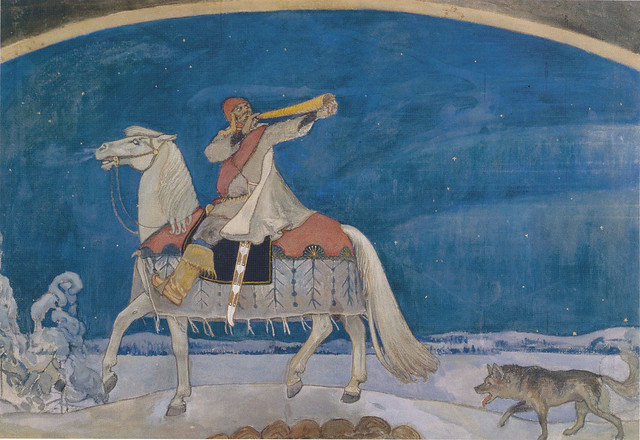
February 28 is Finnish Culture Day, more commonly known as Kalevala Day. According to the Finnish Embassy, “Kalevala Day is celebrated in Finland on the 28th of February, in honour of the day on which the Old Kalevala’s foreword was dated by Lönnrot (February 28, 1835). Kalevala Day is an official flag-raising day in Finland, and simultaneously the Day of Finnish culture.”
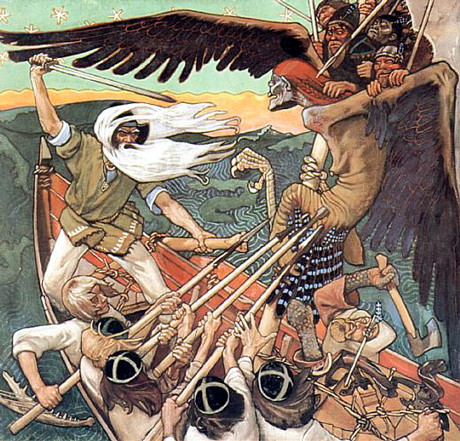
Kullervon_sotaanlähtö

Here’s one account about why the Kalevala is so important to Finland, and specifically Finnish identity:

The first edition of the Kalevala appeared in 1835, compiled and edited by Elias Lönnrot on the basis of the epic folk poems he had collected in Finland and Karelia. This poetic song tradition, sung in an unusual, archaic trochaic tetrametre, had been part of the oral tradition among speakers of Balto-Finnic languages for 2,000 years.

When the Kalevala appeared in print for the first time, Finland had been an autonomous Grand Duchy under Russia for a quarter of a century. Prior to this, until 1809, Finland had been a part of the Swedish empire.

The Kalevala marked an important turning point for Finnish-language culture and caused a stir abroad, as well. It brought a small, unknown people to the attention of other Europeans, and bolstered the Finns’ self-confidence and faith in the possibilities of the Finnish language and culture. The Kalevala began to be called the Finnish national epic.

Elias Lönnrot and his colleagues continued their efforts to collect folk poetry, and new material quickly accumulated. Using this new material, Lönnrot published a second, expanded version of the Kalevala in 1849. This New Kalevala is the version which has been read in Finland ever since and upon which most translations are based.
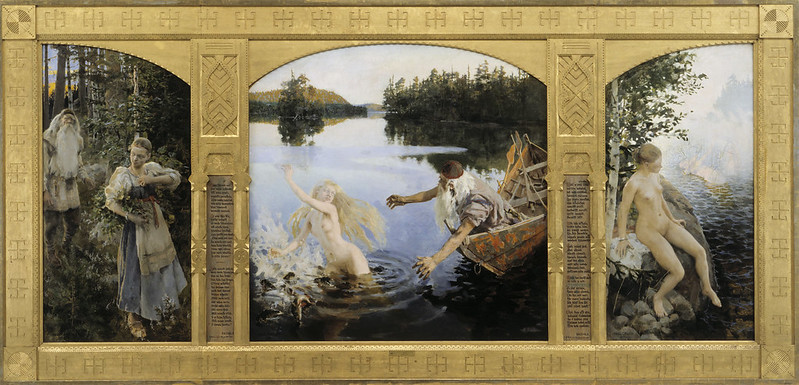
gallen_kallela_the_aino_triptych
Aino-Triptych by Akseli Gallen-Kallela 1891. Left: The first meeting of Aino and Väinämöinen. Right: Aino laments her woes and decides to end her life rather than marry an old man. Middle: The end of the story arc – Väinämöinen catches the Aino fish but is unable to keep hold of her.

And this is the introduction from the Kalevala page on Wikipedia:

The Kalevala or The Kalewala (/ˌkɑːləˈvɑːlə/; Finnish: [ˈkɑle̞ʋɑlɑ]) is a 19th-century work of epic poetry compiled by Elias Lönnrot from Karelian and Finnish oral folklore and mythology.

It is regarded as the national epic of Karelia and Finland and is one of the most significant works of Finnish literature. The Kalevala played an instrumental role in the development of the Finnish national identity, the intensification of Finland’s language strife and the growing sense of nationality that ultimately led to Finland’s independence from Russia in 1917.

The first version of The Kalevala (called The Old Kalevala) was published in 1835. The version most commonly known today was first published in 1849 and consists of 22,795 verses, divided into fifty songs (Finnish: runot). The title can be interpreted as “The Land of Kaleva” or “Kalevia”.
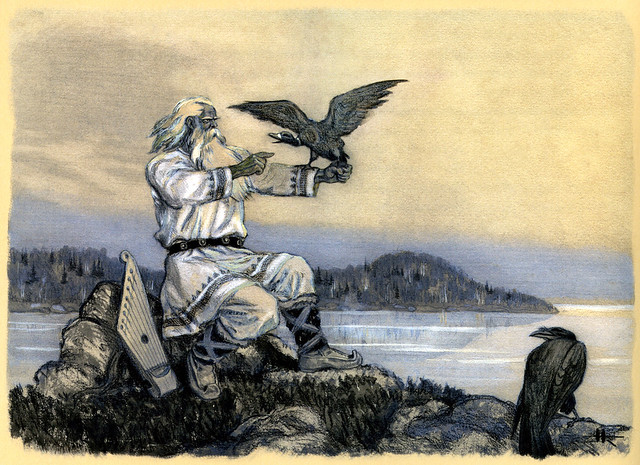
kavella

I wrote about it several years ago, because one of the chapters, Chapter or Rune XX, is all about brewing beer for a wedding. The parts that talks about brewing begins after the art work from the Kalevala below, after the short post I did for a page here a while back. Enjoy.

The Kalevala

The Kalevala is a book and epic poem which the Finn Elias Lönnrot compiled from Finnish and Karelian folklore in the nineteenth century. It is held to be the national epic of Finland and is traditionally thought of as one of the most significant works of Finnish literature. Karelian citizens and other Balto-Finnic speakers also value the work. The Kalevala is credited with some of the inspiration for the national awakening that ultimately led to Finnish governments independence from that of Russia in 1917.

The name can be interpreted as the “lands of Kaleva” (by the Finnish suffix -la/lä for place). The epic consists of 22,795 verses, divided into fifty cantos or “chapters” (Finnish runo). Of those 22,795 verses, more lines were devoted to the oriins of beer than of the origins of mankind.

Virtual Finland also has some basic information about the epic poem. Below is Chapter or Rune XX, which is all about brewing beer for a wedding. The parts that talks about brewing begins after the second art work from the Kalevala below. If you’re keen to read the whole thing, it’s online at the Sacred Texts website.
kalevala-1

RUNE XX
THE BREWING OF BEER

Now we sing the wondrous legends,
Songs of wedding-feasts and dances,
Sing the melodies of wedlock,
Sing the songs of old tradition;
Sing of Ilmarinen’s marriage
To the Maiden of the Rainbow,
Fairest daughter of the Northland,
Sing the drinking-songs of Pohya.

Long prepared they for the wedding
In Pohyola’s halls and chambers,
In the courts of Sariola;
Many things that Louhi ordered,
Great indeed the preparations
For the marriage of the daughter,
For the feasting of the heroes,
For the drinking of the strangers,
For the feeding of the poor-folk,
For the people’s entertainment.

Grew an ox in far Karjala,
Not the largest, nor the smallest,
Was the ox that grew in Suomi;
But his size was all-sufficient,
For his tail was sweeping Jamen,
And his head was over Kemi,
Horns in length a hundred fathoms,
Longer than the horns his mouth was;
Seven days it took a weasel
To encircle neck and shoulders;
One whole day a swallow journeyed
From one horn-tip to the other,
Did not stop between for resting.
Thirty days the squirrel travelled
From the tail to reach the shoulders,
But he could not gain the horn-tip
Till the Moon had long passed over.

This young ox of huge dimensions,
This great calf of distant Suomi,
Was conducted from Karjala
To the meadows of Pohyola;
At each horn a hundred heroes,
At his head and neck a thousand.
When the mighty ox was lassoed,
Led away to Northland pastures,
Peacefully the monster journeyed
By the bays of Sariola,
Ate the pasture on the borders;
To the clouds arose his shoulders,
And his horns to highest heaven.
Not in all of Sariola
Could a butcher be discovered
That could kill the ox for Louhi,
None of all the sons of Northland,
In her hosts of giant people,
In her rising generation,
In the hosts of those grown older.

Came a hero from a distance,
Wirokannas from Karelen,
And these words the gray-beard uttered:
“Wait, O wait, thou ox of Suomi,
Till I bring my ancient war-club;
Then I’ll smite thee on thy forehead,
Break thy skull, thou willing victim!
Nevermore wilt thou in summer
Browse the woods of Sariola,
Bare our pastures, fields, and forests;
Thou, O ox, wilt feed no longer
Through the length and breadth of Northland,
On the borders of this ocean!”

When the ancient Wirokannas
Started out the ox to slaughter,
When Palwoinen swung his war-club,
Quick the victim turned his forehead,
Flashed his flaming eyes upon him;
To the fir-tree leaped the hero,
In the thicket hid Palwoinen,
Hid the gray-haired Wirokannas.

Everywhere they seek a butcher,
One to kill the ox of Suomi,
In the country of Karelen,
And among the Suomi-giants,
In the quiet fields of Ehstland,
On the battle-fields of Sweden,
Mid the mountaineers of Lapland,
In the magic fens of Turya;
Seek him in Tuoni’s empire,
In the death-courts of Manala.
Long the search, and unsuccessful,
On the blue back of the ocean,
On the far-outstretching pastures.

There arose from out the sea-waves,
Rose a hero from the waters,
On the white-capped, roaring breakers,
From the water’s broad expanses;
Nor belonged he to the largest,
Nor belonged he to the smallest;
Made his bed within a sea-shell,
Stood erect beneath a flour-sieve,
Hero old, with hands of iron,
And his face was copper-colored;
Quick the hero full unfolded,
Like the full corn from the kernel.
On his head a hat of flint-stone,
On his feet were sandstone-sandals,
In his hand a golden cleaver,
And the blade was copper-handled.
Thus at last they found a butcher,
Found the magic ox a slayer.
Nothing has been found so mighty
That it has not found a master.

As the sea-god saw his booty,
Quickly rushed he on his victim,
Hurled him to his knees before him,
Quickly felled the calf of Suomi,
Felled the young ox of Karelen.
Bountifully meat was furnished;
Filled at least a thousand hogsheads
Of his blood were seven boatfuls,
And a thousand weight of suet,
For the banquet of Pohyola,
For the marriage-feast of Northland.

In Pohyola was a guest-room,
Ample was the hall of Louhi,
Was in length a hundred furlongs,
And in breadth was nearly fifty;
When upon the roof a rooster
Crowed at break of early morning,
No one on the earth could hear him;
When the dog barked at one entrance,
None could hear him at the other.
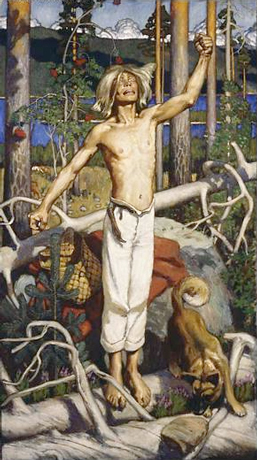
kalevala-2

Louhi, hostess of Pohyola,
Hastens to the hall and court-room,
In the centre speaks as follows:
“Whence indeed will come the liquor,
Who will brew me beer from barley,
Who will make the mead abundant,
For the people of the Northland,
Coming to my daughter’s marriage,
To her drinking-feast and nuptials?
Cannot comprehend the malting,
Never have I learned the secret,
Nor the origin of brewing.”
Spake an old man from his corner:
“Beer arises from the barley,
Comes from barley, hops, and water,
And the fire gives no assistance.
Hop-vine was the son of Remu,
Small the seed in earth was planted,
Cultivated in the loose soil,
Scattered like the evil serpents
On the brink of Kalew-waters,
On the Osmo-fields and borders.
There the young plant grew and flourished,
There arose the climbing hop-vine,
Clinging to the rocks and alders.

“Man of good-luck sowed the barley
On the Osmo hills and lowlands,
And the barley grew and flourished,
Grew and spread in rich abundance,
Fed upon the air and water,
On the Osmo plains and highlands,
On the fields of Kalew-heroes.

“Time had travelled little distance,
Ere the hops in trees were humming,
Barley in the fields was singing,
And from Kalew’s well the water,
This the language of the trio:
‘Let us join our triple forces,
Join to each the other’s powers;
Sad alone to live and struggle,
Little use in working singly,
Better we should toil together.’

“Osmotar, the beer-preparer,
Brewer of the drink refreshing,
Takes the golden grains of barley,
Taking six of barley-kernels,
Taking seven tips of hop-fruit,
Filling seven cups with water,
On the fire she sets the caldron,
Boils the barley, hops, and water,
Lets them steep, and seethe, and bubble
Brewing thus the beer delicious,
In the hottest days of summer,
On the foggy promontory,
On the island forest-covered;
Poured it into birch-wood barrels,
Into hogsheads made of oak-wood.

“Thus did Osmotar of Kalew
Brew together hops and barley,
Could not generate the ferment.
Thinking long and long debating,
Thus she spake in troubled accents:
‘What will bring the effervescence,
Who will add the needed factor,
That the beer may foam and sparkle,
May ferment and be delightful?’

Kalevatar, magic maiden,
Grace and beauty in her fingers,
Swiftly moving, lightly stepping,
In her trimly-buckled sandals,
Steps upon the birch-wood bottom,
Turns one way, and then another,
In the centre of the caldron;
Finds within a splinter lying
From the bottom lifts the fragment,
Turns it in her fingers, musing:
‘What may come of this I know not,
In the hands of magic maidens,
In the virgin hands of Kapo,
Snowy virgin of the Northland!’

“Kalevatar took the splinter
To the magic virgin, Kapo,
Who by unknown force and insight.
Rubbed her hands and knees together,
And produced a snow-white squirrel;
Thus instructed she her creature,
Gave the squirrel these directions:
‘Snow-white squirrel, mountain-jewel,
Flower of the field and forest,
Haste thee whither I would send thee,
Into Metsola’s wide limits,
Into Tapio’s seat of wisdom;
Hasten through the heavy tree-tops,
Wisely through the thickest branches,
That the eagle may not seize thee,
Thus escape the bird of heaven.
Bring me ripe cones from the fir-tree,
From the pine-tree bring me seedlings,
Bring them to the hands of Kapo,
For the beer of Osmo’s daughter.’

Quickly hastened forth the squirrel,
Quickly sped the nimble broad-tail,
Swiftly hopping on its journey
From one thicket to another,
From the birch-tree to the aspen,
From the pine-tree to the willow,
From the sorb-tree to the alder,
Jumping here and there with method,
Crossed the eagle-woods in safety,
Into Metsola’s wide limits,
Into Tapio’s seat of wisdom;
There perceived three magic pine-trees,
There perceived three smaller fir-trees,
Quickly climbed the dark-green branches,
Was not captured by the eagle,
Was not mangled in his talons;
Broke the young cones from the fir-tree,
Cut the shoots of pine-tree branches,
Hid the cones within his pouches,
Wrapped them in his fur-grown mittens
Brought them to the hands of Kapo,
To the magic virgin’s fingers.
Kapo took the cones selected,
Laid them in the beer for ferment,
But it brought no effervescence,
And the beer was cold and lifeless.

“Osmotar, the beer-preparer,
Kapo, brewer of the liquor,
Deeply thought and long considered:
‘What will bring the effervescence,
Who will lend me aid efficient,
That the beer may foam and sparkle,
May ferment and be refreshing?’

“Kalevatar, sparkling maiden,
Grace and beauty in her fingers,
Softly moving, lightly stepping,
In her trimly-buckled sandals,
Steps again upon the bottom,
Turns one way and then another,
In the centre of the caldron,
Sees a chip upon the bottom,
Takes it from its place of resting,
Looks upon the chip and muses
‘What may come of this I know not,
In the hands of mystic maidens,
In the hands of magic Kapo,
In the virgin’s snow-white fingers.’

“Kalevatar took the birch-chip
To the magic maiden, Kapo,
Gave it to the white-faced maiden.
Kapo, by the aid of magic,
Rubbed her hands and knees together,
And produced a magic marten,
And the marten, golden-breasted;
Thus instructed she her creature,
Gave the marten these directions.
‘Thou, my golden-breasted marten,
Thou my son of golden color,
Haste thou whither I may send thee,
To the bear-dens of the mountain,
To the grottoes of the growler,
Gather yeast upon thy fingers,
Gather foam from lips of anger,
From the lips of bears in battle,
Bring it to the hands of Kapo,
To the hands of Osmo’s daughter.’

“Then the marten golden-breasted,
Full consenting, hastened onward,
Quickly bounding on his journey,
Lightly leaping through the distance
Leaping o’er the widest rivers,
Leaping over rocky fissures,
To the bear-dens of the mountain,
To the grottoes of the growler,
Where the wild-bears fight each other,
Where they pass a dread existence,
Iron rocks, their softest pillows,
In the fastnesses of mountains;
From their lips the foam was dripping,
From their tongues the froth of anger;
This the marten deftly gathered,
Brought it to the maiden, Kapo,
Laid it in her dainty fingers.

“Osmotar, the beer-preparer,
Brewer of the beer of barley,
Used the beer-foam as a ferment;
But it brought no effervescence,
Did not make the liquor sparkle.

“Osmotar, the beer-preparer,
Thought again, and long debated:
‘Who or what will bring the ferment,
Th at my beer may not be lifeless?’

“Kalevatar, magic maiden,
Grace and beauty in her fingers,
Softly moving, lightly stepping,
In her trimly-buckled sandals,
Steps again upon the bottom,
Turns one way and then another,
In the centre of the caldron,
Sees a pod upon the bottom,
Lifts it in her snow-white fingers,
Turns it o’er and o’er, and muses:
‘What may come of this I know not,
In the hands of magic maidens,
In the hands of mystic Kapo,
In the snowy virgin’s fingers?’

“Kalevatar, sparkling maiden,
Gave the pod to magic Kapo;
Kapo, by the aid of magic,
Rubbed the pod upon her knee-cap,
And a honey-bee came flying
From the pod within her fingers,
Kapo thus addressed her birdling:
‘Little bee with honeyed winglets,
King of all the fragrant flowers,
Fly thou whither I direct thee,
To the islands in the ocean,
To the water-cliffs and grottoes,
Where asleep a maid has fallen,
Girdled with a belt of copper
By her side are honey-grasses,
By her lips are fragrant flowers,
Herbs and flowers honey-laden;
Gather there the sweetened juices,
Gather honey on thy winglets,
From the calyces of flowers,
From the tips of seven petals,
Bring it to the hands of Kapo,
To the hands of Osmo’s daughter.’

“Then the bee, the swift-winged birdling,
Flew away with lightning-swiftness
On his journey to the islands,
O’er the high waves of the ocean;
Journeyed one day, then a second,
Journeyed all the next day onward,
Till the third day evening brought him
To the islands in the ocean,
To the water-cliffs and grottoes;
Found the maiden sweetly sleeping,
In her silver-tinselled raiment,
Girdled with a belt of copper,
In a nameless meadow, sleeping,
In the honey-fields of magic;
By her side were honeyed grasses,
By her lips were fragrant flowers,
Silver stalks with golden petals;
Dipped its winglets in the honey,
Dipped its fingers in the juices
Of the sweetest of the flowers,
Brought the honey back to Kapo,
To the mystic maiden’s fingers.

“Osmotar, the beer-preparer,
Placed the honey in the liquor;
Kapo mixed the beer and honey,
And the wedding-beer fermented;
Rose the live beer upward, upward,
From the bottom of the vessels,
Upward in the tubs of birch-wood,
Foaming higher, higher, higher,
Till it touched the oaken handles,
Overflowing all the caldrons;
To the ground it foamed and sparkled,
Sank away in sand and gravel.

“Time had gone but little distance,
Scarce a moment had passed over,
Ere the heroes came in numbers
To the foaming beer of Northland,
Rushed to drink the sparkling liquor.
Ere all others Lemminkainen
Drank, and grew intoxicated
On the beer of Osmo’s daughter,
On the honey-drink of Kalew.

“Osmotar, the beer-preparer,
Kapo, brewer of the barley,
Spake these words in saddened accents:
‘Woe is me, my life hard-fated,
Badly have I brewed the liquor,
Have not brewed the beer in wisdom,
Will not live within its vessels,
Overflows and fills Pohyola!’

“From a tree-top sings the redbreast,
From the aspen calls the robin:
‘Do not grieve, thy beer is worthy,
Put it into oaken vessels,
Into strong and willing barrels
Firmly bound with hoops of copper.’

“Thus was brewed the beer or Northland,
At the hands of Osmo’s daughter;
This the origin of brewing
Beer from Kalew-hops and barley;
Great indeed the reputation
Of the ancient beer of Kalew,
Said to make the feeble hardy,
Famed to dry the tears of women,
Famed to cheer the broken-hearted,
Make the aged young and supple,
Make the timid brave and mighty,
Make the brave men ever braver,
Fill the heart with joy and gladness,
Fill the mind with wisdom-sayings,
Fill the tongue with ancient legends,
Only makes the fool more foolish.”

When the hostess of Pohyola
Heard how beer was first fermented,
Heard the origin of brewing,
Straightway did she fill with water
Many oaken tubs and barrels;
Filled but half the largest vessels,
Mixed the barley with the water,
Added also hops abundant;
Well she mixed the triple forces
In her tubs of oak and birch-wood,
Heated stones for months succeeding,
Thus to boil the magic mixture,
Steeped it through the days of summer,
Burned the wood of many forests,
Emptied all the, springs of Pohya;
Daily did the, forests lesson,
And the wells gave up their waters,
Thus to aid the hostess, Louhi,
In the brewing of the liquors,
From the water, hops, and barley,
And from honey of the islands,
For the wedding-feast of Northland,
For Pohyola’s great carousal
And rejoicings at the marriage
Of the Malden of the Rainbow
To the blacksmith, Ilmarinen,
Metal-worker of Wainola.

Smoke is seen upon the island,
Fire, upon the promontory,
Black smoke rising to the heavens
From the fire upon the island;
Fills with clouds the half of Pohya,
Fills Karelen’s many hamlets;
All the people look and wonder,
This the chorus of the women:
“Whence are rising all these smoke-clouds,
Why this dreadful fire in Northland?
Is not like the smoke of camp-fires,
Is too large for fires of shepherds!”

Lemminkainen’s ancient mother
Journeyed in the early morning
For some water to the fountain,
Saw the smoke arise to heaven,
In the region of Pohyola,
These the words the mother uttered:
“‘Tis the smoke of battle-heroes,
From the beat of warring armies!”

Even Ahti, island-hero,
Ancient wizard, Lemminkainen,
Also known as Kaukomieli,
Looked upon the scene in wonder,
Thought awhile and spake as follows:
“I would like to see this nearer,
Learn the cause of all this trouble,
Whence this smoke and great confusion,
Whether smoke from heat of battle,
Or the bonfires of the shepherds.”

Kaukomieli gazed and pondered,
Studied long the rising smoke-clouds;
Came not from the heat of battle,
Came not from the shepherd bonfires;
Heard they were the fires of Louhi
Brewing beer in Sariola,
On Pohyola’s promontory;
Long and oft looked Lemminkainen,
Strained in eagerness his vision,
Stared, and peered, and thought, and wondered,
Looked abashed and envy-swollen,
“O beloved, second mother,
Northland’s well-intentioned hostess,
Brew thy beer of honey-flavor,
Make thy liquors foam and sparkle,
For thy many friends invited,
Brew it well for Lemminkainen,
For his marriage in Pohyola
With the Maiden of the Rainbow.”

Finally the beer was ready,
Beverage of noble heroes,
Stored away in casks and barrels,
There to rest awhile in silence,
In the cellars of the Northland,
In the copper-banded vessels,
In the magic oaken hogsheads,
Plugs and faucets made of copper.
Then the hostess of Pohyola
Skilfully prepared the dishes,
Laid them all with careful fingers
In the boiling-pans and kettles,
Ordered countless loaves of barley,
Ordered many liquid dishes,
All the delicacies of Northland,
For the feasting of her people,
For their richest entertainment,
For the nuptial songs and dances,
At the marriage of her daughter
With the blacksmith, Ilmarinen.

When the loaves were baked and ready.
When the dishes all were seasoned,
Time had gone but little distance,
Scarce a moment had passed over,
Ere the beer, in casks imprisoned,
Loudly rapped, and sang, and murmured:
“Come, ye heroes, come and take me,
Come and let me cheer your spirits,
Make you sing the songs of wisdom,
That with honor ye may praise me,
Sing the songs of beer immortal!”

Straightway Louhi sought a minstrel,
Magic bard and artist-singer,
That the beer might well be lauded,
Might be praised in song and honor.
First as bard they brought a salmon,
Also brought a pike from ocean,
But the salmon had no talent,
And the pike had little wisdom;
Teeth of pike and gills of salmon
Were not made for singing legends.

Then again they sought a singer,
Magic minstrel, beer-enchanter,
Thus to praise the drink of heroes,
Sing the songs of joy and gladness;
And a boy was brought for singing;
But the boy had little knowledge,
Could not praise the beer in honor;
Children’s tongues are filled with questions,
Children cannot speak in wisdom,
Cannot sing the ancient legends.

Stronger grew the beer imprisoned
In the copper-banded vessels,
Locked behind the copper faucets,
Boiled, and foamed, and sang, and murmured:
“If ye do not bring a singer,
That will sing my worth immortal,
That will sing my praise deserving,
I will burst these bands of copper,
Burst the heads of all these barrels;
Will not serve the best of heroes
Till he sings my many virtues.”

Louhi, hostess of Pohyola,
Called a trusted maiden-servant,
Sent her to invite the people
To the marriage of her daughter,
These the words that Louhi uttered:
“O my trusted, truthful maiden,
Servant-maid to me belonging,
Call together all my people,
Call the heroes to my banquet,
Ask the rich, and ask the needy,
Ask the blind and deaf, and crippled,
Ask the young, and ask the aged;
Go thou to the hills, and hedges,
To the highways, and the by-ways,
Urge them to my daughter’s wedding;
Bring the blind, and sorely troubled,
In my boats upon the waters,
In my sledges bring the halting,
With the old, and sick, and needy;
Ask the whole of Sariola,
Ask the people of Karelen,
Ask the ancient Wainamoinen,
Famous bard and wisdom-singer;
But I give command explicit
Not to ask wild Lemminkainen,
Not the island-dweller, Ahti!”
This the question of the servant:
“Why not ask wild Lemminkainen,
Ancient islander and minstrel?”

Louhi gave this simple answer:
“Good the reasons that I give thee
Why the wizard, Lemminkainen,
Must not have an invitation
To my daughter’s feast and marriage
Ahti courts the heat of battle,
Lemminkainen fosters trouble,
Skilful fighter of the virtues;
Evil thinking, acting evil,
He would bring but pain and sorrow,
He would jest and jeer at maidens
In their trimly buckled raiment,
Cannot ask the evil-minded!”
Thus again the servant questions:
“Tell me how to know this Ahti,
Also known as Lemminkainen,
That I may not ask him hither;
Do not know the isle of Ahti,
Nor the home of Kaukomieli
Spake the hostess of Pohyola:
“Easy ’tis to know the wizard,
Easy find the Ahti-dwelling:
Ahti lives on yonder island,
On that point dwells Lemminkainen,
In his mansion near the water,
Far at sea his home and dwelling.”

Thereupon the trusted maiden
Spread the wedding-invitations
To the people of Pohyola,
To the tribes of Kalevala;
Asked the friendless, asked the homeless
Asked the laborers and shepherds,
Asked the fishermen and hunters,
Asked the deaf, the dumb, the crippled,
Asked the young, and asked the aged,
Asked the rich, and asked the needy;
Did not give an invitation
To the reckless Lemminkainen,
Island-dweller of the ocean.

Filed Under: Beers, Just For Fun, Related Pleasures Tagged With: Finland, History, Literature, Poetry

Ballantine’s Literary Ads: John Steinbeck

February 27, 2017 By Jay Brooks

ballantine
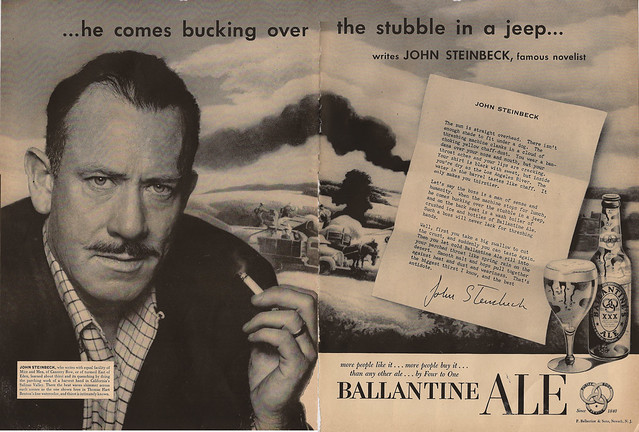
Between 1951 and 1953, P. Ballantine and Sons Brewing Company, or simply Ballentine Beer, created a series of ads with at least thirteen different writers. They asked each one “How would you put a glass of Ballantine Ale into words?” Each author wrote a page that included reference to their beer, and in most cases not subtly. One of them was John Steinbeck, who’s the “American author of 27 books, including 16 novels, six non-fiction books, and five collections of short stories.

Today is the birthday of John Steinbeck (February 27, 1902–December 20, 1968), who was “widely known for the comic novels Tortilla Flat (1935) and Cannery Row (1945), the multi-generation epic East of Eden (1952), and the novellas Of Mice and Men (1937) and The Red Pony (1937). The Pulitzer Prize-winning The Grapes of Wrath (1939)[2] is considered Steinbeck’s masterpiece and part of the American literary canon. In the first 75 years after it was published, it sold 14 million copies.

The winner of the 1962 Nobel Prize in Literature, he has been called ‘a giant of American letters.’ His works are widely read abroad and many of his works are considered classics of Western literature.

Most of Steinbeck’s work is set in southern and central California, particularly in the Salinas Valley and the California Coast Ranges region. His works frequently explored the themes of fate and injustice, especially as applied to downtrodden or everyman protagonists.”

steinbeck

His piece for Ballantine was done in the form of a few paragraphs of one of his novels about the desert, like “The Grapes of Wrath:”

The sun is straight overhead. There isn’t enough shade to fit under a dog. The threshing machine clanks in a cloud of choking yellow chaff-dust. You wear a bandana over your nose and mouth, but your throats aches and your lips are cracking. Your shirt is black with sweat, but inside you’re dry as the Los Angeles River. The water in the barrel tastes like chaff. It only makes you thirstier.

Let’s say the boss is a man of sense and humanity. When the machine stops for lunch, he comes bucking over the stubble in a jeep, and on the back seat is a wash boiler of crushed ice and bottles of Ballantine Ale. Such a boss will never lack for threshing hands.

Well, first, you take a big swallow to cut the crust, and suddenly you can taste again. The you let cold Ballantine Ale rill into your parched throat like a spring rain on the desert. Smooth malt and hops pull together against the heat and dust and weariness. That’s the biggest thirst I know, and the best antidote.

steinbeck2

Filed Under: Art & Beer, Beers, Just For Fun Tagged With: Advertising, Ballantine, History, Literature

Beer In Miniature

February 22, 2017 By Jay Brooks

miniature-cans
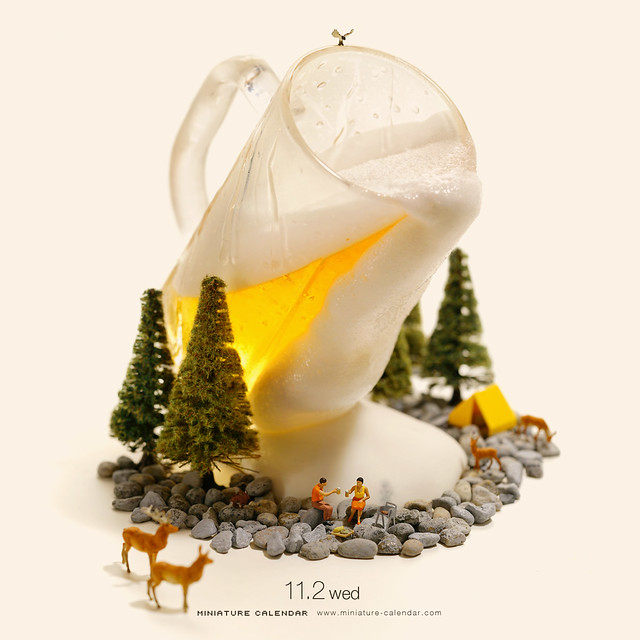
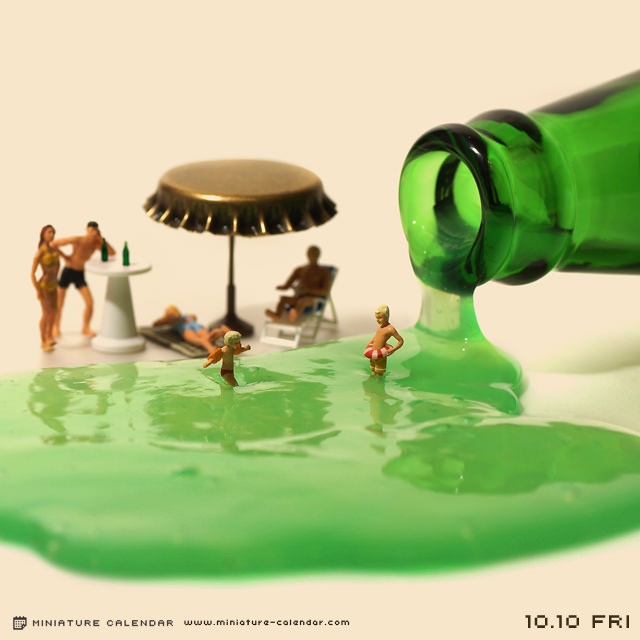
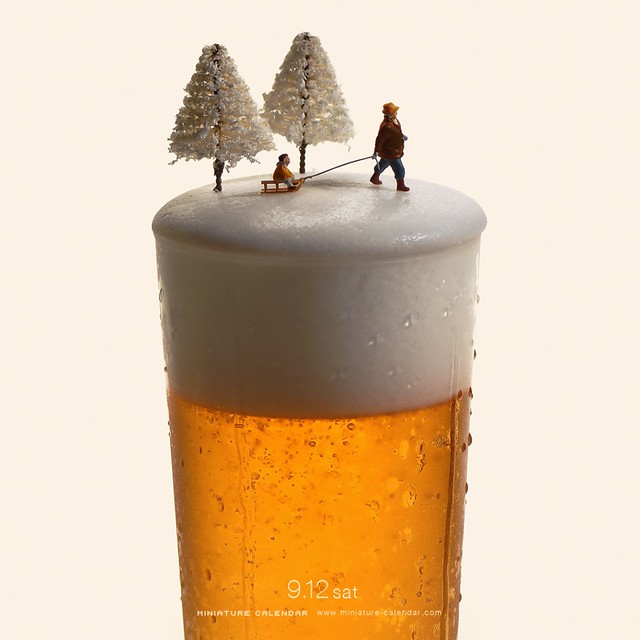
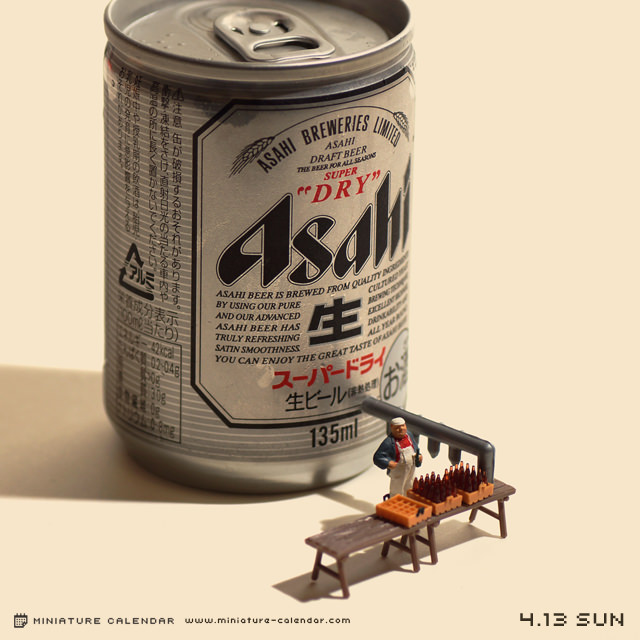
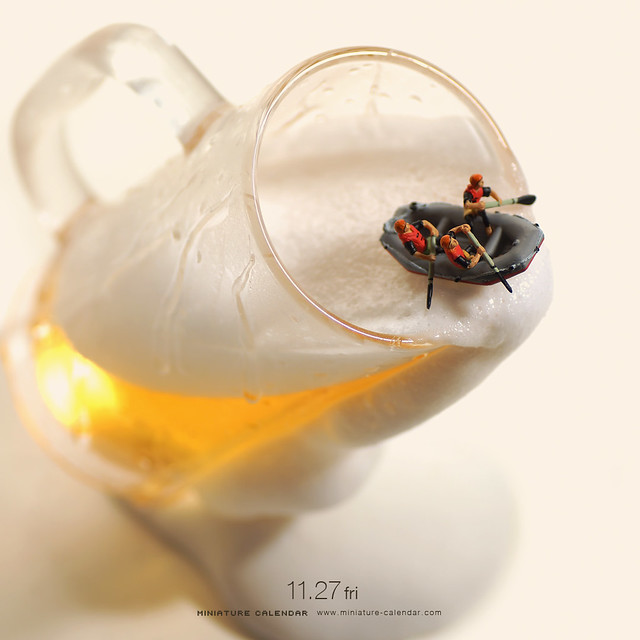
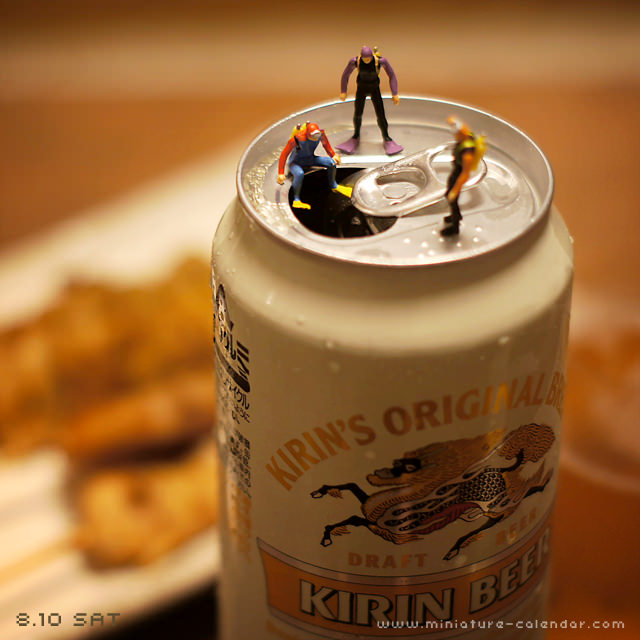
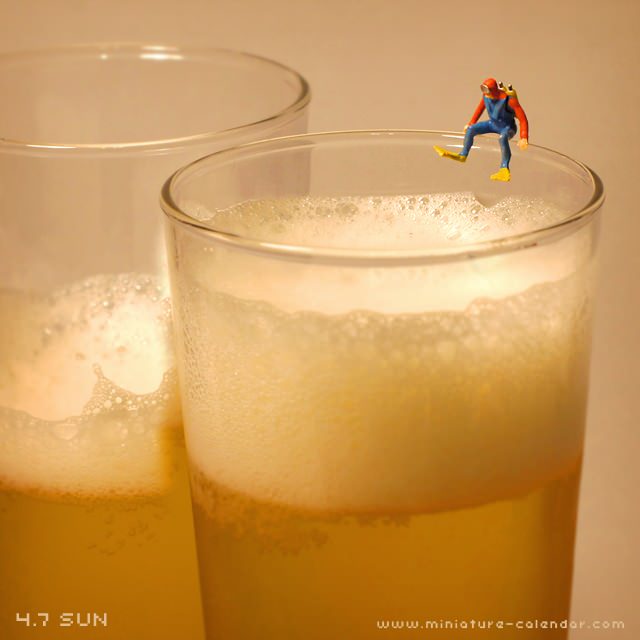
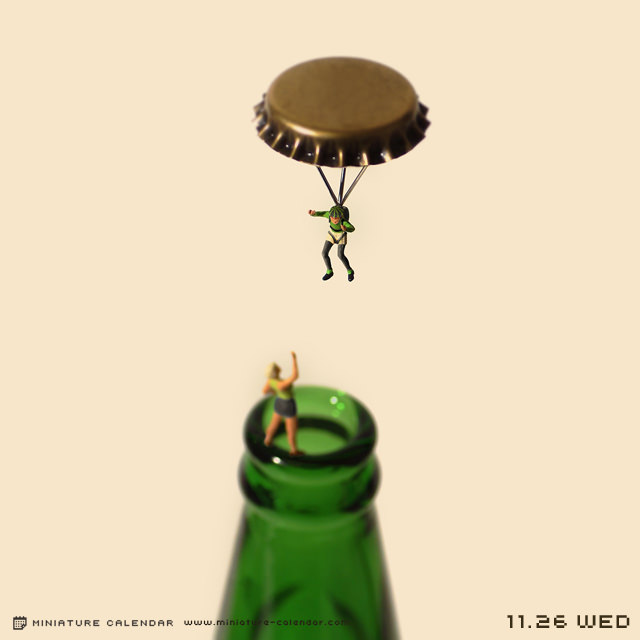
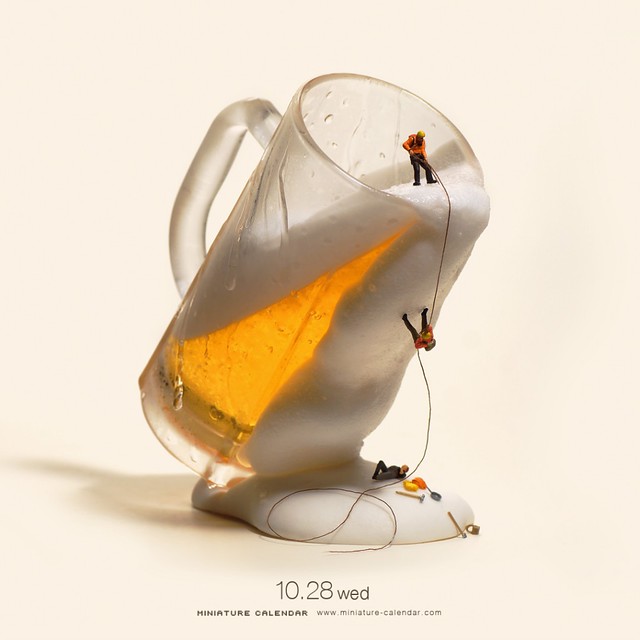
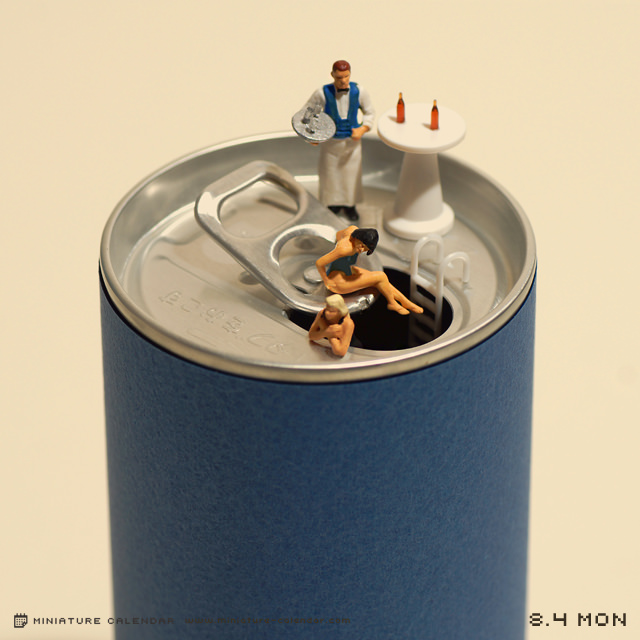
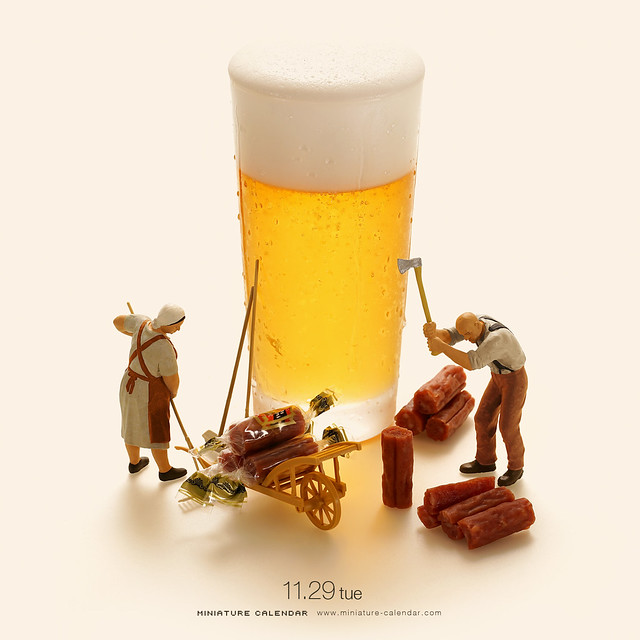
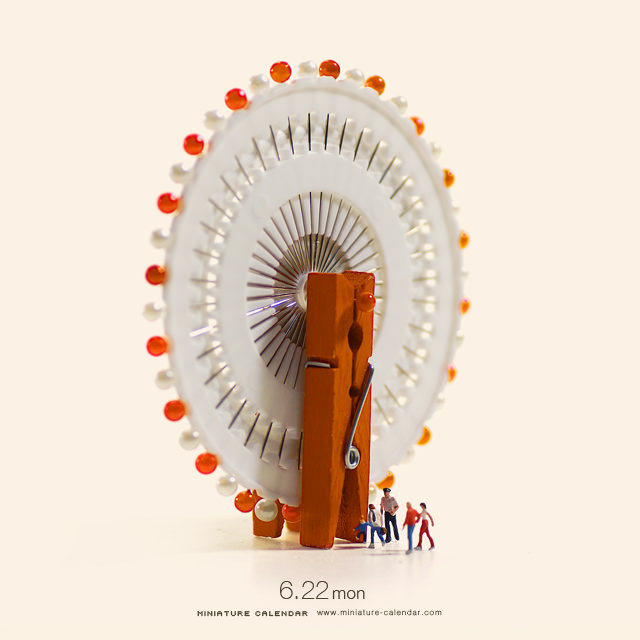
A Japanese photographer, Tatsuya Tanaka, started a daily project back in 2011, photographing a miniature diorama scene every single day, and he’s been at it now non-stop since April 20 of that year, producing (so far) 2,161 pictures. He’s posted them in calendar form, showing a month of thumbnails on a page, at his website, Miniature Calendar. He’s even collected some of them into books, which are available online.

With over 2,000 dioramas created and photographed so far, it’s probably no surprise that some of them are beer-themed. So here’s a sample of some of his photographs. These are not necessarily some of the best ones he’s done, but they’re still pretty awesome, and have something to do with beer. Go over to his website and lose yourself in the rest for a few hours. They’re pretty awesome. Enjoy.

Wednesday, November 2, 2016
161102wed

Friday, October 10, 2014
141010fri

Saturday, September 12, 2015
150912sat

Sunday, April 13, 2014
140413sun

Friday, November 27, 2015
151127fri

Saturday, August 10, 2013
130810sat

Sunday, April 7, 2013
130407sun

Wednesday, November 26, 2014
141126wed

Wednesday, October 28, 2015
151028wed

Monday, August 4, 2014
140804mon

Tuesday, November 29, 2016
161129tue

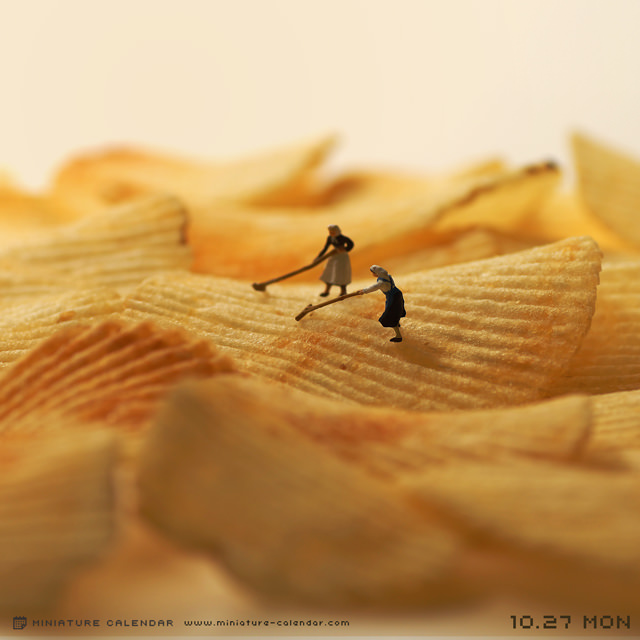
And because life isn’t all beer and skittles, here are two more featuring other passions of mine.

Monday, October 27, 2014
141027mon

Monday, June 22, 2015
150622mon

Filed Under: Beers, Just For Fun, Related Pleasures Tagged With: Humor, Japan, Photography

Beer Word: Symposium

February 20, 2017 By Jay Brooks

beer-word
Last year, for the members of the North American Guild of Beer Writers, I set up a post-CBC symposium the day after the Craft Brewers Conference ended in Philadelphia. We’ll be doing it again in DC this year, on Friday, April 14. Essentially it’s a mini-CBC and we had six speakers, one hour each, including one panel of three, over the course of the day. When I was putting it together, I wasn’t sure what to call it, but liked the sound of symposium. Merriam-Webster defines “symposium” as “a formal meeting at which several specialists deliver short addresses on a topic or on related topics” and Dictionary.com states it’s “a meeting or conference for the discussion of some subject, especially a meeting at which several speakers talk on or discuss a topic before an audience.”

symposium-drinking-party
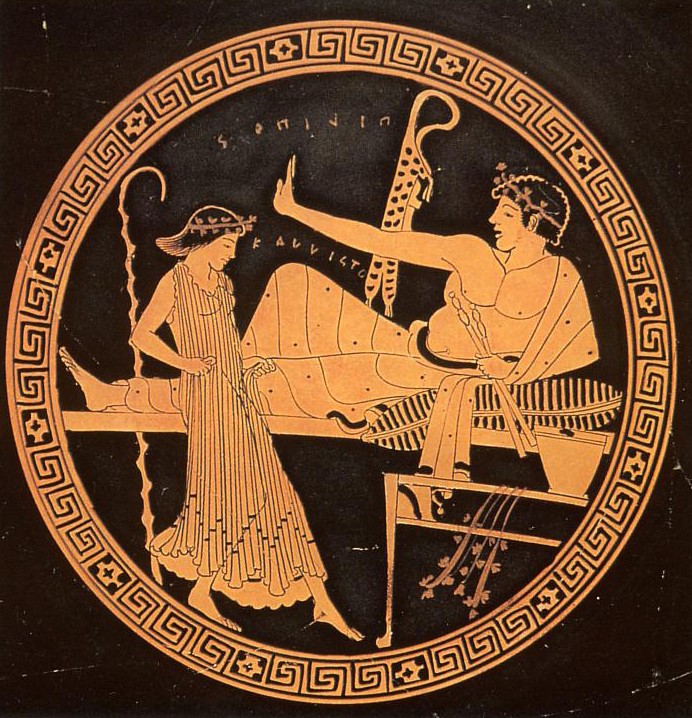
Symposium scene: a reclining youth holds aulos in one hand and gives another one to a female dancer. Tondo from an Attic red-figured Kylix, c. 490-480 BC. From Vulci.

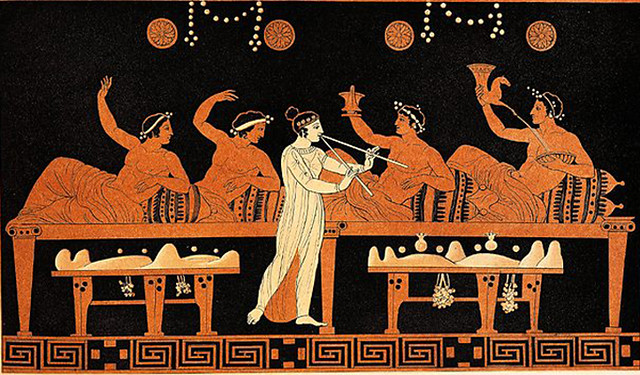
But I just learned that it has an older, original meaning that made my choice of naming our symposium even more perfect than I’d realized. That meaning, according to Merriam-Webster is “a drinking party; especially: one following a banquet and providing music, singing, and conversation.” And dictionary.com defines it “(in ancient Greece and Rome) a convivial meeting, usually following a dinner, for drinking and intellectual conversation.”

Here’s the Etymology:

Borrowing from Latin symposium, from Ancient Greek συμπόσιον ‎(sumpósion, “drinking party”) from συμπίνω ‎(sumpínō, “drink together”) συν- ‎(sun-, “together-”) + πίνω ‎(pínō, “drink”).

Symposiumnorthwall
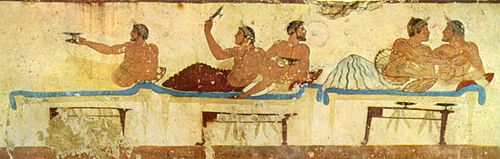
A fresco taken from the north wall of the Tomb of the Diver
(from Paestum, Italy, c. 475 BC): a symposium scene.

This is from the Online Etymology Dictionary:

n. 1580s, “account of a gathering or party,” from Latin symposium “drinking party, symposium,” from Greek symposion “convivial gathering of the educated” (related to sympotes “drinking companion”), from syn- “together” (see syn- ) + posis “a drinking,” from a stem of Aeolic ponen “to drink,” cognate with Latin potare “to drink” (see potion ). The sense of “meeting on some subject” is from 1784. Reflecting the Greek fondness for mixing wine and intellectual discussion, the modern sense is especially from the word being used as a title for one of Plato’s dialogues. Greek plural is symposia, and the leader of one is a symposiarch (c.1600 in English).

And this is the “Did You Know?” section of Merriam-Webster:

It was drinking more than thinking that drew people to the original symposia and that gave us the word symposium. The ancient Greeks would often follow a banquet with a drinking party they called a “symposion.” That name came from “sympinein,” a verb that combines pinein, meaning “to drink,” with the prefix syn-, meaning “together.” Originally, English speakers only used “symposium” to refer to such an ancient Greek party, but in the 18th century British gentlemen’s clubs started using the word for gatherings in which intellectual conversation was fueled by drinking. By the 19th century, “symposium” had gained the more sober sense we know today, describing meetings in which the focus is more on the exchange of ideas and less on imbibing.

So that sounds about right, but with more emphasis on the imbibing, at least that was the goal. But I think I need to attend a lot more symposiums.

Tondo_of_a_Kylix_by_the_Brogos_Painter

Filed Under: Beers, Just For Fun, Related Pleasures Tagged With: Greece, History, Rome, Words

The 8 Kinds Of Drunks

February 17, 2017 By Jay Brooks

thomas-nashe
There are a bewildering number of words to describe that someone has been drinking a bit to much. I’ve collected over 3,000 slang terms, or Drunk Words. There are modern terms, of course, and slang from almost every age of man. Even Ben Franklin had his own list. Another literary take on over-indulging came from Thomas Nashe, who “was a playwright, poet, and satirist. He is best known for his novel The Unfortunate Traveller.” He lived from 1567 until around 1601, and was also “considered the greatest of the English Elizabethan pamphleteers.” One of his pamphlets was entitled the Pierce Penniless, His Suppliction to the Devil, published in 1592. “It was among the most popular of the Elizabethan pamphlets.”
It is written from the point of view of Pierce, a man who has not met with good fortune, who now bitterly complains of the world’s wickedness, and addresses his complaints to the devil. At times the identity of Pierce seems to conflate with Nashe’s own. But Nashe also portrays Pierce as something of an arrogant and prodigal fool. The story is told in a style that is complex, witty, fulminating, extemporaneous, digressive, anecdotal, filled with wicked descriptions, and peppered with newly minted words and Latin phrases. The satire can be mocking and bitingly sharp, and at times Nashe’s style seems to relish its own obscurity.

pierce-penniless

And this is the sort of introduction of the list, that paragraphs that precede it.

King Edgar, because his subjects should not offend in swilling, and bibbing, as they did, caused certaine iron cups to be chayned to everie fountaine and wells fide, and at euery Vintner’s doore, with iron pins in them, to stint euery man how much he should drinke; and he that went beyond one of those pins forfeited a penny for euery draught. And, if stories were well searcht, I belieue hoopes in quart pots were inuented to that ende, that eury man should take his hoope, and no more. I haue heard it justified for a truth by great personages, that the olde Marquesse of Pisana (who yet liues) drinkes not once in feauen years; and I haue read of one Andron of Argos, that was so sildome thirstie, that hee trauailed ouer the hot, burning sands of Lybia, and neuer dranke. Then, why should our colde Clime bring forth such fierie throats? Are we more thivstie than Spaine and Italy, where the sunnes force is doubled? The Germaines and lowe Dutch, me thinkes, should bee continually kept moyst with the foggie ayre and stincking mystes that aryse out of theyr fennie soyle; but as their countrey is ouer-flowed with water, so are their heads alwayes ouer-flowen with wine, and in their bellyes they haue standing quag-myres and bogs of English beere.

One of their breede it was that writ the booke, De Arte Bibendi, a worshipfull treatise, fitte for none but Silenus and his asse to set forth : besides that volume, wee haue generall rules and injunctions, as good as printed precepts, or statutes set downe by Acte of Parliament, that goe from drunkard to drunkard; as still to keepe your first man, not to leaue anie flockes in the bottonie of the cup, to knock the glasse on your thumbe when you haue done, to haue some shooing home to pul on your wine, as a rasher of the coles, or a redde herring, to stirre it about with a candle’s ende to make it taste better, and not to hold your peace whiles the pot is stirring.

Nor haue we one or two kinde of drunkards onely, but eight kindes.

THE EIGHT KINDES OF DRUNKENNES

Below are the eight types of drunks, as articulated by Nashe, along with commentary by the staff of Merriam-Webster.

  1. Ape Drunk
    ape
    The first is ape drunke; and he leapes, and singes, and hollowes, and danceth for the heavens;

    From Merriam-Webster: A number of the animals referenced in Nashe’s list have found themselves commonly used in compound nouns, or functioning as a figurative adjective. Ape, however, appears to have largely escaped this fate. It does come up in the expression go ape (“to become very excited or angry”), which is somewhat similar in meaning to the actions of the drunk described by Nashe but as this is not recorded until the middle of the 20th century it is unlikely to have a connection to ape drunk.

  2. Lion Drunk
    lion
    The second is lion drunke; and he flings the pots about the house, calls his hostesse whore, breakes the glasse windowes with his dagger, and is apt to quarrell with anie man that speaks to him;

    From Merriam-Webster: When considering how often one encounters another person who might best be described as “drunk and mean,” it is rather odd that we should have lost more than one useful ways of referring to such a person in our language. For in addition to Nashe’s lion drunk a number of Scottish dictionaries make note of barley-hood, which is an episode of bad temper brought about by imbibing. A variant of this word, barlikhood, is memorably defined in the glossary to a collection of British plays from the late 18th century: “a fit of drunken angry passion.”

  3. Swine Drunk
    swine
    The third is swine drunke; heavie, lumpish, and sleepie, and cries for a little more drinke, and a fewe more cloathes;

    From Merriam-Webster: Some people think that swine have received a bad rap, what with the whole secondary meaning of “contemptible person,” large portions of the world’s population considering them unclean animals, and the general pejorative meanings of the word pig; others think that they likely don’t care much, save to be relieved that some people do not want to eat them. It is unclear to most lexicographers what connection exists between the members of the family Suidae and Nashe’s idea that a swine drunk wants a “fewe more cloathes.”

  4. Sheep Drunk
    sheep
    The fourth is sheepe drunk; wise in his conceipt, when he cannot bring foorth a right word;

    From Merriam-Webster: Sheep are not an animal that is traditionally associated with drunkenness, or misbehavior of any sort, come to think of it. The word for this particular animal has been used to indicate that a person, or group or people, is timid, meek, or in some other fashion unassertive. If you would like to describe someone as sheepish, meaning “resembling a sheep”, but would like to not have to explain that you don’t mean the sense of sheepish that is tied to embarrassment, you may use the word ovine.

  5. Maudlin Drunk
    maudlin
    The fifth is mawdlen drunke; when a fellowe will weepe for kindnes in the midst of ale, and kisse you, saying, “By God, captaine, I love thee. Goe thy wayes; thou dost not thinke so often of me as I doo thee; I would (if it pleased God) I could not love thee as well as I doo;” and then he puts his finger in his eye, and cryes;

    From Merriam-Webster: We have all met the maudlin drunk; in fact, the word maudlin began with the express meaning of “drunk enough to be emotionally silly,” and later took on the sense of “effusively sentimental.” The word comes from Mary Magdalene, the name of the woman who is often thought to be represented as washing Jesus’ feet with her tears. Through this representation (which some people think is not necessarily Mary Magdalene) the name came to be associated with tears, teariness, and a general state of lachrymosity.

  6. Martin Drunk
    martin
    The sixt is Martin drunke; when a man is drunke, and drinkes himselfe sober ere he stirre;

    From Merriam-Webster: There are a number of animals which are called martin; the name is applied to a wide variety of swallows and flycatchers (these are birds), to a kind of female calf that is born simultaneous with a male (and which is usually sterile and sexually imperfect), and also was formerly used to refer to an ape or monkey. Nashe’s martin drunk most likely is concerned with the last of these three possibilities. The Oxford English Dictionary, one of the few that records any of these kinds of drunkards, suggests that the martin in question was chosen by Nashe as a means of referring to Martin Marprelate, the pseudonym of a rival pamphleteer in the late 16th century.

    While I think Merriam-Webster got most of these right, I think their analysis of Martin was a bit of a stretch, and I think there’s a simpler explanation. The “Dictionary of Phrase and Fable,” from 1894, includes the following definition for “Martin Drunk:”

    Very intoxicated indeed; a drunken man “sobered” by drinking more. The feast of St. Martin (November 11) used to be held as a day of great debauch.

    St. Martin’s Day is still an important holiday in several countries, and I think that Martin being used in that sense makes a great deal more sense than the other, seemingly flimsier explanation.

  7. Goat Drunk
    goate
    The seventh is goate drunke; when, in his drunkennes, he hath no minde but on lecherie;

    From Merriam-Webster: The goat has long been associated with lechery, so it it not surprising that Nashe’s list should reserve this animal for the category of “drunk and horny.” Goat itself has had the meaning of “lecher” since the late 16th century, and a number of words meaning “resembling a goat” (such as rammish and hircine) have also taken on the meaning of “lustful.”

  8. Fox Drunk
    fox
    The eighth is fox drunke—when he is craftie drunke, as manie of the Dutchmen bee, that will never bargaine but when they are drunke.

    From Merriam-Webster: Many of us are somewhat familiar with the extended uses of fox, often implying slyness or craftiness, and which range from being used in expressions (crazy like a fox) to simply being on of the figurative meanings of the word itself (“a clever crafty person”). Less commonly known is the sense of fox (which is now somewhat archaic), meaning “drunk” (although, it should be noted, without any connotations of craftiness). And even less commonly known than this is that Dutchmen will not bargain unless they are drunk … we think Nashe may have made this one up. 


So what do you think of his list. It’s over 400 years old, but still seems to hold some universal truth. Although perhaps a more modern list might look a little different. We may have to look into that.

Filed Under: Beers, Just For Fun, Related Pleasures Tagged With: drinking attitudes, History, Literature, Words

Hulk Smashes Beer Cans

February 16, 2017 By Jay Brooks

hulk
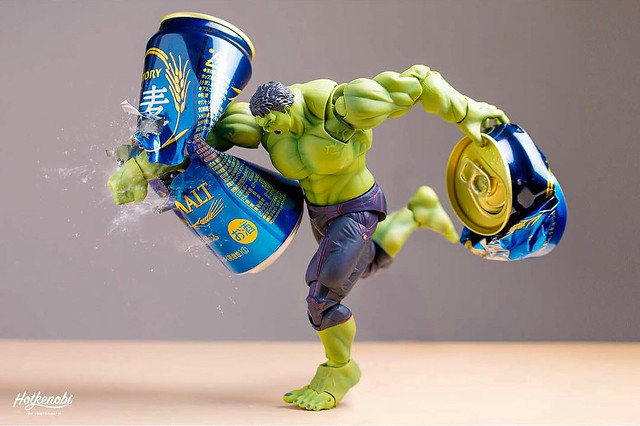
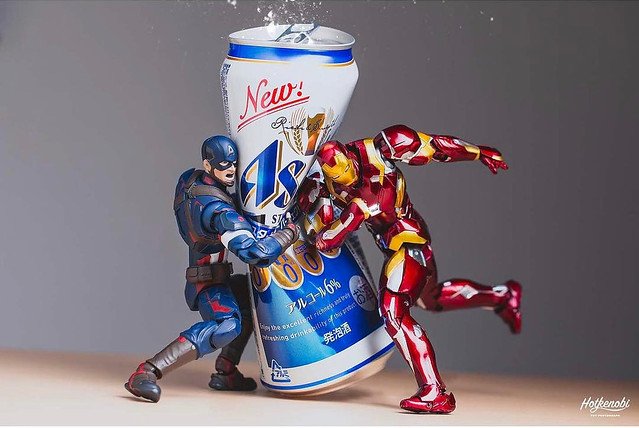
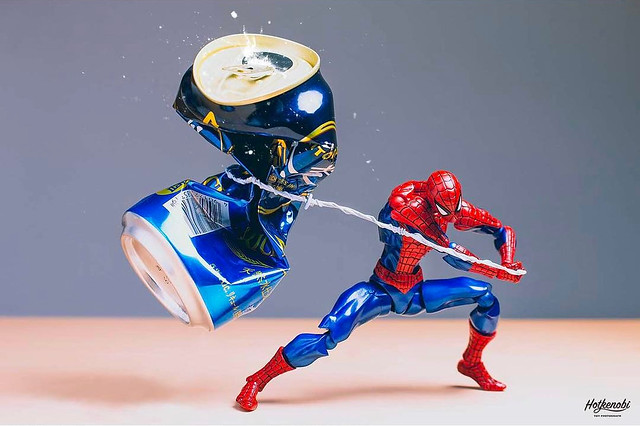
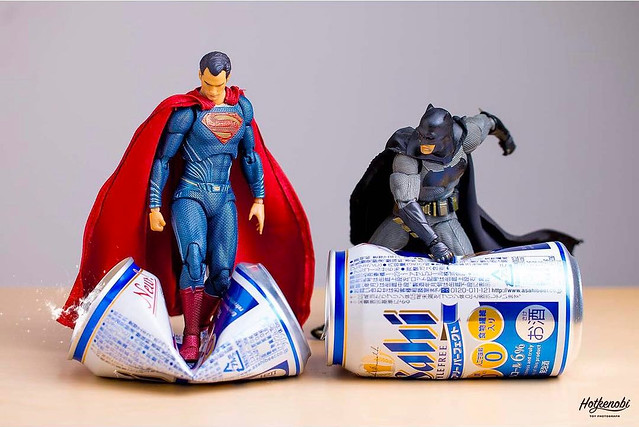
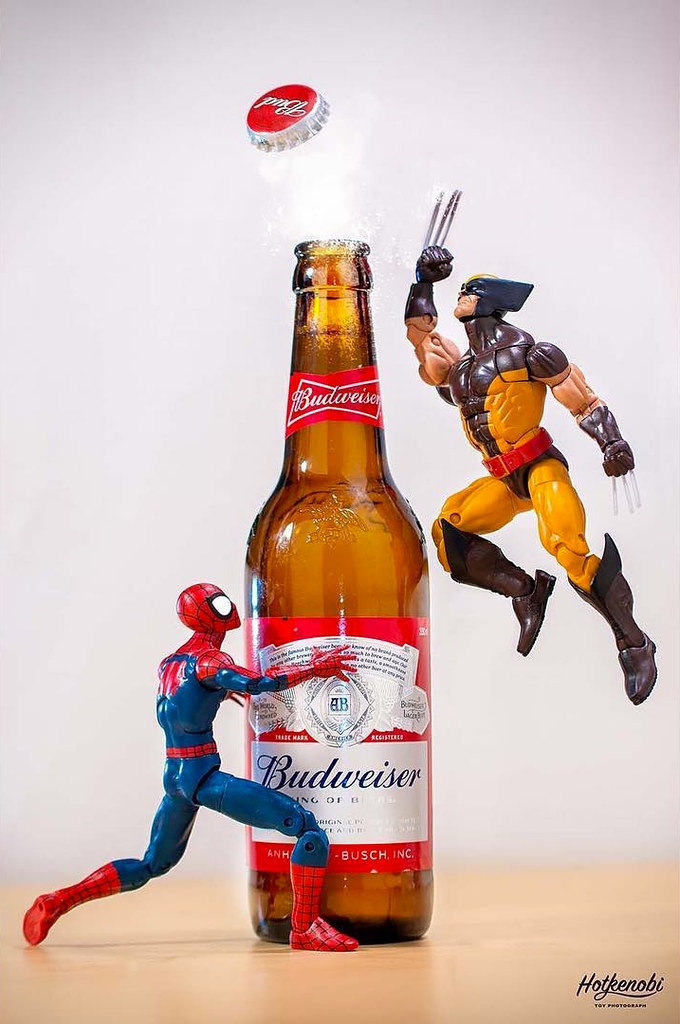
Here’s a fun series of photographs by a Japanese photographer who goes by hot kenobi on Instagram. Apparently he likes action figures, especially of super heroes, quite a bit. Both his Instagram and Twitter feed are filled with photos he’s taken of them in all sorts of situations. But lately, several of his works have involved superheroes, mostly from Marvel, having some fun with beer cans and bottles. Enjoy.

hotkenobi-superheroes-2
Hulk smashes beer cans.

hotkenobi-superheroes-1
Captain America holds a can of Asahi like a punching bag while Iron Man takes a swing at it.

hotkenobi-superheroes-4
Spider-Man takes down a beer can with his web.

hotkenobi-superheroes-3
Superman easily crushes his can, while the mortal Batman has made only a small dent in his.

hotkenobi-superheroes-5
Just to mix things up, Wolverine opens a beer bottle with his adamantium claws, as Spider-Man holds on to it so it won’t fall over and spill.

Filed Under: Art & Beer, Just For Fun, Related Pleasures Tagged With: Cans, Comics, Humor, Photography

New Beer Words: Snotter

February 8, 2017 By Jay Brooks

beer-word
Here’s yet another new word that should be added to the beer lexicon. Well, it’s not exactly a new word, but has been around at least since 1824, and most likely earlier. It showed up today in my twitter feed, from Merriam-Webster, as part of their Words at Play series. The word is snotter and has several meanings, the most common being nautical — A fitting that holds the heel of a sprit close to the mast — and others along the lines of “to snivel; to cry or sob.” And more recently snotter is used as another word for snot.

But Merriam-Webster today highlighted an older, less-common meaning of the word in their Words at Play piece entitled “‘Snotter’, ‘Groak’, and 6 More Words Associated with Bad Habits.”

P1010030
Michael Jackson nosing a beer, during GABF judging in 2002.

Here’s the definition that should be folded into our beer lexicon:

Snotter

Definition: to breathe noisily

Snotter is a dialectal British word, and, as is so often the case with dialect words, carries a certain trenchant charm. It also has a variety of closely-related meanings, as it may be used to refer to snoring, sniveling, sniffing, snorting, or simply as another way to say snot.

If you’ve ever been a beer judge, or even were in a room watching other people judge beer, then you’ve most likely encountered a snotter. There’s a whole lot of noisy breathing going on during beer judging, whether it’s one long draw or a series of short, quick sniffs. Frankly, if you’re not a snotter, you’re probably not doing it correctly.

P1010017

Filed Under: Just For Fun, Related Pleasures Tagged With: Humor, Words

Going For A Beer

February 4, 2017 By Jay Brooks

new-yorker
Today is the birthday of Robert Coover (February 4, 1932- ). He “is an American novelist, short story writer, and professor emeritus in the Literary Arts program at Brown University. He is generally considered a writer of fabulation and metafiction.” He’s written ten novels, along with countless short stories, novellas, and plays. In 2011, he wrote a short story for the New Yorker magazine, entitled “Going for a Beer.”

going-for-beer

Going For A Beer

He finds himself sitting in the neighborhood bar drinking a beer at about the same time that he began to think about going there for one. In fact, he has finished it. Perhaps he’ll have a second one, he thinks, as he downs it and asks for a third. There is a young woman sitting not far from him who is not exactly good-looking but good-looking enough, and probably good in bed, as indeed she is. Did he finish his beer? Can’t remember. What really matters is: Did he enjoy his orgasm? Or even have one? This he is wondering on his way home through the foggy night streets from the young woman’s apartment. Which was full of Kewpie dolls, the sort won at carnivals, and they made a date, as he recalls, to go to one. Where she wins another—she has a knack for it. Whereupon they’re in her apartment again, taking their clothes off, she excitedly cuddling her new doll in a bed heaped with them. He can’t remember when he last slept, and he’s no longer sure, as he staggers through the night streets, still foggy, where his own apartment is, his orgasm, if he had one, already fading from memory. Maybe he should take her back to the carnival, he thinks, where she wins another Kewpie doll (this is at least their second date, maybe their fourth), and this time they go for a romantic nightcap at the bar where they first met. Where a brawny dude starts hassling her. He intervenes and she turns up at his hospital bed, bringing him one of her Kewpie dolls to keep him company. Which is her way of expressing the bond between them, or so he supposes, as he leaves the hospital on crutches, uncertain what part of town he is in. Or what part of the year. He decides that it’s time to call the affair off—she’s driving him crazy—but then the brawny dude turns up at their wedding and apologizes for the pounding he gave him. He didn’t realize, he says, how serious they were. The guy’s wedding present is a gift certificate for two free drinks at the bar where they met and a pair of white satin ribbons for his crutches. During the ceremony, they both carry Kewpie dolls that probably have some barely hidden significance, and indeed do. The child she bears him, his or another’s, reminds him, as if he needed reminding, that time is fast moving on. He has responsibilities now and he decides to check whether he still has the job that he had when he first met her. He does. His absence, if he has been absent, is not remarked on, but he is not congratulated on his marriage, either, no doubt because—it comes back to him now—before he met his wife he was engaged to one of his colleagues and their co-workers had already thrown them an engagement party, so they must resent the money they spent on gifts. It’s embarrassing and the atmosphere is somewhat hostile, but he has a child in kindergarten and another on the way, so what can he do? Well, he still hasn’t cashed in the gift certificate, so, for one thing, what the hell, he can go for a beer, two, in fact, and he can afford a third. There’s a young woman sitting near him who looks like she’s probably good in bed, but she’s not his wife and he has no desire to commit adultery, or so he tells himself, as he sits on the edge of her bed with his pants around his ankles. Is he taking them off or putting them on? He’s not sure, but now he pulls them on and limps home, having left his beribboned crutches somewhere. On arrival, he finds all the Kewpie dolls, which were put on a shelf when the babies started coming, now scattered about the apartment, beheaded and with their limbs amputated. One of the babies is crying, so, while he warms up a bottle of milk on the stove, he goes into its room to give it a pacifier and discovers a note from his wife pinned to its pajamas, which says that she has gone off to the hospital to have another baby and she’d better not find him here when she gets back, because if she does she’ll kill him. He believes her, so he’s soon out on the streets again, wondering if he ever gave that bottle to the baby, or if it’s still boiling away on the stove. He passes the old neighborhood bar and is tempted but decides that he has had enough trouble for one lifetime and is about to walk on when he is stopped by that hulk who beat him up and who now gives him a cigar because he’s just become a father and drags him into the bar for a celebratory drink, or, rather, several, he has lost count. The celebrations are already over, however, and the new father, who has married the same woman who threw him out, is crying in his beer about the miseries of married life and congratulating him on being well out of it, a lucky man. But he doesn’t feel lucky, especially when he sees a young woman sitting near them who looks like she’s probably good in bed and decides to suggest that they go to her place, but too late—she’s already out the door with the guy who beat him up and stole his wife. So he has another beer, wondering where he’s supposed to live now, and realizing—it’s the bartender who so remarks while offering him another on the house—that life is short and brutal and before he knows it he’ll be dead. He’s right. After a few more beers and orgasms, some vaguely remembered, most not, one of his sons, now a racecar driver and the president of the company he used to work for, comes to visit him on his deathbed and, apologizing for arriving so late (I went for a beer, Dad, things happened), says he’s going to miss him but it’s probably for the best. For the best what? he asks, but his son is gone, if he was ever there in the first place. Well . . . you know . . . life, he says to the nurse who has come to pull the sheet over his face and wheel him away.

Filed Under: Beers, Birthdays, Just For Fun, Related Pleasures Tagged With: Literature, Writing

Ballantine’s Literary Ads: James A. Michener

February 3, 2017 By Jay Brooks

ballantine
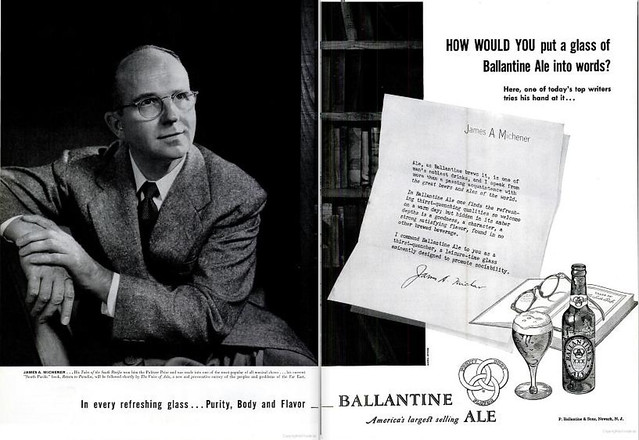
Between 1951 and 1953, P. Ballantine and Sons Brewing Company, or simply Ballentine Beer, created a series of ads with at least thirteen different writers. They asked each one “How would you put a glass of Ballantine Ale into words?” Each author wrote a page that included reference to their beer, and in most cases not subtly. One of them was James A. Michener, who’s best known for Tales of the South Pacific.

Today is the birthday of James A. Michener (February 3, 1907–October 16, 1997), who “was an American author of more than 40 books, the majority of which were fictional, lengthy family sagas covering the lives of many generations in particular geographic locales and incorporating solid history. Michener was known for the popularity of his works; he had numerous bestsellers and works selected for Book of the Month Club. He was also known for his meticulous research behind the books.

Michener’s novels include Tales of the South Pacific for which he won the Pulitzer Prize for Fiction in 1948, Hawaii, The Drifters, Centennial, The Source, The Fires of Spring, Chesapeake, Caribbean, Caravans, Alaska, Texas and Poland. His non-fiction works include Iberia, about his travels in Spain and Portugal; his memoir titled The World Is My Home, and Sports in America. Return to Paradise combines fictional short stories with Michener’s factual descriptions of the Pacific areas where they take place.”

ballantine-1951-Michener

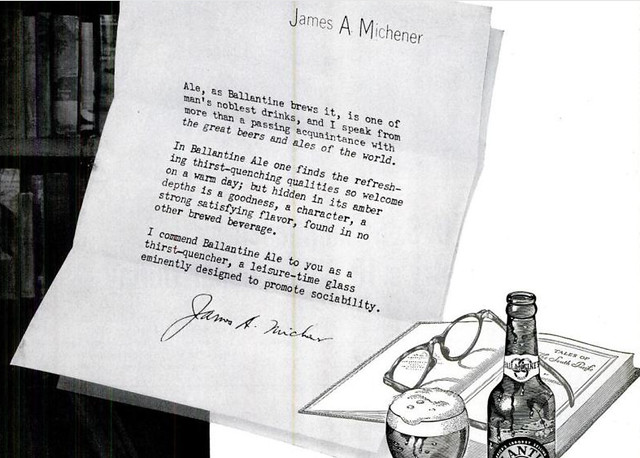
His piece for Ballantine was done in the form of a letter of recommendation:

Ale, as Ballantine brews it, is one of man’s noblest drinks, and I speak from more than a passing acquaintance with the great beers and ales of the world.

In Ballantine Ale one finds the refreshing thirst-quenching qualities so welcome on a warm day; but hidden in its amber depths is a goodness, a character, a strong satisfying flavor, found in no other brewed beverage.

I commend Ballantine Ale to you as a thirst-quencher, a lesiure-time glass eminently designed to promote sociability.

ballantine-1951-Michener-text

Filed Under: Art & Beer, Beers, Just For Fun Tagged With: Advertising, Ballantine, History, Literature

Brewhog Determines 6 More Weeks Of Winter Beers For 2017

February 2, 2017 By Jay Brooks

groundhog-day
Over in Gobbler’s Knob, in Punxsutawney, Pennsylvania, Phil the Groundhog — a.k.a. the Brewhog — raised up his head this morning and looked around, and this year and saw his shadow. You know what that means? It’s six more weeks of drinking winter beers this year. Or something about a late spring, I can’t keep it straight. You can see a video of Punxsutawney Phil here. And there’s more information about Groundhog Day at the Punxsutawney Groundhog Club.

groundhog-field-beer

But this year, I suppose given how the year is going isn’t too surprising, not every groundhog agrees on what the future hold. For example, both Staten Island Chuck along with General Beau Lee in Georgia have predicted an early spring. And so did Shubenacadie Sam in Canada.

groundhog-brew-label

Although another Canadian groundhog, Balzac Billy, from Alberta, Canada, did see his shadow and so is predicting six more weeks of winter, as did Buckeye Chuck of Ohio and Essex Ed of Orange, New Jersey. And so did Big Al, a 14-foot, 1,000-pound alligator, from Texas, who is given KFC chicken each February 2. If he eats the chicken, it’s an early spring, if he passes, then it’s more winter. This year, he didn’t eat.

So it’s up in the air whether, I mean weather, we’ll have an early spring or more winter. I tend to go with the original, Punxsutawney Phil, but for no better reason then I’m from Pennsylvania. I guess we’ll have to wait and see.

alaskan-marmot
In Alaska, they celebrate Marmot Day.

Fingers crossed. And if you don’t have time to watch all of the deliciously wonderful Groundhog Day film today, here it is in a slightly shorter version just over three minutes.

Filed Under: Just For Fun, News, Related Pleasures Tagged With: Holidays, Pennsylvania

« Previous Page
Next Page »

Find Something

Northern California Breweries

Please consider purchasing my latest book, California Breweries North, available from Amazon, or ask for it at your local bookstore.

Recent Comments

  • Bob Paolino on Beer Birthday: Grant Johnston
  • Gambrinus on Historic Beer Birthday: A.J. Houghton
  • Ernie Dewing on Historic Beer Birthday: Charles William Bergner 
  • Steve 'Pudgy' De Rose on Historic Beer Birthday: Jacob Schmidt
  • Jay Brooks on Beer Birthday: Bill Owens

Recent Posts

  • Beer In Ads #5389: Point & Brunswick Bock Beer November 10, 2026
  • Historic Beer Birthday: Edward Cecil Guinness November 10, 2026
  • Historic Beer Birthday: Jacob Betz November 10, 2026
  • Beer In Ads #5388: Bock Beer Vats In The Brewers Hall November 9, 2026
  • Historic Beer Birthday: Peter Barbey November 9, 2026

BBB Archives

Feedback

Head Quarter
This site is hosted and maintained by H25Q.dev. Any questions or comments for the webmaster can be directed here.