Brookston Beer Bulletin

Jay R. Brooks on Beer

  • Home
  • About
  • Editorial
  • Birthdays
  • Art & Beer

Socialize

  • Dribbble
  • Email
  • Facebook
  • Flickr
  • GitHub
  • Instagram
  • LinkedIn
  • Pinterest
  • RSS
  • Twitter
  • YouTube

Powered by Genesis

Historic Beer Birthday: Frank Jones

September 15, 2025 By Jay Brooks

frank-jones

Today is the birthday of Frank Jones (September 15, 1832–October 2, 1902). He was born in New Hampshire and in the 1870s owned the largest brewery in the U.S. He settled in Portsmouth, New Hampshire and after working for his brother for a time, he began working at a brewery. Accounts differ as to whether he simply worked for Englishman John Swindell or if they were partners in the brewery, but after a short time together, Jones became the sole owner of the brewery. According to one timeline, the John Swindells Brewery was founded in 1856, but two years later, in 1858, it became Swindells & Jones Brewery, and a year after that was renamed the Frank Jones Brewery, which it remained until prohibition. After repeal, it reopened as the Eldridge Brewing Co., at least until 1943. Another source says in 1943, it started trading again as the Frank Jones Brewing Co., but closed for good in 1950.

Frank-Jones

Jones was also active in politics and in 1868 was elected mayor of Portsmouth, N.H. Six years later, in 1874 he was elected to Congress as a Democrat and served two terms, deciding not to run for a third. In 1880, he ran for Governor of New Hampshire, but narrowly lost the race. Later in life, he became disgusted by William Jennings Bryan’s stand on “Free Silver,” and he switched to the Republican party. 

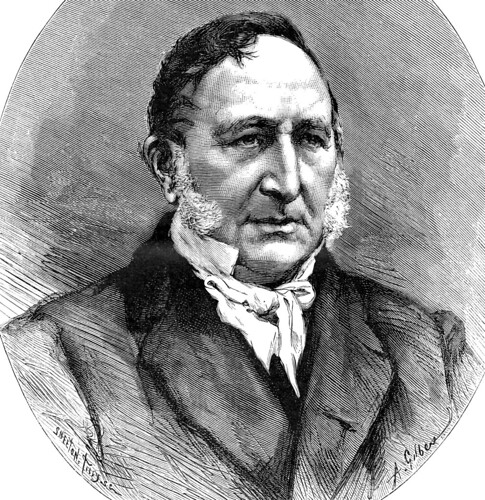
frank-jones-1890s
Jones in the 1890s.

Here is a short biography of Jones from Find-a-Grave:

US Congressman. He was active in numerous businesses, most notably a brewery that by the 1870s was the largest ale brewer in the United States. He invested his profits in other ventures, including hotels, banks, and race horses. He was elected Mayor of Portsmouth, New Hampshire in 1867 and served from 1868 to 1869. He was then elected as a Democrat to represent New Hampshire’s 1st Congressional District in the United States House of Representatives, serving from 1875 to 1879. He unsuccessfully ran for New Hampshire Governor in 1880, losing to Charles Henry Bell. He remained active in the Democratic party, and was an advocate for expansion of the Portsmouth Navy Yard. He was a supporter of Grover Cleveland and in 1885 declined President Cleveland’s offer to nominate him for Secretary of the Navy. In the 1890s he sold his brewery to British investors and became active in railroads and insurance. In 1896 he broke with the Democratic party and was a delegate to the 1900 Republican national convention. The Frank Jones Brewing remained in business until Prohibition in 1917; in the 1990s a local microbrewery briefly revived the name, and in 2000 Nutfield Brewing Company reintroduced Frank Jones Ale. The building that housed his brewery is today home to Tecnomatix Unicam, a computer software company.

frank-jones-1880

And this is his biography from Wikipedia:

Frank Jones was born in Barrington, New Hampshire, on September 15, 1832. He attended the public schools in Barrington. He moved to Portsmouth in 1849 and became a successful merchant and brewer. He owned businesses in Portsmouth and South Boston, Massachusetts.

Jones, the mayor of Portsmouth in 1868 and 1869, elected as a Democrat to the Forty-fourth and Forty-fifth Congresses (March 4, 1875 – March 3, 1879) was not a candidate for renomination in 1878. He was the unsuccessful Democratic candidate for Governor of New Hampshire in 1880, losing to Republican Charles Henry Bell by only a few thousand votes, 44,432 to 40,813.

Later, Jones became involved with the Republican Party. He was disgusted over William Jennings Bryan’s stand on Free Silver. He became interested in railroads and hotels. Jones rebuilt the stately Rockingham Hotel in Portsmouth and enlarged the Hotel Wentworth (now Wentworth-by-the-Sea) in New Castle. Also in Portsmouth, Jones built a mansion in the Second Empire style, with gardens and a horse track, completed in 1876.[1] He was a presidential elector on the Republican ticket in 1900. He died in Portsmouth, New Hampshire, on October 2, 1902, and was buried in Harmony Grove Cemetery.

The Frank Jones Brewery was one of the largest producers of ale in the United States of America. In 1896, Jones’ Portsmouth brewery produced about 250,000 barrels a year. In 1889, Jones put his company’s stock on the market in London. The new company was incorporated on May 17, 1889. In 1950, the Frank Jones Brewery closed after 90 years.

Frank_Jones_brewery_&_malt_houses,_Portsmouth,_N.H.

This account of the brewery is from “Beer New England,” by Will Anderson:

“Keeping up with the Joneses” was not just an idle expression in turn-of-the-century New Hampshire brewing circles: it was a most difficult task indeed. Dominating Manchester was True Jones; dominating Portsmouth (and scores of other markets, too!) was Frank Jones. The two were brothers, part of a family of seven children born unto Mary and Thomas Jones of Barrington, a small town roughly fifteen miles west of Portsmouth. Frank was the older of the two . . . and it was he who would go on to far and away greater prominence. Little, in fact, is known about True Jones. He appears to have followed Frank (and several other siblings) to Portsmouth, from whence he made his way to the state’s largest city, Manchester. There he, in 1891, gained control of the Carney, Lynch & Company brewery. Changing the name to the True W. Jones Brewing Company, he became king of the Manchester brewing scene. But, then again, that was pretty easy: by the 1890s True W. Jones was the only game in town. He was the only brewer in Manchester. True passed away on October 2, 1899, but the brewery that bore his name continued on until New Hampshire went dry in 1917.

But if little is known about True Jones, lots is known about his older brother. Frank Jones was truly a giant among Granite Staters. Raymond A. Brighton, who chronicled the history of Portsmouth in his THEY CAME TO FISH, devoted an entire chapter to Frank, declaring that, while Portsmouth has had many, many notables in its three-hundred fifty plus years of existence, “none of them dominated their times as completely as did Frank Jones.”

Born in 1832, Frank came to Portsmouth — not to be a brewer, but to work as a tin peddler for his brother Hiram’s hardware and stove business — at age sixteen. Frank was much too ambitious, however, to merely peddle tin for very long. By 1858 he’d involved himself in the brewery of an Englishman named John Swindells. Within little more than a year he owned it. And once he owned it, Frank Jones set out to make his brewery the biggest and best around. He added a malt house in 1863, and a second one in 1879. A new brewhouse was constructed in 1870; in 1878 he added a cooperage department; what were generally believed to be the largest ale and porter storage cellars in the world were built in the early 1880s; and extensive bottling works were constructed in 1900.

What really made Frank Jones a Big Man Around Portsmouth, however, was his outside-of-brewing activities and interests. He was twice elected mayor of his adopted city; served New Hampshire as a two-term Congressman; lost in a bid to become governor by a scant 2,000 votes in 1880; was president of the Boston & Maine Railroad, the Granite State Fire Insurance Company, the Portsmouth Fire Association, and the Portsmouth Shoe Company; and was proprietor of two still extant hotels, the Rockingham (in Portsmouth) and the rather colossal Wentworth-by-the-Sea (in nearby Newcastle).

To again quote Portsmouth historian Brighton: “The man was a legend in his own time.”

frank-jones-brewery

This more comprehensive account of the brewery is from Rusty Cans, who also did an exhibition on the Frank Jones Brewery in 2010.

The Frank Jones Brewery was once one of the largest in New England and was founded and headed by a prototypical 19th Century self-made businessman in Portsmouth New Hampshire.  This website is centered on cans, and Frank Jones Ale was never sold in cans. However, it remains one of my favorite breweries perhaps because it was New Hampshire’s most prominent brewery and my wife is a Granite State native.  Actually, until Anheuser-Busch opened their plant in Merrimack in June 1970 it was the only large brewery to operate in New Hampshire. At any rate, here is the story of the Frank Jones Brewery.

Frank-Jones-Portsmouth-Ale--Labels-Frank-Jones-Brewing-Company

Franklin Jones was born in Barrington, New Hampshire in 1832.  He was the fifth of six boys as well as the fifth of seven children in his family.  He left home at 16 and moved to Portsmouth and worked as an apprentice in his older brother Hiram’s stove store.  Within 3 years he owned an interest in the store and in 1854 he took it over completely.  Throughout his life Jones would be active in several businesses at once, a pattern he developed early and in these early years he was also a tin peddler and a rag picker.  In 1858 he became partners with John Swindell, an Englishman who had recently moved to Portsmouth to start a brewery producing ale. 

Jones’ partnership with Swindell only lasted a few months before Jones owned the entire business including the property and, apparently, the recipe for ale that Swindell was using.  A somewhat more ribald story held that Jones, a notorious ladies man, got the recipe for his ale from a housewife he seduced while working as a tin peddler.  However he acquired it, Jones’s ale would be a successful and popular product until 1950.  Swindell did not do as well.  After selling out to Jones he opened another brewery which was not very successful.  He died in 1864 when he was hit by a train while pushing a little girl out of its path.

Frank-Jones-Ale--Labels-Frank-Jones-Brewing-Company

By the time of the Civil War the Frank Jones Brewery was operating profitably and competing with one main rival, the Eldridge Brewing Company founded in Portsmouth in 1864 by Herman Eldridge.  The two companies kept up their rivalry until Prohibition.  Local Prohibitionist sympathies were strong, but the two breweries had steady business.  They even held their own against the many ale-producing breweries in Albany, New York and  Boston.

Jones continually expanded his brewery as the centerpiece of his many businesses.  The Portsmouth Chronicle published  lengthy description of Jones brewery.  Ironically, the paper’s publisher, Frank Miller, although a friend of Jones, was also a prohibitionist.  

Frank_Jones_Company

“In connection with this brewery, Mr. Jones has, within a year or two, erected a large building for a malt house, and here the process of brewing (malting) commences. In the bins, lay immense piles of pure Canada barley, 25,000 to 33,000 bushels, certainly, ‘good looking enough to eat as ale does to drink after the batch is made. About 500 bushels of grain is thrown into the great circular wooden water tank, the sides of which are higher than your head, located in the lower room, and soaked for a couple of days. Then, having been winnowed of all bad kernels, peas, other grains, weed seeds, etc., by dipping off these extraneous matters, which all float on the top of the water, and which are sold at a price for light food for horses, and for pigs, hens and etc. … – the soaked and perfect barley are spread on the smooth, clean floor to the depth of six inches or so, and there lies for a few days to swell and sprout, heat and ferment. There are three of these piles or beds of barley, of 500 bushels each, spread over the floor, in different stages of preparation.

“From here the grain goes into the drying room, the floor of which is iron, punctured with innumerable little holes, like a strainer or sieve, and the coal fires in the furnaces which are never allowed to go out, day or night, the year round. When entirely dry, the grain, which is now malt, or malted barley, is conveyed to the brewery proper, and cracked in a mill, then soaked again, this time in hot water, pure from the Portsmouth Aqueduct, and placed on another sieve or strainer, and the liquid caught below, which, as extract of barley, is all of the grain which is wanted. The residue is the “Brewers Grain” which is sold for food for animals, and is a valuable manure.

“Hops are now added to this liquid extract in such quantities as to produce ale of desired strength and quality, whether stock, amber or cream; and, after fermenting to the proper point, is barreled for use. In pure ale there is no other ingredient besides these, water and hops. But adulteration by means of “quassis” (the wooden bark of tropical trees) instead of hops, may be made at greatly reduced prices. .. . We understand that Mr. Jones” accommodations, spacious and complete as they are, are by no means sufficient for his increasing business; and he has extensive stables and sheds already in the course of erection, and contemplates considerable additions to his brewery and malt house.”

(there is no date listed for this quote in Brighton, King of the Ale makers, 39-40, but it was probably written about 1865.)
Frank-Jones-Ale--Labels-Frank-Jones-Brewing-Co

Jones continued to expand and modernize his brewery over the years.  In 1878 Jones added a cooperage (barrel house) and the next year added a second malt house to his brewery.  At about the same time Jones bought part partnership of a second brewery in Boston to make ale.  In 1883 “The Western Brewer” (a brewer’s trade journal) listed Frank Jones as the largest ale brewer in the country: they had  brewed almost 150,000 barrels of ale in 1882.  As a result of his increasing demand, Jones begins to develop local springs as a water supply.  In 1884 the brew-house was expanded and in 1888 the “Clock Tower” is finished at the brewery.  It was 140 feet high, 40 feet taller than the rest of the brewery.  The clock face measured 11 feet across and the tower bell weighed over 3,000 lbs.  By that time Jones employed over 500 men at his brewery, which probably made him the largest employer in Portsmouth.  In 1890 the brewery added a large bottling shop. 

Frank Jones ales were so popular that in 1889 he opened a branch office in Boston.  In 1875 Jones and his son-in-law and business partner Sinclair together with two other investors bought the Henry Souther & Company brewery in South Boston for $150,000.  The Boston brewery then had the capacity to produce 650 barrels a day, a rate which greatly increased over the years.   Jones put his brother True W. Jones to run the Boston branch.  When one of Jones’ business partners sold out the brewery was renamed the Bay State Brewery.  The Boston brewery continued operation until 1905.

FJB_brewerytower

In the 1890s British financial interests began buying American breweries.  The 1880s had been a time of expansion for many brewers in the US.  When a major depression started in 1893 many brewers found themselves in severe debt.  Moreover, the growth in the number of breweries meant that there was more production capacity than demand.  As a result, breweries had started to consolidate even before the depression began.    In the meantime, stock offerings in European breweries had all been purchased already and British investors were looking for a new outlet.  As the Western Brewer noted…

[The British] are tired of investments in oriental bonds, African mining stock, colonical (sic) promotional organizations, etc.  There is no money in those affairs, and they are quite risky.  Hence American securities attract large attention.  But British speculators will not invest in American railroad stocks…nor will they invest in mining stock….American brewery stock is a more stable commodity. (quoted in Baron, Brewed in America 269)

British investors began buying American breweries in the 1880s and when a depression started in the United States in 1893 and brewers began to fall into financial trouble, British investors stepped in even more.  A number of the investors would buy all or most of the breweries in a single area, often paying well over market value to corner the market.  The buyers would then combine the breweries into one company.  Such trusts operated in Baltimore, Chicago, Detroit, Boston, Philadelphia as well as in other cites.  Efforts to buy some of the biggest concerns such as Anheuser-Busch, Schlitz and Pabst were rebuffed, however.  However, many investors had overpaid for their property.   Consumption of beer dropped in 1894 and 1895 due to the depression and the resulting beer price wars in many areas dropped the price of beer drastically.  In Chicago, for example, the price per barrel went from $6.00 to $3.50.    When the beer tax increased to $2.00 in 1898 to pay for the Spanish-American war over-extended investors began to sell.  Finally, the attempted concentration of breweries had meet with resistance from some local brewers and new, independently owned breweries began to be formed to compete with the conglomerates.

frank-jones-tray

Jones’ sale came at the start of this wave of purchases and was a sign of what would be coming.  He sold his two breweries for $6,300,00 of which between two and three million was “foreign capital.”  He got about 6% in cash and the rest in stock and bonds which were then sold on the British stock market.  Jones kept about $500,000 in stock and he remained on the brewer’s board of directors so in effect he remained in charge.  The British directors were William Heygate, a director of the Middleton Railway, and English brewers E. Ind and R. Pryor.  Jones and his business partner son in law Sinclair made about four million dollars in profit.  Jones guaranteed a 15% net annual profit for three years to the buyers.

There was some local discussion of what British control over such a prominent business would mean to Portsmouth but Jones assured the city that he would remain in control.  A local newspaper under the control of one of Smith’s Republican rivals charged that he was selling his brewery to the British in order to buy out the Boston & Maine railroad.  Jones in fact did become President of the B&M Railroad in 1889, but he had already been on the board of directors.  Sale of the brewery, however, undoubtedly did give him more resources for expanding his other businesses including his railroad stock.  

The brewery of course continued after Jones died in 1902.  In 1903 the Boston plant was closed.  The main brewery in Portsmouth, however, continued brewing ale until Prohibition began in New Hampshire in 1917.  

frank-jones-postcard-1900

The Frank Jones Brewery never reopened after Prohibition.  Its equipment was sold off: the Heuther Brewing Company in Ontario bought the bottling equipment.  But the brand was reborn when Prohibition ended.  Ironically, it was produced by the Eldridge Brewing Company of Portsmouth, Jones’ old rival.  From 1933 to 1937 the Eldridge Brewing Company brewed ale in the old Frank Jones plant under the Eldridge name.  In 1937 it renamed itself the Frank Jones Brewing Company.  Originally their ale was called Eldridge Portsmouth Ale.  However, just to continue the confusion, it was brewed with the old Frank Jones formula!  In 1937 the ale was also renamed Frank Jones Ale. 

FJones_sign1
An ad from the 1940s.

In 1947 the brewery was sold to Caldwell, Inc. another New Hampshire company, one which distilled rum. (This is a different company from the present Caldwell, Inc. which manufactures things such as pallet lifters.)  Consumers’ tastes were changing, however.  Prior to World War II New England and upper New York state were the last holdouts to prefer ale to lager beer.  After the war, however, lager beer gained favor in the Northeast and Frank Jones continued losing sales.  In 1950 the brewery closed.  Some of the buildings still stand in Portsmouth, however, used as offices and shops. 

frank-jones-employees-1910
Employees of the Frank Jones Brewery around 1910.

And this fascinating look at their labels is from a 1902 pamphlet entitled “How Good Ale is Brewed.”

frank-jones-brewery-labels
Frank-Jones-IPA

Filed Under: Birthdays, Breweries, Just For Fun, Politics & Law Tagged With: History, New Hampshire

Historic Beer Birthday: Herman Lackman

September 15, 2025 By Jay Brooks

lackman
Today is the birthday of Herman Lackman (September 15, 1826-June 30, 1890). He was born in Germany, but came to the U.S. as a young man, settling in Cincinnati, Ohio. He founded what would become the Herman Lackman Brewing Co. with a business partner, J.H. Sandmann, and the brewery continued until 1919, when prohibition closed it for good.

Apparently a fansite, Light Over Glass has a lot of information about the brewery, including some biographical information about Lackman:

HERMAN LACKMAN, brewer, a native of Thedinghausen, near Bremen, in Germany, was born Sept. 15, 1826. After he received the usual elementary education, he helped his father (a farmer by trade) work in the fields, until the age of twenty. Without the hope of advancement at home, he moved to America in 1847, and, while learning the language of the country, he stopped in Baltimore, Md. Where he got a job as a farm laborer. In 1849 he came to the West, and settled in Cincinnati. Just two days after his arrival, he found employment in a sawmill where he earned seventy-five cents to a dollar the day. He remained there for eighteen months, until September 1850, and then got a different job paying a monthly salary of thirty-five dollars working for Brauer Schaller & ship, where he spent five years driving a lumber wagon and later a beer wagon.

This certainly was a modest start, but Mr. Lackman managed horses well, possessing a powerful frame and being capable of great labor, and there was something in the man above his calling, and what it was became apparent in 1855, when, by investment of his earnings he became in a small way a brewer himself. Knowing no gateway to success except the one inscribed “hard work,” he applied himself diligently to business, rapidly increased his sales, and through sound methods, straightforward conduct and the ability to organize and carry on a large enterprise, he gained a fortune.

In 1855, Herman Lackman and J.H. Sandmann leased the brewery of Louis Schneider on Agusta Street. Lackman had worked for Foss-Schneider. In 1860 the operation was moved to the property located at Sixth and Stone Streets because they needed more room. Their new property had a beer celler that could hold about 500 barrels. With their expansion they were able to increase the brewery’s output from 2000 barrels in 1855 to approximately 6000 barrels in 1865.

In 1868 Lackman bought out Sandmann’s shares in the company and renamed it, The Herman Lackman, and in 1890, The Herman Lackman Brewing Company. J. H. Sandmann, having retired from the business in 1868, died in 1872, with the respect of all who knew him. Herman Lackman conducted the business alone, and, as said, became the real founder of the present company. Herman Lackman believed in “beer as an agent of good”. He held, however, that to accomplish this good it must be pure-made of the pure malt of barley and hops alone. His principles became known and became part of his beer making.

LackmanPlant

In the new building all modern methods of brewing are perfected. The company does its own milling. Its malt is made from the cream of the barley market. No steam arises from the brew kettle. The great engines move without noise or smoke. The vast ice machines are silently at work. Everything is as neat as the parlor of a painstaking house-wife, from floor to ceiling. Stone floors are clean and ceilings shine. Brasses are burnished and steel glitters.

With a model mill-house, brew-house, engine and boiler-house, whose cap-stone was laid three years after the founder’s death [see biographical sketch], and just that long after he had superintended the building of the foundations. In this building, except one small house, there is not an inch of wood. Stone, iron, steel and brass are its components. It is fireproof, and enduring, like the memory of the good man who planned it, whose four sons would carry out his designs.

One of them, Edward H. Lackman, has since followed his father to his long rest. He was the youngest son, an athlete and an enthusiast, like his brothers, in physical sports, but died early—not, however, before he had contributed his portion of loving labor to the enterprise with which the family name is identified.

Herman Lackman was prominent in city affairs, and served with honor in the school board, as president of the German Orphan’s Asylum, as president of the Third German Reformed Church, as trustee of the Bodmann’s Widows’ Home, director of the Sun Mutual Insurance Company, major in the militia, and president of the Cincinnati Brewers’ Association—which position his son Albert now so worthily fills. Open-hearted and charitable, thoroughly believing that his life work was one of real practical temperance reform. Mr. Lackman died in Cincinnati, June 30, 1890. His death, just as he was beginning extensive improvements to his business, was a public bereavement. He left four sons to take up his work where he left it off.

lackman-blotter

Also, Peared Creation has a short history of the brewery:

Herman Lackman was a native of Thedinghausen, Germany. At age 21 Herman saw no hope of progress in his country so he came to United States. From working in a railroad in Maryland to driving a lumber wagon and working in saw mills, Lackman did it all. It was in 1860 that Herman met up with another German immigrant, John H. Sandmann and together they established Herman-Lackman Brewery at Sixth and Stone Streets in Cincinnati.

After 8 years of doing business together, Lackman bought out Sandmann and took over majority stake in the brewery. At this point it was renamed the Herman Lackman, United States Brewery. In 1890, Lackman incorporates his business as Herman Lackman Brewing Co. In 1919, Lackman, like many brewers, found himself without a business due to the Volstead Act that ushered in the era of prohibition.

In 1933, after the repeal of Prohibition, the facility came to life again but it was bought by Hudepohl Brewing Co. and established as their second plant.

And Cincinnati Brewing History has yet another account:

“Herman Lackman and J. H, Sandmann leased the City Brewery of Louis Schneider in 1855. They paid $50 a month for the brewery on Augusta Street. They invested $1600 to buy horses and wagons. Sandmann was the brewer and Lackman delivered the beer. In 1858 because they needed more room, the partners bought property at Sixth and Stone Streets for $13,000. By 1860 they were able to move their new quarters there. Their new plant had a beer cellar that could hold 5000 barrels. They had increased the brewery’s output from 2,000 barrels in 1855 to about 6,000 barrels in 1865.

Having established a successful business, Lackman felt confident enough to return to Germany for an extended visit. When he came back to Cincinnati in 1868, after almost three years, he bought Sandmann’s share in the company and renamed it the Herman Lackman Brewing Company. He paid his former partner $80,000 in this transaction.

By 1870 the brewery produced 10,000 barrels of beer, a year later the plant was expanded. The beer cellars had a total capacity of 12,000 barrels. Lackman had a 98 foot well dug and the water was pumped by a windmill or by a steam engine in calm weather. The brewery advertised that the well yielded water that was free from all mineral deposits and crystal clear. In 1880 the brewery produced 30,000 barrels of beer. Eventually 5 wells were dug.

In 1890 with $600,000 capital stock the business was incorporated. The brewery produced 45,000 barrels the same year. The plant now included a mill house, brewery building, and an engine and boiler house. All were constructed of brick, iron, and stone to prevent fires. A statue of Gambrinus, the ‘god’ of beer stoop atop the brewery.

Herman Lackman died in 1893. His sons took over the corporation then. Albert Lackman became president. Interestingly, he did not drink beer because it did not agree with him. Henry F. Lackman served as vice-president. Brother Edward H. Lackman was also a company officer. They expanded the brewery and production reached 60,000 barrels a year in 1894. Only barley was used in making the beer, no rice or corn.

When the brewery closed in 1919, Albert was president and treasurer; Henry, vice-president; and Herman W. Lackman, another brother, was secretary. They brewed and bottled Golden Age, a pale beer, Old Honesty, and Old Lager beers.” Cincinnati Breweries, Robert J. Wimberg (1997)

Filed Under: Birthdays, Just For Fun Tagged With: History, Ohio

Historic Beer Birthday: John H. Meyer

September 15, 2025 By Jay Brooks

bavarian-kentucky
Today is the birthday of John H. Meyer (September 15, 1818-1890 or after). Meyer was born in Oldenburg, Germany, but moved to Covington, Kentucky when he was 19. Julius Deglow founded what would become the Bavarian Brewing Co. in 1866. In 1879, John H. Meyer briefly bought a controlling interest in the brewery and for a time it was called the John Meyer Brewery. There’s not much more information I could find out about John H. Meyer, just one group photo and I was unable even to confirm when he died.

John H. Meyer is man on the far right in the front row.

The Wikipedia page for the Bavarian Brewing Co. mentions Meyer, but he’s not even considered one of the most important people in the history of the brewery, which was open for 100 years.

After the brewery was established as DeGlow & Co., new ownership interests within just a couple of years resulted in several change to its name beginning in 1868, including DeGlow, Best & Renner. However, in 1873, it was established as the Bavarian Brewery Co. Over the next several years the brewery operated under this name, but ownership interests varied. John Meyer obtained controlling interest and the brewery operated under his name for a short time, starting in 1879. Then in 1882, a German immigrant named William Riedlin, who established a saloon and beer hall called Tivoli Hall in the Over The Rhine area of Cincinnati, entered into partnership with John Meyer. It operated as the Meyer-Riedlin Brewery before Riedlin purchased controlling interest in the brewery from Meyer, incorporated the business under its former name and became president in 1889.

bavarian-postcard-bottling

The Kenton County Public Library also has a history of the Bavarian Brewery, and again Meyer figured only very briefly in the first paragraph.

bavarian-postcard-bottling-inside

Bavarian Brewery can be traced back to the year 1866 when Julius Deglow and Charles L. Best began operating a small brewery on Pike Street in Lewisburg. In 1869, the brewery officially became known as Bavarian. William Riedlin and John Meyer were the next owners of the brewery. They purchased Bavarian in 1882. Seven years later, Riedlin became the sole owner. Anton Ruh was hired as the brew master.

bavarian-covington

Filed Under: Birthdays, Breweries, Just For Fun Tagged With: History, Kentucky

Beer Birthday: Lars Larson

September 15, 2025 By Jay Brooks

trumer
Today is the 59th birthday of Lars Larson, brewmaster of Trumer Brauerei in Berkeley, California. Larsen studied brewing in Germany and was the perfect person to recreate Trumer Pils in the United States, one of the best pilsners made in California, or indeed anywhere, foreign or domestic. I got to know Lars much better several years ago, when we were both invited to judge a beer competition in Santiago, Chile, and he’s a very thoughtful brewer, and great fun to hang out with. Join me in wishing Lars a very happy birthday.

Lars Larson (Trumer), Homer Smith (Oak Barrel) & Shaun O'Sullivan (21st Amendment)
Lars, with Homer Smith of the Oak Barrel & Shaun O’Sullivan from 21st Amendment, at the Celebrator’s 22nd anniversary party in 2010.
P1080927
Lars in Chile with two of the brewers from Cerveceria Berlina in Argentina.
Lars Larson (Trumer) & Brenden Dobel (Thirsty Bear)
Lars, again at the Celebrator’s 22nd anniversary party in 2010, with Brenden Dobel, from Thirsty Bear.
P1090028
Lars’ former brewing school classmate Asbjorn Gerlach, Matt Brynildson and Lars at Kross Cerveza Independiente in Chile, which Gerlach co-founded.

Filed Under: Birthdays, Just For Fun Tagged With: Bay Area, California, Oakland

Beer In Ads #5078: Cal’s Going!! Going!!

September 14, 2025 By Jay Brooks

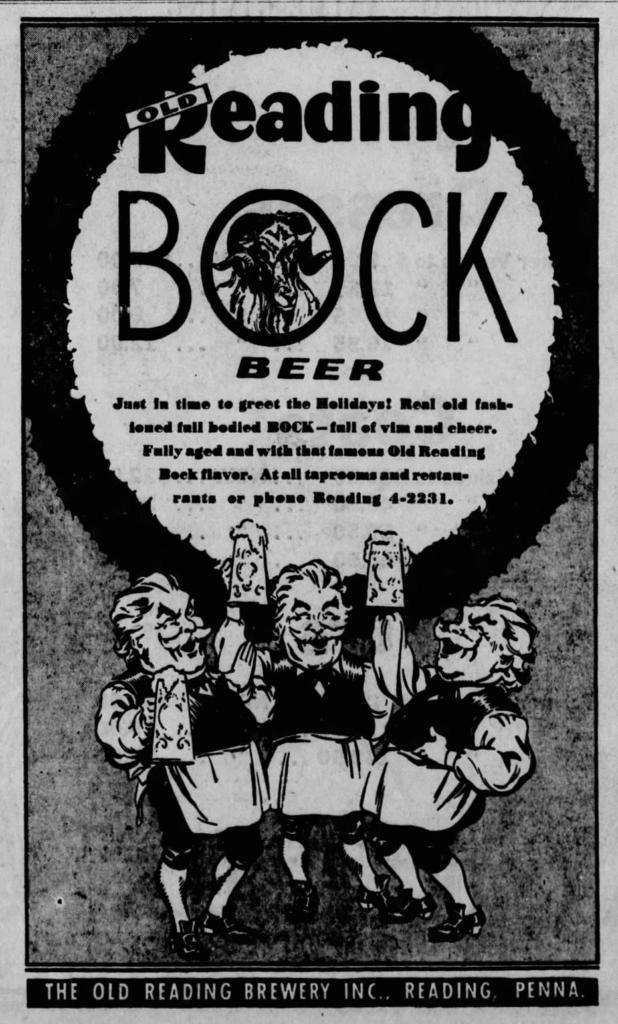
Last year I decided to concentrate on Bock ads. Bock, of course, may have originated in Germany, in the town of Einbeck. Because many 19th century American breweries were founded by German immigrants, they offered a bock at certain times of the year, be it Spring, Easter, Lent, Christmas, or what have you. In a sense they were some of the first seasonal beers. “The style was later adopted in Bavaria by Munich brewers in the 17th century. Due to their Bavarian accent, citizens of Munich pronounced ‘Einbeck’ as ‘ein Bock’ (a billy goat), and thus the beer became known as ‘Bock.’ A goat often appears on bottle labels.” And presumably because they were special releases, many breweries went all out promoting them with beautiful artwork on posters and other advertising.

Sunday’s ad is for Regal Pale Bock Beer, which was published on September 14, 1962. This one really for Cal’s Liquors, with six locations in the Salinas, California area. But they were also advertising their last 770 cases of Regal Pale Bock Beer from the Regal Pale Brewing Co. of San Francisco, California, which was originally founded in 1916 as the Pacific Brewing & Malting Co. This ad ran in The Salinas Californian, also of Salinas, California. Better hurry before they’re all gone.

Filed Under: Art & Beer, Beers, Breweries, Just For Fun Tagged With: Advertising, Bock, California, History

Beer Birthday: Mikkel

September 13, 2025 By Jay Brooks

mikkeller
Today is the 50th birthday — The Big 5-O — of Mikkel Borg Bjergsø, founder of the Danish gypsy brewery Mikkeller. I first met Mikkel in Burton-on-Trent in 2008, during I trip when I accompanied Matt Brynildson to Marston’s where he was doing a collaboration beer. But the last time I ran into him at the Firestone Walker Invitational Beer Festival several summers ago in Paso Robles. Join me in wishing Mikkel a very happy birthday.

Matt Brynildson and Mikkel comparing beards with Sir Thomas Gresham, and wondering if it’s a coincidence?
Me and Mikkel at the recent Firestone Walker Invitational Beer Festival in 2012.
Goofing around with the Firestone Walker logo.
In the cellar at one of the J.D. Wetherspoons in London, with Matt, Toshi Ishi, from Japan, and Australian brewer Richard Adamson, from the now-defunct Barons Brewing.
The same group of brewers out of the cellar and behind the handles.

Filed Under: Birthdays, Just For Fun Tagged With: Denmark

Historic Beer Birthday: Jan Léonardus Moortgat

September 13, 2025 By Jay Brooks

Today is the birthday of Jan Léonardus Moortgat (September 13, 1841-May 15, 1920). He was born in Steenhuffel, Belgium, and worked at his parent’s brewery until he was thirty, in 1871, he married and co-founded the Moortgat Farm Brewery with his wife in Breendonk, which is part of Antwerp. His son Albert created their most famous beer, “Duvel,” in 1917 as “Victory Ale,” but renamed it Duvel in 1926.

This is a Google translation of Moortgat’s Dutch language Wikipedia page:

He was born into the family of Petrus Jan Moortgat (1809-1857), brewer in Steenhuffel and Maria Anna De Geest (1811-1884). Jan Leonardus initially continued to help his mother in the brewery until he was thirty. Afterwards he left the company there to his brother Louis.

In 1871 he married Maria De Block (1846-1910), together bought a piece of land in Breendonk and founded a beer and vinegar brewery. She was the daughter of the tenants of the Spanish Castle, the centuries-old farm on the border of Breendonk and Tisselt. Brewing was combined with running a farm. Brewing was a winter activity, agriculture was used the rest of the year.

Leonard was also alderman at Breendonk from 1876 to 1915 under the mayor of the counts Maurice Louis Marie Gaston de Buisseret Steenbecque de Blarenghien (1831-1888) and his son Robert (1863-1931).

In the early 20th century, he left the management to his son Joseph. He introduced the lager but died early. Afterwards, the leadership passed to the other sons Victor and Albert Moortgat. After the First World War, the Duvel was launched and the brewery was further expanded from a family business to a major player on the Belgian market.

The original Moortgat farmhouse brewery.

This account of the early history of the brewery is from the company’s website:

It all began when Jan-Léonard Moortgat and his wife founded the Moortgat brewery farm in 1871. Around the turn of the century, Moortgat was one of the over 3,000 breweries operating in Belgium.

Jan-Leonard experimented by trial and error, and his top-fermented beers were soon greatly appreciated in the brewery’s home town of Puurs and far beyond. Before long, the Brussels bourgeoisie was also won over by his beers.

Business was booming and Jan-Leonard’s two sons, Albert and Victor, joined the company. There was a clear division of labour: Albert became the brewer, Victor was responsible for delivering the beer to Brussels by horse and dray.

Albert and the Moortgat family c. 1895.

The First World War brought Belgium into contact with England and especially with English ales, which were quite popular at the time.

Inspired by the success of English ales, Albert decided to create a special beer based on the English model.

To create this type of ale, Albert wanted to work with only the best ingredients.

He travelled to the UK to get the specific strain of yeast he wanted and initially met with considerable resistance from the local brewers. It was only after a veritable odyssey across England that he was finally able to get his hands on a precious sample from a Scottish brewery. Our yeast is still cultured from the very same strain to this day!

The two brothers continued to search and experiment until they had perfected the recipe.

To commemorate the end of the First World War, the new beer was initially dubbed ‘Victory Ale’.

Today, of course, it’s known as “Duvel.”

Filed Under: Birthdays, Breweries, Just For Fun Tagged With: Belgium

Beer Birthday: Steve Gonzalez

September 12, 2025 By Jay Brooks

stone
Today is the 55th birthday of Steve Gonzalez, who is the Senior Manager of Brewing and Innovation for Stone Brewing. Gonzalez started in the beer world with Miller, and was briefly with Gallo Winery before joining Stone a little over eight years ago. I not sure when I first met him, but it feels like it’s been a while now. Most recently, I saw him at the grand opening to Stone’s new Napa location a few years back. Join me in wishing Steve a very happy birthday.

steve-gonzalez-senior-manager-of-brewing-and-innovation-small-batch-stone-brewing-co

Steve with Mitch Steele, Matt Brynildsohn and Shaun O’Sullivan.
Steve-gonzalez-guitar
I love Steve’s expression as plays his new mandolin.

[Note: Last two purloined from Facebook.]

Filed Under: Birthdays, Just For Fun Tagged With: California, Southern California

Historic Beer Birthday: Michael Hand, Jr.

September 12, 2025 By Jay Brooks

hand

Today is the birthday of Michael Hand, Jr. (September 12, 1866-1915). He was the son of Michael Hand Sr. , who founded the Michael Hand Brewing Co. in Pawtucket, Rhode Island in 1898. Michael Jr. joined the family brewery and the two of them ran the brewery until Sr. passed away in 1911, and Jr. then became sole owner and continued running it until his own death in 1915. His widow, Annie continued the brewery until it was closed by prohibition. A local beer distributor, James Lavell, who also had a realty business, tricked her and ended up owning the brewery, and also went to jail, but after prohibition ended, he reopened it as the Rhode Island Brewing Co. It remained in business for just five years, closing for good in 1938.
Hand-Pawtucket-RI-Tray

And there’s this account from the Providence Journal:

The brewery was built by Michael Hand of Scranton, Pa., in 1898 and run by Hand and his son Michael Jr., of Pawtucket, until their deaths in 1911 and 1915, respectively. The younger Hand’s widow, Annie, was left to run the brewery, which still brewed beer, even during prohibition. Operating out of a tiny building housing Beacon Realty on Fountain Street in Providence, beer distributor James Lavell took orders and cash for the hooch he made at the Hand Brewery. He ended up in jail, but not before his Crescent Realty had loaned money to Annie Hand, secured by the brewery, and then foreclosed on the mortgage, becoming its owner as prohibition ended.

hand-brewery-opener
And this summary of the brewery is from 100 Years of Brewing:

hand-100yrs
Stout-Labels-Hand-Brewing-Co

Filed Under: Birthdays, Breweries, Just For Fun Tagged With: History, Rhode Island

Historic Beer Birthday: Christian Heurich

September 12, 2025 By Jay Brooks

heurich
Today is the birthday of Christian Heurich (September 12, 1842-March 7, 1945). He was born in Hildburghausener Landkreis district in Thüringen, Germany (though some sources say it was Haina, in Waldeck-Frankenberg located in northwest Hesse, Germany). He came to the U.S. when he was 24, in 1866. A few years later, in 1873, he founded the Chr. Heurich Brewing Co. in the Dictrict of Columbia, and it became D.C.’s longest-operating brewery, and by the 1940s, it “was second only to the U.S. federal government in the amount of land owned in Washington, DC, and the number of people [Heurich] employed.”

christian-heurich-1883


A portrait published in Western Brewer Magazine, 1883, from the Collection of the Historical Society of Washington, D.C.

Here’s his biography from Wikipedia’s entry for the Christian Heurich Mansion, or Brewmaster’s Castle:

Born in 1842 in the village of Haina, near the town of Römhild, Duchy of Saxe-Meiningen (in the region of Thuringia), Christian was the third of four children born to Casper and Marguerite (née Fuchs) Heurich. Christian’s father, was the local innkeeper which included being a butcher and brewer. Christian learned the trade from his father, in addition to several apprenticeships in his youth. By the time Christian was fourteen years both of his parents died, leaving him orphaned. He traveled throughout Europe until his older sister, Elizabeth Jacobsen, who was living in Baltimore, Maryland, convinced him to emigrate to the United States, where he would have a better chance of fulfilling his dream of starting his own brewery; he arrived in June 1866, initially joining his sister in Baltimore. In 1872, Christian went into a partnership with a man named Paul Ritter. Together, they leased a brewery from George Schnell at 1219 20th Street, NW Washington, D.C. Within a year, Mr. Schnell had died and the partnership between the two men had dissolved. In his 1934 autobiography, Aus meinem Leben Heurich writes that he was the one that did most of the labor of brewing, while Schnell entertained customers. Christian married the widow of Mr. Schnell, Amelia Mueller Schnell on September 9, 1873. In 1884, Amelia died of pneumonia.

in 1887, Christian married for the second time to Mathilde Daetz. It was with Mathilde that he built their lavish mansion at 1307 New Hampshire Avenue NW Mathilde worked very closely with the interior designers of the house, The Huber Brothers, NYC. Sadly, due to miscarriage and a carriage accident, Mathilde died in 1895, leaving Christian a widower once again. Christian threw himself into his work, creating an empire in the capital city. In 1894 he opened his new, fireproof brewery which had a capacity for 500,000 barrels of beer a year. The brewery, which rested on the Potomac River is now the site of the Kennedy Center for the Performing Arts. The Christian Heurich Brewing Company was the second largest employer in Washington D.C. during this time, apart from the Federal Government. In 1899, Christian married Amelia Louise Keyser, the niece and namesake of his first wife. Twenty-nine years her senior, together they had four children, three of whom survived into adulthood, Christian Heurich Jr, Anna Marguerite (died as infant), Anita Augusta and Karla Louise. Together, they had a long marriage until Christian Heurich Sr died in 1945 at the age of 102.

This is a lengthier biography from Immigrant Entrepreneurship, written by Mark Benbow:

Family Background

Christian Heurich Sr. was born on September 12, 1842, in the small farming village of Haina in the Duchy of Saxe-Meiningen. He was the third of four children, two boys and two girls. His parents, Casper and Margarete Fuchs Heurich, ran an inn in the village. At the time of his birth, they were tenants in what he later described as “an old castle” belonging to the University of Würzburg. As a boy, Heurich attended a school where one teacher taught several dozen students ranging from six to fourteen years of age. When he was twelve, his family moved a few kilometers away to Römhild, where his father purchased another inn and Heurich attended a new school, excelling in mathematics. In 1857, he graduated at the top of his class. At the time, he was almost fifteen, the age when adolescent males usually began their apprenticeships.

The year before Heurich finished school, his mother died and his father fell ill. Management of the inn “passed into other hands” and, although Casper Heinrich had arranged for the family to continue living there, the children began to depart one by one. Heurich’s older sister, Elisabeth Adelipa, emigrated to the United States with family friends; his older brother, August Friedrich, married and took in Heurich and his younger sister. After graduating, Heurich was apprenticed to an innkeeper in the town of Themar, about fifteen kilometers to the north. There he learned not only how to brew beer but also how to butcher – two essential skills for innkeepers. Since lighter-colored lager beers developed in Bavaria and Vienna in the early nineteenth century were quite popular at the time, these beers may have been among the first he learned to make. In any event, it was a type of beer that he would later brew to his great advantage in the U.S.

After two years as an apprentice, Heurich went on his journeyman trip, or Wanderjahre, and spent two years traveling and learning from master brewers. During his trip, Heurich put his training as a butcher and a brewer to good use: he worked as a butcher in Basel for several weeks and then walked to Munich. From there, he traveled down the Danube by raft to Vienna, where he found work as a brewer. He worked in Vienna for two years and then traveled through Graz, Trieste, Venice, and Milan. By the time he was done, he had walked, ridden, and rafted through what is now Germany, Switzerland, Austria, Italy, and Slovenia, and had worked in numerous breweries along the way. In April 1863, he returned home to Römhild, where he reported for mandatory military service. “Faulty vision” prevented him from enlisting, and he resumed his travels, working his way through Germany, France, and Switzerland before returning to Vienna on what he would later call “the poor man’s ‘grand tour’.”

Of all the cities he visited, Heurich loved Vienna the most. He later wrote of that “wonderful city” and said he “warmed to its beauty, its leisure, its culture.” He had, he noted, “passed ‘the most beautiful time of my life in Vienna.’” Heurich worked in several Viennese breweries as a brewer and a cellarer. He continued to learn different ways to make beer and planned to eventually open his own brewery. It was this dream, in fact, that prompted him to leave Vienna in the end. Elisabeth, his sister in America, explained that whereas he might never be able to open a new brewery in Vienna, there was ample opportunity to start his own business in America.

After immigrating to the United States in 1859, Elisabeth met and married Hermann Jacobsen in Baltimore. From there, she wrote to Heurich often, trying to persuade him to move to the U.S. to start his own brewery. After the American Civil War ended in 1865, Elisabeth “became more insistent,” noting that “Germans … were opening breweries all over the country. Americans were … going in for the lighter, healthier and more sustaining beverages introduced and almost daily being improved on by my own countrymen.” In other words, Americans were drinking more lager beer. Elisabeth’s letters to Heurich were typical of the “America letters” that immigrants sent home for generations. She praised her new country, stressed that the new world offered greater opportunity than the old, and she undoubtedly promised him help in starting a new life.

In 1866, Heurich followed his sister’s advice and left for America. With his savings, a bit over $200 in gold (approximately $2,830 in 2010), he traveled to Hamburg to catch a freight steamer to Great Britain. From there, he booked passage on the passenger ship Helvetia, which made regular trips between Liverpool and New York. The ship departed on April 2, 1866, and was beset by rumors of cholera that very same day. Unfortunately, the rumors quickly proved true. On the third day, the ship turned back toward Liverpool because several people had died and, in Heurich’s words, “most of the passengers were completely beside themselves.” The ship remained in quarantine in Liverpool for seven weeks, and over 300 passengers died of the disease. Heurich avoided illness because he remembered a story about a cholera outbreak in Vienna in 1855, when brewery workers survived by drinking beer instead of water. During his stay in Liverpool, he limited himself to beer and made it through the outbreak. For the record, however, he was not overly fond of English beer and later wrote that it “didn’t do me any harm except to almost persuade me to remain in that country to teach them how to make good German lager.”

The Helvetia left Liverpool the second time at the end of May and arrived in New York on June 11, 1866.[Heurich did a little sightseeing and then took a train to Baltimore to find Elisabeth and her husband Captain Jacobsen, the master of a small sailing ship that carried grain and fruit between Baltimore and the West Indies. The couple lived on Canton Avenue near Fells Point by the waterfront. This area had been home to mariners and those who built, repaired, and supplied ships since the eighteenth century. Back then, a quarter of the city’s 200,000 residents were either German immigrants or of German ancestry, and the area around Fells Point was one of the wards with the heaviest German population.

After arriving in Baltimore, Heurich found that Elisabeth and her husband were at sea. Fortunately, she had left a letter with her housekeeper in case he arrived while they were gone and gave him free reign of their home. Heurich settled in and began to learn English. Although Heurich undoubtedly heard a great deal of German in Fells Point, he was determined to learn English. He signed up for English classes at a local language school and attended three classes a day. When his sister returned with her husband, Heurich was able to greet them in “grammatical though somewhat stilted English, much to their surprise and gratification.”

Baltimore was a good place for Heurich to refine his brewing skills. In 1867, the U.S. had an estimated 3,700 breweries, and Baltimore was home to forty-five. The number was in constant flux as breweries opened, merged, closed, and reopened. Then the fourth largest city in the country, Baltimore had a large and growing population of German immigrants who were well represented in the local brewing industry. By the late 1860s, Americans had begun to acquire a taste for lighter German lager beers, which had been introduced in the U.S. in the 1840s, and newly arrived German immigrants with brewing industry experience quickly found a niche in satisfying this new taste. Heurich was one of many to take advantage of this opportunity.

The German community took an active role in greeting new arrivals. For example, the Baltimore German Society, established in 1783, distributed food and clothing to new German immigrants, and helped them find housing and doctors. Additionally, its employment agency, founded in 1845, helped thousands of newcomers find jobs. Heurich quickly found a job at Röst’s brewery, one of the first lager breweries. Its owner, the Bavarian-born George Röst, was an established member of Baltimore’s German community. He hosted traditional German immigrant societies, including a shooting society [Schützenverein], and held various events at the picnic grounds and beer garden adjacent to the brewery. Though no records exist to confirm this, it could very well be that Heurich found the position at Röst’s through the Baltimore German Society.

Heurich spent a little over a year in Baltimore. In the spring of 1867, he received his first citizenship papers, which declared his intention to become a U.S. citizen. Soon thereafter, he began working as the foreman of the malt house at Seegar’s Brewery. He believed that he owed this job largely to his “good grasp” of English. He worked there briefly and then headed west in search of better opportunities and a chance to move outside the immigrant community that, in his mind, was preventing him from perfecting his English. His first stop was Chicago, where he worked briefly for Seipp and Lehmann, a rapidly growing brewery that produced about 300,000 barrels a year in 1867. But Chicago, with is large German-American population, was not the best place to move out of the German community. Taking this step was important to Heurich, because he wanted to perfect his English skills before starting his own business, so by 1868 he was living with a cousin near Topeka, Kansas.

Heurich’s cousin and his family had been living in Kansas since the mid 1850s. They had been supported, Heurich claimed, by a New England abolitionist group during the struggle to determine whether Kansas would be a free or a slave state. The family had prospered and Heurich enjoyed living there, although he was a farm worker and not a brewer. Most of the people in the area were native English speakers and his language skills improved. Heurich liked to tell the story of how, during his Kansas stay, he cast his one and only vote for president – that vote being for Ulysses S. Grant in the election of 1868. At the time, immigrants were often allowed to vote if they swore that they intended to become citizens. Because Heurich spent most of the rest of his life as a resident of Washington, DC, he was unable to cast another vote in a presidential election, because residents of the “federal city” were excluded from voting in presidential elections until 1964.

Heurich moved back east in the spring of 1869 and complained of a recurring fever. He lived for a time with family members in Illinois but did not show any improvement. He also spent time in nearby St. Louis, Missouri, where he heard a young Joseph Pulitzer speak at a rally. Heurich was so impressed that he decided to translate Pulitzer’s articles from the Westliche Post into English for practice. He also found a job at a local brewery. Heurich’s health did not improve, however, and, as he put it, he “reluctantly” returned to Baltimore in the summer of 1869. By then, he had spent three years in the U.S., had worked in several breweries, had seen several major cities in the eastern half of the country, but had not yet found a chance to open his own brewery.

Back in Maryland, his brother-in-law suggested that he might regain his health at sea, so Heurich signed on as a common seaman, a “banana roustabout,” on his brother-in-law’s small ship. He suffered severe seasickness, but kept at his work. By the time the ship returned from its Caribbean run, Heurich‘s fever was gone and he had visited several new places, including Jamaica. Still, he gladly abandoned his brief career as a sailor to restart his interrupted career as a brewer. He accepted a position as brewmaster at a new brewery in Ripley, Ohio. The brewery only operated for a few months because it was, in Heurich’s words, “not run properly and came to a ‘blow-up.’” After returning to Baltimore, he went back to work at Seegar’s Brewery as the foreman of the malt house.

While at Seegar’s, Heurich was approached by its brewmaster, Paul Ritter, who suggested that they go into business together and buy a brewery. Heurich agreed. He had already been scouring the mid-Atlantic area for a suitable location, and had settled on Washington, DC. Washington’s population had increased dramatically during the Civil War and boasted 131,000 residents in 1870. The city was also undergoing a burst of new development sparked by the creation of a territorial government in 1871. The most important member of this new government was vice-chair of the DC Board of Public Works, Alexander Shepherd. During his tenure as vice-chair (1871-73) and his subsequent term as Washington’s second governor (1873-74), Shepherd rebuilt the city, paving roads, adding sewer and gas lines, installing street lights, and filling in the old canal that had become a fetid sewer. He established the city’s first public transportation system (horse-drawn trolleys) and planted 60,000 trees. The city also began creating parks and filling the swampland south of Pennsylvania Avenue. As a result, early 1870s Washington must have looked like the perfect place to establish a new business. Moreover, there was the added bonus of not having to compete with powerful established competitors.

In his memoirs, Heurich referred to Shepherd as “God’s gift to Washington at a sorely needed time,” and a 1942 Heurich beer advertisement called him one of “Washington History’s Heroes” for developing neighborhoods that were home to the city’s full-time residents and businesses. Although Washington’s founders had wanted the city to be a place for both government and business, the former predominated, and Washington lagged far behind nearby Baltimore economically. But with the infrastructure built by Shepherd, it seemed as though the city might finally become an industrial center. Heurich was one of many business leaders who wanted to make this a reality and thus fulfill the founders’ vision for Washington, DC.

The city must have appealed to many men with similar skills, because over a dozen new breweries besides Heurich’s opened in Washington in the 1870s. Some failed quickly and others sprang up to replace them. Additionally, there were two breweries across the river in Alexandria, Virginia, one of which, Robert Portner’s, eventually became one of the largest breweries in the South. Breweries in Baltimore and Cumberland, Maryland, were too far away to compete with those in the District, but Heurich and Ritter still had more than enough local competitors to contend with.

Washington had a small, but lively, German-American population of about 5,000 residents, or about three percent of the population. There were a number of active German-American organizations, such as the Columbia-Turn-Verein (a gymnastics club), which hosted balls, theater productions, English classes, and other courses. There was also a Sängerbund, or singing club, and two Schützen-Vereine (shooting clubs), each of which owned a park. In addition, the German-American community supported boating clubs, a fishing club, and other organizations that entertained the general public as well. Washington, DC, was also home to two German newspapers and numerous Catholic and Protestant churches as well as a Jewish synagogue. Thus, Heurich and Ritter were moving to a city where they would find an established immigrant community.

heurich_letterhead

Business Development

In September 1872, the two partners put up about $1,000 each (approximately $18,400 in 2010) to form Ritter and Heurich. They rented the Schnell Brewery and Tavern on 20th Street NW between M and N Streets for $1,600 a year (approximately $29,500 in 2010). Founded by George Schnell in 1864, the brewery produced about 500 barrels of wheat (or weiss) beer per year, much of which was sold at its adjacent tavern and beer garden. According to Heurich, the brewery was “run-down,” so they purchased new equipment. They were brewing a month later. Ritter worked as a salesman and bookkeeper, and Heurich brewed the beer. In his memoirs, Heurich noted that “Frank,” described as an “aged colored man,” was kept on as deliveryman and porter. The two partners lived in an attached house on 20th Street, and Ritter’s wife tended to a small nearby barroom where their beer was sold.

Heurich switched the brewery from weiss beer to the barley-based, light lager he had learned to brew as a journeyman in Europe. The brewery began to catch on, but the partnership quickly dissolved. Heurich never specified why the break occurred, but he noted in his memoirs that “right was on my side.” It is possible that Heurich may have thought that Ritter was taking too much credit for the brewery’s excellent beer, since Heurich always stayed behind to work in the brew house while Ritter went out to sell the product. Whatever the reason for the break, Heurich bought out Ritter and started running the business by himself. At the time, he was producing two beers, “Senate,” a light lager, and Maerzen, “a full bodied dark brew.” He often worked eighteen-hour days to meet the demand for his beer, which proved so popular that he had to put customers on a waiting list. But who were these customers?

At the time, Washington society was divided along lines of class and status. The “cave dwellers” were the old, mostly southern, families who could trace their origins back to the city’s founding under presidents John Adams and Thomas Jefferson. More transient was official Washington society, which centered on elected officials, especially the president, cabinet members, congressional leaders, high-ranking military officers as well as diplomats. Heurich noted that these two elite classes preferred wine and whiskey to beer. Accordingly, his very first customers came not from the city’s elite, but rather from the working and middle classes who, along with African-Americans, comprised the city’s permanent, full-time population. They included lower-ranking government functionaries, such as clerks and secretaries, as well as those who worked in the normal day-to-day occupations that keep any city running. As Heurich later noted, “It was mighty good beer and the Washington of that day, full of workmen on the projects initiated by … Shepherd, needed good German lager.”

The Washington elite tended to live and work near Pennsylvania Avenue and in expensive nearby neighborhoods such as Georgetown. Heurich’s brewery was slightly north of the area where the wealthy and powerful lived in 1872, and his customers came from the local neighborhood. Heurich noted that the “lower [classes] when their day of toil was done, clung closely to the little beer taverns and restaurants of their neighborhoods.” Historian Jon Kingsdale noted how saloons acted as a “poor man’s club.” “In its most encompassing function,” he explained, “the saloon served many workingmen as a second home [and the] middle-class male [could retire] to the corner saloon to meet his friends….” Heurich tapped into this market in what was a rapidly growing urban area. He also tapped into the growing restaurant and hotel scene, which was expanding along with the city.

With Ritter and his wife out of the picture, Heurich had to run the brewery himself. Elisabeth came down from Baltimore to help and encouraged Heurich to find a wife. Heurich told his sister that he had a girl in mind but thought he was too busy to be married. Elisabeth suggested that he ask the girl anyway. Heurich agreed, mustered his courage, and, after being literally pushed out of his house by Elisabeth, “dashed” to his next-door neighbor, August Mueller, who farmed the land by Dupont Circle next to Heurich’s brewery. Heurich proposed to Mueller’s daughter, Amelia, who immediately accepted. Amelia was not only Heurich’s neighbor, she also was the widow of George Schnell, who had leased the brewery to Heurich. Schnell had died in November 1872, leaving everything to his wife. Heurich and Amelia were married on September 9, 1873. Heurich was a few days shy of his thirty-first birthday, and his bride was almost a year older.

September 1873 was a month of both personal and historical turning points; it saw not only Heurich’s wedding but also the beginning of a global depression. Changes in the worldwide silver market had already weakened the U.S. economy when American financier Jay Cooke’s Northern Pacific Railway was forced to declare bankruptcy that month. Cooke’s bank was subsequently forced to close, then more banks failed, and the New York stock market collapsed. Throughout the nation, businesses went bankrupt and closed. Heurich noted in his memoirs that his business did not seem to suffer: he continued selling about eight barrels a week and making about $100 weekly (approximately $1,880 in 2010), one third of which was profit. That translated into an average a profit of about $1,700 a year (approximately $32,000 in 2010) at a time when the average annual wage for a U.S. worker was about $384 a year (approximately $7,220 in 2010). So Heurich’s business – still small-scale and local in nature – was doing very well. He continued to do most of the work himself, acting as brewer, salesman, and deliveryman. He lived at his 20th Street brewery with Amelia, a female servant, and several workers. In his second year of business, Heurich added six more employees, who, in the German craft tradition, lived with the family. As his business expanded, Heurich not only hired more workers but also brought relatives and others over from Germany. They sometimes paid their passage with their labor upon arrival.

In early 1878, Heurich was invited to join the board of directors of Washington’s German-American National Savings Bank, which had been founded the year before. He was exceptionally proud of the fact that, after only a few years in business, he had entered the ranks of the city’s leading businessmen. In letters to his family back in Germany, he bragged of his success, not only as a brewer, but also as a bank director. On this last point, he might very well have overstated his success, given that it was a small bank.

Whatever the case, his good fortune was fleeting, as the bank collapsed in autumn of that same year. Heurich and another board member, Christian Ruppert, assumed responsibility for covering the bank’s losses to its depositors. The bank president and a cashier were tried on embezzlement charges and, although convicted, were released on account of mistakes made by the prosecution. In his memoirs, Heurich claims they were acquitted, but hints that he disagreed with the verdict. Nevertheless, many major shareholders had already lost their fortunes in the depression of the 1870s. Heurich took out insurance on his businesses, borrowed from the insurance company to pay off creditors, and then worked even harder to expand his business to pay back the loans from the insurance company. Heurich bragged in his memoirs that he “literally saved that bank with a tidal wave of beer.” Throughout the rest of his long life, Heurich refused to serve on another bank board, and he invested in local real estate instead. One of the area’s largest landowners, second only to the federal government, he capitalized on the city’s growth by purchasing scattered plots of land, including several in the southwest quadrant, where he built his brewery in the 1890s. He also bought enough land in Maryland, just outside the DC border, to build a dairy farm and a second home.

Despite the economic strain of the Long Depression that had started in 1873, Heurich continued to expand his brewery. The White House had begun to buy his beer, and his customer base was growing. On a warm summer night in July 1878, he celebrated the opening of an expanded brewery on 20th Street with a party for 1,000 guests. He had twenty men working for him, a half-dozen delivery teams, and he had built an addition next to his home and the brewery to house the extra workers. Heurich’s hard work paid off as his brewing business and real estate investments continued to grow.

At the same time, however, all of the work began to take a toll on his health, and he suffered from unspecified breakdowns and “dizzy” spells. On these occasions, he chose to retreat to health spas in Germany rather than ones in the U.S. While Heurich may have preferred German spas on account of personal biases, it is also possible that he was motivated by a desire to see family and old friends, and to visit the haunts of his youth. In addition, traveling to distant Germany had another practical advantage: it meant taking a break from day-to-day involvement in the operation of his business, and it forced him to relax. Heurich continued to return to Germany regularly throughout his life. Before he died he made seventy-three trips across the Atlantic. Sometimes he went for health reasons, like in 1902, when he visited Lahmann’s Sanitarium in Dresden after suffering dizzy spells. Sometimes it was a simple vacation, e.g., his trip to the World’s Fair in Paris in 1900. Many of his trips, however, were to his birthplace and hometown. In the summer of 1902, he visited Römhild to dedicate a monument to his old teacher at his former school. Over the decades, Heurich returned to Römhild and Haina numerous times, often engaging in philanthropy: providing money for reconstruction after a fire or building a new public bathhouse, supporting a fire department, or building a children’s home. In 1912, he was made an honorary citizen of Römhild and was later elected an honorary member of the city’s Red Cross. Twice, however, Heurich declined a knighthood offered by a local aristocrat, which, he noted, “as a good American citizen I gladly renounce.”

Heurich’s wife, Amelia, also began to suffer from poor health and a long series of illnesses, and she went to Baltimore to stay with his family. In September 1884, Amelia died of pneumonia at age forty-four. A distraught Heurich buried himself in his work and, on doctor’s orders, made another trip to Germany to take the “cold water cure” at Elgersburg, in Saxe-Gotha. His Washington doctor suggested that Heurich purchase a farm so he could enjoy fresh air while still remaining close enough to the District to keep an eye on his business. He ended up purchasing land near Hyattsville, Maryland, only eight miles from his brewery on 20th street. Heurich named the farm Bellevue, and it remained his country home for the rest of his life. Heurich had the farm’s silos – a long-time fire threat in farms of that era – built out of concrete to make them fireproof. At the time, building with concrete was still relatively new. In the early 1890s, he would take a similar approach when he built a new home in the city and a new brewery.

In 1887, Heurich married a second time, to Mathilde Daetz, sister of August Daetz, the brewery’s secretary and treasurer. Mathilde had moved to the U.S. from Germany in 1886. The marriage was generally happy, although it was marred by the death of their unborn child in 1889. To recuperate from the ordeal, the Heurichs traveled to Germany in 1889 and 1890 where Mathilde tried to regain her health. Then, in 1893, she was seriously injured after being thrown from a horse-drawn carriage. She never fully recovered and died at age thirty-three in January 1895, leaving Heurich a widower for a second time. Heurich again lost himself in his work. In January 1899, he married his third wife, Amelia Louise Keyser, the niece of his first wife, whom he had known since she was a child. A native of Richmond, Virginia, she lived and worked in Washington. Twenty-one years Heurich’s junior, she had to remember not to call her new husband “uncle” at first. They had four children, a son and three daughters. One daughter died as an infant, but the others survived to adulthood, and their son, Christian Heurich Jr., born in 1901, took over the brewery when his father died in 1945.

Despite the loss of his first and second wives, Heurich’s business continued to prosper. In the late 1880s, the District of Columbia had five established breweries (as well as some smaller ones that came and went). Additionally, there were two more across the river in Rosslyn and Alexandria. But Heurich’s remained one of the largest in the area, along with Portner’s in Alexandria. Bottlers for Pabst and Anheuser-Busch also established themselves in Washington, so competition was plentiful. In 1887, the Department of Agriculture ran tests for chemical adulterants and impurities in beer sold in Washington. The report announced that some of the beers included salicylic acid, bicarbonate of soda, and sulphite. The report named no specific beers, but Heurich knew that his beer did not contain these additives or other “impurities.” Still, it took the intervention of a friendly congressman, Jacob Romeis (R-Ohio), to force the Department of Agriculture to release the results for Heurich’s beer. They had tested two bottles and neither contained any impurities or malt substitutes. Beginning in 1891, Heurich ran advertisements boasting that his beer had “a record of purity that challenges the world.” The campaign continued for several years. Heurich also tried to distance himself from saloons that served distilled liquor. The saloon attached to Heurich’s brewery served only his own products and no hard liquor. And, unlike many bars in the area, Heurich’s saloon was furnished with tables and chairs. In this respect, it more closely resembled a traditional German beer hall than an American saloon, since many of the latter did not provide seating for customers.

CHBrewingCo
Photo from the Heurich House Museum.

Social Status

By 1890, Heurich and his family were a part of the Washington business elite. He was active as a businessman and a philanthropist in both the German immigrant community and in Washington society as a whole. He served on the Board of Directors of both the German Orphan Asylum and the Eleanor Ruppert Home for the Aged and Indigent Residents. He was also active in the Chamber of Commerce and the DC Board of Trade. These latter two are of particular importance because, in the absence of an elected District government, these businessmen’s organizations acted as unofficial lobbyists for Washington in Congress by promoting the city’s financial and business interests.

Heurich’s rise was surely aided by the nature of Washington society, which was more open than that of New York, Boston, or other major cities. Newly successful businessmen moved to Washington as newly elected Congressmen or newly appointed officials, and this fluidity made high society more open to new members. Heurich commented on this in his memoirs, “The city was practically invaded by well-to-do midwesterners and westerners of the millionaire type [who had] just about nothing to do but spend [money] . . . in some fashion it became known that ‘society’ could be reached and climbed aboard easier in Washington than anywhere else in these United States.”

Heurich decided to build a new home and a new brewery. The new home would remain near 20th Street and would occupy the two New Hampshire Avenue lots (just off Dupont Circle) that his first wife had bought in 1879. Several factors prompted Heurich to move his brewery to a new location. Growing prohibitionist sentiment within the anti-saloon movement meant that Heurich was under greater pressure to close his 20th Street brewery, which was in a fast-growing residential area. Moreover, Pacific Circle (renamed Dupont Circle in 1882) was becoming a neighborhood of expensive homes, making industry even less welcome in the immediate vicinity. As Heurich later noted, “There were neighbors all around me who declared they objected to the healthy smell of good hops and barley.” Additionally, a series of fires had damaged the brewery, making expensive repairs necessary. In 1892, a fire caused by an explosion in the malt mill swept through the structure, destroying most of the brewery. It even damaged some of the beer in storage. The loss to the stored malt alone, not to mention the rest of the brewery, totaled approximately $20,000 (approximately $494,000 in 2010), enough to put the survival of the business in doubt. This was the third fire since 1875, the previous ones having been started by a chimney spark and a worker smoking in the stables. Recurring fires and the changing neighborhood prompted Heurich to build a fireproof facility in a different part of the city.

In 1894, workers started construction on a new, larger brewery by the Potomac River at 26th and D Streets. The new brewery was completed in 1895; it offered room to expand to a possible capacity of 500,000 barrels annually, up from 30,000 at his 20th Street facility, and it housed an ice plant that could produce 150 tons a day. His business did not take immediate advantage of the extra capacity, but Heurich was evidently prepared for greater sales volume in the future. While the new brewery buildings were being built, the old facility was used to age the beer previously brewed until it was ready for sale, thus reducing the disruption in business. Once the new brewery was ready, the original one was abandoned. Three years later, Heurich added a bottling operation to the new plant, and this made it easier for him to sell his beers a bit further from the city. In 1914, the old ice plant was turned into storage and a new ice plant was constructed that could produce 250 tons a day. Heurich produced “can ice” intended for ice company delivery to homes, and “plate ice” which was meant for large commercial refrigerators. He also added bottling plants in Norfolk and Baltimore, which expanded his customer base beyond DC and into much of Virginia and Maryland as well. However, he did not expand beyond the states neighboring Washington. This was not unusual. Only a few breweries were successful at expanding their market beyond a day’s trip by rail. Beer was still commonly shipped in barrels and was often bottled at the destination by a local bottler. Moreover, shipping beer required use of expensive refrigeration cars. Although Alexandria’s Robert Portner expanded throughout the South, most brewers had all the business they could handle serving their local area.

At the same time that Heurich built his new brewery, he also had a large mansion built in Dupont Circle. Made of concrete and steel, it was Washington’s first fireproof house. Heurich lived in the thirty-one-room house with his third wife, their children, and their servants. The unmarried female servants, all German, lived on the top (fourth) floor. Heurich tapped into the local community of German craftsmen for the woodwork, masonry, and ironwork that decorated the home. His fear of losing another building to fire prevented him from using any of the mansion’s many fireplaces. Heurich even went so far as to have a sculpture of a salamander placed atop the mansion’s roof, because, according to classical Greek literature, salamanders were resistant to fire.

Heurich and his family lived in a mansion in a wealthy section of the city, but all of his children attended Washington’s public schools, and their home life was a mixture of American and German customs. The children’s governess was German, but the entire family spoke both German and English at home. Heurich spoke German with his family up until World War One, at which point he switched entirely to English. Near the end of Heurich’s life, however, his family switched back to German. He was hard of hearing, and found it easier to understand his native language. The family followed the old German custom of erecting a Christmas tree, but by 1900 many wealthy and middle-class American families did so as well. The family also kept dachshunds as family pets, even though the breed fell out of favor among Americans during the First World War. They were not only a German breed but also a known favorite of Kaiser Wilhelm II, and this made them doubly unpopular. The Heurichs’ pets slept at the top of the stairs at night, watching over the family.

When World War I broke out in August 1914, Heurich and his family were on their way to Germany for a vacation. Like thousands of other American citizens, they found themselves neutrals in a war zone with no easy way to get back home. The U.S. embassy in Berlin was swamped with Americans needing money, tickets, and even passports, which had not been needed to travel during peacetime, but which became necessary once war broke out. Like other Americans, Heurich found himself strapped for cash as banks refused to cash checks from foreigners, and Heurich was no longer a German citizen. Heurich was still, however, a favorite son of Römhild, and the city government guaranteed any money Heurich needed. Friends in Berlin promised to help and he was able to book passage on a Dutch ship leaving Amsterdam. Other Americans also trapped in Nuremberg formed committees to deal with the German government and often relied on Heurich to use whatever influence he might have as a German native. Finally, he managed to arrange for a train to take the Americans from Munich to Rotterdam.

Once there, Heurich found that “we had no reservations although we had been given reservations.” A ship, the New Amsterdam, was scheduled to leave in two weeks, and they managed to book passage. Heurich was forced to reserve an “evil smelling little cabin” and complained that the price “was out of all proportion to prevailing steamship passage costs.” Still, Heurich later noted, “I would have chartered a ship for myself and my family if necessary – and would have told them to take the brewery in exchange if I had to.” “I was going,” he remembered, “to get away from here and get home . . . . ” The ship was stopped more than once by British navy ships and inspected. When the British boarded, Heurich recalled, “I came in for their particular attention as my passport showed plainly that though an American citizen in good standing, I was nevertheless a native of the country with which their country was at war.” After a ten-day trip, Heurich and his family reached New York.

Heurich-family-1940


From Left: Charles F. Jacobsen, Christian Heurich Sr., Karla Jacobsen, Charles P. Jacobsen, Christian Jacobsen taken at the Heurich Family Farm around 1940. Photo from the Heurich House Museum.

The Prohibition Movement

Once back in the U.S., Heurich had to deal with the growing prohibition movement, which was gaining strength throughout most of the nation. In 1914, Virginia voted to go dry beginning in November 1916, thus cutting off a large part of Heurich’s market. Even worse, Washington, DC, went dry soon thereafter.[46] The lame duck 64th Congress (1915-17) met for a final time at the end of 1916 and early 1917, and passed several prohibition laws. One of the first was the Sheppard Act – named after dry Senator John Morris Sheppard of Texas – which made Washington totally dry, banning any alcoholic beverage outside of the home. Opponents tried to derail the law by asking for a referendum to allow the citizens of Washington to vote for or against the law. Congress refused to allow such a referendum, and President Woodrow Wilson sided with Congress, noting that there was no mechanism for such a vote. In his January 15, 1917, press conference he told a reporter: “You see, there is no voting machinery in the District of Columbia. It would have to be created. There are some practical difficulties about it.” The drys continued lobbying and the bill finally passed.

Once the Sheppard Bill passed, opponents began lobbying President Wilson to veto the law. American Federation of Labor President (and Wilson political ally) Samuel Gompers visited Wilson and pressed him to kill the bill noting that beer was the working man’s beverage. However, on March 3, 1917, Wilson signed the bill, saying that Congress had been given police powers for the District so the law fell within Congressional responsibilities. Disappointed wets did not give up, however, and seven saloon-keepers filed suit with the District Supreme Court. The plaintiffs claimed that by selling them licenses the District government had recognized the saloon-keepers’ right to sell liquor and that the Sheppard Act therefore violated their property rights. The District of Columbia Supreme Court refused to consider the claim stating that the internal revenue license was, in fact, a tax, and did not actually guarantee the right to sell intoxicants. The ruling judge noted that the U.S. Supreme Court earlier had ruled that there were no rights to property involved in selling liquor, and that public health and safety rights took precedence. By 1917, the Prohibition movement had so much political influence in both major parties that even the politically influential German-American community could not influence Congress.

At midnight on October 31, 1917, Washington, DC, joined the dry ranks without a great deal of fanfare. Many restaurants had already run out of liquor and were serving ice water. Private clubs had sold their remaining stock to their members because private stashes of liquor for personal use were still allowed. A few areas remained crowded with drinkers as midnight approached. Ninth Street from Pennsylvania Avenue to K Street was crowded until after 1 a.m. with people celebrating, or mourning the end of John Barleycorn. M Street between Rock Creek and the Aqueduct Bridge, another saloon-heavy area, ended up closing before midnight as stocks of alcohol were exhausted. Heurich noted that “my brewery business was wiped out in that single gesture . . . an investment of over a million dollars was hamstrung.”

Washington’s German community opposed the measure, but it came at a time when they had little political influence and larger problems due to the impending U.S. entry into World War I. Germany declared unrestricted submarine warfare on January 31, 1917, and President Wilson asked Congress to declare war on April 2. The two intervening months were marked by anti-German hysteria in the District of Columbia, as German immigrants were subject to numerous rumors of spying and sabotage. Moreover, Washington’s business leaders were handicapped when it came to influencing policy, as the city had no representation in Congress and thus little clout. While they could lobby members of the House and Senate committees that oversaw the federal city, Congress had long been accustomed to treating Washington as its personal fiefdom. With no votes to promise or withhold, the District’s business leaders had nothing to offer members of Congress.

Not one to wait for events to overtake him, Heurich attempted to prepare for the coming of Prohibition and kept his business running and his workers employed as long as he could. In August 1917, a few months before the law took effect, he tried making a non-alcoholic fruit drink. He purchased $100,000 worth of apples (approximately $1,700,000 in 2010) and stored the mash in sterilized beer barrels. After adding some hops the drink was ready for sale. Like many Americans, Heurich was eager to show support for the wartime effort and gave his product an “American” name as opposed to a German one. Just as sauerkraut became “liberty cabbage,” Heurich’s new drink was named “Liberty Apple Champagne.” To the brewer’s chagrin, however, his new beverage fermented and he was unable to keep it on the market as a non-alcoholic beverage. He placed it in storage in the hopes that someday he could sell it.[50] In January 1920, shortly before national prohibition started, Heurich was given permission to sell as much of his stock of Liberty Apple Champagne as he could. He sold about one-third of his supply even though customers had to come to the brewery to pick it up. Some of it went to the White House.

The other looming problem for Heurich between 1914 and 1919 was growing anti-German sentiment in the U.S. during the First World War. Heurich noted that when the war began his “sympathies were with Germany, as were the sympathies of thousands of German-born people in this country who were loyal Americans, but who could never forget that Germany was the land of their birth.” In early 1917, as the U.S. prepared to enter the war against Germany, Heurich became the target of frequent, and often ludicrous, rumors. The New York Times reported that Heurich was involved, along with other prominent members of Washington’s German immigrant community, in treasonous activities. In a front-page story, the Times noted:

According to report (sic) around Washington, it was found that the principal man (Heurich) concerned had built concrete foundations for German siege guns on his country estate outside the city, placed to enable them to demolish the Capitol and disguised as fish ponds or similar landscape gardening, and that a secret wireless outfit was found on the estate, with which he had secured valuable information and conveyed it to the enemy.

The Times article continued by stating that an “officer of the Secret Service” said he “paid no attention” to this and similar reports. In reality, the “concrete foundations” were the burial vault for Heurich’s second wife, Mathilde, who had died in 1895.

Heurich noted in a statement to the press that his “loyalty as a citizen was so far beyond question that he regarded the sensational rumors as being beneath his notice.” This did not quell the rumors. In his memoirs, Heurich wrote that stories of his disloyalty were rife during the war. “I was,” he wrote, “in the opinion of these people, a master spy, an intriguer, a German propagandist, a fearful and dangerous person.” Besides the rumors of the gun emplacements, Heurich recounted inviting writers at a newspaper that claimed he had built a wireless station to transmit secret messages to Germany to inspect his property for such a facility, an offer the paper failed to accept. The same paper later reported erroneously that the brewer had committed suicide, insinuating guilt. When Heurich contacted the paper to protest, the editor offered to print a retraction but Heurich told him to “let me remain dead. Leave me in my grave where you have got me for the remainder of the war, and I won’t sue you.” In the end, Heurich spent the rest of the war on his nearby Maryland farm, Bellevue.

Although it was adversely affected, Washington’s German-American community did not suffer the violence witnessed in other parts of the U.S. during the war. Non-naturalized German immigrants were deemed “enemy aliens” and deported from Washington to cities in the Midwest to distance them from the capital. Several local churches stopped giving sermons in German. The local Sängerbund first replaced German songs with English ones and then suspended all of its activities in 1918. It went bankrupt after the war. Washington schools eliminated German language courses in 1918 after enrollment dropped. Heurich’s ten-year-old daughter complained that her friends would no longer play with her, and that they taunted her with the slur “Hun.” Heurich later wrote that, being of German birth, he had to beware of “people intent on witch-burning.” He was careful not to “express opinions of any sort” and was mindful of how he spoke.

During the First World War, the Eighteenth Amendment to the Constitution, which banned “the manufacture, sale, or transportation of intoxicating liquors within, the importation thereof into, or the exportation thereof from the United States” passed Congress. It was ratified in January 1919 and went into effect a year after ratification when the Volstead Act defined “intoxicating” as 0.5 percent alcohol by volume. However, wartime prohibition limited the amount of material available to brewers, and made much of the country dry even before the Eighteenth Amendment took effect. Heurich, now in his mid-seventies, remained in semi-retirement after the District went dry in 1917, but his real estate investments more than sufficed to provide a comfortable living.

Even though Heurich was wealthy and could have retired comfortably, the brewery continued making ice, which Heurich sold to both Congress and the Supreme Court. Given the hostility shown to him during the First World War, this was a remarkable turnaround. Heurich had, however, spent several decades building a solid reputation as a local businessman in Washington, and once the hysteria of 1917-18 had subsided, he quickly reclaimed his place among the leading businessmen of the community. Of course, there was no longer any advantage for the local press in stirring up hostility against Heurich to sell papers. By 1919, anti-Communist panic had taken the place of anti-German hysteria when it came to selling papers and winning votes, and as a longtime conservative business owner, Heurich was a very unconvincing “red.”

The ice business was not a big moneymaker, but it did allow Heurich to continue providing employment to his workers. Moreover, Heurich had been active his entire life, and he seemed to prefer work to a leisurely retirement. Unlike many other brewers, Heurich did not try to survive by making “near beer” or by making beer and then “forgetting” to remove the alcohol, in effect bootlegging. It appeared that he had made the last batch of Senate beer ever.

In March 1933, the Volstead Act was replaced by the Cullen-Harrison Act, which redefined “intoxicating,” making 3.2% beer and wine legal. Heurich, then ninety years old, was welcomed at the White House, where he thanked President Franklin Roosevelt for signing the bill, a far cry from his treatment as an enemy alien in 1917. In December 1933, the Twenty-First Amendment to the Constitution repealed the Eighteenth Amendment, and it became legal to make and sell higher alcohol content beverages again. Heurich originally planned not to return to the beer business, but the tremendous demand for beer convinced him otherwise. Five breweries had been in operation in Washington when Prohibition began, but only Heurich’s and the Abner-Drury Brewery reopened; the latter only lasted a few years, however. Apparently, the Abner-Drury brewery rushed their beer to market while it was still “green” and acquired a reputation for selling bad beer. Heurich dumped the rest of the hard apple cider he had stored through the dry years in order to free up space for 3.2% beer. He had hoped to sell it, but the only offers he had received were from vinegar companies, and Heurich had too much pride to see some of his product, even cider, turned into vinegar. Heurich sold his beer only after it had aged properly, finally putting it on the market in August 1933. He began selling Senate Beer as his flagship brand, along with Senate Ale, Senate Bock, Heurich Lager, and Maerzen Beer.

By 1939 Heurich was the only brewer left in Washington, DC. He sold his beer in Maryland, the District, and in northern Virginia, although Washington and its suburbs accounted for most of his business. That year he began canning his beer; canning allowed beer to be cheaply shipped further than before and Heurich found himself in competition not with other local breweries, but with breweries from Baltimore, eastern Pennsylvania, and from the big national breweries Anheuser-Busch, Schlitz, and Pabst. Heurich’s marketing emphasized the traditional skill that went into making his beer rather than local pride – perhaps a reflection of the transient nature of the District’s population, for which local pride did not have as much meaning.

In September 1939, Heurich was again in Germany on what would prove to be his final trip. Once again, he found himself in Europe when war broke out. The Heurichs made their way to still neutral Denmark and then to Sweden to catch a ship for home. Heurich passed away before the war was over, so he was never able to travel to Germany again.

In June 1940, the ninety-seven year old Heurich celebrated his 75th anniversary as a brewer in the United States (this included his time working in Baltimore). Even though Germany was increasingly unpopular in the U.S., Heurich was treated as a grand old man of DC. Over 4,000 people came to the brewery for the celebration, which featured a “mild variety” of Senate Beer. Newspapers ran congratulatory messages on his anniversary and the Times-Herald, the city’s major newspaper, printed a special section on Heurich’s history. It was filled with well wishes from local businesses and civic leaders. When Heurich turned 100 in 1942, local papers covered the celebration, as they did every year. The brewery continued to do well. In 1945, sales reached a peak of 200,000 barrels with about two hundred employees, in part due to the massive influx of servicemen and workers that flooded the capital during the war. The brewery also sponsored company baseball and basketball teams that participated in local leagues.

Heurich also made certain that his brewery was overt in its patriotism. In 1940, the brewery closed on October 16th to allow its employees to participate in National Registration Day for the first peacetime draft in American history. During the war, he made the brewery’s gymnasium available for volunteer work, such as mailing ration books. His wartime ads featured symbols of American democracy, such as the Lincoln Memorial. Heurich was not hounded by rumors disparaging his patriotism as he had been during the First World War, but such paranoia was not as evident as it had been in 1917-18. Of course, remembering how Prohibitionists had used the First World War to win support, the brewing industry as a whole was careful to emphasize its patriotism and support of the war.

In February 1945, Heurich fell ill with bronchitis. He died in his home on March 7, 1945, at age 102. His funeral service was held at his home, conducted by a local Lutheran minister, and he was buried at Bellevue Farm. The value of Heurich’s estate was set at $3,550,471 at probate (approximately $43,000,000 in 2010), most of which was in the form of property, including the brewery and Bellevue.

chrheurich_senatebeerlabel

Conclusion

After Heurich’s death, his son, Christian Heurich, Jr., took over the operation of the brewery. A graduate of the University of Pennsylvania’s Wharton School of Finance, he started his career in banking and real estate, but had been involved in the family brewery since its reopening in 1933, when he assumed the role of treasurer. Christian Heurich, Jr., knew the brewery business from his father, but had not trained as a brewer, since he entered college just as Prohibition began. Despite his best efforts, sales began to drop after the Second World War. A bad batch of Senate beer tarnished the brand’s reputation, and the brewery’s switch to a new brand, Old Georgetown, only restored some of the business it had lost. In 1955, the brewery launched another new brand, Heurich’s Lager, which was advertised as being made from Heurich’s original recipe. It was well-received, but its success could not stop the loss of customers to other brands. Heurich’s brewery faced the same problem as hundreds of other small and regional breweries. Competition from large brewers such as Anheuser-Busch, Pabst, and Schlitz, which could afford nationwide advertising campaigns and more efficient modern facilities, plus the growing trend towards blander, more generic-tasting beers, forced over a hundred breweries out of business between 1945 and 1960. Heurich’s board of directors decided to close the company before it began to lose money. The last of Heurich’s beer was sold in early 1956. Thereafter, the brewery was used mainly for storage. A theater group used part of it for a stage, which was nicknamed “The Old Vat,” a pun on London’s “Old Vic.” In 1962, the brewery was demolished to make room for the Kennedy Center. It apparently proved exceptionally difficult to knock down, as its thick insulated walls offered considerable resistance to the wrecking ball. Heurich’s home on New Hampshire Avenue was donated to the Columbia Historical Society, which used the house as their headquarters until they put it up for sale in 2001. The Heurich family then repurchased the home to preserve it as a museum. The museum, which is open for tours, is a beautifully preserved Victorian-era mansion with clear German accents, including a beer room with German drinking proverbs on the wall such as “Never let yourself be pained by thirst, there is many a keg left in the cellar.”

Christian Heurich, Sr., was one of many German immigrants who succeeded in the brewing industry. Unlike many of the others, however, he was based in an area that did not have a large customer base of either German immigrants or industrial workers. While Heurich was able to tap into an existing German immigrant community, and while he certainly used this community as a source of support, it was too small to support his business singlehandedly. Heurich’s success was only possible because his product appealed to a wide variety of customers – white and black, native-born and immigrant, white-color government clerks and blue-color workers alike.

Heurich also benefited from the fact that Washington was a city of transients built around a small, but rapidly growing permanent population. Fellow immigrants, new federal workers, elected officials, African-Americans migrating from the South, and even a growing diplomatic corps flowed into the District at such a rate that the population quintupled from 131,000 in 1870 to approximately 800,000 when Heurich died in 1945. Moreover, Washington was a place where comparatively recent immigrants could move into the ranks of city leaders. In Washington, DC, earning money through industry did not disqualify one from entering elite society, as was often the case in cities with an older, established society, such as New York or Philadelphia. In 1872, Heurich made the decision to move to Washington, as he felt that the city promised certain opportunities. His instincts obviously proved correct. Washington, DC, was indeed an excellent place for a recent immigrant to start a new business and move up in society.

heurich-tray

Benbow also has a lengthy article on Rusty Cans that’s more focused on the Heurich brewery:

Christian Heurich emigrated to American from Germany in 1866 having learned the brewing trade as an apprentice to innkeepers. After coming to the US, he worked in several breweries and spent time on a ship captained by his brother-in-law, all the while learning English. In 1872, he and a partner purchased the old Schnell Brewery and Tavern in Washington on 20th Street NW between M and N Streets. Heurich soon bought out his partner’s share in the business and expanded the facility, often working 18 hour days to fill the demand for his beer. It was so popular he was forced to use a waiting list for his customers. Initially Heurich lived at his 20th Street brewery with his first wife (he was widowed twice before his third marriage), a female servant, a nephew and assorted brewery employees. It was common in the period for factories to have living quarters for the owner and the owner’s family as well as for unmarried employees.

christian-heurich-on-his-100th-birthday
Heurich on his 100th birthday. Photo from the Heurich House Museum.

Filed Under: Birthdays, Just For Fun Tagged With: D.C., Germany, History

« Previous Page
Next Page »

Find Something

Northern California Breweries

Please consider purchasing my latest book, California Breweries North, available from Amazon, or ask for it at your local bookstore.

Recent Comments

  • Ernie Dewing on Historic Beer Birthday: Charles William Bergner 
  • Steve 'Pudgy' De Rose on Historic Beer Birthday: Jacob Schmidt
  • Jay Brooks on Beer Birthday: Bill Owens
  • Steve 'Pudgy' De Rose on Beer Birthday: Charles Finkel
  • Steve 'Pudgy' De Rose on Beer Birthday: Bill Owens

Recent Posts

  • Historic Beer Birthday: William Tunis Ryerson January 27, 2026
  • Historic Beer Birthday: Henry Hubach January 27, 2026
  • Beer Birthday: Peter Kruger January 27, 2026
  • Historic Beer Birthday: Charles Hebrank January 27, 2026
  • Beer In Ads #5183: Like From The Fountain Of Youth Is A Glass Of Leidiger Bock Beer January 26, 2026

BBB Archives

Feedback

Head Quarter
This site is hosted and maintained by H25Q.dev. Any questions or comments for the webmaster can be directed here.