

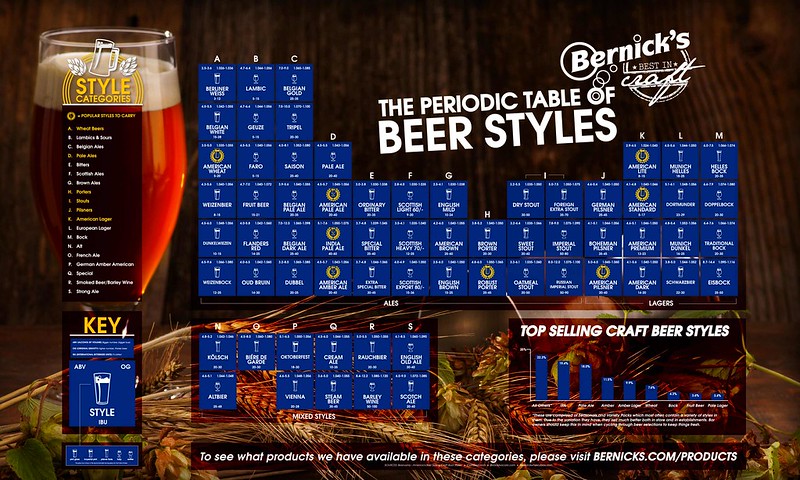
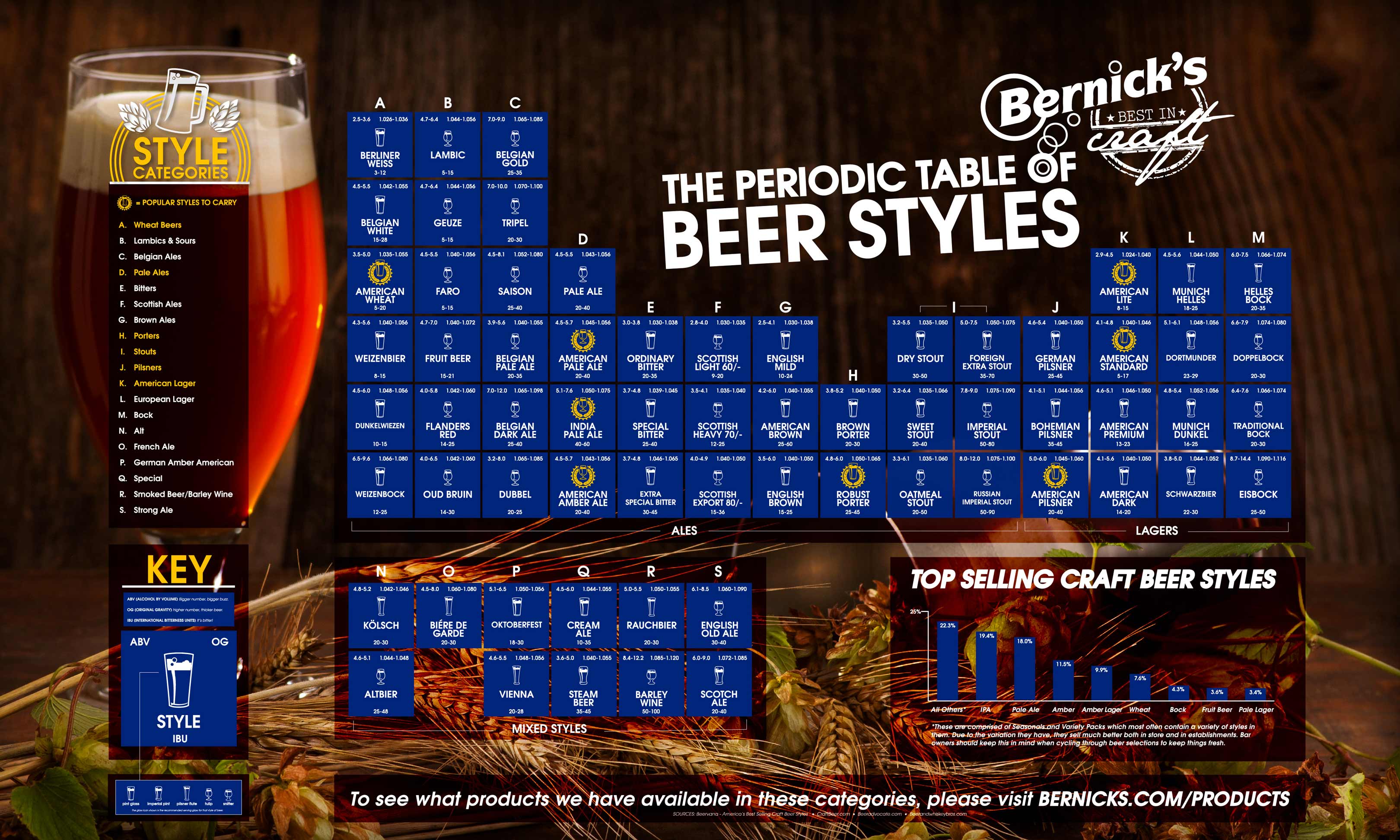
Several companies produce a Periodic Table of Beer Styles poster. Here’s another one, and another, and still one more. They all look more or less the same, and convey almost the exact same information. But yesterday I came across a new one, done by Bernick’s, a distributor in Minnesota, that in addition to most of the usual info, also added the preferred glass for each style. Although they did drop final gravity and any color range information. Still, it’s nice to see someone try to change it up a little. They also added some gold wreaths to indicate the best-selling varieties.
Patent No. 717493A: Wort-Cooler

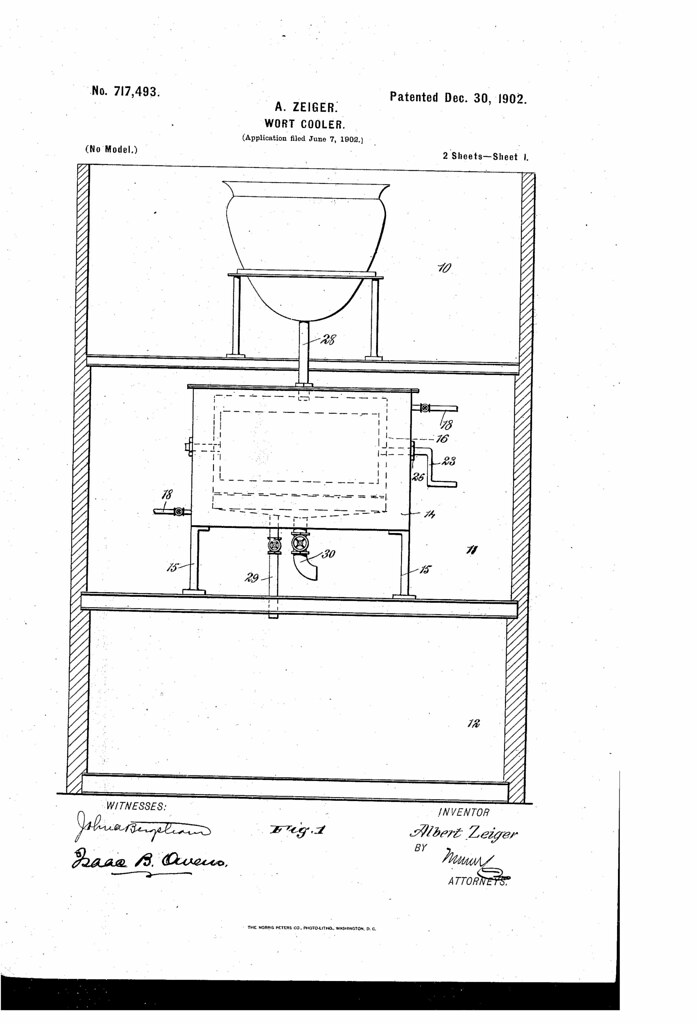
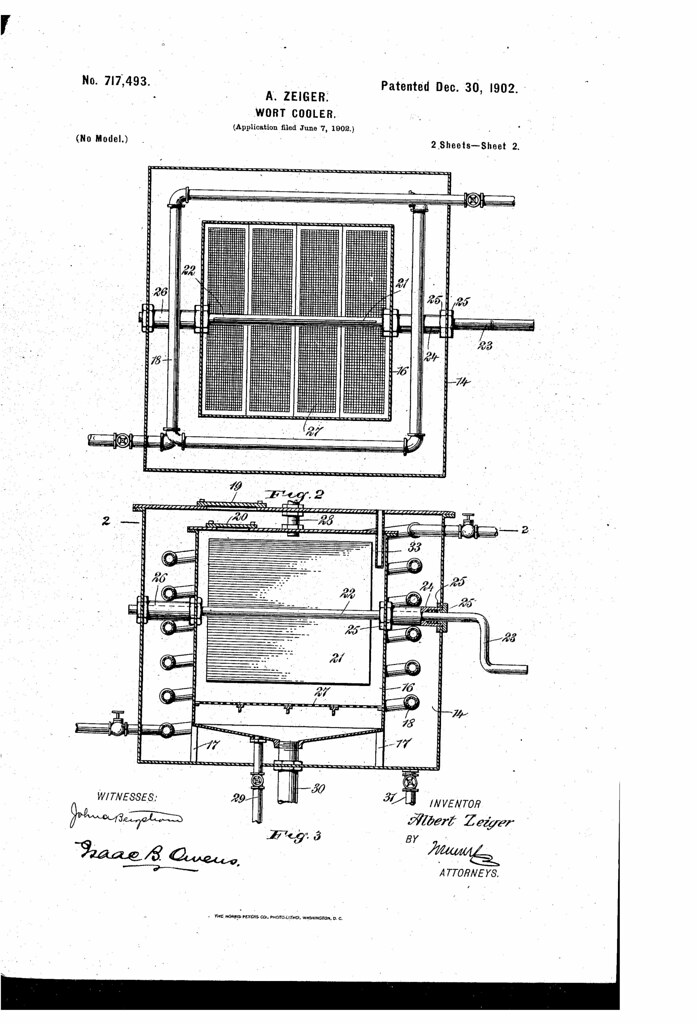
Today in 1902, US Patent 717493 A was issued, an invention of Albert Zeiger, for his “Wort-Cooler.” There’s no Abstract, although in the description it includes this summary:
This invention relates to an apparatus for cooling wort as it comes from the kettles in the brewery; and it embodies certain novel features of construction and arrangement of parts which enables it to be used not only as a wort-cooler, but as a strainer to remove the hops from the wort, thus permitting the wort to be run directly from the cooler into the fermenting-room and dispensing with the necessity of the hopper-jack, which has heretofore been used.
Beer In Ads #1774: Holiday Greetings From Ruppert

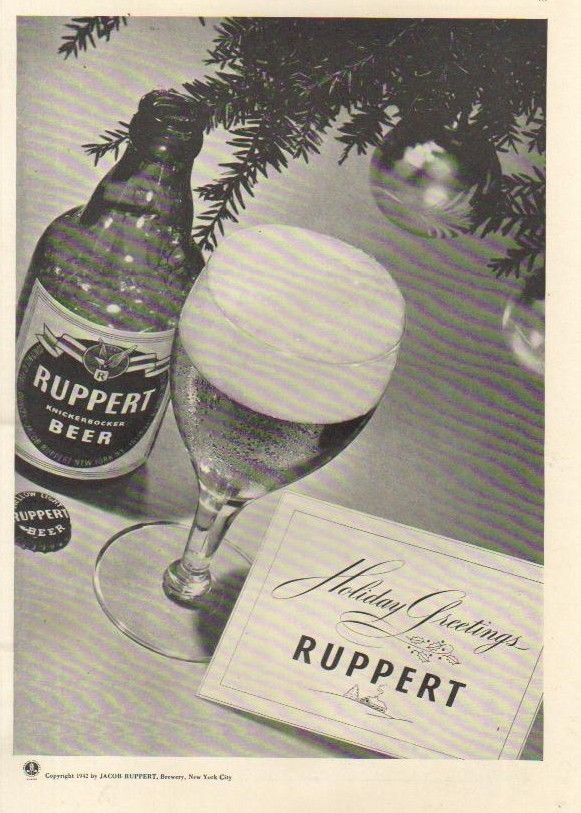
Tuesday’s holiday ad is for Ruppert Knickerbocker Beer, from 1942. It’s a nice simple ad with just a glass of beer and an empty bottle below a Christmas tree. I especially like that it’s tilted to fit more in the frame of the photo.
Patent No. 3550818A: Keg Tapping Device
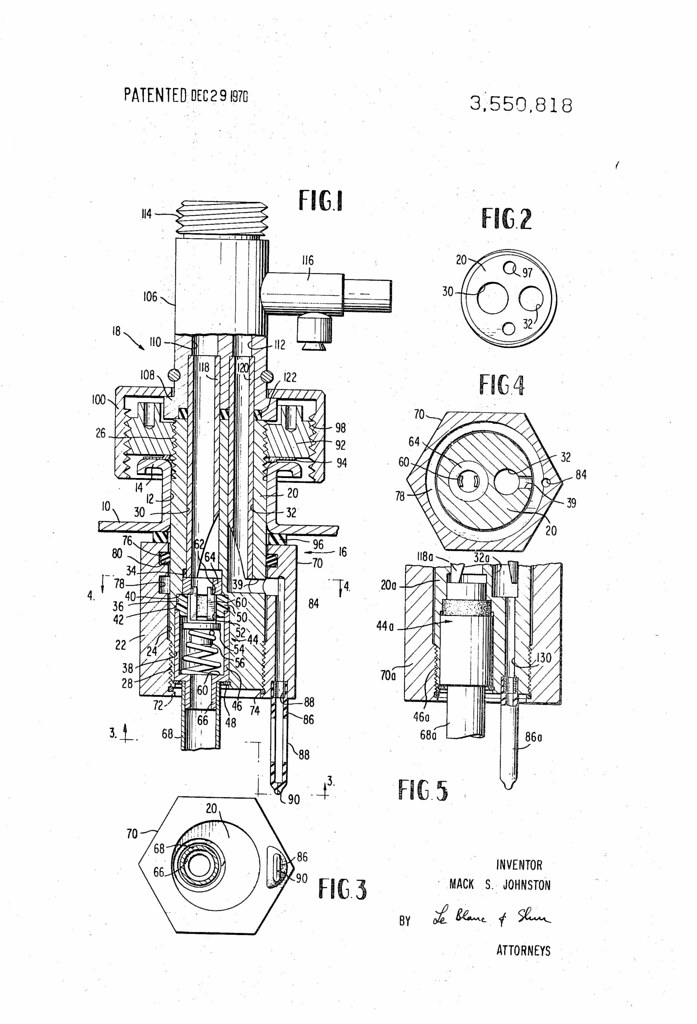
Today in 1970, US Patent 3550818 A was issued, an invention of Mack S. Johnston, for his “Keg Tapping Device.” Here’s the Abstract:
Disclosed is a keg adapter having a siphon body receivable through the opening of a keg and a retainer nut within the keg. The siphon body has liquid and gas passages extending longitudinally of the keg adapter terminating at their upper ends in a pair of bores disposed eccentrically of the axis of the opening. The gas passage terminates intermediate the ends of the siphon body in a lateral opening. The retainer nut has a central opening for receiving the lower portion of the siphon body and an annular recess for communication with the lateral siphon body opening, the recess communicating through a bore in the nut into the keg. A coupler unit having a pair of depending probes is engageable with the keg adapter with the probes being receivable in the bore holes in the siphon body. A liquid valve is disposed in the liquid passage and the lower end of the liquid probe engages an axially moveable member engageable with the valve to open the latter, permitting egress of liquid from the keg through the keg adapter and coupler unit. A flexible envelope having a slit is provided on the lower end of the retainer nut in communication with the bore therethrough to permit ingress of gas through the coupler unit and keg adapter into the keg. The body of the keg adapter is hexagonal as to be receivable within the head of a wrench.
Patent No. 466310A: Wort And Yeast Aerator For Beer Vats
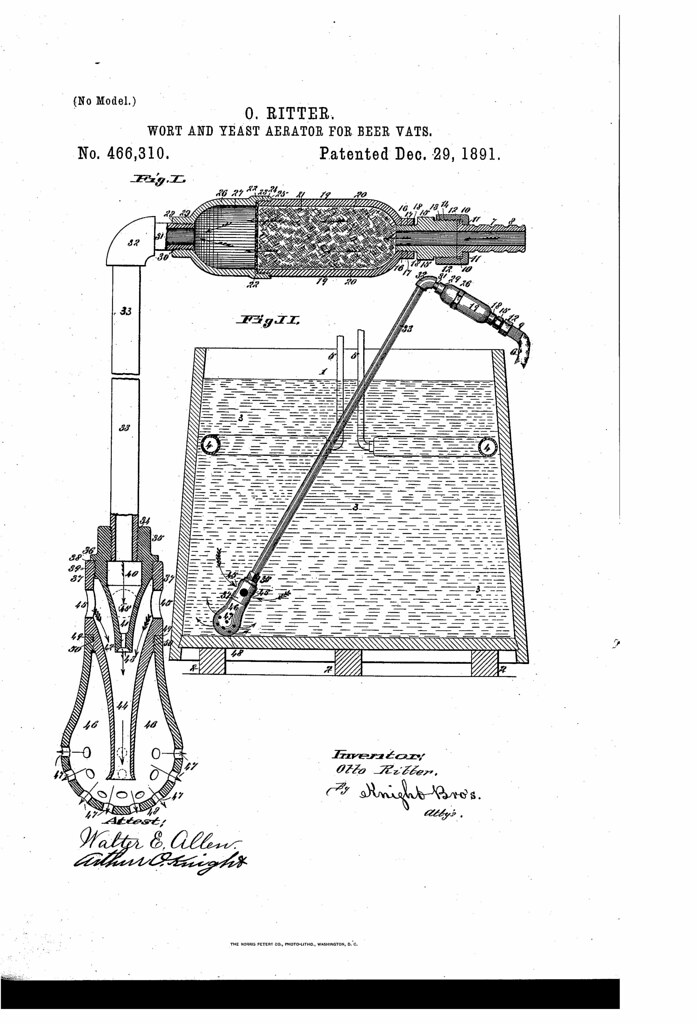
Today in 1891, US Patent 466310 A was issued, an invention of Otto Hitter, for his “Wort and Yeast Aerator For Beer Vats.” There’s no Abstract, although in the description it includes this summary:
I have invented a-certain new and useful Improvement in Wort and Yeast Aerators for Beer Vats, of which the following is a full, clear, and exact description, reference being had to the accompanying drawings, forming part of this specification.
This apparatus is constructed and arranged consists in features of novelty hereinafter fully described, and pointed out in the claims. Figure I isa detail view of the aerator and shows the coupling for the air-hose, the air filter, the bulb-casing of which later forms a handle or hold for the operator, by which he directs the instrument. It also shows the inception filtered air-chamber, the supply air tube, and the compound aerating-bulb; and Fig. II is a vertical section of a brewers fermenting vat and shows the yeast and wort aerator in active operation therein.
Beer In Ads #1773: Holidays Were Made For John Forsythe
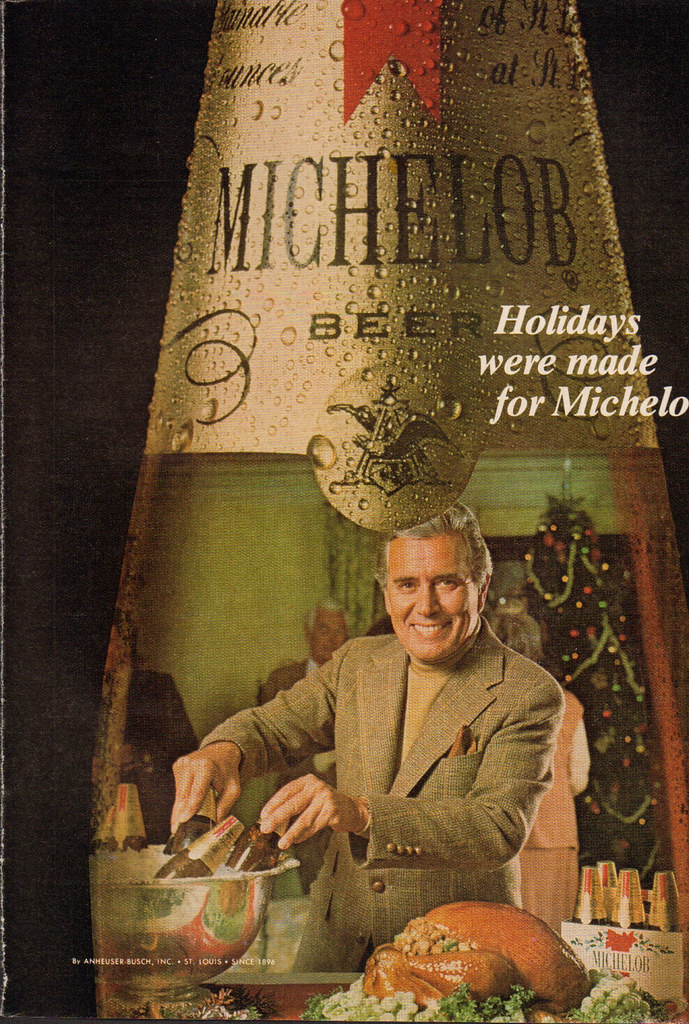
Monday’s holiday ad is for Michelob, from 1980. This holiday ad for Michelob featured actor John Forsythe, who’s best know for being the voice of Charlie in Charlie’s Angels and on the 1980s TV show Dynasty. And right before joining the cast of Dynasty, he did this ad for Michelob, where he’s putting out some bottles of beer into a bowl of ice for a party. Notice the six-pack in the corner that’s been decorated with a wreath. I can’t say I recall them doing special holiday carriers, but then I didn’t really drink the beer in 1980, either.
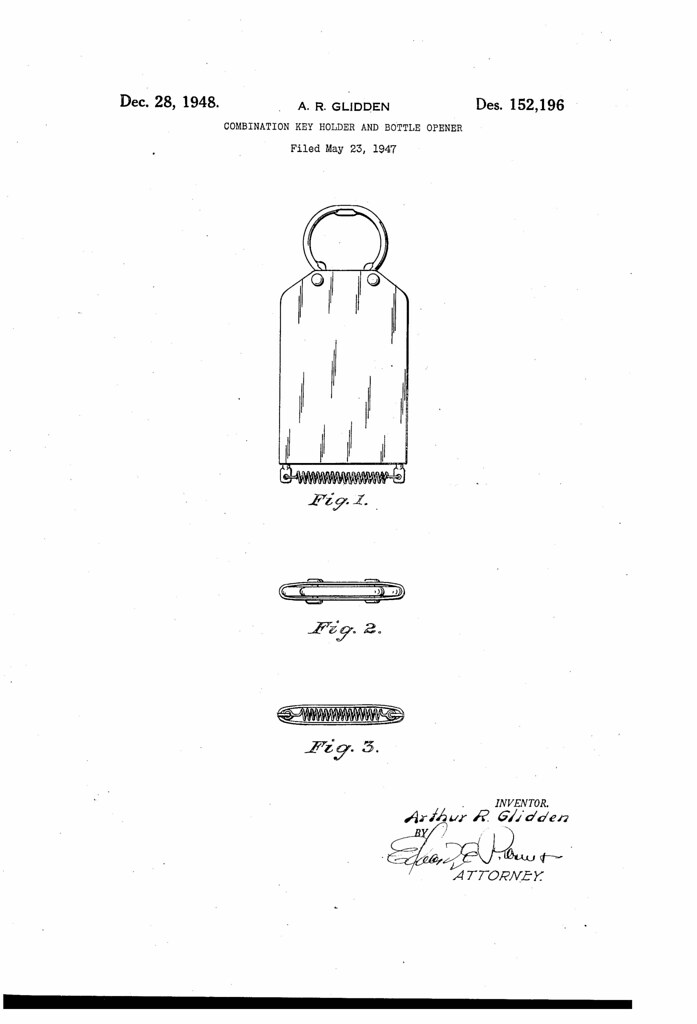
Patent No. D152196S: Design For A Combination Key Holder & Bottle Opener
Today in 1948, US Patent D152196 S was issued, an invention of Arthur R. Glidden, for his “Design For a Combination Key Holder and Bottle Opener.” There’s no Abstract, although in the description it includes this summary:
I have invented a new, original, and ornamental Design for a Combination Key Holder and Bottle Opener, of which the following is a specification, reference being had to the accompanying drawing, forming a part thereof.
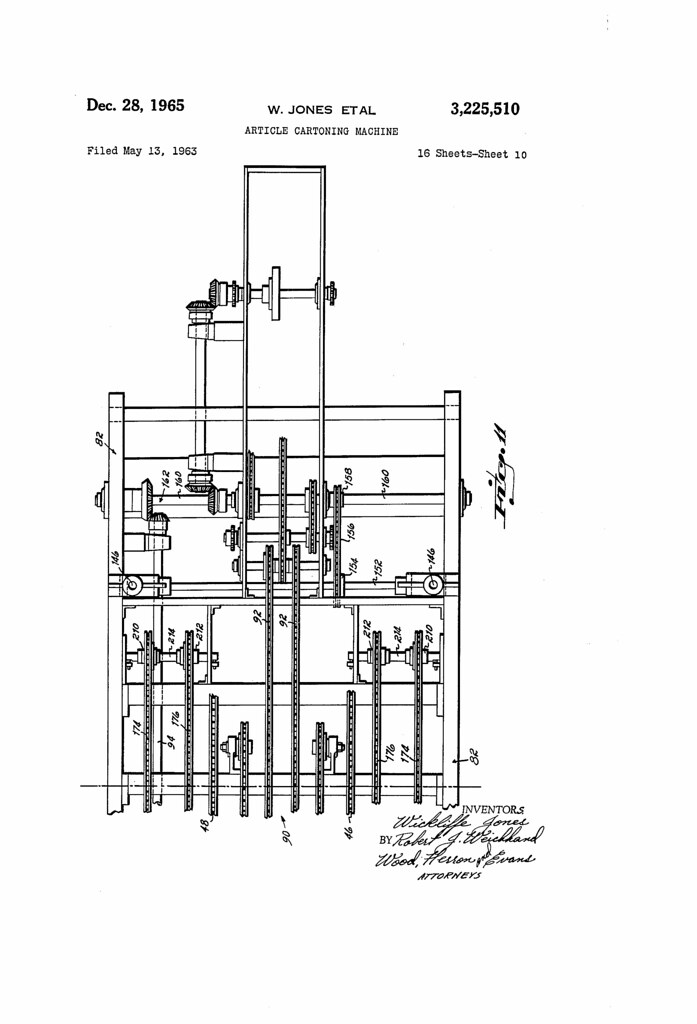
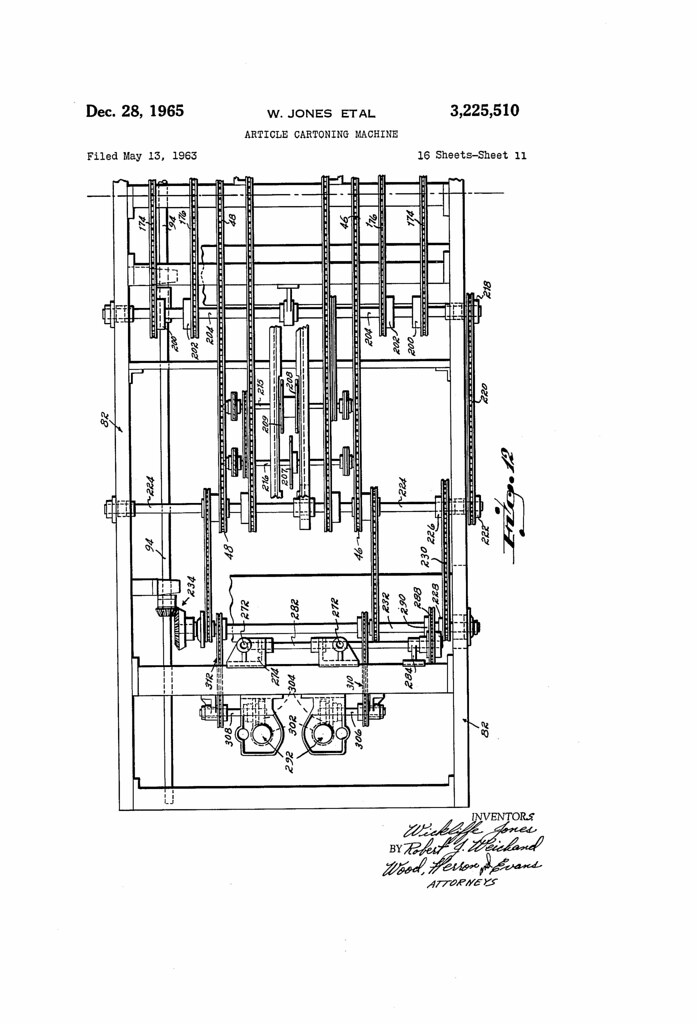
Patent No. 3225510A: Article Cartoning Machine
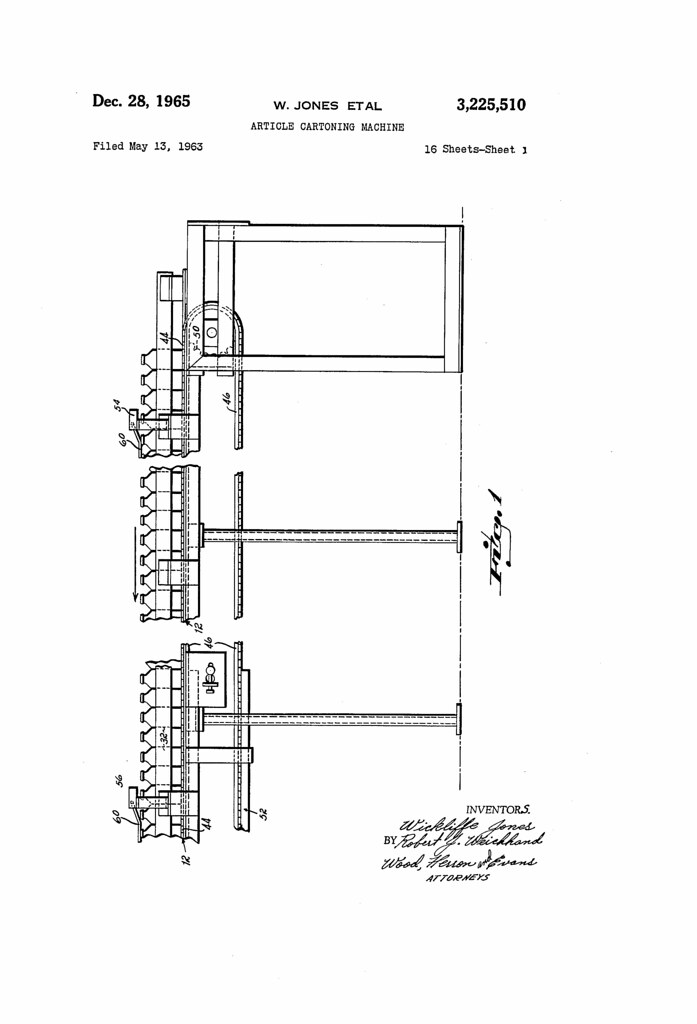
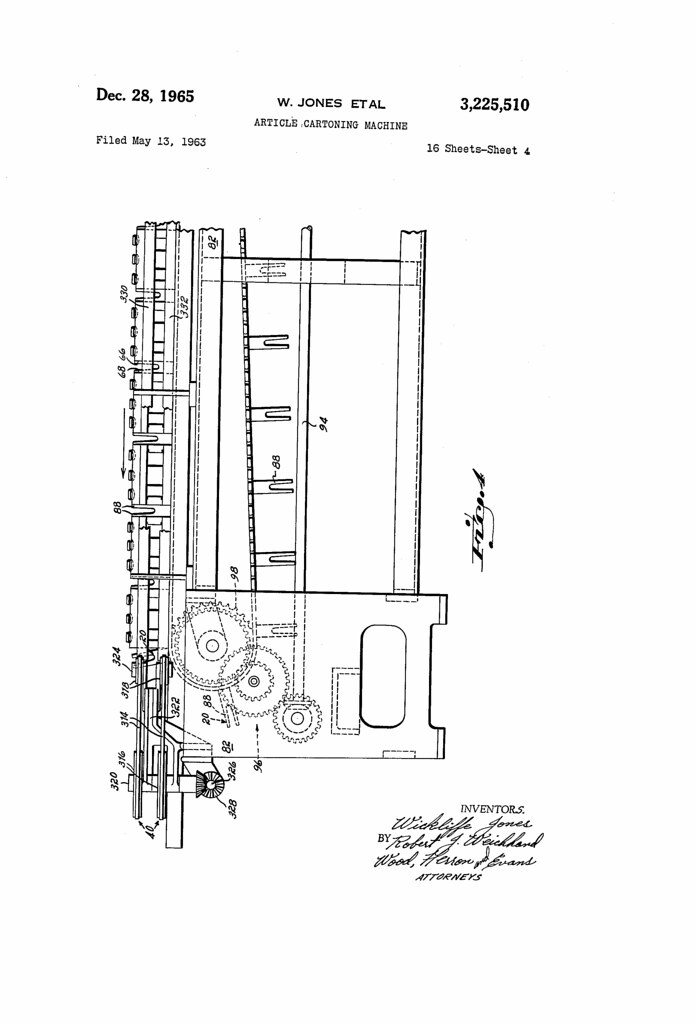
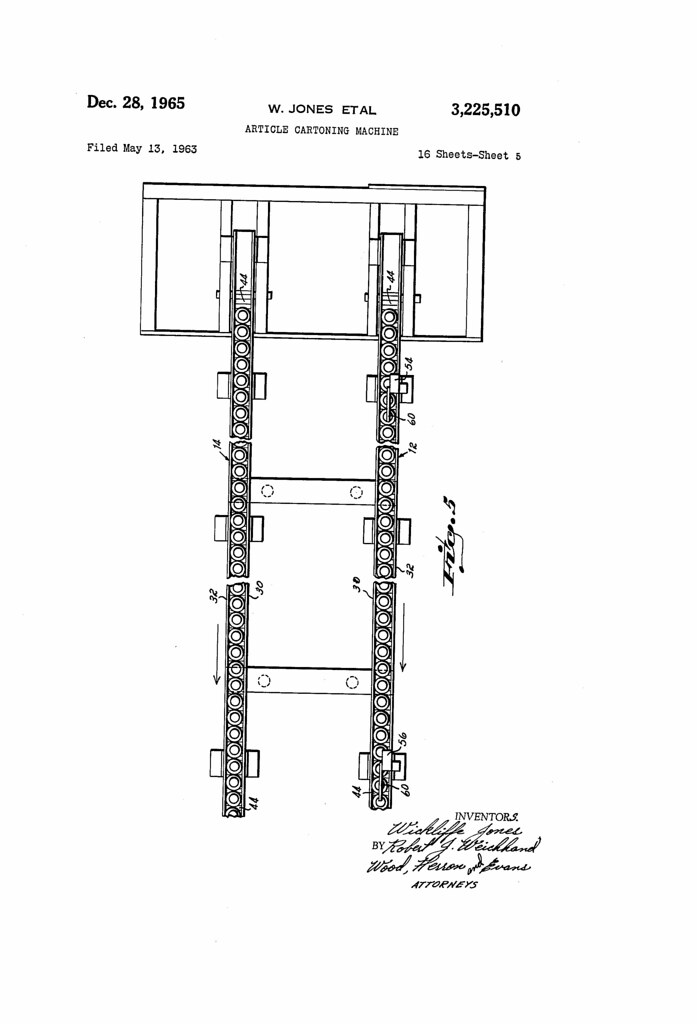
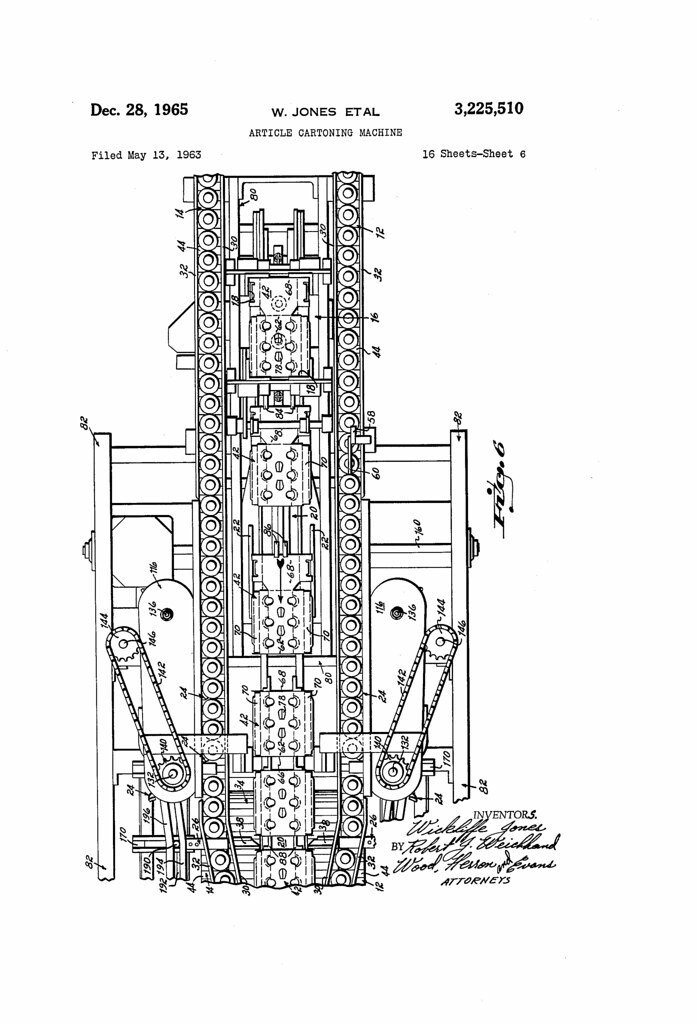
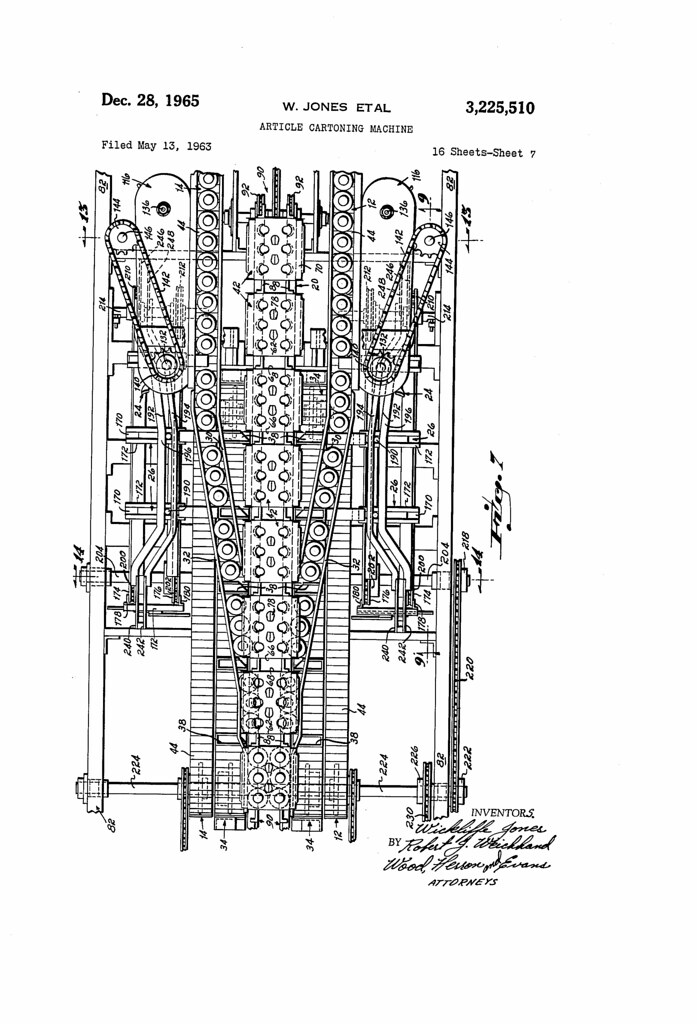
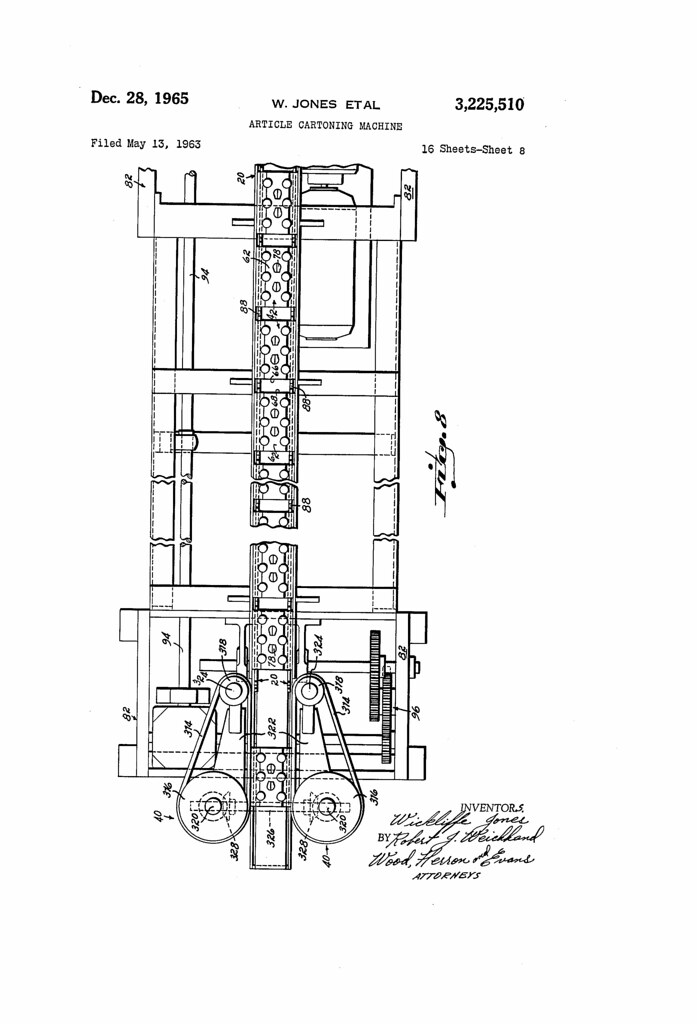
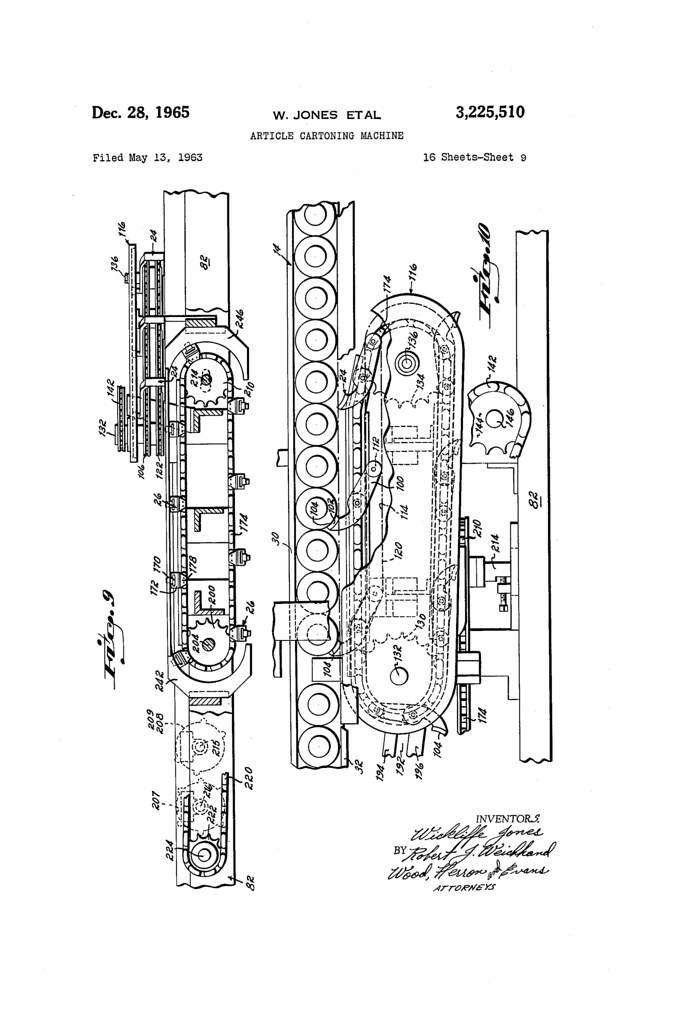
Today in 1965, US Patent 3225510 A was issued, an invention of Robert J. Weichhand and Wickliffe Jones, for their “Article Cartoning Machine.” There’s no Abstract, although in the description it includes this summary:
This invention relates to article packaging and more particularly to a machine for packing beer bottles in conventional six-pack or eight-pack cartons.
More specifically, the machine of this invention is intended for packaging beer bottles in cartons which are formed of paperboard material and which are furnished in a fiat collapsed condition. The collapsed cartons are loaded in stacked formation into a magazine, which includes mechanism for withdrawing the collapsed cartons individually from the lower portion of the magazine subsequently to be erected and loaded. In order to obtain the high loading rate, as indicated above, the bottles, which are fed in a continuous stream, are segregated into groups and the groups advanced into the erected carton from opposite ends. After being loaded with the bottles, liquid adhesive is applied to the flaps of the cartons, then the flaps are folded to a closed position and sealed before the loaded cartons are discharged from the machine.
To perfect a cartoning machine which will handle 600 to 1,200 or more bottles per minute and package them in an automatic manner, the bottles must flow in a substantially straight line continuous movement without any stopping or starting. At the rate of movement of this machine, the inertia of stopping the bottle and starting it again or of jerky acceleration and deceleration would break the bottle or at least scar and tear the paper label. It has thus been an object of this invention to provide a bottle cartoning machine which utilizes smooth acceleration and deceleration substantially straight line continuous flow of the bottles to be packaged and which eliminates abrupt impact reciprocating or oscillating elements which might break the bottle or at least scar the labels upon the bottles. It should be understood that while this machine has been described with reference to packaging bottles, it is equally adaptable to packaging other articles. Of course a machine operable to handle fragile glass is capable of handling metal containers such as beer cans.
The machine includes a series of continuous motion conveyor systems for advancing and erecting cartons after they have been withdrawn individually from the magazine. Thus, the first conveyor apparatus receives the carton blank as it is withdrawn from the bottom of the magazine and includes means for handling the flaps which project outwardly from the opposite open ends of the advancing blank. A first stage conveyor apparatus advances the blank toward a main carton transport conveyor and concurrently partially erects the carton. The partially erected carton is then transferred to a main carton conveyor and during transfer is completely erected by con- Patented Dec. 28, 1965 ice tinuously advancing spacer lugs on the main carton transport conveyor. These lugs coact with the first stage conveyor apparatus to completely erect the carton. The spacer lugs of the main carton conveyor confine the carton firmly in its erected condition and advance it toward the bottle loading zone with the several carton flaps extending outwardly to an open position to avoid any interference of the bottles as they are advanced into the open end of the erected carton.
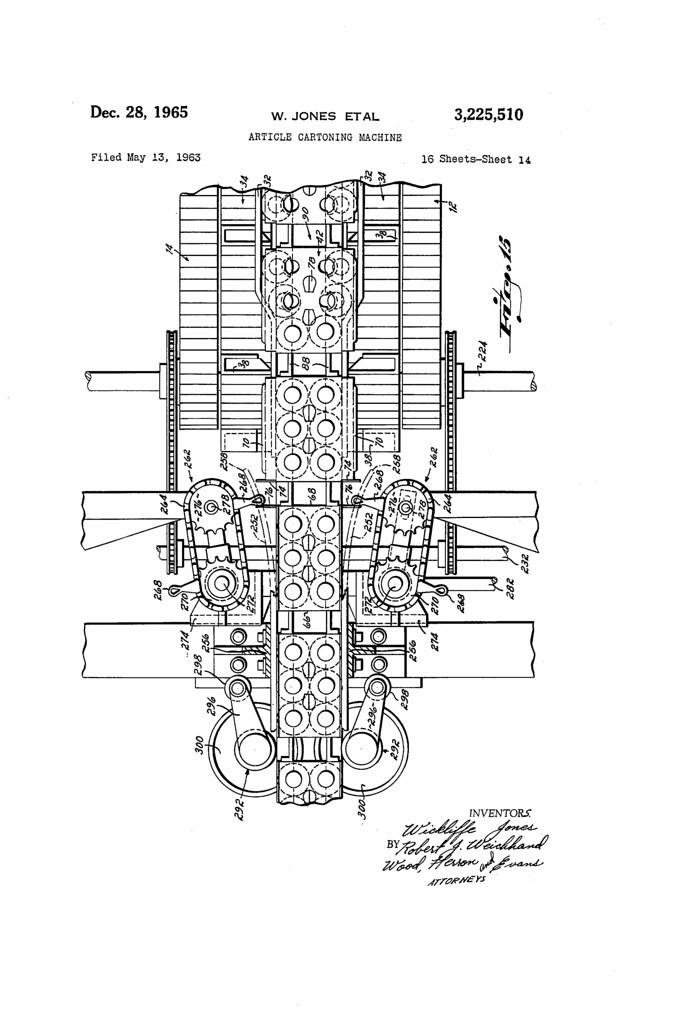
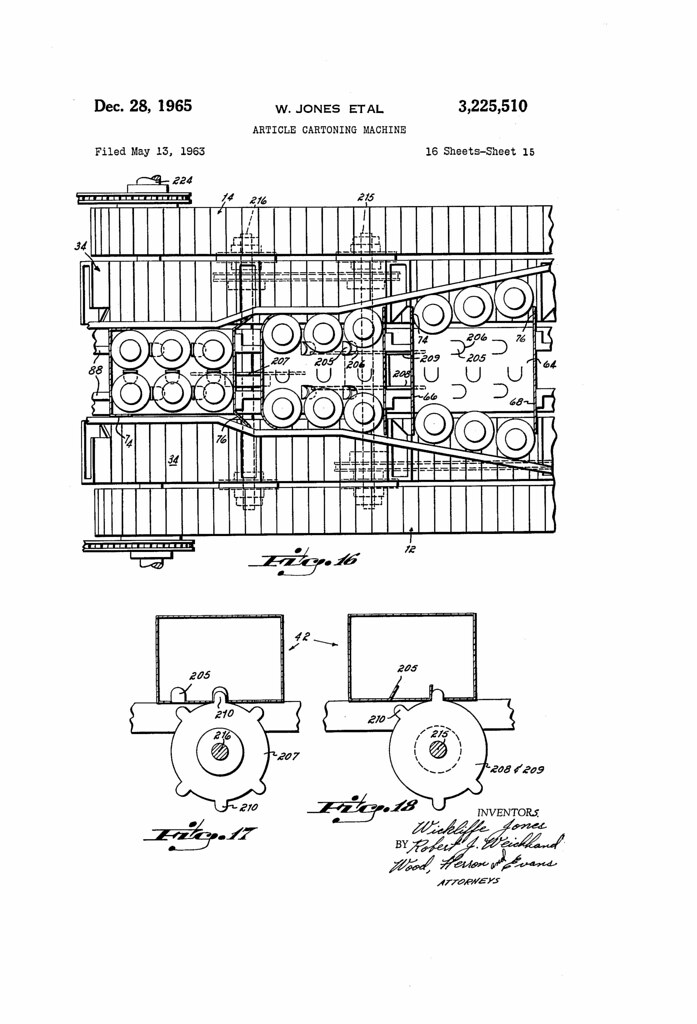
As the erected carton advances to the loading zone, six cans (or eight cans in the case of an eight-pack) are fed laterally from a pair of parallel bottle conveyors into the opposite ends of the carton by stationary converging guide rails. The bottles are segregated into groups of three each (or four in the case of an eight-pack) and fed into the carton. The segregating mechanism consists of restraining fingers which enter in front of every third bottle. These restraining fingers move at a slower rate than the bottle conveyors so that the restraining fingers slow the movement of the bottles. The down stream finger then releases a group of three which move away from the finger or move downstream at a rate determined by the bottle conveyor which is moving faster than the restrained bottles. As soon as the group of three bottles have moved downstream so as to establish a gap between the restrained bottles and the unrestrained ones, spacer fingers enter the gap so as to maintain the spacing between the now grouped bottles. Guide rails then force the group of bottles across a continuously moving bucket conveyor which maintains the spacing of the groups and into the open sides of the cartons. After the bottles are loaded into the carton, liquid adhesive is supplied to the flaps and the flaps are folded to a closed position and sealed as the carton advances toward the discharge end of the machine.
A further objective of the invention has been to provide an improved segregating mechanism for forming articles into groups while advancing the articles toward a packaging zone where the segregated groups are fed transversely into the open end of an advancing carton.




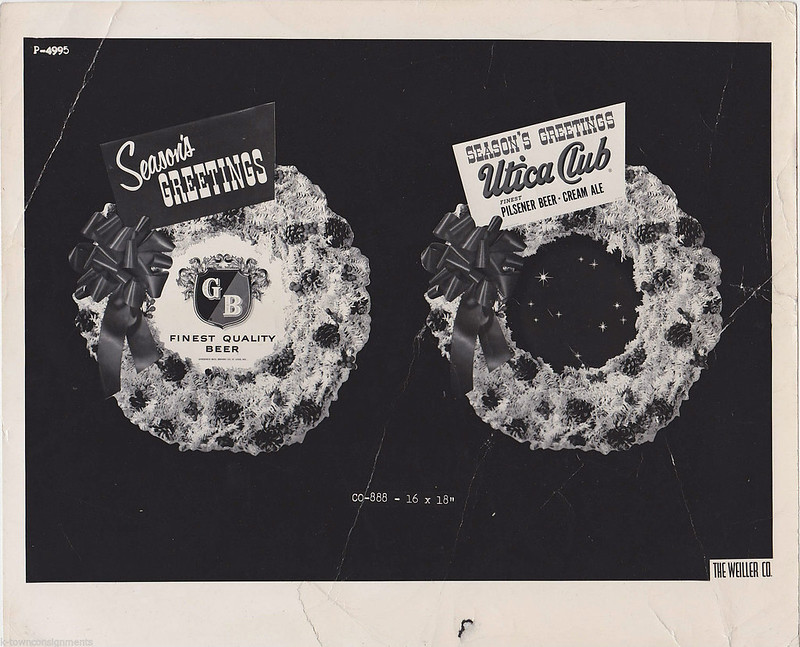
Beer In Ads #1772: Season’s Greetings From Two Breweries
Sunday’s holiday ad is for two breweries — Griesedieck Bros. Brewing Co. and Utica Club. I think it’s from the 1950s and appears to be a stock photo, probably meant to be used by newspapers to advertise either one of the brands, and it was simply cheaper to produce one photo. Happily, you rarely see white wreaths these days.
Patent No. 2492327A: Beer Pouring Device
Today in 1949, US Patent 2492327 A was issued, an invention of Butler Sheldon Jr., for his “Beer Pouring Device.” There’s no Abstract, although in the description it includes this summary:
This invention relates to improvements in a beer pouring device. Broadly, it is an object of my invention to provide a beer pouring device which may be applied to the neck of the standard bottles when the beer is sold.
More specifically, it is an object of my invention to provide a device which has a series of screens at the pouring end thereof, so that when the device is applied to the neck of the bottle and the beer poured through it, a finer head is obtained on the beer which is more like a head obtained from draft beer.
A further object of my invention is to provide an inexpensive device which can be applied to standard bottle necks, which enhances the taste of the beer after it is poured through said device.
A further object of my invention is to provide a device which reduces the size of the gas bubbles after the beer is poured through it in order to give a more creamy quality to the beer.
