Brookston Beer Bulletin

Jay R. Brooks on Beer

  • Home
  • About
  • Editorial
  • Birthdays
  • Art & Beer

Socialize

  • Dribbble
  • Email
  • Facebook
  • Flickr
  • GitHub
  • Instagram
  • LinkedIn
  • Pinterest
  • RSS
  • Twitter
  • YouTube

Powered by Genesis

The Absurdity Of Binge Drinking Statistics

January 11, 2012 By Jay Brooks

binge-barney
This is one of those things that’s increasingly pissing me off, because it avoids real problems that some people have with alcohol in favor of trying to turn individual problems into an epidemic. It’s not. If anything, overall consumption of alcohol is decreasing. But it’s hard to get funding, finance addiction clinics and raise money to fight the scourge of alcohol if you don’t make the situation sound as dire as possible.

Take binge drinking, for example. ABC News just did a story (thanks to Julia Herz for tweeting it) about a “new” report claiming that 38 million Americans “binge drink an average four times a month.” Their story, entitled CDC: Millions of Americans are Binge Drinkers, details how the CDC is claiming that 1 in 6 “adults binge drinks about four times a month, and on average the largest number of drinks consumed is eight.” Not only that, but this is apparently on the rise. Here’s what the CDC website has to say.

New estimates show that binge drinking is a bigger problem than previously thought. More than 38 million U.S. adults binge drink, about 4 times a month, and on average the largest number of drinks consumed is eight. Binge drinking is defined as consuming four or more drinks for women and five or more drinks for men over a short period of time.

In the ABC report, Dr. Fulton Crews, director of the Center for Alcohol Studies at the University of North Carolina at Chapel Hill is quoted in what must be one of the most out-of-touch statements ever made on this subject. “But most people don’t realize that binge drinking is unhealthy.” Seriously? Is there anyone who hasn’t been bombarded with neo-prohibitionist propaganda, whether it’s our government, MADD, Alcohol Justice or some other anti-alcohol group. My kids started receiving the message literally in kindergarten, before they were even able to process it. There isn’t a man or woman alive who believes that drinking too much is good for you.

What people might not know is that what it means to be a “binge drinker” is not as concrete as these “reports” insist. How binge drinking is defined keeps changing, and always it’s narrowing, pulling more people into the circle of binge drinkers, not because they’re suddenly drinking more, but because how it’s defined has changed. I don’t want to repeat myself too much, but I detailed some of the history of this transformation a couple of years ago, in two posts entitled Inflating Binge Drinking Statistics and Son of Binge Drinking Statistics Inconsistencies. And the year before that I wrote about it in Inventing Binge Drinking. What’s clear is that binge drinking went from something somewhat vague — you knew it when you saw it — to ever more specific definitions, the kind that could be quantified and used to alarm people, and, by no small coincidence, be used by anti-alcohol folks in their propaganda.

So yet again the definition seems to be changing. The actual number of “too many” drinks has been somewhat fixed for the last few years at 5 for a man and 4 for a woman. But what keeps changing is the period of time. Initially it was “in a row,” then “within a few hours.” This latest CDC “report” says “in a sitting” and “over a short period of time,” which conceivably could be almost any length of time. At least the ABC report mentions this inconsistency, noting that the definition of the National Institute on Alcohol Abuse and Alcoholism, says the alcohol must be consumed in “two hours or less.” That works out to a beer every thirty minutes for a woman, and for a man, one every 24 minutes.

But what’s also absent from their definition of binge drinking is weight. The definition of being considered drunk is always expressed as a calculation combining time, the amount of alcohol consumed and the weight of the person drinking it. But binge drinking never takes that into account, apart from dividing up gender, presumably under the premise that men are generally bigger than women. That reality, of course, is not true in every case. And it may be indelicate to say so, but with our obesity issues as a nation, in theory it should be taking us longer to actually get drunk today than it did twenty years ago. But the reality is that a 200-pound man will take longer to get drunk than a 120-pound man. The same amount of alcohol will effect the two differently. So why should both be defined as binge drinkers if one becomes inebriated but the other does not?

And frankly, there’s another elephant in the room that troubles me, but is rarely, if ever, talked about. If you’re an adult and choose to drink 5 beers in a row, are not driving, and are not in any other way putting yourself or others at risk, why shouldn’t you be allowed to go a little crazy once in a while? You are, actually. It’s not illegal. Although neo-prohibitionists might not like it, there’s nothing to stop you from going on a bender if you feel like it. You shouldn’t be made to feel guilty about it. If it gets out of hand, your friends and family will likely step in. If it doesn’t so what? Who are you hurting? But every time these “reports” come out, the implication is that binge drinking is bad no matter what. But not all bingeing is the same, especially as they now define it. The average beer dinner runs to at least five courses (unless Sean Paxton is doing it), meaning that every single person attending such a beer dinner is considered a dangerous “binge drinker” by the CDC and other government agencies. Is that rational or realistic? Of course not. That’s entirely different from a person who bellies up to the bar and downs five shots of rotgut in rapid succession. Yet both are considered equally dangerous and costing society untold millions of dollars. It’s absurd.

Here’s some more of the statistical data, which it should be noted was complied through a telephone poll, from the CDC’s press release:

As reported in this month’s Vital Signs, the CDC found that those who were thought less likely to binge drink actually engage in this behavior more often and consume more drinks when they do. While binge drinking is more common among young adults aged 18–34 years, binge drinkers aged 65 years and older report binge drinking more often—an average of five to six times a month. Similarly, while binge drinking is more common among those with household incomes of $75,000 or more, the largest number of drinks consumed on an occasion is significantly higher among binge drinkers with household incomes less than $25,000—an average of eight to nine drinks per occasion, far beyond the amount thought to induce intoxication.

Adult binge drinking is most common in the Midwest, New England, the District of Columbia, Alaska, and Hawaii. On average, however, the number of drinks consumed when binge drinking is highest in the Midwest and southern Mountain states (Arizona, Nevada, New Mexico, and Utah), and in some states— such as Louisiana, Mississippi, and South Carolina—where binge drinking was less common.

But perhaps where this absurdity becomes most evident is in one of the CDC’s suggestions on how to combat binge drinking, which they list under the heading “what you can do.” Here’s the suggestion: “Follow the U.S. Dietary Guidelines on alcohol consumption; if you choose to drink, do so in moderation — no more than one drink per day for women and no more than two drinks per day for men.” Except those are NOT the most recent USDA dietary guidelines. Not even close. The 2010 guidelines “defines ‘low-risk’ drinking as no more than 14 drinks a week for men and 7 drinks a week for women with no more than 4 drinks on any given day for men and 3 drinks a day for women.” So that’s two government agencies that can’t agree on safe levels of consumption, and one that’s essentially lying about it to bolster their own point of view. The UK has had similar problems with their guidelines, when it was revealed a few years ago that their government just made up the safe guidelines, which then became carved in stone for the next twenty or more years, despite being literally plucked out of thin air.

Before the angry comments start flooding in again, I should point out that I don’t believe that binge drinking is always a good idea, or that people should do it all the time. I’m not arguing in favor of it. However, I do believe one does have the right to go on a binge if they feel like it (and as long as they’re being safe and aren’t doing so frequently enough to alarm those people closest to them). I do believe that how the CDC and others define binge drinking is ludicrous and does more harm than good. By making almost everyone a binge drinker through their ever-narrowing definition, they’re avoiding dealing with the serial binge drinkers who really are hurting themselves, and possibly others around them. This does nothing to combat the people who really need help. All it does is demonize all alcohol drinkers, making us all the same, which even the most jaded neo-prohibitionist has to admit, we’re not. It’s not how many drinks one has, or over what period of time, it comes down to how one handles themselves in that situation. If you’re a safe and responsible drinker, none of the rest of that even matters. Drink by example, that’s my new motto.

UPDATE: One of the biggest problems with studies like this is how uncritically they’re reported by the mainstream media. The most common way a press release like this one is used is by taking it and maybe changing around the words slightly but essentially just regurgitating it wholesale, not doing any follow up or critically examining it, and accepting all of it without question. That’s not what journalism should be, but in many cases that’s what it’s become, sad to say. Case in point is The Daily’s piece on it, Binge There, Done That. On the plus side, there’s this cool infographic they created based on the data from the telephone polls that the CDC conducted. On the negative side, there’s no key to the data, but the report mentions that it’s the “percent of the population” that are binge drinkers.
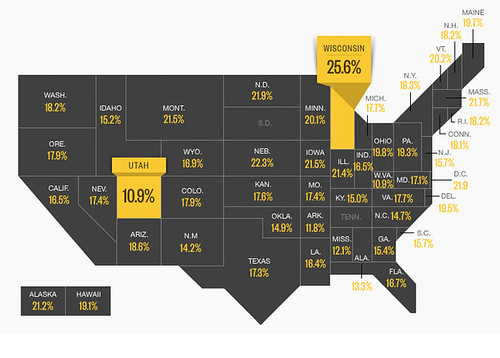

120112-binge-drinking

Filed Under: Editorial, Politics & Law Tagged With: Anti-Alcohol, Prohibitionists, Statistics

Consumer Reports Rates Mainstream Beers

January 7, 2012 By Jay Brooks

consumer-reports
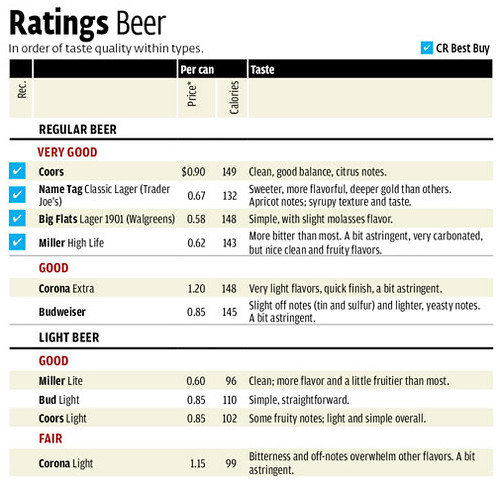
At the end of December, Consumer Reports sent out a press release regarding a beer tasting they’d conducted by an unnamed panel of “experts.” Curious as I was, especially as similar tastings have gone somewhat badly in the past, I held off any judgment until the full report became available, which happened January 3 (though it will be in the February print edition). Here’s the salient parts of the press release, Coors Outscores Bud in Consumer Reports’ Taste Tests of Beer:

Looking to enjoy the last weeks of football season with the perfect brew? Coors regular topped Consumer Reports’ recent taste test of beers, blowing away nine brews including Budweiser and Bud Light. Name Tag and Big Flats — store brands from Trader Joe’s and Walgreens respectively — beat out top-sellers Corona Extra and Budweiser. The full report and Ratings of beer is featured in the February issue of Consumer Reports and online at www.ConsumerReports.org.

To determine the best brews, the experts at Consumer Reports conducted blind taste tests of ten lagers — eight top-selling regular and light beers plus two store brands. Although none of the beers were scored a touchdown, Coors, which scored Very Good but not quite high enough to be rated excellent, came close, standing out for balanced flavors with citrus notes and no off-tastes. In addition to earning the highest marks in Consumer Reports’ tests, Coors, available for $6.45 for a six-pack, was deemed a CR Best Buy along with runners-up Name Tag (Trader Joe’s), Big Flats (Walgreens), and Miller High Life.

When it comes to choosing a beer, taste may be the most important factor to consider, but Consumer Reports tests found that consumers should also keep the following in mind:

  • Regular vs. light. Light beer has 20 to 50 less calories per serving due to lower carbs and slightly less alcohol, but no tested light scored high enough to be very good. Miller Lite, which had more flavor and is a little fruiter than most, was best of the bunch; Corona Light, a bitter brew with traces of tinny and sulfury off-notes was the worst.
  • Price vs. taste. Corona Light costs far more than the higher-rated Miller Lite; and Corona Extra costs about twice as much as three better beers – Name Tag, Big Flats and Miller High Life.
  • Cans vs. bottles. Consumer Reports tasted beer from cans which do a better job than bottles in keeping light, beer’s nemesis, from getting inside. Light can react with beer within weeks or even days to create compounds similar to those a skunk uses to defend itself.

The complete beer Ratings are available in the February issue of Consumer Reports and online at www.ConsumerReports.org starting January 3.

So now they’re out, let’s look a little closer.

On the Plus Side:

  • They used cans for their tasting because they “do a better job than bottles in keeping light, beer’s nemesis, from getting inside.”
  • They included private label, contract beers.

To be fair, I had to stretch to find something positive. While there are advantages to cans, a fresh beer in a bottle or can that’s been well-maintained and cared for should be indistinguishable, and since (one hopes) they poured the beer into a glass first it should really make no difference. And then, of course, limiting the tasting to beer in cans arbitrarily leaves out a lot of good beer, though they left out more than enough on their own.

CR-beer-ratings-feb-2012

On the Minus Side:

  • Only 10 Beers (6 regular, 4 low-calorie)? Really, that’s not very representative of the market. Just sticking to the big guys, there’s no MGD or PBR. There’s no Yuengling. And at this point, to ignore the national craft brewers like Sam Adams, Sierra Nevada and New Belgium seems like a big disservice to their readers. Yes, BMC represent the majority of beer sold, but they’re no longer the only game in town. By ignoring other beers, Consumer Reports is in a sense helping to maintain the status quo. In their world, it’s as if the decline of big brands and the rise of craft beer is not even happening.
  • As I said before, this kind of tasting does not help their readers. I don’t know the exact demographics of Consumer Reports subscribers, but it seems fair to say they’re not the sort of people who buy whatever’s cheapest or whatever’s on sale. They care about what they’re buying. They want the best value or the best quality products. Otherwise, why bother reading a publication that’s supposedly dedicated to those principles. So by ignoring quality and choosing beers to rate based purely on popularity, they’re not telling their readers about quality beers that may be more expensive, but given how much more flavorful they are might be the better value. Of anyone, Consumer Reports should know that price is not the primary factor in determining value.
  • Sorry to keep beating a dead horse, but also by not going beyond the three most popular domestic brands and one import, Consumer Reports missed an opportunity to tell their audience looking for guidance why cheaper isn’t always better. That buying full-flavored beers means drinking less, but enjoying it more. Instead, they fell back on what they’ve always done; dumbed it down and went for numbers over intangibles, price over value, the big over the smaller. Pathetic.
  • I don’t know who their so-called “experts” included, but calling Big Flats “very good” in my mind calls into question their credentials or experience. Because Big Flats, when we tried it at one of my Philopotes Society meetings, was all but undrinkable. And not just by me, but by the entire assembled group, who included experienced judges and brewers that I’ve conducted tastings with for years. Swill, to be kind. And my experience with the others makes me wonder by what standards they were judging the beers. At what temperature were they served? Did they discuss the beers and come to a consensus or merely assign them scores and let the numbers speak for themselves. In order to have your results taken seriously, I think at the very least the methodology used has to be disclosed so the rankings can be placed in that context. There’s no key that explains the difference between a “very good” beer and merely a “good” one, or what the others ratings might be, such as below “good” or above “very good.” I could never in good conscience call Corona a “good” beer. And Budweiser may be a well-made beer, but it lacks that key ingredient I look for in my beer: flavor.
  • Indeed, all of the beers on the list are very lightly flavored beers. Most judges, even experienced ones, would have a hard time distinguishing them blind. I realize that sometimes you have to judge such beers, but I think it would be difficult to rate Coors, Name Tag, Big Flats and Miller High Life as being essentially the same, all “very good.” That seems like a stretch. And at any rate, why bother rating beers that are so much alike and whose sales have more to do with advertising and brand loyalty than taste? Is any loyal Bud fan going to be swayed by this tasting and suddenly switch to Coors? Beer just isn’t like a new refrigerator or toaster.
  • I concur that there are no “very good” or above light beers, but I’d have a hard time calling any of these “good,” either. But that’s perhaps a personal preference. I find all low-calorie light beers an abomination, a slap in the face to good beer everywhere. They have no business even existing, let alone being best-sellers. They’re a triumph of advertising and marketing over good sense and taste.

So it seems to me that Consumer Reports, a well-respected publication, really booted this one and did very little, if anything, to educate their readers and give them some truly useful information about what beers to try. From their choices of which beers to rate and the way in which they rated them, there’s very little here to change anyone’s mind about which beer to choose, or indeed how to choose a good beer in the first place.

Filed Under: Beers, Editorial, News, Reviews Tagged With: Mainstream Coverage

The Beer Hunter Documentary On Kickstarter

December 31, 2011 By Jay Brooks

jackson
Most, if not all, of us who write about beer, and by extension blog about it, would not have a job were it not for one man: Michael Jackson. I think most of us who’ve been doing this for at least a few years now feel that way. I first met Michael at GABF in the early 1990s and feel honored to have been able to call him a friend as well as a colleague. When I did a profile piece on Michael for Beer Connoisseur magazine earlier this year, it was quite personal, and I polled a number of my colleagues and brewers about their feelings on Michael’s legacy so it wouldn’t just be in my voice. Their response was overwhelming and I struggled to use as many of the quotes they sent me as I could. As it was, the article ballooned to nearly twice the word count I was contracted for, because there was just so much to cover.

So I was thrilled when John Richards contacted me earlier this year to tell me about the documentary/biography film he’s working on: The Beer Hunter. In fact, I got on board right away and put my money where my mouth is, becoming a sponsor. That’s how much I’d really like to see this film be made and released. He’d also been doing some informal fund-raising and I know others have also donated to this worthy endeavor, but that’s only taken him so far.

The filmmaker has turned to Kickstarter to raise additional funds, hopefully for the last time (though if my experience in how these things go is any guide, probably not), in an effort to finish the film. He also has some additional lofty goals, including editing additional footage just for the DVD, creating a public archive from the entire library of footage to be housed at London’s Oxford-Brookes University (where Jackson’s print library is located) and set up a non-profit Michael Jackson Memorial Foundation. There is also a lot of additional information at the Kickstarter page and the Beer Hunter movie website, too.

So I’d encourage every single person who’s been touched by Jackson’s work to donate to get this film made. No matter how small, I’m sure it will be appreciated. If you’ve learned about the beer you love through any or all of Michael’s many books on beer and whisky, help keep his memory and legacy alive. Help make sure future generations know who Michael Jackson was, and how important he was to the craft beer scene that exists today, but might not have without his exhaustive efforts. And perhaps most important of all, help to create a film record, a living memory to show him at his best; talking about beer, educating people about beer and enjoying beer, too, an endeavor which he spent nearly four decades perfecting. There was really no one like him. I, for one, would love it for that to be a part of the permanent record of craft beer’s history.

m-jackson-1
Michael and me at Denver’s Great Divide in the mid-1990s.

Filed Under: Beers, Breweries, Editorial, Just For Fun, Related Pleasures Tagged With: Film, History

Make Lew Bryson’s Christmas A Happy One!

December 15, 2011 By Jay Brooks

lew-bryson
Okay people, time to step up to the bar. A month ago, a new project was announced on Kickstarter starring my friend and colleague Lew Bryson. The project is being produced by Rudy Vegliante of Green Leaf Productions and the idea is to create a series of six half-hour television shows starring Lew. With 30 days to go, only 6% of the needed funds to make the show a reality have been raised. A mere 65 people have pledged $3,716 of the $60K needed. Frankly, that’s pathetic.

C’mon, beer people. I’ve pledged $300, and would have gone higher if I wasn’t trying to make a rather large purchase at the moment. Surely, there are more than 65 people who have benefitted from Lew Bryson’s reviews, laughter, rantings, writings, speaking engagements, etc. Just his being in the beer community makes it a better place. We’ve all seen what happens when non-beer people try to make a TV show about beer. At best it comes off half-baked, full of misinformation, half-truths and propaganda. At worst, it’s a disaster. I’ve personally been involved in trying to get several such projects off the ground. None have gotten very far. It’s tough. Most people outside our rarified community don’t quite get why we’re so passionate about it, and that shows in the finished products that have been made so far.

So here’s a chance for one of our own to be the voice of craft beer, celebrating it in a way we can probably all agree with. And with guaranteed laughter, guffaws and unbridled chuckles thrown in for good measure. Lew is the right big galoot for this job.

Lew has just over 2,500 twitter followers, I have a little over 4,000. Even assuming for some overlap, that’s got to be around 6,000. If each one of you pledged just $10, Lew would be home for Christmas, with all the funding he needs. It’s the price of about two pints, give or take. Surely that’s not too much to create a one-of-kind television show about craft beer, by craft beer, for craft beer. Think of it as giving back to the beer community that has enriched your life, in the spirit of the holidays. Give Lew Bryson a Malty Christmas and a Hoppy New Year.

You can get all the details from my previous post or, better still, directly from the Kickstarter project page for American Beer Blogger.

Okay, I’m climbing back down off my soapbox. Resume holiday merriment.

lew-me
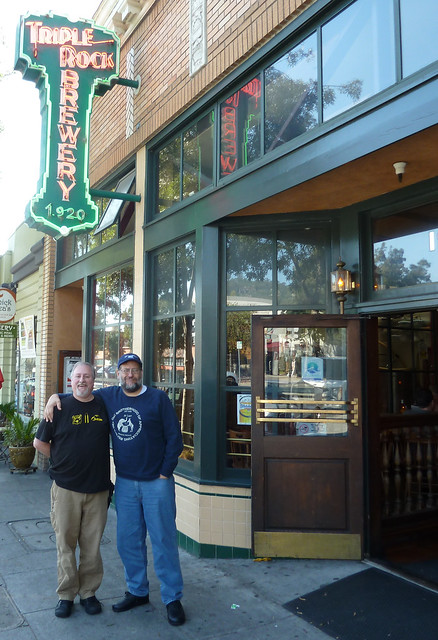
Me and Lew at Berkeley’s Triple Rock last year.

Filed Under: Editorial, Just For Fun, News, Related Pleasures Tagged With: Blogging, Charity, Pennsylvania, Video

Snacking Between Meals Leads to Alcoholism & Death

December 14, 2011 By Jay Brooks

target-alcohol
Before Prohibition became a reality, the prohibitionists used shameless propaganda to advance their cause, and it became increasingly absurd as time went on. When the temperance movement began in the 1830s, it was primarily against hard liquor, and beer was thought of as a drink of moderation, which by comparison it was. But over time, the movement became more and more intolerant of not just all alcohol, but many other things, such as coffee, pickles, pie, sugar, tea, and even meat. Abstinence itself became a goal. It became entirely fanatical, and in many cases was backed by religious factions and led by preachers. This transition is chronicled nicely in Jessica Warner’s “All or Nothing: A Short History of Abstinence in America.”

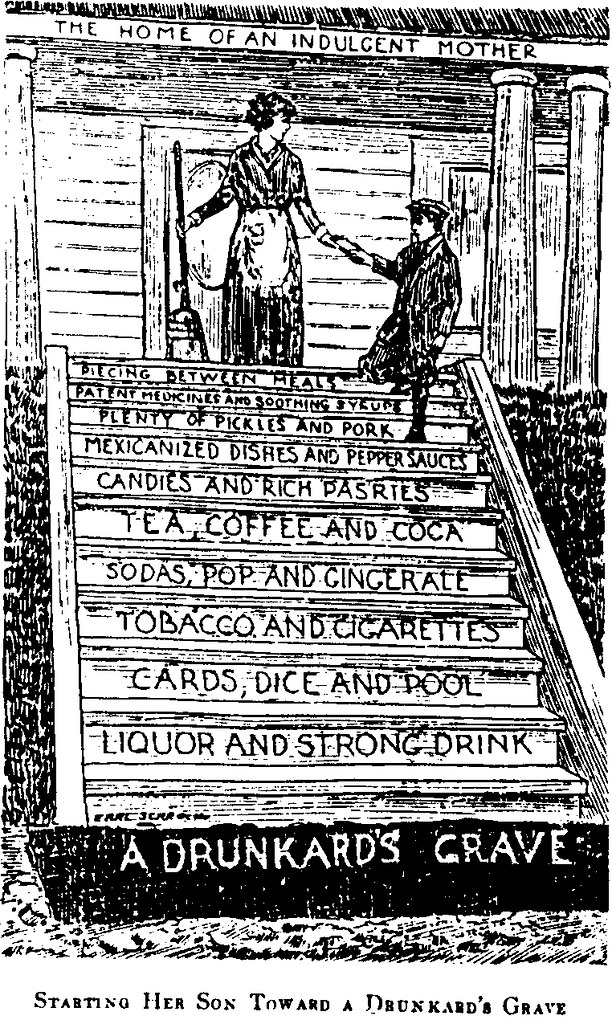
So by 1915, when this piece of propaganda was published, the prohibitionists were in the full flower of absurdity. It’s from a temperance program by evangelist Thomas F. Hubbard, published by the Wagoner Printing Company of Galesburg, Illinois. It’s showing how you could destroy the life of your son by being an “indulgent mother,” leading them down the path (or stairs) to “a drunkard’s grave.” So remember; never, ever be nice to your children. Just look what might happen.

gateway

See if you can follow the logic. If you allow your son to have a little food between meals, a.k.a. “a snack,” it will undoubtedly make him ill, causing you to ease his pain by giving him — gasp — medicine and “soothing syrups.” That, in turn, will undoubtedly lead you to let him eat too many pickles and pork (it’s always bacon’s fault) and “Mexicanized Dishes and pepper sauces,” you know … spices! But once he’s got a taste for flavor, he won’t be so easily satisfied anymore. Hot foods and the “other white meat” will, of course, lead your son to an indulgent life of rich pastry and candy, damn the luck. He’ll want to wash down all those sweet confectionaries with “tea, coffee and coca” (sic). And you know that can’t be good. It’s a slippery slope from there. He’ll then want to drink “sodas, pop and ginger ale.” After that, your son will need to relax with a cigarette or other tobacco. What else could he possibly want? He had no choice, really. You can’t really blame him. After soda pop, everyone needs to light up. It’s only natural. And once you begin smoking, you can’t really help but start gambling. It’s inevitable. Once you light up that ciggie, playing cards, throwing dice and picking up a pool cue can’t be far behind. It just can’t be helped. And you know what every gambler on the face of the Earth does, right? You got it: drink “liquor and strong drink.” And he can’t just drink it on occasion, but he keeps on drinking it, never stopping until he reaches “a drunkard’s grave.” And all because you gave him some Goldfish or Cheez-Its between meals. It’s so obvious. One unbroken chain from snacking to death, with no possible way to break the cycle. It’s like walking down the stairs. Gravity takes over and you can’t help but keep taking each successive step until you have one foot in the grave.

It is, of course, completely absurd, but one has to assume prohibitionists really believed it, just as some people today actually believe that one drink makes someone an alcoholic. And while I can’t imagine today’s anti-alcohol groups rising to this level of evangelical disinformation, they are, sad to say, moving in that direction. Alcohol Justice, for example (who insist they’re not neo-prohibitionists), has hardened their position of late and now takes the position that there are no safe levels of moderate drinking. They no longer take issue with whether one drink, or two drinks or however many drinks is appropriate for moderate consumption. They’re now proselytizing that zero is the only number of drinks that will keep you from falling into a life of ruin and becoming a burden on society, costing the teetotalers many millions of dollars. Total abstinence is now the only way to save yourself. That sure sounds like history repeating itself to me. With MADD, the Robert Wood Johnson Foundation and many others turning toward this position and using increasingly absurdist propaganda, often in the form of “pseudo-scientific studies,” to further their agenda how long can it be before we see this sort of thing in the present. So remember mothers, keep beating your children and never indulge them anything, no matter how much pain they’re in or how much pleasure it might give them. Compassion and love are for sissies. If you want to keep your son out of the drunkard’s grave, you’ll need to crack the whip. After all, it’s for their own good. I’m sure the neo-prohibitionists would approve.

beer-syringe-white
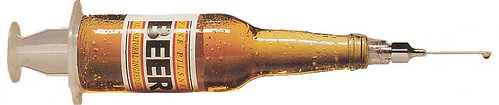
Modern anti-alcohol propaganda: beer leads directly to heroin, or beer is the same as heroin.

Filed Under: Editorial, Politics & Law Tagged With: History, Prohibition, Prohibitionists, Propaganda

Christmas Beer Bans

December 12, 2011 By Jay Brooks

santa-hat-beer
With Christmas falling on a Sunday this year, apparently more than half of the states still have antiquated blue laws on their books, restricting alcohol sales on Sundays, Christmas or both. As of about a year ago, at least fourteen states still enforced some kind of Sunday restriction. But according to a report today on OpenMarket.org entitled Christmas Liquor Bans: Is Your State on the List?, over half of the fifty states, plus D.C., still have some sort of restriction that will effect people in those states’ ability to buy a drink this Christmas. Happily, California’s not on the list, but with 27 places listed, that’s a lot of people who can’t get a drink this December 25. If you live in one of those jurisdictions, be sure to stock up early.

Filed Under: Beers, Editorial, Politics & Law Tagged With: Christmas, Holidays, Law

Beer Sales By Style Through Thanksgiving

December 11, 2011 By Jay Brooks

sales-chart-up
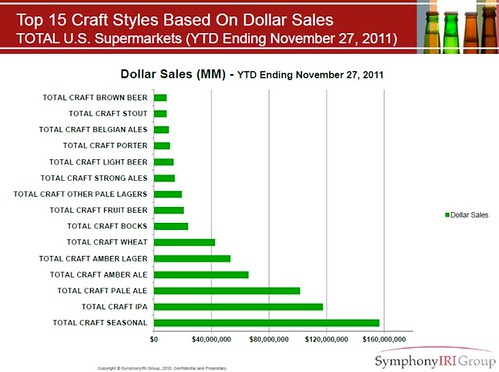
MC Basset, publishers of the Beer Bible — better known by its official title, “The Essential Reference of Domestic Brewers and Their Bottled Brands” — in their monthly e-mail blast, Style Trends, “provided a snapshot of (YTD) beer sales by beer style.” The data they use was compiled by the Symphony IRI Group (IRI), using “a data set that includes 15,000+ US grocery retailers.” The two charts below graph beer sales for calendar year 2011, through November 27th.

It’s also important to remember that by “beer styles,” they don’t mean styles in the ordinary sense used by homebrewers and judges in beer competitions, where the goal is to categorize beers of like characteristics together for ease of comparison. As IRI uses the term, they’re more of a loose arrangement of how they’re sold, since that’s their main focus. They also define what is “craft” beer differently than, say, the Brewers Association does, again because their goals are different. In their world, there are less “styles” than we’re generally used to, but what is “craft” is more loosely defined, allowing almost any beer that’s not a mainstream beer to be included.

In the first chart, it shows sales through Thanksgiving of the Top 15 craft styles based on dollar sales. There’s actually very little that’s surprising in this chart, as the category “seasonals” has been the top category for some time now, and IPAs, in second, is likewise how things have been for some time now. It basically shows that current trends are continuing as they have been lately.

craft-$sales-11-11-27

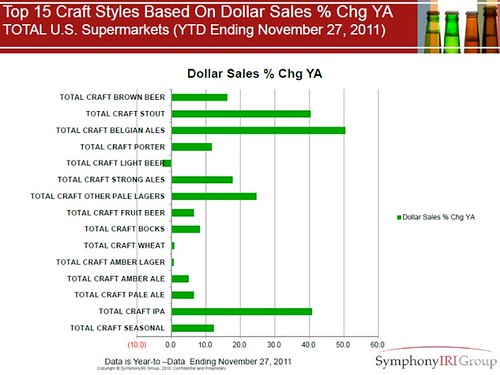
The second chart, however, I find more interesting. It’s showing the same fifteen categories, but by how their sales have changed, by percentage, over the same period of time from last year. In essence, this chart shows which kinds of beers are doing better this year than they did last year.

craft-$change-11-11-27

The second best recorded change, India Pale Ales — at just over 40% — has been trending up for a few years now, and hoppy beers continue to sell well. But what came in at number one is more surprising. Belgian Ales (really Belgian-style ales) are up around 50% over last year. Sure, it’s on a smaller base, but it’s still great to see more complex beers registering such a big increase. Undoubtedly, part of the reason for this is probably due to more outlets beginning to recognize customer demand and adding these beers to their set; but that, too, is a welcome development.

The other surprise is “stouts,” which are also up around 40% over 2010. And five of the beer styles are up over 10%, including “brown beer,” “pale lagers,” “porter,” “seasonals,” and “strong ales.” Only one style is down over last year, and that’s “craft light beer.” I presume that’s mostly Sam Adams Light, though there are a few others, such as Genny Light, Point Honey Light, Shiner Light and Yuengling Light that probably are included in that category.

Of all fifteen categories, all but three of them show fairly healthy growth. In addition to “craft light beer’s” slide, both “amber lager” and “wheat” grew only very slightly in 2011. Every other category grew by at least 5 or more percent from 2010 to 2011. Not bad in a recession.

Filed Under: Beers, Breweries, Editorial, News Tagged With: Business, Statistics

eBuzzing (Formerly Wikio) Beer Blog Rankings For December 2011

December 5, 2011 By Jay Brooks

eBuzzing
The December 2011 standings may have been updated for December, though since there’s no North American presence or website, it’s hard to be sure. For those of you who still have a widget on your blog’s homepage, you may have noticed that the name has changed from Wikio to eBuzzing. As the so-called “consultant,” they told me that would coming back in September. My contact at Wikio also told me his employment contract was ending and he was unsure as to whether it would be renewed. In case it wasn’t, he also copied me on another person there who would be my contact in the event his contract wasn’t renewed. I’ve written e-mails to both of them since September and thus far have received no replies from anyone at eBuzzing.

If you have a widget and clicked on the link, you may also have noticed that it goes nowhere, to a “404 Error Not Found” page. Several people have written me, wondering what’s going on, and sadly, I’ve been unable to shed any light on the situation. They’re not exactly showing that the North American market is very important to them or their business. Gerard Walen, from RoadTrips4Beer, posted on their UK blog and got the following reply:

For the moment US rankings have not been incorporated into the site. We will notify you once the US rankings are once more included at the same high quality as our European rankings.

And to his follow-up, half-joking, question, they said:

For the moment we are focusing on European countries, but will be looking to include more filters for more countries in the future.

So apparently there are no North American rankings or website for now, and they thought it fairly unimportant to let anybody know, or even post that information on the new eBuzzing website. They don’t necessarily owe us an explanation, but it sure would have been nice if they’d let someone know or at least let that information be readily available for anyone who might have been interested in finding out what happened instead of just shutting down their North American operations.

Though curiously, the widgets that are still out there have changed, as if they’ve been updated for December. Every one of them except Jeff from Beervana has plummeted, dropping quite a bit, though a few that weren’t in the Top 20 last month now are. I only know this through the completely unscientific method of having visited every blog on the Top 20 list for the last six months to see if they have a widget and, if so, what their ranking is now, and comparing that to November.

UPDATE: Thanks to Bill Night from It’s Pub Night who figured out how to check any URL using the code from the widget. (Thanks Bill.) Based on that, I was able to sort out the Top 16, and several more using all the beer blogs that made the list over the last six months. Obviously, numbers 17-20 include some blogs that hadn’t made the list before. There are also others below 20 that haven’t been on the list lately, but I can’t really go through the complete list of beer blogs to fill in the missing ones. (Note: If you know your December ranking and it isn’t listed here, please drop me a note and I’ll add you.)

social-labs

eBuzzing December 2011 Beer Blog Rankings (Maybe)

1Beervana (=)
2Seen Through a Glass (Not in Top 20 in November)
3Brewpublic (=)
4A Good Beer Blog (=)
5The New School (+1)
6Appellation Beer Blog (-1)
7It’s Pub Night (+1)
8Brookston Beer Bulletin (-6)
9Oakshire Brewing (+5)
10The Brew Site (+9)
11BetterBeerBlog (+2)
12Beeronomics (Below Top 20 Last Month)
13The Stone Blog (Not in Top 20 in November)
14Drink With The Wench (-7)
15Washington Beer Blog (-6)
16The Not So Professional Beer Blog (Below Top 20 Last Month)
21The Brew Lounge (Below Top 20 Last Month)
23Hoosier Beer Geek (-12)
24KC Beer Blog (-9)
26The Daily Pull (Below Top 20 Last Month)
28Seattle Beer News (-16)
31Beer PHXation (-11)
33The Pour Curator (Below Top 20 Last Month)
35Beer In Baltimore (Below Top 20 Last Month)
36San Diego Beer Blog (-20)
37I Love Beer (Below Top 20 Last Month)
39Road Trips for Beer (-22)
40Beer-Stained Letter (Below Top 20 Last Month)
44The Potable Curmudgeon (?)
49Brewer’s Log (Blog) (?)
52Yours For Good Fermentables (-39)
53Top Fermented (-43)
58Craft Austin (?)
65Beer 47 (Below Top 20 Last Month)
67Brewed For Thought (?)
68Beer at 6512 (?)
69Musings Over a Pint (?)
—Session Beer Project (Below Top 20 Last Month)

This, of course, may be the last month for these rankings. I always stressed that this was just a bit of fun and that we shouldn’t take it too seriously. But I have to say that the way they’ve handled the transition from Wikio to eBuzzing has left a bad taste in my mouth. I certainly understand that changes have to be made when companies merge, but keeping the people who might want to know in the dark is never the right way to go about it, at least in my opinion. Especially when you consider that the merger was first announced two years ago, in December 2009. C’est la vie. It was fun while it lasted.

Filed Under: Editorial, News Tagged With: Blogging, North America, Websites

Sumerian Beer: The Origins of Brewing Technology in Ancient Mesopotamia

November 28, 2011 By Jay Brooks

sumerian-tablet
Peter Damerow, from the Max Planck Institute for the History of Science, in Berlin, has published online a lengthy paper about the origins of Sumerian brewing. Entitled Sumerian Beer: The Origins of Brewing Technology in Ancient Mesopotamia, it’s part of The Cuneiform Digital Library Initiative (CDLI). The opening sentence gives a flavor of its purpose. “The following paper is concerned with the technology of brewing beer in the Sumerian culture of ancient Mesopotamia, which we know about from cuneiform texts of the 3rd millennium BC. and from reminiscences in later scribal traditions which preserved the Sumerian language and literature.”

It’s broken down in to seven sections:

  1. Introduction
  2. Overview of the sources
  3. Beer types and ingredients in proto-cuneiform documents
  4. Beer types and ingredients in the Old Sumerian period
  5. Beer types and ingredients in the neo-Sumerian period
  6. The brewing of beer
  7. What kind of beer did the Sumerians brew?

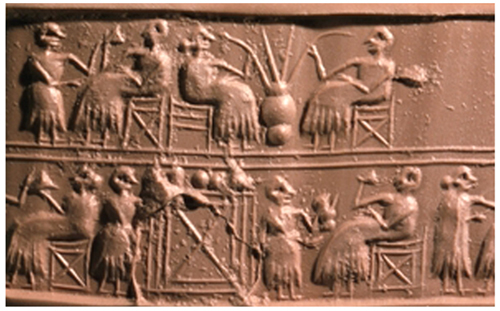
Sumerian-beer
Fig. 1: Impression of a Sumerian cylinder seal from the Early Dynastic IIIa period (ca. 2600 BC; see Woolley 1934, pl. 200, no. 102 [BM 121545]). Persons drinking beer are depicted in the upper row. The habit of drinking beer together from a large vessel using long stalks went out of fashion after the decline of Sumerian culture in the 2nd millennium BC.

I confess I haven’t read the whole thing yet, but I did download the pdf of it so I can put it on my iPad. Still, just from skimming it appears fairly interesting, and a worthy piece to read over the holidays.

Filed Under: Beers, Breweries, Editorial, Just For Fun, News Tagged With: Archeology, History, Science of Brewing

Top 8 Beer Sales Days

November 26, 2011 By Jay Brooks

sales-chart-up
This two-year old SlashFood article showed up in my Paper.li today, retweeted by a brewery I follow. The article, Super Bowl Sunday — The 8th Biggest Beer Day of the Year? questions the list of the top eight “Holidays/Events for Beer.” The list was complied by Nielsen, and as he points out is “combined beer sales from all U.S. outlets (including food, liquor, convenience and drug).” He’s initially is skeptical about why sales for the week following the holiday/event are also tracked, but eventually figured out that’s just how the weeks are tracked. If you want to include a week in which the holiday falls on a Sunday, you have to include the week prior and the week of to get all the relevant sales data. Author Mike Pomranz drew many of his conclusions from his correspondence with Nielsen executives, who naturally have a healthy bias in favor of their own data. As a result, Pomranz may not fully appreciate two additional tidbits about those statistics.

First, Nielsen’s data is almost entirely chain store sales. The big supermarket chains, drug stores, big box stores, convenience stores. As such, it’s a big slice of the pie, but it’s still nowhere near the whole pie. Missing from its numbers are thousands of small independent outlets that sell beer. It works because the sample is the same from period to period and so comparisons and trends can be confidently teased out of the data, and it’s certainly useful, but it doesn’t tell the whole story. What most people outside the industry forget, IMHO, is that it isn’t intended to be all-inclusive. It’s purpose is to identify sales trends and big picture activity. When I was the beer buyer at BevMo, I’d see an endless parade of Nielsen data from various breweries, and each would tell a different story, simply because of the way the information was massaged. There’s so much data that it can be drilled down in endless ways, with each business doing it in a way that was most favorable to their purposes, to show their sales in the best possible light. So it should be taken with a grain of salt. It’s most useful when comparing the same set of data over different periods of time; weeks, months, quarters, years, etc.

beersales

But it tends to break down when comparing different time periods, as in this list, because there are so many more factors that the raw numbers can’t capture. Pomranz certainly gives seasonality its due, concluding that “[i]f you were to normalize sales to account for weekly seasonal changes in overall beer sales, the often beer-centric celebration of the Super Bowl would most likely move significantly up the list.” That’s because climate — the weather — plays a HUGE part in beer sales that can’t be overstated. When the thermometer ticks up, beer sales go up. When it’s time to put on a sweater, beer sales plummet. It’s always been very seasonal that way. But even my old bosses at BevMo failed to recognize its importance and would routinely blame me for poor beer sales (or at least not hitting sales goals) when forces out of my control would hurt the amount of beer people bought. I even had one person tell me I was essentially not allowed to blame the weather, which is a bit like saying you can’t explain getting wet by pointing to the rain.

So not surprisingly, the top four holidays all take place during warm months of the year. And while you don’t normally associate Father’s Day with big beer-soaked picnics, just the fact that it’s in June may account for increased sales. Frankly, Easter is likewise one of those holidays that few people have been able to tie in with beer, but as it usually comes in the spring, it could also be a coincidence of the season.

Second, the Nielsen data is for “Case Sales.” In other words, not kegs. And a lot of holiday or event parties include kegs. For example, every year I was with BevMo our number one weekend for keg sales was Halloween. But in the Nielsen data, it doesn’t even crack the top eight. To me, that suggests another one of the limitations of their list. It’s just common sense. You can’t tell me more people drink beer for Easter than Halloween. Again, that’s because the data is imperfect and not comprehensive. It’s just a snapshot of one particular portion of the beer market.

And in fact, one year later, in 2010, the very same Nielsen chart for the subsequent year has the Super Bowl now in 7th place, with Halloween in 6th, and Easter and Father’s Day no longer registering.
nielsen-top-beer-holidays-jan-2010
So while I think we can mostly agree on which holidays or events are the biggest in terms of beer drinking, even if the order they’ll fall in will vary slightly, it’s best not to rely too heavily on incomplete data that’s not intended to be all-encompassing of the total beer market in America.

Filed Under: Beers, Editorial, Events, News Tagged With: Business, Football, Holidays, Sports, Statistics, Super Bowl

« Previous Page
Next Page »

Find Something

Northern California Breweries

Please consider purchasing my latest book, California Breweries North, available from Amazon, or ask for it at your local bookstore.

Recent Comments

  • Ernie Dewing on Historic Beer Birthday: Charles William Bergner 
  • Steve 'Pudgy' De Rose on Historic Beer Birthday: Jacob Schmidt
  • Jay Brooks on Beer Birthday: Bill Owens
  • Steve 'Pudgy' De Rose on Beer Birthday: Charles Finkel
  • Steve 'Pudgy' De Rose on Beer Birthday: Bill Owens

Recent Posts

  • Beer In Ads #5204: Oh Brother! Griesedieck Bros. Genuine Premium Bock Beer Is Here! February 15, 2026
  • Historic Beer Birthday: Emil Resch February 15, 2026
  • Historic Beer Birthday: Philip Zang February 15, 2026
  • Beer In Ads #5203: Robert Portner’s Bock Beer February 15, 2026
  • Historic Beer Birthday: August Schell February 15, 2026

BBB Archives

Feedback

Head Quarter
This site is hosted and maintained by H25Q.dev. Any questions or comments for the webmaster can be directed here.