Brookston Beer Bulletin

Jay R. Brooks on Beer

  • Home
  • About
  • Editorial
  • Birthdays
  • Art & Beer

Socialize

  • Dribbble
  • Email
  • Facebook
  • Flickr
  • GitHub
  • Instagram
  • LinkedIn
  • Pinterest
  • RSS
  • Twitter
  • YouTube

Powered by Genesis

Brewers Association To Petition TTB For Caffeine Craft Beer Carve-Out

November 16, 2010 By Jay Brooks

ba
On the heels of today’s announcement that the FDA will move to ban caffeine in alcoholic drinks, the Brewers Association announced that it will “formally petition the U.S. Tax and Trade Bureau (TTB) to conduct rulemaking on alcoholic energy drinks.”

From the BA press release:

The petition seeks to disallow synthetic and pure caffeine additions to alcohol beverages, but allow incidental caffeine from ingredients that have a long tradition in brewing, such as coffee, chocolate and tea. The petition seeks to clarify that coffee, chocolate, herbs, spices, seeds and fruit are ingredients that should remain available to brewers to make beers for responsible enjoyment by beer drinkers.

Certain alcoholic energy drinks have received significant negative attention from state attorneys general, public health groups and concerned citizens. Many states are taking action this fall before the federal government has responded, leaving a patchwork of different regulatory wording, all with the same intention. The goal of this federal petition is to provide a clear and consistent national standard to assist state-based rulemaking under the 21st Amendment. This standard would remove the products of concern from shelves without creating unintended damage to the hundreds of craft brewers who, for many years, have been using traditional ingredients like coffee, tea and chocolate to responsibly craft interesting and flavorful beers.

Brewers Association President Charlie Papazian stated, “Responsible brewers have successfully used coffee, chocolate and tea to add interesting flavor and complexity to their beers for decades. In fact, the Aztecs brewed a corn, honey and chili-based beer that contained cocoa. Many craft brewers build on these traditions today using coffee, tea and chocolate. On the other hand, the addition of artificial caffeine not from a natural ingredient source has no heritage or tradition in brewing. We support a ban on the direct addition of caffeine.” The Brewers Association invites TTB to open up public comment and rulemaking on whether these products are appropriate for responsible consumption.

It would certainly be great if they can get the regulatory agencies to see that there is a difference between straight caffeine and the traditional “incidental caffeine” that occurs when beer is brewed using ingredients like coffee, tea, chocolate, herbs, spices, seeds and fruit. So often this type of knee-jerk law, that seeks to ban a substance being used in a specific way, has unintended consequences that harm legitimate uses of the substance. But there are dozens, if not more, legitimate ways in which caffeine can appear in a beer as a part of the brewing process. These do not, and should not, be subject to the same scrutiny that many other caffeine and alcohol drinks are being subjected to. They do not appeal to kids in any way, shape or form and should be protected as separate and distinct.

Save the Coffee Stouts!

Filed Under: Beers, News, Politics & Law Tagged With: Brewers Association, Law

FDA To Rule Caffeine Unsafe In Alcohol

November 16, 2010 By Jay Brooks

caffeine
Harry Schuhmacher, of Beer Business Daily, just issued a news alert that he’s learned from the website of New York Senator Charles Schumer that the FDA “will rule ‘that caffeine is an unsafe food additive to alcoholic beverages, effectively making products such as Four Loko, Joose, and others like them, prohibited for sale in the United States.'”

According to the press release from Senator Schumer:

SCHUMER: FDA TO EFFECTIVELY BAN CAFFEINATED ALCOHOLIC DRINKS; FTC WILL NOTIFY MANUFACTURERS THAT THEY MAY BE ENGAGED IN ILLEGAL MARKETING OF UNSAFE BEVERAGES

After Months of Pressure by Schumer, FDA to Send Notice to Manufacturers of Caffeinated Alcoholic Beverages that Product is Not Considered Safe; Move Will Effectively Ban Products from the Market

FTC to Send Notices to Manufacturers That They Are Engaged in the Marketing of Unsafe Alcoholic Drinks

Schumer: Let This Serve as a Warning to Anyone Who Tries to Peddle Dangerous Beverages to Our Kids, Do it, And We Will Shut You Down

U.S Senator Charles E. Schumer announced today that the Food and Drug Administration (FDA) will rule that caffeine is an unsafe food additive to alcoholic beverages, effectively making products such as Four Loko, Joose, and others like them, prohibited for sale in the United States. Additionally, the Federal Trade Commission (FTC) plans to notify manufacturers that they are engaged in the potential illegal marketing of unsafe alcoholic drinks. These announcements come after months of intense pressure by Senator Schumer to have the drinks banned because of serious risks to consumer health and safety.

“Let these rulings serve as a warning to anyone who tried to peddle dangerous and toxic brews to our children. Do it and we will shut you down,” said Schumer. “This ruling should be the nail in the coffin of these dangerous and toxic drinks. Parents should be able to rest a little easier knowing that soon their children won’t have access to this deadly brew.”

After calls by Schumer to ban the drinks in New York, just this past week, the State Liquor Authority and the state’s largest beer distributors agreed to stop selling these dangerous drinks in New York. In addition to New York’s efforts, Oklahoma, Utah, Michigan, and Washington acted to ban the drinks as did a number of colleges, including Ramapo College, Worcester State University, the University of Rhode Island and the Wentworth Institute of Technology.

Popular drinks such as Four Loko and Joose contain as much as 2-3 coffee cups worth of caffeine and 2-3 cans of beer per container — a potent, dangerous mix that can be extremely hazardous for teens and adults alike. Last month, nine students passed out and were hospitalized after drinking Four Loko, leading states and universities across the country to issue ban, limit, or issue warnings about the drink.

Compounded with its health risks, beverages like Four Loko pose a unique danger because they target young people. The style of the beverages – with a vibrantly colored aluminum can colors and funky designs — appeal to younger consumers, increasing the likelihood that the beverages will be consumed by young adults and creating a problem for parents and business owners who might be misled by the branding. Four Loko is also stocked next to other energy drinks, creating further confusion.

Last week, Schumer was joined in his efforts to ban the drink by Jacqueline Celestino, grandmother of Nicole Lynn Celestino, an 18 year old from Long Island who passed away after drinking the caffeinated alcoholic beverage Four Loko. Nicole, went into cardiac arrest after drinking Four Loko this past August, she had taken a diet pill that day. Nicole’s family has become outspoken advocates for a ban on alcoholic caffeinated drinks like Four Loko.

The dangers of these drinks are well known. A recent study found that young and underage drinkers who combine alcohol with caffeine, which occurs with increasing frequency given the prevalence of beverages like Four Loko and Joose, are more likely to suffer injury, be the victim of sexual assault, drive while intoxicated, and require medical attention than drinkers who consume caffeine-free beverages. In 2008, Anheuser-Busch InBev NV and MillerCoors LLC reformulated caffeinated alcoholic beverages under pressure from several states and regulatory bodies, but smaller companies like the manufacturers of Four Loko and Joose managed to remain unnoticed.

According to the statement, the Federal Trade Commission (FTC) plans to notify manufacturers of caffeinated alcoholic beverages “that they are engaged in the potential illegal marketing of unsafe alcoholic drinks.”

There’s a lot of nonsense in that press release, and no one knows how whatever ruling the FDA makes will effect beer with coffee, tea or caffeine added for flavor.

First there’s this rant: “‘Let these rulings serve as a warning to anyone who tried to peddle dangerous and toxic brews to our children. Do it and we will shut you down,’ said Schumer. ‘This ruling should be the nail in the coffin of these dangerous and toxic drinks. Parents should be able to rest a little easier knowing that soon their children won’t have access to this deadly brew.’”

Did I miss a meeting. People under 21 can’t buy these products now. My kids, your kids, everybody’s kids have no access to these so-called “deadly brews.” If they do find a way to get them (which I have no doubt of) then that’s a failure of another kind. And doing away with them altogether effectively takes them away from law-abiding adults who want to purchase them. That just makes no sense to me. It’s as if they’re saying we can’t control the portion of the population that are under 21 so we’re going to punish everybody because we can’t do our job.

But that aside, there’s absolutely nothing preventing anybody from simply mixing a caffeinated drink with alcohol and making their own drink. That’s the whole reason companies started making pre-packaged RTD’s with alcohol and caffeine in the first place, because people were already doing that on their own. They didn’t create the demand, they responded to it and simply gave the people what they wanted.

This will do virtually nothing to stop people from drinking caffeine and alcohol together. It may make it more difficult and less convenient, but the cat is out of the bag. If anything, going back to people making these drinks themselves will make them less safe, not more, because there will be no standardized ratio for mixing the two.

Toward the end, Schumer claims “[t]he dangers of these drinks are well known.” Really, people have been drinking caffeine and alcohol together as long as the two have existed. Has it become more popular lately? Maybe, but people were doing it pretty regularly as long ago as when I was a young adult, thirty years ago. I’d love to see that study he cites, I’m willing to bet there are holes in it you could drive a truck through.

But the real danger is that undoubtedly craft beers that have beers with caffeine added for flavor, whether coffee or tea, will get dragged under in the government’s zeal to look like they’re doing something to protect people from themselves. Say goodbye to coffee stouts, a drink no underage kid would drink with a ten-foot straw.

Filed Under: Beers, Editorial, News, Politics & Law Tagged With: Malternatives, Science

Two New Studies Show Benefits For Beer Drinking Women

November 16, 2010 By Jay Brooks

women
Two new studies were presented yesterday at the American Heart Association’s annual meeting in Chicago. According to the Wall Street Journal, “[b]oth studies, by researchers at Brigham and Women’s Hospital in Boston and Harvard University, used data from the landmark Nurses’ Health Study, which started in 1976 and involves more than 200,000 women.”

The results of the two studies, and additional ones presented at the meeting, included findings that suggest “women might not have to limit themselves to the [previous] one-drink-a-day guideline.” Also, “[w]omen who have an alcoholic drink or two a day in midlife turn out to be healthier overall in their old age. Another study presented at the conference showed that women who had a daily drink had a lower risk of stroke.”

amer-heart-assn

From the Wall Street Journal:

The research into stroke risk looked at 73,450 women who were free of heart disease and cancer when they entered the study. They were followed from 1984 to 2006. Women who had up to one drink a day had a 20% reduction in stroke risk compared with non-drinkers. There was no impact on stroke risk among most women who drank larger amounts, such as two or three drinks daily. But women who were also on hormone-replacement therapy and who had two drinks a day had an increased stroke risk.

A third study released at the conference by researchers at the University of Rome in La Sapienza, Italy, showed that two to three drinks daily among male heart-bypass-surgery patients was associated with a 25% decline in the rate of subsequent cardiovascular problems like heart attacks and strokes compared to non-drinkers. But the risk of dying increased among people who had four or more drinks daily and had a particular heart problem affecting the left ventricle. The study involved more than 1,000 patients followed for about 3.5 years.

Women who had about two drinks daily also had fewer cardiovascular problems after bypass surgery but the benefit was smaller than seen in men. The researchers said many patients had wondered if they should stop drinking after bypass surgery so a study was designed to look at clinical outcomes among drinkers and non-drinkers.

While they caution that the jury’s still out on certain diseases that affect women, such as breast cancer, the overall effect of moderate drinking remains a positive force on total mortality. This new evidence, along with the mountain that precedes it, highlights yet more reasons why the Breast Cancer Action organization’s churlish denunciation of all alcohol companies in October was so obnoxious and wrong, which I wrote about at length in Biting the Hand That Feeds You.

One of the studies showed more evidence to confirm the prevailing theory that regular, moderate consumption of alcohol will keep you healthier, increasing the odds that you’ll live to a more advanced age than a person who abstains.

Qi Sun, a Harvard medical instructor, looked at nearly 14,000 women who had survived to age 70. Dr. Sun said he found that 1,499 of the women were free of major diseases like cancer and heart disease and had no physical impairments or memory problems. He looked at the amount of drinking these women had done at midlife, or about age 58 on average. Women who reported having one to two drinks most days of the week had a 28% increase in the chance of “successfully surviving” to at least age 70 compared with non-drinkers. Like other studies, Dr. Sun found women drinking most days of the week were more likely to be healthier than women who drank one or two days a week.

That’s advice my wife follows faithfully. Glad to know she’ll probably outlive me.

Filed Under: Beers, Editorial, News, Politics & Law Tagged With: Science, Women

Who Is The Super Bowl For?

November 15, 2010 By Jay Brooks

super-bowl-2011
This season’s Super Bowl is still three months away and we’re only half way through the 2010/11 NFL football season. This next Super Bowl at North Texas Stadium, the new Dallas Cowboy’s place, will be played on February 6, 2011.

super-bowl-xlv

But already I’ve received three e-mails from the Marin Institute with their now annual screed about saving the Super Bowl from beer advertising, known as Free the Bowl. It’s of the “it’s for the kids” variety of complaint, a favorite of anti-alcohol groups. Trying to restrict alcohol advertising began almost immediately after the repeal of Prohibition. Since keeping alcohol illegal proved unreasonable and counter-productive for society, temperance groups instead turned to other ways to limit access to it, and advertising codes proved an effective target, one that continues through today.

free-the-bowl

I realize that the Super Bowl is the chosen target because it’s such a big event, being one of the most watched sports events all year in the U.S. But I can’t help but ask, exactly who is the Super Bowl for? Is it a children’s event? No. Is it a family event? Maybe, but it’s not exactly Thanksgiving or Christmas. I can’t help but think that it’s an adult event where, like most things that occur in our society, some parents exercise the judgment to allow their kids to watch, too, like a PG movie. But let’s look at exactly who the audience is.

Last year, according to Nielsen, an estimated 151.6 million people watched the championship football game. The Marin Institute claims 30 million of those people were underage. I don’t know where they got that figure — perhaps they made it up — but even assuming it’s correct that means the underage audience is around 20%. That also means that the vast majority of the Super Bowl’s audience is adults, just over 80%. And that’s why I believe the Super Bowl is an adult event. Adults who are allowed to drink alcohol. The fact that many adults also let their kids watch the game with them should not turn the Super Bowl into “kid’s programming.” After all, any parent who doesn’t want to subject their kids to beer advertising has a very simple option available to them: they can turn off the game. No one is forcing them to watch or is forcing them to allow their kids to watch.

One more word about the 30 million underage viewers figure. I can only assume that’s all underage viewers, kids aged 0-20. Of those, how many are even paying attention? Certainly not the babies, but when does the so-called critical age begin? My kids are 6 and 9 and definitely do respond to advertising, but only to things they’re interested in already. When a new toy is advertised, the ad has their rapt attention. When it’s something they don’t care about — such as beer — they pay it no mind whatsoever and turn their attention elsewhere.

Assuming the kids’ ages are evenly spaced, that would mean if we assume it’s the kids over 10 and under 21 that are the ones supposedly “at risk” from — gasp — seeing a television commercial, then only 15 million kids are the ones the Marin Institute are concerned about. That’s 10% or just 1 in 10. That would mean 90% of the audience is effectively adult.

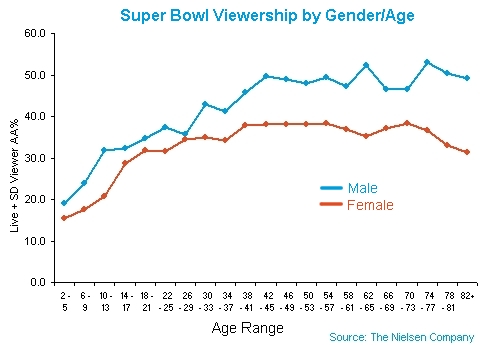
But all that speculation aside, who actually watches the Super Bowl? Is it kids? No, actually, it’s not. According to Nielsen research data, the younger you are, the less likely you are to actually tune in to the Super Bowl.

nielsen-sb-age-2010
According to Nielsen, “[a] look at age/gender demographics showed that viewers of both genders exhibited a similar viewing arc: generally, the older the viewer, the more likely they tuned into the game.”

So kids are actually less likely to watch the Super Bowl than adults, making all this fear-mongering hoopla about kids and the Super Bowl even less truthful and more shameless propaganda. All three of the Marin Institute’s e-mails were to raise money from their supporters. Each included pleas that they needed money to fight the scourge of beer ads during the Super Bowl using such propaganda slogans as listed below, so let’s look at those.

“Football & Beer are not the same thing”

Did anybody say they were? What does that even mean? But that’s followed up with:

“Anheuser-Busch InBev wants kids to think so”

Really, they do? What on earth makes them think that? I should also mention that the graphics in the e-mail show pictures taken from the “Bud Bowl,” the stop-motion ads that Anheuser-Busch ran during the Super Bowl beginning in 1989 that showed two teams of beer bottles wearing football helmets and playing their own bowl game. So perhaps that’s the confusion. Unlike my own children, perhaps they’re unable to tell the difference between animation and reality. This is a tactic that just infuriates me. They seem to suggest that because it’s animated — or fun — that it’s meant to appeal to only children. You hear this same argument when beer labels have Santa Claus on them, as if cartoons and Santa Claus belong exclusively to the province of childhood. But since the last Bud Bowl took place in 1997 — thirteen years ago (14 by the time of the next Super Bowl) — it seems pretty far fetched to use an example that’s over a decade old and no longer even used to try to make their point.

“Football & Beer are a dangerous combination”

I would think playing football while drinking is a bad idea, but watching it? Oh, but wait for the punchline.

“Anheuser-Busch InBev wants kids to think it’s cool to drink when we know that Beer Kills Kids”

Oh, it’s because ABI is trying to make kids think it’s cool to drink beer. Nonsense. 80%, and more like 90%, of the Super Bowl audience is of legal drinking age. That’s the audience for the ads. If anybody, that’s who ABI wants to convince that drinking Bud is cool. Besides the fact that the underage kids can’t buy their products legally, why would any company spend the millions of dollars it costs to get an ad on during the Super Bowl to advertise to 10% of the audience watching? Simple answer; they wouldn’t.

And the phrase “Beer Kills Kids” is needlessly alarmist and at its core, untrue. It makes it sound like beer is a toxic poison. Do some children die because they drank too much alcohol? Of course, but more often it happens because of doing something stupid afterward while still intoxicated, like driving or being in a fraternity hazing. Beer didn’t do them in like they were drinking anti-freeze. It’s exactly the same as with adults, though we hope more adults are capable of behaving more maturely than our youth. But the reality is, for children and adults, that some people are mature enough to drink responsibly and some are not. Nothing magical happens when a person turns 21. I drank more responsibly at age 18 than my stepfather did at 51, my age now.

Worse still, the phrase makes it sound like they’re calling every person who makes or sells beer a murderer. I find that more than a little insulting.

“Americans Love Football…Why Push The Beer?”

This may be the single stupidest rhetorical question ever asked. Check the sales figures, Americans love beer, too. Countless adults like to watch sports and enjoy a beer at the same time. It’s relaxing, it’s enjoyable, it enhances the experience. I do it, don’t you? Don’t most people you know?

Hmm, let’s see. The Super Bowl is the most watched annual sports event in America and the audience is 80-90% adults, and even skews more male. Why would any company that makes a product aimed at almost that exact same demographic want to advertise during the game? Say it with me — “opportunity.” Any company that can afford it, should be advertising during the Super Bowl. To not do so would practically run counter to their corporate charter. And it’s that same opportunity to reach lots of people that the Marin Institute is cynically exploiting to raise money and stir up yet more unwarranted criticism of the beer industry.

The reality is I’m no great fan of the television advertising by the big beer companies, foreign and domestic, but not for the reasons that anti-alcohol groups don’t like it. The way in which beer has been advertised for decades has done a lot of damage over the years to people’s perception of what exactly beer is and can be. They’ve treated beer like an interchangeable commodity that has to be heavily advertised and marketed to sell, because at that level most beer is pretty similar and the differences all come down to how it’s marketed. That has also made it harder for the craft beer industry to be successful, because of how much re-edumacation has been necessary to essentially retrain people about beer’s diversity and sophistication. To this day, when many people say “I don’t like beer” invariably it’s because they view it as that one thing that big beer has convinced them is all that beer is.

But to suggest that those ads can’t run during the Super Bowl just because I’m going to let my children watch the game, too, is to me personally the height of absurdity. If nothing else, it’s a teachable moment for parents. Drinking responsibly with your children is perhaps the best way to show them that drinking alcohol is not to be feared, but can be done safely, enjoyably and in moderation. My wife and I teach that lesson every single day in our household, often while watching television with our kids. As a result, they see untold numbers of commercials for products aimed at adults, both watching sports and other programming. Some are for beer, most are not. But they all elicit a conversation about what they see, allowing us to shape how they respond to and think about the commercials they view. Isn’t that what parenting is all about: engaging your kids? Talking to them about how the world works, what’s in it and how they can deal with it is what we do every day? Why should Super Bowl Sunday be any different?

Filed Under: Beers, Breweries, Editorial, Politics & Law Tagged With: Football, Sports

ABI Suing Baseball Over Exclusive Beer Rights

November 12, 2010 By Jay Brooks

baseball
Today in U.S. District Court, for the Southern District of New York, Anheuser-Busch InBev filed a lawsuit asking for a declaratory judgment against Major League Baseball. In “Anheuser-Busch, Inc. v. Major League Baseball Properties, Inc.,” ABI alleges that MLB “reneged on a renewal of its beer sponsorship rights this year and demanded ‘exponentially higher’ fees.” Back in April of this year, ABI believed it had reached a deal to renew its long-standing status (over 30 years) as the “official beer of baseball,” but apparently the baseball league tried to renegotiate the deal “due to ‘a change in marketplace dynamics,’ according to the lawsuit.” Naturally, MLB was seeking to increase the amount of money they would receive from ABI and also wanted to negotiate with rival beer companies for the same rights. The lawsuit asks the court to enforce the April deal and further prevent “MLBP from negotiating with any other brewers for sponsorship rights. The lawsuit doesn’t request money damages.” Baseball’s position is that the April deal was not binding and that they could “offer sponsorship rights to Anheuser[-Busch]’s competitors.” In addition to sponsoring the league as a whole, Anheuser-Busch also sponsors 26 of the total of thirty individual baseball teams in MLB.

The story has already been picked up by Bloomberg, Reuters, the St. Louis Business Journal and the Wall Street Journal.

Filed Under: Breweries, News, Politics & Law Tagged With: Anheuser-Busch InBev, Baseball, Big Brewers, Law, Sports

Zythophile Examines 40 Years Of CAMRA

November 12, 2010 By Jay Brooks

camra
With the 40th anniversary of the Campaign For Real Ale (CAMRA) just around the corner, one of my favorite beer historians, Martyn Cornell, takes a close look at some mistakes they’ve made along the way and some things they might have done better. He writes Maybe They Should Have Kept to ‘Revitalisation’. And Dropped the ‘Ale’at his wonderful blog Zythophile. Full disclosure, like Martyn, I’m also a CAMRA member.

Filed Under: Editorial, Politics & Law, Related Pleasures Tagged With: Cask, UK

Full Fact Disputes UK Alcohol Statistics

November 9, 2010 By Jay Brooks

beer-syringe
In response to the highly unscientific study published in The Lancet last week suggesting alcohol is more dangerous than heroin, FullFact.org — “A [British] independent fact-checking organisation” — asked the question “Are alcohol-related problems on the rise?” Their conclusion? “Full Fact finds little support in the evidence.”

Filed Under: Beers, Editorial, News, Politics & Law Tagged With: Science, Statistics, UK

Another View On Defining Craft Beer

November 8, 2010 By Jay Brooks

pint
When the Brewers Association redefined “craft beer” a few years ago, it was viewed with controversy and downright scorn by more than a few people. It’s certainly understandable that the BA needs to define what it means to be a craft brewer, because after all that’s their charter. They’re a trade organization for the craft brew industry. They have to be able to define what it means to be a member and to determine who can and cannot be a member. The new definition took a long time to be agreed upon, and even today not everyone does, even within the organization among its members. Some former members were kicked out at the stroke of a pen, so to speak, when they no longer fit the new definition. I personally have mixed feelings about how it’s currently defined and believe it needs further tweaking. But I’m not actually prepared to launch into that discussion right now. Someone else has, however.

Danner Kline is one of the founders of Free the Hops, the grassroots organization that successfully got the Alabama state legislature to raise the maximum a.b.v. allowed from 6% to 13.9% and continues to work toward bringing “the highest quality beers in the world to Alabama.” Kline has his own take on the craft beer definition, What Is Craft Beer?, that appeared in the Birmingham Weekly last Thursday. It’s worth a read, and it’s worth thinking about and discussing, as it will have to change again, especially if the effort right now to change the numbers for breweries in the Unites States Congress is successful.

Filed Under: Breweries, Editorial, Politics & Law Tagged With: United States

Beer In Ads #234: Miss Rheingold On Voting

November 2, 2010 By Jay Brooks

ad-billboard
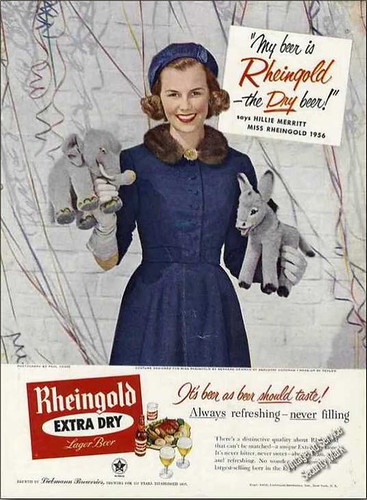
Tuesday’s ad is for Rheingold beer, features Miss Rheingold for 1956 — Hillie Merritt — holding a stuffed elephant and donkey for the election that year, which would have been held November 6, 1956. That was the year Dwight D. Eisenhower defeated Adlai Stevenson. Oddly enough there’s no text whatsoever about the election or politics of any kind, and in fact if it weren’t for the plush political symbols it could be a completely generic beer ad. Happily, however, the stuffed animals are there. Look closely at them. Is it just me, or does the donkey look like he’s laughing while the elephant is wearing a somewhat maniacal expression?

Rheingold-1956-3

Filed Under: Art & Beer, Beers, Politics & Law Tagged With: Advertising, History

Good People Vote

November 2, 2010 By Jay Brooks

vote
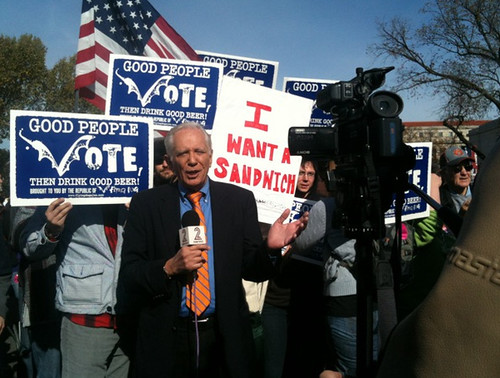
While perusing BuzzFeeds’ 100 Best Signs At The Rally To Restore Sanity And/Or Fear, at #99 the photo features the “Good People Vote” signs from Flying Dog Brewing being held up at the Rally To Restore Sanity over the weekend. Since today is Election Day here in the U.S., this is a great message. So go vote. After that “Then Drink Good Beer!” Now that’s good advice.

good-people-vote

Filed Under: Beers, Breweries, Editorial, Just For Fun, Politics & Law Tagged With: Humor, Maryland

« Previous Page
Next Page »

Find Something

Northern California Breweries

Please consider purchasing my latest book, California Breweries North, available from Amazon, or ask for it at your local bookstore.

Recent Comments

  • Bob Paolino on Beer Birthday: Grant Johnston
  • Gambrinus on Historic Beer Birthday: A.J. Houghton
  • Ernie Dewing on Historic Beer Birthday: Charles William Bergner 
  • Steve 'Pudgy' De Rose on Historic Beer Birthday: Jacob Schmidt
  • Jay Brooks on Beer Birthday: Bill Owens

Recent Posts

  • Beer In Ads #5222: O’Keefe’s Bock Beer April 15, 2026
  • Historic Beer Birthday: George Schmitt April 14, 2026
  • Beer In Ads #5221: Bowler Brothers’ Bock April 14, 2026
  • Historic Beer Birthday: George W. Bashford April 14, 2026
  • Beer In Ads #5220: Hello People! I Am The Centlivre Bock Beer Goat April 13, 2026

BBB Archives

Feedback

Head Quarter
This site is hosted and maintained by H25Q.dev. Any questions or comments for the webmaster can be directed here.