Brookston Beer Bulletin

Jay R. Brooks on Beer

  • Home
  • About
  • Editorial
  • Birthdays
  • Art & Beer

Socialize

  • Dribbble
  • Email
  • Facebook
  • Flickr
  • GitHub
  • Instagram
  • LinkedIn
  • Pinterest
  • RSS
  • Twitter
  • YouTube

Powered by Genesis

Beer More Dangerous Than Heroin!?!

November 1, 2010 By Jay Brooks

beer-syringe
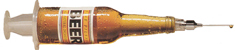
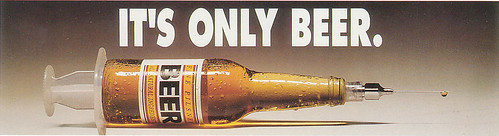
I suppose it was inevitable. Anti-alcohol folks have been saying for years that alcohol is the worst drug on the planet. And comparing it to heroin is not exactly new, either. A popular neo-prohibitionist PSA shows a beer bottle as a syringe to remind people that alcohol is also a drug. You can even buy bookmarks and posters of it at Face, the one-stop shop for neo-prohibitionist propaganda. Of course, aspirin is also a drug, but who would drink beer in either pill or syringe form?
its-only-beer-lg

The characterization of alcohol as a drug is mostly a specious one, because it ultimately depends on how you define what a drug is or how it’s used. You might be tempted to think that it’s fairly easy to explain exactly what is a “drug,” but it’s actually not. Even the most common dictionaries define it rather differently, and how people connote it varies even more widely. Some say it’s only a drug if it’s used as medicine, others any chemical substance that alters something physical, while still other definitions insist a drug is something illicit or illegal. A lot of what definition you choose is dependent on your message or what point you’re trying to make. In other words, context matters. What we can agree on — I hope — is that there are both good and bad drugs. I know there won’t be universal agreement on which is which, but that they’re not all the same I trust can be acknowledged by either side of the alcohol divide.

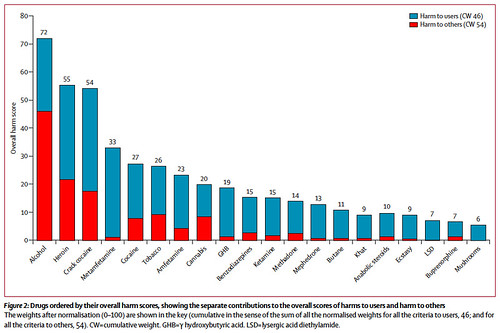
Today the scientific journal The Lancet published a new article entitled Drug Harms in the UK: A Multicriteria Decision Analysis that purports to show that alcohol is more dangerous than heroin. According to their results it is indeed claimed that alcohol is more dangerous to society and individuals than anything else on Earth, including crack, cocaine, tobacco, Ecstasy and LSD. The article — I refuse to call it a study — was authored by David Nutt, the former UK chief drugs adviser who was fired in October of last year by the British government.

Why this so-called study is garnering such media attention has to do with its volatile headline. As they say, if it bleeds it leads, and this definitely has blood on it. But it’s not exactly scientific. I’d always thought of the Lancet as one of the more rigidly scientific journals, but this gives me pause. Essentially, the way the results of this article were collected was by gathering together sixteen “experts,” specifically “members of the Independent Scientific Committee on Drugs (an organization founded by David Nutt after his firing), including two invited specialists” who then sat down for a one-day meeting — called a “workshop” — where each of them was asked to “score 20 drugs on 16 criteria: nine related to the harms that a drug produces in the individual and seven to the harms to others. Drugs were scored out of 100 points, and the criteria were weighted to indicate their relative importance.” Well, how scientific.

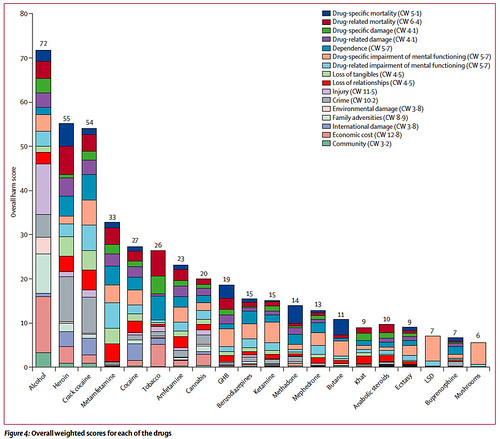
This is the 16 criteria they scored:
Lancet-Nov10-fig-1

So essentially this “study” is simply the scores collected by a few so-called “experts” — almost entirely made up of members of one organization thick with agenda — during a one-day retreat. That’s hardly “proof” of anything. If I were The Lancet, though, I’d be a little embarrassed about having so unscientific a piece being in my previously distinguished pages. Throughout the article, the author infuriatingly keeps referring to the results as “findings,” as if they’re a tally of something more meaningful than mere opinion. Self-fulfilling prophecy is a more reasonable assessment of their “findings.”

Here’s how they explain themselves:

The issue of the weightings is crucial since they affect the overall scores. The weighting process is necessarily based on judgment, so it is best done by a group of experts working to consensus. Although the assessed weights can be made public, they cannot be cross-validated with objective data.

They also admit that their opinionated scores only include the supposed harm of the substances they’re evaluating, and that they did not take into account any benefits, apart from admitting that some do exist.

Limitations of this approach include the fact that we scored only harms. All drugs have some benefits to the user, at least initially, otherwise they would not be used, but this effect might attenuate over time with tolerance and withdrawal. Some drugs such as alcohol and tobacco have commercial benefits to society in terms of providing work and tax, which to some extent offset the harms….

So they admit alcohol’s economic benefits, but still conveniently ignore the many health benefits of responsible, moderate consumption, including the rather important fact that most people who drink moderately will live longer than those who either totally abstain or over-indulge.

No matter, the experts conclude that both heroin and crack-cocaine are nearly a third less dangerous than alcohol. Mushrooms, they’ve declared, are the safest of all.
Lancet-Nov10-fig-2

But essentially they’re taking the minority of people who abuse alcohol and from there go on to imply that essentially everyone who drinks alcohol exacts that same cost to themselves and society, extending the data out to include all drinkers. But that’s clearly untrue and quite ludicrous. All they’ve done is dress up opinions — and biased ones at that — and presented them as facts and findings, based solely on the idea that expert opinions are facts. That The Lancet went along with it shows how mesmerized we are by the lure of so-called, and even self-proclaimed, “expert opinions.”

Finally, the chart below shows the breakdowns of each of the 16 criteria and how much they assigned to each “drug.”
Lancet-Nov10-fig-4

The BBC even collected drinkers’ responses and one woman noted that her grandmother has had a glass of wine every single day since she was 18 and is still going strong, reasonably suggesting that she might not still be here if she’d been taking heroin every day for the same period of time. Professor Nutt won’t even concede that point, saying that it’s not necessarily true, stating that the woman’s grandmother might be better off if she’d taken the heroin instead! He says “all medicines are safe if they’re used appropriately.” Maybe, but why wouldn’t that same logic then extend to alcohol? Why can’t he concede that it’s also safe if used “appropriately?” Can anyone really believe that a prescription of heroin every day is safer than a drink or two of beer per day, just because it didn’t come from a doctor’s advice?

Is it possible there’s another reason for Professor Nutt’s war on alcohol? Well here’s at least one possibility. In December, the London Telegraph reported that Nutt was leading a team at Imperial College London in developing a synthetic alcohol, produced using chemicals related to Valium. According to the report, it “works like alcohol on nerves in the brain that provide a feeling of well-being and relaxation,” but “unlike alcohol its does not affect other parts of the brain that control mood swings and lead to addiction. It is also much easier to flush out of the body.” And because it’s “much more focused in its effects, it can also be switched off with an antidote, leaving the drinker immediately sober.” It’s not too hard to imagine that the scarier and more dangerously alcohol is perceived as a societal evil and health risk, the more customers for synthetic alcohol there would be.

No matter what his true motives, Nutt is … well, I’ve been trying to avoid this but there’s just no way around it, something of a nutter. He claims that his “findings showed that ‘aggressively targeting alcohol harms is a valid and necessary public health strategy.'” Of course, that’s been his position since well before this farce began, so again, it’s much more of an agenda in search of its own validation. Not so much a self-fulfilling prophecy, but a self-created justification for a position he already held. All he needed to do was to create the official-sounding organization “Independent Scientific Committee on Drugs” and then have them say the same thing he’s been saying all along, this time with charts and people with strings of alphabets after their names so it all sounds on the up and up. But this is just another case of the Emperor having no lab coat, and few people in the media even noticing.

UPDATE: As expected, Pete Brown has also tackled Nutt’s Lancet article and its attendant publicity in The MAIN reason Professor Nutt is bad for our health. Check it out.


Filed Under: Beers, Editorial, News, Politics & Law Tagged With: Prohibitionists, Science, Statistics, UK

Good Pub Guide Announces Pay To Play

October 29, 2010 By Jay Brooks

good-pub-guide
I’m not quite sure what to think about this. The Publican reported today that the highly respected and nearly 30-year old UK Good Pub Guide is going to begin charging pubs to be included in the guide. Starting with next year’s edition, fees to be included “will be either £99 or £199, depending on the size of the outlet.” The current issue includes over 5,000 listings, so that would mean future books would realize between £500,000 and £1,000,000 (or between $800,900 and $1.6 million dollars).

The reason for the charge is explained by editor Fiona Stapley, and it’s just what you’d expect. “Putting together a guide like this is quite expensive and we are looking at the business model. More and more guides like this are charging. She added that the judging criteria would remain the same and pubs would still have to reach the same standards to gain a listing.”

good-pub-guide-2010

And yes, I’m sure that it is expensive to put the book together. Having been involved in publishing for a lot of years, I don’t doubt that it’s become increasingly pricey to produce the book. Unfortunately, I’m not sure this is necessarily the best fix. As Stapley states, “more and more guides like this are charging.” Maybe, but I have a hard time believing by doing so they maintain the same level of integrity and independence. The most obvious problem would come when some, or perhaps a lot, of pubs choose not to spend the money. After all, a lot of pubs in the UK are struggling to stay afloat. As a result, the “Good Pub Guide” could become the “Good Pubs Willing to Pay the Fee Guide.” It would no longer be complete. Undoubtedly, many successful pubs would feel compelled to pay in order to not have their business suffer from being excluded. Whenever that happens — and however perfectly legal — it would still be hard not to see it as de facto extortion.

Could they charge pubs to be included and then remain independent in their reviews? I’m sure it’s possible. After all, magazines that accept advertising do it all the time. But this seems slightly different insofar as this is paying to be in a guidebook whose sole purpose it to provide impartial reviews of each pub’s quality and worthiness. Even if they started out with the best of intentions, it seems very likely, to me at least, that over time the pubs that are paying would come to expect something in return for their continued support and the dynamic of the publication would change. And increasingly, pubs that should be recommended would come to not be included just because they balked at the idea of paying for the privilege. That would do a grave disservice to both those good pubs and the potential customers using the guidebook to find them. No matter how hard they tried to remain impartial, it just feels like it would still create an undesirable perception of the potential for misconduct. What do you think? Inevitable and unconcerning or a death blow to impartiality?

Filed Under: Editorial, News, Politics & Law Tagged With: Beer Books, Pubs, UK

Super Drunk

October 27, 2010 By Jay Brooks

superman
This Halloween, a new law in the state of Michigan takes effect. Officially, it’s known as the “High Blood Alcohol Content Enhanced Penalty” law, though most people call it by its nickname: the “Super Drunk” law. Essentially, the new law targets persons driving with a BAC of 0.17 or above and carries harsher penalties than regular drunk driving, to wit:

Under the new law, drunk drivers with a level of .17 or higher will face harsher punishment. Jail time will be doubled, a drivers license will be revoked for a minimum 45 days. Drivers who register .17 or higher will also face mandatory alcohol treatment and costs that could reach as high as $10,000.

According to Michigan ABC television station WJRT Channel 12, the “National Highway Traffic Safety is behind [the new law]. More than 40 states already passed the law and Michigan is one of them.” Strange that I haven’t heard of this before, especially if all but ten states have a similar law on the books. According to the National Conference of State Legislatures, not including Michigan, indeed 42 states have increased penalties for drivers stopped with a BAC of between 0.15 and 0.20, depending on the state.

So I know what you’re probably thinking. “How could I possibly be against this?” Well, the truth is I’m actually not … not exactly, anyway. I’m not necessarily against having harsher penalties for different levels of intoxicated driving. My biggest problem with this law, and presumably it’s the same in the other states, is that while addressing the upper limit, it keeps the lower limit where it is, at 0.08, and also there continues to be “zero tolerance” areas that ignore the law and arrest people who are below 0.08 and also some jurisdictions that either have proposed or have already passed legislation allowing the arrest of people with a lower BAC. I’m just not sure any of this does much to actually stop people from driving drunk — the goal, one hopes — and it especially does nothing to stop the worst offenders. At least one Michigan newspaper agrees with me, writing In The Margins: ‘Super drunk’ law isn’t necessary, nor will it curb hard-core drunks.

To me the problem of the worst offenders driving drunk was never addressed by lowering the BAC. All that’s been accomplished is ruining the lives of more and more people. The argument is always, but what about the people who are hurt by drunk drivers? In a sense, that’s like asking “what about the people who might be accidentally shot during a robbery.” Making robbery illegal hasn’t stopped that problem, either, because people who will do stupid and illegal things will not stop just because the government says “hey you, stop.” Of course it would be great if everybody was responsible and didn’t get behind the wheel of their car when they’d had too much, but more and harsher penalties hasn’t worked before. Maybe it’s time to try a different approach?

Filed Under: Beers, Editorial, News, Politics & Law Tagged With: Law, Prohibitionists

Under the Influence of Recession

October 20, 2010 By Jay Brooks

california
The California Board of Equalization — our taxing agency — yesterday sent out a press release with the results of a study they did on drinking trends in the state based on the collection of excise taxes. The release, Under the Influence of Recession: BOE Answers the Question, “Do People Drink More During an Economic Downturn?” is available as a pdf from the BOE’s newsroom page.

Below is the press release, which reports the overall findings:

There are no consistent patterns in alcohol consumption or spending on alcohol during recessions, a report released today by Board of Equalization (BOE) Chairwoman Betty T. Yee concludes.

The November 2010 edition of the BOE’s Economic Perspective newsletter looks at alcohol consumption data during the recessions of 1970, 1973, 1980, 1981, 1990, 2001 and 2008. The Economic Perspective is a quarterly publication produced by the BOE that looks at economic factors of interest or that influence California economic activity. The November edition looks exclusively at the issue of alcohol consumption during the seven recessions of the last 40 years.

“Economic data compiled by the Board of Equalization contains a wealth of information for estimating revenue impacts and other analyses that serve the agency’s tax administration mission,” said Chairwoman Yee. “In this case, the figures do not indicate any generalized patterns of behavioral change in alcohol use during bad economic times.”

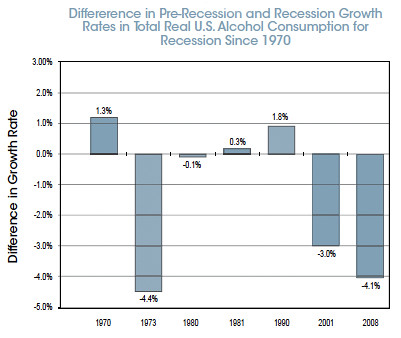
The BOE report notes several ways consumers would be expected to react during recessions: First, total alcohol consumption per capita may fall during the recession, as consumers would have less income to spend on alcohol. Second, consumers may substitute less expensive brands of alcohol for more expensive brands or less expensive ways to consume alcohol for more expensive ways, such as more off-premises consumption during recessions, as opposed to in bars and restaurants. Third, consumers may change the kind of alcohol they drink, for example switching from distilled spirits to less expensive alternatives such as beer. The fourth response, based on psychology more than economics, would be that consumers “drink away their sorrows,” and increase alcohol consumption during recessions. The data show examples of all four kinds of responses during recessions. The most consistent response, occurring in four of the seven recessions studied, was lower growth in on-premises alcohol consumption.

The November Economic Perspective also notes that in terms of national spending patterns on alcohol, prior to the 2008-09 recession total U.S. spending rose 2.4 percent. In contrast, during the 2008-09 recession, U.S. spending on alcohol declined by 1.7 percent.

The Economic Perspective newsletter also notes:

  • Alcohol consumption nationally is at a 25-year high, based on a Gallup survey released in the summer of 2010, with 67 percent of Americans drinking alcohol.
  • Federal Health and Human Services data show a low of 1.96 gallons ethanol consumption per capita in 1954 (a recession year) and a high of 2.76 gallons in both 1980 and 1981 (both of which were recession years).
  • The data show that California alcohol consumption has generally followed national trends in the last 20 years. California per capita consumption, like the U. S., reached a low point in 1998, then started gradually trending upward.

The report points out that historical data show that when confronted with a recession, people who drink alcohol have responded in a variety of ways.

Various Responses Represented in Recessions

The data show examples of all four kinds of responses during recessions. The first consumer response, less growth in total alcohol spending, occurred in 1973, 2001, and 2008. Chart 3 shows these changes in total alcohol spending for each recession. The second kind of response, lower growth in on-premises alcohol consumption, occurred in the recessions that started in 1973, 1980, 1981, and 2008. This appears to be the most consistent response, happening in four of the seven recessions.The third response was seen in both of the 1970s recessions. Beer consumption went up in the recessions of the 1970s, while distilled spirits consumption went down. This kind of response has not happened since the 1970s. And the fourth response, significantly higher total alcohol spending during a recession, happened in 1970 and 1990.

boe-2010-2

And here’s some interesting tidbits from the Economic Perspective newsletter:

Average total U.S. ethanol consumption per capita is tabulated by decade in [the chart below] to track long-term trends. As shown in the chart, average ethanol consumption per capita for the first nine years of the first decade of 2000 was similar to that of both the 1960s and the 1990s. The recent decades with the highest consumption were the 1970s and the 1980s.

boe-2010-1

And here’s some more from the newsletter on alcohol and the economy.

U. S. Alcohol Drinking rate at 25-Year High

A Gallup survey released in the summer of 2010 indicated that 67 percent of Americans drink alcohol, the highest percentage recorded since 1985.1 Is there some kind of statistical relationship between alcohol consumption and economic growth? Do people drink more during recessions and associated periods of high unemployment rates?

Do We Drink More During Recessions?

To answer this question, this article reviews long term and short term trends in alcohol consumption and analyzes changes before and during the recessions we have had since World War II.
According to Gallup:Despite some yearly fluctuations, the percentage of Americans who say they drink alcohol has been remarkably stable over Gallup’s 71 years of tracking it. The high point for drinking came in 1976-1978, when 71 percent said they drank alcohol. The low of 55 percent was recorded in 1958. When Gallup first asked Americans about drinking, in the waning days of the Great Depression in 1939, 58 percent of adults said they were drinkers.

Gallup reports also note that the percentage of Americans who say they drink alcohol has been in the low 60s fairly consistently since 1947.

Gallup Data Show Alcohol Use Unrelated to Recessions

Based on these data, it would appear that prior to 2010 there was little, if any relationship between the percentage of people drinking and economic conditions. The economy was not in a recession during the 1976-1978 period, when the highest percentage of adults defined themselves as alcohol drinkers (71 percent). In fact, the economy was growing rapidly, with real gross domestic product (GDP) increasing an average of 5.2 percent per year during this three-year period. This is well above the 2.9 percent average annual growth rate experienced by the U.S. economy since 1945. The economy was in a recession from August 1957 through April 1958, about the time of the lowest percentage of adult drinking in Gallup’s records (55 percent).2 If anything, these extreme points in the Gallup poll results seem to indicate that people drink more when the economy does

Other Measures of Alcohol Consumption

Polls such as those done by the Gallup Group measure how prevalent drinking is. Other measures indicate how much alcohol is consumed. These include ethanol (pure alcohol) content, gallons of liquid by type of product, and spending in dollars.

Health and Human Services Alcohol Surveillance Reports

The U.S. Department of Health and Human Services (HHS) periodically does surveillance reports of state and national alcohol consumption in terms of gallons of ethanol content of beer, wine, and distilled spirits per capita for those over age 14. Sources of data include state government revenue agencies and various industry sources. The most recent HHS report has these annual data from 1934 through 2008.3 The data show no obvious correlations with recessions. For example, in 2001 (the most recent recession covered by these data) total U.S. ethanol consumption from beer, wine, and distilled spirits was 2.18 gallons per capita,

Alcohol Consumption Rising Since 1998

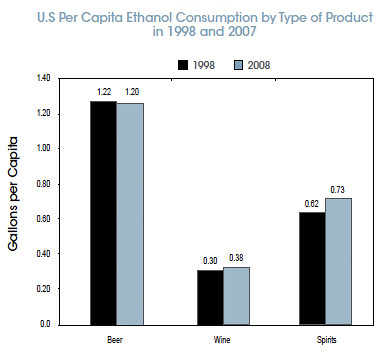
The HHS data show that total U.S. ethanol consumption reached its most recent low point in 1998, at 2.14 gallons per capita. It has been slowly trending upward since then, reaching 2.32 gallons per capita in 2008. As shown in Chart 1, wine and distilled spirits were responsible for the increase in U.S. per capita consumption from 1998 to 2008.

Lowest and Highest Alcohol Consumption

The lowest U.S. total ethanol consumption since the end of World War II was 1.96 gallons per capita in 1954 (a recession year, with a recession running from July 1953 through May 1954). The highest consumption was 2.76 gallons per capita in both 1980 and 1981 (both recession years, each with six-month periods of recessions).

On additional interesting findings is that during a recession, they did note that people tend to go out less frequently, meaning sales of alcohol at restaurants and bars decline, but based on the uptick in retail purchases of alcohol for home consumption it’s essentially a wash. But that means, as we’ve seen brewpubs and restaurants struggle a bit while package craft and regional breweries have had solid growth.

The BOE study concludes that “there appear to be no consistent patterns in alcohol consumption or spending during recessions. Recessions are all different; some last longer than average, some are associated with more than average job losses. Alcohol consumption responses during recessions are also different, and not very predictable. The historical data show that when confronted with a recession, people who drink alcohol have responded in a variety of ways.”

Filed Under: Beers, Editorial, News, Politics & Law Tagged With: California, Press Release, Taxes

Not OK: Oklahoma Considering Beer Tax Hike To Punish Drinkers

October 19, 2010 By Jay Brooks

oklahoma
Oklahoma joins the ranks of states currently considering raising the tax on beer and other alcohol due to budget shortfalls, in effect punishing alcohol companies and the vast majority of people who enjoy drinking their products responsibly. According to the Oklahoman, the heads of three state health agencies, Health Commissioner Terry Cline, Mental Health Commissioner Terri White and Howard Hendrick, director of the Department of Human Services, “urged state lawmakers to raise the alcohol tax to help address a 2012 fiscal year budget deficit that could be as large as $800 million.” This is the same nonsense going around in other states whereby lawmakers go after a convenient target, often with the help of anti-alcohol groups, that they know play well to constituents raised on temperance propaganda that demonizes alcohol as a sin. But essentially the tax hikes aimed at alcohol punish both the companies that make the products and the majority of consumers who drink them responsibly and in moderation, while doing nothing whatsoever to address the root causes of the tiny minority that do abuse alcohol and drugs. They’re not remotely fair.

I’m as sorry as the next citizen that states can’t meet their budgets, but alcohol didn’t cause the problem and shouldn’t be called upon to fix it, either. We should have learned our lesson when this was first tried, during the Civil War, but we keep looking to lifestyles that some people find morally objectionable and trying to legislate that morality to punish people for their choices that differ from the self-righteous. But the budget problems Oklahoma, and many other states, are facing were not caused by alcohol. The specious “charge for harm” notion that the Marin Institute, and other anti-alcohol groups, are pushing is a flawed idea that argues that everybody who makes and drinks alcohol has to pay for any problems caused by a tiny minority that abuses it. But it continues to gain traction because if you beat a drum long enough, and never hear another beat, people start to believe the music is good.

For example “Howard Hendrick, director of the [Oklahoma] Department of Human Services, also said the state should look at increasing the alcohol tax to help pay for treatment and medical costs associated with the use of the product.” But the “medical costs” are not “associated with the use of the product,” if anything, they’re associated with its misuse, a very different thing. The assumption is that everybody that drinks alcohol is a burden on the nation’s healthcare system, but that is not only false, but backwards. The vast majority of people who drink, and who do so responsibly and in moderation, are actually living a healthier lifestyle and are less of a burden on healthcare as a direct result of their good drinking behavior. Such people will most likely live longer than abstainers or binge drinkers.

Hendrick concludes with this tortured bit of logic:

“We’re not saying you can’t drink, we’re not going to prohibition we’re just asking you to pay your share of the cost,” Hendrick said. “We’re just trying to deter people from behaving irresponsibly with alcohol.”

What nonsense. If I, and in fact most people, drink responsibly then we’re not costing society one penny more than any other person. If anything, by our moderation, we’re burdening the healthcare system less and are in fact saving money for the system. We have no “share of the cost” to pay. Raising the cost of alcohol through higher taxes in order “to deter people from behaving irresponsibly” is incredibly insulting to the majority who do not behave irresponsibly. But such logic is pervasive and does nothing to actually stop alcohol abuse. Like any addiction, an addict will find a way to get his preferred addiction by any means necessary.

The only thing that such measures accomplish is that they damage the economy, and place a greater burden on poor people, since alcohol taxes are very regressive. The higher taxes punish primarily law-abiding responsible citizens by raising the price of alcohol even though they’ve done absolutely nothing to deserve such a punishment and in fact have done just the opposite. Lawmakers just can’t let any good deed go unpunished, especially when they’re trying to fix their own mistakes without acknowledging their own culpability or making themselves look bad. Better to blame everything on alcohol. And why not, demonizing alcohol has worked quite well for over a century. There’s no reason to let the facts get in the way of a good story now.

Filed Under: Beers, Editorial, News, Politics & Law Tagged With: Midwest, Oklahoma, Prohibitionists

Texas Considering Lowering Drunk Driving Standard To One Beer

October 15, 2010 By Jay Brooks

texas
According to Fox TV Channel 14 in El Paso, Texas is reporting that the Texas state legislature is considering a law which could make it legal to arrest people who’ve had as little as one beer or a glass of wine.

According to Fox News:

The proposed law doesn’t saying people are drunk at that level, but it does say that drivers are “buzzed” at that point. The law targets drivers with a blood alcohol level between .05 and .07. It’s called the DWAI law, or driving while ability impaired.

I know I’ll take heat for saying this, but it seems to presuppose that any person whose BAC is below .08% is “impaired” to the extent that they’re a danger to themselves or others by driving. But that’s exactly the presumption we already made when we lowered the BAC standard from .1% to .08%. Even though it’s suggested that the penalties for driving “impaired” will be less than driving “drunk,” it will still have a chilling effect on businesses that serve alcohol and even further criminalizes legal behavior.

I’m not in favor of people driving drunk, but continually lowering the standard by which we measure that does nothing to actually stop the real problem drunk drivers. It’s not the solution, but it appears to be the extent of lawmakers and neo-prohibitionists’ creativity.

Fox News concludes with the time table for the new law. “The Texas Senate will discuss the proposed law and possibly pass it in January.”

Filed Under: Beers, Editorial, News, Politics & Law Tagged With: Law, Southern States, Texas

Finnish News Anchor Fired For Drinking Beer On Air

October 15, 2010 By Jay Brooks

finland
I’m not sure who moominvillea is, but they appear to have set up a twitter account for the sole purpose of tweeting news outlets about what he’s calling “beergate.” I don’t know much, but apparently “Finnish news anchor Kimmo Wilska [was] reporting on misconduct of bars selling alcohol [and was caught on camera pretending to drink a bottle of beer]. He was fired later at same day.”

According to the Helsinki Times:

The Finnish Broadcasting Company (YLE) has sacked Kimmo Wilska, a newsreader who pretended to drink from a beer bottle during a bulletin featuring a report on alcohol licence inspections on Wednesday.

Wilska had worked for YLE’s English-language service on an occasional basis.

Timo Kämäräinen, a managing editor in charge of the English-language service, said the public broadcaster did not tolerate the kind of behaviour seen on Wednesday in any of its news bulletins.

The UK’s Asylum adds the following details:

In what turned out to be his last on-air report for YLE, Finland’s second-largest TV channel, [Wilska] carried out a rather amusing prank that unfortunately got him oh-so-very-fired.

As you’ll see from the clip below, as he speaks over footage of beers being poured, the camera quickly cuts back to the studio to show Kimmo, beer in hand, the amber nectar dribbling out of the top.

He swiftly puts the boozy beverage down, and carries on with his report. A joke, of course, but his bosses failed to see the funny side, promptly giving him the boot.

Known as ‘Finland’s Barry White’ because of his sonorous voice, a Facebook support group has already sprung up, defending Kimmo for a joke he promises wasn’t meant to be aired, and was solely for the crew’s amusement.

A Facebook support page, the Kimmo Wilska Support Group, as of this evening has attracted over 48,000 supporters. Even the L.A. Times is covering the story.

Below is the video, at least for now. Several sources are saying that YLE is “forcibly remov[ing] the YouTube video claiming copyright law, even though there are GAZILLIONS of other YLE videos on YouTube. They seem to be particular[ly] angry about this one.” If it’s gone, just search his name and you’ll undoubtedly find another version, because I don’t think YLE will be able to shut down all of them now that it’s gone viral.

At first blush, it certainly seems like the television station’s knee-jerk reaction to fire him was a fairly stupid decision.

Filed Under: Beers, News, Politics & Law Tagged With: Europe, Finland, Mainstream Coverage, Video

European Study Shows Raising Beer Taxes A Bad Idea

October 15, 2010 By Jay Brooks

brewers-europe
Earlier this month, the Brewers of Europe — a trade organization of European breweries — released the results of an independent study they commissioned by PriceWaterhouseCoopers. They asked PWC to “quantify the impact of excise taxes on the overall tax collection, and employment and profitability in the brewing sector compared to other alcoholic beverages.” In Europe, like in the United States, a poor economy coupled with tireless anti-alcohol organizations are causing some politicians to look to the alcohol industry to help fund problems not of their making in the form of higher taxes. The entire report, Taxing the Brewing Sector: A European Analysis of the Costs of Producing Beer and the Impact of Excise Duties, is available online.

They also released a press release, highlighting the findings. From the press release:

“The study provides strong evidence that arbitrary increases in excise tax would hit brewers — and the 1.8 million jobs created in the European hospitality sector generated by the brewing sector — hard just as the economy is striving to emerge from a deeply damaging recession. The study also shows that tax increases will ultimately NOT increase government revenues nor attain the expected levels.”

The study comes at a crucial time, with skyrocketing taxes on beer in some European countries as governments scramble to rake in cash. “At a time when regulators across Europe are looking at scenarios about taxation, we would urge them to give any plan a full economic reality check,” [said] Pierre-Olivier Bergeron, [secretary-general of the Brewers of Europe]. “This study provides the data for sound judgments.”

A comparative cost analysis within the study shows that producers of alcoholic beverages constitute a significant industry within the EU, worth €242.5bn in 2007 in terms of sales. Sales of beer account for the highest proportion by value — €111.5bn or 46%. Beer contributed the highest amount of taxes to Member States across the EU and the lion’s share of jobs.

“This study shows that beer is the most expensive form of alcohol to produce,” observed Pierre-Olivier Bergeron. “So any move toward taxing all drinks based solely on alcohol content (‘unitary taxation’) would disadvantage a low alcohol beverage such as beer further in terms of cost of the product to the consumer.”

The study shows that an increase in excise taxes on the beer and hospitality sectors would be negative in terms of employment and tax collection. This is because increases in excise tax revenue are more than offset by decreases in the revenues obtained by the Government from personal and corporate income taxes, social security payments and, in some cases, from value added tax (VAT).

“The excise tax research shows that a 20% increase in beer excise taxes at national level across Europe would lead to loss of over 70,000 jobs and a fall in government revenues of €115 million EU-wide, due to lower sales and lower income from VAT and corporate taxes,” adds Pierre-Olivier Bergeron. “Also an increase of current EU minimum rates of excise tax will have no beneficial impact on the EU’s internal market or on national treasuries concerned. Plainly this is an ineffective measure for improving public finances and detrimental for brewers.” Bergeron concludes: “Europe’s brewing sector fully backs Europe 2020, the European strategy for smart, sustainable and inclusive growth. Our call for good sense and reason on the excise duty front fully meets the strategic objectives the EU has rightly set for itself, particularly in terms of fostering a high-employment economy.”

Perhaps the biggest finding is how many jobs would be lost if excise taxes were increased. The Marin Institute and the City of San Francisco insisted there would be no job losses if their recently proposed alcohol tax for the city passed. They were quite insulting, I believe, to the concerns of both local businesses and workers for even suggesting that was a potential outcome. This EU study does appear to lend credence to the claims made by many critics of the San Francisco Alcohol Tax, especially the California Alliance for Hospitality Jobs.

Naturally, critics of this study will undoubtedly point to its origin, having been commissioned by a trade organization. But the Brewers of Europe appear to have been very diligent in making the study as impartial as possible, and, perhaps more importantly, they’ve been extremely transparent and up front about their sponsorship of the study. That’s something that American anti-alcohol groups have not been as forthcoming about, with the more common scenario being that they fund academic institutions to conduct a study and then all but hide that fact, or at a minimum downplay it. Those same groups then use the studies they themselves commissioned in propaganda that tries to make them appear impartial or from an independent source, as was seen recently in the City of San Francisco’s nexus study supporting the alcohol tax. So at least this study involved no such subterfuge. People know exactly where it came from, can read the report and draw their own conclusions in full command of all the facts.

Filed Under: Breweries, Editorial, News, Politics & Law Tagged With: Europe, Prohibitionists, Science, Statistics, Taxes

Effects of Alcohol At Different BAC Levels

October 9, 2010 By Jay Brooks

bac-chart
Here’s another interesting infographic created by, of all people, a Term Life Insurance website, showing The Impact of Alcohol on your Body as your blood-alcohol content percentage increases.

bac-graphic

Filed Under: Beers, Just For Fun, Politics & Law Tagged With: Infographics, Science, Statistics

Shattering Myths About Fast Food & “The Good Old Days”

October 8, 2010 By Jay Brooks

comfort-food-wh
Here’s a very interesting piece (shared by Maureen Ogle; thanks Maureen) by Rachel Laudan, and excerpted from the book The Gastronomica Reader. It’s all about the myths of how food used to be in the “good old days” and how many positive improvements to our health and well-being were a direct result of food production and processing becoming more modern and industrialized. The article was reprinted in the Utne Reader as In Praise of Fast Food. It’s pretty thought-provoking.

Laudan concludes with this:

Nostalgia is not what we need. What we need is an ethos that comes to terms with contemporary, industrialized food, not one that dismisses it; an ethos that opens choices for everyone, not one that closes them for many so that a few may enjoy their labor; and an ethos that does not prejudge, but decides case by case when natural is preferable to processed, fresh to preserved, old to new, slow to fast, artisanal to industrial. Such an ethos, and not a timorous Luddism, is what will impel us to create the matchless modern cuisines appropriate to our time.

Filed Under: Food & Beer, Politics & Law, Related Pleasures Tagged With: Food, History, Mythology

« Previous Page
Next Page »

Find Something

Northern California Breweries

Please consider purchasing my latest book, California Breweries North, available from Amazon, or ask for it at your local bookstore.

Recent Comments

  • Bob Paolino on Beer Birthday: Grant Johnston
  • Gambrinus on Historic Beer Birthday: A.J. Houghton
  • Ernie Dewing on Historic Beer Birthday: Charles William Bergner 
  • Steve 'Pudgy' De Rose on Historic Beer Birthday: Jacob Schmidt
  • Jay Brooks on Beer Birthday: Bill Owens

Recent Posts

  • Beer In Ads #5222: O’Keefe’s Bock Beer April 15, 2026
  • Historic Beer Birthday: George Schmitt April 14, 2026
  • Beer In Ads #5221: Bowler Brothers’ Bock April 14, 2026
  • Historic Beer Birthday: George W. Bashford April 14, 2026
  • Beer In Ads #5220: Hello People! I Am The Centlivre Bock Beer Goat April 13, 2026

BBB Archives

Feedback

Head Quarter
This site is hosted and maintained by H25Q.dev. Any questions or comments for the webmaster can be directed here.