Tuesday’s ad is for Miller High Life, most likely from the late 1950s or 60s, when ping pong in paneled rec rooms was all the rage. And how about that tagline? “Sparkling … flavorful … distinctive.”
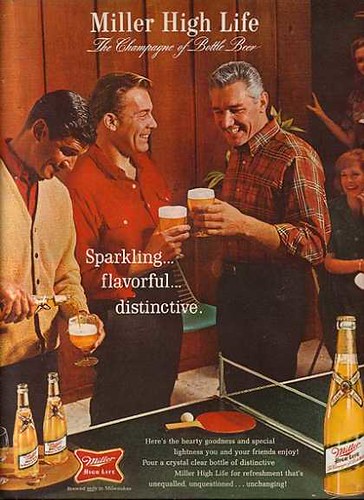

Tuesday’s ad is for Miller High Life, most likely from the late 1950s or 60s, when ping pong in paneled rec rooms was all the rage. And how about that tagline? “Sparkling … flavorful … distinctive.”
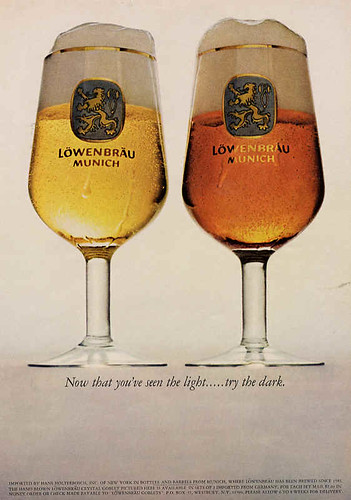
Monday’s ad is for Lowenbrau, a Munich brewery. Today is the day Munich was founded in 1158. It could be from the 1960s or 70s, but my money’s on the Seventies. Showing both kinds — country and western, alright light and dark — the ad features the tagline. “Now that you’ve seen the light …. try the dark.” But really, they’re actually trying to sell the glasses.

I just heard that Valley Brewing in Stockton is being sold and their long-time (and quite talented) brewer Steve Altimari will not continue on with the new owners. Steve posted the following on his blog:
As of 6/12/10 I am no longer working for Valley Brewing Company, my employer for the last 13 years. The brewery is being sold and I am not a part of the new owners plans, so I bid everyone a fond goodbye and see you on the flip side.
Unless the new owners are kick-ass brewers themselves, I don’t see how that’s a positive for the brewery. Hopefully, there will be more details soon.

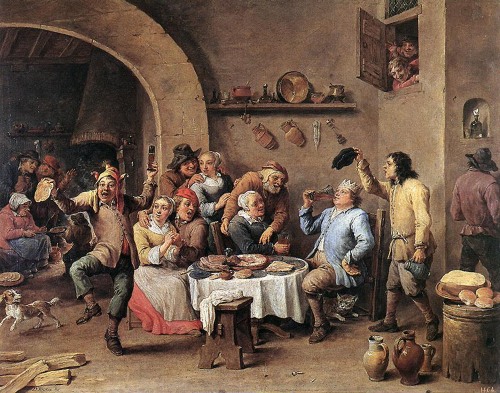
Today’s work of art is another piece I saw last week wandering around the National Gallery of Art in Washington, D.C, the day after SAVOR. It was painted in 1635 by David Teniers the Younger, a Flemish artist born in Antwerp. The painting is known as Peasants Celebrating Twelfth Night.

Teniers was known for his depictions of everyday life, usually showing peasants in a variety of settings. The Twelfth Night revelry shown here also include, of course, drinking beer.
Online, the National Gallery has several detail views available, including this one below of the drinking going on at the table.

He also painted a similar scene about Twelfth Night a few years later entitled Twelfth Night, The King Drinks.
To learn more about David Teniers, Wikipedia has a good overview and there’s also a more detailed biography at the National Gallery. You can see more of his work at the Web Museum, Olga’s Gallery and the National Gallery. There are also additional links at ArtCyclopedia.

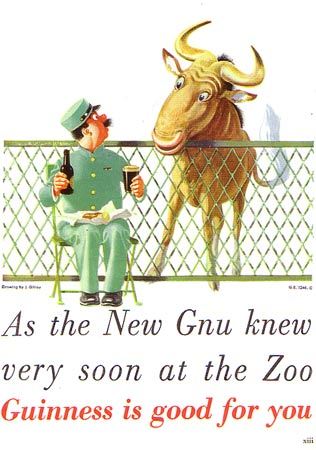
Our 22nd Guinness poster by John Gilroy features another zoo setting, this one with a new Gnu to the zoo, who knew that “Guinness is good for you,” using a nice group of homonyms.
As my Philadelphia theme comes to an end, as does my time at Philly Beer Week, Friday’s ad is for Gretz Beer, never a big force in Philadelphia market, but by 1957 were still hanging on as the smallest brewery left in Philly. You can read below what they were trying to do with their “small car series” of ads, but the exchange between the two men in the Fiat feels forced. It doesn’t feel like a natural conversation, it screams adspeak.
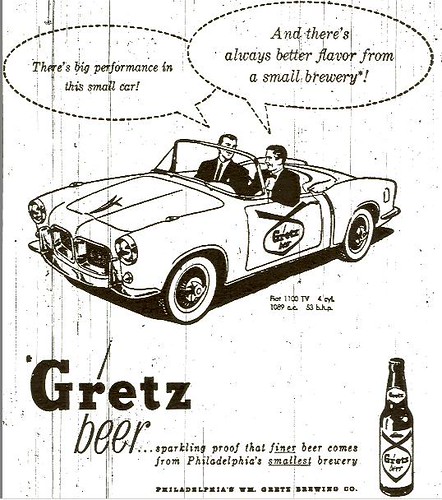
According to Rusty Cans:
The Gretz car series was issued starting in late 1957 by the Gretz Brewing Company in Philadelphia. The smallest of the last four breweries in Philadelphia, Gretz decided to make its small size a selling point by comparing its beer to a sports car. Small cars were better, they argued, and so was a beer from a small brewery! As part of the promotion Gretz bought 11 of the latest sport cars and painted them yellow and black to match the Gretz label colors, with a Gretz logo on the sides. The cars were introduced at the Army-Navy Game in Philadelphia at the end of November 1957 (Navy won 14-0).
And here’s another:
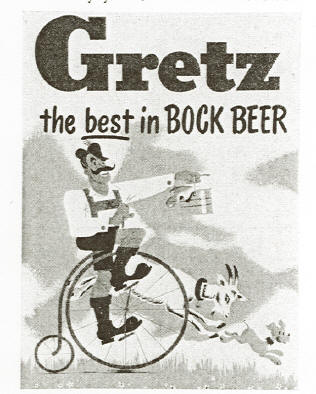
It’s for their bock using the iconic brewery character from 1951.
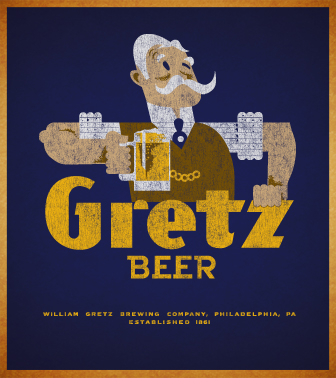
I love this image of the Gretz guy, and in fact have a t-shirt of it I got from Yesterbeer. I also say an original tray with the same image behind the bar at the Kite & Key last night.
Tuesday night in Philadelphia, I was fortunate to get an invitation from Tom Peters to attend his Lambic Dinner at Monk’s Cafe. The dinner included three of the best lambic brewers from Belgium: Frank Boon, from Brouwerij Boon; Armand Debelder, from Brouwerij 3 Fonteinen; and Jean Van Roy, from Brasserie Cantillon. It was an awesome dinner with some just spectacular beers.
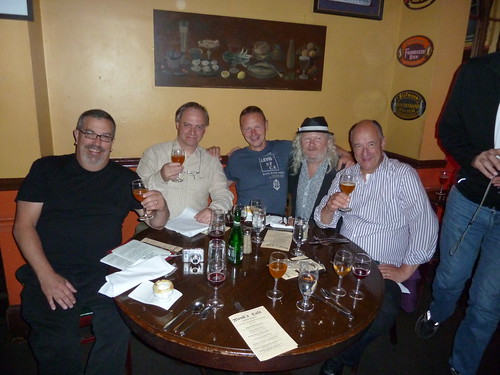
Tom Peters, Frank Boon, Jean Van Roy, Fergie Carey and Armand Debelder at the main table.
It was an eight course beer dinner prepared by guest chef Brian Morin, who cooks at the beer bistro in Toronto, Canada.
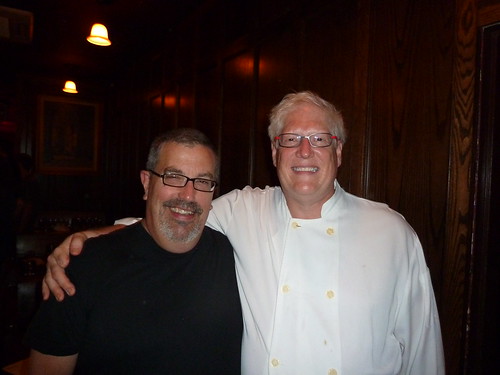
Tom Peters with guest chef Brian Morin.
You can see each of the eight courses below in the slideshow of the Monk’s Lambic beer dinner. This Flickr gallery is best viewed in full screen. To view it that way, after clicking on the arrow in the center to start the slideshow, click on the button on the bottom right with the four arrows pointing outward on it, to see the photos in glorious full screen. Once in full screen slideshow mode, click on “Show Info” to identify each photo.
Continuing my Philadelphia theme for Philly Beer Week, Thursday’s ad is old one, from 1873. The brewery is Bergner & Engel’s, which used to be located on 32nd and Thompson. I just love these old posters showing off the brewery at its best that were common in the latter half of the 19th century.
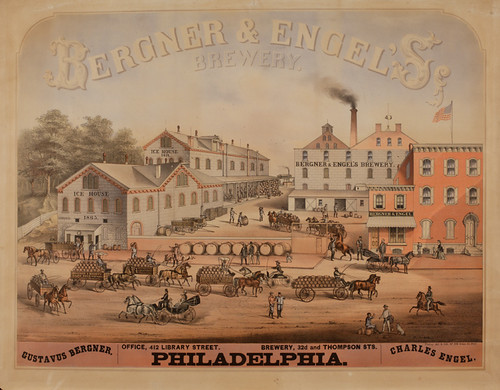
Here’s a description of the poster from the Library Company of Philadelphia:
Since the erection of the first brewery in Philadelphia circa 1683, beer making has been a near steady Philadelphia industry. Following the introduction of lager beer to the Philadelphia market in the mid-19th century, German-American brewers dominated the field. The firm of Bergner & Engel, formed in 1870 between longtime brewers Gustave Bergner and Charles Engel, symbolized the best of the best of that era’s nearly one hundred, mostly German-American run breweries. Operating from a plant built for Bergner in 1858 at 32nd and Thompson streets, the brewery served as the forerunner in the establishment of the industrial neighborhood known as Brewerytown.
This circa 1875 print, a chromolithograph by German-born lithographer Charles P. Tholey, evokes the vitality of the brewing industry and documents the eye-catching imagery of advertising for the city during the 19th century. The advertisement conveys the expanse of the Bergner & Engel plant that included ice houses, a brew room, fermenting and cooling rooms, store rooms, offices, and dwellings. The numerous factory wagons loaded with kegs of beer to be delivered, the visible construction dates of the ice houses, and the several returned and cleaned barrels demonstrate the success of the company. To catch and keep the viewer’s eye, Tholey also employed subtle details such as the excited dogs, the probable job seeker soliciting a worker on break, and one of the proprietors, Bergner, conversing with an employee in front of his office.
Unlike advertisements of today, the product for sale does not serve as the focus of the print. Rather, the factory comprises the image. Competition for consumers was not based on the quality of the good, but the quality of the establishment in which the product was produced. Regarding the circulation of such prints, rather than posting them publicly in stations, on buildings, or fences, businesses probably enclosed the advertisements with product shipments sent to their distributors throughout the country. Enterprises such as Bergner & Engel anticipated that their retailers would display the prints in the public spaces of their establishments to promote their products to a broader base of consumers.
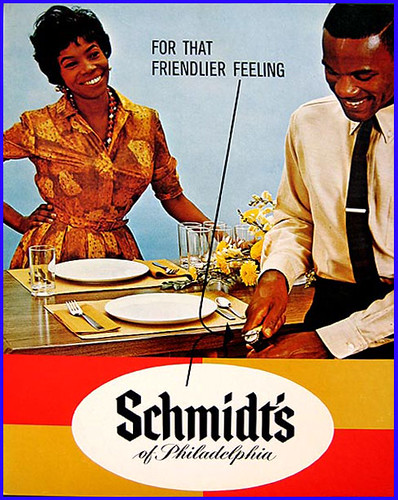
Continuing my Philadelphia theme for Philly Beer Week, Wednesday’s ad is for Schmidt’s. Again, I’m not sure, but my guess is it’s from sometime in the 1970s. I’m not sure about those lines and arrows at all, or what the slogan “For That Friendlier Feeling” has to do with the man opening the bottle.
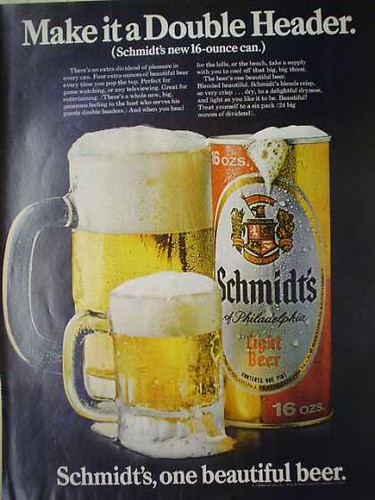
Continuing my Philadelphia theme for Philly Beer Week, Tuesday’s ad is for Schmidt’s. I’m not sure, but my guess is it’s from the mid-1960s. I love how the foam is spilling out from everywhere, both mugs and the can, too.