I don’t know how long it’s been going on, but I just learned of the Lost Pubs Project, a wonderful idea. The project is “Charting The Decline Of The British Pub” by listing, by county, every pub closing. They currently list 10,104 lost pubs. According to the website, “there are 60,000 pubs still in existence in the UK today, [and] they are closing at the rate of 25 per month. Once closed they rarely reopen as most are either demolished or converted to housing.” It’s a collaborative project, and they’re asking for help from locals all over Great Britain to let them know about any “pub which has closed at any time in the past,” and they”re also collecting “any memories, information or photographs” of the closed pubs. Sounds like a very worthwhile thing to do.
GQ Picks 50 Beers To Try

Finally, mainstream magazines are learning. A number of them, usually men’s magazines, publish an annual list of their picks for good beers, whether global or just American, and varying in the number on the list. But they go wrong by trying to call their lists the “top,” “best” or some similar hyperbole. With such a subjective sensation as taste, getting people to ever agree on a list is a fool’s errand, and ends up pissing people off whose favorite wasn’t included or wasn’t high enough on the list. Personally, I love lists but have found they can be dangerous enterprises.
GQ published one today they’re calling I’d Tap That! 50 Beers to Try Right Now. And despite the awkward “I’d tap that” beginning (why do mainstream beer stories always start with a bad pun?) I think they’re taking the right approach. Just presenting 50 beers they think are worth trying to an audience who may not be familiar with many of them is, I think, the way to go. There’s no rankings, no suggestion that these are the beers, or that they’re better than all the rest. They’re just suggestions. And there are some pretty good ones, too. Of course, there are some I wouldn’t have put on the list, but that’s the nature of these lists.
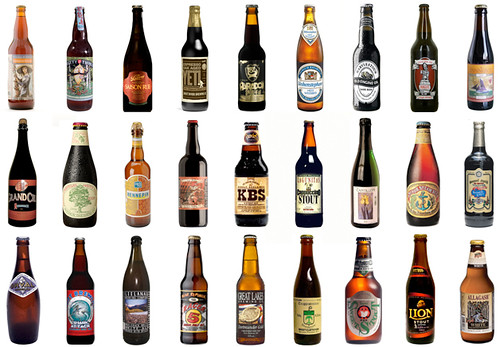
GQ’s 50 Beers to Try Right Now
- Allagash White
- Anchor Christmas Ale
- Anchor Steam
- BrewDog Smokehead
- Brooklyn Black Chocolate Stout
- Dogfish Head Palo Santo Marron
- Fritz Briem 1809 Berliner Weisse
- Great Lakes Dortmunder Gold
- Hitachino Lacto Sweet Stout
- Lagunitas Cappuccino Stout
- Leelanau Whaleback White
- Lion Stout
- Ommegang Hennepin
- Oskar Blues Dales Pale Ale
- Oskar Blues Old Chubb
- Picobrouwerij Alvinne Melchior
- Pretty Things Jack D’Or
- Rodenbach Grand Cru
- Rogue Dead Guy Ale
- Samuel Smith Oatmeal Stout
- Sierra Nevada Harvest Ale
- Sixpoint Sweet Action
- Smuttynose Barleywine
- Stone Imperial Russian Stout
- Stone Old Guardian
- Trumer Pils
- Weihenstephaner Hefeweissbier
- AleSmith Speedway Stout
- Bear Republic Hop Rod Rye
- The Bruery Saison Rue
- Cantillon Iris
- De Struise Pannepot
- Dieu du Ciel Route des Epices
- Dogfish Head 120 Minute IPA
- Jolly Pumpkin La Roja
- Marin Brewing Company IPA
- Orval
- Port Brewing Shark Attack Red
- Russian River Pliny the Elder
- Saison Dupont
- Schneider Aventinus
- Westvleteren Abt 12
- Harviestoun Old Engine Oil
- Great Divide Espresso Oak Aged Yeti Imperial Stout
- Double Mountain Black Irish Stout
- Samuel Adams Utopias
- Founders KBS
- Aecht Schlenkerla Rauchbier
- Russian River Beatification
- Monk’s Café Flemish Sour Ale
Then there are five more “bonus beers” under the sub-heading “In Defense of Bodega Beer,” which presumably means the downscale contrast to the upscale first fifty.
- Budweiser
- Tecate
- Magic Hat #9
- Red Stripe
- Yuengling Traditional Lager
Boobquake Monday

This is slightly off topic, except that I learned about it from British beer writer Melissa Cole. Perhaps you saw the news report where Iranian cleric Hojatoleslam Kazem Sedighi is blaming earthquakes on women. Well, not all women, just the ones with the temerity to show a little skin. Sedighi is quoted as follows. “Many women who do not dress modestly … lead young men astray, corrupt their chastity and spread adultery in society, which (consequently) increases earthquakes.” Crazy, right? Maybe, but let’s make sure first.
Purdue senior Jen McCreight has a plan to test Sedighi’s theory. She wrote an offhand blog post at her Blag Hag entitled In the Name of Science, I Offer My Boobs. She’s asking all women everywhere this Monday, April 26, to wear their most revealing outfit, whether it’s cleavage enhancing, shoulder baring or ankle-showing. The idea is to see if all that immodest dressing (or lack of it) will “significantly increase the number or severity of earthquakes.” It may have started as a little joke, but nearly 90,000 people have signed up to participate on the Facebook Event Page for Boobquake so the event is taking on a life of its own. She’s even written some additional clarifications in case the idea raises your feminine hackles.
Here’s her entreaty to participate:
On Monday, April 26th, I will wear the most cleavage-showing shirt I own. Yes, the one usually reserved for a night on the town. I encourage other female skeptics to join me and embrace the supposed supernatural power of their breasts. Or short shorts, if that’s your preferred form of immodesty. With the power of our scandalous bodies combined, we should surely produce an earthquake. If not, I’m sure Sedighi can come up with a rational explanation for why the ground didn’t rumble. And if we really get through to him, maybe it’ll be one involving plate tectonics.
According to the Facebook Fan Page, the story’s now been featured on CNN and will be covered on BBC News shortly. I know Melissa Cole will be playing along, how about you? Can the immodesty of bare skin produce an earthquake? Let’s find out this Monday. If you decide to participate and tweet about it, the hashtag is #boobquake.
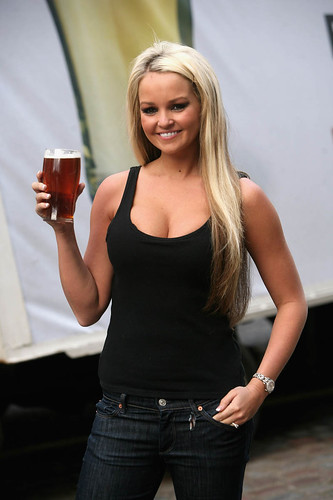
British actress/model Jennifer Ellison doing her part a few years early, at a 2008 Axe the Tax Rally.
Toronado Belgian Blunch 2010

This past Sunday I attended the annual Belgian Beer Lunch, which I’ve taken to calling a blunch, at the Toronado in San Francisco. The meal was again designed and created by Sean Paxton, the Homebrew Chef. The blunch was twelve courses, include 16 beers and lasted just over five hours.

The Toronado decked out for a beer dinner.

Arlene and Sean Paxton, with Dave Keene, owner of the Toronado, in the middle.
Below is a slideshow of the 2010 Toronado Blunch beer dinner. This Flickr gallery is best viewed in full screen. To view it that way, after clicking on the arrow in the center to start the slideshow, click on the button on the bottom right with the four arrows pointing outward on it, to see the photos in glorious full screen. Once in full screen slideshow mode, click on “Show Info” to identify each photo.
Toby Day Day This Sunday

I heard the sad news while I was in Chicago for CBC. On April 5, Toby Day, who owned NW Craft Brands and worked for Anderson Valley Brewing, passed away suddenly. Apparently he’d been battling a serious health issue for many years but kept that information from all but a select few friends. Although Toby lived in Eugene, Oregon, he was a fixture at many beer events throughout the west coast and our paths crossed frequently over the years. He always had a smile on his face and seemed to truly enjoy his work promoting craft beer. The world is a poorer place without Toby in it.
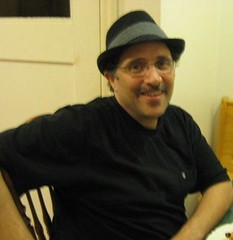
This Sunday, April 25, an event has been set up — Toby Day Day — to honor Toby’s memory and also raise money to help out his family. An Event Facebook Page has been set up, and here are the particulars:
On April 5th, Anderson Valley Brewing Company lost a dear friend and co-worker. Toby Day passed after battling a variety of ailments. Toby was a consummate ambassador of beer and a champion for AVBC since he started working with us in February of 2005.
“Our industry, the beer community, Toby’s family and friends have just lost a very special individual. I lost a friend.” Said AVBC Sales Director Ron Ziomek.
AVBC’s General Manager John Kuhry remembers Toby as “one of the nicest guys you will ever meet with an incredible passion and knowledge of beer. I am glad to have known him.”
On Sunday, April 25, craft beer establishments from Santa Cruz to Seattle will be honoring the life of Toby Day. Many accounts will have special beers on tap in his honor. The proceeds from this “Toby Day Day” are earmarked specifically for Toby’s family to help them pay for outstanding medical and funeral expenses, and to assist with the education of his daughter Lilly and son Tristan, 12 and 9, respectively.
Well wishers can leave their thoughts on his Facebook Page.
Please join us Sunday in raising a glass to a true friend of world-class beer and a world-class guy himself: Toby Day.
I’ll try to get a list of “official” places hosting events and also a way donations can be made directly to the family, if possible. If you can, please help out and honor a terrific guy who made great contributions to the craft beer community.
Eugene:
Sam Bonds Garage
The Bier Stein
Cornucopia (2 locations)
Portland:
The Moon & Sixpence
Concordia Ale House
Roots Organic
The Horse Brass Pub
Seattle:
Uber Tavern
Brouwer’s Cafe

UPDATE:
An account has been set up where donations can be made directly to Toby’s family, should you wish to help out his two children. Donations may be made at any U.S. Bank location across the country. Here are the details:
Account Name: Toby Day Foundation Trust
Account: 153662428728
Tax Donation EIN For Donations: 61-1615294
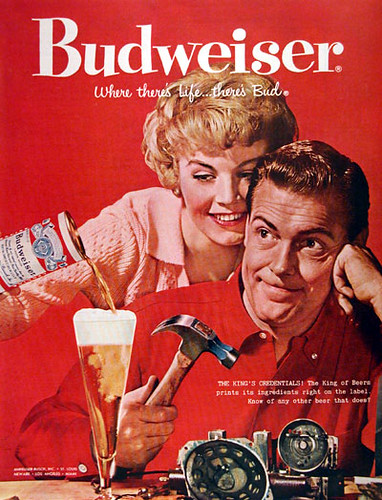
Beer In Ads #93: Budweiser’s Hammer Time

Thursday’s ad during strange glances week also a 1958 ad, this time for Budweiser, under their campaign “Where there’s life .. there’s Bud.” Mr fix-it watches intently as his wife pours his beer from a can into a pilsner glass. What I can’t quite understand is how use fix a telephone with a hammer. There’s also an odd bit of text there, right next to the hammer.
THE KING’S CREDENTIALS: The King of Beers prints its ingredients right on the label. Know of any other beer that does?
Was that really such a bold claim in 1958? I think I was under the impression that most, if not all, beer labels contain at least the primary ingredients on them, but perhaps that’s a more recent development. Since there are only four, I wouldn’t think that would be a point of differentiation. But maybe then most people didn’t know what the ingredients were, or that they were virtually identical from beer to beer.
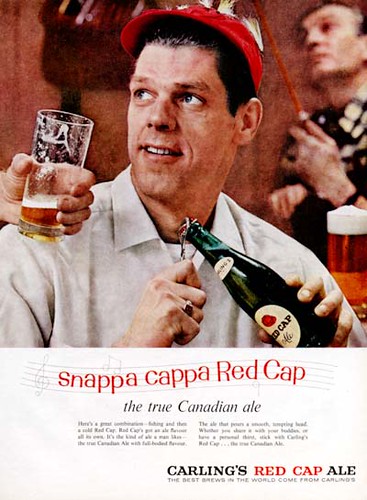
Beer In Ads #92: Snappa Cappa Red Cap
Wednesday’s ad keeps the week’s accidental theme of strange glances going. It’s a 1958 ad for Carling’s Red Cap beer, “the true Canadian ale” — at least according to the ad. The primary sidewards glance in this ad is looking up at someone looking to have their not-yet-empty glass filled. That’s odd enough, but notice the full glass just to his left (our right). Above that glass is another strange sight. Just what exactly is that out-of-focus man holding on to, and looking up at? A light saber? No, it was nearly twenty years before Star Wars debuted. A RC remote? A red fishing rod? At any rate, that makes two odd looks in one ad, two for the price of one.
I Am A Canadian Craft Brewer

In an effort to promote Vancouver Beer Week, which is set to take place May 10-16 throughout the Vancouver, Canada area, the organizers have created a wonderful video, I Am A Canadian Craft Brewer.
Women In Brewing Festival This Saturday In Sacramento

This Saturday, April 24, another festival will be taking place in Sacramento. If yo happen to be up that way — or live nearby, of course — check out the 4th annual Women in Brewing Festival at Rubicon.
Here’s the info, from Rubicon’s blog:
In 2007 the Rubicon Brewing Company established the Women in Brewing celebration. This is an event that digs up the history of women in brewing while spotlighting the talent of those brewers in our industry today. The 4th Annual Women in Brewing Festival will take place at the Rubicon Brewing Company at 2004 Capitol Avenue starting at 11 a.m. on Saturday, April 24th and will go until the beer is gone. Many talented female brewers have been invited to showcase their special recipes and hard to find brews. Some of these ladies will make the journey to the Rubicon Brewing Company to chat with event goers while enjoying a day in the sun with their fellow brewster’s and a pint. This event is not a competition nor is it a “brewfest.” It is a typical day at the Rubicon where we will highlight the fabulous “brewed by women” beer on tap for tasting in sample, goblet or pint along with food specials and, as always, great friends. A silent auction will be held with great prizes donated by local businesses. While honoring and bringing recognition to our women in the brewing industry, the Rubicon Brewing Company is dedicated to raising money and awareness for WEAVE. The event raises more than $4,000 to support crisis intervention services for victims of sexual assault. WEAVE is the primary provider of crisis intervention services to survivors of domestic violence and sexual assault in Sacramento County.
Denise Jones, the head brewer at Moylan’s will be on hand, and probably additional brewsters, too. Stop by and help support a worthy cause. When I first met my wife, she was heavily involved in volunteering for a similar organization in the South Bay, Next Door, so it’s an issue near and dear to me and my family.
The beers below will be served Saturday, and each one was brewed by a female brewer:
- Auburn Alehouse: Scarlet Red
- Blue Frog: Ginger & Meyer Ann
- Lost Coast: Scotch Ale
- Moylans: Hell’s Lager
- Rubicon: Bull of the Woods, Stardancer, 80 Grit
- Santa Cruz: Witches Wit
- Sierra Nevada: Summerfest, Scotch Ale
- Urthel Al: Hop It, Samarath
Bay Area Firkin Fest This Weekend

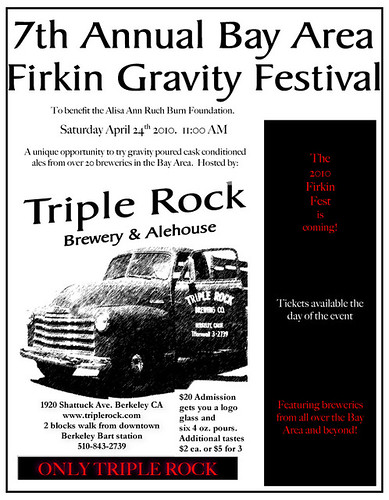
This Saturday, April 24, the 7th annual Bay Area Firkin Fest will be held at Triple Rock Brewery in Berkeley. Doors will open at 11:00 a.m. and tickets are $20. Admission includes a commemorative logo glass and six 4-oz. pours. Additional samples may be purchased for $2 each (or 3 for $5). This is one of the most fun festivals of the season, especially if you love cask beer. See you there.