Brookston Beer Bulletin

Jay R. Brooks on Beer

  • Home
  • About
  • Editorial
  • Birthdays
  • Art & Beer

Socialize

  • Dribbble
  • Email
  • Facebook
  • Flickr
  • GitHub
  • Instagram
  • LinkedIn
  • Pinterest
  • RSS
  • Twitter
  • YouTube

Powered by Genesis

Pete’s Wicked Stout Marinade?

October 26, 2006 By Jay Brooks

In today’s North Coast Journal, a weekly alernative rag for Humboldt County, California, in the food section called Talk of the Table, Joseph Byrd has an article titled Texas Chili. The food information looks sound enough, but I’m no expert on chili. He begins by detailing what chili is, where it originated (San Antonio, according to the article), and begins going through detailed instructions on how to make it, all well and good. However, mid-way through his piece he writes the following:

The meat is put into a marinade of dark bitter stout overnight. There is a dark beer called “Pete’s Wicked Ale” which I find nasty and undrinkable, but it’s perfect for this purpose.

Now Pete’s Wicked Ale began its life as an American Brown Ale. Now that the original Pete has left for more chocolatey pastures, my memory is that under Gambrinus these days it more resembles an amber ale. And it’s ironic that Pete’s Wicked Ale today is brewed in San Antonio, Texas, the home of chili. But either way, it’s hardly a stout, and frankly I have a hard time calling it a dark beer. But I suppose if industral light lager is your standard — which is my guess — (with something like 1 lovibond) then I suppose Pete’s Wicked Ale is at least much darker.

I can certainly imagine it would make a fine marinade — after all, many beers do — but to describe the beer as “nasty and undrinkable” seems downright pernicious, and not just to the beer but also to the author’s own reputation. I say that because such a description shows a certain ignorance for the subject matter and calls into question his qualifications overall, in my opinion. It’s one thing to dislike a particular beer — I dislike plenty — but to label it “undrinkable” and confuse it with a stout shows a certain lack of sophistication regarding his beer knowledge. And it begs the question why such an aside was even necessary? What was the purpose of offering how distasteful the author found the beer? It doesn’t really add anything to the story, unless he wanted to be sure none of his readers might mistake his endorsement of the beer as a marinade for actually liking to drink it, too.

At first, I thought the story originated in Texas, before later realizing he’s right here in California, just a short drive up the coast from me. If he’d been a Texas native, I might more easily forgive his apparent lack of beer savvy, but here in California as a food writer it’s an unpardonable sin.

Filed Under: Editorial, Food & Beer, News

Giving the Bishop the Finger

October 26, 2006 By Jay Brooks

Did you know sex sells? Yeah, me neither. The late comedian and social critic Bill Hicks used to say that the advertisement that big business wants to run is simply a photograph of an attractive woman fully naked and the text “Drink Coke” (or any other company’s slogan). Unlike me, he made it sound funny, of course, but the point is that it’s not really a secret that sex is used to sell almost every imaginable kind of product or service. I had a whole semester on this subject in college, where we were even shown the word s-e-x spelled out in an older version of KFC’s Colonel Sanders logo, along with much else.

Among beer advertisements, especially those of the big breweries, sex is a frequent sales tool from the Coors Twins to St. Pauli Girl. A review of older beer ads will quickly reveal that this is not a new phenomenon, either. Many early breweries used attractive women in their advertising. I’m not necessarily opposed to seeing an attractive woman per se, but when it’s used merely to pander to base instincts and outmoded stereotypes then it’s bad for the beer industry, at least in my opinion. Most of the worst examples of this — Miller’s mud wrestling “cat fight” ad was a particularly bad one — essentially take the position that their target audience is all but exclusively male or certainly male enough that they can safely alienate half the total population. And not just any male, but a certain kind of unenlightened male, the ones for whom Jackass, Beavis and Butthead, Dumb and Dumber, and Beerfest are all high art. Does that make me elitist? Maybe, but I’d rather that than see beer’s image continue to be so unceasingly tarnished.

Not surprisingly, that is outmoded thinking, because the demographics of beer are changing and beer drinking among women is on the rise. Some recent studies show that of the total beer consumed in America, women drank 25% of it. And while it may be no surprise that the age group with the most women beer drinkers is 21-30, the number of women drinking beer who are over age 50 is growing significantly.

But I wouldn’t argue that sexual imagery should never be used in advertising (or art or anywhere else). I don’t think that’s the right solution and frankly I don’t think it possible. Despite fundamentalist attempts globally to suppress sexual awareness and expression, it is a potent part of human nature. Without the sexual urge, we might never procreate and continue as a species so it certainly fills a very vital role in the life cycle.

I would suggest, however, that common sense and a sense of perspective and context might be employed in how sexual images are used, not least of which because we’ll never evolve if advertising continues to keep us wallowing (and literally wrestling) in the mud of our basest primal instincts. The people whose products are being advertised in these ways should have a bit more respect for themselves and their product. Why the big beer companies want to associate themselves with mud wrestling, talking frogs, man law, flatulent horses, etc. is beyond me because it does nothing to elevate the image of their product. Interestingly, when Miller tried to change that carefully created image by using the tagline “Beer: Grown Up,” hardly anyone was buying it. USA Today polls showed a majority of people didn’t like the ads and didn’t think they were effective. Despite Terry Haley, the brand manager for Miller Genuine Draft, saying “[w]e believe in what we’re doing, [w]e’re tapping into a true social trend, and we’re going to stay the course,” Miller quickly dropped the ads, and switched ad agencies, who presumably will return to the puerile.

But the other side of this debate is one of easy offense and our willingness to censor should even only a sole complaint be lodged. Advertisers, advertising and the media generally beat a very hasty retreat when faced with criticism, which is a powerful wedge for organizations and individuals with agendas and an axe to grind. (The media, of course, is paid for by advertising — you may think that you are TV, the magazine and the newspaper’s customer but you are not. Their customer is the advertiser.) For years, organizations with a small, minority membership have caused havoc for the rest of us when they cried offense at one imagined slight after the other. The media landscape for a time was (and probably still is) rife with stories of letter writing campaigns from citizen’s groups in which television shows (and other media) were deemed by these yahoos to be too provocative, too sexy, used too much bad language, showed different morals then their own, and on and on. Basically, much like neo-prohibitionist groups, some people cannot rest until the world is remade in their own image, indeed they cannot tolerate any difference of opinion or alternative (to their own) lifestyle being on display, especially if their children might furtively glance longingly at such imagined hedonism. Worse still, entire entertainment programs have been altered, changed or canceled, books have been banned, and songs have been censored all on the basis of a few complaints or even a single complaint. That 299,999,999 people in the U.S. do not complain seems to carry no weight, or at least far less weight than the single whiner who does. This is literally the very opposite of a democracy, in which the desires of the many are circumvented and denied by a tiny handful of individuals, or in some cases a single person.

This is, of course, true of advertising as well. The hue and cry against much advertising is loud and shrill and seems never to cease. And while I may not disagree with all of it — I’m no fan of a lot of advertising — I find truly reprehensible the impulse to inflict one’s beliefs on the rest of society, as if any person could be certain of the one, true moral compass and way to live one’s life. That anyone pays attention to these nutjobs is a sad commentary indeed on the way our world is heading, but that’s a debate for another day and another forum.

What prompted all of what preceded, is an item reported yesterday by the BBC News in an article titled ‘Provocative’ beer ad criticized. According to the report, a complaint was filed with the UK’s Advertising Standards Authority, an organization that is paid for by the advertising industry and which acts essentially as an ombudsman. That means that people offended by advertising may file complaints and have their cases adjudicated by the ASA. In this instance, a print ad for Bishop’s Finger, a popular beer brewed by the Shepherd Neame Brewery of Kent, England had a complaint filed against it. The ad that prompted the complaint has been removed from Bishop’s Finger’s website, but here is a similar one:

In the offending one, which apparently ran in the magazine Time Out, the woman was seated on a bale of hay and the text read, “I love a good session on the Bishops Finger.” And here are all seven print ads, after the offending one was quickly removed. The name “Bishop’s Finger” has it’s origin in the “ancient finger-shaped signposts that showed the Pilgrims the way to Canterbury Cathedral” that are unique to the Kent area of southeastern England.

It is overtly sexual? Sure. Is it offensive? Not to me, I find it mildly amusing. It does play on the origin of the beer’s name and hearkens back to Chaucer’s time. It uses a pretty obvious double entendre, of course, but it is in context. According to the BBC article, Bishop’s Finger is known for running humorous ads. At least it’s not a scantily clad bikini gal holding a beer for no discernible reason other than to titillate.

The ASA examined the ad for four breaches of the UK’s advertising guidelines and only found that they had violated one, and ruled as follows:

We considered that the text “I love a good session on the Bishops Finger” played on the connotations of drinking and sexual activity. We considered that the woman’s pose was suggestive and concluded that, in combination with the headline text, it was likely to be seen as linking alcohol with seduction and sexual activity.

On this point, the ad breached CAP Code clause 56.9 (Alcoholic drinks).

Here’s 56.9 in its entirety:

Marketing communications must neither link alcohol with seduction, sexual activity or sexual success nor imply that alcohol can enhance attractiveness, masculinity or femininity.

Based on their ruling, the the “Advertising Standards Agency told the beer maker in future to adopt an approach that did not link alcohol with sexual activity.” Okay, I’m sure they’ll get right on that. And given that alcohol and sexual activity are, in fact, linked insofar as sexual activity can be linked with practically anything, I’m not even sure how you could possibly enforce such a perniciously vague standard. Right or wrong, alcohol has been called a “social lubricant” for centuries. That’s one of its roles in society, to pretend otherwise seems dishonest.

But here’s the thing, and perhaps the point of all this — finally — only ONE person in all of England complained about this ad. Only One. Out of a population of more than 60 million people, only ONE person was offended enough to complain. That one person being offended by the ad prompted a full-scale investigation involving who knows how many people, a news article in the BBC, and a major brewer to withdraw an ad from the market. Does that seem reasonable? It sure doesn’t seem so to me. Like many issues of censorship, the person who lodged this complaint could have asked a few friends before starting this ball rolling. Perhaps some friend’s support or non-support might have changed or strengthened their resolve. But even if a 100 people had complained, a hundredfold increase, I would still be skeptical that justice had been served. Perspective has to play in role in looking at issues of censorship and people being offended. I’m sorry this person felt as badly as she (or possibly he, I suppose) claims to have, but that doesn’t mean the whole of England should have to sit up and take notice. Is there anything published in the world today that you couldn’t argue might be offensive to somebody? It’s one thing to be sensitive to the views of others, but quite another to insist the world be inoffensive to all. Every time we pander to such an extreme minority view, however well-intentioned, we fan the flames of intolerance and make it harder for all of us to co-exist. Why can’t we all just have a beer and get along?

Filed Under: Editorial, News Tagged With: Business, Europe, Great Britain, Strange But True

New Belgium Frambozen Brown is Back

October 25, 2006 By Jay Brooks

new-belgium-new
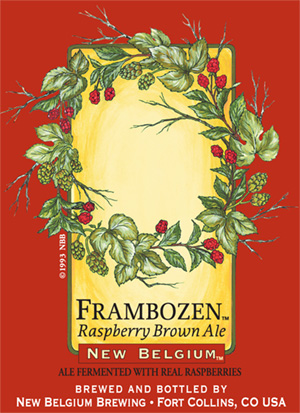
New Belgium Brewing‘s tasty Frambozen Raspberry Brown Ale has been released for the holidays again this year, and will be available in select markets until the end of the year. At previous Celebrator tastings, we’ve given it high marks. Last year we described as:

Strong raspberry fruit aroma with red tinged amber color. Rich tart raspberry flavor with good hop presence that nicely balances. Effervescent creaminess and a lingering finish.

And in 2004:

Sweet fruity berry nose and reddish-amber color with a tan head. Great sweet fruit flavor with nice balance and a clean finish.

I always felt the brown ale sweetened slightly with fruit works very well. It’s a nice twist on Belgian lambics, a mix of the idea of those beers with the caramel, often nutty, flavors of a brown ale. I’m looking forward to seeing these samples in the mailbox.

And how about this great quote they included in the sale sheet, from Stephen Beaumont, writing in Esquire.

“More and more American men are downing big, bold, ungirly fruit beers. Typical is the seasonal Frambozen from new belgium Brewing Company, a raspberry brown ale made for Colorado winters, with a massive taste and a face-slapping 6.3% (this year it’s 7%) alcohol.”

From the press release:

Experiencing Frambozen begins with the aroma of fresh red raspberries, followed by the ripe seductiveness of a fruity brown ale with depth and delicate notes. Frambozen, New Belgium’s traditional winter seasonal, is inspired by the Framboise beers of Belgium, where the use of raspberries as a beer adjunct outdates the universal acceptance of hops.

Frambozen is deep ruby in color, with flavors just as rich. With the fruit as the integral ingredient, its name is derived from the Flemish word for raspberries. Every year, New Belgium sends delegates to Salem, Oregon to oversee the process of turning freshly picked berries from northern Washington into a pure juice that is loaded into oxygen-free CO2 tanker trucks that make the journey back to Colorado. The end result is a delicious, complex beer that is delivered on time to complement holiday meals.

“We have made a conscious decision to process the raspberries into a single strength, straight juice with nothing added,” said Bill Hepp, a brewer with New Belgium who takes the journey to Oregon annually. “As a pure juice, it is a whole food, with no taste or aroma lost in the concentration stage, which ultimately makes the beer that much better.”

Frambozen is available in certain New Belgium markets now through the beginning of the New Year.

nb-frambozen

Filed Under: Beers, Breweries, Related Pleasures Tagged With: Colorado, Press Release, Seasonal Release

Crossing the Red Bridge

October 25, 2006 By Jay Brooks

I have an article coming out next month in New Brewer magazine about gluten-free beers, so I’ve been watching what’s been going on with this kind of beer for many months. In case you’ve missed this growing phenomenon, celiac disease now effects close to 1% of the U.S. population and people with the disease can’t properly digest glutens, a protein in many common grains, including wheat and barley. This means no bread, pizza, pasta or, most importantly, beer. Here and abroad, there is increasing interest in producing a beer that’s both gluten-free and tastes similar to beer. To date, only a handful of American brewers are making one, with several more in Europe and Australia.

My son, Porter, is autistic and many kids with ASD also have some stomach problems similar to those associated with celiac sufferers. As a result, both are put on gluten-free diets with generally positive effects. Over the past summer, I was talking with Dr. Michael Lewis, who pioneered the brewing sciences program at U.C. Davis, about these beers. He mentioned that Anheuser-Busch was also working on a gluten-free beer and suggested a few people there I should talk to about it. Try as I might, I could not penetrate A-B’s bureaucracy beyond a tersely-worded statement from their P.R. department. They seemed genuinely surprised that I even knew about, despite the fact that Miller’s BrewBlog broke the story in early August that A-B had filed a label registration in Missouri for the beer, called Red Bridge Sorghum Beer, and test batch bottles reportedly had been quietly sampled at MBAA meetings. All Anheuser-Busch was willing to say on the matter was the following:

Our goal at Anheuser-Busch is to make sure every consumer can enjoy the kind of beer they feel best about — it’s that simple. That’s why our brewmasters are continually exploring and brewing a variety of beer styles year round. We are currently brewing a beer made with sorghum and without barley, wheat or oats and we’re still developing the final product.

They were unwilling to provide a sample, show me a label, allow me to speak to the person I knew to be working on it, nada. Needless to say, I wasn’t able to include much in the article. This despite the fact that I had seen and tasted a test bottle, seen a label mock-up, and knew they’d both registered the name and picked up the domain name redbridgebeer.com on July 12. To hear the P.R. flacks tell the tale, it was years away from being on store shelves, if ever.

So it was with a gentle smirk that I received the news today — a rumor at best, from an anonymous source — that A-B would be rolling out Red Bridge Sorghum Beer nationally (not in a test market) on December 18. Is it true? I’ll let you know in just under two months.


This mock-up may or may not be the label for A-B’s new gluten-free beer, Red Bridge.

Filed Under: Beers Tagged With: Business, National

How Craft Beer Can Save the World

October 25, 2006 By Jay Brooks

The world’s cup runneth over with living beer traditions. But this vast repository of cultural brewing capital is under attack by global corporations. The top five brewing companies, all of which are American- or European-owned, control 41% of the world market. Perversely, economists and politicians calculate the conquest by industrial breweries as economic growth while the value of small-scale traditional brewing goes uncounted. Much will be lost if this global “beerodiversity” is lost to the forces of corporate-led homogenization.

So begins a very interesting essay at Foreign Policy in Focus (FPIF), a think tank, which, according to it’s website, “brings together scholars, advocates, and activists who strive to make the United States a more responsible global partner.” The essay, The Perils of Globeerization, is by Chris O’Brien, who first contacted me a few months ago to tell about his beer activism at his cleverly titled Fermenting Revolution website. The essay is heavy on foreign policy, big business, history and local traditions of alcohol. It may seem somewhat radical to the more conservative, but it certainly agrees with my own view of how the world works. His take on the history and economics of brewing, and especially how the dominant breweries are effecting brewing traditions across the globe is fascinating. And perhaps most importantly, there are obvious parallels to the craft beer industry in America, as well.

O’Brien also has just published a new book, Fermenting Revolution, too, which is available from the publisher, New Society Publishers, or from Amazon. The subject matter seems pretty interesting, I’m looking forward to reading and reviewing it.


Filed Under: Editorial Tagged With: Business, History, International, Websites

Kansas City Hometown Beer Tour

October 25, 2006 By Jay Brooks

11.11

Kansas City Hometown Beer Tour

Boulevard Brewing, 2501 Southwest Boulevard, Kansas City, Missouri
816.512.5555 or 816.471.1234 [ e-mail ]


Filed Under: Uncategorized Tagged With: Uncategorized

Kansas City Hometown Beer Tour

October 25, 2006 By Jay Brooks

I got an e-mail from Jim Quinn, “The Beer Jockey” of Kansas City, who’s hosting what sounds like a fun and educational tour of Kansas City brewing history as well as local breweries still operating. The limousine tour runs three hours, from Noon to 3:00 p.m., and three tour dates are scheduled: October 28, November 11, and November 25. The tour will begin and end at Boulevard Brewing. The standard cost is $35, which includes “chauffeured transportation, guided tour, on-board beverages, beer samples and handouts.” For $65, your tour also included an “autographed copy of Bob Sullivan’s book, ‘Hometown Beer: History of Kansas City’s Breweries‘”

Here’s an overview of the tour:

  • Tour and taste at KC’s own, nationally-renowned and newly expanded Boulevard Brewing.
  • Hear about the “Beer Castle” on Main Street.
  • See the remains of a family brewery that survived floods and fires yet fell to Prohibition.
  • Learn how many out-of-town breweries were able to enter the local market in the 1870s.
  • Celebrate local brew and sample handcrafted ale at McCoy’s Public House in Westport.


Fine print: Preregistration and payment is required. DEADLINE for registration is the Thursday prior to the tour. A minimum of 12 passengers is required to run the tour. Maximum is 20 passengers. Private chartered tours are also available.
 

10.27, 11.11, 11.25

Kansas City Hometown Beer Tour

Boulevard Brewing, 2501 Southwest Boulevard, Kansas City, Missouri
816.512.5555 or 816.471.1234 [ e-mail ]

Filed Under: Uncategorized Tagged With: Announcements, History, Midwest

Drinking in Germany and Nebraska

October 24, 2006 By Jay Brooks

My friend and colleague, Lisa Morrison, sent me this provocative essay by a woman who grew up in Germany but has lived in Nebraska since she was 17. Angelika Byorth, writing in the Daily Nebraskan speaks to how alcohol is handled differently in the two countries and wonders in print whether adopting a lower drinking age and introducing alcohol into the home as a natural part of daily life might not remove some of its stigma. She makes some great points and it’s nice see an alternative viewpoint to the one the neo-prohibitionist lobby is always pushing. Angelika Byorth lost her husband at 47 to alcoholism and still argues in favor of changing our country’s alcohol policy, so she may be harder for the neo-prohibitionists to dismiss and rebut than usual. Regardless of your side on this issue, an interesting piece and well worth reading.

Filed Under: Editorial, News Tagged With: Midwest

Write Your Own Arrogant Bastard Label

October 24, 2006 By Jay Brooks

Do It For Humanity’s Sake. Or Your Own… You Arrogant Bastard! (Humanity Will Still Benefit)

Stone Brewing, of course, has a history of doing charity work. And unbeknownst to me, they’ve been auctioning off stuff on eBay all year long to raise money for charity. This auction will benefit one of Stone’s charities, the San Pasqual Academy. There are many others. The take so far just this month totals just north of $130,000!

But this one is a doozy, and I’ll let the press release speak for itself:

This month we have an unprecedented opportunity that we’re auctioning off: You getting to write your own Arrogant Bastard Ale bottle!

This is a “once-in-a-lifetime-don’t-expect-you’ll-get-it-again” chance for you to express your arrogance on a bottle of Arrogant Bastard Ale. Try not to screw it up by not bidding enough.

We’ll be taking your writings (either handwritten or submitted as text – your call) and producing at least 60 cases (720 bottles) of your text. Of those 720 bottles, you will personally get 4 cases (48 bottles) and the remainder will be distributed out into the marketplace in your region of the country.

We will not ship beer to your door, but we will work with your closest wholesaler to get the beer to you. (If you wish to pickup the cases here at the brewery, that works too.) Clearly, there’s going to be some guidelines to this. The bottle will need to meet California ABC guidelines, and if we need to ship it out of state it will also need to meet Federal (TTB) guidelines and any other guidelines required by your state. We will make sure it meets with the required governmental approvals. This means that you can’t write any boneheaded thing you want, but a fully Arrogant approach will work! It does for us.

The auction is already up on eBay and will close this Sunday, October 29 at 8:00 p.m. PST sharp. So far there are 10 bidders, and highest at this moment is $760.

Write your own rant for Arrogant Bastard.

Filed Under: Events, Just For Fun, News Tagged With: California, Charity, San Diego

J-Schools and “Happy Amateurism”

October 24, 2006 By Jay Brooks

I’ve been writing quite a bit lately about journalists in the mainstream media who write about beer yet appear to know virtually nothing about the subject. I’ve had a few of my own theories about this phenomenon but I recently came across another one that I hadn’t considered in a book I happened to be reading. The book was 100 Ways America is Screwing Up the World by John Tirman. Number 99 on Tirman’s list is “‘Professional’ Schools, by which he means medical schools, law schools and the one that caught my attention — journalism schools. Here’s his general take on J-schools:

And journalism schools — what is it exactly they teach? What is it that one can learn that will improve skills as an investigator or writer that other disciplines cannot provide? Journalism schools do not and cannot teach problem-solving skills — critical thinking — as well as the social sciences or humanities or natural sciences.

Okay, I think it’s pretty clear he’s no fan of modern journalism. But it was the next sentiments Tirman expressed that really got me thinking about this issue. I hadn’t considered it before, but it makes a lot of sense. Here’s his analysis of the problem:

More than half of the new hires in newsrooms hold undergraduate degrees in journalism. There is an ethic among many in this field of “happy amateurism” — that one can report on anything using certain standard methods. You need not know anything about the covered topic, which means you’ll be at the mercy of people purporting to know — usually the well-heeled who can afford fancy P.R. operations.

That’s exactly the way beer is reported in many instances. A lot of stories originate with press releases from the big breweries, the ones with large marketing budgets. A reporter is then assigned to write the story who appears to know little, if anything at all, about the subject and often seems to do no discernible research. I have always suspected that the way beer is reported extends to other subjects, too, but since I don’t know much about those other disciplines I have no way of knowing. Because if they’ll assign reporters with no knowledge of one subject, why wouldn’t they do the same thing for other topics. So it makes a lot of sense that the problem is the process itself. I mean, it would be simple-minded and ridiculous to suggest there was a conspiracy against beer so this theory goes a long way in explaining why beer is so poorly covered by the media.

Happy amateurism may not explain everything but it seems a very viable start. Unfortunately, if Tirman’s assertion that this is a trend that’s essentially growing as older reporters retire and are replaced by J-school graduates then this problem is only going to get worse unless we can collectively figure out a way to get beer the respect in the media we think it deserves.

Filed Under: Editorial Tagged With: Mainstream Coverage

« Previous Page
Next Page »

Find Something

Northern California Breweries

Please consider purchasing my latest book, California Breweries North, available from Amazon, or ask for it at your local bookstore.

Recent Comments

  • Bob Paolino on Beer Birthday: Grant Johnston
  • Gambrinus on Historic Beer Birthday: A.J. Houghton
  • Ernie Dewing on Historic Beer Birthday: Charles William Bergner 
  • Steve 'Pudgy' De Rose on Historic Beer Birthday: Jacob Schmidt
  • Jay Brooks on Beer Birthday: Bill Owens

Recent Posts

  • Beer In Ads #5234: Bock Bier 28 April Bis 1 Mai April 28, 2026
  • Historic Beer Birthday: Louis F. Neuweiler April 28, 2026
  • Beer Birthday: Michael Demers April 28, 2026
  • Historic Beer Birthday: Ernst F. Baruth April 28, 2026
  • Beer Birthday: Carl Kins April 28, 2026

BBB Archives

Feedback

Head Quarter
This site is hosted and maintained by H25Q.dev. Any questions or comments for the webmaster can be directed here.