Brookston Beer Bulletin

Jay R. Brooks on Beer

  • Home
  • About
  • Editorial
  • Birthdays
  • Art & Beer

Socialize

  • Dribbble
  • Email
  • Facebook
  • Flickr
  • GitHub
  • Instagram
  • LinkedIn
  • Pinterest
  • RSS
  • Twitter
  • YouTube

Powered by Genesis

Oaked Arrogant Bastard Now in Six-Packs

October 23, 2006 By Jay Brooks

Beginning next Monday, October 30, an Arrogant Bastard Ale that uses American Oak Chips will hit the stores. This is the third year now that Stone Brewing has made available this oaked version of their popular Arrogant Bastard. And this year, Oaked Arrogant Bastard will be available for the first time in 12-oz, bottles sold in six-packs.

From the press release:

This year the OAKED is determined to make its presence known even more. How? By fitting in your hand. This year we’ve crammed, forced, shoved and cajoled the OAKED Arrogant Bastard Ale into itty bitty tiny little 12oz bottles. It did not go willingly. Some Stone peeps got hurt. More emotionally, than physically, but it was definitely both. This means that six packs of OAKED Arrogant Bastard Ale are ready and they’ll begin hitting store shelves along side the Double Bastard Ale on Monday, October 30th.

Be cautious. As always. Neither the OAKED Arrogant Bastard Ale, nor the Double Bastard Ale like being bottled up. The OAKED is feeling especially put out about the whole experience, so it is suggested that you either be extraordinarily polite to it (which we’ve been told doesn’t work all that well…dunno…we’ve never tried that route ourselves), or move in with equal or greater arrogance to keep the beer in check. Good luck whichever approach you choose. You will need it.

Oaked Arrogant Bastard, now available in six-packs.
Filed Under: Uncategorized Tagged With: California, Press Release, San Diego, Seasonal Release

Beer Chips

October 23, 2006 By Jay Brooks

Also at the Anchor event for Maureen’s book, Ambitious Brew, I had my second encounter with Beer Chips, a new snack food on the market.

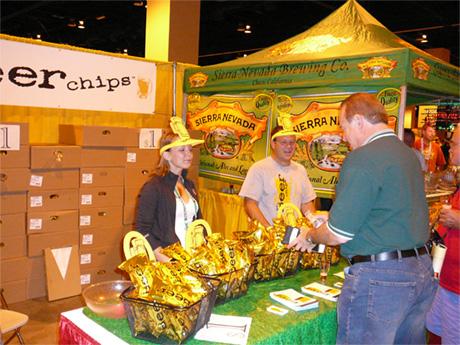
I first noticed them at their own booth next to the Sierra Nevada Brewing tent at GABF last month where, at $1 a bag, they were selling like hot cakes. Now I should make yet another confession here from the start. There are few foods I like more than potato chips. I am quite passionate about my potato chips. I can still get worked up about chips that have been off the market for decades; brands like Tommy Dale’s or Uncle Don’s. Where I grew up in southeastern Pennsylvania, the average grocery store carried at least a dozen local brands of potato chips, and some had many more. My favorite chips growing up were a brand called “Good’s Original Chips,” or “Good’s in the Blue” to distinguish them from a rival brand, “Good’s in the Red.” My “Good’s Potato Chips” could be bought only one day a week and, except for visiting the farm, at only one place on Earth, the Shillington Farmer’s Market, which was open every Friday less than a mile from my childhood home. They were made by Mennonite farmers who appeared to make just enough to sell each week (they never made more for the rush during various holidays) and when they sold out, packed up and went home. You could buy them in bags, but the best way was in a returnable can. Every Friday, I’d pick up a 5-lb. can, pay for the chips and a deposit on the can. The following week, I’d return the empty can and get a new one, this time paying just for the chips inside. It was a beautifully simple system, ecologically as well economically sound.

Sadly, they don’t do the cans anymore, not since the company was taken over by a nephew and moved from the farm to an actual plant. Happily, they still taste as good but I must say some of the magic in them is gone. But I bring this up only to illustrate that potato chips are one of the other things I know something about. So when someone makes chips with beer — combining two of my great loves — then attention must be paid.

The creator of Beer Chips, Brett Stern, who’s a native New Yorker, flew down from Portland, Oregon (where he makes his chips) with boxes of his chips in tow. That gave me a better chance to try the chips, and I must say my first reaction is that they’re very tasty and highly addictive. Of course, that may be the added sugar, itself an unusual ingredient in potato chips. Generally, there are only three ingredients in what I’ll refer to as “craft chips” — let’s call it the spudheitsgebot — which are potatoes cooked in oil (either a vegetable oil or lard, most commonly) with salt added. I’m told the beer used is a bock style that is reduced to a powder and sprinkled on the chips during the cooking phase. And for the most part it works. They do seem to have just a hint of beer flavor and happily it’s not overpowering the way it is in barbecue or some other strongly flavored chip. I brought some home for my wife to try and she loves them, as well, and has become quite addicted. Now if I can only get BevMo to get off their bureaucratic arses and carry them in my neighborhod …

Here’s another review of Beer Chips from Chipworld.

These potato chips had a kettle-cooked texture and were crisp with varying levels of crunch. They earned praise around the chip bowl for being quite tasty. Most of our tasters thought that the chips did taste like beer, though some thought the beer taste was most noticeable on first bite and faded away after that. The chips were generally smallish with wiggly, irregular shapes, some folded over.

The Beer Chips table at GABF.

Filed Under: Beers, Food & Beer, News Tagged With: California, Oregon, Portland, San Francisco

Watermelon Funk is Funkadelic

October 23, 2006 By Jay Brooks

During last weekend’s bus trip to Russian River Brewing in Santa Rosa, Vinnie brought out a couple of pitchers from the barrel of his collaboration with 21st Amendment that’s been sitting in wood for a year now. Essentially as an experiment, Shaun O’Sullivan gave some of his Watermelon Wheat to Vinnie Cilurzo who put it in old pinot noir barrels and spiked it with Brettanomyces. According to Vinnie, who’s been tasting it every couple of months, it’s been a roller coaster of ups and downs, flavor-wise. But both he and Shaun believe, after a good year, that it will very shortly be ready to unleash on the world. There are only about 50 or so gallons and it will be available only at 21st Amendment and Russian River, and possibly at the Toronado. (As of Saturday Dave Keene had not yet tasted it to give his approval for carrying the beer.) Also, five gallons were sent to Boston, I think for Beer Advocate’s Belgian Beer Festival that starts on Friday. So there are only three, maybe four, places where you can try this beer, and not much at any single place. So needless to say, as a great fan of sour beers, I was thrilled to get a chance to sample it.

It was a little cloudy with a dull golden color and a thick white head. It had sharp, fruity estery aromas though not too pronounced with some of the signature “horse blanket” aromas coming through. Delightfully sour flavors and chewy, with a strong candied sweet-tart puckered essence. At the end, the mouthfeel became very juice-like — or à la Jolly Rancher — and this was the only place that the fruit was identifiable as watermelon as it washed down the back of the throat. Overall, a very complex, sour beer. There’s an awful lot going on in this beer. It may not be everyone’s cup of tea, but I quite enjoyed it and hope they’ll do it again soon.


The Watermelon Funk, a collaborative concoction.

Filed Under: Beers, Reviews Tagged With: Bay Area, California, San Francisco

Dogfish Head Beer Dinner at Cathedral Hill

October 21, 2006 By Jay Brooks

11.10

Dinner with the Brewmaster: Sam Calagione of Dogfish Head Brewing Beer Dinner

Cathedral Hill Hotel, 1101 Van Ness Avenue, San Francisco, California
415.674.3406 [ website ]

Filed Under: Uncategorized Tagged With: Uncategorized

Brewtopia World Beer Festival

October 21, 2006 By Jay Brooks

10.20-21

Brewtopia World Beer Festival (3rd annual)

Jacob Javits Convention Center, New York, New York [ website ]
 

Filed Under: Uncategorized Tagged With: Uncategorized

Pizza Port Beer Dinner at Cathedral Hill

October 21, 2006 By Jay Brooks

10.20

Dinner with the Brewmaster: Port Brewing Beer Dinner

Cathedral Hill Hotel, 1101 Van Ness Avenue, San Francisco, California
415.674.3406 [ website ]

Filed Under: Uncategorized Tagged With: Uncategorized

Lost Abbey Dinner Found

October 21, 2006 By Jay Brooks

Last night at the Cathedral Hill Hotel, beer chef Bruce Paton put on yet another delicious “Dinner with the Brewmaster,” this one with Tomme Arthur and the beers of Port Brewing and The Lost Abbey.

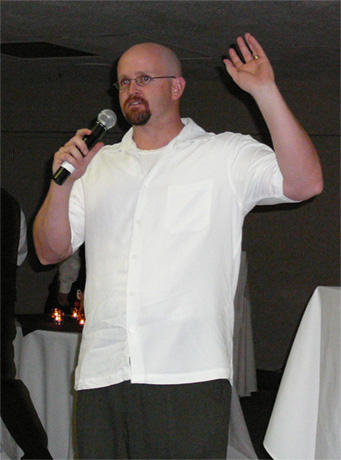
Tomme addresses the packed house, a record-breaking sell-out crowd.

Our first course, a Duck Pozole Terrine with Citrus Herb Salad paired with Lost Abbey Red Barn Ale, which is something of a cross between a Saison and a Bière de Garde. I’ve heard Tomme describe it as either and both, and, of course, the styles are quite close. Both are farmhouse styles, brewed slightly stronger, traditionally in March to last through the warm summer. But while Saisons tend to emphasize the hops and spices, Bière de Gardes are more focused on malt character. The Red Barn, on the hand, is a very malty beer that’s spiced with ginger, orange peel, black pepper and grains of paradise. And as Tomme will be the first to tell you, he’s not trying to imitate either style but rather was inspired by both to create this beer, which is an amazing marriage of both.

Dave Keene, from the Toronado, and Jeff Bagby, from Pizza Port’s Carlsbad brewery.

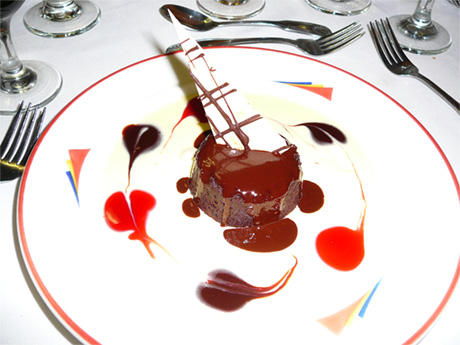
Our dessert was an unbelievably rich Flourless Chocolate Cake with Chile Ancho served with Angel’s Share Barrel Aged Barleywine, an indescribably good pairing. Bruce’s desserts are usually quite tasty, but this one may have been his best ever.

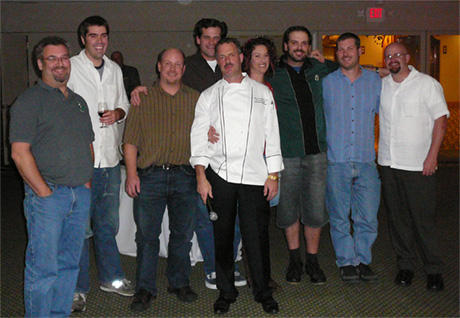
All the brewers in attendance at the dinner, with many of the usual suspects. One surprise, Alan Sprints (on the left), owner of Hair of the Dog in Portland, Oregon was in town for a wedding and joined us at the dinner.

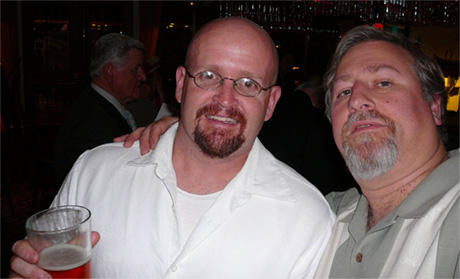
Tomme and me after dinner, relaxing in the bar with Blind Pig IPA.

The other beers of the evening included Cuvee de Tomme served with the soup course, which was a roasted corn soup with gulf prawns and heirloom tomato salsa and a shaved cornucopia of avocado. And the main course was a Duet of Lamb paired with Lost Abbey’s Lost and Found Ale, a Trappist-style abbey ale brewed with a raisin puree.

The next beer dinner with the brewmaster will be November 10 and will feature Sam Calagione and the beers of Dogfish Head. Check out the Beer Chef for more details.

Filed Under: Events, Food & Beer, News Tagged With: California, Photo Gallery, San Diego, San Francisco

First Stop at The Alembic

October 20, 2006 By Jay Brooks

Last night after the Anchor event, a dozen or so of us went over to Dave McLean’s new bar, The Alembic, on upper Haight. The address is 1725 Haight Street and their phone number is 415.666.0822. Dave also owns the Magnolia brewpub a few blocks away. It’s a very small place but also cozy and even a little homey. The have a full bar, all of the Magnolia beers and several guest taps from local breweries. The Alembic’s chef, Eddie Blyden, started bringing us out dishes to sample. What terrific food! Good beer, good food, good spirits, good friends and great atmosphere! I look forward to spending more time at the Alembic.

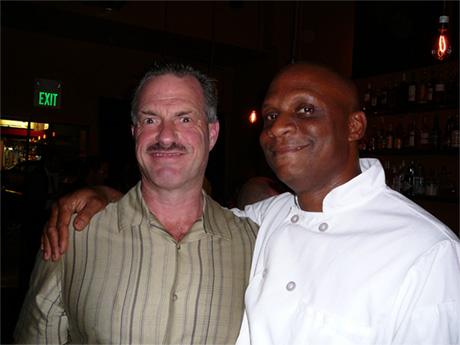
Cathedral Hill Hotel beer chef Bruce Paton and Alembic chef Eddie Blyden, arguably two the best beer chef’s anywhere.

Me with the delicious lemongrass fries, which are done in a Belgian frittes style. My other favorite of the evening were the lamb sliders. Yum!

From the Chronicle:

Small plates from chef Eddie Blyden (of 21st Amendment and now-closed Sneaky Tiki) include charred Monterey Bay squid, and mushroom and autumn squash cassoulet, which vie for a customer’s attention with bar snacks like sage roasted nuts, jerk chicken wings with yogurt sauce, and lemongrass french fries.

The cocktail menu features stripped-down classics like a bourbon old-fashioned and an “old style” Manhattan, and the bar spotlights many Northern California small-craft artisan liquors, a handful of sakes and a rotating selection of local microbrews.

Even the sturdy bar is locally inspired — it’s made from old Kezar stadium bleachers.

Filed Under: Food & Beer, News Tagged With: Business, California, San Francisco

Carlsberg to Import Faux Micros

October 20, 2006 By Jay Brooks

Denmark’s Carlsberg Brewery was founded in 1847 by J. C. Jacobsen. It’s the largest brewery in Denmark by a wide margin, with something like 75% of the market, and is the fifth largest brewer worldwide. Carlsberg beers are sold in over 50 countries. In addition to the flagship Carlsberg brand, they also make Elephant, Tuborg and many others. That makes them the Budweiser of Denmark, in terms of size, market share and dominating business practices.

But craft breweries are slowly gaining a toehold throughout the Denmark with over 40 of them currently in operaion plus around 17 brewpubs sharing 2% of the total market. So last year in response, Carlsberg set up the Jacobsen Brewhouse as a separate entity within the main brewery in Valby. As reported earlier this year, by 2008 Carlsberg will be moving all of its production to its Frederica facility, which now mainly brews Tuborg and a few others, and will close the Valby plant. But the Jacobsen line along with the administrative offices will remain in Valby. The new venture is “located in a building dating from 1878 in the old part of the Carlsberg brewery” and part of the Carlsberg Visitors Centre. Undoubtedly this was done to create positive PR for the brewing giant.

So like Pacific Ridge, Plank Road and Blue Moon before them, Carlsberg is making “specialty beers” under the brand name Jacobsen Brewhouse. To their credit, they make no secret of this fact and proudly display the Carlsberg logo alongside the newer Jacobsen one. The unique shape of the bottle is based on the old lighthouse building at the entrance to the old brewery and no expense appears to have been spared on packaging and marketing, which is one of the dangers of these type of beers, in my opinion. Currently four styles are being made: Bramley Wit, Brown Ale, Saaz Blonde and Original Dark Lager. And so far three seasonals have been made under the name “Jacobsen Limited Edition” with more to follow. The initial seasonals were Chocolate Mint Stout, Golden Christmas Ale and Imperial Barley Wine. And according to the website, they “will also produce four beers from Carlsberg’s successful Semper Ardens series: Criollo Stout, IPA First Gold, Abbey Ale, Winter Rye and Christmas Ale.”

Carlsberg just announced that two of the Jacobsen Brewhouse beers, Saaz Blonde and Bramley Wit, will be imported to England this year, and no doubt America may follow. I’ve never tried any of these beers, so I can’t knock their taste. They may very well be fine, well-made and tasty beers.

Here’s how Carlsberg describes these two beers on the Jacobsen Brewhouse website:

Jacobsen Bramley Wit

Jacobsen Bramley Wit is inspired by the Belgian wheat beer tradition, but with a North European touch in the form of Bramley apples for a flesh, sour flavour and Belle de Boskoop apples for a rounded finish. The Belgian wheat beers use dried orange peel, but we have preferred fresh orange peel for a less bitter impression. Jacobsen Bramley Wit has a light colour, an attractive creamy head and a muted bouquet of cloves and coriander.

Jacobsen Saaz Blonde

Jacobsen Saaz Blonde is brewed according to Belgian traditions for light, top-fermented beers. “Blonde” is the traditional French word for light-coloured beers, while the distinguished Czech malt Saaz with its character of pine needles gives a rounded, aristocratic flavour. Extract of angelica adds a juniper flavour to complement the fruity taste of the yeast. The colour derives from the Pilsner malt characteristic of the Belgian “blonde” tradition, and from a touch of caramel malt to add a slight sweetness.

But all of this brings up the larger issue of big breweries competing with smaller ones on an uneven playing field. Because not only do they try to compete by imitation but also with their larger resources, bigger marketing budgets and a host of other advantages that make the fight anything but fair.

I have no problem with the big breweries making flavorful beers instead of the same old insipid industrial light lagers that dominate the market worldwide, especially when they disclose who’s making them. I have equally no doubt that the big breweries are technically capable of making flavorful beers.

But the heart of the problem is often that the big breweries are big businesses, very big businesses. And all big businesses share a similar ethos and culture that chant the same mantras. Keep costs (ingredients, labor, etc.) low, manipulate the public through advertising and marketing, grow the business every quarter, and the main one (especially for corporations), keep the share price up no matter what.

So it begs the question why in 2005 did Carlsberg feel the need to create a “specialty line of beer” to compete with a handful of tiny breweries catering to very small segment of the market? Why after almost 150 years of making primarily the same products was this decision made now? According to the propaganda, it was “to give people new taste experiences, and we want to challenge and develop beer culture. It’s about making the most of what nature has to offer.” Uh, huh. Sure it is. But let’s assume brewmaster Jens Eiken, head of the new brewhouse (whose quote that is), really believes that — which indeed he probably does — why now? Why not ten years ago, or 50?

In Carlsberg’s the press release when they initially opened the Jacobsen Brewhouse, Nils S. Andersen, Carlsberg’s President, had the following to say:

“In keeping with Carlsberg’s traditions, this is a full and wholehearted venture. This is not some overgrown microbrewery or an exhibition centre — it’s a state-of-the-art brewery where our brewers’ ideas can be brought to fruition with consistently high standards of quality. After all, this is Carlsberg — which means that we have an obligation to maintain the highest quality even when it comes to specialty products and experiments.

“Naturally the Jacobsen brewhouse can draw on all of our expertise at Carlsberg and on the research results from our laboratories, but Jacobsen is to be its own brewery with both the freedom and a duty to create and produce the best and most exciting specialty products in the world — or at least ‘probably the best’, given that these things are always a matter of taste!”

If you’re a regular reader of the Bulletin, you no doubt already know I view large corporations with a great deal of cynicism. I question their ability to make moral or even fair and honest choices when their legal duty to the shareholders is so strikingly singular. They are bound by legal precedent to do only what is in the best interests of the company, and everything and everyone else be damned. Taken to its logical conclusion, that’s how we ended up with so many Enrons, Adelphias, WorldComs and so on. Institutionalized greed with a legal mandate creates environments that cannot tolerate any competition or any erosion of market share. And last year, many larger breweries began to see their customers abandoning their core brands for craft beer, imports (at least here in the U.S.) and even wine and spirits. So as many countries around the world begin to follow the American model and start their own microbrewery revolutions, the status quo big breweries will react in much the same way as they have here in the U.S.

That’s almost certainly the reason why a multi-national company like Carlsberg, with three-quarters of the market in their home country, would feel threatened by 2% of the beer market shifting to craft brewers. They’re incapable of perspective. It’s not permitted any more than losing even an infinitesimal portion of the market can be tolerated. All of the lofty ideals expressed in their marketing is just propaganda, which is what almost all marketing is in reality. In the early days, pioneers like Edward Bernays called it what it was, propaganda. But Hitler had been very impressed with the U.S. War Department’s Office of Public Information (which was headed by Bernays) and its amazing ability to sway public opinion for war just before and during World War One. In fact, so much so, that he adopted many of the same techniques after seizing power in Germany and as a result the term propaganda took on negative connotations and was superseded by the less tainted “Public Relations,” of which marketing is just one part. But as they say, “a rose by any other name …”

So it’s hard not to view the world’s fifth largest brewer waltzing down the same garden path as A-B, SABMiller and Molson Coors (2nd, 3rd and 6th largest, respectively) with anything but suspicion. The beer may, indeed, be good. It may use no adjuncts and be quite delicious. And, if so, I would not hesitate to drink it or support it as I might any well-made craft beer. By the real underlying reasons for making the beer, propaganda aside, are to maintain control and domination of the market and I believe these Goliaths will try to crush every one of their David-like competitors however they can. They may appear to hold out the olive branch of cooperation, tolerance and even support but look behind their back and in the other hand is very large hammer. The only uncertainty is when the hammer will fall.

The Jacobsen Brewhouse at the Carlsberg Visitors Centre in Valby, Denmark.

Filed Under: Editorial, News Tagged With: Business, Europe, International

Anchor Party for Ambitious Brew

October 20, 2006 By Jay Brooks

Last night, Fritz Maytag hosted a private event at Anchor Brewery for the release of historian Maureen Ogle’s new book Ambitious Brew, The Story of American Beer.

It was a fun evening. It was nice seeing Maureen Ogle again (after meeting in Denver last month) and also meeting her husband, who flew out to spend a few days with her in San Francisco. She’s in the middle of a pretty intensive book promotional tour. At least with us for the evening she could relax a bit more. Anchor, as usual, were gracious hosts and had some delicious food and desserts, and of course their wonderful beers. And for a special treat, they were pouring their 2006 Christmas beer which won’t be released officially until November 6.

It was rumored that the long-reclusive Jack McAuliffe — who founded New Albion Brewing, the first modern microbrewery — would be in attendance but he backed out in the end. But in addition to Fritz Maytag, two other brewing legends were there, Michael Laybourn and Don Barkley. Laybourn was one of the founders of Mendocino Brewing Co. and Barkley was their first brewer. Mendocino Brewing hired him after they bought the brewing equipment from New Albion — where Barkley had worked — for the new venture in Hopland. It had been many years since I’d seen either of them. All in all, a great way to spend an evening.

Thanks Maureen.

Bill Owens, who founded Buffalo Bill’s in Hayward, catches up with Fritz Maytag in the Anchor tasting room.

Matt Salie, with Big Sky Brewing, Judy Ashworth, publican emeritus, and Michael Laybourn. In the background Natalie Cilurzo, from Russian River Brewing, talks with Don Barkley.

Matt Salie with Anchor brewer Mark Carpenter, who’s been with Anchor since 1971.

Our choice of libations for the evening.

Vinnie and Natalie Cilurzo, from Russian River Brewing, R.J. Trent, former brewer now with BevMo, Dave Suurballe, President of the San Andreas Malts, and Dave Keene, from the Toronado.

Filed Under: Events Tagged With: California, Other Events, Photo Gallery, San Francisco

« Previous Page
Next Page »

Find Something

Northern California Breweries

Please consider purchasing my latest book, California Breweries North, available from Amazon, or ask for it at your local bookstore.

Recent Comments

  • Bob Paolino on Beer Birthday: Grant Johnston
  • Gambrinus on Historic Beer Birthday: A.J. Houghton
  • Ernie Dewing on Historic Beer Birthday: Charles William Bergner 
  • Steve 'Pudgy' De Rose on Historic Beer Birthday: Jacob Schmidt
  • Jay Brooks on Beer Birthday: Bill Owens

Recent Posts

  • Beer In Ads #5234: Bock Bier 28 April Bis 1 Mai April 28, 2026
  • Historic Beer Birthday: Louis F. Neuweiler April 28, 2026
  • Beer Birthday: Michael Demers April 28, 2026
  • Historic Beer Birthday: Ernst F. Baruth April 28, 2026
  • Beer Birthday: Carl Kins April 28, 2026

BBB Archives

Feedback

Head Quarter
This site is hosted and maintained by H25Q.dev. Any questions or comments for the webmaster can be directed here.