Brookston Beer Bulletin

Jay R. Brooks on Beer

  • Home
  • About
  • Editorial
  • Birthdays
  • Art & Beer

Socialize

  • Dribbble
  • Email
  • Facebook
  • Flickr
  • GitHub
  • Instagram
  • LinkedIn
  • Pinterest
  • RSS
  • Twitter
  • YouTube

Powered by Genesis

Patent No. 3286385A: Electric Beer Tap Handle

November 22, 2016 By Jay Brooks

patent-logo
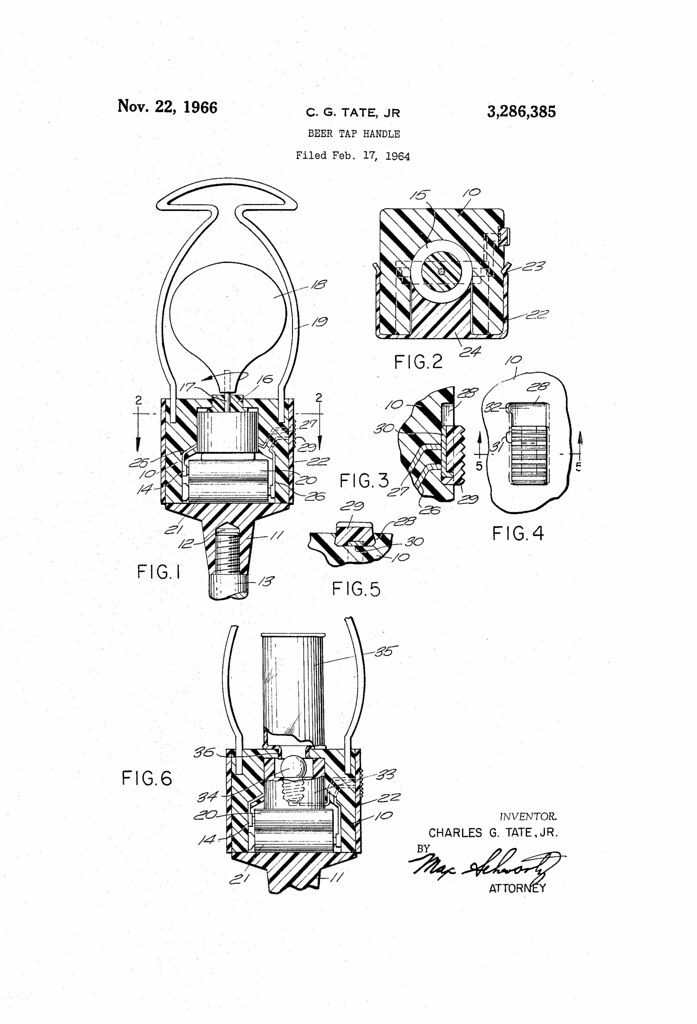
Today in 1966, US Patent 3286385 A was issued, an invention of Charles G. Tate Jr., for his Electric “Beer Tap Handle.” There’s no Abstract, although in the description it includes these claims:

The principal object of the present invention is to provide a beer tarp handle with an electrically operated display device.

Another object of the present invention is to provide a beer tap handle with a movable display device that is electrically driven.

A further object of the present invention is to provide an electrically powered beer tap handle that can readily be converted from a rotating to an oscillating display device or to a stationery light.

Another object of the present invention is to provide a beer tap handle that is simple in construction and easy and economical to manufacture and assemble.
US3286385-0

Filed Under: Beers, Just For Fun, Politics & Law, Related Pleasures Tagged With: Bars, History, Kegs, Law, novelties, Patent

Patent No. 486485A: Pressure Regulator

November 22, 2016 By Jay Brooks

patent-logo
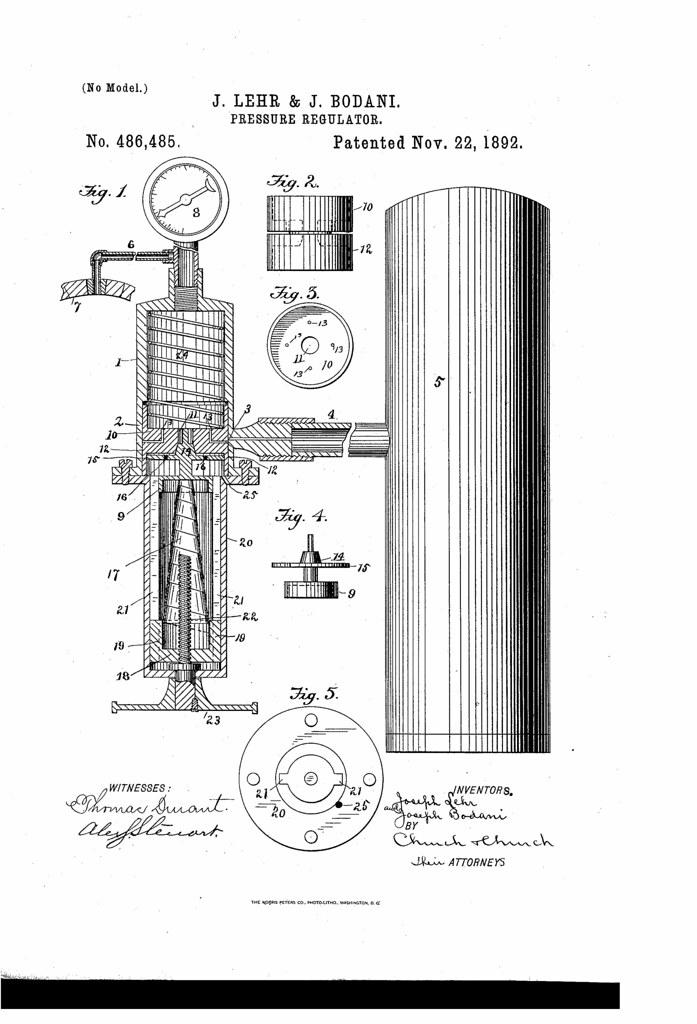
Today in 1892, US Patent 486485 A was issued, an invention of Joseph Lehr and Joseph Bodani, for their “Pressure Regulator.” There’s no Abstract, although in the description it includes these claims:

Our present invention has for its objects to provide a device adapted to maintain an even pressure of air, gas, or other fluid in a chamber or receptacle supplied from a suitable source, which pressure is capable of easy regulation, and though it is especially adapted for maintaining an even and regular pressure on the beer in a keg from which it is being drawn said device is obviously capable of use in other connections and for other purposes; and to these ends it consists in certain improvements in construction and combinations of parts, all as will be hereinafter fully described, and the novel features pointed out particularly in the claims at the end of this specification.

US486485-0

Filed Under: Beers, Just For Fun, Politics & Law, Related Pleasures Tagged With: History, Kegs, Law, Patent

Anchor Christmas Ale 1983

November 22, 2016 By Jay Brooks

xmas-christmas-ale
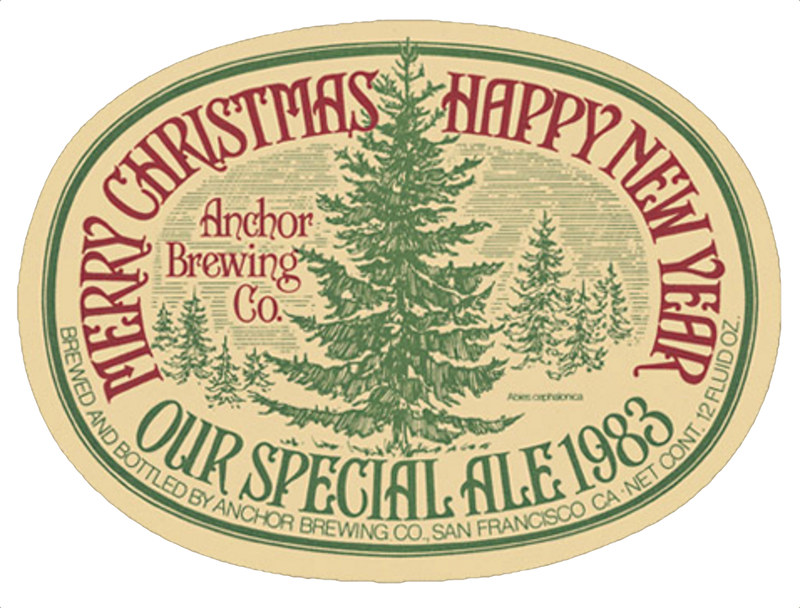
It’s day nine of my holiday hotfoot to Christmas featuring all 42 labels from Anchor’s Christmas Ale — a.k.a. Our Special Ale — all different beers (well, mostly different) and all different labels, each one designed by local artist Jim Stitt, up to and including this year’s label.

1983 was the ninth year that Anchor made their Christmas Ale, and it was similar to the eight previous year’s beers, another variation based on Liberty Ale, still a hoppy pale ale, with no spices added. It was the last year that they based their Christmas Ale on Liberty. From this year forward, also, the label design became relatively fixed and each subsequent label was similar in design. This ninth label was a “Greek Fir,” or “Abies cephalonica.”

Anchor-Xmas-1983

Filed Under: Art & Beer, Beers, Just For Fun Tagged With: Anchor Brewery, Beer Labels, Christmas, History, Holidays

Patent No. 775780A: Art Of Brewing

November 22, 2016 By Jay Brooks

patent-logo
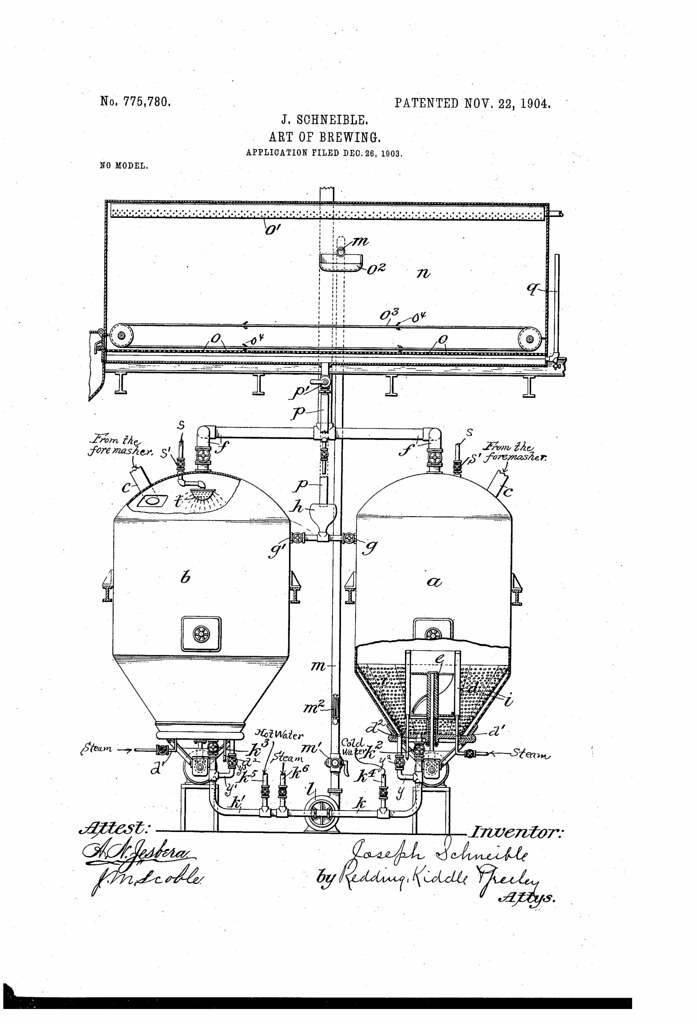
Today in 1904, US Patent 775780 A was issued, an invention of Joseph Schneible, for his “Art Of Brewing.” There’s no Abstract, although in the description it includes these claims:

This invention relates particularly to the preparation of beer-wort, and has for its object to make-it possible to produce with certainty a wort of definite character, with reference particularly to the relationship between sugar and non-sugar, maltodextrins and dextrin, etc.

According to the methods of brewing now practiced the production of a wort of a definite or the best character in so far as it is dependent upon the relative amounts present in it of the different starch derivatives is practically impossible. This is largely due to the fact that the malt mash is subjected for a time long enough to permit conversion of the starch to take place to varying temperatures without so controlling the temperatures as to obtain the different starch derivatives in the desired proportions. This variation of temperature necessarily results from delivering, as is the customary practice, the cooked unmalted cereal mash or other heating medium,”such as hot water, which in some systems of brewing is used to raise the temperature of the malt mash, at substantially the boiling temperature to the mash-tub, which already contains the peptonized malt mash, which is at a temperature much below the boiling-point. The stream of boiling-hot cooked mash raises the temperature of the adjacent portions of the malt mash to a heat approximating its own temperature,which unduly elevated temperature continues long enough for conversion of the starch obviously where the hot cereal to begin. mash or other heating medium is thus introduced into the malt mash it is not only impossible to regulate the temperature to which portions of the malt mash are thus raised, but it is also impossible to regulate the quantity of the malt mash which has its temperature thus unduly raised, and the degree and extent Serial No. 186,592. (No specimens) of conversion or saccharification is therefore impossible of regulation under such methods.

According to the present invention the temperature of the peptonized malt mash is raised to the proper converting degree by the heat of the cooked unmalted cereal mash or other heating medium; but the attainment of the desired temperature .,is effected in so short a space of time that no reaction at other temperatures will take place, the contact of the malt mash at the peptonizing temperature with the substantially boiling hot cooked mash or other heating medium being only momentary, or rather the thorough mixture of the two being so quickly effected that no undesired reaction takes place. The contact or mingling of the malt mash and cooked mash or other heating medium preferably takes place as the two mashes or the malt mash and heating medium are moving on together in a comparatively small stream, and no portion of the malt mash remains in contact for any appreciable length of time with the cooked mash or other heating medium while the latter is at boiling temperature. In other words, the malt mash is raised to the desired converting temperature without subjecting the malt mash to reaction at any temperature other than that which is predetermined.

It will be obvious that the invention can be practiced in different ways and with different forms of apparatus, the most convenient and practicable mode of practicing the invention being to thoroughly mingle the malt mash and the hot cooked mash or other heating medium while in movement from the respective tanks or sources of supply tothe common mash-tub or strainer-tub, so that the desired converting temperature is attained at once in the commingled mashes or commingled malt mash and heating medium. After being so mingled the combined liquor is allowed to stand for the usual period of time required for conversion.

US775780-0

Filed Under: Beers, Breweries, Just For Fun, Politics & Law, Related Pleasures Tagged With: Brewing Equipment, History, Law, Patent, Science of Brewing

Beer In Ads #2101: This Calls For … Away From It All

November 21, 2016 By Jay Brooks


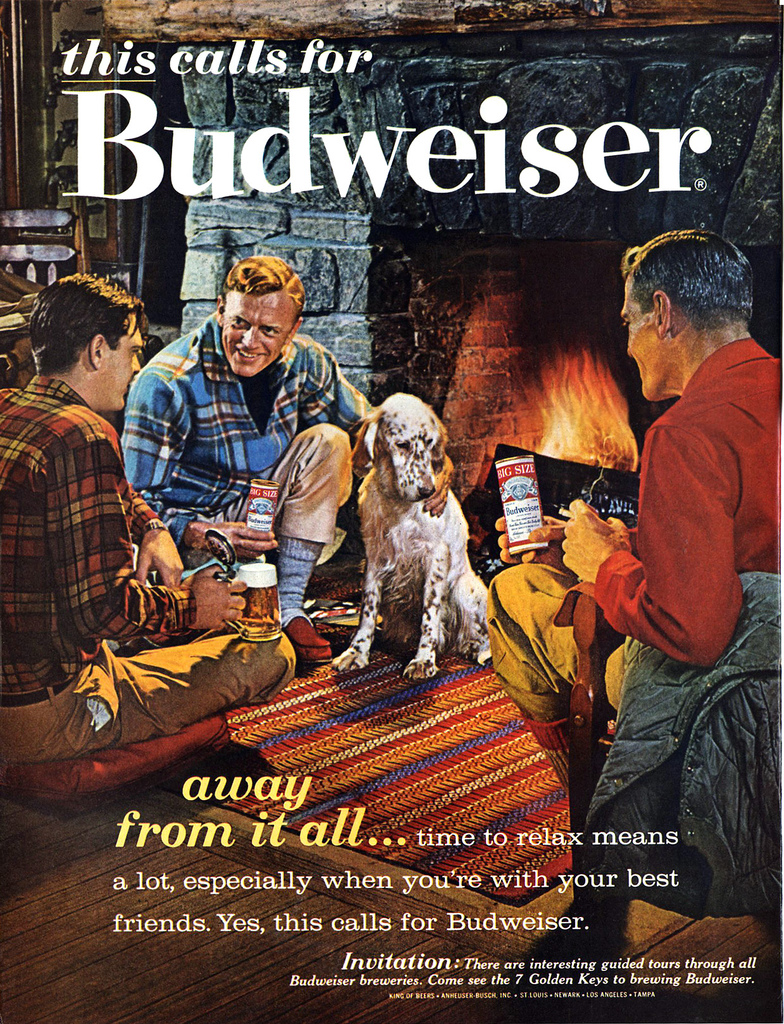
Monday’s ad is for Budweiser, from 1962. In this ad, part of series entitled “This calls for …,” in this case “Away From It All.” In what looks to be a hunting lodge, or possibly a weekend cabin, three manly men (you can tell because they’re wearing plaid flannel) and a dog sit around a roaring fire. They’re each drinking a beer (except for the dog) but curiously only one is using a mug, the other two are drinking straight from the can.

Bud-1962-this-calls-away-from-it-all

Filed Under: Beers Tagged With: Advertising, Budweiser, History

Patent No. 2180828A: Beer Return Device

November 21, 2016 By Jay Brooks

patent-logo
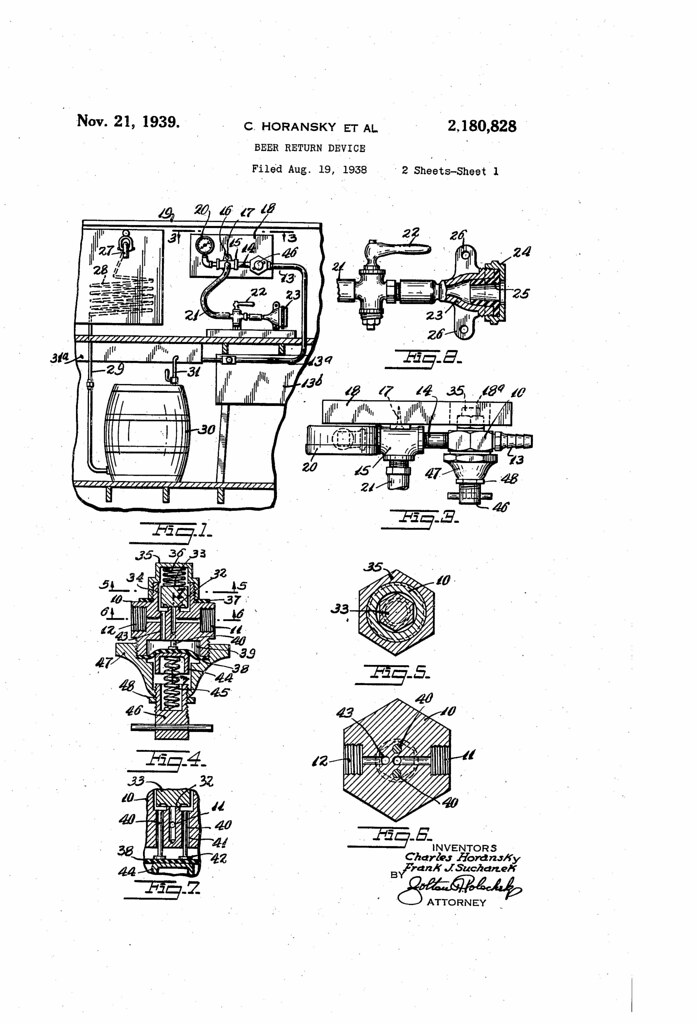
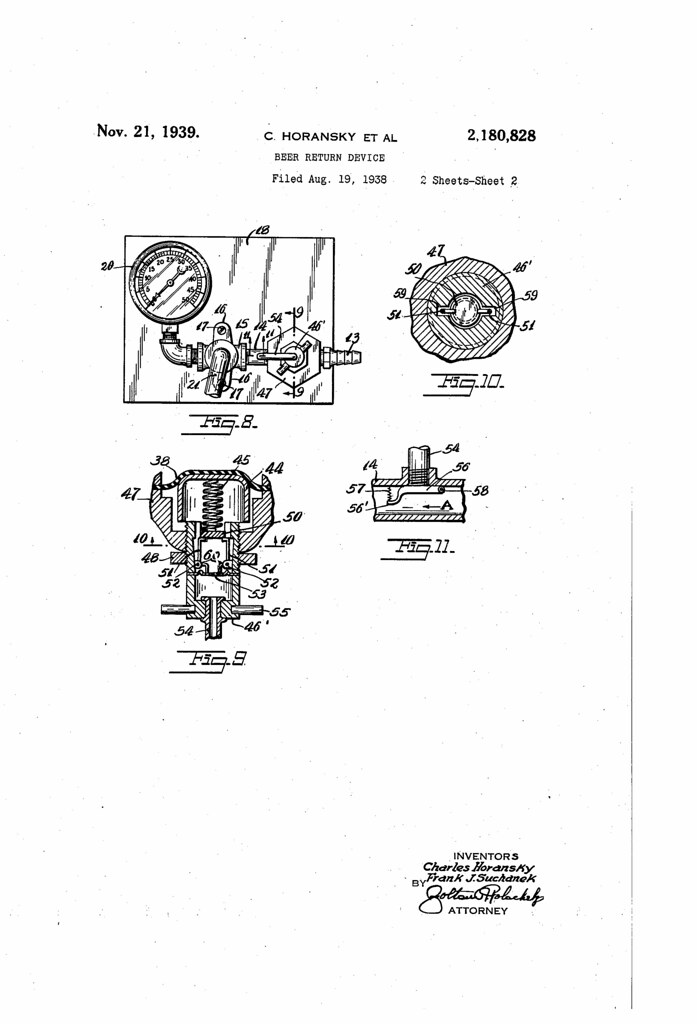
Today in 1939, US Patent 2180828 A was issued, an invention of Charles Horansky and Frank J. Suchanek, for their “Beer Return Device.” There’s no Abstract, although in the description it includes these claims:

This form of device is intended for use with kegs or barrels containing dry contents and to accommodate barrels or kegs containing liquids. The turn-rod 28 is supplied with an inner disk, as shown by Fig. 7, which is secured to the head of said barrel or keg. In Fig. 8 a further modification is shown, and consists of a series of arms 32 on the turn-rod 28 and having outer angular ends in which set-screws 327 are mounted and adapted to take over the end of a barrel or keg and the set-screws caused to engage the body of said barrel or keg ahead of an end hoop, and there by provide a means of securement. The last device set forth can be used alone or in combination with the other devices. Of course the barrel or keg is permitted by all the devices to have a free rotatable movement, which is Very desirable. When the said holding arm 26 is arranged against the end of a barrel or keg, the flat links 24 are positioned as shown in Fig.2, the joints of said links being so constructed as to prevent them from being thrown forward beyond a predetermined point and the rearmost link from being depressed below the horizontal plane of the next link to which it is attached.

US2180828-0
US2180828-1

Filed Under: Beers, Just For Fun, Politics & Law, Related Pleasures Tagged With: Barrels, History, Kegs, Law, Patent

Anchor Christmas Ale 1982

November 21, 2016 By Jay Brooks

xmas-christmas-ale
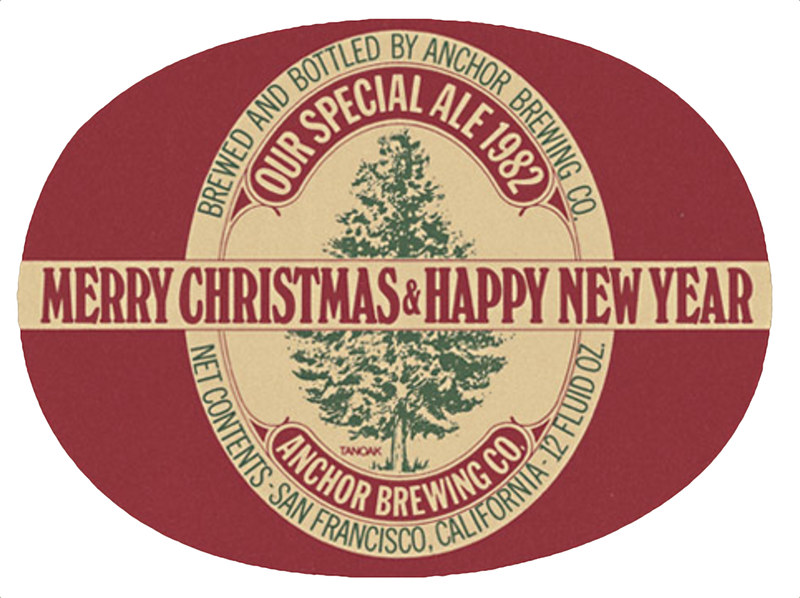
It’s day eight of my seasonal scurry to Christmas featuring all 42 labels from Anchor’s Christmas Ale — a.k.a. Our Special Ale — all different beers (well, mostly different) and all different labels, each one designed by local artist Jim Stitt, up to and including this year’s label.

1982 was the eighth year that Anchor made their Christmas Ale, and it was similar to the seven previous year’s beers, another variation based on Liberty Ale, still a hoppy pale ale, with no spices added. This eighth label was a “Tanoak,” or “Notholithocarpus densiflorus.”

Anchor-Xmas-1982

Filed Under: Art & Beer, Beers, Just For Fun Tagged With: Anchor Brewery, Beer Labels, Christmas, History, Holidays

Patent Nos. 805305A & 805306A: Air Filter

November 21, 2016 By Jay Brooks

patent-logo
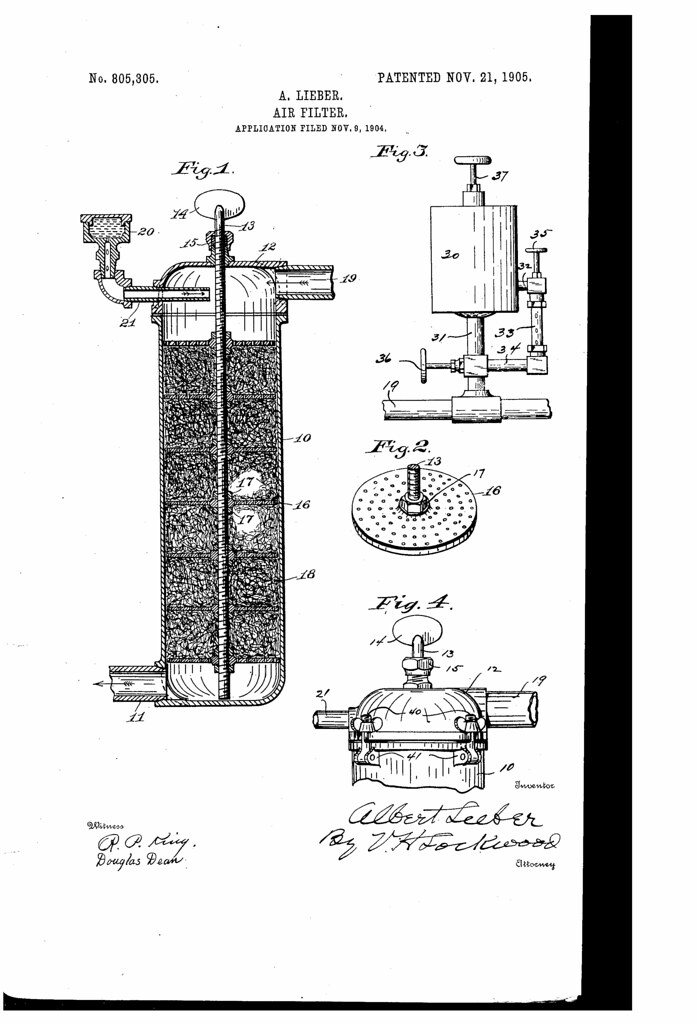
Today in 1905, both US Patent 805305 A and US Patent 805306 A were issued, and both are related inventions of Albert Lieber, under the same name: “Air Filter.” There’s no Abstract, although in the description it includes these claims for the first one:

The object of this invention is to provide an improved construction of air-filter for filtering compressed air and removing from it impurities as well as chemically treating it during its passage through the filter.

The use to which I. have put this filter is for pitching the interior of beer-kegs and the like for blowing and spreading the warm pitch upon the internal surface of a keg by compressed air passing through this filter. In such case the bacteria and germs in the air will be embedded in the pitch and thus affect the beer, impairing its preserving qualities as well as its taste. It is therefore found very important by me that the compressed air used for the purpose mentioned be rendered chemically pure by passing the air through medicated cotton, thus arresting the particles of dust, microbes, germs, and the like. Beer-kegs treated in this way can be used immediately after being pitched and after prior use without the necessity of treating the kegs as heretofore.

US805305-0

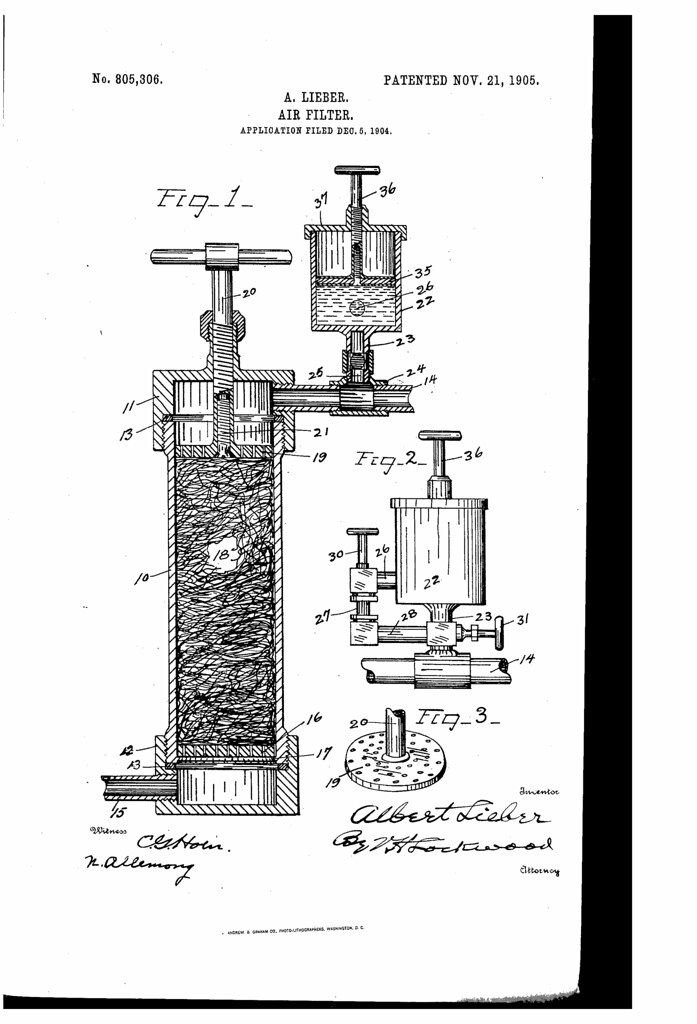
And here’s a description of the claims for the second patent:

The chief feature of this invention consists of means for compressing the cotton or filtering material to the degree best suited for the chemical through which the air passed through the device is being treated.

The purpose of the invention, therefore, is to more thoroughly arrest the bacteria and germs of the air in the filter before the same passes through the filter. I have used it for pitching the interior of beer-kegs, the air being passed through the filter and compressed for blowing and spreading warm pitch upon the internal surface of the keg. This device prevents the bacteria and germs from the air entering the pitch.

US805306-0

Filed Under: Beers, Breweries, Just For Fun, Politics & Law, Related Pleasures Tagged With: Brewing Equipment, History, Law, Patent, Science of Brewing

Belgian Beer Emojis

November 21, 2016 By Jay Brooks

proud-of-beers
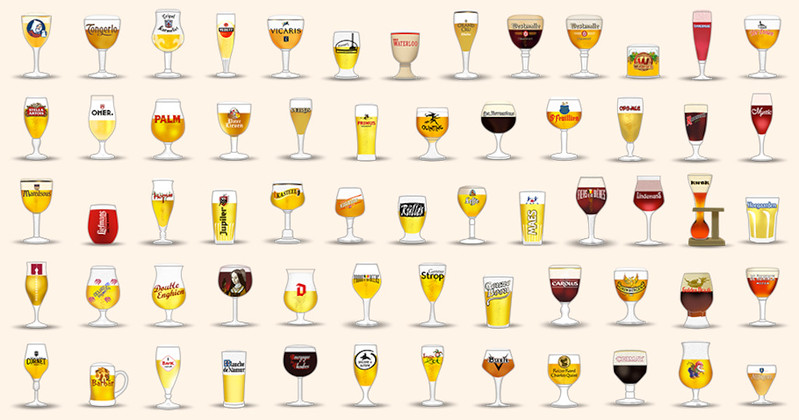
This is fun. The Belgian Brewers’ Association has released a set of 60 beer emojis, each one a different member beer in its proper proprietary and logo glass.

Belgian-Beer-emojies

While not technically emojis (they’s not approved by the Unicode Consortium, and are really virtual stickers) they’re still pretty cool. They can be downloaded at Apple’s app store or Google Play. While the website and news stories mention 60 different ones, I count 118 emojis for iMessage and stickers for WhatsApp or Facebook Messenger, unless I’m missing duplicates. Sadly, I don’t see one for Orval, which is a shame.

beers

I’m not sure how useful they are, but it’s certainly a fun idea. Now if only I get them to work, but that’s another story.

Filed Under: Beers, Just For Fun, Related Pleasures Tagged With: Belgium, Social Media

Patent No. 637738A: Device For Handling Beer Barrels

November 21, 2016 By Jay Brooks

patent-logo
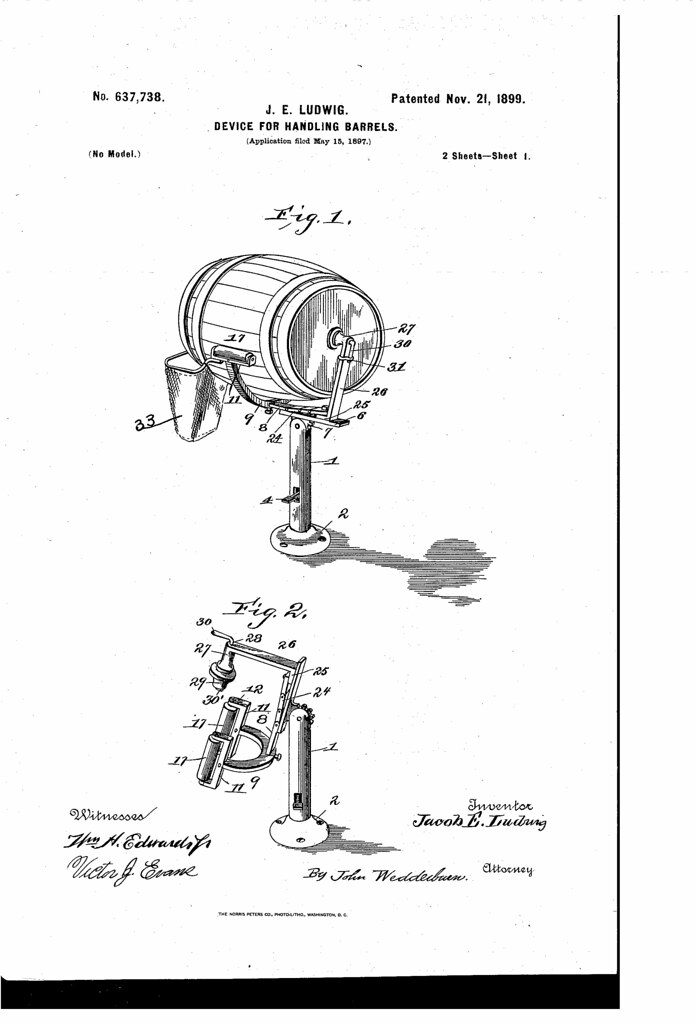
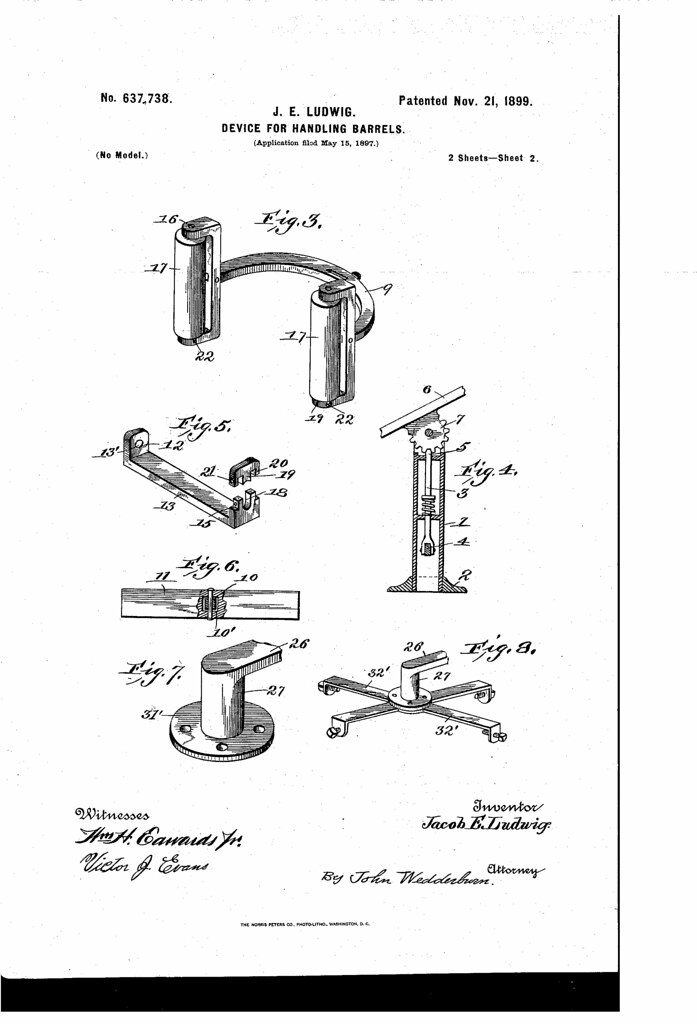
Today in 1899, US Patent 637738 A was issued, an invention of Jacob Elmer Ludwig, for his “Device For Handling Beer Barrels.” There’s no Abstract, although in the description it includes these claims:

This form of device is intended for use with kegs or barrels containing dry contents and to accommodate barrels or kegs containing liquids. The turn-rod 28 is supplied with an inner disk, as shown by Fig. 7, which is secured to the head of said barrel or keg. In Fig. 8 a further modification is shown, and consists of a series of arms 32 on the turn-rod 28 and having outer angular ends in which set-screws 327 are mounted and adapted to take over the end of a barrel or keg and the set-screws caused to engage the body of said barrel or keg ahead of an end hoop, and there by provide a means of securement. The last device set forth can be used alone or in combination with the other devices. Of course the barrel or keg is permitted by all the devices to have a free rotatable movement, which is Very desirable. When the said holding arm 26 is arranged against the end of a barrel or keg, the flat links 24 are positioned as shown in Fig.2, the joints of said links being so constructed as to prevent them from being thrown forward beyond a predetermined point and the rearmost link from being depressed below the horizontal plane of the next link to which it is attached.

US637738-0
US637738-1

Filed Under: Beers, Just For Fun, Politics & Law, Related Pleasures Tagged With: Barrels, Cask, History, Kegs, Law, Patent

« Previous Page
Next Page »

Find Something

Northern California Breweries

Please consider purchasing my latest book, California Breweries North, available from Amazon, or ask for it at your local bookstore.

Recent Comments

  • Bob Paolino on Beer Birthday: Grant Johnston
  • Gambrinus on Historic Beer Birthday: A.J. Houghton
  • Ernie Dewing on Historic Beer Birthday: Charles William Bergner 
  • Steve 'Pudgy' De Rose on Historic Beer Birthday: Jacob Schmidt
  • Jay Brooks on Beer Birthday: Bill Owens

Recent Posts

  • Beer In Ads #5225: Fabled Ambrosia Of The Ancients April 17, 2026
  • Historic Beer Birthday: William O. Poth April 17, 2026
  • Beer In Ads #5224: Harvard Bock Beer April 16, 2026
  • Historic Beer Birthday: William H. Biner April 16, 2026
  • Historic Beer Birthday: Alan Eames April 16, 2026

BBB Archives

Feedback

Head Quarter
This site is hosted and maintained by H25Q.dev. Any questions or comments for the webmaster can be directed here.