Brookston Beer Bulletin

Jay R. Brooks on Beer

  • Home
  • About
  • Editorial
  • Birthdays
  • Art & Beer

Socialize

  • Dribbble
  • Email
  • Facebook
  • Flickr
  • GitHub
  • Instagram
  • LinkedIn
  • Pinterest
  • RSS
  • Twitter
  • YouTube

Powered by Genesis

Patent No. 3488213A: Method And Apparatus For Applying A Coating To The Interior Surface Of A Hollow Article

January 6, 2016 By Jay Brooks

patent-logo
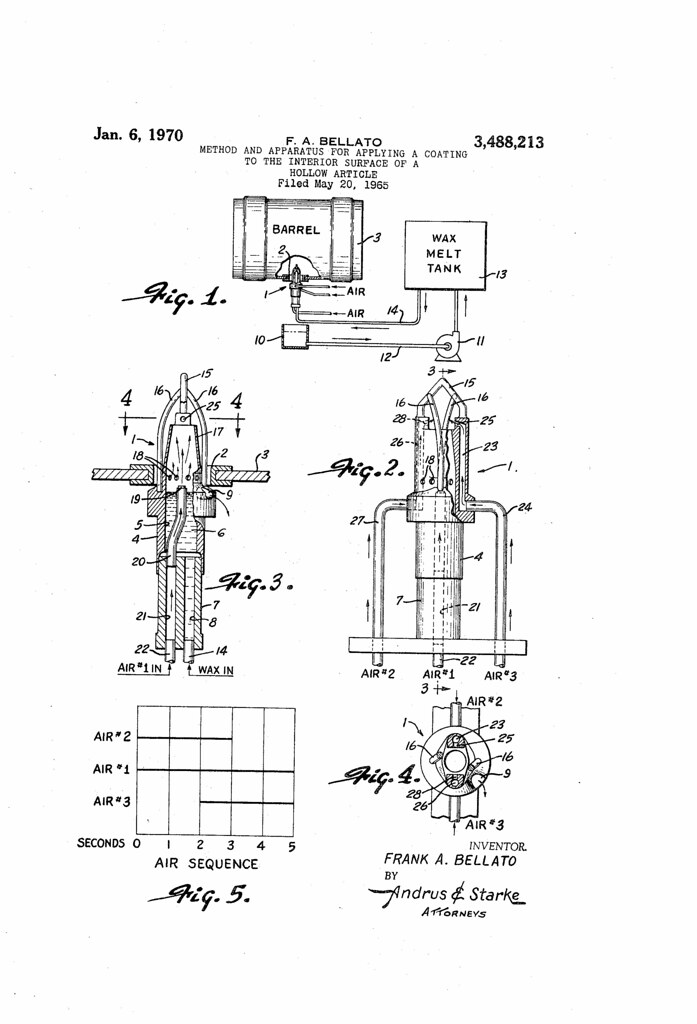
Today in 1970, US Patent 3488213 A was issued, an invention of Frank A. Bellato, assigned to Schlitz Brewing Co., for his “Method and Apparatus For Applying a Coating to the Interior Surface of a Hollow Article.” Here’s the Abstract:

A method and nozzle assembly for coating the interior surface of a barrel with wax or other coating material The nozzle assembly is adapted to be inserted within the bunghole of the barrel and includes a central reservoir which contains melted wax. The Wax is continuously pumped to the reservoir and overflows from the reservoir so that a continual flow of melted wax is achieved. The melted wax is atomized by a pressurized stream of air which is ejected through an orifice into a discharge nozzle located above the level of the wax. In addition to the primary air stream, a pair of auxiliary air jets are employed which are directed laterally towards the ends of the barrel and the auxiliary jets aid in atomizing the wax and directing the atomized wax towards the ends of the barrel.

This invention relates to a method and apparatus for applying a coating to the interior surface of a hollow article and more particularly to a method and apparatus for applying wax or similar coatings to the interior of beer barrels.
US3488213-0

Filed Under: Beers, Just For Fun, Politics & Law, Related Pleasures Tagged With: Barrels, History, Kegs, Law, Patent

Beer In Ads #1781: Geo. Wiedemann Bock Beer

January 5, 2016 By Jay Brooks


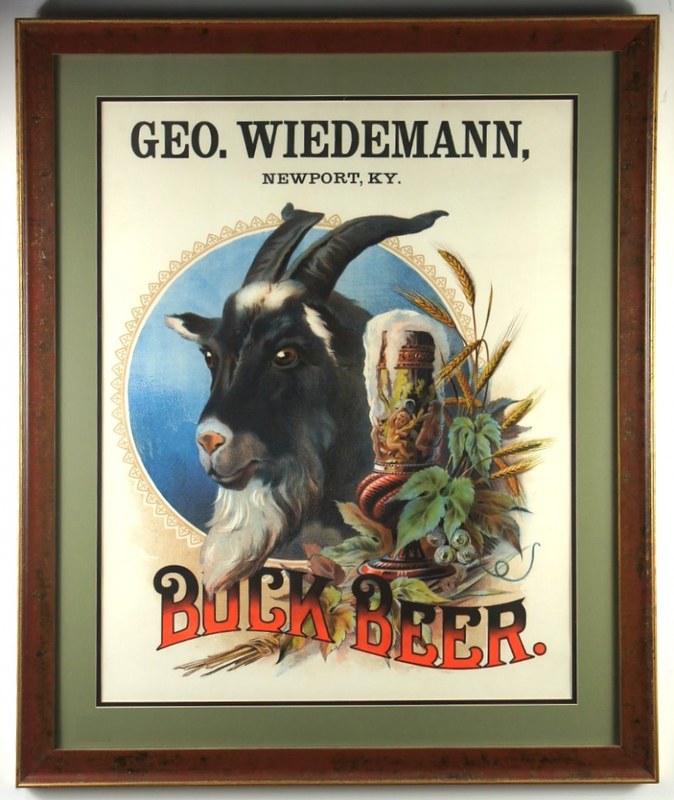
Tuesday’s ad is for Geo. Wiedemann Bock Beer, from around 1910, but definitely pre-prohibition. The Geo. Wiedemann Brewery was in Newport, Kentucky. But continuing Bock Week, it’s another beautiful illustration of a goat and his beer.

Bock-Beer-Signs-Pre-Pro-Geo-Wiedemann-Brewing-Co-1910

Filed Under: Art & Beer, Beers Tagged With: Advertising, History, Kentucky

Patent No. 3552975A: Hop Flavors For Malt Beverages

January 5, 2016 By Jay Brooks

patent-logo
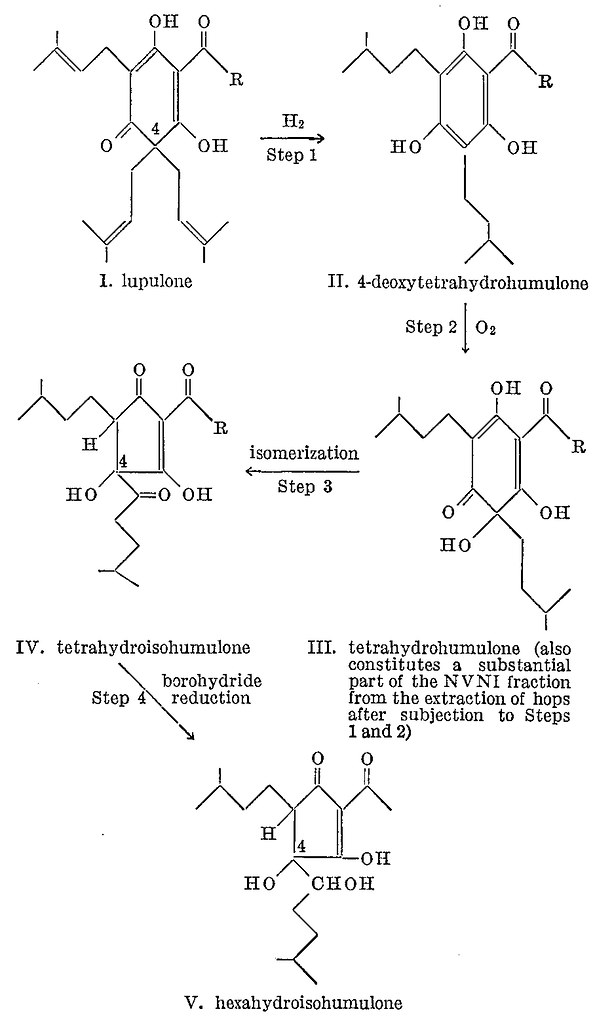
Today in 1971, US Patent 3552975 A was issued, an invention of Paul H. Todd Jr. and Leonard R. Worden, assigned to Matt Brynildson’s first company; the Kalamazoo Spice Extract Co., for their “Hop Flavors for Malt Beverages and the Like.” There’s no Abstract, although in the description it includes this summary:

Process for producing 4-deoxytetrahydrohumulone from lupulone by hydrogenolysis thereof after downward adjustment of pH into the acid range, optional subsequent oxygenation to tetrahydrohumulone, and optional isomerization and reduction to produce hexahydroisohumulone; hexahydroisohumulone itself; use of hexahydroisohumulone, in beverage flavoring; beverages flavored therewith; and employment of the portion of the non-volatile nonisomerizable hop extract fraction which dissolves in water at a pH of at least 9 as starting material in the first-mentioned production processes; use of tetrahydroisohumulone in beverage flavoring, especially by isomerizing tetrahydrohumulone in the beverage; beverages and especially malt beverages so flavored.

US3552975-0

US3552975-1

Filed Under: Beers, Just For Fun, Politics & Law, Related Pleasures Tagged With: History, Hops, Law, Patent, Science

Charlie Papazian Stepping Aside As President Of Brewers Association

January 5, 2016 By Jay Brooks

ba
As far as I know, Charlie Papazian hasn’t worried and has been happy for at least 37 years. That’s the amount of time he’s been president of what’s now called the Brewers Association. When it was first founded, it was known as the Association of Brewers, but has seen its share of changes over the decades. It certainly makes sense, Charlie will turn 67 later this month, so my guess is he’s starting to ease into retirement. Bob Pease, who’s been there almost forever — and is currently the CEO — will assume the duties, and titles, of both president and CEO. The press release goes out of its way to reassure us that Charlie’s not going anywhere, that he’ll still be around. But I suspect he’s also have less day-to-day duties and more time to relax and homebrew.

charlie-blows

Here’s the press release from the BA:

After 37 years of service as president at the Brewers Association, Charlie Papazian will put his passion and vision for the world of beer and brewing into a new role at the Brewers Association. In January, his title shifts to founder, past president. Bob Pease, current CEO, will add president to his title. Papazian will remain an integral part of the association and a leading figure for small and independent brewers, professional and amateur alike. He will continue to attend key Brewers Association and American Homebrewers Association events. He will also participate in other events in the U.S. and internationally, offering his perspectives on beer, brewing and its impact on social and business culture. Charlie is also compiling an archive from the 37 year collection of Brewers Association’s photographs and videos. He is also staging video interviews with craft brewing pioneers that will help capture and chronicle the emergence and continuing journey of craft beer and brewing.

“I discovered craft homebrewing 45 years ago, and it obviously impacted my life. My 37 year journey as founding president has provided me a lifetime of fulfillment. Being part of an organization that serves to enhance the opportunities for professional and amateur craft brewers is especially rewarding. The hard work, dedication and long hours of past and current association staff and the community of brewers it has served has undoubtedly made the world a better place for every beer drinker,” said Papazian. “The tens of thousands of individual stories chronicling the success and joy that craft beer has brought to our lives inspires me. Ultimately it’s the people and their communities who have been and continue to be involved with beer who make our current beer world so special. I look forward to continued opportunities that will enhance the world of beer.”

Among his many accomplishments, Papazian founded the American Homebrewers Association, Institute for Brewing Studies, Brewers Publications, World Beer CupSM and Great American Beer Festival®, which attracts 60,000 attendees annually. He is founding publisher of Zymurgy, the leading magazine for homebrewers and The New Brewer, the flagship journal for small and independent craft brewers. He will continue to serve as a regular contributor for both publications. Papazian has been an inspiration to more than a million homebrewers through his many books, including The Complete Joy of Homebrewing (and its subsequent editions), which many consider the “homebrewer’s bible.”

“Charlie is one of the truly iconic figures in brewing today,” shared Gary Fish, founder and CEO of Deschutes Brewery and chair of the Brewers Association Board of Directors. “He took a quirky notion and made it a movement. Homebrewing and small local breweries brought beer diversity back to the U.S. Charlie can take his fair share of credit for that. We are all in his debt. I look forward to seeing his journey from here.”

“The Brewers Association would not exist today without Charlie’s vision, guidance and determination,” said Pease. “What was once a dream is now an association that lifts up homebrewers, brewers, retailers, distributors, suppliers and beer lovers. We are honored and excited to continue building upon his success.”

Filed Under: Beers, News, Politics & Law Tagged With: Brewers Association, Press Release

Patent No. 2919806A: Hop Strainer

January 5, 2016 By Jay Brooks

patent-logo
Today in 1960, US Patent 2919806 A was issued, an invention of Alvin Hock and Clarence Rechtin, assigned to the Brighton Corp., for their “Hop Strainer.” There’s no Abstract, although in the description it includes this summary:

Our invention resides in the provision of a novel hop strainer especially designed for obtaining instant separation of wort from hops.

Our invention relates in general to that type of mechanism shown in Patent No. 2,412,400 which issued to Alvin Hock on December 10, 1946. Novel features, however, have been incorporated in the machinery of the instant invention as will be emphasized in the passages which follow.

It is an object of our invention to provide a hop strainer which will remove a maximum amount of Wort from the hops without bruising or crushing the hops sufficient to impart an undesirable bitterness to the Wort. Accordingly, an important feature embodied in the construction of a hop strainer according to the teachings of our invention is that of cascading the wort and hops in a sheet or sheets against a perforated plate or screen in such a manner that the combined wort and hops contact the plate or screen in such a way that the great majority of the wort will strike through the plate or screen instantly while the hops are washed along the plate or screen without driving the hops lint and seed through the plate or screen and without undue splashing.

Another very important object of our invention is to provide means for moving the hops and wort along another’ perforated plate or plates in such a Way as to accomplish further separation of the wort from the hops again without subjecting the hops to extreme pressures or harsh treatment.

A further object of our invention is to provide a final pressing action by means of which the last usable wort lis separated from the hops at the final stage in the separation process, this also being accomplished without damage to the hops and wort.

Another important object of our invention is to provide a hop strainer which may be .cleaned easily and quickly so as to protect the purity of the brew and make it economical to use.

US2919806-0

Filed Under: Beers, Just For Fun, Politics & Law, Related Pleasures Tagged With: Brewing Equipment, History, Hops, Law, Patent

Patent No. 19063A: Can Opener

January 5, 2016 By Jay Brooks

patent-logo
Today in 1858, US Patent 19063 A was issued, an invention of Ezra J. Warner, for his “Can Opener.” There’s no Abstract, although in the description it includes this summary:

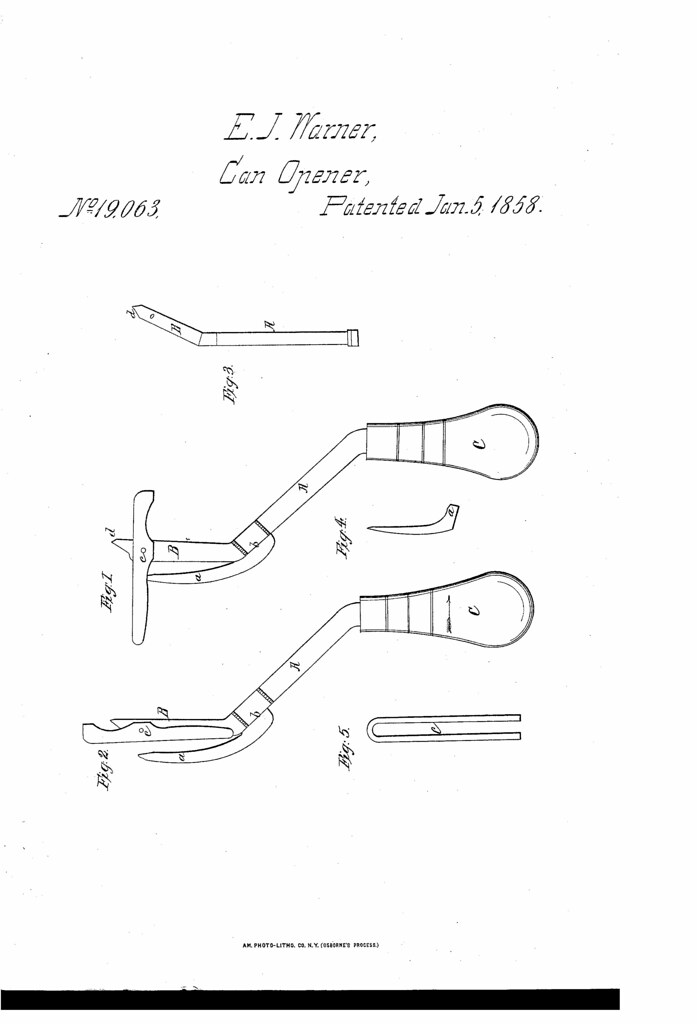
I have invented a new and useful Improvement` in Instruments for Cutting Open Sealed Tin Cans and Boxes; and I do hereby declare that the following is a full, clear, and exact description of the construction, character, and operation of the same, reference being had to the accompanying drawings, which make a part of this specification, in which- Figure l, is a view of the whole instrument, showing the looped bar, (as Fig. 5,) swung across the piercer bar. Fig. 2, is a view of the same, showing another position of the looped bar. Fig. 3, is a view of the shaft, with the piercer bar. Fig. 4, is a view of the curved cutter, (as in Figs. l and 2). Fig. 5, is a view of the looped bar, (as in Figs. 1 and 2.)

I make the shank, A, (including t-he piercer-bar, B,) of steel, substantially, as represented in Figs. l, 2, and 3, with a suitable handle, as C, Figs. l and 2, and I make the point of the piercer bar, B, substantially, in the form represented at d, Figs. l, 2, &c., I make the curved cutter, a, of cast steel, substantially in the form shown in Figs. l, 2, and 4, and attach it to the shank, A, (as at 5,) by passing the end, a, Fig. 4, into a dovetail slot, so that it may be readily removed, in case of its being injured, or when I desire to change the position of the cutting edge from one side of the looped or swinging bar c, to the other or to have it cut in the center, between the two sides, and I bevel the edge on either side, or on both sides, according to the position in which it is to be placed for cutting. I make the looped bar, c, of steel, or any other suitable material, substantially in the form shown in Fig. 5, (and indicated in Figs. 1 and 2,) and attach it to the piercer bar, B, (near its end,) by a fulcrum or joint pin, as shown at c, Figs. l and 2, (and indicated in Fig. 3,) so that it may readily swing, or rock, from the position shown in Fig. 1 to that shown in Fig. 2.

To use this instrument, I swing the loop bar substantially to the position shown at c, in Fig. l, take hold of the handle, C, and press the point, a, of the piercer-bar, B, through the tin in the desired place, turn the instrument, and insert the point of the curved cutter, a, through the perforation already made, (when the looped or swinging bar, c, will be substantially in the position shown in Fig. 2,) and work the handle, C, (in the manner of a brake.) Then the handle, C, is moved in the direction indicated by the dart in Fig. 2, the loop bar, c, will be held against the surface of the tin, while the curved cutter, a, will be forced between its parts and cut the tin smoothly through, and when the handle is moved in the opposite direction the instrument may be pushed forward for another cut, and so on, thus allowing the operator to cut as fast as he can move his hand.

The advantages of my improvement over all other instruments for this purpose consist in the smoothness and rapidity of the cut, as well as the ease with which it is worked, as a child may use it without difficulty, or risk, and in making the curved cutter susceptible of being removed, so that if one should be injured it may be replaced by another, thus saving all the other portions of the instrument, and consequently much expense, and in that the piercer will perforate the tin without causing the liquid to fly out, as it does in all those which make the perforation by percussion of any kind.

US19063-0

Filed Under: Beers, Just For Fun, Politics & Law, Related Pleasures Tagged With: Cans, History, Law, Packaging, Patent

Beer In Ads #1780: The Goat Whisperer

January 4, 2016 By Jay Brooks


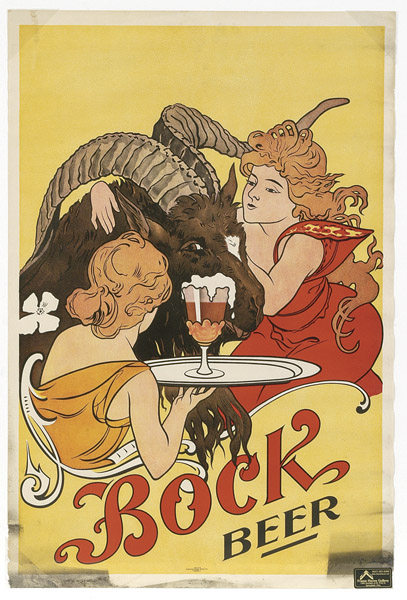
Monday’s ad is for Bock Beer, though it’s not clear who’s bock beer is being advertised. It is believed to be from around 1910 and was most likely created by the Northwestern Lithography Co. of Milwaukee, Wisconsin. One auction house with an original for sale describes the ad as the “scene of lovely young lady whispering something into the ear of a goat, while a second lady brings a tray of beer, with Bock Beer below.” Was goat whispering a thing in the 1910s? How do they know that’s what she’s doing? Though she does have her arm around the goat, like they’re out on a date. Why do goats always have beautiful girlfriends?

m3542

Filed Under: Art & Beer, Beers Tagged With: Advertising, History

American Barley Wine

January 4, 2016 By Jay Brooks

typology
In support of my newly hatched scheme to have a monthly discussion about different types of beer, Typology Tuesday, I offer the first style guide for American Barley Wine, which will be our first beer for January 2016.

wine-of-beer

American Barley Wine

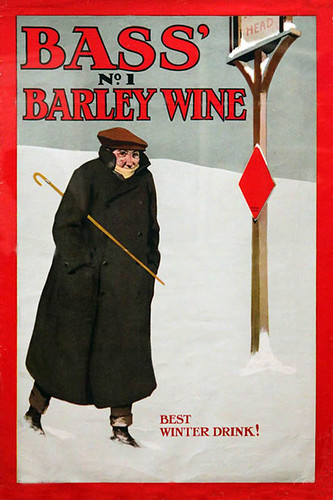
American Barley Wine is one of my favorite styles, and I really miss the days when I judged it for the Toronado Barleywine Festival in San Francisco. Several times I’ve had the pleasure of judging barley wine at both the World Beer Cup and GABF, especially one year when my table did three rounds of barley wine in a row, including the final medal round. That table included Rich Norgrove, from Bear Republic, and George Reisch, from Anheuser-Busch. I love the complexity of barley wines, which make them great sipping, sharing beers. I think of it as one of the quintessential winter beers.

What follows is information about barley wines, collected from a variety of sources. If you know of any additional resources about this type of beer, please let me know.

History

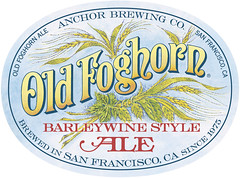
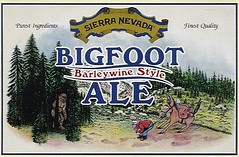
Usually the strongest ale offered by a brewery, often associated with the winter or holiday season and vintage-dated. As with many American craft beer styles, derived from English examples but using American ingredients and featuring a much more forward hop profile. One of the first American craft beer versions was Anchor Old Foghorn, first brewed in 1975. Sierra Nevada Bigfoot, first brewed in 1983, set the standard for the hop-forward style of today. The story goes that when Sierra Nevada first sent Bigfoot out for lab analysis, the lab called and said, “your barleywine is too bitter” – to which Sierra Nevada replied, “thank you.” (BJCP1)

bass-no-1-barley-wine

Origin: usa, from unitedkingdom

am-barley-wine8

A Comparison of Style Ranges

SourceSRMABVO.G.F.G.IBU
BJCP1 (22C) American10-198-12%1.080-1.1201.016-1.03050-100
Brewery DB11-228.4-12%Varies1.024-1.02860-100
GABF2 (89B) American11-188.5-12.2%1.090-1.1201.024-1.02860-100
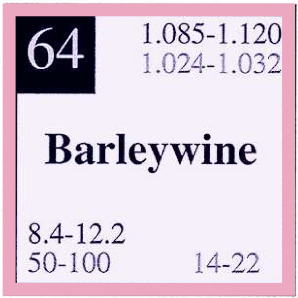
Periodic Table7 (64)14-228.4-12.2%1.085-1.1201.024-1.03250-100
WBC6 (81A) American-Style11-188.5-12.2%1.090-1.1201.024-1.02860-100

Yeast

 Ale
 
 
 Belgian
 Brettanomyces
 Lactobacillus
 Pediococcus
 Other

BJCP Description: 22C. American Barleywine1

Overall Impression: A well-hopped American interpretation of the richest and strongest of the English ales. The hop character should be evident throughout, but does not have to be unbalanced. The alcohol strength and hop bitterness often combine to leave a very long finish.

Aroma: Hop character moderate to assertive and often showcases citrusy, fruity, or resiny New World varieties (although other varieties, such as floral, earthy or spicy English varieties or a blend of varieties, may be used). Rich maltiness, with a character that may be sweet, caramelly, bready, or fairly neutral. Low to moderately-strong fruity esters and alcohol aromatics. However, the intensity of aromatics often subsides with age. Hops tend to be nearly equal to malt in the aroma, with alcohol and esters far behind.

Color Range


Appearance: Color may range from light amber to medium copper; may rarely be as dark as light brown. Often has ruby highlights. Moderately-low to large off-white to light tan head; may have low head retention. May be cloudy with chill haze at cooler temperatures, but generally clears to good to brilliant clarity as it warms. The color may appear to have great depth, as if viewed through a thick glass lens. High alcohol and viscosity may be visible in “legs” when beer is swirled in a glass.

Flavor: Strong, rich malt flavor with a noticeable hop flavor and bitterness in the balance. Moderately-low to moderately high malty sweetness on the palate, although the finish may be somewhat sweet to quite dry (depending on aging). Hop bitterness may range from moderately strong to aggressive. While strongly malty, the balance should always seem bitter. Moderate to high hop flavor (any variety, but often showing a range of New World hop characteristics). Low to moderate fruity esters. Noticeable alcohol presence, but well-integrated. Flavors will smooth out and decline over time, but any oxidized character should be muted (and generally be masked by the hop character). May have some bready or caramelly malt flavors, but these should not be high; roasted or burnt malt flavors are inappropriate.

Mouthfeel: Full-bodied and chewy, with a velvety, luscious texture (although the body may decline with long conditioning). Alcohol warmth should be noticeable but smooth. Should not be syrupy and under-attenuated. Carbonation may be low to moderate, depending on age and conditioning.

Characteristic Ingredients: Well-modified pale malt should form the backbone of the grist. Some specialty or character malts may be used. Dark malts should be used with great restraint, if at all, as most of the color arises from a lengthy boil. New World hops are common, although any varieties can be used in quantity. Generally uses an attenuative American ale yeast.

Style Comparison: The American version of the Barleywine tends to have a greater emphasis on hop bitterness, flavor and aroma than the English Barleywine, and often features American hop varieties. Typically paler than the darker English Barleywines (and lacking in the deeper malt flavors) but darker than the golden English Barleywines. Differs from a Double IPA in that the hops are not extreme, the malt is more forward, and the body is fuller and often richer. An American Barleywine typically has more residual sweetness than a Double IPA, which affects the overall drinkability (sipping vs. drinking).

GABF/World Beer Cup Description

American Barley Wines are amber to deep red/copper-garnet. Chill haze is allowable at cold temperatures. Fruity-ester aroma is often high. Caramel and/or toffee malt aromas are often present. Hop aroma is medium to very high. High residual malty sweetness, often containing a caramel and/or toffee flavors is present. Hop flavor is medium to very high. American type hops are often used but not necessary for this style. Hop bitterness is high. Complexity of alcohols is evident. Fruity-ester flavor is often high. Very low levels of diacetyl may be acceptable. Body is full. Characters indicating oxidation, such as vinous (sometimes sherry-like) aromas and/or flavors, are not generally acceptable in American-style barley wine ales, however if a low level of age-induced oxidation character harmonizes and enhances the overall experience this can be regarded favorably.

american-barley-wine-1864

Glassware

pint-glass-2 snifter
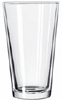
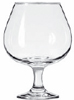
Pint Glass (or Becker, Nonic, Tumbler), Snifter3

Food Pairing

cheese-variety creme-brulee dark-chocolate cake-chocolate steak_meat
Cheese (sharp; Blue, Cheddar, pungent; Gorgonzola, Limburger) General (Dessert, Digestive)3
Crème brûlée, Oxtail4
Dark Chocolate, Strong Blue Cheeses5

Seasonality & Temperature

Season:
season-winter
Winter
Serving:
temp-50-55
50-55° F
Storage:
temp-45-50
45-50° F
Beer 101:
Beer101-barley-wine
Barley Wine

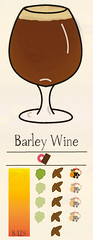
64A-barley-wine

Links About Barley Wine

  • About.com
  • All About Beer’s Profile
  • All About Beer’s Stylistically Speaking by K. Florian Klemp
  • Beer Advocate
  • BJCP 2008 Online (19C)
  • Brewery DB
  • Brew Your Own, by Terry Foster
  • CraftBeer.com
  • GotBeer.com
  • Michael Jackson’s Beer Styles
  • Rate Beer
  • Wikipedia

Further Reading

bp-barley-wine

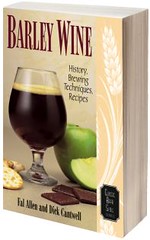
  • Barley Wine: History, Brewing Techniques and Recipes
  • Chapter 11 of Amber Gold & Black, by Martyn Cornell
  • Page 191 of The Beer Bible, by Jeff Alworth
  • Page 119 of The Essentials of Beer Style, by Fred Eckhardt
  • No. 64 on The Periodic Table of Beer Styles
  • Page 152 of What the Hell am I Drinking?, by Don Russell

Commercial Examples of Barley Wine

Avery Hog Heaven Barleywine, Anchor Old Foghorn, Great Divide Old Ruffian, Rogue Old Crustacean, Sierra Nevada Bigfoot, Victory Old Horizontal1

anchor-old-foghorn SierraNevada-Bigfoot-six

Top 10 Examples

Beer Advocate

  1. A Deal With The Devil / Anchorage Brewing
  2. Great / Alpine Beer
  3. Bourbon Barrel Aged Hi-Fi Rye / Flossmoor Station
  4. Brewer’s Reserve Bourbon Barrel Barleywine / Central Waters Brewing
  5. Gratitude / East End Brewing
  6. AleSmith Old Numbskull – Barrel Aged / AleSmith Brewing
  7. Helldorado / Firestone Walker Brewing
  8. Blunderbuss Barleywine / Cambridge Brewing
  9. Tröegs Flying Mouflan (Bourbon Barrel Aged) / Tröegs Brewing
  10. Twisted Trace / Minneapolis Town Hall Brewery

Rate Beer

  1. Dragoon Lazarus
  2. North Coast Old Stock Cellar Reserve Brandy Barrel
  3. Lost Abbey The Angels Share – Bourbon Barrel
  4. AleSmith Old Numbskull – Bourbon Barrel Aged
  5. Goose Island Bourbon County Barleywine
  6. Emelisse White Label Barley Wine (Heaven Hill BA)
  7. Lost Abbey The Angels Share Grand Cru
  8. Firestone Walker Sucaba
  9. Three Floyds Behemoth Barleywine
  10. Hair of the Dog Fred from the Wood

art-barleywine

Key to Sources

1 = BJCP 2015
2 = GABF 2014
3 = Beer Advocate
4 = Garrett Oliver’s Brewmaster’s Table
5 = Brewers Association / CraftBeer.com
6 = World Beer Cup Guidelines 2016
7 = The Periodic Table of Beer Styles 2001
8 = GotBeer.com

Filed Under: Beers, Typology Tagged With: Beer Styles, History, Reference

Announcing Typology Tuesday: A Session About Styles

January 4, 2016 By Jay Brooks

typology
So at the risk of annoying a great many people, I’ve decided to charge straight ahead this year into the hornet’s nest. I love the monthly Session, a.k.a. Beer Blogging Friday, and was thrilled that it was saved last year and continues to soldier on. But I’ve also wished almost since the beginning that it was all about the beer, not that the broader topics aren’t interesting. On the contrary, they’re often very compelling and interesting, especially seeing how disparate people think about them.

But I’m also fascinated by the idea of beer styles, types or kinds of beer. How should they be codified, and of course the ever present question “should they be codified?” So I decided this year to make a conscious effort to think more about different kinds of beer and what makes them unique. And that’s the basic idea behind “Typology Tuesday,” a monthly exploration of different types of beer, with no hosts and me doing most of the work. If you want to join in that would be lovely, and it couldn’t be easier, and I really hope you will. All about Typology Tuesday is in greater detail below, and will also live permanently on a page where all of the previous Typology Tuesdays will be archived. While I won’t be asking for help hosting, there is plenty of opportunity to make suggestions, participate and help shape the inevitable ensuing debate.

Typology-Tuesday

What is Typology Tuesday?

 
Typology is “the study of types,” in this case, of course, I mean types of beer, or “Beer Typology.” I have a love/hate relationship with beer styles. In many ways I believe them to be unnecessary, especially for brewers. But for consumers, they can be quite useful, and provide some sense of consistency for ordering. If you’re thirsty for a hefeweizen or a pale ale, knowing what those are and what you’ll be getting if you order a frosty beverage calling itself by one of those names seems pretty important. And of course, for commercial and homebrew judging, putting like beers with other like beers makes the job of judging much easier and ultimately more fair.

It’s also a bit like music, specifically jazz, but all music, really. I grew up playing jazz (and classical) music, and there’s an almost rite of passage for up and coming artists to perform jazz standards, putting their own spin on songs already very well known. Anyone can do original tunes, designed to showcase a performer’s talents, usually written by that performer, but it takes real talent to be able to take someone else’s song and make it your own. And I think that translates to beer, as well. There are great original brews, but it in some ways it’s more impressive when a brewer makes something amazing within rigid guidelines that nails the style parameters. It’s great when you do something with no rules and no limitations, but it’s at least as impressive when you can create something original and amazing within a structured environment. Yes, rules are meant to be broken but Johann Sebastian Bach is just as marvelous precisely because his music stayed within the confines of baroque music. It took later musicians to break those rules and usher in the period of classical music. Without rules, neither movements would have happened. Instead it would simply have been a free-for-all.

So that dichotomy may seem contradictory but its push/pull nature is, I think, a necessary one. Perhaps it’s like Schrödinger’s cat. Beer styles, or whatever we call them, both matter and don’t matter simultaneously. It’s as if they were in different dimensions and matter on some levels, while not in others. I think that’s why we can never definitely say they do or don’t matter, because it just depends; depends on the circumstances, or the context.

When Stan started The Session, a.k.a. Beer Blogging Friday, in early 2007, many of those early Sessions were about specific styles. But bowing to the wisdom of crowds, the topics have veered off in many directions, only occasionally coming back to stylistic topics, not that there’s anything wrong with that. I even wrote An Open Letter To “The Session” in a vain attempt to steer us back in a stylistic direction, but more people were interested in a wider range of subjects. In the end, I’m just really happy that people are still interested in participating in the Sessions, and that it’s still continuing on.

But I find myself returning time and time again to the subject of beer styles; what they mean, why they are (or aren’t) important and how they should be classified. Are there too many, not enough or are we simply going about organizing them in the wrong way. I know there will be those who think the exercise is futile, and that we should not even try to continually categorize different kinds of beer. But I’m wired that way, and I know I’m not the only one. I love to organize things, feel fairly compelled to do so, and can’t help but feel it’s an essential part of my humanness. As humans, I think we all tend to categorize and organize our surroundings, to a greater or lesser extent, and I think I’m probably on the high end of that spectrum.

So I want to make more of a concerted effort to explore the nature of different kinds of beers, how they can, or should, be organized, divided, dissected and shuffled around, preferably with one in my hand. And that’s the idea behind “Typology,” “Beer Typology” and “Typology Tuesday.” To talk about different kinds of beers, what makes them unique, and where they fit into the taxonomy of all beers is my goal. I’d love to have your help, and include different voices in the journey. Obviously, this is not for everyone, and if the idea fills you with contempt and scorn, please restrain the impulse to bludgeon me with acrid criticism and walk away. Above all else, I want to have fun trying to better understand beer’s diversity, and while that certainly doesn’t preclude critical thinking, criticism and disagreements, they needn’t be disagreeable in and of themselves, especially with an ultimate goal of enjoyment with education. 2016 marks my 25th year working at some level in the beer industry and writing about beer, and even though I know more than I did in 1991, I still feel like there’s a lot to learn and more of a journey ahead of me than behind.

I hope I’m not alone in wanting to better understand beer at both the individual level and the wider and widening landscape of beers, plural. I hope that there will be others who share that desire to keep learning, to keep drinking, to keep wondering.

How to Participate in Typology Tuesday

 
If you write a beer or beer-related blog, please consider joining me on this project about beer styles or types of beer. It couldn’t be easier. It will be sort of like The Session, but also a little different and, hopefully, even a little easier. First of all, there will be no hosts, so you’re off the hook there.

As the name implies, Typology Tuesday will take place on a Tuesday, in this case I’ve chosen the last Tuesday of each month, which should make it at least a few days before the regular Session, and in some cases will provide a week or more in between them. This also gives you the weekend to pick up a beer or beers in a particular style or type and try them, and then another day or two to do your write up about those beers or whatever else you want to contribute. Plus, I’m a big fan of alliteration; just can’t get enough.

The topic for each month will be announced at the beginning of the month, probably no later than the first weekday, but I’ll try to have the schedule up at least a few months ahead on this page for anyone who wants more advance warning. And the topics themselves will simply be the type of beer to highlight and talk about. When the announcement is made, I’ll also provide a style guide using multiple resources to create a page that include lots of information about the type of beer being featured for that month. Use it as a jumping off point, or follow the links provided to delve deeper, or ignore it altogether. Your choice.

Then on or before that day, write a post on that style, type, kind or whatever of beer. You can essentially write about whatever you like, with the only proviso being it should have something to do with the featured type of beer. After your post is published, please let me know it’s up so I can include it in the subsequent round-up. You can send me the URL to your post either by e-mail to Jay (.) Brooks (@) gmail (.) com or by leaving a comment on the original announcement post, or even by including the hashtag #Typology in a tweet.

I would encourage each participant to use the Typology logo for your posts because it lends consistency to all of our efforts and makes it easy for readers to know and understand that your post is part of a larger project. But it’s by no means mandatory. They’re free to use, of course, but please don’t hotlink to them. Instead, please download them and host them on your server or use a photo hosting website like Flickr or Photobucket.


That’s the basics, I’ll also archive each session in a similar format as I’ve done with the Sessions. The first type of beer for the last Tuesday in January — January 26 — will be American Barley Wine.

    • FIRST TOPIC
    • Date: January 26, 2016
    • Topic: Barley Wine
    • Style Guide | Announcement | Roundup | Bulletin Post

I’ll also create a sort of style guide for each kind of beer that I’ll publish concurrently with the announcement of each month’s style. Look for the one on barley wine later today. Drawn from a variety of sources, it will hopefully be a resource to get you thinking about that particular kind of beer and get your mental juices flowing with what you want to say about it. That should also give you several weeks to think about the style of beer up for discussion and even learn more about it ahead of time.

Almost anything is fair game. You could simply review beers in the style. You could discuss its history, how it’s changed over time, or why it shouldn’t be considered a separate style at all. It’s up to you, I only ask that you make it relevant to the discussion about each particular kind of beer, and keep the discussion civil and respectful.

That’s about it. If you have any questions, leave a comment or send me a note. I hope to see everybody’s first posts in about three weeks.

typology-logo

Filed Under: Beers, Just For Fun, Typology Tagged With: Announcements, Beer Styles, Blogging

Patent No. 3227557A: Continuous Fermentation Process With Sedimentable Microorganisms

January 4, 2016 By Jay Brooks

patent-logo
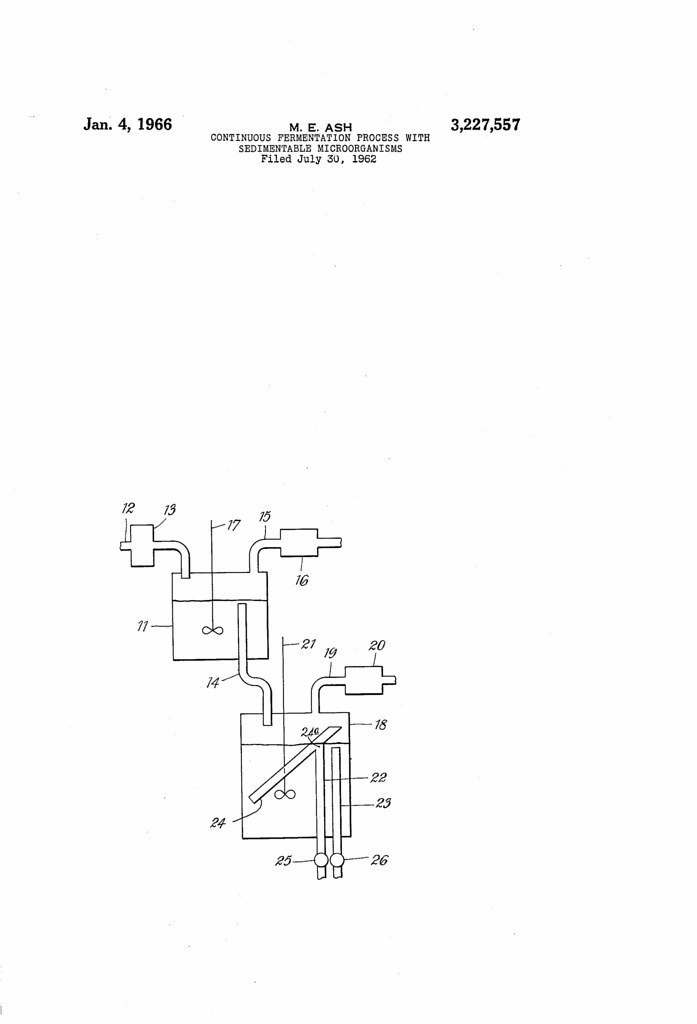
Today in 1966, US Patent 3227557 A was issued, an invention of Michael Edward Ash, assigned to Guinness Son & Co. Ltd., for his “Continuous Fermentation Process with Sedimentable Microorganisms.” There’s no Abstract, although in the description it includes this summary:

This invention relates in general to continuous fermentation systems of the kind in which liquid suspensions comprising a dispersion of said fermentable micro-organisms in a liquid substrate of relatively lower specific gravity, are caused to flow through a fermenting vessel or series of vessels.

More specifically, the invention is concerned with a method and apparatus for controlling the relative degree of concentration of micro-organism in substrate as between any two or all of the stages: inflow, vessel and outflow.

In particular, the invention has been developed for use in connection with the continuous fermentation of Erewers wort in a chemostat system.

The invention is however believed to be applicable to any microbiological process in which a sedimentable micro-organism is operated in a nutrient liquid, and is in the form of a mechanical dispersion in liquid nutrient of relatively lower specific gravity, so that in the absence of turbulence, the micro-organism tends to settle at the bottom of the vessel.

It has already been proposed continuously to ferment Brewers wort or other ferment-able substrate in a plurality of sequentially arranged stirred or unstirred vessels, and to separate the fermenting micro-organism (yeast) from the fermented product (beer) by settlement in a separate vessel or in a part of the final fermentation vessel separated from a stirred region by a baffle.

US3227557-0

Filed Under: Beers, Breweries, Just For Fun, Politics & Law, Related Pleasures Tagged With: Brewing Equipment, Guinness, History, Law, Patent, Science of Brewing

« Previous Page
Next Page »

Find Something

Northern California Breweries

Please consider purchasing my latest book, California Breweries North, available from Amazon, or ask for it at your local bookstore.

Recent Comments

  • Bob Paolino on Beer Birthday: Grant Johnston
  • Gambrinus on Historic Beer Birthday: A.J. Houghton
  • Ernie Dewing on Historic Beer Birthday: Charles William Bergner 
  • Steve 'Pudgy' De Rose on Historic Beer Birthday: Jacob Schmidt
  • Jay Brooks on Beer Birthday: Bill Owens

Recent Posts

  • Beer In Ads #5203: Now’s The Time To Say … Blitz Weinhard Bock For Me! April 3, 2026
  • Beer Birthday: Dave Bonighton April 3, 2026
  • Historic Beer Birthday: Frederick Hinckel Jr. April 3, 2026
  • Beer In Ads #5202: The Bock Beer Time Is Near, And It Comes But Once A Year April 3, 2026
  • Historic Beer Birthday: Henry Pierre Heineken April 3, 2026

BBB Archives

Feedback

Head Quarter
This site is hosted and maintained by H25Q.dev. Any questions or comments for the webmaster can be directed here.