Brookston Beer Bulletin

Jay R. Brooks on Beer

  • Home
  • About
  • Editorial
  • Birthdays
  • Art & Beer

Socialize

  • Dribbble
  • Email
  • Facebook
  • Flickr
  • GitHub
  • Instagram
  • LinkedIn
  • Pinterest
  • RSS
  • Twitter
  • YouTube

Powered by Genesis

Beer In Ads #1661: Guinness Guide To Steaks

August 27, 2015 By Jay Brooks


Thursday’s ad is another one for Guinness, also from 1956. Presenting the “Guinness Guide To Steaks,” featuring seven different steak dishes, a few of which I’d never even heard of, meaning I either need to get out more or common steak dishes have changed a lot in the last sixty years since the ad was published.
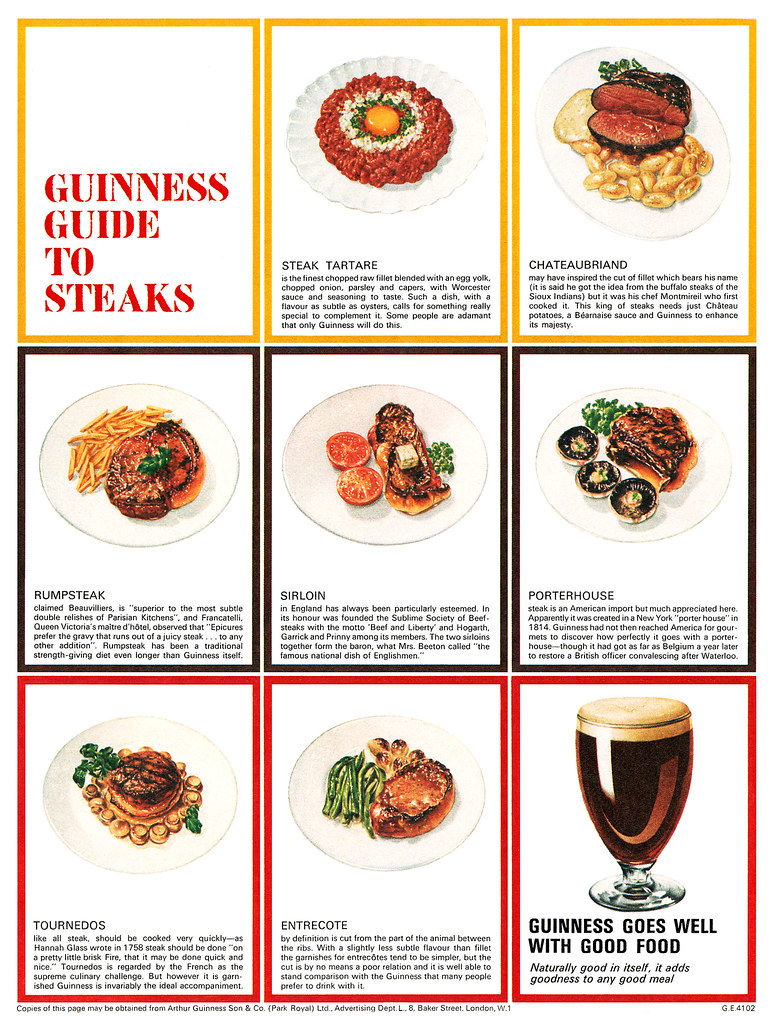
Guinness-1956-guide-to-steaks

Filed Under: Art & Beer, Beers, Food & Beer Tagged With: Advertising, Guinness, History

Patent No. 409956A: Malting And Germinating Apparatus

August 27, 2015 By Jay Brooks

patent-logo
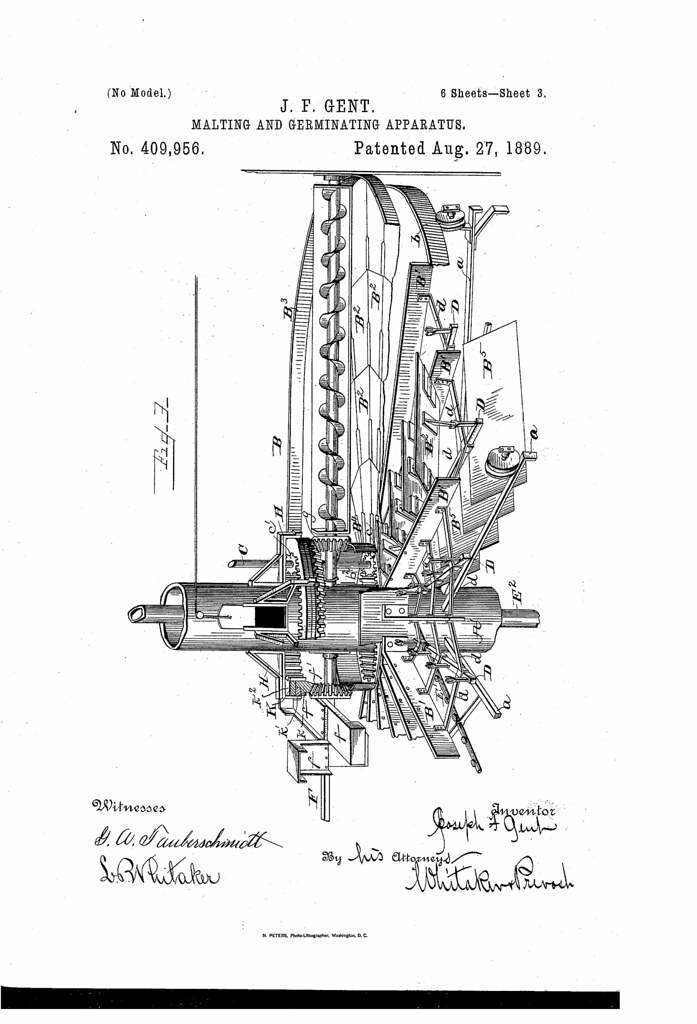
Today in 1889, US Patent 409956 A was issued, an invention of Joseph P. Gent, for his “Malting And Germinating Apparatus.” There’s no Abstract, although in the description it includes this summary:

My invention relates to apparatus for the continuous malt-ing or germinating of grain; and it consists in certain improvements in construction and combination of parts, hereinafter fully described.

What I claim, and desire to secure by Letters Patent, is

1. An apparatus for malting or germinating grain, consisting of an outer casing, a series of perforated floors one above the other, provided with automatically dumping sections, said floors having each a central aperture, an air-supplying pipe extending through said apertures and provided with apertures to discharge air beneath each of said floors, a shaft for rotating said floors, also extending through said openings, and a water pipe extending Within said openings and provided with a discharge above each floor, substantially as described.

2. An apparatus for malting or germinating grain, consisting of perforated floors one above the other, having central apertures in each, a shaft for revolving said floors extending vertically through said apertures, and a water-supply pipe extending also vertically through said apertures and having a spraying-discharge above each floor, the said floors having pivoted automatically-dumping sections, the dumping-point of each floor being a short distance in advance of the dumping point of the floor above, substantially as described.

3. An apparatus for malting or germinating grain, consisting of an inclosing-casing, revolving perforated floors one above the other, an air-pipe extending centrally through said floors and having a discharge-opening beneath each floor, an air-forcing and air moistening device communicating with said pipe, a water-supply pipe extending within said air-pipe and provided with a spraying discharge above each floor, and stirring and leveling devices above each floor, the said floors being provided with pivoted automatically dumping sections, the dumping-point of each floor being slightly in advance of the floor above, substantially as described.

Untitled
Untitled
Untitled
Untitled

Filed Under: Beers, Breweries, Just For Fun, Politics & Law, Related Pleasures Tagged With: Brewing Equipment, History, Law, Malt, Patent, Science of Brewing

Beer In Ads #1660: The Young Hostess Made A Lovely Deep Fry

August 26, 2015 By Jay Brooks


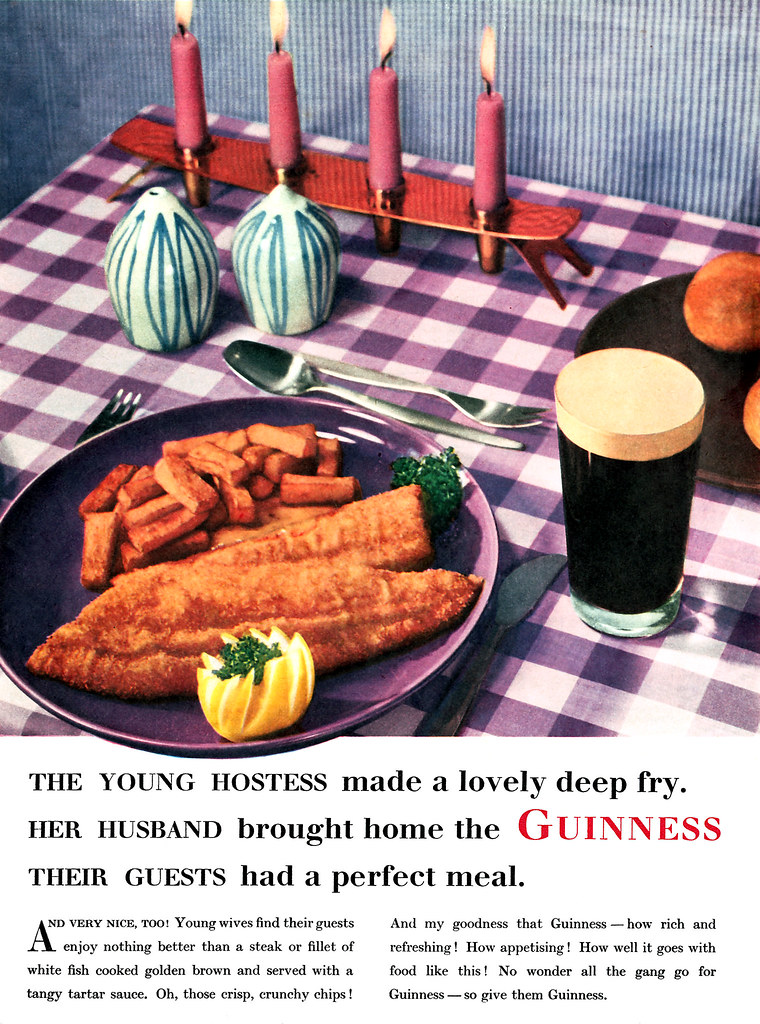
Wednesday’s ad is for Guinness, from 1956. What a lovely story, 1950s style. “The Young Hostess made a lovely deep fry.” But it doesn’t end there, it just builds. Then “her husband brought home the Guinness.” And how did the story end? “Their guests had a perfect meal. And very nice, too!” I know I’m hungry, especially for those “crisp, crunchy chips!”

Guinness-1956-fish-and-chips

Filed Under: Art & Beer, Beers Tagged With: Advertising, Guinness, History

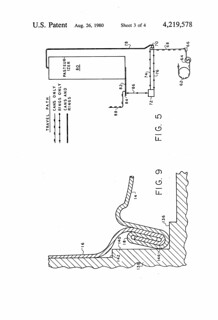
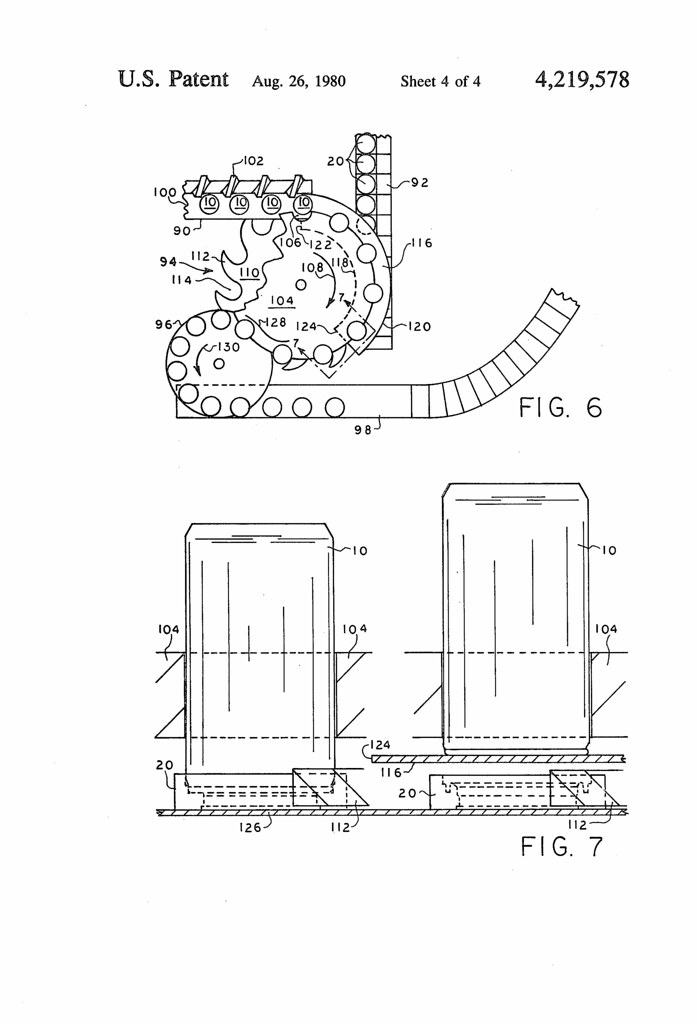
Patent No. 4219578A: Method For Preventing Buckle Of Beer-Can Tops During Pasteurization

August 26, 2015 By Jay Brooks

patent-logo
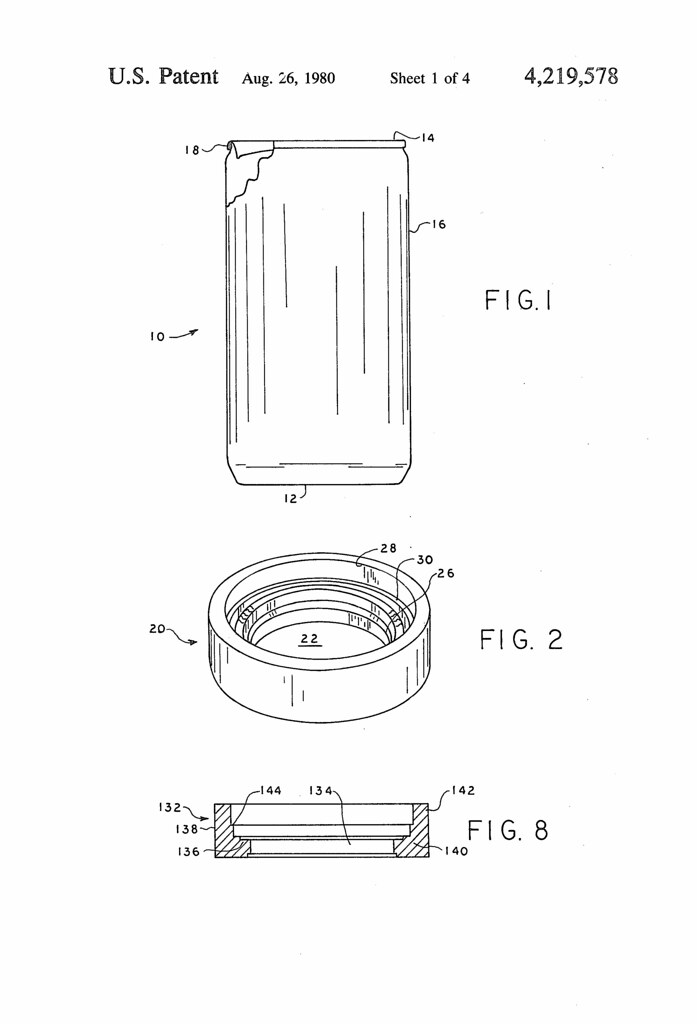
Today in 1980, US Patent 4219578 A was issued, an invention of George J. Collias, assigned to the Kepros-Ganes Company, for his “Method For Preventing Buckle of Beer-Can Tops During Pasteurization.” Here’s the Abstract:

A method is described for preventing buckling of beer-can tops during pasteurization of the beer. Prior to the pasteurization, an anti-buckle ring is mated with each beer can such that the ring captures the double-seamed top of the can. The ring prevents radial displacement at key points of the top and, hence, buckling of the top end of the can, when the heat applied during pasteurization causes the internal pressure of the can to increase. After pasteurization, the ring is automatically removed from the can for further use with another can.

Untitled

Untitled Untitled

Untitled

Filed Under: Beers, Breweries, Just For Fun, Politics & Law, Related Pleasures Tagged With: Cans, History, Law, Packaging, Patent

Beer In Ads #1659: Good Evening, Sir!

August 25, 2015 By Jay Brooks


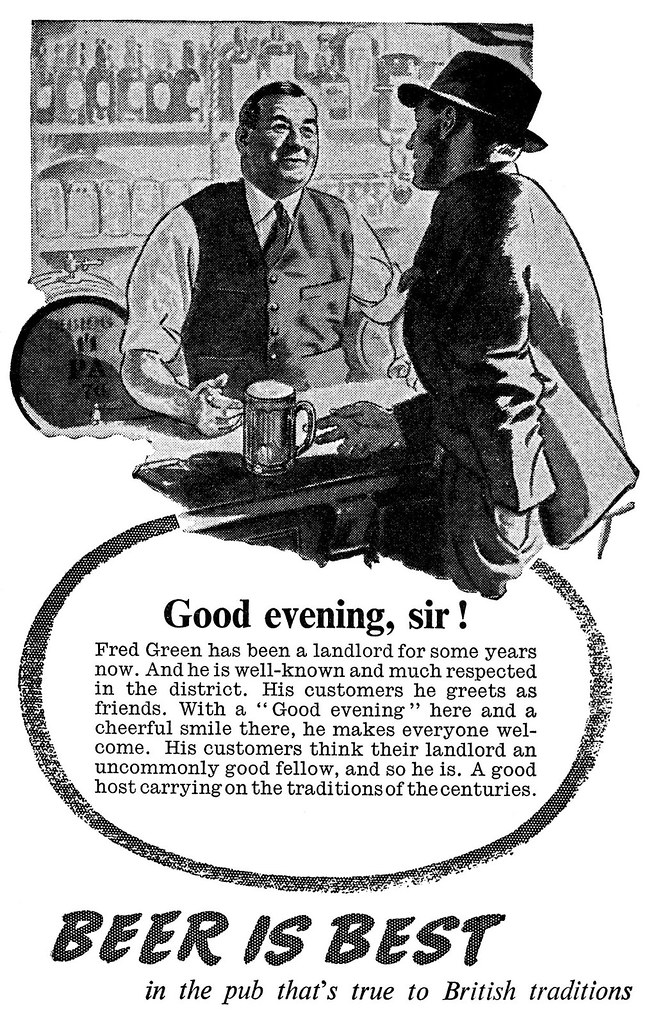
Tuesday’s ad is for the English brewer’s “Beer is Best” campaign, from 1949. The campaign began in 1933, and ran for 30 years, and this one included landlord “Fred Green” — whoever that is — who apparently greets every patron with a “good evening” and a “cheerful smile.” I definitely want to go to that pub.

Beer-is-Best-1949

Filed Under: Art & Beer, Beers Tagged With: Advertising, Great Britain, History, UK

Pliny Buried By Vesuvius

August 25, 2015 By Jay Brooks

pliny
While no one is sure when Pliny the Elder was born — it was sometime around 23 CE — we do know exactly when he died: it was August 25, 79 CE. How can we be so sure? Well, because the day before, August 24, Mount Vesuvius in the Gulf of Naples in southwest Italy, erupted, completely destroying the town of Pompeii. “Pompeii, along with Herculaneum and many villas in the surrounding area, was mostly destroyed and buried under 13 to 20 feet of ash and pumice in the eruption.” We know about this catastrophic event because of a letter by Pliny the Elder’s nephew, Pliny the Younger, “who saw the eruption from a distance and described the death of his uncle, an admiral of the Roman fleet, who tried to rescue citizens.” It’s sounds like it was a pretty awful event, here described on Wikipedia:

That eruption ejected a cloud of stones, ash and fumes to a height of 33 km (20.5 mi) [another source said 27 miles!], spewing molten rock and pulverized pumice at the rate of 1.5 million tons per second, ultimately releasing a hundred thousand times the thermal energy released by the Hiroshima bombing. An estimated 16,000 people died due to hydrothermal pyroclastic flows. The only surviving eyewitness account of the event consists of two letters by Pliny the Younger to the historian Tacitus.

pliny-the-elder-ill

Although known as Pliny the Elder, he was born Gaius Plinius Secundus and studied law and worked as a naval and army commander during the early Roman Empire. But he’s known today more for his writing, specifically “his encyclopedic work, Naturalis Historia, which became a model for all other encyclopedias.” Apparently he spent most of his time off “studying, writing or investigating natural and geographic phenomena in the field,” and the Naturalis Historia was his last work, and ran to 37 volumes, essentially the accumulation of everything he studied over his lifetime.

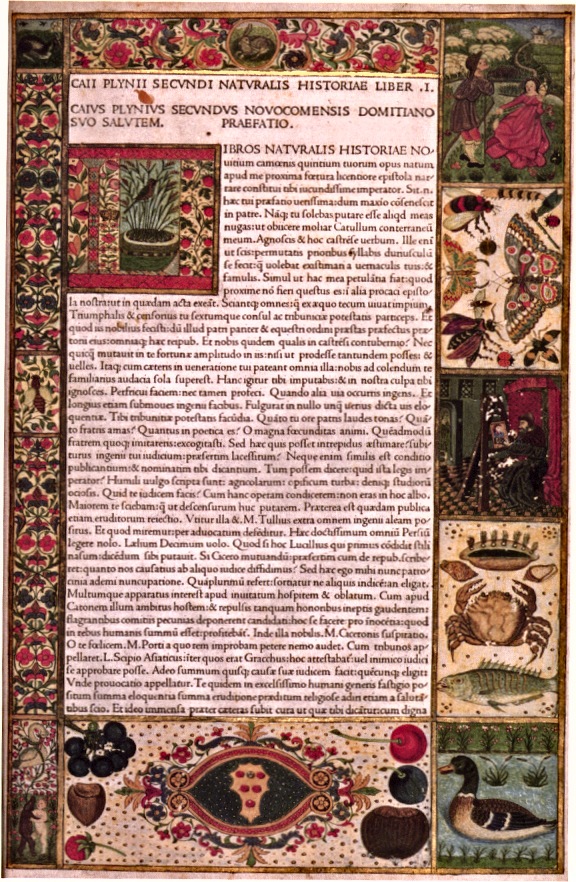
Pliny-1472
A page from a 1472 printing of Pliny’s Natural History.

This is the famous book where Pliny may have first mentioned wild hops, using his own term, “Lupus salictarius,” or “willow wolf,” to describe the plant. The brief mention of hops occurs in Book XXI, in Chapter 50.

Here’s the original Latin text of Pliny from the Teubner editions of the text:

secuntur herbae sponte nascentes, quibus pleraeque gentium utuntur in cibis maximeque Aegyptus, frugum quidem fertilissima, sed ut prope iis carere possit. tanta est ciborum ex herbis abundantia. in Italia paucissimas novimus, fraga, tamnum, ruscum, batim marinam, batim hortensiam, quas aliqui asparagum Gallicum vocant, praeter has pastinacam pratensem, lupum salictarium, eaque verius oblectamenta quam cibos.

This version is from the Second English translation, by John Bostock and Henry Thomas Riley, 1855:

CHAP. 50. (15.)—PLANTS WHICH GROW SPONTANEOUSLY: THE USE MADE OF THEM BY VARIOUS NATIONS, THEIR NATURE, AND REMARKABLE FACTS CONNECTED WITH THEM. THE STRAW- BERRY, THE TAMNUS, AND THE BUTCHER’S BROOM. THE BATIS, TWO VARIETIES OF IT. THE MEADOW PARSNIP. THE HOP.

We now come to the plants which grow spontaneously, and which are employed as an aliment by most nations, the people of Egypt in particular, where they abound in such vast quantities, that, extremely prolific as that country is in corn, it is perhaps the only one that could subsist without it: so abundant are its resources in the various kinds of food to be obtained from plants.
In Italy, however, we are acquainted with but very few of them; those few being the strawberry,1 the tamnus,2 the butcher’s broom,3 the sea4 batis, and the garden batis,5 known by some persons as Gallic asparagus; in addition to which we may mention the meadow parsnip6 and the hop,7 which may be rather termed amusements for the botanist than articles of food.

And here’s Note 7:

7 “Lupus salictarius,” the “willow wolf,” literally; the Humulus lupulus of Linnæus. It probably took its Latin name from the tenacity with which it clung to willows and osiers.

Here’s Book XXI, Chapter 50 translated from the 10 volume edition published by Harvard University Press, 1949-54.

L. There follow the plants that grow wild. Most peoples use these for food, especially the people of Egypt, a land very fruitful in crops, yet about the only one that could manage without them, so great an abundance of food does it get from plants. In Italy however we know few such, strawberries, wild vine, butcher’s broom, samphire, and garden fennel, which some call Gallic asparagus; besides these there are meadow parsnip and willow wolf, though these are delicacies rather than foods.

As you can see, what Pliny says is hardly definitive, and it seems not at all clear that what he’s mentioned in passing may or may not be the same thing as the hops used to make beer today. That’s been the conventional wisdom for a long time, but as we learn time and time again, that doesn’t make it true. Happily, Martyn Cornell looked at this question a few years ago, finding some of the answers to So what DID Pliny the Elder say about hops?

Here’s where the trouble begins:

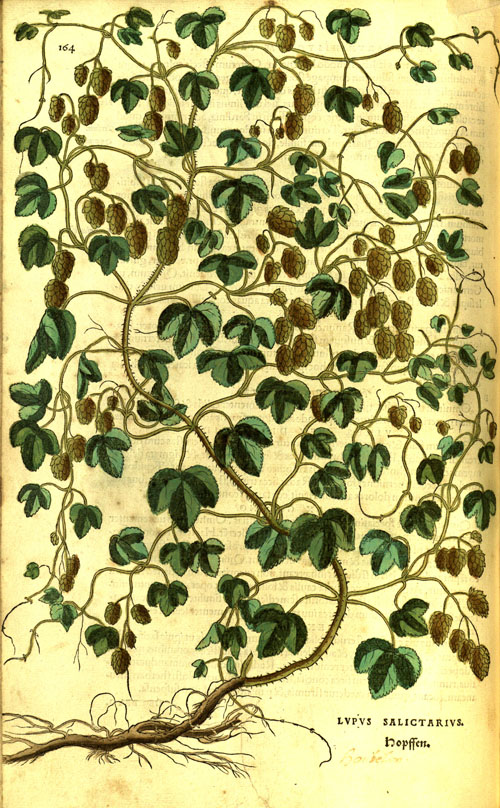
The first person to identify Pliny’s lupus salictarius as the plant that Italians call lupulo, the Spanish lúpulo, Germans Hopfen and English-speakers hops seems to have been a 16th century Bavarian botanist called Leonhart Fuchs, in a book called De historia stirpium commentarii insignes, or Notable commentaries on the history of plants. But Fuchs (after whom, apparently, the fuchsia is named), had made a big effort to try to match up “modern” plants with those mentioned by classical authors, and may have made a mistake in deciding that lupulo was derived from, and identical with, Pliny’s lupus salictarius. At least one writer has suggested that the word lupulo, far from being derived from the earlier term, may simply be an Italian error for “l’upulo“, via the French for hop, houblon, and nothing to do with lupus salictarius.

Fuchs-hops
Humulus lupulus (Cannabaceae) by Leonhart Fuchs,
published in “De historia stirpium commentarii insignes”, 1542

A lot has been made of Pliny’s mention of lupus salictarius, some of it reasonable, and some of quite a stretch. “Never let the truth get in the way of a good story,” observed Mark Twain. But this one is a bit trickier than some. It’s certainly seems possible that Pliny was talking about wild hops, and for all one knows just as likely as unlikely. It’s one of those things that you want to be true, though of course wishing for something doesn’t make it so. We may never know. Cornell concludes his article with his opinion on the matter:

I think it’s somewhere between possible and probable that lupus salictarius WAS the wild hop plant: Pliny puts it among other wild plants from which the fresh shoots were harvested for cooking, like asparagus, and hop shoots are still cooked today, while “willow wolf” is a good description of what hops are capable of in the wild as they grow up trees for support. But that’s a long way from “definite”, and to write as if Pliny’s lupus salictarius was unequivocally the hop plant is wrong.

When the great Swedish botanist Carl von Linné attached a scientific name to the hop in 1753 he gave it the genus name Humulus, from the Swedish for “hop”, humle, and the species name lupulus from the medieval Latin word for “hop”. Even if lupus salictarius WERE the origin of lupulus, therefore, it would be wrong to say, as many websites do, that Pliny “is credited with inventing the botanical name for hops.” He didn’t: Linnaeus did.

It looks like this, and many other great Strange Tales of Ale will be contained in Martyn’s latest book, which will be published in a few weeks, on September 19, 2015. Pre-order a copy on Amazon before you forget.

Luckily, true or not true, the beer Pliny the Elder tastes just as good. But on the anniversary of Pliny’s death at Pompeii, it seems as good a day as any to pour of bottle of hoppy beer. Vive la Pliny.

pliny-the-elder-roman-naturalist-sheila-terry

Filed Under: Birthdays, Just For Fun, Related Pleasures Tagged With: History, Hops

Patent No. 3525625A: Fermentation Of Wort

August 25, 2015 By Jay Brooks

patent-logo
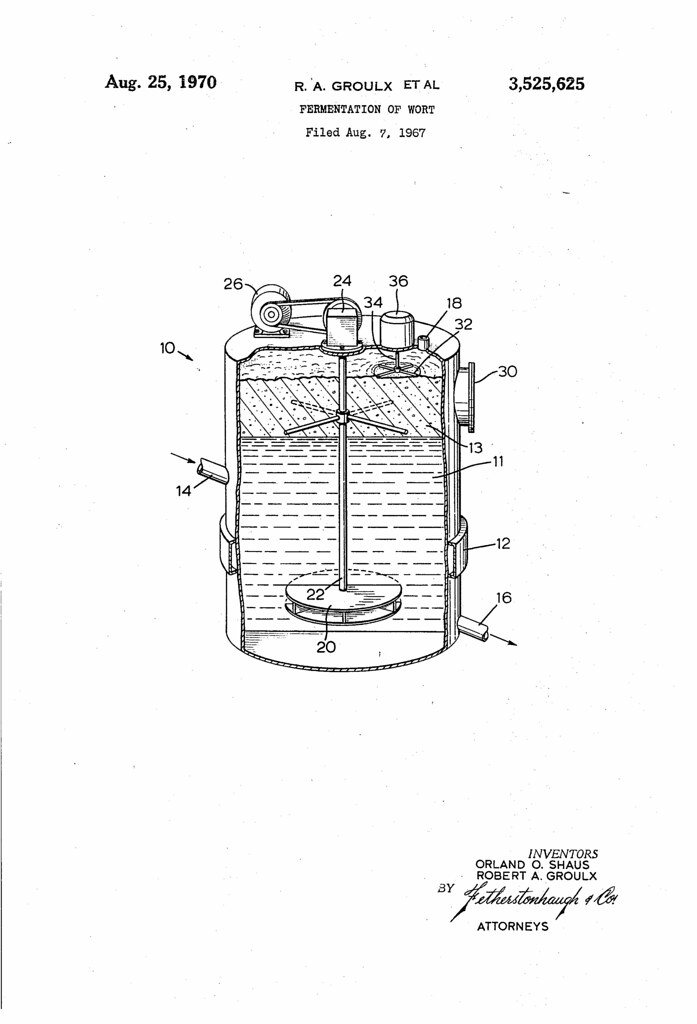
Today in 1970, US Patent 3525625 A was issued, an invention of Robert A. Groulx and Orland O. Schaus, assigned to Canadian Breweries Ltd., for their “Fermentation of Wort.” There’s no Abstract, although in the description it includes this summary:

This invention relates to the fermentation of wort in the making of a potable alcoholic brewery beverage such as ale.

Various types of yeast are used in the making of alcoholic brewery beverages wherein a yeast fermentable substrate known as brewers wort is fermented by the action of a yeast to give a potable beverage. The general process is very well known and description of the complete process is not included herein. Some yeasts are heavy and tend to sink to the bottom of the wort substrate. Others are light and tend to rise to the top of the. substrate. These latter yeasts are called top fermenting yeasts and are commonly used in the manufacture of a type of alcoholic brewery beverage generally known as ale. This invention is concerned with the control of the size of the yeast cap.

Top fermenting yeasts tend to gather in a foam on the top of the fermenting Wort is the fermentation process takes place in what is known in the brewing trade as a yeast cap. This cap often becomes quite deep and represents a substantial quantity of yeast that is not in active contact with the wort. It thus represents an inefficiency in the use of yeast in the process. In many cases, the cap becomes so large that the fermenting vessel overflows with a resulting loss of yeast content and admixed fermenting substrate. This latter condition is known as purging and is wasteful and undesirable. Purging is quite likely to be encountered Where one attempts to use modern accelerated fermentation techniques which involve higher yeast concentrations, elevated temperatures, and agitation of the wort with a view to keeping the yeast in eflicient contact therewith, not only with top fermenting yeasts but also with bottom fermenting yeasts where purging is encountered. While it is, of course, possible to avoid the occurrence of purging by running the fermenting vessel with a lower volume of Wort to provide a greater free board area above the wort surface, this reduces the capacity of a fermenter. From this point of view, it is costly.

It is, therefore, an object of this invention to improve the efficiency of the fermentation process by achieving a more efficient contact of the yeast with the wort.

It is a further object of the invention to control the occurrence of purging in a fermentation process.

It is a still further object of the invention to increase the capacity at which a fermenter may be operated by maintaining the yeast cap at a small dimension.

Untitled

Filed Under: Beers, Breweries, Just For Fun, Politics & Law, Related Pleasures Tagged With: History, Law, Patent, Science of Brewing, Wort

Beer In Ads #1658: That’s Just What This Meal Was Needing

August 24, 2015 By Jay Brooks


Monday’s ad is another one for Guinness, from 1956. “Guinness! That’s Just What This Meal Was Needing.” Two couples are in the garden at a “cosy-looking pub” with a table of bread, cheese and fruit. One of the men — who reminds me a little of Matt Damon — got the first round and is delivering four pints of Guinness. I especially love this copy. “Nothing is added. Nothing is taken away. Every drop you drink is the real thing.” Are they going for Goldilocks or ripping off Coca-Cola thirteen years before Coke debuted “It’s the Real Thing.” Maybe Guinness should be suing them?

Guinness-1956-outdoor-cafe

Filed Under: Art & Beer, Beers Tagged With: Advertising, Guinness, History

Patent No. 2090714A: Bottle Opener

August 24, 2015 By Jay Brooks

patent-logo
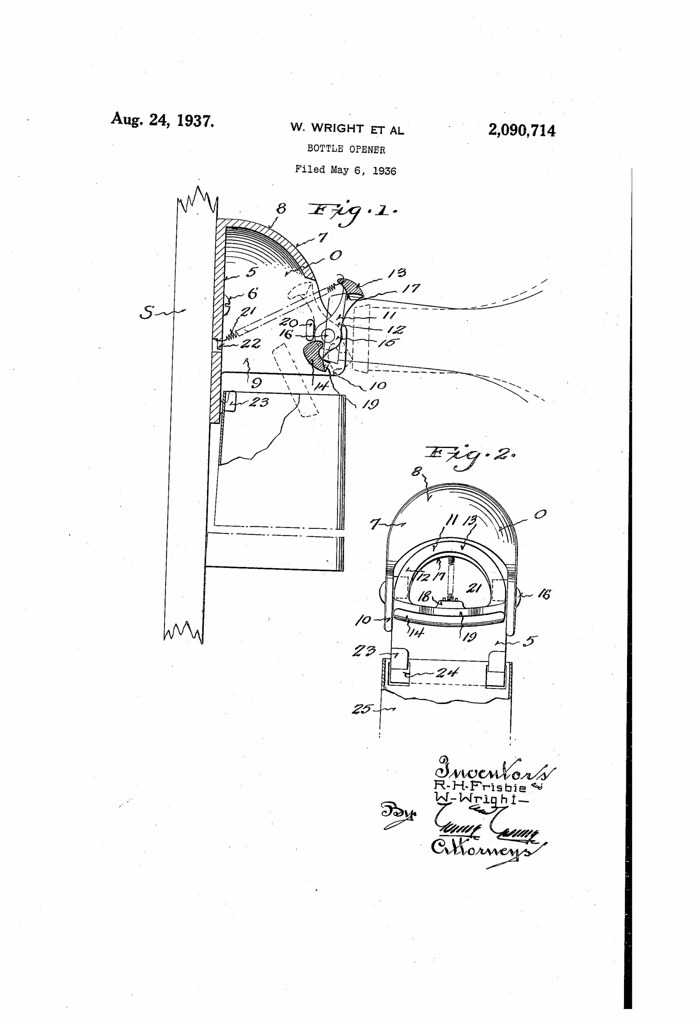
Today in 1937, US Patent 2090714 A was issued, an invention of Raymond H. Frisbie and William Wright, for their “Bottle Opener.” There’s no Abstract, although in the description it includes this summary:

This invention appertains to a novel appliance for removing crown caps from bottles in a convenient and expeditious manner.

One of the primary objects of our invention 5 is the provision of a bottle opener of the wall type, embodying means whereby the caps can be quickly and firmly gripped for removal without the necessity of lifting the bottle above the horizontal, so that undue disturbance of the bottle contents will be prevented.

Another salient object of our invention is to provide a wall bottle opener having a swinging member provided with a cap-engaging lip, and means for guiding the cap under said lip when the bottle is pushed forwardly (in a substantially horizontal plane) in the opening. with means for limiting the swinging movement of said member so that upon downward movement of the bottle the lip will function to pull the cap from the bottle neck.

A further object of our invention is the provision of a wall bottle opener embodying a supporting plate for carrying the swinging member and for supporting a receptacle for the loose caps, the swinging member functioning to guide and throw the caps into the receptacle when the same are pulled off of the bottles.

A further important object of our invention is the provision of a cap stop on the swinging member arranged below the cap-engaging lip, so that the bottle neck and cap will be held in proper position when the bottle is inserted in the opener, and when the member is swung to its operative cap-engaging position.

Untitled

Filed Under: Beers, Just For Fun, Politics & Law, Related Pleasures Tagged With: History, Law, Packaging, Patent

Sonoma State Beer Appreciation Class Open For Fall

August 24, 2015 By Jay Brooks

SSU-seal
Sonoma State University will again be offering my “Beer Appreciation” certificate course this fall. Classes start in just over two weeks, on September 9. The class is through SSU’s Extended Education school, and fueled by Lagunitas, which is where the 12-week, 36-hour course will be held.

lagunitaslogo

Classes are once a week, beginning September 9, on Wednesday nights from 6:30-9:30, and again classes won’t be in a stuffy classroom, but will be held in special lounge room at Lagunitas Brewing in Petaluma. If you’re interested in learning more about the class, I set up a page with more about my Sonoma State University Beer Appreciation Course. Or if you’re ready to go, here’s the official SSU class page and there’s information online about registration, too.

Untitled
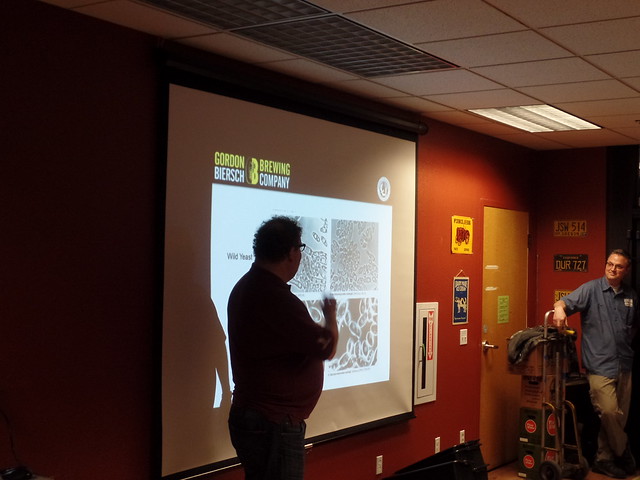
A scene from last semester’s class, with Dan Gordon talking about lagers, while Vinnie Cilurzo waits in the wings to present to the class about sour and barrel-aged beers.

Filed Under: Beers, Breweries, Events, Just For Fun, News, Related Pleasures Tagged With: Announcements, California, Education, Sonoma County

« Previous Page
Next Page »

Find Something

Northern California Breweries

Please consider purchasing my latest book, California Breweries North, available from Amazon, or ask for it at your local bookstore.

Recent Comments

  • Bob Paolino on Beer Birthday: Grant Johnston
  • Gambrinus on Historic Beer Birthday: A.J. Houghton
  • Ernie Dewing on Historic Beer Birthday: Charles William Bergner 
  • Steve 'Pudgy' De Rose on Historic Beer Birthday: Jacob Schmidt
  • Jay Brooks on Beer Birthday: Bill Owens

Recent Posts

  • Historic Beer Birthday: Henry Thrale April 4, 2026
  • Beer In Ads #5203: Now’s The Time To Say … Blitz Weinhard Bock For Me! April 3, 2026
  • Beer Birthday: Dave Bonighton April 3, 2026
  • Historic Beer Birthday: Frederick Hinckel Jr. April 3, 2026
  • Beer In Ads #5202: The Bock Beer Time Is Near, And It Comes But Once A Year April 3, 2026

BBB Archives

Feedback

Head Quarter
This site is hosted and maintained by H25Q.dev. Any questions or comments for the webmaster can be directed here.