Brookston Beer Bulletin

Jay R. Brooks on Beer

  • Home
  • About
  • Editorial
  • Birthdays
  • Art & Beer

Socialize

  • Dribbble
  • Email
  • Facebook
  • Flickr
  • GitHub
  • Instagram
  • LinkedIn
  • Pinterest
  • RSS
  • Twitter
  • YouTube

Powered by Genesis

Go Mild For The Next Session

April 11, 2015 By Jay Brooks

session-the
For the 99th Session, our host is Alistair Reece, who writes the Fuggled blog. He’s also the founder of American Mild Month, which will take place for the first time this May. Intended as a companion to May is Mild Month, which is a month-long promotion of mild ale sponsored by CAMRA in Great Britain, there’s also a Facebook page and so far he’s gotten 45 breweries to commit offering a mild ale during the month. So for the May Session, the topic is “Localising Mild,” which he describes below.

Each May CAMRA in the UK encourages drinkers to get out and drink Mild Ales. This May is the first, as far as I am aware, American Mild Month, which has 45 breweries, so far, committed to brewing mild ales. Of those 45 breweries some are brewing the traditional English dark and pale mild styles, while a couple have said they will brew an ‘American Mild’, which American Mild Month describes as:
a restrained, darkish ale, with gentle hopping and a clean finish so that the malt and what hops are present, shine through

An essential element of the American Mild is that it uses American malts, hops, and the clean yeast strain that is commonly used over here. Like the development of many a beers style around the world, American Mild is the localisation of a beer from elsewhere, giving a nod to the original, but going its own way.

That then is the crux of the theme for The Session in May, how would you localise mild? What would an Irish, Belgian, Czech, or Australian Mild look like? Is anyone in your country making such a beer? For homebrewers, have you dabbled in cross-cultural beer making when it comes to mild?

The first Friday of May is also the first day of May. May Day, or International Workers Day, and it is apt that a beer style closely associated with the industrial regions of England should be the theme for the Session. Have at it folks!

american-mild-month

So don’t go crazy, don’t go wild, instead this May go mild. To participate in the May Session, leave a comment to the original announcement on or before Friday, May 1.
label-mild-ale-bybo

Filed Under: Beers, Events, Related Pleasures, The Session Tagged With: Announcements, Beer Styles, Holidays

Patent No. D9211S: Design For Beer-Mug

April 11, 2015 By Jay Brooks

patent-logo
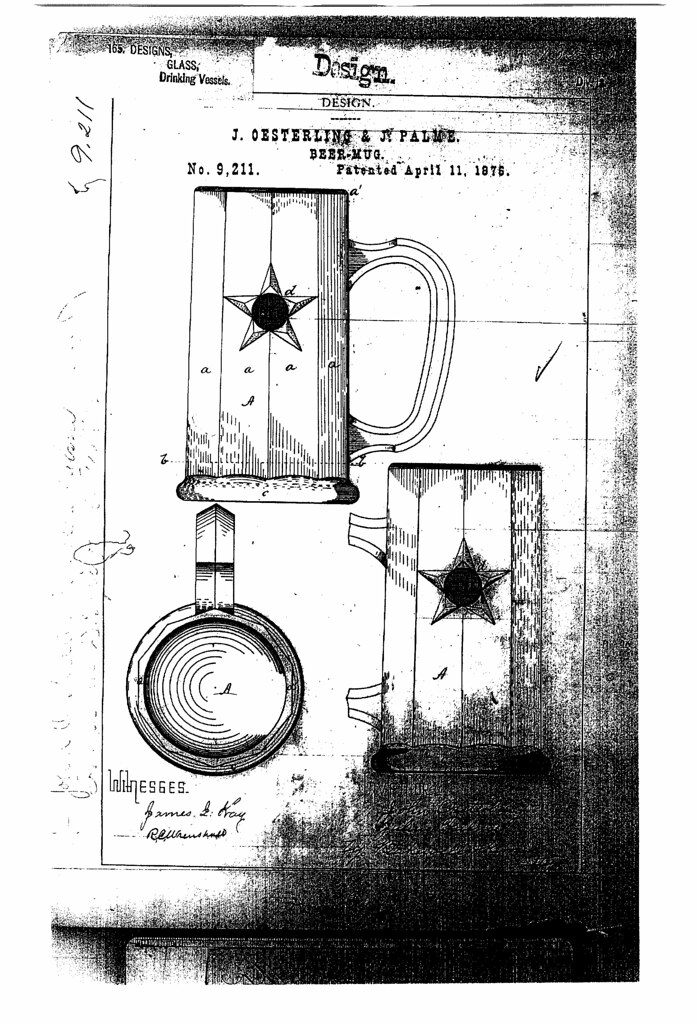
Today in 1876, US Patent D9211 S was issued, an invention of John Oesterling and Julius Palme, for their “Design for Beer-Mug.” There’s no Abstract, but it’s claimed that they have “invented a new and useful Improvement in Design for Beer-Mugs or Ale-Glasses, with or without foot or stein; and we do hereby declare the following to be a full, clear, and exact description thereof, reference being made to the accompanying drawing forming part of this specification, and illustrating our design as applied to a beer-mug. Our design is intended for beer-mugs or ale glasses, with or without foot or stems, and consists in forming the exterior of an ale or beerglass of a series of planes upon one or more of which star-shaped figures are formed.”

USD9211-0

Filed Under: Beers, Just For Fun, Politics & Law, Related Pleasures Tagged With: Glassware, History, Law, Patent

Bistro IPA Festival Winners 2015

April 11, 2015 By Jay Brooks

bistro
After missing this festival for the past few years, I finally made it back to judge this year’s Bistro IPA Festival. This year’s big winner was Solana Beach IPA, from Pizza Port Solana Beach, which was chosen best in show, out of 70 IPA offerings, at the 18th annual IPA Festival today at the Bistro in Hayward, California. The full list of winners is below.

  • 1st Place: Solana Beach IPA (Pizza Port Solana Beach)
  • 2nd Place: Spring IPA (Faction Brewing)
  • 3rd Place: Raceway IPA (Pizza Port Carlsbad)
  • People’s Choice: Knee Deep Breaking Bud (Knee Deep Brewing)

Filed Under: Beers, Breweries, Events, News Tagged With: Awards, Bay Area, California, IPA

Patent No. 989546A: Bottle-Filling Machine

April 11, 2015 By Jay Brooks

patent-logo
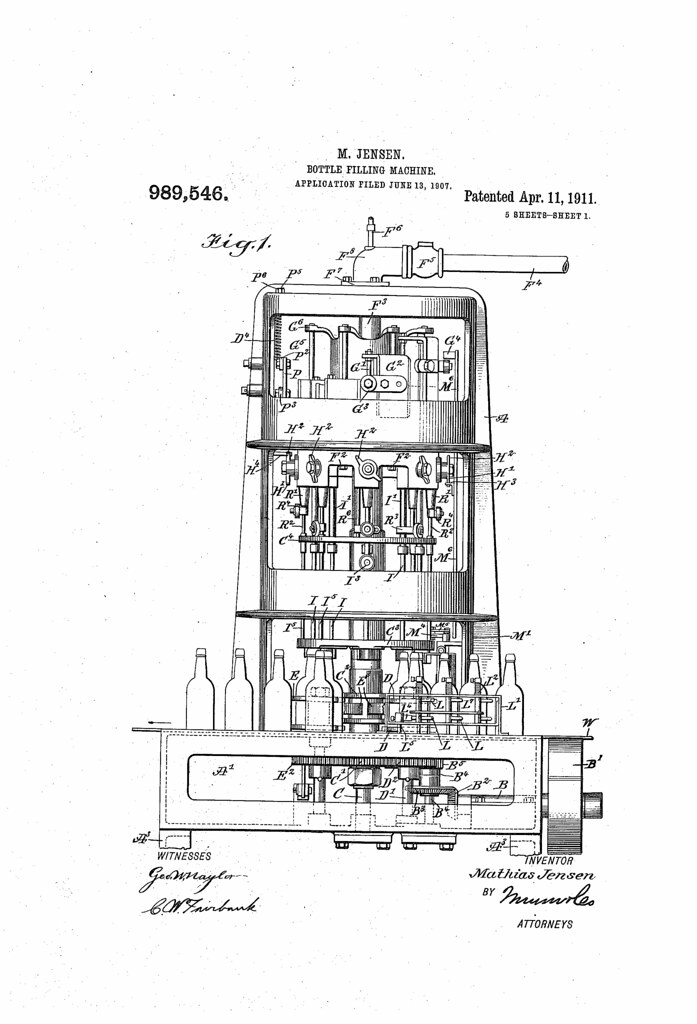
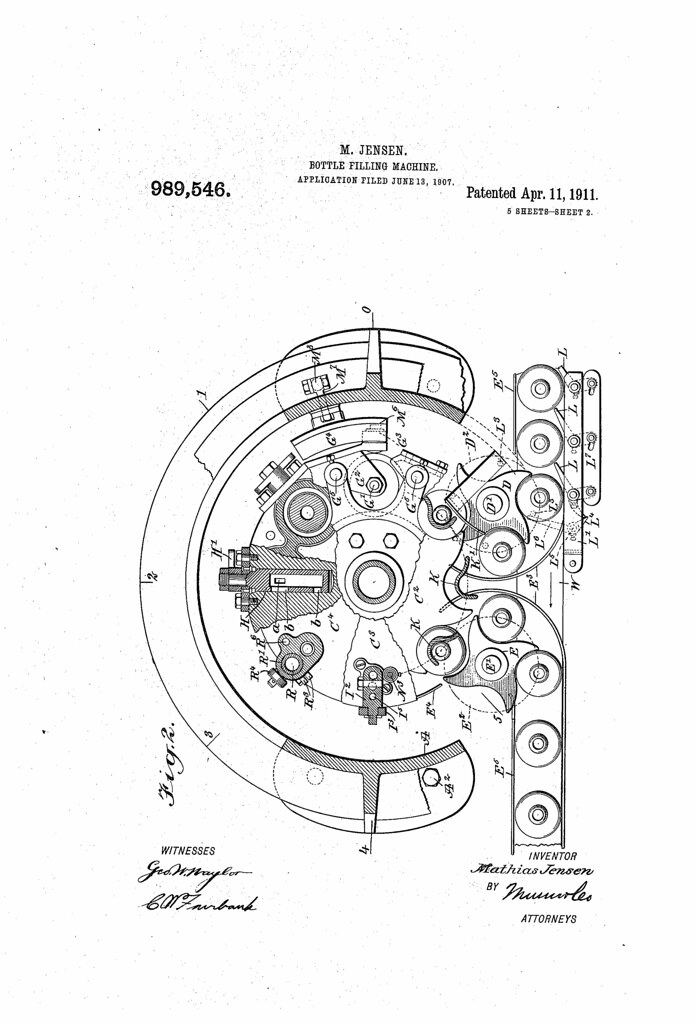
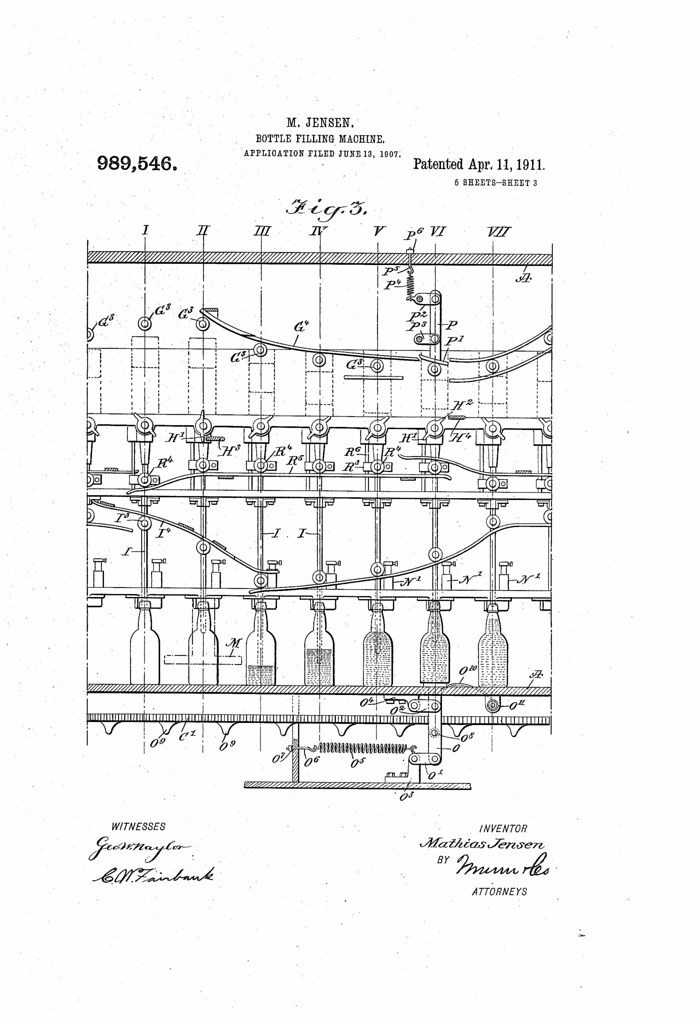
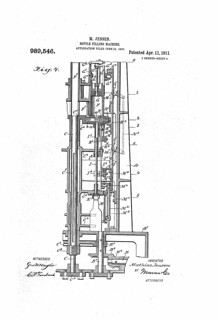
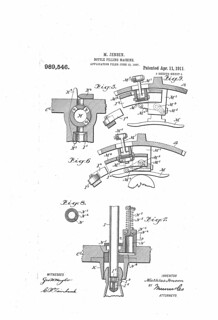
Today in 1911, US Patent 989546 A was issued, an invention of Mathias Jensen, for his “Bottle-Filling Machine.” There’s no Abstract, but there’s this description. “invented a new and Improved Bottle-Filling Machine, of which the following is a full, clear, and exact description.”

This invention relates to certain improvements in machines for filling bottles, cans, or other containers with liquid or semi-liquid` substances, and more particularly to that type of machine in which a series of empty containers are continuously delivered to the machine, automatically filled in succession, and continuously delivered thereof. In a filling machine embodying all of the various features of my invention, the containers are conveyed along an endless belt to the machine and the latter operates to remove them from the belt, fill them in succession, and return them to the belt. The machine is so constructed that after filling each bottle, the liquid is removed from the bottle to a predetermined level below the mouth thereof, irrespective of slight variations in the height of successive bottles.

US989546-0
US989546-1
US989546-2

US989546-3 US989546-4

Filed Under: Beers, Breweries, Just For Fun, Politics & Law, Related Pleasures Tagged With: Brewing Equipment, History, Law, Patent, Science of Brewing

Patent No. 2503339A: Metallic Beer Barrel

April 11, 2015 By Jay Brooks

patent-logo
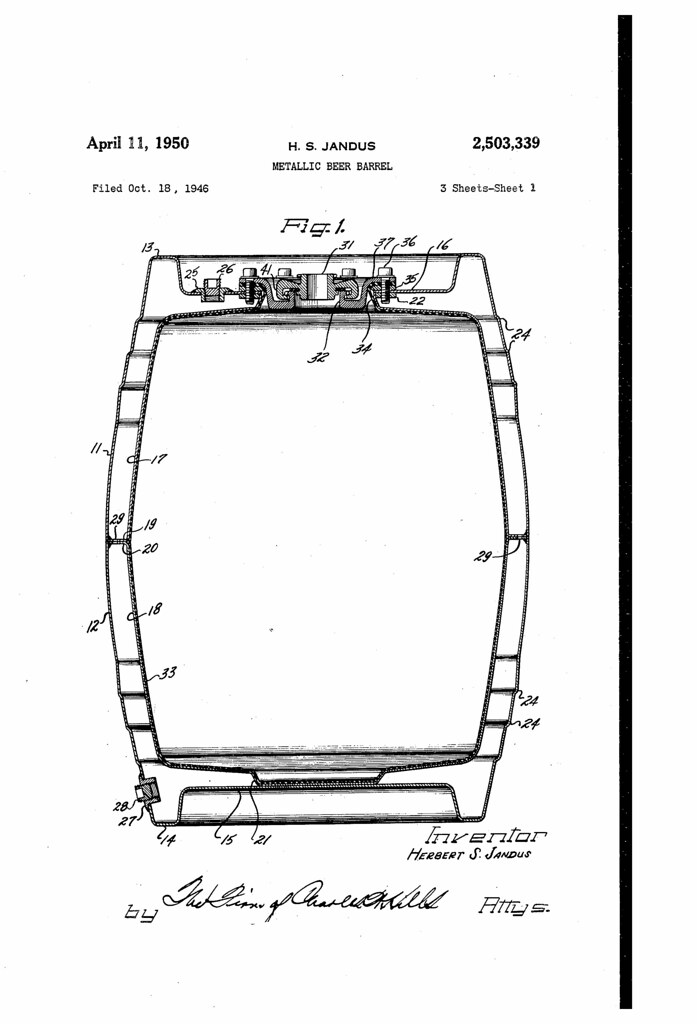
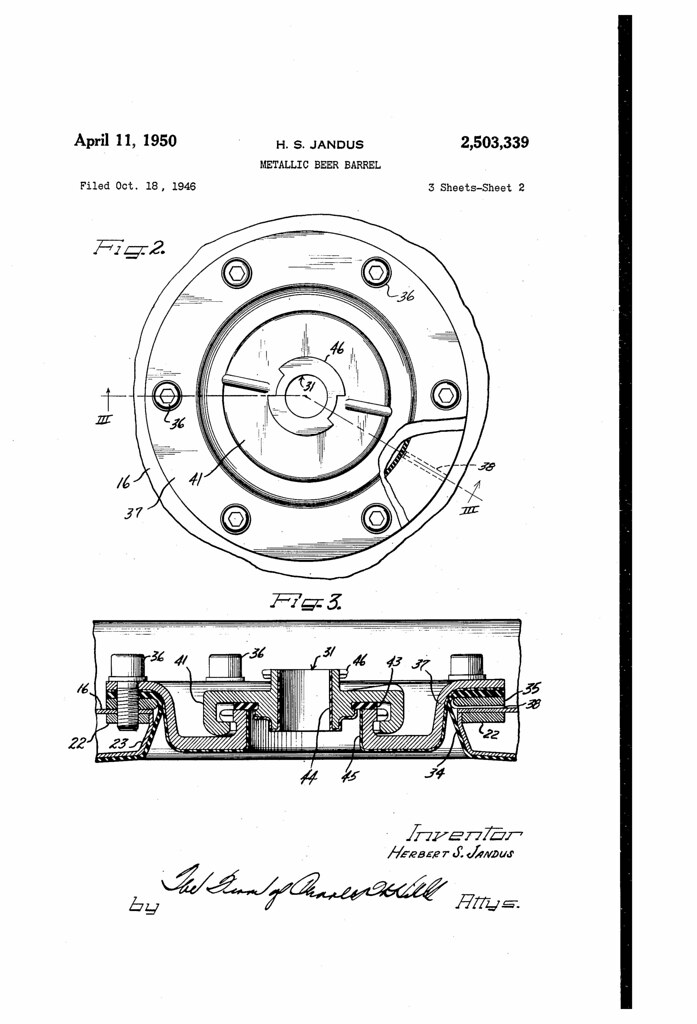
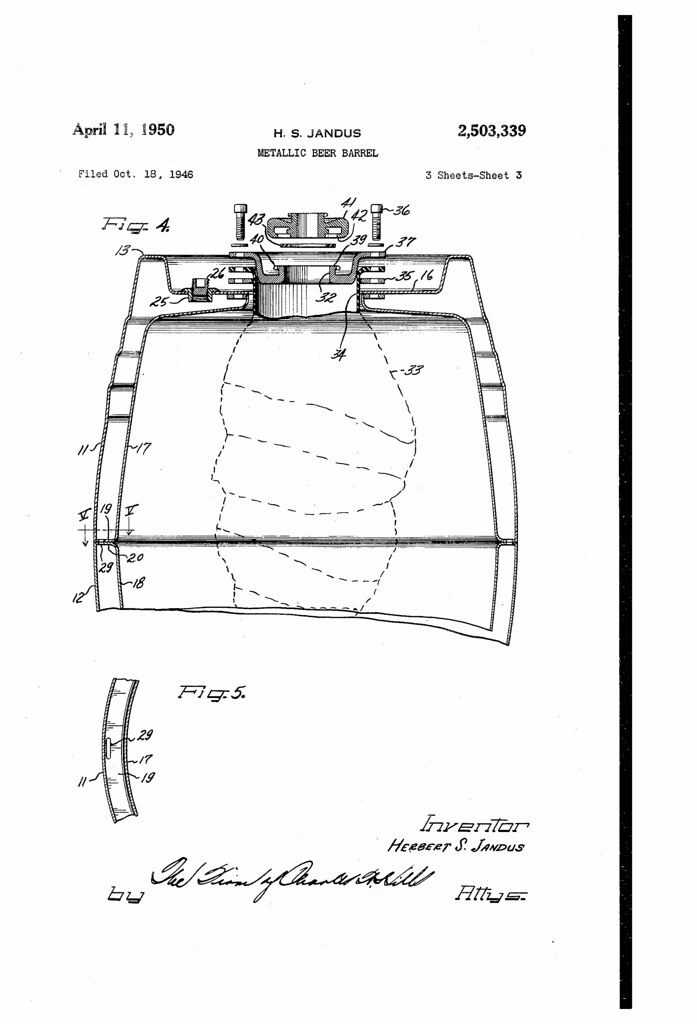
Today in 1950, US Patent 2503339 A was issued, an invention of Herbert S. Jandus, for his “Metallic Beer Barrel.” There’s no Abstract, but there’s this description. “This invention relates to double walled containers and more particularly to double walled beer barrels made from sheet metal stampings and provided with a removable or permanent liner made of a material suitable as a container for beer,” and then a few more specific reasons for the metal keg design.

By constructing such a barrel with double walls, a number of advantages are gained thereby. A sturdy construction of sufficient rigidity to withstand the hard usage to which these barrels are ordinarily subjected can be formed of relatively thin sheet material by’ stamping methods, portions of the total structure being made in sections which are subsequently secured together, and yet the total weight can be kept within satisfactory limits. To accompany the advantage of using sheet metal suitable for stamping, provision is made for the lining of the inner shell so that the metal itself need not be one that is especially adapted because of its inertness for the reception of beer or other edible Products.

A double walled construction is readily adapted for the provisions of an opening into the interior shell, larger than the usual filling opening or tap rod opening such as are usually provided in wooden barrels, for example. Such an enlarged opening can be used to facilitate the cleaning and the inspection of the barrel, and may also be used for the insertion and removal of a separate removable liner.

US2503339-0
US2503339-1
US2503339-2

Filed Under: Beers, Just For Fun, Politics & Law, Related Pleasures Tagged With: History, Kegs, Law, Patent

Beer In Ads #1521: Alpen Brau Bottled Beer

April 10, 2015 By Jay Brooks


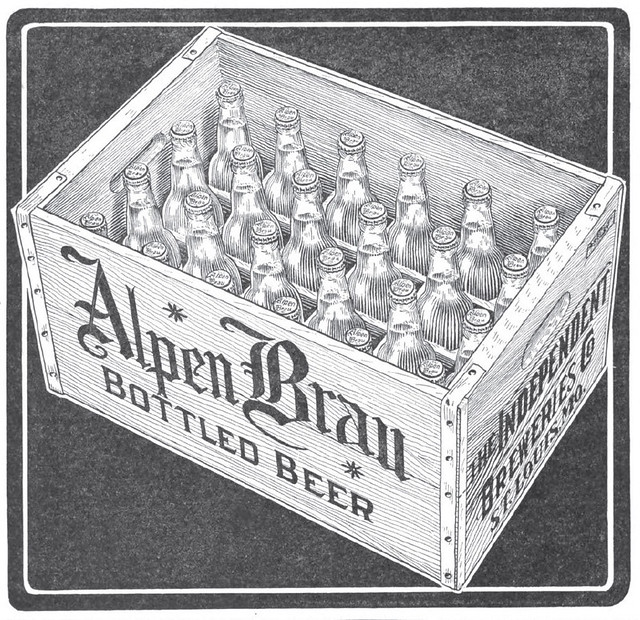
Friday’s ad is for Alpen Brau Bottled Beer, brewed by the Independent Breweries Co. of St. Louis, from 1916. A simple, but cool illustration.

Alpen-Brau-1916

Filed Under: Art & Beer, Beers Tagged With: Advertising, History

Patent No. 2373294A: Beer Dispensing Device

April 10, 2015 By Jay Brooks

patent-logo
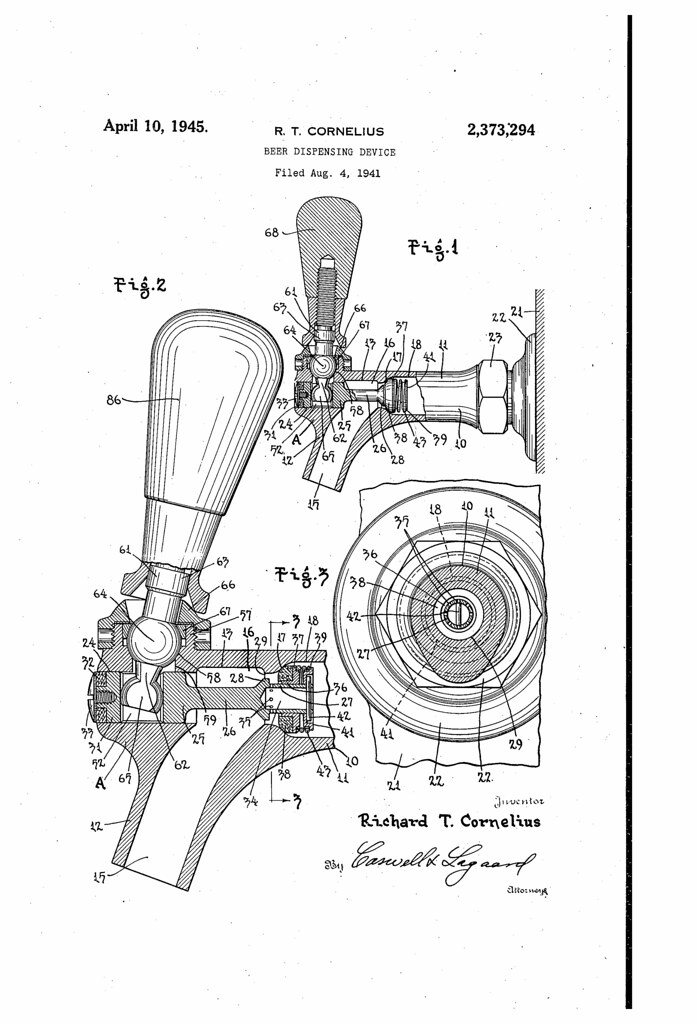
Today in 1945, US Patent 2373294 A was issued, an invention of Richard T. Cornelius, for his “Beer Dispensing Device.” There’s no Abstract for his tapping device, and it’s almost impossible to find a simple description because the OCR did such a bad job reading the application.

US2373294-0

Filed Under: Beers, Just For Fun, Politics & Law, Related Pleasures Tagged With: History, Kegs, Law, Patent

The California Drought: Almonds, Water (And Beer)

April 10, 2015 By Jay Brooks

almonds
You probably noticed that California is living under severe drought conditions, especially since governor Jerry Brown recently imposed restrictions on our water use. One of the frequent industries to bear the brunt of blame is, of course, agriculture, which uses a lot of water to feed the country. But more specifically, a lot of blame has come down on almonds with stories in the Chronicle, the Guardian and even Slate declaring 10 Percent of California’s Water Goes to Almond Farming, among many others. I haven’t paid too much attention to that, mostly for the selfish reason that I’m not much of a fan of almonds, and couldn’t care less if they stopped growing them.

Gizmodo has an interesting article suggesting that all that stuff about almonds was hooey entitled Seriously, Stop Demonizing Almonds. In a persuasive piece, it’s revealed that “Almonds might take 10 percent of the state’s water, but as the same report notes, they’re generating about 15 percent of the state’s total farming value and almost 25 percent of the agricultural exports from the state.” Of course, I’m no expert on these things, but I encourage you to read it and decide for yourself.

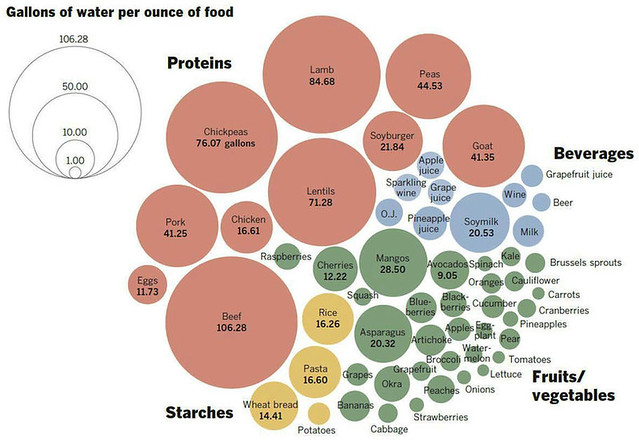
But I actually bring this up for wholly non-almond related reasons. Something in the article caught my attention, which is the chart below. It’s an infographic which originally was published in the L.A. Times, which the Gizmodo author, Alissa Walker, characterizes as a “very misguided infographic of “water-hungry foods.” The title indicates it shows the relative amount of water used to make the finished product, “Gallons of water per ounce of food.”

gallons-water-per-oz-food

But look where beer is on the chart. Beverages are in blue. Soymilk looks like it uses the most, but apparently there was an error that’s now been corrected, and it’s actually pineapple juice that’s the biggest water hog, using 6.36 gallons per ounce of juice. Compared to all the drinks listed, beer looks to be the most efficient, and the interactive portions of the chart on the L.A. Times website indicates that beer uses 1.96 gallons to produce one ounce of beer. But even that seems high.

A bunch of years ago I wrote a feature article for All About Beer entitled It Ain’t Easy Bein’ Green: The Greening of America’s Breweries, that examined the steps breweries were taking to lighten their burden on the planet, not just with water, but all sorts of things. One thing I learned was that brewing used roughly a 10-to-1 ratio of water, meaning they use 10 gallons for every gallon of beer. At that time, I also found. “Examining smart ways to conserve water, several breweries have reduced that ratio to four or five-to-one and Uinta Brewery from Utah has gotten it down to 3-to-1.” More recently, the Brewers Association’s Water and Wastewater: Treatment/Volume Reduction Manual claims that the average is now more like 7-to-1 gallons, with a few breweries actually below 3-to-1. Two years ago, Environmental Leader reported that MillerCoors managed to get their ratio of water use down to “3.82 barrels of water per barrel of beer.”

But even staying with a ratio of 10-to-1 for ease of math, this seems egregiously high. Converting the L.A. Times figure of 1.96 gallons to 1 ounce figure to ounces, it becomes 250.88 ounces of water per ounce of beer, or a 251-to-1 ratio, or 25 times reality, and undoubtedly more.

So where did this figure come from? All the Times reveals about its methodology is this. “Totals were converted to U.S. gallons per ounce (weight). Beverage values were additionally converted into fluid ounces using the USDA National Nutrient Database for Standard Reference.” But that doesn’t really tell us where they got the numbers they’re basing this on. It doesn’t really tell us anything. But one thing seems clear, breweries are relatively efficient in their water use, much more so than is being reported during the California drought. And that brings us back to a statement U.S. Davis professor Charlie Bamforth recently made, which seems even more relevant in light of this. “When in drought, drink more beer.”

Filed Under: Beers, Editorial, News, Politics & Law, Related Pleasures Tagged With: California, Food, Water

Patent No. 4915959A: Decarboxylation Of Acetolactate To Diacetyl, Enzymatic Reduction To Acetoin

April 10, 2015 By Jay Brooks

patent-logo
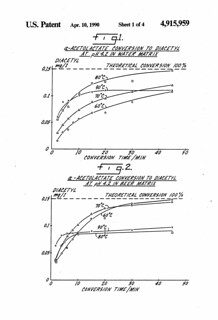
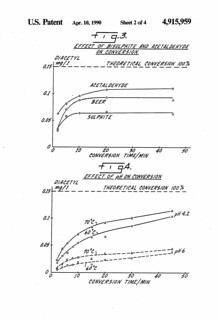
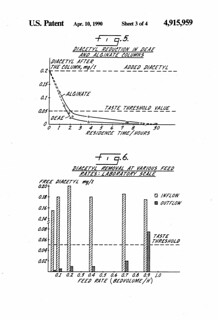
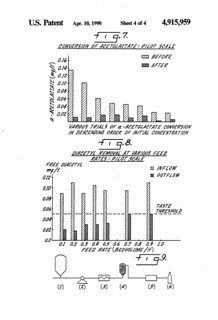
Today in 1990, US Patent 4915959 A was issued, an invention of Esko Pajunen, Veijo Makinen, Heikki O. Lommi, and Markku S. Loisa, for their “Method for the Continuous Maturation of Fermented Beer” or the “Decarboxylation of Acetolactate to Diacetyl, Enzymatic Reduction to Acetoin.” Here’s the Abstract:

Beer is fermented by the use of yeast and after fermentation the yeast is removed and the maturation or lagering of the beer is accomplished by a continuous maturation process which involves heat treating the beer to convert all or substantially all the alpha acetolactate and other diacetyl precursors present to diacetyl, cooling the beer, and feeding the heat treated fermented beer through a reaction column packed with immobilized yeast cells at a flow rate which effects the conversion of said diacetyl to acetoin in order to lower the concentration of said diacetyl to levels which do not result in tastes normally considered unacceptable for a beer.

US4915959-1 US4915959-2

US4915959-3 US4915959-4

Filed Under: Beers, Breweries, Just For Fun, Politics & Law, Related Pleasures Tagged With: History, Law, Patent, Science of Brewing

Let’s Grab A Beer

April 10, 2015 By Jay Brooks

lets-grab-a-beer
Show of hands: who remembers “Here’s to Beer,” the somewhat lackluster attempt by Anheuser-Busch to teach consumers more about beer eight years ago? No? Let me refresh your memory. The original idea in 2005 was to have all of the major breweries work together to promote beer as an industry, rather than promote any one brand, sort of like the Beer Belongs campaign by a brewers trade group in the late 1940s and 1950s. Unfortunately, trust was not strong among the competing larger breweries and none signed on, fearing A-B would run the show and control the message for their own benefit. So A-B decided to go it alone, and launched a consumer website in 2006 called Here’s to Beer. If you click on the link, it still works, but it’s not that first attempt anymore. Before it launched there were press releases and media talking about it, including me in Here’s To Beer — Here’s to Making it Appear Relevant and Appealing. A few days later the website went live and I did an initial review of it, which was not overwhelmingly positive. A year later I started questioning if Here’s to Beer was dead with R.I.P. Here’s to Beer? But it turned out that the reports of its demise had been premature, and a month later Phase 2 launched with an updated website. That website, which used to be “herestobeer.com” changed to “htbeerconnoisseur.com” and that’s the one that is still online, although it doesn’t appear to have been updated in quite some time, if ever. The copyright information at the bottom of the home page is dated 2009, and attributed to “Here’s to Beer, Inc.” which you won’t be surprised to learn is located at 1 Busch Place, Saint Louis,” the headquarters for Anheuser-Busch InBev. So Phase 2 was about as successful as the first attempt, and quietly faded away.

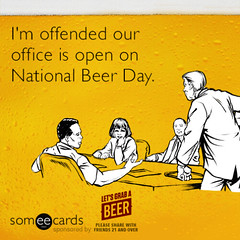
So this past Tuesday, on “National Beer Day,” you may have seen some of these graphics making the rounds on Twitter, Facebook and other social media. I know I retweeted a couple of them.

lgab-offended lgab-national-day

It turns out they’re part of a new effort by ABI, this time called “Leg’s Grab a Beer.” Apparently Beer Marketer’s Insights first reported on it, but I saw it on AdAge, in an article entitled Let’s Grab a Beer… With A-B InBev: Brewer Tries Unbranded Beer Image Campaign. The idea, this time around, according to Julia Mize, ABI VP of Beer Category + Community, is wanting “consumers to understand all the different varieties that are available with beer for different occasions.” Which is much more possible now that they acquired several more smaller breweries outright.

But her subsequent statement is really hilarious: “[W]e wanted to do it in a non-branded way so that we make sure we are connecting with the consumers and it’s not forced. It’s not marketing. Our intention here is to just have a resource that is relevant and fun and celebrates beer.” That reminds me of something Bill Hicks said about marketing, “they’re going for the anti-marketing dollar.” Essentially they’re marketing by not marketing, a tactic more prevalent in our more media-savvy present. And while I’m certainly not against a little education, this seems more like a Tumblr than any real effort at that. The plan apparently is for the “site [to] include a combination of original and aggregated content, ranging from ‘deep reads about the past, present and future of beer’ to colorful charts and graphics,” although at least for now there’s a lot more of the latter. Some of the “deep reads” include such titles as “7 Beer GIFs that Will Make Your Mouth Water” and a photograph of “Women demonstrating against Prohibition 1932.” It’s not exactly heady stuff they’re tackling so far.

Here’s to Beer, for all its faults, at least tried to educate consumers. This latest attempt seems more intended to entertain, not that there’s anything wrong with that.

The National Beer Day cards were done, apparently, in partnership with Some E-Cards. Sadly, it doesn’t look like you can make your own cards using the beer background. That’s a shame, it would have been fun to make some.

There’s definitely some interesting things being shared, but edumacation it ain’t. The other problem I see is something that seems to happen frequently to these sorts of efforts. There was a flurry of posts to the Let’s Grab a Beer Tumblr (might as well call it what it is) but then nothing new since Tuesday, three days ago. That’s a long time for a tumblr to not be updated. I have several, and make an effort to post something at least once a day, while many others post new content far more often than that. But Here’s to Beer suffered from the same problem: infrequent updates gave little reason to return to the site with any frequency. If you can absorb everything there in a few minutes and then there’s nothing new posted, why would anyone become a regular visitor?

Web

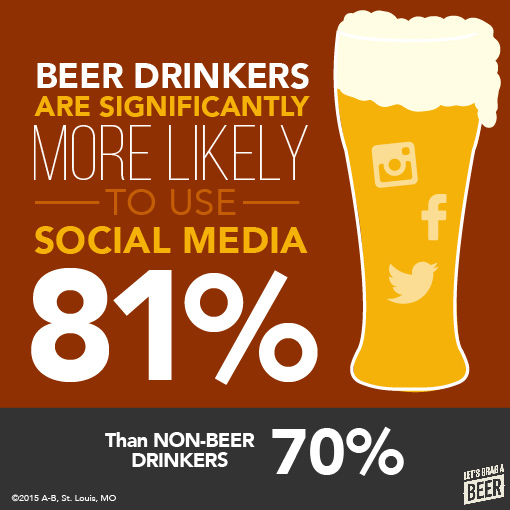
It’s somewhat obvious why they’re doing this, as one of their own posts makes clear. So if beer drinkers are using social media more often, why wouldn’t they realize you have to keep up with the pace of that social media? If they really want something like this to work, they need at least a dedicated person working on this 24/7. That’s what makes a successful Tumblr.

Midway through the AdAge article, the author suggests it’s branding at the heart of this move.

But there is also an inherent fear in industry circles about the so-called “wineification” [how I hate that word!] of beer. This refers to placing emphasis on beer styles, versus brands. For instance, if more people walk into bars and ask for a “wheat beer,” rather than a Shock Top or Blue Moon, brands become less valuable. And good branding equals profits.

“They are facing the ultimate challenge here of trying to promote a category that really lives through its brands,” said one industry executive, speaking on the condition of anonymity. “So how do you celebrate beer without making it a commodity? The value of the industry is in the equity of the brands.”

I have to take issue with her definition of “wineification,” saying it means “placing emphasis on beer styles, versus brands.” I don’t think that’s it at all. Nobody walks into a wine bar and says “give me a Chardonnay” or “oh, anything red will be fine.” The term generally has been used to suggest that beer is trying to be fancy, or be marketed more like wine, and is usually used derisively (at least by me). I think people do look to drink a particular type of beer they’re in the mood for or for some other reason just want at a particular time, but it’s been a long time (at least a decade or more, I’d guess) since most people would sit down at a bar and ask the bartender for whatever “pale ale,” or perhaps more popularly an “IPA, they have on tap. Brands still matter a great deal, as the spate of recent high profile trademark disputes among brewers should make abundantly clear to anyone paying attention.

But the rest is an interesting insight. Branding is how all of the big brewers made their fortunes, especially when most beer tasted about the same. In effect, all beer was commodified for a long time, which is why advertising, marketing and branding became so important for the success of the big beer companies. It was no accident that year after year, A-B outspent their competition in ad dollars per barrel by a wide margin. I haven’t seen those figures since InBev took control of A-B, but certainly that was the case up until that transition.

Now that smaller breweries have essentially uncommodified beer by offering a wide range of beers that don’t all resemble or taste like one another, big brewers are left asking themselves what to do now. “So how do you celebrate beer without making it a commodity? The value of the industry is in the equity of the brands.” In some ways that, anonymous executive is still engaging in old beer thinking, using the framework of how the industry used to be constituted. One could argue it still is since 90% of beer is of that single, commodified type — American lager — but it’s nowhere near as universal as when I was a kid. And I think even small beer’s 10% slice of the total beer pie is enough to have at least changed many, if not most, people’s perception of it, even if they choose to still buy the big brewer’s beers. Even the loyal customers still buying the bland American beers know about Yuengling, or Samuel Adams, or Sierra Nevada, or New Belgium, or Lagunitas. What the big brewers bought with decades of blanket advertising was not just blind loyalty, but habit. And habits are harder to shake, because they’re no longer conscious decisions.

So I’m unequivocally in favor of beer education for everyone. We’ve known since the beginning of flavorful beer’s rise that education was the path to winning over more beer drinkers. In order to appreciate it, you have to know something about it. That may not be necessary to simply drink it and enjoy it, but to appreciate what you’re tasting, you do have to know a little more.

I think music once again provides a useful analogy. You don’t need to know anything about music theory or composition to love the Allegro con brio first movement to Beethoven’s 5th symphony in C minor, or Gershwin’s Rhapsody in Blue. But if you do, the experience is much richer because you understand what they were doing differently than their predecessors and how they were expressing musical ideas. The history of music is all about rules, and breaking them. Baroque music was very orderly and followed strict rules for its composition, then innovative composers broke those rules and created the classical music period, which in turn had its rules broken by romantic composers, and so on. Each time there was push back from the status quo before the new music became the next established form.

I think we’re seeing something similar with beer, too, as traditional rules have been broken, but are often respected, too. Innovation is simply trying something a little different or even going back to something that hasn’t been done for a long time, or mixing the two, or doing something old in a new way. It doesn’t have to mean something particularly snooty or high falootin’ as we so often seem to think. It’s just how change occurs. It’s trying to find something you can call your own that a brewery can sell and make their reputation. Few breweries, if any, will do that making the same thing as everybody else is. That’s how we got in the mess we were in by 1980 in the first place. So we should expect breweries to try something new, with 3,000 of them they almost have to experiment to find a niche, or their place in the market. Some will undoubtedly work better than others, and some will ultimately fail while others succeed. That’s the natural order of things. That’s healthy competition, with breweries competing on taste or what people are willing to support and buy.

I think I’ve veered off quite a bit from where I started with this, rambling on about some unrelated ideas, but the takeaway is that education matters — “Just Say Know™” is my catchphrase — but this may not be the best way to engage more people to learn about beer. Still, I’m up for whatever. Let’s grab a beer.

Filed Under: Beers, Breweries, Editorial, Related Pleasures Tagged With: Advertising, Anheuser-Busch InBev, Big Brewers, Business, Education, Marketing, Websites

« Previous Page
Next Page »

Find Something

Northern California Breweries

Please consider purchasing my latest book, California Breweries North, available from Amazon, or ask for it at your local bookstore.

Recent Comments

  • Bob Paolino on Beer Birthday: Grant Johnston
  • Gambrinus on Historic Beer Birthday: A.J. Houghton
  • Ernie Dewing on Historic Beer Birthday: Charles William Bergner 
  • Steve 'Pudgy' De Rose on Historic Beer Birthday: Jacob Schmidt
  • Jay Brooks on Beer Birthday: Bill Owens

Recent Posts

  • Beer In Ads #5203: Now’s The Time To Say … Blitz Weinhard Bock For Me! April 3, 2026
  • Beer Birthday: Dave Bonighton April 3, 2026
  • Historic Beer Birthday: Frederick Hinckel Jr. April 3, 2026
  • Beer In Ads #5202: The Bock Beer Time Is Near, And It Comes But Once A Year April 3, 2026
  • Historic Beer Birthday: Henry Pierre Heineken April 3, 2026

BBB Archives

Feedback

Head Quarter
This site is hosted and maintained by H25Q.dev. Any questions or comments for the webmaster can be directed here.