Brookston Beer Bulletin

Jay R. Brooks on Beer

  • Home
  • About
  • Editorial
  • Birthdays
  • Art & Beer

Socialize

  • Dribbble
  • Email
  • Facebook
  • Flickr
  • GitHub
  • Instagram
  • LinkedIn
  • Pinterest
  • RSS
  • Twitter
  • YouTube

Powered by Genesis

Patent No. 2372854A: Yeast

April 3, 2015 By Jay Brooks

patent-logo
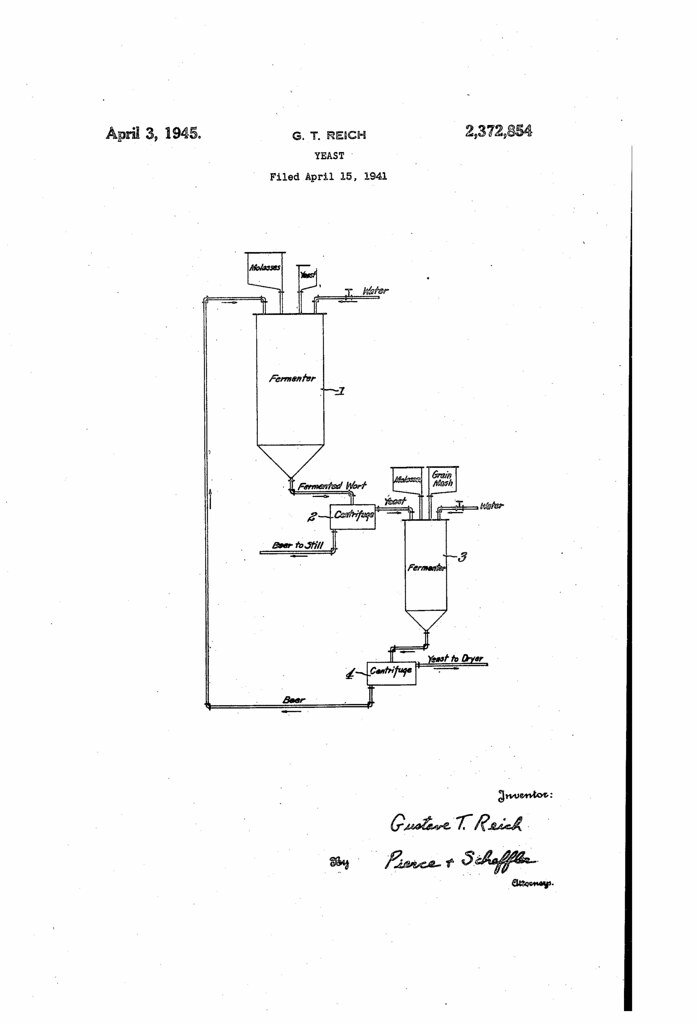
Today in 1945, US Patent 2372854 A was issued, an invention of Gustave T. Reich, for his “Yeast.” There’s no Abstract, but the descriptions states that the “invention relates to yeast and its production and it is particularly directed to a method of improving the quality of yeast obtained in the alcoholic fermentation of saccharine materials, particularly sugar rellnery materials such as black-strap molasses. It also claims to improve yeast production in twelve different ways, and then lists each way, if you’re curious.
US2372854-0

Filed Under: Beers, Just For Fun, Politics & Law, Related Pleasures Tagged With: History, Law, Patent, Yeast

Parenting Lessons From The Prohibitionists

April 3, 2015 By Jay Brooks

parents
I’m always amazed about how people feel there’s nothing with wrong with telling me how to live, what to believe or how to raise my children. Advice is fine, even if it’s often unbidden, but so much of our culture revolves around believing we know what’s best for everybody else. And even that would be just fine if people smugly thought they were better than other people (not that there aren’t of plenty of people who do fit that description) if they didn’t take the next step of trying to force their point of view on the rest of us.

Parenting is certainly not the only place this phenomenon manifests itself, but it is one of the most pervasive. I recently saw a story that illustrates this perfectly. A suburban couple let their two kids (I think ages 7 and 9) walk their neighborhood alone as long as they stayed together. The parents also taught them to hold hands when crossing the street and other sensible safety tips. But authorities saw them walking down a street, picked them up (frightening them in the process), and charged the parents with child endangerment, citing some forgotten law about kids having to be supervised at all times. I can’t tell you how often I was out of my parents watchful gaze as a kid, but it was a lot. And not just me, but literally every kid I knew. I know “times have changed” and all that but have we really become a police state? There was a similar story about a kid in New York City whose mother was teaching her to take the subway by herself, and the police tried to arrest her, too. This is getting seriously out of hand. We may as well just lock up this generation and not let them out of their prisons (homes, I mean homes) until they turn 18 (or 21 lest they discover the illicit pleasure of alcohol while off fighting our next war to protect our way of life).

But what will such a sheltered generation do, having faced no dangers, no frightening situations where there was no parent to swoop in and save the day? They’ll probably fall apart, that’s what. Raising a child is teaching them how to be on their own, to become self-reliant adults. How can we possibly do that by never allowing them to ever be unsupervised? How can we teach them to trust anyone if we never trust them to be on their own? It’s baffling that we’re doing this to our children. I’m not saying ship them off to the inner city to fend for themselves, but slowly, little by little, teach them to be responsible for themselves. Give them small tasks to complete, unsupervised jobs where we let them figure out how to accomplish a goal or even let them fail once in awhile. It’s how we learn. A speaker at my class Wednesday night was reminding my students that not only should you not worry about failing once in a while in your business, but if you don’t, you’ll never learn anything. He remarked that you only learn from your mistakes, taking very little from your victories. So as parents, if we never let our kids learn how to compete, let them fail or put them in situations that test them, they’ll never become full-fledged individuals capable of surviving in the wild. Is that why so many kids are still living at home with their parents after they’re adults? I’m sure it’s not the only reason, but it seems like it has to be a factor. Helicopter parenting has to be part of the answer.

But regardless of how any of us decide we want to raise our children, why do we feel that however we do it is the right way, often the only way, and proceed to do whatever we can to shame anyone with a different idea. I confess, I’m guilty of this, too, from time to time. Every time I’m in a movie theatre with kids who’ve never been taught to shut up, I’m guilty of wanting to shout at their parents, who blissfully keep answering their inane questions — still using their outside voice — with nary a care for the rest of the audience. That’s maddening, to me, especially since it wasn’t that difficult to teach our own kids to be quiet watching a film. But on the larger questions, why do so many people think they should be able to push their ideals on everyone else?

Nowhere is this more in the open as when it comes to alcohol. The very idea that we lowered the drinking age from the nearly worldwide standard of 18 to 21, while still allowing our 18-20 years olds to fight and die for us, is indicative of the “we know better than you” school of parenting. The latest example of this to get me fired up is a link sent to me by Brian Yaeger, who’s recently moved back to Portland from Amsterdam. (Thanks, Brian. I’ll get you for this!) The link he sent me was from a CNN article, Kids allowed sips of alcohol are more likely to drink in high school, study says. WebMD also tackled the same underlying study with Letting Kids Sip Alcohol May ‘Send Wrong Message’.

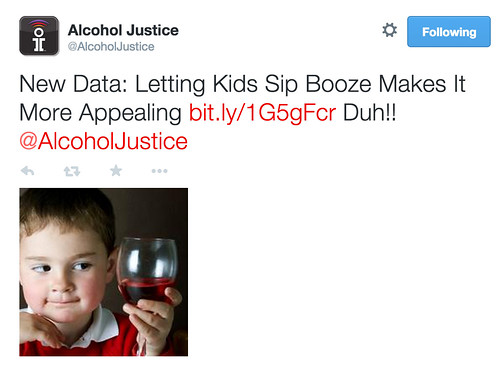
Alcohol Justice’s reaction was swift and predictable.

AJ-tweet-15-04-01

New Data: Letting Kids Sip Booze Makes It More Appealing http://bit.ly/1G5gFcr Duh!! @AlcoholJustice

Their tweet linked to the WebMD’s take, which is how I subsequently saw that one. I love that they still haven’t quite figured out this Twitter thing, even though they tweet something like two dozen times a a day, often sending the same tweets over and over again for weeks on end. But copying your own Twitter handle in your own message, in effect letting yourself know about the tweet you just sent? What’s that all about? What did they think they were doing? But I’m also happy to see the kid holding a glass of wine, it’s more often beer that they’re overtly targeting.

But I especially find the single word “Duh!!!” to be telling. It’s basically an insulting “fuck you” to most of the rest of the world, whose culture and long-standing traditions see nothing wrong with a world in which children are exposed to alcohol in the home as an ordinary part of life. It’s only in recent years that Belgian schools stopped serving table beer to students. Watered-down wine on the table in Italy or France is just part of a normal Friday. But we know better, and we’re happy to tell not just you, but the rest of the world how to live, too.

All the fuss is over a “new” study entitled The Prospective Association Between Sipping Alcohol by the Sixth Grade and Later Substance Use in the Journal of Studies on Alcohol and Drugs. Uncharacteristically, the full text is available online.

As you can see from the headlines, parents beware. You better not be giving your kids a sip of alcohol, or you’ll be setting them down the path to ruin. The study apparently shows “that children who had sipped alcohol by the sixth grade were about five times more likely to have a full drink by the time they were in high school and four times more likely to binge drink or get drunk.” Uh oh. CNN reports:

The study involved surveys of 561 middle school students in Rhode Island over a three-year period. A little under a third of the students said they had sipped alcohol by the start of middle school, with most of those saying they got the alcohol from their parents at a party or on a special occasion.

Even when factoring out issues that could encourage problem drinking down the road, such as how much their parents drink, a history of alcoholism in their family or having a risk-taking personality, the children who sipped were more likely to be drinking in high school, said [Kristina] Jackson[, one of the co-authors of the study].

Twenty-six percent of the kids who had sipped alcohol said they had a full drink by the ninth grade versus under 6% for the kids who never sipped alcohol, the survey found. Nine percent said they had binged on alcohol (had five or more drinks at one time) or gotten drunk versus under 2% for the non-sippers.

Nothing more scientific than giving kids a survey and then factoring out a host of things that may or may not have any influence on whether or not they’ll drink later in life. They make drinking in high school sound like it’s a Satanic orgy, but it’s a pretty normal rite of passage for most people. If you didn’t have a few drinks at some point during your high school years, there’s probably something wrong with you that this study definitely didn’t factor in.

The WebMD version of the story notes that 3 out of ten students told them “they’d had at least one sip of alcohol” and that “[i]n most cases, those sips were provided by parents, often at parties or special occasions.” And because of that “[b]y ninth grade, 26 percent of those who’d had sips of alcohol at a younger age said they’d had at least one full alcoholic drink, compared with less than 6 percent of those who didn’t get sips of alcohol when younger.” Even with their vague controls, I still don’t see any clear causation. 6% vs. 26% and 9% vs. 2% don’t seem like an earth-shattering differences, with less than 600 people in one geographic area. I can think of dozens of reasons that might account for why this occurs, and the lead researcher even says as much, but of course that doesn’t make it into the headline. Jackson said. “The findings don’t prove that sips of alcohol at an early age are to blame for teen drinking” and “[w]e’re not trying to say whether it’s ‘OK’ or ‘not OK’ for parents to allow this.” So what are you saying, if not just that? Why isn’t the headline that the “findings don’t prove that sips of alcohol at an early age are to blame for teen drinking?”

WebMD continues. “She noted that some parents believe that introducing children to alcohol at home teaches them about responsible drinking and reduces the appeal of alcohol. ‘Our study provides evidence to the contrary,’ Jackson said,” contradicting her previous statement. But this is the problem I talked about a few days ago in Studies Show Studies Don’t Show Much, which made a compelling argument that studies in isolation, out of context and on their own are almost meaningless. This is especially true, because of course there are studies that show just the opposite. For example, a study in the Journal of Adolescent Heath “found that children who drank with their parents were about half as likely to say they had alcohol in the past month and about one third as likely to admit to binge drinking (having five or more drinks in a row) in the previous two weeks.”

But here’s where I think the judgmental parenting advice kicks in, despite her insisting that is not the intention. Jackson states near the end of the article that “giving sips of alcohol to young children may send them a ‘mixed message.'” Sure, but you don’t have any idea of the context of the circumstances sufficient to make that claim, do you? If you assume that a parent just handed their son or daughter a drink, let them sip it, and then walked away, maybe she could make such a claim. But that scenario is pretty hard to imagine. There would undoubtedly be a discussion. There would be context, a talk about what was taking place, questions and answers, learning might even be part of it, which is why drawing conclusions about 561 such events without any context makes it so difficult to say those incidents caused future behavior in such a demonstrative way or were the proximate cause of it.

She finished with this sage bit of wisdom. “At that age, some kids may have difficulty understanding the difference between a sip of wine and having a full beer.” Only if parents let that be the case. Only if no discussion takes place. Only if the parents are complete idiots. Only if she thinks kids are really, really stupid. The most common age for the first sip was 10, with 26% of those surveyed. That’s my daughter’s age. She definitely knows the difference between a sip and a full pint glass. And frankly, I think she could make out the difference between 16 ounces of liquid and a teaspoon’s worth when she was much, much younger than that.

In the discussion section of the “study” the message turns from reporting to advice, and to telling me how I should approach my parenting:

Our findings underscore the importance of advising parents to provide clear, consistent messages about the unacceptability of alcohol consumption for youth. Offering even a sip of alcohol may undermine such messages, particularly among younger children who tend to have more concrete thinking and may be unable to understand the difference between drinking a sip and drinking several drinks. In addition, parents should be encouraged to secure and monitor alcohol in the home, and given our reports of accidental consumption, parents should monitor their own beverages—children may intentionally or, as our data show, inadvertently take a sip. Of note, children who report having been asked by adults in the home to fetch or pour alcohol are shown to have greater odds of sipping alcohol. Messages to parents about keeping their children from sipping alcohol may need to be provided via preventive intervention or community education, particularly because some parents report feeling pressured by other adults to allow their children to have sips of alcohol at social events.

She’s basically telling parents to make sure to keep a wall up separating children from interacting with anything found in the adult world. It’s a frequent position taken by prohibitionists, that children should never see their parents drinking alcohol, should never see alcohol of any kind, whether ads for it or even walking by it in grocery stores, so convinced are they that one peek will alter their behavior and forever corrupt their futures and turn them into alcoholics. You may recall Alcohol Justice’s recent temper tantrum that children could be exposed to as many as four minutes of beer advertising during the four-hour Super Bowl spectacle, and what a disaster that would cause.

It’s hard to not bring up the fact that the study was part of the Center for Alcohol and Addiction Studies at Brown University. Their “mission is to promote the identification, prevention, and effective treatment of alcohol and other drug use problems in our society through research, education, training, and policy advocacy.” So it’s not to find out if there are problems, identify what positives and negatives exist, but they set out with the premise that only problems exist and what can they do about it. That’s what prohibitionists do. That is not science. It’s advocacy. Also, the study was supported by a grant from the National Institute on Alcohol Abuse and Alcoholism, who similarly starts with the premise of alcohol abuse and alcoholism. It’s right there in their title. They owe their existence to Richard Nixon, who “signed the Comprehensive Alcohol Abuse and Alcoholism Prevention, Treatment, and Rehabilitation Act of 1970 on December 31, 1970.” It had been spearheaded by “Senator Harold Hughes, a recovering alcoholic who championed the cause of alcoholism research.” There’s nothing wrong with any of that, but it does show that what they’re interested in studying is not health or any balanced study of alcohol, but are focused on “abuse and alcoholism.” It’s what they’re interested in and are looking for. When you set out to find problems, you’ll find them. It’s in your charter and self-preservation will help you along the way. It’s the same as when prohibitionists claim that any study undertaken by someone with ties to the alcohol industry is tainted or biases their findings. This is exactly the same, but curiously that fact is conveniently ignored when it suits their agenda.

But whether stated or not, the reason for the study seems to be embedded in how it’s being used, by both the media and the researchers who created it, to create another tool to stop people from drinking, starting with the children. Even though the author clearly states that the “findings don’t prove that sips of alcohol at an early age are to blame for teen drinking,” she’s still willing to dole out all sorts of advice on how parents should do their job, even offering this soothing balm lest what you just read started you panicking. “‘I don’t think parents need to feel that their child is doomed, ‘Kristina Jackson, one of the co-authors of the study, said of parents who already let their kids have sips of alcohol.” Whew, that’s a relief. After spending countless hours creating a study and analyzing its results, using headlines that suggest one sip and little Johnny or Susie are destined for the life of an alcoholic, which ultimately found no causation, they’re still talking to the press about how to keep your loved ones from drinking in high school and telling me and every other parent how to raise our children. It’s a little bit insulting.

“I think the most important thing is to make sure that children know when drinking alcohol is acceptable and when it is not,” said Jackson.” That’s her final takeaway at the bottom of the CNN piece. Her advice is I should make sure my kids know when it’s okay to drink and when they shouldn’t, I guess under the assumption that before this I didn’t know that. My house, and everybody else’s apparently, were a free for all, because I didn’t know my ten-year old and my newly minted teenager aren’t supposed to drink alcohol just yet. Thanks for that. I don’t know what I would have done without this study. Because if after all that, “the most important thing” my kids need to know is they’re not allowed to drink, they sure wasted an awful lot of time and money. My kids know that. I’m willing to bet yours do to.

But the very last thing she says is this howler. “One theory is that some of these children are getting a message that drinking is okay, especially when it is offered by the parent,” she said. Hilarious. I’m sorry to be the one to tell her this, because maybe she doesn’t know, but drinking is okay. My kids know drinking is okay. They watch my wife and I drink all the time. They also know that they aren’t allowed to drink themselves until they’re 21. And they can’t drive until they’re 16. And they can’t join the military until they’re 18. They know all these things, and much more. Is that because they’re budding geniuses or my wife and I are amazing parents? Well, I don’t like to brag … but no, it has nothing to do with any of that. Our kids do well in school but are fairly typical, and I see us as similarly run of the mill parents, trying our best to raise ’em up right. I have a personal theory that each of us deeply remember the wounds inflicted upon us by our own parents and everybody’s approach to parenting is a determination to not make the same mistakes that our parents did, because there’s no such thing as a perfect parent. In the process, each of us makes all new mistakes, that our kids in turn will be sure not to do my grandchildren. It’s the cycle of parenting mistakes. I think the most any parent can hope for is do their best, and try to teach their children how to be their own person; a productive, self-reliant member of society. And there’s definitely no one right way to accomplish that. But I sure wish the prohibitionists and so many other self-professed do-gooders would stop telling to me how to be a parent. It really is getting out of hand. I’d like to ask my son Porter to fetch me a beer, but I’m afraid child services might intervene because I’m putting him at risk for becoming a drinking high schooler since seeing a beer, and especially me enjoying it, might give him the idea that drinking a beer is okay.

Filed Under: Beers, Editorial, Politics & Law Tagged With: Anti-Alcohol, Prohibitionists, Science, Statistics

Patent No. 4913680A: Low-Trellis Mobile Hop Picker

April 3, 2015 By Jay Brooks

patent-logo
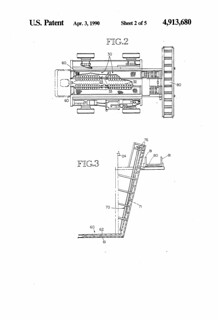
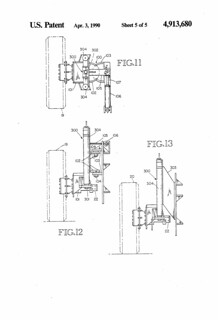
Today in 1990, US Patent 4913680 A was issued, an invention of Donald A. Desmarais, for his “Low-Trellis Mobile Hop Picker.” Here’s the Abstract:

A mobile hop picking machine is provided with independently elevatable wheels. The picker straddles a trellis to position opposing picking cats on either side of the vines. Front and rear banks of picking hooks move upwardly to pick the hops. A bank of resilient raking tines comb the vines upwardly between the picking banks. The picking cats are pivoted about their front edges and are supported for transverse movement on their rear edges. Cylinders urge the rear of the cats toward the vines. A contact member connected to the cat moves the cat transversely, to avoid cat contact with poles, against a biased mounting provided for the hydraulic cylinder. Longitudinal conveyors transport the hops rearwardly and upwardly. A squeeze conveyor floats on a top support over the elevating end of the longitudinal conveyors. An alternate arrangement intersperses the raking tines and picking hooks.

US4913680-1

US4913680-2 US4913680-4

US4913680-3 US4913680-5

Filed Under: Just For Fun, Politics & Law, Related Pleasures Tagged With: History, Hops, Law, Patent

Top 50 Craft Breweries Infographic

April 3, 2015 By Jay Brooks

maps-usa
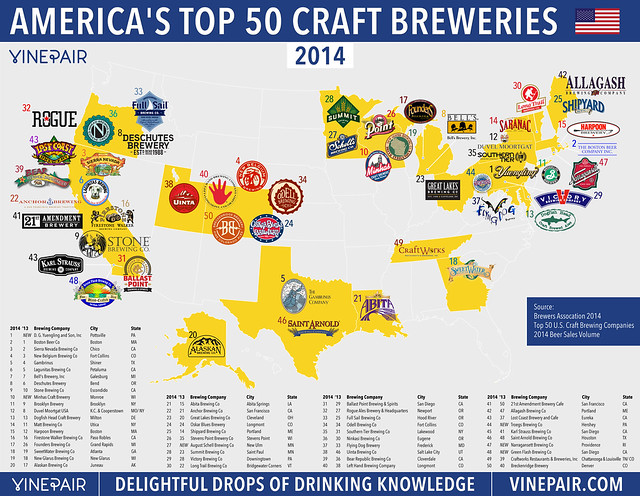
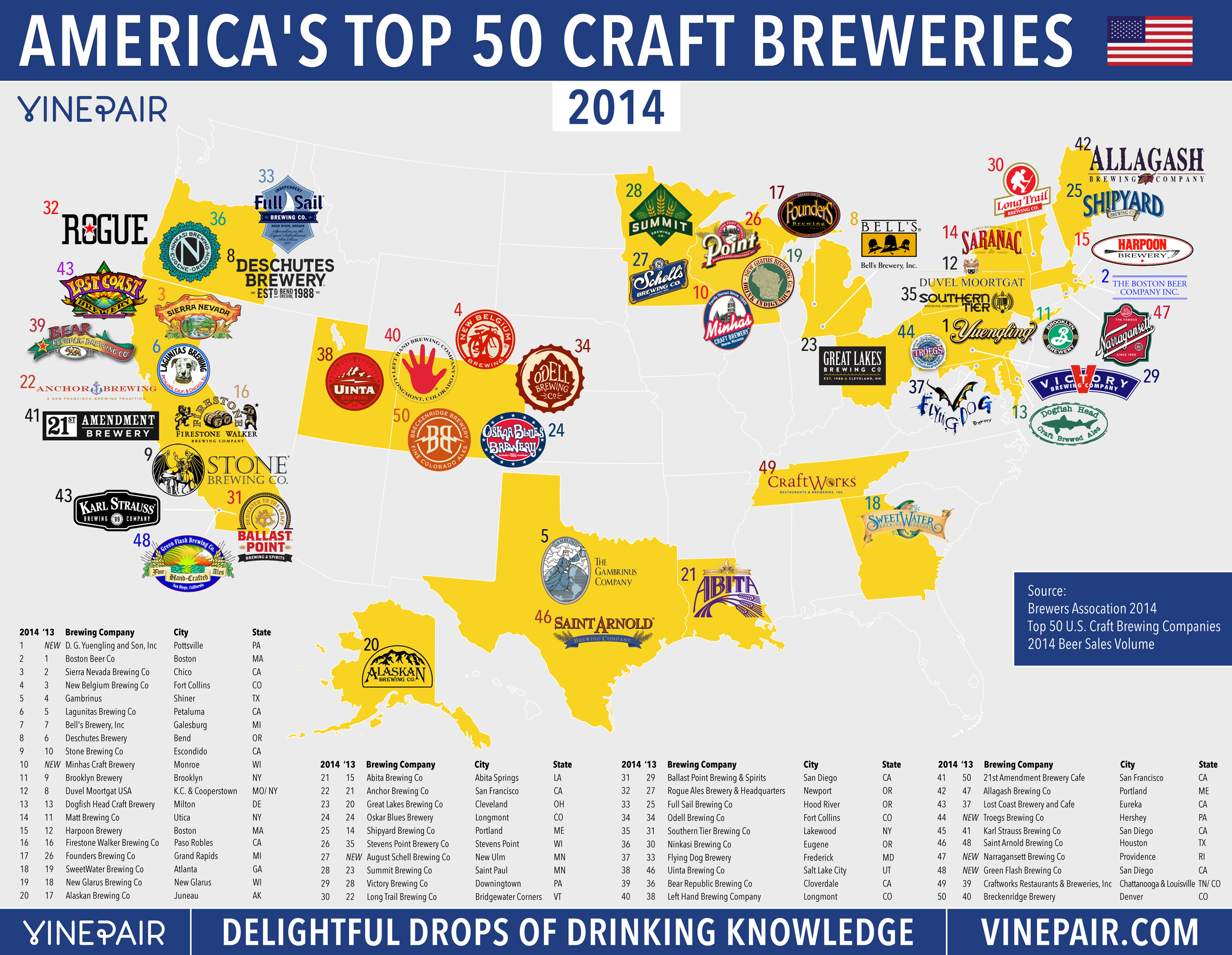
This is pretty cool. Vinepair took the list the BA released on Tuesday, the Top 50 Craft Breweries For 2014, and created an infographic showing where the top fifty are located. It’s interesting to see the pockets where there are only smaller breweries, those ranked 51-3000+. It does appear that the top 50 are concentrated in a few broad areas.

top-50-craft-breweries-2014-us-2500px
Click here to see the infographic full size.

Filed Under: Breweries, Just For Fun, Related Pleasures Tagged With: Brewers Association, Infographics, Statistics, United States

Patent No. 53692A: Improvement In Beer-Faucets

April 3, 2015 By Jay Brooks

patent-logo
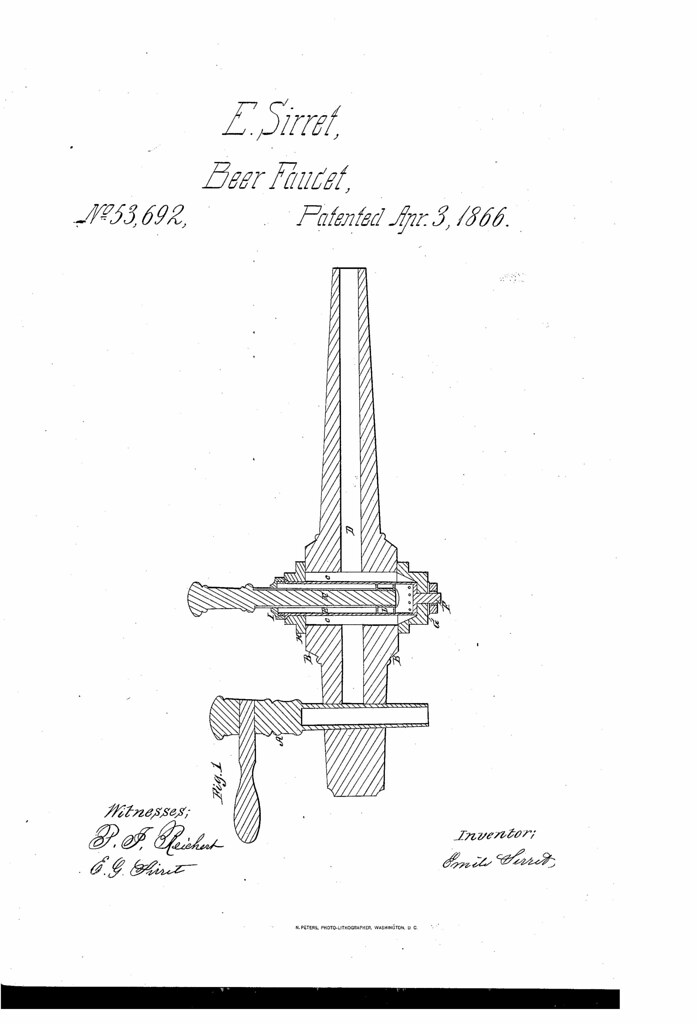
Today in 1866, US Patent 53692 A was issued, an invention of Emile Sirret, for his “Improvement in Beer-Faucets” There’s no Abstract, but he describes his invention as “A device for foaming beer and other liquids artificially previous to their being drawn, so as to be able to cause the foaming of the liquid to any degree desired within a common faucet, and that immediately after, when the pin of the faucet is turned so as to open, the liquid will flow from it in a creamy and gaseous state sufficient to fill two or three glasses without renewing the operation.” More specifically:

The nature of my invention consists in having a hollow room or chamber inside a common faucet, between the cross-pin and the end which taps into the barrel. The hole in the faucet running through this chamber will constantly keep it filled with liquid, so that when it is required the foaming operation can be performed, which is done by placing down in the chamber a kind of syringe with a ring of line holes around the lowest end of the tube, this end being fastened to the bottom of the chamber by means of a screw. Ihe upper end of the tube with the piston-rod extending outside is tightly fastened on the top of the chamber, so as to prevent any escape of liquid. The head of the piston-rod extending out of the tube, and running parallel with the head of the cross-pin, enables the same hand to handle both of them with facility. The up-and-down movement of the piston will naturally force in and out of the tube through the small holes all the liquid contained in the chamber, and convert it into a foaming substance.

US53692-0

Filed Under: Beers, Just For Fun, Politics & Law, Related Pleasures Tagged With: History, Kegs, Law, Patent

Beer In Ads #1513: There’s More

April 2, 2015 By Jay Brooks


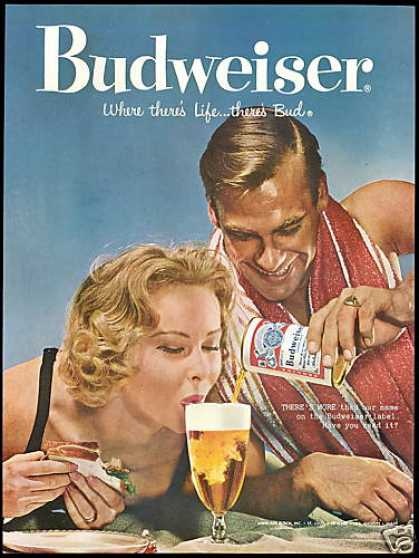
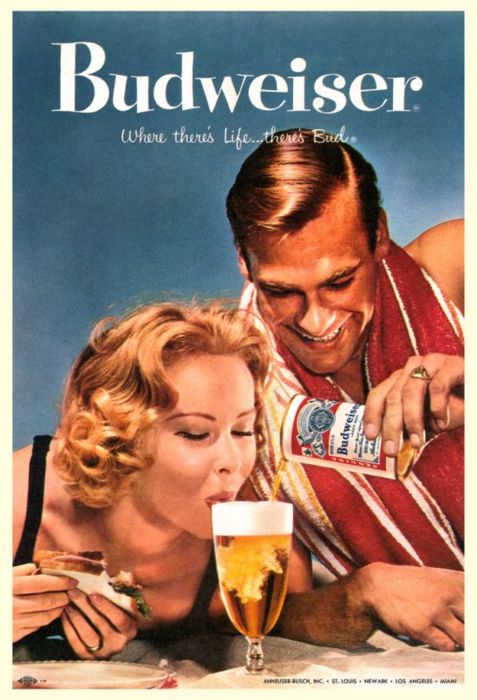
Thursday’s ad is still another one for Budweiser, this one from 1958. It’s another ad from their “Where there’s life” series, this one is called “There’s More.” A couple lying on the beach, with the woman eating a sandwich while the man is pouring a can of beer into her glass, which is already full. She’s trying to keep it from overflowing by sipping on it, but with the smile on his face, it looks like he may be doing it on purpose.

Bud-1958-theres-more

Here’s a slightly larger version of the ad, but without the text.

Bud-1958-beach

Filed Under: Art & Beer, Beers Tagged With: Advertising, Budweiser, History

Patent No. 671321A: Faucet Or Tapping-Bung For Tapping Beer

April 2, 2015 By Jay Brooks

patent-logo
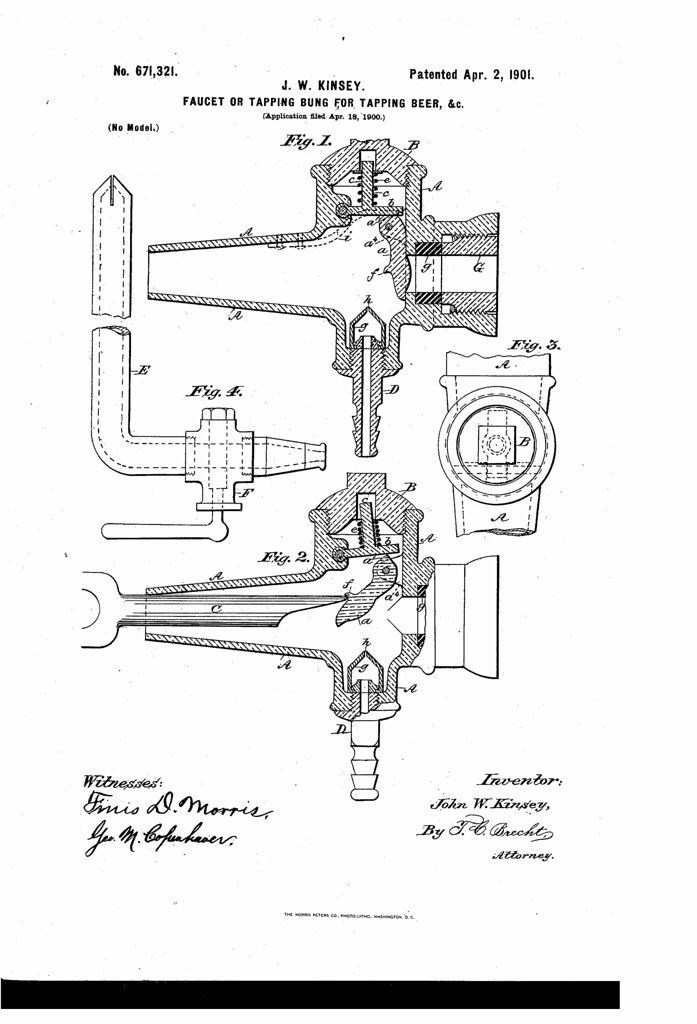
Today in 1901, US Patent 671321 A was issued, an invention of John W. Kinsey, for his “Faucet or Tapping-Bung For Tapping Beer, Etc.” There’s no Abstract, but the description claims that he’s “invented certain new and useful Improvements in Faucets or Tapping- Bungs for Tapping Beer, Ale, Porter, and other Aerated Liquors.” More particularly:

The object of the invention is to produce a faucet or tapping-bung for tapping such kegs containing said aerated liquids in a more convenient and easy manner; also, to produce a hung having an adjustable closing-valve so arranged as to be easy of access and readily operated, thereby dispensing with the use of the cork now required in closing the. end of the faucet or tapping-bung, and which must, after making the tap, be forced down into the keg with the hollow rod through which the beer, ale, &c., is drawn; also, to accomplish this in an easy and expeditious manner-at a small expense, and, finally, to produce the faucet or tapping-bung so that it is not liable to get out of order or that it can be readily repaired if any part shall be broken.

US671321-0

Filed Under: Beers, Just For Fun, Politics & Law, Related Pleasures Tagged With: History, Kegs, Law, Patent

Patent No. 1996550A: Container Opener Or Church Key

April 2, 2015 By Jay Brooks

patent-logo
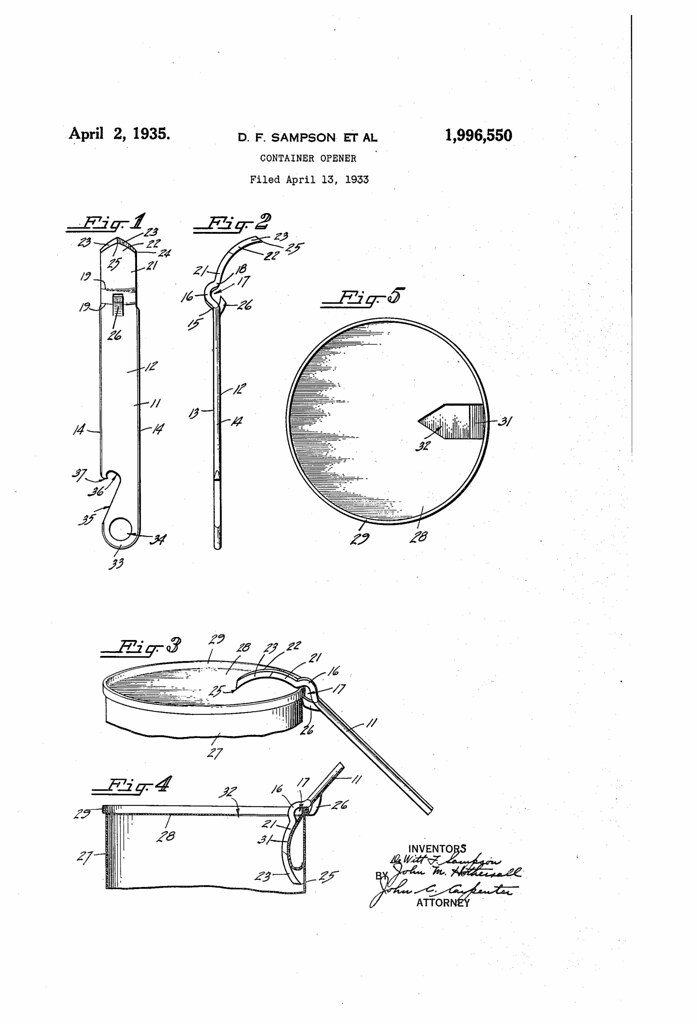
Today in 1935, US Patent 1996550 A was issued, an invention of John M. Hothersall and Dewitt F. Sampson, assigned to American Can Co., for their “Container Opener.” There’s no Abstract, but the description states that the “invention relates in general to container opening devices and more particularly to a punch opener for producing a substantial pouring opening in containers having projecting end scams or joints.” Essentially it’s a church key that includes a bottle opener, as well. Here’s how this church key is special:

The principal object of the invention is to provide a container opener which at one stroke or turning movement produces a substantial pouring opening in a wall of a container through which the contents, be they fluid or granular, may be readily dispensed.

Another important object of the invention is to provide a container opening punch or cutter adapted to work on the lever principle and which employs a projecting end joint of a container, for example, the end seam, as a fulcrum or pivot point about which the cutter may be rocked into opening position in a single arcuate movement.

Another important object of the invention is the provision of such a rocker punch whose operating parts are all adapted to be formed out of a single piece of steel or other suitable material in a few simple die operations, and which, because of its simplicity of construction, can be produced inexpensively and automatically with a view to supplying the public with an efficient opening tool at small cost.

Still another important object of the invention is the provision of such a punch opener which is adapted to produce a substantial and complete pouring opening quickly at one arcuate movement of the opener. While such rapidly and completely created opening is desirable in connection with containers filled with most products, dry or wet, from the standpoint of the time element, it lends itself exceptionally well to and solves a real problem in the opening of containers filled with effervescent liquids such as beer, where a quick and adequate opening will prevent ebullition and spilling of the contents.

US1996550-0

Filed Under: Beers, Just For Fun, Politics & Law, Related Pleasures Tagged With: Cans, History, Law, Patent

Crosby Hop Farms

April 2, 2015 By Jay Brooks

crosby-hops
With the Craft Brewers Conference in Portland just a couple of weeks away, I’ve been receiving numerous e-mails from vendors who will be at the trade show. It happens every year. Some are of no interest whatsoever, while others are fun to see. For example, this morning one came in from Crosby Hop Farms, an Oregon hop grower. They’re doing an open house Wednesday night at the farm, which could be fun. But the e-mail included a link to a video they created about their company. No matter how many times I visit a hop farm, it’s always a spectacular sight.

This is the next best thing to being there. I think I may have to go to this one. You can also see more about the farm at Craft Brewing Business with these two stories: Hip hops: Craft beer’s impact on a growing industry and A Hop Farmer’s Diary: 30 days in the life of Oregon’s Crosby Hop Farm.

Crosby-Craft-brewing

Filed Under: Beers, Events, Just For Fun, Related Pleasures Tagged With: CBC, Hops, Oregon, Video

Patent No. 1996184A: Keg Tapping Seal

April 2, 2015 By Jay Brooks

patent-logo
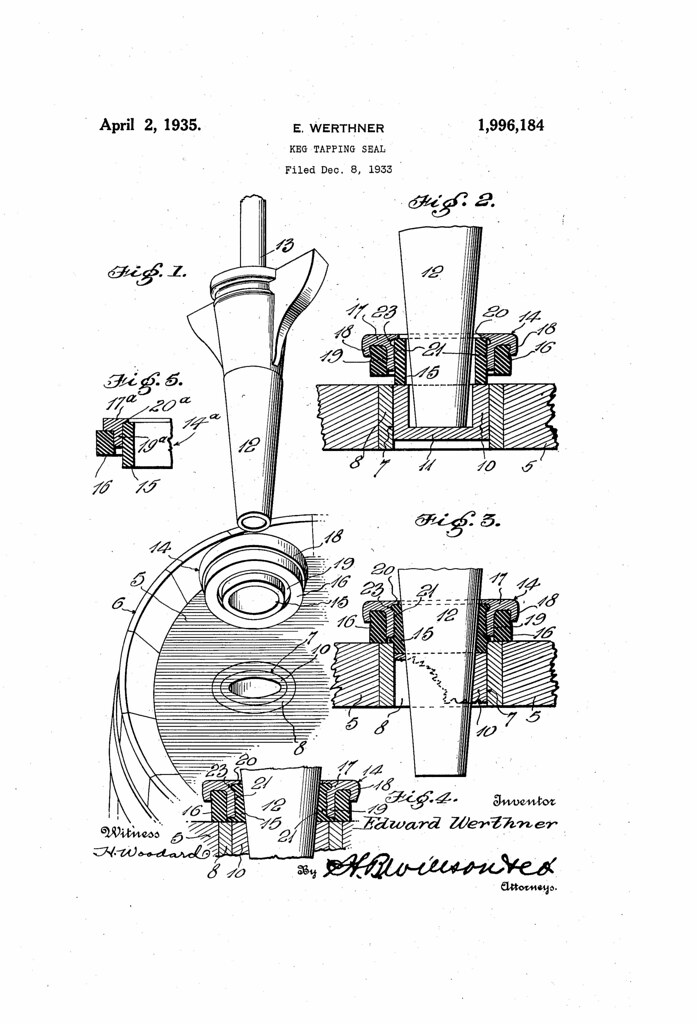
Today in 1935, US Patent 1996184A was issued, an invention of Edward Werthner, for his “Keg Tapping Seal.” There’s no Abstract, and the OCR was taking the day off when they digitized this one. I’ve tried to fix it where I could but some of it is just gibberish:

The usual beer keg is commonly only provided a cupped wooden bung and the dispensing means for discharging the beer as needed includes a tapered tap to be driven into the cupped bung to break out the bung bottom and their wedge fluid tightly into the bung side wall, said tap carrying the usual faucet tube or red; it often happens, however, that the side wall of the bung instead of remaining intact in the bung hole, breaks and will not fit tightly seal around the tap, or that the bung is driven completely into the keg. When such occurrences happen, not only does the keg-tapping person becomes showered with leaking beer squirting under pressure from the keg, but the gas from the beer is lost and the beer soon spoils. It is the object of my invention, however, to overcome such difficulties with the foregoing in-view, the invention resides in the novel subject matter hereinafter described and claimed, description being accomplished by reference to the accompanying drawing.

US1996184-0

Filed Under: Beers, Just For Fun, Politics & Law, Related Pleasures Tagged With: History, Kegs, Law, Patent

« Previous Page
Next Page »

Find Something

Northern California Breweries

Please consider purchasing my latest book, California Breweries North, available from Amazon, or ask for it at your local bookstore.

Recent Comments

  • Bob Paolino on Beer Birthday: Grant Johnston
  • Gambrinus on Historic Beer Birthday: A.J. Houghton
  • Ernie Dewing on Historic Beer Birthday: Charles William Bergner 
  • Steve 'Pudgy' De Rose on Historic Beer Birthday: Jacob Schmidt
  • Jay Brooks on Beer Birthday: Bill Owens

Recent Posts

  • Historic Beer Birthday: William H. Gerst April 1, 2026
  • Historic Beer Birthday: Carl W. Conrad April 1, 2026
  • Beer In Ads #5198: Heim’s Bock Beer! Ready To-Day April 1, 2026
  • Historic Beer Birthday: August Koch April 1, 2026
  • Historic Beer Birthday: Thomas Fowell Buxton April 1, 2026

BBB Archives

Feedback

Head Quarter
This site is hosted and maintained by H25Q.dev. Any questions or comments for the webmaster can be directed here.