Thursday’s ad is for Extra Cascade Beer, from 1929. The beer was made by the Kotobukiya Beer Brewery in Yokohama, Japan. Apparently a lager beer of “finest quality,” it’s hard not to admire the generous heads on the four mugs shown in the ad.


Thursday’s ad is for Extra Cascade Beer, from 1929. The beer was made by the Kotobukiya Beer Brewery in Yokohama, Japan. Apparently a lager beer of “finest quality,” it’s hard not to admire the generous heads on the four mugs shown in the ad.

Regular readers know I frequently write about my belief that AA and other abstinence-only programs are doomed to fail and are not the way we should be approaching people with drinking problems. Here’s a couple of recent articles to add to the mounting evidence that our peculiar dogma about addiction is unraveling.
The first is Addicts Are Made, Not Born: And It’s Not the Drugs That Create Them, which was in SF Weekly. It covers a study done at Columbia University that concluded that the “[m]ost commonly held fears about meth are unfounded, just as they were with crack, just as they were with marijuana.”
“The science points to opportunity and surroundings as the key factors in determining who ends up ‘addicted.’ Provided choice, people will opt not to start on the road to being a fiend. Given nothing else to do, they may try drugs.” So we continue to attack the drugs, or the alcohol, but ignore the reasons people try them. Brilliant.
The second was in Psychology Today, entitled Failure as the Antidote to Addiction, which suggests that by never allowing kids to fail at anything, they never learn how to deal with adversity, or more importantly, overcome it. It seems like the same thing as with disease, where by keeping everything totally sterile and hygienic, we don’t build up the immunities to fight diseases when we encounter them.
The article features a school in Pennsylvania that’s letting kids fail at small tasks and then giving them the tools to learn from them.
Failure is an indispensable part of all innovation. When students design or build something and it fails, everyone can see that it failed; there is nothing abstract or removed about it. The most important part of the learning process is what happens next: trying to figure out why it failed and what can be done to fix it. This is how students learn to be resilient.
The other benefit is that students who learn to fail are less likely to become addicts later in life. Because “[a]ddicts react to challenges and failure by. . . you know. Somehow they failed to learn that failure is a necessary part of living, the only route to success, to coping, to dealing with the universe. And learning how to cope with failure can only occur when people, kids, encounter reality directly.”
I also think that’s why we need alcohol education, and not continue to have policies that keep kids away from alcohol or people drinking it. It, too, creates the same dangerous situation where they know nothing about the etiquette of drinking and end up bingeing in secret, which is far more dangerous, and which is also the whole point of the Amethyst Initiative.


Today’s beer film is the first of Michael Jackson’s six-part series, The Beer Hunter, that he did for Channel 4 (UK) and the Discovery Channel here in 1989. Since today is the birthday of Michael Jackson, it seemed like a good time to pull out the classics. Episode 1 is California Pilgrimage.

Here’s good news for your next backyard barbecue. Not only is marinating your meat a tasty choice, it’s also better for your health. According to a new study by the American Chemical Society released today in their Journal of Agriculture and Food Chemistry, “the very same beer that many people enjoy at backyard barbeques could, when used as a marinade, help reduce the formation of potentially harmful substances in grilled meats.”
The new study, Effect of Beer Marinades on Formation of Polycyclic Aromatic Hydrocarbons in Charcoal-Grilled Pork, is better explained in the ACS press release:
I.M.P.L.V.O. Ferreira and colleagues explain that past studies have shown an association between consumption of grilled meats and a high incidence of colorectal cancer. Polycyclic aromatic hydrocarbons (PAHs) are substances that can form when meats are cooked at very high temperatures, like on a backyard grill. And high levels of PAHs, which are also in cigarette smoke and car exhaust, are associated with cancers in laboratory animals, although it’s uncertain if that’s true for people. Nevertheless, the European Union Commission Regulation has established the most suitable indicators for the occurrence and carcinogenic potency of PAHs in food and attributed maximum levels for these compounds in foods. Beer, wine or tea marinades can reduce the levels of some potential carcinogens in cooked meat, but little was known about how different beer marinades affect PAH levels, until now.
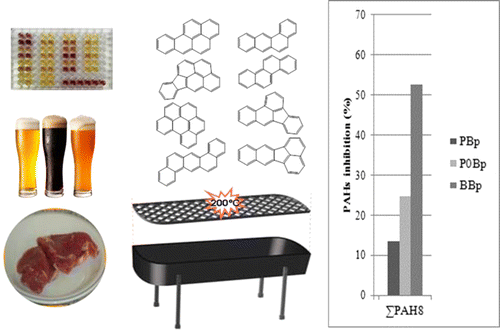
The researchers grilled samples of pork marinated for four hours in Pilsner beer, non-alcoholic Pilsner beer or a black beer ale, to well-done on a charcoal grill. Black beer had the strongest effect, reducing the levels of eight major PAHs by more than half compared with unmarinated pork. “Thus, the intake of beer marinated meat can be a suitable mitigation strategy,” say the researchers.
The study was done using pork, so I wonder if it’s true for steak, too. Looking at the chart, it appears that the “Black Beer” is best for making the meat healthier, so I wonder if it’s the roasted malt? And why would non-alcoholic beer work better than pilsner? Clearly, more research is needed.
And here’s the abstract, if you want the more technical version:
The effect of marinating meat with Pilsner beer, nonalcoholic Pilsner beer, and Black beer (coded respectively PB, P0B, and BB) on the formation of polycyclic aromatic hydrocarbons (PAHs) in charcoal-grilled pork was evaluated and compared with the formation of these compounds in unmarinated meat. Antiradical activity of marinades (DPPH assay) was assayed. BB exhibited the strongest scavenging activity (68.0%), followed by P0B (36.5%) and PB (29.5%). Control and marinated meat samples contained the eight PAHs named PAH8 by the EFSA and classified as suitable indicators for carcinogenic potency of PAHs in food. BB showed the highest inhibitory effect in the formation of PAH8 (53%), followed by P0B (25%) and PB (13%). The inhibitory effect of beer marinades on PAH8 increased with the increase of their radical-scavenging activity. BB marinade was the most efficient on reduction of PAH formation, providing a proper mitigation strategy.
Wednesday’s ad is another one for Sakura beer, this one from between 1928-32. This fetching flag-bearer is thrusting a glass of beer to the heavens from her perch above the Earth. I’m not sure why — It may be her confidence and assertive stare — but I want the beer she’s offering.

Today’s beer film is a commercial for a Dutch beer, Bavaria Beer, in this case for their Radler. The hilarious spot imagines that Elvis Presley is not dead, but today lives on a desert island along will fellow not dead celebrities Tupac Shakur, Kurt Cobain, Bruce Lee and Marilyn Monroe. When a ship wanders close, with practiced ease they sound they alarm and strike the set, so there’s (almost) nothing to see as the ship speeds by, training their binoculars on the now empty-looking beach. Luckily, you don’t really need to know Dutch to figure out what’s going on.
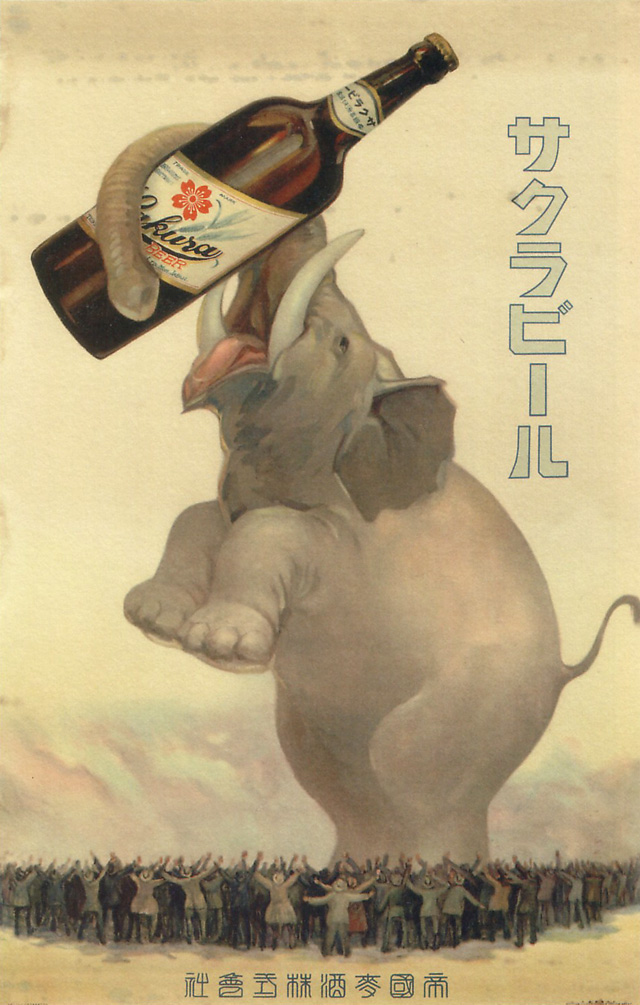
Tuesday’s ad is for the Sakura beer, from 1924. An elephant is rearing back on his hind legs, holding the world’s biggest beer in his trunk. Below him, hundreds (or more?) cheer.
Today’s beer film is the documentary feature Beer Wars, written and directed by Anat Baron, who celebrates her birthday today. Beer Wars was released in 2009, making it nearly five years old. Whew, a lot has happened in that time. Enjoy.

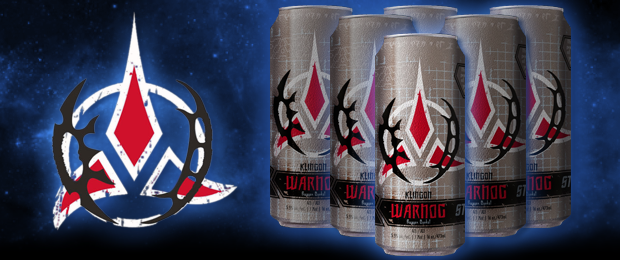
Trekkers rejoice, especially if you’ve gone so far as to learn the Klingon language. According to the Hollywood Reporter, CBS has announced “Star Trek’s first officially licensed and recognized brew,” which will be called Klingon Warnog.
The new beer, a “Danish Roggen Dunkel,” was brewed by Tin Man Brewing of Evansville, Indiana, in partnership with CBS Consumer Products and the Federation of Beer. Although curiously, some of the mock-ups list the beer as simply a “Roggen Dunkel” or a “Dunkelweizen.”
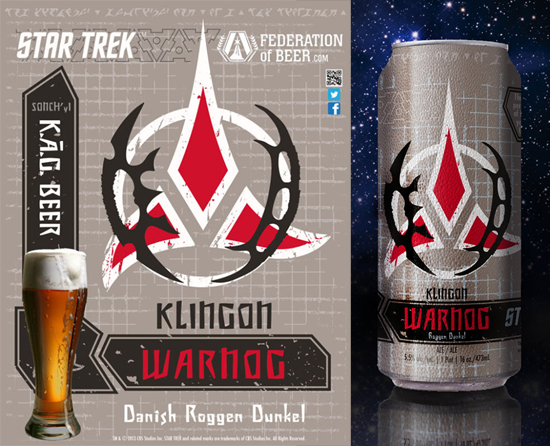
CBS is describing the beer’s flavor as having been drawn “from blending rye malt with a traditional clove character, creating a bold beer suited for the harsh Klingon lifestyle.”
According to the Star Trek Memory Beta wiki, Warnog was mentioned and appeared in an episode of Deep Space Nine — “Sons and Daughters,” from 1997 — along with several Star Trek novels.
The public will get their first preview and taste of Warnog at the Nightclub and Bar Show in Las Vegas today, March 25, 2014, before it becomes available across the U.S. and Canada later this year. This will most likely be the first in a line of Star Trek beverages, and there’s also a Vulcan Ale in the works. “Live long and party on!”
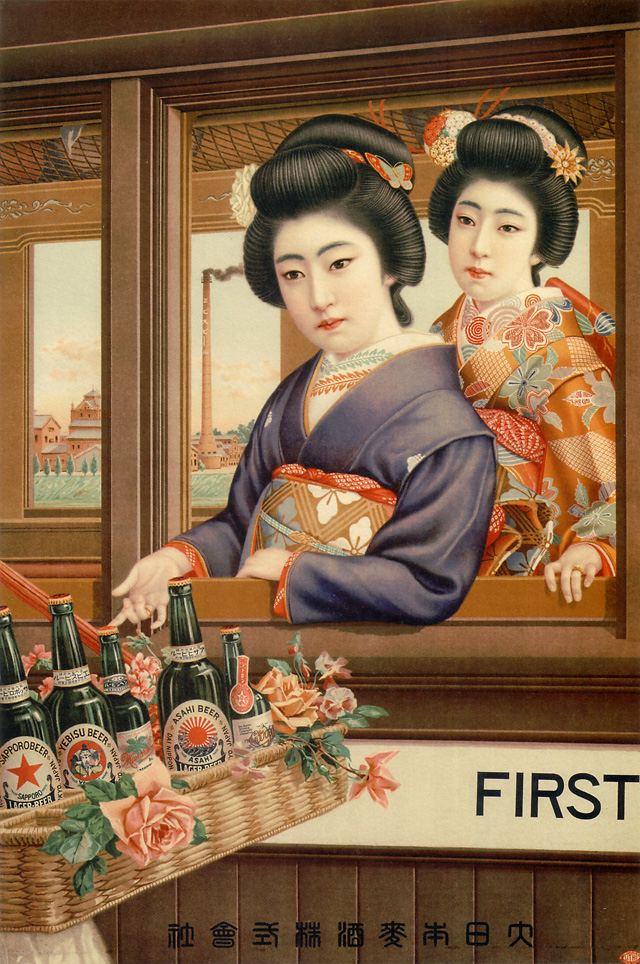
Monday’s ad is for the Nippon Brewery, from 1912. Showing a couple of Geishas on a train, with a vendor at the station offering them beer from a full basket. Through the window on the other side of the train is a large factory, which is presumably the brewery.