

Curious how to properly use a butterfly beer opener? Not to worry, Lagunitas has your back. Watch and learn, grasshopper.
Beer In Art #149: Jan Luyken’s The Cooper

This week’s work of art is by the Dutch illustrator and engraver Jan Luyken. His watercolor painting, The Cooper, was originally done as a study for an engraving he was working on for a larger project, a book entitled “Het Menselyk Bedryf,” or “Book Of Trades.”
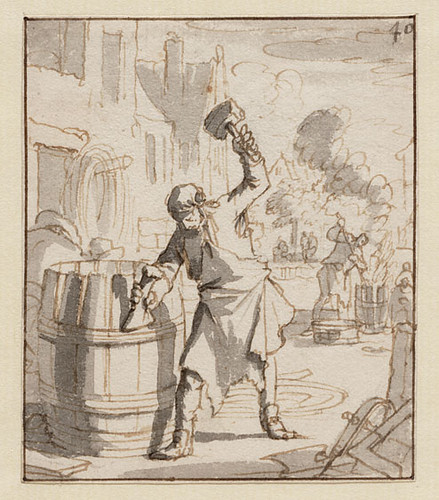
Both the watercolor and the subsequent engraving, which is below, was completed in 1694.
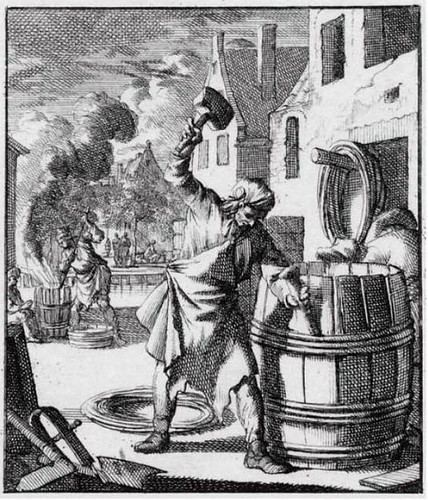
The final engraving was included in The Book of Trades, and looked like this in one edition.

On critic, writing about Luyken’s Cooper, has the following to say:
Luyken’s rapid treatment of the work is accentuated by the use of quick brush strokes in the watercolour highlights. The cooper, who is outside his workshop, is attaching the barrel staves which he has shaped and positioned in the background, his colleague is coating the inside of a barrel with wax.
You can read Luyken’s biography at Wikipedia or at Scroll Publishing. You can also see the rest of the engravings from The Book of Trades and you can see other works at WikiGallery. Also, his biblical set, Martyrs Mirror, from 1685, can be seen at Bethel College’s website.
Declines Of The British Pub Slowing?

In September, the British Beer & Pub Association released information regarding pub closures in the UK.
Back in the 1970s more than 90% of all beer consumed in Britain was bought from the “on trade” — pubs and clubs.
According to the British Beer & Pub Association this ratio had fallen to 51% from pubs and 49% from supermarkets at the end of last year. “It will cross over in the near future,” said a spokesman, possibly as soon as this Christmas.
This would be a watershed moment for Britain’s beer industry, a culmination of long-standing change in consumers’ drinking habits as well as confirmation that the recession has caused people to stay at home more.
The figure came as a report from the GMB union highlighted how the high price of beer has caused the destruction of thousands of neighborhood pubs, in turn damaging many working class communities. It said that local pubs, many of which had survived the Blitz and the great depression of the 1930s, were now being destroyed by the recession.
Pub closures hit a record rate of 53 a week at the height of the recession. Last year, 26 a week closed their doors, leaving just 52,500 pubs in Britain, nearly half of the level at its peak before the World War II.
The Beer & Pub Association blamed competition from the supermarkets, which often sell beer as a “loss leader” to drive customers into their stores, and above-inflation increases to beer duty. The GMB blamed large pub companies putting up their prices because they were struggling with too many debts.
Last week, they released a new statement, Sticking to the facts on pub closure numbers, which said, in part:
The BBPA has moved to set the record straight over conflicting analysis in recent days of UK pub closure figures. It is absolutely clear from CGA data, says the BBPA, that free trade pubs have been closing at a much faster rate that tenanted and leased pubs in recent years. The BBPA has published its full analysis of the data on its website, today available from the link below.
From January 2009 to June this year, CGA figures show 3,444 free trade pubs closed, compared with 2,239 tenanted and leased pubs over the same period. As the free trade sector has considerably fewer pubs, their closure rate over the period was almost double that of the tenanted and leased sector, at 16 per cent, as compared with 8 per cent. Taking new openings into account, there was a 9 per cent net reduction in free houses, compared with a 6 per cent reduction in tenanted and leased.
Free trade closures are higher, despite the considerable numbers of pubs being sold into the free trade from the tenanted sector. The reason that there are more free-trade pubs now than there were at the start of 2009 is that companies have sold tenanted/leased pubs to private owners, where this has been deemed appropriate.
“Pub closures are caused by a huge range of issues — the greatest of which we can influence are undoubtedly punitive rates of taxation and the high cost of regulation. And though there is still some way to go to halt the decline, we should all welcome that the latest figures show that the net closure rate has fallen significantly.”
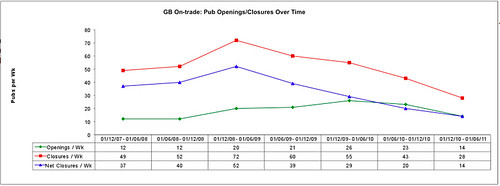
Still, net closures are 14 per week. That’s two a day! But really, it’s 28 pubs closing each week or four a day, which is even more alarming. I’ve been told by Brit friends who know more about this than I do that it’s the bad pubs that are closing, but I have a hard time believing that’s all it is. With that many closing, there must be some good ones, or at least just average ones, that can’t survive as well.
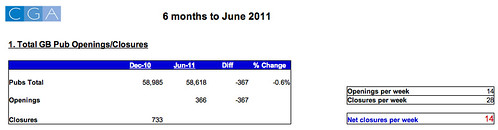
Overall closures are declining since their all-time high (or low) in 2008, as are openings as well, so you can see why there is some reason for optimism. When things are going poorly, you tend to focus on whatever positives you can. Everyone who was involved in craft beer in the mid-1990s will know what I mean. But I’d still be more pleased if the British pub was to regain its footing by opening more pubs than are closing.
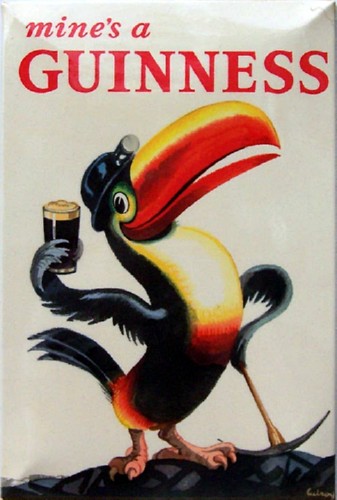
Guinness Ad #94: Mine’s A Guinness

Our 94th Guinness ad is a bit of a pun, showing the iconic Toucan underground wearing a miner’s helmet, leaning on a pick axe in one hand. In his other hand is a pint of Guinness with the slogan “mine’s a Guinness.”
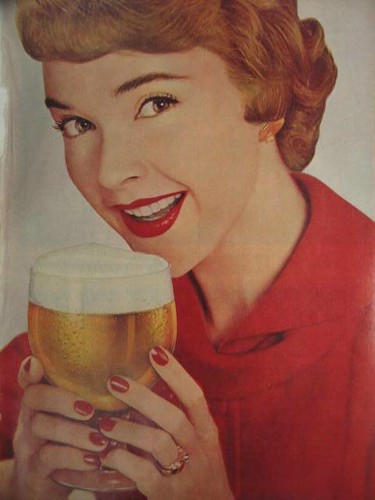
Beer In Ads #480: Red For Black Label

Friday’s ad is for Carling Black Label, from 1962. The ad is pretty simple, and I assume I may be missing part of it since there’s no text at all. But the photo is just a red-headed woman wearing all red, with red nail polish, holding a glass of Carling Black Label while looking longingly at the camera. Red for Black Label. Who’s thirsty?
Jaime Jurado Hired As Susquehanna Brewmaster

My good friend Jaime Jurado — who for many years now has been the brewmaster for Gambrinus in San Antonio, Texas — has accepted a new position as the brewmaster for the new Susquehanna Brewing Co. in Pittston, Pennsylvania. He’ll begin in his new position on January 1, 2012.
Jurado’s been the Director of Brewing Operations with Gambrinus since 1997. Gambrinus owns several beer brands, including BridgePort, Pete’s (which they recently discontinued), Shiner and Trumer. Prior to that, Jamie brewed at Stroh’s, Courage Brewing and the Lion in Wilkes-Barre, Pennsylvania. He was also President of the MBAA from 2005-06.
From the press release:
Susquehanna Brewing Company (SBC), like The Gambrinus Company, is a family-owned company. Owners, Ed Maier, Fred Maier and Mark Nobile have respected the Chairman of The Gambrinus Company for decades. “Gambrinus brews outstanding and varied beers across a broad portfolio, and the creativity, passion and pursuit of excellence is evident in what it has accomplished. We’ve known Jaime for years, and have seen how he has grown and gained impressive depth, which is attributable to The Gambrinus Company. Jaime comes with best wishes of Gambrinus, and no hurdles,” notes SBC President Ed Maier.
SBC represents a new direction in the exciting trajectory of American craft brewing. Founded by the former beer distributors of United Beverage in Pittston, PA, with a rich history of significant regional breweries in one family, as well as a multi-generation beer distribution enterprise in the other, this is the first successful beer distribution company to take up brewing… but being from brewing across generations, there already exists hand’s-on experience from running a regional brewery in the organization in its President.
Whatever that means?!?

Jaime with Lars Larson from Trumer at the Celebrator’s 18th Anniversary Party.
Questionable press release language aside, I’m happy for Jaime and wish him and SBC the best.

Jamie with my son Porter and my wife at the Spoetzl Brewery in Shiner, Texas.
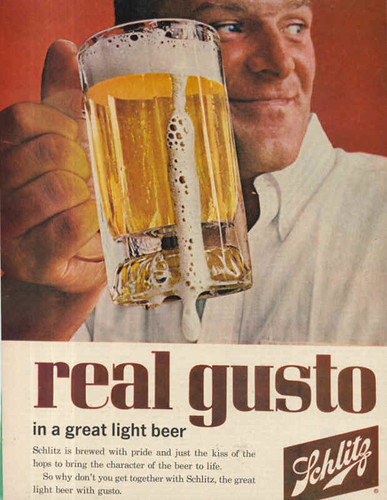
Beer In Ads #479: Real Gusto Plain
Thursday’s ad is for Schlitz, from their “Real Gusto” series of ads that took place in the 1960s. This is at least the fourth one of these I’ve featured, and it’s probably one of the tamest. While other ads included a can, a hat and even the Olympics, this is just a smiling man in a plain white shirt gripping his mug of beer as foam trickles down the side, threatening to drip to the ground any second now.
MADD Rates The States

According to a press release sent out by the neo-prohibitionist organization MADD yesterday, it’s the five-year anniversary of the launching of their Campaign to Eliminate Drunk Driving® program, which you can tell is all about the results since they went to the trouble to get a “registered trademark” on the name. I also find it somewhat ironic that an organization whose name is “Mothers Against Drunk Driving” has to start a side campaign within its organization to eliminate drunk driving. Isn’t that supposed to be their main purpose? It was, of course — once upon a time — but it’s moved so far from that simple idea now that it seems it’s almost an afterthought so that five years ago they had to create a new program to address the issue of drunk driving.
So yesterday they released the somewhat arrogantly-named “Report to the Nation, which rates each state on its progress toward eliminating drunk driving.” The news is just what you’d expect, indeed what it is every time. “[W]e’ve made substantial progress together, but there is still much work to be done.” And so it goes. Every time. They have to make progress, or why do they even exist, but there always has to be more to do, or else who would keep giving them money? That dichotomy creates contradictions that call all of their assertions into question. For example, on page 6 of the 32-page report, a splash page entitled “A New Hope,” the headline is “drunk driving fatalities reduced by almost half.” And that would certainly be good news, I don’t dispute that. Except that what they refer to as “remarkable progress” in the first paragraph morphs into something entirely different by the second paragraph, which begins: “Despite great progress, drunk driving fatalities have remained relatively stagnant since the mid-nineties, with roughly one out of three highway deaths caused by a drunk driver.” Now how exactly can fatalities be “reduced by almost half” while at the same time “remaining relatively stagnant?”
It’s a game, sadly. Non-profits may not care about profits the way corporations do, but that doesn’t mean they don’t care about money … a lot. They complain constantly about the money that alcohol companies spend on lobbying or influencing policy, but that’s exactly what these neo-prohibitionist groups do, too. Most non-profits may start out with the best of intentions, with a clear goal in mind, but then seem to collapse under their own weight into money-sucking organizations nearly as bad as those they often rail against as they grow larger. In a sense, they become victims of their own success. They become “institutions,” with fixed costs, offices, salaries to pay, consultant fees, marketing materials, advertising, webmasters, etc. They need a lot of money just to take care of their day-to-day costs, never mind whatever they’re trying to achieve. MADD’s gone so far from their original intent that when my son was in kindergarten, he got a bookmark from them during “red Ribbon Week” so he’d know that drugs are bad. Never mind that he parroted that message the next time we tried to give him medicine when he was sick, not quite old enough to process that not ALL drugs were bad.
The “report” also floats yet another made up number of how much it all costs, this time that “drunk driving costs the United States more than $132 billion annually.,” similar to the CDC’s recent $223.5 billion figure, though that was for “excessive alcohol use,” not just driving. Their “research” was done by the Pacific Institute for Research and Evaluation (PIRE), and their figure “includes $61 billion in monetary costs, plus quality-of-life losses valued at $71 billion,” just as notoriously impossible to quantify as lost wages, though they did still try to include “crashes outside of work involving employees and benefit-eligible dependents.” The full study itself, however, is not included in the “report,” just a one-paragraph summary of it so I don’t know all of the particulars.
Another aspect of the report is about “turning cars into the cure,” which really means just “ignition locks,” one of the most invasive ideas ever implemented, especially for first-time offenders who do not constitute the bulk of the problem. What continues to bother me about this is that MADD, and the rest of the Anti-Alcohol bunch, continue to ignore supporting a much better solution, the technology to create cars that drive themselves. That technology is surprisingly close to becoming a reality, with several prototypes in various states of development and being tested. It would virtually eliminate not just drunk driving, but bad driving, texting and telephone issues while driving, and so much more. Just input the address of where you want to go into a computer and the car takes you there while you sit and watch. Instead, MADD seems to prefer technology that punishes. At a minimum, why not support both?
But the bulk of the “report,” around half of it, is their evaluations of how each state is doing to combat drunk driving, at least according to their criteria. They use a five-star scale, with each star representing whether the state does what MADD wants them to regarding the following:
- Interlocks for All First-Times Convicted Drunk Drivers
- Sobriety Checkpoints
- Administrative License Revocation
- Child Endangerment
- No Refusal
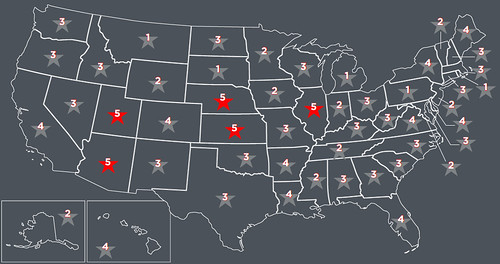
Five states got highest marks:
- Arizona
- Illinois
- Kansas
- Nebraska
- Utah
And like a good bell curve, five got just 1 (nobody got a zero):
- Michigan
- Montana
- Pennsylvania
- Rhode Island
- South Dakota
There’s also an interactive map where you can see how your state did. California, for example, got a surprising 4. I’m sure Alcohol Justice would disagree with that one.
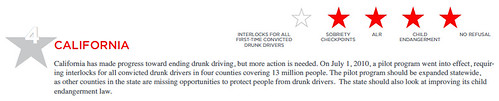
The states that got a five are still, of course, encouraged to do more. And by more, MADD means for each state to accept what they think is the best approach. Do what we say, or risk a bad rating, that seems to be at least part of the message. With most states receiving a three, there’s plenty of room for improvement, and plenty of need for more fund-raising.
Beer In Ads #478: Eisbär-Braü Schneider Brive
Wednesday’s ad is for Eisbär-Braü Schneider Brive. And while I don’t know the pilsner ad’s age, it does contain art nouveau elements, especially those beautiful framing elements, which suggests the decades right before and right after the turn of the 18th century into the 19th. The polar bear with the mug of beer on a tray is cool, too, but that doesn’t look like a pilsner, does it?

Fomenting Female Fear

The purported scientific journal Alcoholism: Clinical and Experimental Research has just published another doozy, this one entitled The Legacy of Minimum Legal Drinking Age Law Changes: Long-Term Effects on Suicide and Homicide Deaths Among Women. The idea was to compare people drinking before the age was raised to 21 with when 18-year olds could still legally imbibe, but the conclusions are .. well, off the deep end and unnecessarily alarmist. So, of course, anti-alcohol groups are running with the results, just as you’d expect.
Despite it being in a “scientific journal” it appears to be nothing more than junk science. They start with this premise. “Prior to the establishment of the uniform drinking age of 21 in the United States, many states permitted legal purchase of alcohol at younger ages. Lower drinking ages were associated with several adverse outcomes, including elevated rates of suicide and homicide among youth.” Really? So the other 139 nations who allow people 18 or under are all killing their kids, getting them to commit suicide more often or generally simply not caring about their health. Most of the rest of the world allows their citizens to drink before they turn 21. Apart from the eight countries where it’s illegal for everyone — mostly for religious reasons — only a dozen countries are as high as 21 (only 5 according to Alcohol Problems & Conclusions), like us. Clearly, the rest of the world hates its kids, right?
Here’s the rest of the Abstract:
Methods: Analysis of data from the U.S. Multiple Cause of Death files, 1990 to 2004, combined with data on the living population from the U.S. Census and American Community Survey. The assembled data contained records on over 200,000 suicides and 130,000 homicides for individuals born between 1949 and 1972, the years during which the drinking age was in flux. Logistic regression models were used to evaluate whether adults who were legally permitted to drink prior to age 21 were at elevated risk for death by these causes. A quasi-experimental analytical approach was employed, which incorporated state and birth-year fixed effects to account for unobserved covariates associated with policy exposure.
Results: In the population as a whole, we found no association between minimum drinking age and homicide or suicide. However, significant policy-by-sex interactions were observed for both outcomes, such that women exposed to permissive drinking age laws were at higher risk for both suicide (OR = 1.12, 95% CI: 1.05, 1.18, p = 0.0003) and homicide (OR = 1.15, 95% CI: 1.04, 1.25, p = 0.0028). Effect sizes were stronger for the portion of the cohort born after 1960, whereas no significant effects were observed for women born prior to 1960.
Conclusions: Lower drinking ages may result in persistent elevated risk for suicide and homicide among women born after 1960. The national drinking age of 21 may be preventing about 600 suicides and 600 homicides annually.
Okay, the first thing that should stick out is the statement that “[i]n the population as a whole, we found no association between minimum drinking age and homicide or suicide.” But then they go on to suggest “significant” findings for just women, even though their findings show that for suicide, a woman is only 12% more likely to commit suicide if she starts drinking legally at 18, and 15% more likely to be murdered. That hardly sounds “significant” and seems small enough that statistical error alone could account for some of the difference. But more importantly, it makes no allowance for any of the literally millions of other factors that lead to any person committing suicide or being murdered. And there’s just no causation or direct correlation linking the two outcomes. The difference in time alone could account for the statistical difference. The time when the age was 18 was different than later, when it was 21. Times change, and so accordingly would how people react to it.
And again, even though it’s only women who the “study” found were affected, they note that the “trends were not mirrored among men,” but examining all this data that “proves” a link for women, their answer to why it doesn’t increase a risk for men is this. “It’s hard to say why that happened.” Well, how scientific. When the results are what they’re looking for, they point to the data. When the data doesn’t support the conclusion they want, they don’t know what happened. Hmm.
Join Together’s headline, Lower Legal Drinking Age Linked to Higher Risk for Homicide, Suicide in Women, claims there is a definite link (which the study itself never says). And their graphic shows a presumably passed out woman in front of a blurry empty bottle of liquor. At the end of their article, lead researcher Richard Grucza says the following. “In fact, what we have here is a natural experiment that supports that idea, by demonstrating an unintended but positive consequence that comes from having raised the drinking age.” But there’s nothing natural about that conclusion. Just like MADD in the past has claimed victory against drunk driving deaths while ignoring improved car safety, mandatory seat belt laws and countless other factors, this “study” looks at two cohorts of numbers and jumps to a conclusion worthy of Evel Knievel’s rocket car leap over the Snake River without ever showing a connection actually linking the two outcomes. Really, they just assume there is a connection, presumably for no better reason than they’re looking for one.
It just feels like there’s no real evidence to truly support such far-reaching conclusions, more like they’re using the data to force an outcome. They’ve certainly over-simplified society and the complex ways in which people determine they want out or want to take someone else out. So they blame alcohol, and when people started drinking.