Brookston Beer Bulletin

Jay R. Brooks on Beer

  • Home
  • About
  • Editorial
  • Birthdays
  • Art & Beer

Socialize

  • Dribbble
  • Email
  • Facebook
  • Flickr
  • GitHub
  • Instagram
  • LinkedIn
  • Pinterest
  • RSS
  • Twitter
  • YouTube

Powered by Genesis

Under the Influence of Recession

October 20, 2010 By Jay Brooks

california
The California Board of Equalization — our taxing agency — yesterday sent out a press release with the results of a study they did on drinking trends in the state based on the collection of excise taxes. The release, Under the Influence of Recession: BOE Answers the Question, “Do People Drink More During an Economic Downturn?” is available as a pdf from the BOE’s newsroom page.

Below is the press release, which reports the overall findings:

There are no consistent patterns in alcohol consumption or spending on alcohol during recessions, a report released today by Board of Equalization (BOE) Chairwoman Betty T. Yee concludes.

The November 2010 edition of the BOE’s Economic Perspective newsletter looks at alcohol consumption data during the recessions of 1970, 1973, 1980, 1981, 1990, 2001 and 2008. The Economic Perspective is a quarterly publication produced by the BOE that looks at economic factors of interest or that influence California economic activity. The November edition looks exclusively at the issue of alcohol consumption during the seven recessions of the last 40 years.

“Economic data compiled by the Board of Equalization contains a wealth of information for estimating revenue impacts and other analyses that serve the agency’s tax administration mission,” said Chairwoman Yee. “In this case, the figures do not indicate any generalized patterns of behavioral change in alcohol use during bad economic times.”

The BOE report notes several ways consumers would be expected to react during recessions: First, total alcohol consumption per capita may fall during the recession, as consumers would have less income to spend on alcohol. Second, consumers may substitute less expensive brands of alcohol for more expensive brands or less expensive ways to consume alcohol for more expensive ways, such as more off-premises consumption during recessions, as opposed to in bars and restaurants. Third, consumers may change the kind of alcohol they drink, for example switching from distilled spirits to less expensive alternatives such as beer. The fourth response, based on psychology more than economics, would be that consumers “drink away their sorrows,” and increase alcohol consumption during recessions. The data show examples of all four kinds of responses during recessions. The most consistent response, occurring in four of the seven recessions studied, was lower growth in on-premises alcohol consumption.

The November Economic Perspective also notes that in terms of national spending patterns on alcohol, prior to the 2008-09 recession total U.S. spending rose 2.4 percent. In contrast, during the 2008-09 recession, U.S. spending on alcohol declined by 1.7 percent.

The Economic Perspective newsletter also notes:

  • Alcohol consumption nationally is at a 25-year high, based on a Gallup survey released in the summer of 2010, with 67 percent of Americans drinking alcohol.
  • Federal Health and Human Services data show a low of 1.96 gallons ethanol consumption per capita in 1954 (a recession year) and a high of 2.76 gallons in both 1980 and 1981 (both of which were recession years).
  • The data show that California alcohol consumption has generally followed national trends in the last 20 years. California per capita consumption, like the U. S., reached a low point in 1998, then started gradually trending upward.

The report points out that historical data show that when confronted with a recession, people who drink alcohol have responded in a variety of ways.

Various Responses Represented in Recessions

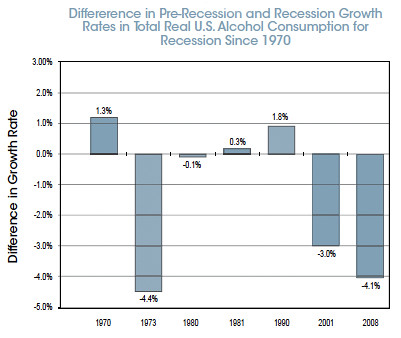
The data show examples of all four kinds of responses during recessions. The first consumer response, less growth in total alcohol spending, occurred in 1973, 2001, and 2008. Chart 3 shows these changes in total alcohol spending for each recession. The second kind of response, lower growth in on-premises alcohol consumption, occurred in the recessions that started in 1973, 1980, 1981, and 2008. This appears to be the most consistent response, happening in four of the seven recessions.The third response was seen in both of the 1970s recessions. Beer consumption went up in the recessions of the 1970s, while distilled spirits consumption went down. This kind of response has not happened since the 1970s. And the fourth response, significantly higher total alcohol spending during a recession, happened in 1970 and 1990.
boe-2010-2

And here’s some interesting tidbits from the Economic Perspective newsletter:

Average total U.S. ethanol consumption per capita is tabulated by decade in [the chart below] to track long-term trends. As shown in the chart, average ethanol consumption per capita for the first nine years of the first decade of 2000 was similar to that of both the 1960s and the 1990s. The recent decades with the highest consumption were the 1970s and the 1980s.
boe-2010-1

And here’s some more from the newsletter on alcohol and the economy.

U. S. Alcohol Drinking rate at 25-Year High

A Gallup survey released in the summer of 2010 indicated that 67 percent of Americans drink alcohol, the highest percentage recorded since 1985.1 Is there some kind of statistical relationship between alcohol consumption and economic growth? Do people drink more during recessions and associated periods of high unemployment rates?

Do We Drink More During Recessions?

To answer this question, this article reviews long term and short term trends in alcohol consumption and analyzes changes before and during the recessions we have had since World War II.
According to Gallup:Despite some yearly fluctuations, the percentage of Americans who say they drink alcohol has been remarkably stable over Gallup’s 71 years of tracking it. The high point for drinking came in 1976-1978, when 71 percent said they drank alcohol. The low of 55 percent was recorded in 1958. When Gallup first asked Americans about drinking, in the waning days of the Great Depression in 1939, 58 percent of adults said they were drinkers.

Gallup reports also note that the percentage of Americans who say they drink alcohol has been in the low 60s fairly consistently since 1947.

Gallup Data Show Alcohol Use Unrelated to Recessions

Based on these data, it would appear that prior to 2010 there was little, if any relationship between the percentage of people drinking and economic conditions. The economy was not in a recession during the 1976-1978 period, when the highest percentage of adults defined themselves as alcohol drinkers (71 percent). In fact, the economy was growing rapidly, with real gross domestic product (GDP) increasing an average of 5.2 percent per year during this three-year period. This is well above the 2.9 percent average annual growth rate experienced by the U.S. economy since 1945. The economy was in a recession from August 1957 through April 1958, about the time of the lowest percentage of adult drinking in Gallup’s records (55 percent).2 If anything, these extreme points in the Gallup poll results seem to indicate that people drink more when the economy does

Other Measures of Alcohol Consumption

Polls such as those done by the Gallup Group measure how prevalent drinking is. Other measures indicate how much alcohol is consumed. These include ethanol (pure alcohol) content, gallons of liquid by type of product, and spending in dollars.

Health and Human Services Alcohol Surveillance Reports

The U.S. Department of Health and Human Services (HHS) periodically does surveillance reports of state and national alcohol consumption in terms of gallons of ethanol content of beer, wine, and distilled spirits per capita for those over age 14. Sources of data include state government revenue agencies and various industry sources. The most recent HHS report has these annual data from 1934 through 2008.3 The data show no obvious correlations with recessions. For example, in 2001 (the most recent recession covered by these data) total U.S. ethanol consumption from beer, wine, and distilled spirits was 2.18 gallons per capita,

Alcohol Consumption Rising Since 1998

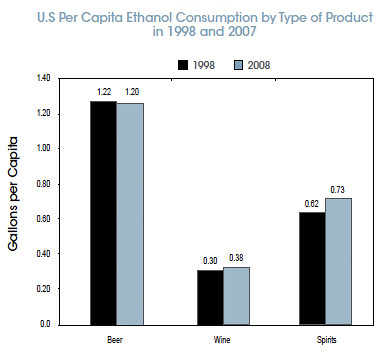
The HHS data show that total U.S. ethanol consumption reached its most recent low point in 1998, at 2.14 gallons per capita. It has been slowly trending upward since then, reaching 2.32 gallons per capita in 2008. As shown in Chart 1, wine and distilled spirits were responsible for the increase in U.S. per capita consumption from 1998 to 2008.

Lowest and Highest Alcohol Consumption

The lowest U.S. total ethanol consumption since the end of World War II was 1.96 gallons per capita in 1954 (a recession year, with a recession running from July 1953 through May 1954). The highest consumption was 2.76 gallons per capita in both 1980 and 1981 (both recession years, each with six-month periods of recessions).

On additional interesting findings is that during a recession, they did note that people tend to go out less frequently, meaning sales of alcohol at restaurants and bars decline, but based on the uptick in retail purchases of alcohol for home consumption it’s essentially a wash. But that means, as we’ve seen brewpubs and restaurants struggle a bit while package craft and regional breweries have had solid growth.

The BOE study concludes that “there appear to be no consistent patterns in alcohol consumption or spending during recessions. Recessions are all different; some last longer than average, some are associated with more than average job losses. Alcohol consumption responses during recessions are also different, and not very predictable. The historical data show that when confronted with a recession, people who drink alcohol have responded in a variety of ways.”

Filed Under: Beers, Editorial, News, Politics & Law Tagged With: California, Press Release, Taxes

Blue Bottle’s Stout Coffee Cake

October 16, 2010 By Jay Brooks

blue-bottle
Back in August, I wrote about a cake made with stout at Miette’s in San Francisco and Oakland. It had been chosen by Alton Brown of the Food Network as one of the Top Ten Sweets in the United States. And while it was very tasty, I lamented the fact that it was made with Guinness stout rather than a local beer. I’ve noticed that a lot of foodies who insist on local food ingredients and even wine are completely blind to the concept of local beer. It’s a head-scratcher, with the most famous example I know is that locavore pioneer Alice Waters until very recently served soulless imported beers at her famous restaurant Chez Panisse.

The restaurant’s website describes Waters as an “American pioneer of a culinary philosophy that maintains that cooking should be based on the finest and freshest seasonal ingredients that are produced sustainably and locally. She is a passionate advocate for a food economy that is ‘good, clean, and fair.’ Over the course of nearly forty years, Chez Panisse has helped create a community of scores of local farmers and ranchers whose dedication to sustainable agriculture assures the restaurant a steady supply of fresh and pure ingredients.” While I don’t quibble with her influence and importance in creating the idea of how important using local ingredients is, the fact is that it took 35 years to extend that idea to beer. I find that incredibly sad and to me it says quite a lot about how slow much of the food community has been to embrace craft beer while at the same time they’ve been so quick to champion artisanal cheese, bread, chocolates, preserves, charcuterie, pickles, coffee, tea, wine and much more. Happily, things are finally changing and a growing number of self-avowed foodies are accepting craft beer as an equal to other artisanal foodstuffs.

So I was thrilled to learn that another local company, Blue Bottle Coffee, was making a pastry — in this case a coffee cake — using a local stout, Magnolia Stout of Circumstance. Dave McLean’s Magnolia Gastropub makes some great beers (and has really good food, too) so I was very keen to try the coffee cake made with his beer.

Blue Bottle Coffee has six locations in the Bay Area (five in San Francisco and one in Oakland; and there’s a seventh location in Brooklyn, too) and last week I stopped by their Kiosk location on Linden Street in San Francisco.

blue-btl-kiosk
Waiting in line at the Linden Street Kiosk.

It turns out that the co-founder of Miette, Caitlin Williams Freeman — who made the other stout cake — sold her interest in Miette and started making pastries for her husband’s company, Blue Bottle Coffee. Her most famous pastries are the art-inspired creations she makes for the San Francisco Museum of Modern Art. But it was the beer confections that caught my interest.

stout-ccake-1
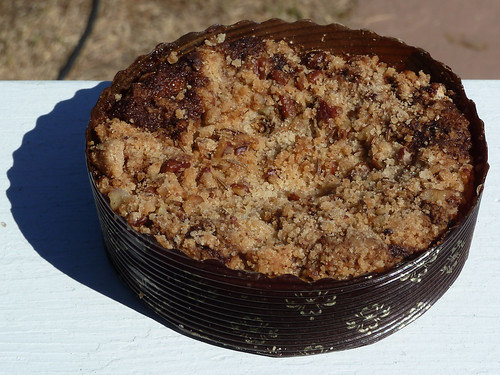
Blue Bottle Coffee’s coffee cake made with Magnolia’s stout.

The coffee cakes are sold in a small, round personal size. They’re quite tasty, with a melange of different flavors. There appear to be oats, chopped walnuts, caraway seeds and possibly dried currants in the cake. The stout brings out a nice balancing sweetness that’s treacly and molasses-like. That sweetness also balances the dry cake and makes it nice and moist so that when you bite into it you get both dry and wet sensations. I’m not actually much of a coffee drinker — I prefer tea — but I can see how this cake would be a perfect compliment to their coffee, which as I understand it are some of the best.

P1010387
The Blue Bottle Coffee Cake close-up on my kitchen counter.

Filed Under: Beers, Just For Fun Tagged With: California, Food, San Francisco

Tailgating For The Flames: Black Diamond’s TV Commercial

October 13, 2010 By Jay Brooks

black-diamond-new
If you haven’t watched much sports on television lately perhaps you missed the new cable television commercial by the Bay Area’s own Black Diamond Brewing of Concord. Happily, it’s now up on YouTube. Go Flames!

Filed Under: Beers, Breweries, Just For Fun Tagged With: Advertising, Bay Area, California, Humor, Video

Firestone-Walker Brewery Video

October 8, 2010 By Jay Brooks

firestone-walker
Firestone-Walker Brewing just posted a cool video shot in the brewery, with great production values and music. I’m not sure if we’ll see it anytime soon on television, even cable, but it’s better than most of the beer ads currently running.

Filed Under: Breweries, Just For Fun Tagged With: California, Southern California, Video

Beer Birthday: Craft Beer

October 8, 2010 By Jay Brooks

new-albion-banner
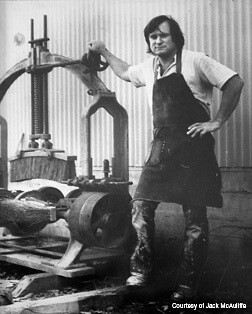
Today is the 34th anniversary of a momentous moment in the short history of craft beer. On October 8, 1976, the New Albion Brewery was incorporated in the State of California. Though the brewery opened in July the following year, it only lasted until 1982 or 83. It was ahead of its time, way ahead. But it was the first small brewery to be built from scratch, mostly by hand, using junkyard parts and old dairy equipment. To me, and many others, that makes it the first modern craft brewery and its legacy should be remembered, revered and celebrated. Its founder, Jack McAuliffe, essentially shied away from the brewing community after 1983, returning to his original profession as an engineer. As a result, few people — except us old-timers and historians — give McAuliffe his due. A lot of young brewers and fans don’t know his name, though that, happily, is changing.

Maureen Ogle managed to track down McAuliffe through his daughter for her book, Ambitious Brew, and in it she gives a great account of New Albion Brewery.

McAuliffe

Sierra Nevada recently lured McAuliffe to Chico to collaborate on a beer for their 30th anniversary. Jack & Ken’s Ale, a black barley wine, came out recently, and that seems to be the beginning of a resurgence or renaissance for Jack McAuliffe. He’s back in the public eye, and people are writing once more about his lasting impact on the craft beer industry. Here are a few places he’s been mentioned:

  • John Holl had a great piece he did for CraftBeer.com, New Albion Brewing.
  • Eric Braun in the San Antonio Express-News, McAuliffe’s new home, wrote Jack McAuliffe is Namesake of Commemorative Sierra Nevada Beer.
  • Greg Kitsock in the Washington Post writes The father of craft brewing comes out of retirement.

Then there’s The birthday of craft beer, written by me for my newspaper column. It was supposed to run this Wednesday but got bumped to next week, which happens occasionally. But it did go online this week, in time to raise a toast tonight

My idea is to designate today as the “birthday of craft beer,” a holiday to celebrate New Albion Brewery, Jack McAuliffe and the thousands of small breweries that followed to create the beer landscape we all enjoy today. Working with the California Small Brewers Association, we’re going to petition the state to recognize October 8, 2011 in some fashion as the 35th anniversary and the birthday of craft beer. If you’d like to help that effort, drop me a line and when we have a better idea what needs to happen, I’ll reach out to you. For now, today is the 34th anniversary, and the birthday of craft beer, so join me in raising a glass to Jack McAuliffe, New Albion Brewery and all the great beer that’s flowed since 1976. Happy birthday craft beer.

new-albion-ale

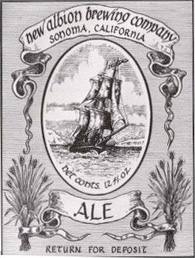
Here’s one of the original New Albion labels. The original sign from the New Albion Brewery now hangs on the wall at Russian River Brewing in Santa Rosa. Stop by and see it anytime you like. To see what New Albion looked like, check out breweriana collector Jess Kidden’s page on New Albion Brewing, where he’s reproduced two articles that appeared in Brewer’s Digest in 1979 and 80.

Filed Under: Birthdays, Breweries Tagged With: California, History, Northern California

The Celebrator’s Conversation With Ken Grossman

October 7, 2010 By Jay Brooks

sierra-nevada
Tom Dalldorf did a great interview with Ken Grossman of Sierra Nevada Brewing for the most recent issue of the Celebrator Beer News. The new issue features part of the interview and also Grossman on the cover for Sierra Nevada’s 30th anniversary this year.

2010_ken_grossman

The entire interview is just under 30 minutes and was done last month in Chico. Enjoy.

A Conversation with Ken Grossman from Wing and Wing Productions on Vimeo.

Filed Under: Breweries, Just For Fun Tagged With: California, Interview, Northern California, Video

Mayor’s Veto Stands, No SF Alcohol Tax For Now

October 5, 2010 By Jay Brooks

san-francisco
After San Francisco Supervisor John Avalos asked for a week’s postponement, his attempt to override Mayor Gavin Newsom’s veto of the proposed ordinance imposing an alcohol tax in the city failed today. The Chronicle is reporting that, as many expected, Avalos was unable to find the vote he needed to override Newsom’s veto two weeks ago.

In the last two weeks Avalos has spent his time on more political gamesmanship, questioning the mayor’s right to veto, despite the question having been answered by the court in 1986. No word yet whether he’ll now take the vote to the people, something he claimed to be considering after the mayor’s veto. Only time will tell, but I doubt we’ve heard the last of this issue. This sure is one dead horse, but I’m sure he’ll find a way to keep beating it.

Filed Under: Breweries, Editorial, News, Politics & Law Tagged With: California, Prohibitionists, San Francisco, Taxes

Calling The Brew Kettle Black

October 4, 2010 By Jay Brooks

marin-institute
In an irony apparently lost on the Marin Institute, their latest missive to the faithful accuses Big Alcohol of doing “anything” to protect their business. The exact headline is Big Alcohol will do anything to avoid paying for alcohol-related harm. This is related to the industry’s recent support of California Proposition 26, which is attempting to close the loophole created by the California Supreme Court that allows “fees” to be imposed under certain conditions with just a majority vote rather than the 2/3 vote required for ordinary taxes. This has led to a spate of taxes pretending to be fees being imposed throughout the state. The proposition seeks to expose those hidden taxes and subject them to the same standard as any other taxes.

As I wrote before in Trash Talking Prop 26, this proposition was not started by the alcohol industry, or even the oil or tobacco industries, but was a grassroots effort sponsored by the California Chamber of Commerce and the California Taxpayers’ Association, and is supported by nearly sixty chambers of commerce and tax organizations. There is also support from trade organizations in a wide range of businesses and industries. It wasn’t until August that alcohol donations were made and that’s a significant point the Marin Institute is conveniently ignoring. It was at that time that “every company who makes alcohol, distributes alcohol and sells and serves alcohol realized they were under attack by the Marin Institute, who was pushing [San Francisco supervisor John] Avalos and supplying him him with all the resources for the test case to add a new tax to alcohol in San Francisco. That’s when most of us even became aware of Prop 26. Before that, I’d wager, hardly anyone in the alcohol industry had paid it much attention. When you’re being attacked, you tend to defend yourself.”

So at a minimum, the Marin Institute is mis-characterizing Prop 26 and at worst is using the results of its own actions to claim that the alcohol industry will go to great lengths to “avoid paying for alcohol-related harm.” But first of all, the notion of “alcohol-related harm” is something that the Marin Institute made up themselves. Alcohol companies, like any business, are simply trying to protect themselves from having to pay more taxes. This is something every company in every industry would do, in fact has to do, indeed is mandated to do by their corporate charter. Shareholders would be right to revolt if they didn’t take those steps. That the Marin Institute is using this very reasonable and understandable reaction to being attacked by the Marin Institute to paint the industry as going too far is more than a little hypocritical as it shows the lengths that they will go to in bending reality to their service. The rest of the missive also misstates what the proposition is really about, further showing how far they’ll go to further their agenda. If that’s not the pot calling the brew kettle black, I don’t know what is.

Filed Under: Editorial, Politics & Law Tagged With: California, Prohibitionists

Next Up For San Francisco’s Alcohol Tax? The Voters

September 23, 2010 By Jay Brooks

vote
Politicians are used to getting their way, and so are powerful non-profits, so they tend not to look at defeat as losing, but as an opportunity to try to win a different way. Certainly they’d never openly admit they’re wrong or have lost. If one strategy doesn’t work, they try another. The will of the people or common sense rarely matters, what matters is winning.

And so the new alcohol tax for the city of San Francisco, as proposed by supervisor John Avalos, was vetoed by mayor Gavin Newsom. But that’s hardly the end of it. I’m sure that Avalos and his backing organization, the Marin Institute, are still trying to strong-arm the three supervisors who voted against the new tax in the hopes of an override, but in the meantime, they’re also looking at others ways to realize their agenda. The determination of the minority who claim the moral high ground will not be stopped so easily. Their dream of punishing the majority of lawful, responsible drinkers for the excesses of the few will not go gently into that long goodnight. Likewise, their dream of punishing the big alcohol companies with a scheme that will barely register on their radar while at the same time causing real harm to the local economy, to local restaurant and bar owners and employees, and to hundreds of small family-owned breweries, wineries and distilleries will also not stop, but will instead just veer off in a different direction.

Just hours after Newsom’s swift veto of the alcohol tax, “supervisor John Avalos says the measure might be taken to voters to override Mayor Gavin Newsom’s veto.”

Unfortunately, every news outlet keeps repeating the lie that the tax would only add “a few cents per standard serving of beer, wine or hard liquor.” Don’t any of these news outlets fact check? As the business community has tried to explain — and any person with a functioning brain should understand — the initial tax (like all costs of doing business) will be marked up along the supply chain from wholesaler to retailer to consumer. Seriously, how hard is that to comprehend? This won’t be a “nickel a drink,” more like a buck a drink. Okay, maybe not that much for most, but if I have to keep hearing it’s only a nickel, I think I’m within my rights to engage in a little hyperbole, too. At least I’m up front about it. I feel like if I turn around, I’ll see Upton Sinclair shaking his head behind me. As he observed, “It is difficult to get a man to understand something when his job depends on not understanding it.” And so it goes.

And what also doesn’t get talked about — but should — is that alcohol is already the most taxed consumer product on planet America, with the possible exception of tobacco. But tobacco, you may recall, has no health benefits whereas the moderate consumption of alcohol has plenty, not least of which is that you’ll most likely live longer if you drink a little instead of abstain.

Every state and community is having trouble paying for the services its citizens feel entitled to, and that’s undoubtedly a real problem. I personally believe politics has led us down this path, but regardless I don’t believe politics can save us from it, either. Everybody wants the services, but curiously no one is willing to pay for them. No one wants their taxes to go up, even though that’s probably the fairest way to get us out of this mess. Instead, politicians keep trying to find a solution that doesn’t seem like a tax, in most cases just so they can continue to say they’re against more taxes, for no grander purpose than they want to keep their jobs. So when the Marin Institute whispered in the ear of John Avalos, “psst, have I got a ‘fee’ for you,” … he listened.

And in the end, that’s why I’m so vehemently opposed to this type of tax. It’s dishonest at its core. It argues from a false premise. I don’t really care how much the tax is, it’s patently unfair at any amount. It takes the all too familiar position that drinking alcohol is somehow a sin and therefore people should have to pay to enjoy it. Bullshit. I don’t believe that and neither should you. The concept of sin is a religious “belief” and last time I checked the Constitution guaranteed that I can believe otherwise and that in any event religion, where the idea of sin flourishes, should have nothing to do with the governing of alcohol policy or any other damn law.

What we have is decades of demonization working its way into a discussion it should have no part in. It’s utter nonsense to suggest that alcohol “made” people abuse it and further that the people who make it and sell it share that blame, too. When we start taxing ammunition and gun companies for the crimes people commit using their products then come talk to me about charge for harm. When we start taxing soda companies, high fructose corn syrup makers, fast food chains and red meat companies for the obesity epidemic and the burden it places on our healthcare system then come talk to me about charge for harm. When we start taxing the oil companies and car manufacturers for the loss of the ozone layer and other natural disasters from their dismantling of mass transit and people driving too much then come talk to me about charge for harm. Virtually every human activity does some harm to someone or something. Trying to calculate all of them and figure out who owes what is a fool’s errand. And that’s why we don’t, except when it comes to alcohol. Alcohol has been a convenient scapegoat for well over a century now, and there’s no end in sight for the ills of society it can be blamed for.

My biggest fear if this does go to a vote, is that the mis-information and propaganda out there has created a populace that believes one thing when another is closer to the truth. One of the most potent takeaways from the quasi-debate that KQED aired a few weeks ago, was how frighteningly uninformed many people are about this issue. So many have let emotions, inflated statistics and one-sided reporting inform them on this issue that I think a lot of people will happily pull that “yes” lever, blissfully ignorant of how unfair it is and how their emotions have been manipulated by propaganda and fear. And that’s a direct result, I think, of our local media just uncritically parroting propaganda in favor of the tax and all but ignoring any meaningful opposition.

But long term it’s also because we allow the debate to start from the premise that alcohol is bad in and of itself. It’s not. All the evidence you need to disprove that is your own behavior and those of almost everyone around you, easily able to responsibly drink moderate amounts of alcohol. You’re the majority. You’re the norm. You’re doing something good; good for you and for society. Drink up. Enjoy yourself. Don’t let fear and propaganda win the day.

Filed Under: Editorial, News, Politics & Law Tagged With: California, Law, San Francisco

Media Reaction To SF Mayor’s Veto Of Alcohol Tax

September 22, 2010 By Jay Brooks

san-francisco
As I reported yesterday, San Francisco mayor Gavin Newsom kept his promise to veto the proposed ordinance that seeks to add an additional tax on alcohol sold in the city.

Here’s mayor Newsom’s veto letter that he sent to city supervisors:

This letter communicates my veto of the ordinance pending in File Number 100865, finally passed by the Board of Supervisors today, September 21, 2010. This ordinance proposes an Alcohol Mitigation Fee to be imposed on alcoholic beverage wholesalers and others who sell or distribute alcoholic beverages in San Francisco.

I cannot support this unnecessary and harmful new fee that will hurt our City’s economy and cost us jobs at a time when we most need them.

In this economy, I fundamentally believe that we need to be encouraging local businesses – large and small – to continue to work and operate in our neighborhoods, to continue to provide jobs and security to the residents of San Francisco, and to continue to support our City’s economy in its recovery. It is in these times of struggle that we need to stimulate our local economy – not pursue policies that will stifle growth and put our county at a competitive disadvantage with every other county in California.

In addition, while we have faced significant budget deficits for the last three years, we consistently have supported the provision of critical health care services to our residents most in need – at a much higher rate than surrounding counties. And, we will continue to do so. Therefore, I do not accept the premise that, but for this fee, we will be slashing our health care programs.

I also strongly believe that we are in questionable legal territory due to state preemption issues, and that passing this ordinance would risk millions of dollars in attorney’s fees that we can ill afford. I prefer to hold those battles for creative policy areas where we believe we are in strong legal standing.

I remain committed to working with the Board of Supervisors and City departments to continue to identify impactful programs to help chronic inebriates in San Francisco. However, I do not believe that an alcohol impact fee is the best approach in achieving that policy goal. Our best hope for continued strong financial standing of this City and support for public health services is to help our local economy grow and thrive.

The media reaction has been swift and voluminous. At least twenty media outlets throughout the state have weighed in since yesterday afternoon. Here’s what the San Francisco Chronicle, by John Coté, had to say:

Newsom contends the fee would hurt jobs and is illegal, treading on the state’s authority to regulate alcohol.

“You don’t help the city’s general fund by spending hundreds of thousands of dollars on a lawsuit we’re going to lose,” Newsom said.

Other opponents, such as the San Francisco , argue the fee is really a tax and thus needs voter approval. The city attorney issued a confidential opinion to supervisors that warned of potentially significant legal risks associated with the legislation on both fronts. Liquor industry representatives vowed to sue if the legislation were enacted.

And I love this gem. “Avalos said there was simply ‘no evidence’ that consumers would face inflated costs.” Puh-leeze. His insistence that there would be no mark-up on the tax from wholesaler to retailer to consumer is completely naive and disingenuous. Everyone in the business community is telling him the tax will be marked up, but that’s not “evidence.” Does he think they’re all lying just because they don’t like the tax? Has he never worked in any business capacity? That’s what businesses do, they mark up their costs and pass them along to consumers. Not doing so is how you go out of business.

Filed Under: News, Politics & Law Tagged With: California, Government, Law, Mainstream Coverage, San Francisco

« Previous Page
Next Page »

Find Something

Northern California Breweries

Please consider purchasing my latest book, California Breweries North, available from Amazon, or ask for it at your local bookstore.

Recent Comments

  • Bob Paolino on Beer Birthday: Grant Johnston
  • Gambrinus on Historic Beer Birthday: A.J. Houghton
  • Ernie Dewing on Historic Beer Birthday: Charles William Bergner 
  • Steve 'Pudgy' De Rose on Historic Beer Birthday: Jacob Schmidt
  • Jay Brooks on Beer Birthday: Bill Owens

Recent Posts

  • Beer In Ads #5171: It Has To Be Good To Be Gunther’s March 18, 2026
  • Historic Beer Birthday: James Toohey March 18, 2026
  • John Updike’s Paean To The Beer Can March 18, 2026
  • Historic Beer Birthday: John Smith March 18, 2026
  • Beer Birthday: Jason Chavez March 18, 2026

BBB Archives

Feedback

Head Quarter
This site is hosted and maintained by H25Q.dev. Any questions or comments for the webmaster can be directed here.