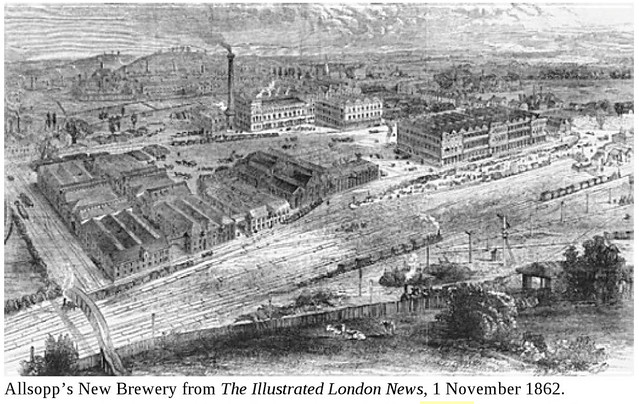
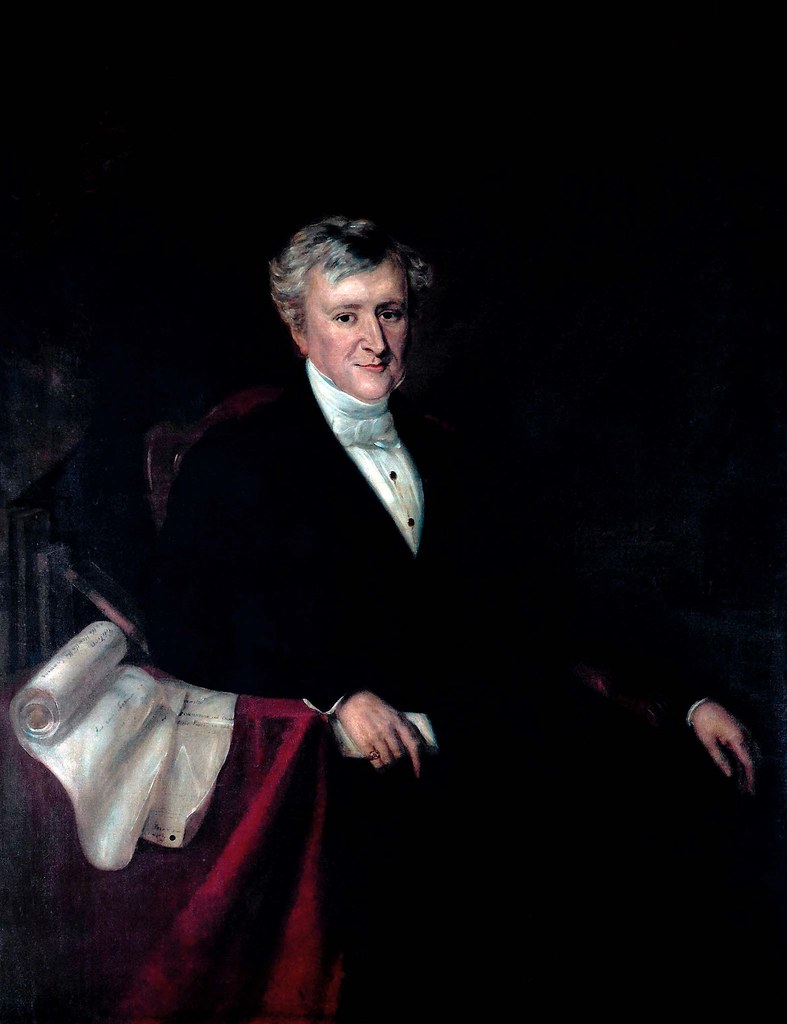
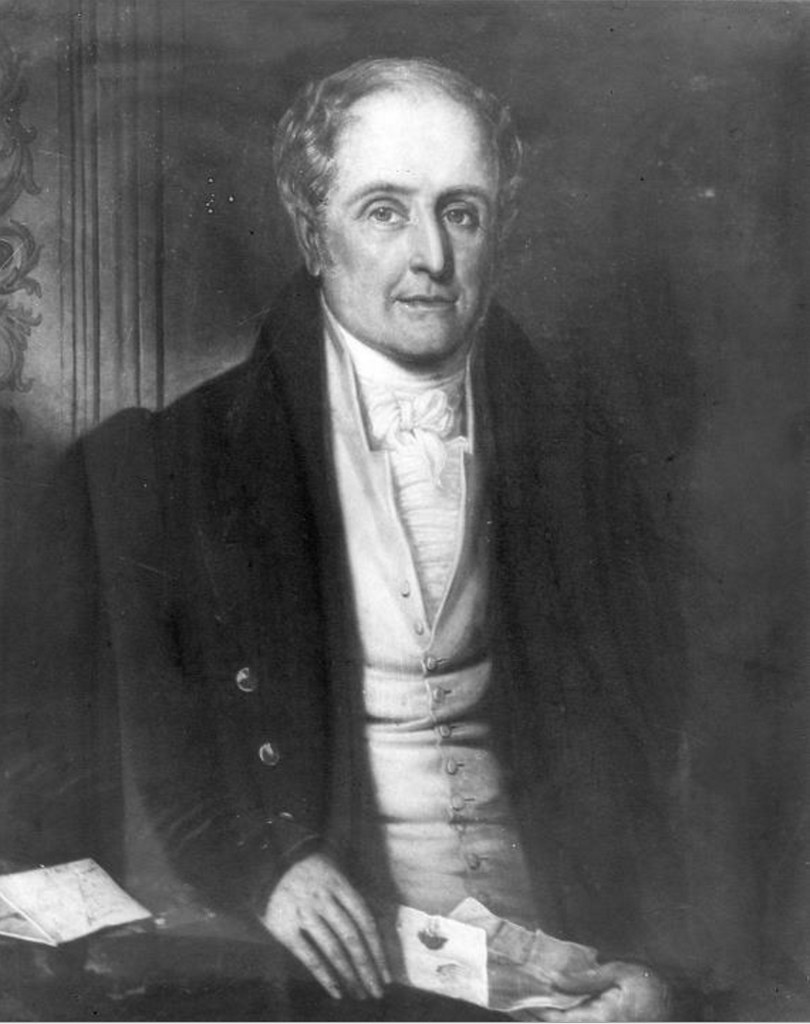
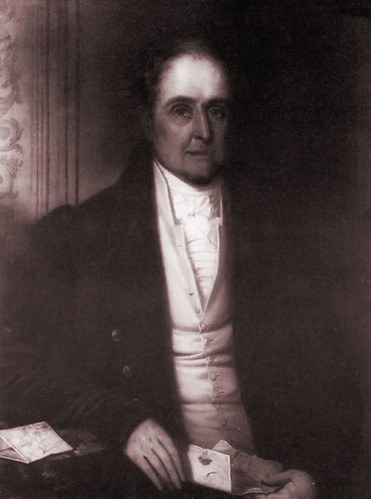
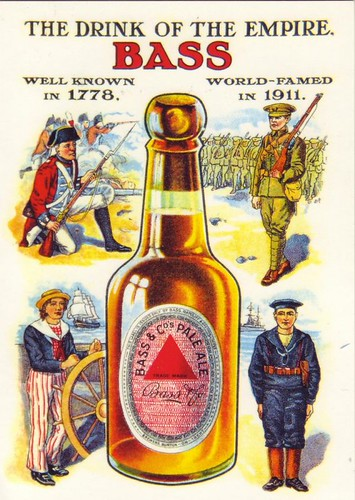
Today is the birthday of Samuel Allsopp (August 12, 1780-February 26, 1838). He purchased the brewery started in the 1740s by his uncle, Benjamin Wilson, in 1807. Bringing his family into the business, he renamed it Samuel Allsopp & Sons. When he died in 1838, the Burton-on-Trent brewery passed to his son Henry Allsopp.
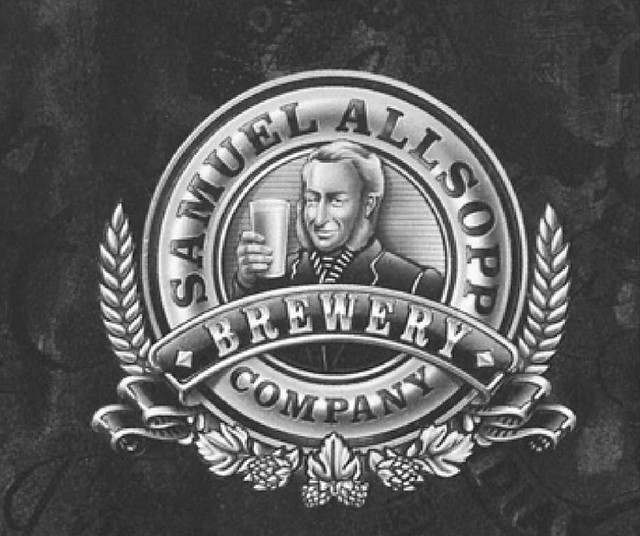
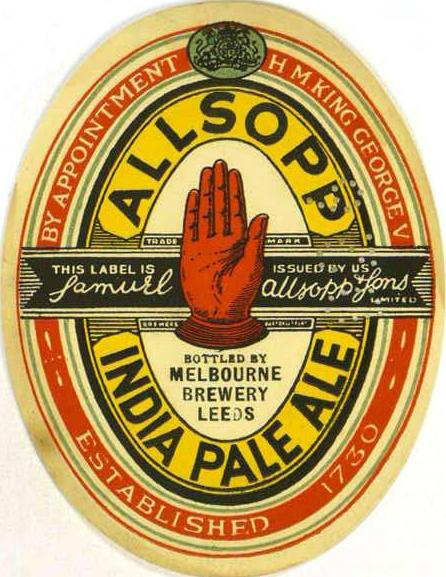
While I couldn’t find any pictures of Samuel Allsop, the logo of the Samuel Allsop Brewery Co., from 1994-98, used his likeness.
“Ind Coope & Samuel Allsopp Breweries: The History of the Hand,” by Ian Webster, includes this memoriuam from shortly after Allsopp’s death:
Here’s a history of Allsopp’s brewery from Wikipedia:
Allsopp’s origins go back to the 1740s, when Benjamin Wilson, an innkeeper-brewer of Burton, brewed beer for his own premises and sold some to other innkeepers. Over the next 60 years, Wilson and his son and successor, also called Benjamin, cautiously built up the business and became the town’s leading brewer. In about 1800, Benjamin Junior took his nephew Samuel Allsopp into the business and then in 1807, following a downturn in trade because of the Napoleonic blockade, he sold his brewery to Allsopp for £7,000.
Allsopp struggled at first as he tried to replace the lost Baltic trade with home trade, but in 1822 he successfully copied the India Pale Ale of Hodgson, a London brewer, and business started to improve.
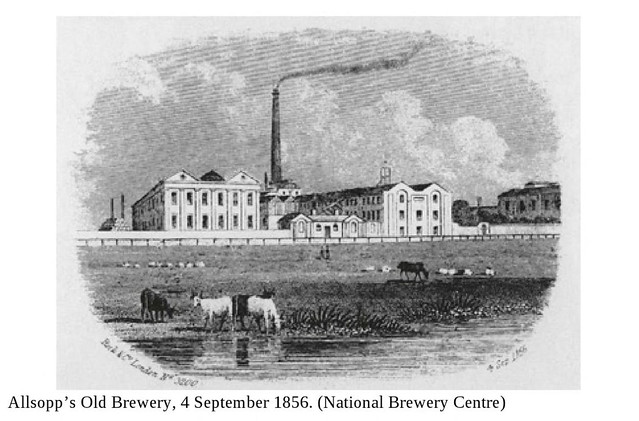
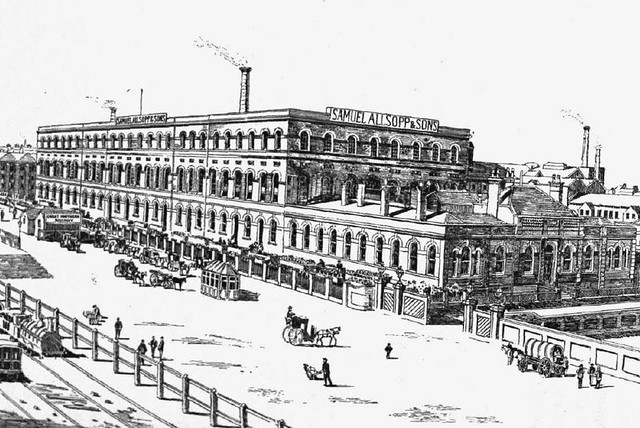
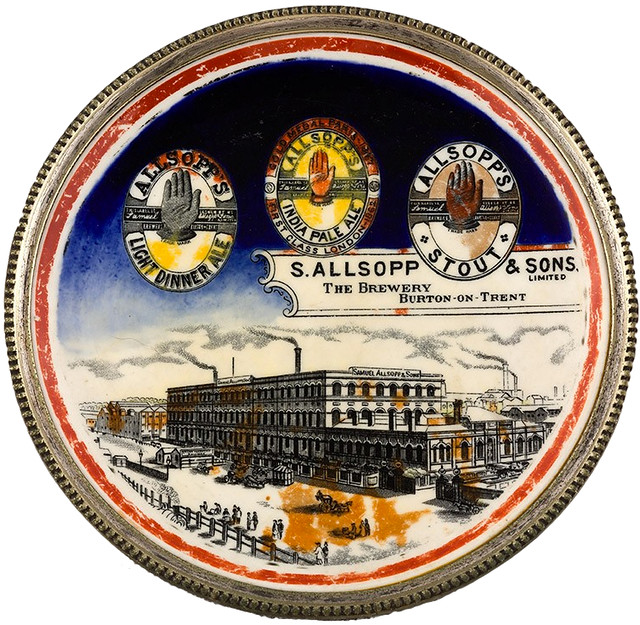
After Samuel’s death in 1838, his sons Charles and Henry continued the brewery as Allsopp and Sons. In 1859 they built a new brewery near the railway station, and added a prestigious office block in 1864. By 1861 Allsopps was the second largest brewery after Bass. Henry Allsopp retired in 1882 and his son Samuel Charles Allsopp took over. Allsopps was incorporated as a public limited company in 1887 under the style Samuel Allsopp & Sons Limited . There were scuffles at the doors of the bank in the City as potential investors fought for copies of the prospectus, but within three years, these investors were demanding their money back as the returns were so much lower than predicted. Under Samuel Allsopp, ennobled as the 2nd Lord Hindlip on the death of his father, Allsopps lurched from crisis to crisis. With the difficult trading conditions for beer at the beginning of the 20th century, many Burton breweries were forced to close down or amalgamate. After a failed attempt at a merger with Thomas Salt and Co and the Burton Brewery Company in 1907, Allsopps fell into the hands of the receivers in 1911. The company’s capital was restructured and it continued trading. In 1935 Samuel Allsopp & Sons merged with Ind Coope Ltd to form Ind Coope and Allsopp Ltd. The Allsopp name was dropped in 1959 and in 1971 Ind Coope was incorporated into Allied Breweries.
And here’s another history from “The Brewing Industry: A Guide to Historical Records,” edited by Lesley Richmond and Alison Turton, published in 1990:
Today is the birthday of Edward Greenall (August 10, 1758-August 20, 1835). He was the son of Thomas Greenall, who founded Greenall’s Brewery in 1762.
There’s not too much biographical information about Edward, but he is mentioned briefly in Thomas Greenall & Family:
The eldest son of Thomas Greenall was Edward (1758-1835), who purchased the Walton Hall estate. He had five sons of whom Thomas, Peter and Gilbert entered the family firm. It was Edward’s youngest son, Gilbert Greenall (1806-1894) who first lived at Walton Hall.
Greenall’s Brewery was founded by Thomas Greenall in 1762. Initially based in St Helens, the company relocated to Warrington in 1787.
It bought the Groves & Whitnall Brewery in Salford in 1961, Shipstone’s Brewery in Nottingham in 1978 and Davenport’s Brewery in Birmingham in 1986. For much of the 20th century, the company traded as Greenall Whitley & Co Limited. The St Helens brewery was demolished in the 1970s to make way for a new shopping centre. The Warrington brewery on the edge of Stockton Heath was bought by Bruntwood, renamed Wilderspool Business Park and is now let to office occupiers.
The company ceased brewing in 1991 to concentrate on running pubs and hotels.
In 1999, the tenanted wing of the Greenall’s operation was sold to the Japanese bank, Nomura for £370 million and the main Greenall’s operation, involving 770 pubs and 69 budget lodges, was sold to Scottish and Newcastle for £1.1billion. Greenalls started to focus its resources on its De Vere and Village Leisure hotel branding at that time.
In February 2005, Greenalls sold The Belfry to The Quinn Group for £186 million.
The Greenall family connection remained as Lord Daresbury, the descendant of the original founder, remained the non-executive chairman. This tie was severed in 2006 when Daresbury stepped down from the post and much of the family’s interest was sold.
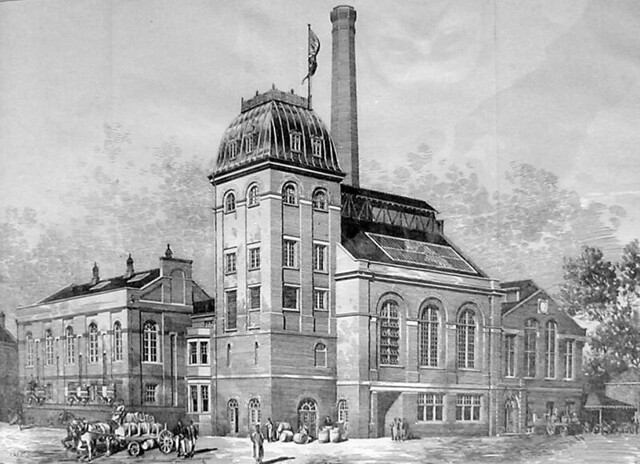
The Greenall, Whitley & Co. Ltd. Brewery, in St. Helens, in 1902.
Patriarch Thomas Greenall learned the brewing trade from his wife’s family in the 1750s and founded his own brewery in northwestern England at St. Helens in 1762. Brewing was a highly competitive business, with rivals ranging from the lone homebrewer to inns and pubs that brewed their own ales to wholesale brew masters like Greenall. Though the founder dabbled in nail making, coal mining, and yarn spinning throughout the late 18th century, brewing remained the family’s core interest. By the turn of the century, Thomas had brought sons Edward, William, and Peter into the business. The Greenalls began to purchase their own pubs and inns as early as 1800, helping to accelerate a gradual elimination of their competition. In Britain, it was customary for bars owned by breweries to carry only the beers brewed by the parent company. For nearly two centuries, these “tied houses” were a profitable segment of Greenall’s business.
In 1788, Greenall formed a separate partnership with William Orrett and Thomas Lyon to purchase the Saracen’s Head Brewery in nearby Wilderspool. Business was so good that within just three years the three partners undertook a £4,400 expansion of the operation.
The family business interests endured a rapid succession of generations in the first two decades of the 19th century. In 1805, both Thomas Greenall and William Orrett died. By 1817, the passing of William and Peter Greenall left only Edward to operate the growing St. Helens brewery. Just a year later, Thomas Lyon died. His nephew and heir, also Thomas, was interested in the Wilderspool brewery only as an investment. In 1818, 60-year-old Edward assigned eldest son Thomas to manage the family’s half interest in Wilderspool and charged younger son Peter with management of the family brewery at St. Helens.
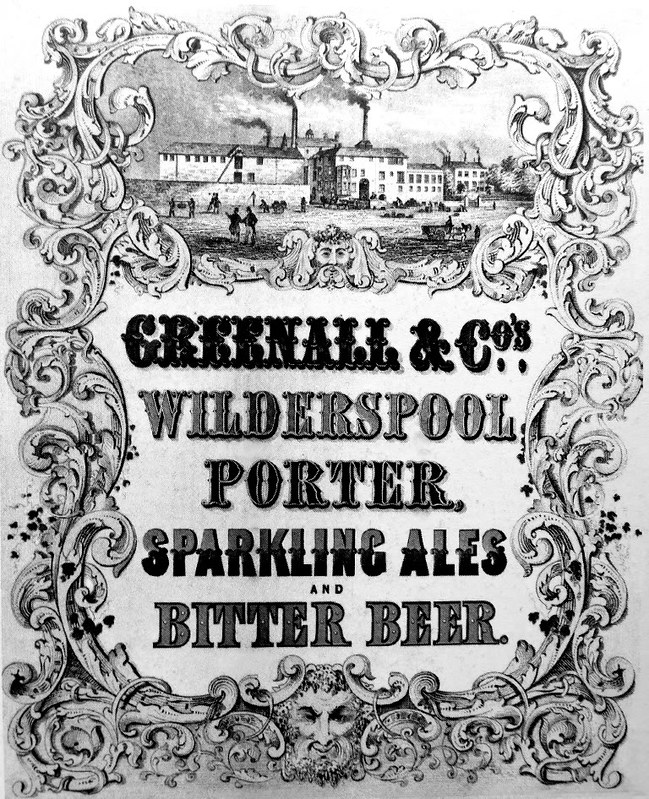
While Peter pursued politics, eventually winning election to Parliament, Thomas proved to be the brewer of his generation. By this time, the family businesses had grown to the point that the Greenalls served as chairmen, guiding the overall direction of the company but leaving daily management concerns to other top executives. Throughout this period, ownership of the pubs and inns through which Greenall’s porters, sparkling ales, and bitters were dispensed was a key to maintaining a strong competitive position.
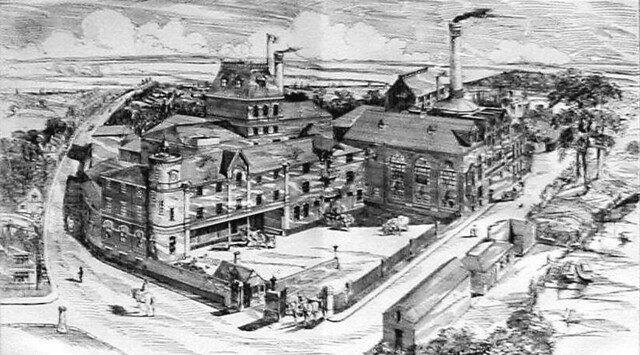
And this is Greenall Whitley & Co’s., Wilderspool Brewery, in Warrington in 1887.
And continuing Funding Universe’s history, this portion, entitled “Consolidation of Family Holdings in Mid-19th Century” is where Gilbert comes in and runs the company:
When both Peter and Thomas died in the late 1840s, their younger brother, Parliamentarian Gilbert Greenall, inherited the family’s St. Helens and Wilderspool holdings. Gilbert appointed his nephew, John Whitley, to manage the Wilderspool brewery in 1853 and set out himself to rebuild, retool, and enlarge the St. Helens operation mid-decade.
Longtime silent partner Thomas Lyon died in 1859 and his estate sold his stake in the Wilderspool brewery to Gilbert Greenall, making the Greenall family the sole owners of both the St. Helens and the Wilderspool operations. Gilbert marked the occasion by changing the unified firm’s name to Greenall & Company. Not long thereafter, Greenalls eliminated its last major local competitor by acquiring the Dentons Green Brewery in St. Helens. In 1880, Gilbert (who was made a baronet in 1876 by Queen Victoria) merged the St. Helens and Wilderspool breweries as Greenall Whitley & Company Limited and installed himself as the corporation’s first chairman. Though operating under the same corporate umbrella, the two houses retained their separate identities and brands. By 1882, Greenall’s annual sales volume totaled nearly 90,000 barrels of beer and the company owned about 200 pubs.
Sir Gilbert guided the expansion and modernization of the Wilderspool brewery as well as a flurry of acquisitions in the waning years of the 19th century. His four-year, £6,750 modernization program brought in state-of-the-art brewing and bottling equipment, upgraded the company’s railway access, and expanded the operation’s office space. Acquisitions included the Halewood, Richardson’s, and Spring breweries, bringing with them more than two dozen pubs. A rapid series of untimely deaths accelerated the family’s succession plans when in the space of just two years both Sir Gilbert and his second-in-command, Peter Whitley, died, propelling the chairman’s son, also Gilbert, into the leadership of two growing breweries at the young age of 27.
The new chairman suffered a trial by fire in the first two decades of the 20th century. He began the transition from horse-drawn transportation to gasoline-driven vehicles as early as 1908, adopting some of the first vehicles of their type. World War I brought extreme deprivation to the United Kingdom. Rationing of all foods–including brewing ingredients–and manpower shortages made this period a difficult one for Greenall Whitley, but the company emerged from the conflict unscathed.
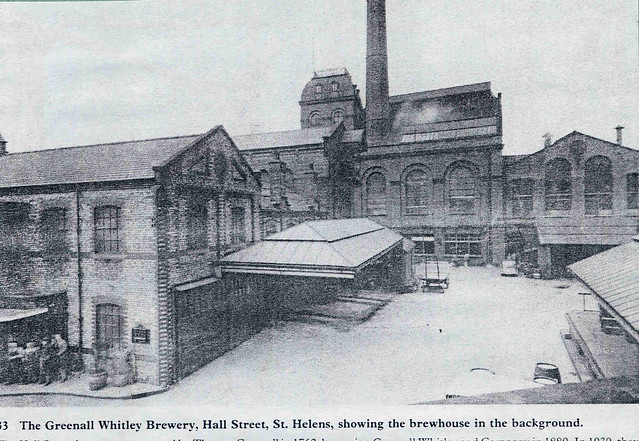
The St. Helens brewery in the 1930s.
Greenall Whitley resumed its acquisition strategy in the period between the World Wars, purchasing nine pubs in 1919 alone. Four years later, the brewery diversified into wine and liquors through the acquisition of Gilbert & John Greenall Limited, a distillery owned by another branch of the family. Though the business remained concentrated in the northwest region of Britain, acquisitions gave Greenall Whitley a growing share of the area’s breweries and pubs in the early 1930s. The purchase of three operations in as many years added nearly 90 ale houses and inns to the company roster.
After four decades as chairman, Lord Gilbert Greenall (who had been given the hereditary title First Baron Daresbury of Walton by King George V in 1927) died in 1938, passing leadership of Greenall Whitley to his son Edward. In his nine years of service to the company, Edward made a special effort to restore and preserve the company’s historic pubs, as well as maintain high standards of quality in the breweries.
Today is the birthday of John Allen Young (August 7, 1921-September 17, 2006). Young was the great-great-grandson of Charles Young, who co-founded Young’s brewery in 1831. “He joined the family firm in 1954 after serving as a fighter pilot and a merchant seaman. He became chairman and chief executive in 1962 when his father retired and reverted to executive chairman in 1999.”
Here’s his obituary, written by Roger Protz, from the Guardian in 2006.
John Young, who has died aged 85, will have a prominent place in the Brewers’ Hall of Fame, revered as the father of the “real ale revolution”, an iconoclast who believed in good traditional beer drunk in good traditional pubs. Young, chairman of Young’s of Wandsworth in south London for 44 years, steered the family brewery on a different course from the rest of the industry in the 1970s. It was a course that was derided at the time: however, it proved not only successful for Young’s but also encouraged other regional brewers to follow suit.
A spate of mergers in the 1960s had created six national brewers who attempted to transform the way beer was made by switching from cask ale to keg beer – filtered, pasteurised and artificially carbonated. Panic ensued as such brands as Watney’s Red Barrel, Worthington E and Whitbread Tankard rapidly dominated the market. Smaller regional brewers rushed to emulate the “Big Six”, as they were known.
In Wandsworth, John Young raised his standard above the Ram Brewery, on the oldest brewing site in Britain, and declared he would remain faithful to beer that matured naturally in its cask. He was laughed to scorn by directors of other breweries. Among the legion of stories about him, one is told of a meeting of the Brewers’ Society in London where, during a break for coffee, one member saw a funeral hearse passing by outside. “There goes another of your customers, John,” he told Young, to roars of laughter from his colleagues. John Young had the last laugh.
He was born in Winchester, the eldest of four sons of William Allen Young. The family was steeped in brewing. John was the great-great-grandson of Charles Allen Young, one of two businessmen who took over the 16th-century Ram Brewery in 1831. John’s mother was Joan Barrow Simonds, a member of the family that owned Simonds Brewery in Reading.
But John’s first love was sailing: he was educated at the Nautical College in Pangbourne. Sailing holidays in the late 1930s on the river Orwell in Suffolk brought John and his brothers into contact with Arthur Ransome at Pin Mill, the setting for We Didn’t Mean to Go to Sea. Ransome claimed that he, rather than the brothers’ father, introduced the boys to the pleasures of beer and darts.
Either side of the second world war, John went to Corpus Christi College, Cambridge, where he graduated with an honours degree in economics. During the war he served with distinction as a fighter pilot on aircraft carriers. He left the Fleet Air Arm as a lieutenant commander in 1947 and launched a career in shipping. For a while he was based in Antwerp, where he met his Belgian wife Yvonne. They married in 1951 and settled in West Sussex, from where John, with his brothers, was summoned to work at the Ram Brewery in 1954.
He succeeded his father as chairman in 1962 and set about refashioning the company to meet the challenges of the time. Improving the pub estate and offering children’s rooms – a daring move at the time – did not mean a move away from traditional values. The brewery retained a fierce commitment to cask beer and delivered it to local pubs by horse-drawn drays, while a live ram mascot, along with ducks and geese, were familiar if bizarre sights at Wandsworth.
The energetic new chairman visited every pub in his estate. He was on first name terms with his landlords and became friendly with regular customers. Company annual general meetings became lavish affairs where a white-suited John Young would proclaim his belief in traditional brewing values. He was so horrified by the way some London pubs were being remodeled in the 1970s – as wild west saloons or sputniks – that he once threatened to enter one pub armed with a packet of soap flakes to throw into a large fountain that had been installed there.
The commitment to cask beer paid off. Sales of Young’s ales rocketed and their success was instrumental in helping the Campaign for Real Ale to make its mark in the early 1970s. In 1975 John Young was made a CBE to mark his work in brewing and for charity: he was chairman of the National Hospital for Nervous Diseases in Bloomsbury and raised millions of pounds to build new wards and install modern equipment.
His passion for brewing remained unabated, and John continued to work and chair company AGMs up to this year, though he was visibly ill with cancer. His last few months in office were dogged by controversy: a redevelopment scheme in Wandsworth meant the brewery had to close. When a suitable alternative site could not be found in London, Young’s agreed to merge its brewing operations with Charles Wells of Bedford, a move that has not pleased all lovers of Young’s distinctive beers.
But 200 Young’s pubs will remain in London and the south-east, bricks and mortar reminders of the man who guided their fortunes with undiminished fervour for more than 40 years.
He is survived by a son, James, who is deputy chairman of Young’s, and a daughter, Ilse.
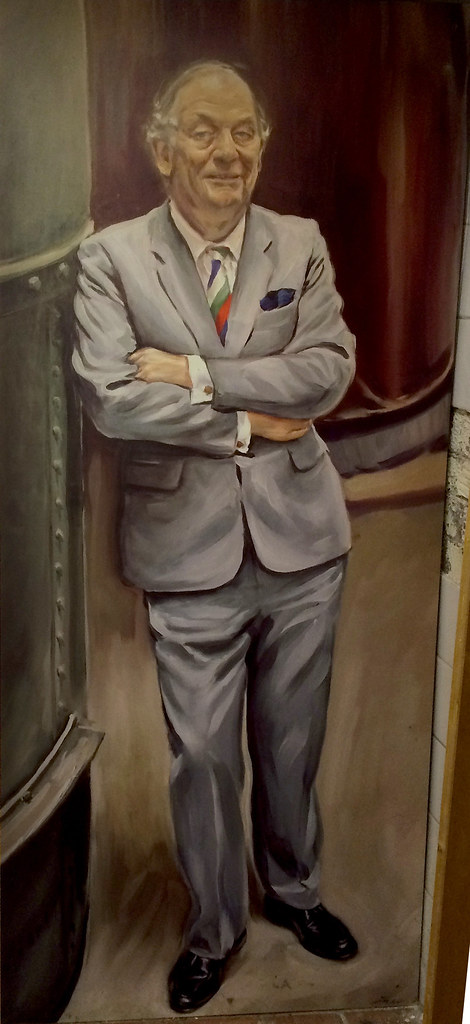
A portrait of John Young that used to be in the brewery tasting room.
And here’s another obit, this one from the Telegraph:
The brewing industry is mourning the loss of one of its most passionate and colourful characters, Young & Co’s chairman, John Young. He died at the age of 85 after a long battle against cancer. The timing is particularly poignant as Young’s will this week cease production at the historic Ram Brewery in Wandsworth, south London, where ales were first brewed in 1581.
Mr Young – known affectionately as Mr John by staff – was a staunch opponent of red tape. Last year, he complained in the annual report: “At the brewery, we can no longer walk down the yard to the offices because of health and safety regulations. Our horses need passports. Since they cannot fit into a photo-booth, a vet must be employed to sketch the animal.”
Mr Young will also be remembered for his eccentric annual shareholder meetings. In what became a tradition as he fended off attempts at reform by activist shareholder Guinness Peat Group, he started bringing props to the event.
One year, he wore a bee-keeper’s hat to show his resolve to keep the group’s preferential B shares for family members. On other occasions, he brandished a megaphone to make sure “certain people, who seemed to be ignoring what I have to say” could hear him, and sported oversized boxing gloves.
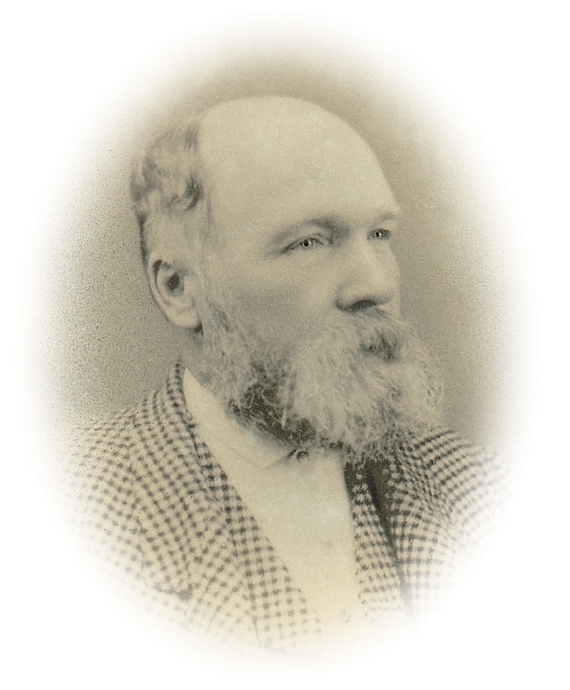
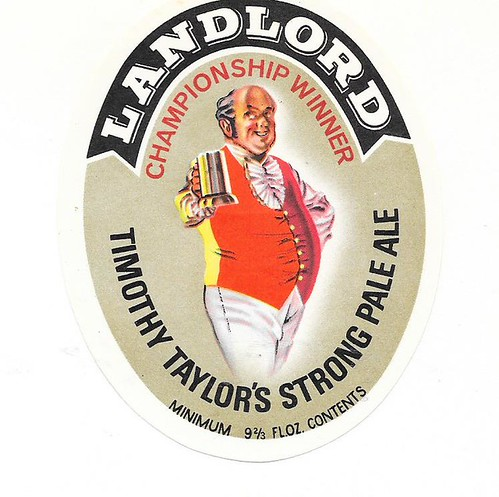
Today is the birthday of Timothy Taylor (August 6, 1826-January 1898). He was born in Bingley, part of West Riding in Yorkshire, England. In 1858, he founded a brewery with two partners, local businessmen James Shackleton and John Naylor, but by 1863 the partnership was dissolved and it became known as Timothy Taylor & Co. His sons, Percy and Robert Henry, joined him in the family business, and today the brewery remains in the Taylor family.
Here’s part of the early history of the brewery from the UK journal Brewery History:
Timothy Taylor, born on the sixth of August 1826 at Bingley in the West Riding of Yorkshire, was the eldest son of Richard and Elizabeth Taylor (neé Petyt). The family lived at Myrtle Place, Bingley, in 1841. Richard’s trade was tailoring and at that time they had an apprentice living with them. By the following census, Timothy had joined his father in business, then at premises on the Main Street, Bingley.
Between the years 1854 and 1857 a branch of Taylor & Sons, tailors and drapers, became established in Low Street, Keighley, with Timothy moving there, presumably to manage the outlet. The town had a population of 18,259 in 1851, with its main industries being the manufacture of textiles and engineering. Drinkers were able to slake their thirsts at eighteen fully licensed public houses and nine beerhouses. Three pubs were situated in Low Street, the thoroughfare where Timothy had set up shop.
Next door to his premises was the business and residence of Robert Aked, printer, stationer and stamp distributor.
Robert had one daughter, Charlotte, who married Timothy on the seventeenth of September, 1857 at the parish church. The following year Timothy commenced brewing in Cook Lane, a road that adjoined Low Street.
Whether his father-in-law instigated this new career move or was entirely of Timothy’s own volition it is not known, obviously he would have seen the amount of trade done by the local inns. He continued with his tailoring and drapery business, which had by 1861 been removed a short distance along Low Street, to a point where it became Change Gate. The company purchased their first public houses during 1859, the Volunteer’s Arms, Lawkholme Lane, Keighley, and New Inn at Bocking.
Richard Metcalf of Barking, Essex, presumably a property speculator, offered for sale in May 1863, the Knowle Park Estate, either in one lot or several lots. Timothy bought an area of land 5,000 square yards, forming part of Walker Royd Close, opposite Knowle Park Farm. The purchase of this green field site, about half a mile from the Cook Lane property provided the opportunity to move away from what was at that time the rather insanitary centre of Keighley and secure a pure supply of brewing liquor. An application to build at the Knowle came before the Keighley Local Board of Health in June 1863, sometime after that date Knowle Spring House, brewhouse and maltkiln were erected. The dwelling house was built as two homes for the Taylor and Aked families. Ownership of the land changed in September 1863 to Robert Aked. In this rural idyll, Timothy also farmed and when he later advertised for a malt kiln worker, one with agricultural experience was preferred.
By 1867 it appears he had severed all connections with the textile trade and a couple of years later showed his commitment to the local brewing trade by joining the Bradford and District Brewers’ Association’s first committee.
And this early history is from the UK blog Make Mine A Magee’s:
The founder of the firm, Timothy was born in Bingley in the West Riding of Yorkshire, on the 6th of August 1826 to Richard and his wife Elizabeth. Richard Taylor was, appropriately enough a Tailor, who at the time of Timothys birth was living on Myrtle Place in Bingley; and his eldest son joined him in his business. Soon after leaving school in 1841, where he quickly learned his fathers trade and went on to become the companys salesman in the local towns, and by 1853 the concern was known as Richard Taylor & Sons with premises on Main Street in Bingley and a second branch opening in Keighley in 1854; where Timothy was joined by his younger brother, Henry. However after two years the business partnership was dissolved; with Henry Taylor moving back to help run his fathers business in Bingley as a separate concern. The neighbours of Timothy at his premises on Low Street in Keighley included another local businessman, Robert Aked whose daughter Charlotte was to marry Timothy Taylor, in the parish church of Keighley on September 17, 1857.
In 1858, a family tragedy (the death of Timothy`s brother-in-law, Charles) quite probably gave him the inspiration to enter the brewing trade; as later in 1858, he entered into a partnership with local businessmen James Shackleton and John Naylor An old barn and stables on Cook Lane in Keighley were chosen as suitable for conversion to a brewery and Timothy commenced producing his ales later that year. The business began to prosper and by 1861, the census returns show that Timothy Taylor was listed as a Brewer, employing 8 men and 1 boy; however in 1863, the partnership between Timothy and the other gentlemen was dissolved on the 22nd of April.
Later, in 1863, the estate of the Greenwood family in Keighley; Knowle Park was offered for sale by their agent, and Timothy was possessed of sufficient acumen to acquire a substantial portion of it; and in June of that year, an application was duly presented to the Keighley Board of Health to erect a new brewery and other structures; amongst which was Knowle Spring House, (The family home for many years). By 1867, Timothy had severed most of his close ties with the clothing trade and was a founder member of the first committee of The Bradford & District Brewers Association whose first meetings were held in that year. Sadly, Timothy Taylor passed away in January 1898; with the business carried on by his sons Robert Henry Taylor and Percy Taylor, and by 1911, rising demand for the brewery’s products saw an expansion of the brewery, with new buildings being erected to house a Mill, Mash Tun (which was in use until 2000), Copper and Hop Back (replaced in 1976).
Today is the birthday of Hamar Alfred Bass (July 30, 1842-April 8, 1898). He was the great-grandson of William Bass, the founder of the Bass brewery, and the second son of brewer Michael Thomas Bass.
Bass was born in Burton upon Trent, the second son of brewer Michael Thomas Bass and his wife Eliza Jane Arden, daughter of Major Samuel Arden of Longcrofts Hall, Stafford. Bass was the great-grandson of William Bass, the founder of the brewery firm of Bass & Co, and his elder brother became Lord Burton. Bass was educated at Harrow School and became a Director of the family firm of Bass, Ratcliff, Gretton and Co. He was Honorary Major of the 4th Prince of Wales’s (North Staffordshire) Regiment and was a J.P. for Staffordshire. Bass played cricket for the Marylebone Cricket Club (MCC), making a single first-class appearance for the MCC against Sussex in 1865. He was dismissed in the MCC’s first-innings by James Lillywhite, while in their second-innings he was dismissed for 3 runs by George Wells. The match ended in a draw.
Bass was elected MP for Tamworth at a in by-election in 1878 and held the seat until 1885 when the representation was reduced to one seat under the Redistribution of Seats Act 1885. He was elected MP for West Staffordshire in the 1885 general election and held the seat until his death aged 55 in 1898 from a complex form of rheumatism.
Bass was a breeder at the Byrkley Stud and his horse “Love Wisely” won the Ascot Gold Cup in 1896. He was also for 12 years master of the Meynell Hunt.
Bass married Louisa Bagot (1853–1942), daughter of William Bagot, 3rd Baron Bagot, in 1879. They lived at Byrkley Lodge and Needwood House, Burton, and also at 145 Piccadilly, London. After his death, Louisa married Rev Bernard Shaw.
Bass’s sister Emily Bass married Sir William Plowden, MP for Wolverhampton West, and his sister Alice Bass married Sir George Chetwode being the mother of Field Marshal Philip Chetwode.
Bass’s son William succeeded in his uncle’s baronetcy according to special remainder. Hamar Bass’s daughter Sibell Lucia married Major Berkeley John Talbot Levett of the Scots Guards, son of Theophilus Levett of Wychnor Park, Staffordshire. Berkeley Levett served as one of the Gentlemen Ushers to the Royal Family from 1919 to 1937.
Rear: Austro-Hungarian Ambassador, Lady Alice Stanley.
Back Row: Hon. Col. Legge, Marquis of Soveral, Duchess of Devonshire, Mr Hamar Alfred Bass, Lord Elcho, Miss Jane Thornewill, H.M. Queen Alexandra, Lord Burton (Michael Arthur Bass), Lady Mar & Kellie, Prince Henry of Pless
Front Row: Lady Noreen Bass, Miss Muriel Wilson, Lady Desborough, Lady de Grey, H.M. King Edward VII, Lady Burton (Harriett Bass), Princess Henry of Pless, Mrs Alice Fredrica Keppel, Miss Bunny Thornewill
Hamar Bass was the second son of Michael Thomas Bass and his wife Eliza Jane Arden. He was brother of Lord Burton and also a Director of the family firm of Bass, Ratcliff, Gretton and Co. One sister Emily married Sir William Plowden, MP for Wolverhampton West, and the other married Sir George Chetwode being the mother of Field Marshall Philip Chetwode.
Hamar Bass was MP for Tamworth from 1878 to 1885. He was then MP for West Staffordshire from 1885 until his death aged 56 in 1898 from a complex form of rheumatism.
Hamar Bass married Louisa Bagot (1853-1942), daughter of William Bagot, 3rd Baron Bagot, in 1879. They lived at Byrkley Lodge and Needwood House, Burton, and also at 145 Piccadilly, London. Louisa subsequently married Rev Bernard Shaw. He was a breeder at the Byrkley Stud and his horse “Love Wisely” won the Ascot Gold Cup in 1896. He was also for 12 years master of the Meynell Hunt.
His son William succeeded in his uncle’s baronetcy of Stafford according to special remainder. Hamar Bass’s daughter Sibell Lucia married Major Berkeley John Talbot Levett, Scots Guard, son of Theophilus Levett of Wychnor Park, Staffordshire. Berkeley Levett served as one of the Gentlemen Ushers to the Royal Family from 1919 to 1937.
Today is the birthday of Michael Thomas Bass (July 23, 1760-March 9, 1827). He was the son of Bass brewery founder William Bass who ran the brewery from 1787, greatly increasing the brewery’s business and expanding into new markets, such as the Baltic States and Germany.
Bass was the son of William Bass, a carrier from Leicestershire, who founded the brewery in 1777. After his father’s death in 1787, Michael ran the brewery with his brother William until he took sole control in 1795. He continued to develop the Baltic trade with Russia and North Germany, exporting via the River Trent and Hull.
He extended the brewery’s operations, laying the foundations for its future success. He entered into partnership with John Ratcliff and in 1799 he built a second brewery at Burton. Following the Napoleonic blockade, Burton brewers needed another market, and Bass was one of the breweries to start brewing and exporting India Pale Ale (IPA).
Bass married Sarah Hoskins, the daughter of Abraham Hoskins of Burton and Newton Solney. Sarah’s brother, Abraham, built Bladon Castle, a folly which aroused bad feeling locally. Sarah’s great grandfather George Hayne was responsible for establishing the Trent Navigation as an active concern.
Bass died at the age of 66. His eldest son, Michael Thomas Bass continued to manage the brewery company and was MP for Derby for over 35 years. His third son Abraham Bass was an influential cricketer, known as the ‘father of midlands cricket’
After his father’s death in 1787, Michael ran the brewery with his brother William until he took sole control in 1795. He continued to develop the Baltic trade with Russia and North Germany, exporting via the River Trent and Hull.
He extended the brewery’s operations, laying the foundations for its future success. He entered into partnership with John Ratcliff and in 1799 he built a second brewery at Burton. Following the Napoleonic blockade, Burton brewers needed another market, and Bass was one of the breweries to start brewing and exporting India Pale Ale.
Bass married Sarah Hoskins, the daughter of Abraham Hoskins of Burton and Newton Solney. Sarah’s brother, Abraham, built Bladon Castle, a folly which aroused bad feeling locally. Sarah’s great grandfather George Hayne was responsible for establishing the Trent Navigation as an active concern.
On Bass’s death in 1827, his eldest son, Michael Thomas Bass, Jr., born in 1799, succeeded to the brewery.
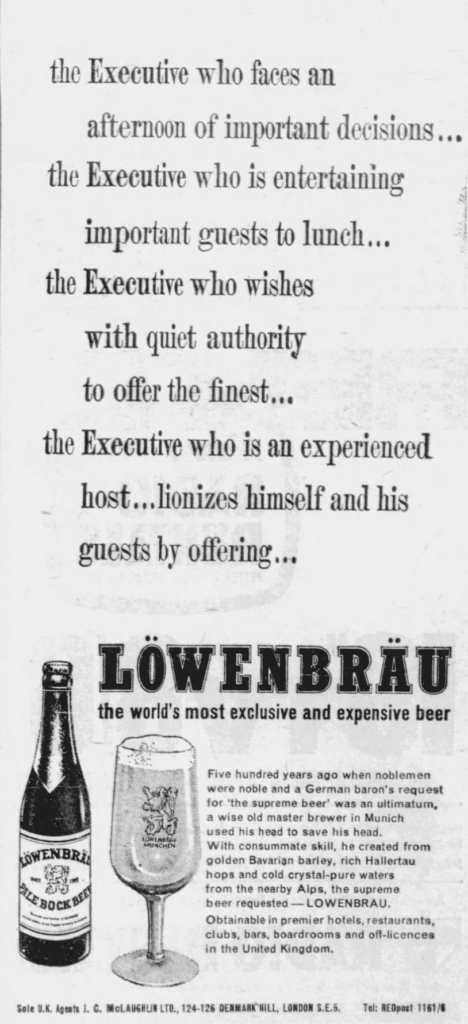
Two years ago I decided to concentrate on Bock ads for awhile. Bock, of course, may have originated in Germany, in the town of Einbeck. Because many 19th century American breweries were founded by German immigrants, they offered a bock at certain times of the year, be it Spring, Easter, Lent, Christmas, or what have you. In a sense they were some of the first seasonal beers. “The style was later adopted in Bavaria by Munich brewers in the 17th century. Due to their Bavarian accent, citizens of Munich pronounced ‘Einbeck’ as ‘ein Bock’ (a billy goat), and thus the beer became known as ‘Bock.’ A goat often appears on bottle labels.” And presumably because they were special releases, many breweries went all out promoting them with beautiful artwork on posters and other advertising. With Spring approaching, there are so many great examples that I’m going to post two a day for a few months.
Wednesday’s ad is for Löwenbräu Pale Bock Beer, which was published on July 22, 1964. This ad was for the Löwenbräu Brewery, of Munich, Germany, which was originally founded in 1383. It’s funny to me that in trying to position the brand as high-end, they state that it’s “the world’s most exclusive and expensive beer.” This ad ran in the Evening Standard, of London, England.
Today is the birthday of English beer writer Adrian Tierney-Jones. Adrian’s written several beer books, and writes online at Called to the Bar. I first got to know him when he was the editor for 1001 Beers You Must Taste Before You Die, to which I contributed around two-dozen entries. I’ve also seen Adrian at events in London and Belgium since then, and he’s a great person to share a pint with. Join me in wishing Adrian a very happy birthday.
Having another pint.
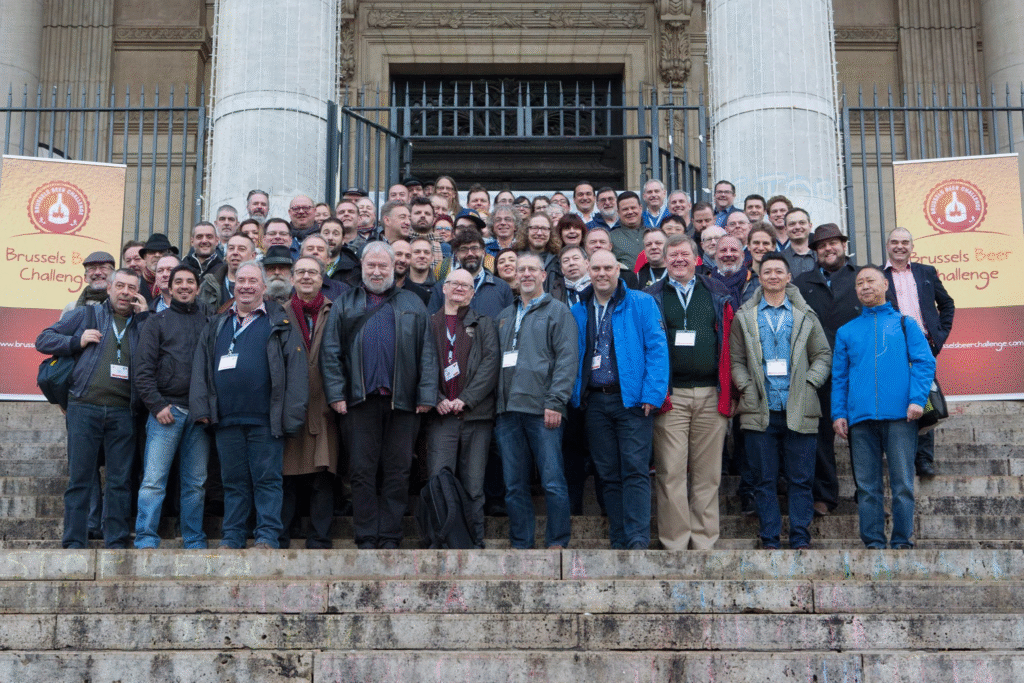
In Leuven for the Brussels Beer Challenge a few years ago: Adrian, with fellow Brits Tim Hampson, Tim Webb and Pete Brown.
Me and Adrian having a beer and a chat in Belgium in 2014.
Brussels 2015, from left: Me, Stephen Beaumont, Pete Brown, Yuri Katunin and Adrian.
Visiting Brassiere De La Senne in Brussels with a group after Brussels Beer Challenge judging..
Judging in Brussels in 2016.
[Note: first and third photos purloined from Facebook.]
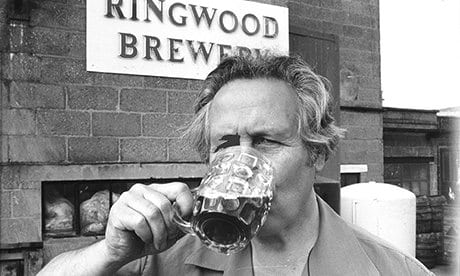
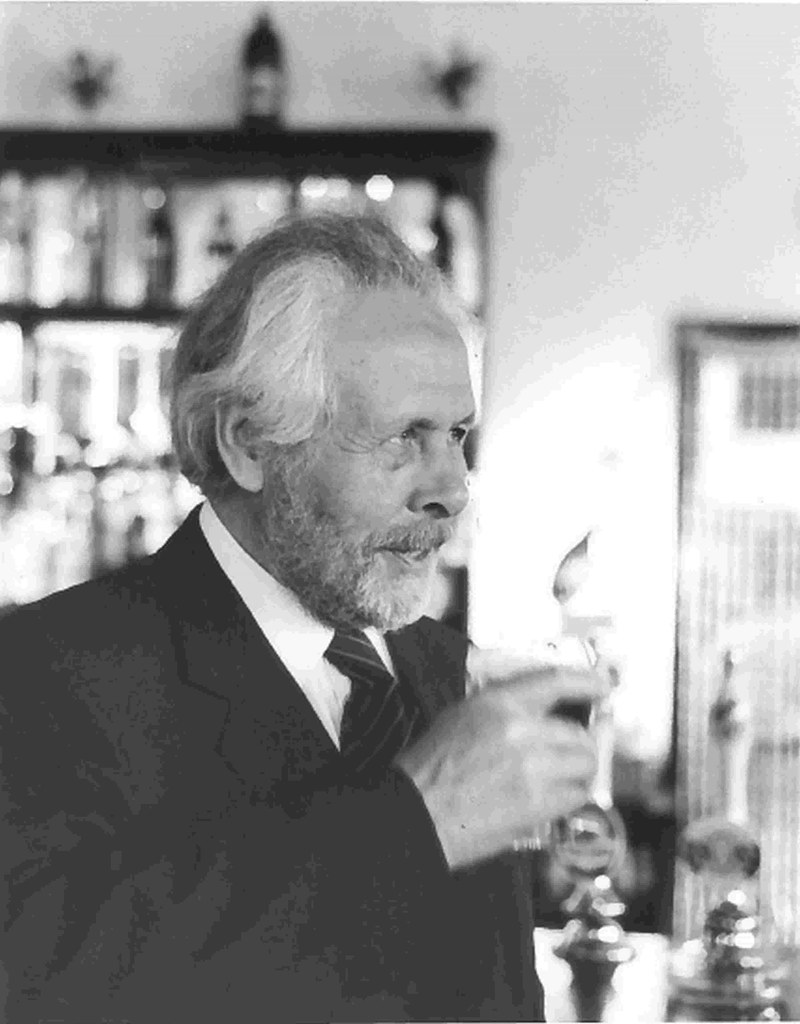
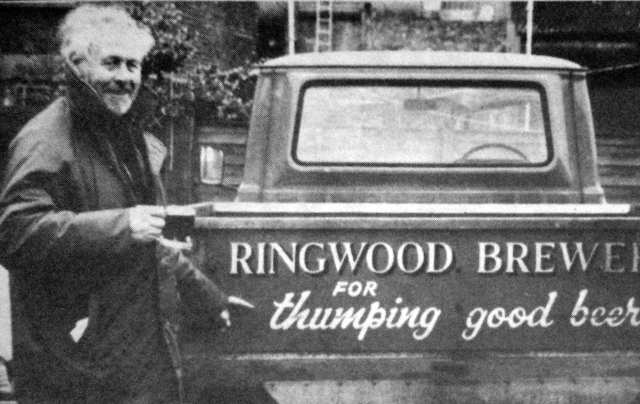
Today is the birthday of Peter Austin (July 18, 1921-January 1, 2014). He “was a British brewer. He founded Ringwood Brewery and was a co-founder and first chairman of the Society of Independent Brewers (SIBA). He built some 140 new breweries in the UK and 16 other countries.”
Peter Austin was born in Edmonton, London on 18 July 1921. He went to Highgate School, followed by the British merchant navy training ship HMS Conway. His father worked for the brewing equipment supplier Pontifex, and his great-uncle had run a brewery in Christchurch.
Austin founded Ringwood Brewery in 1978. In 1979, David Bruce started his first Firkin Brewery brewpub in Elephant and Castle, London; Austin oversaw his choice of equipment and the design for its small basement brewery.
Austin was the prime mover in establishing the Society of Independent Brewers (SIBA) in 1980, and its first chairman. Under his leadership, SIBA campaigned for 20 years, without the support of any other body, for a progressive beer duty system (smaller breweries to pay less tax on their products) to be introduced in the UK. Such a system was finally adopted by the then Chancellor Gordon Brown in 2002.
By the time that Austin had retired from Ringwood Brewery, he had assisted in helping start 40 new UK breweries in a decade. After that, he worked internationally, in the US, France, China, Nigeria, and Russia, among others, building some 140 new breweries in 17 countries.
In the US alone, 74 new breweries were built, all using his brewing system. He taught Alan Pugsley brewing, and he went on to found Shipyard Brewing Company in 1994, and later take over Sea Dog Brewing Company.
Peter only recently passed away. Here’s his obituary in the Guardian, written by Roger Protz:
One rain-swept day in 1978 I went to Ringwood in Hampshire to meet Peter Austin and encounter a new concept in beer making: a micro-brewery. At that time brewing was dominated by six giant national brewers who were converting their pubs to keg beers and taking over and closing many of the remaining independent breweries.
It seemed unlikely that Peter Austin’s tiny plant in a former bakery would dent the power of the Big Six nationals. But Ringwood Brewery proved to be a catalyst. Camra – the Campaign for Real Ale – had been launched in 1971, its membership had soared and its beer festivals were packed.
Rebellion was in the air and Peter Austin, who has died aged 92, was ready to meet the challenge. When he eventually retired from Ringwood he helped set up some 40 new breweries in Britain over 10 years at a rate of one every three months. He then toured the world, repeating the exercise in countries as diverse as China, France, Nigeria, Russia and the United States. In total he built some 140 breweries in 17 countries.
Peter Austin was born in Edmonton, north London, and educated in Highgate and on the Merchant Navy training ship HMS Conway. His family was closely involved in the brewing industry. A great uncle ran a brewery in Christchurch while his father worked for Pontifex, a major supplier of brewing equipment. As a result of the Hampshire connection, his first love was boats not beer and he sailed in Poole Harbour during school holidays. He joined P&O from the Conway but contracted TB and had to be invalided home from Australia.
He was not fit enough to fight in World War Two and moved into brewing. He did his “pupillage” or apprenticeship at Friary, Holroyd & Healy in Guildford, worked briefly at Morrells in Oxford and joined the Hull Brewery in 1945, where he became head brewer. He left in 1975 following a takeover by Northern Dairies.
He moved to Hampshire, bought a boat and took visitors on fishing expeditions. But the brewing bug had bit deep. In 1977 he accepted an invitation from Monty Python’s Terry Jones and Guardian writer Richard Boston – both passionate believers in the concept of small is beautiful – to build a tiny brewery in a former cattle byre at Penrhos Court in Herefordshire. He was back in brewing and a year later opened Ringwood. With business partner David Welsh, he produced Ringwood Best Bitter, Fortyniner and XXXX Porter. The strong ale Old Thumper put Ringwood and micro-brewing on the map when it won the Champion Beer of Britain award from Camra in 1988. Peter was the first chairman of the Small Independent Brewers’ Association (Siba), now the Society of Independent Brewers, which became a powerful lobbying voice for the sector.
In 1986 Peter and David Welsh moved from the original site in Ringwood into bigger buildings in the town that had once housed Tunks Brewery. Ringwood was now a substantial business, producing 80 barrels a week for pubs throughout the south and south-west. Peter sold his share to David Welsh and became a consultant, adviser and builder to aspiring brewers in Britain and then worldwide.
His biggest impact was undoubtedly in the United States where 74 breweries were built using his brewing system. Alan Pugsley learnt the brewing skills with Peter at Ringwood (pictured above with Peter) and emigrated to the U.S. where he helped set up the D L Geary Brewing Company in Portland, Maine, in1986, one of the first new-wave American micros. Pugsley opened his own Shipyard brewery in Portland in 1992 and Peter gave him permission to brew Old Thumper under license. He supplied a sample of the Ringwood yeast culture for authenticity. A new brewery using Peter Austin’s system will open this month at the Four Mile Pub in Victoria, British Columbia — a fitting memorial.
Peter Austin married twice. His first wife, Joan, died in 1972 and he married Zena, who pre-deceased him. He had five children, Roland, Jane, Henry (who died in 1992) Jeremy and Sarah, and two step-children, Philip and Leah.
His impact on good beer is immeasurable. There are more than 2,000 craft breweries in the U.S., 1,200 in Britain, 150 in Australia, 70 in New Zealand and a growing number in Italy. Beer drinkers have never had greater choice – and much of that is due to Peter Austin. Alan Pugsley at Shipyard in Maine says: “He was an inspiration” and Terry Jones hails him as “the grandfather of micro-brewing”.
This tribute to his mentor is from Pugsley’s Brewing Projects International:
In 1978 Peter Austin opened Ringwood Brewery in Hampshire, England, presenting a new concept in beer making: a microbrewery. At that time in the UK brewing was dominated by six giant national brewers who were converting their pubs from cask conditioned beers ( real ale) to bland filtered keg beers and taking over and closing many of the remaining independent breweries.
It seemed unlikely that Peter Austin’s tiny plant in a former bakery would dent the power of the Big Six nationals. But Ringwood Brewery proved to be a catalyst. CAMRA – the Campaign for Real Ale – had been launched in 1971, its membership had soared and its beer festivals were packed.
Rebellion was in the air and Peter Austin was ready to meet the challenge. When he eventually retired from Ringwood he had helped set up some 40 new breweries in Britain over 10 years at a rate of one every three months. He then toured the world, repeating the exercise in countries as diverse as China, France, Belgium, Nigeria, South Africa, Russia, Canada and the United States. In total he and his consulting company built some 140 breweries in 17 countries.
Peter Austin was born in Edmonton, north London, and educated in Highgate and on the Merchant Navy training ship HMS Conway. His family was closely involved in the brewing industry. A great uncle ran a brewery in Christchurch while his father worked for Pontifex, a major supplier of brewing equipment. As a result of the Hampshire connection, his first love was boats not beer and he sailed in Poole Harbour during school holidays. He joined P&O from the Conway but contracted TB and had to be invalided home from Australia.
He was not fit enough to fight in World War Two and moved into brewing. He did his “pupillage” or apprenticeship at Friary, Holroyd & Healy in Guildford, worked briefly at Morrells in Oxford and joined the Hull Brewery in 1945, where he became head brewer. He left in 1975 following a takeover by Northern Dairies.
He moved to Hampshire, bought a boat and took visitors on fishing expeditions. But the brewing bug had bit deep. In 1977 he accepted an invitation from Monty Python’s Terry Jones and Guardian writer Richard Boston – both passionate believers in the concept of small is beautiful – to build a tiny brewery in a former cattle byre at Penrhos Court in Herefordshire. He was back in brewing and a year later opened Ringwood. With business partner David Welsh, he produced Ringwood Best Bitter, Fortyniner and XXXX Porter. The strong ale Old Thumper put Ringwood and microbrewing on the map when it won the Champion Beer of Britain award from CAMRA in 1988. Peter was the first chairman of the Small Independent Brewers’ Association (SIBA), now the Society of Independent Brewers, which became a powerful lobbying voice for the sector.
In 1986 Peter and David Welsh moved from the original site in Minty’s Yard, Ringwood into bigger buildings in the town that had once housed Tunks Brewery. Ringwood was now a substantial business, producing over 80 barrels a week for pubs throughout the south and south-west. In 1990 Peter sold his shares to David Welsh but continued consulting to aspiring brewers in Britain and worldwide.
His biggest impact was undoubtedly in the United States where over 75 breweries have been built using the Original Peter Austin Brick Kettle Brewing System. Alan Pugsley learnt the brewing skills with Peter at Ringwood and emigrated to the U.S. where he helped set up the D L Geary Brewing Company in Portland, Maine, in 1986, one of the first new-wave American micros. In 1994 Shipyard Brewing Company was opened in Portland, Maine where Ringwood Brewery gave Alan Pugsley permission to brew Peter Austin’s Old Thumper recipe under licence. Peters legacy is truly alive and well in North America particularly the North East corridor.
Peter Austin passed away January 1, 2014 at the age of 92. Peter was a master brewer, Alan Pugsley’s mentor and dear friend. He was a great man, a great brewer, and an inspiration to all whom he touched. His legacy will continue on through the many beers and brewers he inspired around the world. His impact on good beer is immeasurable. There are more than 2,500 craft breweries in the U.S., 1,200 in Britain, 150 in Australia, 70 in New Zealand and a growing number in Italy. Beer drinkers have never had greater choice – and much of that is due to Peter Austin.
THE founder of Ringwood brewery Peter Austin – widely credited with saving the microbrewery movement in the UK as well as introducing it to America and popularising it worldwide – has died aged 92.
Mr Austin set up the famed brewery in 1978, aged 57. He came from a brewing family; his great-uncle was a brewer in Christchurch and his father worked for Pontifex, which was the leading brewing engineering firm in the country.
After school Mr Austin joined the sail training ship HMS Conway and subsequently went to sea with P&O. He was invalided out in 1938 and convalesced before going to Friary Meux Brewery in Guildford to study.
In 1944 he worked at Morrells in Oxford and in 1945 he went as third brewer to the Hull Brewery, where he stayed for 30 years, eventually becoming head brewer.
But in 1975, disillusioned with the direction of the company after it was taken over by Northern Dairies, he left 30 years of brewing, bought a boat and ran sea-angling trips on the south coast.
Mr Austin was approached by Monty Python star Terry Jones and The Guardian beer columnist Richard Boston, who were looking for help setting up a small brewery with Martin Griffiths, the owner of a medieval manor called Penrhos Court and he leaped at the chance to return to brewing.
The Penrhos Brewery was established and this inspired Mr Austin to launch Ringwood Brewery, starting with small premises in the old station yard.
Business partner David Welsh previously described Mr Austin as “a slave to the mash tun”, often checking his brews in the early hours.
He told The Grist magazine in 1995: “One very hot summer night he went down (to the brewery) in his dressing gown and had to take this off to skim the yeast. There was a knock at the door and it turned out to be the local bobby who was confronted by Peter in his underpants, wielding a yeast scoop. ‘You’re probably wondering what I’m doing officer’, he said. ‘I didn’t like to ask, sir’,” came the reply.”
In 1982 Mr Austin hired Alan Pugsley to train to brew and work with him on brewery start-ups.
They installed more than 120 breweries in 17 countries, including Siberia, China, Nigeria and South Africa. The equipment for the Siberian brewery was lost in the Russian railway system for two years before finally turning up in Dudinka.
Mr Austin also helped found the UK’s small brewers association SIBA in 1980.
Keith Bott of Titanic Brewery in Staffordshire, the current SIBA chairman, told Camra magazine: “Peter Austin was the godfather of the microbrewing revolution in the UK.”
In 1986 Mr Austin moved the brewery to its current location, and retired two years later, aged 67. On July 12, 2007, it was announced that Ringwood had been purchased by Marston’s Plc for £19.2million.
Mr Austin’s son Jeremy said: “The family are proud of dad, who was very modest about all that he had achieved.
“Peter was a determined and colourful character who made an impression on all. He was bright and amusing right up until the end and his family and friends will miss him deeply.”
Today would have been the 72nd birthday of Glenn Payne, an Englishman who wore many beer hats, but unfortunately passed away several years ago. I first met Glenn many moons ago when he was the beer buyer for Safeway in the UK. Since then, we’d judged together many times at both GABF and the World Beer Cup, and once at the Great British Beer Festival, too. He’s been involved with Meantime Brewing among too many projects for me to keep track of, and he’s been a great ambassador for British beer but, perhaps more importantly, for American beer in Great Britain. Join me in drinking a toast to Glenn’s memory. Cheers, mate.
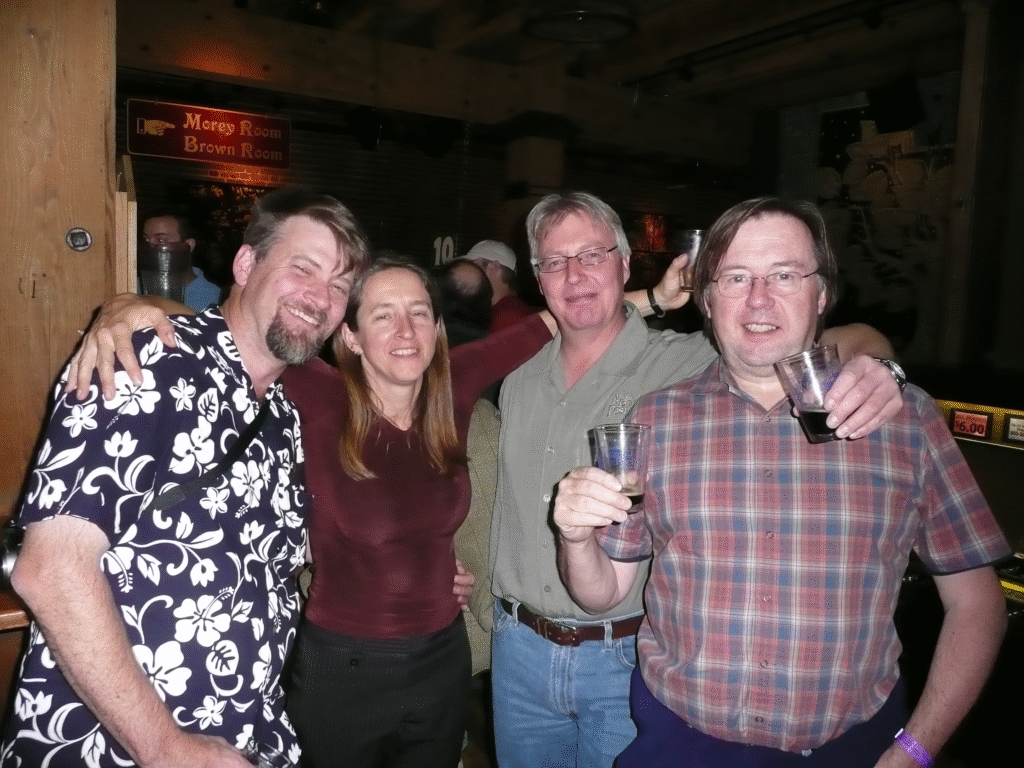
With Chris and Cheryl Black, owners of the Falling Rock, Mark Dorber, formerly the publican of the White Horse in London (and now owner of the Anchor) and Glenn Payne at the Brewers Reception at Wynkoop during GABF Week in 2007.
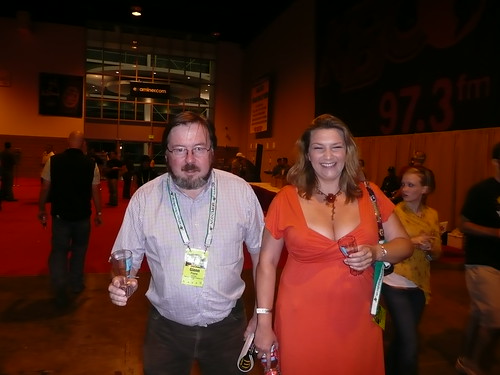
Glenn, with Melissa Cole, at GABF in 2009.
Glenn with Greg Koch, from Stone Brewing, also at GABF in 2009.
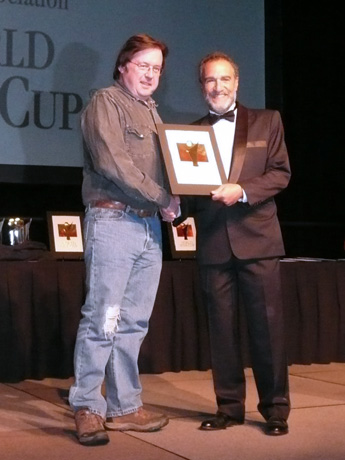
Glenn accepting a World Beer Cup award on behalf of a British brewery who couldn’t be there in 2008.