Brookston Beer Bulletin

Jay R. Brooks on Beer

  • Home
  • About
  • Editorial
  • Birthdays
  • Art & Beer

Socialize

  • Dribbble
  • Email
  • Facebook
  • Flickr
  • GitHub
  • Instagram
  • LinkedIn
  • Pinterest
  • RSS
  • Twitter
  • YouTube

Powered by Genesis

Beer In Ads #5221: Bowler Brothers’ Bock

April 14, 2026 By Jay Brooks

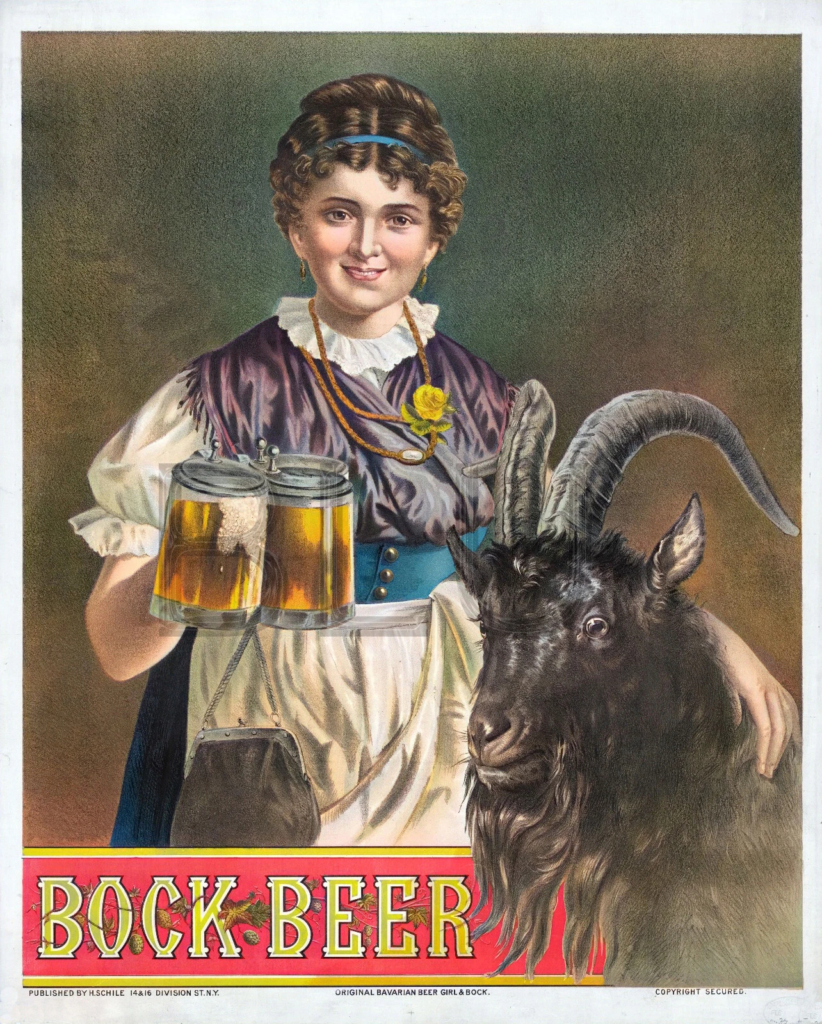
Two years ago I decided to concentrate on Bock ads for awhile. Bock, of course, may have originated in Germany, in the town of Einbeck. Because many 19th century American breweries were founded by German immigrants, they offered a bock at certain times of the year, be it Spring, Easter, Lent, Christmas, or what have you. In a sense they were some of the first seasonal beers. “The style was later adopted in Bavaria by Munich brewers in the 17th century. Due to their Bavarian accent, citizens of Munich pronounced ‘Einbeck’ as ‘ein Bock’ (a billy goat), and thus the beer became known as ‘Bock.’ A goat often appears on bottle labels.” And presumably because they were special releases, many breweries went all out promoting them with beautiful artwork on posters and other advertising. With Spring approaching, there are so many great examples that I’m going to post two a day for a few months.
Tuesday’s first ad is for Bowler Brothers’ Bock Beer, which was published on April 14, 1914. This one was for the Bowler Brothers Brewing Co. of Worcester, Massachusetts, which was founded in 1883, but a few years after prohibition was repealed it went by the Brockert Brewing Co. until 1945 when it changed its name agin to the Worcester Brewing Co., which it remained for twenty years until it closed for good in 1965. This ad ran in The Record Journal, of Meriden, Massachusetts. 

Filed Under: Art & Beer, Beers, Breweries, Just For Fun Tagged With: Advertising, Bock, History, Massachusetts

Historic Beer Birthday: George W. Bashford

April 14, 2026 By Jay Brooks

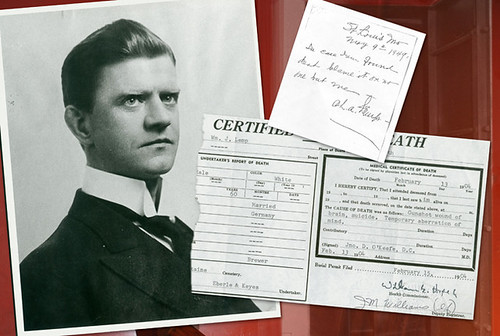
Today is the birthday of George William (Some accounts say Wesley, though his headstone has only an initial “W”) Bashford (April 14, 1833-January 4, 1913). He was born in Columbia, New York, and by 1860, as age 25, he was living in Wisconsin and married Emma Jane in February, though another souce claims the marriage didn’t take place until 1865. He served in the Army during the Civil War, stationed in Iowa, and seems to have settle there afterwards, and all four of his children were born in Iowa. In 1899, the family moved to Oregon and settled in Jacksonville, Oregon. He appears to have owned the Medford Lumber Yard at 8th and Fir streets, but In 1893, he founded the Southern Oregon Brewing, Ice and Cold Storage Co. also in nearby Medford, Oregon. After 1895, they used Medford Brewing Co. as a trade name for the business.

He appears to have gotten out of the brewing business fairly quickly, and sold the brewery to Henry Weinhard in 1897, just four years after starting it. With anothger partner, he then returned to milling, and “bought a flour mill in Roseburg, [which] stayed in the family until it was blown up in the famous Roseburg blast in 1959.”

Because he was brewing for such a short time, there wasn’t much more information I could find. Here’s a short obituary from 1913:

Filed Under: Birthdays, Breweries, Just For Fun Tagged With: History, Iowa, New York, Oregon

Beer In Ads #5220: Hello People! I Am The Centlivre Bock Beer Goat

April 13, 2026 By Jay Brooks

Two years ago I decided to concentrate on Bock ads for awhile. Bock, of course, may have originated in Germany, in the town of Einbeck. Because many 19th century American breweries were founded by German immigrants, they offered a bock at certain times of the year, be it Spring, Easter, Lent, Christmas, or what have you. In a sense they were some of the first seasonal beers. “The style was later adopted in Bavaria by Munich brewers in the 17th century. Due to their Bavarian accent, citizens of Munich pronounced ‘Einbeck’ as ‘ein Bock’ (a billy goat), and thus the beer became known as ‘Bock.’ A goat often appears on bottle labels.” And presumably because they were special releases, many breweries went all out promoting them with beautiful artwork on posters and other advertising. With Spring approaching, there are so many great examples that I’m going to post two a day for a few months.

Monday’s ad is for Centlivre Bock Beer, which was published on April 13, 1916. This one was for the The brewery was the C.L. Centlivre Brewing Co. of Fort Wayne, Indiana, which was founded in 1862 by Charles l. Centlivre. It went through several name changes until 1970, when it closed, however it was recently relaunched by the Centlivre family as Centlivre Beer. This ad ran in The Fort Wayne News, also of Fort Wayne, Indiana. 

Filed Under: Art & Beer, Beers, Breweries, Just For Fun Tagged With: Advertising, Bock, History, Indiana

Historic Beer Birthday: George Gund II

April 13, 2026 By Jay Brooks

gunds
Today is the birthday of George Gund II (April 13, 1888-November 15, 1966). He was the son of George F. Gund and the grandson of John Gund, the founder of John Gund Brewing, of La Crosse, Wisconsin, and the brother of Henry Gund and John Gund Jr., who founded Lexington Brewing, in Lexington, Kentucky. George Frederick Gund founded Gund Brewing Co., of Cleveland, Ohio. Despite the brewing heritage, Gund II “was an American banker, business executive, and real estate investor who lived in Cleveland, Ohio in the early and middle part of the 20th century. Heir to the George Frederick Gund brewing and banking fortune, he was a philanthropist for most of his life. He established The George Gund Foundation in 1952 and endowed it with most of his $600 million fortune at his death.”

george-gund-headshot

Here’s his biography from Wikipedia:

Gund’s grandfather, Johann Gund, was born in 1830 in Brühl am Rhein in the independent country of the Grand Duchy of Baden (now part of Germany). The family emigrated to the United States in 1848 and settled in Illinois, but in 1854 moved to La Crosse, Wisconsin. There his grandfather founded the John Gund Brewery. His father, George Frederick Gund, was born in LaCrosse in 1856 and later managed the Gund Brewery. His father moved to Seattle, Washington, founded the Seattle Brewing and Malting Company, became a director of two banks, and then returned to the Midwest to move his family to Cleveland in 1897. His father bought the Jacob Mall Brewing Company, renamed it the Gund Brewing Company, and made a large fortune investing in banking, mining, and real estate.

George Gund, Jr. (as he was then known) was born to George Frederick and Anna Louise (Metzger) Gund on April 13, 1888. He was a student at the University School of Cleveland from 1897 to 1905. He entered Harvard University, and received his A.B. in 1909. Toward the end of his Harvard education, he simultaneously enrolled in the Harvard Business School, and graduated in the school’s first class in 1909. He moved to Seattle and took a job as a clerk with the Seattle First National Bank, but moved back to Cleveland when his father died in 1916. But when World War I broke out, he enlisted in the United States Army and served in the Military Intelligence Division.

gund-brewery-ohio
The Jacob Mall Brewing Co. when George Gund bought it in 1897.

After the start of prohibition in the United States in 1920, Gund was forced to close his father’s brewery in Cleveland. But during the war, Kaffee HAG, a German corporation, was stripped of its assets in the United States. Among its subsidiaries was Sanka, the company which manufactured decaffeinated coffee. Gund purchased Sanka in 1919, then sold it to Kellogg’s in 1927 for $10 million in stock. Gund also took over management of the Gund Realty Company in Cleveland and invested his money in numerous ventures. During the depths of the Great Depression, he purchased large amounts of stock at very low prices.

Gund studied animal husbandry at Iowa State University from 1922 to 1923. He made many trips to California and Nevada, often staying there for many months at a time, and became interested in a possible political career in Nevada. He purchased a large cattle ranch in Nevada, but on May 23, 1936, he married Jessica Laidlaw Roesler. She was the granddaughter of Henry Bedell Laidlaw, the founder of one of the first investment banking houses in New York City, Laidlaw & Company. Gund purchased a large home in Beachwood, a wealthy suburb of Cleveland, and the couple had six children: George III, Agnes, Gordon, Graham, Geoffrey, and Louise.

In 1937, Gund was elected a director of the Cleveland Trust Company (a savings bank established in 1896), and was named president in 1941. He was made chairman of the board of trustees in 1962. Under Gund’s leadership, by 1967 the bank had more than $2 billion in assets, making it the 18th largest bank in the United States. Gund also served on the board of directors of another 30 national and multinational corporations. But despite the urban nature of his work, Gund never lost his affection for the Old West. He used his income to collect a large number of works of art which depicted the American West, including works by Albert Bierstadt, Frederic Remington, and Charles Marion Russell.

George Gund died of leukemia at the Cleveland Clinic on November 15, 1966. He was interred at Lake View Cemetery in Cleveland.

His foundation also has a nice biography of him.

gunds-clevelander

Gunds--quot-Finest-quot--Beer-Labels-Gund-Brewing-Co

Filed Under: Birthdays, Just For Fun Tagged With: History, Wisconsin

Historic Beer Birthday: Joseph Bramah

April 13, 2026 By Jay Brooks

Today is the birthday of Joseph Bramah (April 13, 1748-December 9, 1814). Bramah was an English engineer, and inventor, whose most famous invention was the hydraulic press. But he also made improvements and created a practical beer engine, creating his beer pump and engine inventions between 1785 and 1797.

Joseph Bramah: portrait in oils

Another summary of his achievements is quite flattering:

English engineer and inventor whose lock manufacturing shop was the cradle of the British machine-tool industry. Central in early Victorian lockmaking and manufacturing, he influenced almost every mechanical trade of the time. Like Henry Ford, his influence was probably greater for the manufacturing processes he developed, than the product itself. He took out his first patent on a safety lock (1784) and in 1795 he patented his hydraulic press, known as the Bramah press, used for heavy forging. He devised a numerical printing machine for bank notes and was one of the first to suggest the practicability of screw propellers and of hydraulic transmission. He invented milling and planing machines and other machine tools, a beer-engine (1797), and a water-closet.

As for the actual patents, there were two of them. The first was in 1785 and was for what he called a “beer pump.” Then, in 1793 he was granted Patent No. 2196 for his improved version, now referred to as a “beer engine.” It was actually a Dutchman, John Lofting, who had first invented the beer pump in 1688, but Bramah’s were more refined and practical, and more importantly, patented. Curiously, Grace’s Guide to British Industrial History lists the patent dates as 1787 and 1797, so it’s unclear which are the correct dates.

In this engraving, entitled Men of Science Living in 1807-8, Bramah is on the left side, the tenth one in the back from the left. He’s the one with the wide sash across his chest and the star-shaped badge on his jacket. Others include Joseph Banks, Henry Cavendish and James Watt.

Engraving after ‘Men of Science Living in 1807-8’

There’s even a J.D. Wetherspoon’s pub in his home town of Bramley called The Joseph Bramah

Filed Under: Birthdays, Just For Fun, Politics & Law, Related Pleasures Tagged With: Cask, England, Great Britain, History

Beer In Ads #5219: Good Old Point Special Bock Beer

April 12, 2026 By Jay Brooks

Two years ago I decided to concentrate on Bock ads for awhile. Bock, of course, may have originated in Germany, in the town of Einbeck. Because many 19th century American breweries were founded by German immigrants, they offered a bock at certain times of the year, be it Spring, Easter, Lent, Christmas, or what have you. In a sense they were some of the first seasonal beers. “The style was later adopted in Bavaria by Munich brewers in the 17th century. Due to their Bavarian accent, citizens of Munich pronounced ‘Einbeck’ as ‘ein Bock’ (a billy goat), and thus the beer became known as ‘Bock.’ A goat often appears on bottle labels.” And presumably because they were special releases, many breweries went all out promoting them with beautiful artwork on posters and other advertising. With Spring approaching, there are so many great examples that I’m going to post two a day for a few months.

Sunday’s second ad is for Point Special Bock Beer, which was published on April 12, 1938. This one was for the Stevens Point Brewery of Stevens Point, Wisconsin, which was originally founded in 1857 and is still brewing today. This ad ran in The Stevens Point Journal, also of Stevens Point, Wisconsin. I love that the ad is celebrating the fifth anniversary of the repeal of prohibition, and that their beer was “Extra-Aged for Easter,” whatever that means. The inset describes a statewide brewery celebration throughout Wisconsin.

Filed Under: Art & Beer, Beers, Breweries, Just For Fun Tagged With: Advertising, Bock, History, Wisconsin

Beer In Ads #5218: The “Butter-In” Of The Season

April 12, 2026 By Jay Brooks

Two years ago I decided to concentrate on Bock ads for awhile. Bock, of course, may have originated in Germany, in the town of Einbeck. Because many 19th century American breweries were founded by German immigrants, they offered a bock at certain times of the year, be it Spring, Easter, Lent, Christmas, or what have you. In a sense they were some of the first seasonal beers. “The style was later adopted in Bavaria by Munich brewers in the 17th century. Due to their Bavarian accent, citizens of Munich pronounced ‘Einbeck’ as ‘ein Bock’ (a billy goat), and thus the beer became known as ‘Bock.’ A goat often appears on bottle labels.” And presumably because they were special releases, many breweries went all out promoting them with beautiful artwork on posters and other advertising. With Spring approaching, there are so many great examples that I’m going to post two a day for a few months.

Sunday’s first ad is for Lembeck & Betz Bock Beer, which was published on April 12, 1906. This one was for the Lembeck & Betz Eagle Brewing Co., of Jersey City, New Jersey, which was originally founded in 1869 Henry Lembeck and John Betz. The ad ran in the Jersey Journal, also of Jersey City, New Jersey.

Filed Under: Art & Beer, Beers, Breweries, Just For Fun Tagged With: Advertising, Bock, History, New Jersey

Beer In Ads #5217: The King Of All Beers

April 11, 2026 By Jay Brooks

Two years ago I decided to concentrate on Bock ads for awhile. Bock, of course, may have originated in Germany, in the town of Einbeck. Because many 19th century American breweries were founded by German immigrants, they offered a bock at certain times of the year, be it Spring, Easter, Lent, Christmas, or what have you. In a sense they were some of the first seasonal beers. “The style was later adopted in Bavaria by Munich brewers in the 17th century. Due to their Bavarian accent, citizens of Munich pronounced ‘Einbeck’ as ‘ein Bock’ (a billy goat), and thus the beer became known as ‘Bock.’ A goat often appears on bottle labels.” And presumably because they were special releases, many breweries went all out promoting them with beautiful artwork on posters and other advertising. With Spring approaching, there are so many great examples that I’m going to post two a day for a few months.

Saturday’s second ad is for Lexington Bock Beer, which was published on April 11, 1903. This one was for the Lexington Brewing Co., of Lexington, Kentucky, which was originally founded in 1897. The ad ran in the Lexington Herald Leader, also of Lexington, Kentucky.

Filed Under: Art & Beer, Beers, Breweries, Just For Fun Tagged With: Advertising, Bock, History, Kentucky

Beer In Ads #5216: The Finest Bock, As Usual

April 11, 2026 By Jay Brooks

Two years ago I decided to concentrate on Bock ads for awhile. Bock, of course, may have originated in Germany, in the town of Einbeck. Because many 19th century American breweries were founded by German immigrants, they offered a bock at certain times of the year, be it Spring, Easter, Lent, Christmas, or what have you. In a sense they were some of the first seasonal beers. “The style was later adopted in Bavaria by Munich brewers in the 17th century. Due to their Bavarian accent, citizens of Munich pronounced ‘Einbeck’ as ‘ein Bock’ (a billy goat), and thus the beer became known as ‘Bock.’ A goat often appears on bottle labels.” And presumably because they were special releases, many breweries went all out promoting them with beautiful artwork on posters and other advertising. With Spring approaching, there are so many great examples that I’m going to post two a day for a few months.

Saturday’s first ad is for Anheuser-Busch Bock Beer, which was published on April 11, 1891. This one was for the Anheuser-Busch Brewing Co., then of St. Louis, Missouri, which was originally founded in 1852 as the Bavarian Brewery by George Schneider. Eberhard Anheuser and Adolphus Busch, who’s married Anheuser’s daughter Lilly, had acquired it outright by 1869. The ad ran in the Washington Post, of Washington, D.C.

Filed Under: Art & Beer, Beers, Breweries, Just For Fun Tagged With: Advertising, Bock, History, Missouri

Historic Beer Birthday: Anton Heeb

April 11, 2026 By Jay Brooks

Today is the birthday of Anton Heeb (April 11, 1811-January 23, 1888). He was born in Hesse-Kassel, Germany, and emigrated to the U.S. in 1835, when he was 24 years old, originally landing in Baltimore, Maryland. Here, Tavern Trove picks up the story:

He lived in that city for a short time then moved to Newark, New Jersey.  By 1838 he had moved to the St. Louis, Missouri, a city that at the time was on the western frontier of America.

In August of 1838 Anton Heeb married Elizabeth Fleischhauer and they had one child before she died a few years later.  Heeb married again to Carolina Knopf in 1845, but she also died just a few days after giving birth to their first child Laurenz in February 1846.  In November of that year Heeb married once again to Katharina Gehrig.  In addition to being a very brave woman she was the daughter of Joseph Anton Gehrig, a brewer who had just arrived in St. Louis from Switzerland.

The elder Gehrig at age 49 had obtained employment at the Washington Brewery in St. Louis and there he met and took under his wing fellow brewer and Swiss emigre 22 year old Matheus Tschirgi.

Gehring was not in America to be in somebody’s employ.  He wanted a brewery of his own.  He saw opportunity in the Territory of Iowa, specifically in the river town of Dubuque.  In the spring of 1846 Gehrig and Tschirgi journeyed 350 miles up the Mississippi to a brand new town that had never before seen a brewery.  But when Gehrig died in August he left a fully functioning brewery in the hands of the apprentice brewer Tschirgi.  Heeb and his betrothed received the terrible news along with a request to come help young Tschirgi in the Dubuque brewery.

Reports say that Heeb was an experienced brewer and maltster, but the St. Louis City Directory of 1847 lists Anthony Heeb as a brick maker.  Nonetheless Heeb got married, wrapped up business in St. Louis and by the next spring he and his wife had arrived in Dubuque.

Iowa had now become a state and Dubuque was growing quickly.  With Heeb in charge the Dubuque brewery started making money and the Heeb family started growing as well. Ultimately Anton and Katharina had nine children together.

The Heeb brewery grew too.  In addition to being the first brewery in Iowa it maintained its position as the largest brewery in Iowa too.  Tschirgi eventually moved on to found other breweries throughout Iowa.  Heeb stayed put, ultimately guiding the brewery for 41 years until his death at age 76, on the 23rd of January 1888.

In 1892 the Dubuque Brewing and Malting Company was brought into the Iowa brewery syndicate, and over the next four years Iowa anti-saloon laws convinced the brewery to close.

This obituary of Anton Heeb is from the Daily Times on January 24, 1888

Mr. Anton Heeb Dies at His Home on Couler Avenue Yesterday Afternoon.

Biography of the Most Prominent Brewer in the Northwest.

Mr. Anton Heeb died at his home, 2125 Couler avenue, at a quarter after 3 o’clock yesterday afternoon, his bedside being surrounded by his immediate relatives. The cause of death was a complication of diseases of which rheumatism was the most prominent. He had been subject to the latter disease for about twenty-five years, but about a year ago he was attacked by his old complaint in such a manner that he was greatly enfeebled and kept gradually growing weaker until the lamp of life flickered for the last time. He demise had been expected for two weeks by his family, but the public were not aware that his end was so near, and when it became known it occasioned deep regret.

Mr. Heeb was born in Kurhessen, Germany, on the 11th of April, 1811, and accordingly lacked but a few months of being 77 years of age. He emigrated to America and landed in Baltimore, in 1835. He remained in Baltimore a short time, and then moved to Newark, N.J., where he also remained a short time, and then removed to St. Louis, remaining there until 1846, when he came to Dubuque to seek a location for a brewery. Finding this a suitable place, he, in 1847, established one here and conducted it up to about the time he was taken sick, something over a year ago, being in the business forty-one years. His business grew until it became the most extensive in Iowa, if not in that portion of the Northwest, west of the Mississippi, and he was known far and wide. In January , 1846 he was united in marriage to Miss Katharina Gehrig, a distant relative of the Late Joseph Gehrig, of the Jefferson House, also a native of Germany, who was his second wife, his first wife being Miss Carolin Knapp. He leaves two children by the latter, Jacob and Lawrence of LeMars. His surviving children are: Caroline, who is the wife of Mr. Fred Tschudi; Julia, the wife of Mr. Michael Zwack; Bertha, who is Mrs. L.J. Baumhover; Emily, who is in a convent at Redwing, Minn., and whose name in religion is Sister Cassilda; Anna, the wife of Mr. Frank Hellman of Sioux City; Ben and A.F. Heeb. Mr. Louis Heeb, another of his sons, and one of the most excellent young men Dubuque has ever had, died three of four years ago.

Mr. Heeb was a man of a great deal more than ordinary intelligence, and on several occasions was honored by his fellow citizens with offices of honor and trust. He served his ward as a member of the Council; and was also a member of the Board of Supervisors, in both of which positions he performed his duties in a manner which reflected the highest credit upon himself and his constituents. At the time of his demise he was a member of the Board of Directors of the Dubuque Fire and Marine Insurance Company. Mr. Heeb was the soul of honor, a thorough gentleman, kind-hearted and charitable, and his death will be sincerely regretted by all. He has lain down the burdens of this life with the silvered crown of honored age upon his head, and his memory will be revered in the years to come.

And this account is from Encyclopedia Dubuque:

HEEB, Anton. (Hesse Cassel, Germany Apr. 11,1811–Dubuque, IA, Jan. 23, 1888). Heeb once operated the largest brewery in Iowa. He emigrated to America and landed in Baltimore in September, 1835; in 1836, he went to St. Louis; he came to Dubuque in 1846. The following year, 1847, he came here, located permanently, and established the A. HEEB BREWING COMPANY at Couler and Eagle Point avenues (later Central Avenue and East 22nd Street). In July 1875 records in the United States Revenue Office in Dubuque indicated that Heeb had sold 904 barrels of beer. In 1879 the Dubuque Herald stated that he had purchased $7,000, equivalent to $166,166.67 in 2016, in hops. At the time of his death, the company had an annual production of 15,000 barrels. Heeb’s brewery was among those which formed the DUBUQUE BREWING AND MALTING COMPANY.

Heeb served as a director of the GERMAN TRUST AND SAVINGS BANK and the DUBUQUE FIRE AND MARINE INSURANCE COMPANY. At the time of the building of the Chicago, Dubuque and Minnesota and the Chicago, Clinton and Dubuque railroads, he was involved in construction contracts with Mr. Morgan. He was elected an alderman to the city council and a county supervisor.

And here’s a second obituary of Anton Heeb from the Daily Herald, also on January 24, 1888

DEATH OF A. HEEB

Another of Dubuque’s Prominent Citizens Answers the Last Summons

Yesterday afternoon at a quarter past three, death ended the sufferings of one of Dubuque’s most prominent citizens, Hon. Anton Heeb. For the past twenty five years he had been afflicted with rheumatixm, and for the past year had suffered almost continually with it, though able at times to be up and around. For about two weeks it had been feared hourly that the disease, combined with his advanced age, would result fatally. Yesterday morning he was somewhat brighter than hehad been, and his family were hopeful, but a relapse set in and at the hour stated, he died.

Anton Heeb was born April 11, 1811, at Kurheasen, Germany, and emigrated to this country in 1835, landing at Baltimore. From there he went to New Jersy, and in 1836 went to St. Louis. He came to Dubuque in 1846 and in the following year established the foundation of the great business which bears his name. During the more than forty years in which he has conducted the brewing business it has constantly grown so that it became the largest institution of the kind in the state. He was also known to be most scrupulousin all his business dealings, and has left as a precious heirloom, a most enviable name for honesty and integrity. He did not devote his entire attention to the brewing business, but found time to engage in many public enterprises. At the time of the building of the Chicago, Dubuque and Minnnesota and the Chicago, Clinton and Dubuque railroads, he was largely interested in construction contracts in connections with Mr. Morgan. He was a director of the German Bank, and also of the Dubuque Fire and Marine Insurance Company, and was interested in other institutions of the city. He was an honorary member of the Pius Benevolent Society.

Mr. Heeb was twice married his first wife being Miss Caroline Knapp. In 1846 he was united in marriage to Miss Kathrina Gehrig, a native of Germany and a relative of the late Jos. Gehrig. Besides his wife, he leaves surviving his several children, Jacob and Lawrence of LaMars, Iowa, sons by his former wife, and Caroline (Mrs. Fred Tschudi), Julia (Mrs. Michael Zwack, Bertha (Mrs. L. J. Baumhover), Emily (Sister Cassilda, of Red Wing convent), Ben, Anna (Mrs. Frank Hellman of Sioux City), and A. F. The oldest child by his second wife, Louis, died a few years ago.

Mr. Heeb was a most exemplary citizen and was deeply loved by all the members of his family and respected by all who knew him or had business dealings with him. He was a staunch Catholic, and in his last moments received the sacraments and the consolations of his church.

He was during his lifetime, a staunch Democrat and was elected a county supervisor and twice as a member of the city council. His official record was typical of the man, and he endeavored in every way to serve the public with the most scrupulous honesty and with the utmost regard to the public welfate. Dubuque has lost in his death one of her best and most public spirited citizens, and one who will be sincerely mourned.

The funeral will take place from the family residence, 2125 Couler avenue, Thursday morning at half past 9, to St. Mary’s church, of which Mr. Heeb was during his life, a most faithful and liberal communicant. The interment will be at the German Catholic cemetery.

And these are from an article in 1932 speculating about whether or not the brewery would reopen after prohibition.

Filed Under: Birthdays, Breweries, Just For Fun Tagged With: Germany, History, Iowa

« Previous Page
Next Page »

Find Something

Northern California Breweries

Please consider purchasing my latest book, California Breweries North, available from Amazon, or ask for it at your local bookstore.

Recent Comments

  • Bob Paolino on Beer Birthday: Grant Johnston
  • Gambrinus on Historic Beer Birthday: A.J. Houghton
  • Ernie Dewing on Historic Beer Birthday: Charles William Bergner 
  • Steve 'Pudgy' De Rose on Historic Beer Birthday: Jacob Schmidt
  • Jay Brooks on Beer Birthday: Bill Owens

Recent Posts

  • Historic Beer Birthday: Joseph Theurer May 24, 2026
  • Historic Beer Birthday: James Barkley May 23, 2026
  • Beer Birthday: Tony Forder May 23, 2026
  • Historic Beer Birthday: Henry Wagstaff May 22, 2026
  • Historic Beer Birthday: Jacob Leinenkugel May 22, 2026

BBB Archives

Feedback

Head Quarter
This site is hosted and maintained by H25Q.dev. Any questions or comments for the webmaster can be directed here.