Brookston Beer Bulletin

Jay R. Brooks on Beer

  • Home
  • About
  • Editorial
  • Birthdays
  • Art & Beer

Socialize

  • Dribbble
  • Email
  • Facebook
  • Flickr
  • GitHub
  • Instagram
  • LinkedIn
  • Pinterest
  • RSS
  • Twitter
  • YouTube

Powered by Genesis

Historic Beer Birthday: Lawrence Steese

April 30, 2026 By Jay Brooks

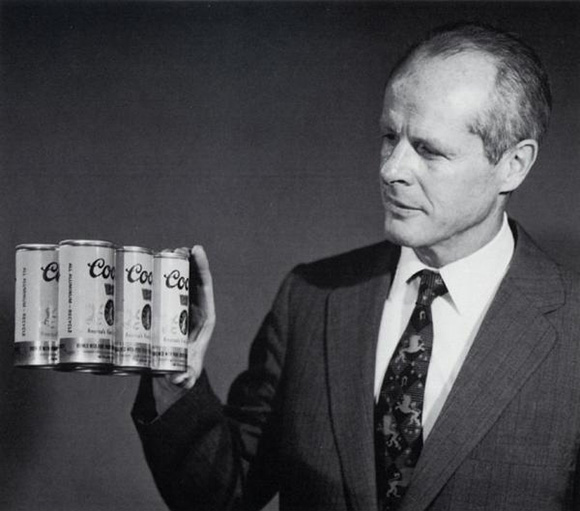
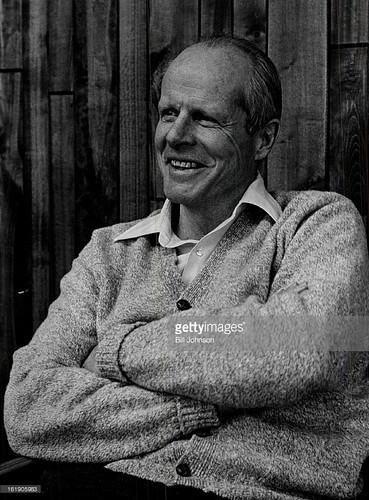
Today is the birthday of Lawrence Steese (April 20, 1912-April 19, 1991). Steese is part of the more recent lore of Anchor Brewing. Originally from Mill Valley, in Marin County, he bought Anchor in 1960 when Joe Allen was retiring, though Allen stayed around to teach him how to make Steam Beer. Fifty-one percent of the brewery was then bought by Fritz Maytag, who eventually bought out Steese and assumed full control.

Steese was from Mill Valley, and in the July 14, 1962 edition of the Daily Independent Journal, an article used the headline How a Marinite Rescued Steam Beer, which included the following in its coverage.

SOME THREE years ago the requiem for steam beer was being played, and the sad demise of a California tradition was being mourned. At that time Joe Allen, owner of Anchor Brewery, announced his retirement. There was no one skilled in the exacting art of steam beer brewing to take his place, and no one, it seemed, who cared to take the time and trouble to learn from the old master. No one, that is, until Lawrence Steese decided he’d like to try. Joe Allen was more than willing to teach. And since his official “retirement” these three years past, Allen has spent his days at the brewery as professor of steam beer brewing. The making of steam beer is not like the brewing of other beers. Steam beer is naturally carbonated; neither additives nor preservatives become it. “The Sincere Beer,” it is called by some. IT IS TRULY a “health food,” its devotees assert, containing more malt and hops than other beers, and without corn or rice to lighten it.

And this account of Fritz Maytag buying Anchor from Steese is on their website:

By 1965, as America slaked its thirst with lighter, mass-produced, heavily marketed beers, the Old Spaghetti Factory had become one of Anchor’s last remaining accounts. Fred—ever loyal—even loaned the brewery money to help keep San Francisco’s beer afloat. In July 1965, he heard the news that Anchor—then known as the Steam Beer Brewing Company—was about to shut down.

Fred turned to a customer and friend who was living in the City by the Bay, twenty-seven-year-old Fritz Maytag—great-grandson of the founder of a well-known appliance company in Newton, Iowa. Fred knew that if Maytag paid a visit to the brewery, he might just fall in love with it. Sure enough, “it was as if,” Fritz reminisced, “someone said, ‘That’s the last cable car and it’s going out of business tomorrow unless you put up a few thousand dollars.’”

On August 2, Fritz Maytag shook hands with owner/brewmaster Lawrence Steese, purchasing 51% of the brewery (and its debt) and rescuing our brewery from imminent oblivion. Final papers were filed September 24. San Francisco’s iconic beer and “medieval brewery”—as Fritz fondly calls it—were saved!

steese-anchor
And this is Steese’s story, distilled to its essence on Anchor Brewery’s website today.

Filed Under: Birthdays, Breweries, Just For Fun Tagged With: California, History

Beer In Ads #5235: The Buck Is Loose!

April 29, 2026 By Jay Brooks

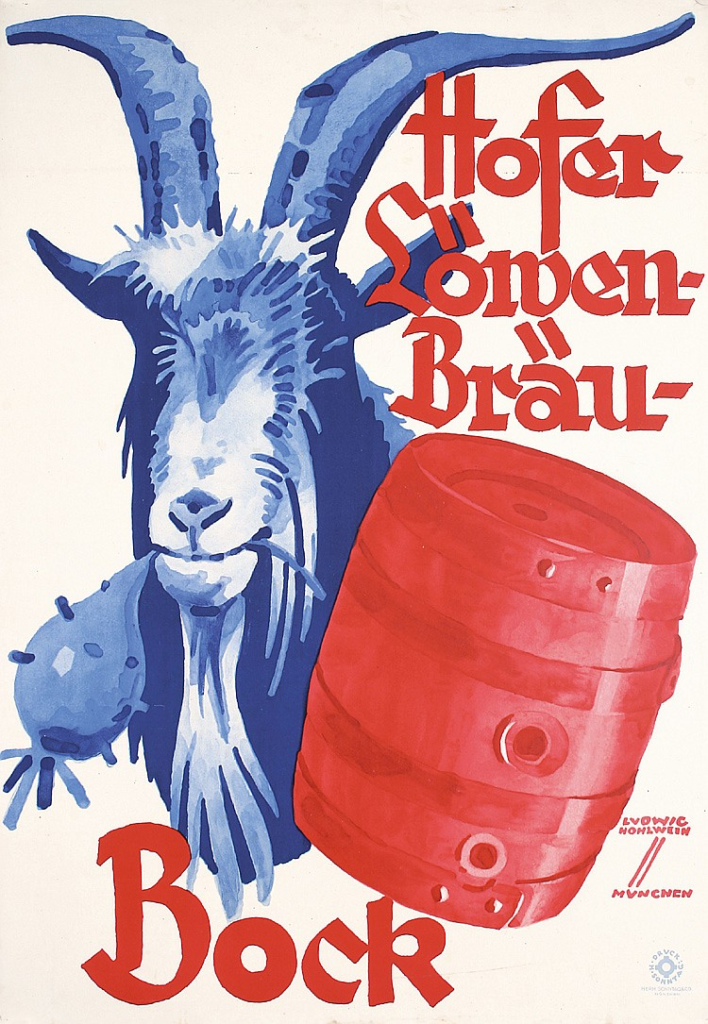
Two years ago I decided to concentrate on Bock ads for awhile. Bock, of course, may have originated in Germany, in the town of Einbeck. Because many 19th century American breweries were founded by German immigrants, they offered a bock at certain times of the year, be it Spring, Easter, Lent, Christmas, or what have you. In a sense they were some of the first seasonal beers. “The style was later adopted in Bavaria by Munich brewers in the 17th century. Due to their Bavarian accent, citizens of Munich pronounced ‘Einbeck’ as ‘ein Bock’ (a billy goat), and thus the beer became known as ‘Bock.’ A goat often appears on bottle labels.” And presumably because they were special releases, many breweries went all out promoting them with beautiful artwork on posters and other advertising. With Spring approaching, there are so many great examples that I’m going to post two a day for a few months.

Wednesday’s ad is for Weber’s Celebrated Bock Beer, which was published on April 29, 1881. This ad was for the Peter Weber’s Union Brewery of Madison, Indiana, which was founded in 1863. This ad ran in The Madison Daily Evening Star, also of Madison, Indiana. I do love the before and after illustrations.

Filed Under: Art & Beer, Beers, Breweries, Just For Fun Tagged With: Advertising, Bock, History, Wisconsin

Historic Beer Birthday: Robert Cain

April 29, 2026 By Jay Brooks

cains-robt
Today is the birthday of Robert Cain (April 29, 1826-July 19, 1907). He “was the founder of the firm Robert Cain and Sons, a brewer in Liverpool, England,” which today is simply known as Cains.

cains-robert
This is his biography from his Wikipedia page:

He was born on Spike Island, County Cork, Ireland on 29 April 1826, the son of James Cain (1797–1871), a private soldier in the 88th Foot, a regiment of the British Army. There is some dispute over the identity of Cain’s mother. Later family records and stories claim that his mother was Mary Deane, the daughter of Alexander Deane, an architect and mayor of Cork. However, in the entry for his brother William in the Liverpool register of births his mother’s maiden name is listed as Mary Kirk (died 1864).

The story of the life of Robert Cain and Cains Brewery is told in Christopher Routledge’s 2008 history of the brewery, Cains: The Story of Liverpool in a Pint, which unpicks many of the mythologies that have developed around the Cain family. Many of these mythologies seem to date back to the 1920s and 1930s, when Cain’s sons William Cain and Charles Nall-Cain were given titles in the British honours system, and centre on the idea that the brewery’s founder had a background in the Irish gentry. Such a background would have made his sons more acceptable to the British establishment at the time. However, according to Routledge, Robert Cain was born in poverty in 1826, the son of a private soldier who would soon be forced to leave the army and travel to England to find work. Cain arrived in Liverpool with his parents in late 1827 or early 1828 and grew up in the slums of the Islington area of the city with his older sister Hannah and two younger siblings, Mary and William. When he was in his early teens Cain was indentured to a cooper on board a ship carrying palm oil from West Africa.

After working out his indenture Cain returned to Liverpool in 1844 where he set himself up first as a cooper and soon after, as a brewer. According to Routledge he met Ann Newall, the daughter of James Newall, a shoemaker, and they were married on 4 April 1847 in St. Philip’s Church, Hardman Street, Liverpool. He began brewing around 1848 on Limekiln Lane in the Scotland Road area, but soon expanded his operation to a nearby brewery on Wilton Street and finally moved to the existing Mersey Brewery (now known as the Robert Cain Brewery or Cains Brewery) on Stanhope Street, Liverpool in 1858. At the same time as he was developing his brewing business, Cain also made shrewd property deals and ran a hotel near to the brewery on Stanhope Street; as the company grew it expanded by buying out smaller brewers and taking control of their pubs.

Cain became one of Liverpool’s most successful businessmen with a passion for using the most modern techniques and equipment. He expanded the brewery several times, most notably in 1887 and in 1900–1902, when the landmark redbrick part of the brewery was constructed. By the time of his death on 19 July 1907 Cain was one of Britain’s richest men, leaving a personal estate of £400,000 (around £28 million at 2005 prices). He also had political influence, working behind the scenes to help the Conservative Party maintain control of Liverpool throughout the late nineteenth century. In fact he was so influential in the area of Toxteth Park, Liverpool where he lived that he became known as “King of the Toxteths”. Contemporary reports of his funeral and burial at St. James’s Cemetery suggest as many as 3,000 people attended.

The company, Robert Cain and Sons, owned over 200 pubs in Liverpool but is most notable for having built three of the most gloriously extravagant pubs in Britain: The Philharmonic Dining Rooms, The Vines and The Central. These highly ornate and elaborate pubs, built to celebrate Robert Cain’s own success and to demonstrate the skill of Liverpool craftsmen, remain landmark Liverpool buildings in the twenty-first century.

Robert_Cain_(brewer)
And this partial history is from the brewery’s Wikipedia page:

The Cains brewery was founded by Irishman Robert Cain in 1858 when he bought an established brewery. Cain had begun his brewing career aged 24 when he purchased a pub and brewed his own ales.

Within 25 years of founding his brewery, Cain had established 200 pubs, including the Philharmonic Dining Rooms, the Vines and the Central Commercial Hotel, which are currently listed as being of architectural merit. His personal mansion had each window arch inscribed with his monogram. In 1887 construction began on a second brewery.

In 1921, 14 years after Cain’s death, the Cains brewery merged with Walkers of Warrington, becoming Walker Cains. Then in 1923 the original Stanhope Street Brewery was sold to Higsons, who continued to brew Cains ales.

In 1985, Higsons was bought by Boddingtons of Manchester. Five years later Boddingtons opted to concentrate on pub ownership and sold all its breweries to Whitbread, at which point the Stanhope Street site was closed.

The company merged with Peter Walker & Son in 1921 to form Walker Cains. Peter Walker & Son had a large brewery in Warrington so sold its Liverpool brewery to Higsons in 1923. Boddingtons of Manchester took over in 1985. In 1990 Whitbread acquired Boddington’s brewing operations and closed the then Higsons Brewery in 1990. It was reopened by GB Breweries, who became part of Bryggerigruppen in 1991, and in 2002 was sold to Gardener-Shaw for £3.4 million.

The brewery closed in June 2013 with debts totalling more than £8m.

Cains-Mersey-Brewery-Liverpool

This account is from the Brewery’s website:

Liverpool in the first half of the 19th Century was one of the world’s most thriving ports – awash with visitors from all over the globe, money and opportunity.

This was reflected in the stunning rise of Robert Cain, from an entrepreneurial 24-year-old brewing his own ale in one pub, to a rich and influential businessman with the title of Lord Brocket and an estate of 200 pubs.

Purchasing the brewery and establishing Cains in 1858, he commissioned the current premises around 30 years later, determined that the business would endure a lot longer than he could.

And so his legacy is still evident today, not only in the beers which still bear his name, but in the distinctive design of the brewery itself – The ‘Terracotta Palace’ – and the stunning interiors of famous Liverpool pubs such as The Vines, The Central Commercial Hotel and The Philharmonic Dining Rooms, all listed as having special architectural merit.

Born in County Cork, Robert Cain took the path of many poor Irish immigrants and arrived in Liverpool to seek his fortune.

As a wide-eyed teenager arriving in the bustling city he could never have imagined a life which would see him create an enduring Liverpool brand, become wealthy, accept the title of Lord Brocket and marry the daughter of a former Lord Mayor of Liverpool.

When he died in 1907, over 3,000 people are reputed to have attended his funeral.

So how did this man make his fortune, what drove him to continually thrive to make his brewery, pubs and beers the most tasteful and memorable they could be?

Determined to establish the brewery, Robert Cain started with one pub at the age of 24, brewing his beer on the premises and saving towards the brewery he desperately needed to achieve his dream.

As well as this determination, Robert Cain was a perfectionist and a man with a strong belief in himself. If something had his name associated with it, he wanted it to be stylish and impeccable.

Even his self-designed home had his own initials etched into the glass of every single window.

It was this characteristic which led to the detail he insisted on in his pubs. Detail which has seen celebrated venues such as The Philharmonic Dining Rooms as famous for their ornate marble lavatories and incredible ceilings as they are for their beers.

He certainly left everyone involved with the brewery over the next two centuries a lot to live up to.

cains-formidable-coaster

And this account is by Chris Routledge, from his book Cains: The Story of Liverpool in a Pint, and provided to St. James Cemetery in Liverpool:

Robert Cain was born on April 29, 1826 on Spike Island, which is in the entrance to Cork Harbour on the south coast of Ireland. His father James Cain was a soldier in the 88th Regiment of the British Army, known as the 88th Foot “Connaught Rangers.” After his father left the army because of ill health the family moved to Liverpool and Robert went to sea on the Palm oil ships working the West African coast. Palm oil had replaced slaves as Liverpool’s primary trade with that part of Africa and the conditions were hostile and unpleasant. Many sailors died in minor battles and skirmishes, or from Malaria; it was known as the “white man’s graveyard.”

Robert Cain survived his time at sea and arrived in Liverpool in the late 1840s to set himself up as a brewer. He married Ann Newall, the daughter of a shoemaker in 1847 and in 1850 the couple began brewing on Limekiln Lane in the Scotland Road/Vauxhall area of the city. Within a few years the quality of Cain’s brews was such that he expanded the operation, moving to a small brewery on nearby Wilton Street. By 1858 the brewery needed to expand again and supported by his growing collection of pubs Cain bought Hindley’s brewery on Stanhope Street, Toxteth, where the current Cain’s brewery now stands.

The Stanhope Street brewery, which Cain named the Mersey Brewery, was much larger than Cain’s previous breweries and included a great deal of brewing equipment. Over the following decades Cain updated and developed the site, pulling down nearby court-style slum housing to expand. By the 1880s, when Cain and his large family (he had 11 children) were living in a mansion on Aigburth Road, the brewery was one of the largest in the city. Cain himself was an important figure in the powerful Constitutional Association and had considerable influence on local politics. He recruited brewery workers to campaign on behalf of Conservative candidates for the Council and became known as “King of the Toxteths.” He was generally well-liked and respected by his workers and the Cain family were well known in the area of Aigburth and St. Michaels.

Like other Victorian gentlemen Cain enjoyed having his portrait painted and was a patron of the arts. He sat for the well-known Liverpool artist William Daniels for at least two portraits and was also painted by George Hall Neale, a Manx painter who lived and worked in Liverpool in the late nineteenth century. Cain was also a collector of rare plants and was especially fond of orchids.

By 1896, when the company became Robert Cain and Sons Ltd, Cain was one of the wealthiest and most powerful men in the city. Cain’s “Superior Ales and Stouts” were available across Liverpool. After the death of his wife he moved to an even larger house near Hoylake and was followed by most of his children, who lived in their own flamboyant mansions nearby. As the twentieth century began Cain began to move control of the business to his sons Charles and William, who later became noted philanthopists, supporting medical charities, including the Women’s Hospital and the Bluecoat Hospital, as well as providing money for aircraft during World War I. William Cain donated his house at Hoylake, known as Wilton Grange, to the nation as a convalescent home for injured officers. Both sons became baronets and Charles Cain became Lord Brocket in 1933.

Robert Cain fell ill in late 1906 and after six months of declining health he died at home on July 19, 1907 during a heatwave. His lavish funeral on July 23 took place on a day of thunderstorms and torrential rain, but despite the bad weather a crowd of three thousand attended and had to be restrained by the police at the gates of St James’s. Official mourners included aldermen, city dignitaries and businessmen, including the brewer Daniel Higson, whose company would later buy Cain’s brewery and operate it for almost 70 years. Also in attendance was Cain’s friend George Hall Neale. Interestingly Cain’s father James, who died in poverty in 1871, and with whom Cain had very little contact after the 1840s, is also buried separately at St. James’s.

cains-christmas

Filed Under: Birthdays, Just For Fun Tagged With: England, Great Britain, History

Historic Beer Birthday: Philip Jacob Ebling Jr.

April 29, 2026 By Jay Brooks

Today is the birthday of Philip Jacob Ebling Jr. (April 29, 1861-September 26, 1896). He was the son of Philip Ebling, who along with his brother William Ebling founded the Ebling Brewing Co., which was known by several different names during its life from 1868 to 1950, including the Philip Ebling & Bro. Wm., Aurora Park Brewery, Ph. & Wm. Ebling Brewing Co. and Ebling Brewing Co., which was its name almost the entirety of the 20th century, both before and after prohibition.

Here’s a short biography from Find a Grave:

Philip Jacob Ebling, son of Philip and Catherine (Baum)Ebling, was president of the Ebling Brewery when his father Philip Ebling died in 1895. He Then directed all of its affairs until death called him in 1896. Philip Jr. was a member of Wieland Lodge No. 714, Free and Accepted Masons; he was also a member of the Schnorer Club and the K.O.S. Bowling Club. Philip Jacob Ebling married at Union Hill, New Jersey, April 12, 1894, Amanda Anna Peter, born March 01, 1872, daughter of William and Caroline (Aeppli) (Ohlenschlager) Peter. He had one child her name was Priscilla Katherine Philipine Ebling.

ebling-brewery-postcard

The brewery apparently aged some of their beer in Bronx caves, and for some of their beers, like Special Brew, whose label boasts that the beer was “aged in natural rock caves.” Which sounds crazy, but in 2009, road construction crews in the Melrose section of the Bronx found the old caves, which was detailed by Edible Geography in Bronx Beer Caves.

An Ebling beer truck on 61st Street in New York in 1938.
Ebling-Brewing-Co-1908-Calendar-Signs-Pre-Pro-Ebling-Brewing-Co--Pre-Prohibition-_83627-1
A 1908 calendar from the brewery.

Filed Under: Birthdays, Just For Fun Tagged With: History, New York

Historic Beer Birthday: Matthew Vassar

April 29, 2026 By Jay Brooks

Today is the birthday of Matthew Vassar (April 29, 1792-June 23, 1868). Vassar was born in England, specifically in East Dereham, Norfolk. While he’s best know for having founded one of the first women’s colleges in America, Vassar College, the money came from operating his brewery, M. Vassar & Co., which when he first built it in Poughkeepsie it was the largest brewery in the Americas.

vassar_matthew0212

Here’s a short biography from Find a Grave:

Business Magnate. Self-made man with only a very basic formal education. When his father’s brewery burned in 1811 and he discontinued business, Matthew Vassar started his own brewery independently. As business increased he became involved in many things. Among others, in 1842 he became President of the Hudson River Railroad. In 1861, inspired by a niece, he endowed the first women’s college in the United States, with $408,000 and 200 acres of land east of Poughkeepsie which is where present-day Vassar College still stands. A lasting legacy for him which is also humorously embodied in an old song, “And so you see, to old V.C. Our love shall never fail. Full well we know that all we owe To Matthew Vassar’s ale.”

Vassar-Brewer-tinbox

For much more thorough biographies, there’s Wikipedia, the Vassar Encyclopedia, and the Vassar Quarterly has a long article about the brewery, The Brew that Built Vassar.

vassars-Brewer-brewery

There’s also another piece in a blog concentrating on the Hudson Valley, The Rise and Fall of M. Vassar and Co..

m-vassar-and-co


This is the larger brick brewery on the waterfront Vassar built in 1836, just above the Main Street Landing. The waterfront facility had a brewing capacity of 60,000 barrels annually.

Portrait of Matthew Vassar, by Charles Loring Elliott.

Filed Under: Birthdays, Breweries, Just For Fun Tagged With: Education, England, History

Beer In Ads #5234: Bock Bier 28 April Bis 1 Mai

April 28, 2026 By Jay Brooks

Two years ago I decided to concentrate on Bock ads for awhile. Bock, of course, may have originated in Germany, in the town of Einbeck. Because many 19th century American breweries were founded by German immigrants, they offered a bock at certain times of the year, be it Spring, Easter, Lent, Christmas, or what have you. In a sense they were some of the first seasonal beers. “The style was later adopted in Bavaria by Munich brewers in the 17th century. Due to their Bavarian accent, citizens of Munich pronounced ‘Einbeck’ as ‘ein Bock’ (a billy goat), and thus the beer became known as ‘Bock.’ A goat often appears on bottle labels.” And presumably because they were special releases, many breweries went all out promoting them with beautiful artwork on posters and other advertising. With Spring approaching, there are so many great examples that I’m going to post two a day for a few months.

Tuesday’s ad is for a number of different Bock Beers, which was published on April 28, 1888. This ad was for multiple breweries on a full page of ad each advertising their own seasonal bock beer. This ad ran in The Abend-Anzeiger, a German Language newspaper published in St. Louis, Missouri.

Filed Under: Art & Beer, Beers, Breweries, Just For Fun Tagged With: Advertising, Bock, History, Missouri

Historic Beer Birthday: Louis F. Neuweiler

April 28, 2026 By Jay Brooks

neuweiler
Today is the birthday of Louis F. Neuweiler (April 28, 1848-1929). He was born in Württemberg, Germany, and his family was in the brewing business. He came to the U.S., first to Philadelphia, where he worked at local breweries there and also met his wife. In 1891, he moved to Allentown, where he formed a partnership with Benedict Nuding, who had started the Germania Brewery there in 1875 or 78 (sources differ). When they started their partnership, the brewery name was changed to the Nuding Brewing Co, but after Neuweiler bought out Nuding in 1900, it became the Louis F. Neuweiler & Son Brewery, which it remained until finally closing for good in 1968.

Louis-Neuweiler

Here’s a short biography from Find-a-Grave:

Born into a family of brewers, he immigrated to America and settled for a time in the Philadelphia area. While in Philadelphia he met his wife Sophia. They had 16 children. They relocated to Allentown, PA in 1891. He formed a brewing partnership with longtime brewer Benedict Nuding but bought him out in 1900. In 1906 his son Charles joined the brewery and the business became known as L.F. Neuweiler & Son. The “new” Neuweiler Brewery was opened on April 28, 1913 at the corner of Front and Gordon Streets in Allentown. His son Louis joined the family business and the company became known as Louis F. Neuweiler & Sons. Their slogan was “Nix Besser” meaning “none better”. After Louis died in 1929 the business was run by Charles Neuweiler. Neuweiler beers were regional best sellers until they went out of business in 1968.

neuweiler-brewery-litho

This story of the brewery is from a local Allentown newspaper, The Morning Call, from 2004:

Louis Neuweiler came to Allentown in 1891. Beermaking then was more than 100 years old in the Valley, its roots going back to the Moravian brewers in Bethlehem. Neuweiler hooked up with longtime brewer Benedict Nuding, whose business was at Seventh and Union streets. In 1900, Neuweiler bought out Nuding. In 1906, he took his oldest son, Charles, into the business that became L.F. Neuweiler & Son.

The Seventh Street location was too small for expansion, so in 1911 the Neuweilers purchased 4.5 acres at Front and Gordon streets and hired Philadelphia architects Peukert and Wunder to build the brewery. It got its water from an underground lake 900 feet below. Neuweiler ordered his own generators for electric power and had separate wells drilled.

Neuweiler opened at this location on April 28, 1913. That day, son Louis P. entered the business and its name became Louis F. Neuweiler & Sons, a name it would retain until 1965. (Louis P. Neuweiler later left the family business and became a local banking executive at Merchants National Bank.)

Neuweiler’s truly was a family operation. Charles Neuweiler sometimes drove the horse-drawn wagon to Bethlehem loaded with barrels. The women in the family kept the books.

Neuweilers-Premium--Ale-Labels-Louis-F-Neuweilers-Sons

Neuweiler’s also was something of an absolute monarchy. Generous to his family, Louis F. Neuweiler had a temper and little patience with those he regarded as lesser mortals. He once ripped the telephone out of the wall in frustration and told the operator she could go to hell when she couldn’t understand the phone number he was asking for.

Louis F. died in 1929. It was during Prohibition and Neuweiler’s was brewing only near beer with 3.2 percent alcohol and making mixers under the names Purity and Frontenac Pale. In the early 1930s, Charles Neuweiler turned down an offer to buy the brewery for $500,000 from gangster/bootlegger Arthur Flegenheimer, aka Dutch Schultz. According to son Theodore Neuweiler, his father said, “We have always made honest beer,” and ordered Schultz off the property.

At first, the post-Prohibition years were good for Neuweiler’s. Its slogan “nix besser,” none better, was shared across the community. But by the early 1960s it found itself trapped between the growing market share of the beer giants of the Midwest and the growing preference for its lighter product.

On May 31, 1968, Neuweiler’s closed its doors for the last time, $800,000 in debt.

Over the years, some of the equipment was sold. One of the stainless steel brewing tanks ended up at the Milford Park campmeeting grounds in Old Zionsville to be used for water storage.

neuweiler-brewery-2

This is a translation of his German Wikipedia page:

Neuweiler was born as the son of a family of beer brewers. He emigrated to the United States and began to work as a brewer in Philadelphia . Within a few years he obtained the title of a Braumeister. In 1891 he met the businessman and hotelier Benedict Nuding, who had founded the Germania Brewery in Allentown in 1878.

Neuweiler became Nuding’s business partner. Together, they managed the brewery with success – until 1900 they already reached an annual output of 20,000 barrels . When Nuding retired in the same year, Neuweiler took over his shares and moved his sons into the company’s business during the following years. In 1925 the name Louis F. Neuweiler’s Sons, valid until the brewery was closed, was chosen for the brewery.

The brewery continued to be successful. In 1913 Neuweiler had a new, larger brewery complex built. The new brewery employed forty employees and reached an annual output of 50,000 barrels. A subterranean lake under the property was opened and a separate power plant was built – the brewery was thus independent of the electricity and water supply through the city.

During the period of prohibition, the Neuweiler brewery produced alcohol-reduced light beer and lemonade. At the height of its success, the Neuweiler brewery produced about 400,000 barrels a year and had 15 beer brands in its assortment. On May 31, 1968, she was closed.

Neuweiler died in 1929, his sons took over the management of the company. He is buried at the Fairview Cemetery in Allentown.

neuweilers-tray

And this history of the brewery is from the English Wikipedia page:

Neuweiler Brewery was founded by Louis Neuwiler, who bought out longtime local brewer Benedict Nuding in 1900. Nuding’s operation was limited by its location, and in 1911 Neuweiler and his son, Charles, eager to expand, hired Philadelphia architects Peukert and Wunder to build a new complex some distance away, at Front and Gordon streets.

The brewery, featuring its own generators for electric power, opened in 1913. By 1932, the brewery buildings and the warehouse building were joined as one structure, and the former machine warehouse became an independent electric plant with an ammonia tank and ice machine. A pump warehouse had been added onto the northwest corner of the former stock warehouse, and a two-story bottling plant with a basement was located to the north of the other buildings. Neuweiler produced several brands of beer: Light Lager, Cream Ale, Stock Ale, Premium Ale, Bock (seasonal), Half & Half, Porter, Stout and Hochberg. Most were available in the 12 oz. “Steinies” or Export bottles, quarts, cans or kegs. When in full operation, Neuweiler’s was one of Allentown’s largest employers.

By 1950, the bottling plant was extended to the corner of North Front Street and Liberty Street, the stock warehouse was extended toward North Front Street, and a tile ash hopper was located behind the boiler house.

Brewery operations ceased in 1968 due to competition from national breweries. However, the Neuweiler recipes and brand names were purchased by the Ortlieb Brewery of Philadelphia, who also purchased the Fuhrmann and Schmidt (Shamokin) breweries in 1966. After the brewery’s closure, the F&S Brewery produced several of the Neuweiler beers (Porter, Light Lager and Cream Ale) from around 1970 until closing in 1975. After F&S closed, the Ortlieb brewery continued Neuweiler Cream Ale at the Philadelphia plant until the late 1970s.

1915_-_Neuweiler_Beer_Laboratory
“This photo from 1915 shows the laboratory at the Neuweiler Brewery that created the various brews made and sold by the company.”

These pages are from “American Breweries of the Past,” by David G. Moyer:

Neuweiler-1

Neuweiler-2

neuweilers

And this lively history is from a local Allentown television station:

Arthur Flegenheimer, aka “Dutch Schultz,” is not remembered as one of your major league 1930s gangster headline-grabbers like Al Capone or Jack “Legs” Diamond. But such a view badly underestimates the man and his ruthlessness. And when he strode into the offices of Louis F. Neuweiler and Sons Brewery on Front Street in Allentown in 1932 he must have seemed formidable enough.

Cutting to the chase, the dapper dressing “Dutch” had some words for brewery owner Charles Neuweiler, son of the brewery’s founder and then the company’s president. He wanted to buy out the Neuweiler family operation which, since the start of Prohibition in 1920, had been reduced to turning out ice cream, “near beer” and carbonated soda water. He was offering $500,000 in cold cash.

Schultz may have thought he had made Neuweiler an offer he couldn’t refuse. It’s not known if the Dutchman’s “boys” were hanging around with itchy trigger fingers on their “gats” during the conversation.

But according to Charles’s son, Theodore Neuweiler, who recounted this tale to the press in the 1950s, his father was not biting. “We have always made honest beer,” he recalled his father saying before ordering Schultz off his property. And apparently the gangster went quietly.
Neuweiler-BeerAlePorter-Coasters-Over-4-Inches-Louis-F-Neuweiler039-s-Sons
Shortly thereafter FDR would be elected, Prohibition banished, and happy days here again. And “Dutch” would die in 1935 on a hospital operating room table in Newark, New Jersey, following a hit by rival gangsters.

Today Neuweiler’s, which closed in 1968 and was left in a state that could only be called abandonment, is once more in the local news. Plans about its possible future as apartments, lofts or shops as part of the Neighborhood Improvement Zone- aka “the NIZ”- have caused much speculation. Could Neuweiler’s — at least the building if not the brewery — come back to life?

All of this activity would have undoubtedly impressed old Louis F. Neuweiler, the brewery’s founder, although he might be disappointed that nobody is talking about making beer there. As a native of Wurttemberg, Germany he knew what beer was to all good Germans of his time and place- a thick hardy brew that was both food and drink and had been as long as there had been Germans.

For a time, Neuweiler worked in a Philadelphia brewery and rose within the ranks of the company. In 1891 he came to Allentown and teamed up with longtime local brewer Benedict Nuding. A Civil War veteran and several years Louis Neuweiler’s senior, Nuding’s brewery was located at 7th St. near Union.

Beer making had been going on in the Lehigh Valley probably since the first German settlers arrived. Commercial operations in Allentown are usually traced to the Eagle Brewery that opened at Lehigh and Union Streets in the 1850s. By the start of the 20th century there would be a number of breweries dotting the Lehigh Valley in Allentown, Bethlehem and Easton.

By 1900 Nuding was ready to retire and Neuweiler brought him out. But even then Neuweiler had bigger ambitions. He had just admitted his son Charles into the business and began to look around for a space that was much larger than the site on 7th Street and also closer to a railroad line that would make shipment easier.

Neuweilers--Capuziner-Beer-Labels-Louis-F-Neuweilers-Sons

What the new brewery also needed was a supply of pure water.

Neuweiler found all that he was hoping for- even a lake of pure water 900 feet underground- on a 4.5 acre site at the corner of Front and Gordon Streets. To build the brewery he hired Peukert & Wunder, Philadelphia architects with a national reputation for brewery design.

Work began on Neuweiler’s in 1911. It was completed two years later and opened for production on April 28, 1913. The Lehigh Valley had seen many brewery openings before but Neuweiler’s was something special. With its red brick tower that could be seen for many miles it dominated the horizon along the banks of the Lehigh River. In an extra architectural flourish a huge N, similar to those on a Paris bridge that honored Napoleon, framed and mounted in a colossal cartouche, was placed on the side of the building. The era didn’t nickname brewers “beer barons” for nothing.

Despite its size Neuweiler’s was a family business. Charles had been required to learn the business from the ground up, including driving a wagon load of beer barrels when called on to do so. Even the female members of the family played a role by keeping the brewery’s books.

Neuweiler’s was not a democracy. Patriarch Louis F., while a generous father to his family, expected obedience from them, even as adults. Although there is nothing on the record this may explain why one of his sons, Louis P., left the family business and got into local banking.

One of the longtime family stories that was recorded dealt with a confrontation between Louis F. and a telephone operator. When she could not understand the number Neuweiler was asking for he became so enraged he suggested there was a warm place she should go and ripped the phone’s cord out of the wall. His sons, fearing local reaction and gossip, told their father he had to call her back and apologize. According to the surviving sources the exchange went something like this:

Neuweiler: “Is this the woman who I told to go to hell?”
Operator: (timidly) “Yes”
Neuweiler: “Well you don’t have to go now!”

Louis F. died in 1929 and with the end of Prohibition in 1933 Neuweiler’s flourished. But the rise of national brewers and the post World War II preference for lighter beers doomed Neuweiler’s and other local ethnic brewers. But, who knows. Thanks to the NIZ the big N may rise again.

allentown-to-algiers

neuweiler-pils-can

Filed Under: Birthdays, Just For Fun Tagged With: Germany, History, Pennsylvania

Historic Beer Birthday: Ernst F. Baruth

April 28, 2026 By Jay Brooks

Today is the birthday of Ernst F. Baruth (April 28, 1842-February 1906). While what would become Anchor Brewing began during the California Gold Rush when Gottlieb Brekle arrived from Germany and began brewing in San Francisco at what he called the Golden City Brewery, it didn’t become known as Anchor Brewing until 1896, when “Ernst F. Baruth and his son-in-law, Otto Schinkel, Jr., bought the old brewery on Pacific Avenue and named it Anchor. The brewery burned down in the fires that followed the 1906 earthquake, but was rebuilt at a different location in 1907.” Baruth had passed away the same year as the earthquake, shortly before it.

I did discover that he was a president of the Norddeutscher Verein (or North German Association) in 1886 as noted in this portrait from a book celebrating the organization’s 25th anniversary, or Silver Anniversary 1874-1899.

ernst-baruth-1886

According to Anchor Brewery’s website:

[In 1896] German brewer Ernst Frederick Baruth and his son-in-law, Otto Schinkel, Jr., bought the old brewery on Pacific (the first of six Anchor locations around the City over the years) and named it Anchor. No one knows why Baruth and Schinkel chose the name Anchor, except, perhaps, for its indirect but powerful allusion to the booming Port of San Francisco.

Surprisingly, there isn’t much biographical information about Baruth. He was born somewhere in Germany, and arrived in New York City on August 13, 1875, on a ship named the “SS Neckar” that departed from Bremen, Germany and then sailed to Southampton, England, before heading west to America.

anchor-brewery-early-1900s-lg
The Anchor Brewery in the early 1900s.

Filed Under: Birthdays, Just For Fun Tagged With: Anchor Brewery, California, History, San Francisco

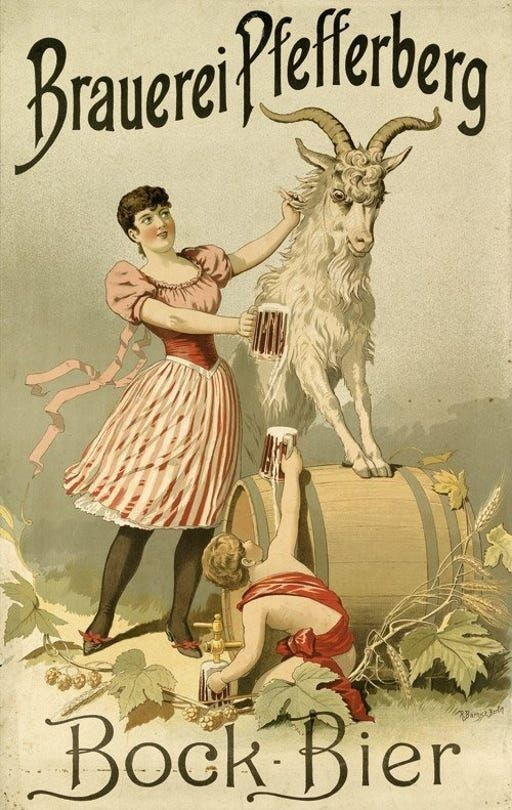
Beer In Ads #5232: Bock Bier Vom 27 April Bis 1 Mai

April 27, 2026 By Jay Brooks

Two years ago I decided to concentrate on Bock ads for awhile. Bock, of course, may have originated in Germany, in the town of Einbeck. Because many 19th century American breweries were founded by German immigrants, they offered a bock at certain times of the year, be it Spring, Easter, Lent, Christmas, or what have you. In a sense they were some of the first seasonal beers. “The style was later adopted in Bavaria by Munich brewers in the 17th century. Due to their Bavarian accent, citizens of Munich pronounced ‘Einbeck’ as ‘ein Bock’ (a billy goat), and thus the beer became known as ‘Bock.’ A goat often appears on bottle labels.” And presumably because they were special releases, many breweries went all out promoting them with beautiful artwork on posters and other advertising. With Spring approaching, there are so many great examples that I’m going to post two a day for a few months.

Monday’s first ad is for a number of different Bock Beers, which was published on April 27, 1899. This ad was for multiple breweries on a full page of ad each advertising their own seasonal bock beer. This ad ran in The Abend-Anzeiger, a German Language newspaper published in St. Louis, Missouri.
Filed Under: Art & Beer, Beers, Breweries, Just For Fun Tagged With: Advertising, Bock, History, Missouri

Historic Beer Birthday: Adam Gettelman

April 27, 2026 By Jay Brooks

Today is the birthday of Adam Gettelman (April 27, 1847-February 14, 1925). He and his father-in-law, George Schweickhart, founded the Strohn & Reitzenstein Brewery in 1854, though the same year it became known as the Menomonee Brewery. When Schweickhart passed away in 1876, Adam Gettelman became the sole owner and renamed it the A. Gettelman Brewing Co. The Milwaukee brewery managed to remain open during prohibition and began making beer again in 1933. When Adam Gettelman died in 1925, his sons continued to run the brewery, but in 1961 was bought by rival Miller Brewing.

Adam-Gettelman

This short biography is from the Wisconsin Historical Society:

He began his apprenticeship in the brewing business in 1865, and in 1871 was admitted to partnership in the Menominee Brewery, owned by his father-in-law, George Schweikhart. In 1876 Gettelman became sole proprietor, and in 1887 incorporated the business, which was known as the A. Gettelman Brewing Co. after 1904. He was president and treasurer of the firm (1887-1925). His son, FREDERICK GETTELMAN, b. Wauwatosa, attended Racine College and graduated from a school for brewers, the Wahl Henius Institute, Chicago (1909). He became president of the A. Gettelman Brewing Co. on his father’s death, and was also president of the Frederick Gettelman Co., manufacturers of high-speed snow plows. Gettelman was instrumental in developing several innovations that alleviated the problems of modern brewing, including a steel barrel, a glass-lined beer storage tank, and a beer pasteurizer. He also developed a farm tillage machine.

And this an early history of the A. Gettleman Brewery, from the Encyclopedia of Milwaukee:

The A. Gettelman Brewing Company (1856-1961) was one of Milwaukee’s major industrial brewers. Although remaining a mid-sized brewer among the city’s giants, Gettelman was an important innovator of beer packaging and advertising and a significant acquisition in the expansion of the Miller Brewing Company.

The Gettelman Brewing Company originated as George Schweickhart’s Menomonee Brewery, established near what is now 44th and State Streets in 1856. Coming from an established brewing family in Mühlhausen, Alsace, Schweickhart purchased a half-built brewery started by Strohn and Reitzenstein, who had both died in a cholera epidemic two years earlier. The brewery’s location in the Menomonee River Valley west of Milwaukee provided ideal access to clean water from nearby Wauwatosa wells, ice from the river, natural caves for storage cellars, and hops and barley from surrounding farms, while still maintaining easy access to Milwaukee and surrounding towns via the old Watertown Plank Road and later railroad connections.

In 1871, Schweickhart brought Adam Gettelman on as a partner in his brewery. Gettelman was an apprentice at the brewery who had married Schweickhart’s daughter in 1870. In 1874, Schweickhart sold off his portion to his son-in-law, Charles Schuckmann, whom Gettelman later bought out to become sole owner of the brewery in 1876. Officially named the A. Gettelman Brewing Company in 1887, the Gettelman family remained in control of the brewery for three generations, until it was sold in 1961.

Fire destroyed a significant portion of the original brewery in 1877, and Gettelman rebuilt and updated their facilities. Gettelman kept the brewery relatively small—just big enough for the family to manage and maintain a high quality product. In 1891, Gettelman introduced its flagship “$1,000 Beer” brand, offering a $1,000 reward to anyone who could prove that it was made with anything other than pure barley malt and hops. Gettelman also introduced its popular “Milwaukee’s Best” brand in 1895.

Gettelman survived Prohibition making “near beer” and through several different investments outside of brewing, like the West Side Savings Bank, the development and manufacturing of snow plows, gold-mining in the American southwest, and a sugar beet processing plant in Menomonee Falls. Gettelman returned to brewing in 1933, with Frederick “Fritz” Gettelman as president.

gettleman-brewery

And this history of the brewery is from a company brochure from 1954, when the brewery was celebrating its 100th anniversary.

OBSCURE as might seem the relationship between a cholera epidemic and the origin of a brewery, no one recording the history of the A. Gettelman Brewing Co. can over-look the fact that if it had not been for the former the latter might never have existed — or, at least, not as it is known today.

Around the middle of the nineteenth century, two men known as Strohn and Reitzenstein bought a three-acre tract of land on the old Watertown Plank Road in a village west of Milwaukee then called Center City. Even in that early year, the seed of the reputation Milwaukee was to gain as the world’s beer capital was beginning to show signs of germination. The predominantly Germanic strain of its population probably had something to do with it, but the real reason was the same then as it is today — its proximity to a limitless supply of water ideally suited for brewing good beer.

There was at least one other important consideration that led the Messrs. Strohn and Reitzenstein to select the spot they did — the fact that it was close to the Menominee River from which ice might be harvested to supply the all-important refrigeration.

But, despite their canny judgment in the choice of a site for their brewery and all their plans for its construction and operation, the two men were never to see their dream materialize. Both were cut down by the cholera epidemic then ravaging the country at a time when their project had advanced no further than the excavation stage.

Meanwhile, the word that Milwaukee was an ideal spot for brewing beer had reached as far east as Buffalo, New York. One of its citizens, a brewmaster by the name of George Schweickhardt, heard it and, with his brother, made the trip west to investigate. They came across the excavation on the Watertown Plank Road. Like the men who had first chosen it, the Schweickhardt brothers knew a good spot when they saw one and it was not long before the structure which today forms part of the A. Gettelman Brewing Co. began to take shape.

The problem the Schweickhardts faced was not merely one of building their brewery and selling its product to an eagerly awaiting public. Even then competition in the beer business was keen. There were about 15 other breweries in and around Milwaukee vieing for the favor of the great Milwaukee beer palate. It was then, as it is now, a question of survival of the fittest.

In time, however, the brewing know-how George Schweickhardt had accumulated in New York and, before that, as a brewer and wine-maker in his native Alsace began to pay off. With the disappearance of the weaker of his competitors and passage of the years, it became evident that the Menominee Brewery — as it was then called — would take its rightful place in the great family of breweries that was to make Milwaukee a by-word wherever beer drinkers gather.

For anyone accustomed to highly organized metropolitan Milwaukee, the thirteenth largest city in the nation, it is difficult to imagine the rugged conditions existing when the A. Gettelman Brewing Company was in its early formative stages.

Little similarity can be found for example between State street, today one of the city’s most heavily traveled thoroughfares, and the old Watertown Plank Road which, at one time, was the brewery’s only avenue to the Milwaukee market. Perhaps no one intimately connected with the brewery remembers this state of affairs more poignantly than “Uncle” Charlie Schmidt, veteran employee and secretary of the company at the time of his retirement in 1950. “The Watertown Plank Road . . . was a dirt road subject to heavy travel by wagons hauling stone from the stone quarries nearby,” Uncle Charlie writes in his memoirs. “Extensive travel on this road resulted in six inches of fine dust in dry weather and a like amount of mud when it rained. From the Miller Brewing Co. to our plant was a walk consisting of two 12-inch planks side by side. Even so, we often had to wear rubber boots for there was still plenty of mud to walk through.”

In those days, according to Uncle Charlie, the trip from the brewery up the hill to 35th Street was a task for only the stout of heart. So arduous was the ascent, in fact, that the team of horses starting to pull a wagon loaded with 35 to 40 half barrels had to be augmented about half way up the hill by an additional team.

As though just traversing this road was not painful enough, travelers entering the city were forced to pay a fee at a toll gate located a block west of the brewery.

There Was a Bright Side
But all was not hardship for those who shared their youth with that of the A. Gettelman Brewing Company. In striding toward its destiny, a city often tramples underfoot some of its inherent natural charm. The Menominee River, now sullied by the wash from heavy industry, was once a fisherman’s dream. Just west of the brewery the river was dammed up to make a reservoir for winter ice-cutting operations. In the spring of the year, when the water was high, pike, pickerel and suckers came up the river to spawn — and to fall prey to the fishermen along its banks. What fish — particularly suckers — the farmers couldn’t eat they boiled thoroughly and used for hog-feed.

As was mentioned before, protecting the beer against the extreme temperatures prevailing in this part of the country was a major problem. Refrigeration as we know it today was not even in the dream stage and the methods of keeping the beer cool in summer and warm in winter bordered on the bizarre by present day standards. About the year 1878, Gettelman had two ice house branches, one located at 14th and Highland and the other at S. 10th and Walker. Every afternoon, Gettelman’s two beer peddlers — Biegler and Hartzheim by name — would get their day’s load of beer from the brewery and haul it to the ice house assigned to their use. There they would unload it, store it overnight, and load it up the next morning to be delivered to their customers.

Tough on Country Drivers
The rigors of those handling the beer in the city was nothing however, compared to those with which the country peddlers were confronted daily. Two men, a Henry Stadler and a Bill Dienberg, covered, between them, Elm Grove, Brookfield, New Berlin, Butler, Fussville and Menomonee Falls. Though this would be considered an extremely limited area today, it took the two men a full 12-hour day to make deliveries. And this does not take into consideration the time it took them to load up in the morning, and to feed and clean their horses at night. As compensation for their efforts, each man received a cool $45 per month.

Close Employee Association
But the lack of transportation facilities and personal conveniences which worked such great hardships on early brewery employees made for a close association between them which belongs only to the past. Since most of the early employees of the Menominee Brewery were single, they lived and boarded on brewery premises. A large room was provided for sleeping quarters and what is now the office reception room served as a dining area. The task of serving the men their meals fell to Mr. Schweickhardt’s daughter and a full day’s job it was. Breakfast was at 6 a.m., lunch at 9, dinner at 12 and supper at 6 p.m.

As Magdelana Schweickhardt bustled around the groaning board matching the supply of good German home-cooked victuals to the hearty appetites of the boarders, she was regarded with special interest by a man whose natural leadership qualities had won for him the position of brewery foreman. As day followed day, the friendship between Magdelana Schweickhardt and her father’s foreman ripened and eventually culminated in marriage. That was in 1870 and the day was a fateful one for the Menominee Brewery for the man Magdelana married was Adam Gettelman who was later to give his name to the company as it is known today.

By the year 1870, the brewery which Strohn and Reitzenstein had begun about 18 years before had grown into a vigorous young business. The brewing lore that George Schweickhardt had learned in his former brewery at Buffalo plus the increasing demands of a robust and thirsty Milwaukee populace had put the business on a sound financial footing and made it a force to reckon with on the competitive market.

Jointly guiding its destiny until 1876 were George Schweickhardt and his son-in-law Adam Gettelman. In that year, the senior partner of the firm left the brewing business to devote his full time to a stone quarry on the Hawley Road of which he was half-owner. The move left the youthful Adam Gettelman to conduct the affairs of the brewery by himself.

The next year — 1877 — was a trying one for the new proprietor and everyone associated with the brewery. About noon of October 30 fire struck the brewery buildings and caused more than $31,000 damage before it was finally brought under control.

A good idea of the journalism of the day can be gained from the story of the catastrophe carried by the Milwaukee Sentinel the next day. It read, in part: “Yesterday noon a man rode in on horseback post-haste, over the Watertown Plank Road, to secure the services of the fire department. The brewery of Adam Gettelman & Co. in the Menominee Valley, about half a mile northwest of Fred Miller’s Brewery, had taken fire and would be reduced to ashes if the city authorities failed to honor his call for assistance. The excited rider reined in his perspiring horse before the house of No.5 and thence word was telegraphed to headquarters. ‘Fire beyond the city limits — shall we run the steamer?’ was the announcement. The code would not admit of a more satisfactory message. Chief Lippert hitched his gray horse in a twinkling and drove off as if the very Nick had taken to the road in the rear, and soon answered the telegraph in person. The steamer was ordered out, Supply Hose No. 1 was telegraphed for and with all due speed the burning buildings were reached.”

The story goes on to relate how heroically the firemen labored to save the brewery as well as the home of Mr. Schweickhardt to the south of the burning buildings and the two-story brick ice-house to the north. Concerning the fire-fighters’ valiant efforts, the article had this to say: “Engineer Dusoldt kept his steamer steadily at work, and so evenly that there was no bursting of hose to interrupt the service. All the firemen labored with a will that reflected a credit on the service and gained them the praise of all on the grounds. The steamer of the National Home had been sent for, but, owing to some misunderstanding, the veterans failed to appear. The Milwaukeeans were obliged to fight the fire alone, and right royally did they charge upon and subdue it.”

Brewery Suffers Financially
Despite the vigor with which the fire-eating stalwarts “did charge upon and subdue” the blaze it consumed enough of the Gettelman property to burn a sizable hole in the brewery’s bank account since the loss was only about half covered by insurance.

Despite everything, though, a news item appearing in the Sentinel of November 3, 1877 — only a few days after the fire — stated that contracts were being let by the brewery for reconstruction.

With completion of the rebuilding program, the A. Gettelman Brewing Company continued its steady march toward popular favor. Keeping pace with the growth of the brewery was the family of Adam and Magdelana Gettelman. In 1884 a son, William, was born to them followed three years later by Fred and Elfrieda. In later years, William was to become president of the West Side Bank founded and headed until 1925 by his father. Fred stayed on with the brewery to inherit its presidency and make himself a symbol of the brewing industry in Milwaukee and everywhere Gettelman beer was consumed.

$1,000 Beer Introduced
It was Adam Gettelman, however, who started the famous “$1,000 Natural Process” on its way to the high esteem it enjoys today. In 1891, Gettelman advertising started carrying an offer of $1,000 to anyone able to prove that Gettelman’s premium beer was brewed with anything but pure malt, hops and water. This occurred in a day when the brewing industry in general was swinging to substitute ingredients. Chemists all over the country made a play for the $1,000 but, to this day, no one has ever been able to claim it.

Also carrying the $1,000 reward was Gettelman’s “Hospital Tonic” introduced in 1892. Backed by the recommendation of the medical profession, the new tonic plummeted to popularity on the wings of its especial value to nursing mothers. The “Hospital Tonic” no longer graces the shelves of the nation’s drugstores — due, probably, to advent of scientifically prepared baby formulas and increased tempo of modern day existence.

Gettelman Spur Built
By the year 1895, Gettelman’s production had soared to the point where it was no longer feasible to haul the beer by wagon to the railroad situated on the shores of Lake Michigan. Accordingly, a spur from the Milwaukee Road mainline was run into the brewery yard. This was a momentous event in the life of the brewery, a milestone in its progress. It was no more than fitting, therefore, that the occasion be marked by a celebration of major proportions.

And so it was. On April 13, 1895, a huge crowd gathered on the Gettelman grounds to watch Adam Gettelman drive the “golden” spike that would signal completion of the spur. While Hensler’s Juvenile Band spiritedly played “How Dry I Am” and the crowd cheered enthusiastically, Adam started pounding away at the spike. About half way through the operation, one of the on-lookers –William Starke by name — asking Adam to stop, placed a nickel on the flange of the rail so the imbedded spike might hold it there. “Here’s the nickel,” he said, “for a good glass of beer.”

As the last stroke of Adam Gettelman’s mallet was still ringing in the air, the first car was shunted into the siding. It was a beer car filled with official well-wishers from the Miller Brewing Company, two blocks away. Together, Gettelman officials, Miller officials and a hundred or so thirsty bystanders trouped into Gettelman’s bottle house to get down to some serious suds-slurping. The day was a decided success.

Lying between the turn of the century and the beginning of the Prohibition era were years of growth and development for the A. Gettelman Brewing Company. In the 50-odd years of its existence, Gettelman beer had become as much a part of the Milwaukee scene as its culinary counterpart wieners and sauerkraut — and as dear to the heart of every true Milwaukeean. In the face of an increasingly active market with that exacting taskmaster Production rapidly ascending to power, Adam Gettelman serenely guided his brewery along the path of quality brewing. While other breweries spread their supply lines to the four corners of the land, Adam was content with providing his Milwaukee friends with the kind of beer that smacked of the good old days.

Consequently, the little brewery on the old Watertown Plank Road never loomed as a Titan among others of its kind, nor does it to this day. But, in staying small, it retained the warmth and “family feeling” it had in the days when Magdelena Schweickhardt — later the bride of Adam Gettelman — served steaming hot ”vittles” to the brewery’s jovial worker-residents.

Despite the fact that the “drys” had tapped off most of the gemuetlichkeit from Gettelman’s satisfying old brew, the suds-sipping citizenry of Milwaukee remained loyal.

As if bowing out after he was assured of that fact, Adam Gettelman died in 1925. For the next four years, the affairs of the brewery were guided by Adam’s eldest son, William, who at the same time, succeeded his father as president of the West Side Bank which the latter had founded.

The cohesiveness and general esprit de corps with which Adam Gettelman, in his wisdom, had inoculated his company began paying real dividends with the coming of prohibition in 1919. While breweries made of blander stuff withered away under the arid provisions of the Eighteenth Amendment, Gettelman tightened its belt and turned its attention to the manufacture of “near beer” and malt syrup.
As in the case of every other brewery that lived through those trying times, Gettelman was compelled to cut back drastically on its working force. Brewmaster Julius Stemmler headed a crew consisting of Conrad Gieger, John Haertl, William Pust, William Dienberg and chief engineer Louis Gettelman. In those days, even the office force was not exempt from plant duty. It was not at all unusual for “Uncle” Charlie Schmidt, Fred Englehardt and Charlie Mollenhauer to don working clothes and pitch in when the brew reached the bottling stage. According to memoirs set down by Uncle Charlie, though, his biggest job was “to look out of the windows and count the number of automobiles passing by.”

While all this was going on, the driver’s seat of the brewery was occupied by three of the Gettelman clan — first Adam, then William, and in 1929, the rosy-cheeked Fred.

In almost every family circle there’s one child that stands apart from the others — not necessarily better or worse, but somehow different in a way that sometimes challenges description. Of all the children reared by Adam and Magdelana Gettelman in the big house on the hill overlooking the brewery, the cherubic Fritzy perhaps fitted that description more than any of the others. He shared in the heritage of good common sense handed down to him by his mother and father and their folks before them, but his had overtones of the dreamer. It was, however, flavored by a certain sharp inquisitiveness and compulsion to create that forced him to do something about his dreams rather than leave them in the air-castle stage. The same quality that caused an elastic band to appear one day on the screen doors of the Gettelman mansion so that they might shut of themselves, introduced to the beer-making world in later years the steel keg with the broad band around the middle for easy rolling. The idea for the steel keg came out of Fred’s dusty and venerable old “private engineering office” located in the building in which he had been born. It first saw light of day on a piece of “brown butcher paper,” Fred’s favorite method of putting his thoughts in tangible form. Shortly after Fred had promised exclusive manufacturing rights to L. R. Smith of the A. 0. Smith Corp., an Eastern firm offered him $1,000,000 for the same rights. But Fred had given his word and the Eastern representative went home with an unsigned contract. Manufacture of the steel barrels is now a major item on the A. 0. Smith schedule.

The spirit of not being quite satisfied with things as they were stayed with him the whole of his life. At seven Fred fitted the family baby buggy out with brakes and, with gravity as his engine, went whizzing down the decline from the house on the hill to the Watertown Plank Road far below. Much later in life he invented the Gettelman snow plow, pasteurizers for beer and milk, a washer that cleaned beer bottles with a jet of steam and a host of other things, many of which are still on brown butcher paper and will perhaps never get beyond that stage. He even played a major role in perfection of the huge glass-lined storage tanks for beer now a common sight on any brewery property.

But, though he owned as many patents as many a full-time inventor, dreaming up things to make life easier only occupied part of Fred’s time. There was a practical, everyday business side to him, too. He felt deeply his responsibility to the brewery and its employees. In a way, he had the toughest row to hoe of any of his predecessors. Not only was the brewery laboring under the yoke of prohibition, but the very year that Fred took up the reins — 1929 — the bottom fell out of things economically. There was indeed many a time during those black days that Fred’s indomitable will was the only light that pierced the darkness.

The years following repeal of Prohibition were, for Gettelman as for all of Milwaukee’s breweries, full of growth and development. The thirst of the true beer-drinker, never completely quenched by poor substitutes concocted in private cellars, skyrocketed the fortunes of the brewing industry to unprecedented heights.

But no situation, however favorable, is without its attendant dangers. With a public eager to drink anything under a brewer’s label the temptation was rife in brewing circles to cut corners on quality. Some breweries did just that and paid for their lack of foresight with extinction when the public’s first enthusiasm no longer beclouded its powers of discrimination.

Fred Gettelman, Sr., however, had piloted his brewery through the difficult days of depression and prohibition and he had no intention of jeopardizing everything he and his employees had worked so hard to preserve. Consequently, Gettelman beer, while not breaking any production records, held to the same fine quality upon which its pre-prohibition reputation had been built and the brewery came through safely.

The A. Gettelman Brewing Company first began to show signs of the new post-prohibition prosperity in 1937 with construction of an addition to the old bottle-house. An 80 x 110 foot structure, the building was twice the size of the building it annexed. Cream-colored bricks salvaged from the old Gettelman mansion atop the hill overlooking the brewery went into the construction of its walls and the bottling equipment it housed was modernity itself. In fact, Fritz Gettelman had had a hand in the improvement of the bottle washer installed in the new bottle house. It was he who had dreamed up and perfected the idea of cleaning the bottles with high pressure steam and water. So efficient was the equipment in the ultra modern bottle shop that Gettelman was able to show figures proving that breakage on bottles of all makes and ages ran only .442 per cent of total bottles handled.

In addition to the modern machinery on the ground floor the bottle shop boasted a battery of glass-lined storage tanks in the basement, an innovation which Fritz Gettelman had also helped engineer. During development of the revolutionary tanks, he had spent long hours at the A. 0. Smith plant subjecting experimental models to every conceivable torture to prove his idea that molten glass will stick to steel. How he did this in the face of skeptical college “enchineers” — as he called them –is another story, but the success he encountered is borne out by the fact that few progressive breweries today are without the big beer holders with the glazed walls.

All this while the affairs of the brewery had been directed from the office building which lies between State street and the brewery proper. By 1948, however, it was becoming increasingly apparent that the expanding brewery would need corresponding office facilities. It was decided, therefore, that an old malt-house which had, for the last several years, served as a place for miscellaneous storage be made over into an office building. Part of the building had originally been the first Gettelman homestead, antedating even the mansion on the hill. From what had once been its living room emerged the present office reception room whose walls are panelled with the cypress of the old wooden beer storage tanks. From the rest of the building the architect’s skill and a lot of hard work wrought the present Gettelman offices. Fritz Gettelman went along with, and indeed inaugurated, most of the brewery’s advances, but he turned a deaf ear to any suggestion that he move his office to the newly renovated building. Moreover, he insisted that the second story room in which he had been born and from which had come many of his ideas on the humble brown butcher paper be left inviolate — and so it has been, to this day.

Modernization of brewery and office facilities was approved by everyone connected with the business, but no one sanctioned them more heartily than the two Gettelman brothers, Fred, Jr., and Tom, sons of the energetic and imaginative Fritz. Actively entering the management affairs of the brewery in 1939 and 1941, respectively, the two younger Gettelmans not only welcomed the changes but were, in large measure, responsible for their execution. Interest of the brothers in increased production and administrative efficiency was not an overnight affair. The lives of both of them had revolved around the brewery almost since they had taken their first steps and they had a working knowledge of every facet of the business long before they emerged from brewers’ school as master brewers.

As it turned out, the talents of the two men were so complementary that it seemed almost a part of some well-formulated long range plan. Fred found himself more at home in the operational end of the plant while Tom’s talents turned to the intangibles of the business — things like sales promotion, advertising and public relations.

It is in such capable hands that the destiny of the A. Gettelman Brewing Company rests. It seemed only in keeping with the spirit of Fred Gettelman, Sr. — all his life dedicated to the best interests of his business and the people in it — that, at his passing in June, 1954, he should have provided so well for his brewery’s future in the persons of his two sons.

New technological advances, widely expanded markets, an ever further propagation of the proud old Gettelman name — these are but a few of the things the two younger Gettelmans plan to make the A. Gettelman Brewing Company of the future an even better place with which to be associated than it has been in the past. To achieve these goals they look confidently to the same fine spirit of cooperation on the part of the Gettelman family of employees that has so importantly contributed to the high place the brewery now enjoys.

Filed Under: Birthdays, Breweries, Just For Fun Tagged With: History, Wisconsin

« Previous Page
Next Page »

Find Something

Northern California Breweries

Please consider purchasing my latest book, California Breweries North, available from Amazon, or ask for it at your local bookstore.

Recent Comments

  • Bob Paolino on Beer Birthday: Grant Johnston
  • Gambrinus on Historic Beer Birthday: A.J. Houghton
  • Ernie Dewing on Historic Beer Birthday: Charles William Bergner 
  • Steve 'Pudgy' De Rose on Historic Beer Birthday: Jacob Schmidt
  • Jay Brooks on Beer Birthday: Bill Owens

Recent Posts

  • Beer Birthday: Colin Kaminski June 17, 2026
  • Beer Birthday: Ed Stoudt June 17, 2026
  • Beer In Ads #5270: Bock Beer Prima Special June 16, 2026
  • Historic Beer Birthday: Max Delbrück June 16, 2026
  • Historic Beer Birthday: Harry MacElhone June 16, 2026

BBB Archives

Feedback

Head Quarter
This site is hosted and maintained by H25Q.dev. Any questions or comments for the webmaster can be directed here.