Saturday’s ad is for Falstaff, from 1967. It looks like they’re camping next to a river somewhere in the southwest, possibly along the Colorado by the Grand Canyon? I like their three-word description of the beer. “Crisp. Clean. Robust.”


Saturday’s ad is for Falstaff, from 1967. It looks like they’re camping next to a river somewhere in the southwest, possibly along the Colorado by the Grand Canyon? I like their three-word description of the beer. “Crisp. Clean. Robust.”

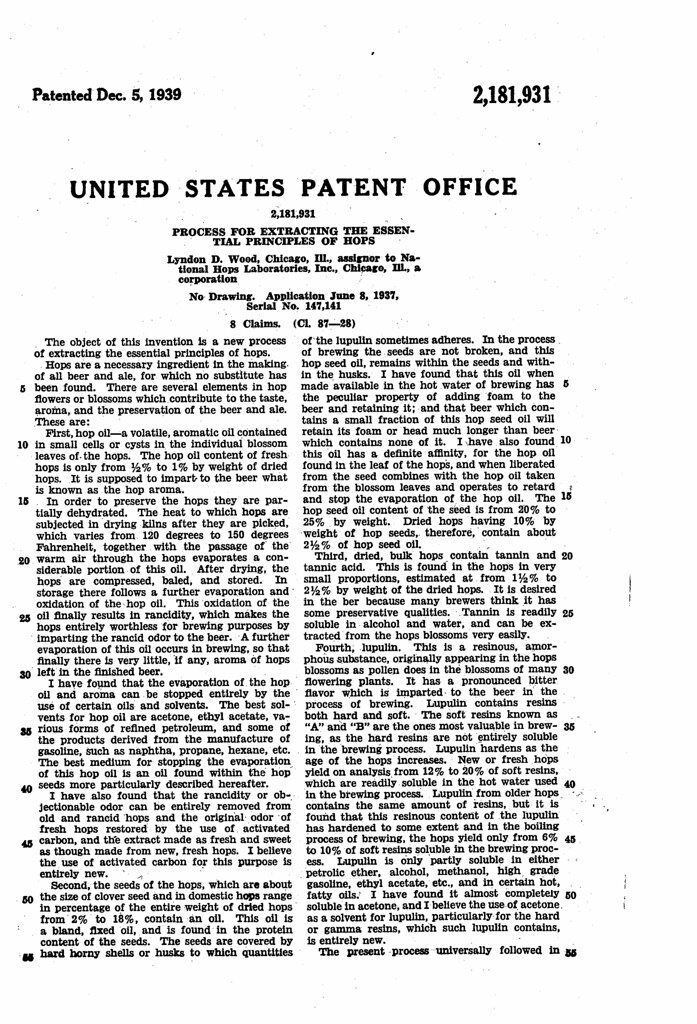
Today in 1939, US Patent 2181931 A was issued, an invention of Lyndon D. Wood, assigned to National Hops Lab, Inc., for his “Process for Extracting the Essential Principles of Hops.” There’s no Abstract, although in the description it includes this summary:
My process is essentially as follows:
My first procedure is to suitably prepare the hops by pulverizing them to’ a degree of fineness sufficient to crush all of the seeds which they contain and finely enough so that they will pass a 20 mesh screen or sieve. This may be done in any one of several types of mills which can be adapted for the work such as a ball mill, plate mill, roller mill, or a cutting mill, or a combination of cutting and hammer mill. The mill should be enclosed so that no air current are present in which the aroma of the hops can be dispersed. From the mill the prepared or pulverized hops should be conveyed to a closed tank or receptacle where the solvent is applied.
When old hops are used in which the lupulin has hardened and particularly those in which a rancid odor has occurred from the oxidation of hop oil, I employ activated carbon, which may be made from the vegetable, fibrous material of the hops residue after extraction has been made.
This activated carbon may be used in two ways. (a) By mixing it in finely powdered form with the pulverized hops while they are in a dry state.
When this method is employed ounce of activated carbon will be used to each pound of pulverized hops. The prepared hops should be stirred and shaken until the activated carbon has been thoroughly mixed with them, then be permitted to stand in a closed container for a period of time not less than two hours. The activated carbon experiments have shown restores the odor of fresh hops.

Friday’s ad is for Oland’s Schooner Lager Beer, from 1967. The Oland Brewery is from Nova Scotia, Canada, though today it’s owned by Labatt Brewing, and ultimately ABI. The tagline, “putting a Schooner in a bottle is skilled work,” plays nicely on the beer’s name and follows through with the punchline at the bottom, “taking it out is pure pleasure.”

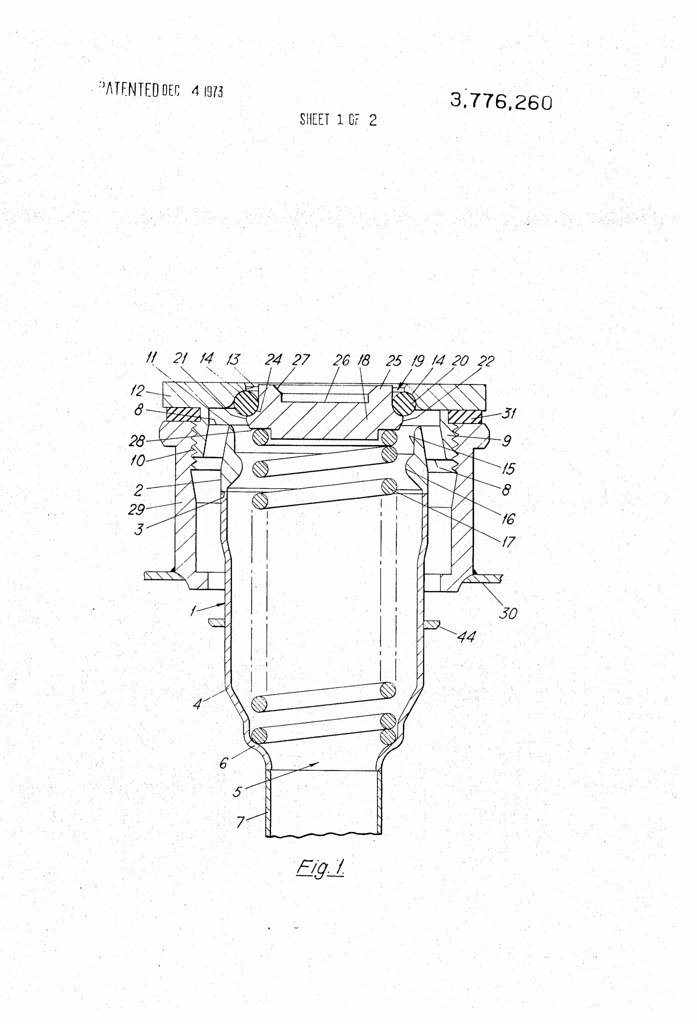
Today in 1973, US Patent 3776260 A was issued, an invention of Maurice Ruddick, for his “Beer Kegs and Like Containers.” Here’s the Abstract:
A spear and closure assembly which is arranged to be fitted as a single unit in the neck of a beer keg or like container comprises a tubular housing having one end open and the spear fixed to the housing and projecting from its other end, and a valve seat which is fixed to the housing so that it is located adjacent the open end of the housing and projects radially inwards with respect to the open end. The housing, the spear, and the valve seat are connected to form a unitary structure, such as by welding or by a combination of welding and being formed integrally. A spring located within the housing acts on a disc like closure member so that a resilient valve ring is pressed by the closure member against the valve seat, hence closing the opening bounded by the valve seat. Assembly of the spring, the closure member, and the valve ring within the structure is made easy by arranging that the size and shape of the spring and closure member allow these to be passed through the opening bounded by the valve seat, and by providing the valve ring with sufficient resilience to allow it to be deformed and squeezed through this opening. In use, application of a filling or dispensing fitting moves the valve ring and the closure member axially inwards against the action of the spring, the valve ring being displaced axially relative to the closure member and forming a seal against a second valve seat formed on the housing so that two separate passages are formed through the fitting and into the container, one through the housing and the spear and the other outside the housing via an aperture between the two valve seats.

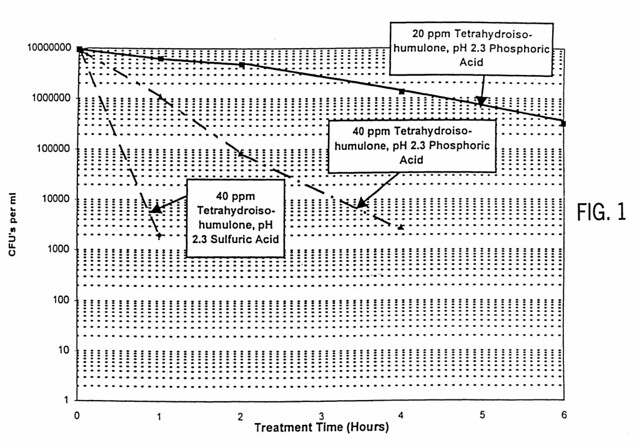
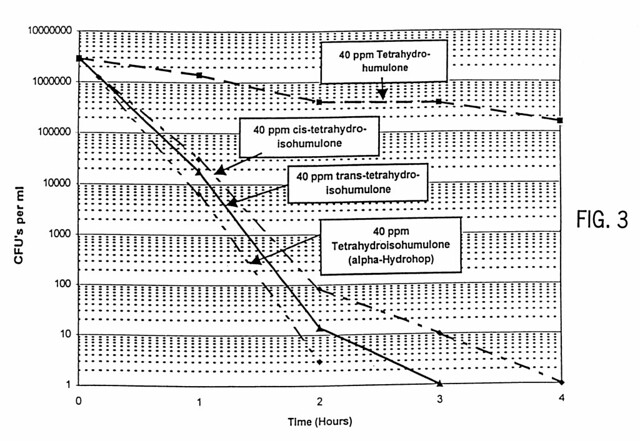
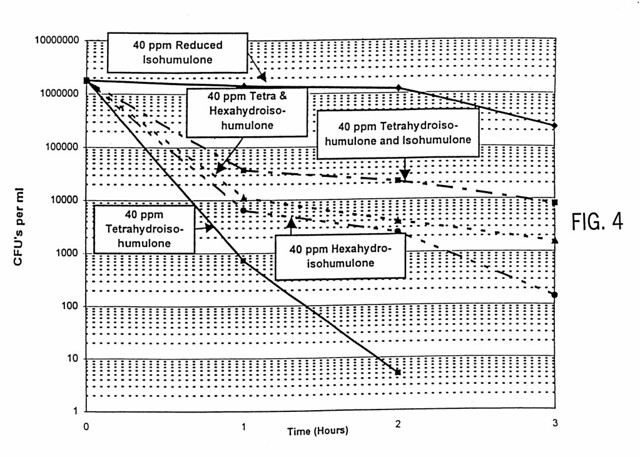
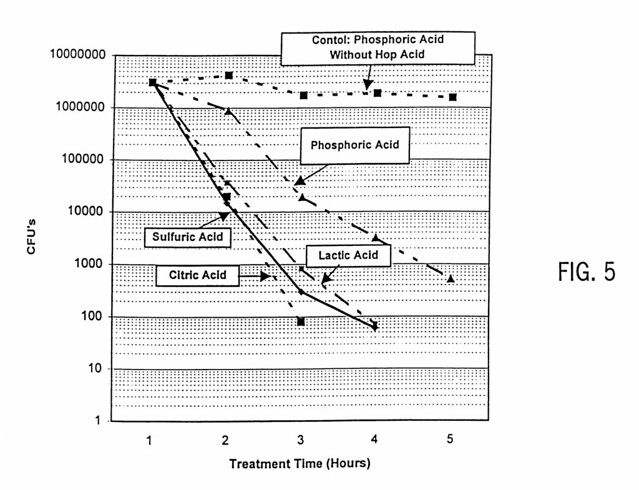
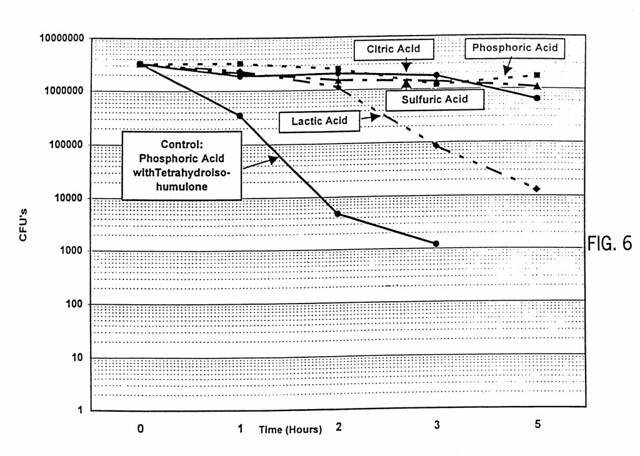
Today in 2001, US Patent 6326185 B1 was issued, an invention of Michael C. Barney, Kathleen M. Carrick, Alfonso Navarro, and David S. Ryder, assigned to Miller Brewing Company, for their “Method For Decontaminating Yeast.” Here’s the Abstract:
An improved method for reducing colony forming units bacteria in yeast is disclosed. The method involves contacting the yeast with a hop acid in an amount sufficient to give a final concentration of the hop acid of at least about 40 ppm.

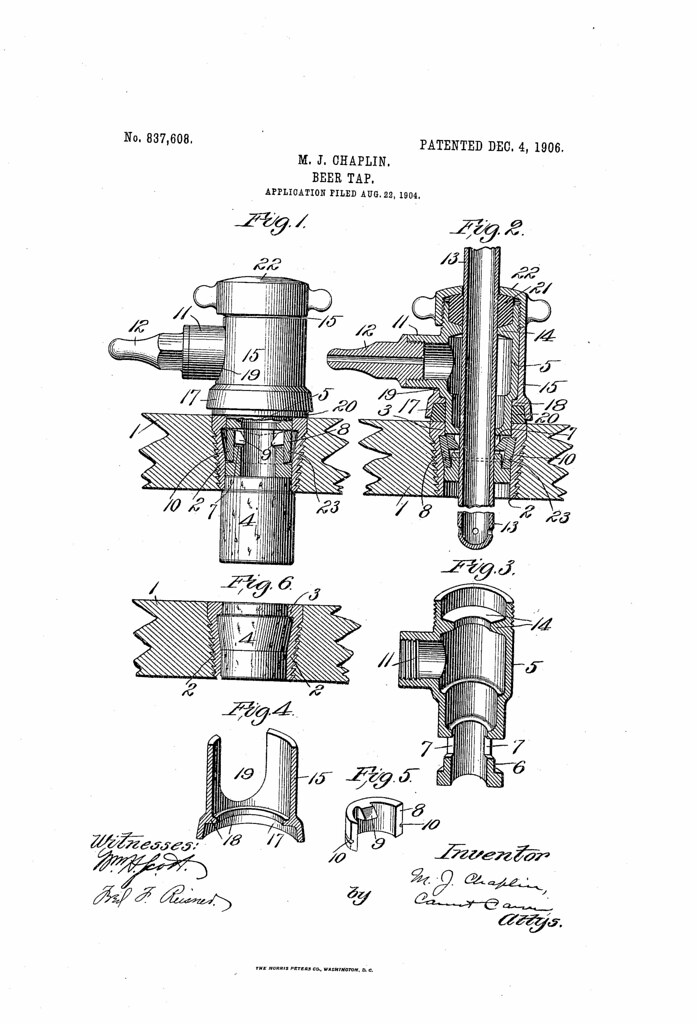
Today in 1902, US Patent 837608 A was issued, an invention of Manley J. Chaplin, for his “Beer-Tap.” There’s no Abstract, although in the description it includes this summary:
My invention relates to taps for beer-casks, and has for its principal objects to provide a tap having simple and effective means for locking it in place, to provide a tap that will be locked in place by the insertion of the discharge-pipe, to provide means for simultaneously packing the joints around the discharge-pipe and around the bung-hole, and other objects hereinafter more fully appearing.
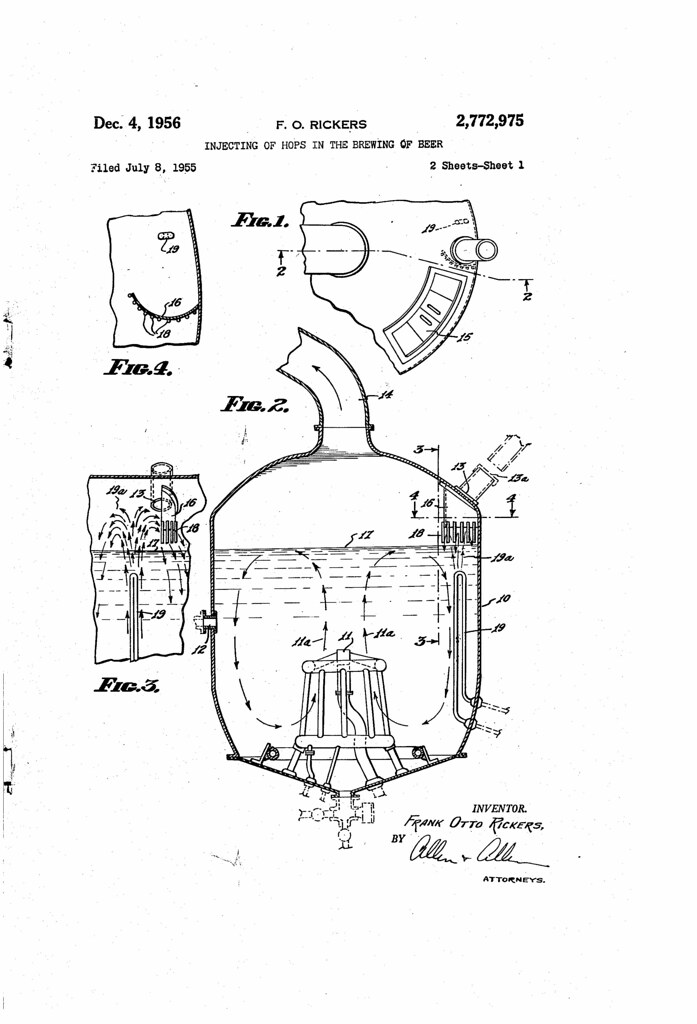
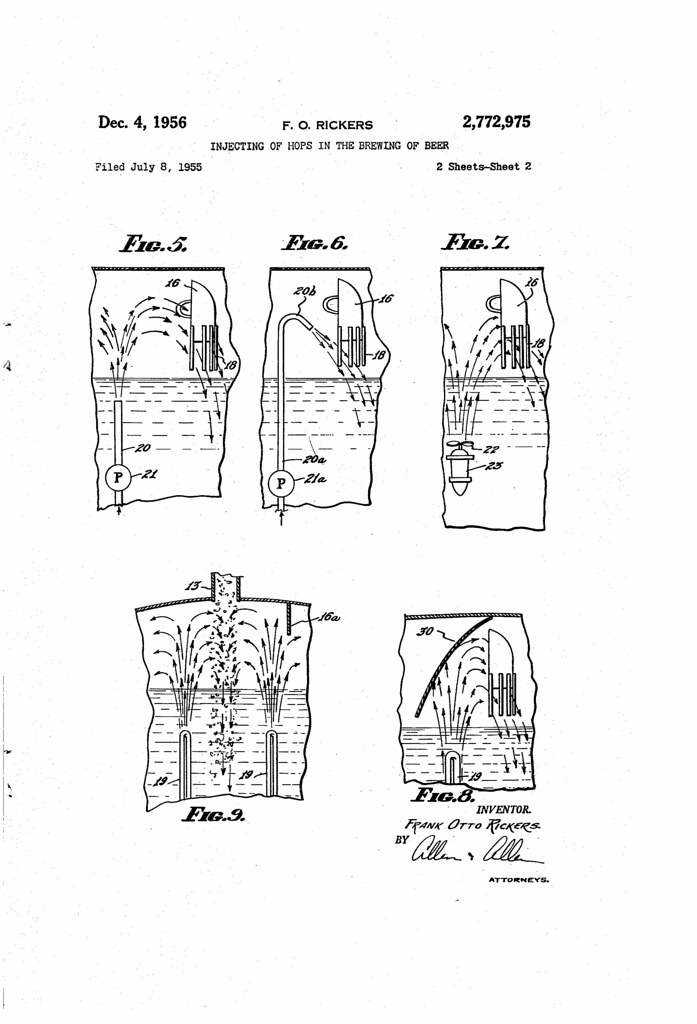
Today in 1956, US Patent 2772975 A was issued, an invention of Frank Otto Rickers, assigned to the Geo Wiedemann Brewing Co. Inc., for his “Injecting Of Hops In The Brewing Of Beer.” There’s no Abstract, although in the description it includes this summary:
It is an object of the present invention to provide for the addition of the hops to a brew kettle in a manner such that the hops will be uniformly distributed through the brew and for greatly increased control over this step of the brewing so any deteriorating effect is prevented by storing in cold temperature so that the loss of hops up the flue will be minimized. Thus, it is an object of the present invention to provide process to the end that each successive brew will have undergone the same length of time in the cooking of the same amount of hops.
Briefly, in the practice of my invention I provide means for insuring that the hops, as they are added to the kettle, are wetted down and caused to enter below the surface of the brew in a rather closely confined area and I provide for a localized ebullition and circulation of the brew such that the lumps or fragments of hops are carried by this localized ebullition and circulation down into the bottom of the kettle whence they are uniformly distributed by the general circulation in the kettle.
Thursday’s ad is for Genesee Beer, from 1970. The snowy stream reminds me more of a Coors ad, and how about the handle on the glass mug, that’s an odd looking one. And that foam head looks staged and fake, but then quite a lot of ads around this time and before had foam like this, they must have all used the same photo stagers.
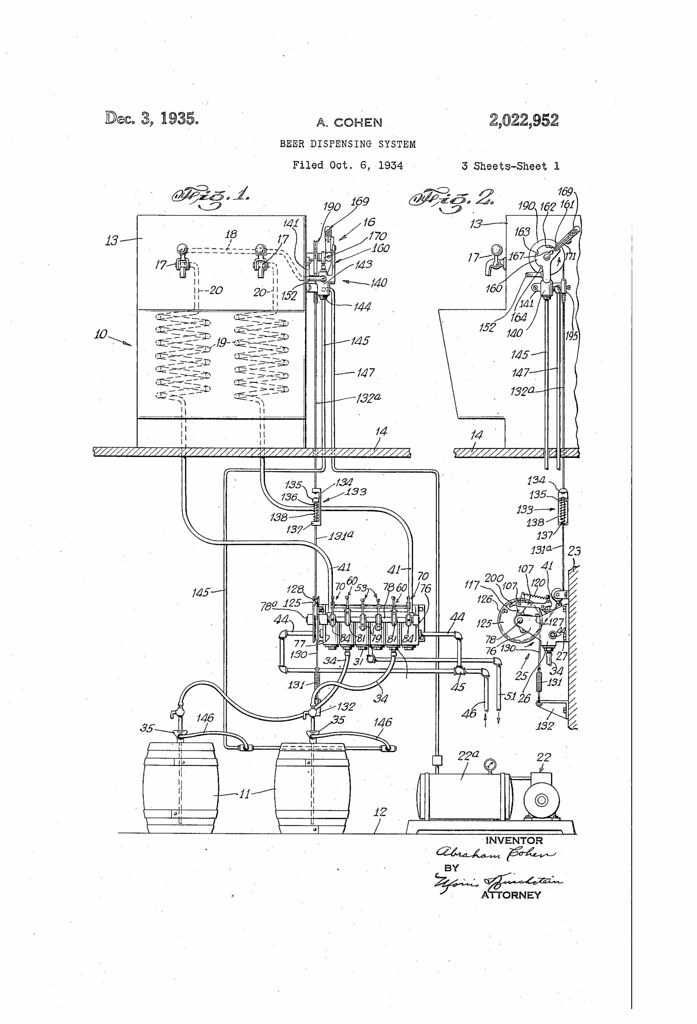
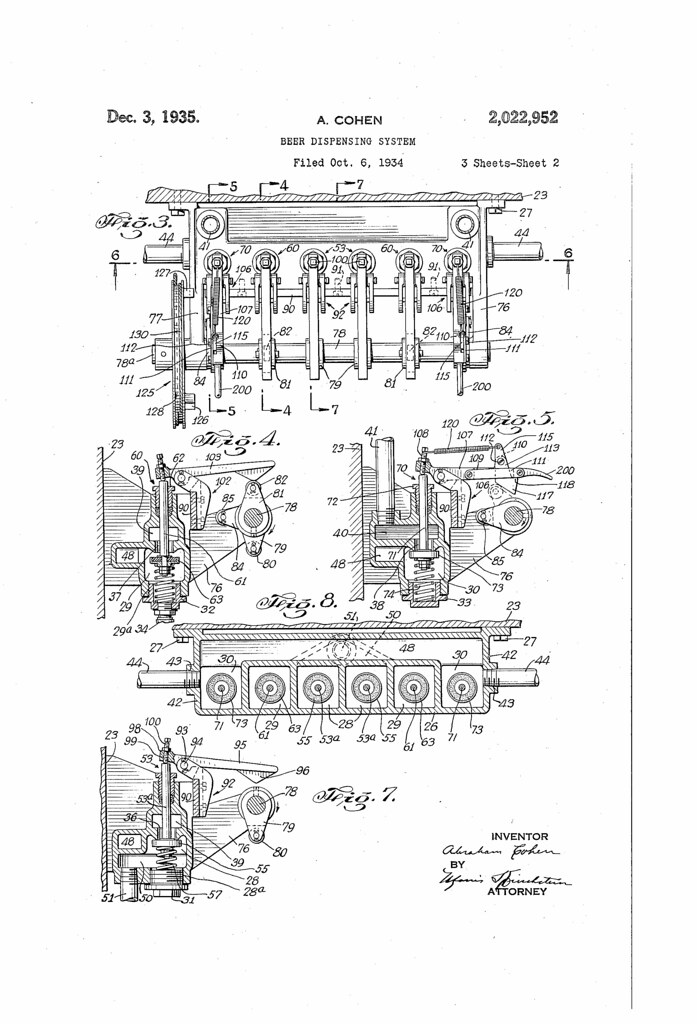
Today in 1935, US Patent 2022952 A was issued, an invention of Abraham Cohen, assigned to Beer Control Systems Inc., for his “Beer Dispensing System.” There’s no Abstract, although in the description it includes this summary:
This invention relates to beer dispensing systems.
An object of this invention is to provide a system of the character described, provided with 5 highly improved means for returning the beer within the beer coils to the barrels and for flushing the coils with water and draining the water from the coils.

Today in 2002, US Patent PP13311 P2 was issued, an invention of Eugene G. Probasco, assigned to John I. Haas, Inc., for his “Hop plant named ‘Millennium-Late.'” Here’s the Abstract:
A new and distinct triploid hop, Humulus lupulus, plant named ‘Millennium-Late’ selected from the progeny of tetraploid ‘Nugget’×proprietary line No. ‘833-53M’, characterized by a high percentage of alpha-acids, a higher alpha/beta ratio, significantly higher percentages of humulene and caryophyllene, coupled with a high yield and resistance to powdery mildew. Harvest maturity is late, similar to ‘Nugget’ and following ‘Galena’ by about 1 week.
A few weeks before, also in 2002, Probasco was also granted Patent Nos. PP13128P2, PP13129P2 & PP13132P2: Millennium Hops, specifically for Millennium-48, Millennium-MiddleLate and Millennium-44.