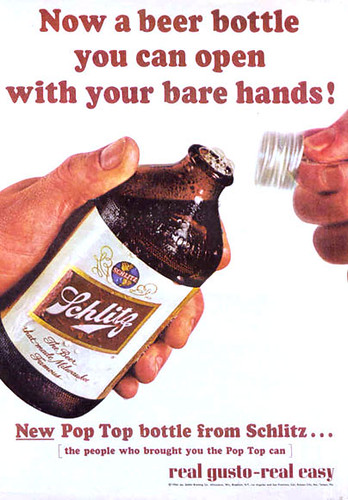
Monday’s ad is a 1955 ad for Schlitz with the oddball slogan “Your thirst can ‘feel‘ the difference.”

By Jay Brooks

Monday’s ad is a 1955 ad for Schlitz with the oddball slogan “Your thirst can ‘feel‘ the difference.”

By Jay Brooks
![]()
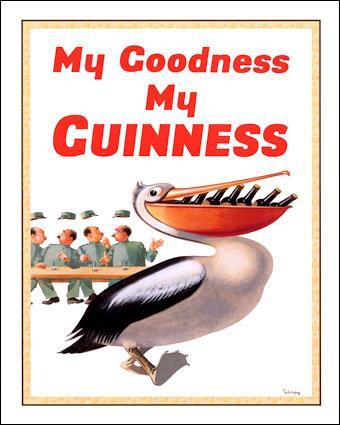
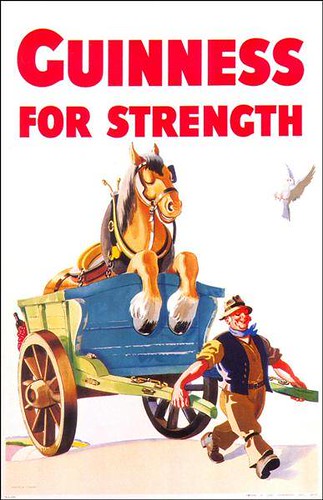
Our eleventh Guinness poster by John Gilroy is another “My Goodness, My Guinness” one, this time featuring a crane about to snatch another construction worker’s Guinness.

By Jay Brooks

Friday’s ad is for Miller High Life from 1952 and features a female golfer and the tagline “The Lady Chooses.” I love the hat with tees in them, and did you notice she’s wearing a golf glove on both hands.

By Jay Brooks

Thursday’s ad is for Ballantine’s Ale, and is from the 1950s. It features the slogan “How American it is … to want something better!” It features a then-new train engine — one I’m sure my son Porter could identify by name if he wasn’t asleep — as a symbol of progress. It’s slightly curious only the bottle itself is in color while the rest is in black and white, which I imagine was design decision to make the bottle pop.

By Jay Brooks

I’m an unabashed lover of animation, which is why I always bristle when the neo-prohibitionists invariably complain when a cartoon is used to sell beer. They always argue that cartoons appeal only to children, and seem to forget that adults love them, too. Many of the most famous cartoons we love were originally made for adults, to be shown before feature films at the theater in the days before television. It wasn’t until the advent of TV, I’d argue, that the split began between cartoons for kids and for adults.
Anyway, I recently was looking for and found a bootleg DVD of old Quisp & Quake commercials, which were created by Jay Ward, famous for Rocky & Bullwinkle, among much else. And, yes, I am that much of an animation geek. Anyway, I also discovered at the same website, something I hadn’t previously known about: a Hanna-Barbera made Flintstones cartoon done in 1967 for an Anheuser-Busch distributor meeting or convention. I promptly ordered that as well.

It’s a little over 19 minutes, shows some upcoming television and radio spots for Busch Bavarian Beer, but also includes a mini-Flinstones story, too, that begins when Fred and Barney lose their jobs and go to a bar to drink Busch beer. It appears aimed at distributors, and possibly retailers, to show what advertising will be used in 1967 to support the brand and help it continue to be successful. There’s some great old adspeak in the video, where the narrator talks about “advertising that moves the consumer to Busch” with what they call — and they say in hushed tones implying it’s a new term — “Target Advertising.” But here’s my favorite. “We used words that beer drinkers understood.” That had me laughing out loud. What exactly are the words that beer drinkers understand? Are they small ones? Simple ones? Ones without too many syllables?

After a few minutes of a Flintstones story, going to the bar, then back home, the boys return again to the bar. The bar’s name is actually “Tavern-Type Inn Bar Grill Lounge Pub Saloon.” They agree to take over for the bartender and serve some Busch beer, then watch a video within the video that’s aimed at the distributors and talks about advertising plans for 1967. Apparently last year’s slogan was “you can’t say beer better than Busch” and the new one will be “when you’re due for a beer, Busch does it!.”

I think my favorite part of the video is when the beer wagon comes out of the A-B gate, pulled by Clydes-dinos. After the video, the 5:00 whistle sounds and Fred and Barney have to go back to work serving Busch to the after work rush. When they’re done, they talk about what hard work it was, and they throw out this bon mot, which must have delighted the crowd. “It takes know how to work in the beer business,” to which Fred replies “yeah, and we got no know how, no how.” Eventually, their boss from the gravel pit, Mr. Slate, comes in the bar and they get their jobs back, of course, wrapping up the story arc from the beginning.
It’s a fun cartoon, especially for the beer geek, and I can’t imagine how expensive it must have been to get Hanna-Barbera, one of the premiere animation studios at that time, to do an industrial film for them. Happily, you don’t have to go out and buy a copy of it like I did, but can watch it right here, because I found it on YouTube, separated into two parts. Enjoy.
Part 1: 9:22
Part 2: 9:59
By Jay Brooks

Wednesday’s ad is for Falls City Brewing, a mostly obscure brewery from Louisville, Kentucky that operated from 1905 to 1978. They’re probably most well-known nationally for Billy Beer, created with Billy Carter, President Jimmy Carter’s less-successful brother. Looking at the record-player and the records in the ad — dude, get your hands off that vinyl, don’t you know how to hold a record? — I’m guessing it’s late 50s, and on closer inspection it’s copyrighted 1956. Parts of the ad copy are hilarious. “real cool … with plenty of cold.” But this is my favorite: “It’s pasteurized to guard its Magic Flavor.”

By Jay Brooks

Tuesday’s ad is for Mackeson’s Stout, originally brewed by the Hythe Brewery in Kent, which was founded in 1699. The Mackeson family acquired the brewery in 1801 and introduced their most enduring beer, the milk stout, in 1907, before being taken over by Whitbread in the late 1920s. I love the notion that the milk stout is the product of illicit love between beer and milk, though of course there’s no actual milk in the beer.

By Jay Brooks

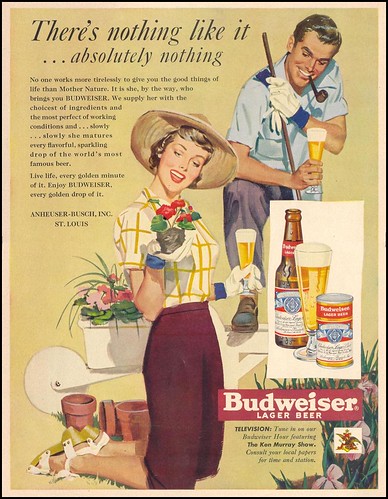
Monday’s ad, since it’s the first one I’ve posted since Spring began on Saturday, is all about getting out and working on your lawn and garden … with a beer, of course. A lawnmower beer, perhaps? Though it looks like a pretty old lawnmower. It’s for Burgie, brewed by Burgermeister Brewery of San Francisco, California. It’s about as green an ad as I can imagine. I’m not sure of the date, though it was probably before 1972, when the brewery was bought by Falstaff from Chicago’s Meister Brau (who owned it at that time). Eventually, the brewery closed around 1979.

By Jay Brooks
![]()
Our tenth Guinness poster by John Gilroy is a variation on the iconic toucan on a weathervane, the difference here is he’s high above a town square on a bright Spring day where, as the tagline suggests, it’s a “Lovely day for a Guinness.”

By Jay Brooks

This may well be the most disturbing story about our Nation’s Prohibition ever told, and one that’s certainly been kept fairly secret. While doing research on her book, The Poisoner’s Handbook, author Deborah Blum discovered that anti-alcohol factions of the U.S. government became so fanatical that they poisoned illegal alcohol either directly or indirectly, possibly killing, or more correctly murdering, as many as 10,000 U.S. citizens! Let that sink in. The whole sordid tale can be found on Slate, entitled The Chemist’s War: The little-told story of how the U.S. government poisoned alcohol during Prohibition with deadly consequences. I’d encourage you to read the entire article, but here are the nuts and bolts.
The government added chemical substances to alcohol used for other purposes, like paint thinner, and unscrupulous bootlegger’s were stealing industrial alcohol and then converting it to something that could be consumed. So the government, knowing full well that it would end up being drunk by people, started spiking it with chemicals that were very, very harmful, ones that the bootlegger’s chemists couldn’t deal with and the result was thousands of deaths. Why would our government do that? Here, Blum cites the frustration of lawmakers to stop people drinking along with prohibitionists who were surprised by our “country’s defiant response to the new laws [which] shocked those who sincerely (and naively) believed that the amendment would usher in a new era of upright behavior.”
During Prohibition, however, an official sense of higher purpose kept the poisoning program in place. As the Chicago Tribune editorialized in 1927: “Normally, no American government would engage in such business. … It is only in the curious fanaticism of Prohibition that any means, however barbarous, are considered justified.” Others, however, accused lawmakers opposed to the poisoning plan of being in cahoots with criminals and argued that bootleggers and their law-breaking alcoholic customers deserved no sympathy. “Must Uncle Sam guarantee safety first for souses?” asked Nebraska’s Omaha Bee.
Only a handful of people in fact spoke out against this practice. One was Charles Norris, chief medical examiner for New York City, who referred to the program as “our national experiment in extermination.”
“The government knows it is not stopping drinking by putting poison in alcohol,” New York City medical examiner Charles Norris said at a hastily organized press conference. “[Y]et it continues its poisoning processes, heedless of the fact that people determined to drink are daily absorbing that poison. Knowing this to be true, the United States government must be charged with the moral responsibility for the deaths that poisoned liquor causes, although it cannot be held legally responsible.”
Frankly, I don’t see why they couldn’t be held legally responsible since they were in effect knowingly poisoning people, especially after the first deaths occurred. That they didn’t stop it then says quite a lot about how determined they were. It often appears to me that modern day prohibitionists take an ends-justify-the-means approach to further their agenda and will employ just about any tactic, despite its consequences or ethical disconnect. It would appear that’s nothing new after all. The fact that more people don’t know about this dark chapter of our history of prohibition makes it easier for today’s anti-alcohol supporters to continue their quest for another national alcohol ban. Let’s hope we can all learn from this mistake of history and aren’t doomed to repeat it.