Brookston Beer Bulletin

Jay R. Brooks on Beer

  • Home
  • About
  • Editorial
  • Birthdays
  • Art & Beer

Socialize

  • Dribbble
  • Email
  • Facebook
  • Flickr
  • GitHub
  • Instagram
  • LinkedIn
  • Pinterest
  • RSS
  • Twitter
  • YouTube

Powered by Genesis

Beer In Ads #1725: A Bear, A Beer, A Halloween Party

October 31, 2015 By Jay Brooks


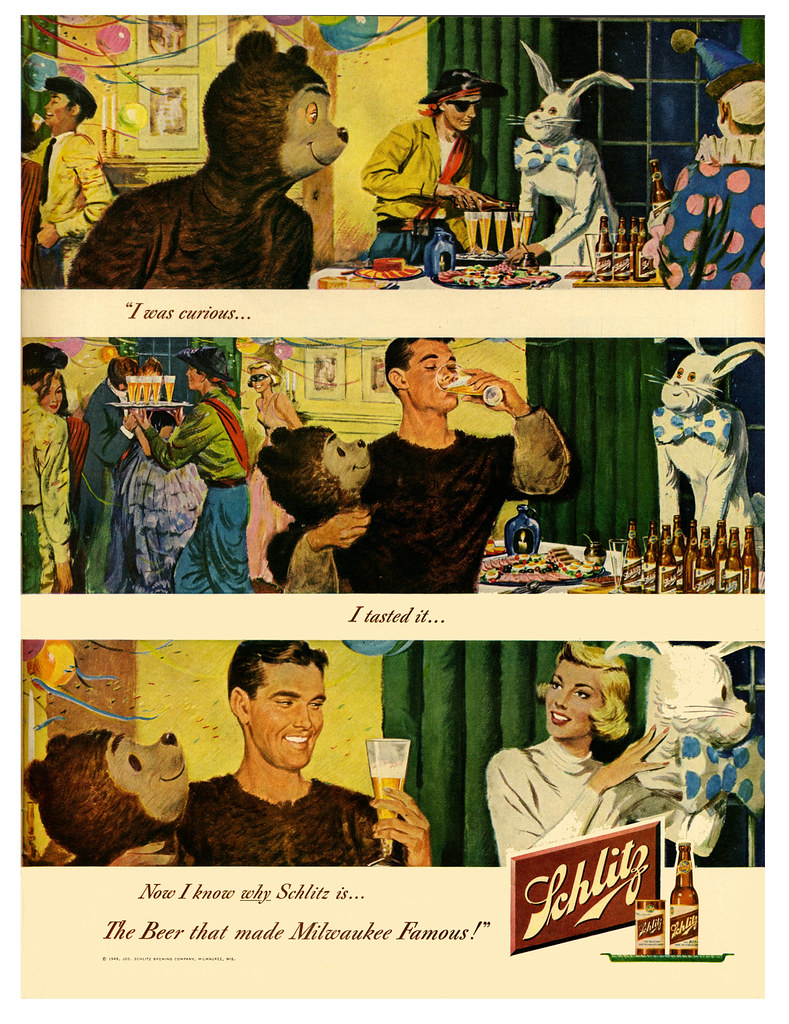
Saturday’s Halloween ad is for Schlitz, from 1949. Part of Schlitz’s “I Was Curious” series, each employing a three-panel structure, this one takes place at a Halloween party. A man dressed as a bear spots a table full or Schlitz beer and was apparently thirsty enough to get a beer, forcing him to reveal himself by removing his bear helmet/mask to drink the beer, at which point, the bunny behind the table removes her rabbit head to reveal a fetching blonde, and the two appear to make googly eyes at one another. Which should mean the ad will have a happy ending. But in the first panel, the bunny was holding on onto a tray while a pirate poured beers into glasses, and then briskly goes off to deliver the beers to other guests at the party. That might suggest that he’s one of the hosts of the party, and possibly the bunny’s husband or boyfriend. So maybe this ad is racier than you might think at first glance. Perhaps we’re seeing the start of an affair?
Schlitz-1949-halloween-party

Filed Under: Art & Beer, Beers Tagged With: Advertising, Halloween, History, Holidays, Schlitz

No Beer, No Work

September 7, 2015 By Jay Brooks

no-beer-no-work
Today, of course, is Labor Day in the U.S. and Canada, celebrated each year on the first Monday in September since 1894, at least federally. Most countries, more than 80, celebrate something similar on May 1, and a few others on different days. In the Bahamas, for example, it’s the first Friday in June and in New Zealand, it’s celebrated the fourth Monday in October, while in Australia it’s different for every territory there. But the genesis is the same, to “honor the American labor movement and the contributions that workers have made to the strength, prosperity, and well-being of their country.”

According to Wikipedia, “Labor Day was promoted by the Central Labor Union and the Knights of Labor, who organized the first parade in New York City. After the Haymarket Massacre in Chicago on May 4, 1886, U.S. President Grover Cleveland feared that commemorating Labor Day on May 1 could become an opportunity to commemorate the affair. Therefore, in 1887, the United States holiday was established in September to support the Labor Day that the Knights favored.” And you can read more about it at the Department of Labor.

Unlike today, when labor movements, and particularly unions, are demonized in the press and by the right-wing political machine, most people supported labor in some fashion for the very simply reason that a majority of people were part of the labor force. Today, thanks to effective propaganda, many people vote against their own interests. But that was not yet the case when Prohibition took effect in 1920. So many people in the labor force who were very unhappy about not being able to drink a beer after eight hours of back-breaking work started agitating for a repeal of prohibition, in some cases right from the start, since it became abundantly clear very quickly that a working life without the reward of a cold beer was going to suck.

Even before the 18th Amendment was to take effect on January 17, 1920, a previous measure passed by Congress, the Wartime Prohibition Act banned “the sale of alcoholic beverages having an alcohol content of greater than 2.75%” beginning on June 30, 1919.” The measure supposedly was “intended to save grain for the war effort,” but it actually “was passed after the armistice ending World War I was signed on November 11, 1918.” Since July 1st was the first day after alcohol was banned under the Wartime Prohibition Act, that day became known as the “Thirsty-First.”

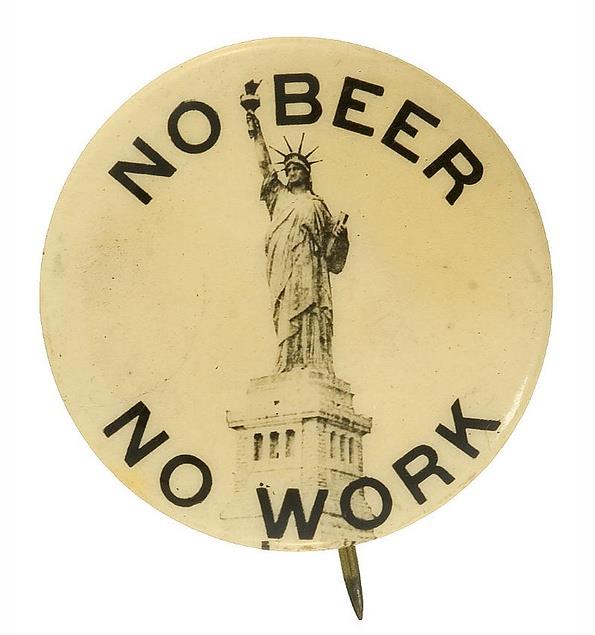
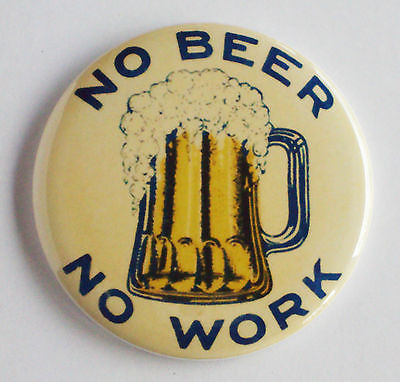
So labor organizations in New York City began making plans to oppose and protest Prohibition, creating pins bearing their slogan “No Beer, No Work.”

no-beer-no-work-pin

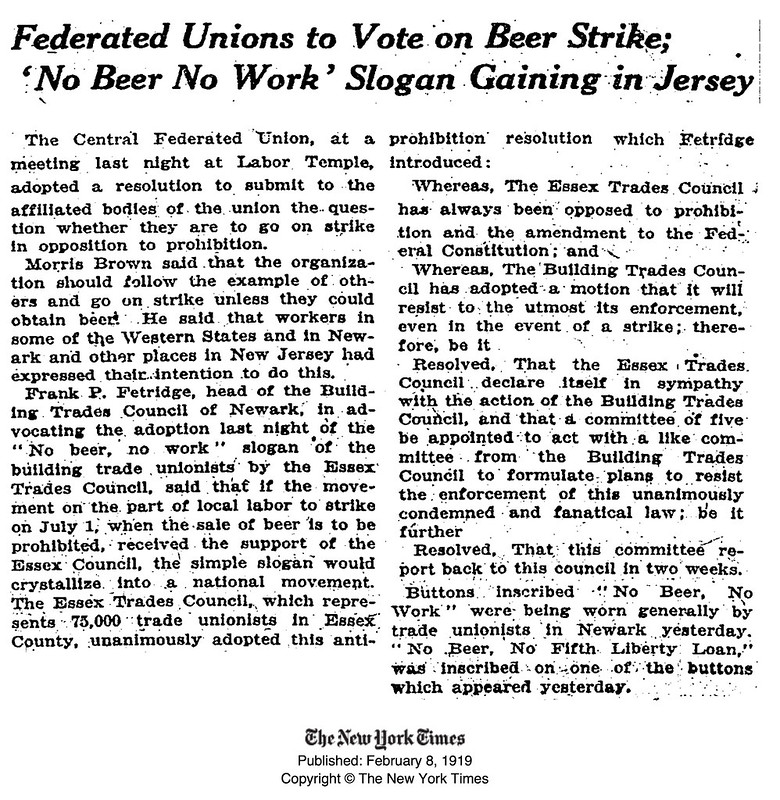
In addition, they planned a walk-out for July 1 of 1919, which was reported in the New York Times on February 8, 1919.

nyt-feb8-1919

The next day, February 9, 1919, the story was picked up in Chicago and ran on the front page of The Evening World.

NoBeerNoWork-1919-Chicago

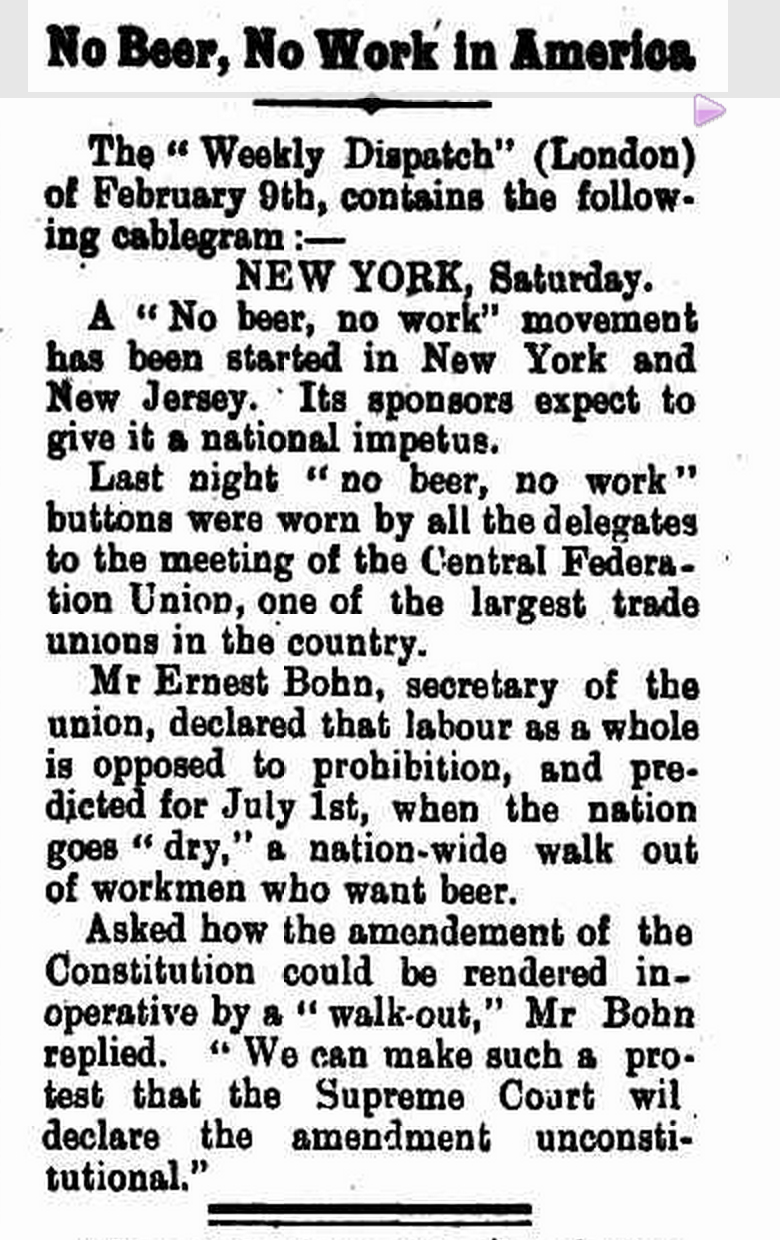
The news even made it as far as Australia’s Northern Territory Times and Gazette of Darwin, which ran the story on April 19, 1919 (reporting on events of February 8th and 9th):

NoBeerNoWork-1919-Australia

A “No beer, no work” movement has been started in New York and New Jersey. Its sponsors expect to give it a national impetus. Last night “no beer, no work” buttons were worn by all the delegates to the meeting of the Central Federation Union, one of the largest trade unions in the country. Mr. Ernest Bohn, secretary of the union, declared that labour as a whole is opposed to prohibition, and predicted for July 1st, when the nation goes “dry,” a nation-wide walk out of workmen who want beer. Asked how the amendment of the Constitution could be rendered inoperative by a ” walk-out,” Mr Bohn replied. “We can make such a protest that the Supreme Court wilt declare the amendment unconstitutional.”

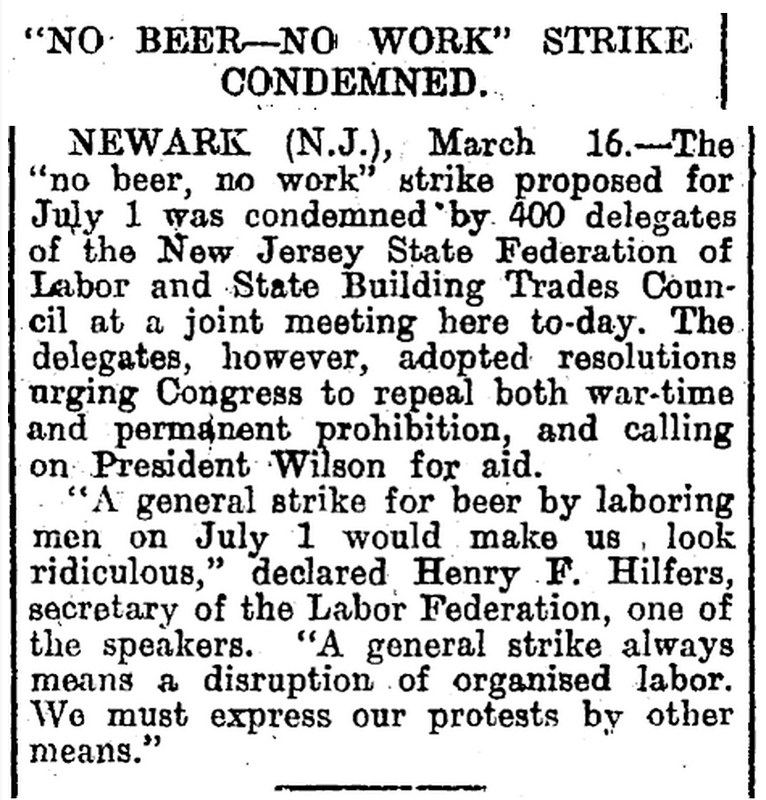
But not everyone in labor agreed, as evidenced by this article in New Jersey’s Poverty Bay Herald on May 3, 1919, where 400 union delegates in the Garden State came out against the strike, although they agreed that Prohibition was a bad idea.

NoBeerNoWork-1919-NJ

But there’s not much more about these efforts in New York that I could find. I did find this paragraph, by a Columbia history student, who in his junior year received a research grant, the Edwin Robbins Prize, and used it to do his senior thesis:

“New York Organized Labor and Prohibition Resistance: The ‘No Beer, No Work’ Movement of 1919.” A forgotten moment in labor history, it was a fascinating intersection of culture, gender, and class, examining the untidy boundary between “economic” and “social” life. Some local trade-unionists co-opted a catchy slogan, “No Beer, No Work,” with the intent of fomenting a national general strike, attempting to save the saloon, galvanize class consciousness, and lead workers into a labor party. The strike more than failed; it never occurred.

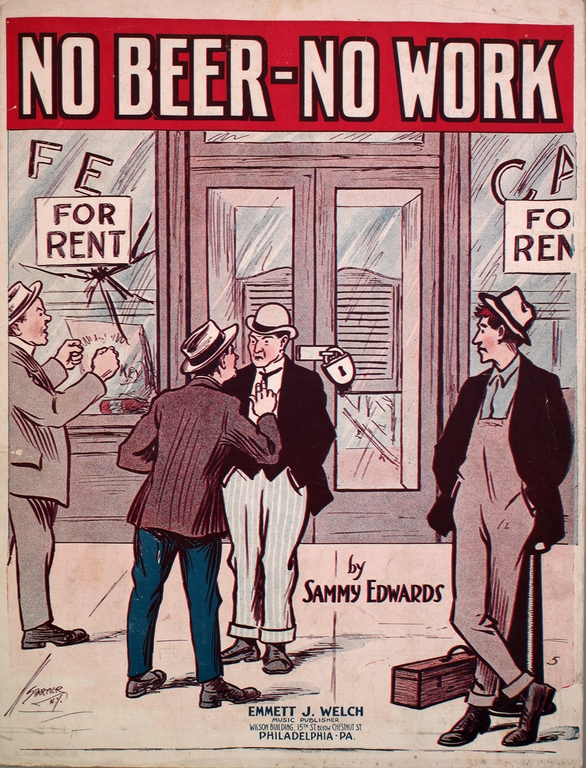
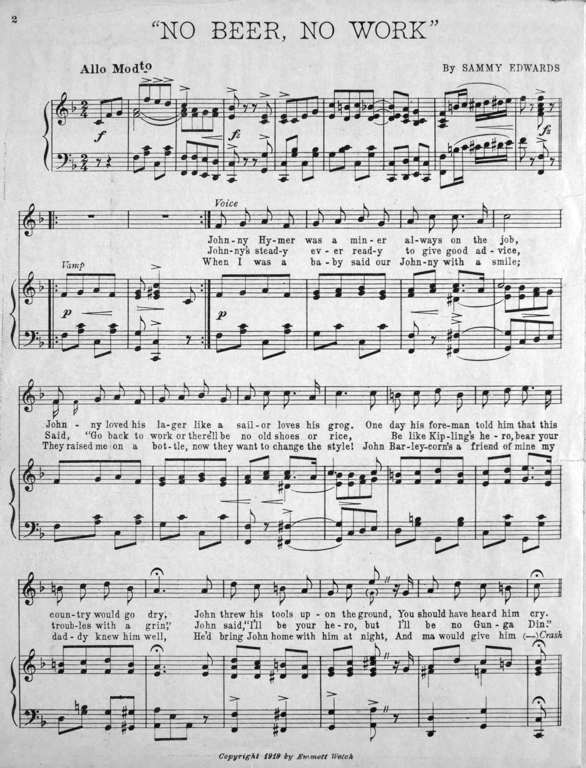
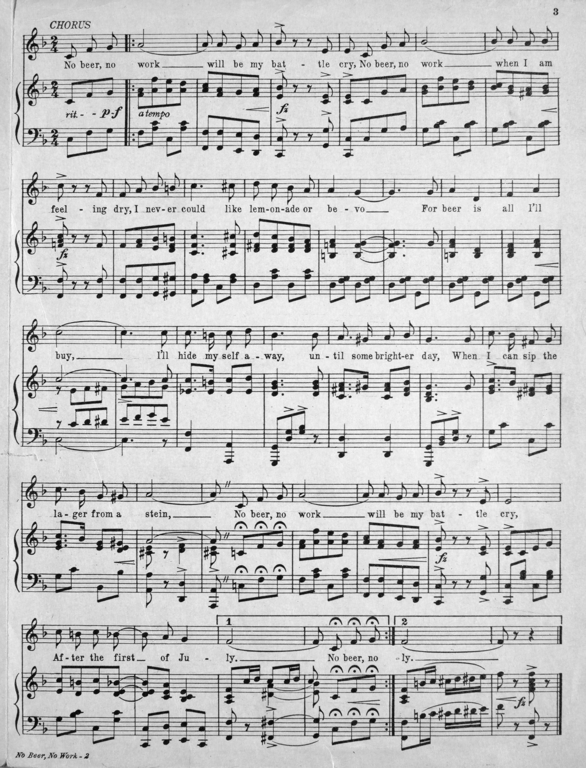
Perhaps more curiously, and what started this, is I discovered that more than one person took the great slogan “No Beer, No Work,” and wrote a song about it, using it as the title. The first I found was written in 1919, by Sammy Edwards.

nbnw-0
nbnw-1
nbnw-2

And here are the lyrics to NO BEER, NO WORK, by Sammy Edwards, 1919:

1. Johnny Hymer was a miner, always on the job.
Johnny loved his lager like a sailor loves his grog.
One day, his foreman told him that this country would go dry.
John threw his tools upon the ground. You should have heard him cry:

CHORUS: “No beer, no work” will be my battle cry.
“No beer, no work” when I am feeling dry.
I never could like lemonade or bevo, for beer is all I’ll buy.
I’ll hide my self away
Until some brighter day
When I can sip the lager from a stein.
“No beer, no work” will be my battle cry
After the first of July.

2. Johnny’s steady, ever ready to give good advice,
Said, “Go back to work or there’ll be no old shoes or rice.
Be like Kipling’s hero. Bear your troubles with a grin.”
John said, “I’ll be your hero, but I’ll be no Gunga Din.”

3. “When I was a baby,” said our Johnny with a smile,
“They raised me on a bottle. Now they want to change the style.
John Barleycorn’s a friend of mine. My daddy knew him well.
He’d bring John home with him at night and ma would give him —.

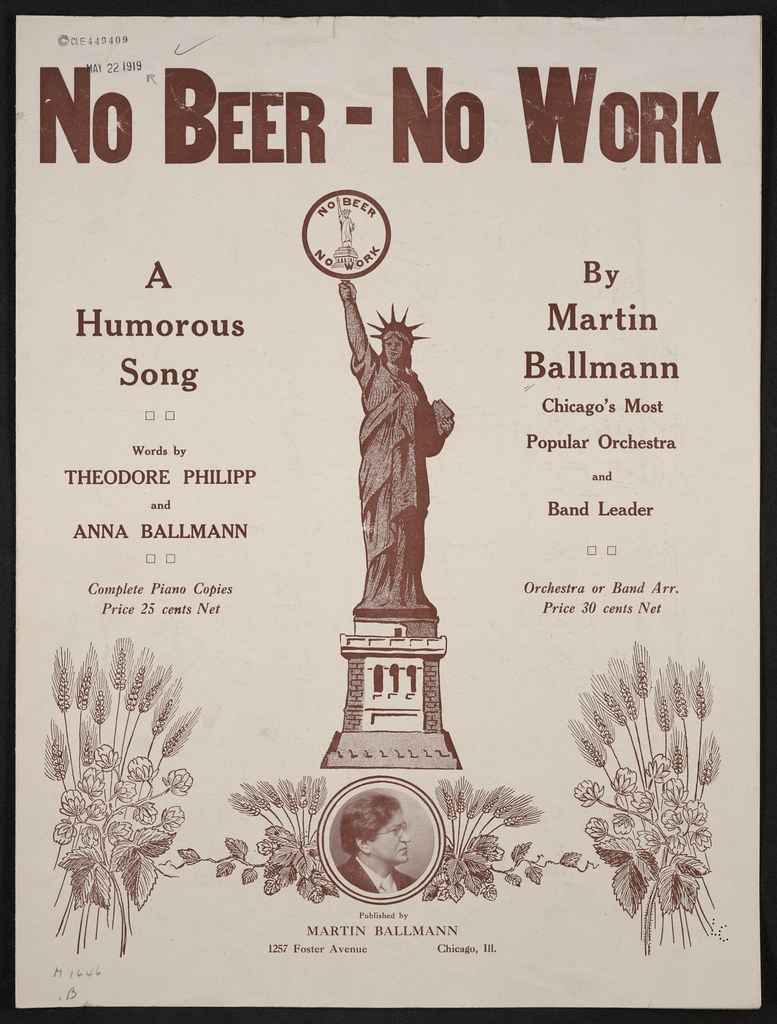
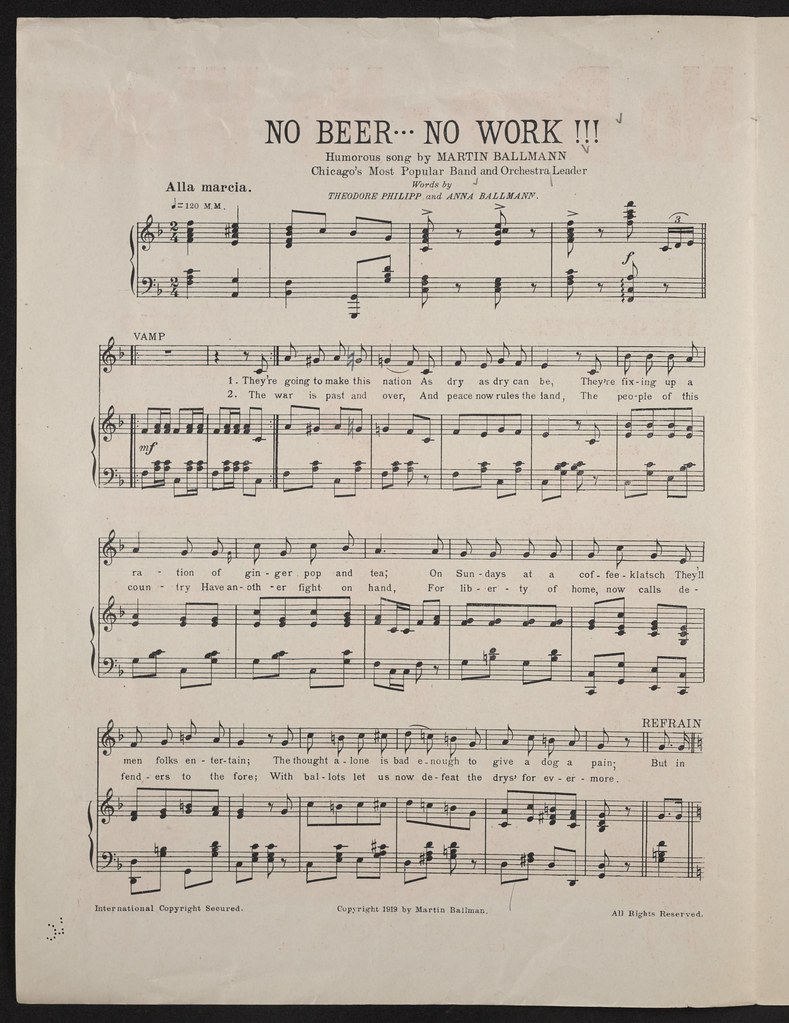
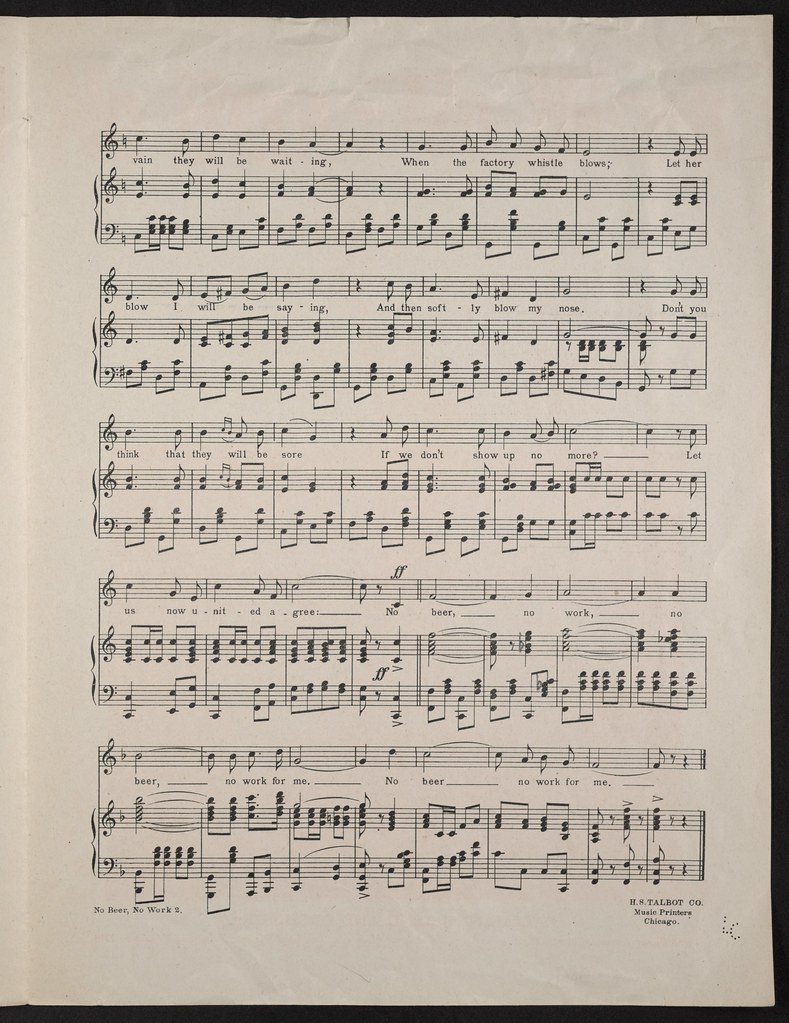
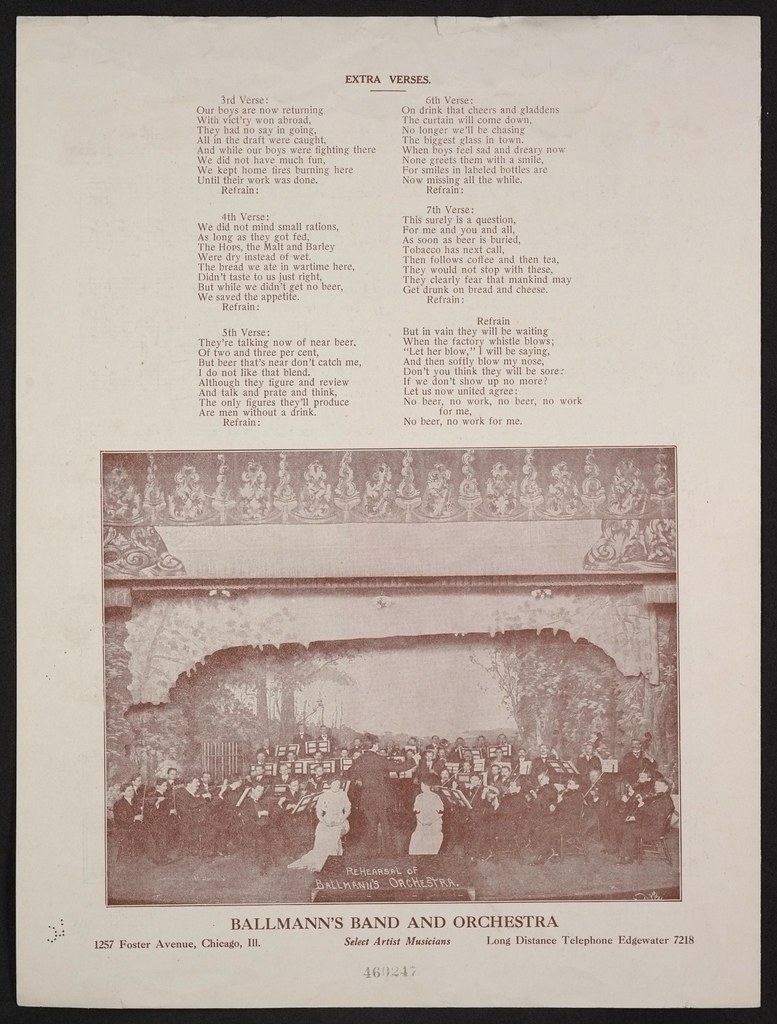
Then the very same year, another song was published by Martin Ballmann, with lyrics by Anna Ballmann and Theodore Philipp, also with the title “No Beer, No Work.” Ballman’s version was published in Chicago, and is completely different than Edwards’, apart from the title, of course.

nb-nw-0
nb-nw-1
nb-nw-2
nb-nw-3

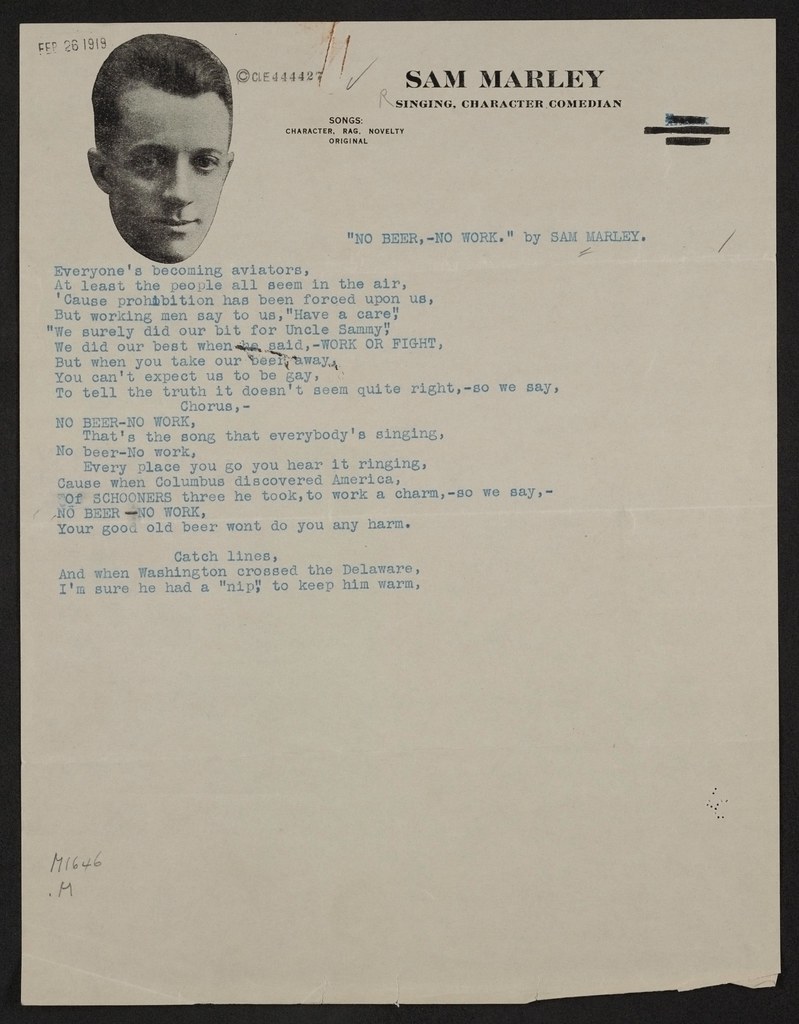
And lastly, music-wise at least, again in early 1919 (February 26 the paper is stamped), “singing character comedian” Sam Marley created original novelty lyrics for a song he called … wait for it … “No Beer, No Work.” His typed lyrics can be found in the collection of the Library of Congress.

no-beer-lyrics

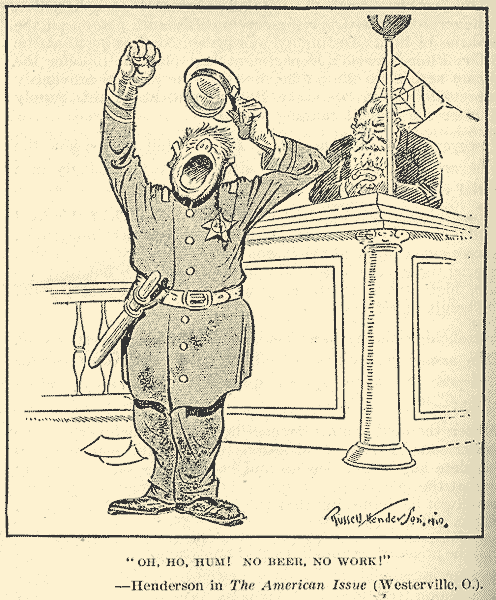
Here’s a political cartoon originally from “The American Issue” of Westerville, Ohio, published August 19, 1919, drawn by an artist named Henderson.

No_Beer

And finally, American author and poet Ellis Parker Butler, wrote a poem in 1919 also using labor’s slogan as the title, which was published in the magazine “Snappy Stories.” Butler’s poem was a parody of Henry Wadsworth Longfellow’s Excelsior.

No Beer, No Work

The shades of night was fallin’ slow
As through New York a guy did go
And nail on ev’ry barroom door
A card that this here motter bore:
‘No beer, no work.’

His brow was sad, his mouth was dry;
It was the first day of July,
And where, all parched and scorched it hung,
These words was stenciled on his tongue:
‘No beer, no work.’

‘Oh, stay,’ the maiden said, ‘and sup
This malted milk from this here cup.’
A shudder passed through that there guy,
But with a moan he made reply:
‘No beer, no work.’

At break of day, as through the town
The milkman put milk bottles down,
Onto one stoop a sort of snore
Was heard, and then was heard no more—
‘No beer, no work.’

The poor old guy plumb dead was found
And planted in the buryin’ ground,
Still graspin’ in his hand of ice
Them placards with this sad device:
‘No beer, no work.’

no-beer-no-work-mug-pin

To which I can only add. Happy Labor Day!

Filed Under: Editorial, Just For Fun, Politics & Law, Related Pleasures Tagged With: History, Holidays, Music, Poetry, Prohibition

Beer In Ads #1606: 4th Of July Snowman

July 4, 2015 By Jay Brooks


Saturday’s ad is for Rheingold Beer, from 1937. This was an unusual ad for independence day, using a snowman in July to talk about “the glorious Fourth.” And the snowman is lighting a firecracker, it must have really stood out in a magazine or newspaper published in the summer. And another oddity: there’s a circle containing the pjrase “beer is best,” which was a phrase being used at the time in Great Britain by a brewers trade group so it’s interesting to see it in an American ad during the same time period.

Reingold-1937-snowman

Filed Under: Art & Beer, Beers Tagged With: Advertising, History, Holidays, Rheingold

Beer Can Dads 2015

June 21, 2015 By Jay Brooks

fathers
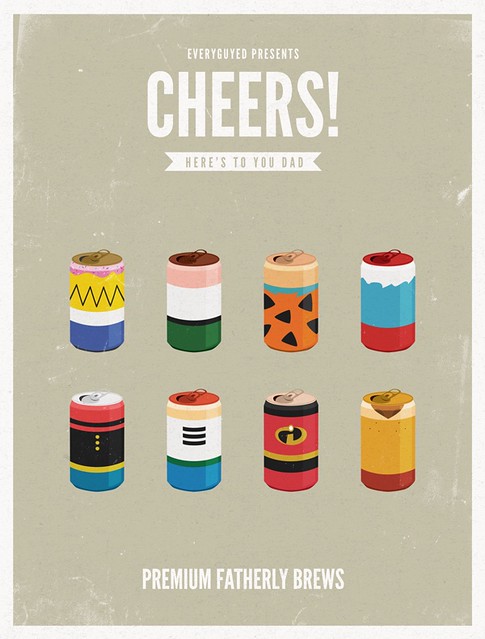
I posted these a few years ago, but given that it’s Father’s Day I figured today was a good day to take another look at them. Around 2011, the good folks at Every Guyed designed eight beer can dads.

fathersday-cartoondads

Here was the idea:

To celebrate Father’s Day, EveryGuyed and Moxy Creative House have teamed up once again to deliver the second installment of the ‘Cheers!’. This time we had creative director Glenn Michael raise a glass — and his brush — to 8 iconic animated dads, re-envisioning them as beer cans.

When you were a kid, Father’s Day was a pretty boring affair. Now you’re of age, and all of a sudden you have the chance to do something with your dad that he’ll actually enjoy: share a cold one together.

See if you can guess all of the cartoon dads. You can see all eight of them in the slideshow above. The answers can found at the bottom of the original post I did.

Looking at this again, I still want my own dad can. What would yours look like?

Filed Under: Art & Beer, Beers, Just For Fun, Related Pleasures Tagged With: Cans, Cartoons, Holidays, Humor

American Craft Beer Week 2015

May 11, 2015 By Jay Brooks

acbw-2015
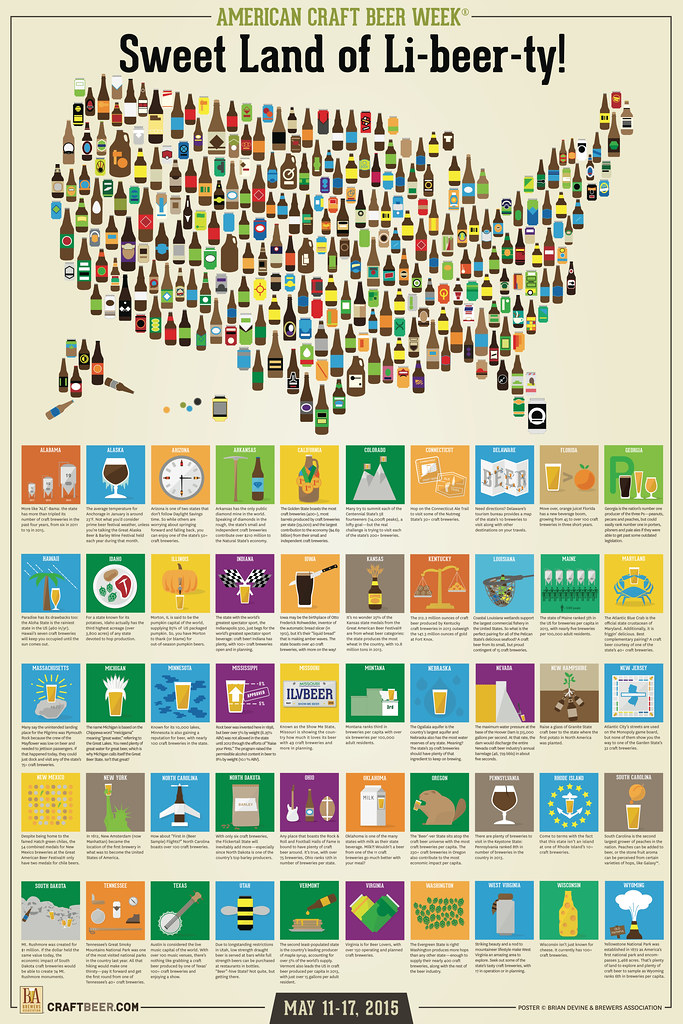
Today begins the 10th annual American Craft Beer Week, which is themed this year as Cheers to the Sweet Land of Li-beer-ty. This year it will take place May 11-17, and “all 50 states will hold events including exclusive brewery tours, special craft beer releases, food and beer pairings, tap takeovers and more to honor the ever-advancing craft beer culture and unite tens of thousands of beer lovers nationwide.”

“American Craft Beer Week has provided independent beer fans across the country a chance to support their local breweries since 2006,” said Julia Herz, publisher of CraftBeer.com and craft beer program director at the Brewers Association. “With celebrations happening in all 50 states, this is truly an annual national event that recognizes all those involved in making craft beer from small breweries in the U.S. such a success.”

You can also follow news of ACBW and see what events have been scheduled and the list can be searched by state. The BA this year has also “created an interactive graphic with fun facts to commemorate each state and their commitment to craft brewing.”

acbw-map-2015
Click here to see the ACBW poster full size.

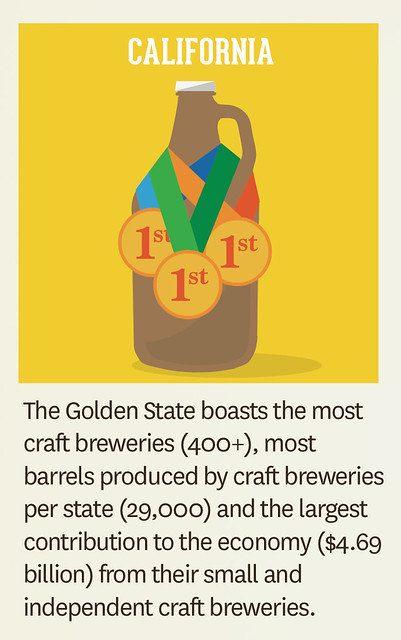
And here’s a larger view of what they had to say about California.

acbw-map-2015-cal

Filed Under: Beers, Breweries, Events, Just For Fun, News Tagged With: Beer Weeks, Brewers Association, Holidays

Beer In Ads #1546: Tecate’s Three Amigos

May 5, 2015 By Jay Brooks


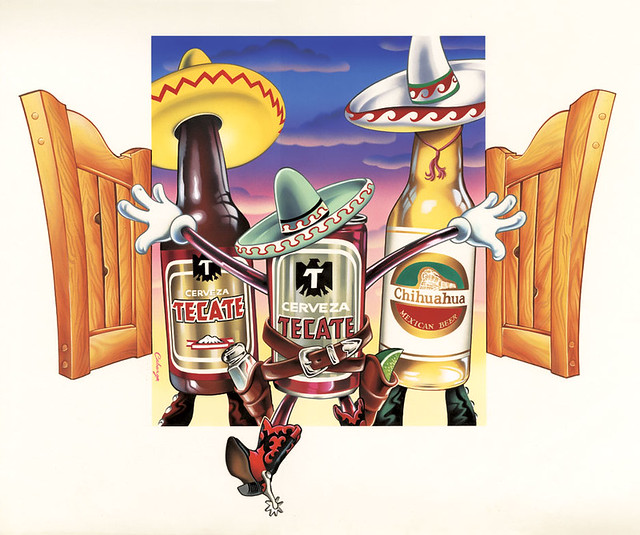
Tuesday’s ad, for Cinco de Mayo, is for Tecate beer, from 1988. The cartoon art was created by Leslie Cabarga and used by Tecate in a series of ads that summer, and was even made into a poster. Showing two Tecates, a bottle and a can, though the can is clearly the leader, along with a bottle of Chihuahua (which I recall selling at BevMo for $2.99 per six-pack), making an entrance into a wild west saloon. Notice the can has a bottle of salt and a lime in his holsters. It’s a pretty cheesy ad, but this was also the same time 7-Up was advertising using a spot with arms and legs, and California raisins were similarly animated, so maybe it was popular.

Tecate1

Filed Under: Art & Beer, Beers Tagged With: Advertising, History, Holidays, Mexico

Go Mild For The Next Session

April 11, 2015 By Jay Brooks

session-the
For the 99th Session, our host is Alistair Reece, who writes the Fuggled blog. He’s also the founder of American Mild Month, which will take place for the first time this May. Intended as a companion to May is Mild Month, which is a month-long promotion of mild ale sponsored by CAMRA in Great Britain, there’s also a Facebook page and so far he’s gotten 45 breweries to commit offering a mild ale during the month. So for the May Session, the topic is “Localising Mild,” which he describes below.

Each May CAMRA in the UK encourages drinkers to get out and drink Mild Ales. This May is the first, as far as I am aware, American Mild Month, which has 45 breweries, so far, committed to brewing mild ales. Of those 45 breweries some are brewing the traditional English dark and pale mild styles, while a couple have said they will brew an ‘American Mild’, which American Mild Month describes as:
a restrained, darkish ale, with gentle hopping and a clean finish so that the malt and what hops are present, shine through

An essential element of the American Mild is that it uses American malts, hops, and the clean yeast strain that is commonly used over here. Like the development of many a beers style around the world, American Mild is the localisation of a beer from elsewhere, giving a nod to the original, but going its own way.

That then is the crux of the theme for The Session in May, how would you localise mild? What would an Irish, Belgian, Czech, or Australian Mild look like? Is anyone in your country making such a beer? For homebrewers, have you dabbled in cross-cultural beer making when it comes to mild?

The first Friday of May is also the first day of May. May Day, or International Workers Day, and it is apt that a beer style closely associated with the industrial regions of England should be the theme for the Session. Have at it folks!

american-mild-month

So don’t go crazy, don’t go wild, instead this May go mild. To participate in the May Session, leave a comment to the original announcement on or before Friday, May 1.

label-mild-ale-bybo

Filed Under: Beers, Events, Related Pleasures, The Session Tagged With: Announcements, Beer Styles, Holidays

Beer In Ads #1516: Decorating The Eggs

April 5, 2015 By Jay Brooks


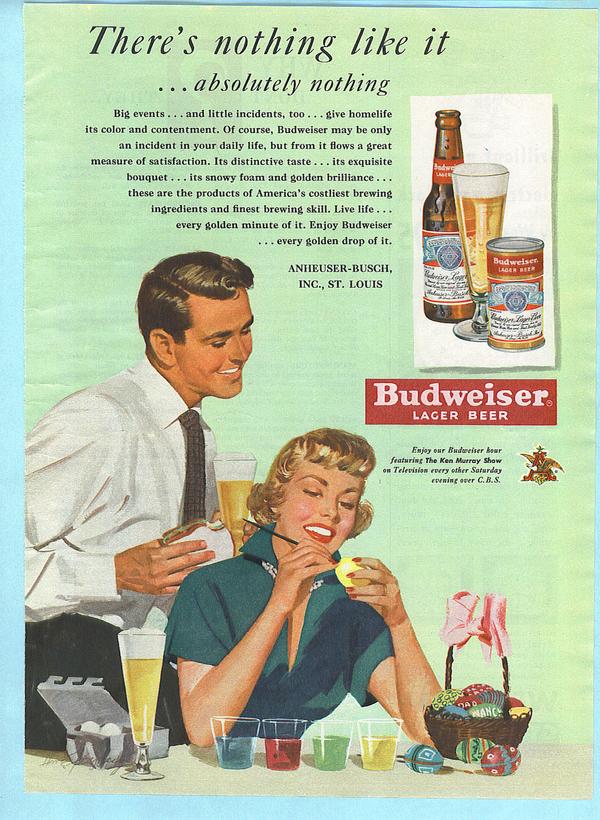
Sunday’s ad is an Easter ad for Budweiser, from 1950. It’s an ad from the “There’s Nothing Like It … Absolutely Nothing.” In this holiday-themed ad, a woman is coloring and decorating eggs for Easter, while behind her, a man is holding a sandwich and a beer, watching her do all the work. She’s in a dress with her pearls, and he’s in a white shirt and tie. That takes some sizable confidence to not put on a smock or apron when working with food dye. That green background is somewhat nauseating, too. I hope that’s not the walls of their home, but who knows. You did see interiors back then with some horrific (to our eye) colors.

Bud-1950-easter

Filed Under: Art & Beer, Beers Tagged With: Advertising, Budweiser, History, Holidays

The Brewhog Saw His Shadow Again, 6 More Weeks Of Winter Beers

February 2, 2015 By Jay Brooks

groundhog-day
Over in Gobbler’s Knob, in Punxsutawney, Pennsylvania, Phil the Groundhog — a.k.a. Brewhog — raised up his head this morning and looked around, and this year saw his shadow everywhere he looked for the second year in a row. You know what that means. It’s six more weeks of drinking winter beers this year. Or something about a late spring, I can’t keep it straight. You can see a video of Punxsutawney Phil here. And there’s more information about Groundhog Day at the Punxsutawney Groundhog Club.

Straub-groundhog-brew-2013

Filed Under: Just For Fun, News Tagged With: Holidays, Pennsylvania

Happy Burns Night

January 25, 2015 By Jay Brooks

scotland
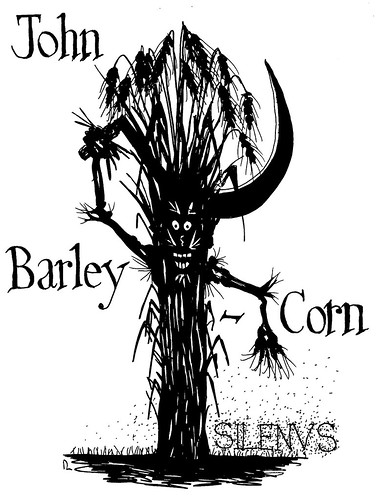
Tonight, many fans of the Scottish poet Robert Burns, will celebrate Burns Night with a meal of Haggis, Scotch Whisky and a night of poetry reading. Though Burns was apparently a whisky drinker, I feel confident saying he probably also drank beer and there are plenty of ways you could incorporate beer and whisky into your evening. I nominate for your poetry recitation, Burns’ version of the popular folksong John Barleycorn, which is believed to have originated sometime in the 16th century. Burns wrote his in 1782, and because of his fame, is one the most oft quoted versions. Here’s how I summarized it in a post about John Barleycorn a few years ago:

Primarily an allegorical story of death, resurrection and drinking, the main character—the eponymous John Barleycorn—is the personification of barley who is attacked and made to suffer indignities and eventually death. These correspond roughly to the stages of barley growing and cultivation, like reaping and malting. Some scholars see the story as pagan, representing the ideology of the cycles of nature, spirits and the pagan harvest, and possibly even human sacrifice. After John Barleycorn’s death, he is resurrected as beer, bread and whisky. Some have also compared it to the Christian transubstantiation, since his body is eaten as bread and drank as beer.

Silenvs-john-barleycorn

John Barleycorn

There were three kings into the east,
Three kings both great and high,
An’ they hae sworn a solemn oath
John Barleycorn should die.

They took a plough and ploughed him down,
Put clods upon his head;
An’ they hae sworn a solemn oath
John Barleycorn was dead.

But the cheerfu’ spring came kindly on,
And show’rs began to fall;
John Barleycorn got up again,
And sore surprised them all.

The sultry suns of summer came,
And he grew thick and strong;
His head weel armed wi’ pointed spears,
That no one should him wrong.

The sober autumn entered mild,
When he grew wan and pale;
His bending joints and drooping head
Showed he began to fail.

His colour sickened more and more,
He faded into age;
And then his enemies began
To show their deadly rage.

They’ve ta’en a weapon long and sharp,
And cut him by the knee;
Then tied him fast upon a cart,
Like a rogue for forgerie.

They laid him down upon his back,
And cudgelled him full sore;
They hung him up before the storm,
And turned him o’er and o’er.

They filled up a darksome pit
With water to the brim;
They heaved in John Barleycorn,
There let him sink or swim.

They laid him out upon the floor,
To work him farther woe,
And still, as signs of life appeared,
They tossed him to and fro.

They wasted, o’er a scorching flame,
The marrow of his bones;
But a miller used him worst of all,
For he crushed him ‘tween two stones.

And they hae ta’en his very heart’s blood,
And drank it round and round;
And still the more and more they drank,
Their joy did more abound.

John Barleycorn was a hero bold,
Of noble enterprise;
For if you do but taste his blood,
‘Twill make your courage rise;

‘Twill make a man forget his woe;
‘Twill heighten all his joy:
‘Twill make the widow’s heart to sing,
Tho’ the tear were in her eye.

Then let us toast John Barleycorn,
Each man a glass in hand;
And may his great posterity
Ne’er fail in old Scotland!

Here’s an analysis of the poem, and below is a video of the Scottish St. Andrews Society of Greater St. Louis‘ Burns Night in 2011 and the recitation of John Barleycorn by an Allan Stewart.

And although it has little to do with Burns Night, I still love the version sung by the band Traffic, with frontman Steve Winwood, which appeared on their 1970 album John Barleycorn Must Die.

Filed Under: Art & Beer, Events, Food & Beer, Just For Fun, Related Pleasures Tagged With: Holidays, Music, Poetry, Video

« Previous Page
Next Page »

Find Something

Northern California Breweries

Please consider purchasing my latest book, California Breweries North, available from Amazon, or ask for it at your local bookstore.

Recent Comments

  • Ernie Dewing on Historic Beer Birthday: Charles William Bergner 
  • Steve 'Pudgy' De Rose on Historic Beer Birthday: Jacob Schmidt
  • Jay Brooks on Beer Birthday: Bill Owens
  • Steve 'Pudgy' De Rose on Beer Birthday: Charles Finkel
  • Steve 'Pudgy' De Rose on Beer Birthday: Bill Owens

Recent Posts

  • Historic Beer Birthday: Jacob Knecht January 25, 2026
  • Beer In Ads #5181: Turn Winter Into Spring January 24, 2026
  • Historic Beer Birthday: Philip Bissinger January 24, 2026
  • Historic Beer Birthday: Gottlieb Muhlhauser January 24, 2026
  • Beer Birthday: Ted Vivatson January 24, 2026

BBB Archives

Feedback

Head Quarter
This site is hosted and maintained by H25Q.dev. Any questions or comments for the webmaster can be directed here.