Brookston Beer Bulletin

Jay R. Brooks on Beer

  • Home
  • About
  • Editorial
  • Birthdays
  • Art & Beer

Socialize

  • Dribbble
  • Email
  • Facebook
  • Flickr
  • GitHub
  • Instagram
  • LinkedIn
  • Pinterest
  • RSS
  • Twitter
  • YouTube

Powered by Genesis

Alcohol Fees Vs. Taxes: The Sinclair Decision

June 25, 2010 By Jay Brooks

sinclair
Warning: This post is primarily about arcane legal distinctions and standards that will (or should) be applied to what’s going on in San Francisco. If that’s not your pint of plain, you may want to ignore this post. Yesterday I dipped my toe in the mash tun that is the city of San Francisco’s proposed “Alcohol Mitigation Fee Ordinance” (AMFO). The reason they’re characterizing it as a “fee” instead of a “tax” has to do with politics. A fee doesn’t require a two-thirds vote like a tax, just a simple majority.

Another odd detail that’s missing is a requirement for this type of fee is that a Nexus Study be done, and the proposed ordinance does indeed make reference to it on Page 3, where they claim it’s on file with the Clerk of the Board of Supervisors but leave a blank space for the file number. The reason it’s left blank is because there is no completed Nexus Study, as required. The proponents of the ordinance claim it will be completed in a week, but then why didn’t they wait until it was done before introducing the fee ordinance? If that’s a requirement, it seems they’ve jumped the gun, and this will give opponents less time to review the Nexus Study, which doesn’t seem at all fair.

There’s also no mention in the language exactly how they will collect from companies who do business in San Francisco but have no offices in the city, and thus are outside the city’s jurisdiction?

The earlier draft version of the AMFO included the language “ethanol ounce.” While nobody was sure how that was being designed, it’s now moot because the final document changed the language at the 11h hour to “ounce of alcohol” which is still rather vague and subject to a variety of interpretations as to how it will be applied. If I had to guess, I’d say that it’s possible that the strong spirits lobby got that change made since it would impact them the most by reducing their proportional taxes while beer would get hit the hardest. Curiously, all of the news reports I’ve seen, such as the one from KTVU Channel 2, a typical example, continues to use the phrase “ounce of ethanol” suggesting the mainstream media is working off of earlier versions or not looking at the source document at all. In either event, it’s not exactly stellar reporting and gives the public who reads that the wrong impression of what the AMFO will actually be doing.
sinclair-pinup

But the biggest hurdle is one that’s been in place since 1997, when the California Supreme Court decided the case of Sinclair Paint Co. v. State Board of Equalization, et al. In that seminal case, the state tried to impose a fee on paint companies for potential harm caused by lead paint. Here’s a summary, from the Pillsbury Tax Page: “The Supreme Court held that case law clearly indicates that the police power is broad enough to include mandatory remedial measures to mitigate the past, present, or future adverse impact of the fee payer’s operations, at least where, as here, the measure requires a causal connection or nexus between the product and its adverse effects.” [my emphasis.] What that means is that a “fee” of this type in order to be constitutional and not need a two-thirds majority like any other tax (in other words to keep its “fee status”) it must be proven to have a direct link to the harm being caused by the product being taxed … uh, excuse me, having a fee imposed on it.

In their conclusion, Pillsbury characterizes these fees as camouflaged taxes.

The potential impact of Sinclair is tremendous since it is completely dependent upon the Legislature’s propensity to camouflage taxes as fees. Virtually every industry can be found to place some type of burden on society and now the Court has only limited the Legislature’s ability to impose fees on those industries within the bounds of its inventiveness. It is difficult, if not impossible, to reconcile Sinclair with the state of the law existing prior thereto.

And for the past thirteen years that’s been the standard and remains the controlling case. That means that the AMFO has to “prove” a direct link from the alcohol and the harm they claim is placing such an onerous burden on city resources. In the first two pages of the AMFO, they cite several studies they believe show such a link. But they’re wrong. For every study cited, I could produce ten that says the opposite, including studies that show that the moderate consumption of alcohol makes a person healthier than abstaining. To me, that suggests that trying to keep people from drinking is reckless endangerment or at least is putting the health of every adult who drinks moderately and responsibly at risk. And some of the studies mentioned aren’t even cited, meaning there’s no way to even confirm they say what the AMFO says they do. To say that their “proof” is shoddy is an understatement.

But, as usual, that doesn’t stop Bruce Lee Livingston, executive director of Marin Institute, from trotting out his favorite bullshit line, modified for the specific occasion. “It’s time for Big Alcohol, including wholesalers, to pay its fair share. A local alcohol charge for harm fee is long overdue.” I’m so tired of having to address this each and every time they give voice to this lie. As I’ve said many, many times, no other product save tobacco pays more taxes than alcohol already. To say that there’s some “fair” amount that alcohol companies should be paying is utter nonsense. There’s no amount high enough that would actually satisfy the Marin Institute, all they want to do in reality is put all alcohol companies out of business, the economy and a majority of people’s wishes be damned.


Filed Under: Beers, Editorial, Politics & Law Tagged With: Law, Prohibitionists

San Francisco Wants To Add Alcohol Fee To Every Drink

June 24, 2010 By Jay Brooks

san-francisco
They tried this last year, unsuccessfully, but the neo-prohibitionists are nothing if not incessant. So it’s now been introduced again. City of San Francisco Supervisor John Avalos has introduced the “Alcohol Mitigation Fee Ordinance” (AMFO) in an effort to impose a “fee” (which is technically different from a “tax” since that would be illegal) on alcohol sold in the city. They can call it a “fee” or anything they like if that makes it legal and presumably keeps their conscious clear, but a tax is defined as “a compulsory contribution to state revenue, levied by the government on personal income and business profits or added to the cost of some goods, services, and transactions.” [Oxford Dictionary of English.] If it walks and talks like a duck, guess what it is? It’s complete and utter bullshit, not to mince words.

The stated rationale is that the “fee” is meant to cover the so-called harm caused by people who use alcohol by charging a fee to the distributors and retailers who sell it. For support of that idea, they cite studies that are nowhere near impartial. Essentially they just shopped for the studies that said what they wanted, ignored those that contradicted them, and used that to “prove” their case.

If passed, the AMFO would add a fee of $0.076 to every ounce of alcohol sold in San Francisco. So if I understand that correctly, for a 12-oz. bottle of beer that would be an additional 91.2 cents and for a pint another 121.6 cents, or roughly $1.22. And that fee will imposed at the wholesale level, and the distributors will then naturally mark-up the fee, and so will the retailers, meaning in reality the price of a pint will go up at least a dollar and a half, possibly more. The Marin Institute, who’s really behind this fee, is selling this idea as a “nickel-a-drink” because they’ve found that it polls well with consumers who see no problem with an extra nickel. But as is so typical with the Marin Institute, their “nickel-a-drink” propaganda is just another one of their numerous lies.

Earlier versions of the proposed ordinance used the term “ethanol ounce” presumably to equalize the alcohol content in different types of drinks, like spirits and wine which usually have higher alcohol percentages. The latest version appears to have dropped that, meaning that the fee on beer would be proportionally much, much higher than spirits or wine.

Where this whole idea came from is the despicable Marin Institute, an organization as anti-alcohol as one could imagine. They’ve been pushing this “fee” idea and using the rhetoric about “charge for harm,” which may sound good on paper but it’s entirely unfair to ordinary casual drinkers, which constitute the vast majority who drink alcohol. The Marin Institute claims that “Big Alcohol [should be] accountable for the tremendous harm its products cause. Appropriately taxing alcohol in each state and at the federal level will help reduce over-consumption, as well as provide much-needed funds for prevention and health care.” They hardly even say why that should be the case, so sure are they that people will just swallow that idea without thinking about it. But let’s think about it anyway.

Do the products actually cause any harm or do some people abusing the products cause the harm? Obviously, it’s not the alcohol itself, but its misuse that causes any trouble. If those people who abuse alcohol are straining the health and police resources of San Francisco, then the city should charge them. But saying that the alcohol those people abused should foot the bill is prima facie ridiculous. We don’t charge soda companies for all the unhealthy people that result from drinking pop, or red meat, or any other unhealthy foods that make unhealthy people thus placing a greater burden on our health care system. We don’t charge parachute companies or other extreme sports equipment manufacturers for increased use of emergency room facilities that are disproportionally called upon by extreme sports enthusiasts when “accidents” happen. We don’t put a tax on motorcycle purchases even though its more likely that a motorcycle rider will be involved in an accident, and/or that their accident will likely be more serious than if that accident occurred while driving a car, thus placing a greater burden on our healthcare system. I could go on and on. The point is that it’s absurd that alcohol companies should be responsible for any harm that an adult drinking one of their products might cause to himself or someone else. But the neo-prohibitionists keep on making that argument, regardless of how specious it is.

Even assuming their assertion that there is any “harm its products cause,” it’s still not everybody who drinks alcohol. This “fee” punishes everyone who drinks because it raises the price for everybody across the board. That means that the 99% of adults who drink responsibly and don’t place an undue burden on the city’s resources are forced to pay for the 1% that might. And yet the Marin Institute has no problem saying that’s not only fair, but how the world ought to be. According to them, alcohol has to pay for any harm someone who drinks it may cause, but every other product in the world does not. Why? Obviously, it’s not remotely about fairness or even funding healthcare for people who need it. It’s about punishing alcohol manufacturers and consumers who drink it in any way they can think of. They also claim that others states have similar policies in place, as if that makes it right, but then contradict themselves in their press release by stating that if passed, the “San Francisco alcohol mitigation fee will be the nation’s first local ‘charge for alcohol harm’ program, expanding on traditional nuisance and enforcement laws.”

What will this do to San Francisco’s business should it cost 30%+ more for a drink (or at least $1.25 and possibly as much as $2 more per pint) in the city versus the surrounding big cities like Oakland or San Jose? I think they’ll lose convention revenue, not to mention the nighttime and weekend influx from the Bay Area to the city. And tourism could take a hit, too. Not that any of those concerns are remotely part of the Marin Institute’s list of things they care about. How, or why, they cozied up to Supervisor John Avalos remains a mystery. He, at least, should care about what this might do to San Francisco’s economy. And don’t forget this is a test case. If it works and San Francisco does impose this “fee,” you can bet it will be tried in every metropolitan area where the neo-prohibitionists have a “friend” in local government. Alcohol is already the most taxed consumer good on the market today, but the wingnuts at the Marin Institute won’t rest until it’s taxed out of existence entirely. Yesterday, they took one more step closer toward realizing that goal.

marin-institute
Be afraid, be very afraid….

Filed Under: Breweries, Editorial, News, Politics & Law Tagged With: California, Distributors, Prohibitionists, San Francisco

UK Wants Pubs To Be Responsible For Patrons

June 2, 2010 By Jay Brooks

pub-sign
According to an article in the UK’s Publican, the National Institute for Health and Clinical Excellence (or, ironically, NICE), which describes itself as “an independent organisation responsible for providing national guidance on promoting good health and preventing and treating ill health,” has made several recommendations for tackling their nation’s alcohol abuse problems.

I’ll skip most of these. Not only have they been floated before, but I and many others have discredited them before. They recommend the old saws; minimum pricing, limiting the number of places in a given area where alcohol may be purchased and a total advertising ban. Most of them are nonsense, but here’s the one that sticks out this time around.

“Protection of the public’s health” should be added to the current licensing objectives.

What that means essentially, is that NICE wants pubs to be legally responsible for individual customers’ behavior as a condition of being licensed by the government to sell alcohol. There are already laws, at least on this side of the pond, where bartenders can’t serve a person who is obviously intoxicated or at least over-intoxicated. I don’t know if the UK has a similar law.

I’ve never liked these kinds of laws, because they’re overly paternalistic. They remove personal responsibility and place it on businesses, and their employees, to determine for someone when they’ve had enough. Now obviously, there are some people for whom their behavior makes this very easy and those people should not be served more alcohol. No bar I know wants to keep serving a belligerent or sloppy drunk. It’s not really good for business for a variety of reasons. These laws also give people an excuse to act irresponsibly, knowing they can always blame someone else, using the law to their advantage and avoiding any responsibility on their own part.

But what about the judgment calls? Only an individual can really determine when he or she has had enough. Yes, I understand that there are people who lose their ability to judge when they drink too much. Those people are usually pretty obvious about it. But this is about the minority abusers. The majority can self determine when to stop. But we keep trying to enact laws that affect everyone, even the people who are mature enough to take care of themselves in most situations. We always end of punishing everyone because of the actions of a few. That’s why paternalism is such a bad idea. The government has no business trying to protect people from themselves. There are plenty of other laws for alcohol abusers to break that don’t effect the responsible drinkers.

Then, of course, there’s the freedom to just get drunk if you want to. I wouldn’t advocate this as a lifestyle, but every now and again it feels good to get rip-roaring drunk. As long as you didn’t drive, made plans on how to get home and aren’t bothering other people, why shouldn’t you be allowed to get and maintain yourself in a drunken state? What business is it of the government to try to make sure that never happens, at least not in public. And yet there are laws against public drunkenness? Why?

And the notion that this is about the “public health” is laughable when it’s aimed only at alcohol. At least beer has many proven health benefits. Soda has no health benefits or nutritional value whatsoever, yet no one’s advocating we cut people off when they’ve had too much soda pop. We still sometimes have soda machines in our schools. The obesity and poor health caused by a diet of soda places a burden on any nation’s health care system, yet where’s the hue and cry over that? Red meat has a lot of protein, but over-indulging in eating it can cause many health problems that similarly tax healthcare. Why are restaurant owners allowed to serve someone as big as steak as they want? Why isn’t there a push for legislation limiting the amount of bacon that can be served at a Sunday brunch? Sounds ridiculous, right? But it’s exactly what NICE is proposing. We only find it funny when it’s not about alcohol. With alcohol, we accept that it has to be regulated in such a fashion.

But that’s just years of anti-alcohol propaganda to the point where most people accept that alcohol is inherently evil. It’s not. It can’t be. Alcohol just is. It takes each individual person to determine their own relationship with it. And most get along with it just fine. The great majority of adults can and do drink responsibly their entire lives. No intervention necessary. And that percentage would be even higher if we were allowed to educate our kids about it, if it didn’t carry such a ridiculous stigma created by people opposed to it and if it wasn’t constantly under attack by such people.

I would never argue that there aren’t people who shouldn’t drink or who are unable to handle themselves around alcohol. There will always be such people, just as there are junkies, over-eaters and addictive personalities of every stripe. We cannot eradicate such people or problems by punishing everyone else who doesn’t abuse alcohol, or whatever else we’re trying to stop from being abused. But time and time again, that’s what well-meaning (I continue to hope) government agencies and organizations continue to propose. It’s a shame for the rest of us that they never, ever, work.

Filed Under: Beers, Editorial, Politics & Law Tagged With: Prohibitionists, Pubs, UK

Ontario Declares Santa Claus Only For Kids

May 28, 2010 By Jay Brooks

ontario
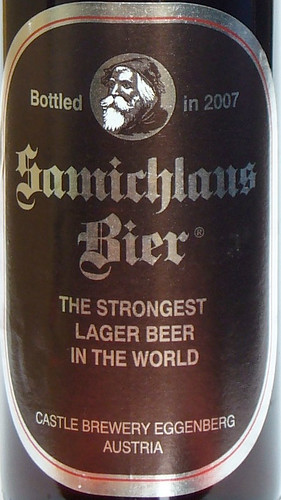
According to the Canadian National Post (sent in by an alert reader — thanks Brian S.), the LCBO — the Liquor Control Board of Ontario — has banned the Christmas beer Samichlaus, from Schloss Eggenberg. Here’s the reason, if you can even call it that.

The Alcohol and Gaming Commission of Ontario has decided the beer’s label contravenes rules against advertising to children. It features the name of the beer, Samichlaus, a Swiss-German nickname for the saint behind the Santa Claus legend, and a small black-and-white bearded figure.

It’s apparently a violation of “section 1(4) of the commission’s advertising guidelines, which prohibits liquor packaging aimed at children.”

Samichlaus

But the notion that Santa Claus, and by extension Christmas itself, is exclusively the domain of children is absurd on its face. But set that aside for a moment, and look at the label. Have you ever seen a less kid-friendly label? Nothing pulls in kids like a brown label, almost devoid of holiday colors. And the image of Santa Claus they believe puts children at risk? As the article suggests, the label’s image looks more like an “old fisherman [o]r a weather-beaten hobo.” I just see an old man with a beard and a nondescript hat; anything but someone kids would be drawn to the dark side over. How could any reasonable person look at that label and conclude it’s “aimed” at marketing to children?

Of course, Santa Claus — or St. Nicholas — is also the patron saint of brewers and the brewery only makes Samichlaus once a year, on December 6, which is his saint’s feast day.

I’m not sure why this issue keeps coming up, apart from some people seem to have some very strange ideas about who Christmas is for and who gets to decide. And that brings us back to this idea that Santa Claus somehow only appeals to children and is not for adults. I don’t know who the adults are who feel this way, but they must be some of the least empathetic, most stingy, unfeeling curmudgeonly people on the planet because for me the spirit of Santa Claus is about giving, regardless of age. I’m 51, a devout non-believer, and I love Christmas and especially the idea of Santa Claus. And I know I’m not alone on this one.

What’s perhaps most unsettling, is that the entire province has been mobilized to eradicate this scourge of Samichlaus based on a “single complaint from a private person.” Yes, that’s right. One person didn’t like the label and now the rest of the people in the province will be deprived this great beer. Nice going, jackass. This seems to keep happening — in the UK, Philly, San Diego and elsewhere — where the opinion of one person seems to matter more than the collective sensibilities of a whole community or society.

In an earlier post, I referred to this as the “tyranny of the minority,” but perhaps the better question is why government agencies spring into action over just one complaint? With a large population and just a single (or even just a few complaints) shouldn’t the silence of the many be taken into account, too? Ontario has an estimated population of just over 13 million people (as of last year) yet access to a (very good) product has been removed from the entire population because one guy didn’t like it. This is not how decisions should be made in a democracy or even in a “federal parliamentary democracy and constitutional monarchy.”

Filed Under: Beers, News, Politics & Law Tagged With: Canada, Ontario, Prohibitionists

Stopping Underage Reading

May 20, 2010 By Jay Brooks

websites
This continues to just piss me off — I know, what doesn’t? — but it’s resurfaced again in a HealthDay News report on the television website for Channel 13 WTHR Indianapolis. The article, Alcohol Companies Use New Media to Lure Young Drinkers: Report, is about the time-honored practice of believing that current times are the worst they’ve ever been (not like when we were young) and today’s youth is in more danger (not like the innocent times when we were young). Every generation seems to go through these machinations that the corruption of the young is either a new phenomenon or is far worse now because of some modern innovation that wasn’t around (in those innocent days when we were young).

Today’s bogeyman is the “latest new media technologies — including cell phones, social networking sites, YouTube and other features of the expanding digital universe — [used] to reach young drinkers.” Or at least so says a new report, Alcohol Marketing in the Digital Age, by American University in Washington, D.C. The report naturally singles out Facebook, MySpace and other social media and the web more generally as the new moral vacuum where our youth is being corrupted. It’s slightly more grounded than many of these types of reports, but it’s still fairly alarmist of the-end-is-nigh if we don’t do something variety. The fact that every older generation is afraid for the younger generation and pretends to be protecting it by trying to stop some imagined danger makes such arguments fall flat for me.

But here’s the bit that continues to chap my hide:

One area the study authors want officials and activists to look at is weak age-verification mechanisms, pointing out how easy it is for a young person to enter a false birth date so they are legally “of age” to enter a Web site.

Yet I’m not aware of any website that can dispense beer or any other alcohol. All you can do at the average website is — drum roll, please — read. So why on earth do you have to be 21 to read? Could someone check out a book about beer at the local library if they were under 21? Of, course. But online, now that’s dangerous. Until it’s against the law to read then no one has to be “‘of age’ to enter a Web site,” whether it’s about beer or anything else. Trying to keep people from information, even if it’s perceived to be the wrong sort of information, is a very slippery slope. And frankly, keeping people in the dark about something that’s supposedly bad for them keeps them from the truth, forming their own opinions, and exposes them only to the “approved” message, which is often laced with propaganda and misinformation to promote a specific agenda. That’s in part, at least, why so many people today fall for neo-propagandist arguments about the evils of alcohol. As long as the propaganda is so one-sided and people, young or otherwise, have no access to a balance of perspectives, then ignorance will continue to rule the day, as it so often does.

Henny Youngman was probably the exception to the rule when he quipped “when I read about the evils of drinking, I gave up reading.” Unfortunately, more people probably believed what they read and gave up drinking. And that will continue to be the case if we continue to keep people from reading about things that others believe to be dangerous. That’s the very definition of a society that’s not free. Now I need a drink. See how dangerous this all is?

Filed Under: Beers, Editorial, Politics & Law Tagged With: Prohibitionists, Underage

Kenya’s Kill Me Quick Moonshine

May 15, 2010 By Jay Brooks

kenya
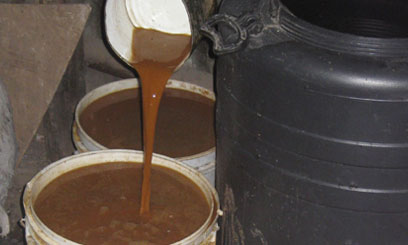
An alert Bulletin reader (thanks Jason) sent me a link to a story in the Economist with similarities to an earlier post I did, Poisoning People During Prohibition: A Disturbing Parable, in which the African nation of Kenya is battling the problem of illegal moonshine occasionally made with jet fuel or embalming fluid. Kill me quick, Kenya’s lethal brew deserves its name is an interesting read. A native moonshine concoction known as chang’aa is causing problems for both the government and a good portion of the nation’s youth. Chang’aa is a fermented drink brewed with corn (maize) and sorghum.

The problem is, unscrupulous moonshiners are speeding up the fermentation by adding stolen dangers like rocket fuel … well, jet fuel, antifreeze and embalming fluid. Those things, it goes without saying, are not something you should drink, even diluted. According to the article, “10ml of methanol can burn the optic nerve; 30ml can kill.” Also, police raids have turned up other unsavory things in the moonshine: decomposing rats, excrement and women’s underwear. As the Economist points out, the word chang’aa means literally “kill me quick” and is well chosen. For the equivalent of one U.S. dollar, you can buy four glasses, and the adulterated chang’aa has killed more than a few and blinded still others.

The reason people drink it is because most people in Kenya live in grinding poverty and can’t afford legitimate alcoholic drinks like beer. Beer there is so heavily taxed that only the rich can afford it. Surprisingly, no one but the breweries are suggesting that perhaps the taxes could be lower so poor people don’t have to risk death to drink alcohol. East African Breweries, “one of Kenya’s biggest companies and taxpayers,” unsurprisingly “wants to see illicit chang’aa replaced with a safer commercial version.” That would undoubtedly involve lowering alcohol taxes and despite the fact that it might actually save lives the government is concerned that “bringing the price of alcohol down to that of water risks increasing alcoholism and forcing the very poorest into even dodgier booze dens. In any case, it could add other costs: crime, violence to women and children, unsafe sex and bad health.” None of those are good, but are they worse then death? It’s the old alcohol as entirely evil argument writ large.

kenya-moonshine
Chang’aa

This is an interesting case to me because it’s taking the idea of how taxes affect consumption to a whole new level. Neo-Prohibitionists in the U.S. have long argued that higher taxes will decrease consumption and especially access by young people. It’s been their stated rationale for many attempts at pushing higher excise taxes on alcohol. But there’s obviously a threshold where that starts to backfire. In Prohibition, for example, removing it completely (in effect, the same as making it too expensive) didn’t stop people from drinking, it simply drove it underground. And in this real world example, Kenya’s taxes are obviously too high such that it’s driven people to drink illegal — but affordable — alcohol. Ours haven’t reached that point yet, despite the best efforts of the anti-alcohol wingnuts. As one commenter succinctly put it:

When a given chunk of economic activity contains a fair mix of illegal and legal business, controlling the illegal part by increasing the regulations of the legal part is illogical and ineffective. On the other hand, if the great majority of the market can eventually be brought into the legal realm, then there is room for regulations to reduce whatever damage it might cause. The legal recreational drugs in most of the world, alcohol and tobacco, are regulated and taxed to the point where if the prices were much higher, an illegal market would likely develop. For example, when cigarettes in Canada were taxed to a price of roughly 2X that in the US, some serious smuggling began. Thus, when Kenya should do is first enable unadulterated legal alcoholic drinks to be sold at a price that’s competitive with the rotgut the drunks are now stuck with. Even habitual drunks will pay a small premium for safety and known potency.

In fact, the UN estimated that half of Kenya’s alcohol trade is for the illegal moonshine, suggesting that the taxes for the legal drinks is way too high. But apparently it’s harder to give up the tax revenue than create a safer world for Kenya. Instead, crackdowns are the order of the day, as Kenya to Sustain War Against Brews. In typical jack boot fashion, ignoring any root causes, “Internal Security Minister Professor George Saitoti says the government will not relent on its war against the production and consumption of illicit brew in the country.” Yeah, that’s going to fix the problem. Unfortunately, it’s a typical response. It’s easier to beat people with a cudgel than understand their problems and try to fix the underlying causes. Obviously, people don’t actually want the risk of death associated with their choice of drink, but the fact that so many are willing to take such risks is indicative of a deep-seeded problem. It seems to me that the accepted propaganda that all alcohol is evil causes such bad decisions because governments seem more worried about not going against the propaganda than they are about finding actual solutions.

While not easy by any stretch of the imagination, the best solution to Kenya’s problems is to improve the life of its poorest citizens. That would do more to quell the moonshine than virtually anything else they might try, and it would certainly be better than using police powers and violence. The strong arm approach never works in the long run. But I suppose as long as the U.S. is the model, that’s what other nations will try, too. Our enforcement of Prohibition was pitifully ineffective and caused more deaths than people it saved, I’d warrant — including purposely poisoning people in the name of enforcement — and our current “war on drugs” is similarly having the same useless effect, making the problems associated with drug use actually worse and guaranteeing the criminal element, and the violence that brings with it, too. Until we realize that such methods will never work, other nations will continue to look to us for guidance will and fail as miserably as we have. More’s the pity.

Filed Under: Beers, Breweries, Politics & Law, Related Pleasures Tagged With: Africa, Kenya, Prohibitionists, Taxes

Alcoholismo

May 14, 2010 By Jay Brooks

mexico
It appears the U.S. doesn’t have a lock on goofy, over-the-top anti-alcohol propaganda. Mexico has some pretty bad propaganda, too. This comes courtesy of I-Mockery, a humor website, and its founder, Roger Barr, who describes the Mexican Crazy Mexican Monografias: Alcoholismo propaganda:

When it comes to public service announcements, America is really quite tame compared to the rest of the world. While we have the ultra-corny NBC celebrity spots which always end with “The more you know…”, other countries aren’t nearly as sheepish when it comes to displaying the harsh realities of life. This became even clearer to me when I stumbled upon an incredible collection of Mexican monografias posters in the basement of a Philadelphia art gallery last year. Some of them were extremely graphic, and others were pretty friggin’ hilarious… needless to say I purchased one of each.

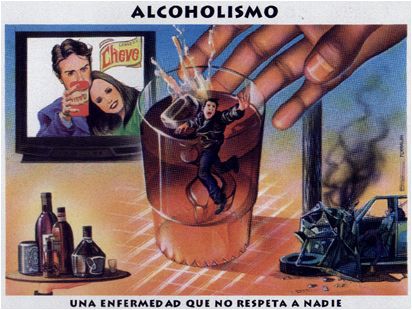
Barr then goes on, in often hilarious fashion, to translate and comment on each of the images, such as this example below.

alcoholismo

Hmmm, I’m getting a few mixed signals here. From what I can tell, if you become an alcoholic, one of several things can happen to you: a) you can crash your car into a telephone pole, b) you’ll appear in your very own television commercial, or c) you’ll somehow fall into a huge glass of liquor which a giant will then pick up to drink and you’ll die in his stomach. See what I mean? Those Mexicans aren’t gonna shy away from the truth about alcoholism. Harsh reality, people.

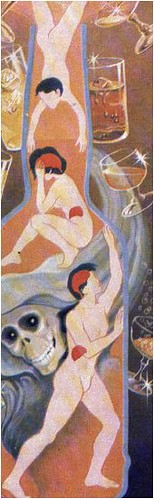
And this very surreal piece of art:

alcoholismo-2

“Some bottles of alcohol contain miniature humans who don’t have any genitals, and oh yeah, Death likes to hangout inside bottles too. Kind of like a genie, but the only kind of wish he’ll grant is your wish for the sweet release of death.”

Barr has broken down every one of the nearly two dozen graphic works cautioning people about the dangers of alcohol. And before I get another rash of comments, I’m not making fun of those dangers, just this ridiculous attempt to warn people about them using these illustrations. But take a look for yourself at the Alcoholismo, it’s pretty funny stuff.

alcoholismo-3

Filed Under: Editorial, Just For Fun, Politics & Law Tagged With: Humor, Mexico, Prohibitionists

Prohibition Through Taxation

April 1, 2010 By Jay Brooks

tax
Being April Fool’s Day, this might almost seem laughable, if it wasn’t so serious and obvious an attempt to bring about prohibition through taxation. (And thanks to the many people who sent me information about this, you know who you are, I appreciate it.) A San Diego couple, Kent and Josephine Whitney, have introduced a ballot initiative they’re calling the “Alcohol-Related Harm and Damage Services Act of 2010.” If that sounds innocuous, it’s not. If they collect the required 433,971 signatures by August 23, it will be on the California ballot this November. The “Act” seeks to raise alcohol taxes as listed below. If you have a drink in your hand, put it down first. If you’re standing up, sit down. Drum roll, please:

  • Spirits — 2,700% increase [from $0.65 per 750 ml bottle to $17.57]
  • Beer — 5,500% increase [from $0.11 per 6-pack to $6.08]
  • Wine — 12,775% increase [from $0.04 per 750 ml bottle to $5.11]

No, those aren’t typos. The anticipated revenue of $7-9 billion would be used to fund the Department of Alcohol and Drug Programs, whatever that is. It won’t be used to fix the state deficit apparently.

In the OC Weekly Blog, Dave Lieberman correctly comments that “this is Prohibition through taxation” [a phrase I hope he won’t mind me borrowing]. He continues.

“The armchair libertarians must be having sedentary conniption fits from Yreka to Ysidro. Nowhere does it say that alcohol has to be a zero-sum game, not to mention the fact that the vast majority of those who do drink do so responsibly, which means you’re taxing those who play by the rules to pay for those who don’t.”

Ballotpedia lists a dozen reasons for the ballot measure, each one more fallacious than the last. The Whitney’s blame alcohol for murders, pregnant women drinking, burdens on health care, underage drinking, binge drinking; pretty much everything any neo-prohibitionists has ever thrown up against the wall, while naturally ignoring all of the personal responsibility for any of those actions. It’s as if they’ve drank the anti-alcohol kool-aid and believe unquestioningly all of the propaganda from those groups. To blame the alcohol and not the people who engage in those behaviors is a common tactic lately but ignores logic, common sense and any notion of fairness. It also reveals quite a lot about the mindset of the people who believe such nonsense. Also, if the ballot measure should pass, it would declare all of that nonsensically bad propaganda masquerading as statistics as true!

It also ignores the physical and mental health benefits of responsibly drinking moderate amounts of alcohol. Numerous studies have shown many, many health benefits to moderate drinking, not least of which are the many studies that show that people who drink moderately tend to live longer and be healthier than people who either abstain or overindulge. So in effect, this ballot measure would most likely make people in California less healthy.

Curiously, the State Attorney General’s summary says:

Additional state revenues of between $7 billion and $9 billion annually from an increase in state excise taxes on alcoholic beverages, with the proceeds going to support alcohol-related programs and services. A decrease in state and local revenues from existing excise and sales taxes on alcoholic beverages of several hundred million dollars annually due to a likely decline in consumption of alcoholic beverages.

The Initiative’s Analysis from the state Legislative Analyst’s Office goes into more detail but remains similarly conservative in the negative consequences while swallowing wholesale the notion that it would actually bring in the estimated $7-9 billion in additional excise tax revenue. First of all, the loss of business and company’s going out of business outright would cause that figure to be greatly reduced from the start. If a bottle of wine has at least $5.11 in state excise taxes plus all of the other taxes, plus the costs of ingredients, manufacture, packaging, transportation, etc. even two-buck chuck is going to become ten-buck Ken or worse.

Similarly, if just the state excise tax on a six-pack of beer starts at $6.08, again plus every other cost of doing business, just who in their right mind believes that consumers will continue to merrily drink the same amounts at exponentially higher prices? Don’t even get me started on how many dollars will fly out of California by people driving to bordering states to buy their alcohol. You’re going to see a cottage industry in just-over-the-border liquor stores popping up wherever a road leaves California. It’s absurd to believe the revenue stream would continue at the same rate.

That analysis suggests that only several hundreds of millions of dollars would be lost in decreased consumption seems laughably conservative. Here’s some of their reasoning, from the analysis:

Effects on Existing State Excise and SUT Revenues. The decline in taxable consumption of alcoholic beverages that would likely be caused by this measure would reduce the revenues received for the General Fund from the existing state excise and SUT revenues. We estimate that this could potentially result in a loss of state revenues of several hundred million dollars annually.

Effects on Local Revenues. The likely decline in taxable consumption of alcoholic beverages due to the increase in the excise tax imposed under this measure would also affect local SUT revenues. We estimate that local governments, primarily cities and counties, would experience a decrease in sales tax revenues of approximately $100 million on a statewide basis due to the excise tax increase.

Indirect Economic Effects. If the measure were to result in declines in overall economic activity in California, it could produce indirect state and local revenue losses. Such effects could occur, for example, if businesses were to close because they could no longer remain profitable as the overall economy adjusted to a lower demand for alcohol in the long run. If these lost resources were not redirected back to California’s economy into equal or more productive activities, then it would likely lead to a net loss in taxable income and spending for state and local governments. The magnitude of these potential revenue losses is unknown.

See that last bit? “The magnitude of these potential revenue losses is unknown.” I can pretty much tell you it’s going to be staggering. It would be a near prohibition, with a return to illegal hooch. After homebrewers start selling their kitchen beers under the table, new law enforcement agencies will be created to stop them, every homebrew shop will be watched and anyone with a pair of rubber boots will be under suspicion.

So who the hell are the Whitneys and why are they trying to effect an alcoholic Armageddon? Those are good questions, I think, and there’s at least one very disturbing possibility. The V Bit Set speculates that it may be simply for money. Doing some detective work, internet style, he points out there is a Kent Whitney in the San Diego area who owns the 21st Century Wellness Initiative, and the ballot measure would provide “fifteen percent for the funding of grants for naturopathic treatment and recovery programs for alcohol addiction.” Are the two connected? He admits it’s wild conjecture at this point, but it is compelling nonetheless. If it turns out to be true, how vile and repugnant would this be? On an unimaginable scale, I’d have to say. To attack an entire healthy industry, putting thousands of workers and hundreds of businesses at risk of being removed from the economy for personal gain would be one of the most abominable acts of all time. If they’re sincere, it’s clear they either didn’t think through their actions or are entirely hostile to anyone who enjoys, makes or sells alcohol.

Filed Under: Editorial, News, Politics & Law Tagged With: California, Prohibitionists, Southern California

Marin Institue Wagging Their Finger At Brewers Again

March 30, 2010 By Jay Brooks

marin-institute
The Marin Institute is at it again. Today, they published a shiny color-coded map showing how — and I love this bit of doublespeak — “State Governments Neglect Beer Taxes.” The press release goes on to suggest that “inflation has decreased the value of low beer taxes, while state budget shortfalls have exploded.” Of course, that argument can be made for every single tax in existence, from sales tax to income tax yet they’re not crying about those not being raised. Everything is effected by inflation, yet it’s alcohol taxes that must bear the burden for that. And I’ve said it before, and I guess I have to keep saying it, but trying to make alcohol pay for the state’s shortfalls is not in the least bit fair. Alcohol companies didn’t cause the problems we’re all experiencing, yet these neo-prohibitionists keep insisting they must disproportionally pay to fix them. Whatever fixes are imposed should be paid by everyone, not just the convenient target of an extremist anti-alcohol organization.

This neglect, they claim, has “[l]egislators ignoring a lot of revenue their states could use right now.” They neglect, naturally, to factor in all of the direct and indirect positive economic contributions that the alcohol industry makes to our economy, one of the few industries growing and providing jobs. Instead, they suggest punishing and harming the alcohol industry to, and here’s a telling quote, “prevent future losses.” That presupposes that these taxes are somehow ordained from on high, sacrosanct and absolutely necessary. But are they? Not in the least. The taxes they’re referring to are excise taxes, taxes no other industry except tobacco has to pay. Alcohol companies already pay more taxes than any other goods manufacturing industry in the country. The notion that they have to be adjusted for inflation is something these yahoos just made up because they don’t like alcohol. The maps are very colorful and utterly useless.

pretty-map
Ooh, look at the pretty colors.
 

These excise taxes are patently unfair and always have been since they were first imposed during the Civil War to raise money for the Northern Army. That they’re taken for granted and most people believe there’s a good reason for them has more to do with anti-alcohol propaganda and decades of ceaseless attacks painting alcohol as a sin. Today’s reason du jour for the continued excise taxes is usually stated as alcohol is somehow duty-bound to pay for any harm caused by people abusing the products they make and sell. This argument, of course, doesn’t stand up to the simplest logic. Not everybody abuses alcohol, of course, and the percentage that do so are in a very small minority of the total number of people who regularly drink.

Still, this notion persists that the industry must pay for a small percentage of alcohol abusers. But if it’s about the harm, then why aren’t soda and fast food manufacturers taxed similarly for the burden they place on our healthcare system. People over-eating surely has made many people unhealthy and their medical bills far higher than people who eat a healthier diet. Why don’t they have to pay for the harm they cause? Why don’t pharmaceutical companies get taxed for the harm caused by people who abuse their prescription drugs? Why don’t gun and bullet makers have to pay for the violence caused by their products? I could go on and on. Almost everything causes harm if abused, but only alcohol has to pay for it, apparently.

What’s most pernicious about these recent attacks by anti-alcohol groups is that they’re simply seizing an opportunity caused by the economic downturn to advance an agenda that has little to do with what caused our economic woes. They’re essentially just stoking people’s fears to further their own agenda of removing alcohol from society by taxing it to death and figuring people will go along with it if they step up their lying to them about it at a time when we’re all worried about the future. It’s quite frankly, disgraceful.

In other recent news, the California state legislature did not approve Jim Beall’s latest attempt to punish alcohol with his nickel-a-drink tax that’s come up several times before and will continue to be brought up until the people of San Jose finally get smart enough to vote him out of office. Jim Beall is like a rabid dog that just won’t quit nipping at alcohol’s heels.

The Marin Institute’s chief flack, Bruce Lee Livingston quipped after its most recent defeat. “How in good conscience … can these public servants vote no or even worse abstain on this bill? It’s a travesty; whose interests are they representing?” Well, listen up, I’ll tell you. A nickel-a-drink sounds like a modest proposal, but it’s not. It would greatly raise the price of alcohol, especially beer, and even though I know that’s your real goal, it harms a healthy segment of the economy at a time when there are fewer and fewer healthy segments left. Legislators understand that. You do not, because you don’t care about the economy if it means alcohol continues to prosper. You only care about causing the alcohol industry harm. So it helps the interests of business, something pretty important if raising money is the goal so everyone in California can prosper. To you, it seems like a fine time to attack alcohol, but to people who really do care about the state’s economy, not so much. You also keep going on about big beer, but this harms 200 small breweries, many of which are Mom & Pop businesses just trying to make a living and feed their families, not giant behemoths.

Voting against it also helps the interests of the poor, who buy a lot of the beer, especially when Beall’s bill exempts 79% of wineries. The fee (or tax) is regressive, meaning it falls disproportionally on the poorest Californians. The bill also funds healthcare facilities to treat alcohol and drug abuse. Drugs, you may not realize, are not made in breweries, so asking alcohol companies to pay for pharmaceutical abuse is not exactly fair. In addition, the $700 million (still only 3.5% of the state deficit) you claim will help the budget won’t do any such thing if all or a portion is being used for these treatment facilities. Those are in addition to balancing the budget.

Sadly, the bill, “AB 1694 will be re-considered in the Assembly Health Committee on April 6.” And so it goes ….

Filed Under: Breweries, Editorial Tagged With: California, Northern California, Prohibitionists

B.A.C. & The Definition Of Being Drunk

March 22, 2010 By Jay Brooks

drunk-in-public
Thanks to my friend Rick for sending this my way. In an editorial in the student newspaper for Temple University, the Temple News Online, student commentator Cary Carr writes about sudents getting drunk in a piece she called When Your BAC Exceeds .31 and the Label Reads Natty Ice, Trouble Brews. It’s mostly an anecdotal essay about student drinking and how kids should be more responsible and watch their intake. It’s all well and good, and there’s nothing I take issue with, but there’s just something that leaps out at you in the middle of it.

After all, there does tend to be a hierarchy to drunkenness, ranging from a happy tipsy to an invincible and shameless drunk to the stage we’ve all witnessed or experienced: how-are-you-even-alive drunk.

Of course there are more technical levels of intoxication, which Dr. Jeremy Frank, a psychologist from Tuttleman’s Counseling Services, explained.

“The best way to categorize stages of drunk is with Blood Alcohol Concentration,” Frank said. BAC is the ratio of alcohol to blood in the body. “Drunk is from .11 to .15. Very drunk is usually between .16 and .19. Once you get to .25 to .30 you generally are in a stupor, and from .31 and up would be the beginning of a coma.”

Hmm, according to the field of psychology, drunk is “from .11 to .15,” or above the 0.08% that MADD and other groups rammed down our throats in the early 1980s, when the standard was 0.10%, very much in line with Frank’s definition. Interesting. I wonder how other fields define being drunk?

Filed Under: Editorial, Politics & Law Tagged With: Prohibitionists

« Previous Page
Next Page »

Find Something

Northern California Breweries

Please consider purchasing my latest book, California Breweries North, available from Amazon, or ask for it at your local bookstore.

Recent Comments

  • Ernie Dewing on Historic Beer Birthday: Charles William Bergner 
  • Steve 'Pudgy' De Rose on Historic Beer Birthday: Jacob Schmidt
  • Jay Brooks on Beer Birthday: Bill Owens
  • Steve 'Pudgy' De Rose on Beer Birthday: Charles Finkel
  • Steve 'Pudgy' De Rose on Beer Birthday: Bill Owens

Recent Posts

  • Historic Beer Birthday: Joseph Bosch February 11, 2026
  • Historic Beer Birthday: Charles Engel February 11, 2026
  • Historic Beer Birthday: Daniel Jung February 11, 2026
  • Beer In Ads #5198: Back Again! Wiedemann’s Genuine Bock Beer February 10, 2026
  • Historic Beer Birthday: Jacob Hammel February 10, 2026

BBB Archives

Feedback

Head Quarter
This site is hosted and maintained by H25Q.dev. Any questions or comments for the webmaster can be directed here.