

Today’s infographic shows the stages of the brewing process graphically. It’s called simply The Process of Brewing Beer.
The Science Of Beer Color

Popular Science’s BeerSci series had another interesting post last month on How Beer Gets Its Color, this time addressing “the two chemical reactions that most influence the malt character and color of your brew.” It’s wonderfully geeky, and goes into the Maillard reaction, named for French chemist Louis Camille Maillard, which is also known as “browning,” and is essentially how “amino acids react with a reducing sugar.” Between that, and caramelization, the various colors in beer are created.
Brewers used to use the Lovibond scale — expressed as “Degrees Lovibond” — when referring to color, but it’s largely been replaced by SRM (Standard Reference Measurement) or the EBC (European Brewing Convention), which is similar but has a different numbering system. Here’s what the SRM range looks like:
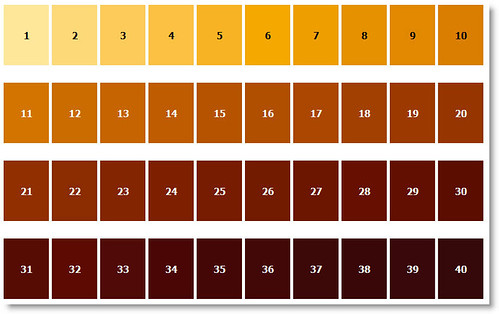
For more infomation, check out the terrific Beer Color Laboratories. I keep their wallet size color reference guide in my wallet at all times, and have the larger one in my office. They’re great if you don’t have a spectrophotometer lying around.

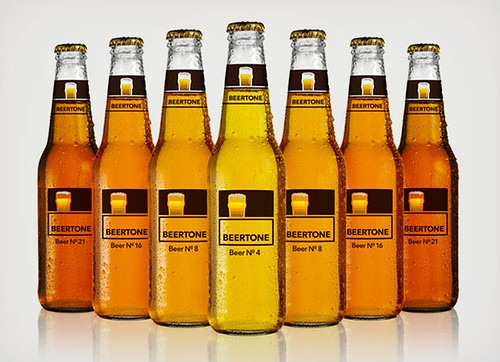
Another interesting expression of beer color is coming out of Switzerland. Beertone is essentially a playful spoof on or homage to the Pantone color system used by design professionals. Beertone is taking individual beers and making a beertone card for each, with information about each beer on it. Here’s a sample mock-up of what the cards will look like.
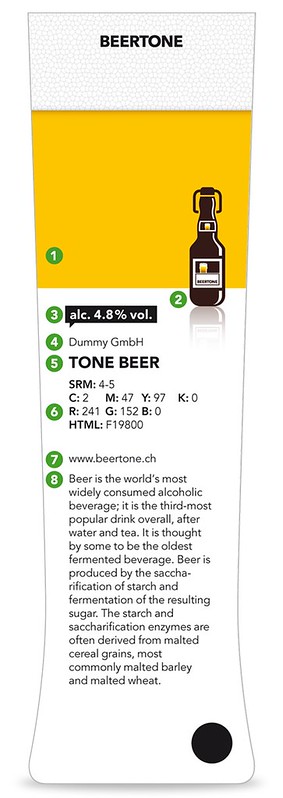
- The Beer Color: The concept from Beertone. Each beer has been shot in a special glass, to avoid reflexes and extern influences. The results are amazing.
- The Beer Bottle: There’s so many cool Beer Labels that we thought, we must have the bottle on each page.
- Alcohol by Volume: The percent alcohol by volume (% alc/vol). It’s a standard measure of how much alcohol (ethanol) is contained in an alcoholic beverage.
- Brewery: it’s important to know who produced the Beer. Big and small companies have their places on Beertone.
- Beer Name: That’s most important thing to remember when the barkeeper asks what do you wanna drink.
- The Color Information: As part from Beertone concept, we present the color references from different color models. With the best values compared to the Beer color.
- Brewery Site: If you want to know more about the Beer and its Brewery, here you will have their official site.
- Beer Description: Here the Beer enthusiasts will have a description about each Beer. Useful information is always relevant. What a better way to start a good conversation at the bar?
So far, only Swiss beers are available for pre-order — and they’re pretty pricey — with plans for German beers and Brazilian beers to be released later this year.
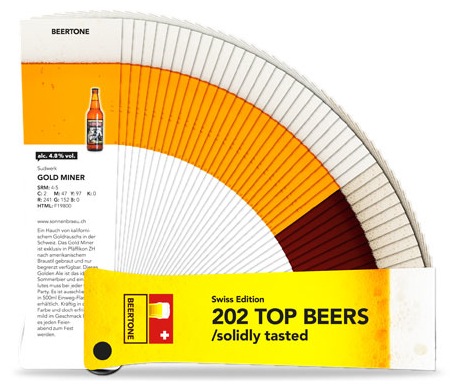
It certainly seems like a cool idea, if a little unwieldy. I think they should sell them like trading cards and sell packs at bars. But I’d certainly like to see them expanded into the U.S., Great Britain, the Czech Republic, et al., and see what a wider geographic range of beers would look like.
The Science Of Making Beer Stronger

Popular Science’s intermittent series BeerSci had an interesting post yesterday on How To Make Strong Beer Stronger, tackling the issue of how “fractional freezing will concentrate any beer, provided you have a bit of patience and a very cold freezer.”

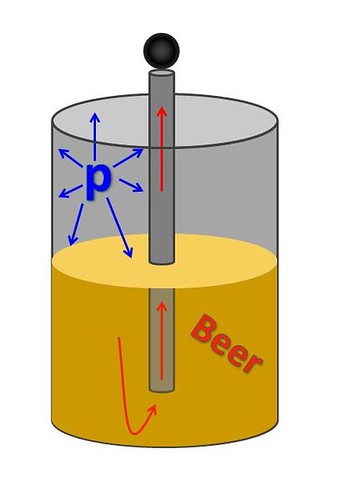
The Physics Of Beer: Pressure

The Physics Buzz Blog, part of Physics Central, had an interesting tutorial on pressure, using the science of brewing to illustrate how pressure works in the The Physics of Beer. They start with the keg, but also discuss the nitrogen widget used in Guinness widget cans.
The Magic of Brewing, the Joy of Beer

Take a tour of the Suffolk brewery Greene King with head brewer John Bexon hosted by UK beer writer Roger Protz. The video, entitled The Magic of Brewing, the Joy of Beer, runs just under a half-hour and includes a tour of Greene King’s “traditional brew house and fermenting area, taking in the ancient wooden vats where Strong Suffolk is matured.” Enjoy.
Anchor Video On History Of California Lager

Anchor Brewing today posted a new video about the history of California Lager, and their new Zymaster series which attempts to recreate the beer brewed by Boca Brewing in the 1870s. You can read more about that history on their blog, too, in Part 1 and Part 2.
A Biologist’s St. Patrick’s Day Song

This is one of the coolest, albeit nerdy, songs I’ve heard since Tom Lehrer was doing the Vatican Rag and singing about the Elements. And thanks to Peter H. for sending me the link. It’s a St. Patrick’s Day song by a biologist, known only as Cadamole, who apparently lives in Washington, D.C. He sings about the biology of beer and … well, just listen to it for yourself. Enjoy!
And below are the lyrics so you can sing along:
In the year of our lord eighteen hundred and eleven
On March the seventeenth day
I will raise up a beer and I’ll raise up a cheer
For Saccharomyces cerevisiae
Here’s to brewers yeast, that humblest of all beasts
Producing carbon gas reducing acetaldehyde
But my friends that isn’t all — it makes ethyl alcohol
That is what the yeast excretes and that’s what we imbibe
Anaerobic isolation
Alcoholic fermentation
NADH oxidation
Give me a beer
[CHORUS]
My intestinal wall absorbs that ethanol
And soon it passes through my blood-brain barrier
There’s a girl in the next seat who I didn’t think that sweet
But after a few drinks I want to marry her
I guess it’s not surprising, my dopamine is rising
And my glutamate receptors are all shot
I’d surely be bemoaning all the extra serotonin
But my judgment is impaired and my confidence is not
Allosteric modulation
No Long Term Potentiation
Hastens my inebriation
Give me a beer
[CHORUS]
When ethanol is in me, some shows up in my kidneys
And inhibits vasopressin by degrees
A decrease in aquaporins hinders water re-absorption
And pretty soon I really have to pee
Well my liver breaks it down so my body can rebound
By my store of glycogen is soon depleted
And tomorrow when I’m sober I will also be hungover
Cause I flushed electrolytes that my nerves and muscles needed
Diuretic activation
Urination urination
Urination dehydration
Give me a beer
[CHORUS]
Homebrewing: The Ultimate DIY

This will be obvious to anyone who’s ever home brewed, but it’s still nice to see it laid out. Dave Conz, who’s an assistant research professor at the Center for Nanotechnology in Society and the Consortium for Science, Policy, and Outcomes (and a lecturer in interdisciplinary studies in the School of Letters and Sciences at Arizona State University) penned an article, What Beer Can Teach Us About Emerging Technologies, where he makes the case that the legalization of homebrewing led to the rise in commercial brewers and breweries, along with a wave of innovation and creativity. Hard to disagree with that. To my mind, homebrewing is easily the ultimate DIY.
Sumerian Beer: The Origins of Brewing Technology in Ancient Mesopotamia

Peter Damerow, from the Max Planck Institute for the History of Science, in Berlin, has published online a lengthy paper about the origins of Sumerian brewing. Entitled Sumerian Beer: The Origins of Brewing Technology in Ancient Mesopotamia, it’s part of The Cuneiform Digital Library Initiative (CDLI). The opening sentence gives a flavor of its purpose. “The following paper is concerned with the technology of brewing beer in the Sumerian culture of ancient Mesopotamia, which we know about from cuneiform texts of the 3rd millennium BC. and from reminiscences in later scribal traditions which preserved the Sumerian language and literature.”
It’s broken down in to seven sections:
- Introduction
- Overview of the sources
- Beer types and ingredients in proto-cuneiform documents
- Beer types and ingredients in the Old Sumerian period
- Beer types and ingredients in the neo-Sumerian period
- The brewing of beer
- What kind of beer did the Sumerians brew?
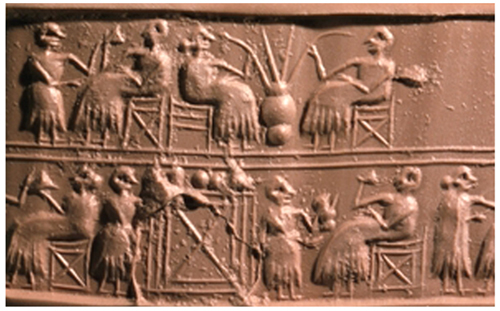
Fig. 1: Impression of a Sumerian cylinder seal from the Early Dynastic IIIa period (ca. 2600 BC; see Woolley 1934, pl. 200, no. 102 [BM 121545]). Persons drinking beer are depicted in the upper row. The habit of drinking beer together from a large vessel using long stalks went out of fashion after the decline of Sumerian culture in the 2nd millennium BC.
I confess I haven’t read the whole thing yet, but I did download the pdf of it so I can put it on my iPad. Still, just from skimming it appears fairly interesting, and a worthy piece to read over the holidays.
Session #56: Thanks To The Big Boys

Our 56th Session is a nod of the head, acknowledging the positive aspects of the big, multinational brewers that we so often admonish and criticize. Our host, Reuben Gray at Tale of the Ale, calls his topic Thanks to the Big Boys, which he describes as follows:
What I’m looking for is this. Most of us that write about beer do so with the small independent brewery in mind. Often it is along the lines of Micro brew = Good and Macro brew, anything brewed by the large multinationals is evil and should be destroyed. Well I don’t agree with that, though there may be some that are a little evil….
Anyway I want people to pick a large brewery or corporation that owns a lot of breweries. There are many to chose from. Give thanks to them for something they have done. Maybe they produce a beer you do actually like. Maybe they do great things for the cause of beer in general even if their beer is bland and tasteless but enjoyed by millions every day.
While I don’t necessarily like most of the products made by the remaining larger brewers, what they do make is incredibly difficult to brew consistently. They have perfected the science side of brewing, however in doing so I believe they have lost a lot of the artistic side of the equation. To me the best beers contain an equal mix of both the brewer’s art and science. Craft brewers are the modern alchemists, turning base materials into liquid gold. One of alchemy’s goals was to find an “elixir of life.” In craft beer’s innovation, creativity, diversity; ultimately producing a panoply of flavorful beer, I don’t think it’s a stretch to suggest they have found that mythic elixir.
But the science that the big brewers bring to to the table is, at least in part, what allowed the new generation of brewers to — as Sam Calagione is fond of saying — “let their freak flag fly.” From the dawn of the industrial revolution, all of the big brewers (which, for the most part, was ALL of them) introduced innovation after innovation into the brewing process. Refrigeration became commonplace. Thanks to Pasteur, yeast was finally understood and could be controlled. Industrialization allowed for so many advancements into the process that an ancient brewer would hardly recognize one today. From the mid-1800s to the present, brewing has changed more than in the thousands of year before that time. And for that, we can thank all of the big breweries who invested heavily in improving the way their beer was made. R&D suddenly became a much bigger part of an operating brewery, and the trade literature of that time is crammed full of one latest innovation after another.
In fact, the breweries that innovated better than their competitors and adapted to the new technologies began to dominate the beer industry. While there were certainly other factors at work, it does partly explain the sharp drop in the number of breweries in America which peaked around 1873 with 4,131. After the decade of the 1870s, improved efficiencies in the brewhouse meant that breweries could serve a wider geographic territory and the more successful started swallowing up the weaker. By 1900, the number of breweries was below 1,800.
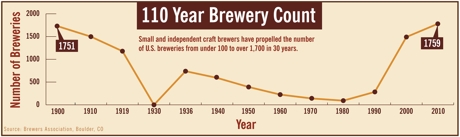
For the next century, both before Prohibition and then after (ignoring that blip of re-openings in 1933) the number of operating breweries continued to fall until around 1980, when thanks to the new microbrewery revolution they began to rise once more. By that time it was less about efficiencies and more about the bigger trying to squelch the competition. Maybe it had always been strictly about “business,” but in the 1970s and 80s it seemed more more ugly, at least to me, as I watched one regional brewery after another close all around me.
But for their part, the remaining companies did keep the history of beer alive, with many having extensive libraries, collections of breweriana and a desire to celebrate the fact that the had survived at least up to that point. By the time I joined the beer industry in some fashion, and was no longer a civilian, there were only three really big brewers, and few more remaining regionals. Like the old nursery rhyme, Ten Little Indians, “then there were three.” The Big 3, as they were often referred to. It seemed like there would always be the Big 3. I was a surprised as anyone when Coors and Miller decided to merge their U.S. operations. “Three little Injuns out on a canoe, One tumbled overboard and then there were two.” I rarely hear anyone refer to the remaining ABI and MillerCoors as the Big 2, now they’re just the big brewers. And Pabst could easily become another third, if only they’d just buy their own brewery and become a legitimate player.
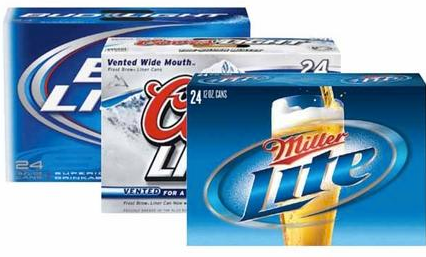
So I think we have much to thank the big boys for, from the science and modern technology they embraced to their reluctant role as the keepers of brewing history. Not to mention that they could easily have stopped the legal change that gave a tax break to small brewers way back when. It was certainly within their political clout to kill it, but they worked with the small brewers instead. Whether it was because they didn’t consider them a threat or whether they genuinely welcomed them into their fraternity it unclear, but doesn’t really matter in the end.
One thing many beer geeks, I think, don’t realize is that there are many, many really good people working at the big breweries. We spend so much energy criticizing their products, their advertising, their marketing, their toxic and often bullying practices, that many people overlook that fact. The big breweries are alike with the small ones insofar as the entire industry is comprised of a nearly universal group of good people, certainly a cut above any other I’ve worked in or knew people who did. And the beer business is a people business, as much as it’s about anything else. So while I may not raise a toast to everything they do, and I may not use one of their beers for that toast, I will very much raise a toast to the people, and especially the brewers, that comprise the largest segment of the beer industry: the big boys. This one’s for you.