Brookston Beer Bulletin

Jay R. Brooks on Beer

  • Home
  • About
  • Editorial
  • Birthdays
  • Art & Beer

Socialize

  • Dribbble
  • Email
  • Facebook
  • Flickr
  • GitHub
  • Instagram
  • LinkedIn
  • Pinterest
  • RSS
  • Twitter
  • YouTube

Powered by Genesis

Buddy’s Beer Garden

November 11, 2023 By Jay Brooks

looney-tunes
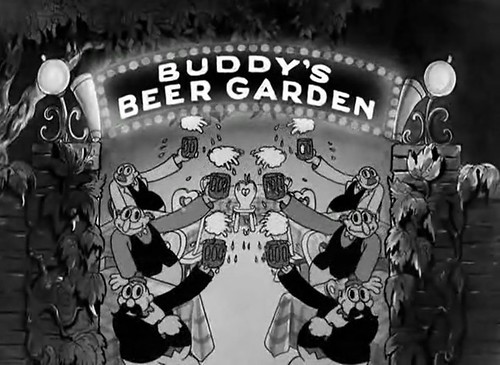
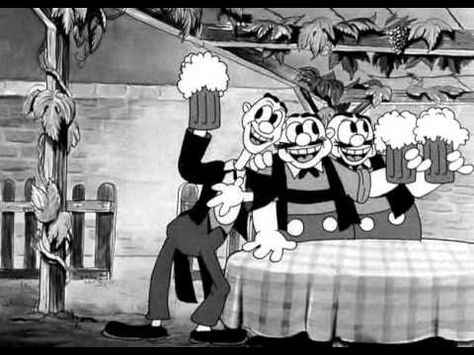
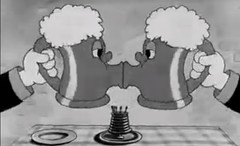
On the eve of the repeal of prohibition, anticipation must have been running pretty high. On November 11, 1933, Warner Brothers cartoon studios released their newest Looney Tunes animated short film, “Buddy’s Beer Garden.”

“It is a Looney Tunes cartoon, featuring Buddy, the second star of the series. It was supervised by Earl Duvall, here credited as ‘Duval,’ was one of only five Warner Bros. cartoons directed by him, and one of only three Buddy shorts. Musical direction was by Norman Spencer.”

buddysbeergarden
Here’s the description of the film from Wikipedia:

We enter Buddy’s beer garden, where are gathered many merry patrons, singing “Oh du lieber Augustin”, mugs in hand. The happy opening scene fades to one of an equally merry Buddy, who balances a tray and sings of the good cheer his beer brings (to the tune of “Auf Wiederseh’n (We’ll Meet Again)”), as he fixes a tablecloth and sets down two glasses of his ware, while a black dog, pretzels on its tail, behind him barks in tune. A German oom-pah band creates an ambience (and, as the band reappears four times throughout the cartoon, each time they are seen, as a gag, a small member of the group will come out of the largest member’s brass instrument, playing, in succession, a trumpet, maracas, a piano, and a bass drum.) Beer flows on tap, and Buddy ensures that each mug has plenty of foam. Cookie neatly prepares several pretzels, which then are salted by the same little dachshund, and carried thence away. The tongue sandwiches offered as part of the bar’s free lunch sing & lap up mustard; an impatient patron (presumably the same brute who serves as the villain in later shorts, such as Buddy’s Show Boat and Buddy’s Garage) demands his beer, which he instantly gulps down upon its arrival.

buddys-beer-garden
All present take part in “It’s Time to Sing ‘Sweet Adeline’ Again”: some sing, one patron plays his spaghetti as though the noodles were strings on a harp, Buddy makes an instrument out of his steins, &c. Cookie comes around, offering cigars and cigarettes to the patrons, one of whom, the same impatient brute as before, accepts, but not before freshly stroking the girl’s chin. Cookie performs an exotic dance for the entire beer garden, and is joined by the selfsame patron, & a formerly stationery piano. The film goes on: Buddy whistles “Hi Lee Hi Lo”, tossing beer from one mug to another, preparing sandwiches, clearing tables.

buddysbeergarden6
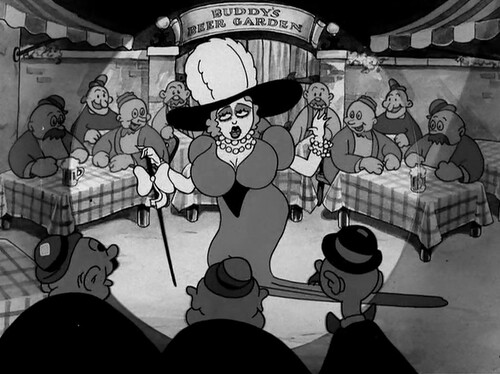
As a final treat for his customers, Our Hero introduces a lady singer (who bears a striking resemblance to Mae West), who reveals herself only after Buddy’s departure and a brief musical interlude. The grand dame attracts the attention of the very same recurring patron, who drunkenly stumbles over to her with the intention of receiving a kiss: as the song (“I Love my Big Time, Slow Time Baseball Man”) ends, he makes his request, but a horned goat, part of a poster advertising “Bock Beer”, but nonetheless quite alive, with its horns stabs the patron’s backside, sending him flying. The patron, on his airborne journey, causes the lady singer to catch her dress on an overhanging tree; the dress tears, & the throaty performer, now grounded, is revealed to be a cross-dressed Buddy. Pleasantly embarrassed, Buddy stalks away, waving blithely to all present; in the final shot, we see that the bird cage strapped to Buddy’s posterior (there to replicate the voluptuousness of his singing persona), in fact houses an exotic bird, which shows itself to have a voice & nose like those of Jimmy Durante, as well as a saying: “Am I mortified!”

buddysbeergarden3
buddys-beer-garden-1
Although it’s fairly small, here’s the entire cartoon to watch. Enjoy.

Filed Under: Just For Fun, Politics & Law, Related Pleasures Tagged With: Cartoons, History, Prohibition

Guy de Maupassant’s “Waiter, A Glass Of Beer!”

August 5, 2023 By Jay Brooks

book
Today is the birthday of French writer Guy de Maupassant. He was a prolific writer, very popular during his lifetime, and “considered one of the fathers of the modern short story and one of the form’s finest exponents.” He wrote half-a-dozen novels and around 240 short stories. One of them was entitled “Waiter, A Glass of Beer!,” although since the original was in French, it’s sometimes translated as “Waiter, A Bock!” It’s a somewhat melancholy tale, but there’s a couple of great quotes in the story, like how the barfly describes his life:

I get up out of bed at noon. I come here, I have a meal, I drink beer, I wait for the evening, I have dinner, I drink beer, and then, about half-past one in the morning, I go home to bed again, because, you see, they close at that hour—which is a nuisance. I have probably spent six years out of the last ten on this seat, in this corner, and the rest of the time in bed—none of it anywhere else. Occasionally I have a chat with some of the guests.

And in the “Bock” version of the story, the barfly is referred to as a “regular” in the beer bar, but in the “glass of beer” version they use an interesting term I hadn’t heard before: a “beerite,” which he describes as “one of those habitual frequenters of beer-palaces who come in the morning when the doors open, and leave when they close for the night.” I may have to try to get that word back into common usage, if indeed it ever was.

Because it’s in the public domain, several versions are available online. I’ve reprinted the Bartelby version below, but you can see others, such as one of the Bock versions at Classic Short Stories or at Google Books’ version at The Complete Short Stories of Guy de Maupassant. Enjoy.

Guy_de_Maupassant_fotograferad_av_Félix_Nadar_1888
A photograph of Guy de Passant taken in 1888.

‘Waiter, a Glass of Beer!’

I WAS going nowhere in particular. I was merely taking a stroll after dinner. I passed the Lyonnais Bank, the Rue Vivienne, and other streets besides. Suddenly I halted before a half-empty beer-palace. With no special object in view—for I was not thirsty—I went in.

Casting a glance about for a comfortable place, I took a seat next to a man who looked rather old, and was smoking a cheap clay pipe, which was as black as coal. Half a dozen glass saucers piled up on the table in front of him indicated the number of glasses he had already consumed. I paid no closer attention to my neighbor, recognizing him at once for a “beerite,” one of those habitual frequenters of beer-palaces who come in the morning when the doors open, and leave when they close for the night. He was untidy, and bald on the top of his head, a shock of long, greasy, pepper-and-salt hair falling upon his coat collar. His clothes, which were too loose, had apparently been made at a time when he was stouter. One suspected that his trousers were not fastened on tight, and that every ten yards the wearer would have to stop and pull up that erratic garment. Had he a waistcoat on? The bare thought of his boots, and of what they might contain, made me shudder. His frayed cuffs were a deep black all round the edges—just like his nails.

No sooner had I sat down beside this individual, than he coolly addressed me:

“How are you?”

I turned toward him in surprise, and looked him over. Then he resumed:

“You don’t recognize me?”

“No.”

“Des Barrets.”

I was dumfounded. It was Count Jean des Barrets, an intimate friend of college days. I shook hands with him, but was too much perturbed to bring out a syllable. At last I stammered:

“And you—how are you?”

To which he placidly replied:

“I might be worse.”

That was all he said. I tried to be civil, and racked my brain for an observation to make. At last I put the question:

“And—er—what are you doing at present?”

He answered in a tone of resignation:

“As you see.”

I felt myself blushing. Nevertheless, I braved it out:

“But every day, I mean?”

After puffing out an enormous cloud of smoke, he replied:

“It’s the same thing every day.”

Thereupon, giving the marble surface of the table a rat-tat-tat with a copper coin, he exclaimed:

“Waiter, two glasses of beer!”

A distant voice repeated, “Two glasses of beer!” A voice still more distant shouted a strident “Here you are!” Then appeared a man in a white apron, carrying two glasses, from which he spilt a few yellow drops as he shuffled speedily across the sanded floor.

Des Barrets emptied his glass at a single draft, and put it back on the table, sucking off the foam which had remained on his mustache. After this he inquired:

“Anything new?”

I really had nothing new to tell him, and so I muttered:

“No, old chap, nothing that I know of. I—I’m in business.”

In the same even tone he asked me:

“Oh! And do you find that amusing?”

“No. But it can’t be helped. A fellow must do something or other.”

“Why so?”

“Well—er—so as to have his time occupied.”

“What’s the use of that? I never do anything, as you see—no, not a thing. If one is poor, I understand that one must work. But as long as one has anything to live upon, then it’s quite unnecessary. Work—why work? Are you doing it for yourself or for others? If you are doing it for yourself, I suppose you enjoy it, and then it’s all right; if you do it for somebody else, you’re an idiot!”

Then, resting his pipe on the marble slab, he again cried out aloud:

“Waiter, a glass of beer!”

Turning back to me, he continued:

“Talking makes me thirsty. I am not used to it. No, I have no occupation; I do nothing but simply grow old. I shall have nothing to grieve for when I die. This beer-palace will be my only parting memory. No wife—no children—no cares—no worry. That’s the best way.”

He drained the tall glass brought him, wiped his mouth with the back of his hand, and took to his pipe once more.

I was stupefied. Presently I said:

“But you have not always been like this?”

“I beg your pardon, always; ever since I left college.”

“But this is no life for you, my dear fellow! Why, it’s horrible! Surely you have something to do—you must have friends—you must be attached to somebody or something?”

“Not at all. I get up out of bed at noon. I come here, I have a meal, I drink beer, I wait for the evening, I have dinner, I drink beer, and then, about half-past one in the morning, I go home to bed again, because, you see, they close at that hour—which is a nuisance. I have probably spent six years out of the last ten on this seat, in this corner, and the rest of the time in bed—none of it anywhere else. Occasionally I have a chat with some of the guests.”

“But when you first came to Paris, what did you do, to start with?”

“I took my degree—at the Café de Médicis.”

“And what did you do next?”

“Next? Oh, I crossed the river, and came here!”

“Why did you take that much trouble?”

“Well, you know, a fellow can hardly stay in the Latin Quarter all his life. The students are too noisy. I shall never move again, now. Waiter, a glass of beer!”

I thought he was making game of me, and so persisted:

“Now, look here, tell me the truth! You have had some great sorrow, haven’t you? some unfortunate love-affair perhaps? You certainly look like a man who has been hard hit by fate. Tell me—how old are you?”

“Thirty-three; but I look at least forty-five.”

His wrinkled face, which was none too clean, might indeed almost have belonged to an old man. From the top of his skull fluttered a wisp or two of hair above some skin of a doubtful color. He had enormous eyebrows, a heavy mustache, and a thick, shaggy beard. There appeared to my vision—I can scarcely tell why—a basin full of dark water, in which he had attempted to wash.

“Yes,” said I, “you look older than you are. Surely you must have had some trouble.”

“None in the world, I tell you. I have aged because I never take any exercise. There’s nothing worse for people than this life in cafés.”

Still I could not believe him:

“Ah, then you’ve been a bit gay! One doesn’t get bald like that without running after the women a good deal.”

He tranquilly shook his head, sowing his coat collar with little white particles that fell from his last remaining locks.

“No,” he remarked, “I have always behaved myself.” And raising his eyes to the chandelier overhead, he added, “If I’m bald, the gas is to blame. It’s frightfully bad for the hair. Waiter, a glass of beer!—You don’t seem thirsty?”

“No, thanks. But really, your case is interesting. When did this—er—apathy set in? It isn’t normal; it isn’t natural. There’s something beneath all this.”

“Well, yes—it dates back a long way. I’ll tell you about it.”…

“Waiter, a glass of beer!”

The glass that was brought him he gulped down at one swallow. Only, in taking up his pipe again, as his hand trembled, he let it drop, and it broke. This caused him a gesture of despair, and drew from him the complaint:

“Well, now, that’s really a tragedy, that is. It’ll take me a month to color another.”

And through the immense room, now full of tobacco-smoke and beer-drinkers, resounded again his everlasting cry:

“Waiter, a glass of beer!” Only this time he added, “And a new pipe!”

Filed Under: Beers, Just For Fun, Related Pleasures Tagged With: Literature

Beer In Ads #4477: Miss Rheingold 1959, Royal Dutch Treat For Seven American Beauties

June 23, 2023 By Jay Brooks

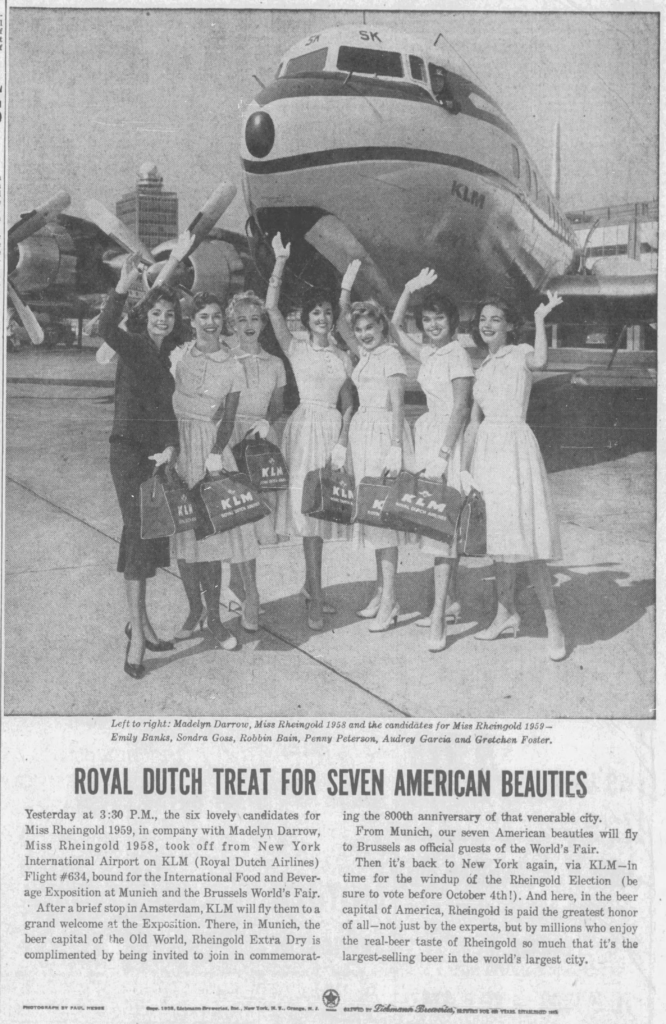
Friday’s ad is for “Rheingold Beer,” from 1958. This ad was made for the Rheingold Brewery, which was founded by the Liebmann family in 1883 in New York, New York. At its peak, it sold 35% of all the beer in New York state. In 1963, the family sold the brewery and in was shut down in 1976. In 1940, Philip Liebmann, great-grandson of the founder, Samuel Liebmann, started the “Miss Rheingold” pageant as the centerpiece of its marketing campaign. Beer drinkers voted each year on the young lady who would be featured as Miss Rheingold in advertisements. In the 1940s and 1950s in New York, “the selection of Miss Rheingold was as highly anticipated as the race for the White House.” The winning model was then featured in at least twelve monthly advertisements for the brewery, beginning in 1940 and ending in 1965. Beginning in 1941, the selection of next year’s Miss Rheingold was instituted and became wildly popular in the New York Area. In this newspaper item, from September 1958, we see Miss Rheingold 1958, Madelyn Darrow, along with the six finalists for Miss Rheingold 1959 on the airport tarmac about to board a KLM flight to Europe to attend the International Food and Beverage Exposition in Munich, Germany, followed by a visit to the 1958 Brussels World’s Fair. Waving in front of the plane, from left to right are Madelyn Darrow, Miss Rheingold 1948, Emily Banks, Sondra Goss, Robbin Bain, Penny Peterson, Audrey Garcia and Gretchen Foster.

And below is a slightly lighter version of the ad that allows you to see more detail.

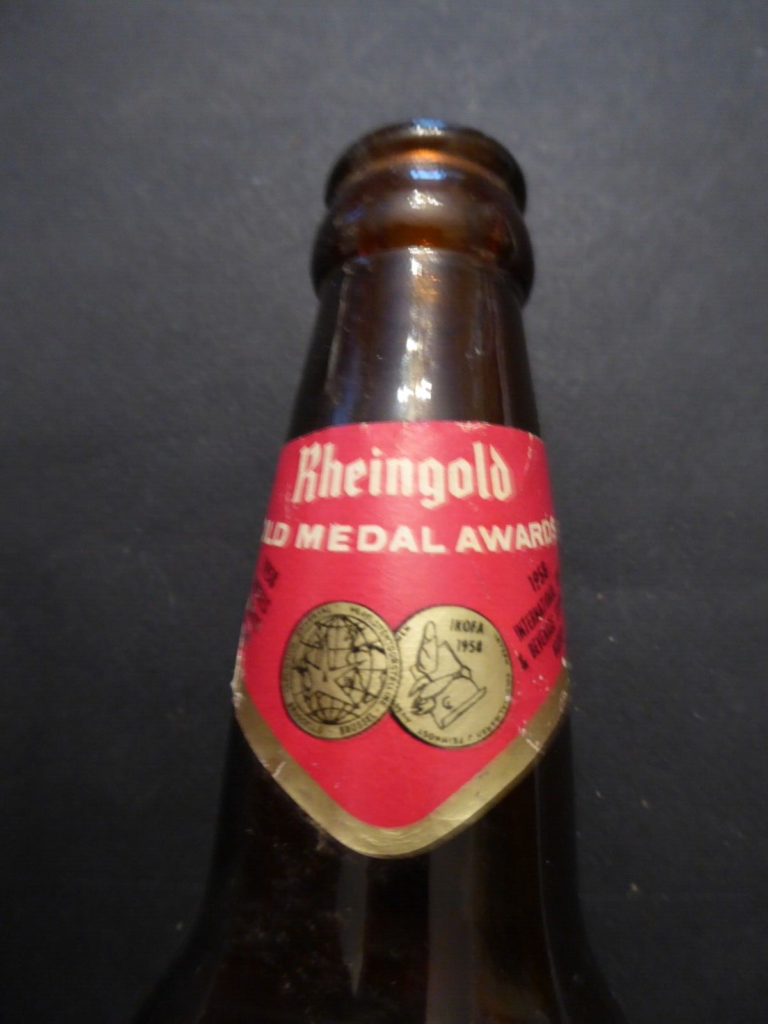
Another interesting thing that happened is that at the International Food and Beverage Exposition in Munich, apparently Rheingold won a gold medal for their beer, because their neck label after the event included the following

And here’s a close up of the neck label.

Filed Under: Art & Beer, Beers, Related Pleasures Tagged With: Advertising, History, Rheingold

Beer In Ads #4383: Brains May Be Nice, But Beauty Pays Real Cash

March 17, 2023 By Jay Brooks

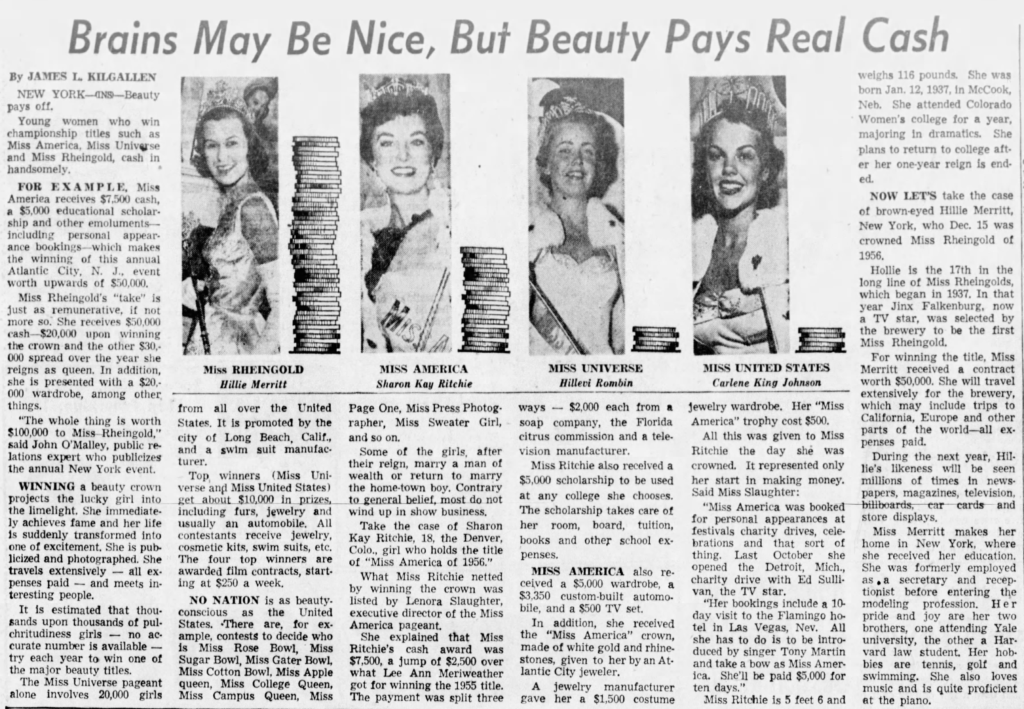
Friday’s ad is for “Rheingold Beer,” from 1956. This ad was made for the Rheingold Brewery, which was founded by the Liebmann family in 1883 in New York, New York. At its peak, it sold 35% of all the beer in New York state. In 1963, the family sold the brewery and in was shut down in 1976. In 1940, Philip Liebmann, great-grandson of the founder, Samuel Liebmann, started the “Miss Rheingold” pageant as the centerpiece of its marketing campaign. Beer drinkers voted each year on the young lady who would be featured as Miss Rheingold in advertisements. In the 1940s and 1950s in New York, “the selection of Miss Rheingold was as highly anticipated as the race for the White House.” The winning model was then featured in at least twelve monthly advertisements for the brewery, beginning in 1940 and ending in 1965. Beginning in 1941, the selection of next year’s Miss Rheingold was instituted and became wildly popular in the New York Area. Hillie Merritt was elected as Miss Rheingold 1955. Not to take anything away from the other Miss Rheingolds, but her story is pretty amazing. She was born Hildegarde Ercklentz in Hamburg, Germany in 1934 but she moved to New York when her father was given a position there with the German bank he worked for. In 1941, they had to flee the United States and lived for a time in Japan, before finally making it back to Hamburg after the war and then by 1950 was living once again in New York City. The story of that journey was written by her and published as “Journey Interrupted” in 2016. By 1955, she was Mrs. Hillie Merritt (although it may actually have been Merrill), with a one-year old son, and decided on a lark to enter the contest. Soon after the year she divorced and then married corporate executive David Mahoney, and they became a prominent couple in the NY social scene and in philanthropic circles. In 1990, they founded the Harvard Mahoney Neuroscience Institute, which Hildegarde Mahoney took charge of after her husband’s death in 2000 and she’s still running the charity today. In this interesting newspaper article, from December, they’re examining how much money you can make from winning beauty pageants. Highlighting several different contest, such as Miss America, Miss Universe, and Miss United States, Miss Rheingold 1956, Hillie Merritt, is the winner my a wide margin in terms of how much money she’s make. Another interesting tidbit, if not entirely surprising, is that “no nation is as beauty-conscious as the United States,” and then lists off a plethora of additional beauty contests.

Filed Under: Art & Beer, Beers, Related Pleasures Tagged With: Advertising, History, Rheingold

A Tale Of Pretty Polly Perkins

March 10, 2023 By Jay Brooks

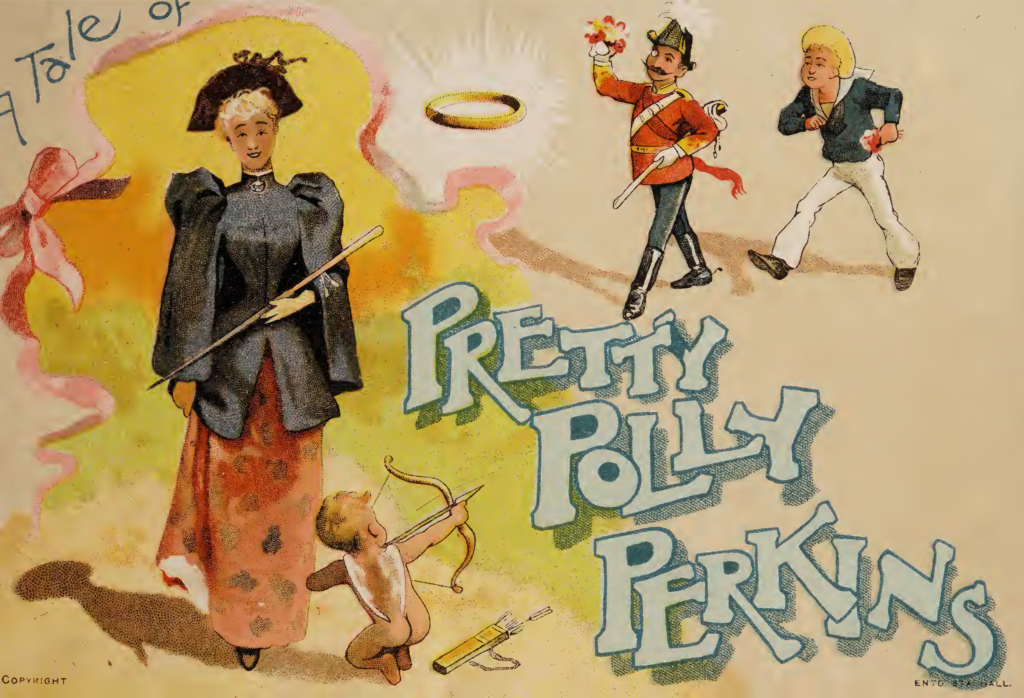
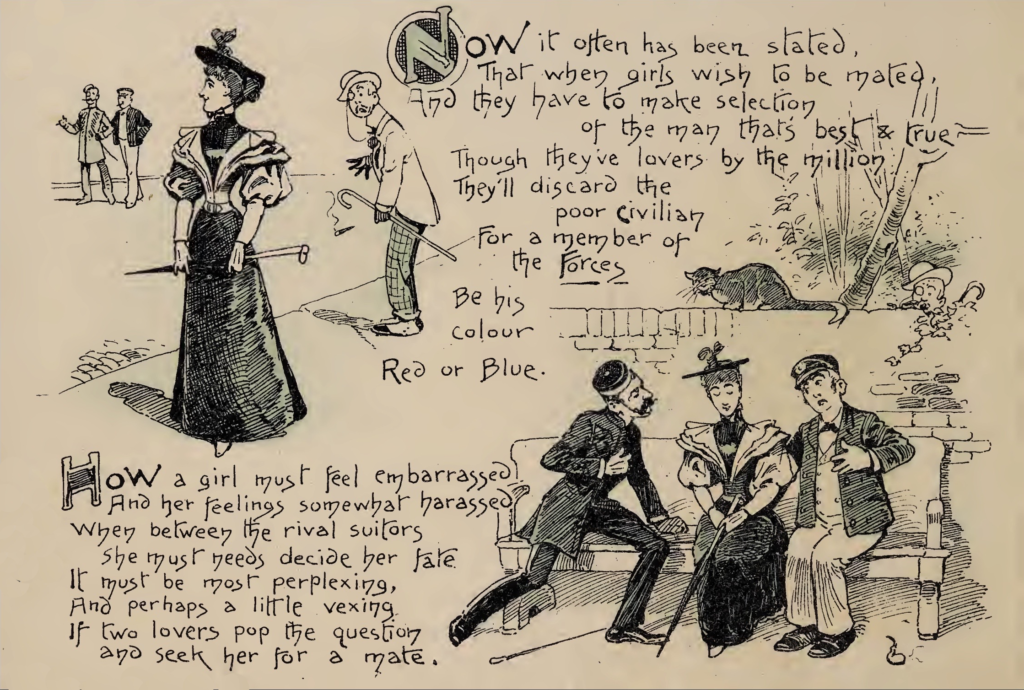
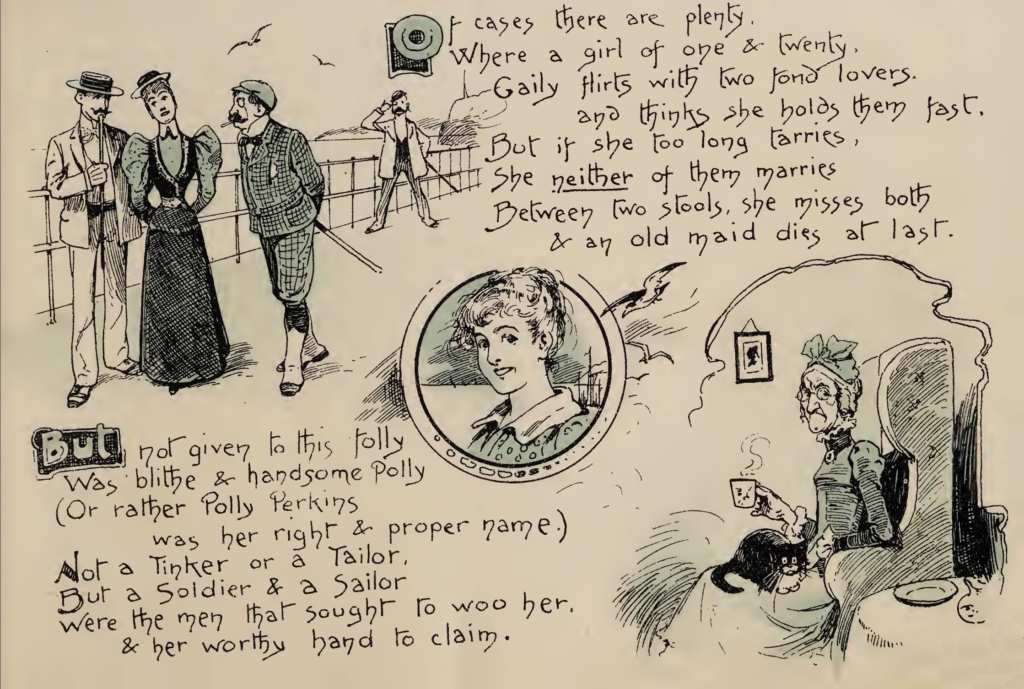
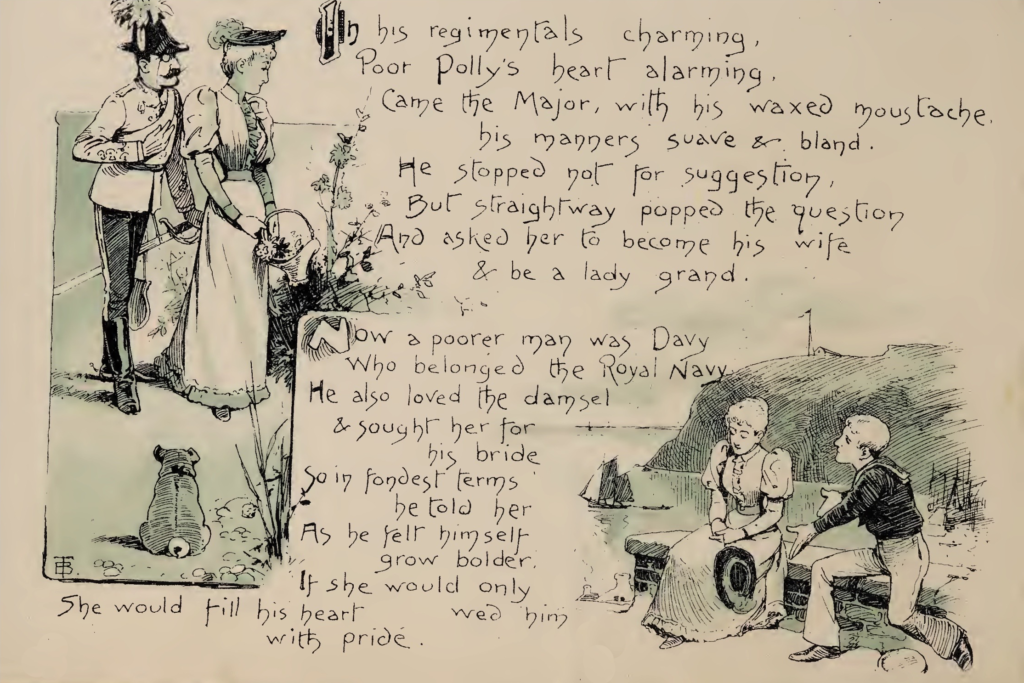
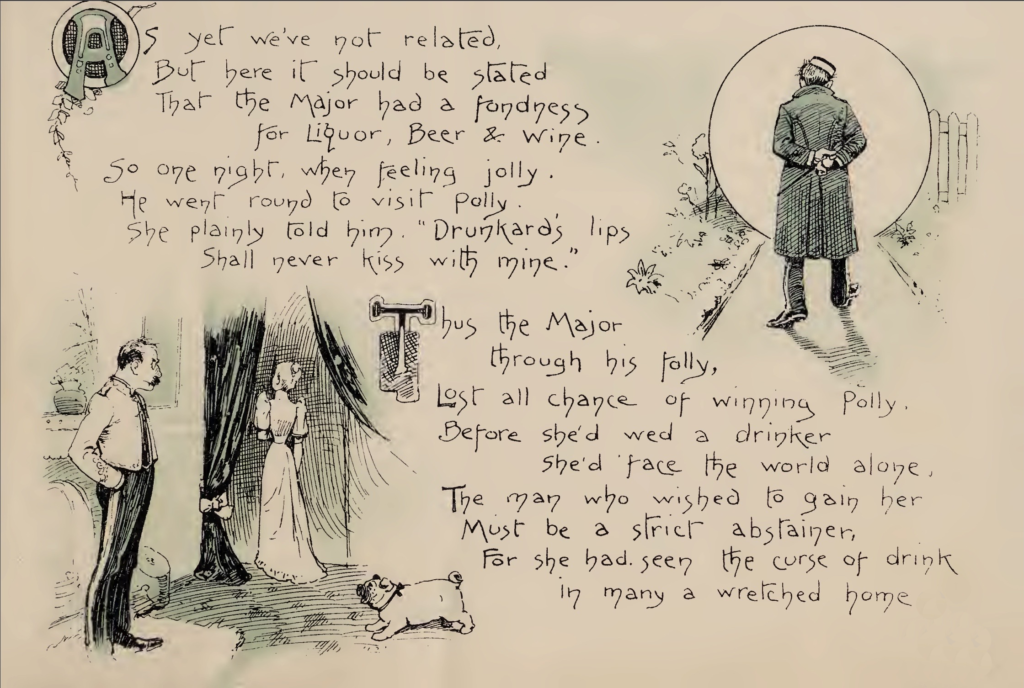
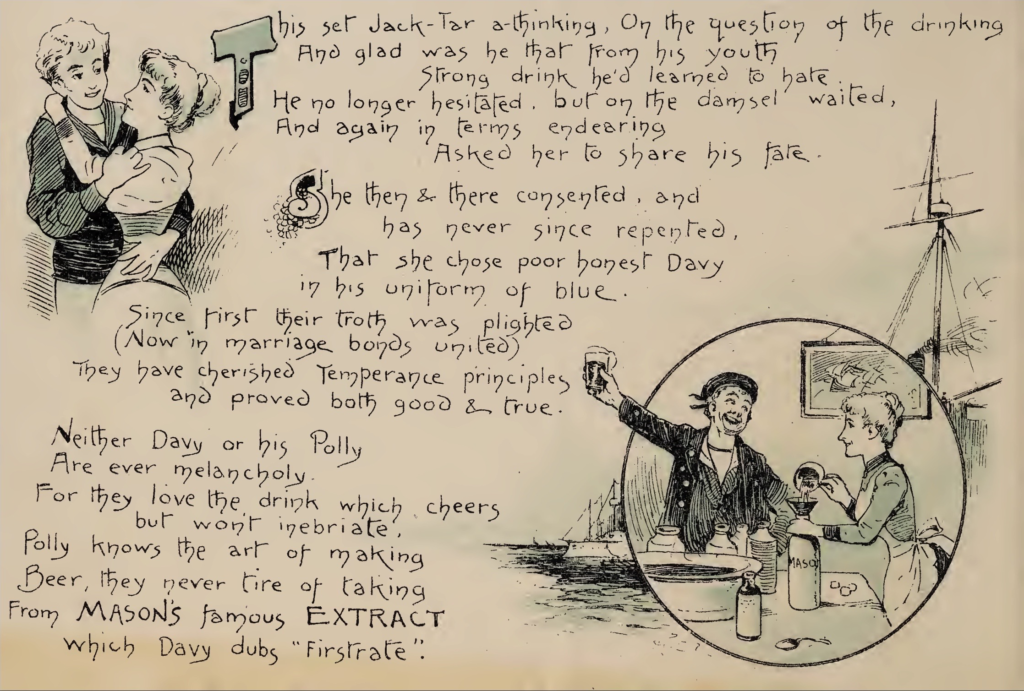
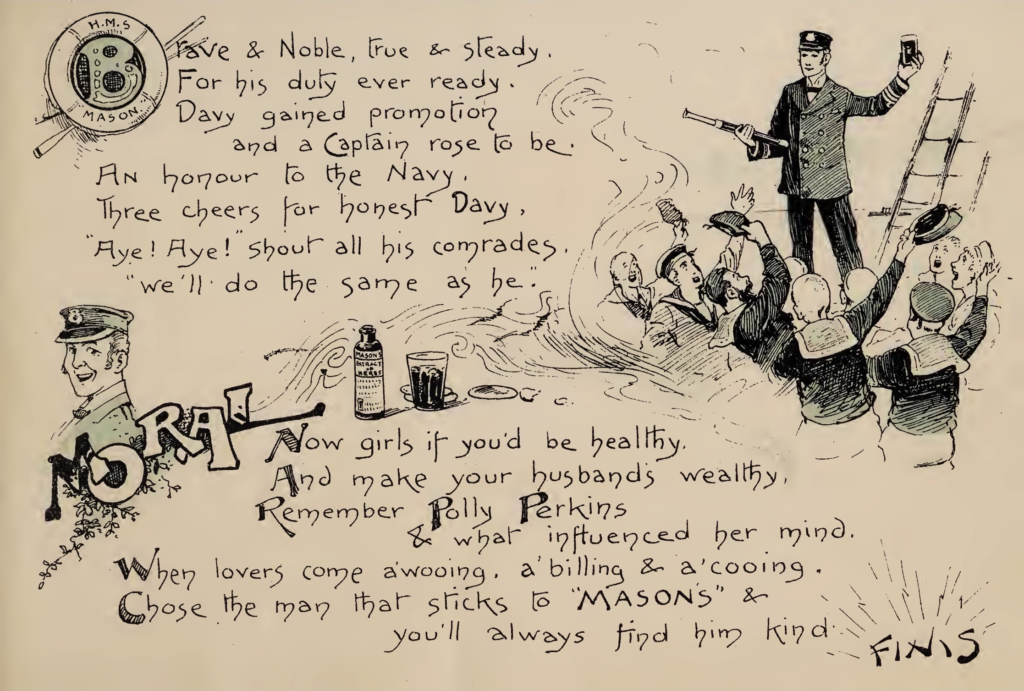
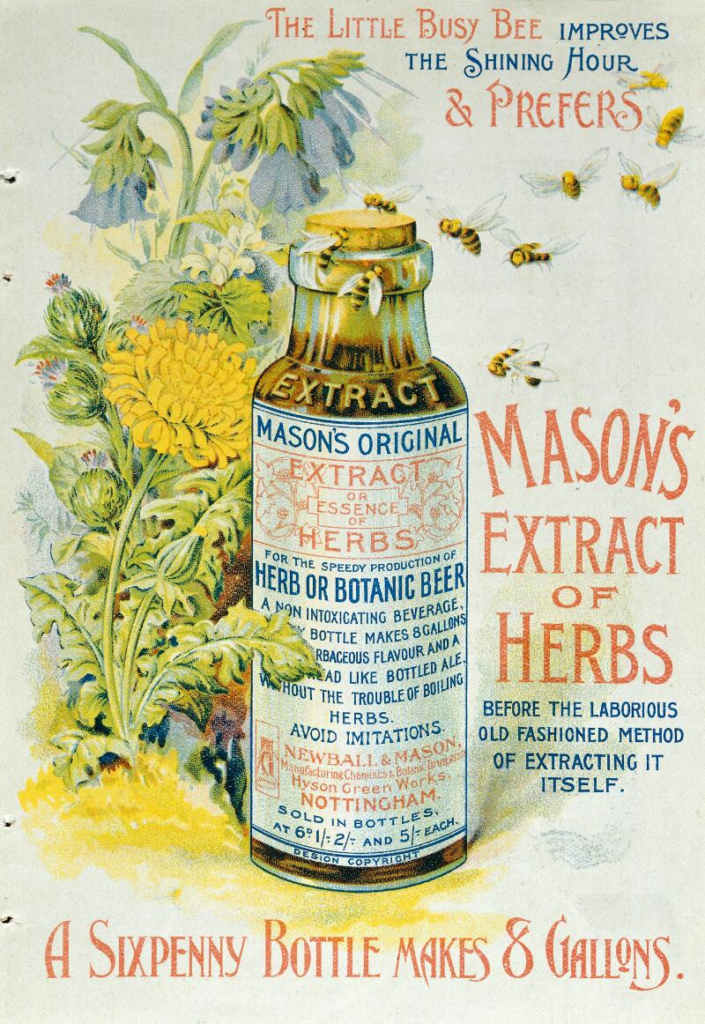
While looking through the Internet Archive today, I came across this odd bit of temperance literature from England. It’s a six-page story published in 1890 to persuade people from partaking of the demon alcohol and instead suggesting Mason’s Extract of Herbs “for the speedy production of herb or botanic beer, a non-intoxicating beverage.” Unsurprisingly, it was published by Newball & Mason, makers of the apparently non-alcoholic beer. It’s called “A Tale of Pretty Polly Perkins.”

The name, I believe, comes from an earlier song called Pretty Polly Perkins of Paddington Green that was first published in 1864. According to Wikipedia, “it was almost universally known in England until around the mid-1950s, when it began to fade as being too old-fashioned.” So here’s the story in full. It’s worth a read.

Page 1.
Page 2.
Page 3.
Page 4.
Page 5.
Page 6.
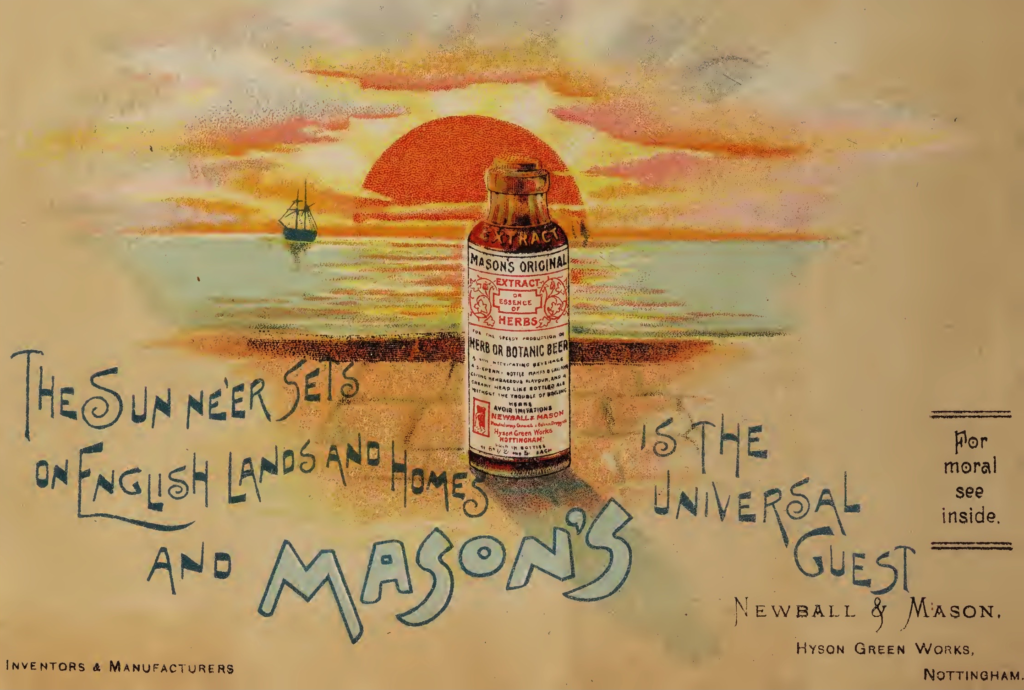
Back Cover.

The back cover shows a bottle of Mason’s Original Herb or Botanic Beer. What was it exactly? I’m not sure, but the Monterey Bay Herb Company has a history of it on their Facebook page:

Herbal History: Mason’s Botanical Beer

“The little busy bee improves the shining hour and prefers Mason’s Extract of Herbs before the laborious old fashioned method of extracting it itself.”

Newball & Mason’s original Extract of Herbs, also known as “Botanic Beer,” was promoted as a refreshing tonic and non-alcoholic alternative to beer in keeping with the Temperance movement which prevailed at the time. The company was formed in 1859 through a partnership between Thomas Ayres Newball and his apprentice, 15-year old Thomas Mason. In 1875, the younger Thomas opened a factory on Park Row in Nottingham, from which he produced his “extract of herbs.”

Advertisements for Mason’s Extract of Herbs appeared regularly in newspapers and on posters and handbills circulated in street railways throughout London. The ads always contained the familiar tagline,”The little busy bee improves the shining hour and prefers Mason’s Extract of Herbs before the laborious old fashioned method of extracting it itself’ and instructed the reader to “Send 9 stamps for sample bottle, enough to make eight gallons.”

In 1880, Thomas took on an apprentice of his own, Benjamin Deaville, who later became a partner in the company. Over the next several years, the company would move twice more until landing in New Basford where the two men established Maville Works, a merging of their names. Here the company diversified to also produce coffee, flavorings, fruit essences, dried herbs and household chemicals.

Benjamin became the sole proprietor after Thomas died in 1911, and he remained chairman and managing director until his death in 1938. Newball and Mason relocated to Staffordshire in 1957, where it continued to operate until 1970.

Wondering what Mason’s botanical beer was made of? Like most formulas of the period, it was a closely guarded secret. But, because few things stay secret forever (and the label’s illustration provides a clue)…the primary ingredients were yarrow, dandelion, comfrey and horehound.

Ad for Mason’s Extract from around 1900.

So it’s made with “yarrow, dandelion, comfrey and horehound,” ingredients more at home in a gruit. How exactly did that concoction create a beverage that tasted in any way like beer, enough that they felt comfortable calling it beer, botanic beer or otherwise?

Below is some more information from an advertising leaflet produced in the 1890s.

Newball & Mason’s original extract of herbs or ‘botanic beer’ was promoted as a wholesome, refreshing drink, a tonic. Most importantly (in line with the Temperance movement of the time which disapproved of alcohol drinking and campaigned determinedly against it), it was marketed as a non alcoholic (and much cheaper) alternative to beer.

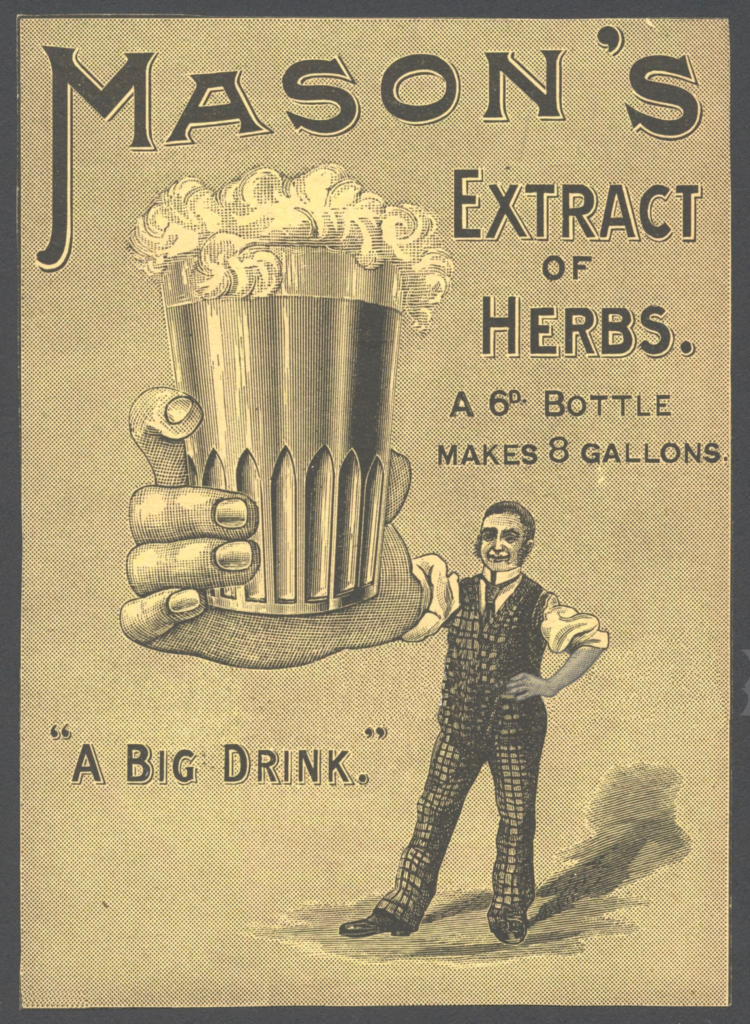
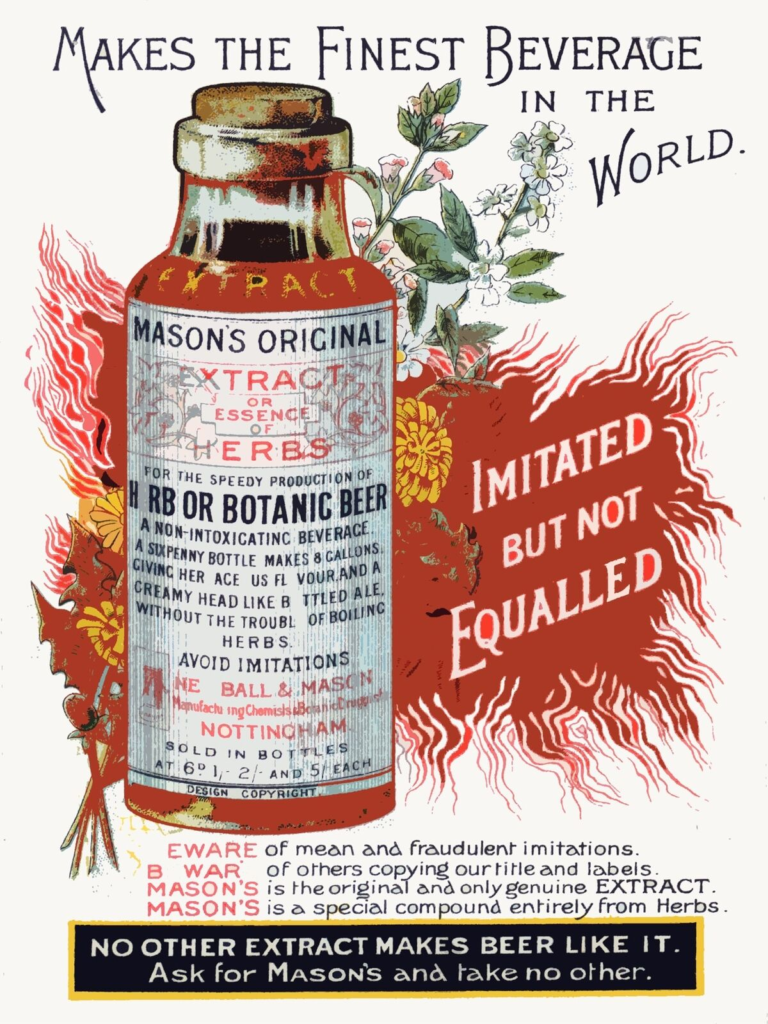
In the advertisement an image of bees buzzing round a bottle and the clump of flowers to the left (dandelion, white dead nettle, burdock and comfrey) suggest the natural and healthy origin of the extract. Another image shows a smiling, young, male scientist holding a glass of the extract, endorsing the product. Newball & Mason were manufacturing chemists & botanic druggists based at the Hyson Green Works, Nottingham.

I love the line “no other extract makes beer like it.” That I believe. And here’s one more account of the extract, from a local history group in Nottingham, England:

The company of Newball and Mason was originally founded by Thomas Ayres Newball and Thomas Mason. In 1850 Thomas Ayres Newball had opened a chemist shop at 36 Derby Road, Nottingham and in 1859, at the age of fifteen, Thomas Mason became his apprentice. After several years, Thomas Mason opened his own shop on Derby Road and it was at this time that he invented the ‘extract of herbs’, a concentrated essence that could be made up into the non-alcoholic beverage, ‘Botanic Beer’. In the 1870’s the two businesses were amalgamated to form Newball and Mason, chemist and druggist, with premises near the Market Place and at 10 Derby Road (Morris’s Trade Directory for 1877). With the growing popularity of botanic beer, in 1875 Thomas Mason opened a factory on Park Row in Nottingham, to produce his ‘extract of herbs’. Benjamin Deaville joined the company as an apprentice in 1880 and after serving a three year apprenticeship, he decided to concentrate on the manufacturing side of the business, later becoming a partner in the company.

In 1890, the company moved into a larger factory on Terrace Street in Hyson Green and in 1902, they moved again to a former lace factory on Beech Avenue, New Basford. This factory was known as the ‘Maville Works’, combining the names of Mason and Deaville. By this time, Newball and Mason had diversified to produce not only the ‘extract of herbs’ but also coffee, fruit essences and flavourings, household chemicals, culinary and medicinal herbs, the latter being grown on the company’s herb and fruit farm in Bunny. In 1911, Thomas Mason died and Benjamin Deaville became the sole proprietor. In 1925 he decided to form a private limited company and held the position of chairman and managing director until his death in 1938.

THE INGREDIENTS : yarrow, dandelion, comfrey and horehound. All grow wild in Ryde Cemetery so if you fancy taking up brewing…!

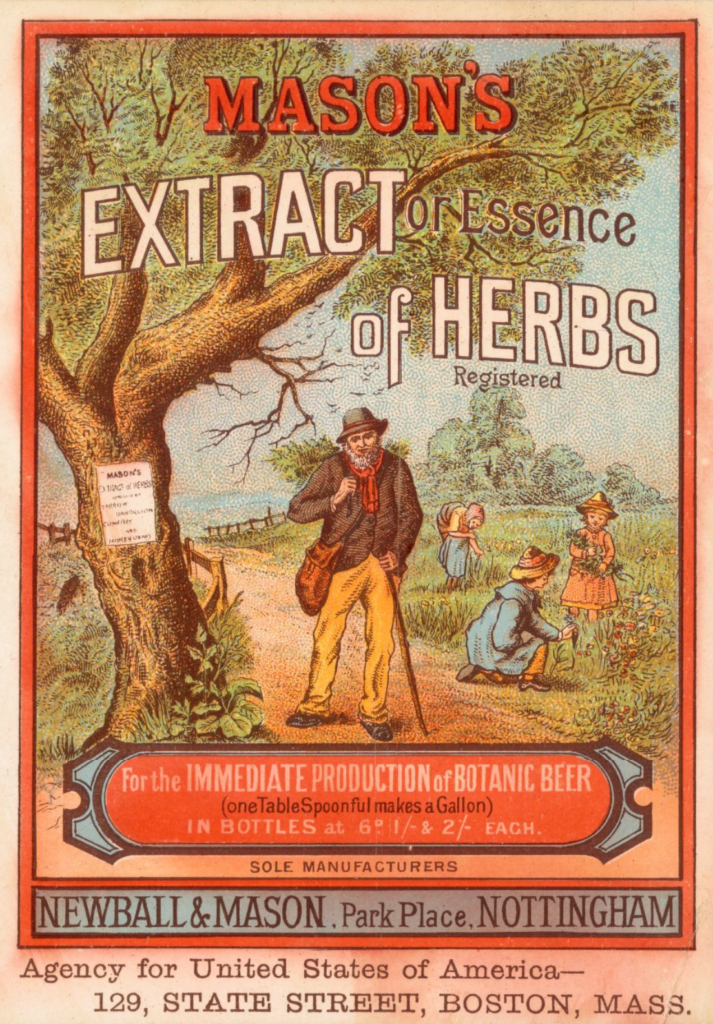
Based on this ad from the 1890s, it looks it was also sold in the U.S., as well.

Filed Under: Art & Beer, Beers, Just For Fun, Politics & Law, Related Pleasures Tagged With: History, Literature, Prohibitionists

The First Tavern In America

March 4, 2023 By Jay Brooks

Today, March 4, in 1634 is when the first licensed tavern in Colonial America opened in Boston, which is why today is also considered “American Tavern Day.” Given that record-keeping was spotty back then, you probably won’t be surprised that it’s not absolutely certain it was the first, although it seems to have been the first in New England at least. Apparently, there is some evidence that another may have opened earlier in Jamestown, Virginia, but I’ve not seen the evidence for that, so here we are.

The account of it opening comes from Boston magistrate John Winthrop, who wrote in his journal under the date 4 March 1634 that “Samuel Cole set up the first house for common entertainment,” this being the first public house or tavern in the colony.

This definitely not Samuel Cole’s Inn but it is typical of taverns of that time period and often shows up in stories about early taverns.

This account is from 1917, and appeared in the book “Old Boston Taverns and Tavern Clubs,” by Samual Adams Drake.

SAMUEL COLE’S INN

Samuel Cole came to Boston in the fleet with Governor Winthrop, and he with his wife Ann were the fortieth and forty-first on the list of original members of the First Church. He requested to become a freeman October 19, 1630, and was sworn May 18, 1631. He was the ninth to sign the roll of the Ancient and Honorable Artillery Company in 1637 and in the same year was disarmed for his religious views. In 1636 he contributed to the maintenance of a free school and in 1656 to the building of the town house. In 1652 he was one of those chosen to receive monies for Harvard College. In 1634 he opened the first ordinary, or inn. It was situated on Washington Street, nearly opposite the head of Water Street. Here, in 1636, Sir Henry Vane, the governor, entertained Miantonomo and two of Canonicus’s sons, with other chiefs. While the four sachems dined at the Governor’s house, which stood near the entrance to Pemberton Square, the chiefs, some twenty in all, dined at Cole’s Inn. At this time a treaty of peace was concluded here between the English and the Narragansetts.

In 1637, in the month of June, there sailed into Boston Harbor the ship Hector, from London, with the Rev. John Davenport and two London merchants, Theophilus Eaton and Edward Hopkins, his son-in-law, two future governors of Connecticut. On the same vessel was a young man, a ward of King Charles I., James, Lord Ley, a son of the Earl of Marlborough (who had just died). He was also to hold high positions in the future and attain fame as a mathematician and navigator.

The Earl of Marlborough, while in Boston, was at Cole’s Inn, and while he was here was of sober carriage and observant of the country which he came to view. He consorted frequently with Sir Henry Vane, visiting with him Maverick, at Noddle’s Island, and returning to England with Vane in August, 1637.

His estate in England was a small one in Teffont Evias, or Ewyas, Wilts, near Hinton Station, and in the church there may still be seen the tombs of the Leys. He also had a reversion to lands in Heywood, Wilts.

In 1649 he compounded with Parliament for his lands and giving bond was allowed to depart from England to the plantations in America.

On the restoration of Charles II. in 1661, the Earl returned to England and in the next year was assisted by the King to fit out an expedition to the West Indies. In 1665 he commanded “that huge ship,” the Old James, and in the great victorious sea fight of June 3 with the Dutch was slain, with Rear Admiral Sansum, Lords Portland, Muskerry, and others.

He died without issue and the title went to his uncle, in whom the title became extinct, to be revived later in the more celebrated Duke, of the Churchill family.

It was shortly after the Earl’s departure that Cole was disarmed for his sympathy for his neighbor on the south, Mrs. Ann Hutchinson, and he was also fined at the same time for disorders at his house. In the following spring he was given permission to sell his house, to which he had just built an addition, and he disposed of it to Capt. Robert Sedgwick in February, 1638.

Cole then removed to a house erroneously noted by some as the first inn, situated next his son-in-law, Edmund Grosse, near the shore on North Street. This he sold in 1645 to George Halsall and bought other land of Valentine Hill.

Although it was always known as Cole’s Inn, writer Henry Wadsworth Longfellow mentions it throughout his play “John Endicott,” but calls it the “The Three Mariners.” For example, from Act IV:

Now let us make a straight wake for the tavern Of the Three Mariners, Samuel Cole commander; Where we can take our ease, and see the shipping, And talk about old times.

Filed Under: Just For Fun, Related Pleasures Tagged With: Bars, Boston, History, Massachusetts, New England

Märzen Madness 2023

March 3, 2023 By Jay Brooks

I may not be biggest fan of academia’s version of indentured servitude, otherwise known as college basketball, but I do still enjoy the games of March Madness every year. The tournament is usually a fun diversion for a few weeks each year, so for the twelfth straight year, I’ve set up a fantasy game, similar to fantasy football or baseball. It’s a bracket game through Yahoo which I call “Märzen Madness.” It doesn’t look like there’s a limit to the number of people who can play, so sign up and make your picks beginning right now, with the first games taking place on March 14, which only gives you roughly two weeks to complete your bracket. So don’t delay, sign up right away and fill out your bracket.

To join Märzen Madness and play the Yahoo! Sports Tournament Pick’em game, just follow the link below. You’ll also need a Yahoo ID (which is free if you don’t already have one).

To accept the invitation and play Märzen Madness this year, just follow this invitation link.

Good luck everybody.

Filed Under: Just For Fun, Related Pleasures Tagged With: Fantasy, Games, Sports

Gŵyl Mabsant

February 9, 2023 By Jay Brooks

Today is Gŵyl Mabsant, which is an old Welsh holiday that hasn’t been widely observed there since the 1860s, so it’s been gone for some time. But maybe it’s worth bring back. It certainly sounded interesting, especially when one article referred to it as “A Drunken Welsh Mini-Olympics,” and described it thusly:

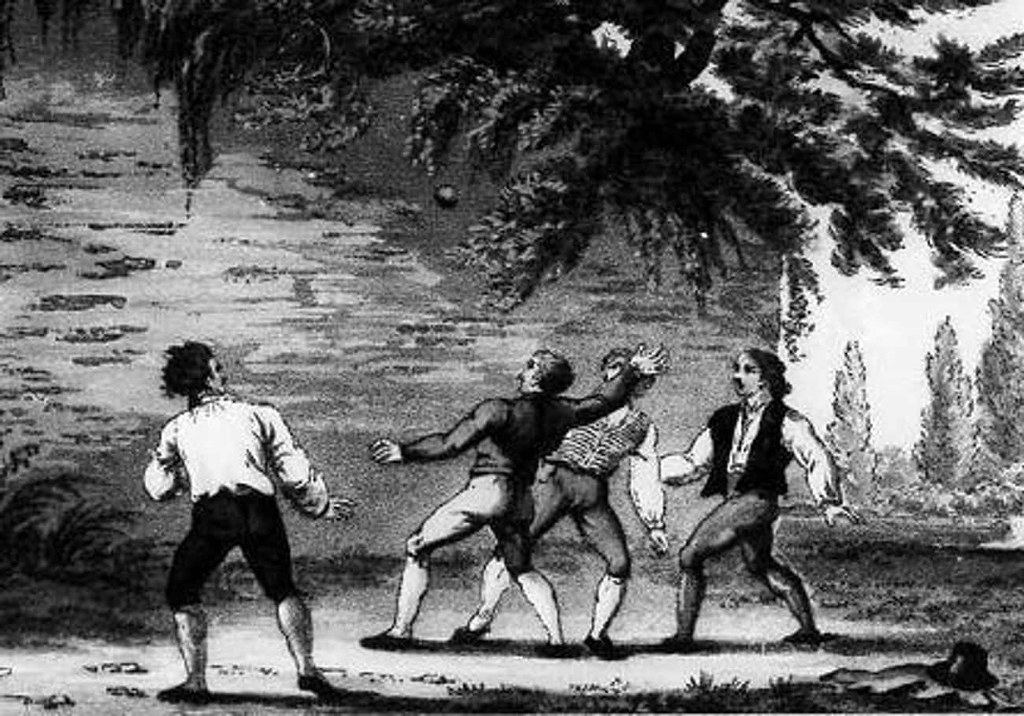
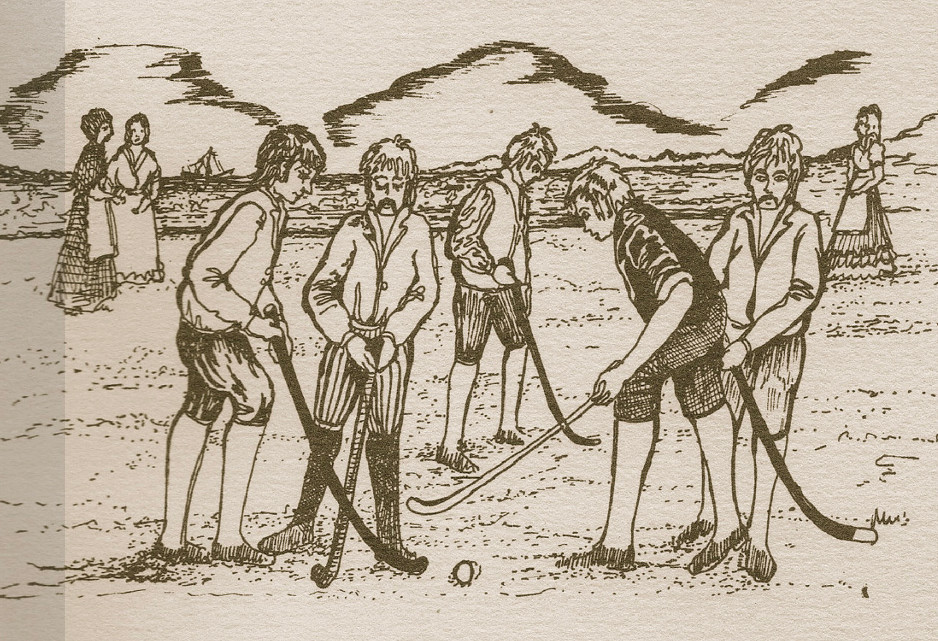
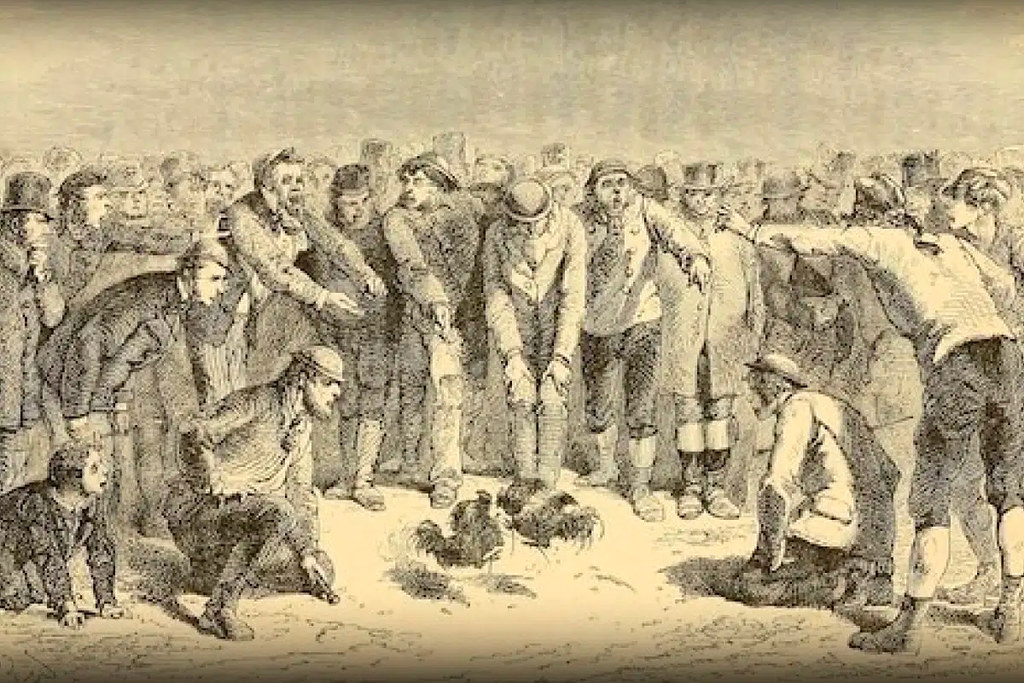
The Welsh holiday of Gŵyl Mabsant, which celebrates a local parish saint, hasn’t been properly celebrated since the end of the 19th century. It’s a damn shame, too – the whole thing sounds like a blast, with highly unorthodox athletic competitions such as blindfolded wheelbarrow-driving, “fives” (a squash-like game, pictured, played against the church walls), and something called “old women’s grinning matches.” There was also football, bando (a field hockey-like game), and, unfortunately, cockfighting. The mix of alcohol, gambling, and crazy games gave the holiday a bad reputation, ultimately getting it shut down by religious leaders.

The game of ‘fives’, rather like a primitive form of squash, often took place against the church walls. Image from The Cambrian Popular Antiquities, Peter Roberts (1815).

And this account is from the Museum of Wales:

The gŵyl mabsant was one of the most popular rural festivals in Wales. Commemorating the local parish saint, this annual celebration developed from a dedication through prayer to a programme of recreational activities, enjoyed by all.

Gŵylmabsantau was mentioned in writing as early as 1470, and the festival was common throughout Wales up until the end of the 19th century.

From cockfighting to grinning matches

Competitions at the festivals ranged from running races to old women’s grinning matches and blindfolded wheelbarrow-driving. At the three day sports event held in Llangyfelach near Swansea in 1780, competitions and prizes included a women’s race for a smock and petticoat and eating a hot pudding for a silver table spoon. Animal sports were a familiar scene, particularly cockfights, on which large amounts of money were wagered. Birds were specially trained for the contest, and the owner of a victorious cockerel was held in high esteem.

Early versions of Association Football were often played over Christmas, New Year and at Shrovetide. Large crowds of spectators gathered to witness the matches, which, owing to a lack of pre-determined rules, tended to degenerate into chaos, with injuries being common.

Bando

Bando was another favoured team sport and continued in some areas until the late 19th century. Particularly popular in Glamorgan, bando was similar to the modern game of hockey and teams used clubs to strike the ball towards a goal.

A rowdy reputation

Owing to the combination of betting, feasting and alcohol consumption, it was not surprising that parish festivals built-up a reputation for their rowdiness. Publicans often played a significant role in organising and promoting sports events, many being arranged over the bar. The games contested were high-spirited and unwritten rules were often decided informally before the start of a match. As many sports were localised activities, rules usually differed from place to place, leading to disagreements between parishes.

Cockfighting
Cockfighting featured prominently on the rural calendar, and was popular with all sections of society throughout Wales until the early 19th century.

Concern regarding the unlicensed revelry and alcoholic over-indulgence commonly occurring at the festivals, as well as the doubtful benefits of the games themselves, was increasingly voiced from the 18th century onwards, most noticeably by religious leaders.

Worthless and sinful

The Methodist and other religious revivals which swept across Wales from the mid 18th century until the turn of the 20th century, attacked sporting activities indiscriminately as worthless and sinful. Physical recreation was viewed by some as a great threat to the morals of the population. Eminent religious figures, such as Thomas Charles, tried to suppress impious fairs and festivals, in 1799 he described Wales as “sunk in superstition and vice”. Consequently, parishioners turned increasingly to churches and chapels for release and salvation, and as prayer meetings were sometimes purposely arranged to clash with sports days, religion became a potent force in the eventual decline of the Gŵyl Mabsant.

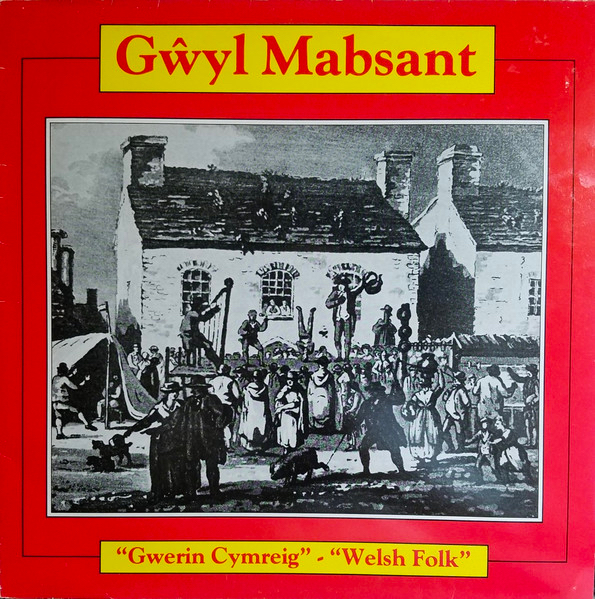
This is the album cover for a record of Welsh Celtic folk songs released in 1984.

And this one is from Cracked:

Looking back at some historical holidays, we kind of got an unfair deal. We get Arbor Day, a day theoretically dedicated to trees but practically dedicated to nothing, and Columbus Day, a day celebrated by people trying to defend a racist on the internet. Meanwhile, we don’t get Gwyl Mabsant.

Gwyl Mabsant means “Feast of the Patron,” and it, appropriately, was a religious festival that honored a parish’s patron saint. While it was intended to be a time of prayer, Gwyl Mabsant experienced a major shift around the time of the Reformation. This took away much of the religious context from the festival and replaced it with partying that would make any frat boy jealous.

The true saint of Gwyl Mabsant was booze, and this more popular version of the festival involved days of drinking and participating in sports and games. Contests like eating hot pudding and racing wheelbarrows while blindfolded would get a laugh out of Gwyl Mabsant attendees. Old women participated in “grinning matches,” which might be a version of gurning, an English contest in which people try to make and maintain the ugliest face possible. Drunkenly laughing at old ladies was probably as good a time as drunks were going to have in the days before beer pong and Waffle House.

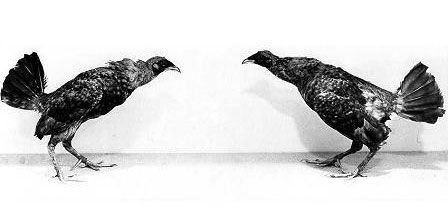
Gambling was another major appeal to Gwyl Mabsant, and the main draw was cockfighting. Owners became stars of the festival and betting on the fights sort of became the main event.

Nothing screams “Feast of the Patron” like betting on which bird will kill the other.
Of course, between the gambling, drinking, and mocking of the elderly, someone was bound to ruin the fun. Like a resident assistant in a college dorm, someone had to come in and break up the party. In this instance, religious leaders began to object to the festivities associated with Gwyl Mabsant.

Revival movements started pushing back against the festivals around the middle of the 18th century. Gwyl Mabsant didn’t survive in any form much longer, and now one of the most fun holidays but a small blip in the history books and a loss for WorldStar viewers.

Filed Under: Just For Fun, Related Pleasures Tagged With: History, Holidays

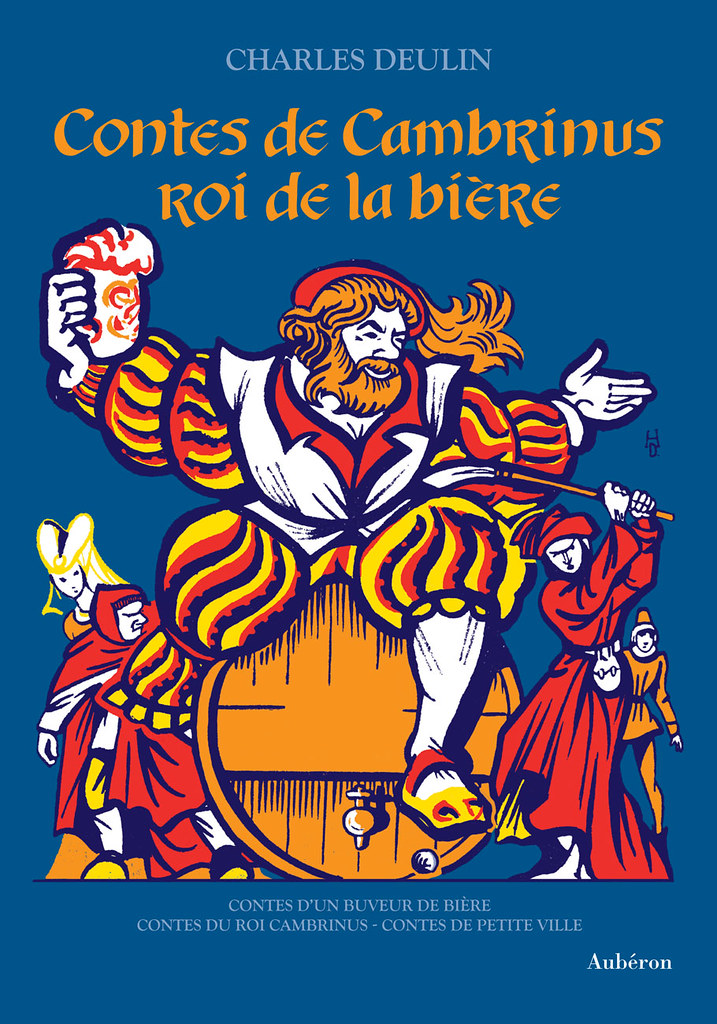
Charles Deulin’s Tales of King Cambrinus

January 4, 2023 By Jay Brooks

gambrinus
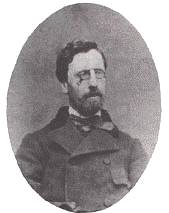
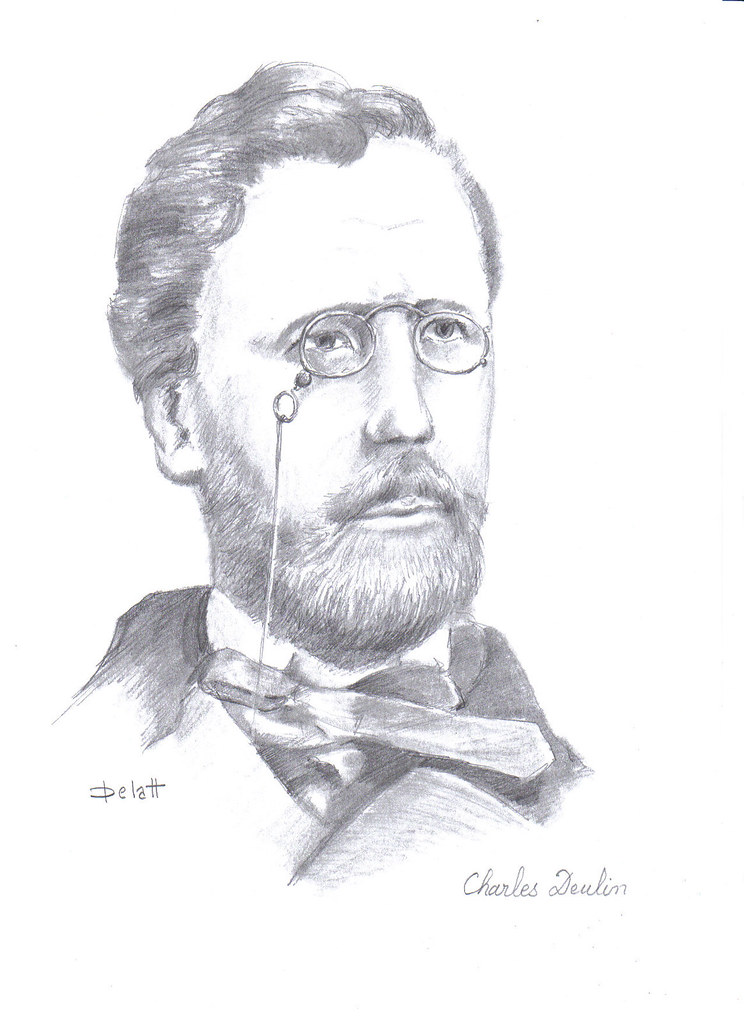
Today is the birthday of Charles Deulin (January 4, 1827–77). He was “a French writer, theatre critic, and folklorist who is most known for his contemporary adaptations of European folk tales.”

deulin

This biography of Deulin is from “The Greenwood Encyclopedia of Folktales and Fairy Tales,” published in 2008:

Charles Deulin was the son of a poor tailor who lived in the Escaut, a region in the north of France whose folklore inspired his major works. Deulin’s early career as the secretary of an enlightened notary and patron of the arts came to a sudden end after he eloped with the daughter of a notable local merchant. Deulin relocated to Paris, where he worked as a columnist for numerous French journals and reviews. However, Deulin found his real fame writing tales that drew on regional folklore and folktales. His first tale, “Le compere de la mort” (“Godfather Death”), was based on an oral tale that he had first adapted as a song. His tales achieved both popular and critical success, so Deulin mined the rare resources and folk literature in the Library of the Arsenal in Paris for material that he could reshape into tales of his own. Contes d’un buveur de biere (Tales of a Beer Drinker, 1868) and its sequels Contes du roi Cambrinus (Tales of King Cambrinus, 1874) and Histoires de petite ville (Village Stories, 1875) constitute his most important collections of fairy tales. Les contes de ma Mere l’Oye avant Perrault (The Tales of Mother Goose from before Perrault), a scholarly work that explores Charles Perrault’s likely sources, was published in 1879, after his death. Deulin and his beer drinker remind us of his contemporary Alphonse Daudet and his windmill of Provence. Despite obvious differences between these writers, they both provide sharp yet personal evocations of the lore of their native regions, thanks to their skill at giving French language a distinctive regional twist.

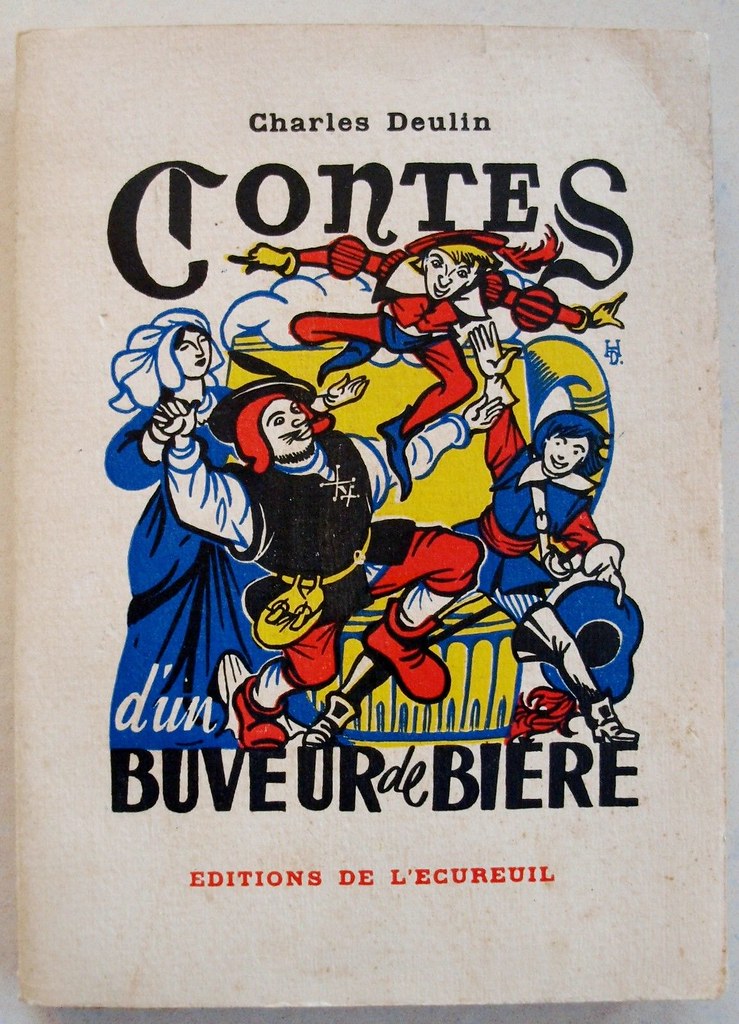
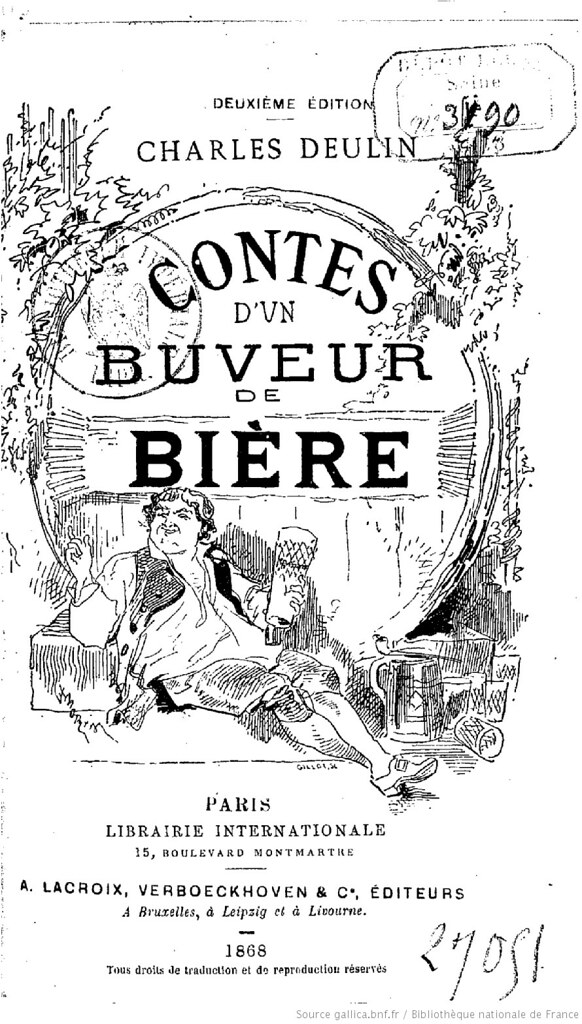
His second collection of stories was called “Contes d’un buveur de bière” (“Tales of a Beer Drinker”) and was published in 1868. “Deulin based one of the stories, “Cambrinus, Roi de la Bière” (“Cambrinus, King of Beer”), on folktales about the origin of a beer-brewing mythological king called Gambrinus. In the story, a lovelorn Gambrinus makes a deal with the Devil, and Beelzebub teaches him about brewing.”

tales-of-beer-drinker

Here’s a summary of his first Cambrinus story:

In this, the seminal Cambrinus short story, Cambrinus is an apprentice glassblower in the Flemish village of Fresnes-sur-Escaut, but he believes that he lacks the skill and upward mobility to succeed in glassblowing. He becomes smitten with the master glassblower’s daughter, Flandrine. When he tells her, she rebuffs him and he leaves in disgrace. He apprentices himself to a viol master and becomes a great player. One day, he summons the courage to climb on a barrel and play publicly. He plays well, but just as he has whipped the crowd into a dance, the sight of Flandrine flusters him, and he bungles his playing. The villagers, believing Cambrinus tripped them up on purpose, pull him off the barrel to jeer and strike him. A contemptuous judge called Jocko sentences Cambrinus to a month in prison. When Cambrinus emerges a month later, he feels so ashamed that he prepares to hang himself. As he stands with the noose around his neck, a colourfully-dressed stranger appears. Cambrinus recognizes him by his horns: it is Beelzebub. As they chat, Beelzebub reveals that he has killed the judge, and now expects to collect Cambrinus’ soul, for, he says, such is his fate if he hangs himself. Not wanting to go to hell or to return to life as he knew it, Cambrinus tries to bargain. Beelzebub cannot make Flandrine love him, so Cambrinus settles for forgetting his affection for her; he also wants revenge on the villagers. Beelzebub tells him that the way to forget is if “one nail drives out another.”

Cambrinus wins a fortune in games of skill and chance. The consistent winning becomes tedious, so he returns to Flanders—but Flandrine still refuses him. Once again, he is about to hang himself when Beelzebub reappears, and tells him that drinking is the way to forget. Cambrinus drinks wine, gin, whisky, cider, and brandy, but his condition only worsens. Cambrinus is momentarily contented when Beelzebub introduces him to beer, but he seeks revenge on those who would not dance for him. Beelzebub tells him that playing the carillon will prove irresistible.

Cambrinus builds a large brewery with a carillon and a belfry, then invites the villagers for a drink after Mass. They come, but find the beer too bitter. To punish them, Cambrinus plays his carillon, and everyone in earshot is compelled to dance until they beg for a drink. This time, they find the beer delicious, and Cambrinus’ dances become an institution that transforms the village of Fresnes-sur-Escaut.

Fame of the drink and of Cambrinus’ carillon reaches the king of the Netherlands, who in return heaps titles of nobility on Cambrinus: Duke of Brabant, Count of Flanders, Lord of Fresnes. But even after founding the town of Cambrai, Cambrinus prefers the villagers’ honorary title for him: King of Beer. When Flandrine finally approaches him, he rejects her.

At the end of the 30 years, Beelzebub sends Jocko, the judge, to fetch Cambrinus; but Jocko drinks too much beer and sleeps for three days. Since he is too ashamed to return to hell, he hides in a purse. Cambrinus thrives for nearly a hundred years more. When Cambrinus finally dies, Beelzebub comes for his soul, only to find that Cambrinus’ body has become a beer barrel.

Contes_d'un_buveur_de_bière_Deulin_Charles

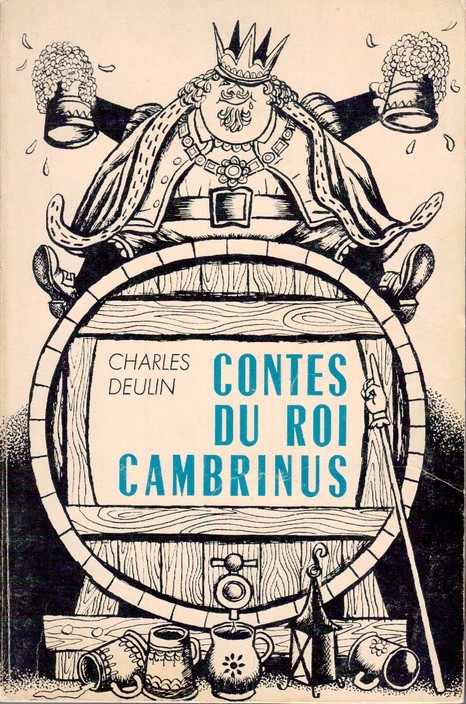
For his third collection of stories, “Deulin made his Cambrinus character the focus,” in “Contes du roi Cambrinus” (“Tales of King Cambrinus”), which was published in 1874. This collection included at least “Cambrinus, The Devil’s Pot, Manneken-pis, Martin and Martine, The Muscades of Guerliche, The Poirier de Misère, and The Thirty-Six Encounters of Jean du Gogué.

cambrinus

This is a Google translation from the French Wikisource library:

I

In the old days, there was in the village of Fresnes-sur-l’Escaut a glass boy named Cambrinus, according to other Gambrinus, who, with his pink and fresh face, his beard and his golden hair, was indeed the prettiest you could see.

More than one young lady of glass, bringing her father’s dinner, was annoying the handsome Cambrinus; but he had eyes only for Flandrine, the daughter of his blower.

Flandrine was, on her side, a beautiful girl with golden hair, cheeks reouvelèmes, – It was meant to be a vermeilles, and never would a better matched couple have been blessed by the cure, had there not been between them an insurmountable barrier.

Cambrinus was not a glass race and could not aspire to mastery. He had, throughout his life, to pass the bottle sketched to his blower, without ever claiming the honor of finishing it himself.

Nobody is ignorant, indeed, that the glassmakers are all Gentiles-men by birth and only show their sons the noble profession of blower. But Flandrine was too proud to lower her eyes to a simple big boy, as they say in the language of glass.

This made the unhappy man, consumed by a fire ten times hotter than his oven, lost his fresh colors and became dry like a heron.

No longer able to hold out, one day he was alone with Flandrine, he took his courage in both hands and told him his feelings. The proud girl received him with such disdain that in despair he planted his work there and did not reappear at the glassworks.

As he loved music, he bought a viol to charm his troubles and tried to play it without ever learning.

The idea then came to him to become a musician. ” I will become a great artist, he said to himself, and perhaps Flandrin will want me. A good musician is well worth a glass gentleman. ”

He went to find an old canon of Conde’s collegiate, named Josquin, who had a wonderful genius for music. He told him of his troubles and asked him to teach him his art. Josquin felt sorry for his grief and showed him to play the viol according to the rules.

Cambrinus was soon in a position to make the girls dance on the meadow. He was ten times more skillful than the other minstrels; but unfortunately! No one is a prophet in his own country.

The people of Fresnes did not want to believe that a glass boy had become in such a short time a good musician, and it was under a rolling fire of jeers that, on a fine Sunday, armed with his viola, he mounted his platform I mean his barrel.

Although very moved, he gave a sure hand the first bows. Little by little he became animated and led the dance with a vigor and an enthusiasm that silenced the laughter. Everything was going well when Flandrine appeared.

At his sight, the unfortunate man lost his head, played against the weather and beat the campaign so well that the dancers, believing that he was making fun of them, dragged him out of his barrel, broke his rapes on the shoulders and sent him back booed, boozy and pooped eyes.

To make matters worse, there was at that time at Conde a judge who did justice like the grocers sell candles, by leaning the scales to his liking. He was a stammerer, spoke almost always in Latin, mumbled paternosters from morning till night, and looked so much like a monkey that he was nicknamed Jocko.

Jocko learned the case and called the disrupters to his court. The Fresnois went there, each bearing a couple of chickens which they offered to the judge. The latter found the chickens so fat and Cambrinus so guilty that, although the unfortunate man had been beaten in full sun, he condemned him to a month’s imprisonment for assault and night-time fury.

It was a big heartbreak for the poor boy. He was so ashamed and sorry that when he was released from prison he resolved to end life. He unfastened the rope from his well, which was brand new, and reached the wood of Odomez.

At the darkest intersection, he climbed an oak tree, sat down on the first branch, tied the rope tightly and wrapped it around his neck. That done, he raised his head, and he was going to take the plunge, when he suddenly stopped.

Before his eyes was a man of tall stature, dressed in a green coat with copper buttons, wearing a feathered hat, armed with a hunting knife, and carrying a silver horn over his carnivore. Cambrinus and he looked at each other for some time in silence.

“That I do not bother you! finally said the unknown.

“I am in no hurry,” replied the other, a little chilled by the presence of a stranger.

– But I am, my good Cambrinus.

– Here! you know my name?

– And I also know that you’re going to dance your last jig, because you’ve been thrown in prison and the kind Flandrine refuses to enlist you in the big brotherhood … ”

And so saying, the stranger took off his hat.

“What! it’s you, myn heer van Belzebuth. Well ! by your two horns, I thought you were uglier.

– Thank you!

– And what good wind brings you?

– Is it not today Saturday? My wife is washing the house, and, as I hate wassingues …

– You have decamped. I understand that. And … did you have a good hunt?

– Pooh! I only report the soul of the judge of Condé.

– How! Jocko is dead! And you take away his soul! Oh ! but do not waste time, myn heer. What are you waiting for?

– I’m waiting for yours.

– What if I do not hang myself?

– It will be hell in this world.

– Which is not much better. But that’s just right, that, godverdom! Come on, Monsieur the devil, be good devil and shoot me from there!

– But how?

Let Flandrine want to marry me.

– Impossible, good! What woman wants …

“God wills it, I know it; but what she does not want?

– What she does not want, the devil himself would lose his horns.

– So, make sure I do not love him anymore.

– I agree … on one condition. It is that you will give me your soul in exchange.

– Right now?

– No. In thirty years from here.

– My faith! start there. I am too unhappy … but you will help me, on the other hand, to avenge myself on the people of Fresnes.

Let’s first think of healing yourself, and remember this. One nail drives out another. It is not so strongsion that does not yield to a more passionate passion. Day and night plays, and replaces the game of love by the love of the game.

“I’ll try,” Cambrinus said. Thank you, myn heer. ”

He untied his rope and drew his bow.

II

There was precisely in Condé, the following Sunday, a great archery. Cambrinus went there, like all the Fresnois.

The brotherhood of the archers of San Sebastián had displayed, in price, five dishes and three tin pots, plus six teaspoons in silver for the last birdie shot. Cambrinus won four dishes, two coffee pots and six silver spoons. No one had ever heard of such an address.

As, eight days later, the ball was to be played on the Place Verte de Conde, he formed at Fresnes a platoon of players, and although until then the Fresnois had scarcely shone on the game of palm, he did not He feared not to fight against the parts of Valenciennes and Quaregnon, the two strongest in the country. The Valenciennes and the Quaregnonais were defeated by the Fresnois. They got angry, and they fisted in every street.

Cambrinus then bought a blind finch, which, in the fashion of the people of the Walloon country, he carried everywhere with him. Having heard that there must have been a great competition of finches in Saint-Amand, he took his fellow-traveler and set off.

On approaching the town, he met on the Croisette the guns that, three hundred in number, went to the place of the battle, two by two, and holding in their hands their little wooden cages, furnished with wire. The procession was preceded by a drum-major, adorned with his cane, two drums, and six hams, ornamented with flowers, worthy of the prize.

Cambrinus followed suit, and when the cages were ranged in battle, along the enclosure of the Abbey, a pretty concert was heard. Each bird shouted at the top of its cheerful chorus, while with a piece of chalk its master, under the surveillance of the commissaries, conscientiously inscribed the guns on a slate. The noise was such that the big bell of the tower had not been heard.

The Fresnois had bet three thousand florins that, without intermingling his song of p’tit-p’tit-petit-placapiau who escape the artifithese second-rate, his virtuoso would repeat nine hundred times in one hour ran-plan-plan-plan-biscouïtte-biscoriau, the true solo, the only one that can count.

The bird went up to nine hundred and fifty, and the master won the first prize and the three thousand florins, after which the Amandinois triumphantly walked the man and the beast, one carrying the other.

Cambrinus then set out to cross Flanders, beating with his tenor the most renowned gunslingers; and it is from this period that the Flemings are as passionate about finches as the English for cockfights.

From Flanders he went to Germany and traveled from town to town, playing all games of skill and chance. Everywhere he took his chance with him. He made general admiration, gained enormous sums, became immensely rich, but he did not cure of his love.

This infallible luck had at first delighted him. Later, she only amused him; then she left him cold and soon she bored him. In the end, he was so tired of this perpetual gain that he would have given everything to lose once; but his happiness pursued him with relentless obstinacy.

He was beginning to be very unhappy, when, one morning, he awoke with a luminous idea: “To something happiness is good,” he said to himself. Perhaps Flandrine will consent to marry me, now that I am all sewn with gold. ”

He returned to deposit his treasures at the feet of the cruel; but, unbelievable and well done to astonish the ladies of today, Flandrine refused.

“Are you a gentleman? she says.

– No.

– Well! win your treasures, I will marry only a gentleman.”

Cambrinus was so desperate that one fine day, between dog and wolf, he returned to the wood of Odomez, climbed the oak, sat down on the first branch, and fastened his rope securely. Already the noose around the neck was passing, when the green hunter appeared.

“Ah! fuck! cried Beelzebub, I had forgotten the proverb: Unhappy in love, happy in the game. Do you want me to tell you a way to lose? ”

Cambrinus listened.

“Yes, you will lose, and you will lose more than gold. You will lose your memory, and with it the torments of remembrance.

– And how?

– Wood. Wine is the father of oblivion. Wormmake waves of joy. Nothing beats a bottle of piot to drown human sadness.

– You might be right, myn heer.”

And Cambrinus rolled his rope and went back to Fresnes.

III

Without wasting time, he had a large cellar of six hundred feet, forty feet wide, and tall, built in broad Tournay stones. He garnishes it with the most exquisite wines.

In the lightnings, arranged on two parallel lines, ripened the warm burgundy, the sweet burgundy, the sparkling champagne, the gay malvoisie, the marsala bulletin board, the ardent sherry, the generous tokai and the tender johannisberg, which opens to the square heads of Germany the golden gates of daydreaming.

Day and night Cambrinus drank the juice of the vine in Bohemian glasses. The unfortunate thought he drank oblivion, he drank only love. Where did this phenomenon come from? Alas! that the good Flemings are otherwise built that the people of elsewhere.

At home, when the fumes of wine invade the brain, when the divine juice ends under the skull, as the lava at the bottom of the crater, it is only then that the imagination catches fire.

At the sixth glass, the Flamand invariably saw in front of his eyes, at the arms of pretty dancers, myriads of Flandrines, who made him a nique by performing interminable carmagnoles.

Then he sought oblivion in Norman cider, manceau parsley, Gallic mead, French cognac, Dutch gin, English gin, Scottish whiskey, German kirsch. Alas! cider, perry, mead, cognac, juniper, gin, whiskey, and kirsch only fueled the furnace. The more he drank, the more excited he was, the more he raged.

One evening he could no longer resist; he ran all at once to the wood of Odomez, climbed the oak, fastened the rope, and, without raising his eyes, to be sure not to return, He rushed the rope around his neck. The rope broke and the hangman fell into the green hunter’s arms.

“Do you want to let me go, damn impostor? exclaimed Cambrinus in a strangled voice. How! you will not even be able to hang yourself at your ease! ”

Belzebuth burst out laughing.

“I wanted to see,” he said, “how far the confidence of a good Flemish would go. And now, for the trouble, I’ll heal you. Here, look!”

All at once the trees parted to the right and to the left, so as to leave a large empty square, and Cambrinus saw in line long rows of large poles made of chestnut wood, where were curled frail plants which bore green and fragrant bells.

Some of the stakes were lying on the ground and three to four hundred squatting women seemed to peel a huge salad. This strange forest was bounded by a vast brick building.

“What is this, myn God? exclaimed the Fresnois.

“This, my good man, is a hopshop, and the house you see there a brewery. The flower of this plant will heal you from love sickness. Follow me. ”

Beelzebub led him into the building. There were enormous vats, stoves, tons, and boilers full of blond liquor, from which an acrid perfume was exhaled. Men in blue aprons were doing a strange job.

“It is with barley and hops,” says Beelzebub, “that, by the example of these men, you will make Flemish wine, that is, beer. re. When the millstone has crushed the barley, you will brew it in this large vat, from which the barley wine will pass into these vast boilers to be married to the hops. The hops flower will give the flavor and scent to barley wine. Thanks to the sacred plant, the beer, like the juice of the vine, can age in barrels. She will come out blonde like topaz or brown like onyx, and make good Flemings as many gods on the earth. Here, wood! ”

And Beelzebub pulled from one of the casks a great jug of foaming beer. Cambrinus obeyed and made a face.

“Drink again, again!”

The other goal, discarded and felt a sort of calm down gradually in his senses.

“Are not you happy as a god?

“Yes, sir, except that I miss the supreme pleasure of the gods.

– And which one?

– Revenge! The people of Fresnes have not wanted to dance to the sound of my viol. Give me an instrument that will blow them to my will.

– Listen, then.”

At this moment, nine knocks sounded at the belfry of Vieux-Conde.

– Well? Cambrinus said.

– Shut up and listen again. ”

The bell tower of Fresnes repeated the ring, then that of Condé, then that of Bruille.

“After? said the Fresnois again.

– You ask me for an instrument that forces you to dance. Here he is all found. Have you noticed that these bells each have their own sound? Gather several, give them, put the ringtone in motion with two keyboards, one of keys and the other of pedals, you will have the most beautiful chime …

– Carillon! This is the name of which I will baptize this marvelous instrument, exclaimed Cambrinus. Thank you, my good Beelzebub, and … goodbye!

– No. Goodbye! … in thirty years … and, as I like business, you will give me the grace to sign this paper with a drop of your blood. ”

He presented him with a feather and a parchment covered with cabalistic characters. The Fresnois pricked his fingertip and signed. At once the hops, the brewery, and Beelzebub, all disappeared.

IV [ edit ]
Returning to Fresnes, Cambrinus advised a rich and deep land sheltered from the wind. He bought it and planted some hops. He also had an immense brewery built in the very spot of the village, in all likeness to that which Belzebub had shown him. He crowned it with a belfry in the shape of a gigantic can, surmounted by a pint and a barrel, which ended with a golden rooster.

If a stranger had come into the country to perform these strange works, we would have been very careful not to laugh at them, but the builder being born at Fresnes, he was thought to be mad, as it should, and we began to laugh at him again.

He paid no attention to it, asked mechanics and bell-founders, and made the establishment of the carillon and the brewery march in front.

When it was all over, he made two great brews, one of white beer, the other of dark beer, and one Sunday morning, after mass, he invited people to have a drink.

“Ugh! how bitter! said one.

– It’s horrible! another said.

– Despicable! added a third.

– Abominable! Concludes a fourth.

Cambrinus was smiling under his breath.

In the afternoon, he arranged long tables around the square. On these tables pots and glasses full of dark beer awaited the drinkers. When the Fresnois came out of vespers, the brewer urged them to cool off again. They refused.

“You do not want to drink, boys,” thought Cambrinus, “well! you will dance! And he went up to his belfry.

“Dig, din, don,” said the chime.

Suddenly, oh prodigy! at the first blows of the bells, men, women, children, all stopped short, as if they were preparing to dance.

“Dyke, dyke, din. ”

All raised their legs, and the mayor himself shook the ashes of his pipe and sat up.

“Dig, din, gift, dike, dyke, gift. ”

All jumped in rhythm, and the mayor and the country guard jumped higher than the others.

Cambrinus then paused, then he attacked the air:

Band of beggars, would you like to dance?

The young, the old, the fat, the skinny, the big and the small, the rights, the turtles, the wobbly, the lame began to dance again, until the dogs stood on their hind legs to dance as well. . A cart passed by: the horse and the cart entered the dance. They danced on the square, in the streets, in the alleys, as far as the carillon was heard; and on the road the people of Conde who came to Fresnes were dancing without knowing why or how. Everything was dancing in the houses: men, animals and furniture. The old men danced by the fire, the sick in their beds. the horses danced in the stable, the cows in the stable, the hens in the henhouse; and the tables danced, the chairs, the cupboards, and the dressers; and the houses danced themselves, and the brasserie danced and the church; and the tower in which Cambrinus was pealing was opposite the bell-tower, giving himself graces. Never, since the world is a world, had we seen such a jerky jerk!

After an hour of this exercise, the Fresnois were swimming. Panting, exhausted, they shouted to the carillonneur:

“Stop, stop! We can not take it anymore!

– No no. Dance, “replied the carillonneur, and the more he carilloned, the more the dancersleapt. Their heads clashed, and the crowd began to moan piteously.

” To drink ! to drink! They finally shouted.

The carillonneur stopped pealing, and men, women, children, animals, and houses stopped dancing. Dancers and dancers rushed over the peas, which, surprisingly, had jumped with the tables without spreading a single drop of beer.

Thus put in taste, the Fresnois no longer found the new detestable liquor, on the contrary.

After they had emptied three or four pints each, they asked Cambrinus to let his music go. and they danced all evening and part of the night.

The next day and the following days, the rumor spread, and people came from all parts to Fresnes to drink beer and to dance in the carillon.

A crowd of chimes; music clocks, breweries, taverns, cabarets and estaminets soon settled in Fresnes, Condé, Valenciennes, Lille, Dunkirk, Mons, Tournay, Bruges, Leuven and Brussels.

Like a godmother who throws dragees, the carillon shook her silver apron full of magical notes, and the barley wine flowed in the Netherlands, Holland, Germany, England and Scotland.

They drank the dark beer, the white beer, the double beer, the lambic, the faro, the pale-ale, the scotch-ale, the porter and the stout, without forgetting the beer; however, the carillon de Fresnes remained the only enchanted carillon, the beer of Fresnes, the best beer, and the Fresnois, the first drinkers in the world.

Competitions of Frankish drinkers took place, such as finches in all the Netherlands; but it was only at Fresnes that they found some good drinkers, capable of absorbing a hundred pints in one day of a fair and twelve steins while the twelve o’clock strokes were striking at the church clock.

To reward the inventor with dignity, the King of the Netherlands made him Duke of Brabant, Count of Flanders and Lord of Fresnes. It was then that the new Duke founded the city of Cambrai; but the title which he preferred to all others was that of “king of beer,” which the locals bestowed on him.

He did not delay, however, in experiencing the generous effects of the brown liquor. At first he emptied his two cans every evening. At the end of six months of this regime, his amorous delirium calmed down, the face of Flandrine appeared to him less clear and less mocking.

When he could hold his twelve pints, he felt in him only a vague and indefinable reverie.

The evening he went to twenty, he fell into a sort of drowsiness, which was not without charm, and quite forgot Flandrine. In a short time, his face again rivaled the full moon: he became very fat and was perfectly happy.

When Flandrine saw that the lord de Fresnes was not thinking of claiming his hand, it was she who came round about him; but, as he dreamed, his eyes half closed, he did not recognize her, and offered him a pint.

The king of beer was, besides, a good king’s man, who put his happiness in smoking his pipe and drinking his mug at the same table as his subjects. His subjects all imitated his example, and it is from then on that, melancholy smokers, besides stomachs and noses in bloom, the good Flemings spend their lives draining pints without speaking ill of anyone and without thinking of anything.

V

However, thirty years were over, and Belzebub thought of demanding the soul of Cambrinus. The devil will not always touch his debts in no one. Like the creditors from above, he sometimes sends a bailiff.

On the other hand, as the world gets older, becomes worse and gives more work to those below, Beelzebub, in order to suffice, is obliged, from time to time, to make recruits.

To reinforce his staff, he chooses, among the newcomers, the good people who on earth have particularly resembled him.

The judge who had formerly condemned Cambrinus had the honor of passing the devil, and, in memory of his former office, Belzebub resolved to elevate him to the rank of infernal usher.

“Come on, face of ape,” he said to him one morning. The moment has come to signal you with new feats. You will go to the village of Fresnes, and there you will claim in my name the soul of Cambrinus, king of beer. Here is the title.

– Su … Sufficiency, Do … Domine, “answered Jocko. And he took the road to Fresnes at once. He arrived there on the Sunday of the ducasse.

The king of beer had just risen in his turn. He saw the emissary of Beelzebub coming from afar, recognized him, and suspected what was bringing him.

VI

It was about six o’clock, and the people were leaving the table having drunk and eaten since midday. Some were spreading in cabarets to digest by smoking a pipe. Others played bowling or raven, or else bricotiau.

The envoy of Beelzebub addressed a circle of drinkers sitting at the door of the estaminet of the Grand St. Lawrence, patron of glassmakers.

At this moment, dig, din, don! a sheaf of notes burst into the air like a rocket, then the carillon began to play:

Hello, my friend Vincent,

Health, how is it?

The judge immediately jumped like a gigantic puppet.

“What … what do I have? He said, and nothing was a buffoon like the furious face with which he was fidgeting.

All the Fresnois gathered together, holding the ribs with laughter.

Ah! what a nose he has! ‘

then played the chime, and two hundred voices sang in chorus:

Ah! what a nose he has!

as long as the dancer fell to the ground, exhausted and out of breath. The chime was silent.

As Jocko complained of a horrible thirst, he was brought a mug of beer which he emptied at one stroke.

Having always liked to raise his elbow, he drank a second, then a third, then a crowd of others with his good friends the Fresnois.

By dint of drinking, he completely forgot his mission, and when, towards the fiftieth mug, the heads warmed up and the hops began, as they say at home, to pass the poles, he was suddenly seized with a gay access been crazy.

He got up, took the pots, the cans, and the glasses, threw everything on the pavement, threw the table and cover over it, then began to dance on his own, claiming the music loudly.

The Fresnois all ran behind him in single file: he made several rounds of the place on the air of the Codaqui, and took the band out of the village, a quarter of a league away.

He finally fell on the road, tired and completely out of action. He was laid down against a haystack, and slept there for three days and three nights without debriding.

When he awoke, he was so ashamed that he did not dare to go back to Fresnes or go back to hell. Not knowing where to go, he saw an empty purse that a poor man was tending to passers-by. He went in and hid there so well that he is still there.

And from that comes a common saying of a penniless man that he houses the devil in his purse.

VII

Lord de Fresnes continued to carillon and brew beer for nearly a hundred years, with no further news of hell. As he isthat the devil never lost anything, Belzebuth hoped to repel the soul of the duke of Brabant on the day of his death; but when the supreme moment came, in the place of his debtor, he found only a barrel of beer; he was well caught.

Was it because of the effect of the drink of forgetfulness, or did Belzébuth seek revenge for the trick Cambrinus had played him? The memory of the king of beer was soon lost in Fresnes and in all the Netherlands.

The Douaiiens still celebrate the feast of their old Gayant, but it is a long time ago that Cambrai no longer walks the wicker giant who represented Cambrinus, the royal founder of the city.

It is among the Prussians that the memory of Bacchus of hops has been preserved. There, in each tavern, you will see, in the place of honor, a magnificent image representing, sitting on a barrel, a brave knight dressed in a purple cloak lined with ermine. The left hand leans on a crown and a sword; the right raises triumphantly a mug of foaming beer.

It is Cambrinus, the king of beer, as he was in his lifetime, with his beautiful figure, his long golden hair, and his long golden beard.

Students annually appoint bierkœnig most outspoken drinker of them, and only they are entitled to this great honor of sitting under the portrait of the monarch sparkling.

The people of Fresnes will be very surprised when they read this truthful story. Just as they did not believe in the genius of Cambrinus before, they will not believe his glory today, and when he who has written these lines will go and drink a pint at the Ducasse de Fresnes, we will not hesitate to to call him an impostor, so true is it that no one is a prophet in his country!

cambrinus-2

Unfortunately, from what I can tell, most of Deulin’s works have not been published in an English translation, which is a shame. I’d love to read more of his “Tales of a Beer Drinker” and its sequel “Tales of King Cambrinus.”

PortraitCharlesDeulin

Filed Under: Beers, Birthdays, Just For Fun, Related Pleasures Tagged With: History, Literature, Mythology

Everything You Always Wanted To Know About Quaffing, Quafftide & Quaffsmanship But Were Afraid To Ask

December 5, 2022 By Jay Brooks

A few weeks ago, an old word resurfaced in the Twitterverse — quafftide — which apparently originated in the 16th century and its resurgence has been attributed to English lexicographer, etymologist, and media personality Susie Dent, although it was Stephen Beaumont sharing a tweet about it that brought it to my attention. The first mention of it by Dent I’ve found is a tweet from 2016.

And at the time I wholly endorsed its acceptance in our everyday language, and I was not the only one. Even fellow beer writer Don Tse changed his Twitter handle to Don Quafftide Tse. I still see it being used on social media and I hope to play some small part in its — fingers crossed — resurrection into common parlance. It’s a beautiful word that definitely does not deserve to be considered obsolete. So in an effort to help it along, I did a little digging.

The definition I first saw for quafftide was as follows:

‘quafftide,’ or ‘quaff-tide,’ a wonderful old word (16th century?) meaning: ‘The single word announcement that this is the time, or season, for a drink.’

I grabbed my O.E.D. (the 1971 compact edition) and found quaff-tide listed.

According to the O.E.D., the first use of the word in print was in 1582, by Richard Stanyhurst in his translation of Virgil’s Aeneid. The use of the word came in Book IV:

Fame, the blab vnciuil, fosters her phansye reciting,
That the fleete is strongly furnisht, theire passage apoincted.
Deuoyd of al counsayle scolding through cittye she ploddeth.
Mutch lyke Dame Thyas with great sollemnitye sturred
Of Bacchus third yeers feasting, when quaftyde aproacheth,
And showts in nighttyme doo ringe in loftye Cithoeron.
At last she Aeneas thus, not prouoked, asaulteth.

Curiously, there’s another word with the base ‘quaff’ whose use was also found first in Stanyhurst’s Aeneid. In this case, it was in Book I and the word was “quaffy.”

Theyre panch with venison they franck and quaffye carousing,

The O.E.D. defines it simply as “of the nature of quaffing.” Both words, of course, come from the word “quaff” — ‘to drink deeply; to take a long draught; also, to drink repeatedly in this manner’ — which was first used sometime between 1529 and 1579, not long before quaff-tide appears.

Quaff, of course, is the most common form of the word, which is still in use today, although I would argue it’s not terribly common these days and is likely waning. Other forms of the word include “quaffer” (one that quaffs) and “quaffing.”

But there’s also one more that I recently came across, “quaffsmanship.” I’d actually seen it before, but saw it again fresh from having learned about quafftide. It’s not in the O.E.D., or any other dictionary I’m aware of, for that matter. I’ve only found two instances of it being used online. The first is from Time Magazine, in A Letter From The Publisher, Jul. 4, 1977, in which he describes writer Stefan Kanfer.

Senior Writer Stefan Kanfer, who chronicled the aesthetics of beer, imbibes neither hard liquor nor water — only beer. “If they did an analysis of my blood,” he says, “they’d find 10% red corpuscles, 10% white corpuscles and 80% hops and malt.” Of the 187 varieties of classic beer, Kanfer has sampled about 100. Says he: “That’s not over a weekend or even a year, but over a lifetime of quaffsmanship.”

And the second one I found is from an article by Jeff Simon in the Buffalo Daily News, entitled No Talk Show For You, Bubba, Not At Any Price from May 7, 2002. Simon uses it in describing former U.S. President Ulysses S. Grant in comparing him to another former president, Bill Clinton.

All I can think of is Ulysses S. Grant. Yes, I know he was a war hero and a deeply devoted family man — neither of which would be the way a conservative would describe you, to put it mildly. Grant was also only 5 feet 8 inches tall and smoked 20 cigars a day (we won’t even talk about his legendary quaffsmanship).

But then I figured out why it seemed familiar. I had seen, and even shared an old ad prominently using the word quaffsmanship in the late fifties and early sixties. The Carlsberg Brewery used it in a short series of ads from 1959 until 1962, as far as I can tell. The earliest I could find is from 1959 and ran as a two-page advertainment in Sports Illustrated in their June 22, 1959 issue. Its title? “Quaffsmanship.”

The art for this, and in fact all of the art during Carlsberg’s quaffsmanship ad campaign, was created by famed Danish designer Ib Antoni. All of the illustrations in the Carlsberg ads were done by him.

I also discovered a short New York Times article from just before the above Sports Illustrated double-truck. It appeared in the newspaper on May 29, 1959, and details Carlsberg’s plans with the new ad campaign, focused on promoting the brand under the banner of “Quaffsmanship — the joy of drinking beer.” It actually mentions the Sports Illustrated ad and teases other publications that will carry subsequent ads in the same campaign.

But this is the only ad I could find from 1959, but interestingly it makes reference at the bottom to a “handsome Quaffer’s Plaque” which can be ordered for a mere 75-cents from an address in New York. Unfortunately, I’ve been unable to discover what that looked like, but I bet it was spectacular.

It wasn’t until 1960 that a series of “Quaffsmanship” ads started to appear. Each ones tells a part of beer’s history that it was 1960 and not all of the stories are completely accurate, but they are all fairly entertaining. They seem very wordy, not just compared to today’s advertising, but even for the time.

And this ad using elements from the the other ads ran in the New York Times on May 8, 1960. It also includes other material, and even coins a new word, referring to collecting beer items from the campaign. That word is “quaffiana,” an obvious play on breweriana, and is yet another new word based on quaffing. The article includes more information on how to acquire your own quaffiana.

And on the same day, the Times also published this article, “Advertising: Fomenting a Beer Revolution,” which provides another report on Carlsberg’s quaffsmanship ad campaign, how it’s going and their plans for the coming year as it continues.

The following year, 1961, saw less ads, and less history, and instead focused on types of modern day quaffers.

But I guess it wasn’t quite as good an ad campaign as their initial reports about it suggested, because by 1962 they abandoned it for something else. I was only able to find one quaffmanship ad for that year, and it’s similar to the ones from 1961.

From there, the trail goes cold, and there’s no more from Carlsberg on the subject. I did, however, find an earlier ad, from 1917, for Rainier. It includes the headline: “Remember— Rainier at ‘Quafftide.'” Curiously, it’s for “The New Rainier,” which is turns out is a non-alcoholic version of their beer (or as they put it, “a non-intoxicating cereal beverage”), which given the year was probably their answer to prohibition coming. But using it in an ad presumably aimed at the general public suggests that the word would have been understood by most people who read it.

Is that it? Nope, I also found a poem entitled “Quaff-Tide” written by a Mac McGovern in May of 2019

Its QUAFF-TIDE, “The season for drinking,” don’t you know?
A time to celebrate; a few pints go down each round.
Then, stagger, fall down, too drunk, crashed on the ground.

So that must be it, right? Not quite, I found out one more interesting tidbit about quafftide. There’s an English band called “The Zen Hussies.” The band’s Twitter feed describes their music succinctly. “Vintage Rock and Roll, Rhythm and Blues, Ska, Pre-War Jazz and Soulful Latino – all infused with a feisty Post-Punk attitude and a terribly English sensibility.” They’re based out of Bristol, or at least they used to be. I can’t be sure, but their website isn’t working and on social media there’s nothing newer than 2017. But they have around six albums on Bandcamp. Their most recent album (or their last, depending on how you want to spin it) was “The Charm Account.” And the first track on the album is titled … you guessed it … “Quafftide.” I strongly encourage you to give it a listen below. It’s a jaunty little ditty. It’s also completely wonderful and reminds me a lot of the Squirrel Nut Zippers.

Filed Under: Beers, Breweries, Just For Fun, Related Pleasures Tagged With: Advertising, Business, Carlsberg, History, Words

« Previous Page
Next Page »

Find Something

Northern California Breweries

Please consider purchasing my latest book, California Breweries North, available from Amazon, or ask for it at your local bookstore.

Recent Comments

  • Steve 'Pudgy' De Rose on Historic Beer Birthday: Jacob Schmidt
  • Jay Brooks on Beer Birthday: Bill Owens
  • Steve 'Pudgy' De Rose on Beer Birthday: Charles Finkel
  • Steve 'Pudgy' De Rose on Beer Birthday: Bill Owens
  • Steve "Pudgy" De Rose on Beer Birthday: Pete Slosberg

Recent Posts

  • Beer In Ads #5156: Straub Bock Beer December 30, 2025
  • Beer Birthday: John Dean December 30, 2025
  • Beer In Ads #5155: Bock Beer Festival Parade December 29, 2025
  • Historic Beer Birthday: August A. Busch, Sr. December 29, 2025
  • Beer Birthday: Michael Lewis December 29, 2025

BBB Archives

Feedback

Head Quarter
This site is hosted and maintained by H25Q.dev. Any questions or comments for the webmaster can be directed here.