Brookston Beer Bulletin

Jay R. Brooks on Beer

  • Home
  • About
  • Editorial
  • Birthdays
  • Art & Beer

Socialize

  • Dribbble
  • Email
  • Facebook
  • Flickr
  • GitHub
  • Instagram
  • LinkedIn
  • Pinterest
  • RSS
  • Twitter
  • YouTube

Powered by Genesis

Historic Beer Birthday: William Krug

December 1, 2025 By Jay Brooks

krug-neb
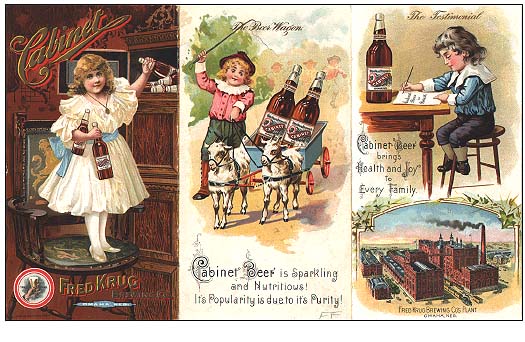
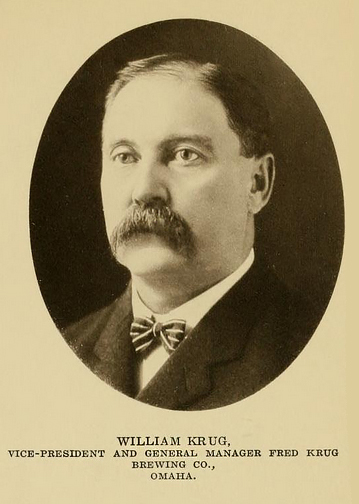
Today is the birthday of William Krug (December 1, 1857-June 21, 1910). He was the grandson of Fredrick Krug, who was the “German-immigrant founder of the Frederick Krug Brewing Company of Omaha, Nebraska. Krug is often cited as one of the early settlers of Omaha. In addition to operating the brewery for almost the entire duration of his life, Krug operated Krug Park in the Benson community and was the president of the Home Fire Insurance Company, which was founded in Omaha in 1884.” His son Frederick H. was involved in the business, and was treasurer, but passed away when he was only 44, five years before his father passed away. William also passed away young, nine years before his grandfather died, and fours before his father, but was vice-president and GM of the brewery when he died.
william-krug

This is a short biography or obituary from Find-a-Grave:

Married Katherine Griesedeck. Oldest son of Fredrick Krug and was the head of Krug Brewery at the time of his death. He was an investor in the development of fair grounds and was on the board of directors of the Omaha Driving Park Association. He was test driving a Stearns automobile driven by Mr. Wallace of Wallace Auto Company, when another car crashed into them at the intersection of 34th and Leavenworth. William was thrown from the car fracturing his skull on the curb dying instantly. He lived at 818 S. 20th Street.
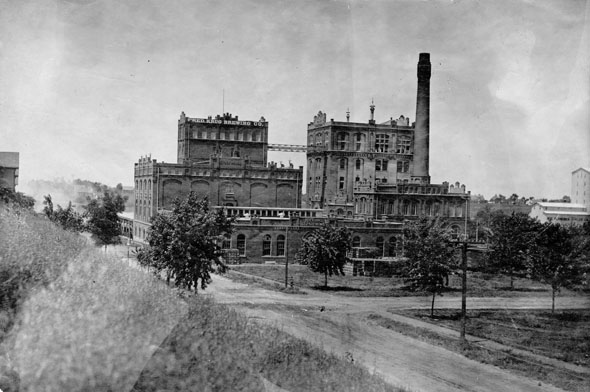
Krug-Brewery-1920
The brewery in 1920.

“The Fred Krug Brewery was located at 2435 Deer Park Boulevard in Omaha, Nebraska. Founded in 1859, Krug Brewery was the first brewery in the city. Krug was one of the “Big 4” brewers located in Omaha, which also included the Storz, Willow Springs and Metz breweries. Later sold to Falstaff in 1936, the facility closed in 1987.
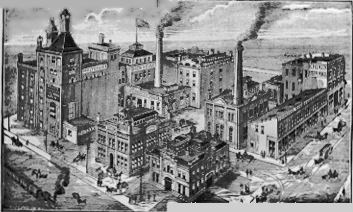
Krug-Brewery-sm
And in its heyday.

This is a short history of the brewery.

In 1859 Frederick Krug established the Krug Brewery with an original output of one and a half barrels a day. In 1878 the brewery was located on Farnam between 10th & 11th Streets in Downtown Omaha, and by 1880 it was brewing approximately 25,000 barrels a year. In 1894 the brewery moved to 29th & Vinton Street near South Omaha. It cost $750,000 and was reportedly one of the best equipped breweries in the country. Omaha’s historic Anheuser-Busch Beer Depot is the only remaining building from the original Krug Brewery.

You wouldn’t believe there was such difference in beers until you use one Krug’s popular brands. They are uniform perfectly brewed and well-aged absolutely pure and leave no bad after effects. The kind of beer that acts as a tonic and a system builder. Order a trial case and begin to enjoy. – Text from a 1910 advertisement by Fred Krug Brewing Company.

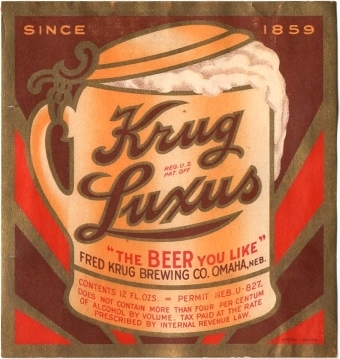
Krug brewed beer under several labels: Fred Krug, Cabinet, and Luxus. Krug supported an amateur baseball team called Luxus, taking them as far as the Amateur Baseball World Championship in 1915.
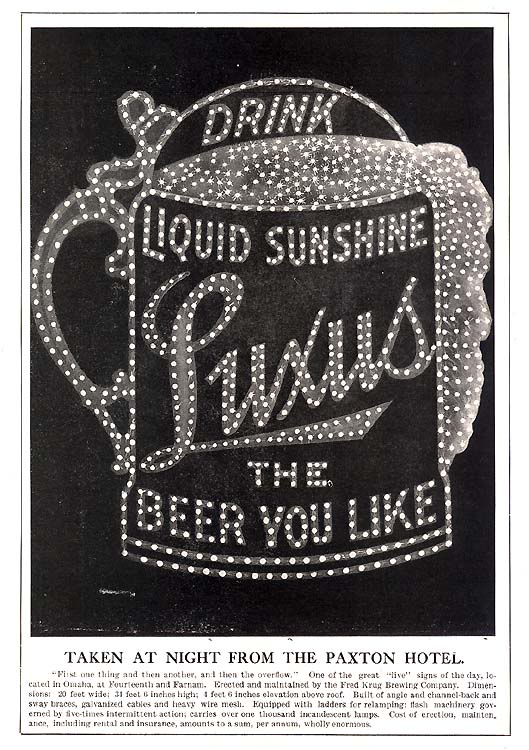
PaxtonHotel

Krug-Luxus-Beer--Labels-Fred-Krug-Brewing-Company

krug1

Filed Under: Birthdays, Breweries, Just For Fun Tagged With: History, Nebraska

Beer In Ads #5128: Here To Enjoy For Christmas! Gem Bock Beer

November 30, 2025 By Jay Brooks

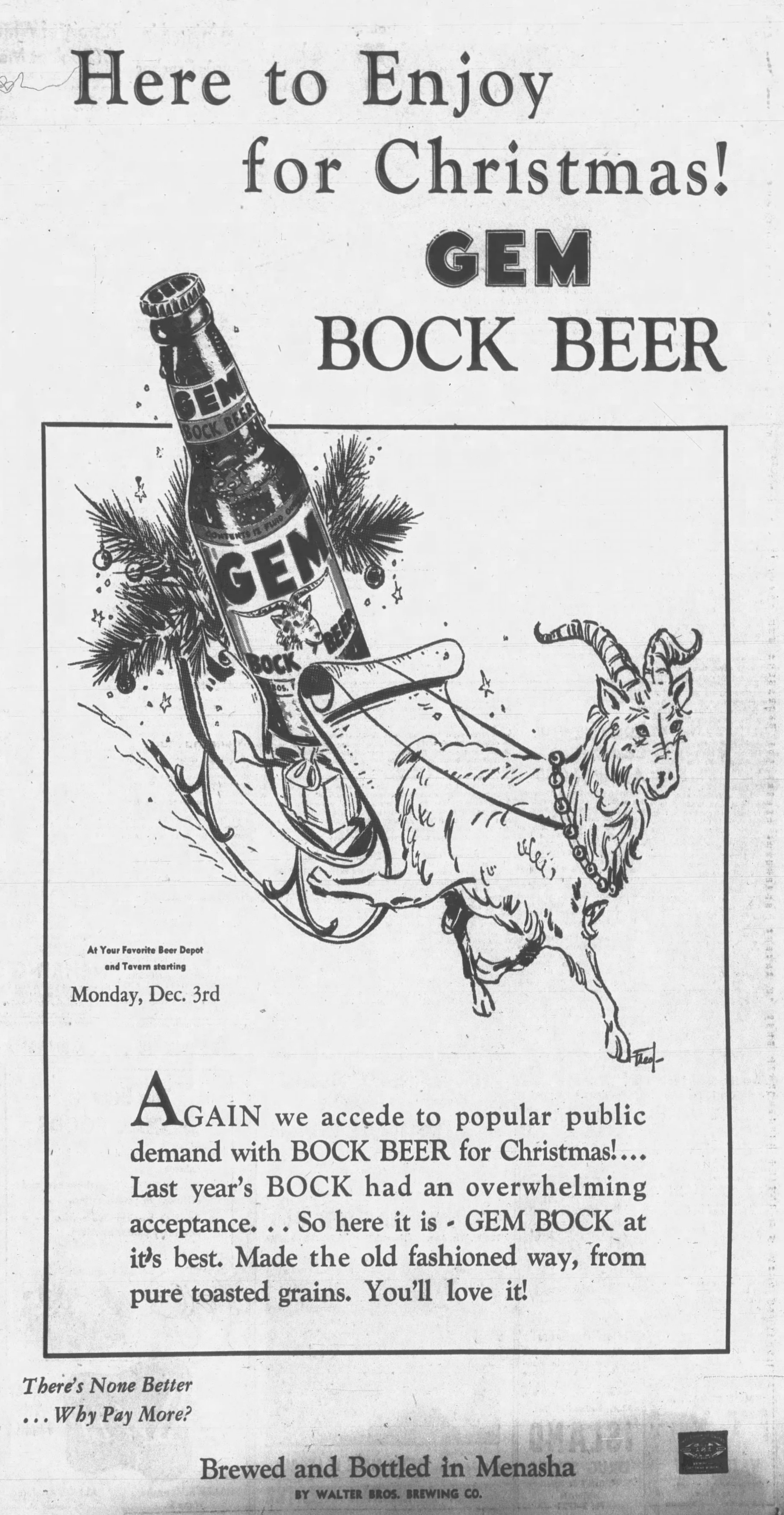
Last year I decided to concentrate on Bock ads for awhile. Bock, of course, may have originated in Germany, in the town of Einbeck. Because many 19th century American breweries were founded by German immigrants, they offered a bock at certain times of the year, be it Spring, Easter, Lent, Christmas, or what have you. In a sense they were some of the first seasonal beers. “The style was later adopted in Bavaria by Munich brewers in the 17th century. Due to their Bavarian accent, citizens of Munich pronounced ‘Einbeck’ as ‘ein Bock’ (a billy goat), and thus the beer became known as ‘Bock.’ A goat often appears on bottle labels.” And presumably because they were special releases, many breweries went all out promoting them with beautiful artwork on posters and other advertising.

Sunday’s ad is for Gem Bock Beer, which was published on November 30, 1951. This ad was for the Walter Bros. Brewing Co. of Menasha, Wisconsin, which was originally founded as the Island City Brewery in 1860. It became known as Walter Bros. in 1933 after prohibition, although the brothers had been involved in the brewery since 1888. This ad ran in The Post Crescent, from Appleton, Wisconsin.

Filed Under: Art & Beer, Beers, Breweries, Just For Fun Tagged With: Advertising, Bock, History, Wisconsin

Beer In Ads #5127: Augsburger Bock

November 29, 2025 By Jay Brooks

Last year I decided to concentrate on Bock ads for awhile. Bock, of course, may have originated in Germany, in the town of Einbeck. Because many 19th century American breweries were founded by German immigrants, they offered a bock at certain times of the year, be it Spring, Easter, Lent, Christmas, or what have you. In a sense they were some of the first seasonal beers. “The style was later adopted in Bavaria by Munich brewers in the 17th century. Due to their Bavarian accent, citizens of Munich pronounced ‘Einbeck’ as ‘ein Bock’ (a billy goat), and thus the beer became known as ‘Bock.’ A goat often appears on bottle labels.” And presumably because they were special releases, many breweries went all out promoting them with beautiful artwork on posters and other advertising.

Saturday’s ad is for Augsburger Bock Beer, which was published on November 29, 1985. This ad was for the Joseph Huber Brewing Co. of Monroe, Wisconsin, which was originally founded in 1845. This ad ran in The Baxter Bulletin, from Mountain Home, Arkansas and Baxter County, Arkansas, and surrounding areas.

Filed Under: Art & Beer, Beers, Breweries, Just For Fun Tagged With: Advertising, Arkansas, Bock, History, Wisconsin

Historic Beer Birthday: Herman Uihlein Jr.

November 29, 2025 By Jay Brooks

schlitz-globe

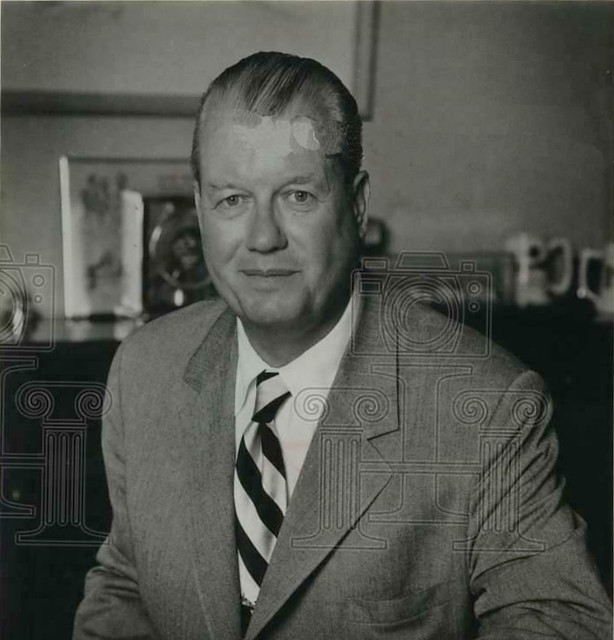
Today is the birthday of Herman Alfred Uihlein Jr. (November 29, 1917-February 27, 2008). He was the son of Henry Uihlein II, and was the great-grandson of Henry Uihlein, who for many years was the president of the Joseph Schlitz Brewing Company early in the 20th century. Herman Jr. served on the board of Schlitz for 40 years.

Herman-Uihlein-Jr

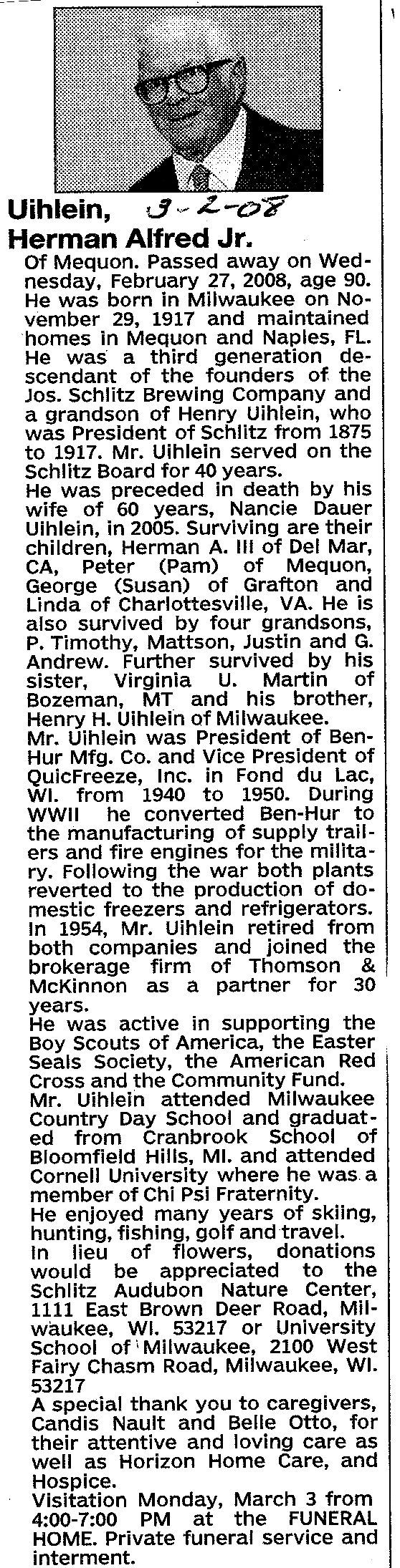
Here’s an obituary of Uihlein from the  Milwaukee Journal Sentinel:

Uihlein, Herman Alfred Jr. Of Mequon. Passed away on Wednesday, February 27, 2008, age 90. He was born in Milwaukee on November 29, 1917 and maintained homes in Mequon and Naples, FL. He was a third generation descendant of the founders of the Jos. Schlitz Brewing Company and a grandson of Henry Uihlein, who was President of Schlitz from 1875 to 1917. Mr. Uihlein served on the Schlitz Board for 40 years. He was preceded in death by his wife of 60 years, Nancie Dauer Uihlein, in 2005. Surviving are their children, Herman A. III of Del Mar, CA, Peter (Pam) of Mequon, George (Susan) of Grafton and Linda of Charlottesville, VA. He is also survived by four grandsons, P. Timothy, Mattson, Justin and G. Andrew. Further survived by his sister, Virginia U. Martin of Bozeman, MT and his brother, Henry H. Uihlein of Milwaukee. Mr. Uihlein was President of Ben-Hur Mfg. Co. and Vice President of QuicFreeze, Inc. in Fond du Lac, WI. from 1940 to 1950. During WWII he converted Ben-Hur to the manufacturing of supply trailers and fire engines for the military. Following the war both plants reverted to the production of domestic freezers and refrigerators. In 1954, Mr. Uihlein retired from both companies and joined the brokerage firm of Thomson & McKinnon as a partner for 30 years. He was active in supporting the Boy Scouts of America, the Easter Seals Society, the American Red Cross and the Community Fund. Mr. Uihlein attended Milwaukee Country Day School and graduated from Cranbrook School of Bloomfield Hills, MI. and attended Cornell University where he was a member of Chi Psi Fraternity. He enjoyed many years of skiing, hunting, fishing, golf and travel.

Herman-Uihlein-Jr-obit
Herman-Uihlein-Jr-and-wife
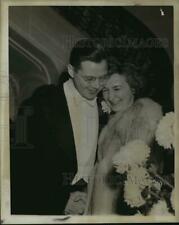
Uihlein and his wife.

Filed Under: Birthdays, Breweries, Just For Fun Tagged With: Florida, History, Schlitz, Wisconsin

Beer In Ads #5126: Having Guests … Or A Family Dinner Thanksgiving Day

November 27, 2025 By Jay Brooks

Last year I decided to concentrate on Bock ads for awhile. Bock, of course, may have originated in Germany, in the town of Einbeck. Because many 19th century American breweries were founded by German immigrants, they offered a bock at certain times of the year, be it Spring, Easter, Lent, Christmas, or what have you. In a sense they were some of the first seasonal beers. “The style was later adopted in Bavaria by Munich brewers in the 17th century. Due to their Bavarian accent, citizens of Munich pronounced ‘Einbeck’ as ‘ein Bock’ (a billy goat), and thus the beer became known as ‘Bock.’ A goat often appears on bottle labels.” And presumably because they were special releases, many breweries went all out promoting them with beautiful artwork on posters and other advertising.

Thursday’s ad is for Kaier’s Bock Beer, among others, which was published on November 27, 1961. This ad was for the Charles D. Kaier Co. Brewery of Mahanoy City, Pennsylvania, which was originally founded in 1880. This ad ran in The Record American, also from Mahanoy City, Pennsylvania.

Filed Under: Art & Beer, Beers, Breweries, Just For Fun Tagged With: Advertising, Bock, History, Holidays, Pennsylvania

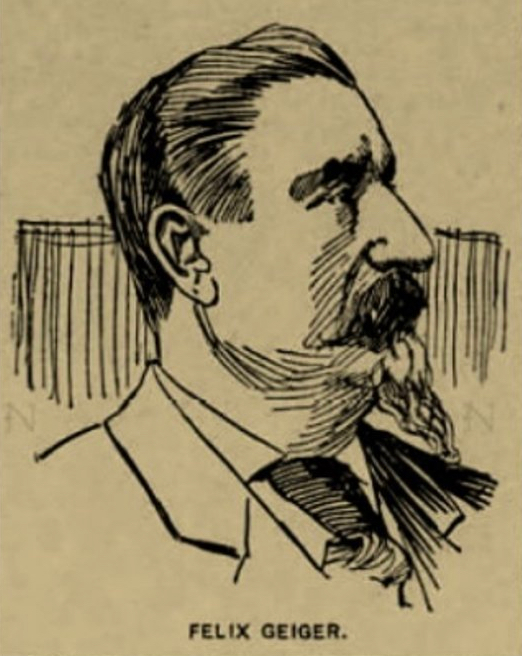
Historic Beer Birthday: Felix Geiger

November 27, 2025 By Jay Brooks

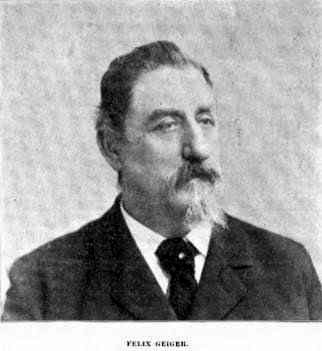
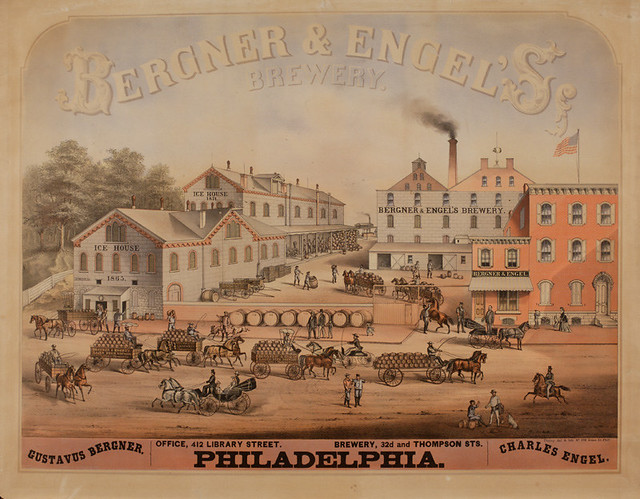
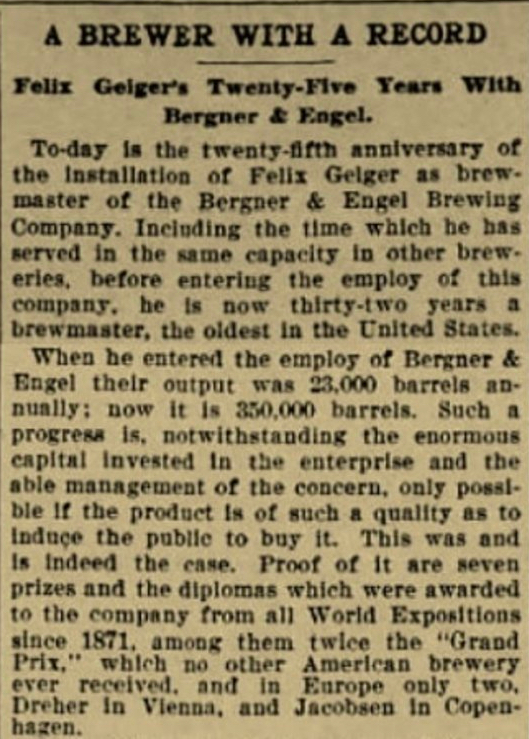
Today is the birthday of Felix Geiger (November 27, 1834-October 6, 1898). He was born in Kappel, Wurttemberg, Germany. After learning to be a brewery in Germany, he emigrated to America in 1854, when he was 20, settling in Philadelphia. After working for several area breweries he became a brewmaster, working at several in Philadelphia, finishing his career with Bergner & Engel.

Here is his obituary from the American Brewer’s Review:

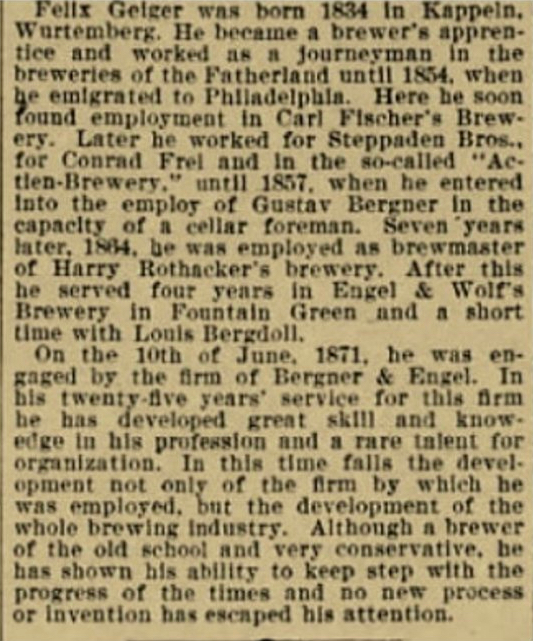
“One of the best known and most popular among the brewmasters and German inhabitants generally of Philadelphia has joined the silent majority. On Oct. 6, Felix Geiger, brewmaster of the Bergner and Engel Brewery for many years departed this life and with him the brewmasters of the city of brotherly love lost one of the most genial companions and active workers in all that interested them.

Felix Geiger was born in 1834 at Kappeln, Wurtemberg. He became a brewers apprentice and worked as a journeyman in German breweries until 1854, when he came to Philadelphia.Here he soon found employment in Carl Fischer’s brewery. Later he worked for Steppaden Brothers, for Conrad Frei and in the so-called “Actien Brewery” until 1857, when he entered the employ of Gustav Bergner as cellar foreman. Seven years later, in 1864, he was employed as a brewmaster in Harry Rothacker’s brewery, later with Engel & Wolf, and a short time with Louis Bergdoll.

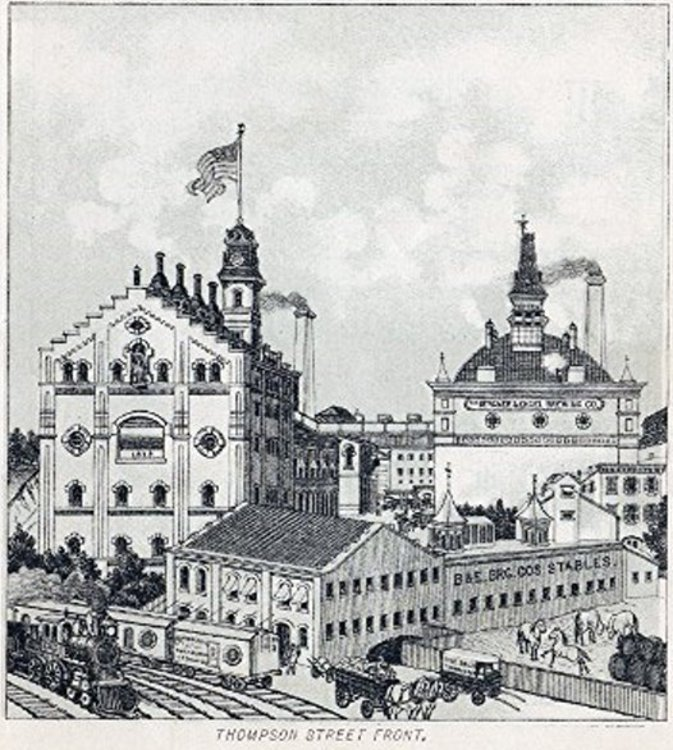
In 1871, he was engaged by the firm of Bergner & Engel. In the long term of years he was connected with this brewery he developed great skill and knowledge in his profession, and a rare talent for organization. He was much liked by the employees of the brewery. Mr. Geiger is survived by a widow, three daughters and one son, Joseph, who is president of the George Keller Brewing Company.

The funeral was held Oct. 9, the brewmasters’ association turning out in a body and a large attendance of prominent Germans accompanying the deceased to his last resting place.”

From a Philadelphia newspaper, June 10, 1896.

Filed Under: Birthdays, Breweries, Just For Fun Tagged With: Germany, Pennsylvania

Historic Beer Birthday: Simon E. Bernheimer

November 26, 2025 By Jay Brooks

lion-ny
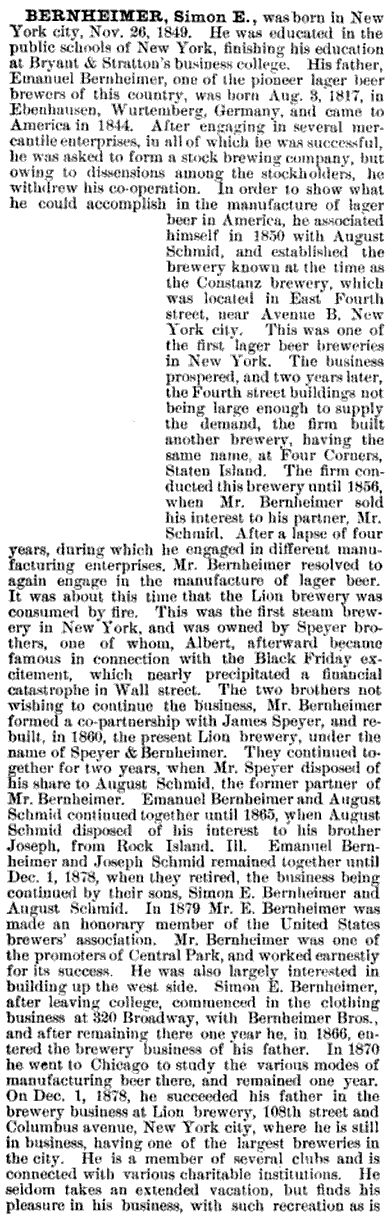
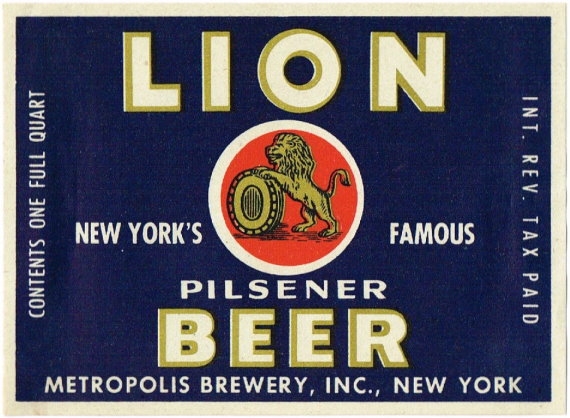
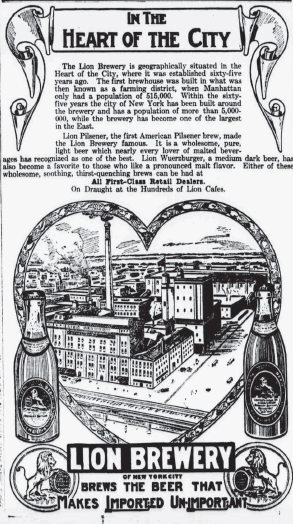
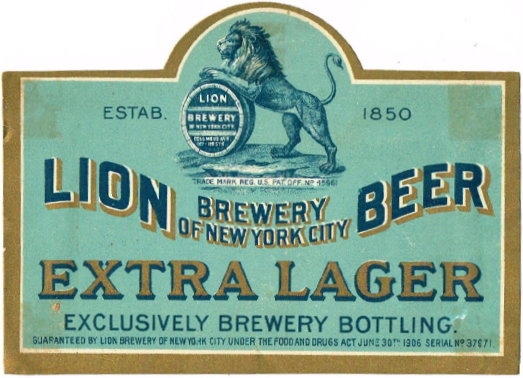
Today is the birthday of Simon E. Bernheimer (November 26, 1849-July 25, 1911). He was born in New York, the son of Emmanuel Bernheimer, who founded the Constanz Brewery, with his partner August Schmid, in 1850, on East 4th Street near Avenue B, and a couple of years later, with a different partner, James Speyers, he started the Lion Brewery on Columbus Ave, between 107th and 108th Streets in Manhattan, next door to the beer garden at the Lion Park, and indeed it is sometimes referred to as the Lion Park Brewery. The business was reorganized in 1868, and his old business partner August Schmid also became a partner in the Lion Brewery, and by 1890 its official name was the Bernheimer & Schmid Brewery, though they continued to trade under the Lion Brewery name. In 1878, Simon took over the business when his father retired. In 1895, it was the sixth-largest brewery in the U.S. After 1903, it was called the Lion Brewery of New York, presumably to avoid confusion with the many other breweries with Lion in their name. Lion survived prohibition but closed for good in 1942.

simon-e-bernheimer
This biography of Bernheimer is from “The National Cyclopedia of American Biography, Vol. 5,” published in 1894:

simon-e-bernheimer-bio-1
simon-e-bernheimer-bio-2

Lion-Pilsener-Style-Beer-Labels-Lion-Brewery-of-New-York-City--pre-Prohibition

This is about the brewery from Wikipedia:

Shortly after immigrating to the United States, Swiss-German August Schmid and Emanuel Bernheimer founded the Costanz Brewery at East 4th Street near Avenue B in 1850. The brewery produced a lagered beer, a favorite among German immigrants. By 1852, they built a second Costanz Brewery at Four Corners in Staten Island, home to a large German community. Five years later, Bernheimer became the partner of another German immigrant, James Speyers and founded the Lion Brewery in 1857 in Manhattan Valley.

A group of Catholic Bavarians helped build the Lion Brewery. When it was built, they held masses in the Brewery on Sunday mornings.

Lion-Pilsener-Beer-Labels-Metropolis-Brewery-Inc

At its peak, the Lion Brewery occupied about six square city blocks, from Central Park West to Amsterdam Avenue and from 107th to 109th Street. At the time Manhattan’s Upper West Side was an open area with inexpensive land housing, many public institutions and an insane asylum. There were about five to ten thousand living in shanties after being displaced by the creation of Central Park in 1859. Consequently, with the brewery and surrounding areas, the Upper West Side failed to increase its real estate value until the early twentieth century.

In 1862, a $1 tax on each barrel of beer hurt small brewers but not Lion. The anti-saloon movement in the late 19th and early 20th century encouraged Lion to clean up its own saloons. Lion Brewery got caught up in a wave of mergers and closings among some of the smaller New York Brewers in the early 1940s which continued until 1941, when the business closed. The brewery (including the canning facilities) was auctioned off on August 26, 1943. The plant was demolished in 1944 and more than 3,000 tons of steel were taken from the original brewery structure and recycled for the war effort.

After the Brewery was knocked down the lot was paved over with cinders. On Sundays, after the war, returning World War II Veterans formed a Softball League and played almost every Sunday afternoon. Home plate was located near 107th street and Columbus Avenue. Today, apartment houses occupy the Lion brewery’s former location.

lionbrewery1

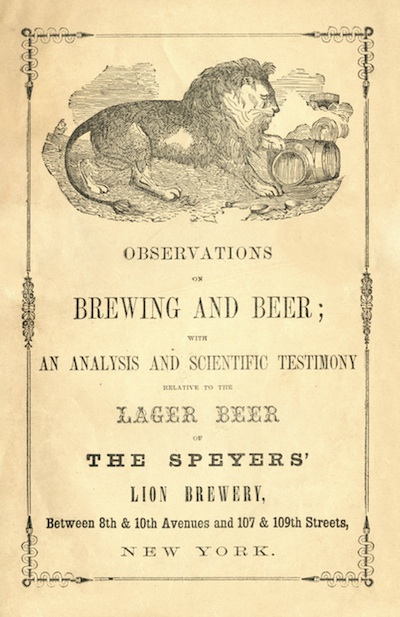
Around 1860, the brewery published a pamphlet titled “Observations on Brewing and Beer: With an Analysis and Scientific Testimony Relative to the Lager Beer of the Speyers’ Lion Brewery.” The pamphlet had a short history of the different kinds of beer, and an analysis showing that their lager beer was pure. The pamphlet also included some great line drawings of the brewery complex.

And here’s another story from Rusty Cans:

In 1850 recent Swiss German immigrants August Schmid and Emanuel Bernheimer founded the Costanz Brewery at East 4th Street near Avenue B. The brewery specialized in lagered beer, a favorites among their fellow immigrants. By 1852, their success encouraged them to build a second Costanz Brewery at Four Corners in Staten Island, then home to a large German immigrant community. Eight years later, Bernheimer became the partner of another German immigrant, James Speyers, in his Lion Brewery, established in 1857.

The Lion Brewery, depicted here, occupied a site bounded by what are now Central Park West and Amsterdam Avenue and extending from 107th to 109th Streets. The background view includes Central Park, with a glimpse of the Blockhouse, a relic from the War of 1812. (The Church of the Ascension is there now, built with the brewery’s help in the 1890s). During this period Manhattan’s Upper West Side was a relatively open area offering inexpensive land and it accommodated numerous public institutions including an insane asylum. Also clustered in the neighborhood were the shanty homes of between 5-10,000 thousand people displaced by the formal opening of Central Park in 1859. The combination of shanties, public institutions, and such foul-smelling industries as breweries explains why the Upper West Side failed to develop the real estate value of other areas bordering Central Park until the early twentieth century.

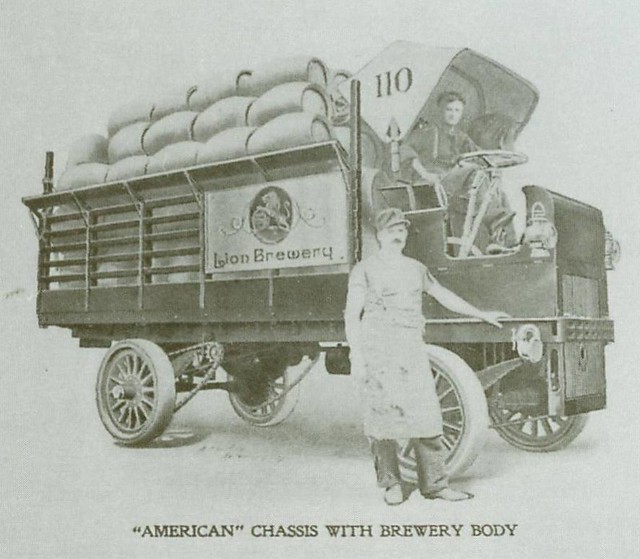
liontruck1

Late in the life of the Lion Brewery, it became involved in a number of mergers and acquisitions, eventually becoming The Greater New York Brewery, Inc.:

Lion brewing got caught up in a wave of mergers and closing among some of the smaller New York Brewers in the early 1940s. In late 1940, the Fidelio Brewing Co., located at 1st Ave. between 29th and 30th Streets., closed. However, on November 15, 1940, it reopened business as the Greater New York Brewery, Inc. In December 1940, the Greater New York Brewery merged with the Horton Pilsener Brewing Co., which was located at Amsterdam Ave. and 128th Street. Horton Brewing President Alex White became a director of Greater New York Brewery and they continued producing previous Horton products. In January 1941, the Greater New York Brewery merged with City Brewing Corporation of Queens. In February of 1941, Horton, as part of Greater New York Brewery, closed its doors. On April 9, 1941, City Brewing Corporation, as part of Greater New York Brewery, temporarily had its license canceled because of illegal merchandising in the form of gifts to retailers. (It apparently reopened at a later date.)

In May of 1941, Greater New York Brewery, Inc. acquired the Lion Brewery. It was the only brewery of the four that merged that had facilities to package beer in flat top cans. But by February of 1942, the Lion Brewery was closed and put up for sale. There being no buyers, the brewery (including the canning facilities) was auctioned off on August 26, 1943. In 1944 over 3,000 tons of steel were taken from the original brewery structure and recycled for the war effort. In April, 1946, the Greater New York Brewery, Inc. became known as the Greater New York Industries. This entity remained in operation until 1950.

For its short lifetime the former Lion Brewery continued to produce beer in cans labeled as products of the Greater New York Brewery. The two flat tops produced are scarce, but not truly rare. However, during its short life span, the Greater New York Brewery also produced a very rare crowntainer and two rare quarts containing Lion beer and ale. There are only 3 of the Beer quarts known today and the Ale is not much more common. Another rare Lion can, a Lion Pilsner, was produced by Pilsner Brewing in New York in the 1940s, but I do not yet know this company’s relationship to the original Lion Brewing. Today, apartment houses occupy the Lion brewery’s former location.

lion-1915

Lion-Extra-Lager-Beer--Labels-Lion-Brewery-Of-New-York-City

Filed Under: Birthdays, Breweries, Just For Fun Tagged With: History, New York

Beer In Ads #5125: The Beer Drinker’s Corner By Joe Ortlieb

November 25, 2025 By Jay Brooks

Last year I decided to concentrate on Bock ads for awhile. Bock, of course, may have originated in Germany, in the town of Einbeck. Because many 19th century American breweries were founded by German immigrants, they offered a bock at certain times of the year, be it Spring, Easter, Lent, Christmas, or what have you. In a sense they were some of the first seasonal beers. “The style was later adopted in Bavaria by Munich brewers in the 17th century. Due to their Bavarian accent, citizens of Munich pronounced ‘Einbeck’ as ‘ein Bock’ (a billy goat), and thus the beer became known as ‘Bock.’ A goat often appears on bottle labels.” And presumably because they were special releases, many breweries went all out promoting them with beautiful artwork on posters and other advertising.

Tuesday’s ad is for Ortlieb Bock Beer, which was published on November 25, 1968. This ad was for the Henry Ortlieb Brewing Co. of Philadelphia, Pennsylvania, which was originally founded in 1859 by Louis Schweitzer, but an Ortlieb was in involved in the brewery by at least 1879. It became known as the Henry Ortlieb Brewery in 1893 and continued under that name until 1981. This ad ran in The Morning Call, from Allentown, Pennsylvania. It’s an early example of ad masquerading as news under the titled “The Beer Drinker’s Corner,” and purportedly written by “Joe Ortlieb, Brewmaster.”

Filed Under: Art & Beer, Beers, Breweries, Just For Fun Tagged With: Advertising, Bock, History, Pennsylvania, Philadelphia

Beer In Ads #5124: Anchor Bock Beer

November 24, 2025 By Jay Brooks

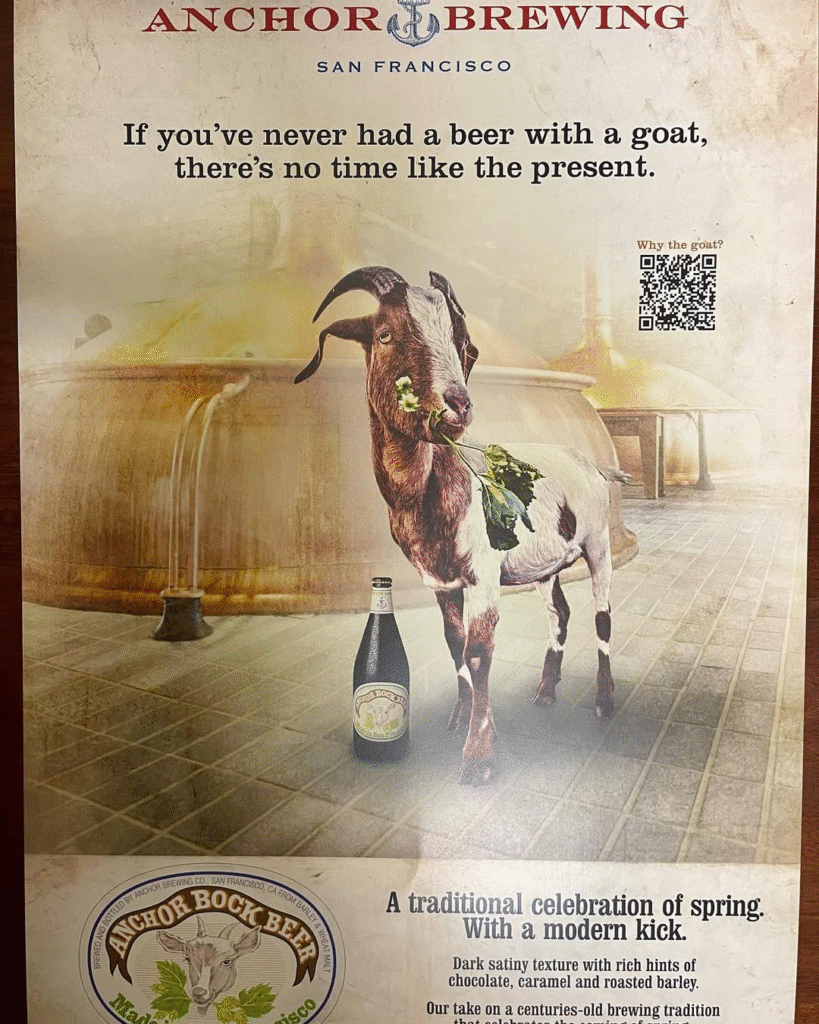
Last year I decided to concentrate on Bock ads for awhile. Bock, of course, may have originated in Germany, in the town of Einbeck. Because many 19th century American breweries were founded by German immigrants, they offered a bock at certain times of the year, be it Spring, Easter, Lent, Christmas, or what have you. In a sense they were some of the first seasonal beers. “The style was later adopted in Bavaria by Munich brewers in the 17th century. Due to their Bavarian accent, citizens of Munich pronounced ‘Einbeck’ as ‘ein Bock’ (a billy goat), and thus the beer became known as ‘Bock.’ A goat often appears on bottle labels.” And presumably because they were special releases, many breweries went all out promoting them with beautiful artwork on posters and other advertising.

Monday’s ad is for Anchor Bock Beer, and was published maybe sometime in the mid-to-late-2000s, since Anchor’s Bock debuted in 2005. It was made for the Anchor Brewing Co. of San Francisco, California, which was originally founded in 1896. Anchor rarely advertised, especially during the Maytag years, so this isn’t something you see very often.

Filed Under: Art & Beer, Beers, Breweries, Just For Fun Tagged With: Advertising, Bock, California, History, San Francisco

Beer In Ads #5123: Golden Age Special Thanksgiving Brew

November 23, 2025 By Jay Brooks

Last year I decided to concentrate on Bock ads for awhile. Bock, of course, may have originated in Germany, in the town of Einbeck. Because many 19th century American breweries were founded by German immigrants, they offered a bock at certain times of the year, be it Spring, Easter, Lent, Christmas, or what have you. In a sense they were some of the first seasonal beers. “The style was later adopted in Bavaria by Munich brewers in the 17th century. Due to their Bavarian accent, citizens of Munich pronounced ‘Einbeck’ as ‘ein Bock’ (a billy goat), and thus the beer became known as ‘Bock.’ A goat often appears on bottle labels.” And presumably because they were special releases, many breweries went all out promoting them with beautiful artwork on posters and other advertising.

Sunday’s ad is for Golden Age Special Thanksgiving Brew, which was published on November 23, 1934. While technically not a bock beer, I’d argue it’s close enough given this description: “Golden Age Brewmaster-Scientists lead the procession. ‘If Spring has its Bock Beer, why not a special beer to glorify the Thanksgiving season,’ so reasoned they.” This ad was for Golden Age Breweries of Spokane, Washington, which was originally founded as the B. Schade Brewing in 1904. It became known as Golden Age Breweries after prohibition, and used that name from 1934 until 1948. This ad ran in The Spokane Chronicle, also from Spokane, Washington.

Filed Under: Art & Beer, Beers, Breweries, Just For Fun Tagged With: Advertising, Bock, History, Washington

« Previous Page
Next Page »

Find Something

Northern California Breweries

Please consider purchasing my latest book, California Breweries North, available from Amazon, or ask for it at your local bookstore.

Recent Comments

  • Bob Paolino on Beer Birthday: Grant Johnston
  • Gambrinus on Historic Beer Birthday: A.J. Houghton
  • Ernie Dewing on Historic Beer Birthday: Charles William Bergner 
  • Steve 'Pudgy' De Rose on Historic Beer Birthday: Jacob Schmidt
  • Jay Brooks on Beer Birthday: Bill Owens

Recent Posts

  • Beer In Ads #5167: Acme Bock Is Back Tomorrow! March 16, 2026
  • Historic Beer Birthday: John Land March 16, 2026
  • Historic Beer Birthday: Axel Heiberg March 16, 2026
  • Beer Birthday: Paul Segura March 16, 2026
  • Beer Birthday: Steve Hindy March 16, 2026

BBB Archives

Feedback

Head Quarter
This site is hosted and maintained by H25Q.dev. Any questions or comments for the webmaster can be directed here.