Brookston Beer Bulletin

Jay R. Brooks on Beer

  • Home
  • About
  • Editorial
  • Birthdays
  • Art & Beer

Socialize

  • Dribbble
  • Email
  • Facebook
  • Flickr
  • GitHub
  • Instagram
  • LinkedIn
  • Pinterest
  • RSS
  • Twitter
  • YouTube

Powered by Genesis

Historic Beer Birthday: Peter Barbey

November 9, 2025 By Jay Brooks

sunshine-lt
Today is the birthday of Peter Barbey (November 9, 1825-February 15, 1897). He was born in Bavaria, though the actual town seems to be in some dispute, and learned brewing at his uncle’s brewery there from the age of fourteen. As an adult, he worked at breweries throughout Europe, then entered military service for a four-year tour of duty. After that, at age 25 he came to the United States and found work in Philadelphia. But he found a better job in nearby Reading working at the brewery of Frederick Lauer.
peter-barbey

He apparently liked Reading (my hometown) because he founded his own brewery there in 1857, with Abraham Peltzer, which they called the Peter Barbey & Abraham Peltzer Brewery. Barbey must have bought him out, because in 1861 it was renamed the Peter Barbey Brewery. His son John joined him at the brewery in 1880, and they called it Peter Barbey & Son after that, until it closed in 1920 because of Prohibition. But it did return in 1933 as Barbey’s Inc. In 1951, they completely rebranded it as the Sunshine Brewing Co. before closing for good in 1970.

barbery-keg
Peter and possibly his son tapping a keg of his beer.

This is from “Biographies from Historical and Biographical Annals,” by Morton Montgomery, published in 1909:

Peter Barbey, the founder of Barbey’s Brewery at Reading, Pa., was born Nov. 9, 1825, in Dierbach, Canton of Bergzabern, Rhinepfalz, Bavaria, son of Christopher Barbey. He attended the schools of his native place until he was fourteen years of age, when he entered the brewing establishment of his uncle, Peter Barbey, for the purpose of learning the business. After remaining there three years, he found employment in France and Switzerland in different brewing establishments during the next four years, in observance of a German custom to increase his knowledge of the business in this way by practical experience. He then returned home, and being twenty-one years of age, entered the army in a cavalry regiment where be served as a soldier for four years. At the expiration of his term of service, be emigrated to America, proceeding immediately to Philadelphia, and for several years he was engaged there in different breweries; he then located at Reading, and entered the employ of Frederick Lauer, also a German, who had by this time established himself in the brewing business at Third and Chestnut streets. In 1860 Mr. Barbey embarked in business for himself as a brewer, and carried his affairs on with increasing success until his decease in 1897.

Mr. Barbey was a Democrat in politics, but never inclined to fill any public offices. He assisted in organizing the Keystone National Bank in 1883 and served as a director until his decease in 1897. He was prominently identified with Teutonia Lodge, No. 368, F. & A. M., in which he was a past master, and with Germania Lodge, I. O. O. F.

Mr. Barbey married Rosina Kuntz, daughter of Philip Kuntz, of Rhenish Bavaria, and they had two children: Katrina, who died in infancy; and John, who, after arriving of age, engaged with his father in the brewing business under the name of P. Barbey & Son. Notwithstanding the decease of his father in 1897, the firm name has been continued until the present time.

sunshine-brewery
The brewery building in the 1950s.

And here’s an obituary, from the “Allentown Morning Call,” from February 16, 1897:

Peter Barbey, the well-known Reading brewer, died yesterday morning at his home, aged 71 years. Mr. Barbey was a native of Dierbach, Canton of Borgzaben, Rhinepfaltz, Bavaria. He attended the schools of his native country until the age of 14, when he entered the brewery establishment of his uncle, Peter Barbey, for the purpose of learning the business. When about 23 years of age, he came to America. He entered the employ of Frederick Lauer, in Reading. Later he conducted several saloons and then started in the brewery business. Deceased was married to Rosina, daughter of Philip Kuntz, of Rhenish Bavaria. They had two children, Katrina, a daughter, deceased; and John Barbey. In politics he was a Democrat, but never was an aspirant for any office. He was a director of the Keystone National Bank, a member of Teutonia Lodge, No. 568, F. and A. M., and of Germania Lodge, I.O.O.F.

get-on-sunny-side

This is from an article in the January 1942 issue of the Historical Review of Berks County:

Reading naturally felt the effects of this movement as can be witnessed in the Peter Barbey Brewery establishment. Peter Barbey, the originator of this brewery, was born November 9, 1825, in Dierback, Canton of Bergzabern, Rhinepfalz, Bavaria, the son of Christopher and Katrina Barbey. Until the age of 14 Peter attended the schools there, after which he entered the brewing establishment of his uncle, where he remained three years learning the business of a brewer. At the age of thirty-two (in the year 1857), Barbey emigrated to the United States, and proceeding at once to Philadelphia engaged for two and one-half years in the pursuit of his trade. In 1859 he settled at Reading, where he entered the employ of Frederick Lauer for one year, and soon after opened a saloon. Peter Barbey began his prosperous career as a brewer here in 1869, when he established a brewing plant at River and Hockly Streets. Montgomery wrote of the Barbey Brewery: “the buildings are a three-story brewery, a six-story brick malthouse, two refrigerators and two ice houses-they cover a tract of three acres. In the malt house are five germinating floors, one storage floor, and two large drying kilns. Two engines, producing 60 horse-power, and two large duplex boilers, of 75 horse-power, are used. Thirty hands are employed.” Barbey’s son, John, became a partner in 1880, the firm henceforth trading as P. Barbey and Son. During the year 1885 twenty thousand barrels of beer and porter were manufactured and sold, although the full capacity was thirty-five thousand barrels, and the full malting capacity seventy-five thousand bushels of barley malt.

Thus by 1880 the foundation had been laid for one of Reading’s important industries. Developed as a normal, if not necessary, adjunct to the life of the German population, it brought to this community the industry and craft of the old country. As Reading grew, so did her brewing industry, and its importance was more than local. Frederick Lauer was one of the organizers, and president, of the United States Brewers’ Association, and he was also a leading citizen of Reading. As a public servant and philanthropist he was honored by his fellow citizens, and his statue now stands in our city park. There it symbolizes the social as well as the economic significance of the early industry.

barbey-peter
And this is from “100 Years of Brewing:”

peter-barbey-100yrs-1
peter-barbey-100yrs-2
peter-barbey-100yrs-3
peter-barbey-100yrs-4
Sunshine-Brewing-Co-SUNSHINE-PREMIUM-BEER-label (1)

Sunshine-Cream-Ale-Beer-Label

Filed Under: Birthdays, Just For Fun Tagged With: History, Pennsylvania

Historic Beer Birthday: Edward George Bremer

November 8, 2025 By Jay Brooks

Today is the birthday of Edward George Bremer (November 8, 1897-May 4, 1965). He was born in Saint Paul, Minnesota and was the son of Adolf Bremer and the nephew of Otto Bremer, who together owned the Jacob Schmidt Brewing Co. after Adolf married the daughter of Jacob Schmidt. Because of his wealthy father, Edward was kidnapped in 1934 and held for ransom in a case that attracted national attention.

Larger memorial image loading...

Below is his obituary from the Fairbanks Daily News-Miner in 1965.

Larger memorial image loading...
Edward with his father, Adolf Bremer.

Filed Under: Birthdays, Just For Fun Tagged With: Minnesota

Beer Birthday: Jason Petros

November 7, 2025 By Jay Brooks

bn-grenade
Today is the 47th birthday of Jason Petros, who is part of The Brewing Network, and co-host on the Session, host of Dr. Homebrew, plus he inexplicably has a podcast about Disneyland called EarzUp Podcast. He really likes the happiest place on earth. He even has a side business, covears, selling colorful covers for your mouse ears. Oh, and he’s the social media director for the Brewing Network, not to mention an avid homebrewer, of course. Join me in wishing Jason a very happy birthday.

P1080942
Jason (far left), at the 3rd anniversary party for the Brewing Network in 2008 at Downtown Joe’s in Napa.
jp_4
See, I told you he liked Disneyland … and churros.
jostin-shaun-jason
Men in Plaid: Justin Crossley, Shaun O’Sullivan and Jason at an SF Beer Week opening a few years ago.
jp_1
Jason and his wife Taren at Drake’s Dealership a couple of years ago.

Filed Under: Birthdays, Just For Fun Tagged With: Homebrewing, Media, Social Media

Historic Beer Birthday: John N. Straub

November 6, 2025 By Jay Brooks

Today is the birthday of John N. Straub (November 6, 1810-November 1891). He was born in Darmstadt, Germany, and emigrated at age 20 to the U.S., in 1830, landing initially in Baltimore, but as soon as he was able moved to Pittsburgh, Pennsylvania. In 1831, he founded the John N. Straub Brewery and became what is believed to be the first lager brewer there. As far as I can tell, he is not related to the Straub Brewery in nearby St. Marys, Pennsylvania, although its founder Peter Straub did work for John N. Straub when he first came to America, before starting his own brewery. The John N. Straub Brewery also had a branch in Allegheny, and in 1899, it became a branch of the Pittsburgh Brewing Co.

John-N-Straub-portrait

This biography by his son is from “100 Years of Brewing:”

john-n-straub-bio-1
john-n-straub-bio-2
john-n-straub-bio-3

This short obituary is from the Brewers Journal:

john-n-straub-obit
Straub-Brewing-brewery

And this is a short history of the brewery itself, also from “100 Years of Brewing.”

Straub-Brewing-100yrs
Straub-Brewing-poster

Filed Under: Birthdays, Breweries, Just For Fun Tagged With: Germany, Pennsylvania

Beer Birthday: Kim Sturdavant

November 5, 2025 By Jay Brooks

Today is the 46th birthday of Kim Sturdavant. He was born in Eugene, Oregon and got his professional brewing start at Marin Brewing Co. before taking over at Social Kitchen & Brewery in San Francisco in 2011. While there he invented the Brut IPA sub-style, which was a popular type of IPA for a time. He left in 2019 and for a time was brewing at Pacifica Brewery, but more recently he’s joined Admiral Maltings as a Technical Sales Representative. Kim’s a great brewer and a terrific person. Join me in wishing Kim a very happy birthday.

Kim at Pacifica Brewery.
Kim for a newspaper article I did about him and Brut IPA a few years back.
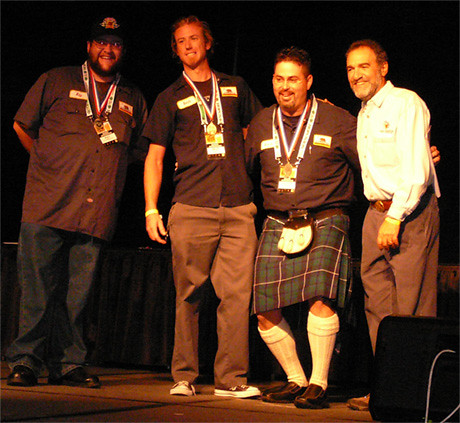
Kim on stage with Charlie Papazian, Brendan Moylan and Arne Johnson picking up a medal during GABF in 2011.
Kim serving at the opening gala for SF Beer Week, also in 2011.
Kim with a few fellow brewers at the Celebrator Beer News Anniversary Party in 2009.

Filed Under: Birthdays, Just For Fun Tagged With: California, Oregon, San Francisco

Historic Beer Birthday: William G. Jung

November 5, 2025 By Jay Brooks

jung-wis
Today is the birthday of William Gustave Jung (November 5, 1886-September 17, 1947). I couldn’t find very much information about Jung, though I believe he was born in Germany. After seeking his fortune in America, he apparently worked at the Silver Creek Brewery, which also became known as the Chas. Hamm Brewing Co. in 1910. Unfortunately, Charles Hamm died of pneumonia while an American soldier in Europe in 1918. Jung, who was a brewmaster, leased the brewery from the Hamm family after Charles Hamm’s death (including making non-alcoholic drinks and soda during prohibition as the Jung Beverage Co.) until 1932, when he bought it from the family, renaming it the William G. Jung Products Co. Brewery, but a few years later shortening that to the Jung Brewing Co. It remained in business until 1958, when it closed for good.

jungs-old-country-label
jung-beer-bottles

Jung-bock
jung-pilsener-can
Jung-holiday-beer

Filed Under: Birthdays, Breweries, Just For Fun Tagged With: History, Wisconsin

Historic Beer Birthday: Carl Sedlmayr

November 4, 2025 By Jay Brooks

spaten-hops
Today is the birthday of Carl Sedlmayr (November 4, 1847-February 1, 1915). Carl was the grandson of Gabriel Sedlmayr and the third son of Gabriel Sedlmayr II. Carl’s father inherited the Spaten Brewery, along with his brother, when his father died, but Gabriel became sole owner after his brother Joseph left to start his own brewery, Franziskaner. Two of Carl’s older brothers died before their father, so when Gabriel II passed away, he and his two brothers Johann and Anton inherited the family brewery.

Carl-Sedlmayr
And here he’s mentioned in a History of Beer:

Spaten Brewery in Munich launched a pale lager in 1894. Their brewer at that time was Carl Sedlmayr, son of the renowned brewmaster Gabriel Sedlmayr Jr. who was an advocate of the use of the steam engine in the brewery. Along with the Austrian brewer Anton Dreher he had toured dynamic England and Scotland in 1833 and managed to gain access to a few breweries. The visitors were fascinated by the industrial methods they observed and the fact that British brewers could produce beers of consistent strength, achieved with the aid of the saccharometer. Dreher’s Schwechater Brewery in Vienna became the first to brew bottom-fermented Vienna-style lager in 1841, which soon proved very popular.

sedlmayr_gabriel_1874
The caption of this photo, from German Wikipedia, translates to “Delivery of the Spade brewery to the sons Johann, Carl and Anton Sedlmayr 1874,” although I can’t say which one is Carl.

SPATEN-Geschichte

Filed Under: Birthdays, Breweries, Just For Fun Tagged With: Germany, History

Historic Beer Birthday: Gottfried Krueger

November 4, 2025 By Jay Brooks

kruger
Today is the birthday of Gottfried Wilhelm Ephraim Krueger (November 4, 1837-November 7, 1926). He was born in Baden-Württemberg, Germany, but he emigrated to America, settling in New Jersey. In 1858, along with his uncle, John Laible, he founded the Gottfried Krueger Brewing Co. When his uncle died in 1875, Krueger became sole owner. In 1908, the brewery merged with Anton Hupfel and Peter Hauck breweries to form the United States Brewing Company. “The company dissolves, but Gottfreid Krueger Brewing Co. retains the facilities of Trefz Brewers, The Home Brewing Co., Union Brewing Co., and Lyons & Sons Brewery, all of Newark, New Jersey.” After Kruger died in 1926, the brewery reopened after repeal, and in 1935 famously became the first brewery to put their beer in cans, making them highly sought after to breweriana aficionados today. It continued in business until it was sold and the Newark brewery closed in 1961.

Gottfried-Krueger
Here’s a short biography from Find-a-Grave:

Businessman. He founded Gottfried Krueger Brewing Company in Newark, New Jersey, and directed its rise to popularity in the first half of the 20th century. In 1933 the company pioneered the practice of putting beer in cans, being the first brewery to do so.

gottfried_krueger_ad
And this is from “Decadence & Decay,” Paul Robeson Galleries Program, Rutgers University, Newark, NJ, 2009, entitled “Gottfried Krueger: Epitome of a German-American Brewer,” by Carl Miller:

On the evening of September 25, 1883, the hottest party in Newark was at Gottfried Krueger’s brewery on Belmont Avenue. The crowd of 5,000 included congressmen, senators, assemblymen, judges, mayors and police officials. Anyone lacking directions needed only to look for the novel glow of electric lights and the 140-foot tall Gothic malt tower, topped by an American flag and the initials “GK”. Why the celebration? It was the grand opening of Gottfried Krueger’s spectacular new brewery. While music and good cheer filled the courtyard outside, guests inside the brewery marveled at the shiny copper brew kettles, gigantic oak fermenting casks and the endless array of pipes, pumps, hoses and vats. Liberal samples of the brewery’s product flowed as proud employees educated their guests on the finer points of beer-making.

The new plant was the latest milestone in a family brewing tradition that would span more than a century in Newark. It began in 1853, when a teenage Gottfried Krueger arrived in America fresh from his birthplace on the banks of Germany’s famous Rhine River. Newark, like most major cities, boasted dozens of breweries by mid-century. One such venture was the firm of Adams & Laible, who established a brewery on Belmont Avenue at West Kinney Street in 1851. It was here that young Gottfried would learn his craft, starting as a brewmaster’s apprentice to Laible, his uncle.

Just at this time, the brewing of beer on this side of the Atlantic was on the verge of a radical transformation. While heavy British-style brews like ale, porter and stout had been the norm in America for generations, an exploding population of European immigrants spurred a demand for the lighter, less alcoholic German-style lager beer. Within a short time, German immigrant brewers had perfected a uniquely American version of lager beer—a light, effervescent, golden brew that would soon capture the nation’s palate and build great fortunes for its makers.

After climbing to the position of brewmaster working for his uncle, Krueger purchased the brewery on Belmont Avenue in 1865 in partnership with Gottlieb Hill. As the popularity of lager beer soared, so did the brewery’s sales. When the two partners took over the business, it was producing no more than 4,000 barrels (31 gallons per barrel) of lager beer annually. By 1875, sales had blossomed to 25,000 barrels per year, requiring almost constant enlargement of the brewing facilities. During that same year, Hill retired and Krueger became the brewery’s sole owner.

The ever-burgeoning condition of their industry offered German-American brewers inroads to positions of leadership within the community. Of this, Gottfried Krueger took full advantage. He was first elected Freeholder, and then, in 1876 and 1879, served as a New Jersey Assemblyman. In 1891, he was appointed Judge of the Court of Errors and Appeals, a position he held for 11 years. Known forever afterward as “Judge Krueger” by his friends and business associates, the brewer served on the boards of a variety of corporations and was president of the New Jersey Brewers Association.

As the 20th century dawned, the first generation of German-American brewers could reflect with great pride on what they had accomplished over the previous fifty years. The consumption of beer in America had exploded from a paltry 750,000 barrels in 1850 to over 39,000,000 barrels in 1900. Small, wood-frame breweries had long ago been replaced by palatial Victorian-style edifices that stood as monuments to the grand success of the German-American brewers. Lager beer had, indeed, become the national beverage. It would now fall upon the next generation to carry the industry through its next half century.

At the Krueger brewery, sons John F. and Gottfried C. Krueger had each joined their father in the family business by 1903. It was this generation that would face the brewing industry’s first great challenge. While beer was busy embedding itself into American culture, the ever-present temperance movement had been making strides of it’s own. Groups like the Women’s Christian Temperance Union and the Anti-Saloon League had grown to include tens of thousands of members nationwide, and their influence was felt by brewers everywhere.

The outbreak of war in Europe in 1914 only made matters worse, as a rampant anti-German sentiment swept the nation. In Pennsylvania and Texas, well-publicized investigations of the brewers in those states painted the entire industry as unpatriotic and pro-German. Lubricated by the feverish wartime climate, the push for National Prohibition glided through Congress and the state legislatures with astonishing ease. It was the brewers’ worst nightmare come true.

On January 16, 1920, the 18th Amendment to the Constitution took affect and the manufacture of beer became a federal crime. Many brewers turned to soft drinks, dairy products and low-alcohol near beer. Among other offerings, the Krueger brewery produced a near beer called Krueger’s Old Essex Brew, which mimicked the taste of real beer, but contained less than the 1/2 of 1 percent of alcohol permitted by law.

Largely through President Theodore Roosevelt’s prodding of Congress, beer again became legal at 12:01 am on April 7, 1933—an event that revelers dubbed “New Beer’s Eve.” Around the country, beer drinkers celebrated as brewery whistles blared and old-fashioned beer wagons paraded through city streets. As one of only a few New Jersey breweries still making near beer, the Krueger brewery was in a prime position to supply “the real stuff” the moment it became legal. In the first eighteen hours, the Krueger brewery sent out 35,000 barrels of beer and still had orders it could not fill. Sadly, Gottfried Krueger did not survive to see the banner day. He had died in 1926 at age 89.

As the initial hoopla over beer’s triumphant return began to fade, brewers were left facing a harsh new reality. Congress had re-legalized beer mainly to provide new revenue streams, and so a hefty $5.00 per barrel tax was imposed. State taxes, which averaged $1.17 per barrel during the 1930s, were another new menace. Then, too, the nation was in the midst of a Depression. While some predicted that beer sales would quickly reach their pre-prohibition levels, that would not happen for many years. Over-capacity and slim profit margins created a high mortality rate within the industry. Between 1935 and 1945, the number of America breweries fell from 766 to 468.

Nevertheless, optimism ran high at the Krueger brewery. Despite the tough conditions, a good beer, a strong financial position and an innovative marketing strategy could bring success. Under president William Krueger, the company scored an important victory when it became the first brewer to sell beer in cans in 1934. Before prohibition, the vast majority of beer was served over bar tops. But with the advent of iceboxes in the household, the consumption of beer inside the home grew enormously, and the beer can was a perfect fit. Cans chilled the beer faster, took up far less space than bottles, required no return/deposit, and were significantly lighter and easier to transport.

But, in the end, massive sales volume was the only means of survival. By the mid-1950s, nationally-shipping brewers like Anheuser-Busch, Pabst, Schlitz and others had grabbed significant shares of the beer market in virtually every city in the nation. Their economies of scale, low production costs, streamlined distribution systems, and astronomical advertising budgets eroded the fragile markets of small, regional brewers.

They began to drop like flies. In 1961, the Krueger brewery drained its tanks of their last trickles of beer and closed its doors for good. Relentless competition added the Krueger brewery to its long list of victims. The venerable Krueger label was sold to the Narragansett Brewing Company, which brewed its version of the brand in Rhode Island and shipped it back to Newark to tap any lingering demand for the century-old brew. But, of course, it was never the same. Krueger Beer—true Krueger Beer—was gone forever.

krueger-brewery-1909
And this account of the brewer is from “One Hundred Years of Brewing:”

krueger-100yrs-1
krueger-100yrs-2

krueger-family
Gottfried Krueger and his two sons who joined them in the business, Gottfried Jr. and John.

And here’s another biography from geneology.com:

Gottfried Krueger was born in Sulzfeld, Baden in Germany on November 4, 1837 and migrated to America at the age of 15 on February 13, 1853. Krueger was a poor lad when he landed at Castle Garden in New York City but circumstances later prompted admirers to see his subsequent rise as a Horatio Alger-like rags-to riches tale.

He went directly to Newark where he started work in the Belmont Avenue brewery of his uncle, John Laible and his partner Louis Adam. Krueger started from the bottom in his apprenticeship. Through hard work and determination, Krueger prospered over the next decade and at the age of twenty-one, Liable and Adam made him the plant foreman. He began saving his money and thinking seriously about his future. In 1860 he became a naturalized American citizen and in the same year he married Catharina Horter, the daughter of another Baden citizen. In 1865 Louis Adam, who had bought out Liable, offered to sell Krueger his interest in the business. Krueger had saved $2,000 and found a partner in Gottlieb Hill and with an additional $8,000 that Krueger was able to borrow, the brewing firm of Hill and Krueger was born. The partnership lasted a decade and the brewery prospered, however in 1875 Hill’s health collapsed and forced him into retirement. He died shortly thereafter. Gottfried Krueger managed to raise another $55,000 and buy out Hill’s heirs at the age of thirty-eight.

Although his business fortunes brightened in the 1860s and 1870s, tragedy dogged his private life. Between 1861 and 1873, Gottfried and Catharina had eight children but only two- Gottfried Karl and Johan Frederick survived into adulthood. None of the others lived past six years of age and three lived less than a year. Catharina died in September 1873. Krueger remarried within a year after her death. On April 24, 1874 he married Bertha Johanna Liable. She was a cousin and relation of his uncle John Liable. They eventually had ten children-seven of whom survived- a son and six daughters. They all lived on the second floor of a house that adjoined the brewery.

Krueger continued to expand his business and his brewery became a city landmark.

Krueger continued to expand his business and his brewery became a city landmark.

Krueger built his home at the top of one of the highest points in the City and in one of the most exclusive residential sections of Newark. The new home was handsomely furnished and Gottfried, though not an active collector, took considerable pride in the paintings he hung on his new walls. It was a beautiful home in keeping with Krueger’s status as one of the leading families of Newark.

Krueger built his home at the top of one of the highest points in the City and in one of the most exclusive residential sections of Newark. The new home was handsomely furnished and Gottfried, though not an active collector, took considerable pride in the paintings he hung on his new walls. It was a beautiful home in keeping with Krueger’s status as one of the leading families of Newark.

Krueger made many trips with his family back and forth to Germany, however he was forced to spent a number of years behind the German lines when The Great War broke out. He, an old man and his wife, returned to Newark in 1919. The house was much too big for them now- the children has grown up and were on their own. Krueger moved to his summer house in Allenhurst, N.J. His wife died in 1921 and he died at home surrounded by his family on November 7, 1926.

Krueger made many trips with his family back and forth to Germany, however he was forced to spent a number of years behind the German lines when The Great War broke out. He, an old man and his wife, returned to Newark in 1919. The house was much too big for them now- the children has grown up and were on their own. Krueger moved to his summer house in Allenhurst, N.J. His wife died in 1921 and he died at home surrounded by his family on November 7, 1926.

krueger-1935-kent

Krueger-BeerAles-Coasters-G-Krueger-Brewing-Company

Krueger-Cream-Ale-Labels-G-Krueger-Brewing-Co
Krueger-Beer-Labels-G-Krueger-Brewing-Co

Filed Under: Beers, Birthdays, Just For Fun Tagged With: Germany, History, New Jersey

Historic Beer Birthday: Charles J. Vopička

November 3, 2025 By Jay Brooks

atlas-chicago
Today is the birthday of Charles Joseph Vopička (November 3, 1857-September 3, 1935). He was born on the Czech Republic, but emigrated to the U.S. and became a U.S. Citizen and was also a Diplomat. He “served as United States Minister to Bulgaria from 1913 to 1919, United States Minister to Romania from 1913 to 1921, and United States Minister to Serbia from 1913 to 1919.” In April 1891, Vopička and other investors founded the Bohemian Brewing Co. in Chicago, though the name was changed to the Atlas Brewing Co. in 1896. Because of prohibition, they stopped making alcoholic beer in 1920, and during those thirteen years was called the Atlas Beverage Co. while they produced non-alcoholic drinks. In 1933, it reopened again and made beer until closing for good in 1962.

charles-vopicka
This biography is from the Foreign Language Press Survey:

Charles J. Vopicka, the only American of Czechoslovak origin to hold a diplomatic post under the United States, was born in the little village of Dolm Hbity (Dolni Hbity), near Prague, Bohemia, November 3, 1857. His father was a farmer and mayor of the community. That the young man had to seek his fortune early is not to be wondered at, because the family consisted of fourteen children.

After attending the local schools, Charles set out for Prague where he hoped to acquire a business education. Possessed of a good voice he sang in the choir of the Benedictine Monastery and the Monastery of Krizovnice, which enabled him to pay his board, room, clothing and have a small amount for pocket money. Upon the completion of his business studies young Vopicka secured a position as bookkeeper in a brewery where he remained for four years, during which time he studied French. English and Russian.

The year 1880 finds young Vopicka in the United States. After spending a 2short time in Racine and Milwaukee, Wisconsin, he decided seek his fortune in Chicago, Illinois, where he arrived in 1881, and has made his home ever since. Immediately he became an American citizen. In the fall of that year he formed a partnership with Otto Kubin under the name of Vopicka and Kubin, which engaged in the real estate and banking business until 1889. Due to a close application to the affairs of the firm by both partners the business prospered and civic honors began to be showered upon Mr. Vopicka. From 1894 until 1897 he was a member of the Chicago West Park Commission; from 1901 until 1907 he was member of the Chicago Board of Education; from 1902 until 1904 he was a member of the Chicago Board of Local Improvements; in 1906 and 1912 respectively, he served on the Chicago Charter Commission, and the Chicago Association of Commerce.

About this time he organized the Atlas Brewing Company of Chicago and became its President and Manager. For four years he served as a director of the Kaspar State Bank, Chicago, and from 1909 until 1913 he was a member of the Illinois Manufacturers’ Association. In 1904 he was candidate for Congress for the fifth district of Illinois on the Democratic 3ticket, but he was defeated.

On September 11, 1913, President Wilson appointed Mr. Vopicka as United States Envoy Extraordinary and Minister Plenipotentiary to Rumania, Serbia and Bulgaria. Here his work, exacting enough in peace times, was made doubly difficult by the outbreak of the Great War. Added to the delicate situation which was created by the daily snapping of diplomatic threads, there was imposed upon him the extra hazardous task of acting as Chairman of the International Commission in Serbia, where he was also representing the German and Austro-Hungarian interests. He was representing British interests in Bulgaria and German and Turkish interests in Rumania. Representing nine nations in Bucharest, during the German occupation of that city, his life for four years was one of extraordinary activity and private and public strain. Acting for Germany and Turkey he handed their ultimatum to Rumania. Likewise to him fell the task of persuading several hundred thousand Russians to remain in the trenches to fight the Central Powers to the bitter end. After the termination of hostilities and the consequent resumption of international 4amenities, Minister Vopicka conducted parleys for the various powers and has notably assisted in the task of building order out of chaos and destruction. In the spring of 1920, he resigned.

On February 3, 1883, Mr. Vopicka married Miss Victoria Kubin, a daughter of Martin Kubin, an organist of Chicago. They had six children….

He is also a member of the Chicago Athletic Association; the South Shore Club; the Iroquois Club and the Bohemian (Ceska Beseda) Club, all of Chicago.

One of the outstanding accomplishments of Mr. Vopicka, while a member of the Chicago West Park Commission, was the erection of the open natatorium connected with a gymnasium, the first to be established in the United States.

Mr. Vopicka has always been prominent in the affairs of the Americans of Czechoslovak origin. He has served on numerous committees and helped in many ways. During the war he could do but little as his diplomatic post required all of his time, energy and strength. However, when the Hoover campaign to aid Czechoslovak children was underway he served as Chairman of the Chicago District Committee.

His experiences in the Balkans during the Great War have thus far been untold. That they will be of considerable historical value, because of their disinterest, is a foregone conclusion. Mr.Vopicka is now engaged in gathering his notes and compiling them in a back, “Secrets of the Balkans”, which will appear very shortly. It promises to be one of the sensations in Great War literature.

Since his retirement from diplomatic work, Mr. Vopicka has again taken up business and is now the head of the American Traders Corporation. He is also interested in solving the financial problems of Czechoslovakia and is the active head of a concern planning to build a modern hotel in Prague.

vopicka-memorial
Despite his diplomatic and other business activities, he was the president and manager so he must have found time to be involved in running the brewery, because, in 1911, he gave an address during the annual convention of the U.S. Brewers Association.

Vopicka-USBA-address

vopicka-and-family
Vopička and his family.

And this is from Heritage Happenings, a newsletter from the Bohemian National Cemetary, where Vopička is buried:

volpicka-stories-of-stones

Atlas-Prager-Bohemian-Beer-Labels-Atlas-Brewing-Company
Forest-Inn-Lager-Beer-Labels-Atlas-Brewing-Company
Atlas-Bock-1888

Filed Under: Birthdays, Just For Fun, Politics & Law Tagged With: Czech Republic, History, Illinois

Beer Birthday: Rick Lyke

November 3, 2025 By Jay Brooks

pints-for-prostates
Today is the 65th birthday of Rick Lyke, a fellow drinks writer in North Carolina. Rick writes for a variety of publications and online at Lyke 2 Drink. It’s especially terrific that we can all celebrate Rick’s 65th today, because he fought and won a battle with prostate cancer, which prompted him to found the grassroots organization Pints For Prostates. Rick is a terrific champion for both great beer and men’s health. Join me in wishing Rick a very happy birthday.

Rick Lyke, Organizer of Rare Beer Tasting @ Wynkoop
Rick at the first Rare Beer Tasting at Wynkoop during GABF Week in 2009.
Carol Stoudt, Amy Dalton & Rick Lyke @ Rare Beer Tasting
Rick with Carol Stoudt and Amy Dalton at the first Rare Beer tasting at Wynkoop to raise money for his Pints for Prostates organization.
wbfnc08-20
Lew Bryson and Rick at the World Beer Festival in Durham in 2008.
Jeff Bearer, Stan Hieronymus, Stephen Beaumont, me and Rick Lyke @ Great Divide
Jeff Bearer, Stan Hieronymus, Stephen Beaumont and me with Rick at the Great Divide open house on the first day of GABF a number of years ago.
sambrunch-3
And finally, the ubiquitous Sam Adams brunch photo I use four times a year, with Daniel Bradford, of All About Beer, Jim Koch, Amy Dalton (who used to be with All About Beer) and Rick.

Filed Under: Birthdays, Just For Fun Tagged With: Health & Beer, North Carolina

« Previous Page
Next Page »

Find Something

Northern California Breweries

Please consider purchasing my latest book, California Breweries North, available from Amazon, or ask for it at your local bookstore.

Recent Comments

  • Ernie Dewing on Historic Beer Birthday: Charles William Bergner 
  • Steve 'Pudgy' De Rose on Historic Beer Birthday: Jacob Schmidt
  • Jay Brooks on Beer Birthday: Bill Owens
  • Steve 'Pudgy' De Rose on Beer Birthday: Charles Finkel
  • Steve 'Pudgy' De Rose on Beer Birthday: Bill Owens

Recent Posts

  • Historic Beer Birthday: Henry Weinhard February 18, 2026
  • Historic Beer Birthday: Simeon Hotz February 18, 2026
  • Beer Birthday: Teri Fahrendorf February 18, 2026
  • Beer In Ads #5207: Good News! Good Cheer! Dawson’s Bock Beer Is Here! February 17, 2026
  • Historic Beer Birthday: George Younger February 17, 2026

BBB Archives

Feedback

Head Quarter
This site is hosted and maintained by H25Q.dev. Any questions or comments for the webmaster can be directed here.