
Today’s infographic is a hop wheel, created by Puterbaugh Farms, a fourth generation hop farming family in Yakima Valley of Washington d.b.a. Hops Direct.


Today’s infographic is a hop wheel, created by Puterbaugh Farms, a fourth generation hop farming family in Yakima Valley of Washington d.b.a. Hops Direct.

For our 78th Session, our host is James Davidson, who writes beer bar band, where he writes about his many passions, and also writes about beer for the Australian Brews News. His topic asks everyone to make their “elevator pitch” to be as “persuasive and passionate about beer can you be in the short[est] space possible?” Here’s a fuller explanation of how to make Your Elevator Pitch for Beer:
“Elevator pitch” is a term used by marketers, sales people, film/tv makers and the like. It’s the delivery of a short but powerful summary that will sell their idea or concept to the listener in one swift hit.
Here’s the scenario:
You walk into an elevator and hit the button for your destination level. Already in the elevator is someone holding a beer…and it’s a beer that annoys you because, in your view, it represents all that is bad with the current state of beer.
You can’t help but say something, so you confront your lift passenger with the reason why their beer choice is bad.
30 seconds is all you have to sell your pitch for better beer, before the lift reaches the destination floor. There’s no time, space or words to waste. You must capture and persuade the person’s attention as quickly as possible. When that person walks out of the elevator, you want them to be convinced that you have the right angle on how to make a better beer world.
Here’s the rules:
- In less than 250 words or 30 seconds of multimedia content, write/record/create your elevator pitch for beer in which you argue you case, hoping to covert the listener to your beer cause.
- Blog/publish it online on Friday 2nd August, 2013.
- When your contribution has been posted, leave a comment here with a link to your post. Alternatively, email, tweet or facebook me with a link to your post.
The topic is essentially open. It is whatever you feel passionately about when it comes to the misgivings of beer in today’s market and/or culture.
What is the argument/topic that you believe will best advance a better beer world? You may just want to argue for craft beer over mass-produced bland lagers. Maybe you actually want to end the need to define “craft beer”. Maybe it’s that the way gender is used or represented when it comes to beer, such as attempts to push “girly styles”. Maybe you believe brands like Carling, Samuel Adams or James Squire should be in everyone’s beer fridge. You may be an purist for the cause of CAMRA, or you may want to argue against CAMRA. Maybe you think the outrageous ingredients and hybrid styles of extreme brewing are hurting beer today, or maybe there needs to be more delicious high alcohol triple barrel aged palate wreckers…?
Maybe the person in the elevator with you isn’t even holding beer, but instead they have some sugary pre-mix lolly-like alcoholic drink, and you want to convince them that drinking beer is a much better option. Even worse…maybe that person is holding a “low-carb” beer!
Maybe you think everything about beer is actually just fine. So argue your case for that.
And that’s the other reason why I have set this challenge is to help refocus my own argument for beer. The more I have learned about brewing, the beer industry and business, and the history of beer, the harder I have found it to define a strong argument for my own (Australian-centric) beer position statement of: drink “craft” beer instead of soulless mass produced adjunct lagers.
This is an exercise in words. I hope that this can be the easiest and hardest contribution that you have ever made to the beer conversation.
The easiest, because it’s a mere 250 words or 30 seconds. The hardest, because it requires every word to be important, meaningful, useful and powerful. There’s no room for footnotes, caveats or rebuttal.

So on Thursday, August 1, make your pitch. As I suffer from an acute case of verbosity, the hardest part will be keeping it to the length of an elevator ride. Going down?


Today’s infographic is entitled Drunken Geniuses, and shows additional facts from the recent studies showing that the more intelligent one may be, the more likely they’ll also drink more, too. It was created by Pamela Brooke and Jack Kelle for Best Masters Degree.

Click here to see the infographic full size.

Today’s infographic is from the horribly misnamed Food & Wine magazine where they featured a chart entitled Exercise Your Beer Know-How that shows over two-dozen beer styles from lighter to stronger, with where they fall on the spectrum of four different criteria, and then they suggest an example.

Click here to see the chart full size.

Today’s infographic was created by Damayanti Chakravarty of Mumbai, India. What Really Goes In To Beer Making is part of a larger work, a “foldable pocket-sized infographic” called Know your Beer!
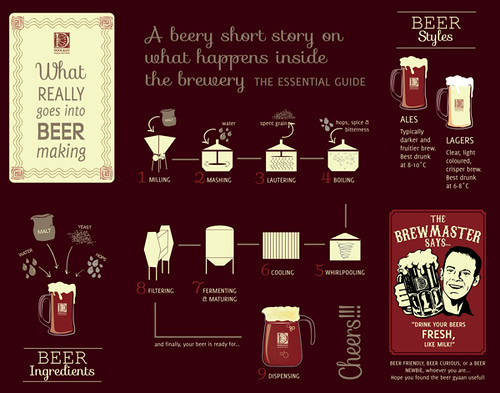
Click here to see the infographic full size.

Today’s infographic is entitled 10 Surprising Health Benefits of Drinking Beer, and was created by the Future of Health Now. None of these are particularly surprising, especially to regular readers, but thanks to anti-alcohol biases they tend to be under-reported and breweries are, in fact, forbidden from making health claims about their beer, another neo-prohibitionist victory. But drink up — in moderation of course — you’ll live longer and it’ll annoy the hell out of them.

One of San Francisco’s newest beer companies, Pine Street Brewery, is building its own brewery and trying to expand its business. One of things they’re in desperate need of is tap handles and kegs. So they’ve turned to Indiegogo (a crowdfunding website similar to Kickstarter) to help raise the funds they need to grow. They’re offering various tchotchkes for different levels of financial support, as detailed in the Indigogo Pine Street Brewery web page.
With our recipes perfected and a commercial brewing space secured, we need tap handles and kegs to keep up with growing demand in San Francisco! With your help we can provide our city with enough green PSB handles to have our beer in every neighborhood.
We’ve brainstormed hard to come up with great incentives for your donations – just a small token of how much we appreciate your generosity. (Check the gallery for photos of the prizes: http://www.indiegogo.com/projects/pine-street-b…). Your contributions will help us establish our presence in the city, and we hope you’ll be proud to say you helped make it happen!
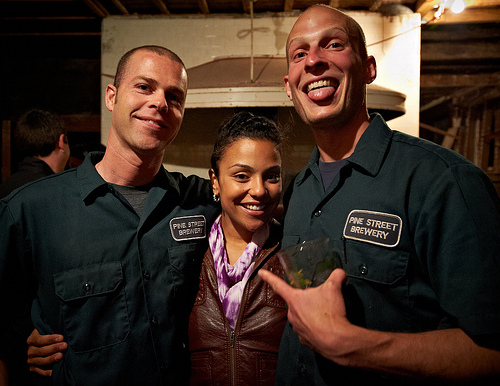
The Pine Street Brewery founders.
The Pine Street Brewery Story
Our Story – Pine Street Brewery from Pine Street Brewery on Vimeo.

Today’s infographic is Know Your Beer Flavors: The Beer Pyramid, created by Jennifer Hood for an article in San Diego’s Locale Magazine, Beerology: How to analyze flavors, why you shouldn’t drink from a can, and why you vote like you drink…

Click here to see the pyramid full size.
UPDATE: It looks like the material for the pyramid was taken from Cicerone Michael Agnew’s video he did for Betty Crocker. Here’s a link to the video, Beerology: The Flavor Triangle.


Today’s infographic is entitled “Facts About Beer,” and was created by Wong Sockying of Singapore. It looks like there’s a lot of information there, but I couldn’t find an example of much larger than the one below.
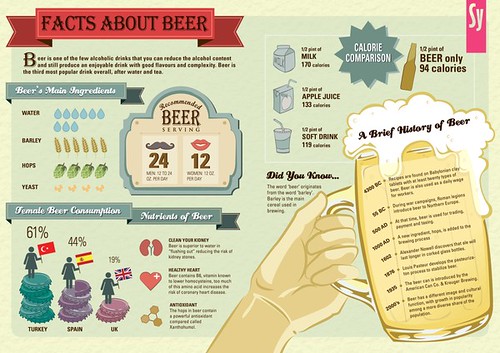
Click here to see the infographic full size.

Today’s infographic is a pie chart showing where people buy their beer. The chart was originally used with an AdAge story, Stat of the Day: Where People Buy Their Beer, using statistics from February of last year. By dollars, most people buy their beer at restaurants, but imagine how much more would be sold if more restaurants actually paid better attention to their beer list. Second was bars, followed by convenience stores in third place. By volume, the most beer is sold at convenience stores, followed by supermarkets/grocery stores and “other” in third place. In both measure, concessions comes in last place; I wonder if the often-gouging price has something to do with that?
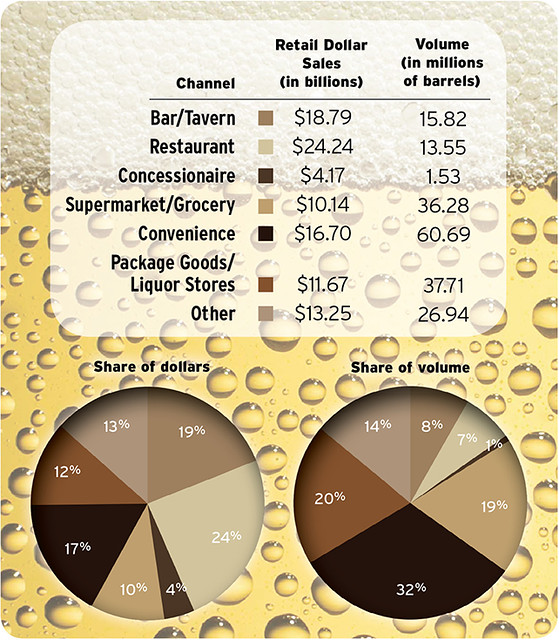
Click here to see the chart full size.

