Today in ancient Egypt was celebrated as the Nativity of Hathor. She “was a major goddess in ancient Egyptian religion who played a wide variety of roles. As a sky deity, she was the mother, or consort, of the sky god Horus and the sun god Ra, both of whom were connected with kingship, and thus she was the symbolic mother of their earthly representatives, the pharaohs. She was one of several goddesses who acted as the Eye of Ra, Ra’s feminine counterpart, and in this form she had a vengeful aspect that protected him from his enemies. Her beneficent side represented music, dance, joy, love, sexuality and maternal care, and she acted as the consort of several male deities and the mother of their sons. These two aspects of the goddess exemplified the Egyptian conception of femininity. Hathor crossed boundaries between worlds, helping deceased souls in the transition to the afterlife.” But she was also “called the mistress of music, dance, garlands, myrrh, and drunkenness.”
Here’s the initial part of her entry on her Wikipedia page:
Hathor was a major goddess in ancient Egyptian religion who played a wide variety of roles. As a sky deity, she was the mother or consort of the sky god Horus and the sun godRa, both of whom were connected with kingship, and thus she was the symbolic mother of their earthly representatives, the pharaohs. She was one of several goddesses who acted as the Eye of Ra, Ra’s feminine counterpart, and in this form she had a vengeful aspect that protected him from his enemies. Her beneficent side represented music, dance, joy, love, sexuality and maternal care, and she acted as the consort of several male deities and the mother of their sons. These two aspects of the goddess exemplified the Egyptian conception of femininity. Hathor crossed boundaries between worlds, helping deceased souls in the transition to the afterlife.
Hathor was often depicted as a cow, symbolizing her maternal and celestial aspect, although her most common form was a woman wearing a headdress of cow horns and a sun disk. She could also be represented as a lioness, cobra, or sycamore tree.
Cattle goddesses similar to Hathor were portrayed in Egyptian art in the fourth millennium BC, but she may not have appeared until the Old Kingdom (c. 2686–2181 BC). With the patronage of Old Kingdom rulers she became one of Egypt’s most important deities. More temples were dedicated to her than to any other goddess; her most prominent temple was Dendera in Upper Egypt. She was also worshipped in the temples of her male consorts. The Egyptians connected her with foreign lands such as Nubia and Canaan and their valuable goods, such as incense and semiprecious stones, and some of the peoples in those lands adopted her worship. In Egypt, she was one of the deities commonly invoked in private prayers and votive offerings, particularly by women desiring children.
During the New Kingdom (c. 1550–1070 BC), goddesses such as Mut and Isis encroached on Hathor’s position in royal ideology, but she remained one of the most widely worshipped deities. After the end of the New Kingdom, Hathor was increasingly overshadowed by Isis, but she continued to be venerated until the extinction of ancient Egyptian religion in the early centuries AD.
Banquet scene from the tomb chapel of Nebamun, 14th century BC. Its imagery of music and dancing alludes to Hathor.
Music, Dance, and Joy
Egyptian religion celebrated the sensory pleasures of life, believed to be among the gods’ gifts to humanity. Egyptians ate, drank, danced, and played music at their religious festivals. They perfumed the air with flowers and incense. Many of Hathor’s epithets link her to celebration; she is called the mistress of music, dance, garlands, myrrh, and drunkenness. In hymns and temple reliefs, musicians play tambourines, harps, lyres, and sistra in Hathor’s honor. The sistrum, a rattle-like instrument, was particularly important in Hathor’s worship. Sistra had erotic connotations and, by extension, alluded to the creation of new life.
These aspects of Hathor were linked with the myth of the Eye of Ra. The Eye was pacified by beer in the story of the Destruction of Mankind. In some versions of the Distant Goddess myth, the wandering Eye’s wildness abated when she was appeased with products of civilization like music, dance, and wine. The water of the annual flooding of the Nile, colored red by sediment, was likened to wine, and to the red-dyed beer in the Destruction of Mankind. Festivals during the inundation therefore incorporated drink, music, and dance as a way to appease the returning goddess. A text from the Temple of Edfu says of Hathor, “the gods play the sistrum for her, the goddesses dance for her to dispel her bad temper.” A hymn to the goddess Raet-Tawy as a form of Hathor at the temple of Medamud describes the Festival of Drunkenness as part of her mythic return to Egypt. Women carry bouquets of flowers, drunken revelers play drums, and people and animals from foreign lands dance for her as she enters the temple’s festival booth. The noise of the celebration drives away hostile powers and ensures the goddess will remain in her joyful form as she awaits the male god of the temple, her mythological consort Montu, whose son she will bear.
A drawing based on an ancient Egyptian wall painting shows a drinking festival in progress. The upper row of figures features revelers drinking wine, including one woman who has overindulged. The lower row shows a procession with musicians. (by Betsy Bryan)
Festivals
Many of Hathor’s annual festivals were celebrated with drinking and dancing that served a ritual purpose. Revelers at these festivals may have aimed to reach a state of religious ecstasy, which was otherwise rare or nonexistent in ancient Egyptian religion. Graves-Brown suggests that celebrants in Hathor’s festivals aimed to reach an altered state of consciousness to allow them interact with the divine realm. An example is the Festival of Drunkenness, commemorating the return of the Eye of Ra, which was celebrated on the twentieth day of the month of Thout at temples to Hathor and to other Eye goddesses. It was celebrated as early as the Middle Kingdom, but it is best known from Ptolemaic and Roman times. The dancing, eating and drinking that took place during the Festival of Drunkenness represented the opposite of the sorrow, hunger, and thirst that the Egyptians associated with death. Whereas the rampages of the Eye of Ra brought death to humans, the Festival of Drunkenness celebrated life, abundance, and joy.
In a local Theban festival known as the Beautiful Festival of the Valley, which began to be celebrated in the Middle Kingdom, the cult image of Amun from the Temple of Karnak visited the temples in the Theban Necropolis while members of the community went to the tombs of their deceased relatives to drink, eat, and celebrate. Hathor was not involved in this festival until the early New Kingdom, after which Amun’s overnight stay in the temples at Deir el-Bahari came to be seen as his sexual union with her.
Several temples in Ptolemaic times, including that of Dendera, observed the Egyptian new year with a series of ceremonies in which images of the temple deity were supposed to be revitalized by contact with the sun god. On the days leading up to the new year, Dendera’s statue of Hathor was taken to the wabet, a specialized room in the temple, and placed under a ceiling decorated with images of the sky and sun. On the first day of the new year, the first day of the month of Thoth, the Hathor image was carried up to the roof to be bathed in genuine sunlight.
The best-documented festival focused on Hathor is another Ptolemaic celebration, the Festival of the Beautiful Reunion. It took place over fourteen days in the month of Epiphi. Hathor’s cult image from Dendera was carried by boat to several temple sites to visit the gods of those temples. The endpoint of the journey was the Temple of Horus at Edfu, where the Hathor statue from Dendera met that of Horus of Edfu and the two were placed together. On one day of the festival, these images were carried out to a shrine where primordial deities such as the sun god and the Ennead were said to be buried. The texts say the divine couple performed offering rites for these entombed gods.Many Egyptologists regard this festival as a ritual marriage between Horus and Hathor, although Martin Stadler challenges this view, arguing that it instead represented the rejuvenation of the buried creator gods. Bleeker thought the Beautiful Reunion was another celebration of the return of the Distant Goddess, citing allusions in the temple’s festival texts to the myth of the solar eye. Barbara Richter argues that the festival represented all three things at once. She points out that the birth of Horus and Hathor’s son Ihy was celebrated at Dendera nine months after the Festival of the Beautiful Reunion, implying that Hathor’s visit to Horus represented Ihy’s conception.
The third month of the Egyptian calendar, Hathor or Athyr, was named for the goddess. Festivities in her honor took place throughout the month, although they are not recorded in the texts from Dendera.
And here’s another account of the Festival of Drunkenness, from Just History:
There was an importance placed on beer in Egyptian culture as well. The source of this festival is a mythological story of how beer saved the world.
The story goes that Re, the sun god, was frankly salty about the “duplicitousness” of mankind and called his children together to discuss it. A Council of the Gods is called, and they decide to punish the rebellious men by letting loose the goddess Hathor. She stormed out in the form of Sakhnet, which literally means female magical power. In some stories this is the form of a great flood, and in others it is the form of a lion. Whatever this form is, Hathor went to town killing everyone up and down the Nile Valley. Re and the other gods started to feel bad about what they let loose, and tried to get her to stop, but at this point Hathor was in a blood rage and would not and could not stop. In order to stop her murderous rampage, the Council of the Gods flooded the fields with beer that had been tinted red with ocher to look like blood. Hathor greedily lapped it up and got drunk and passed out. Mankind was saved by drunkenness.
Originally, it was thought these rituals took place in later in Egyptian history when they were ruled the Greeks and Romans. However, recent discoveries from the excavations of the Temple of Mut complex in Luxor show they took place much earlier- around 1470 BCE. Dr. Betsy Bryan’s research has found the Festival of Drunkenness was celebrated by people at least once a year, sometimes twice, in homes, temples and makeshift desert shrines. It was different than many other temple ceremonies as the priests or pharaoh would act on behalf of the people. In this ritual, everyone participated together- the elites and the peasants. The scene is described in a hymn to Sakhnet as young women with flowing garlands in their hair serving alcohol to everyone They all drink to the point of passing out, then are awoken to the beating of drums and the priests carried out a likeness of the goddess Hathor and they present their petitions to her. It wasn’t just drinking going on either. Graffiti was found discussing “traveling the marshes”, which is a euphemism for having sex. These festivals took place at the beginning of the Nile floods in mid-August, which hearkened to the fertility and renewal of the land by the floods.
The excavations have found what is termed a “porch of drunkenness” associated with Hatshepsut, the woman who became pharaoh. The porch was constructed at the height of her reign. It has been theorized that Hatshepsut was instrumental in popularizing the festival to justify her assumption of pharaonic powers by association with a Great Goddess. There is also a tantalizing discussion of Hatshepsut driving off enemies of Egypt termed the “shemau”, which at least one historian believes was the Jewish people. Then the festivals would be a time to celebrate the fertility of the remaining Egyptians and to replenish their population. This would place the Biblical exodus much earlier than theorized. There is no additional corroboration for this theory however.
No one knows why the porch of drunkenness was taken down. Hatsheput’s name was stricken by her successor, Thutmose III, so it could have been part of that campaign. The ritual fell out of favor as well, and according to Bryan it had lost favor completely by the reign of Amenhotep III. She observed that Egyptians did not like the alcohol making them lose control, and that was what this ritual was about- taking them to the edge of chaos. However, in the time of the fun loving Greeks and Romans it regained popularity. Herodotus reported in 440 BCE that the festivals drew as many as 700,000 participants and drunkenness and sexual permissiveness was the rule. There are also mentions of the festival as late as 200 CE. Although the significance of it had gone, there’s nothing better than a good party.
The Ancient Egyptian Festival of Drunkenness
The Festival of Drunkenness is a religiously significant celebration that was held annually (said to be biannually in some places) by the ancient Egyptians. The background story for the celebration of this festival can be found in a text known as The Book of the Heavenly Cow . In this text, there is an ancient Egyptian myth involving the destruction of mankind. According to the myth, human beings were saved from extinction thanks, in part, to alcohol.
The Destruction of Mankind
In The Book of the Heavenly Cow , there is a myth known as the ‘Destruction of Mankind’. This story begins by stating that once upon a time, human beings lived together with the gods, and were ruled over by Ra (Re). It goes on to say that when Ra had grown old, mankind began to conspire against him. Ra became aware of mankind’s scheming, and decided to summon the other gods to his palace, in order to obtain counsel from them.
After explaining his dilemma to the gods, it was suggested to Ra that he ought to release his Eye, so that it might smite down humanity. He agreed with this suggestion, and sent his Eye in the form of the goddess Hathor to punish mankind. In the meantime, the humans fled to the desert, as they became fearful of Ra.
Nevertheless, Hathor, who was transformed into a lion (or the warlike goddess Sekhmet), descended and slew mankind in the desert. In one version of the story, the goddess went on a rampage, and was about to wipe out all of humanity when Ra took pity on mankind. It was through Ra’s subsequent intervention that mankind was saved. In an alternate version of the myth, it seems that Ra had planned the event to save mankind, so that he could be the savior of humanity.
Thus, Ra summoned his messengers, and ordered them to bring him a great amount of haematite from Elephantine. He then ordered the haematite to be ground. In the meantime, barley was also being ground to produce beer. When both substances were ready, Ra had the haematite put into the beer, so that it resembled human blood. It is written that 7,000 jars of this beer were made.
One night, Ra poured out the blood-like beer, which flooded the fields “three palms high.” On the morning of the next day, the goddess saw that the fields were flooded with what seemed to be human blood, and was delighted at the sight. She began drinking the liquid without knowing that it was actually beer, and soon became intoxicated, then fell asleep. As a result, mankind was saved from destruction.
The Day of Celebration
The Festival of Drunkenness is celebrated on the 20th day of Thoth, the 1st month of the ancient Egyptian calendar. The festival of drunkenness was a communal affair and on one level, the celebrations took place in temples. On another level, this festival took place in peoples’ houses and shrines.
Typically, the participants of this festival would be served lots of alcohol, get drunk, and fall asleep. It was not regarded, however, as a social drinking session, but was sacred event. In the temples, the celebrants would be awoken by the sound of drums and music. Upon waking up, they would worship the goddess Hathor.
Other aspects of the ritual celebration included dancing and the lighting of torches, which was performed in the hopes that the devotees of the goddess would receive an epiphany from her. Another activity believed to have been undertaken during the festival was sex. In a hymn regarding the festival, there is a phrase “traveling through the marshes”, and it has been speculated that this is an ancient Egyptian euphemism for having sex.
One explanation for this activity is provided by regarding Hathor in her role as a goddess of love. Alternatively, it may have been linked to the fertility of the land as well. The Festival of Drunkenness was typically celebrated around the middle of August, the period when the Nile began to rise. Therefore, sexual activity during the festival may have also been perceived as a means of bringing the Nile floods back, and thus ensuring the fertility of the land.
Egyptian painting of dancers and flutists, from the Tomb of Nebamun.
And apparently Hathor and drunkenness, too, played a role in Ancient Egyptian funerals.
Funerary Practices
As an afterlife deity, Hathor appeared frequently in funerary texts and art. In the early New Kingdom, for instance, Osiris, Anubis, and Hathor were the three deities most commonly found in royal tomb decoration. In that period she often appeared as the goddess welcoming the dead into the afterlife. Other images referred to her more obliquely. Reliefs in Old Kingdom tombs show men and women performing a ritual called “shaking the papyrus”. The significance of this rite is not known, but inscriptions sometimes say it was performed “for Hathor”, and shaking papyrus stalks produces a rustling sound that may have been likened to the rattling of a sistrum. Other Hathoric imagery in tombs included the cow emerging from the mountain of the necropolis and the seated figure of the goddess presiding over a garden in the afterlife. Images of Nut were often painted or incised inside coffins, indicating the coffin was her womb, from which the occupant would be reborn in the afterlife. In the Third Intermediate Period, Hathor began to be placed on the floor of the coffin, with Nut on the interior of the lid.
Tomb art from the Eighteenth Dynasty often shows people drinking, dancing, and playing music, as well as holding menat necklaces and sistra—all imagery that alluded to Hathor. These images may represent private feasts that were celebrated in front of tombs to commemorate the people buried there, or they may show gatherings at temple festivals such as the Beautiful Festival of the Valley. Festivals were thought to allow contact between the human and divine realms, and by extension, between the living and the dead. Thus, texts from tombs often expressed a wish that the deceased would be able to participate in festivals, primarily those dedicated to Osiris. Tombs’ festival imagery, however, may refer to festivals involving Hathor, such as the Festival of Drunkenness, or to the private feasts, which were also closely connected with her. Drinking and dancing at these feasts may have been meant to intoxicate the celebrants, as at the Festival of Drunkenness, allowing them to commune with the spirits of the deceased.
Hathor was said to supply offerings to deceased people as early as the Old Kingdom, and spells to enable both men and women to join her retinue in the afterlife appeared as early as the Coffin Texts in the Middle Kingdom. Some burial goods that portray deceased women as goddesses may depict these women as followers of Hathor, although whether the imagery refers to Hathor or Isis is not known. The link between Hathor and deceased women was maintained into the Roman Period, the last stage of ancient Egyptian religion before its extinction.
Hathor welcoming Seti I into the afterlife. (13th century BCE)
And Treasures of Egypt has a great overview of Hathor, and so does History Cooperative.
Today is the birthday of Rudolph J. Schaefer III (August 29, 1930-June 10, 2011). Also nicknamed “Rudie” — he was the great-great-grandson of Rudolph J. Schaefer, who was the son of Maximilian Schaefer, and he, along with his brother Frederick, founded the F&M Schaefer Brewing Company in 1842. Rudie’s great-grandfather Rudolph became the president of F&M Schaefer Brewing in 1912, and continued in that position until his death. He also bought out his uncles and their heirs, and controlled the entire company, which allowed his father Rudie to become president in 1927, a position he held until retiring in 1969. Rudie III then became president, and held that position until 1975. “In 1981 Schaefer was acquired by Stroh Brewing Company which, in turn, was acquired by Pabst Brewing Company in 1999.”
Rudolph J. Schaefer III, of Stonington and Key Largo, Fla., died Friday, June 10, 2011, in his home, surrounded by his loving family.
Mr. Schaefer was born on Aug. 29, 1930 in New York City to Rudolph Jay Schaefer Jr. and Lucia (Moran) Schaefer.
Rudie attended the Rye Country Day School, Choate, Washington and Lee and graduated from Hofstra University with a bachelor of business administration. Rudie also attended the Harvard Business School PMD Management Program.
After graduation, Rudie enlisted in the Navy in June, 1952. He served active duty aboard the USS MacGowen DD678 from 1953 to 1957 in the Middle East, attaining the rank of lieutenant JG. He remained in the Naval Reserves until 1969.
Rudie married Jane A. Isdale of New Rochelle, N.Y. at St. John’s Episcopal Church in Larchmont, N.Y. in 1956.
Joining the F&M Schaefer Brewing Co. in 1957, he later served as president of the brewery from 1972 to 1975. His great-grandfather founded the F&M Schaefer Brewing Company in 1842.
Mr. Schaefer was involved, and worked on many boards throughout his life. He was vice president and board member of the New York School For The Deaf, board member of the United Hospital in Port Chester N.Y., the New Rochelle Hospital as well as L&M Hospital in New London. Rudie was also a board member of the Lincoln Savings Bank and the New London Savings Bank.
A philanthropist throughout his life, Rudie was especially proud of his work with the Mystic Seaport, serving as a trustee in 1975 and later president and chairman of the board from 1983 to 1989.
His love of the sea and yachting, sparked a life long interest in marine art. He was very proactive in supporting many aspiring marine artists. Rudie was instrumental in building the Mystic Maritime Art Gallery at the Mystic Seaport in honor of his father, Rudolph J. Schaefer Jr.
Mr. Schaefer was actively involved in many clubs and organizations including the Cruising Club of America, founder of the Stonington Country Club, Stonington Harbor Yacht Club, Ocean Reef Club, member and commodore of the Key Largo Anglers Club, New York Yacht Club. Former memberships include the American Yacht Club, Larchmont Yacht Club and the Shelter Island Yacht Club.
And here’s another obituary from the Hartford Courant, published September 18, 2011:
Extraordinary Life: Rudolph J. Schaefer III of Stonington, was a successful businessman and a generous philanthropist, but the sea was his passion. He also was an heir to the F&M Schaefer Brewing Co., New York’s longest operating brewery.
Rudie Schaefer was a successful businessman and a generous philanthropist, but the sea was his passion. He enjoyed being on the water, collecting modern marine art and working for Mystic Seaport, where he served as president of the board of trustees.
He also was an heir to the F&M Schaefer Brewing Co., New York’s longest operating brewery.
Rudie Schaefer III was born Aug. 29, 1930, and grew up in Larchmont, N.Y., outside Manhattan. His mother, Lucia, was a homemaker and his father was commodore of the Larchmont Yacht Club. Rudie grew up on the water, sailing small and large boats. He graduated from Rye Country Day School and Choate, then attended Washington and Lee University for two years. He obtained his bachelor’s degree in business from Hofstra University in 1952.
After graduation, he enlisted in the Navy and served in the Middle East from 1953 to 1957. He was en route to the Suez Canal during the Middle East crisis of 1956, when many people thought war was imminent. His ship was the last to go through the canal before it closed, but the issues were resolved and he did not see combat.
In the fall of 1956, he married Jane Isdale, a fellow sailor from Larchmont. They had six children; one daughter Anne, predeceased him.
F&M Schaefer, the family beer company, was founded by Schaefer’s great-grandfather Max Schaefer and Max’s brother, Frederick Schaefer, who came to New York in the late 1830s. They worked for a small brewery, owned by Sebastian Summers, but Max introduced the formula for lager beer, popular in Germany but unknown in the United States. Lager became extremely popular, and in 1842 the brothers bought the company. It was a family company for nearly 150 years, and its memorable slogan was “Schaefer: The one beer to have when you are having more than one.”
After his Navy servicer, Schaefer joined the family company in 1957, and went first to Albany to run a plant. The family moved several times as Schaefer rose in the company, and he lived in Rye while he served as president from 1972 until 1975. He retired in 1976.
In 1981, the Stroh Brewery bought the company, and Pabst Brewery bought Stroh in 1999, but Schaefer beer continues to be brewed and distributed in the Northeast and Puerto Rico.
For about five years, Schaefer was a partner in Aquasport, a company that manufactured small fishing boats in Florida.
He also was an outdoorsman who loved trap shooting, hunting and fishing. He once hooked a “grander,” a 1,000 pound black marlin, in Australia, which took 3-1/2 hours to reel in. Broken eardrums kept him from deep sea diving, but he loved going out on his 46-foot yacht built from the hull of a lobster boat.
In the early 1980s, Schaefer became one of the founders of the Stonington Country Club. A perfectionist, he would go around the course picking up rocks, or take a dinghy out to retrieve balls lost in the pond.
The high spirits that led him to dress up in crazy costumes for clown dives at the country club as a teenager never faded. He was a storyteller and had a sense of humor about himself. He liked to tell the story of how he once took a golf swing and missed, then knocked the ball into the clubhouse on the way back.
In 1982, the Schaefers moved to Stonington.
“Mystic Seaport brought us here,” said Jane Schaefer who like her husband, became an active volunteer at the seaport. Like his father, he became a trustee and served as president and chairman of the board from 1983 to 1989.
Schaefer was one of the early Pilots, a group of seaport volunteers who spend two weekends a year doing odd jobs, including painting and maintenance at the port. Schaefer’s preferred activity was shingling, and he would suit up in his tool belt and repair roofs wherever it was needed.
Schaefer had an encyclopedic knowledge of boating.
“He just knew every boat yard up and down the East Coast,” said Russell Burgess, a sailing friend. To make sure that old-boat-building techniques and sailing yarns weren’t forgotten, Schaefer funded a position for an oral historian at Mystic who interviewed boat builders, architects and famous sailors. He supported the library and was active in finding collections and boats for the museum.
Always interested in art, Schaefer was instrumental in establishing the Maritime Gallery at Mystic Seaport, a showcase for modern, international marine art and donated a building in honor of his father. Some of the younger artists whom Schaefer collected and promoted became well-known, such as Don Demers, a Maine painter whose work he first encountered at the gallery.
“Rudie took note of the paintings, introduced himself and made a point of complimenting me,” recalled Demers. Schaefer began buying Demers’ work, and in 1988, Demers had a one-man show at Mystic that sold out.
“He had a lot of influence,” Demers said. “If you got Rudie’s stamp of approval, you were validated, and that certainly happened to me.”
Schaefer’s approach to art mirrored his approach to life: He was gregarious and effusive.
“He’d pull people over and say, look at this. We’d talk and talk and talk about it,” said Demers. “It was really a joy to show him a painting.”
“He was a rare trustee,” said Paul O’Pecko, the reference librarian. “He really did give freely of his time, talent and treasure.”
“He had a motto,” said his wife. “Make one person smile every day.”
Today is the birthday of Charles H. Wacker (August 29, 1856-October 31, 1929). Wacker’s family came from Württemberg Germany (though some sources claim he was from Switzerland), and he was 2nd generation American, having been born in Chicago, Illinois. His father Frederick, also a brewer, founded the Wacker and Birk Brewing and Malting Co. In 1882 or 83, Charles joined his father in the family business, and rose to prominence in Chicago throughout his life.
He was a “mover and shaker” in the early days of Chicago. He was part of the Chicago Plan Commission formed to win acceptance of the famous Burnham Plan of 1909. He was a contemporary of Daniel Burnham and helped him promote his plan for the development of the city’s lakefront and system of parks. Lower and Upper Wacker Drive (two roads one on top of the other) in Chicago is named for him.
Charles Henry Wacker, born in Chicago, Illinois, was a second generation German American who was a businessman and philanthropist. His father was Frederick Wacker, a brewer, who was born in Württemberg Germany. He was Vice Chairman of the General Committee of the Commercial Club of Chicago, and in 1909 was appointed Chairman of the Chicago Plan Commission by Mayor Busse. As Commission chairman from 1909 to 1926, he championed the Burnham Plan for improving Chicago. This work included addresses, obtaining wide publicity from newspapers, and publishing Wacker’s Manual of the Plan of Chicago (by Walter D. Moody) as a textbook for local schoolchildren.
Prior to serving on the Commission, Wacker was a Chicago brewer and the director of the 1893 Columbian Exposition held in Chicago.
As a businessman he was part of a consortium of Chicago brewers who underwrote the methods that facilitated the commercialization of refrigeration machines.
Wacker Drive, built as part of the Burnham Plan, and Charles H. Wacker Elementary School are named in his honor. The name Wacker is also attached to other institutions in Chicago, such as the Hotel Wacker.
Charles H. Wacker was educated at Lake Forest Academy (class of 1872) and thereafter at Switzerland’s University of Geneva.
The Chicago brewery his father started was originally called Seidenschwanz & Wacker, and was located on Hinsdale, between Pine and Rush streets. It was founded in 1857, but the following year it became known as Wacker & Seidenschwanz, and was on N. Franklin Street. That version lasted until 1865. Beginning that same year, its name changed once again to the Frederick Wacker Brewery, and its address was listed as 848 N. Franklin Street, presumably in the same location as its predecessor. Sixteen years later, in 1882, it relocated to 171 N. Desplaines (now Indiana Street) and it became known as the Wacker & Birk Brewing & Malting Co. This is also when Charles joined his father’s business, when he would have been 26 years old. Just before prohibition the name was shortened to the Wacker & Birk Co., although it appears to have closed by 1920.
Here’s one more biography, from the library at the University of Illinois at Chicago:
Wacker was born in 1856 to a German immigrant who owned a brewing and malting company. Although he worked as a real estate investor and bank director, Wacker eventually took over his father’s business. In civic affairs, Wacker was director of the Ways and Means Committee for the World’s Columbian Exposition of 1893. In 1909, Mayor Fred Busse appointed Wacker to the Chicago Plan Commission, a committee designed to convince residents to issue bonds and spend money on widening streets, improving sidewalks, and redeveloping parts of the city. During his tenure on the Commission, Wacker urged voters to approve the forest preserves referenda. Later, he served on the Forest Preserve Plan Committee. Chicago leaders rewarded Wacker by renaming a double-decker roadway after him. First proposed in the Burnham Plan and completed in the 1920s, Wacker Drive runs along the Chicago River in the Loop.
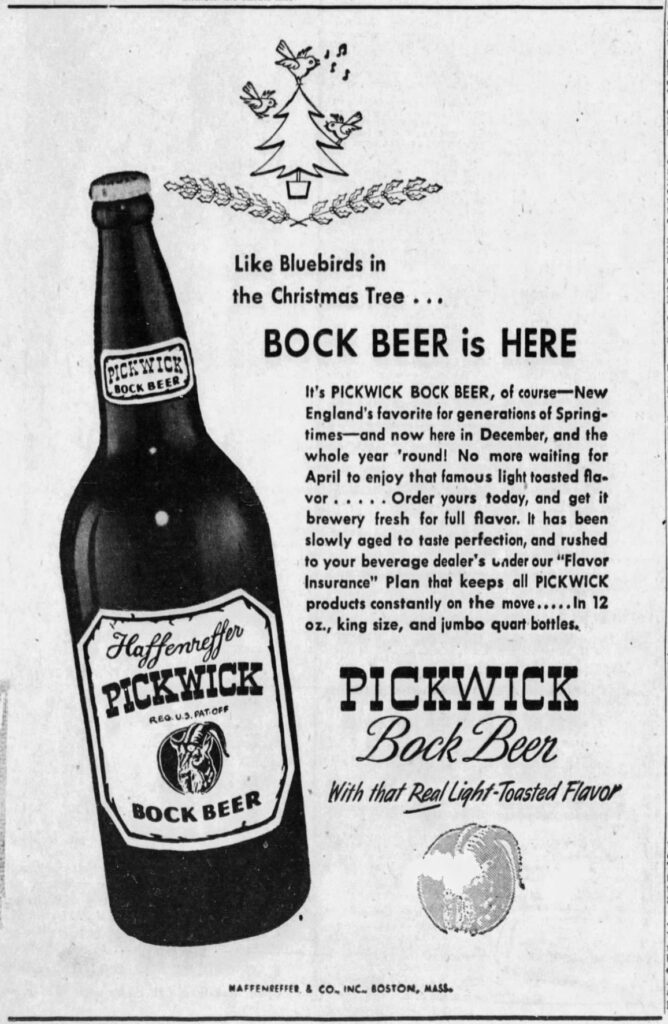
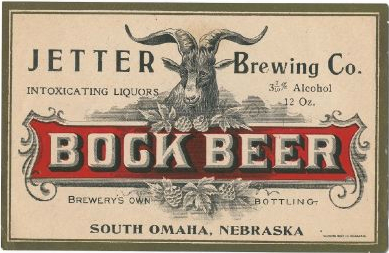
Last year I decided to concentrate on Bock ads. Bock, of course, may have originated in Germany, in the town of Einbeck. Because many 19th century American breweries were founded by German immigrants, they offered a bock at certain times of the year, be it Spring, Easter, Lent, Christmas, or what have you. In a sense they were some of the first seasonal beers. “The style was later adopted in Bavaria by Munich brewers in the 17th century. Due to their Bavarian accent, citizens of Munich pronounced ‘Einbeck’ as ‘ein Bock’ (a billy goat), and thus the beer became known as ‘Bock.’ A goat often appears on bottle labels.” And presumably because they were special releases, many breweries went all out promoting them with beautiful artwork on posters and other advertising.
Thursday’s ad is for Graupner Bock Beer, which was published on August 28, 1933. This one was for the Robert H. Graupner Brewery of Harrisburg, Pennsylvania, which was originally founded in 1875 as Koenig & Bro. and was also often called the Centennial Brewery, though Graupner was usually in the name after 1893. They also mention two of the other beers, Graupner’s X-Tra Fine Beer and Silver Stock Lager. But what’s most curious about the ad is that most of it is taken up by the telling of one of the many origin stories of bock beer. This ad ran in The Harrisburg Telegraph, also of Harrisburg, Pennsylvania.
Today is the birthday of Sandy Dvore (August 28, 1934-November 20, 2020). He was a prolific American artist, graphic designer, and title designer. This short biography from his Wikipedia page gives the highlights:
Around 1962, he met Hollywood publicist Guy McElwaine playing baseball, who represented Natalie Wood, Warren Beatty, Judy Garland and Tony Bennett and needed ads created. Through this connection, Dvore became well known for designing back cover art for Sammy Davis Jr. in Variety. Dvore then illustrated an ad for Judy Garland for Judy at Carnegie Hall which caught the attention of American theatrical agent and film producer Freddie Fields. The pair worked together for 13 years on numerous projects. Dvore would go on to illustrate hundreds of ads for stars like Frank Sinatra, Liza Minnelli, Natalie Wood, David Bowie, Mick Jagger, and Steve McQueen. His minimal but vibrant illustrated trade ads held the coveted back pages of The Hollywood Reporter and Variety for years.
Sandy Dvore is best known for his work in designing television title sequences, such as the walking partridges in The Partridge Family, and the brush-stroke logo and paintings from the long-running soap opera The Young and the Restless. His film title credits include the 1976 film Lipstick and the 1972 Blaxploitation thriller Blacula. He also designed the opening credits for selected seasons of the nighttime soap opera Knots Landing.
Dvore’s work in graphic design won him an Emmy Award in 1987 for Carol, Carl, Whoopi and Robin.
But as memorable as that work is, that’s not why I’m sharing his birthday here, as you might expect. He also worked on a more beer-related project. Robert Leo Hulseman, whose father founded the Solo Cup Company. In the 1970s, Hulseman hired Dvore to design a new plastic cup for the company. Here’s the story, from the now-defunct design blog Design-Ago:
One rainy day in early 1970’s Los Angeles…
Leo Hulesman, founder of the Solo cup company, stopped by the studio of Hollywood designer Sandy Dvore.
“I heard you’re the best commercial artist around.” Said Hulesman.
This was true. Dvore was the hottest designer in Hollywood. His work appeared everywhere from billboards to trade ads and most famously, every week in the Hollywood Reporter and Variety publications. At the time, these were the most important pieces of the Hollywood community. EVERYONE looked to these weekly magazines to see what their peers were doing.
Hulesman was looking for a design for his new venture, children’s records that would be a promotional giveaway on the Solo cup box. You see, Dora Hall, a singer who was also Mrs. Hulesman, had given up her career in Ziegfield Follies to raise their children. This was a chance for her to get back to performing again and do something her children could enjoy.
“I’m doing very well now” said Dvore. “I’ve got some major projects and I really don’t want to do small piece work. It would take up a lot of time.”
“What if I give you a retainer?” Said Hulesman.
“He was sharp”, Dvore thought.
At the time Dvore was doing big name television projects, The Partidge Family and The Waltons.
“I could send you a chunk of money…” “What kind of number are we talking?” Asked Hulseman.
“$17,500” stated Dvore.
“Why don’t we just make it a flat $25,000.” Replied Hulesman.
They shook hands and Hulesman smiled. He enjoyed the banter as he, like Dvore, was a self made man from Chicago.
“He liked that I could handle myself.” Dvore remembered. “We became friends and I enjoyed knowing him.”
Hulesman enjoyed sharing the success he had. He would pay for entire television specials for his wife Dora so she could have an opportunity perform.
When it’s time to change.
“The Solo company at the time had an old serif logo right out of a type book.” Dvore remembers.
Dvore looked at the two O’s in the SOLO logo and the idea came to him, simple as that. He hadn’t been asked to create a new logo either. He just thought,
“as a artist, we can do better.”
Hulesman had his feet propped up on Dvore’s desk when he showed him what he had come up with.
“We should change your logo, this should be the logo for your company.” Dvore slid the concept to Hulesman.
The negative space in the SOLO, O’s replaced with cups, along with a new san-serif type.
Hulesman looked at it and replied, “send it to the company.”
And, one short phone call later, it became the logo you still see everywhere today.
Sometimes, but not often, it IS that easy.
A relationship of trust formed between Dvore and Hulesman. Which is why Dvore felt comfortable proposing new ideas.
“Why are all your cups white? You should have some colored cups.”
With this idea Dvore took the colors from his recent Partridge Family art and applied the same blue, yellow and red to the cups.
And in another short phone call to the factory, the Solo cup company started producing color cups.
“I even used the same color numbers from the Partridge Family logo.” Recalls Dvore.
And so, once again, a simple yet smart idea, a phone call, and the rest is history, the red Solo cup was born.
Whoever would have thought a cup would be so famous?
It has inspired songs, drinking games, tattoo’s, merchandise and created plenty of hazy memories.
Why red became the go-to, and a cultural icon is anyone’s guess.
“It’s become the most well known and most seen thing I have ever done.” Dvore states today.
Every day, millions of people get their morning cup of coffee and before they take a sip there it is, the Solo cup logo.
Every night, people attend a party or have a game of beer pong and there it is again, the red Solo cup.
Last year I decided to concentrate on Bock ads. Bock, of course, may have originated in Germany, in the town of Einbeck. Because many 19th century American breweries were founded by German immigrants, they offered a bock at certain times of the year, be it Spring, Easter, Lent, Christmas, or what have you. In a sense they were some of the first seasonal beers. “The style was later adopted in Bavaria by Munich brewers in the 17th century. Due to their Bavarian accent, citizens of Munich pronounced ‘Einbeck’ as ‘ein Bock’ (a billy goat), and thus the beer became known as ‘Bock.’ A goat often appears on bottle labels.” And presumably because they were special releases, many breweries went all out promoting them with beautiful artwork on posters and other advertising.
Wednesday’s poster is for Falken Schaffhauser’s Bock, and was published in 1934. This one was made for the Bierbrauerei Falken Schaffhausen, or Falcon Brewery, of Schaffhausen, Switzerland. The brewery was founded in 1799, and is still in business today, and is “considered the only independent brewery in the Schaffhausen region,” and is Switzerland’s 5th largest brewery. This one is for their Schaffhauser Bock and shows a group of protestors carrying signs, though in the end they’re just beer signs. It was created by Swiss artist Arnold Oechslin.
Last year I decided to concentrate on Bock ads. Bock, of course, may have originated in Germany, in the town of Einbeck. Because many 19th century American breweries were founded by German immigrants, they offered a bock at certain times of the year, be it Spring, Easter, Lent, Christmas, or what have you. In a sense they were some of the first seasonal beers. “The style was later adopted in Bavaria by Munich brewers in the 17th century. Due to their Bavarian accent, citizens of Munich pronounced ‘Einbeck’ as ‘ein Bock’ (a billy goat), and thus the beer became known as ‘Bock.’ A goat often appears on bottle labels.” And presumably because they were special releases, many breweries went all out promoting them with beautiful artwork on posters and other advertising.
Tuesday’s ad is for Shreveport Bock Beer, which was published on August 26, 1904. This one was for, I think, the Shreveport Brewery of Shreveport, Louisiana, which was originally founded in 1902, but only appears to have been in business until 1906. This ad ran in The Shreveport Times, also of Shreveport, Louisiana.
Last year I decided to concentrate on Bock ads. Bock, of course, may have originated in Germany, in the town of Einbeck. Because many 19th century American breweries were founded by German immigrants, they offered a bock at certain times of the year, be it Spring, Easter, Lent, Christmas, or what have you. In a sense they were some of the first seasonal beers. “The style was later adopted in Bavaria by Munich brewers in the 17th century. Due to their Bavarian accent, citizens of Munich pronounced ‘Einbeck’ as ‘ein Bock’ (a billy goat), and thus the beer became known as ‘Bock.’ A goat often appears on bottle labels.” And presumably because they were special releases, many breweries went all out promoting them with beautiful artwork on posters and other advertising.
Monday’s ad is for Atlas Bock Beer, which was published on August 25, 1933. This one was for, I think, the Atlas Brewing Co. (or Atlas Beverage Co.) of Chicago, Illinois, which was originally founded in 1891 as the Bohemian Brewing Co. of Chicago, but was renamed Atlas in 1896. This ad ran in The Daily Argus Leader, of Sioux Falls, North Dakota. I love that the name of the restaurant was “The Eat Shoppe.”
Today is the birthday of Hans Adolf Krebs (August 25, 1900-November 22, 1981). He was a German-born British physician and biochemist. He was the pioneer scientist in study of cellular respiration, a biochemical pathway in cells for production of energy. He is best known for his discoveries of two important chemical reactions in the body, namely the urea cycle and the citric acid cycle. The latter, the key sequence of metabolic reactions that produces energy in cells, often eponymously known as the “Krebs cycle,” earned him a Nobel Prize in Physiology or Medicine in 1953. And it’s the Krebs cycle that is his relation to brewing, as it’s also known as the respiratory phase, the second aerobic state of the fermentation process immediately following the lag period.
Here’s a description of the Krebs cycle from Life Fermented:
The Krebs cycle, also known as the tricarboxylic acid (TCA) cycle or the citric acid cycle, is a circular and repeating set of reactions which requires oxygen. In beer making, this would occur in the first stage of fermentation when the yeast is pitched into a well aerated wort, and carries on until all oxygen is used up.
Pyruvate (are you tired of this word yet?) is first converted to acetyl-CoA (pronounced “Co-A”) in the following reaction:
pyruvate + 2 NAD+ + CoA-SH → acetyl-CoA + CO2 + NADH, with the help of the pyruvate dehydrogenase (PDH) complex. Note that this is the first time CO2 is produced, and yet more NADH is generated.
This acetyl-CoA then enters into a cycle of reactions which nets two molecules of CO2, one GTP (guanosine triphosphate, another unit of energy equivalent to ATP), three NADH, and one FADH2 (flavin adenine dinucleotide, which functions similarly to NADH). After the cycle completes, another acetyl-CoA molecule enters and the cycle repeats itself.
But wait, this just made more NADH, and we need to regenerate NAD+ so glycolysis can continue. Both the NADH and FADH2 now donate their electrons to a process called the electron transport chain/ oxidative phosphorylation. The result is a return of NAD to the NAD+ state, and a large amount of ATP cellular energy.
Because the Krebs cycle is so efficient at producing ATP energy units, this is the yeast’s preferred pathway. But, you’ll notice a rather conspicuous absence: ethanol. This is only formed in the absence of oxygen.
Here’s a biography of Krebs, from the Nobel Prize website:
Sir Hans Adolf Krebs was born at Hildesheim, Germany, on August 25th, 1900. He is the son of Georg Krebs, M.D., an ear, nose, and throat surgeon of that city, and his wife Alma, née Davidson.
Krebs was educated at the Gymnasium Andreanum at Hildesheim and between the years 1918 and 1923 he studied medicine at the Universities of Göttingen, Freiburg-im-Breisgau, and Berlin. After one year at the Third Medical Clinic of the University of Berlin he took, in 1925, his M.D. degree at the University of Hamburg and then spent one year studying chemistry at Berlin. In 1926 he was appointed Assistant to Professor Otto Warburg at the Kaiser Wilhelm Institute for Biology at Berlin-Dahlem, where he remained until 1930.
In I930, he returned to hospital work, first at the Municipal Hospital at Altona under Professor L. Lichtwitz and later at the Medical Clinic of the University of Freiburg-im-Breisgau under Professor S. J. Thannhauser.
In June 1933, the National Socialist Government terminated his appointment and he went, at the invitation of Sir Frederick Gowland Hopkins, to the School of Biochemistry, Cambridge, where he held a Rockefeller Studentship until 1934, when he was appointed Demonstrator of Biochemistry in the University of Cambridge.
In 1935, he was appointed Lecturer in Pharmacology at the University of Sheffield, and in 1938 Lecturer-in-Charge of the Department of Biochemistry then newly founded there.
In 1945 this appointment was raised to that of Professor, and of Director of a Medical Research Council’s research unit established in his Department. In 1954 he was appointed Whitley Professor of Biochemistry in the University of Oxford and the Medical Research Council’s Unit for Research in Cell Metabolism was transferred to Oxford.
Professor Krebs’ researches have been mainly concerned with various aspects of intermediary metabolism. Among the subjects he has studied are the synthesis of urea in the mammalian liver, the synthesis of uric acid and purine bases in birds, the intermediary stages of the oxidation of foodstuffs, the mechanism of the active transport of electrolytes and the relations between cell respiration and the generation of adenosine polyphosphates.
Among his many publications is the remarkable survey of energy transformations in living matter, published in 1957, in collaboration with H. L. Kornberg, which discusses the complex chemical processes which provide living organisms with high-energy phosphate by way of what is known as the Krebs or citric acid cycle.
Krebs was elected a Fellow of the Royal Society of London in 1947. In 1954 the Royal Medal of the Royal Society, and in 1958 the Gold Medal of the Netherlands Society for Physics, Medical Science and Surgery were conferred upon him. He was knighted in 1958. He holds honorary degrees of the Universities of Chicago, Freiburg-im-Breisgau, Paris, Glasgow, London, Sheffield, Leicester, Berlin (Humboldt University), and Jerusalem.
He married Margaret Cicely Fieldhouse, of Wickersley, Yorkshire, in 1938. They have two sons, Paul and John, and one daughter, Helen.
And in the Microbe Wiki, on a page entitled “Saccharomyces cerevisiae use and function in alcohol production,” under a section called “Fermentation of alchohol,” the Krebs cycle is placed in its portion in the fermentation process:
Saccharomyces cerevisiae is able to perform both aerobic and anaerobic respiration. The process begins with the yeast breaking down the different forms of sugar in the wort. The types of sugars typically found in wort are the monosaccharides glucose and fructose. These sugars contain a single hexose, which is composed of 6 carbon atoms in the molecular formula C6H12O6. Disaccharides are formed when two monosaccharides join together. Typical disaccharides in the wort are galactose, sucrose, and maltose. The third type of fermentable sugar in the wort is a trisaccharide. This trisaccharide is formed when three monosccharides join together. Maltotriose is the trisaccharide commonly found in the wort and is composed of three glucose molecules. The wort does contain other sugars such as dextrins but it is not fermentable by yeast10. These dextrins contain four monosaccarides joined together. In order for the yeast to use the disaccharides and trisaccharides they first must be broken down to monosaccharides. The yeast does this by using different enzymes both inside and outside the cell. The enzyme invertase is used to break down sucrose into glucose and fructose. The invertase catalyzes the hydrolysis of the sucrose by breaking the O-C (fructose bond). The other enzyme used is maltase, which breaks down maltose and maltotriose into glucose inside the cell. The enzyme does this by catalyzing the hydrolysis of the sugars by breaking the glycosidic bond holding the glucose molecules together.
Once the sugars are broken down into monosaccharides the yeast can use them. The primary step is called glycolysis. In this process the glucose is converted to pyruvate using different enzymes in a series of chemical modifications. The electrons from glucose end up being transferred to energy carrying molecules like NAD+ to form NADH. ATP is also formed when phosphates are transferred from high-energy intermediates of glycolysis to ADP. In the presence of oxygen aerobic respiration can occur. This occurs in the mitochondria of the yeast. The energy of the pyruvate is extracted when it goes through metabolic processes like the Krebs cycle. The products of this type of metabolism are ATP, H2O, and CO2. However if there is no oxygen present and an abundance of sugars, as in the wort, the yeast undergo alcoholic fermentation. This type of metabolism yields much smaller amounts of energy when compared to aerobic respiration. However, because of the large supply of sugars from the different grains the wort is a very good environment for fermentative growth. The alcoholic fermentation begins with the two pyruvate acquired from glycolysis. These two pyruvate are decarboxylated by pyruvate decarboxylase to form two acetaldehydes and CO2. The CO2 is the gas that is observed during fermentation as bubbles that float to the top of the wort creating the kräusen or beer head, the foam that is very characteristic of a freshly poured beer. Pyruvate decarboxylase is a homotetramer meaning it contains four identical subunits. This also means that is has four active sites. The active sites are where the pyruvate reacts with the cofactors thiamine pyrophosphate (TPP) and magnesium to remove the carbon dioxide9. The final step to form alcohol is the addition of a hydrogen ion to the aldehyde to form ethanol. This hydrogen ion is from the NADH made during glycolysis and converts back to NAD+. The ethanol is originally believed to serve as an antibiotic against other microbes. This form of defense ensures that bacteria do not grow in the wort, thus ruining the beer with off flavors. However recently with the boom of craft beer different bacteria have been purposefully added to create what is known as sour beer. The sour taste comes from the waste products of the bacteria.
To learn more about the Krebs cycle check out this video from the University of Oklahoma’s Chemistry of Beer – Unit 7 – Chemical Concepts: Krebs Cycle:
Today is the birthday of August Uihlein (August 25, 1842-October 11, 1911). He was born in Wertheim am Main, Baden, Germany. He came to the U.S. with his grandfather and August was educated as a brewer in the U.S., working initially for the Uhrig Brewery in St. Louis. In 1867, he returned to Milwaukee, Wisconsin, where his grandfather had settled, and “joined what was now the Joseph Schlitz Brewing Company, the same brewery that had been founded by his uncle August Krug in the 1840s (Krug’s widow, Anna Maria, had married Joseph Schlitz in 1858).”
On the death of Schlitz in 1875, control of the firm passed into the hands of Uihlein and his brothers. When Mrs. Schlitz died in 1887, the Uihlein brothers acquired complete ownership of the corporation. Uihlein was secretary and chairman of the board (1874–1911). He was also actively involved in banking, real estate, and many other Milwaukee businesses.
Here’s a biography of August Uihlein from Find-a-Grave:
Brewer and business executive. He was the first of the Uihlein dynasty that owned and operated Joseph Schlitz Brewing Co. over the years. Born Georg Carl August Ühlein, son of Josef Benedikt Ühlein and Katherina Krug, in Wertheim am Main, Baden, Germany. At age eight he endured a rough immigration on the way to Milwaukee, Wisconsin, in 1850, traveling with his grandfather, Georg Krug. He survived the mid-Atlantic fire and sinking of the S.S. Helene Schlomann, during which his grandfather managed to save him and $800 in gold that was subsequently used to expand his uncle August Krug’s brewery and to hire a bookkeeper, Joseph Schlitz. He attended Milwaukee’s German-English Academy, then studied at St. Louis University in Missouri (1855 to 1857). His uncle, August Krug, died in 1856 and Schlitz became the manager of the brewery and two years later married Krug’s widow and changed the name to Joseph Schlitz Brewing Co. In 1858, at age 16, Uihlein convinced Schlitz to hire him as a bookkeeper after only 60 days training in the subject in St. Louis. August proposed to take a company inventory and revamp the brewery’s accounting system from single to double-entry bookkeeping. While holding down a full-time job (age 17) at the Second Ward Savings Bank (now First Wisconsin) without salary, he applied this training to the brewery’s accounting during evenings. For his efforts at the bank, he received a gold pen from Valentine Blatz after a year of service. He then worked the Uhrig Brewery in 1860 in St. Louis (the Uhrig family had a summer home in Milwaukee) as a bookkeeper, collector, and shipping clerk for $20 a month and two years later, shortly before his 20th birthday, he was promoted to the position of general manager. Returning to Milwaukee in 1867, he became the bookkeeper for the Joseph Schlitz brewery, and on the death of Schlitz in 1875, management control of the firm passed into the hands of him and his brothers, all nephews of the brewery’s original founder, August Krug. Along with his brothers Henry and Edward, he continued the business strategies initiated by Schlitz. The company developed a system of agencies across the United States to sell beer, and developed its own vast rail distribution network. When Mrs. Schlitz died in 1887, the Uihlein brothers acquired complete ownership of the enterprise. From a ranking of tenth largest US brewer in 1877, their national marketing plan propelled the company to third by 1895. Sitting among the top three breweries was little comfort when prohibition came about. The company met the challenge as did others, restructuring the brewery as Joseph Schlitz Beverage Co. to produce near beer, yeast, soft drinks, malt syrup and a chocolate candy named “Eline” (a phonetic play on the family name). Returning to brewing in 1933, the company launched an acquisition plan and new construction that led them to second and then first place in US beer production. For the next 40 the years the company would remain near the top and at one point was ranked as the largest in the world. August Uihlein was Schlitz company secretary from 1874 and also chairman of the board from 1880 until his death in 1911, and was prominently identified with banking, real estate, and many other Milwaukee enterprises. Interested in racing horses, he maintained a large stock farm near Kenosha and was the owner of the famous trotting-horse champion, “Harvester.” Noted for his local philanthropy, he donated large sums to the German-English Academy and to the Milwaukee Public Library. He died while visiting in Germany.
Uihlein family photo, early 1880’s – bottom row, from left; Charles, superintendent of the bottling works; Edward, vice president in charge of developing the Chicago markets; Henry, president. Top row, from left; William J., assistant superintendent of the brewery; Alfred, superintendent and brewmaster; August, secretary and chief operating officer.