Brookston Beer Bulletin

Jay R. Brooks on Beer

  • Home
  • About
  • Editorial
  • Birthdays
  • Art & Beer

Socialize

  • Dribbble
  • Email
  • Facebook
  • Flickr
  • GitHub
  • Instagram
  • LinkedIn
  • Pinterest
  • RSS
  • Twitter
  • YouTube

Powered by Genesis

Charting Beer With Infographics

November 30, 2009 By Jay Brooks

piechart
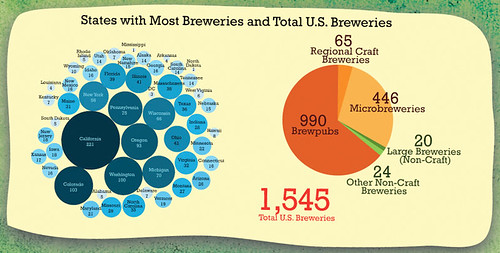
My friend and colleague Rick Lyke has the good fortune to have a son-in-law who’s a graphic designer and really, really good at creating graphs or infographics, which is essentially a chart that tell a story. For the second year in a row, Rick has persuaded his son-in-law, Mike Wirth, to create an awesome infographic of various GABF medal statistics for his Lyke2Drink blog. Since he introduced this back in August, about a month before this year’s GABF, hopefully he won’t mind my sharing it. I’ve parsed some of the most interesting mini-charts within the infographic and displayed them below.
most-breweries-vs-total
These charts show the number of breweries by state and the total number by type or size of brewery.
breweries-vs-medals
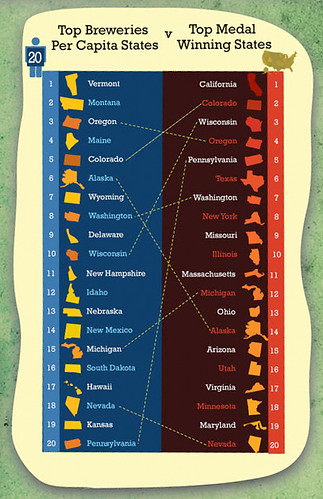
This is a chart of states with the most per capita breweries vs. the states that have won the most cumulative medals since they began awarding medals through 2008.
top-amer-breweries-09
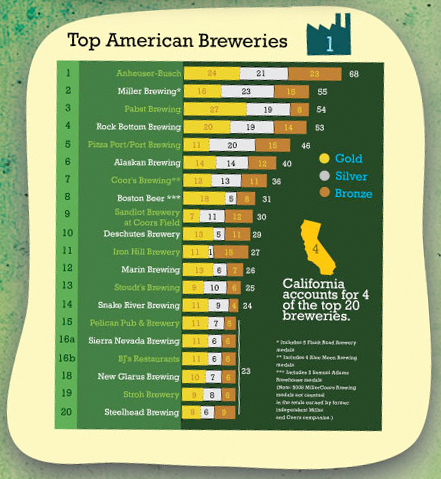
This is a chart of the breweries that have won the most cumulative medals since they began awarding medals through 2008.
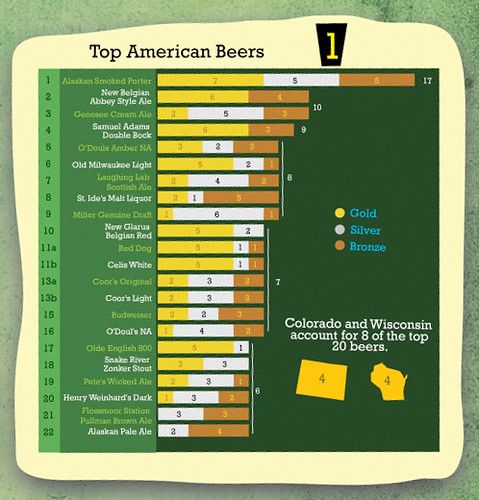
top-amer-beers-09
This is a chart of the individual beers that have won the most cumulative medals since they began awarding medals through 2008.
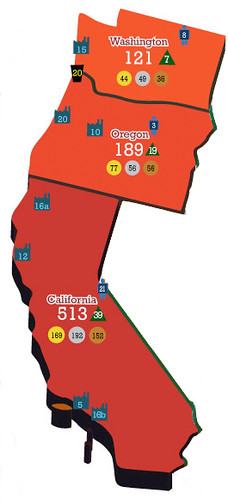
west-coast-gabf-medals
Lastly, here is a detail of the west coast and the medals won by breweries in California, Oregon and Washington.
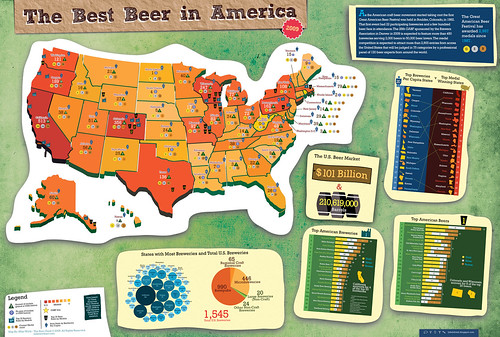
best-beer-america-2009
This is the entire infographic, show smaller of course, but click here to see it full size or see it at Mike Wirth’s website or with Rick Lyke’s original analysis.

Filed Under: Beers, Breweries, Just For Fun Tagged With: Awards, GABF, Statistics

Beer In Art #54: Vangobot’s 99 Bottles Pop Art

November 29, 2009 By Jay Brooks

art-beer
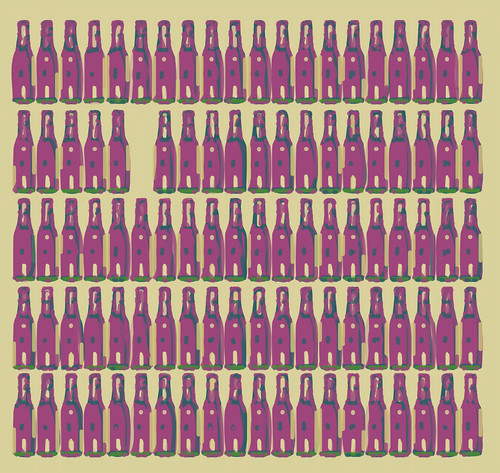
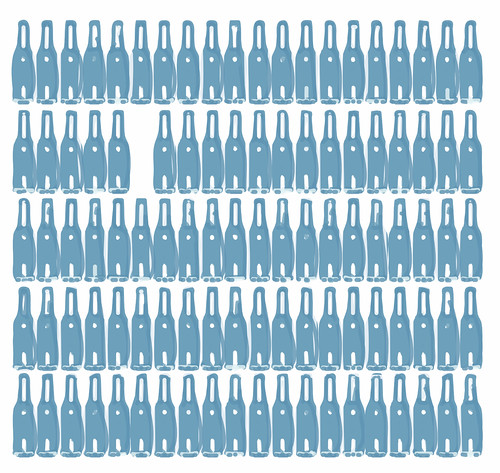
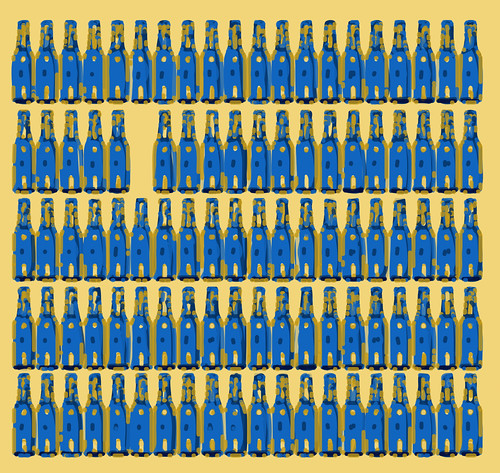
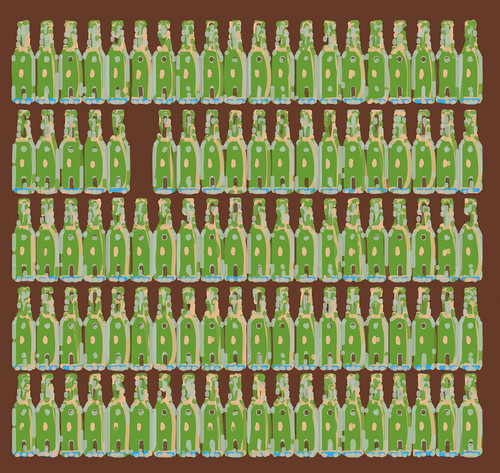
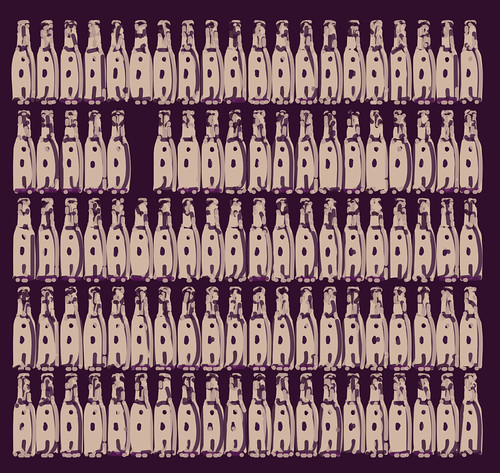
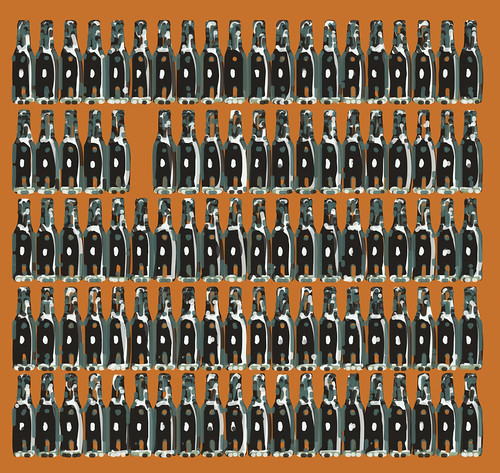
Today’s work of art may be one of the strangest pieces I’ve highlighted here, and may in fact stretch the definition of what actually constitutes “art.” The piece, or rather pieces, were designed by a human artist, but were painted by a robot, dubbed “Vangobot,” no doubt a reference to Vincent Van Gogh. The title of the work is a literal one, 99 Bottles of Beer on the Wall.

99_bottles-Reflect
99 Bottles of Beer on the Wall — Reflect.

The Vangobot is the brainchild of the Pop Art Machine and here’s their description:

Pop Art Machine is an experimental art suite that renders complex vectors portraying many different brush sizes, paint layers and brush handling techniques. The results can be printed but also physically painted with acrylics on canvas using a specialized CNC based robot named Vangobot.

There’s even a short video of Vangobot in action, painting.

99_bottles-Spring_Fashion
99 Bottles of Beer on the Wall — Spring Fashion.

There are fifteen different versions of 99 Bottles of Beer on the Wall, of which I’ve featured seven of them here. As far as I can tell, the names of each version have something to do with either their color scheme or an association made from that color.

99_bottles-Trident
99 Bottles of Beer on the Wall — Trident.

At the Pop Art Machine website there are over 20,000 paintings done by Vangobot.

99_bottles-Theology
99 Bottles of Beer on the Wall — Theology.

The website features Pop Art, a style that’s as much an attitude as a style. From Wikipedia:

Pop art is a visual art movement that emerged in the mid 1950s in Britain and in the late 1950s in the United States. Pop art challenged tradition by asserting that an artist’s use of the mass-produced visual commodities of popular culture is contiguous with the perspective of fine art. Pop removes the material from its context and isolates the object, or combines it with other objects, for contemplation. The concept of pop art refers not as much to the art itself as to the attitudes that led to it.

Pop art is an art movement of the twentieth century. Characterized by themes and techniques drawn from popular mass culture, such as advertising, comic books and mundane cultural objects, pop art is widely interpreted as a reaction to the then-dominant ideas of abstract expressionism, as well as an expansion upon them. Pop art, aimed to employ images of popular as opposed to elitist culture in art, emphasizing the banal or kitschy elements of any given culture, most often through the use of irony. It is also associated with the artists’ use of mechanical means of reproduction or rendering techniques.

Much of pop art is considered incongruent, as the conceptual practices that are often used make it difficult for some to readily comprehend. Pop art and minimalism are considered to be the last Modern Art movements and thus the precursors to postmodern art, or some of the earliest examples of Postmodern Art themselves.

Pop art often takes as its imagery that which is currently in use in advertising.[5] Product labeling and logos figure prominently in the imagery chosen by pop artists. Consider the Campbell’s Soup Cans labels, by Andy Warhol. Even the labeling on the shipping carton containing retail items has been used as subject matter in pop art. Consider Warhol’s Campbell’s Tomato Juice Box 1964, (pictured below), or his Brillo Soap Box sculptures.

99_bottles-Blue
99 Bottles of Beer on the Wall — Blue.

Some of the most well-known Pop Artists include Andy Warhol, Roy Lichtenstein, Jasper Johns and Keith Haring (who was born in Reading, PA but grew up in nearby Kutztown; I had his uncle as my art teacher in high school).

99_bottles-gone_walkabout
99 Bottles of Beer on the Wall — Gone Walkabout.

All fifteen versions of 99 Bottles of Beer on the Wall can be downloaded in the high resolution size of 3600 × 3406 so it can be printed fairly large, perhaps large enough to fill your wall.

99_bottles-Astoria
99 Bottles of Beer on the Wall — Astoria.

For about Pop Art, beyond Wikipedia, there’s also some good info at the Art Archive, Art Lex, World Wide Arts Resources and Pop Art Machine has a large collection of articles about Pop Art.

Filed Under: Art & Beer, Just For Fun

Toy Beer Trains

November 27, 2009 By Jay Brooks

train
Today, of course, is the busiest shopping day of the year. I’m staying home and drinking, as usual, but yesterday at my in-laws, my mother-in-law put up on the wall a giant poster where the grandkids could list all the toys they were hoping Santa might bring them this year. My son Porter filled out his entire section with requests for trains, particularly Lionel trains. He’s been obsessed with trains as long as I can remember. First it was Thomas the Tank Engine, then the I Love Toy Trains series, followed by Geo Trax. For a while now, though, he’s been fully engrossed in the expensive model trains, especially HO and G gauge, which seem to be his favorites. It what almost appears savant-like, he knows more about trains than anyone I know. To me, the old black steam trains all look alike but he sees them and cries “that’s the Big Boy” or the “GG-1” or some other unfamiliar name with complete certainty. I’d think he’s just making it up but recently at the barber shop, another man waiting his turn happened to run a local train museum and the two of them talked about trains like equals. The man confided in me later that my son had truly impressed him with his train knowledge, confirming what I’d always believed, that Porter really is as obsessed as I can be, just about different things. The apple really doesn’t fall very far from the tree.

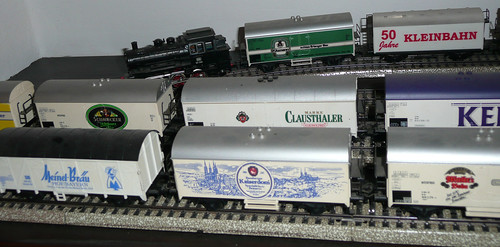
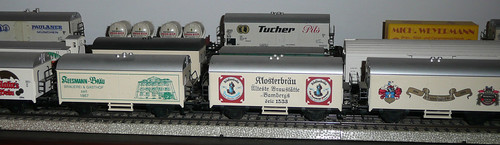
One thing that’s surprised me is that I see toy trains with breweries on them all the time. But what I’ve learned about model trains is that despite the word “toy” often being associated with them, there are far more adults collecting them than kids. For one thing they’re very, very expensive. So I suspect that’s why they can get away with so many beer-themed boxcars and the like. When we got home last night from or holiday feast, I decided to do a quick Google search for toy trains for breweries. Lots of lots of them, big surprise. There’s even a guy out there who collects toy beer trains, and he’s cataloged 780 of them with 658 photos. Check out The H.O. Beer Car Collectors Website and be amazed.

The most I’ve ever seen in one place is in Germany, at Weyermann Specialty Malt in Bamberg.
weyermanns-3
In Weyermann’s meeting room, the wall is completely filled with brewery signs and every available shelf, mantle and ledge has toy trains on them.

weyermanns-1
Mostly European brands, but there are a surprising number of American brewery trains, too.

Below is a slideshow of just a sampling of all the toy beer trains I found online. Most are from the The H.O. Beer Car Collectors, which is hands down the best resource I came across. The Flickr gallery is best viewed in full screen. To view it that way, after clicking on the arrow in the center to start the slideshow, click on the button on the bottom right with the four arrows pointing outward on it, to see the photos in glorious full screen.

Filed Under: Breweries, Just For Fun, Related Pleasures Tagged With: Christmas, Gift Ideas, Holidays

Hoppy Thanksgiving a.k.a. Beer & Turkey Day

November 26, 2009 By Jay Brooks

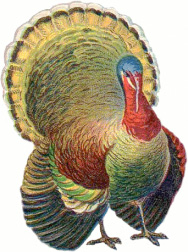
turkey
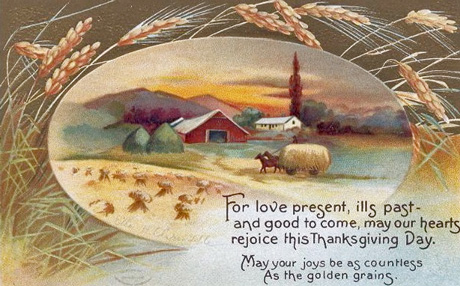
Hoppy Thanksgiving everybody. “May your joys be as countless as the golden grains.”

beer-and-turkey
For quite some time now — personally at least — Thanksgiving is really “Beer & Turkey Day.” I love turkey. I could eat it several times a week and not get tired of it. But unlike most people, I like it dry — no gravy. It stems from my Great Aunt Helen, who couldn’t make a turkey juicy to save her life, even though her heart was in the right place. And I never liked gravy all that much; weird, I know. As a kid, it just meant developing a taste for dry turkey. As an adult, it means finding the right beer to counteract the dryness I now love so much. Of course, making it wok with not just the turkey but also cranberry sauce, stuffing, potatoes and the rest of the feast is also a challenge.

For me, I’ve found that spicy beers work best for the Thanksgiving meal, the spicier the better for my purposes. Not everybody likes their beer spiced, I know, but my feeling is there are 364 other days when you can drink those.

My two favorites for Thanksgiving are Anchor’s Christmas Ale and Pike’s Auld Acquaintance.

Though Anchor’s “Our Special Ale” began in 1975 as essentially a brown ale, over the years since it became more holiday-oriented as spices were increasingly added. In my opinion, it’s best years were the later half of the 90’s decade when it was very spicy indeed. Though most people thought they were too spicy during that period of time, I reveled in the complex spiciness and found them to be the perfect complement to dry turkey and the other Thanksgiving fixings.

When Pike began making their Auld Acquaintance, they loaded it with spices and it quickly became my new favorite, especially when Anchor started backing off the spiciness of the Christmas Ale as the new millennium dawned. But early in the 2000s, it was discontinued in the bottle and I was unable to get it, returning instead to Anchor’s Christmas Ale, even though I wish it was spicier.

Happily, Pike under the new/old owners is bottling it Auld Acquaintance again, though it doesn’t appear to be exactly the same. It used to be around 6.5% abv, if memory serves, whereas the new bottle is a more modest 5%. It does contain orange peel, coriander, cinnamon and nutmeg. I also remember it being hoppy, while the 2008/9 version is only 32 IBUs.

turkey

So this year, happily I got to try both beers with dinner. I started with the Anchor, and it delivered almost everything I wanted, though I still pine for it to be even more spicy. But it certainly worked with my meal. The Auld Acquaintance, on the other hand, was slightly disappointing. It was thinner-bodied than I remember it and the spiciness was likewise more restrained. There was a lot there, but I wanted to be hit over the head, rather than be spoon fed. Still, I can’t complain. They both worked well and as I sit here writing this the rest of the family cleans up — and shoots me dirty looks — but I am completely satisfied. Ah, beer and turkey — a match made in heaven.

In past years, there were quite a few suggestions for beer and turkey pairings. Really, they’re almost all good suggestions. The important thing is family and friends. But the beer is the icing on the cake that makes the meal divine.

thanksgiving

Filed Under: Beers, Food & Beer, Just For Fun Tagged With: Holidays

The BA’s Newest Brewster

November 24, 2009 By Jay Brooks

ba
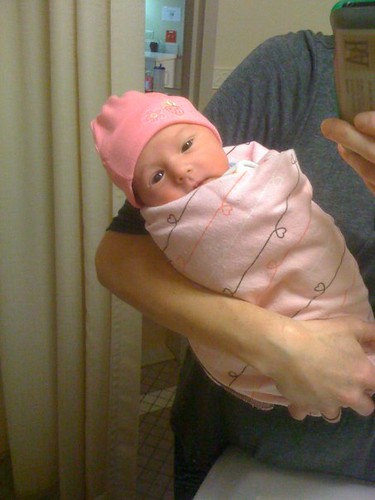
If you’ve spent any time in the brewing world or homebrewing, you know doubt know Erin Fay Glass, who’s the Membership Coordinator / Brewery Detective for the Brewers Association, while her husband, Gary Glass, is director of the American Homebrewers Association. On Thursday, they had their first child, a daughter. I spoke to Erin a few days before, and she just sent me the information below. Mother and child are doing great. Here’s what Erin had to say:

Been unplugged way more than usual. Maya Ryleigh is doing really well – certainly keeping us busy. We are totally, utterly smitten with this little gal. I see what people mean by a parent’s love. It’s like she’s been here all along.

Particulars:

Original Gravity: 6 pounds, 14 ounces
IBUs: 19.5 in.
Style: Girl
Release Date: November 19, 2008
Label: Maya Ryleigh Glass

Maya_Ryleigh
Maya Ryleigh

Maya_Ryleigh-2
Maya with her parents, Gary and Erin.

Filed Under: Just For Fun, News Tagged With: Announcements, Colorado

Bottle Openers Made By Blacksmiths

November 22, 2009 By Jay Brooks

opener-metal
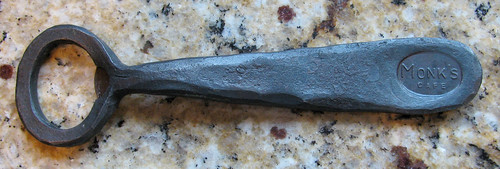
A few years ago, my friend Tom Peters, the co-owner of Monk’s Cafe in Philadelphia, celebrated a big anniversary, I can’t recall which one it was — five years maybe, ten? Anyway, he had a local blacksmith experiment with making the perfect bottle opener.

monks-opener

Then, once he had the best design, he had 100 of them made with his logo stamped on the handle. I was somehow fortunate to be given one (thanks Tom!) and to date it’s been my favorite bottle opener I’ve ever owned. It just feels right in your hand, the perfect heft. It pops any crown with very little effort and makes a pleasantly satisfying sound in the process. In short, it’s a pleasure to use. It makes me want to open more beer bottles.

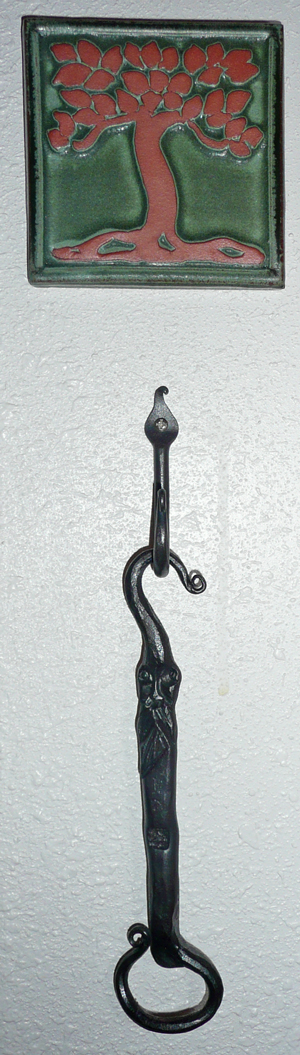
Last month, I was in Asheville, North Carolina on vacation with my family. In addition to wanting to check out their growing beer scene, there was a show we wanted to go to, the Craft Fair of the Southern Highland Craft Guild. My wife and I are huge fans of artisan crafts, hand made objects. It’s the same impulse that makes me love craft beer. We came home with a number of beautiful objects. But as we were first going in we happened upon a blacksmith set up outside the hall where the show was taking place. We stopped to watch him work and got to chatting. The blacksmith’s name was Alwin Wagener, and his business was known as Wagener Forge. He had a very interesting, cool looking corkscrew, so I told him the story of the Monk’s Cafe opener. He said he also had made bottle openers and asked how long we were going to be at the show, and we went inside for several hours. When we returned, he had made the opener pictured below.

It works as well as the Monk’s opener and is very cool looking, too. I love the green man’s face, with the hair looped up to hang it from. Because of strange state laws, we couldn’t buy it from him there and met him later at his studio, where we also picked up a handmade matching hook. The tile above it was also something we picked up at the craft fair. They two just seemed to compliment each other so I hung them together on the wall in our kitchen.

asheville-opener

Filed Under: Art & Beer, Beers, Just For Fun, Related Pleasures Tagged With: Packaging

Beer In Art #53: George Morland’s Alehouse Politicians

November 22, 2009 By Jay Brooks

art-beer
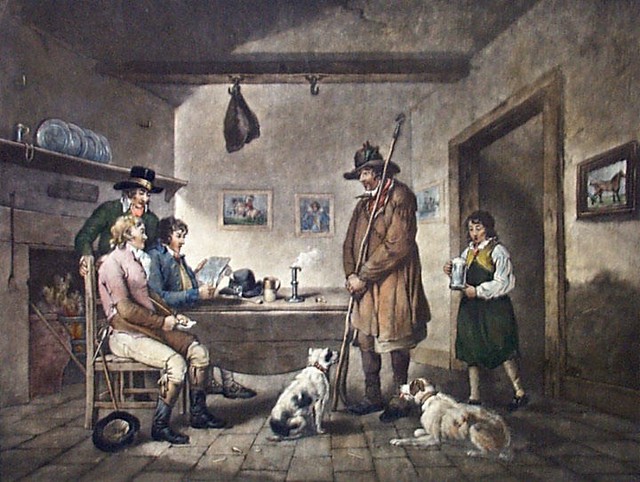
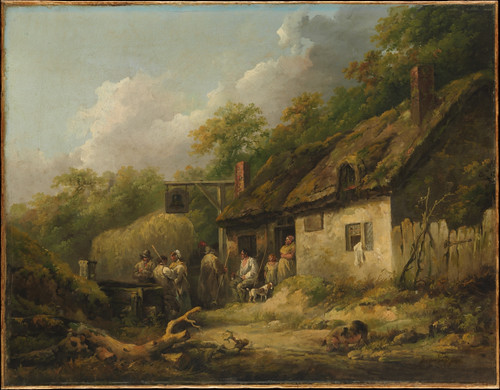
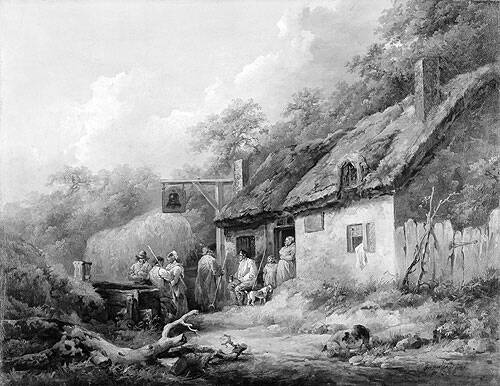
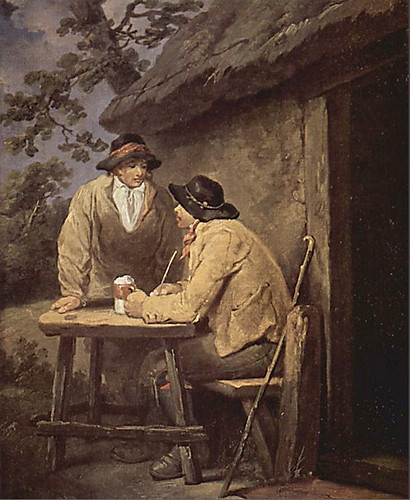
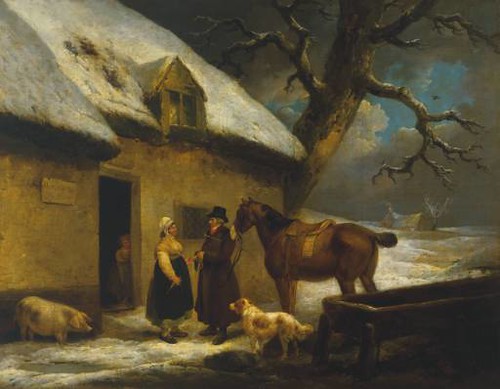
Today’s artist comes from the very early days of England’s artistic beginnings. Before the 18th century, there was little that could properly be called “English art.” At that time, most art came from France, Spain, The Netherlands, Germany and a few others. That’s who English painters studied. But that began to change in the mid-1700 with such painters as Thomas Gainsborough, William Turner, John Constable, George Romney, Henry Raeburn and today’s featured painter, George Morland. While others painted portraits and some city life, Morland concentrated on rural life and, naturally, the county inn was often featured in his works. The initial painting that led me to Morland, pictured below, is known as Alehouse Politicians,, most likely painted during the 1790s.

Morland-alehouse_politicians
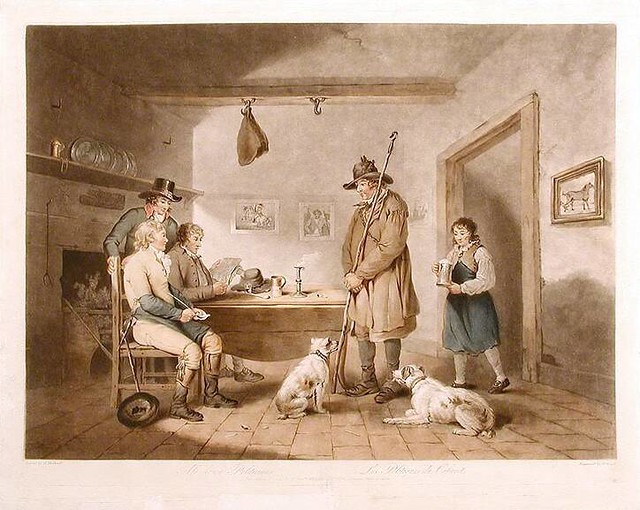
Like most of Morland’s popular paintings, others made copies of them as engravings to be sold to the public, such as this Mezzotint by W. Ward, published by Wards and Co. in 1801.

morland_alehouse_politicians2 (1)

Plenty more of Morland’s rural paintings depicted inns, such as the Fox Inn, painted in 1792.

Morland-fox_inn

Or The Bell Inn, from the Metropolitan Museum of Art:

Morland-bell_inn-color

Which itself was redone as a black and white engraving:

Morland-bell_inn

From his biography at Wikipedia:

Morland was born in London on 26 June 1763. His mother was a Frenchwoman, who possessed a small independent property of her own. His grandfather, George H. Morland, was a subject painter. Henry Robert Morland (c. 1719 – 1797), father of George, was also an artist and engraver, and picture restorer, at one time a rich man, but later in reduced circumstances. His pictures of Jaundry-maids, reproduced in mezzotint and representing ladies of some importance, were very popular in their time.

The finest of Morland’s pictures were executed between 1790 and 1794, and amongst them his picture of the inside of a stable, in Tate Britain, London, may be reckoned as a masterpiece. His works deal with scenes in rustic and homely life, depicted with purity and simplicity, and show much direct and instinctive feeling for nature. His coloring is mellow, rich in tone, and vibrant in quality, but, with all their charm, his works reveal often signs of the haste with which they were painted and the carelessness with which they were drawn. He had a supreme power of observation and great executive skill, and he was able to select the vital constituents of a scene and depict even the least interesting of subjects with artistic grace and brilliant representation. His pictures are never crowded; the figures in them remarkably well composed, often so cleverly grouped as to conceal any inaccuracies of drawing, and to produce the effect of a very successful composition. As a painter of English scenes he takes the very highest position, and his work is marked by a spirit and a dash, always combined with broad, harmonious coloring. He exhibited regularly at the Royal Academy from 1784 down to 1804, but few of his academy pictures can be identified owing to the inadequate description of them afforded by their titles.

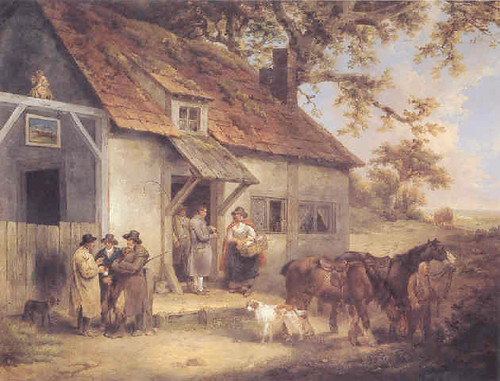
Here’s yet another one, Outside the Alehouse Door, painted in 1792.

Morland-before-tavern

And here’s one final painting, Outside an Inn, Winter, painted around 1795, and part of the Tate Collection:

Morland-outside_inn

If you want to know more about George Morland, his Wikipedia page is a good start, but there’s also a good biography at the Online Encyclopedia. The Sterling Times has the most complete collection of his prints and Google Books has an online book about Morland, George Morland: his life and works. ArtCyclopedia has a good collection of links and more of his works can also be seen at The Old Print Shop, Intaglio Fine Art, the Art Renewal Center and the Tate Collection.

Filed Under: Art & Beer, Just For Fun Tagged With: England, Pubs, UK

Star Trek’s Engineering Deck Brewery

November 21, 2009 By Jay Brooks

beer-trek
If you’re like me, you love what I call “brewery porn,” which is photos of brewing equipment either installed or by themselves. So when I watched the film reboot of Star Trek, I was convinced that portions of the movie — the engineering deck — were filmed inside a large brewery. Sitting in the darkened theater back in May, I remember thinking it looked a lot like Anheuser-Busch’s brewery in Fort Collins. But I forgot about it until last night, when I re-watched the film on DVD. It turns out I was half-right. It was filmed in a large Anheuser-Busch brewery, but it was the one in Van Nuys, California (which in retrospect makes sense, since it’s closer to Hollywood).

Reading over the Trekkie chatter about the movie, it appears that the decision to use the brewery as stand-in for the engineering deck was one of the least popular things about the new film. But perhaps what was most surprising was that, while to anyone reading the Bulletin or who’s been inside a brewery it was completely obvious, many people didn’t even realize what it was. But if you did know, it was a bit jarring and made it more difficult — as critics charged — to continue the suspension of belief necessary to get lost in the story. One common criticism I didn’t agree with was that while the rest of the ship was all shiny and new looking, the engineering deck (brewery) looked dark and dingy. But remembering the tours of cruise and military ships I’ve been on, that’s the way it often is. The places for the passengers are decorated for comfort and are appealing to the eye while in the places where it’s just for the employees, such niceties are ignored and decorated merely for convenience and functionality. Below are a few screencaps and other photos from the film inside the Anheuser-Busch brewery in Van Nuys. Being a Star Trek fan since I was a kid, I still liked the film and would recommend it on its own merits. Despite certain anomalies and inconsistencies, it was still entertaining and enjoyable to watch. Except, of course, for the brewery.

enterprise-brewery
Nuclear symbols were painted on the fermenters to make them look more reactor-like.

enterprise-brewery-2
A screen cap from the film inside the brewery in Van Nuys.

enterprise-brewery-5
Another screen cap, this one after the characters Captain Kirk and Scotty beam back aboard the Enterprise.

enterprise-brewery-3
Director JJ Abrams (in the foreground) directing Star Trek inside the A-B brewery.

enterprise-brewery-4
In this view, similar to the first one, you can see the flying camera used, and developed by J. Patrick Daily.

Filed Under: Breweries, Just For Fun, Related Pleasures Tagged With: California, Entertainment, Film, Southern California

Beer In Ads #6: Biere d’Alsace

November 21, 2009 By Jay Brooks

ad-billboard
The artist for today’s ad was born in the Alsace, in 1873, in what is today part of France. But two years before he was born, it belonged to the German Empire, who had annexed it after the Franco-Prussian War that began in 1870. Why is that relevant? Because Jean-Jacques Waltz, better known as “Hansi,” grew up hating the Germans and early in his career drew editorial cartoons poking fun at them. This won him few friends in Germany and in fact he even spent time in jail, “imprisoned several times by German authorities for making fun of the German military and professors.” In addition to putting down his captors, he wrote and drew scenes extolling Alsace’s virtues. One of his most famous works was a history of Alsace for kids by “Uncle Hansi,” L’Historie d’Alssace. The ad today features a girl in the traditional costume of the Alsace, and in fact it shows up in a number of Hansi’s works. I’m not sure if the illustration is advertising for a specific brewery of just beer from the Alsace generally. There is a brewery in Luttenbach (near the border between France in Germany in the Alsace) today known as Les Caves de la Brasserie. The date in the star, 1648, seems to suggest an older brewery, one that perhaps is no longer with us.

Hansi's Biere d'Alsace

Filed Under: Art & Beer, Beers, Just For Fun Tagged With: Europe, France, Germany, History

Breweries Have 5th-Most Satisfied Customers

November 18, 2009 By Jay Brooks

acsi
According to a new survey, released yesterday by the American Consumer Satisfaction Index (and tweeted my way by Anat Baron — thanks!), Breweries ranked 5th in overall satisfaction by consumers among industries polled by the group. Here are the first five with their score in parentheses (out of 100):

  1. Personal Care & Cleaning Products (85)
  2. Soft Drinks (85)
  3. Full Service Restaurants (84)
  4. Automobiles & Light Vehicles (84)
  5. Breweries (84)

For breweries, this is the highest marks they’ve received since this poll began, and represents a 1.2% increase over last year.

As reported by Brand Week, comfort foods like candy and beer continued to do well.

Beer manufacturers reached their highest level to date with a score of 84 (out of a 100-point scale) to mark a 1.2 percent change from 2008 rankings. Top companies included Anheuser-Busch InBev (85) and SABMiller (83), which grew 3.7 percent and 1.2 percent respectively from last year. Molson Coors Brewing (81) dipped by 2.4 percent, while “all others” maintained their rank at 83.

The ACSI had their own take on beer in their analysis:

Beer: A Comfort Drink?

Beer drinker satisfaction has soared to an all-time high in ACSI. It too seems to follow the pattern of chocolate and sweets, but perhaps a bit less pronounced. The industry improved 1.2% to an ACSI score of 84, led by a 4% climb for Anheuser-Busch to a score of 85. Just a year after it was acquired by the Belgian-Brazilian conglomerate InBev, Anheuser-Busch matched its biggest ever single-year gain to reach its highest level ever. InBev has made a number of changes in business strategy—it sold the ten theme parks owned by Anheuser-Busch to reduce debt and focus on core business, cut over 1,000 employees, and overhauled management. The company has seen increased sales of lower-priced brands such as Natural Light and Busch and of newer products such as Bud Light Lime and Golden Wheat varieties.

Results for Miller and Coors brands, which market under a joint operating agreement, were mixed. Miller improved slightly, up 1% to 83, while Coors dropped 2% to 81, falling to the bottom of the industry. The Coors brand portfolio is composed of a greater proportion of high-end entities and more high-priced brands compared with Anheuser-Busch. In the midst of an economic downturn, customers typically look more to value for money. Coors drinkers report a sharp decline in value for money.

The ACSI also noted a pattern during economic downturns:

“The same thing happened in 2001 in the midst of the previous recession and also in 2004 when concern over the Iraq war and rising fuel prices appeared to be reflected in higher satisfaction with comfort foods,” said Professor Claes Fornell, founder of the ACSI and author of The Satisfied Customer, in a statement.

Newspapers and Cable/Satellite TV tied for last, though Airlines were a close second-to-last.

Filed Under: Breweries, Editorial, Just For Fun, News Tagged With: Mainstream Coverage, Statistics

« Previous Page
Next Page »

Find Something

Northern California Breweries

Please consider purchasing my latest book, California Breweries North, available from Amazon, or ask for it at your local bookstore.

Recent Comments

  • Bob Paolino on Beer Birthday: Grant Johnston
  • Gambrinus on Historic Beer Birthday: A.J. Houghton
  • Ernie Dewing on Historic Beer Birthday: Charles William Bergner 
  • Steve 'Pudgy' De Rose on Historic Beer Birthday: Jacob Schmidt
  • Jay Brooks on Beer Birthday: Bill Owens

Recent Posts

  • Beer In Ads #5392: Anheuser-Busch Bock Beer November 14, 2026
  • Historic Beer Birthday: William IV, Duke of Bavaria November 13, 2026
  • Historic Beer Birthday: Hans Johann Claussen November 13, 2026
  • Historic Beer Birthday: Abram Nash November 13, 2026
  • Beer Birthday: Don Russell November 13, 2026

BBB Archives

Feedback

Head Quarter
This site is hosted and maintained by H25Q.dev. Any questions or comments for the webmaster can be directed here.