Brookston Beer Bulletin

Jay R. Brooks on Beer

  • Home
  • About
  • Editorial
  • Birthdays
  • Art & Beer

Socialize

  • Dribbble
  • Email
  • Facebook
  • Flickr
  • GitHub
  • Instagram
  • LinkedIn
  • Pinterest
  • RSS
  • Twitter
  • YouTube

Powered by Genesis

Time To Enter Our Beer Writing Contest

August 19, 2013 By Jay Brooks

nagbw-new
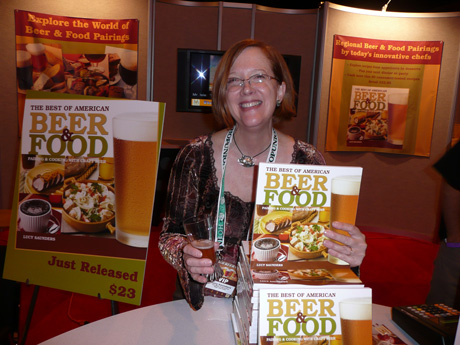
If you write about beer in print or online or broadcast, please consider joining over 100 of your colleagues in the newly reformed North American Guild of Beer Writers. Even if I can’t persuade you to join, if you’ve written something you’re proud of between July of last year and June 30 of this year, you should enter it in our NAGBW Writing Contest, which is open to non-members as well as guild members. Our goal is to raise the level of beer writing by rewarding the best efforts of our colleagues. “NAGBW’s awards honor the best beer and brewing industry coverage in seven categories. Journalism, feature writing, freelance authors, blogs and broadcast or published in print or online are eligible.” Don’t delay, because the deadline is coming up fast; it’s August 26.

nagbw-460

The seven categories are for Best Book, Magazine Writing, Newspaper (Paid Circulation) Writing, Brewspaper/Free Zine Writing, Beer Blog, Beer and Food Writing, and Broadcast/Podcast. The cost to compete is $30 per entry (but only $15 for members — see, you should join).

Submit your entry or entries online through our partner Submittable by next Monday, August 26. Again, that’s for work published or broadcast between July 1, 2012 and June 30, 2013. Online submissions are accepted at submittable.com, and print books may be mailed to: Lucy Saunders, Attn: NAGBW Awards, 4230 N. Oakland Ave. #178, Shorewood, WI 53211.

If you have any questions, contact www.nagbw.org via our website, drop me a line, or simply comment here. Award winners will be announced during GABF, date and time to be announced shortly. Perhaps I’ll see you there?

Filed Under: Beers, News, Related Pleasures Tagged With: Announcements, Awards, Beer Writers Guild, Blogging, Contest, NAGBW, Writing

Bud Blamed In Absurd E.R. Visit Study

August 16, 2013 By Jay Brooks

medicine
That the neo-prohibitionists are rife with propaganda is well documented, but this one may take the cake. A new study at John Hopkins, conducted by David Jernigan, appears to show that Budweiser is the most popular drink “most commonly linked to emergency room visits.” Apparently “Budweiser has 9.1 percent of the national beer market, and represents approximately 15 percent of the E.R. ‘market.'” After Bud, it was “Steel Reserve Malt Liquor, Colt 45 malt liquor, Bud Ice (another malt liquor), Bud Light, and a discount-priced vodka called Barton’s.” Another malt liquor brand, “King Cobra, account[s] for only 2.4 percent of the U.S. beer market, but accounted for 46 percent of the beer consumed by E.R. patients.” The conclusion, as reported by NBC News, was that “[o]verall, malt liquor and lower alcohol beer dominated consumption but vodka, gin, brandy and cognac were overrepresented, too.”

But despite all the attention and scary statistics and headlines — Alcohol Justice gleefully tweeted the headline Budweiser to Blame for Most Alcohol-Related ER Visits — the study itself is absurd. The story Sherrif A.J. retweeted was from Science World Report, and despite the headline, the story doesn’t back up the sensationalist tone of it at all. The “study,” if we can even call it that, consisted of giving a survey to 105 people at one inner city Baltimore E.R., in a predominately African-American neighborhood.

The study was done by David Jernigan, who in addition to being an associate professor in the Department of Health, Behavior and Society at the Johns Hopkins Bloomberg School of Public Health, is more importantly the director of the Center on Alcohol Marketing and Youth (CAMY), a notoriously anti-alcohol organization. That affiliation is not disclosed in any of the reports on this particular “study.”

Curiously, he does admit that both the Federal Trade Commission and the National Institute on Drug Abuse both told him personally that “this kind of research cannot be done.” Did he listen? Nope, he went right ahead and jumped to all sorts of conclusions, even though there’s no clear cut causality here whatsoever. And look how they conducted the study, and persuaded people to participate:

By using a drop down menu on a small notebook computer, the survey takers managed to obtain information from patients, and to include about 400 brands, in less than five minutes. At first, Jernigan, said, many patients refused to talk. But then the survey takers, with the permission of the emergency room staff, donned white coats. After that, patients talked freely.

See what they did? They put on white lab coats, so they looked like they worked there or were E.R. doctors, and tricked people into answering. Nice.

But the news was reported that, in fact, the conclusions were sound, especially in the headlines, which is only what a majority of people will see. The problems with the study, its limitations and lack of causality is buried toward the end, well after most people stop reading. The fact that it was done by essentially a neo-prohibitionist organization is never mentioned at all. And that certainly didn’t stop Johns Hopkins from issuing a press release. The study itself was published in the journal Substance Use & Misuse, under the title Alcohol Brand Use and Injury in the Emergency Department: A Pilot Study. But none of that stopped anybody from spreading the news about how Bud, and the other brands, are directly responsible for people visiting the E.R. It couldn’t be any other reason, right?

Filed Under: Beers, News, Politics & Law Tagged With: Anti-Alcohol, Prohibitionists, Statistics

Mosquitoes Prefer Beer Lovers

August 9, 2013 By Jay Brooks

mosquito
There was an interesting article recently in the Smithsonian’s Surprising Science entitled Why Do Mosquitoes Bite Some People More Than Others? The article provides a good overview about why some people get bitten more frequently than others, and some of the causes believed to account for this very real phenomenon.

An estimated 20 percent of people, it turns out, are especially delicious for mosquitoes, and get bit more often on a consistent basis. And while scientists don’t yet have a cure for the ailment, other than preventing bites with insect repellent (which, we’ve recently discovered, some mosquitoes can become immune to over time), they do have a number of ideas regarding why some of us are more prone to bites than others.

Some of the factors include blood type, carbon dioxide, exercise and metabolism, pregnancy, skin bacteria, the color of your clothing and even genetics. But the interesting one that stood out for me, of course, was beer.

Just a single 12-ounce bottle of beer can make you more attractive to the insects, one study found. But even though researchers had suspected this was because drinking increases the amount of ethanol excreted in sweat, or because it increases body temperature, neither of these factors were found to correlate with mosquito landings, making their affinity for drinkers something of a mystery.

That beer is a mosquito attracter was confirmed by a study with the wonderfully bland title Alcohol ingestion stimulates mosquito attraction (seriously, who comes up with the titles for journal articles, so often they’re just dreadful). Of course, even though they know that it’s true that drinking alcohol attracts more mosquito bites, they still haven’t a clue why.

I’d love to see a study of different kinds of beer to see if any particular kind is more attractive to mosquitos than another. Can you imagine the ad copy following that study? “Drink our beer at your next picnic and mosquitoes will leave you alone!”

Mosquito-Beach

Filed Under: Beers, Just For Fun, News Tagged With: Science, Statistics

Are Americans Turning Away From Beer?

August 6, 2013 By Jay Brooks

gallup-poll
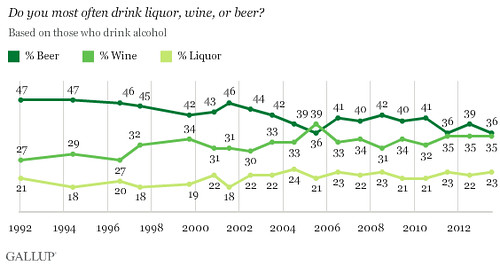
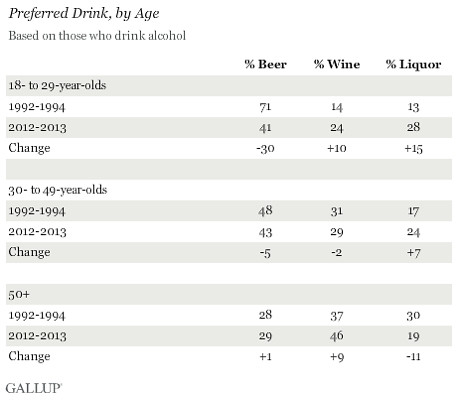
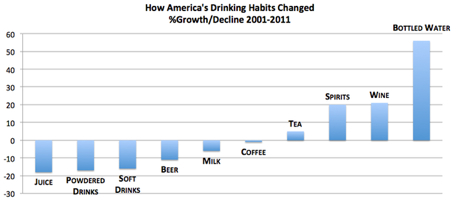
Well I can’t say that seems to be the case from my personal experience, but a new Gallup Poll is being spun that way, especially in an Atlantic article, Why Are American Drinkers Turning Against Beer? This particular Gallop Poll is done each year — since at least 1939 — and what you have to remember is that it’s a popularity poll, not necessarily a scientific one. The poll itself is conducted in a proper manner, but it’s asking people to “say what they drink” or “what they prefer.” And that’s far different from what the actual sales indicate. The last time I wrote about this was in 2010, when that year the Latest Gallup Poll Reveals Drinking At 25-Year High With Beer #1.

Gallop-2013-01

This year, the big story is “per capita consumption of beer down 20 percent,” as is overall production of beer. But as they continue to lump all beer together, when clearly patterns of drinking beer are changing, by keeping the poll simple they miss some of what’s really going on.

As my “beer brother” Lew Bryson commented. “Craft beer has been on a tear since 2002; latest figures have it up 15% annually (volume, 17% on $ sales). Volume sales of the majors are down, and trending downward steadily. Wine and spirits are picking up some of that, but craft is picking up a good share. It’s also worth noting that this IS a ‘what do you like’ poll, not ‘how much do you drink’ sales numbers. Beer still wins that by a sizable margin, both on volume and $ sales.” True indeed, when I wrote about this in 2010, beer outsold beer 4 to 1, showing just how skewed the difference is between what people say they like to drink, and what they actually drink.

One curious thing I wonder about these polls, and other alcohol data generally, is why alcohol is always divided up into these three tidy boxes? And where in these categories, if anywhere, is captured the sales, preferences or what-have-you for cider, alcopops, sake and other beverages that don’t seem to fit neatly into one of the big three. Are they ignored, or lumped into one of the three? It’s seems a fairly relevant question, since cider’s on a big upswing and alcopops have had their ups and downs, but certainly have to be part of the equation, especially when it comes to the all-important 18-29 demographic. But not even the full report gives any additional clues.

Gallop-2013-02

Another item that makes me question Gallup’s polling is the huge gains of bottled water. To me that has more to do with availability than anything else. It’s getting harder and harder to even find a water fountain these days, because business has figured out that people will pay for it when that have no choice.

Gallop-2013-03

Another explanation that didn’t ring true was that “American drinkers are more health-conscious today” and that’s led to people choosing other beverages, but even the author admits that this “does not adequately explain why Americans would turn against light beer,” as if that really is a healthy alternative. As I’ve said endlessly, low-calorie diet beer is hardly any healthier than non-light beers so that argument doesn’t hold any water … or even any watered-down beer.

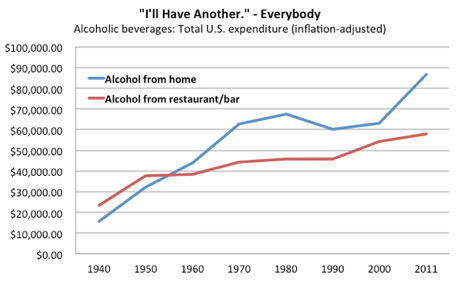
Happily, the day after this story ran on the Atlantic’s website, the same author posted The Death of Beer Has Been Greatly Exaggerated, in which Derek Thompson shows that, despite the Gallop Poll, “total U.S. spending on all alcoholic beverages — both at home and at restaurants and bars — is up 27 percent since 1980 and even more since the mid-century.”

Gallop-2013-04

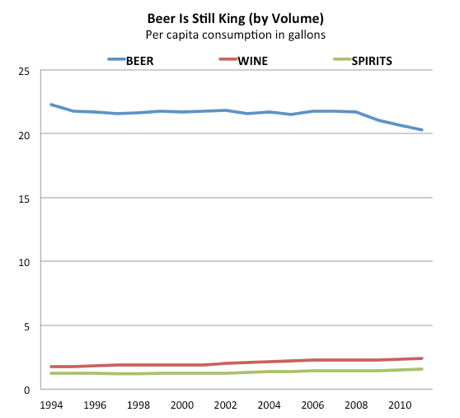
And as I mentioned earlier, beer currently still outsells wine by a significant margin, and his data also indicates that “beer volume still outsells wine volume by 8.5” times! So it’s pretty hard to swallow once more that beer is on the ropes.

Gallop-2013-05

Thompson sums up his two days worth of articles:

The total amount of beer consumed by Americans is in structural decline, and there are more wine-drinkers than there used to be. But beer is still the most popular boozy beverage in America and overall sales are holding up, thanks in part to the emergence of craft beers.

Did we really need another Gallop Poll or Atlantic business writer to tell us that?

Filed Under: Beers, Editorial, News, Politics & Law Tagged With: Mainstream Coverage, Poll, Statistics, United States

American Beer Sales Continue To Climb: BA Releases Mid-Year Numbers

August 5, 2013 By Jay Brooks

ba
You probably saw this last week, but just in case, the Brewers Association released the preliminary mid-year numbers on how beer sales are going so far in 2013. It’s probably no surprise to most that the news is good, with double-digit growth once more, a common story these days.

During the first six months of 2013, American craft beer dollar sales and volume were up 15 percent and 13 percent, respectively. Over the same period last year, dollar sales jumped 14 percent and volume increased 12 percent.

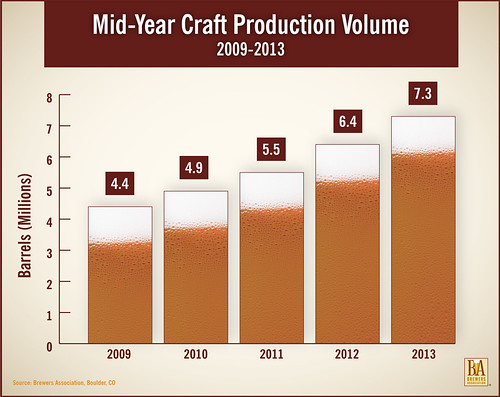
During the first half of 2013, approximately 7.3 million barrels of beer were sold by small and independent craft brewers, up from 6.4 million barrels over the first half of 2012. American craft beer continues to grow despite decreased overall beer sales, which were down two percent through the first six months of the year.

It’s nice to see the steady increases over the last five years.

MidYear_HR-2013

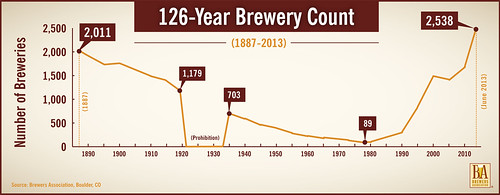
The number of breweries also continues the meteoric rise of late, with latest count standing at an amazing 2, 538.

There are 2,538 breweries operating in the U.S. as of June 30, 2013, an increase of 446 breweries since June 2012. The BA also lists an additional 1,605 breweries in planning at the year’s midpoint, compared to 1,252 a year ago. As of June 30, 2013, the count of craft breweries was at 2,483, showing that 98 percent of U.S. brewers are craft brewers. Craft brewers currently employ an estimated 108,440 full-time and part-time workers, many of which are manufacturing jobs, contributing significantly to the U.S. economy.

Brewery-Count-HR-2013

“More breweries are currently operating in the U.S. than at any time since the 1870s.” [Director of the Brewers Association, Paul] Gatza added. “With each new brewery opening, American craft brewers are reinforcing the U.S.’s position as the world’s most diverse brewing nation. It’s a very good time to be an American beer lover.”

Amen to that.

Filed Under: Beers, Breweries, News Tagged With: Brewers Association, Business, Statistics, United States

Cantillon’s Zwanze Day 2013 Announced

July 14, 2013 By Jay Brooks

cantillon
Cantillon just announced both the date — September 14 — and the participating bars for this year’s Zwanze Day. If you’re not familiar with it, here’s an overview I wrote about last year’s Zwanze Day for my newspaper column.

Belgium has essentially two separate regions, with the northern half known as Flanders. The language spoken there is a dialect of Dutch, known by the same name as the people of Flanders: Flemish. The word “zwanze” is unique to Flemish, has its origins in Yiddish, and essentially means a self-deprecating type of humor that’s typified by sharp-edged, playful jokes, usually good-natured. It’s said that this type of humor has become “a characteristic, defining trait” of the Flemish themselves, and for some a way of life. A “zwanze” is a joke, a “zwanzer” a joker.

It was with that same playful spirit that Cantillon approached the concept of making a Zwanze beer. The goal was to create a fun beer; something a little unusual, using non-traditional ingredients. This year’s Zwanze beer is made with rhubarb. The base beer is a Lambic, with two seasons, or summers, in wooden barrels. That’s then moved into a stainless steel conditioning tank where 300-grams of rhubarb per liter — about 2/3-pound — are added and aged for roughly three months, and then it’s kegged directly from the tank.

The first Zwanze beer was made in 2008, and was also a rhubarb beer. In subsequent years they’ve made it with elderflowers, pineau d’aunis (a red wine grape) and last year they brewed a sour witbier, made with the traditional coriander and orange peel. This is the only repeat so far, which was necessitated when the originally planned 2012 version — a Lambic take on a Trappist Abbey Ale — didn’t mature in time. Van Roy decided instead to make the rhubarb Lambic again, primarily because it was his wife’s favorite.

As a result, while it’s not been announced, I believe this year’s Zwanze Day beer will most likely be that Lambic take on a Trappist Abbey Ale that wasn’t quite ready last year.

zwanze-day-2013

A worldwide toast of the rare, unique beer will be held simultaneously at 46 beer bars and breweries across the globe, in 14 countries, mostly European. By far, the U.S. has the most, with 22, including four in California:

  • Beachwood BBQ — Seal Beach, California
  • Mikkeller Bar SF — San Francisco, California
  • Russian River Brewing — Santa Rosa, California
  • Stone Bistro & Gardens — Escondido, California

You can find the full list at Cantillon’s website.

Filed Under: Beers, Breweries, Just For Fun, News Tagged With: Announcements, Belgium

CNBC Closing Bell: Craft Beer Reviving The Economy

July 12, 2013 By Jay Brooks

cnbc
The CNBC show Closing Bell had Brewers Association Craft Beer Program Director Julia Herz on the program earlier today. Despite the host showing some ignorance of beer and asking a few hostile questions, Julia held her own and did beer proud.

Filed Under: Beers, Breweries, Just For Fun, News, Related Pleasures Tagged With: Brewers Association, Mainstream Coverage, Video

Synthetic Yeast

July 12, 2013 By Jay Brooks

yeast-cell
According to the UK Telegraph, a worldwide effort is underway to create Synthetic Yeast, which scientists believe will allow brewers to “make beer cheaper and stronger.”

From the article:

Researchers, who have been awarded £1 million of government funding for the project, will first attempt to recreate a slimmed down version of Saccharomyces cerevisiae, the yeast used in the brewing industry to ferment beer.

It will be the first time a genome has been built from scratch for a eukaryotic organism, the branch of the evolutionary tree that includes plants and animals.

The scientists then aim to redesign parts of the yeast genome so that it can perform functions that are not possible naturally.

Professor Paul Freemont, from the centre for synthetic biology and innovation at Imperial College London who is helping to lead the British part of the project, said they could help make yeast more efficient so they required less energy and could tolerate more alcohol before dying, allowing beer to be made stronger.

He said: “The brewing industry is very interested in this project for any new opportunities it may present as they use yeast to manufacture beer.

“One of the aims of the project is to develop this yeast strain as a vehicle that you can put in new chemical pathways and directly manipulate it in a way that is not possible at the moment.

“Clearly there are strains of yeast that are highly resistant to alcohol, but they all die off as the alcohol gets higher, so making more alcohol resistant strains will be very useful for that industry in terms of cost value.

“Strains that are metabolically more optimal and don’t require as much energy will also be useful.”

The synthetic yeast project, also known as Sc2.0, will draw together expertise from around the world.

I can’t quite decide yet whether I think this is a good idea, offering brewers many more choices and opportunities to create unique beers or a Frankenstein moment of science going too far in manipulating an essentially natural process. I guess time will tell.

beer-yeast

Filed Under: Breweries, News Tagged With: Science, Science of Brewing, UK, Yeast

Costco’s Craft Beer Sales

July 12, 2013 By Jay Brooks

costco
I just saw this interesting item on Drinks Business, a European news organization covering … well, the drinks business. When I think of the beer Costco sells, I tend to think of those ginormous 30-packs of megabrand cans or bottles. Many of those multi-packs were created just for Costco, Sam’s Club and other warehouse chains. But according to the article, “Costco has announced that craft beer now accounts for 30% of the company’s total beer sales.” That’s over 4-1/2 times the national average and over twice California’s market share. Impressive.
US-craft-beer

Filed Under: Beers, News Tagged With: Business

Modelo Agrees To Reduce Its Tied House Monopoly In Mexico

July 11, 2013 By Jay Brooks

mexico
I know governments have become increasingly beholden to business interests in my lifetime, but the idealist in me is unable to just be okay with that. It’s certainly true here in the U.S., where politicians are bought and sold, and the interests of ordinary folks rarely count for much in political decisions. And that’s unlikely to change while corporations are essentially immortals with all of the rights of people and none of the consequences or responsibilities, and whose profits have been declared free speech that can be used to influence our politics. Apparently Mexico’s government is similarly business-oriented. According to a story in today’s Wall Street Journal, “Mexico’s top brewer said Thursday it reached an agreement with the country’s anti-trust authority to limit its sales exclusivity contracts with corner stores, bars and restaurants, allowing more room for craft brewers and other players in a lucrative market split by Anheuser-Busch InBev’s Grupo Modelo unit and Heineken N.V.’s Cerveceria Cuauhtemoc Moctezuma.”

In a world where people mattered, a government would tell companies what the rules are and expect them to follow them. Negotiations would be, and frankly should be, unnecessary. But that’s not the way the world works anymore, if indeed it ever did.

More from the Journal piece:

Modelo said in a statement it would cap such agreements to no more than 25% of its points of sale, with the aim of reducing that number to 20% by 2018. The brewer said it would also allow craft brewers to sell their beers in bars and restaurants where Modelo has locked in exclusive pouring terms.

…

The Mexican beer market, the world’s fifth-biggest according to Euromonitor, is a virtual duopoly, with Modelo brands like Corona claiming around 58% of the 67 million hectoliters of brew sold in Mexico each year, while Cerveceria Cuauhtemoc brands like Tecate account for 41%.

Around half of the beer sold in Mexico each year is channeled through small convenience stores, many of which agree to sell only one of the two brewers’ brands in exchange for branded awnings, signs or refrigerators, as well as discounts on beer purchases, credit and even assistance with local permits.

The country is Heineken’s largest market, accounting for about 16% of sales, while it represents around 13% of AB InBev’s pro forma sales, according to Credit Suisse.

Nice that Modelo will “ALLOW craft brewers to sell their beers in bars and restaurants.” How magnanimous. While the Wall Street Journal, itself as pro-business as they come, ignored the reasons for Modelo’s change of heart, Beer Business Daily reveals why they’ve agreed to soften their monopoly. It’s because the Mexican Federal Competition Commission ruled, 4-1, “that future exclusive contracts that Cuauhtemoc and Grupo Modelo have with retailers be limited in nature.” If they don’t, they could be fined up to 8% of their total income. According to Harry, currently the two biggest Mexican brewery’s “exclusive contracts with retailers account for about 85% of total volume.”

More from Beer Biz Daily:

The CFC ruled that craft brewers (such as Cerveceria Minerva and Primus) that manufacture beer in Mexico (under 100m hectos a year) should have unfettered access to restaurants, bars, and cantinas, and that big brewers’ exclusive contracts with accounts should not exceed 25% of the total outlets they do business with, which is reduced to 20% over five years. Current contracts are allowed to continue in effect without change until they expire.

I find it odd that Heineken apparently responded with a press release saying “that it will abide by the new rules and ‘standardise and simplify some of our future contracts with customers.'” How nice that they let us know they’ve agreed to follow the law. That’s what drives me crazy about the large multinational corporations with economies bigger than many nations. But at least it’s some good news for Mexico’s smaller breweries and their burgeoning craft beer scene.

Filed Under: Breweries, News, Politics & Law Tagged With: Anheuser-Busch InBev, Mexico, Modelo

« Previous Page
Next Page »

Find Something

Northern California Breweries

Please consider purchasing my latest book, California Breweries North, available from Amazon, or ask for it at your local bookstore.

Recent Comments

  • Ernie Dewing on Historic Beer Birthday: Charles William Bergner 
  • Steve 'Pudgy' De Rose on Historic Beer Birthday: Jacob Schmidt
  • Jay Brooks on Beer Birthday: Bill Owens
  • Steve 'Pudgy' De Rose on Beer Birthday: Charles Finkel
  • Steve 'Pudgy' De Rose on Beer Birthday: Bill Owens

Recent Posts

  • Beer In Ads #5189: The Bock Of The Town February 1, 2026
  • Historic Beer Birthday: Leo Van Munching Sr. February 1, 2026
  • Historic Beer Birthday: John Thomas February 1, 2026
  • Historic Beer Birthday: Johann Schiff February 1, 2026
  • Beer In Ads #5188: Aged Bock Beer Is Always In Season January 31, 2026

BBB Archives

Feedback

Head Quarter
This site is hosted and maintained by H25Q.dev. Any questions or comments for the webmaster can be directed here.