Brookston Beer Bulletin

Jay R. Brooks on Beer

  • Home
  • About
  • Editorial
  • Birthdays
  • Art & Beer

Socialize

  • Dribbble
  • Email
  • Facebook
  • Flickr
  • GitHub
  • Instagram
  • LinkedIn
  • Pinterest
  • RSS
  • Twitter
  • YouTube

Powered by Genesis

Finnish News Anchor Fired For Drinking Beer On Air

October 15, 2010 By Jay Brooks

finland
I’m not sure who moominvillea is, but they appear to have set up a twitter account for the sole purpose of tweeting news outlets about what he’s calling “beergate.” I don’t know much, but apparently “Finnish news anchor Kimmo Wilska [was] reporting on misconduct of bars selling alcohol [and was caught on camera pretending to drink a bottle of beer]. He was fired later at same day.”

According to the Helsinki Times:

The Finnish Broadcasting Company (YLE) has sacked Kimmo Wilska, a newsreader who pretended to drink from a beer bottle during a bulletin featuring a report on alcohol licence inspections on Wednesday.

Wilska had worked for YLE’s English-language service on an occasional basis.

Timo Kämäräinen, a managing editor in charge of the English-language service, said the public broadcaster did not tolerate the kind of behaviour seen on Wednesday in any of its news bulletins.

The UK’s Asylum adds the following details:

In what turned out to be his last on-air report for YLE, Finland’s second-largest TV channel, [Wilska] carried out a rather amusing prank that unfortunately got him oh-so-very-fired.

As you’ll see from the clip below, as he speaks over footage of beers being poured, the camera quickly cuts back to the studio to show Kimmo, beer in hand, the amber nectar dribbling out of the top.

He swiftly puts the boozy beverage down, and carries on with his report. A joke, of course, but his bosses failed to see the funny side, promptly giving him the boot.

Known as ‘Finland’s Barry White’ because of his sonorous voice, a Facebook support group has already sprung up, defending Kimmo for a joke he promises wasn’t meant to be aired, and was solely for the crew’s amusement.

A Facebook support page, the Kimmo Wilska Support Group, as of this evening has attracted over 48,000 supporters. Even the L.A. Times is covering the story.

Below is the video, at least for now. Several sources are saying that YLE is “forcibly remov[ing] the YouTube video claiming copyright law, even though there are GAZILLIONS of other YLE videos on YouTube. They seem to be particular[ly] angry about this one.” If it’s gone, just search his name and you’ll undoubtedly find another version, because I don’t think YLE will be able to shut down all of them now that it’s gone viral.

At first blush, it certainly seems like the television station’s knee-jerk reaction to fire him was a fairly stupid decision.

Filed Under: Beers, News, Politics & Law Tagged With: Europe, Finland, Mainstream Coverage, Video

European Study Shows Raising Beer Taxes A Bad Idea

October 15, 2010 By Jay Brooks

brewers-europe
Earlier this month, the Brewers of Europe — a trade organization of European breweries — released the results of an independent study they commissioned by PriceWaterhouseCoopers. They asked PWC to “quantify the impact of excise taxes on the overall tax collection, and employment and profitability in the brewing sector compared to other alcoholic beverages.” In Europe, like in the United States, a poor economy coupled with tireless anti-alcohol organizations are causing some politicians to look to the alcohol industry to help fund problems not of their making in the form of higher taxes. The entire report, Taxing the Brewing Sector: A European Analysis of the Costs of Producing Beer and the Impact of Excise Duties, is available online.

They also released a press release, highlighting the findings. From the press release:

“The study provides strong evidence that arbitrary increases in excise tax would hit brewers — and the 1.8 million jobs created in the European hospitality sector generated by the brewing sector — hard just as the economy is striving to emerge from a deeply damaging recession. The study also shows that tax increases will ultimately NOT increase government revenues nor attain the expected levels.”

The study comes at a crucial time, with skyrocketing taxes on beer in some European countries as governments scramble to rake in cash. “At a time when regulators across Europe are looking at scenarios about taxation, we would urge them to give any plan a full economic reality check,” [said] Pierre-Olivier Bergeron, [secretary-general of the Brewers of Europe]. “This study provides the data for sound judgments.”

A comparative cost analysis within the study shows that producers of alcoholic beverages constitute a significant industry within the EU, worth €242.5bn in 2007 in terms of sales. Sales of beer account for the highest proportion by value — €111.5bn or 46%. Beer contributed the highest amount of taxes to Member States across the EU and the lion’s share of jobs.

“This study shows that beer is the most expensive form of alcohol to produce,” observed Pierre-Olivier Bergeron. “So any move toward taxing all drinks based solely on alcohol content (‘unitary taxation’) would disadvantage a low alcohol beverage such as beer further in terms of cost of the product to the consumer.”

The study shows that an increase in excise taxes on the beer and hospitality sectors would be negative in terms of employment and tax collection. This is because increases in excise tax revenue are more than offset by decreases in the revenues obtained by the Government from personal and corporate income taxes, social security payments and, in some cases, from value added tax (VAT).

“The excise tax research shows that a 20% increase in beer excise taxes at national level across Europe would lead to loss of over 70,000 jobs and a fall in government revenues of €115 million EU-wide, due to lower sales and lower income from VAT and corporate taxes,” adds Pierre-Olivier Bergeron. “Also an increase of current EU minimum rates of excise tax will have no beneficial impact on the EU’s internal market or on national treasuries concerned. Plainly this is an ineffective measure for improving public finances and detrimental for brewers.” Bergeron concludes: “Europe’s brewing sector fully backs Europe 2020, the European strategy for smart, sustainable and inclusive growth. Our call for good sense and reason on the excise duty front fully meets the strategic objectives the EU has rightly set for itself, particularly in terms of fostering a high-employment economy.”

Perhaps the biggest finding is how many jobs would be lost if excise taxes were increased. The Marin Institute and the City of San Francisco insisted there would be no job losses if their recently proposed alcohol tax for the city passed. They were quite insulting, I believe, to the concerns of both local businesses and workers for even suggesting that was a potential outcome. This EU study does appear to lend credence to the claims made by many critics of the San Francisco Alcohol Tax, especially the California Alliance for Hospitality Jobs.

Naturally, critics of this study will undoubtedly point to its origin, having been commissioned by a trade organization. But the Brewers of Europe appear to have been very diligent in making the study as impartial as possible, and, perhaps more importantly, they’ve been extremely transparent and up front about their sponsorship of the study. That’s something that American anti-alcohol groups have not been as forthcoming about, with the more common scenario being that they fund academic institutions to conduct a study and then all but hide that fact, or at a minimum downplay it. Those same groups then use the studies they themselves commissioned in propaganda that tries to make them appear impartial or from an independent source, as was seen recently in the City of San Francisco’s nexus study supporting the alcohol tax. So at least this study involved no such subterfuge. People know exactly where it came from, can read the report and draw their own conclusions in full command of all the facts.

Filed Under: Breweries, Editorial, News, Politics & Law Tagged With: Europe, Prohibitionists, Science, Statistics, Taxes

Yuengling To Buy Former Coors Brewery In Memphis

October 14, 2010 By Jay Brooks

yuengling-eagle
The Wall Street Journal is reporting that Yuengling Brewery of Pottsville, Pennsylvania is close to finalizing a deal to purchase the brewery in Memphis, Tennessee formerly owned by Coors. Yuengling has signed a letter of intent to buy the brewery for an undisclosed amount and the deal is expected to close in a few weeks. This will be Yuengling’s fourth brewery, as they currently own and operate three breweries, two in Pennsylvania and one in Florida.

The brewery was originally built by Schlitz in 1971 and then Stroh’s operated it for a time before selling it to Coors, where they brewed their Blue Moon line of stealth micros, along with Zima and Keystone. MillerCoors shut it down in 2006 and I seem to recall there were some labor disputes there, too. Then later that same year it was sold for $9 million and it became the Hardy Bottling Co..

Filed Under: Breweries, News Tagged With: Business, Pennsylvania, Tennessee

SABMiller Proposes Floating Brewery

October 12, 2010 By Jay Brooks

ship-cargo
SABMiller put out a press release today with their prediction for the future of breweries, “given a range of different scenarios determined by the cost and availability of water and energy.” Below is the text fro the release.

Working with innovation consultancy, Innovia Technology, SABMiller envisioned four plausible business environments, based on the different uncertainties facing the brewing industry over the next 30 years. These scenarios informed thinking around how the ‘Brewery of the Future’ might look under different circumstances, with some surprising results.

The most extreme scenario, ‘Marginal Survival’ envisaged a market with limited access to water and high energy costs. This scenario – where people would migrate from areas of water shortage or turbulent weather -provoked the most unorthodox response. One of the proposed solutions was a smaller, mobile brewery which would move from place to place on the back of a ship.

floating-brewery

Rob Wilkinson, Director of Innovia, said: “The descriptions are intended as food for thought rather than as blueprints for building new facilities. However, the example of the brewery on a ship is entirely feasible. It would allow for rapid entry to new markets, especially where no infrastructure is in place, it would provide flexibility in positioning and length of stay and allow SABMiller to move with water sources, with people, with crops, or even away from severe weather, natural disasters or political instability.”

Maurice Egan, SABMiller’s group head of manufacturing said: “Whilst this research has produced some imaginative solutions, the business case behind the thinking is very serious. We need to ensure that, given the rapid pace of technological developments, the impacts of climate change and growing wealth in developing economies, SABMiller has the capability to define, design and deploy our future breweries and supply chains.”

In another scenario ‘Energy Deprived’, where energy prices and the cost of transport are high but water plentiful and cheap, the brewery is closely integrated with the community, sharing facilities and resources. For example, local farmers might use the brewery mills for processing crops, while the brewery would use their agricultural waste to create bio-fuel as an energy source; the kilns used for malting barley might also be shared with local businesses as a facility for drying paper pulp. The resulting brewery would be a sustainable building looking not unlike the Eden Project in Cornwall where hot processes are timetabled for the day and cold processes during the cooler night in order to optimize resource use.

The other two scenarios envisaged were:

‘Water Scarce’, where energy costs are low due to large scale investment in alternatives to fossil fuels, but water is in short supply exacerbated by population increases coupled with climate change. In this case, the brewery would be highly optimised for low water use, using less than 2 litre of water to produce 1 litre of beer compared to SABMiller’s current average of 4.5 litres; this would be achieved in part by implementing a continuous brewing system and in part by advanced water treatment technologies.

‘Plentiful Supply’ describes a world self-sufficient in both water and energy, which benefits from low transport costs, abundant rainfall and robust water infrastructure. In this cornucopia sustainability and environmental stewardship remain key drivers. For example, the brewery would use natural processes to upgrade waste or extract valuable chemicals from it so as to reduce environmental impact. Power would be derived from renewable sources such as solar panels, rainwater would be collected and as much water as possible recycled.

Filed Under: Breweries, News Tagged With: Announcements, Science of Brewing

The Texas Craft Beer Boom

October 11, 2010 By Jay Brooks

texas
The Houston Chronicle has a great article on the growing craft beer scene in Texas, Swimming in Beer, The state is seeing a boom in craft brews as more players jump into an unquenched market. Like the country as a whole, a lot of new breweries are being planned and are opening, despite a poor economy in many other sectors.

Filed Under: Breweries, News Tagged With: Southern States, Texas

Son of Binge Drinking Statistics Inconsistencies

October 6, 2010 By Jay Brooks

binge-modern
If you read my previous post about Inflating Binge Drinking Statistics, you’ve seen how data can be manipulated and essentially bent to any purpose. Today a second news item in U.S. News & World Report, 1 in 4 U.S. Teens and Young Adults Binge Drink, presents yet another portrait of reality using binge drinking data from the CDC.

This one focused more on underage drinking, declaring that 1 in 4 U.S. teens and young adults are binge drinkers. According to CDC director Dr. Thomas R. Frieden, “[n]inety percent of the alcohol consumed by high school students is consumed in the course of binge drinking.” Frieden goes on to say that “[a]mong drinkers, one-third of adults and two-thirds of high school kids binge drink, but doesn’t that contradict the 1 in 4 statistic and the 90% declaration? Which is it: 25%, 66% or 90%?

Beyond the fuzzy math, that high school students binge drink is a bit of a duh statistic, they don’t exactly have much choice under the circumstances. That’s because all underage drinking is done underground, none of it is out in the open. So any time they do get a chance to drink it’s without supervision. And that’s a direct result of the minimum age being 21 instead of 18 and also because not only is education not available, but is even considered criminal in some states. It was not unusual when I was a teenager for parties where alcohol was served to be chaperoned by parents with the full knowledge of other parents, too. Today, that would be cause in many places for arrests and jail time. But as a result of adult supervision, I never witnessed any problems at those parties and they were very safe. But thanks to zealotry and a no tolerance policy such safe environments are now impossible.

Another discrepancy is that in the U.S. News & World Report, the CDC claims that “more than 33 million adults have reported binge drinking in the past year.” That’s in contrast to the NPR story, in which the CDC claims that “half of all alcohol consumed by adults in the US is binge drinking.” Then on the CDC’s website there’s a map of the U.S. showing binge drinking averages by state, with the lowest state being Tennessee (with 6.8%) and the highest being Wisconsin (23.9%).

Filed Under: Beers, Editorial, News, Politics & Law Tagged With: Health & Beer, Prohibitionists, Science, Statistics

Biting the Hand That Feeds You

October 6, 2010 By Jay Brooks

ribbon-pink
This has has me seriously steaming mad. As you may know, October is Breast Cancer Awareness Month. The brewing community, particularly locally, has done much to help that cause and raise money for breast cancer research and treatment. Marin Brewing has been putting on the Breastfest for ten years now, and the annual beer festival was specifically created to benefit breast cancer awareness. As a side note, Marin County inexplicably has one of the highest rates of breast cancer in the country.

Natalie Cilurzo, co-owner of Russian River Brewing in Santa Rosa, goes all out every October with their All Hopped Up For the Cure campaign to raise money for the cause. For the last few years, they’ve decorated the brewpub in pink and auctioned a pink Vespa. It’s a cause that’s very personal to her and she spends a lot of time and energy on it every year.

rr-ribbon

That’s just the Bay Area. In Atlanta, there’s a Beer 4 Boobs beer festival. There are similar breast cancer charity events at breweries and in the form of beer festivals all over the country. Boulder, Colorado has one at Boulder Beer Co. and the Lost Abbey in San Diego sponsored an event along with White Labs. The Ladies of Craft Beer also held a “Beer for Boobs Brunch” at Denver’s Freshcraft restaurant. And that’s probably the tip of the proverbial iceberg.

My own mother died from breast cancer when I was only 22, nearly thirty years ago. I’ve lived virtually my entire adult life without the comfort and counsel of my mother so it’s pretty personal to me, as well. As a result, I’m quite proud that the brewing community is so supportive of a cause that’s near and dear to me and many of my friends.

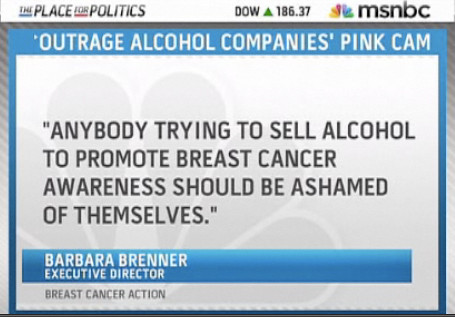
But apparently I shouldn’t be proud of that. In fact I should be ashamed of it. That’s what Angela Wall of Breast Cancer Action in San Francisco said on MSNBC yesterday. And it wasn’t just an offhand remark, it was the considered position of her organization. They even put up a prepared graphic with the same quote, but from Executive Director Barbara Brenner telling me a second time how ashamed I should be that the brewing community might try to help her cause.

breast-cancer-2

This reminds me a bit of when Anheuser-Busch put water in plain white beer cans with only their logo and where the water came from and then sent them to Haiti to help with earthquake relief. The Marin Institute had the temerity to chastise them in a press release for putting their logo on the cans and, wait for it, sending out a press release about it. I wrote all about that in Let No Good Deed Go Unpunished.

This is the same thing. But there’s a couple of ways to look at her problem with alcohol companies raising money for breast cancer. First — for purposes of discussion — let’s assume that alcohol does indeed cause breast cancer. The Marin Institute has this hokey idea of “charge for harm” where they believe that whatever “harm” is caused by people drinking alcohol should have to be paid for by the companies who make it. It’s a specious argument, but again — just to talk about it — let’s say that they’re right. Wouldn’t the industry actually paying money for their supposed harm be a good thing, exactly what their critics think they should be doing? That they’re raising money for breast cancer should be seen as a good thing, shouldn’t it? If they think the alcohol industry is causing the problem, then this should be exactly what the industry should do. But they don’t, do they? They think the industry shouldn’t be doing that, and they think they shouldn’t be trying to make a profit either.

Wall claims that “trying to sell alcohol to promote breast cancer awareness” is “shameful” because alcohol also carries a risk of breast cancer. But that makes no sense. Does she think for that reason alone, alcohol companies should simply just go out of business and stop making their products? Obviously, that would harm the economy and put thousands out of work. And of course, not everyone who drinks will get breast cancer. So presumably she’d prefer that the alcohol companies simply not raise money for her cause, but that seems counter-intuitive since it’s money that funds research into finding a cure for breast cancer. But since no one’s going to stop making alcohol just on her say so, I honestly don’t understand why she’d turn down money that might actually help find a cure if it didn’t come from the “right” source.

I would very much want there to be a cure for breast cancer found, if for no grander reason than I hope no one else has to go through losing their mother at a young age. I’m sure many people feel that way, and a number of them probably also work in the alcohol field. Some of them are my friends. But here Wall is telling me we should be ashamed of feeling that way because we work in the alcohol industry. I have to say, that pisses me off but good. I don’t think I’ve ever felt so conflicted about wanting to help a cause but feeling deeply offended and insulted by some of the people and organizations involved in it.

But perhaps the most telling part of the interview was when the MSNBC reporter remarked that one alcohol company had donated $500,000 to breast cancer awareness causes and then she asked a simple, direct question of Wall. “Do you think that money should be given back?” Wall hems and haws, but refuses to give a yes or no answer, indeed never really even addresses the question. Clearly, she’s not giving the money back. But the brewing industry, we’re the hypocrites?

On a post at their Think Before You Pink blog about this MSNBC appearance, they state that “[w]hile we do believe that the media focuses too heavily on lifestyle (diet and exercise, for example) in discussion of breast cancer risk, it’s irresponsible for companies to encourage people to ‘drink year round for breast cancer.'” So what Breast Cancer Action is saying is that they don’t like the media or how it covers breast cancer, but they’re still willing to use it when it suits them by appearing on it to further their agenda and get their message out. So I ask again, it’s the alcohol industry who’s being hypocritical by raising money for breast cancer?

One other quite strange argument made by Angela Wall for why alcohol companies should not be raising money for breast cancer was that it was no longer necessary. She said. “I don’t think anybody in this country is unaware of breast cancer in this month.” Oh, really? I guess we’re done with this issue, no more awareness or money is needed, the fight is over. Good job everybody, you can go home now. Of course, then why bother to keep designating October as Breast Cancer Awareness Month? If their work is done, why bother? You get the feeling she really hates us, if she’d go so far as to try and convince people that whatever money we raise isn’t even necessary. But I guess we should be getting used to that. Being in the alcohol industry is increasingly like being the fat kid at model camp. Everyone feels like they can make fun of us and attack us because, you know, we’re fat after all.

breast-cancer-1

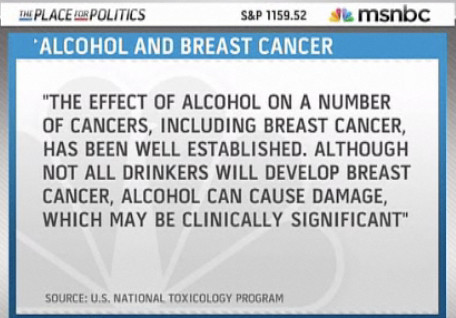
The basis for Breast Cancer Action’s outrage is the results of one new study in the Journal of Clinical Oncology that “found drinking alcoholic beverages, including wine, beer and liquor, may increase risk of breast cancer recurrence, particularly among postmenopausal and overweight and/or obese women.” That’s as reported in a story in Food Consumer, which also cherry picks a few other studies which show similar risks. But that’s not exactly the whole story nor is this exactly as settled as they’d like you to believe, not by a long shot. While studies do indeed appear to show an increased risk of breast cancer in women, at least one done by Kaiser Permanente shows that it’s the amount that matters, the higher the intake the greater the risk, meaning moderate drinking has less risk.

Still others show just the opposite. For example, a 2008 study at the Universidade do Porto, Porto, Portugal showed that Compounds in Beer and Wine Slow Breast Cancer Cell Growth. Still another suggests that “xanthohumol found in hops [has] the potential to lower the risk of prostate cancer, [and] researchers believe it could also reduce breast cancer risk in a similar manner — by binding to the receptors on breast cancer cells and blocking the effects of estrogen which stimulates the growth of certain types of breast cancer.” That’s about the discovery that xanthohumol is a Cancer-fighting agent found in beer.

In a fact sheet about the relationship between Alcohol and the Risk of Breast Cancer at Cornell University, there’s this sage advice:

Researchers have reported that women who consume light to moderate amounts of alcohol have a decreased risk of developing and dying from cardiovascular disease. Since more women are affected by and may die from cardiovascular diseases than breast cancer, the recommendations regarding alcohol and breast cancer may seem to contradict the reports regarding cardiovascular disease. The 1996 Guidelines on Diet, Nutrition and Cancer Prevention from the American Cancer Society suggest that most adults can drink, but they should limit their intake. Given the complex relationship between alcohol consumption and different diseases, any recommendations should be based on information about all health risks and benefits.

Exactly. Of course women should make individual decisions based upon their family history and/or other personal factors, but making a pronouncement for everyone is wrong. The overall positive effects of moderate alcohol consumption have to be weighed against individual risk factors. For example, total mortality is effected positively by moderate alcohol consumption, that is numerous studies and meta-studies have shown that people who drink in moderation will most likely live longer than people who abstain completely or who regularly binge drink. And that’s taking into account both the negative and positive risks and rewards.

So the Breast Cancer Action’s outrage seems to avoid looking at the big picture and instead focuses all it’s enmity at one individual study. I’m not saying it shouldn’t be concerned by that study, but to not factor in any other and to use that to shout at organizations trying to help their cause is unbelievably obnoxious and off-putting.

Wall also claims that alcohol represents the “only proven link between food and breast cancer.” Hmm, let’s break that down. That’s a pretty declarative statement for something as complex as the relationship between cancer and alcohol and how the body processes it. That there are studies that seem to show an increased risk of breast cancer and others which show just the opposite suggests that a definite link has hardly been “proven.” But perhaps more annoying is her saying that it’s the only food that increases the risk of breast cancer. Dietary fat also appears to be linked. “International findings suggest that breast cancer rates are minimal in countries where the standard diet is low in fat (particularly animal fat). It is known that fat cells play a role in estrogen production, especially in postmenopausal women. Therefore, being overweight may contribute to risky estrogen exposure in such individuals.” According to WebMD:

The link between diet and breast cancer is debated. Obesity is a noteworthy risk factor, and drinking alcohol regularly — more than a couple of drinks a day — may promote the disease. Many studies have shown that women whose diets are high in fat are more likely to get the disease. Researchers suspect that if a woman lowers her daily calories from fat — to less than 20%-30% — her diet may help protect her from developing breast cancer.

So if being obese puts you at risk for breast cancer and eating food is what causes you to become obese, I’d say that food played a pretty direct role there. And let’s not forget that earlier this year, Breast Cancer Action similarly chastised one of their own, Susan G. Komen For the Cure, for partnering with KFC in “Buckets For the Cure.” Characterizing themselves as “the respected watchdog of the breast cancer movement,” one of their problems with the KFC partnership was that it exploited “breast cancer and [would] do the most harm in low income communities that are already disproportionately affected by health issues like obesity and diabetes, as well as breast cancer.” They went all out against them on their Think Before You Pink blog. Maybe not a direct reference to food, but they’re certainly linking food, obesity and breast cancer with KFC’s new pinkwashing campaign to “raise money for breast cancer” is half-cooked!

KFC-pink-bucket

Obviously, this story really pushed my buttons. Breast Cancer Action essentially is trying to invalidate the hard work of friends of mine who are sincerely trying to help find a cure for breast cancer and who have raised a lot of money in support of that cause. More than that, they’ve insulted those people for their sincere efforts. Quite frankly, I think they should be ashamed of themselves.

You can watch the entire story for yourself from MSNBC below.

Some Additional Thoughts: Since this post went online a few days ago, I was actually surprised to see that a lot of people shared my anger and frustration over this and similar experiences people have had. After reading the comments along with some experiences I’ve had with other charities, I’m really starting to believe that there’s now a “charitable industrial complex,” that these behemoth charities have become big business in their own right. And from what some of you have written, and from what I’ve seen, it appears that, like many big corporations, much of the profits go to the people who run them and only a little goes to shareholders, or in this case to the actual charitable cause itself. They seem to have become more about the money than the well-intentioned passion to do something about an issue that led to their formation. That’s a deeply disturbing trend.

Second, another thought occurred to me about how Breast Cancer Action was wrong to insult the alcohol community for their efforts. In the video from MSNBC, the piece opens by singling out Mike’s Hard Lemonade and Chambord for having programs designed to benefit breast cancer awareness. But what they didn’t ask was why? There are lots of worthy causes any company could choose to support. It’s possible it was just a calculated decision to ensnare more female drinkers, but there could be another, more personal, reason, too. All of the people in the brewing industry I know who do a lot for breast cancer, do so because breast cancer has touched their loves at some point. That’s why I’m passionate about the cause, and I suspect that that’s not an uncommon feeling. So it’s at least possible, I’d say even plausible, that Chambord decided to support breast cancer awareness because someone in the company or someone close to the company had breast cancer or knew someone who did. With so many available causes, people tend to pick the one that’s personal to them. My family tends to support Autism charities for the simple reason that our son Porter is autistic. I’d say that’s a pretty typical response. I’d be willing to say most charities are supported by the people who have been effected most by the diseases or issues at the heart of any particular charity.

According to the American Cancer Society, “[b]reast cancer is the most common cancer among women in the United States, other than skin cancer. It is the second leading cause of cancer death in women, after lung cancer. The chance of a woman having invasive breast cancer some time during her life is a little less 1 in 8. The chance of dying from breast cancer is about 1 in 35.” So that’s a lot of people and suggests that a large percentage of the population have been touched by breast cancer, either directly or indirectly. So I think it’s entirely likely that Chambord may have started their breast cancer awareness campaign precisely because someone in the company had an experience with breast cancer and wanted to do something about it. Perhaps it was to honor a loved one’s memory or perhaps to celebrate a survivor. We don’t know because Breast Cancer Action didn’t even bother to ask before lashing out at them for trying to do a good deed. As far as I can tell, they just assumed an evil intent but never asked the simple question “why.” My guess is they don’t actually care what the answer is, and asking it may have stopped their own quest for attention and publicity and donations.

Filed Under: Beers, Editorial, News, Politics & Law Tagged With: Charity, Prohibitionists, Video

Mayor’s Veto Stands, No SF Alcohol Tax For Now

October 5, 2010 By Jay Brooks

san-francisco
After San Francisco Supervisor John Avalos asked for a week’s postponement, his attempt to override Mayor Gavin Newsom’s veto of the proposed ordinance imposing an alcohol tax in the city failed today. The Chronicle is reporting that, as many expected, Avalos was unable to find the vote he needed to override Newsom’s veto two weeks ago.

In the last two weeks Avalos has spent his time on more political gamesmanship, questioning the mayor’s right to veto, despite the question having been answered by the court in 1986. No word yet whether he’ll now take the vote to the people, something he claimed to be considering after the mayor’s veto. Only time will tell, but I doubt we’ve heard the last of this issue. This sure is one dead horse, but I’m sure he’ll find a way to keep beating it.

Filed Under: Breweries, Editorial, News, Politics & Law Tagged With: California, Prohibitionists, San Francisco, Taxes

Sam Calagione Ready For His Close-Up As Date Set For TV Show Debut

October 5, 2010 By Jay Brooks

discovery
Mark your calendars. The date has now been set for the debut of Brew Masters, the Discovery channel television show that will star Sam Calagione. It will debut on Sunday, November 21 at 10:00 p.m. ET/PT.

Here’s part of the press release:

It’s cold, it’s comforting, it’s beer….but for Sam Calagione, founder of one of America’s leading craft brewers Dogfish Head Brewery, beer is a passion, a business and a personal quest for best, most imaginative brews. Premiering Sunday, November 21 at 10 PM E/P on Discovery Channel, BREW MASTERS follows Sam and his partners in suds as they travel the country and the world sourcing exotic ingredients and discovering ancient techniques to produce beers of astounding originality.

From chocolate to oysters to tomatoes, Sam is constantly pushing his team and himself to innovate and celebrate the amazing world of beer and beer making. The imagination of the Dogfish Head team is matched only by the fun they inject into every facet of their jobs. Beer tasting meetings in the conference room with co-workers, a bocce ball league in the parking lot, filming original rap videos in the brewery plant, its all in a days work for BREW MASTERS.

BREW MASTERS taps more than just kegs and barrels, it unlocks a fascinating history of beer making, showcasing the ingenuity and passion behind our love affair with those alluring suds and how it played a role in building civilizations, said Clark Bunting, President and General Manager of Discovery Channel.

Running a successful business also requires inspiration, so BREW MASTERS hits the road for the ultimate beer tasting road trip. Sam sets out to recreate ancient ales that have been discovered at sites around the world from Egypt to Peru. He travels to Rome to research old world Italian beers as inspiration for a new site in New York with Mario Batali. A visit to New Zealand introduces the idea of making the first tomato based beer. And back home, Sam is tasked to come up with a commemorative beer called Bitches Brew to celebrate the 40th anniversary release of Miles Davis famous recording.

Beer has always been my passion. It is so much more than what you see in the glass. I’m excited to share the diligence, daring and creativity that we pour into our work, said Calagione.

BREW MASTERS is produced for Discovery Channel by Zero Point Zero Productions. Chris Collins and Lydia Tenaglia are executive producers. Tim Pastore is executive producer for Discovery Channel.

And Channel Guide magazine also mentions the new show for the fall lineup.

Filed Under: Beers, Events, Just For Fun, News, Related Pleasures Tagged With: Announcements, Television

Family Dining Leads To Responsible Drinking

October 5, 2010 By Jay Brooks

family-dinner-4
It’s not often I agree with the neo-prohibitionists but last month the National Center on Addiction and Substance Abuse (CASA) released the findings of their sixth annual Importance of Family Dinners survey. And guess what, kids who eat with their parents at family dinners are less likely to develop bad habits like binge drinking, smoking or drug use. It’s one of those studies I characterize as “duh studies,” because the results are so obvious. Do we really need a survey to tell us that being engaged with our children is better than being alienated from them? At any rate, Medical News Today, has the story of this year’s survey.

The first one was conducted in 2003, and based on their survey concluded that “teens who have dinner with their families five or more nights in a week are 32 percent likelier never to have tried cigarettes (86 percent vs. 65 percent), 45 percent likelier never to have tried alcohol (68 percent vs. 47 percent), and 24 percent likelier never to have smoked pot (88 percent vs. 71 percent). This also led to CASA creating a holiday, Family Day — A Day to Eat Dinner with Your Children (September 27) and it’s one that I support and list on my calendar database of holidays.

But here’s my one quibble and where we part company — it’s always something, right? — these same organizations that celebrate family are the same groups that also have pushed to make it illegal for parents to give their own children a taste of alcohol in the home, believing they know better. For example, California just added civil penalties to the criminal ones for giving alcohol to a minor in the home. In theory, I’m not allowed to teach my own children about alcohol when I, as their parent, believe it’s appropriate. The best I can do is model responsible behavior by my example of drinking in moderation and trying to cast doubt on the propaganda they’ve been receiving at school literally since kindergarten that’s mandated by the state and with “learning” materials from MADD.

These same groups also have pressured state alcohol regulators to not allow kids at beer festivals, though wine tastings are usually just fine. They claim to love family and want kids to not engage in what they believe to be dangerous behaviors, at least while they’re minors, but at the same time want to deny parents the tools and resources to educate their own children about those dangers. They don’t want kids even seeing adults drink, even though it’s legal for adults to do so and it would allow children to see their parents drink responsibly, thus showing by example how the majority of Americans consume it. It would model good behavior and act as a balance to negative stereotypes, showing that drinking can be part of a healthy adult lifestyle. Showing both the positive and the negative stereotypes would teach kids they have a choice, that drinking doesn’t have to lead to destructive behaviors if done responsibly.

We already know what happens when they’re not permitted to learn that lesson. They go off to college or out in the world and, on their own for the first time, binge drink or worse. And who can blame them? If they’ve seen no positive drinking examples and only know the propaganda they’ve been brainwashed with since elementary school, what else should we expect?

I agree that families should be engaged, that parents should be involved with their kids and especially their teenagers. But as long as parents are handicapped by misguided anti-alcohol advocates who think “just say no” is a valid approach or think kindergarten is an appropriate age to begin teaching kids about drinking and driving, then nothing will change. Real change has to begin at home, with the family, and that also has to include modeling positive behavior and freeing parents to make decisions about their own children.

I see the negative effects of the propaganda every time my six-year old daughter reminds me beer is a drug and I have to, yet again, explain to her that it’s okay for Daddy and other adults to drink it. Either they can’t be bothered to explain the difference between legal alcohol and drugs or she’s too young to grasp the concept. Either way, it’s not working. When Porter was her age, he came home from the “Red Ribbon Week” lectures chiding us for using cold medicine because it was a drug, and “all drugs are bad.” That’s the message he got. But that’s what happens when zealots are allowed to shape the policy and parents are cut out of the decision-making process for raising their own children.

Filed Under: Beers, Editorial, Food & Beer, News, Politics & Law Tagged With: Prohibitionists, Science, Statistics

« Previous Page
Next Page »

Find Something

Northern California Breweries

Please consider purchasing my latest book, California Breweries North, available from Amazon, or ask for it at your local bookstore.

Recent Comments

  • Bob Paolino on Beer Birthday: Grant Johnston
  • Gambrinus on Historic Beer Birthday: A.J. Houghton
  • Ernie Dewing on Historic Beer Birthday: Charles William Bergner 
  • Steve 'Pudgy' De Rose on Historic Beer Birthday: Jacob Schmidt
  • Jay Brooks on Beer Birthday: Bill Owens

Recent Posts

  • Historic Beer Birthday: Joseph Metcalfe February 28, 2026
  • Beer In Ads #5135: What Record’s Bock Beer Is February 27, 2026
  • Historic Beer Birthday: Albert Braun February 27, 2026
  • Historic Beer Birthday: John J. Schlawig February 27, 2026
  • Beer In Ads #5134: Lord Bushkill On Bushkill Bock February 27, 2026

BBB Archives

Feedback

Head Quarter
This site is hosted and maintained by H25Q.dev. Any questions or comments for the webmaster can be directed here.